1.1) Project
Management
• Project management is the process of
  planning, scheduling and controlling all of
  the activities within each stage of the
  system development cycle.
• Good project management involves creating
  a project plan.
• A project plan is a summary of a project
  that specifies who, what, how and when.
• A project plan usually breaks down the
  project into major tasks called subprojects.
• It must also provide an overall schedule and a
        proposed schedule for each of the subprojects.
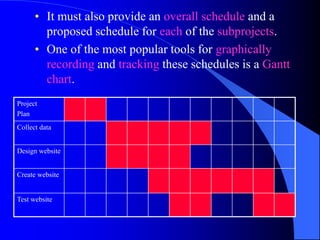
      • One of the most popular tools for graphically
        recording and tracking these schedules is a Gantt
        chart.
Project
Plan
Collect data


Design website


Create website


Test website
• It must also identify the people, information
  technology and data/information required
  by the system.
• To minimise problems, people working on
  the project should understand the need for
  project goals, deliverables and schedules.
• Project goals may be broad or specific and
  they relate to ways of testing if the project is
  successful.
• Deliverables are tangible items expected
  from a task. E.g. a report, diagram, manual
• Schedules set out the timing of major tasks
  and assigns personnel to each task.
• The success of a new system depends upon
  accurate time estimates.
• Communication skills incorporate a variety
  of strategies and techniques for dealing with
  other people.
• They facilitate information sharing and
  genuine understanding.
• They include:
     • active listening
     • conflict resolution
     • negotiation skills
     • interview techniques
     • team building
• Active listening involves restating,
  reflecting and summarising the speaker’s
  ideas.
• Conflict resolution solves arguments and
  disputes.
• It involves listening to all sides of a
  problem and looking for any viable
  solutions.
• Negotiation skills are used to reach a
  compromise between all parties.
• Interview techniques involve careful
  preparation, implementation and follow-up.
• Some general rules could include:
      • Make sure the purpose of the interview
        is understood.
      • Ask open-ended questions.
      • Restate the responses.
      • Review the main points.
      • Follow up on any unclear information.
• Team building is the process of getting a
  group of people working together
  effectively.
• A number of different roles are required for
  the project to succeed.
• Three important roles are:
   • systems analysts
   • programmers
   • project leaders

HSC IPT 1.1) Project mangement

  • 1.
  • 2.
    • Project managementis the process of planning, scheduling and controlling all of the activities within each stage of the system development cycle. • Good project management involves creating a project plan. • A project plan is a summary of a project that specifies who, what, how and when. • A project plan usually breaks down the project into major tasks called subprojects.
  • 3.
    • It mustalso provide an overall schedule and a proposed schedule for each of the subprojects. • One of the most popular tools for graphically recording and tracking these schedules is a Gantt chart. Project Plan Collect data Design website Create website Test website
  • 4.
    • It mustalso identify the people, information technology and data/information required by the system. • To minimise problems, people working on the project should understand the need for project goals, deliverables and schedules. • Project goals may be broad or specific and they relate to ways of testing if the project is successful. • Deliverables are tangible items expected from a task. E.g. a report, diagram, manual
  • 5.
    • Schedules setout the timing of major tasks and assigns personnel to each task. • The success of a new system depends upon accurate time estimates. • Communication skills incorporate a variety of strategies and techniques for dealing with other people. • They facilitate information sharing and genuine understanding.
  • 6.
    • They include: • active listening • conflict resolution • negotiation skills • interview techniques • team building
  • 7.
    • Active listeninginvolves restating, reflecting and summarising the speaker’s ideas. • Conflict resolution solves arguments and disputes. • It involves listening to all sides of a problem and looking for any viable solutions. • Negotiation skills are used to reach a compromise between all parties.
  • 8.
    • Interview techniquesinvolve careful preparation, implementation and follow-up. • Some general rules could include: • Make sure the purpose of the interview is understood. • Ask open-ended questions. • Restate the responses. • Review the main points. • Follow up on any unclear information.
  • 9.
    • Team buildingis the process of getting a group of people working together effectively. • A number of different roles are required for the project to succeed. • Three important roles are: • systems analysts • programmers • project leaders