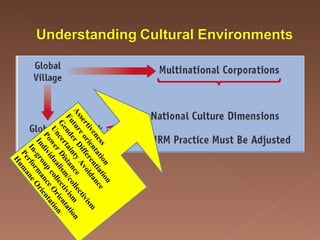
Assertiveness Future orientation Gender Differentiation Uncertainty Avoidance Power Distance Individualism/collectivism In-group collectivism Performance Orientation Humane Orientation
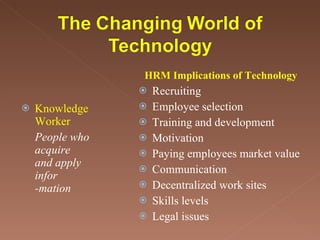
Knowledge Worker People who acquire and apply infor -mation Recruiting Employee selection Training and development Motivation Paying employees market value Communication Decentralized work sites Skills levels Legal issues HRM Implications of Technology
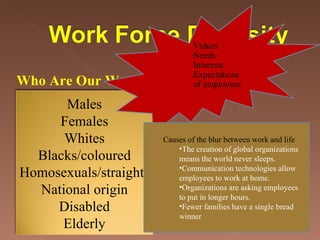
Who Are Our Workers Work/ Life Balance Values Needs Interests Expectations of employees Causes of the blur between work and life The creation of global organizations means the world never sleeps. Communication technologies allow employees to work at home. Organizations are asking employees to put in longer hours. Fewer families have a single bread winner Males Females Whites Blacks/coloured Homosexuals/straights National origin Disabled Elderly
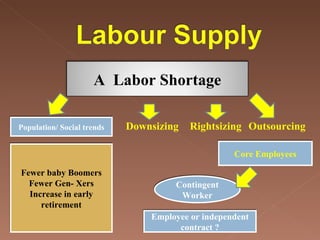
Downsizing Rightsizing Outsourcing Fewer baby Boomers Fewer Gen- Xers Increase in early retirement Population/ Social trends Core Employees Contingent Worker Employee or independent contract ? A  Labor Shortage
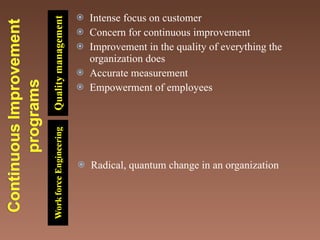
Intense focus on customer Concern for continuous improvement Improvement in the quality of everything the organization does Accurate measurement Empowerment of employees Radical, quantum change in an organization
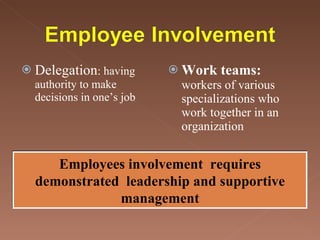
Delegation : having authority to make decisions in one’s job Work teams:  workers of various specializations who work together in an organization Employees involvement  requires demonstrated  leadership and supportive management
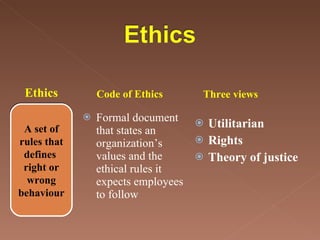
Formal document  that states an organization’s values and the ethical rules it expects employees to follow Utilitarian Rights Theory of justice A set of rules that defines  right or wrong behaviour Ethics Code of Ethics Three views
 
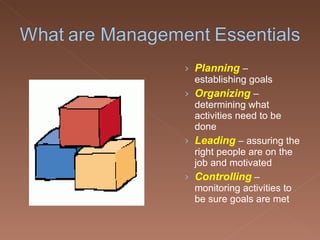
Planning   – establishing goals Organizing   – determining what activities need to be done Leading  – assuring the right people are on the job and motivated Controlling  – monitoring activities to be sure goals are met
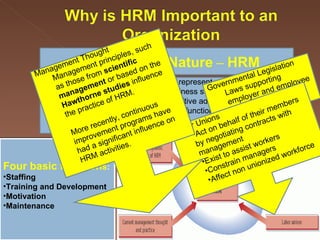
The Strategic Nature  –  HRM a strategic business partner and represent employees.   forward-thinking, support the business strategy, and assist the organization in maintaining competitive advantage.   concerned with the total cost of its function and for determining value added to the organization.   Four basic function s : Staffing Training and Development Motivation Maintenance Governmental Legislation Laws supporting employer and employee actions Labor Unions  Act on behalf of their members by negotiating contracts with management Exist to assist workers  Constrain managers Affect non unionized workforce Management Thought Management principles, such as those from  scientific management  or based on the  Hawthorne studies  influence the practice of HRM.  More recently, continuous improvement programs have had a significant influence on  HRM activities.
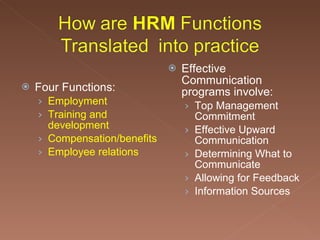
Four Functions: Employment Training and development Compensation/benefits Employee relations Effective Communication programs involve: Top Management Commitment Effective Upward Communication Determining What to Communicate Allowing for Feedback Information Sources
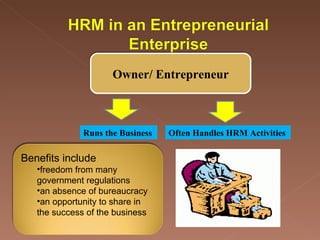
Owner/ Entrepreneur Runs the Business Often Handles HRM Activities Benefits include freedom from many government regulations an absence of bureaucracy an opportunity to share in the success of the business
 
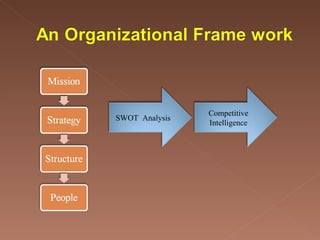
SWOT  Analysis Competitive Intelligence
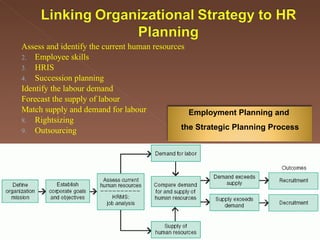
Assess and identify the current human resources Employee skills HRIS Succession planning Identify the labour demand Forecast the supply of labour Match supply and demand for labour Rightsizing Outsourcing Employment Planning and  the Strategic Planning Process
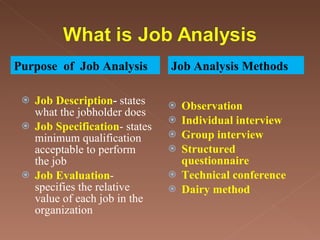
Job Description -  states what the jobholder does Job Specification - states minimum qualification acceptable to perform  the job Job Evaluation - specifies the relative value of each job in the organization Observation Individual interview  Group interview  Structured questionnaire Technical conference  Dairy method Purpose  of  Job Analysis Job Analysis Methods
 
Barriers to recruiting Success Image of the organization Attractiveness of job Internal /organizational policies Government influence Recruiting cost Find a large, diverse job- candidate pool Help unqualified candidates  self – select out of candidacy
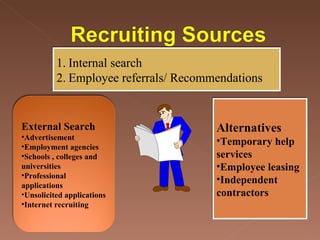
Internal search Employee referrals/ Recommendations Alternatives Temporary help services Employee leasing Independent contractors External Search Advertisement Employment agencies Schools , colleges and universities Professional applications Unsolicited applications Internet recruiting


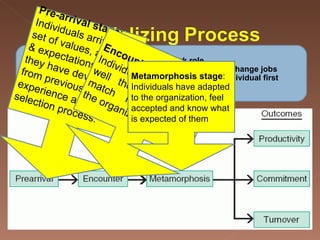
A process of adaptation to a new work role.   Adjustments must be made whenever individuals change jobs The most profound adjustment occurs when an individual first enters an organization Pre-arrival stage :  Individuals arrive with set of values, attitudes & expectations which they have developed from previous experience and the selection process.   Encounter stage :  Individuals discover how well their expectations match realities within the organization Metamorphosis stage :  Individuals have adapted to the organization, feel accepted and know what is expected of them
 
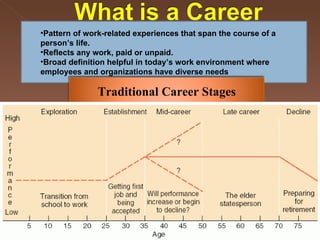
Pattern of work-related experiences that span the course of a person’s life.  Reflects any work, paid or unpaid.   Broad definition helpful in today’s work environment where employees and organizations have diverse needs Traditional Career Stages
 
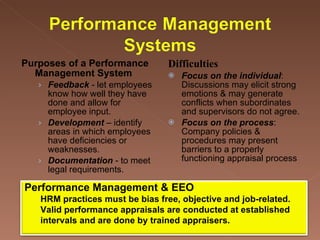
Purposes of a Performance Management System  Feedback  - let employees know how well they have done and allow for employee input.  Development  – identify areas in which employees have deficiencies or weaknesses.  Documentation  - to meet legal requirements.  Difficulties Focus on the individual :  Discussions may elicit strong emotions & may generate conflicts when subordinates and supervisors do not agree.  Focus on the process :  Company policies & procedures may present barriers to a properly functioning appraisal process Performance Management & EEO HRM practices must be bias free, objective and job-related.  Valid performance appraisals are conducted at established intervals and are done by trained appraisers.


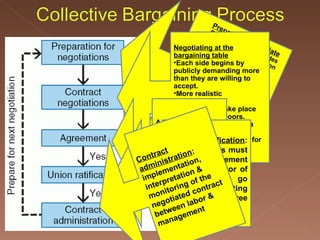
Preparing tonegotiate   Fact-gathering:   Includes internal information (employee performance records, overtime) & external (data on what similar org’n’s are doing & the economy).   Goal-setting:   Management decides what it can expect from the negotiation.   Strategy development:   This includes assessing the other side’s power & tactics Negotiating at the bargaining table Each side begins by publicly demanding more than they are willing to accept.   More realistic assessments & compromises take place behind closed doors.   After oral agreement, a written contract is submitted to the union for ratification Agreement : if parties agree, union takes contract to union members Union Ratification : union members must ‘ratify’ the agreement by voting in favor of it; if not, must go back to negotiating until members agree to contract Contract administration : implementation, interpretation & monitoring of the negotiated contract between labor & management
[email_address] miss u lot my AddictioN

HRM review book

  • 1.
  • 2.
  • 3.
    Assertiveness Future orientationGender Differentiation Uncertainty Avoidance Power Distance Individualism/collectivism In-group collectivism Performance Orientation Humane Orientation
  • 4.
    Knowledge Worker Peoplewho acquire and apply infor -mation Recruiting Employee selection Training and development Motivation Paying employees market value Communication Decentralized work sites Skills levels Legal issues HRM Implications of Technology
  • 5.
    Who Are OurWorkers Work/ Life Balance Values Needs Interests Expectations of employees Causes of the blur between work and life The creation of global organizations means the world never sleeps. Communication technologies allow employees to work at home. Organizations are asking employees to put in longer hours. Fewer families have a single bread winner Males Females Whites Blacks/coloured Homosexuals/straights National origin Disabled Elderly
  • 6.
    Downsizing Rightsizing OutsourcingFewer baby Boomers Fewer Gen- Xers Increase in early retirement Population/ Social trends Core Employees Contingent Worker Employee or independent contract ? A Labor Shortage
  • 7.
    Intense focus oncustomer Concern for continuous improvement Improvement in the quality of everything the organization does Accurate measurement Empowerment of employees Radical, quantum change in an organization
  • 8.
    Delegation : havingauthority to make decisions in one’s job Work teams: workers of various specializations who work together in an organization Employees involvement requires demonstrated leadership and supportive management
  • 9.
    Formal document that states an organization’s values and the ethical rules it expects employees to follow Utilitarian Rights Theory of justice A set of rules that defines right or wrong behaviour Ethics Code of Ethics Three views
  • 10.
  • 11.
    Planning – establishing goals Organizing – determining what activities need to be done Leading – assuring the right people are on the job and motivated Controlling – monitoring activities to be sure goals are met
  • 12.
    The Strategic Nature – HRM a strategic business partner and represent employees. forward-thinking, support the business strategy, and assist the organization in maintaining competitive advantage. concerned with the total cost of its function and for determining value added to the organization. Four basic function s : Staffing Training and Development Motivation Maintenance Governmental Legislation Laws supporting employer and employee actions Labor Unions Act on behalf of their members by negotiating contracts with management Exist to assist workers Constrain managers Affect non unionized workforce Management Thought Management principles, such as those from scientific management or based on the Hawthorne studies influence the practice of HRM. More recently, continuous improvement programs have had a significant influence on HRM activities.
  • 13.
    Four Functions: EmploymentTraining and development Compensation/benefits Employee relations Effective Communication programs involve: Top Management Commitment Effective Upward Communication Determining What to Communicate Allowing for Feedback Information Sources
  • 14.
    Owner/ Entrepreneur Runsthe Business Often Handles HRM Activities Benefits include freedom from many government regulations an absence of bureaucracy an opportunity to share in the success of the business
  • 15.
  • 16.
    SWOT AnalysisCompetitive Intelligence
  • 17.
    Assess and identifythe current human resources Employee skills HRIS Succession planning Identify the labour demand Forecast the supply of labour Match supply and demand for labour Rightsizing Outsourcing Employment Planning and the Strategic Planning Process
  • 18.
    Job Description - states what the jobholder does Job Specification - states minimum qualification acceptable to perform the job Job Evaluation - specifies the relative value of each job in the organization Observation Individual interview Group interview Structured questionnaire Technical conference Dairy method Purpose of Job Analysis Job Analysis Methods
  • 19.
  • 20.
    Barriers to recruitingSuccess Image of the organization Attractiveness of job Internal /organizational policies Government influence Recruiting cost Find a large, diverse job- candidate pool Help unqualified candidates self – select out of candidacy
  • 21.
    Internal search Employeereferrals/ Recommendations Alternatives Temporary help services Employee leasing Independent contractors External Search Advertisement Employment agencies Schools , colleges and universities Professional applications Unsolicited applications Internet recruiting
  • 22.
  • 23.
  • 24.
  • 25.
    A process ofadaptation to a new work role. Adjustments must be made whenever individuals change jobs The most profound adjustment occurs when an individual first enters an organization Pre-arrival stage : Individuals arrive with set of values, attitudes & expectations which they have developed from previous experience and the selection process. Encounter stage : Individuals discover how well their expectations match realities within the organization Metamorphosis stage : Individuals have adapted to the organization, feel accepted and know what is expected of them
  • 26.
  • 27.
    Pattern of work-relatedexperiences that span the course of a person’s life. Reflects any work, paid or unpaid. Broad definition helpful in today’s work environment where employees and organizations have diverse needs Traditional Career Stages
  • 28.
  • 29.
    Purposes of aPerformance Management System Feedback - let employees know how well they have done and allow for employee input. Development – identify areas in which employees have deficiencies or weaknesses. Documentation - to meet legal requirements. Difficulties Focus on the individual : Discussions may elicit strong emotions & may generate conflicts when subordinates and supervisors do not agree. Focus on the process : Company policies & procedures may present barriers to a properly functioning appraisal process Performance Management & EEO HRM practices must be bias free, objective and job-related. Valid performance appraisals are conducted at established intervals and are done by trained appraisers.
  • 30.
  • 31.
  • 32.
  • 33.
  • 34.
    Preparing tonegotiate Fact-gathering: Includes internal information (employee performance records, overtime) & external (data on what similar org’n’s are doing & the economy). Goal-setting: Management decides what it can expect from the negotiation. Strategy development: This includes assessing the other side’s power & tactics Negotiating at the bargaining table Each side begins by publicly demanding more than they are willing to accept. More realistic assessments & compromises take place behind closed doors. After oral agreement, a written contract is submitted to the union for ratification Agreement : if parties agree, union takes contract to union members Union Ratification : union members must ‘ratify’ the agreement by voting in favor of it; if not, must go back to negotiating until members agree to contract Contract administration : implementation, interpretation & monitoring of the negotiated contract between labor & management
  • 35.
    [email_address] miss ulot my AddictioN