




Presentation
On
Stuffing over HSBC Bank
STUFFING
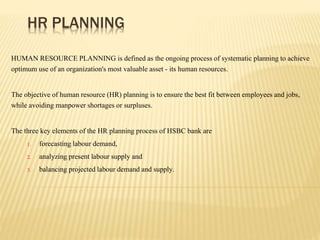
HR PLANNING
HUMAN RESOURCE PLANNING is defined as the ongoing process of systematic planning to achieve
optimum use of an organization's most valuable asset - its human resources.
The objective of human resource (HR) planning is to ensure the best fit between employees and jobs,
while avoiding manpower shortages or surpluses.
The three key elements of the HR planning process of HSBC bank are
1. forecasting labour demand,
2. analyzing present labour supply and
3. balancing projected labour demand and supply.
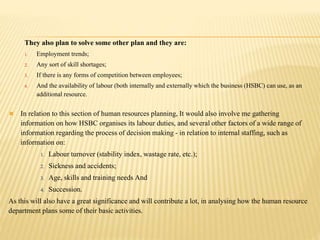
They also plan to solve some other plan and they are:
1. Employment trends;
2. Any sort of skill shortages;
3. If there is any forms of competition between employees;
4. And the availability of labour (both internally and externally which the business (HSBC) can use, as an
additional resource.
 In relation to this section of human resources planning, It would also involve me gathering
information on how HSBC organises its labour duties, and several other factors of a wide range of
information regarding the process of decision making - in relation to internal staffing, such as
information on:
1. Labour turnover (stability index, wastage rate, etc.);
2. Sickness and accidents;
3. Age, skills and training needs And
4. Succession.
As this will also have a great significance and will contribute a lot, in analysing how the human resource
department plans some of their basic activities.
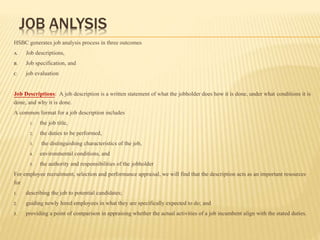
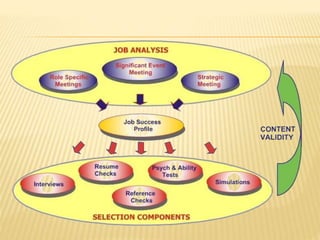
JOB ANLYSIS
HSBC generates job analysis process in three outcomes
A. Job descriptions,
B. Job specification, and
C. job evaluation
Job Descriptions: A job description is a written statement of what the jobholder does how it is done, under what conditions it is
done, and why it is done.
A common format for a job description includes
1. the job title,
2. the duties to be performed,
3. the distinguishing characteristics of the job,
4. environmental conditions, and
5. the authority and responsibilities of the jobholder
For employee recruitment, selection and performance appraisal, we will find that the description acts as an important resources
for
1. describing the job to potential candidates;
2. guiding newly hired employees in what they are specifically expected to do; and
3. providing a point of comparison in appraising whether the actual activities of a job incumbent align with the stated duties.
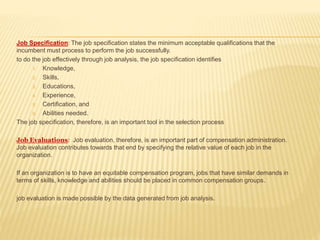
Job Specification: The job specification states the minimum acceptable qualifications that the
incumbent must process to perform the job successfully.
to do the job effectively through job analysis, the job specification identifies
1. Knowledge,
2. Skills,
3. Educations,
4. Experience,
5. Certification, and
6. Abilities needed.
The job specification, therefore, is an important tool in the selection process
Job Evaluations: Job evaluation, therefore, is an important part of compensation administration.
Job evaluation contributes towards that end by specifying the relative value of each job in the
organization.
If an organization is to have an equitable compensation program, jobs that have similar demands in
terms of skills, knowledge and abilities should be placed in common compensation groups.
job evaluation is made possible by the data generated from job analysis.
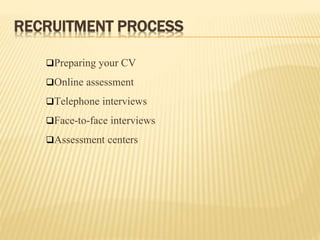
RECRUITMENT PROCESS
Preparing your CV
Online assessment
Telephone interviews
Face-to-face interviews
Assessment centers
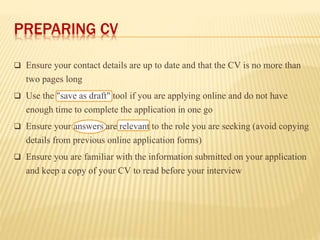
PREPARING CV
 Ensure your contact details are up to date and that the CV is no more than
two pages long
 Use the "save as draft" tool if you are applying online and do not have
enough time to complete the application in one go
 Ensure your answers are relevant to the role you are seeking (avoid copying
details from previous online application forms)
 Ensure you are familiar with the information submitted on your application
and keep a copy of your CV to read before your interview
TELEPHONE INTERVIEWS
 If using your mobile phone, ensure it has enough battery life remaining
 For each example, explain:
1. the situation you faced;
2. the specific task required of you;
3. the action that you took; and
4. the result of this action
 Give direct and honest answers
 Listen carefully and speak clearly, politely and confidently. Remember
that you will not be able to make eye contact or use body language
 Pause for a moment if you need time to think through your answers
FACE-TO-FACE INTERVIEWS
 Take a moment to think before answering each question
 If you don't understand a question, ask the interviewer to repeat it
 Ask when you can expect feedback
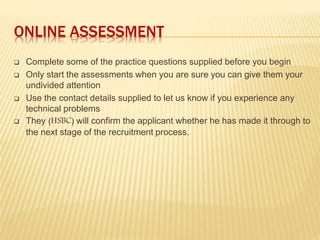
ONLINE ASSESSMENT
 Complete some of the practice questions supplied before you begin
 Only start the assessments when you are sure you can give them your
undivided attention
 Use the contact details supplied to let us know if you experience any
technical problems
 They (HSBC) will confirm the applicant whether he has made it through to
the next stage of the recruitment process.
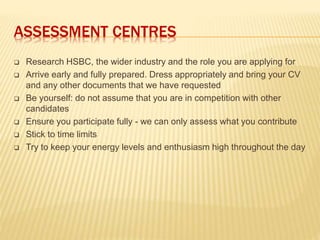
ASSESSMENT CENTRES
 Research HSBC, the wider industry and the role you are applying for
 Arrive early and fully prepared. Dress appropriately and bring your CV
and any other documents that we have requested
 Be yourself: do not assume that you are in competition with other
candidates
 Ensure you participate fully - we can only assess what you contribute
 Stick to time limits
 Try to keep your energy levels and enthusiasm high throughout the day
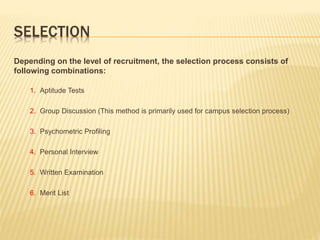
SELECTION
Depending on the level of recruitment, the selection process consists of
following combinations:
1. Aptitude Tests
2. Group Discussion (This method is primarily used for campus selection process)
3. Psychometric Profiling
4. Personal Interview
5. Written Examination
6. Merit List
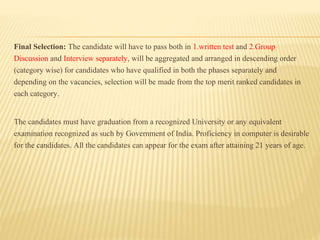
Final Selection: The candidate will have to pass both in 1.written test and 2.Group
Discussion and Interview separately, will be aggregated and arranged in descending order
(category wise) for candidates who have qualified in both the phases separately and
depending on the vacancies, selection will be made from the top merit ranked candidates in
each category.
The candidates must have graduation from a recognized University or any equivalent
examination recognized as such by Government of India. Proficiency in computer is desirable
for the candidates. All the candidates can appear for the exam after attaining 21 years of age.

HRM Presentation On Stuffing over HSBC Bank

  • 1.
  • 2.
  • 3.
    HR PLANNING HUMAN RESOURCEPLANNING is defined as the ongoing process of systematic planning to achieve optimum use of an organization's most valuable asset - its human resources. The objective of human resource (HR) planning is to ensure the best fit between employees and jobs, while avoiding manpower shortages or surpluses. The three key elements of the HR planning process of HSBC bank are 1. forecasting labour demand, 2. analyzing present labour supply and 3. balancing projected labour demand and supply.
  • 4.
    They also planto solve some other plan and they are: 1. Employment trends; 2. Any sort of skill shortages; 3. If there is any forms of competition between employees; 4. And the availability of labour (both internally and externally which the business (HSBC) can use, as an additional resource.  In relation to this section of human resources planning, It would also involve me gathering information on how HSBC organises its labour duties, and several other factors of a wide range of information regarding the process of decision making - in relation to internal staffing, such as information on: 1. Labour turnover (stability index, wastage rate, etc.); 2. Sickness and accidents; 3. Age, skills and training needs And 4. Succession. As this will also have a great significance and will contribute a lot, in analysing how the human resource department plans some of their basic activities.
  • 5.
    JOB ANLYSIS HSBC generatesjob analysis process in three outcomes A. Job descriptions, B. Job specification, and C. job evaluation Job Descriptions: A job description is a written statement of what the jobholder does how it is done, under what conditions it is done, and why it is done. A common format for a job description includes 1. the job title, 2. the duties to be performed, 3. the distinguishing characteristics of the job, 4. environmental conditions, and 5. the authority and responsibilities of the jobholder For employee recruitment, selection and performance appraisal, we will find that the description acts as an important resources for 1. describing the job to potential candidates; 2. guiding newly hired employees in what they are specifically expected to do; and 3. providing a point of comparison in appraising whether the actual activities of a job incumbent align with the stated duties.
  • 6.
    Job Specification: Thejob specification states the minimum acceptable qualifications that the incumbent must process to perform the job successfully. to do the job effectively through job analysis, the job specification identifies 1. Knowledge, 2. Skills, 3. Educations, 4. Experience, 5. Certification, and 6. Abilities needed. The job specification, therefore, is an important tool in the selection process Job Evaluations: Job evaluation, therefore, is an important part of compensation administration. Job evaluation contributes towards that end by specifying the relative value of each job in the organization. If an organization is to have an equitable compensation program, jobs that have similar demands in terms of skills, knowledge and abilities should be placed in common compensation groups. job evaluation is made possible by the data generated from job analysis.
  • 8.
    RECRUITMENT PROCESS Preparing yourCV Online assessment Telephone interviews Face-to-face interviews Assessment centers
  • 9.
    PREPARING CV  Ensureyour contact details are up to date and that the CV is no more than two pages long  Use the "save as draft" tool if you are applying online and do not have enough time to complete the application in one go  Ensure your answers are relevant to the role you are seeking (avoid copying details from previous online application forms)  Ensure you are familiar with the information submitted on your application and keep a copy of your CV to read before your interview
  • 10.
    TELEPHONE INTERVIEWS  Ifusing your mobile phone, ensure it has enough battery life remaining  For each example, explain: 1. the situation you faced; 2. the specific task required of you; 3. the action that you took; and 4. the result of this action  Give direct and honest answers  Listen carefully and speak clearly, politely and confidently. Remember that you will not be able to make eye contact or use body language  Pause for a moment if you need time to think through your answers
  • 11.
    FACE-TO-FACE INTERVIEWS  Takea moment to think before answering each question  If you don't understand a question, ask the interviewer to repeat it  Ask when you can expect feedback
  • 12.
    ONLINE ASSESSMENT  Completesome of the practice questions supplied before you begin  Only start the assessments when you are sure you can give them your undivided attention  Use the contact details supplied to let us know if you experience any technical problems  They (HSBC) will confirm the applicant whether he has made it through to the next stage of the recruitment process.
  • 13.
    ASSESSMENT CENTRES  ResearchHSBC, the wider industry and the role you are applying for  Arrive early and fully prepared. Dress appropriately and bring your CV and any other documents that we have requested  Be yourself: do not assume that you are in competition with other candidates  Ensure you participate fully - we can only assess what you contribute  Stick to time limits  Try to keep your energy levels and enthusiasm high throughout the day
  • 14.
    SELECTION Depending on thelevel of recruitment, the selection process consists of following combinations: 1. Aptitude Tests 2. Group Discussion (This method is primarily used for campus selection process) 3. Psychometric Profiling 4. Personal Interview 5. Written Examination 6. Merit List
  • 15.
    Final Selection: Thecandidate will have to pass both in 1.written test and 2.Group Discussion and Interview separately, will be aggregated and arranged in descending order (category wise) for candidates who have qualified in both the phases separately and depending on the vacancies, selection will be made from the top merit ranked candidates in each category. The candidates must have graduation from a recognized University or any equivalent examination recognized as such by Government of India. Proficiency in computer is desirable for the candidates. All the candidates can appear for the exam after attaining 21 years of age.