5/22/2013 Bipin Prasad 1
UNIT 2
HUMAN RESOURCE
PLANNING
5/22/2013 Bipin Prasad 2
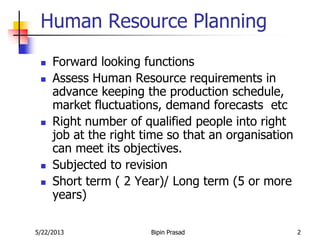
Human Resource Planning
 Forward looking functions
 Assess Human Resource requirements in
advance keeping the production schedule,
market fluctuations, demand forecasts etc
 Right number of qualified people into right
job at the right time so that an organisation
can meet its objectives.
 Subjected to revision
 Short term ( 2 Year)/ Long term (5 or more
years)
5/22/2013 Bipin Prasad 3
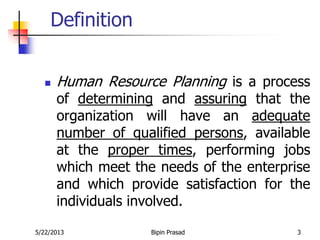
Definition
 Human Resource Planning is a process
of determining and assuring that the
organization will have an adequate
number of qualified persons, available
at the proper times, performing jobs
which meet the needs of the enterprise
and which provide satisfaction for the
individuals involved.
5/22/2013 Bipin Prasad 4
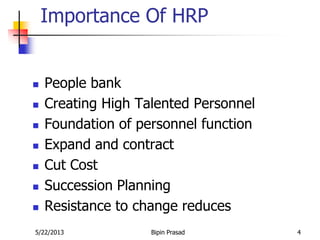
Importance Of HRP
 People bank
 Creating High Talented Personnel
 Foundation of personnel function
 Expand and contract
 Cut Cost
 Succession Planning
 Resistance to change reduces
5/22/2013 Bipin Prasad 5
Factors affecting HRP
 Type and strategy of organisation.
 Organisational growth cycle and
planning
 Environmental uncertainties
 Type and quality of Information
 Nature of jobs being field
 Outsourcing.
5/22/2013 Bipin Prasad 6
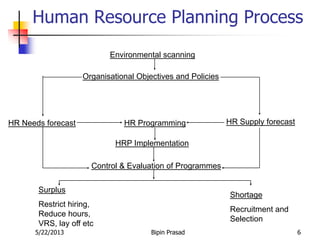
Human Resource Planning Process
Environmental scanning
Organisational Objectives and Policies
HR Needs forecast HR Supply forecastHR Programming
HRP Implementation
Control & Evaluation of Programmes
Surplus
Restrict hiring,
Reduce hours,
VRS, lay off etc
Shortage
Recruitment and
Selection
5/22/2013 Bipin Prasad 7
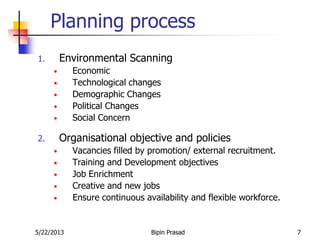
Planning process
1. Environmental Scanning
• Economic
• Technological changes
• Demographic Changes
• Political Changes
• Social Concern
2. Organisational objective and policies
• Vacancies filled by promotion/ external recruitment.
• Training and Development objectives
• Job Enrichment
• Creative and new jobs
• Ensure continuous availability and flexible workforce.
5/22/2013 Bipin Prasad 8
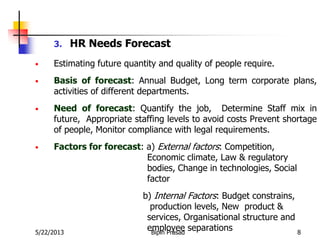
• Estimating future quantity and quality of people require.
• Basis of forecast: Annual Budget, Long term corporate plans,
activities of different departments.
• Need of forecast: Quantify the job, Determine Staff mix in
future, Appropriate staffing levels to avoid costs Prevent shortage
of people, Monitor compliance with legal requirements.
• Factors for forecast: a) External factors: Competition,
Economic climate, Law & regulatory
bodies, Change in technologies, Social
factor
b) Internal Factors: Budget constrains,
production levels, New product &
services, Organisational structure and
employee separations
3. HR Needs Forecast
5/22/2013 Bipin Prasad 9
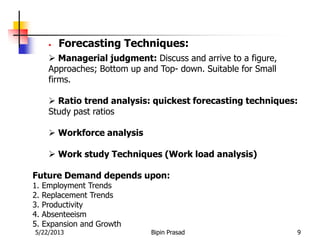
• Forecasting Techniques:
 Managerial judgment: Discuss and arrive to a figure,
Approaches; Bottom up and Top- down. Suitable for Small
firms.
 Ratio trend analysis: quickest forecasting techniques:
Study past ratios
 Workforce analysis
 Work study Techniques (Work load analysis)
Future Demand depends upon:
1. Employment Trends
2. Replacement Trends
3. Productivity
4. Absenteeism
5. Expansion and Growth
5/22/2013 Bipin Prasad 10
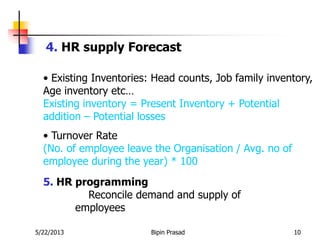
4. HR supply Forecast
• Existing Inventories: Head counts, Job family inventory,
Age inventory etc…
Existing inventory = Present Inventory + Potential
addition – Potential losses
• Turnover Rate
(No. of employee leave the Organisation / Avg. no of
employee during the year) * 100
5. HR programming
Reconcile demand and supply of
employees
5/22/2013 Bipin Prasad 11
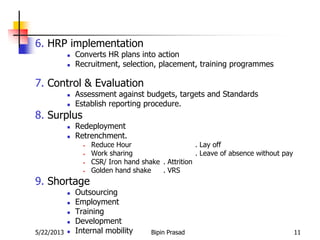
6. HRP implementation
 Converts HR plans into action
 Recruitment, selection, placement, training programmes
7. Control & Evaluation
 Assessment against budgets, targets and Standards
 Establish reporting procedure.
8. Surplus
 Redeployment
 Retrenchment.
• Reduce Hour . Lay off
• Work sharing . Leave of absence without pay
• CSR/ Iron hand shake . Attrition
• Golden hand shake . VRS
9. Shortage
 Outsourcing
 Employment
 Training
 Development
 Internal mobility
5/22/2013 Bipin Prasad 12
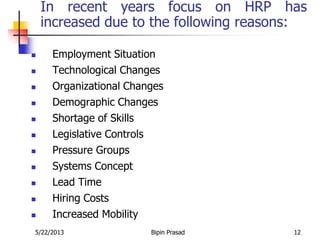
In recent years focus on HRP has
increased due to the following reasons:
 Employment Situation
 Technological Changes
 Organizational Changes
 Demographic Changes
 Shortage of Skills
 Legislative Controls
 Pressure Groups
 Systems Concept
 Lead Time
 Hiring Costs
 Increased Mobility
5/22/2013 Bipin Prasad 13
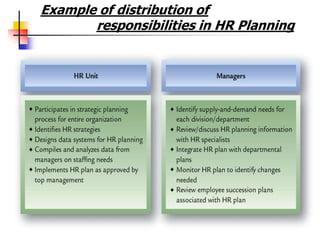
Example of distribution of
responsibilities in HR Planning
5/22/2013 Bipin Prasad 14
5/22/2013 Bipin Prasad 15
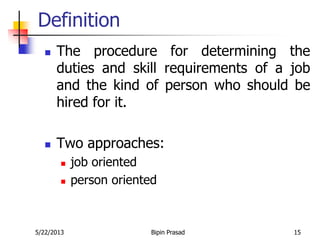
Definition
 The procedure for determining the
duties and skill requirements of a job
and the kind of person who should be
hired for it.
 Two approaches:
 job oriented
 person oriented
5/22/2013 Bipin Prasad 16
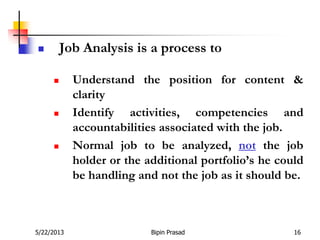
 Job Analysis is a process to
 Understand the position for content &
clarity
 Identify activities, competencies and
accountabilities associated with the job.
 Normal job to be analyzed, not the job
holder or the additional portfolio’s he could
be handling and not the job as it should be.
5/22/2013 Bipin Prasad 17
JOB ANALYSIS
 When an individual moves on, he takes
along with him, his:
 managerial style
 problem solving ability and
 performance.
 What he leaves behind is his:
 functions,
 scope of work and
 accountabilities
 In other words, HIS JOB REMAINS.
5/22/2013 Bipin Prasad 18
JOB ANALYSIS IS ….
NOT
 A personal analysis
 A performance appraisal
5/22/2013 Bipin Prasad 19
Uses Of Job Analysis
 Human resource planning
 Recruitment and Selection
 Placement
 Training and development
 Job evaluation
 Performance appraisal
 Employee counseling
 Job design
 Organizational design
5/22/2013 Bipin Prasad 20
The Output of Job Analysis
 Job description
 A list of a job’s duties, responsibilities,
reporting relationships, working conditions,
and supervisory responsibilities
 Job specifications
 A list of a job’s “human requirements,” that is,
the requisite education, skills, personality, and
so on.
5/22/2013 Bipin Prasad 21
 Job Description: A job description is an
organized factual statement of job contents in
the form of duties and responsibilities of a
specific job.
 The preparation of job description is
necessary before a vacancy is advertised.
 It tells in brief the nature and type of job.
 Job description document discloses what is to
be done, how it is to be done and why it is to
be done.
5/22/2013 Bipin Prasad 22
1.Job title
2.Job location
3.Job summary
4.Duties to be performed
5.Machines, tools, materials
6.Relation to other jobs
7.Nature of supervision
8.Working environment
Contents of Job Description:
5/22/2013 Bipin Prasad 23
 A job specification is a document which
states the minimum acceptable human
qualities necessary to perform a job
properly.
 It sets forth requirements sought in the
person who is to be selected to perform a
particular job.
 The job specification should define the
minimum acceptable standards for
employment and performance on the job.
Job Specification:
5/22/2013 Bipin Prasad 24
Contents of Job Specification:
 What human traits and experience are
required to do the job well?
 Qualifications
 Prior experience
 Special training
 Personality factors
 Physical characteristics
 Other attributes/qualities
5/22/2013 Bipin Prasad 25
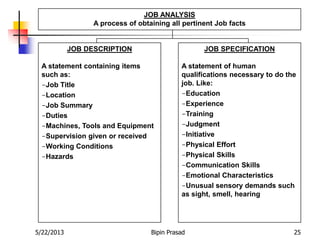
JOB ANALYSIS
A process of obtaining all pertinent Job facts
JOB DESCRIPTION
A statement containing items
such as:
-Job Title
-Location
-Job Summary
-Duties
-Machines, Tools and Equipment
-Supervision given or received
-Working Conditions
-Hazards
JOB SPECIFICATION
A statement of human
qualifications necessary to do the
job. Like:
-Education
-Experience
-Training
-Judgment
-Initiative
-Physical Effort
-Physical Skills
-Communication Skills
-Emotional Characteristics
-Unusual sensory demands such
as sight, smell, hearing
5/22/2013 Bipin Prasad 26
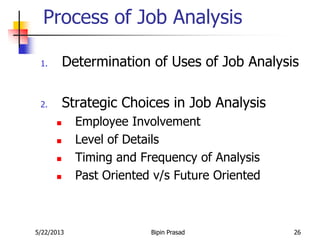
Process of Job Analysis
1. Determination of Uses of Job Analysis
2. Strategic Choices in Job Analysis
 Employee Involvement
 Level of Details
 Timing and Frequency of Analysis
 Past Oriented v/s Future Oriented
5/22/2013 Bipin Prasad 27
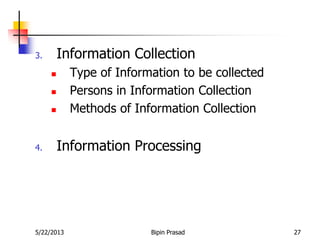
3. Information Collection
 Type of Information to be collected
 Persons in Information Collection
 Methods of Information Collection
4. Information Processing
5/22/2013 Bipin Prasad 28
5/22/2013 Bipin Prasad 29
JOB Design
 The term job design refers to the way the
tasks are combined to form a complete job.
 Job design is a process which integrates
work content (tasks, functions,
relationships),the reward and the
qualifications required for each job in a way
that meet the needs of employees and the
organization.
5/22/2013 Bipin Prasad 30
Purpose Of Job Design
 To meet the organizational requirements such
as higher productivity, operational efficiency,
quality of product/service etc.
 To satisfy the needs of the individual
employees like interest, challenge,
achievement or accomplishment etc.
 To integrate the needs of the individual with
the organizational requirements.
5/22/2013 Bipin Prasad 31
Techniques Of Job Design
 Work simplification:
In work simplification the complete job
is broken down into small sub-parts,
usually consisting of few operations.
This is done so that employees can do
these jobs without much specialized
training.
5/22/2013 Bipin Prasad 32
 Job Rotation:
Job rotation refers to the practice of
shifting people from one job to
another within a working group so
that there is some variety and relief
from the boredom of routine.
5/22/2013 Bipin Prasad 33
 Job Enlargement:
It means assignment of varied tasks or
duties of the jobs of employees all on
the same level.
The additional tasks or duties do not
require new skills but can be
performed with similar skills and efforts
as before.
5/22/2013 Bipin Prasad 34
Job Enrichment:
It implies increasing the contents of a
job or the deliberate upgrading of
responsibility, scope and challenge in
work.
It is motivational technique which
emphasizes the need for challenging
and interesting work.
It leads to a vertically enhanced job by
adding functions from other
organizational levels.

Human resource planning

  • 1.
    5/22/2013 Bipin Prasad1 UNIT 2 HUMAN RESOURCE PLANNING
  • 2.
    5/22/2013 Bipin Prasad2 Human Resource Planning  Forward looking functions  Assess Human Resource requirements in advance keeping the production schedule, market fluctuations, demand forecasts etc  Right number of qualified people into right job at the right time so that an organisation can meet its objectives.  Subjected to revision  Short term ( 2 Year)/ Long term (5 or more years)
  • 3.
    5/22/2013 Bipin Prasad3 Definition  Human Resource Planning is a process of determining and assuring that the organization will have an adequate number of qualified persons, available at the proper times, performing jobs which meet the needs of the enterprise and which provide satisfaction for the individuals involved.
  • 4.
    5/22/2013 Bipin Prasad4 Importance Of HRP  People bank  Creating High Talented Personnel  Foundation of personnel function  Expand and contract  Cut Cost  Succession Planning  Resistance to change reduces
  • 5.
    5/22/2013 Bipin Prasad5 Factors affecting HRP  Type and strategy of organisation.  Organisational growth cycle and planning  Environmental uncertainties  Type and quality of Information  Nature of jobs being field  Outsourcing.
  • 6.
    5/22/2013 Bipin Prasad6 Human Resource Planning Process Environmental scanning Organisational Objectives and Policies HR Needs forecast HR Supply forecastHR Programming HRP Implementation Control & Evaluation of Programmes Surplus Restrict hiring, Reduce hours, VRS, lay off etc Shortage Recruitment and Selection
  • 7.
    5/22/2013 Bipin Prasad7 Planning process 1. Environmental Scanning • Economic • Technological changes • Demographic Changes • Political Changes • Social Concern 2. Organisational objective and policies • Vacancies filled by promotion/ external recruitment. • Training and Development objectives • Job Enrichment • Creative and new jobs • Ensure continuous availability and flexible workforce.
  • 8.
    5/22/2013 Bipin Prasad8 • Estimating future quantity and quality of people require. • Basis of forecast: Annual Budget, Long term corporate plans, activities of different departments. • Need of forecast: Quantify the job, Determine Staff mix in future, Appropriate staffing levels to avoid costs Prevent shortage of people, Monitor compliance with legal requirements. • Factors for forecast: a) External factors: Competition, Economic climate, Law & regulatory bodies, Change in technologies, Social factor b) Internal Factors: Budget constrains, production levels, New product & services, Organisational structure and employee separations 3. HR Needs Forecast
  • 9.
    5/22/2013 Bipin Prasad9 • Forecasting Techniques:  Managerial judgment: Discuss and arrive to a figure, Approaches; Bottom up and Top- down. Suitable for Small firms.  Ratio trend analysis: quickest forecasting techniques: Study past ratios  Workforce analysis  Work study Techniques (Work load analysis) Future Demand depends upon: 1. Employment Trends 2. Replacement Trends 3. Productivity 4. Absenteeism 5. Expansion and Growth
  • 10.
    5/22/2013 Bipin Prasad10 4. HR supply Forecast • Existing Inventories: Head counts, Job family inventory, Age inventory etc… Existing inventory = Present Inventory + Potential addition – Potential losses • Turnover Rate (No. of employee leave the Organisation / Avg. no of employee during the year) * 100 5. HR programming Reconcile demand and supply of employees
  • 11.
    5/22/2013 Bipin Prasad11 6. HRP implementation  Converts HR plans into action  Recruitment, selection, placement, training programmes 7. Control & Evaluation  Assessment against budgets, targets and Standards  Establish reporting procedure. 8. Surplus  Redeployment  Retrenchment. • Reduce Hour . Lay off • Work sharing . Leave of absence without pay • CSR/ Iron hand shake . Attrition • Golden hand shake . VRS 9. Shortage  Outsourcing  Employment  Training  Development  Internal mobility
  • 12.
    5/22/2013 Bipin Prasad12 In recent years focus on HRP has increased due to the following reasons:  Employment Situation  Technological Changes  Organizational Changes  Demographic Changes  Shortage of Skills  Legislative Controls  Pressure Groups  Systems Concept  Lead Time  Hiring Costs  Increased Mobility
  • 13.
    5/22/2013 Bipin Prasad13 Example of distribution of responsibilities in HR Planning
  • 14.
  • 15.
    5/22/2013 Bipin Prasad15 Definition  The procedure for determining the duties and skill requirements of a job and the kind of person who should be hired for it.  Two approaches:  job oriented  person oriented
  • 16.
    5/22/2013 Bipin Prasad16  Job Analysis is a process to  Understand the position for content & clarity  Identify activities, competencies and accountabilities associated with the job.  Normal job to be analyzed, not the job holder or the additional portfolio’s he could be handling and not the job as it should be.
  • 17.
    5/22/2013 Bipin Prasad17 JOB ANALYSIS  When an individual moves on, he takes along with him, his:  managerial style  problem solving ability and  performance.  What he leaves behind is his:  functions,  scope of work and  accountabilities  In other words, HIS JOB REMAINS.
  • 18.
    5/22/2013 Bipin Prasad18 JOB ANALYSIS IS …. NOT  A personal analysis  A performance appraisal
  • 19.
    5/22/2013 Bipin Prasad19 Uses Of Job Analysis  Human resource planning  Recruitment and Selection  Placement  Training and development  Job evaluation  Performance appraisal  Employee counseling  Job design  Organizational design
  • 20.
    5/22/2013 Bipin Prasad20 The Output of Job Analysis  Job description  A list of a job’s duties, responsibilities, reporting relationships, working conditions, and supervisory responsibilities  Job specifications  A list of a job’s “human requirements,” that is, the requisite education, skills, personality, and so on.
  • 21.
    5/22/2013 Bipin Prasad21  Job Description: A job description is an organized factual statement of job contents in the form of duties and responsibilities of a specific job.  The preparation of job description is necessary before a vacancy is advertised.  It tells in brief the nature and type of job.  Job description document discloses what is to be done, how it is to be done and why it is to be done.
  • 22.
    5/22/2013 Bipin Prasad22 1.Job title 2.Job location 3.Job summary 4.Duties to be performed 5.Machines, tools, materials 6.Relation to other jobs 7.Nature of supervision 8.Working environment Contents of Job Description:
  • 23.
    5/22/2013 Bipin Prasad23  A job specification is a document which states the minimum acceptable human qualities necessary to perform a job properly.  It sets forth requirements sought in the person who is to be selected to perform a particular job.  The job specification should define the minimum acceptable standards for employment and performance on the job. Job Specification:
  • 24.
    5/22/2013 Bipin Prasad24 Contents of Job Specification:  What human traits and experience are required to do the job well?  Qualifications  Prior experience  Special training  Personality factors  Physical characteristics  Other attributes/qualities
  • 25.
    5/22/2013 Bipin Prasad25 JOB ANALYSIS A process of obtaining all pertinent Job facts JOB DESCRIPTION A statement containing items such as: -Job Title -Location -Job Summary -Duties -Machines, Tools and Equipment -Supervision given or received -Working Conditions -Hazards JOB SPECIFICATION A statement of human qualifications necessary to do the job. Like: -Education -Experience -Training -Judgment -Initiative -Physical Effort -Physical Skills -Communication Skills -Emotional Characteristics -Unusual sensory demands such as sight, smell, hearing
  • 26.
    5/22/2013 Bipin Prasad26 Process of Job Analysis 1. Determination of Uses of Job Analysis 2. Strategic Choices in Job Analysis  Employee Involvement  Level of Details  Timing and Frequency of Analysis  Past Oriented v/s Future Oriented
  • 27.
    5/22/2013 Bipin Prasad27 3. Information Collection  Type of Information to be collected  Persons in Information Collection  Methods of Information Collection 4. Information Processing
  • 28.
  • 29.
    5/22/2013 Bipin Prasad29 JOB Design  The term job design refers to the way the tasks are combined to form a complete job.  Job design is a process which integrates work content (tasks, functions, relationships),the reward and the qualifications required for each job in a way that meet the needs of employees and the organization.
  • 30.
    5/22/2013 Bipin Prasad30 Purpose Of Job Design  To meet the organizational requirements such as higher productivity, operational efficiency, quality of product/service etc.  To satisfy the needs of the individual employees like interest, challenge, achievement or accomplishment etc.  To integrate the needs of the individual with the organizational requirements.
  • 31.
    5/22/2013 Bipin Prasad31 Techniques Of Job Design  Work simplification: In work simplification the complete job is broken down into small sub-parts, usually consisting of few operations. This is done so that employees can do these jobs without much specialized training.
  • 32.
    5/22/2013 Bipin Prasad32  Job Rotation: Job rotation refers to the practice of shifting people from one job to another within a working group so that there is some variety and relief from the boredom of routine.
  • 33.
    5/22/2013 Bipin Prasad33  Job Enlargement: It means assignment of varied tasks or duties of the jobs of employees all on the same level. The additional tasks or duties do not require new skills but can be performed with similar skills and efforts as before.
  • 34.
    5/22/2013 Bipin Prasad34 Job Enrichment: It implies increasing the contents of a job or the deliberate upgrading of responsibility, scope and challenge in work. It is motivational technique which emphasizes the need for challenging and interesting work. It leads to a vertically enhanced job by adding functions from other organizational levels.