PRESENATATION
ON
PERFORMANCE APPRAISAL
MASTER OF BUSINESS ADMINISTRATION
Submitted By:
Name: Ankit Raj
Program: MBA-(2)
Session: (2022-2024)
Submitted To:
Rumna Mam
TABLE OF CONTENTS
Performance Appraisal
Features of Performance Appraisal
Purpose of Performance Appraisal
Process of Performance Appraisal
Possible Errors
Performance Appraisal Methods
Performance Appraisal
 Performance Appraisal is a regular review of an
employee’s job performance and contribution to
a company.
 Company use performance appraisals to
determine which employees have contributed the
most to the company’s growth review progress
and reward high-achieving workers.
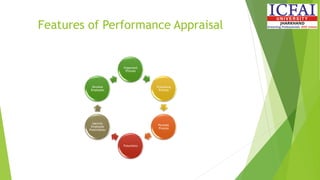
Features of Performance Appraisal
Organized
Process
Evaluating
Process
Periodic
Process
Futuristics
Identify
Employee
Potentiaties
Develop
Employee
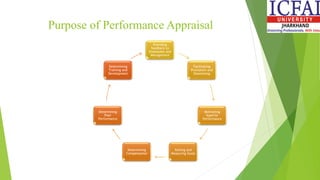
Purpose of Performance Appraisal
Providing
feedback to
Employees and
Management
Facilitating
Promotion and
Downsizing
Motivating
Superior
Performance
Setting and
Measuring Goals
Determining
Compensation
Determining
Poor
Performance
Determining
Training and
Development
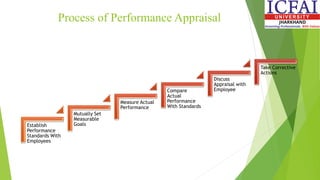
Process of Performance Appraisal
Establish
Performance
Standards With
Employees
Mutually Set
Measurable
Goals
Measure Actual
Performance
Compare
Actual
Performance
With Standards
Discuss
Appraisal with
Employee
Take Corrective
Actions
Possible Errors
 First impression error.
 Halo effect (Judging someone on the basis of one
characteristics).
 Strictness or Leniency.
 Sterotyping (Judging someone on basic of group
he or she belong).
 Similar to me.
Performance Appraisal Methods
Traditional Methods of
Performance Appraisal
 Rating Scales
 Confidential Report
 Paired Comparison Method
 Checklist Method
 Forced Choice Method
 Essay Method
 Performance Test and Observation
 Forced Distribution Method
 Field Review Method
Modern Methods of
Performance Appraisal
 Assessment Centers
 Human Resource Accounting
 Behaviorally Anchored Rating
Scale (BARS)
 Management by Objectives
 360 Degree Feedback
 Psychological Appraisals
 Human-Asset Accounting Method
Traditional Methods of Performance
Appraisal
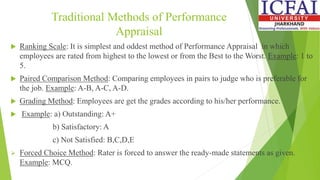
 Ranking Scale: It is simplest and oddest method of Performance Appraisal in which
employees are rated from highest to the lowest or from the Best to the Worst. Example: 1 to
5.
 Paired Comparison Method: Comparing employees in pairs to judge who is preferable for
the job. Example: A-B, A-C, A-D.
 Grading Method: Employees are get the grades according to his/her performance.
 Example: a) Outstanding: A+
b) Satisfactory: A
c) Not Satisfied: B,C,D,E
 Forced Choice Method: Rater is forced to answer the ready-made statements as given.
Example: MCQ.
Traditional Methods of Performance Appraisal
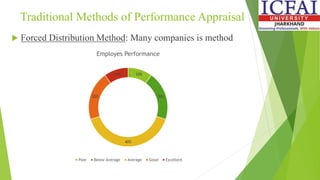
 Forced Distribution Method: Many companies is method
10%
20%
40%
20%
10%
Employes Performance
Poor Below Average Average Good Excellent
Traditional Methods of Performance Appraisal
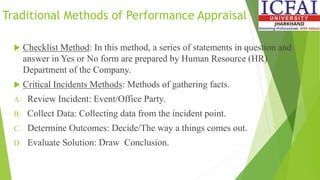
 Checklist Method: In this method, a series of statements in question and
answer in Yes or No form are prepared by Human Resource (HR)
Department of the Company.
 Critical Incidents Methods: Methods of gathering facts.
A. Review Incident: Event/Office Party.
B. Collect Data: Collecting data from the incident point.
C. Determine Outcomes: Decide/The way a things comes out.
D. Evaluate Solution: Draw Conclusion.
Traditional Methods of Performance
Appraisal
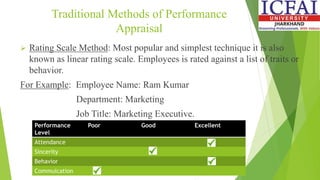
 Rating Scale Method: Most popular and simplest technique it is also
known as linear rating scale. Employees is rated against a list of traits or
behavior.
For Example: Employee Name: Ram Kumar
Department: Marketing
Job Title: Marketing Executive.
Performance
Level
Poor Good Excellent
Attendance
Sincerity
Behavior
Commuication
Traditional Methods of Performance Appraisal
 Essay Method: It involves description of performance of an employee by
his/her supervisor it is also known as Free form method.
 Free Review Method: Employees are not judged by his/her supervisor but is
can be monitored by another person usually from HR Department.
 Confidential Report Method: Collect information of employees strength,
weakness, intelligence, attitude, characteristics etc. This method is mainly
used in Government Office.
Modern Methods of Performance Appraisal
 Management by Objectives (MBO): It is a method where Managers and
Employees gather together to identify, plan, organize and communicate
companies objectives to focus.
 Behaviorally Anchored Rating Scale (BARS): BARS is used to rate
performance and to bring both qualitative and quantitative data of the
employees.
 Assessment Centers: Often used in selection procedure to test suitability of
the candidate. It consist several test to show whether a person is the right fit
for a position or not.
Modern Methods of Performance Appraisal
 360 Degree Appraisal: Evaluate an employee using feedback collected
from the Direct Report, Peers (his/her colleagues), Customers, Supervisors
whom he/she interact in course of his/her job.
 Human Resource Accounting: Analyses an employee performance through
the monetary benefits he/she yields to the employees.
References
 https://youtu.be/A4GklhGISxM
 https://youtu.be/zie_-CF_VeQ
 https://youtu.be/PfaPjO8CN2Q
Presentation_On_Performance_Appraisal.pptx

Presentation_On_Performance_Appraisal.pptx

  • 1.
    PRESENATATION ON PERFORMANCE APPRAISAL MASTER OFBUSINESS ADMINISTRATION Submitted By: Name: Ankit Raj Program: MBA-(2) Session: (2022-2024) Submitted To: Rumna Mam
  • 2.
    TABLE OF CONTENTS PerformanceAppraisal Features of Performance Appraisal Purpose of Performance Appraisal Process of Performance Appraisal Possible Errors Performance Appraisal Methods
  • 3.
    Performance Appraisal  PerformanceAppraisal is a regular review of an employee’s job performance and contribution to a company.  Company use performance appraisals to determine which employees have contributed the most to the company’s growth review progress and reward high-achieving workers.
  • 4.
    Features of PerformanceAppraisal Organized Process Evaluating Process Periodic Process Futuristics Identify Employee Potentiaties Develop Employee
  • 5.
    Purpose of PerformanceAppraisal Providing feedback to Employees and Management Facilitating Promotion and Downsizing Motivating Superior Performance Setting and Measuring Goals Determining Compensation Determining Poor Performance Determining Training and Development
  • 6.
    Process of PerformanceAppraisal Establish Performance Standards With Employees Mutually Set Measurable Goals Measure Actual Performance Compare Actual Performance With Standards Discuss Appraisal with Employee Take Corrective Actions
  • 7.
    Possible Errors  Firstimpression error.  Halo effect (Judging someone on the basis of one characteristics).  Strictness or Leniency.  Sterotyping (Judging someone on basic of group he or she belong).  Similar to me.
  • 8.
    Performance Appraisal Methods TraditionalMethods of Performance Appraisal  Rating Scales  Confidential Report  Paired Comparison Method  Checklist Method  Forced Choice Method  Essay Method  Performance Test and Observation  Forced Distribution Method  Field Review Method Modern Methods of Performance Appraisal  Assessment Centers  Human Resource Accounting  Behaviorally Anchored Rating Scale (BARS)  Management by Objectives  360 Degree Feedback  Psychological Appraisals  Human-Asset Accounting Method
  • 9.
    Traditional Methods ofPerformance Appraisal  Ranking Scale: It is simplest and oddest method of Performance Appraisal in which employees are rated from highest to the lowest or from the Best to the Worst. Example: 1 to 5.  Paired Comparison Method: Comparing employees in pairs to judge who is preferable for the job. Example: A-B, A-C, A-D.  Grading Method: Employees are get the grades according to his/her performance.  Example: a) Outstanding: A+ b) Satisfactory: A c) Not Satisfied: B,C,D,E  Forced Choice Method: Rater is forced to answer the ready-made statements as given. Example: MCQ.
  • 10.
    Traditional Methods ofPerformance Appraisal  Forced Distribution Method: Many companies is method 10% 20% 40% 20% 10% Employes Performance Poor Below Average Average Good Excellent
  • 11.
    Traditional Methods ofPerformance Appraisal  Checklist Method: In this method, a series of statements in question and answer in Yes or No form are prepared by Human Resource (HR) Department of the Company.  Critical Incidents Methods: Methods of gathering facts. A. Review Incident: Event/Office Party. B. Collect Data: Collecting data from the incident point. C. Determine Outcomes: Decide/The way a things comes out. D. Evaluate Solution: Draw Conclusion.
  • 12.
    Traditional Methods ofPerformance Appraisal  Rating Scale Method: Most popular and simplest technique it is also known as linear rating scale. Employees is rated against a list of traits or behavior. For Example: Employee Name: Ram Kumar Department: Marketing Job Title: Marketing Executive. Performance Level Poor Good Excellent Attendance Sincerity Behavior Commuication
  • 13.
    Traditional Methods ofPerformance Appraisal  Essay Method: It involves description of performance of an employee by his/her supervisor it is also known as Free form method.  Free Review Method: Employees are not judged by his/her supervisor but is can be monitored by another person usually from HR Department.  Confidential Report Method: Collect information of employees strength, weakness, intelligence, attitude, characteristics etc. This method is mainly used in Government Office.
  • 14.
    Modern Methods ofPerformance Appraisal  Management by Objectives (MBO): It is a method where Managers and Employees gather together to identify, plan, organize and communicate companies objectives to focus.  Behaviorally Anchored Rating Scale (BARS): BARS is used to rate performance and to bring both qualitative and quantitative data of the employees.  Assessment Centers: Often used in selection procedure to test suitability of the candidate. It consist several test to show whether a person is the right fit for a position or not.
  • 15.
    Modern Methods ofPerformance Appraisal  360 Degree Appraisal: Evaluate an employee using feedback collected from the Direct Report, Peers (his/her colleagues), Customers, Supervisors whom he/she interact in course of his/her job.  Human Resource Accounting: Analyses an employee performance through the monetary benefits he/she yields to the employees.
  • 16.