Performance
Management
Introduction
Performance management is the broad collection of activities
designed to maximize individual performance to contribute into
organizational performance as per optimum
It includes setting expectations, measuring employee behaviors and
results, providing coaching and feedback, and evaluating
performance over time to use in decision-making
The purpose is to align individual efforts to achieve organizational
goals
A successful performance management program helps an employer
retain talented employees, keep employees engaged, enhance
employee learning and build a winning corporate culture
2
Agenda
• Performance appraisal versus performance
management
• Performance management continuum
• Rater errors
3
DEFINITION
According to Edwin B Flippo, “Performance appraisal is a
systematic, periodic and so far as humanly possible, an impartial rating
of an employee’s excellence in matters pertaining to his present job and
to his potentialities for a better job”
4
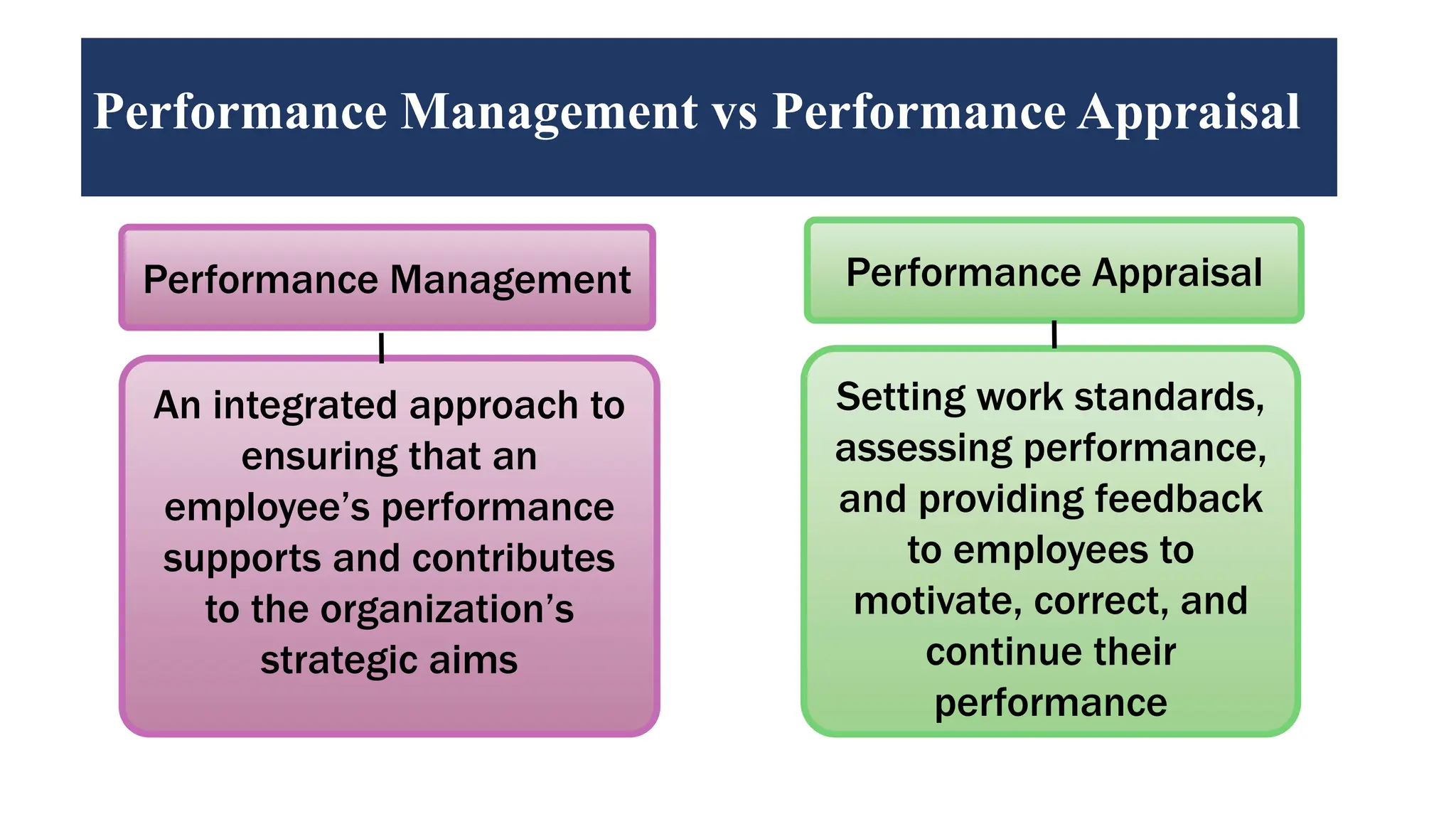
Performance Appraisal
Setting work standards,
assessing performance,
and providing feedback
to employees to
motivate, correct, and
continue their
performance
Performance Management
An integrated approach to
ensuring that an
employee’s performance
supports and contributes
to the organization’s
strategic aims
Performance Management vs Performance Appraisal
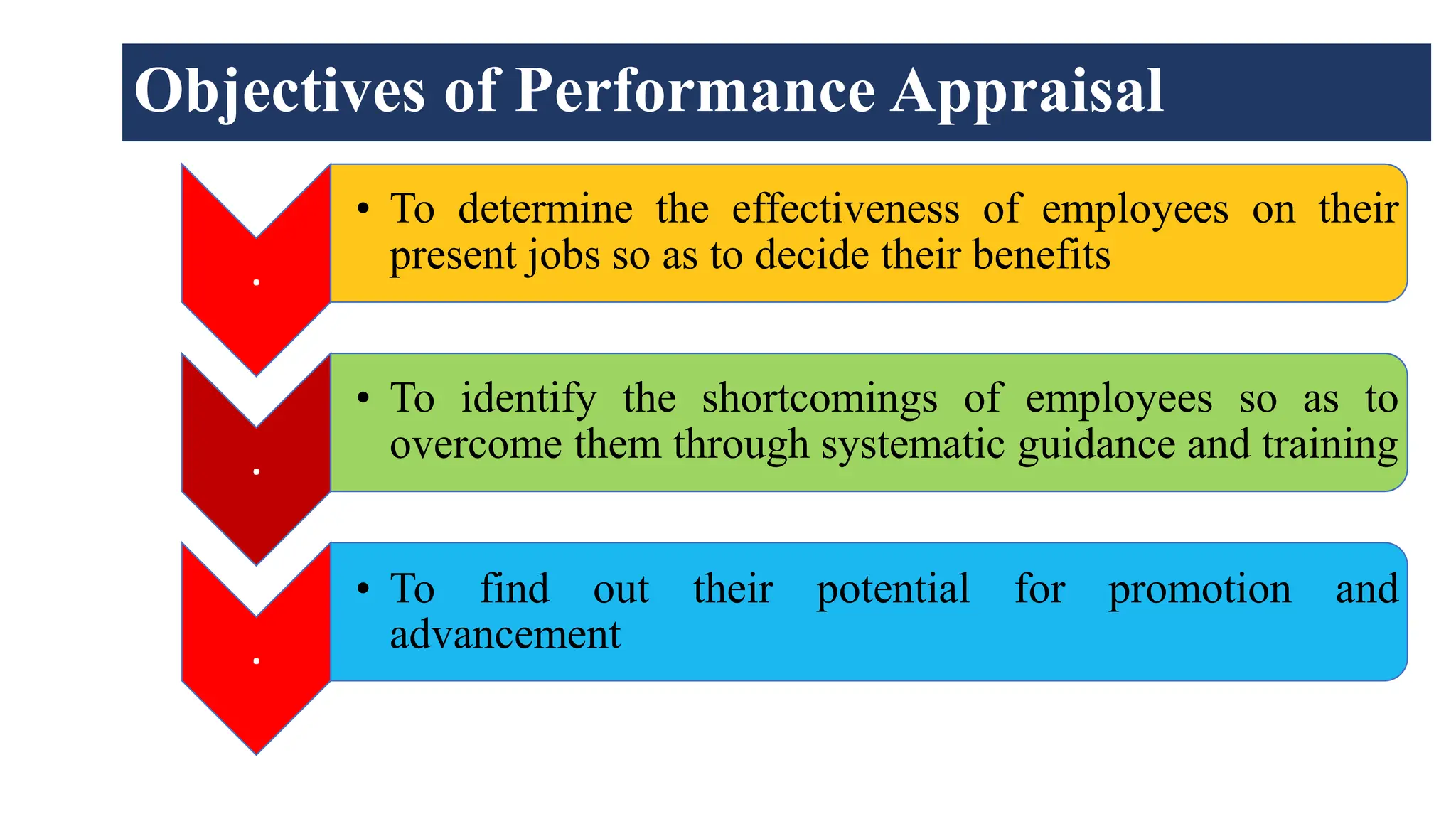
.
• To determine the effectiveness of employees on their
present jobs so as to decide their benefits
.
• To identify the shortcomings of employees so as to
overcome them through systematic guidance and training
.
• To find out their potential for promotion and
advancement
Objectives of Performance Appraisal
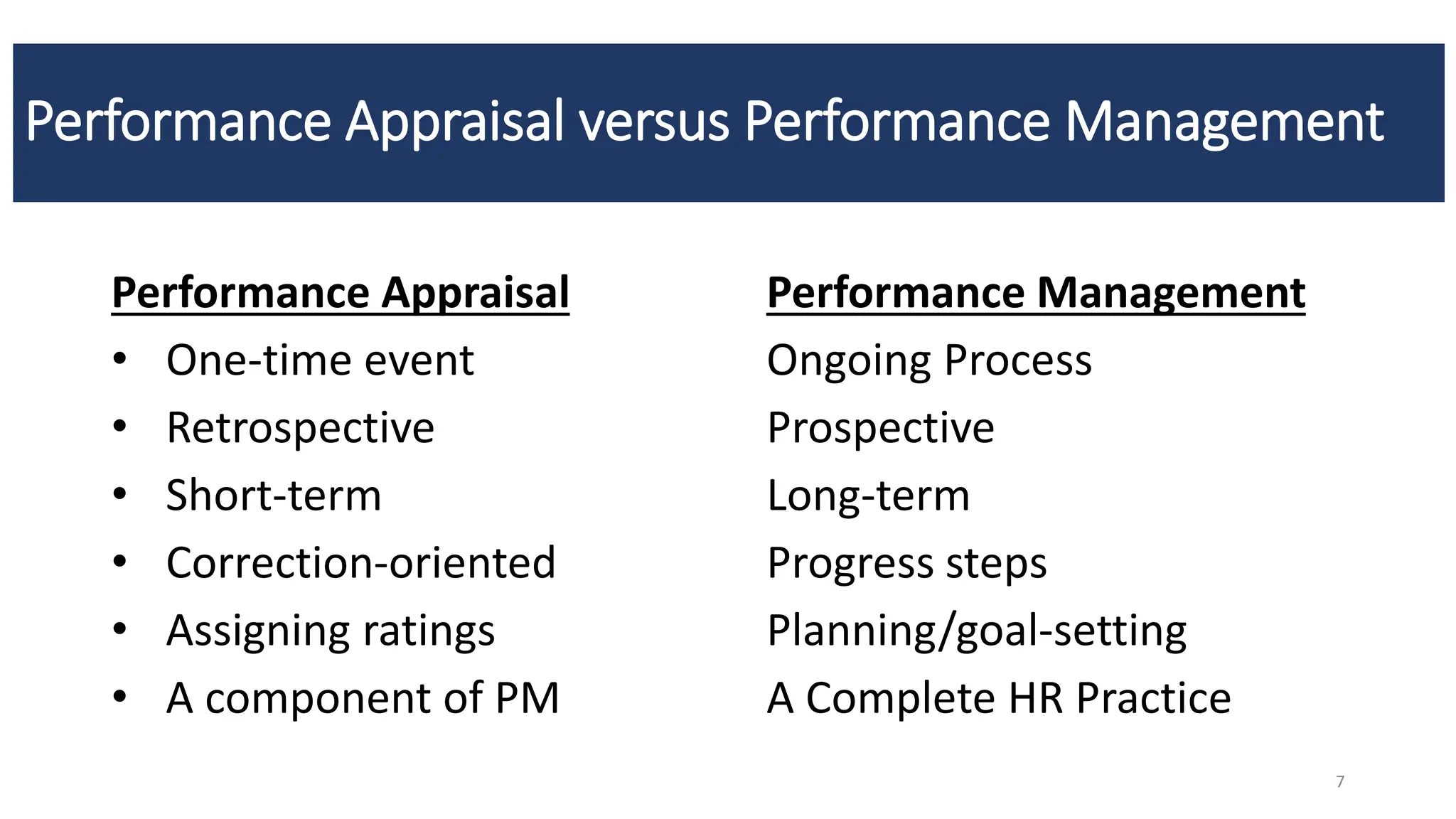
Performance Appraisal versus Performance Management
Performance Appraisal Performance Management
• One-time event Ongoing Process
• Retrospective Prospective
• Short-term Long-term
• Correction-oriented Progress steps
• Assigning ratings Planning/goal-setting
• A component of PM A Complete HR Practice
7
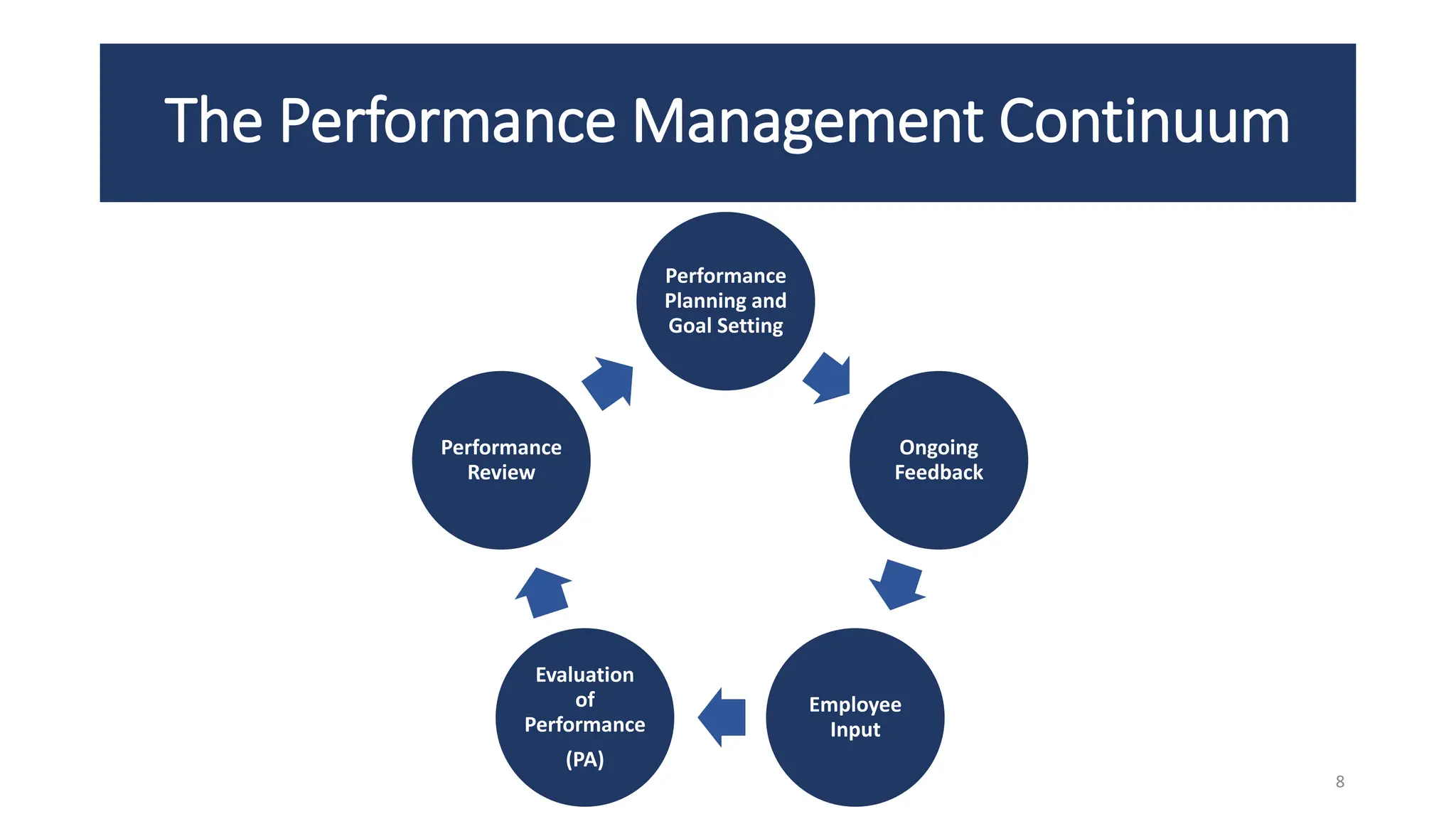
The Performance Management Continuum
8
Performance
Planning and
Goal Setting
Ongoing
Feedback
Employee
Input
Evaluation
of
Performance
(PA)
Performance
Review
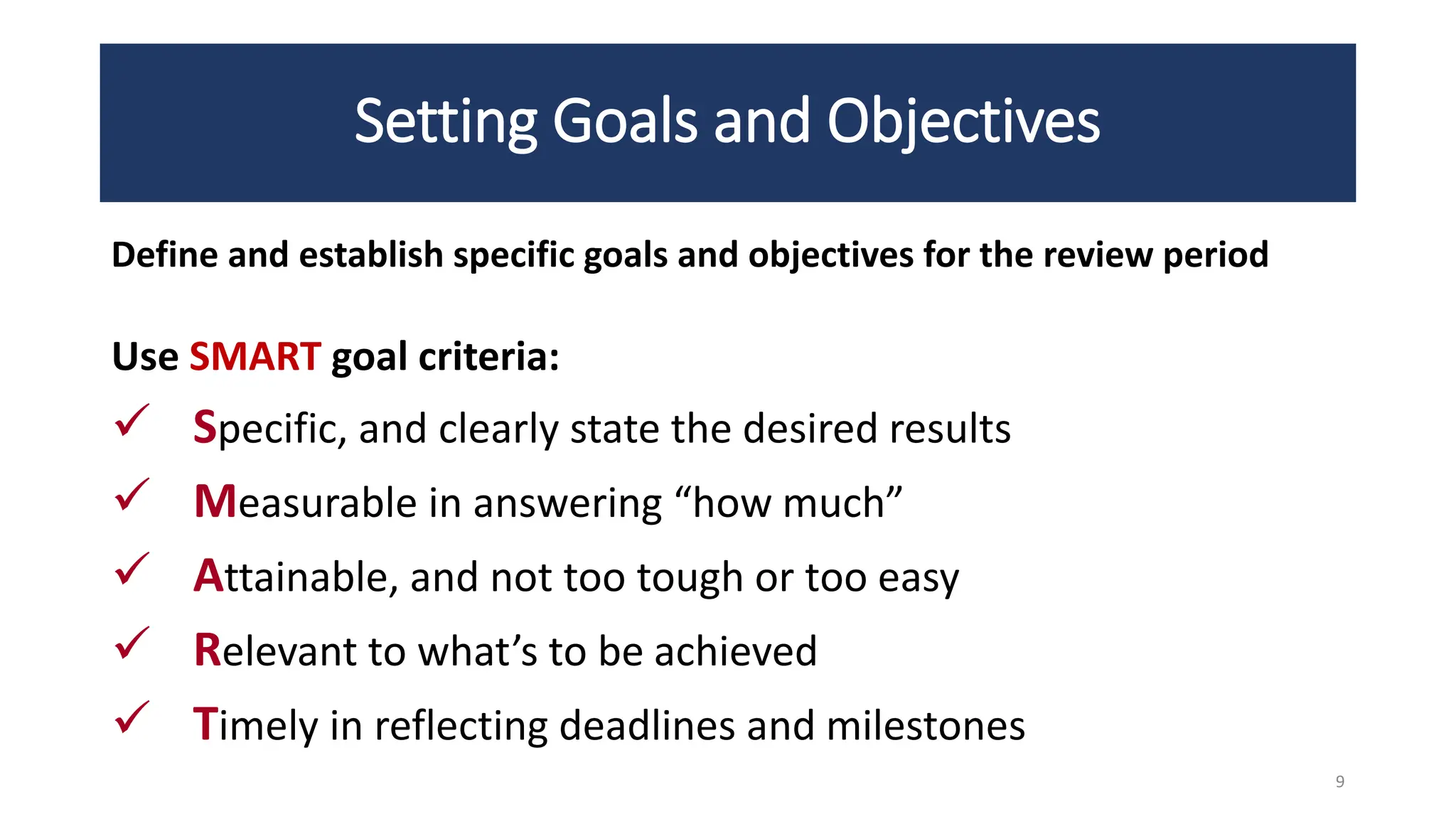
Setting Goals and Objectives
Define and establish specific goals and objectives for the review period
Use SMART goal criteria:
 Specific, and clearly state the desired results
 Measurable in answering “how much”
 Attainable, and not too tough or too easy
 Relevant to what’s to be achieved
 Timely in reflecting deadlines and milestones
9
Setting Goals and Objectives (cont.)
 Align goals and objectives with the organization’s business
plan
 Establish mutually agreed-upon goals between the
employee and the manager
 Establish milestone review dates
 Communicate changes or redirection of goals and
objectives in a timely manner
10
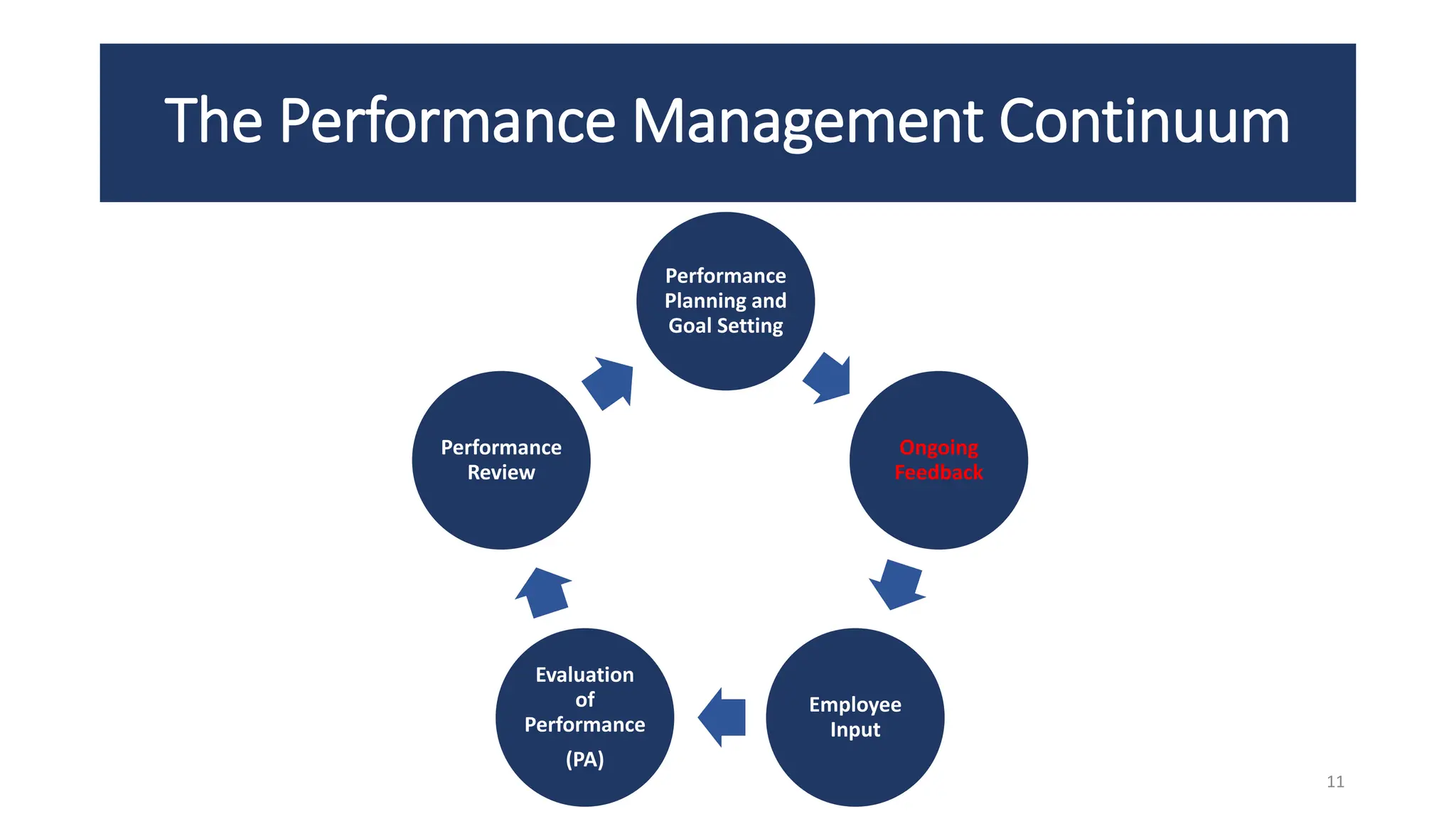
The Performance Management Continuum
11
Performance
Planning and
Goal Setting
Ongoing
Feedback
Employee
Input
Evaluation
of
Performance
(PA)
Performance
Review
Providing Continuous Feedback
Effective performance management systems include a process for
continuous feedback
• Establish milestone dates for periodic monitoring of performance
objectives and progress reports in objective terms
• Be aware that goals or objectives may need to be changed or
retargeted during the review period
• Maintain open communication channels to ensure that issues are
elevated quickly and resolved timely
• Coach, assist and/or redirect employees who request assistance and
those who are failing to meet standards
12
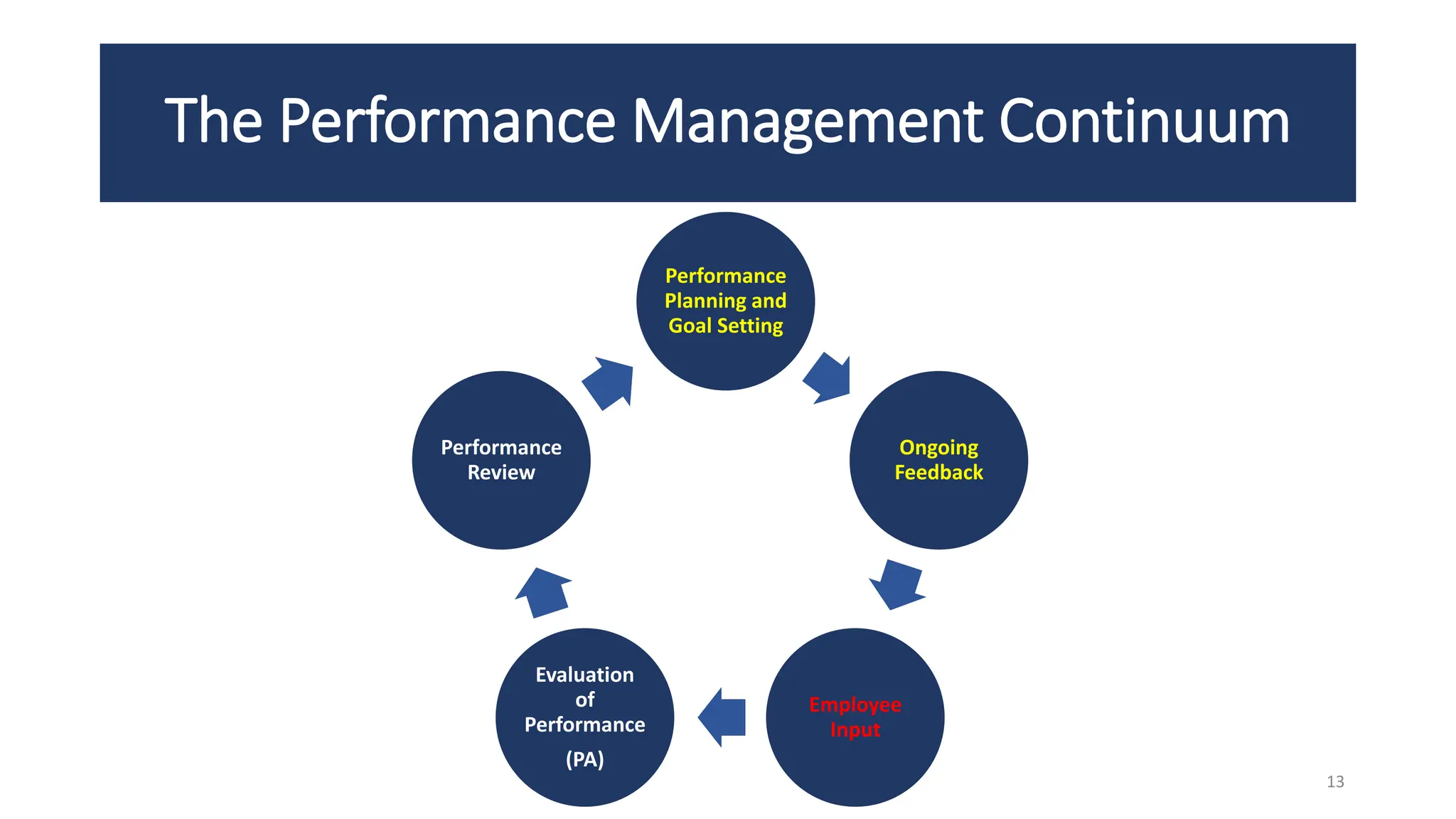
The Performance Management Continuum
13
Performance
Planning and
Goal Setting
Ongoing
Feedback
Employee
Input
Evaluation
of
Performance
(PA)
Performance
Review
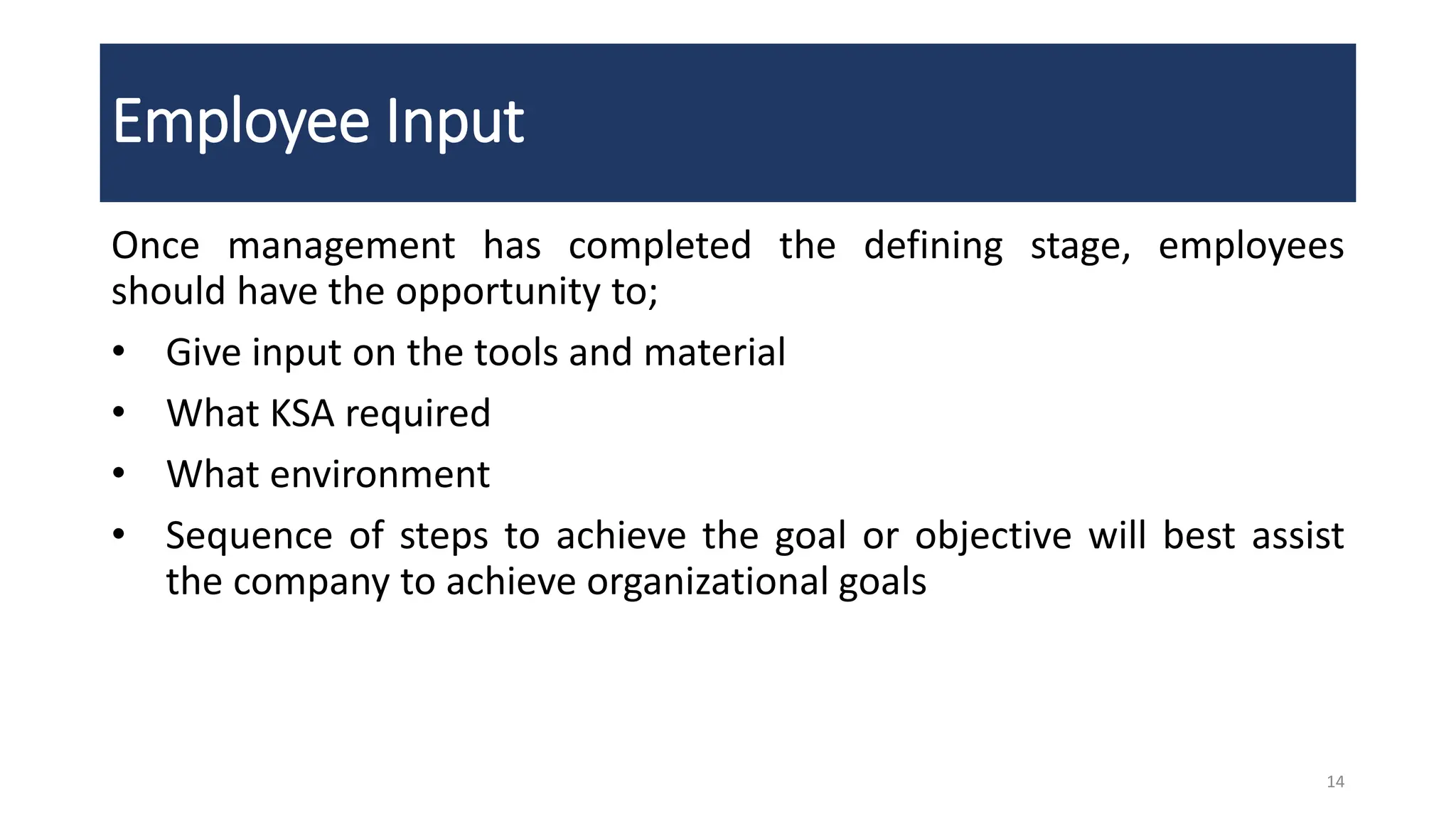
Employee Input
Once management has completed the defining stage, employees
should have the opportunity to;
• Give input on the tools and material
• What KSA required
• What environment
• Sequence of steps to achieve the goal or objective will best assist
the company to achieve organizational goals
14
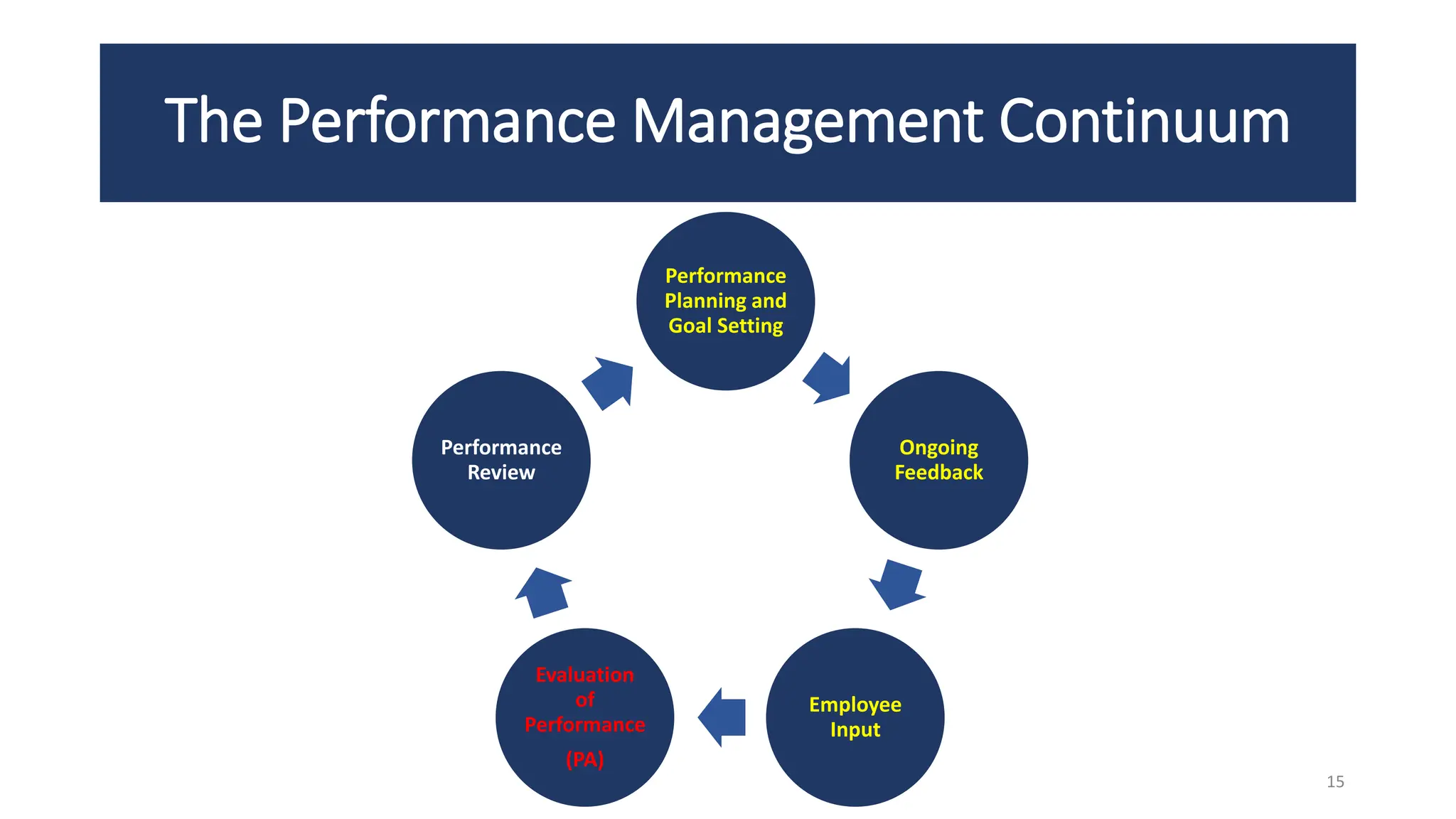
The Performance Management Continuum
15
Performance
Planning and
Goal Setting
Ongoing
Feedback
Employee
Input
Evaluation
of
Performance
(PA)
Performance
Review
Conducting Appraisals
To ensure an effective performance appraisal meeting, take the following
steps:
• Be prepared by collecting and reviewing performance notes, feedback
and other data
• Request self-appraisals from employees to be completed two weeks prior
to the appraisal meeting
• Choose a private and comfortable space for the meeting and schedule
sufficient time to focus on the review
• Encourage open dialogue regarding performance levels, lessons learned,
ongoing progress, and goals and objectives for the next review period
16
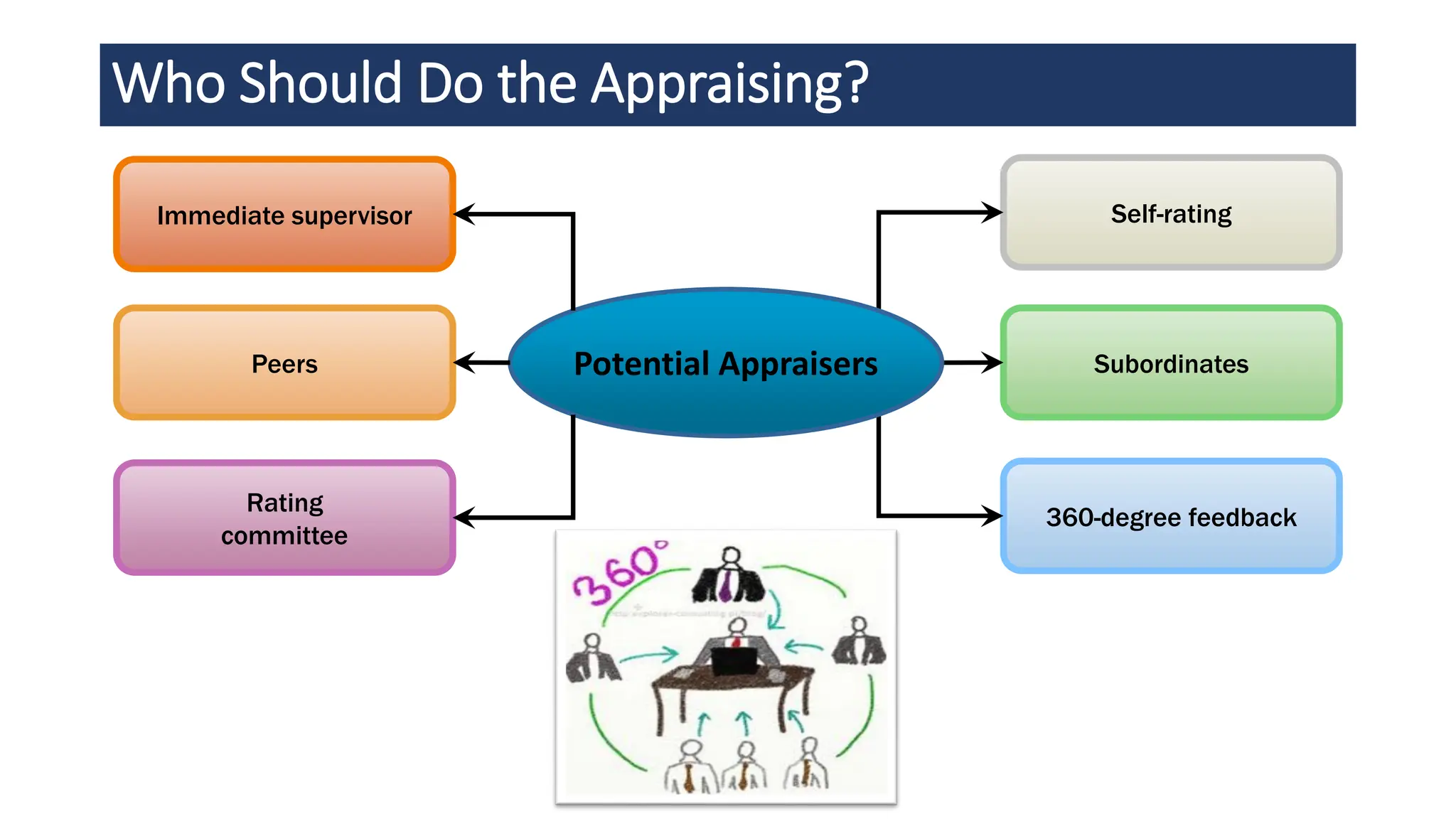
Who Should Do the Appraising?
Self-rating
Subordinates
360-degree feedback
Potential Appraisers
Immediate supervisor
Peers
Rating
committee
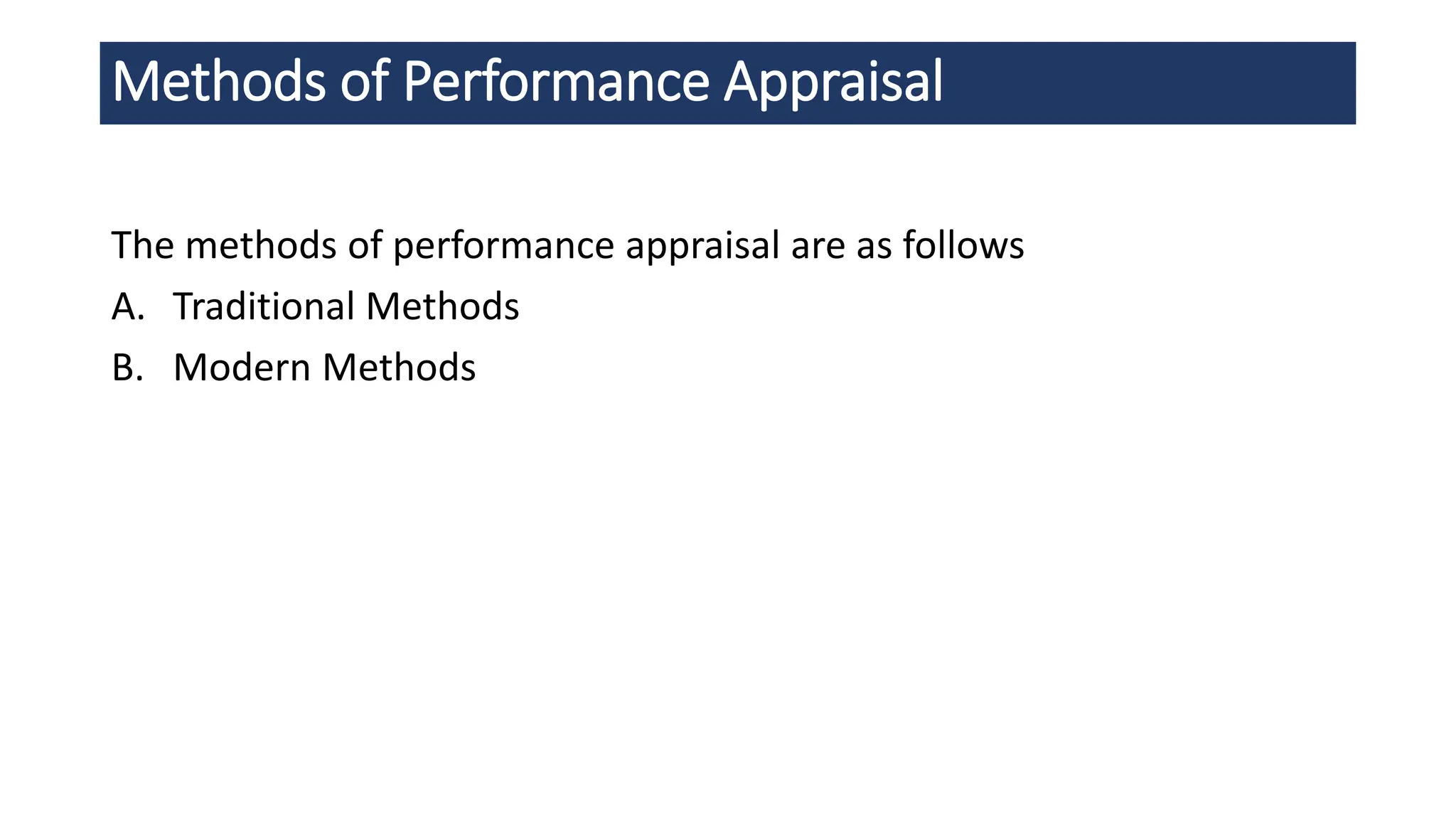
The methods of performance appraisal are as follows
A. Traditional Methods
B. Modern Methods
Methods of Performance Appraisal
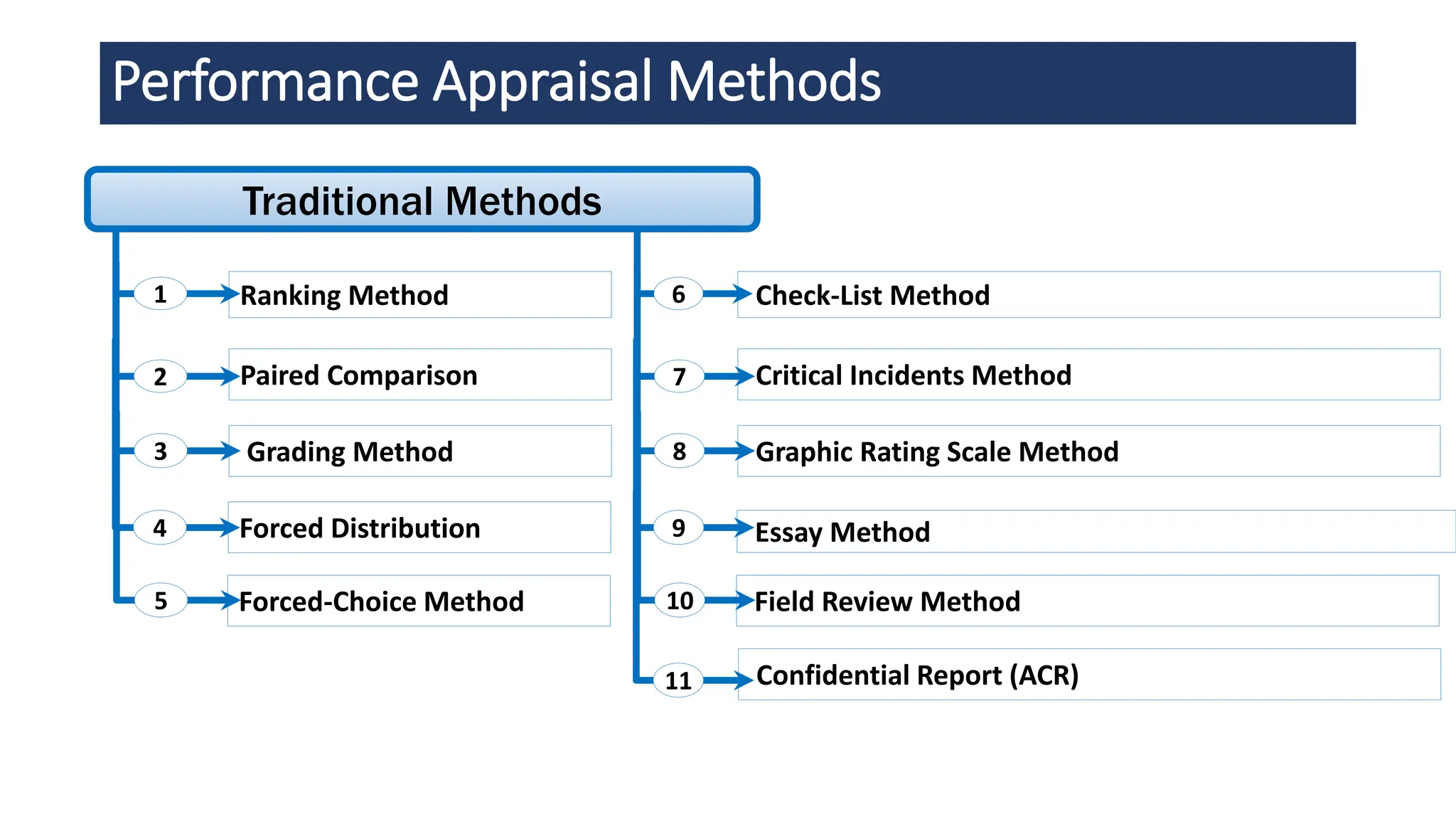
Performance Appraisal Methods
1
2
3
4
5
Paired Comparison
Ranking Method
Grading Method
Forced Distribution
Forced-Choice Method
6
7
8
9
10
Critical Incidents Method
Check-List Method
Graphic Rating Scale Method
Essay Method
Field Review Method
Traditional Methods
Confidential Report (ACR)
11
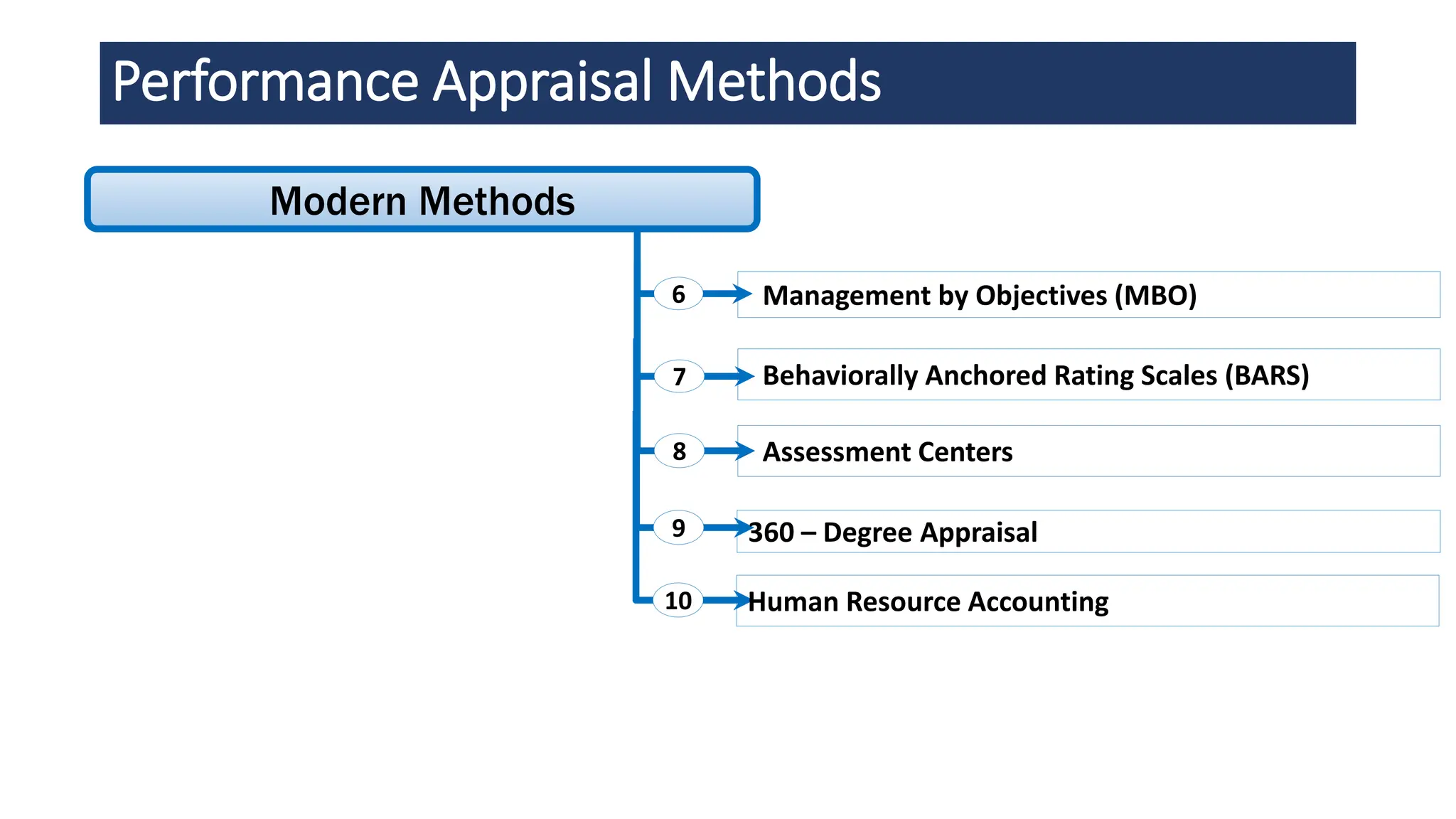
Performance Appraisal Methods
6
7
8
9
10
Behaviorally Anchored Rating Scales (BARS)
Management by Objectives (MBO)
Assessment Centers
360 – Degree Appraisal
Human Resource Accounting
Modern Methods
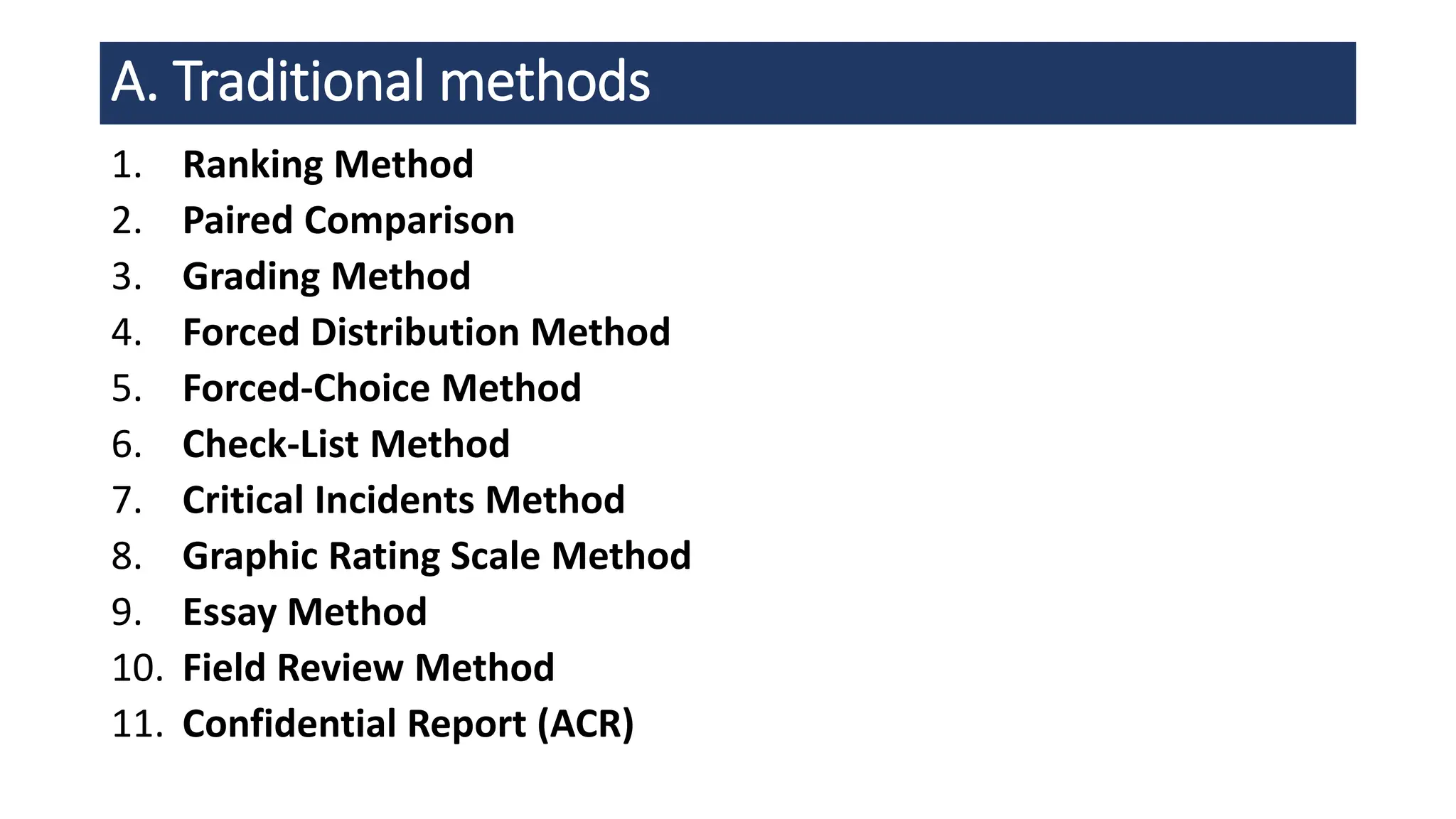
1. Ranking Method
2. Paired Comparison
3. Grading Method
4. Forced Distribution Method
5. Forced-Choice Method
6. Check-List Method
7. Critical Incidents Method
8. Graphic Rating Scale Method
9. Essay Method
10. Field Review Method
11. Confidential Report (ACR)
A. Traditional methods
1. Ranking Method
It is the oldest and simplest formal systematic method of
performance appraisal in which employee is compared with all
others for the purpose of placing order of worth. The employees
are ranked from the highest to the lowest or from the best to the
worst
2. Paired Comparison
In this method, each employee is compared with other
employees on one-on one basis only. The rater is provided with a
bunch of slips each coining pair of names, the rater puts a tick
mark against the employee whom he insiders the better of the
two
3. Grading Method
In this method, certain categories of worth are established in
advance and carefully defined. There can be three categories
established for employees: outstanding, satisfactory and
unsatisfactory. The employee is, then, allocated to the grade that
best describes his or her performance
4. Forced Distribution Method
This method assumes that employees performance level
confirms to a normal statistical distribution i.e., 10,20,40,20 and
10%. This is useful for rating a large number of employees’ job
performance and promo ability. It tends to eliminate or reduce
bias
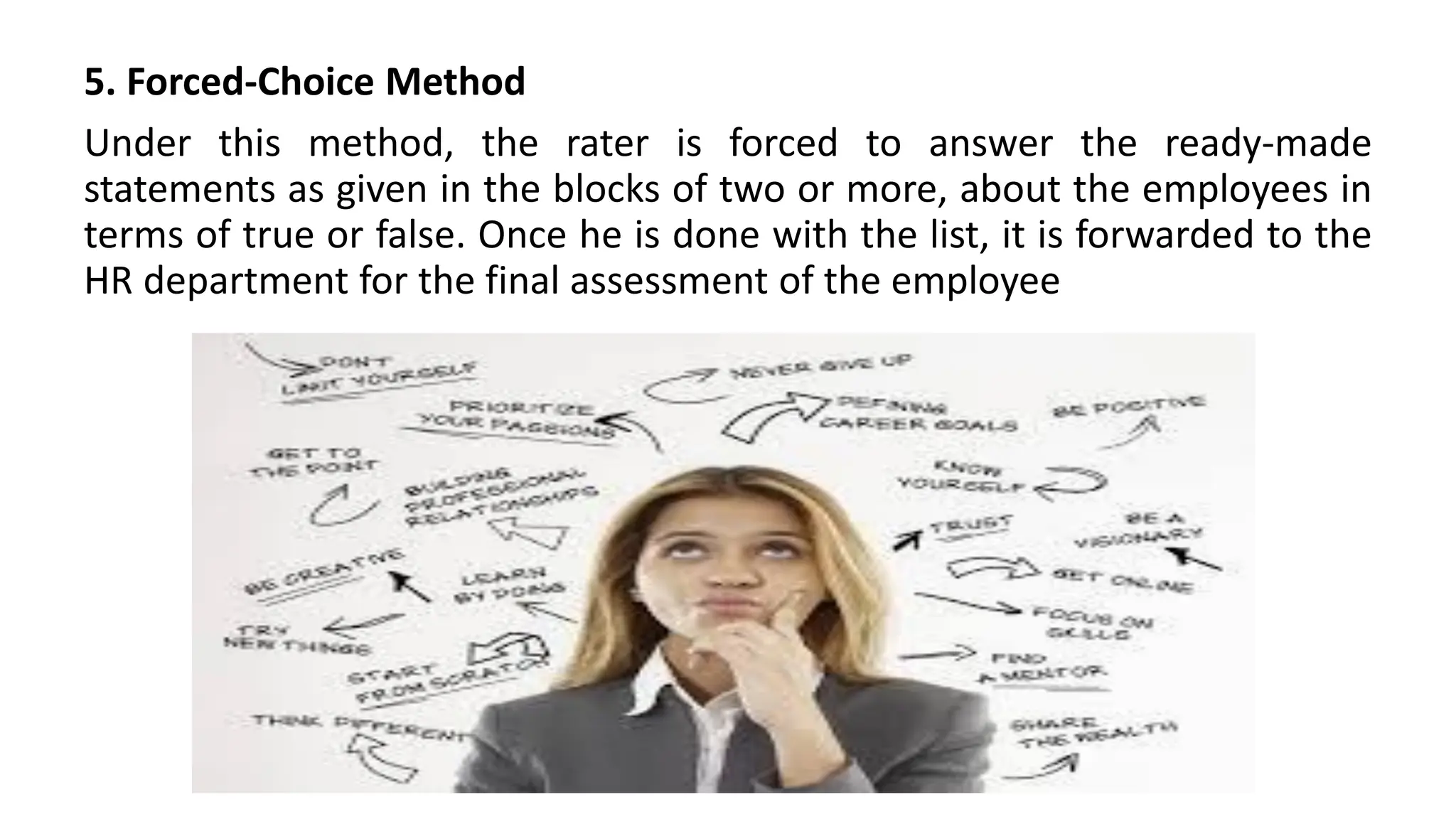
5. Forced-Choice Method
Under this method, the rater is forced to answer the ready-made
statements as given in the blocks of two or more, about the employees in
terms of true or false. Once he is done with the list, it is forwarded to the
HR department for the final assessment of the employee
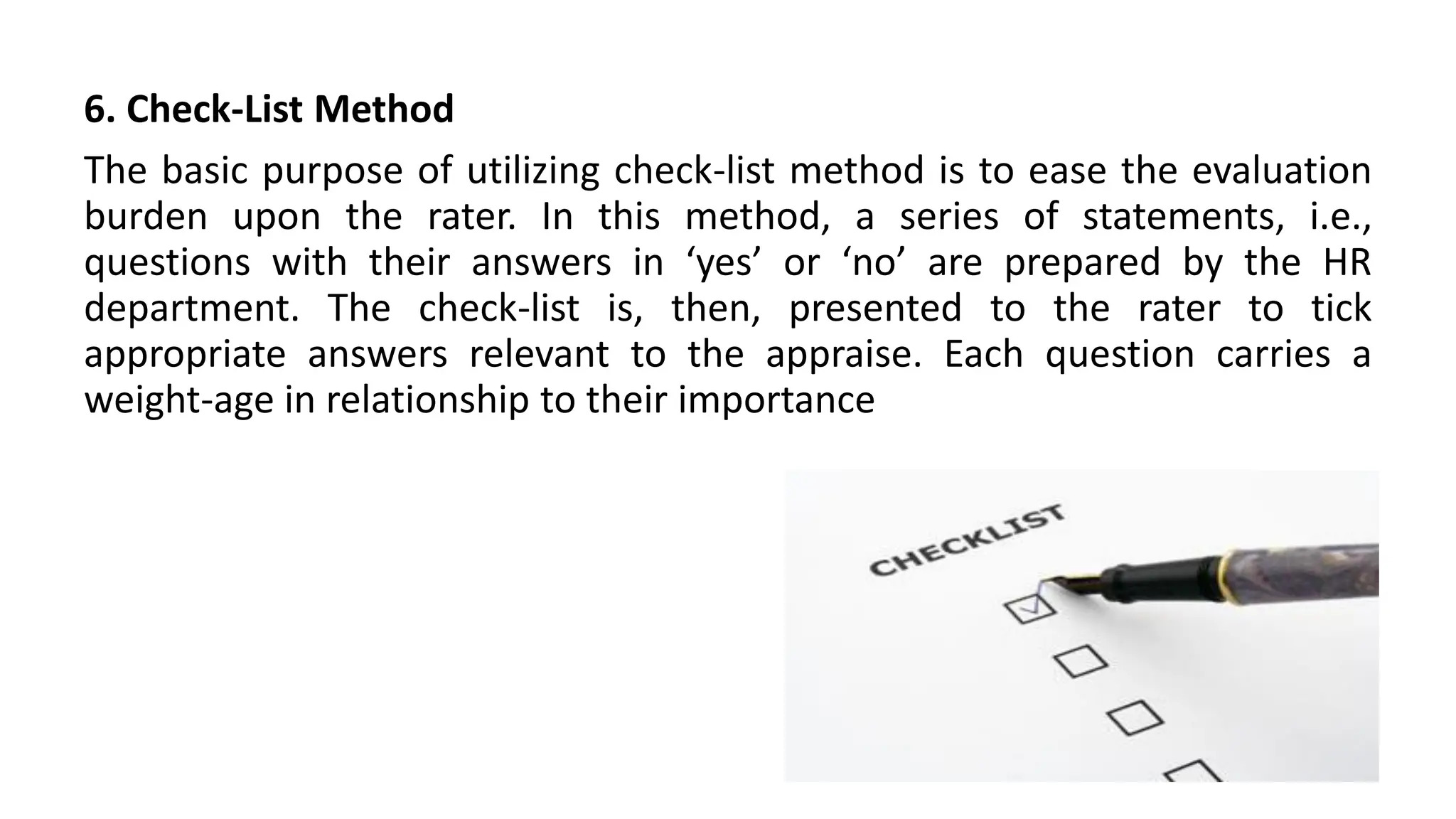
6. Check-List Method
The basic purpose of utilizing check-list method is to ease the evaluation
burden upon the rater. In this method, a series of statements, i.e.,
questions with their answers in ‘yes’ or ‘no’ are prepared by the HR
department. The check-list is, then, presented to the rater to tick
appropriate answers relevant to the appraise. Each question carries a
weight-age in relationship to their importance
7. Critical Incidents Method
The critical incident method requires the rater to record statements that
describe extremely good or bad behavior related to job performance. The
statements are called critical incidents and are usually recorded by
the supervisor during the evaluation period for each subordinate.
Recorded incidents include a brief explanation of what happened
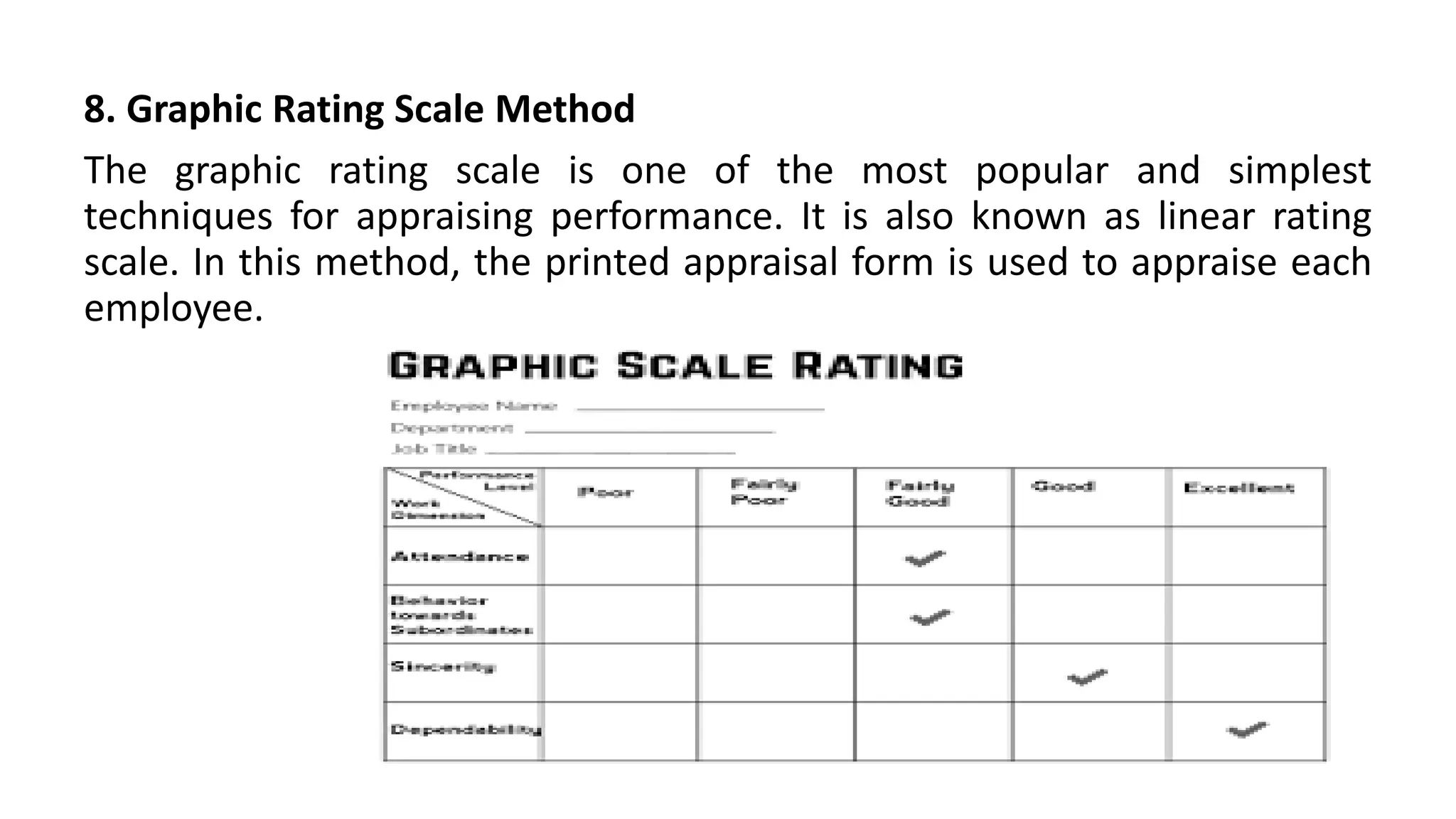
8. Graphic Rating Scale Method
The graphic rating scale is one of the most popular and simplest
techniques for appraising performance. It is also known as linear rating
scale. In this method, the printed appraisal form is used to appraise each
employee.
9. Essay Method
Essay method is the simplest one among various appraisal methods
available. In this method, the rater writes a narrative description on an
employee’s strengths, weaknesses, past performance, potential and
suggestions for improvement. Its positive point is that it is simple in use. It
does not require complex formats and extensive/specific training to
complete it.
10. Field Review Method
This is an appraisal done by someone outside employees, own department
usually from corporate or HR department
Advantages: Useful for managerial level promotions, when comparable
information is needed
Disadvantages: Outsider is generally not familiar with employees work
environment, Observation of actual behaviors not possible
11. Confidential Report
It is the traditional way of appraising employees mainly in the Government
Departments. Evaluation is made by the immediate boss or supervisor for
giving effect to promotion and transfer. Usually a structured format is
devised to collect information on employee’s strength weakness,
intelligence, attitude, character, attendance, discipline, etc.
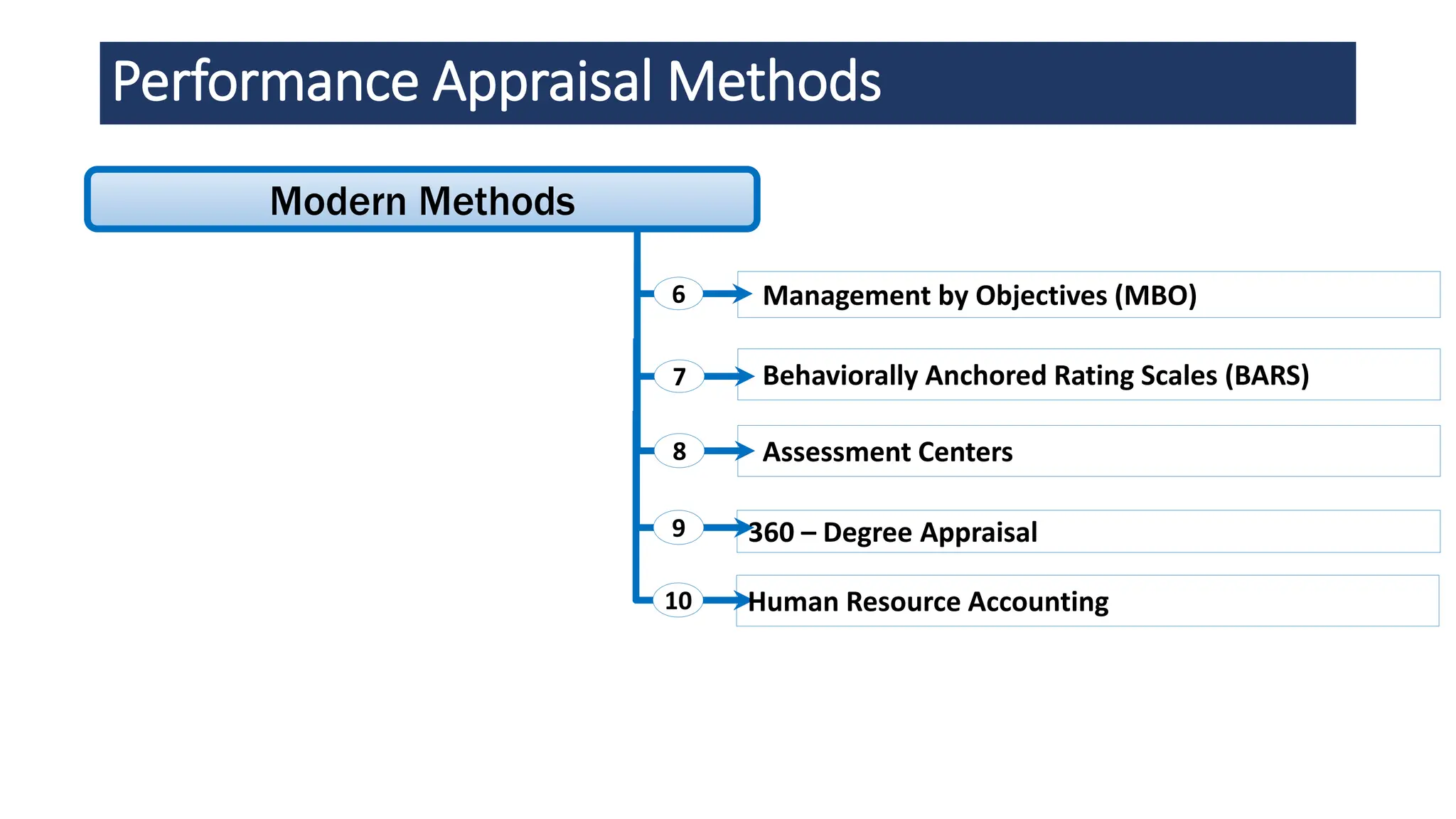
Performance Appraisal Methods
6
7
8
9
10
Behaviorally Anchored Rating Scales (BARS)
Management by Objectives (MBO)
Assessment Centers
360 – Degree Appraisal
Human Resource Accounting
Modern Methods
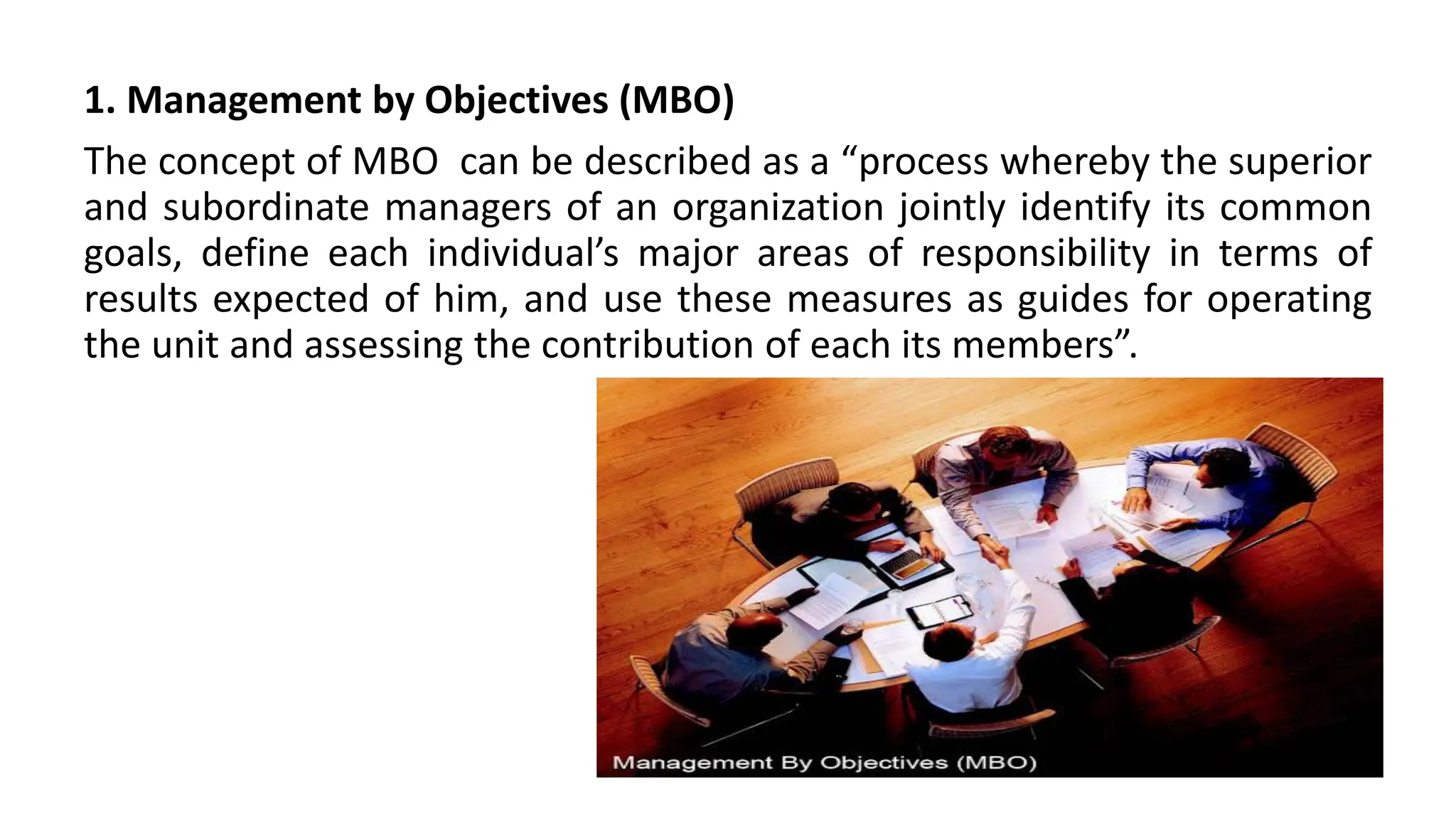
1. Management by Objectives (MBO)
The concept of MBO can be described as a “process whereby the superior
and subordinate managers of an organization jointly identify its common
goals, define each individual’s major areas of responsibility in terms of
results expected of him, and use these measures as guides for operating
the unit and assessing the contribution of each its members”.
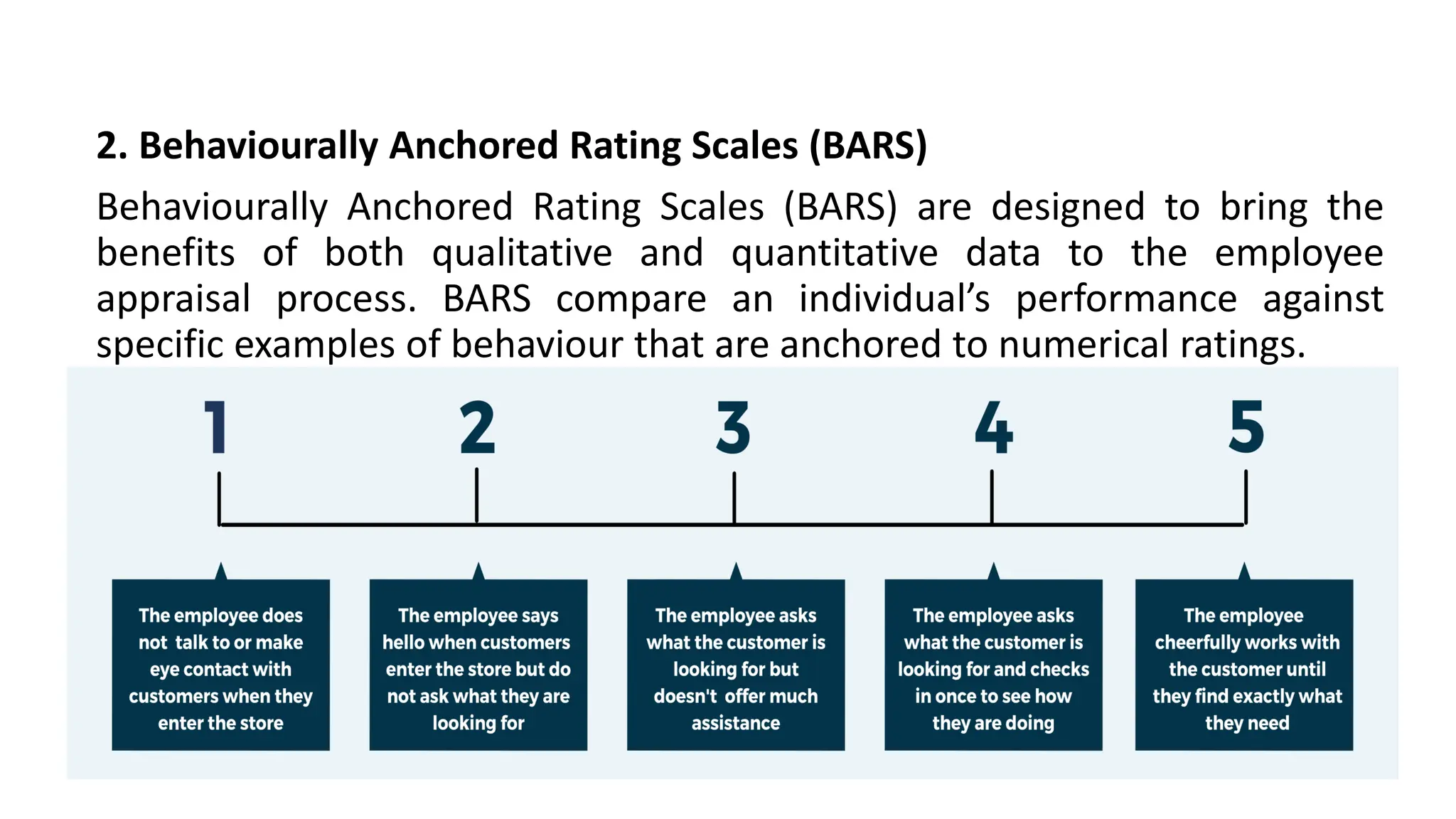
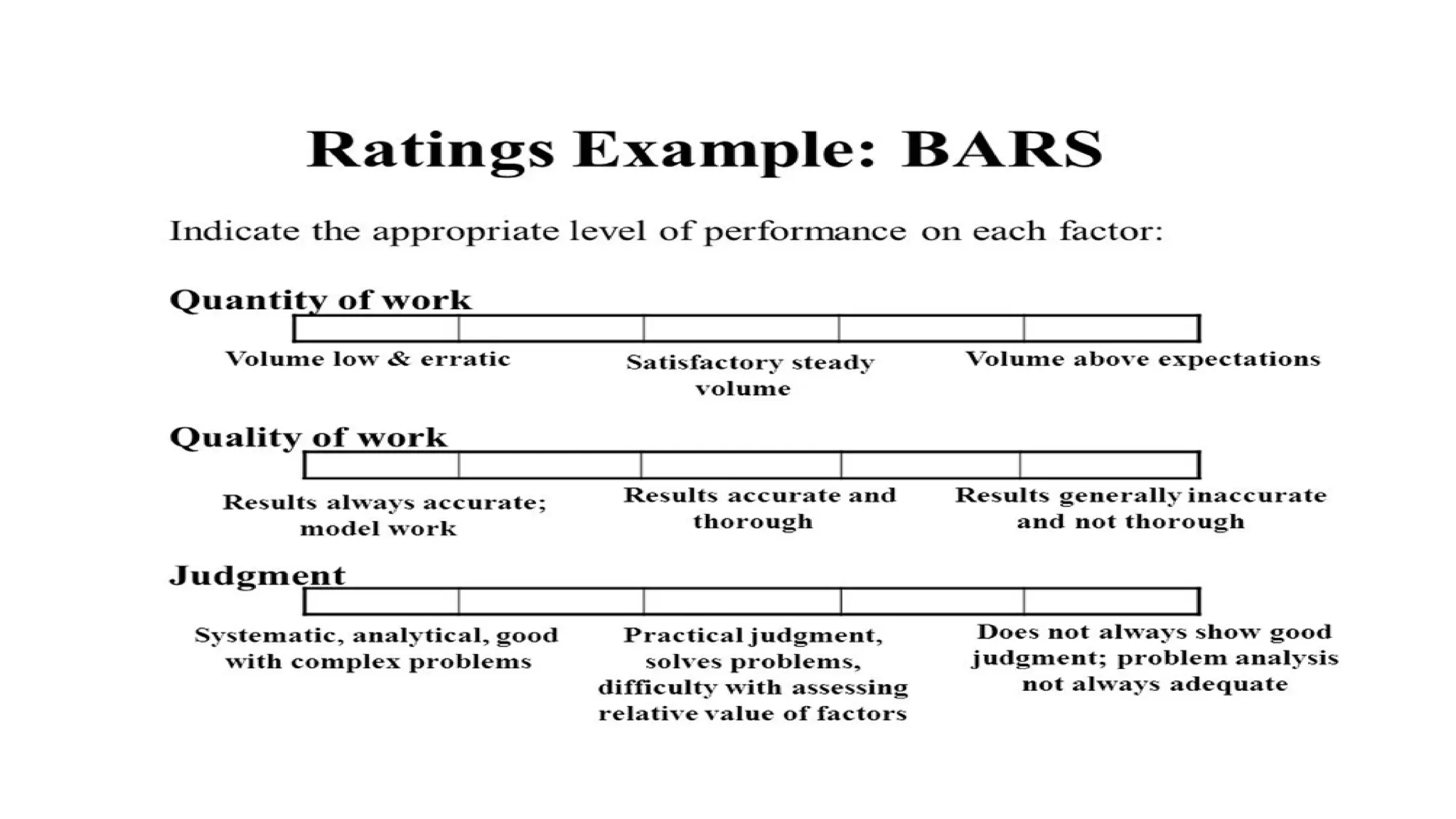
2. Behaviourally Anchored Rating Scales (BARS)
Behaviourally Anchored Rating Scales (BARS) are designed to bring the
benefits of both qualitative and quantitative data to the employee
appraisal process. BARS compare an individual’s performance against
specific examples of behaviour that are anchored to numerical ratings.
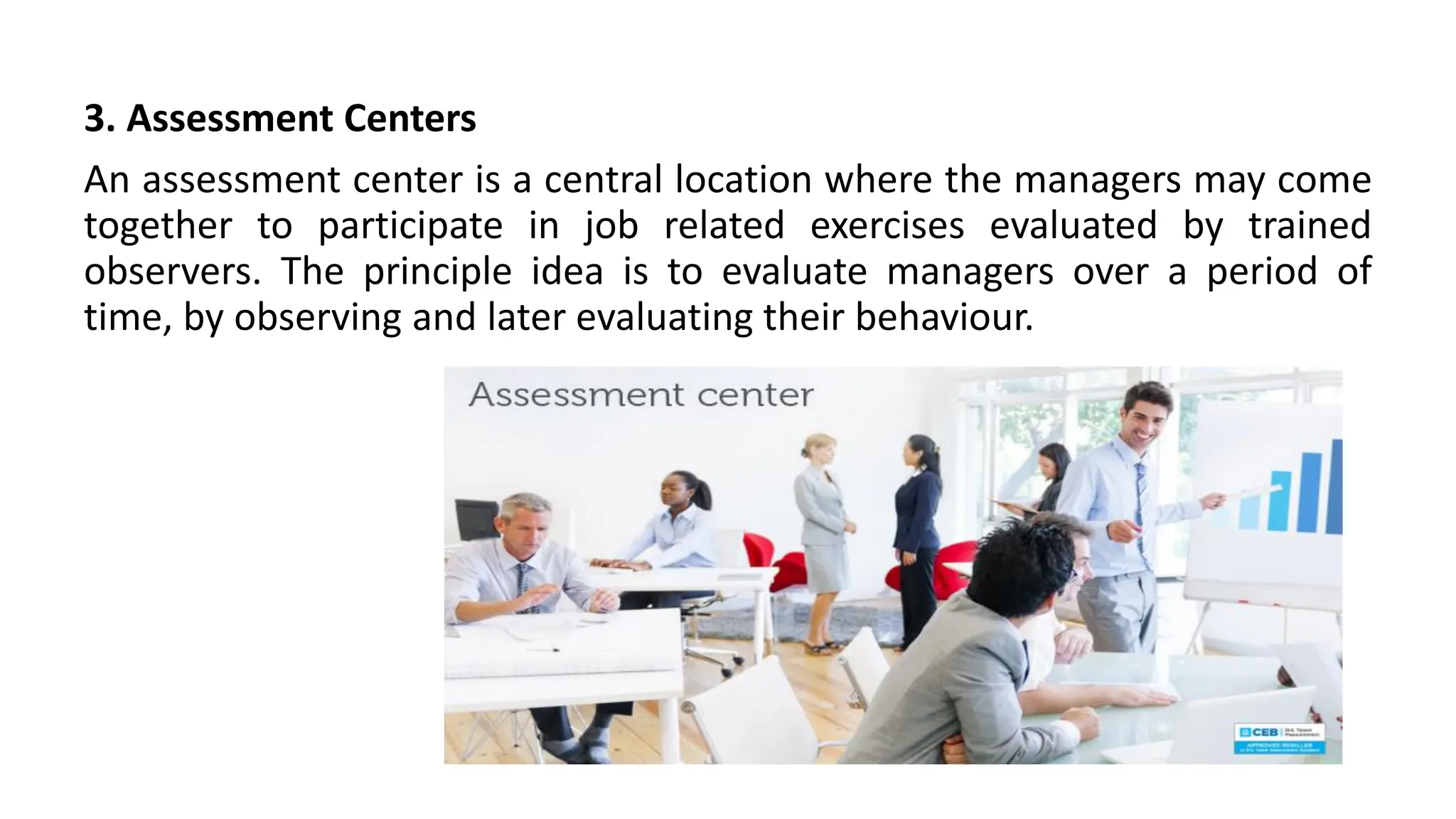
3. Assessment Centers
An assessment center is a central location where the managers may come
together to participate in job related exercises evaluated by trained
observers. The principle idea is to evaluate managers over a period of
time, by observing and later evaluating their behaviour.
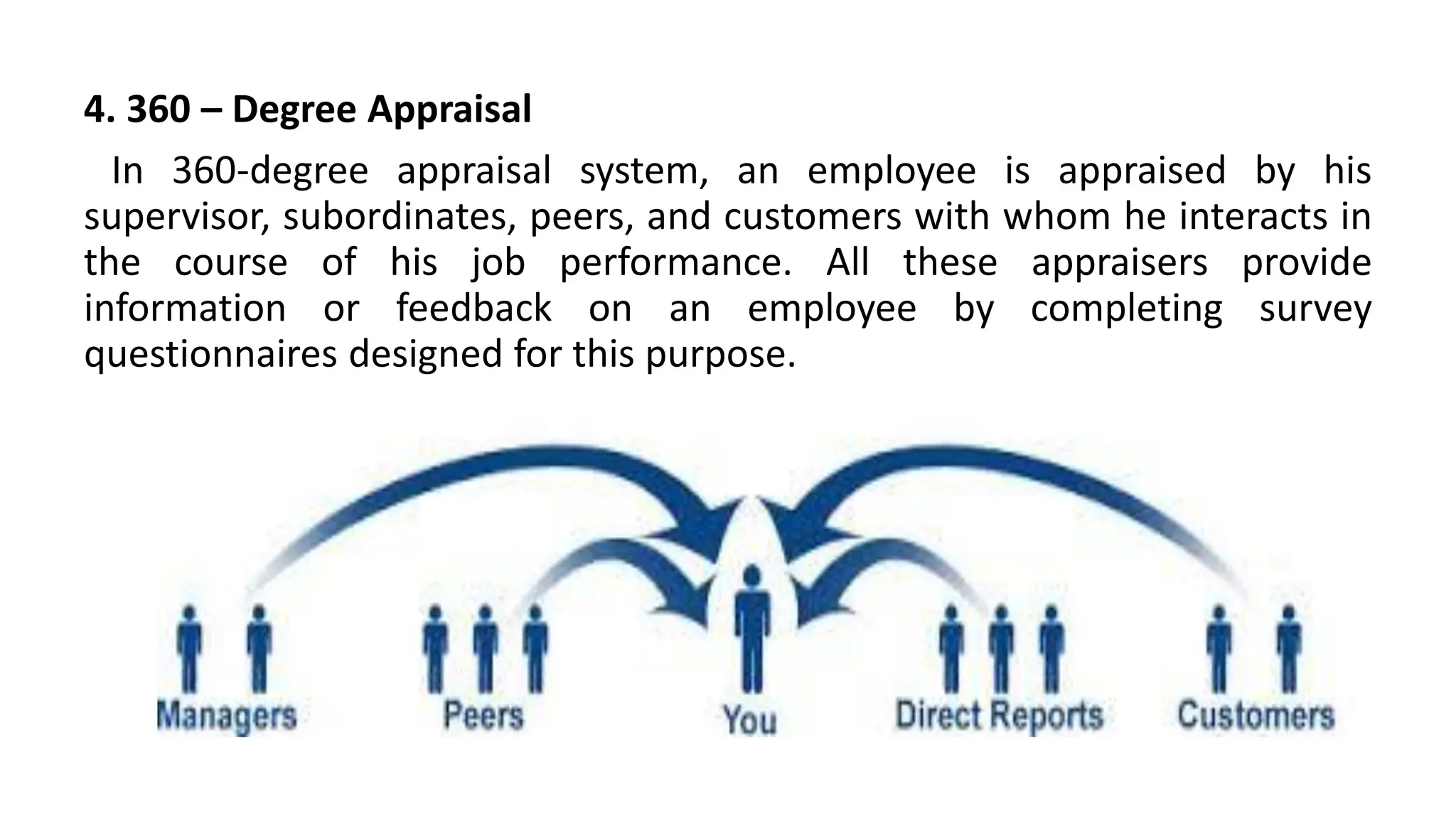
4. 360 – Degree Appraisal
In 360-degree appraisal system, an employee is appraised by his
supervisor, subordinates, peers, and customers with whom he interacts in
the course of his job performance. All these appraisers provide
information or feedback on an employee by completing survey
questionnaires designed for this purpose.
5. Human Resource Accounting
Human resource method attaches money values to the value of a firms
internal human resources and its external customer good will. Under this
method, performance is judged in terms of costs and contributions of
employees. Difference between the cost and contribution will reflect the
performance of the employees
Rater Errors - Grote (1996)
Managers sometimes make errors in judgement due to their own perceptions and biases.
Some common rater errors include the following:
• Contrast effect. One is best other is not
• Primacy Effect. First impression
• Halo/ Horn effect. Performance is completely appraised based on a perceived
positive quality, feature or trait (the employee never/ever can/ do wrong)
• Central tendency. Lack of rating differentiation between employees
• Leniency. Avoidance of honest ratings to avoid conflict
• Recency effect. Narrow focus on recent events rather than the entire performance
period
• Similarity/”like me”. Favorable ratings given to employees who have similar values or
interests to the rater
38
Rater Errors (cont.)
Tips to avoid rater errors:
• Make objective statements – “Ali arrived late on four occasions” rather than “Ali
is always late.”
• Consider the totality of the employee’s performance over the entire review
period
• Make and keep adequate records with specific examples
• Establish milestones for progress reviews
• Seek input from other managers or human resources
• Participate in an organization-wide calibration process
39
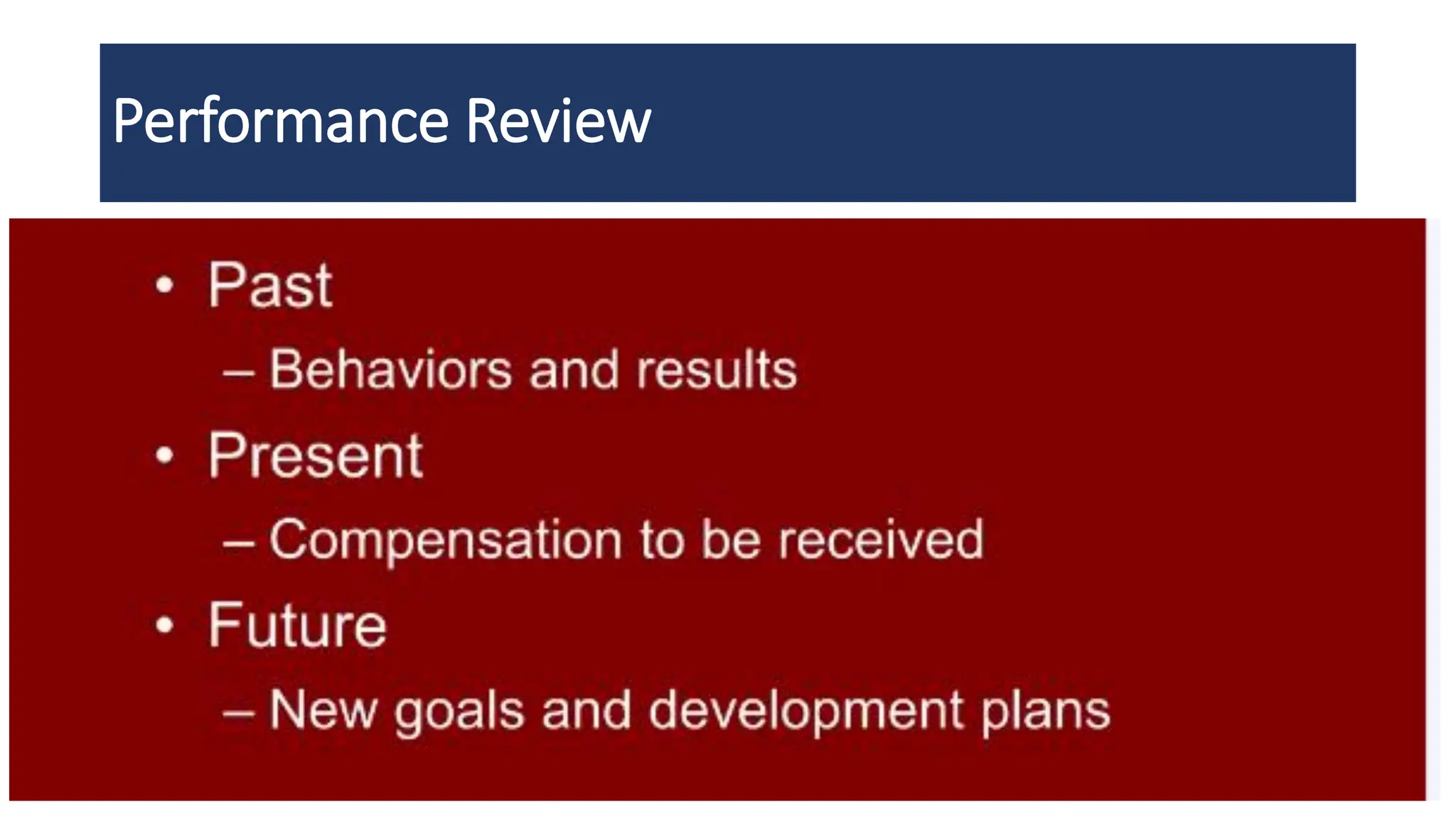
Performance Review
40
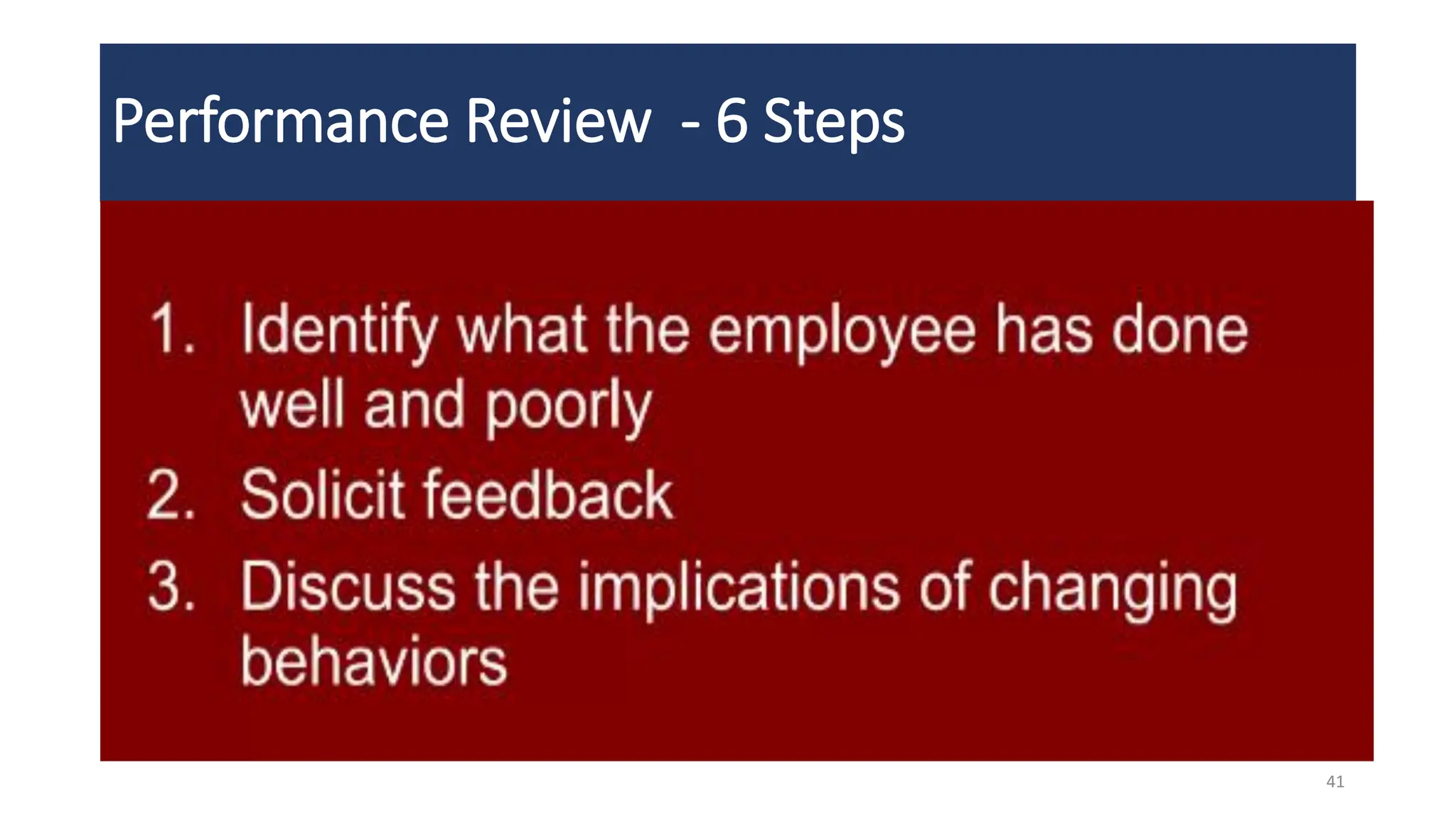
Performance Review - 6 Steps
41
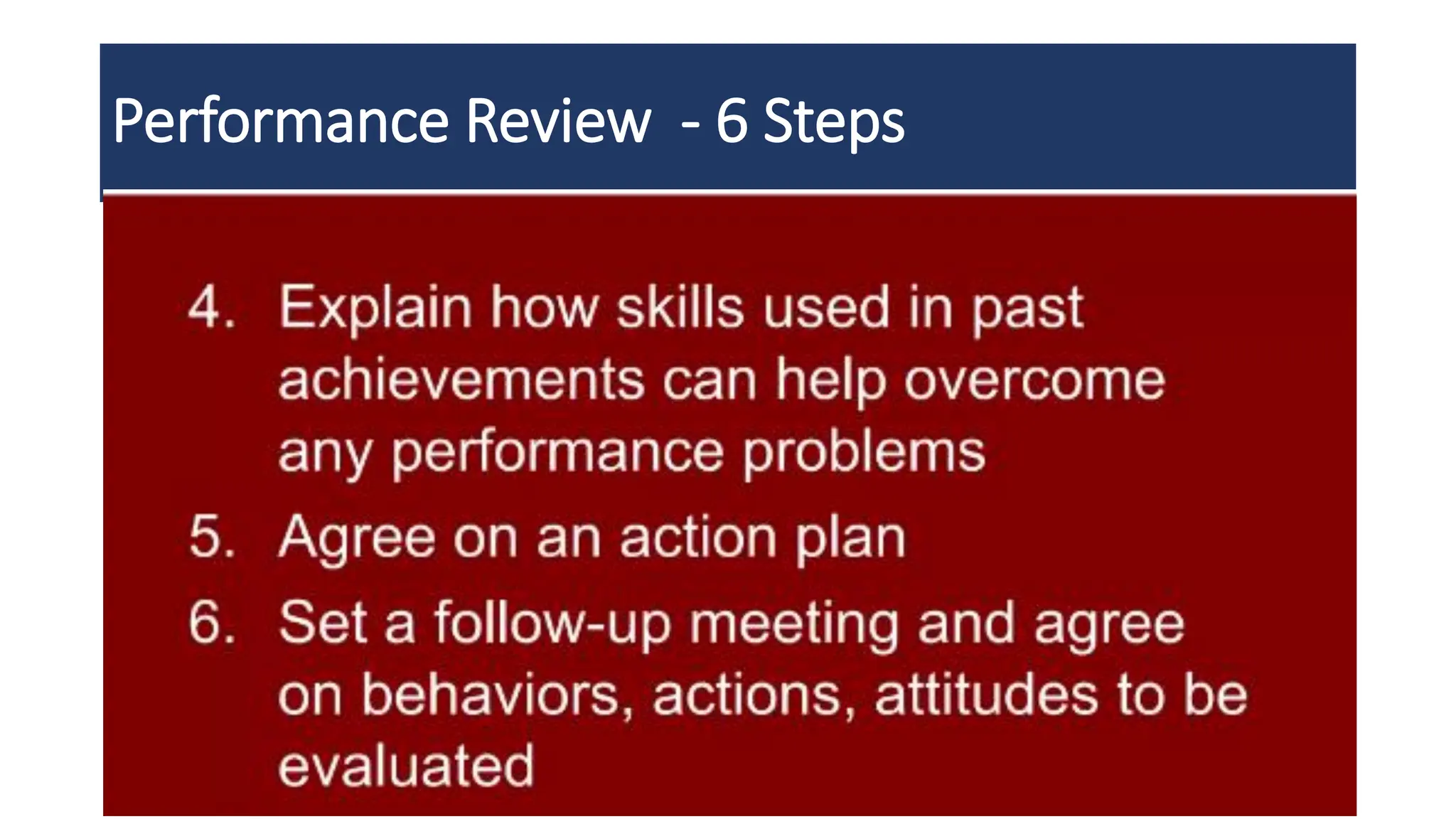
Performance Review - 6 Steps
42
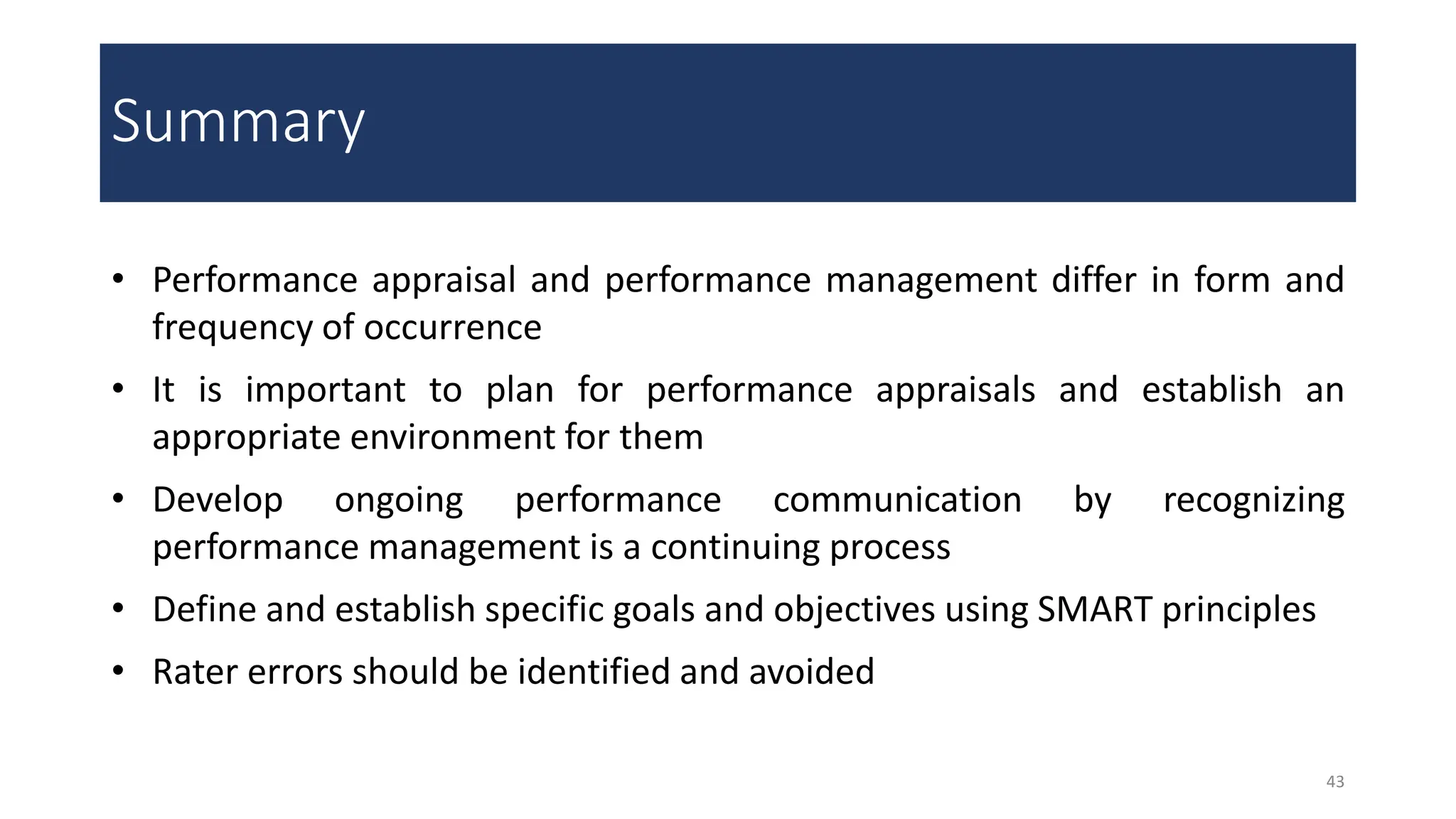
Summary
43
• Performance appraisal and performance management differ in form and
frequency of occurrence
• It is important to plan for performance appraisals and establish an
appropriate environment for them
• Develop ongoing performance communication by recognizing
performance management is a continuing process
• Define and establish specific goals and objectives using SMART principles
• Rater errors should be identified and avoided

Lecture 4 - Perfromance Management.pdfLecture 4 - Perfromance Management.pdf

  • 1.
  • 2.
    Introduction Performance management isthe broad collection of activities designed to maximize individual performance to contribute into organizational performance as per optimum It includes setting expectations, measuring employee behaviors and results, providing coaching and feedback, and evaluating performance over time to use in decision-making The purpose is to align individual efforts to achieve organizational goals A successful performance management program helps an employer retain talented employees, keep employees engaged, enhance employee learning and build a winning corporate culture 2
  • 3.
    Agenda • Performance appraisalversus performance management • Performance management continuum • Rater errors 3
  • 4.
    DEFINITION According to EdwinB Flippo, “Performance appraisal is a systematic, periodic and so far as humanly possible, an impartial rating of an employee’s excellence in matters pertaining to his present job and to his potentialities for a better job” 4
  • 5.
    Performance Appraisal Setting workstandards, assessing performance, and providing feedback to employees to motivate, correct, and continue their performance Performance Management An integrated approach to ensuring that an employee’s performance supports and contributes to the organization’s strategic aims Performance Management vs Performance Appraisal
  • 6.
    . • To determinethe effectiveness of employees on their present jobs so as to decide their benefits . • To identify the shortcomings of employees so as to overcome them through systematic guidance and training . • To find out their potential for promotion and advancement Objectives of Performance Appraisal
  • 7.
    Performance Appraisal versusPerformance Management Performance Appraisal Performance Management • One-time event Ongoing Process • Retrospective Prospective • Short-term Long-term • Correction-oriented Progress steps • Assigning ratings Planning/goal-setting • A component of PM A Complete HR Practice 7
  • 8.
    The Performance ManagementContinuum 8 Performance Planning and Goal Setting Ongoing Feedback Employee Input Evaluation of Performance (PA) Performance Review
  • 9.
    Setting Goals andObjectives Define and establish specific goals and objectives for the review period Use SMART goal criteria:  Specific, and clearly state the desired results  Measurable in answering “how much”  Attainable, and not too tough or too easy  Relevant to what’s to be achieved  Timely in reflecting deadlines and milestones 9
  • 10.
    Setting Goals andObjectives (cont.)  Align goals and objectives with the organization’s business plan  Establish mutually agreed-upon goals between the employee and the manager  Establish milestone review dates  Communicate changes or redirection of goals and objectives in a timely manner 10
  • 11.
    The Performance ManagementContinuum 11 Performance Planning and Goal Setting Ongoing Feedback Employee Input Evaluation of Performance (PA) Performance Review
  • 12.
    Providing Continuous Feedback Effectiveperformance management systems include a process for continuous feedback • Establish milestone dates for periodic monitoring of performance objectives and progress reports in objective terms • Be aware that goals or objectives may need to be changed or retargeted during the review period • Maintain open communication channels to ensure that issues are elevated quickly and resolved timely • Coach, assist and/or redirect employees who request assistance and those who are failing to meet standards 12
  • 13.
    The Performance ManagementContinuum 13 Performance Planning and Goal Setting Ongoing Feedback Employee Input Evaluation of Performance (PA) Performance Review
  • 14.
    Employee Input Once managementhas completed the defining stage, employees should have the opportunity to; • Give input on the tools and material • What KSA required • What environment • Sequence of steps to achieve the goal or objective will best assist the company to achieve organizational goals 14
  • 15.
    The Performance ManagementContinuum 15 Performance Planning and Goal Setting Ongoing Feedback Employee Input Evaluation of Performance (PA) Performance Review
  • 16.
    Conducting Appraisals To ensurean effective performance appraisal meeting, take the following steps: • Be prepared by collecting and reviewing performance notes, feedback and other data • Request self-appraisals from employees to be completed two weeks prior to the appraisal meeting • Choose a private and comfortable space for the meeting and schedule sufficient time to focus on the review • Encourage open dialogue regarding performance levels, lessons learned, ongoing progress, and goals and objectives for the next review period 16
  • 17.
    Who Should Dothe Appraising? Self-rating Subordinates 360-degree feedback Potential Appraisers Immediate supervisor Peers Rating committee
  • 18.
    The methods ofperformance appraisal are as follows A. Traditional Methods B. Modern Methods Methods of Performance Appraisal
  • 19.
    Performance Appraisal Methods 1 2 3 4 5 PairedComparison Ranking Method Grading Method Forced Distribution Forced-Choice Method 6 7 8 9 10 Critical Incidents Method Check-List Method Graphic Rating Scale Method Essay Method Field Review Method Traditional Methods Confidential Report (ACR) 11
  • 20.
    Performance Appraisal Methods 6 7 8 9 10 BehaviorallyAnchored Rating Scales (BARS) Management by Objectives (MBO) Assessment Centers 360 – Degree Appraisal Human Resource Accounting Modern Methods
  • 21.
    1. Ranking Method 2.Paired Comparison 3. Grading Method 4. Forced Distribution Method 5. Forced-Choice Method 6. Check-List Method 7. Critical Incidents Method 8. Graphic Rating Scale Method 9. Essay Method 10. Field Review Method 11. Confidential Report (ACR) A. Traditional methods
  • 22.
    1. Ranking Method Itis the oldest and simplest formal systematic method of performance appraisal in which employee is compared with all others for the purpose of placing order of worth. The employees are ranked from the highest to the lowest or from the best to the worst 2. Paired Comparison In this method, each employee is compared with other employees on one-on one basis only. The rater is provided with a bunch of slips each coining pair of names, the rater puts a tick mark against the employee whom he insiders the better of the two
  • 23.
    3. Grading Method Inthis method, certain categories of worth are established in advance and carefully defined. There can be three categories established for employees: outstanding, satisfactory and unsatisfactory. The employee is, then, allocated to the grade that best describes his or her performance 4. Forced Distribution Method This method assumes that employees performance level confirms to a normal statistical distribution i.e., 10,20,40,20 and 10%. This is useful for rating a large number of employees’ job performance and promo ability. It tends to eliminate or reduce bias
  • 24.
    5. Forced-Choice Method Underthis method, the rater is forced to answer the ready-made statements as given in the blocks of two or more, about the employees in terms of true or false. Once he is done with the list, it is forwarded to the HR department for the final assessment of the employee
  • 25.
    6. Check-List Method Thebasic purpose of utilizing check-list method is to ease the evaluation burden upon the rater. In this method, a series of statements, i.e., questions with their answers in ‘yes’ or ‘no’ are prepared by the HR department. The check-list is, then, presented to the rater to tick appropriate answers relevant to the appraise. Each question carries a weight-age in relationship to their importance
  • 26.
    7. Critical IncidentsMethod The critical incident method requires the rater to record statements that describe extremely good or bad behavior related to job performance. The statements are called critical incidents and are usually recorded by the supervisor during the evaluation period for each subordinate. Recorded incidents include a brief explanation of what happened
  • 27.
    8. Graphic RatingScale Method The graphic rating scale is one of the most popular and simplest techniques for appraising performance. It is also known as linear rating scale. In this method, the printed appraisal form is used to appraise each employee.
  • 28.
    9. Essay Method Essaymethod is the simplest one among various appraisal methods available. In this method, the rater writes a narrative description on an employee’s strengths, weaknesses, past performance, potential and suggestions for improvement. Its positive point is that it is simple in use. It does not require complex formats and extensive/specific training to complete it.
  • 29.
    10. Field ReviewMethod This is an appraisal done by someone outside employees, own department usually from corporate or HR department Advantages: Useful for managerial level promotions, when comparable information is needed Disadvantages: Outsider is generally not familiar with employees work environment, Observation of actual behaviors not possible
  • 30.
    11. Confidential Report Itis the traditional way of appraising employees mainly in the Government Departments. Evaluation is made by the immediate boss or supervisor for giving effect to promotion and transfer. Usually a structured format is devised to collect information on employee’s strength weakness, intelligence, attitude, character, attendance, discipline, etc.
  • 31.
    Performance Appraisal Methods 6 7 8 9 10 BehaviorallyAnchored Rating Scales (BARS) Management by Objectives (MBO) Assessment Centers 360 – Degree Appraisal Human Resource Accounting Modern Methods
  • 32.
    1. Management byObjectives (MBO) The concept of MBO can be described as a “process whereby the superior and subordinate managers of an organization jointly identify its common goals, define each individual’s major areas of responsibility in terms of results expected of him, and use these measures as guides for operating the unit and assessing the contribution of each its members”.
  • 33.
    2. Behaviourally AnchoredRating Scales (BARS) Behaviourally Anchored Rating Scales (BARS) are designed to bring the benefits of both qualitative and quantitative data to the employee appraisal process. BARS compare an individual’s performance against specific examples of behaviour that are anchored to numerical ratings.
  • 35.
    3. Assessment Centers Anassessment center is a central location where the managers may come together to participate in job related exercises evaluated by trained observers. The principle idea is to evaluate managers over a period of time, by observing and later evaluating their behaviour.
  • 36.
    4. 360 –Degree Appraisal In 360-degree appraisal system, an employee is appraised by his supervisor, subordinates, peers, and customers with whom he interacts in the course of his job performance. All these appraisers provide information or feedback on an employee by completing survey questionnaires designed for this purpose.
  • 37.
    5. Human ResourceAccounting Human resource method attaches money values to the value of a firms internal human resources and its external customer good will. Under this method, performance is judged in terms of costs and contributions of employees. Difference between the cost and contribution will reflect the performance of the employees
  • 38.
    Rater Errors -Grote (1996) Managers sometimes make errors in judgement due to their own perceptions and biases. Some common rater errors include the following: • Contrast effect. One is best other is not • Primacy Effect. First impression • Halo/ Horn effect. Performance is completely appraised based on a perceived positive quality, feature or trait (the employee never/ever can/ do wrong) • Central tendency. Lack of rating differentiation between employees • Leniency. Avoidance of honest ratings to avoid conflict • Recency effect. Narrow focus on recent events rather than the entire performance period • Similarity/”like me”. Favorable ratings given to employees who have similar values or interests to the rater 38
  • 39.
    Rater Errors (cont.) Tipsto avoid rater errors: • Make objective statements – “Ali arrived late on four occasions” rather than “Ali is always late.” • Consider the totality of the employee’s performance over the entire review period • Make and keep adequate records with specific examples • Establish milestones for progress reviews • Seek input from other managers or human resources • Participate in an organization-wide calibration process 39
  • 40.
  • 41.
  • 42.
  • 43.
    Summary 43 • Performance appraisaland performance management differ in form and frequency of occurrence • It is important to plan for performance appraisals and establish an appropriate environment for them • Develop ongoing performance communication by recognizing performance management is a continuing process • Define and establish specific goals and objectives using SMART principles • Rater errors should be identified and avoided