การวางแผนกำลังพล ให้สอดคล้องกับ ยุทธศาสตร์ทางธุรกิจขององค์กร Kiattisak Sampaongern HR Manager/CPAC [email_address]
Today Discussion HR Management and Business Strategy Change & Competitive Challenge HR Management and Business Strategy Manpower Planning Process Manpower Analysis Manpower Forecast – Demand/Supply Action Plan Manpower Planning Management Recruitment Development Employee Shortage/Surplus Key Take Away/Q&A
21st Century is the era of “Change” “ All thing in this world are impermanent. They have the nature to rise and pass away. To be in harmony with this truth bring true happiness “ Buddhist Chant
Top Ten Most popular Career 2006 Network system analysis Physician’s analysis Medical Assistants Medical Records and Health Information Technicians Software Engineer Physical Therapist Aides Fitness Trainer Database Administrators Veterinary Technicians Dental Hygienists Source : www.alec.co.uk
Top Ten Decline Career in 2014  Stock Clerk File Clerk Post Officer Secretaries except legal , medical , executive Administrative support Call Center Staff Door to door sales Purchasing Officer Computer Operator HR Officer Source : www.bls.gov
Increasing globalization ( การเติบโตของโลกกาภิวัฒน์ ) Emergence of new competitors ( คู่แข่งขันรายใหม่ ) Changing customer demands ( ความต้องการของลูกค้าเปลี่ยนแปลงไป ) Shortened product life cycles ( สินค้ามีอายุสั้นลง ) Heightened environmental concerns ( การให้ความสำคัญกับสิ่งแวดล้อม ) Increasing regulatory demands ( กฎกติกาใหม่ๆ ) Forces of “Change ” Joseph M. Ryan, Ph.D. Wharton School
What do customers want? Speed Right at the first time High standard performance Passion and experience
Strategic Management Process Mission Goal External Analysis Internal Analysis Human  Resources Needs Skill Behavior Culture Strategic  Choice Human  Resources Practices Human  Action Organization Performance Source : Human Resources Management 3 rd  edition Gaining a competitive advantage Human  Capability
HRM Strategy Vision  Internal / External Manpower Planning Selection Process Salary Bonus Welfare Benefit  Performance appraisal Potential evaluation Talent Assessment Compensation Management Performance Management Succession plan Promotion Job assignment Career  Planning Learning Training Development Development Retire Early Retire Termination Employee relation Retire & Retain Manpower Planning Mission  Biz Result  Leadership Human Capability  Culture Business Process Competency  Change
Change Globalization Global Competitor Global Mindset Technology Change Learning Organization  Knowledge Base Economy Talent  Performance Mgt. Development Plan Competitiveness Vision/Mission KPIs Competency HRD link to business result Value/Culture Organization Technology/Skill Business Result HRM Process Succession Plan
How to Create  High Performance Organization? How people are serve organization target? ( ทำอย่างไร ... พนักงานทำงานตามเป้าหมายที่องค์กรต้องการ ) How talents are selected ? ( ทำอย่างไร ... จะคัดเลือกคนเก่งคนดี ) How to motivate people ?  ( ทำอย่างไร .. จะจูงใจให้ทำงาน ) How people are developed ?  ( ทำอย่างไร ... จะพัฒนาความสามารถพนักงาน ) How to retain people ?  ( ทำอย่างไร ... จะรักษาพนักงานไว้ได้ )
A goal without a plan is just a wish. Antoine de Saint-Exupery
Manpower Planning Process
MANPOWER PLANNING “ process of  identifying  and  responding  to  organizational needs  and charting new policies, systems, and programs that will assure effective human resource management under changing conditions in the future” getting  the right people   at  the right place on  the right time www.icb.cau.edu.cn
Purpose of Manpower Planning Recruitment Gaps Training and Development Staff Costings Redundancy Collective Bargaining Accommodation www.ulst.ac.uk
Developing a work unit Activity Analysis Raw Input What material, data and information are needed? Equipment What special equipment, facilities and systems are needed? Human Resources What knowledge , skill and attribute are needed? Activity What task are required in the production? Output What product ad service is provide? How is the output measured Source : Human Resources Management 3 rd  edition Gaining a competitive advantage
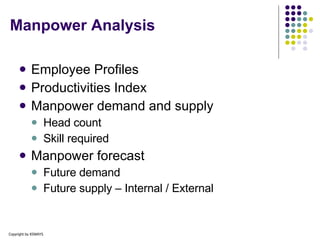
Manpower Analysis Employee Profiles Productivities Index Manpower demand and supply Head count Skill required Manpower forecast Future demand Future supply   – Internal / External
Sample : Employee Profile
Sample : Productivities Index
Forecasting Future Demand (1) Requires looking at: Skills required To achieve Business Targets (Goals, Design, Culture)  Assess skills available Vs Required Predict how many people required Skills will depend on: Timescale Nature of Org. activities
Need assessment process Person analysis Organization analysis Task analysis Source : Human Resources Management 3 rd  edition Gaining a competitive advantage Who need training? In what do they need training? What is the context?  Reason Legislation Lack of basic skill Poor performance New technology New product New job Customer request Higher performance  Outcome What trainee need to learn Who receives training Type of training Frequency of training Training or other option such job redesign
Forecasting Future Demand (2) Techniques Used to Forecast Demand: Systematic Techniques Time series or ratio trend analysis Work-study approach Productivity trend analysis Managerial Judgement Combined Approach (1+2) Working back from costs
Forecasting Supply - Internal Involves identifying/acknowledging the existing staff employed by an organisation department by department grade by grade Involves: Skills Audits Predicting Staff Turnover Internal promotion analysis
Forecasting Supply - External Filling the GAP using the external labour market: Local  International Understanding of the dynamics of the Labour Market to update plans as trends change and develop General population density Population movements  Age distribution Unemployment rates Education Level Proportion with higher education Skill levels/Skills shortages
Action Plan  Situation Plans: Redundancy  Redeployment Retirement Recruitment Training Retention Succession Option Plan  Outsourcing
Manpower Planning Management
Manpower Management Surplus – Shortage Restructure Skill Required
Sample : Manpower Planning   Productivities Reject & Rework Manpower Turnover Existing
% Productivities Index Sample : Manpower Planning
Dealing with an Oversupply of Manpower Freeze hiring Restrict overtime Retrain/redeploy Switch to part-time employees Use unpaid vacations Use a shorter workweek Use pay reductions Use sabbaticals Encourage early retirements
Dealing with an Undersupply of Personnel Hire additional workers Improve productivity through training Use overtime Add additional shifts Reassign jobs Use temporary workers Improve retention
Recruitment Job Choice Vacancy Applicant Recruitment Sources Company policy Recruiter Internal – external recruiting Market positioning and company image Internal – external source Collage and universities Employment agencies
Development Methods Apprentice Training Coaching Job Rotation Shadowing Special Project Assignment On-the-Job Training Mentoring Off-site Training Program Community of Practice (CoP) Self Study Assessment Center  Preferences, Corporate Culture, Actual Possibilities Intervention for Development Development through Work Job Rotations Shadowing/Coaching CoP Activities Challenges Training & Development Job Enlargement/Enrichment CBT Career Counseling Source : Hunseok Oh (Department of Education, Seoul National University, Korea)
Option for Reducing an  Expected Labor Surplus Option Speed Human Suffering 1.Downsizing Fast High 2.Pay Reduction Fast High 3.Demotions Fast High 4.Transfers Fast Moderate 5.Work sharing Fast  Moderate 6.Retirement Slow Low 7.Natural attrition Slow Low 8.Retraining Slow Low Source : Human Resources Management 3 rd  edition Gaining a competitive advantage
Option for Avoiding an  Expected Labor Shortage Option Speed Revocability 1.Overtime Fast   High 2.Temporary employees Fast   High 3.Outsourcing Fast   High 4.Retrained transfers Slow   High 5.Turnover reductions Slow    Moderate 6.New external hires Slow   Low 7.Technological innovation Slow   Low Source : Human Resources Management 3 rd  edition Gaining a competitive advantage
Key Take Away Fact & Data Manpower Planning is not Recruitment Commitment from Management Budget Thai Culture Communication/Communication/Communication Employee Feeling Believe in Value of Individual
ANY QUESTION? "The important thing is not to stop questioning."  Albert Einstein

Ks Manpower Planning

  • 1.
  • 2.
    Today Discussion HRManagement and Business Strategy Change & Competitive Challenge HR Management and Business Strategy Manpower Planning Process Manpower Analysis Manpower Forecast – Demand/Supply Action Plan Manpower Planning Management Recruitment Development Employee Shortage/Surplus Key Take Away/Q&A
  • 3.
    21st Century isthe era of “Change” “ All thing in this world are impermanent. They have the nature to rise and pass away. To be in harmony with this truth bring true happiness “ Buddhist Chant
  • 4.
    Top Ten Mostpopular Career 2006 Network system analysis Physician’s analysis Medical Assistants Medical Records and Health Information Technicians Software Engineer Physical Therapist Aides Fitness Trainer Database Administrators Veterinary Technicians Dental Hygienists Source : www.alec.co.uk
  • 5.
    Top Ten DeclineCareer in 2014 Stock Clerk File Clerk Post Officer Secretaries except legal , medical , executive Administrative support Call Center Staff Door to door sales Purchasing Officer Computer Operator HR Officer Source : www.bls.gov
  • 6.
    Increasing globalization (การเติบโตของโลกกาภิวัฒน์ ) Emergence of new competitors ( คู่แข่งขันรายใหม่ ) Changing customer demands ( ความต้องการของลูกค้าเปลี่ยนแปลงไป ) Shortened product life cycles ( สินค้ามีอายุสั้นลง ) Heightened environmental concerns ( การให้ความสำคัญกับสิ่งแวดล้อม ) Increasing regulatory demands ( กฎกติกาใหม่ๆ ) Forces of “Change ” Joseph M. Ryan, Ph.D. Wharton School
  • 7.
    What do customerswant? Speed Right at the first time High standard performance Passion and experience
  • 8.
    Strategic Management ProcessMission Goal External Analysis Internal Analysis Human Resources Needs Skill Behavior Culture Strategic Choice Human Resources Practices Human Action Organization Performance Source : Human Resources Management 3 rd edition Gaining a competitive advantage Human Capability
  • 9.
    HRM Strategy Vision Internal / External Manpower Planning Selection Process Salary Bonus Welfare Benefit Performance appraisal Potential evaluation Talent Assessment Compensation Management Performance Management Succession plan Promotion Job assignment Career Planning Learning Training Development Development Retire Early Retire Termination Employee relation Retire & Retain Manpower Planning Mission Biz Result Leadership Human Capability Culture Business Process Competency Change
  • 10.
    Change Globalization GlobalCompetitor Global Mindset Technology Change Learning Organization Knowledge Base Economy Talent Performance Mgt. Development Plan Competitiveness Vision/Mission KPIs Competency HRD link to business result Value/Culture Organization Technology/Skill Business Result HRM Process Succession Plan
  • 11.
    How to Create High Performance Organization? How people are serve organization target? ( ทำอย่างไร ... พนักงานทำงานตามเป้าหมายที่องค์กรต้องการ ) How talents are selected ? ( ทำอย่างไร ... จะคัดเลือกคนเก่งคนดี ) How to motivate people ? ( ทำอย่างไร .. จะจูงใจให้ทำงาน ) How people are developed ? ( ทำอย่างไร ... จะพัฒนาความสามารถพนักงาน ) How to retain people ? ( ทำอย่างไร ... จะรักษาพนักงานไว้ได้ )
  • 12.
    A goal withouta plan is just a wish. Antoine de Saint-Exupery
  • 13.
  • 14.
    MANPOWER PLANNING “process of identifying and responding to organizational needs and charting new policies, systems, and programs that will assure effective human resource management under changing conditions in the future” getting the right people at the right place on the right time www.icb.cau.edu.cn
  • 15.
    Purpose of ManpowerPlanning Recruitment Gaps Training and Development Staff Costings Redundancy Collective Bargaining Accommodation www.ulst.ac.uk
  • 16.
    Developing a workunit Activity Analysis Raw Input What material, data and information are needed? Equipment What special equipment, facilities and systems are needed? Human Resources What knowledge , skill and attribute are needed? Activity What task are required in the production? Output What product ad service is provide? How is the output measured Source : Human Resources Management 3 rd edition Gaining a competitive advantage
  • 17.
    Manpower Analysis EmployeeProfiles Productivities Index Manpower demand and supply Head count Skill required Manpower forecast Future demand Future supply – Internal / External
  • 18.
  • 19.
  • 20.
    Forecasting Future Demand(1) Requires looking at: Skills required To achieve Business Targets (Goals, Design, Culture) Assess skills available Vs Required Predict how many people required Skills will depend on: Timescale Nature of Org. activities
  • 21.
    Need assessment processPerson analysis Organization analysis Task analysis Source : Human Resources Management 3 rd edition Gaining a competitive advantage Who need training? In what do they need training? What is the context? Reason Legislation Lack of basic skill Poor performance New technology New product New job Customer request Higher performance Outcome What trainee need to learn Who receives training Type of training Frequency of training Training or other option such job redesign
  • 22.
    Forecasting Future Demand(2) Techniques Used to Forecast Demand: Systematic Techniques Time series or ratio trend analysis Work-study approach Productivity trend analysis Managerial Judgement Combined Approach (1+2) Working back from costs
  • 23.
    Forecasting Supply -Internal Involves identifying/acknowledging the existing staff employed by an organisation department by department grade by grade Involves: Skills Audits Predicting Staff Turnover Internal promotion analysis
  • 24.
    Forecasting Supply -External Filling the GAP using the external labour market: Local International Understanding of the dynamics of the Labour Market to update plans as trends change and develop General population density Population movements Age distribution Unemployment rates Education Level Proportion with higher education Skill levels/Skills shortages
  • 25.
    Action Plan Situation Plans: Redundancy Redeployment Retirement Recruitment Training Retention Succession Option Plan Outsourcing
  • 26.
  • 27.
    Manpower Management Surplus– Shortage Restructure Skill Required
  • 28.
    Sample : ManpowerPlanning Productivities Reject & Rework Manpower Turnover Existing
  • 29.
    % Productivities IndexSample : Manpower Planning
  • 30.
    Dealing with anOversupply of Manpower Freeze hiring Restrict overtime Retrain/redeploy Switch to part-time employees Use unpaid vacations Use a shorter workweek Use pay reductions Use sabbaticals Encourage early retirements
  • 31.
    Dealing with anUndersupply of Personnel Hire additional workers Improve productivity through training Use overtime Add additional shifts Reassign jobs Use temporary workers Improve retention
  • 32.
    Recruitment Job ChoiceVacancy Applicant Recruitment Sources Company policy Recruiter Internal – external recruiting Market positioning and company image Internal – external source Collage and universities Employment agencies
  • 33.
    Development Methods ApprenticeTraining Coaching Job Rotation Shadowing Special Project Assignment On-the-Job Training Mentoring Off-site Training Program Community of Practice (CoP) Self Study Assessment Center Preferences, Corporate Culture, Actual Possibilities Intervention for Development Development through Work Job Rotations Shadowing/Coaching CoP Activities Challenges Training & Development Job Enlargement/Enrichment CBT Career Counseling Source : Hunseok Oh (Department of Education, Seoul National University, Korea)
  • 34.
    Option for Reducingan Expected Labor Surplus Option Speed Human Suffering 1.Downsizing Fast High 2.Pay Reduction Fast High 3.Demotions Fast High 4.Transfers Fast Moderate 5.Work sharing Fast Moderate 6.Retirement Slow Low 7.Natural attrition Slow Low 8.Retraining Slow Low Source : Human Resources Management 3 rd edition Gaining a competitive advantage
  • 35.
    Option for Avoidingan Expected Labor Shortage Option Speed Revocability 1.Overtime Fast High 2.Temporary employees Fast High 3.Outsourcing Fast High 4.Retrained transfers Slow High 5.Turnover reductions Slow Moderate 6.New external hires Slow Low 7.Technological innovation Slow Low Source : Human Resources Management 3 rd edition Gaining a competitive advantage
  • 36.
    Key Take AwayFact & Data Manpower Planning is not Recruitment Commitment from Management Budget Thai Culture Communication/Communication/Communication Employee Feeling Believe in Value of Individual
  • 37.
    ANY QUESTION? "Theimportant thing is not to stop questioning." Albert Einstein