Human Resource Management
Management Process
• Planning
• Organizing
• Staffing
• Leading
• Controlling
Human Resource Management
“The policies and practices involved in carrying out the
‘people’ or human resource aspects of a management position,
including recruiting, screening, training, rewarding, and appraising.”
- Gary Dessler
“HRM is concerned with the most effective use of people to
achieve organizational and individual goals. It is the way of managing
people at work, so that they give their best to the organization.”
- Invancevich and Glueck
Nature of HRM
1. HRM involves the application of management
functions and principles.
2. Decision relating to employees must be integrated.
3. Decisions made influence the effectiveness of an
organization.
4. HRM functions are not confined to business
establishments only.
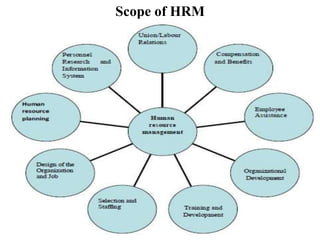
Scope of HRM
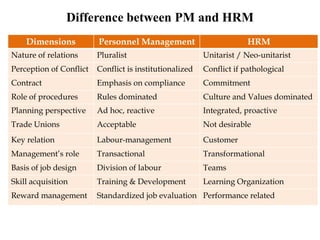
Difference between PM and HRM
Dimensions Personnel Management HRM
Nature of relations Pluralist Unitarist / Neo-unitarist
Perception of Conflict Conflict is institutionalized Conflict if pathological
Contract Emphasis on compliance Commitment
Role of procedures Rules dominated Culture and Values dominated
Planning perspective Ad hoc, reactive Integrated, proactive
Trade Unions Acceptable Not desirable
Key relation Labour-management Customer
Management’s role Transactional Transformational
Basis of job design Division of labour Teams
Skill acquisition Training & Development Learning Organization
Reward management Standardized job evaluation Performance related
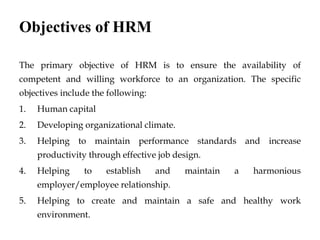
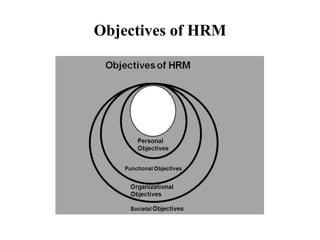
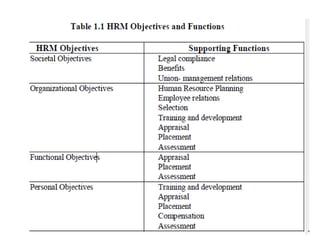
Objectives of HRM
The primary objective of HRM is to ensure the availability of
competent and willing workforce to an organization. The specific
objectives include the following:
1. Human capital
2. Developing organizational climate.
3. Helping to maintain performance standards and increase
productivity through effective job design.
4. Helping to establish and maintain a harmonious
employer/employee relationship.
5. Helping to create and maintain a safe and healthy work
environment.
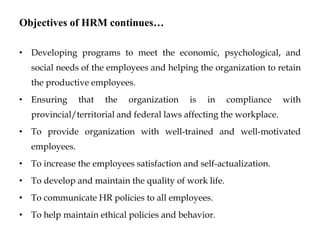
Objectives of HRM continues…
• Developing programs to meet the economic, psychological, and
social needs of the employees and helping the organization to retain
the productive employees.
• Ensuring that the organization is in compliance with
provincial/territorial and federal laws affecting the workplace.
• To provide organization with well-trained and well-motivated
employees.
• To increase the employees satisfaction and self-actualization.
• To develop and maintain the quality of work life.
• To communicate HR policies to all employees.
• To help maintain ethical policies and behavior.
Objectives of HRM
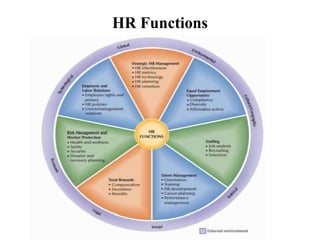
HR Functions
HR Functions…
• Strategic HR Management
• Equal Employment Opportunity
• Staffing
• Talent Management and Development
• Total Rewards
• Risk Management and Worker Protection
• Employee and Labour Relations
Evolution of HRM
• Welfare Officer
• Personnel Management
• Human Resource Management
• SHRM
Roles & Responsibilities of HR
Manager
The primary responsibilities of Human Resource managers are:
• To develop a thorough knowledge of corporate culture, plans and
policies.
• To act as an internal change agent and consultant
• To initiate change and act as an expert and facilitator
• To actively involve in company’s strategy formulation
• To keep communication line open between the HRD function and
individuals and groups both within and outside the organization
• To identify and evolve HRD strategies in consonance with overall
business strategy.
Continue…
• To facilitate the development of various organizational teams and
their working relationship with other teams and individuals.
• To try and relate people and work so that the organization
objectives are achieved efficiently and effectively.
• To diagnose problems and determine appropriate solution
particularly in the human resource areas.
• To provide co-ordination and support services for the delivery of
HRD programmes and services
• To evaluate the impact of an HRD intervention or to conduct
research so as to identify, develop or test how HRD In general has
improved individual and organizational performance.
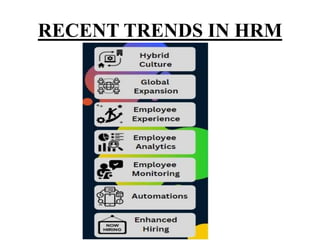
RECENT TRENDS IN HRM
1. A hybrid structure
The personnel groups relocated when work-from-home became a routine, leaving all the
teams and companies to disband from one particular geographical location to
anywhere in the nation.
Where some organizations are encouraging their employees to start in-office jobs again,
many are content with a hybrid culture and are continuing to play by that.
2. Global expansion on the rise
Shifting your work into the global market – remote working is an initial step. With changing
times and technology the trends in HRM have taken a turn too, and the inauguration of
a business in foreign lands is becoming a cakewalk. Furthermore, governments uplifting
strict policies in this post-pandemic era – support the businesses too.
3. Employee experiences take precedence
Employees today don’t just want a good paycheck but a quality culture and healthy work
environment as well. As a part of trends in HRM, a good remuneration retains an
employee, and a qualified environment and experience assist in the choice too.
HR leaders should bring about methods to encourage positive workforce health, making
the employees more flexible to changes and disruptions.
4. Analytics gaining the front seats
With no physical human contact, tracking and measuring the work and employees became
strenuous, especially when the workforce is spread throughout the globe. Analytics is
said to play an impacting role in offering information for decision-making.
5. A surge in monitoring the employees
With the growing number of hybrid workers, managers are often unable to scrutinize every
single employee and their work. The lack of personal interaction led to a surge in
employee monitoring techniques that gave birth to yet another set of trends in HRM.
Keeping track of work and performance, attendance, and leaves, are just a portion of
employee monitoring practices.
6. Automation of everyday tasks
To give precedence to high-value and productive workings, HR leaders can leverage AI-
powered solutions to automate their daily tasks that were carried out manually.
Practices such as screening, sourcing talents, onboarding, keeping check of attendance,
etc., and a lot more now can be carried out by the systems in this tech-driven world.
7. Augmenting the hiring processes
Yet another perk that can be considered as a part of trends in HRM are chatbots. With their
assistance, employers can now manage to select quality candidates for relevant
positions out of the ample talent pools available.
Solutions such as resume screening choose explicit candidate profiles, subsequently
ensuing in higher work performance and enhanced productivity.
The top solutions AI offers to the HR sector are, cloud solutions, bots, language processing,
digital assistants, automated solutions, etc., which are just some initial ones. ‘
From learning how to administer the work-from-home workers to pivoting toward the
contactless deliveries, everything was put on the table in front of us in a haphazard
manner.
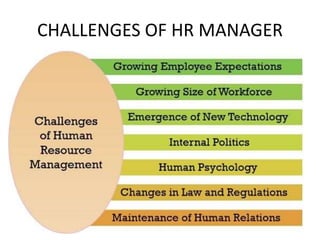
CHALLENGES OF HR MANAGER
Other Authors…
• Dave Ulrich - Four Roles
• R.L.Mathis & J.H.Jackson - Three Roles
• Mc. Kinsey - 7 S
Dave Ulrich…
• Strategic Partner Role
• Change Agent Role
• Employees Champion Role
• Administrative Role
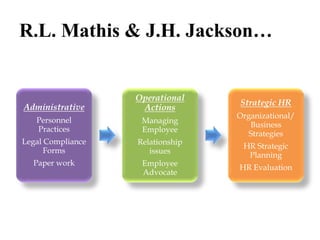
R.L. Mathis & J.H. Jackson…
Administrative
Personnel
Practices
Legal Compliance
Forms
Paper work
Operational
Actions
Managing
Employee
Relationship
issues
Employee
Advocate
Strategic HR
Organizational/
Business
Strategies
HR Strategic
Planning
HR Evaluation
Mc. Kinsey’s 7-S framework
model…
• Strategy
• Structure
• Systems
• Style
• Staff
• Skills
• Super-ordinate Goals
What is a HRM Plan?
HRM is a strategic and systematic approach to managing
people in a way that would maximise their motivation and
contribution towards meeting the organisation’s objectives. A
HRM Plan is a departmental document which sets out what
programmes are required in the following few years to practise
HRM in the department. The aim of a HRM Plan is to help the
department to achieve its mission and objectives through a
systematic design and implementation of HRM programmes.
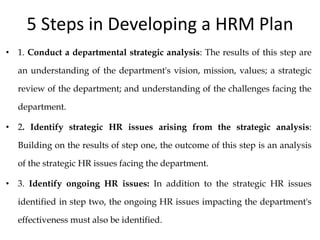
5 Steps in Developing a HRM Plan
• 1. Conduct a departmental strategic analysis: The results of this step are
an understanding of the department's vision, mission, values; a strategic
review of the department; and understanding of the challenges facing the
department.
• 2. Identify strategic HR issues arising from the strategic analysis:
Building on the results of step one, the outcome of this step is an analysis
of the strategic HR issues facing the department.
• 3. Identify ongoing HR issues: In addition to the strategic HR issues
identified in step two, the ongoing HR issues impacting the department's
effectiveness must also be identified.
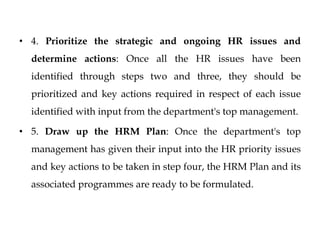
• 4. Prioritize the strategic and ongoing HR issues and
determine actions: Once all the HR issues have been
identified through steps two and three, they should be
prioritized and key actions required in respect of each issue
identified with input from the department's top management.
• 5. Draw up the HRM Plan: Once the department's top
management has given their input into the HR priority issues
and key actions to be taken in step four, the HRM Plan and its
associated programmes are ready to be formulated.

HRM_Module_1.pptx

  • 1.
  • 2.
    Management Process • Planning •Organizing • Staffing • Leading • Controlling
  • 3.
    Human Resource Management “Thepolicies and practices involved in carrying out the ‘people’ or human resource aspects of a management position, including recruiting, screening, training, rewarding, and appraising.” - Gary Dessler “HRM is concerned with the most effective use of people to achieve organizational and individual goals. It is the way of managing people at work, so that they give their best to the organization.” - Invancevich and Glueck
  • 4.
    Nature of HRM 1.HRM involves the application of management functions and principles. 2. Decision relating to employees must be integrated. 3. Decisions made influence the effectiveness of an organization. 4. HRM functions are not confined to business establishments only.
  • 5.
  • 6.
    Difference between PMand HRM Dimensions Personnel Management HRM Nature of relations Pluralist Unitarist / Neo-unitarist Perception of Conflict Conflict is institutionalized Conflict if pathological Contract Emphasis on compliance Commitment Role of procedures Rules dominated Culture and Values dominated Planning perspective Ad hoc, reactive Integrated, proactive Trade Unions Acceptable Not desirable Key relation Labour-management Customer Management’s role Transactional Transformational Basis of job design Division of labour Teams Skill acquisition Training & Development Learning Organization Reward management Standardized job evaluation Performance related
  • 7.
    Objectives of HRM Theprimary objective of HRM is to ensure the availability of competent and willing workforce to an organization. The specific objectives include the following: 1. Human capital 2. Developing organizational climate. 3. Helping to maintain performance standards and increase productivity through effective job design. 4. Helping to establish and maintain a harmonious employer/employee relationship. 5. Helping to create and maintain a safe and healthy work environment.
  • 8.
    Objectives of HRMcontinues… • Developing programs to meet the economic, psychological, and social needs of the employees and helping the organization to retain the productive employees. • Ensuring that the organization is in compliance with provincial/territorial and federal laws affecting the workplace. • To provide organization with well-trained and well-motivated employees. • To increase the employees satisfaction and self-actualization. • To develop and maintain the quality of work life. • To communicate HR policies to all employees. • To help maintain ethical policies and behavior.
  • 9.
  • 11.
  • 12.
    HR Functions… • StrategicHR Management • Equal Employment Opportunity • Staffing • Talent Management and Development • Total Rewards • Risk Management and Worker Protection • Employee and Labour Relations
  • 13.
    Evolution of HRM •Welfare Officer • Personnel Management • Human Resource Management • SHRM
  • 14.
    Roles & Responsibilitiesof HR Manager The primary responsibilities of Human Resource managers are: • To develop a thorough knowledge of corporate culture, plans and policies. • To act as an internal change agent and consultant • To initiate change and act as an expert and facilitator • To actively involve in company’s strategy formulation • To keep communication line open between the HRD function and individuals and groups both within and outside the organization • To identify and evolve HRD strategies in consonance with overall business strategy.
  • 15.
    Continue… • To facilitatethe development of various organizational teams and their working relationship with other teams and individuals. • To try and relate people and work so that the organization objectives are achieved efficiently and effectively. • To diagnose problems and determine appropriate solution particularly in the human resource areas. • To provide co-ordination and support services for the delivery of HRD programmes and services • To evaluate the impact of an HRD intervention or to conduct research so as to identify, develop or test how HRD In general has improved individual and organizational performance.
  • 16.
  • 17.
    1. A hybridstructure The personnel groups relocated when work-from-home became a routine, leaving all the teams and companies to disband from one particular geographical location to anywhere in the nation. Where some organizations are encouraging their employees to start in-office jobs again, many are content with a hybrid culture and are continuing to play by that. 2. Global expansion on the rise Shifting your work into the global market – remote working is an initial step. With changing times and technology the trends in HRM have taken a turn too, and the inauguration of a business in foreign lands is becoming a cakewalk. Furthermore, governments uplifting strict policies in this post-pandemic era – support the businesses too. 3. Employee experiences take precedence Employees today don’t just want a good paycheck but a quality culture and healthy work environment as well. As a part of trends in HRM, a good remuneration retains an employee, and a qualified environment and experience assist in the choice too. HR leaders should bring about methods to encourage positive workforce health, making the employees more flexible to changes and disruptions. 4. Analytics gaining the front seats With no physical human contact, tracking and measuring the work and employees became strenuous, especially when the workforce is spread throughout the globe. Analytics is said to play an impacting role in offering information for decision-making.
  • 18.
    5. A surgein monitoring the employees With the growing number of hybrid workers, managers are often unable to scrutinize every single employee and their work. The lack of personal interaction led to a surge in employee monitoring techniques that gave birth to yet another set of trends in HRM. Keeping track of work and performance, attendance, and leaves, are just a portion of employee monitoring practices. 6. Automation of everyday tasks To give precedence to high-value and productive workings, HR leaders can leverage AI- powered solutions to automate their daily tasks that were carried out manually. Practices such as screening, sourcing talents, onboarding, keeping check of attendance, etc., and a lot more now can be carried out by the systems in this tech-driven world. 7. Augmenting the hiring processes Yet another perk that can be considered as a part of trends in HRM are chatbots. With their assistance, employers can now manage to select quality candidates for relevant positions out of the ample talent pools available. Solutions such as resume screening choose explicit candidate profiles, subsequently ensuing in higher work performance and enhanced productivity. The top solutions AI offers to the HR sector are, cloud solutions, bots, language processing, digital assistants, automated solutions, etc., which are just some initial ones. ‘ From learning how to administer the work-from-home workers to pivoting toward the contactless deliveries, everything was put on the table in front of us in a haphazard manner.
  • 19.
  • 20.
    Other Authors… • DaveUlrich - Four Roles • R.L.Mathis & J.H.Jackson - Three Roles • Mc. Kinsey - 7 S
  • 21.
    Dave Ulrich… • StrategicPartner Role • Change Agent Role • Employees Champion Role • Administrative Role
  • 22.
    R.L. Mathis &J.H. Jackson… Administrative Personnel Practices Legal Compliance Forms Paper work Operational Actions Managing Employee Relationship issues Employee Advocate Strategic HR Organizational/ Business Strategies HR Strategic Planning HR Evaluation
  • 23.
    Mc. Kinsey’s 7-Sframework model… • Strategy • Structure • Systems • Style • Staff • Skills • Super-ordinate Goals
  • 24.
    What is aHRM Plan? HRM is a strategic and systematic approach to managing people in a way that would maximise their motivation and contribution towards meeting the organisation’s objectives. A HRM Plan is a departmental document which sets out what programmes are required in the following few years to practise HRM in the department. The aim of a HRM Plan is to help the department to achieve its mission and objectives through a systematic design and implementation of HRM programmes.
  • 25.
    5 Steps inDeveloping a HRM Plan • 1. Conduct a departmental strategic analysis: The results of this step are an understanding of the department's vision, mission, values; a strategic review of the department; and understanding of the challenges facing the department. • 2. Identify strategic HR issues arising from the strategic analysis: Building on the results of step one, the outcome of this step is an analysis of the strategic HR issues facing the department. • 3. Identify ongoing HR issues: In addition to the strategic HR issues identified in step two, the ongoing HR issues impacting the department's effectiveness must also be identified.
  • 26.
    • 4. Prioritizethe strategic and ongoing HR issues and determine actions: Once all the HR issues have been identified through steps two and three, they should be prioritized and key actions required in respect of each issue identified with input from the department's top management. • 5. Draw up the HRM Plan: Once the department's top management has given their input into the HR priority issues and key actions to be taken in step four, the HRM Plan and its associated programmes are ready to be formulated.