The document discusses creating intelligent and cost-conscious shared services processes. It outlines an approach to shared services that involves assessing the current state, formulating options, conducting feasibility analyses, and developing a low-cost model. Key objectives are discussed such as strategic alignment. A shared services vision and structure is presented using accounts payable as a pilot function. The rationale for a shared services center is described as providing a service-oriented and scalable infrastructure with appropriate accountability.

Introduction to iProcess, focusing on creating intelligent, cost-effective processes for shared services.
Overview of value creation approach including assessment, model development, and governance for shared service implementation.
Defining key objectives and a structured approach to Business Support Services with a focus on the Accounts Payable pilot.
Vision for an Accounts Payable Service Center emphasizing process efficiency, service quality, and cost savings.
Different organizational models for shared services including centralized, hybrid, distributed, and hosted options.
Framework for assessing cost structures and benchmarking across sectors to determine shared service viability.
Strategies for effectively deploying shared services, focusing on outsourcing benefits and guiding principles.
Designing future organizational structures around shared services including function placement and governance. Assessment of risks in implementing shared services with mitigation strategies and a summary of key practices.
1 iProcess Value Creation
Approach
Ramesh Krish Proprietary and Confidential P2
4.
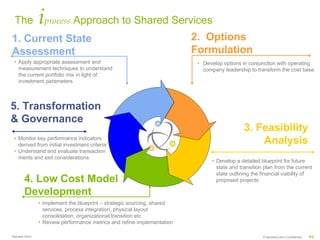
The iprocess Approach to Shared Services
1. Current State 2. Options
Assessment Formulation
• Apply appropriate assessment and • Develop options in conjunction with operating
measurement techniques to understand company leadership to transform the cost base
the current portfolio mix in light of
investment parameters
5. Transformation
& Governance
3. Feasibility
• Monitor key performance indicators
derived from initial investment criteria
CUSTOMER Analysis
• Understand and evaluate transaction
merits and exit considerations
• Develop a detailed blueprint for future
state and transition plan from the current
state outlining the financial viability of
4. Low Cost Model proposed projects
Development
• Implement the blueprint – strategic sourcing, shared
services, process integration, physical layout
consolidation, organizational transition etc
• Review performance metrics and refine implementation
Ramesh Krish Proprietary and Confidential P3
5.
2 Shared Services Vision
Ramesh Krish Proprietary and Confidential P4
6.
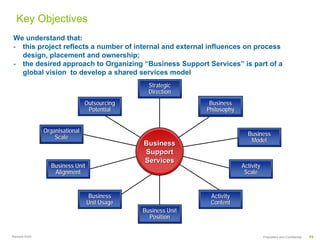
Key Objectives
We understandthat:
- this project reflects a number of internal and external influences on process
design, placement and ownership;
- the desired approach to Organizing “Business Support Services” is part of a
global vision to develop a shared services model
Strategic
Direction
Outsourcing Business
Potential Philosophy
Organisational
Business
Scale Model
Business
Support
Services
Business Unit Activity
Alignment Scale
Business Activity
Unit Usage Content
Business Unit
Position
Ramesh Krish Proprietary and Confidential P5
7.
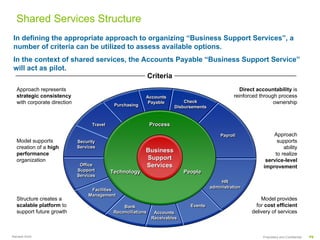
Shared Services Structure
Indefining the appropriate approach to organizing “Business Support Services”, a
number of criteria can be utilized to assess available options.
In the context of shared services, the Accounts Payable “Business Support Service”
will act as pilot.
Criteria
Approach represents Direct accountability is
strategic consistency Accounts
Accounts reinforced through process
with corporate direction Payable
Payable Check
Check ownership
Purchasing
Purchasing Disbursements
Disbursements
Travel
Travel Process
Services
Services
Payroll
Payroll Approach
Model supports Security
Security supports
creation of a high Services
Services ability
performance
Business
to realize
organization Support service-level
Office
Office Services improvement
Support
Support Technology People
Services
Services
HR
HR
administration
administration
Facilities
Facilities
Management
Management
Structure creates a Model provides
scalable platform to Bank
Bank Events
Events for cost efficient
support future growth Reconciliations
Reconciliations Accounts
Accounts delivery of services
Receivables
Receivables
Ramesh Krish Proprietary and Confidential P6
8.
3 Shared Services Rationale
Ramesh Krish Proprietary and Confidential P7
9.
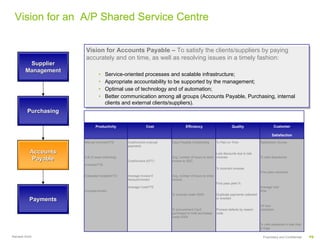
Vision for anA/P Shared Service Centre
Vision for Accounts Payable – To satisfy the clients/suppliers by paying
accurately and on time, as well as resolving issues in a timely fashion:
Supplier
Management
•• Service-oriented processes and scalable infrastructure;
Service-oriented processes and scalable infrastructure;
•• Appropriate accountability to be supported by the management;
Appropriate accountability to be supported by the management;
•• Optimal use of technology and of automation;
Optimal use of technology and of automation;
•• Better communication among all groups (Accounts Payable, Purchasing, internal
Better communication among all groups (Accounts Payable, Purchasing, internal
clients and external clients/suppliers).
Purchasing
Business Performance Dimensions – Sample of performance metrics for A/P
Productivity Cost Efficiency Quality Customer
Satisfaction
Manual Invoices/FTE Cost/Invoice (manual Days Payable Outstanding % Paid on Time Satisfaction Survey
payment)
Accounts Lost discounts due to late
Full (3 ways-matching) Avg. number of hours to send invoices % calls abandoned
Payable Cost/Invoice (EFT) invoice to SSC
Invoices/FTE
% incorrect invoices
First pass resolution
Evaluated receipts/FTE Average Invoice € Avg. number of hours to enter
Amount/Vendor invoice
First pass yield %
Average Cost/FTE Average hold
Invoices/vendor time
% invoices under €500 Duplicate payments collected
Payments or avoided
24 hour
% procurement Card Process defects by reason resolution
purchases to total purchases code
under €500
% calls answered in less than
3 rings
Ramesh Krish Proprietary and Confidential P8
10.
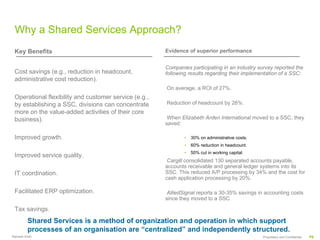
Why a SharedServices Approach?
Key Benefits Evidence of superior performance
Companies participating in an industry survey reported the
Cost savings (e.g., reduction in headcount, following results regarding their implementation of a SSC:
administrative cost reduction).
On average, a ROI of 27%.
Operational flexibility and customer service (e.g.,
by establishing a SSC, divisions can concentrate Reduction of headcount by 26%.
more on the value-added activities of their core
business). When Elizabeth Arden International moved to a SSC, they
saved:
Improved growth. • 30% on administrative costs.
• 60% reduction in headcount.
• 50% cut in working capital.
Improved service quality.
Cargill consolidated 130 separated accounts payable,
accounts receivable and general ledger systems into its
IT coordination. SSC. This reduced A/P processing by 34% and the cost for
cash application processing by 20%.
Facilitated ERP optimization. AlliedSignal reports a 30-35% savings in accounting costs
since they moved to a SSC.
Tax savings.
Shared Services is a method of organization and operation in which support
processes of an organisation are “centralized” and independently structured.
Ramesh Krish Proprietary and Confidential P9
11.
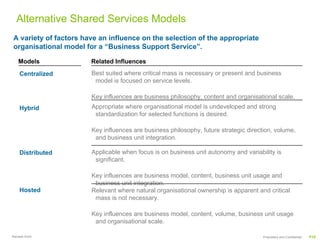
Alternative Shared ServicesModels
A variety of factors have an influence on the selection of the appropriate
organisational model for a “Business Support Service”.
Models Related Influences
Centralized Best suited where critical mass is necessary or present and business
model is focused on service levels.
Key influences are business philosophy, content and organisational scale.
Hybrid Appropriate where organisational model is undeveloped and strong
standardization for selected functions is desired.
Key influences are business philosophy, future strategic direction, volume,
and business unit integration.
Distributed Applicable when focus is on business unit autonomy and variability is
significant.
Key influences are business model, content, business unit usage and
business unit integration.
Hosted Relevant where natural organisational ownership is apparent and critical
mass is not necessary.
Key influences are business model, content, volume, business unit usage
and organisational scale.
Ramesh Krish Proprietary and Confidential P10
12.
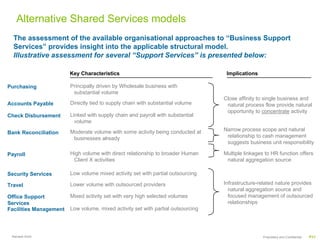
Alternative Shared Servicesmodels
The assessment of the available organisational approaches to “Business Support
Services” provides insight into the applicable structural model.
Illustrative assessment for several “Support Services” is presented below:
Key Characteristics Implications
Purchasing Principally driven by Wholesale business with
substantial volume
Close affinity to single business and
Accounts Payable Directly tied to supply chain with substantial volume natural process flow provide natural
opportunity to concentrate activity
Check Disbursement Linked with supply chain and payroll with substantial
volume
Moderate volume with some activity being conducted at Narrow process scope and natural
Bank Reconciliation
businesses already relationship to cash management
suggests business unit responsibility
Payroll High volume with direct relationship to broader Human Multiple linkages to HR function offers
Client X activities natural aggregation source
Security Services Low volume mixed activity set with partial outsourcing
Travel Lower volume with outsourced providers Infrastructure-related nature provides
natural aggregation source and
Office Support Mixed activity set with very high selected volumes focused management of outsourced
Services relationships
Facilities Management Low volume, mixed activity set with partial outsourcing
Ramesh Krish Proprietary and Confidential P11
13.
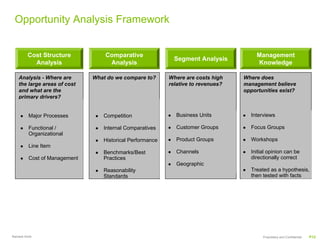
Opportunity Analysis Framework
Cost Structure Comparative Management
Segment Analysis
Analysis Analysis Knowledge
Analysis - Where are What do we compare to? Where are costs high Where does
the large areas of cost relative to revenues? management believe
and what are the opportunities exist?
primary drivers?
Major Processes Competition Business Units Interviews
Functional / Internal Comparatives Customer Groups Focus Groups
Organizational
Historical Performance Product Groups Workshops
Line Item
Benchmarks/Best Channels Initial opinion can be
Cost of Management Practices directionally correct
Geographic
Reasonability Treated as a hypothesis,
Standards then tested with facts
Ramesh Krish Proprietary and Confidential P12
14.
4 Shared ServicesDeployment
Ramesh Krish Proprietary and Confidential P13
15.
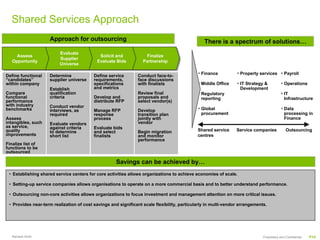
Shared Services Approach
Approach for outsourcing There is a spectrum of solutions…
Evaluate
Evaluate
Assess
Assess Solicit and
Solicit and Finalize
Finalize
Supplier
Supplier
Opportunity
Opportunity Evaluate Bids
Evaluate Bids Partnership
Partnership
Universe
Universe
4 Finance 4 Property services 4 Payroll
Define functional Determine Define service Conduct face-to-
“candidates” supplier universe requirements, face discussions
within company specifications with finalists 4 Middle Office 4 IT
Strategy & 4 Operations
Establish and metrics Development
Compare qualification Review final 4 Regulatory 4 IT
functional criteria Develop and proposals and reporting Infrastructure
performance distribute RFP select vendor(s)
with industry Conduct vendor
benchmarks 4 Global 4 Data
interviews, as Manage RFP Develop
required response transition plan procurement processing in
Assess process jointly with Finance
intangibles, such Evaluate vendors vendor
as service, against criteria Evaluate bids
quality to determine and select Begin migration Shared service Service companies Outsourcing
improvements short list finalists and monitor centres
performance
Finalize list of
functions to be
outsourced
Savings can be achieved by…
• Establishing shared service centers for core activities allows organizations to achieve economies of scale.
• Setting-up service companies allows organisations to operate on a more commercial basis and to better understand performance.
• Outsourcing non-core activities allows organizations to focus investment and management attention on more critical issues.
• Provides near-term realization of cost savings and significant scale flexibility, particularly in multi-vendor arrangements.
Ramesh Krish Proprietary and Confidential P14
16.
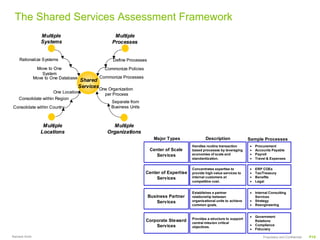
The Shared ServicesAssessment Framework
Multiple Multiple
Systems Processes
Rationalize Systems Define Processes
Move to One Commonize Policies
System
Move to One Database Commonize Processes
Shared
ServicesOne Organization
One Location
per Process
Consolidate within Region
Separate from
Consolidate within Country Business Units
Multiple Multiple
Locations Organizations
Major Types Description Sample Processes
Handles routine transaction • Procurement
Center of Scale based processes by leveraging • Accounts Payable
Services economies of scale and • Payroll
standardization. • Travel & Expenses
Concentrates expertise to • ERP COEs
Center of Expertise provide high-value services to • Tax/Treasury
Services internal customers at • Benefits
competitive cost. • Legal
Establishes a partner • Internal Consulting
Business Partner relationship between Services
Services organizational units to achieve • Strategy
common goals. • Reengineering
• Government
Provides a structure to support
Corporate Steward central mission critical
Relations
Services • Compliance
objectives.
• Fiduciary
Ramesh Krish Proprietary and Confidential P15
17.
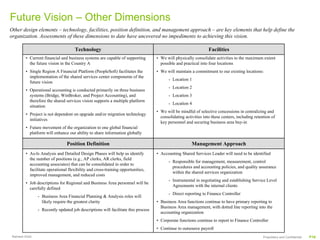
Future Vision –Other Dimensions
Other design elements – technology, facilities, position definition, and management approach – are key elements that help define the
organization. Assessments of these dimensions to date have uncovered no impediments to achieving this vision.
Technology Facilities
• Current financial and business systems are capable of supporting • We will physically consolidate activities to the maximum extent
the future vision in the Country A possible and practical into four locations
• Single Region A Financial Platform (PeopleSoft) facilitates the • We will maintain a commitment to our existing locations:
implementation of the shared services center components of the
- Location 1
future vision
- Location 2
• Operational accounting is conducted primarily on three business
systems (Bridge, WinBroker, and Project Accounting), and - Location 3
therefore the shared services vision supports a multiple platform
- Location 4
situation
• We will be mindful of selective concessions in centralizing and
• Project is not dependent on upgrade and/or migration technology
consolidating activities into these centers, including retention of
initiatives
key personnel and securing business area buy-in
• Future movement of the organization to one global financial
platform will enhance our ability to share information globally
Position Definition Management Approach
• As-Is Analysis and Detailed Design Phases will help us identify • Accounting Shared Services Leader will need to be identified
the number of positions (e.g., AP clerks, AR clerks, field
- Responsible for management, measurement, control
accounting associates) that can be consolidated in order to
procedures and accounting policies, and quality assurance
facilitate operational flexibility and cross-training opportunities,
within the shared services organization
improved management, and reduced costs
- Instrumental in negotiating and establishing Service Level
• Job descriptions for Regional and Business Area personnel will be
Agreements with the internal clients
carefully defined
- Direct reporting to Finance Controller
- Business Area Financial Planning & Analysis roles will
likely require the greatest clarity • Business Area functions continue to have primary reporting to
Business Area management, with dotted line reporting into the
- Recently updated job descriptions will facilitate this process
accounting organization
• Corporate functions continue to report to Finance Controller
• Continue to outsource payroll
Ramesh Krish Proprietary and Confidential P16
18.
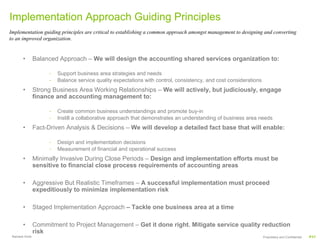
Implementation Approach GuidingPrinciples
Implementation guiding principles are critical to establishing a common approach amongst management to designing and converting
to an improved organization.
• Balanced Approach – We will design the accounting shared services organization to:
- Support business area strategies and needs
- Balance service quality expectations with control, consistency, and cost considerations
• Strong Business Area Working Relationships – We will actively, but judiciously, engage
finance and accounting management to:
- Create common business understandings and promote buy-in
- Instill a collaborative approach that demonstrates an understanding of business area needs
• Fact-Driven Analysis & Decisions – We will develop a detailed fact base that will enable:
- Design and implementation decisions
- Measurement of financial and operational success
• Minimally Invasive During Close Periods – Design and implementation efforts must be
sensitive to financial close process requirements of accounting areas
• Aggressive But Realistic Timeframes – A successful implementation must proceed
expeditiously to minimize implementation risk
• Staged Implementation Approach – Tackle one business area at a time
• Commitment to Project Management – Get it done right. Mitigate service quality reduction
risk
Ramesh Krish Proprietary and Confidential P17
19.
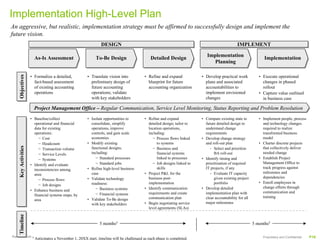
Implementation High-Level Plan
Anaggressive, but realistic, implementation strategy must be affirmed to successfully design and implement the
future vision.
DESIGN
DESIGN IMPLEMENT
IMPLEMENT
Implementation
As-Is Assessment To-Be Design Detailed Design Implementation
Planning
• Formalize a detailed, • Translate vision into • Refine and expand • Develop practical work • Execute operational
Objectives
Objectives
fact-based assessment preliminary design of blueprint for future plans and associated changes in phased
of existing accounting future accounting accounting organization accountabilities to rollout
operations operations; validate implement envisioned • Capture value outlined
with key stakeholders changes in business case
Project Management Office – Regular Communication, Service Level Monitoring, Status Reporting and Problem Resolution
• Baseline/collect • Isolate opportunities to • Refine and expand • Compare existing state to • Implement people, process
operational and financial consolidate, simplify detailed design; tailor to future detailed design to and technology changes
data for existing operations, improve location operations, understand change required to realize
operations: controls, and gain scale including: requirements transformed business
− Cost economies − Process flows linked • Develop change strategy model
− Headcount • Modify existing to systems and roll-out plan • Charter discrete projects
Key Activities
functional designs, − Business and - Select and prioritize that collectively deliver
Key Activities
− Transaction volume
− Service Levels including: financial systems BA roll-out needed change
− Systems − Standard processes linked to processes • Identify timing and • Establish Project
− Standard jobs − Job designs linked to prioritization of required Management Office to
• Identify and evaluate
• Refine high-level business skills IT projects, if any track progress against
inconsistencies among
case • Project P&L for the - Evaluate IT capacity milestones and
area:
• Validate technology business post- given existing project dependencies
− Process flows
readiness: implementation portfolio • Enroll employees in
− Job designs
− Business systems • Identify communication • Develop detailed change efforts through
• Enhance business and communication and
− Financial systems requirements and create implementation plan with
financial systems maps, by training
• Validate To-Be design communication plan clear accountability for all
area
with key stakeholders • Begin negotiating service major milestones
level agreements (SLAs)
Timeline
Timeline
5 months5 5 months5
Ramesh Krish 5 Proprietary and Confidential P18
Anticipates a November 1, 20XX start; timeline will be challenged as each phase is completed.
20.
Project Organization
Enrolling key stakeholders, business area management and Subject Matter Advisors in the project from design through implementation
will be critical to project success.
Roles & Responsibilities
− CFO −Business Head • Provide active, visible and vocal leadership
Steering Committee
Steering Committee − Controller −[HR]
• Champion Business Area buy-in
− Business Area CFO 1 −[IT]
− Business Area CFO 2 −[Tax] • Execute enterprise-wide communications/ recommendations
Project Sponsor − TBD • Serve as main voice for project – change advocate/ opinion leader
Project Sponsor
• Set overall project direction, set priorities and allocate resources
Project Manager
Project Manager − TBD • Responsible for overall engagement execution and management
• Identify issues & risks and ensure escalation/ resolution
Business Area Teams
Business Area Teams Program Management
• Support Team Leads in project planning and delivery
• Track status and manage issue identification and resolution
BU 1
BU 1 • Design and deliver change management programs
Team Rosters:
BU 2
BU 2 − 1.0 Team Lead
Team Leads
• Manage collection and synthesis of data, internal benchmarks, and design elements
− X.0 Business Area Lead
BU 3
BU 3 − X.0 Analysts • Facilitate meetings with key executives, business areas, and functional teams
Program
Program − TBD SMAs • Participate in site visits, planning sessions and development of deliverables
Management Office
Management Office BU 4
BU 4 • Skill set needs: Operational performance improvement; Accounting process redesign;
Benchmarking study design and execution; Implementation planning; Strong oral and
BU 5
BU 5 written skills; Visioning Sessions; and Group facilitation
Business Area Leads
Other
Other • Act as liaison with represented Business Area
Tax Team
Tax Team • Deep business area/ technical knowledge and familiarity with its accounting roles
Human Resources/
Human Resources/ • Participate in data gathering, visioning, and planning
− 1.0 Team Lead
− TBD SMAs Facilities Team
Facilities Team Analysts
− 1.0 Team Lead • Perform selected benchmarking, business case, process & organization analysis
− X.0 Analysts activities
Treasury Team
Treasury Team − TBD SMAs • Assist with deliverable development
− 1.0 Team Lead Subject Matter Advisors (SMAs)
− TBD SMAs Technology Team • Help anticipate, identify and resolve issues
Technology Team • Provide accounting and shared services center subject matter expertise and support,
− 1.0 Team Lead as needed
− X.0 Analysts • Reference applicable best practices
− TBD SMAs
Ramesh Krish Proprietary and Confidential P19
21.
5 Alternate SharedServices
Models
Ramesh Krish Proprietary and Confidential P20
22.
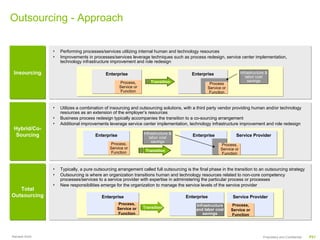
Outsourcing - Approach
4 Performing processes/services utilizing internal human and technology resources
4 Improvements in processes/services leverage techniques such as process redesign, service center implementation,
technology infrastructure improvement and role redesign
Insourcing Enterprise Enterprise Infrastructure &
labor cost
Process, Transition savings
Process
Service or Service or
Function Function
4 Utilizes a combination of insourcing and outsourcing solutions, with a third party vendor providing human and/or technology
resources as an extension of the employer’s resources
4 Business process redesign typically accompanies the transition to a co-sourcing arrangement
4 Additional improvements leverage service center implementation, technology infrastructure improvement and role redesign
Hybrid/Co-
Sourcing Infrastructure &
Enterprise labor cost
Enterprise Service Provider
savings
Process, Process,
Service or Service or
Function Transition
Function
4 Typically, a pure outsourcing arrangement called full outsourcing is the final phase in the transition to an outsourcing strategy
4 Outsourcing is where an organization transitions human and technology resources related to non-core competency
processes/services to a service provider with expertise in administering the particular process or processes
4 New responsibilities emerge for the organization to manage the service levels of the service provider
Total
Outsourcing Enterprise Enterprise Service Provider
Process, Infrastructure Process,
Service or Transition
and labor cost Service or
Function savings Function
Ramesh Krish Proprietary and Confidential P21
23.
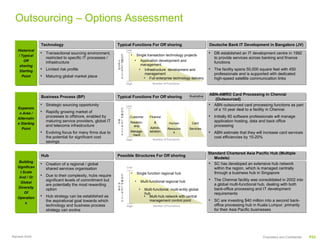
Outsourcing – OptionsAssessment
Technology Typical Functions For Off shoring Deutsche Bank IT Development in Bangalore (JV)
Historical Low
4 Transactional sourcing environment, 4 DB established an IT development centre in 1992
/ Typical C 4 Single transaction technology projects
restricted to specific IT processes / O to provide services across banking and finance
Off T M 4 Application development and
infrastructure E P functions
shoring C L management
E
4 Limited risk profile H
X 4 Infrastructure development and 4 The facility spans 50,000 square feet with 450
Starting I
T
management professionals and is supported with dedicated
Point 4 Maturing global market place Y 4 Full enterprise technology delivery high-speed satellite communication links
High Number of Functions
Illustrative
ABN-AMRO Card Processing in Chennai
Business Process (BP) Typical Functions For Off shoring
(Outsourced)
4 Strategic sourcing opportunity Low 4 ABN outsourced card processing functions as part
Expansio C of a 10 year deal to a facility in Chennai
n Area / 4 Rapidly growing market of O
M
Alternativ
processes to offshore, enabled by P Customer Finance 4 Initially 60 software professionals will manage
maturing service providers, global IT B L application hosting, data and back office
e Starting P E Relation- & Human Card
and telecoms infrastructure X ship processing
Point I Admin- Resource Services
4 Evolving focus for many firms due to T Manage- istration s 4 ABN estimate that they will increase card services
Y ment
the potential for significant cost cost efficiencies by 15-20%
High Number of Functions
savings
Standard Chartered Asia Pacific Hub (Multiple
Hub Possible Structures For Off shoring
Models)
Building
4 Creation of a regional / global 4 SC has developed an extensive hub network
Significan shared services organisation Low within the region, which is managed centrally
t Scale 4 Single function regional hub through a business hub in Singapore
4 Due to their complexity, hubs require C
And / Or O
significant levels of commitment but M 4 The Chennai facility was consolidated in 2002 into
Global 4 Multi-functional regional hub
HP a global multi-functional hub, dealing with both
are potentially the most rewarding U L
Diversity back-office processing and IT development
option B E 4 Multi-functional, multi-entity global
Of X hub requirements
4 Hub strategy can be established as I 4 Multi-hub network with central
Operation T
the aspirational goal towards which Y management control point 4 SC are investing $40 million into a second back-
s
technology and business process High Number of Functions office processing hub in Kuala Lumpur, primarily
strategy can evolve for their Asia Pacific businesses
Ramesh Krish Proprietary and Confidential P22
24.
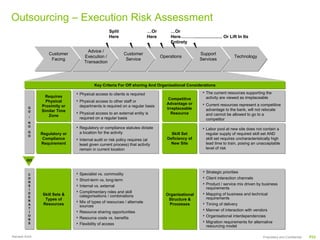
Outsourcing – ExecutionRisk Assessment
Split …Or …Or
Here Here Here………....................... Or Lift In Its
Entirety
Advice /
Customer Customer Support
Execution / Operations Technology
Facing Service Services
Transaction
Key Criteria For Off shoring And Organisational Considerations
4 Physical access to clients is required 4 The current resources supporting the
Requires activity are viewed as irreplaceable
Competitive
Physical 4 Physicalaccess to other staff or
Advantage or 4 Currentresources represent a competitive
G
Proximity or departments is required on a regular basis
Irreplaceable advantage to the bank, will not relocate
O Similar Time
4 Physical access to an external entity is Resource and cannot be allowed to go to a
/ Zone
required on a regular basis competitor
N
O 4 Regulatory or compliance statutes dictate 4 Labor pool at new site does not contain a
G
Regulatory or a location for the activity Skill Set regular supply of required skill set AND
O
Compliance 4 Internal audit or risk policy requires (at Deficiency of skill set requires uncharacteristically high
Requirement least given current process) that activity New Site lead time to train, posing an unacceptable
remain in current location level of risk
GO
4 Strategic priorities
C 4 Specialist vs. commodity
O 4 Client interaction channels
4 Short-term vs. long-term
N
4 Product / service mix driven by business
S 4 Internal vs. external
I requirements
D 4 Complimentary roles and skill
Skill Sets & Organizational 4 Mapping of business and technical
E categorisations / combinations
Types of Structure & requirements
R 4 Mix of types of resources / alternate
A Resources Processes 4 Timing of delivery
sources
T
4 Manner of interaction with vendors
I 4 Resource sharing opportunities
O 4 Organisational interdependencies
N 4 Resource costs vs. benefits
S 4 Migration requirements for alternative
4 Flexibility of access
resourcing model
Ramesh Krish Proprietary and Confidential P23
25.
6 Functional Placement
Ramesh Krish Proprietary and Confidential P24
26.
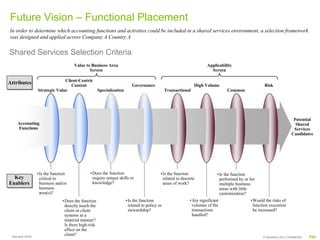
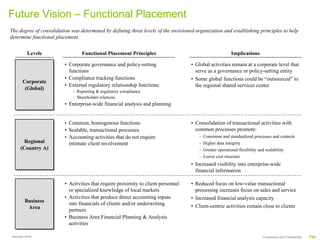
Future Vision –Functional Placement
In order to determine which accounting functions and activities could be included in a shared services environment, a selection framework
was designed and applied across Company A Country A
Shared Services Selection Criteria
Value to Business Area Applicability
Screen Screen
Client-Centric
Attributes Content Governance High Volume Risk
Strategic Value Specialization Transactional Common
Potential
Accounting Shared
Functions Services
Candidates
•Is the function •Does the function •Is the function •Is the function
Key critical to require unique skills or related to discrete performed by or for
Enablers business and/or knowledge? areas of work? multiple business
business areas with little
area(s)? customization?
•Does the function •Is the function •Are significant •Would the risks of
directly touch the related to policy or volumes of the function execution
client or client stewardship? transactions be increased?
systems in a handled?
material manner?
Is there high-risk
effect on the
Ramesh Krish
client?
Proprietary and Confidential P25
27.
Future Vision –Functional Placement
The degree of consolidation was determined by defining three levels of the envisioned organization and establishing principles to help
determine functional placement.
Levels Functional Placement Principles Implications
• Corporate governance and policy-setting • Global activities remain at a corporate level that
functions serve as a governance or policy-setting entity
• Compliance tracking functions • Some global functions could be “outsourced” to
Corporate
Corporate • External regulatory relationship functions: the regional shared services center
(Global)
(Global) - Reporting & regulatory compliance
- Shareholder relations
• Enterprise-wide financial analysis and planning
• Common, homogenous functions • Consolidation of transactional activities with
• Scalable, transactional processes common processes promote:
• Accounting activities that do not require - Consistent and standardized processes and controls
Regional
Regional intimate client involvement - Higher data integrity
(Country A)
(Country A) - Greater operational flexibility and scalability
- Lower cost structure
• Increased visibility into enterprise-wide
financial information
• Activities that require proximity to client personnel • Reduced focus on low-value transactional
or specialized knowledge of local markets processing increases focus on sales and service
• Activities that produce direct accounting inputs • Increased financial analysis capacity
Business
Business into financials of clients and/or underwriting
Area
Area • Client-centric activities remain close to clients
partners
• Business Area Financial Planning & Analysis
activities
Ramesh Krish Proprietary and Confidential P26
28.
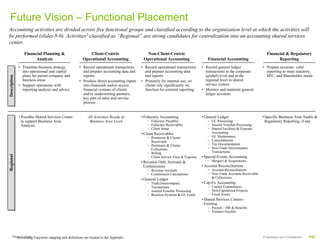
Future Vision –Functional Placement
Accounting activities are divided across five functional groups and classified according to the organization level at which the activities will
be performed (slides 8-9). Activities2 classified as “Regional” are strong candidates for centralization into an accounting shared services
center.
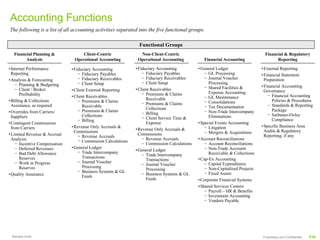
Financial Planning & Client-Centric Non-Client-Centric Financial & Regulatory
Analysis Operational Accounting Operational Accounting Financial Accounting Reporting
• Translate business strategy • Record operational transactions • Record operational transactions • Record general ledger • Prepare accurate, valid
into operational and capital and prepare accounting data and and prepare accounting data transactions at the corporate reporting to meet statutory,
plans for parent company and reports and reports (global) level and at the SEC, and Shareholder needs
Description
Description
business areas • Produce direct accounting inputs • Primarily for internal use; no regional level in shared
• Support operations with into financials and/or access clients rely significantly on service centers
reporting analysis and advice financial systems of clients function for external reporting • Monitor and maintain general
and/or underwriting partners; ledger accounts
key part of sales and service
process
• Possible Shared Services Center All Activities Reside at • Fiduciary Accounting • General Ledger • Specific Business Area Audits &
to support Business Area Business Area Level − Fiduciary Payables − GL Processing Regulatory Reporting, if any
Analysis − Fiduciary Receivables − Journal Voucher Processing
− Client Setup − Shared Facilities & Expense
• Client Receivables Accounting
− Premiums & Claims − GL Maintenance
Receivable − Consolidations
− Premiums & Claims − Tax Documentation
Collections − Non-Trade Intercompany
− Billing Transactions
Regional
− Client Service Time & Expense • Special Events Accounting
Regional
• Revenue Only Accruals & − Mergers & Acquisitions
Commissions • Account Reconciliations
− Revenue Accruals − Account Reconciliations
− Commission Calculations − Non-Trade Accounts Receivable
• General Ledger & Collections
− Trade Intercompany • Cap-Ex Accounting
Transactions − Capital Expenditures
− Journal Voucher Processing − Non-Capitalized Projects
− Business Systems & GL Feeds − Fixed Assets
• Shared Services Centers –
Existing
− Payroll – HR & Benefits
− Vendors Payable
Ramesh Krish Functions mapping and definitions are located in the Appendix.
2 Accounting Proprietary and Confidential P27
29.
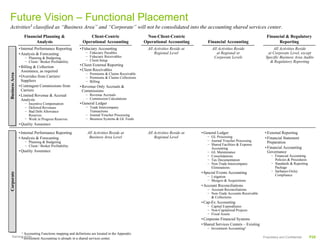
Future Vision –Functional Placement
Activities3 classified as “Business Area” and “Corporate” will not be consolidated into the accounting shared services center.
Financial Planning & Client-Centric Non-Client-Centric Financial & Regulatory
Analysis Operational Accounting Operational Accounting Financial Accounting Reporting
• Internal Performance Reporting • Fiduciary Accounting All Activities Reside at All Activities Reside All Activities Reside
• Analysis & Forecasting − Fiduciary Payables Regional Level at Regional or at Corporate Level, except
− Planning & Budgeting − Fiduciary Receivables Corporate Levels Specific Business Area Audits
− Client / Broker Profitability − Client Setup & Regulatory Reporting
• Billing & Collection • Client External Reporting
Assistance, as required • Client Receivables
− Premiums & Claims Receivable
Business Area
Business Area
• Overrides from Carriers/ − Premiums & Claims Collections
Suppliers − Billing
• Contingent Commissions from • Revenue Only Accruals &
Carriers Commissions
• Limited Revenue & Accrual − Revenue Accruals
Analysis − Commission Calculations
− Incentive Compensation • General Ledger
− Deferred Revenues − Trade Intercompany
− Bad Debt Allowance Transactions
Reserves − Journal Voucher Processing
− Work in Progress Reserves − Business Systems & GL Feeds
• Quality Assurance
• Internal Performance Reporting All Activities Reside at All Activities Reside at • General Ledger • External Reporting
• Analysis & Forecasting Business Area Level Regional Level − GL Processing • Financial Statement
− Planning & Budgeting − Journal Voucher Processing Preparation
− Client / Broker Profitability − Shared Facilities & Expense
Accounting • Financial Accounting
• Quality Assurance − GL Maintenance Governance
− Consolidations − Financial Accounting
− Tax Documentation Policies & Procedures
− Non-Trade Intercompany − Standards & Reporting
Eliminations Package
• Special Events Accounting − Sarbanes-Oxley
Corporate
Corporate
− Litigation Compliance
− Mergers & Acquisitions
• Account Reconciliations
− Account Reconciliations
− Non-Trade Accounts Receivable
& Collections
• Cap-Ex Accounting
− Capital Expenditures
− Non-Capitalized Projects
− Fixed Assets
• Corporate Financial Systems
• Shared Services Centers – Existing
− Investment Accounting4
Accounting Functions mapping and definitions are located in the Appendix.
3
Ramesh Krish
4 Investment Accounting is already in a shared services center. Proprietary and Confidential P28
30.
7 Finance & Accounting Process
Design
Ramesh Krish Proprietary and Confidential P29
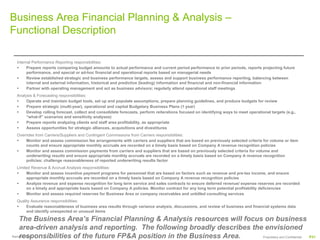
Business Area FinancialPlanning & Analysis –
Functional Description
Internal Performance Reporting responsibilities:
Prepare reports comparing budget amounts to actual performance and current period performance to prior periods, reports projecting future
performance, and special or ad-hoc financial and operational reports based on managerial needs
Review established strategic and business performance targets, assess and support business performance reporting, balancing between
internal and external information, historical and predictive (leading) information and financial and non-financial information
Partner with operating management and act as business advisors; regularly attend operational staff meetings
Analysis & Forecasting responsibilities:
Operate and maintain budget tools, set up and populate assumptions, prepare planning guidelines, and produce budgets for review
Prepare strategic (multi-year), operational and capital Budgetary Business Plans (1 year)
Develop rolling forecast, collect and consolidate forecasts, perform reiterations focused on identifying ways to meet operational targets (e.g.,
“what-if” scenarios and sensitivity analyses)
Prepare reports analyzing clients and staff area profitability, as appropriate
Assess opportunities for strategic alliances, acquisitions and divestitures
Overrides from Carriers/Suppliers and Contingent Commissions from Carriers responsibilities:
Monitor and assess commission fee arrangements with carriers and suppliers that are based on previously selected criteria for volume or item
counts and ensure appropriate monthly accruals are recorded on a timely basis based on Company A revenue recognition policies
Monitor and assess commission payments from carriers and suppliers that are based on previously selected criteria for volume and
underwriting results and ensure appropriate monthly accruals are recorded on a timely basis based on Company A revenue recognition
policies; challenge reasonableness of reported underwriting results factor
Limited Revenue & Accrual Analysis responsibilities:
Monitor and assess incentive payment programs for personnel that are based on factors such as revenue and pre-tax income, and ensure
appropriate monthly accruals are recorded on a timely basis based on Company A revenue recognition policies
Analyze revenue and expense recognition for long term service and sales contracts to ensure deferred revenue/ expense reserves are recorded
on a timely and appropriate basis based on Company A policies. Monitor contract for any long term potential profitability deficiencies
Monitor and assess required reserves for Business Area or company receivables and unbilled consulting services
Quality Assurance responsibilities:
Evaluate reasonableness of business area results through variance analysis, discussions, and review of business and financial systems data
and identify unexpected or unusual items
The Business Area’s Financial Planning & Analysis resources will focus on business
area-driven analysis and reporting. The following broadly describes the envisioned
responsibilities of the future FP&A position in the Business Area.
Ramesh Krish Proprietary and Confidential P31
33.
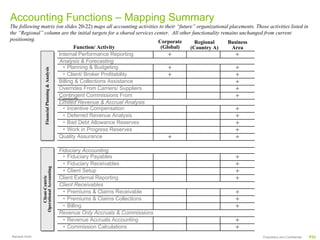
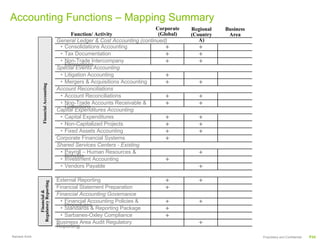
Accounting Functions –Mapping Summary
The following matrix (on slides 20-22) maps all accounting activities to their “future” organizational placements. Those activities listed in
the “Regional” column are the initial targets for a shared services center. All other functionality remains unchanged from current
positioning. Corporate Regional Business
Function/ Activity (Global) (Country A) Area
Internal Performance Reporting + +
Analysis & Forecasting
• Planning & Budgeting + +
Financial Planning & Analysis
• Client/ Broker Profitability + +
Billing & Collections Assistance +
Overrides From Carriers/ Suppliers +
Contingent Commissions From
Carriers
+
Limited Revenue & Accrual Analysis
• Incentive Compensation +
• Deferred Revenue Analysis +
• Bad Debt Allowance Reserves +
• Work in Progress Reserves +
Quality Assurance + +
Fiduciary Accounting
• Fiduciary Payables +
• Fiduciary Receivables +
Operational Accounting
• Client Setup +
+
Client-Centric
Client External Reporting
Client-Centric
Client Receivables
• Premiums & Claims Receivable +
• Premiums & Claims Collections +
• Billing +
Revenue Only Accruals & Commissions
• Revenue Accruals Accounting +
• Commission Calculations +
Ramesh Krish Proprietary and Confidential P32
34.
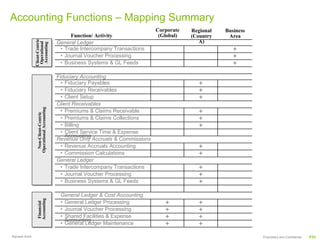
Accounting Functions –Mapping Summary
Corporate Regional Business
Client-Centric Function/ Activity (Global) (Country Area
A)
Client-Centric
Operational General Ledger
Accounting
Operational
Accounting • Trade Intercompany Transactions +
• Journal Voucher Processing +
• Business Systems & GL Feeds +
Fiduciary Accounting
• Fiduciary Payables +
• Fiduciary Receivables +
• Client Setup +
Client Receivables
Operational Accounting
• Premiums & Claims Receivable +
Non-Client-Centric
Non-Client-Centric
• Premiums & Claims Collections +
• Billing +
• Client Service Time & Expense
Accounting
Revenue Only Accruals & Commissions
• Revenue Accruals Accounting +
• Commission Calculations +
General Ledger
• Trade Intercompany Transactions +
• Journal Voucher Processing +
• Business Systems & GL Feeds +
General Ledger & Cost Accounting
Accounting
Accounting
• General Ledger Processing + +
Financial
Financial
• Journal Voucher Processing + +
• Shared Facilities & Expense
Accounting
+ +
• General Ledger Maintenance + +
Ramesh Krish Proprietary and Confidential P33
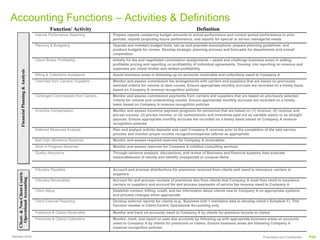
Accounting Functions –Activities & Definitions
Function/ Activity Definition
Internal Performance Reporting Prepare reports comparing budget amounts to actual performance and current period performance to prior
periods, reports projecting future performance, and reports for special or ad-hoc managerial needs
Planning & Budgeting Operate and maintain budget tools, set up and populate assumptions, prepare planning guidelines, and
produce budgets for review. Develop strategic planning process and forecasts for departments and overall
corporation
Client/ Broker Profitability Initially for fee and negotiated commission assignments – assist and challenge business areas in setting
profitable pricing and reporting on profitability of individual agreements. Develop into reporting on revenue and
expenses per client/ broker and related profitability
Financial Planning & Analysis
Billing & Collections Assistance Assist business areas in following up on accounts receivable and collections owed to Company A
Overrides from Carriers/ Suppliers Monitor and assess commission fee arrangements with carriers and suppliers that are based on previously
selected criteria for volume or item counts. Ensure appropriate monthly accruals are recorded on a timely basis
based on Company A revenue recognition policies
Contingent Commissions from Carriers Monitor and assess commission payments from carriers and suppliers that are based on previously selected
criteria for volume and underwriting results. Ensure appropriate monthly accruals are recorded on a timely
basis based on Company A revenue recognition policies
Incentive Compensation Monitor and assess incentive payment programs for personnel that are based on (1) revenue; (2) revenue and
pre-tax income; (3) pre-tax income; or (4) commissions and incentives paid out as variable salary or as straight
payouts. Ensure appropriate monthly accruals are recorded on a timely basis based on Company A revenue
recognition policies
Deferred Revenues Analysis Plan and analyze activity deposits and cash Company A receives prior to the completion of the sale service
process and monitor proper income recognition/expense referral as appropriate
Bad Debt Allowance Reserves Monitor and assess required reserves for Company A receivables
Work in Progress Reserves Monitor and assess reserves for Company A unbilled consulting services
Quality Assurance Through variance analysis, discussions, and review of Business and financial systems data evaluate
reasonableness of results and identify unexpected or unusual items
Fiduciary Payables Account and process distributions for premiums received from clients and owed to insurance carriers or
Client- & Non-Client-Centric
suppliers
Client- & Non-Client-Centric
Operational Accounting
Fiduciary Receivables Account for and process receipts of premiums due from clients that Company A must then remit to insurance
carriers or suppliers and account for and process payments of service fee revenue owed to Company A
Client Setup Establish contact, billing, credit, and tax information about clients new to Company A on appropriate systems
and process changes when appropriate
Client External Reporting Develop external reports for clients (e.g., Business Unit 1 maintains data to develop client’s Schedule F). This
function resides in Client-Centric Operational Accounting only
Premiums & Claims Receivable Monitor and track on accounts owed to Company A by clients for premium income or claims
Premiums & Claims Collections Monitor, track, and report on past due accounts by following up with appropriate business areas on accounts
owed to Company A by clients for premiums or claims. Ensure business areas are following Company A
expense recognition policies
Ramesh Krish Proprietary and Confidential P35
37.
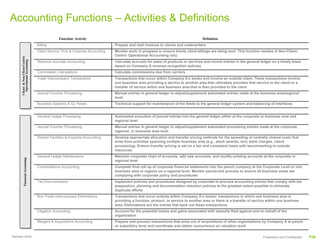
Accounting Functions –Activities & Definitions
Function/ Activity Definition
Billing Prepare and mail invoices to clients and underwriters
Client Service Time & Expense Accounting Monitor work in progress to ensure timely client billings are being sent. This function resides in Non-Client-
Centric Operational Accounting only
Client- & Non-Client-Centric
Operational Accounting
Revenue Accruals Accounting Calculate accruals for sales of products or services and record entries in the general ledger on a timely basis
Operational Accounting
based on Company A revenue recognition policies
Commission Calculations Calculate commissions due from carriers
Trade Intercompany Transactions Transactions that occur within Company A’s books and involve an outside client. These transactions involve
one business area providing a service to another area that ultimately provides that service to the client or a
transfer of service within one business area that is then provided to the client
Journal Voucher Processing Manual entries in general ledger to adjust/supplement automated entries made at the business area/regional
level
Business Systems & GL Feeds Technical support for maintenance of the feeds to the general ledger system and balancing of interfaces
General Ledger Processing Automated execution of journal entries into the general ledger either at the corporate or business area and
regional level
Journal Voucher Processing Manual entries in general ledger to adjust/supplement automated processing entries made at the corporate,
regional, or business area level
Shared Facilities & Expense Accounting Develop appropriate allocation and transfer pricing methods for the spreading of centrally shared costs that
arise from activities spanning multiple business area (e.g., stock awards, rent, bank charges, check
processing). Ensure transfer pricing is set on a fair and consistent basis with benchmarking to outside
resources
General Ledger Maintenance Maintain corporate chart of accounts, add new accounts, and modify existing accounts at the corporate or
Financial Accounting
regional level
Consolidations Accounting Complete final roll up of corporate financial statements into the parent company at the Corporate Level or into
business area or regions on a regional level. Monitor period-end process to ensure all business areas are
complying with corporate policy and procedures
Tax Documentation Implement policies and procedures designed by corporate to process accounting entries that comply with tax
preparation, planning and documentation retention policies to the greatest extent possible to eliminate
duplicate efforts
Non-Trade Intercompany Eliminations Transactions that occur entirely within Company A’s books; transactions in which one business area is
providing a function, product, or service to another area or there is a transfer of service within one business
area. Eliminations are the entries that back out these transactions.
Litigation Accounting Account for the potential losses and gains associated with lawsuits filed against and on behalf of the
organization
Mergers & Acquisitions Accounting Prepare and process transactions that arise out of acquisitions of other organizations by Company A at parent
or subsidiary level and coordinate and obtain concurrence on valuation work
Ramesh Krish Proprietary and Confidential P36
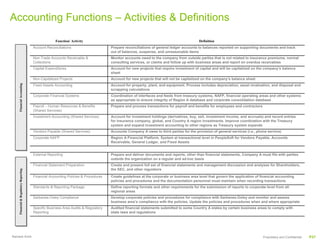
38.
Accounting Functions –Activities & Definitions
Function/ Activity Definition
Account Reconciliations Prepare reconciliations of general ledger accounts to balances reported on supporting documents and track
out of balances, suspense, and unreasonable items
Non-Trade Accounts Receivable & Monitor accounts owed to the company from outside parties that is not related to insurance premiums, normal
Collections consulting services, or claims and follow up with business areas and report on overdue receivables
Capital Expenditures Account for new projects that require investment of capital and will be capitalized on the company’s balance
sheet
Non-Capitalized Projects Account for new projects that will not be capitalized on the company’s balance sheet
Financial Accounting
Fixed Assets Accounting Account for property, plant, and equipment. Process includes depreciation, asset revaluation, and disposal and
Financial Accounting
scrapping calculations
Corporate Financial Systems Coordination of interfaces and feeds from treasury systems, NAFP, financial operating areas and other systems
as appropriate to ensure integrity of Region A database and corporate consolidation database
Payroll – Human Resources & Benefits Prepare and process transactions for payroll and benefits for employees and contractors
(Shared Services)
Investment Accounting (Shared Services) Account for investment holdings (derivatives, buy, sell, investment income, and accruals) and record entries
for insurance company, global, and Country A region investments. Improve coordination with the Treasury
system and expand investment accounting to other regions as Treasury system expands
Vendors Payable (Shared Services) Accounts Company A owes to third parties for the provision of general services (i.e., phone service)
Corporate NAFP Region A Financial Platform. System at transactional level in PeopleSoft for Vendors Payable, Accounts
Receivable, General Ledger, and Fixed Assets
External Reporting Prepare and deliver documents and reports, other than financial statements, Company A must file with parties
outside the organization on a regular and ad-hoc basis
Financial Statement Preparation Create and present full set of financial statements and management discussion and analyses for Shareholders,
the SEC, and other regulators
Financial & Regulatory Reporting
Financial Accounting Policies & Procedures Create guidelines at the corporate or business area level that govern the application of financial accounting
policies and procedures and the documentation personnel must maintain when recording transactions
Standards & Reporting Package Define reporting formats and other requirements for the submission of reports to corporate level from all
regional areas
Sarbanes-Oxley Compliance Develop corporate policies and procedures for compliance with Sarbanes-Oxley and monitor and assess
business area’s compliance with the policies. Update the policies and procedures when and where appropriate
Specific Business Area Audits & Regulatory Audited financial statements submitted to some Country A states by certain business areas to comply with
Reporting state laws and regulations
Ramesh Krish Proprietary and Confidential P37
Appendix - WayForward
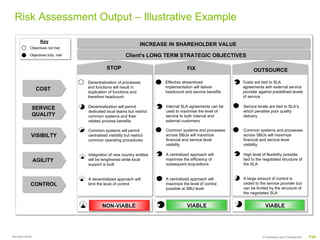
Risk Assessment Output – Illustrative Example
Key
INCREASE IN SHAREHOLDER VALUE
Objectives not met
Objectives fully met Client's LONG TERM STRATEGIC OBJECTIVES
STOP FIX OUTSOURCE
Decentralization of processes Effective streamlined Costs are tied to SLA
and functions will result in implementation will deliver agreements with external service
COST duplication of functions and headcount and service benefits provider against predefined levels
therefore headcount of service
SERVICE Decentralization will permit Internal SLA agreements can be Service levels are tied to SLA’s,
dedicated local teams but restrict used to maximise the level of which penalise poor quality
QUALITY common systems and their service to both internal and delivery
related process benefits external customers
Common systems will permit Common systems and processes Common systems and processes
VISIBILTY centralised visibility but restrict across SBUs will maximize across SBUs will maximize
common operating procedures financial and service level financial and service level
visibility visibility
Integration of new country entities A centralized approach will High level of flexibility possible
AGILITY will be lengthened while local maximise the efficiency of tied to the negotiated structure of
support is built subsequent acquisitions the SLA
A decentralized approach will A centralized approach will A large amount of control is
CONTROL limit the level of control maximize the level of control ceded to the service provider but
possible at SBU level can be limited by the structure of
the negotiated SLA
NON-VIABLE VIABLE VIABLE
Ramesh Krish Proprietary and Confidential P39
41.
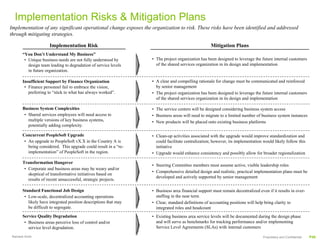
Implementation Risks &Mitigation Plans
Implementation of any significant operational change exposes the organization to risk. These risks have been identified and addressed
through mitigating strategies.
Implementation Risk Mitigation Plans
“You Don’t Understand My Business”
• Unique business needs are not fully understood by • The project organization has been designed to leverage the future internal customers
design team leading to degradation of service levels of the shared services organization in its design and implementation
in future organization.
Insufficient Support by Finance Organization • A clear and compelling rationale for change must be communicated and reinforced
• Finance personnel fail to embrace the vision, by senior management
preferring to “stick to what has always worked”. • The project organization has been designed to leverage the future internal customers
of the shared services organization in its design and implementation
Business System Complexities • The service centers will be designed considering business system access
• Shared services employees will need access to • Business areas will need to migrate to a limited number of business system instances
multiple versions of key business systems, • New products will be placed onto existing business platforms
potentially adding complexity.
Concurrent PeopleSoft Upgrade • Clean-up activities associated with the upgrade would improve standardization and
• An upgrade to PeopleSoft vX.X in the Country A is could facilitate centralization; however, its implementation would likely follow this
being considered. This upgrade could result in a “re- initiative
implementation” of PeopleSoft in the region. • Upgrade would enhance consistency and possibly allow for broader regionalization
Transformation Hangover
• Steering Committee members must assume active, visible leadership roles
• Corporate and business areas may be weary and/or
• Comprehensive detailed design and realistic, practical implementation plans must be
skeptical of transformative initiatives based on
developed and actively supported by senior management
results of recent unsuccessful, strategic projects.
Standard Functional Job Design • Business area financial support must remain decentralized even if it results in over-
• Low-scale, decentralized accounting operations staffing in the near term
likely have integrated position descriptions that may • Clear, standard definitions of accounting positions will help bring clarity to
be difficult to segregate. integrated roles and headcount
Service Quality Degradation • Existing business area service levels will be documented during the design phase
• Business areas perceive loss of control and/or and will serve as benchmarks for tracking performance and/or implementing
service level degradation. Service Level Agreements (SLAs) with internal customers
Ramesh Krish Proprietary and Confidential P40
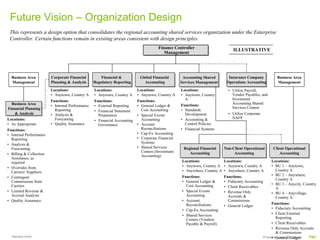
Future Vision –Organization Design
This represents a design option that consolidates the regional accounting shared services organization under the Enterprise
Controller. Certain functions remain in existing areas consistent with design principles.
Finance Controller
Finance Controller ILLUSTRATIVE
Management
Management
Business Area Corporate Financial
Corporate Financial Financial &
Financial & Global Financial
Global Financial Accounting Shared
Accounting Shared Insurance Company
Insurance Company Business Area
Management Planning & Analysis
Planning & Analysis Regulatory Reporting
Regulatory Reporting Accounting
Accounting Services Management
Services Management Operations Accounting
Operations Accounting Management
Locations: Locations: Locations: Locations: • Utilize Payroll,
• Anytown, Country A • Anytown, Country A • Anytown, Country A • Anytown, Country Vendor Payables, and
Functions: Functions: Functions: A Investment
Business Area
Business Area Accounting Shared
• Internal Performance • External Reporting • General Ledger & Functions:
Services Centers
Financial Planning
Financial Planning Reporting Cost Accounting • Standards
• Financial Statement
& Analysis
& Analysis • Analysis & Preparation • Special Events Development • Utilize Corporate
Locations: Forecasting Accounting • Accounting & NAFP
• Financial Accounting
• As Appropriate • Quality Assurance Governance • Account Control Policies
Functions: Reconciliations • Financial Systems
• Internal Performance • Cap-Ex Accounting
Reporting • Corporate Financial
• Analysis & Systems
Forecasting • Shared Services Regional Financial Non-Client Operational Client Operational
Regional Financial Non-Client Operational Client Operational
Centers (Investment
• Billing & Collection Accounting)
Accounting
Accounting Accounting
Accounting
Assistance, as
required Locations: Locations: Locations:
• Overrides from • Anytown, Country A • Anytown, Country A • BU 1 – Anytown,
Carriers/ Suppliers • Anywhere, Country A • Anywhere, Country A Country A
• BU 2 – Anywhere,
• Contingent Functions: Functions:
Country A
Commissions from • General Ledger & • Fiduciary Accounting
Carriers Cost Accounting • BU 3 – Anycity, Country
• Client Receivables A
• Limited Revenue & • Special Events • Revenue Only • BU 4 – Anyvillage,
Accrual Analysis Accounting Accruals & Country A
• Quality Assurance • Account Commissions
Reconciliations Functions:
• General Ledger
• Cap-Ex Accounting • Fiduciary Accounting
• Shared Services • Client External
Centers (Vendors Reporting
Payable & Payroll) • Client Receivables
• Revenue Only Accruals
& Commissions
Ramesh Krish • General Ledger
Proprietary and Confidential P42
44.
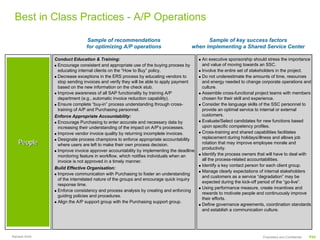
Best in ClassPractices - A/P Operations
Sample of recommendations Sample of key success factors
for optimizing A/P operations when implementing a Shared Service Center
Conduct Education & Training: An executive sponsorship should stress the importance
Encourage consistent and appropriate use of the buying process by and value of moving towards an SSC.
educating internal clients on the “How to Buy” policy. Involve the entire set of stakeholders in the project.
Decrease exceptions in the ERS process by educating vendors to Do not underestimate the amounts of time, resources
stop sending invoices and verify they will be able to apply payment and energy needed to change corporate operations and
based on the new information on the check stub. culture.
Improve awareness of all SAP functionality by training A/P Assemble cross-functional project teams with members
department (e.g., automatic invoice reduction capability). chosen for their skill and experience.
Ensure complete “buy-in” process understanding through cross- Consider the language skills of the SSC personnel to
training of A/P and Purchasing personnel. provide an optimal service to internal or external
Enforce Appropriate Accountability: customers.
Encourage Purchasing to enter accurate and necessary data by Evaluate/Select candidates for new functions based
increasing their understanding of the impact on A/P’s processes. upon specific competency profiles.
Improve vendor invoice quality by returning incomplete invoices. Cross-training and shared capabilities facilitates
Designate process champions to enforce appropriate accountability replacement during holidays/illness and allows job
People where users are left to make their own process decision. rotation that may improve employee morale and
productivity.
Improve invoice approver accountability by implementing the deadline
monitoring feature in workflow, which notifies individuals when an Identify the process owners that will have to deal with
invoice is not approved in a timely manner. all the process-related accountabilities.
Identify a key contact person for each client group.
Build Effective Organisation:
Manage clearly expectations of internal stakeholders
Improve communication with Purchasing to foster an understanding
and customers as a service “degradation” may be
of the interrelated nature of the groups and encourage quick inquiry
expected during the kick-off period of the “go-live”.
response time.
Using performance measure, create incentives and
Enforce consistency and process analysis by creating and enforcing
rewards to motivate people and continuously improve
guiding policies and procedures.
their efforts.
Align the A/P support group with the Purchasing support group.
Define governance agreements, coordination standards
and establish a communication culture.
Ramesh Krish Proprietary and Confidential P43
45.
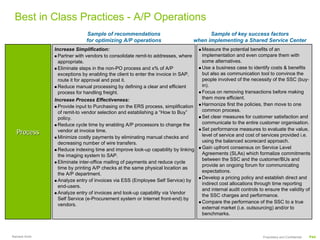
Best in ClassPractices - A/P Operations
Sample of recommendations Sample of key success factors
for optimizing A/P operations when implementing a Shared Service Center
Increase Simplification: Measure the potential benefits of an
Partner with vendors to consolidate remit-to addresses, where implementation and even compare them with
appropriate. some alternatives.
Eliminate steps in the non-PO process and x% of A/P Use a business case to identify costs & benefits
exceptions by enabling the client to enter the invoice in SAP, but also as communication tool to convince the
route it for approval and post it. people involved of the necessity of the SSC (buy-
Reduce manual processing by defining a clear and efficient in).
process for handling freight. Focus on removing transactions before making
Increase Process Effectiveness: them more efficient.
Provide input to Purchasing on the ERS process, simplification Harmonize first the policies, then move to one
of remit-to vendor selection and establishing a “How to Buy” common process.
policy. Set clear measures for customer satisfaction and
Reduce cycle time by enabling A/P processors to change the communicate to the entire customer organisation.
Set performance measures to evaluate the value,
Process vendor at invoice time.
level of service and cost of services provided i.e.
Minimize costly payments by eliminating manual checks and
decreasing number of wire transfers. using the balanced scorecard approach.
Reduce indexing time and improve look-up capability by linking Gain upfront consensus on Service Level
the imaging system to SAP. Agreements (SLAs) which formalize commitments
between the SSC and the customer/BUs and
Eliminate inter-office mailing of payments and reduce cycle
provide an ongoing forum for communicating
time by printing A/P checks at the same physical location as
expectations.
the A/P department.
Develop a pricing policy and establish direct and
Analyze entry of invoices via ESS (Employee Self Service) by
indirect cost allocations through time reporting
end-users.
and internal audit controls to ensure the validity of
Analyze entry of invoices and look-up capability via Vendor
the SSC charges and performance.
Self Service (e-Procurement system or Internet front-end) by
Compare the performance of the SSC to a true
vendors.
external market (i.e. outsourcing) and/or to
benchmarks.
Ramesh Krish Proprietary and Confidential P44
46.
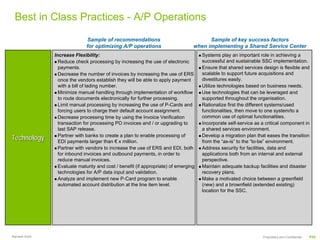
Best in ClassPractices - A/P Operations
Sample of recommendations Sample of key success factors
for optimizing A/P operations when implementing a Shared Service Center
Increase Flexibility: Systems play an important role in achieving a
Reduce check processing by increasing the use of electronic successful and sustainable SSC implementation.
payments. Ensure that shared services design is flexible and
Decrease the number of invoices by increasing the use of ERS scalable to support future acquisitions and
once the vendors establish they will be able to apply payment divestitures easily.
with a bill of lading number. Utilize technologies based on business needs.
Minimize manual handling through implementation of workflow Use technologies that can be leveraged and
to route documents electronically for further processing. supported throughout the organisation.
Limit manual processing by increasing the use of P-Cards and Rationalize first the different systems/used
forcing users to charge their default account assignment. functionalities, then move to one system/to a
Decrease processing time by using the Invoice Verification common use of optimal functionalities.
transaction for processing PO invoices and / or upgrading to Incorporate self-service as a critical component in
last SAP release. a shared services environment.
Technology Partner with banks to create a plan to enable processing of
EDI payments larger than € x million.
Develop a migration plan that eases the transition
from the “as-is” to the “to-be” environment.
Partner with vendors to increase the use of ERS and EDI, both Address security for facilities, data and
for inbound invoices and outbound payments, in order to applications both from an internal and external
reduce manual invoices. perspective.
Evaluate maturity and cost / benefit (if appropriate) of emerging Maintain adequate backup facilities and disaster
technologies for A/P data input and validation. recovery plans.
Analyze and implement new P-Card program to enable Make a motivated choice between a greenfield
automated account distribution at the line item level. (new) and a brownfield (extended existing)
location for the SSC.
Ramesh Krish Proprietary and Confidential P45
47.
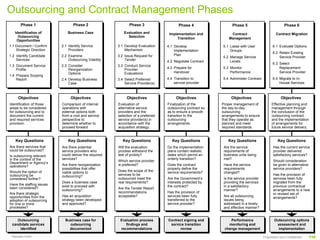
Outsourcing and ContractManagement Phases
Phase 1 Phase 2 Phase 3 Phase 4 Phase 5 Phase 6
Identification of Business Case Evaluation and Implementation and Contract Contract Migration
Outsourcing Selection Transition Management
Opportunities
1.1 Document / Confirm 2.1 Identify Service 3.1 Develop Evaluation 4.1 Develop 5.1 Liaise with User 6.1 Evaluate Options
Strategic Direction Providers Mechanism Implementation Groups
6.2 Retain Existing
1.2 Identify Candidate 2.2 Examine 3.2 Issue Request for Plan
5.2 Manage Service Service Provider
Services Outsourcing Viability Tender 4.2 Negotiate Contract Levels
6.3 Select
1.3 Document Service 2.3 Consider 3.3 Conduct Service
Profile Reorganization Provider 4.3 Prepare for 5.3 Monitor Replacement
Options Evaluations Handover Performance Service Provider
1.4 Prepare Scoping
Report 2.4 Develop Business 3.4 Select Preferred 4.4 Transition to 5.4 Administer Contract 6.4 Migrate to In-
Case Service Provider(s) service provider House Services
Objectives
Objectives Objectives
Objectives
Identification of those
Identification of those Comparison of internal
Comparison of internal Evaluation of
Evaluation of Finalization of the
Finalization of the Proper management of
Proper management of Effective planning and
Effective planning and
areas to be considered
areas to be considered operations with
operations with alternative service
alternative service outsourcing contract so
outsourcing contract so the day-to-day
the day-to-day management through
management through
for outsourcing and to
for outsourcing and to external options both
external options both providers and the
providers and the as to ensure aasmooth
as to ensure smooth outsourcing
outsourcing the conclusion of the
the conclusion of the
document the current
document the current from aacost and service
from cost and service selection of aapreferred
selection of preferred transition to the
transition to the arrangements to ensure
arrangements to ensure outsourcing contract
outsourcing contract
and required services
and required services perspective to
perspective to service provider(s) in
service provider(s) in outsourcing
outsourcing that they operate as
that they operate as and the implementation
and the implementation
provision.
provision. determine whether to
determine whether to accordance with the
accordance with the arrangements.
arrangements. planned and meet
planned and meet of arrangements for
of arrangements for
proceed forward
proceed forward acquisition strategy.
acquisition strategy. required standards.
required standards. future service delivery.
future service delivery.
Key Questions
Key Questions Key Questions
Key Questions
Are there services that
Are there services that Are there potential
Are there potential Will the evaluation
Will the evaluation Do the implementation
Do the implementation Are the service
Are the service Has the current service
Has the current service
could be outsourced?
could be outsourced? service providers who process withstand the plans contain realistic requirements of provider delivered
service providers who process withstand the plans contain realistic requirements of provider delivered
Is outsourcing relevant could deliver the required
could deliver the required test of probity?
test of probity? dates which permit an
dates which permit an business units being
business units being satisfactory services?
satisfactory services?
Is outsourcing relevant services? orderly transition? met?
in the context of the
in the context of the services? Which service provider orderly transition? met? Should consideration
Department or Agency’s Which service provider Should consideration
Department or Agency’s Are there reorganization is preferred? Does the contract Have the service be given to alternative
operations?
operations? Are there reorganization is preferred? Does the contract Have the service be given to alternative
possibilities that offer
possibilities that offer properly define the
properly define the requirements
requirements service providers?
service providers?
Should the option of viable options to Does the scope of the
Does the scope of the service requirements? changed?
Should the option of viable options to services to be service requirements? changed? Has the provision of
outsourcing be
outsourcing be outsourcing? services to be Has the provision of
considered further? outsourcing? outsourced meet the Are the Government’s Is the service provider services been fully
considered further? outsourced meet the Are the Government’s Is the service provider services been fully
Does aabusiness case
Does business case real requirements?
real requirements? interests protected by
interests protected by providing the services
providing the services migrated from the
migrated from the
Have the staffing issues
Have the staffing issues exist to proceed with the contract? in aasatisfactory previous contractual
been considered? exist to proceed with Are the Tender Report the contract? in satisfactory previous contractual
been considered? outsourcing? Are the Tender Report manner? arrangements to aanew
outsourcing? recommendations Has the provision of manner? arrangements to new
Are there strategic
Are there strategic recommendations Has the provision of or revised set of
or revised set of
opportunities from the Has an acquisition
Has an acquisition acceptable?
acceptable? services been fully
services been fully Are all outsourcing
Are all outsourcing arrangements?
opportunities from the strategy been developed transferred to the issues being arrangements?
adoption of outsourcing
adoption of outsourcing strategy been developed transferred to the issues being
for one or more
for one or more and approved?
and approved? service provider?
service provider? addressed in aatimely
addressed in timely
processes?
processes? and effective manner?
and effective manner?
Outsourcing
Outsourcing Business case for
Business case for Evaluation process
Evaluation process Contract signing and
Contract signing and Performance
Performance Outsourcing options
Outsourcing options
candidate services
candidate services outsourcing
outsourcing findings and
findings and service transition
service transition monitoring and
monitoring and assessment and
assessment and
identified
identified documented
documented recommendations
recommendations review
review change management
change management implementation
implementation
Ramesh Krish Proprietary and Confidential P46
48.
i process
Thank You
Ramesh Krish
Cell: 917-971-9701