ENHANCING EFFORTS OF LEARNING
    AND MOTIVATION LEARNING
  MATHEMATICAL MODEL STUDENT
LEARNING THROUGH OF INQUIRY THE
 USE PROP IN JUNIOR HIGH SCHOOL
 Mathematics is one of the most important science in
  everyday life, but many students who think math is
  complicated and tedious

   Lack of student motivation toward learning of
    mathematics especially, will hinder the learning process.

   One of models for effective learning is Model Student
    Learning Through Of Inquiry
How to improve students' mathematics
learning outcomes through inquiry
learning with props?


How to increase students' motivation to
learn mathematics through inquiry
learning with material props?
To find out how to improve learning outcomes
Students through the learning of mathematics
inquiry with props in Junior High School


To find out how to increase motivation Student to
learn mathematics through inquiry learning with
props in Junior High School.
For teachers
Teachers can hone skills in developing and using instructional media
or props are effective and efficient to involve students actively in
the learning process.
For Students
expected to cope with boredom, stress and interesting liking and
motivation in learning mathematics and to improve students' mathematics
learning outcomes.

For Researchers
Can provide insight to researchers and picture of the obstacles that
may be faced in the creation of learning media
For schools
The results of this study are expected to contribute in
improving the quality of learning mathematics
1. Learning mathematics is a process of interaction between educators
 and learners with learning resources on the subjects of mathematics in
 the school environment.
2. Motivation is an impulse or drive is given to students to do something
that is learned. Motivation can also be regarded as an attempt to
provide specific conditions, so that someone wanted and wanted to do
something that is learned.
3. Learning outcomes the ability of a person as a learning process, or the
acquisition of knowledge skills developed by eye learning, which is
usually indicated by test scores or grades given by teachers.
4. Inquiry,
According Gulo (2002) in Trianto (2011:135): Strategies inquiry means a
series of learning activities that involve the most of all the students'
ability to search and investigating in a
systematic, critical, logical, analytical, so that they can formulate their
own findings with confidence.
5. Viewer Tool communication channel or intermediary is used to carry
or convey a message in order to achieve the goal of teaching.
Teaching said to be good or successful if it has the
following characteristics:
 1. The results were long lasting and can be used by
 students.
 2. The result was a knowledge of "original" or "authentic".


        William Burton in Hamalik (2007: 28) argued that "A good
        learning situation consist of a rich and varied series of
        learning experience unified around a vigorous purpose and
        Carried on interaction with a rich, varied and provocative
        environment."
Ismail (2004: 1.13) suggests that the
 process of learning mathematics is
deliberately designed with the aim to
  create an atmosphere allowing si
 pelajar carry out activities to study
   mathematics, and the process is
  centered on the teachers to teach
            mathematics.
Strategy of inquiry means a
series of learning activities
that involve the most of all
the students' ability to
search and investigating in a
systematic, critical, logical, a
nalytical, so that they can
formulate      their       own
findings with confidence.
(Gulo (2002) n Trianto
(2011:135)
Learning steps carried out by teachers on Learning
stage of inquiry (Eggen and Kauchak (1996) in Trianto
(2011: 141)):

•   Presents a question or problem
•   Make a hypothesis
•   Designing the experiment
•   Conduct experiments to obtain information
•   Collect and analyze data
•   Make conclusion
The mathematical prop is a prop that
its use be integrated with the
objectives and content of teaching that
has been poured in the outline of the
teaching program (GBPPP)
mathematics and aims to enhance the
quality of teaching and learning
activities.
According to Mc. Donald in Hamalik
(2007:158), motivation is an energy change
witgoal reaction. hin the person characterized by
affective arousal and anticipatory


 There are several forms that can be done in grow
 motivation in learning :
 1. Give the numbers
 2. Praise
 3. Interest
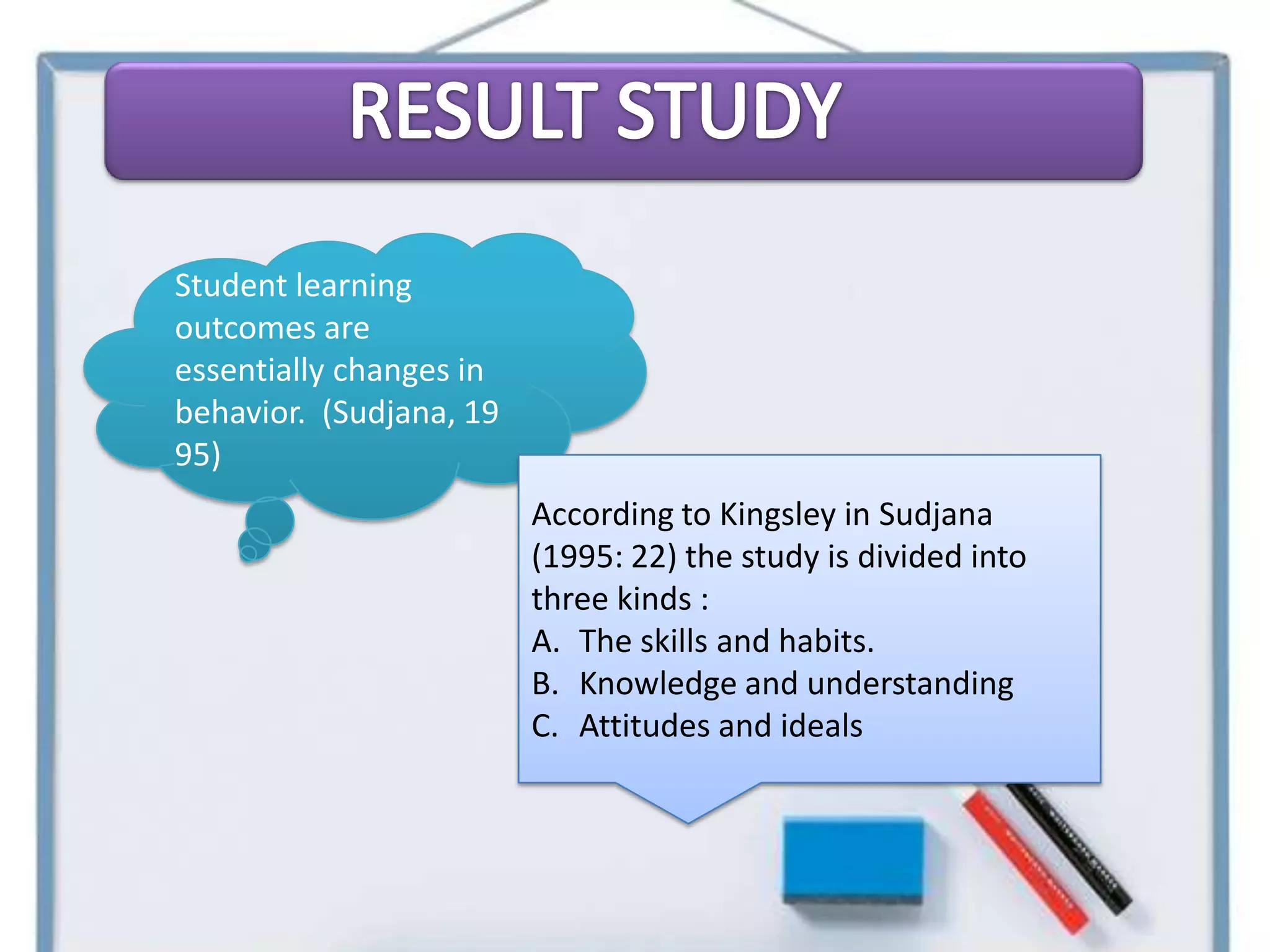
Student learning
outcomes are
essentially changes in
behavior. (Sudjana, 19
95)
                         According to Kingsley in Sudjana
                         (1995: 22) the study is divided into
                         three kinds :
                         A. The skills and habits.
                         B. Knowledge and understanding
                         C. Attitudes and ideals
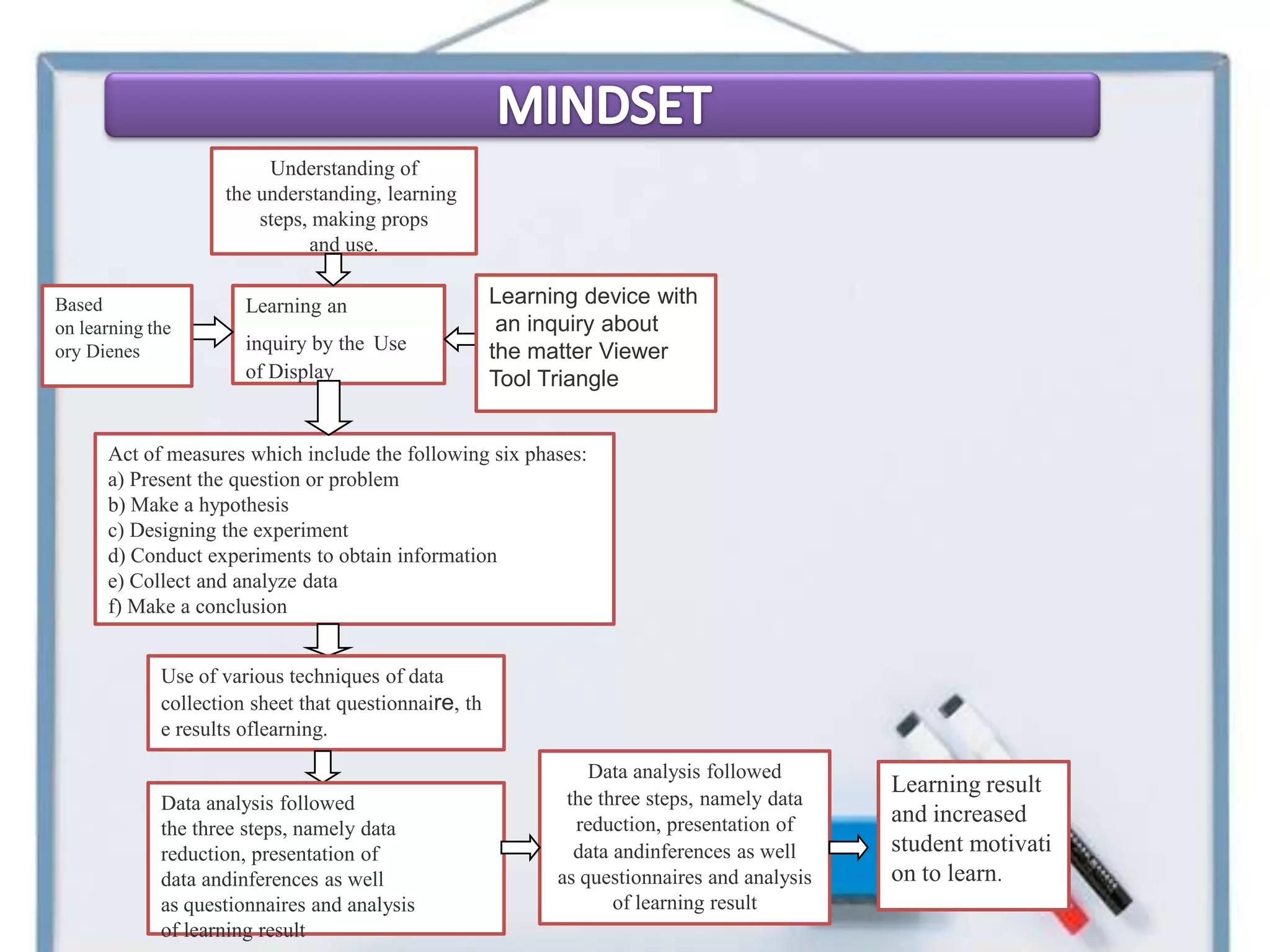
Understanding of
                    the understanding, learning
                        steps, making props
                              and use.

Based                  Learning an                     Learning device with
on learning the                                         an inquiry about
ory Dienes             inquiry by the Use              the matter Viewer
                       of Display                      Tool Triangle


      Act of measures which include the following six phases:
      a) Present the question or problem
      b) Make a hypothesis
      c) Designing the experiment
      d) Conduct experiments to obtain information
      e) Collect and analyze data
      f) Make a conclusion


             Use of various techniques of data
             collection sheet that questionnaire, th
             e results oflearning.

                                                                 Data analysis followed
                                                                                              Learning result
             Data analysis followed                           the three steps, namely data
                                                               reduction, presentation of     and increased
             the three steps, namely data
             reduction, presentation of                        data andinferences as well     student motivati
             data andinferences as well                      as questionnaires and analysis   on to learn.
             as questionnaires and analysis                         of learning result
             of learning result
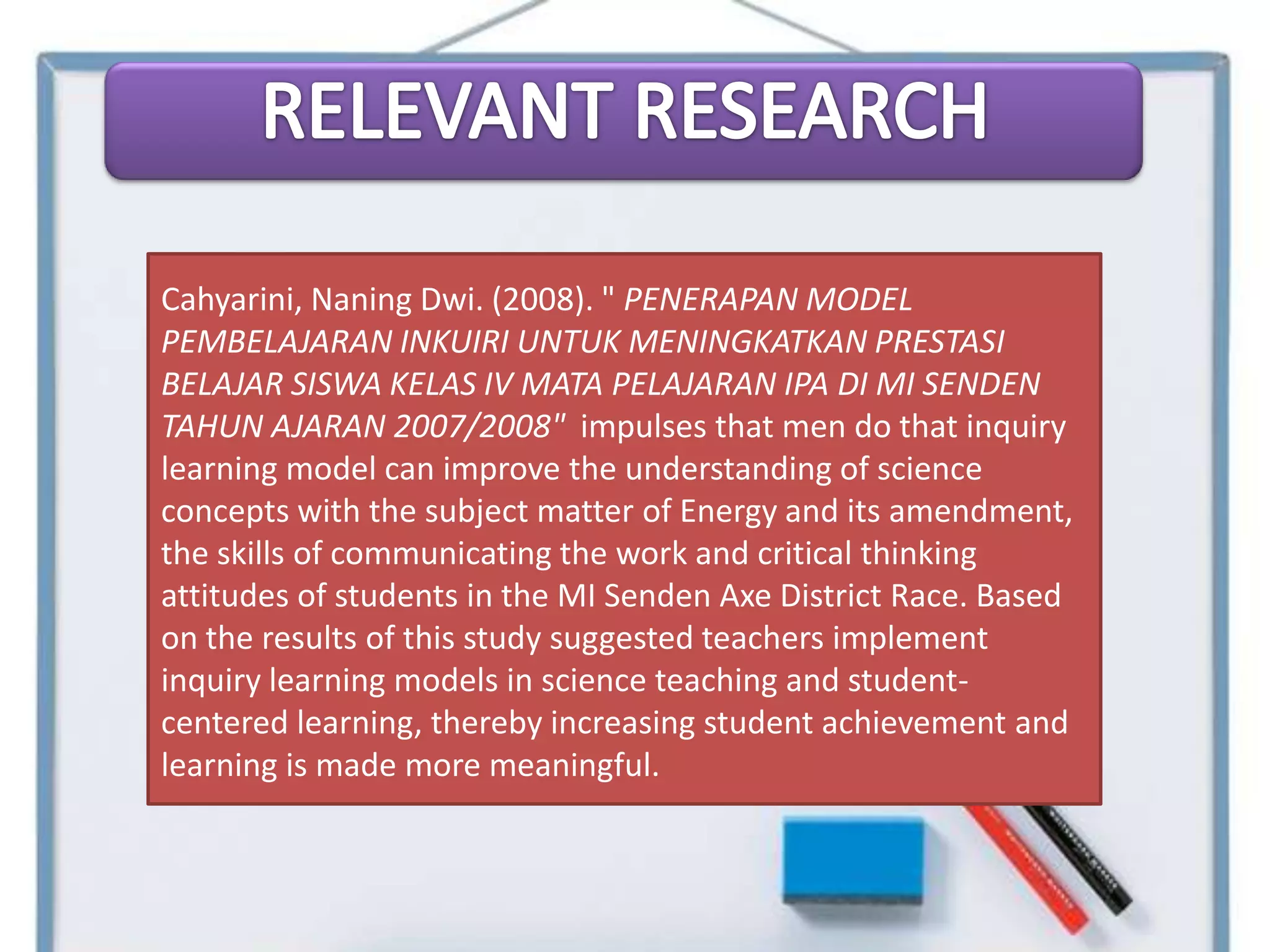
Cahyarini, Naning Dwi. (2008). " PENERAPAN MODEL
PEMBELAJARAN INKUIRI UNTUK MENINGKATKAN PRESTASI
BELAJAR SISWA KELAS IV MATA PELAJARAN IPA DI MI SENDEN
TAHUN AJARAN 2007/2008" impulses that men do that inquiry
learning model can improve the understanding of science
concepts with the subject matter of Energy and its amendment,
the skills of communicating the work and critical thinking
attitudes of students in the MI Senden Axe District Race. Based
on the results of this study suggested teachers implement
inquiry learning models in science teaching and student-
centered learning, thereby increasing student achievement and
learning is made ​more meaningful.
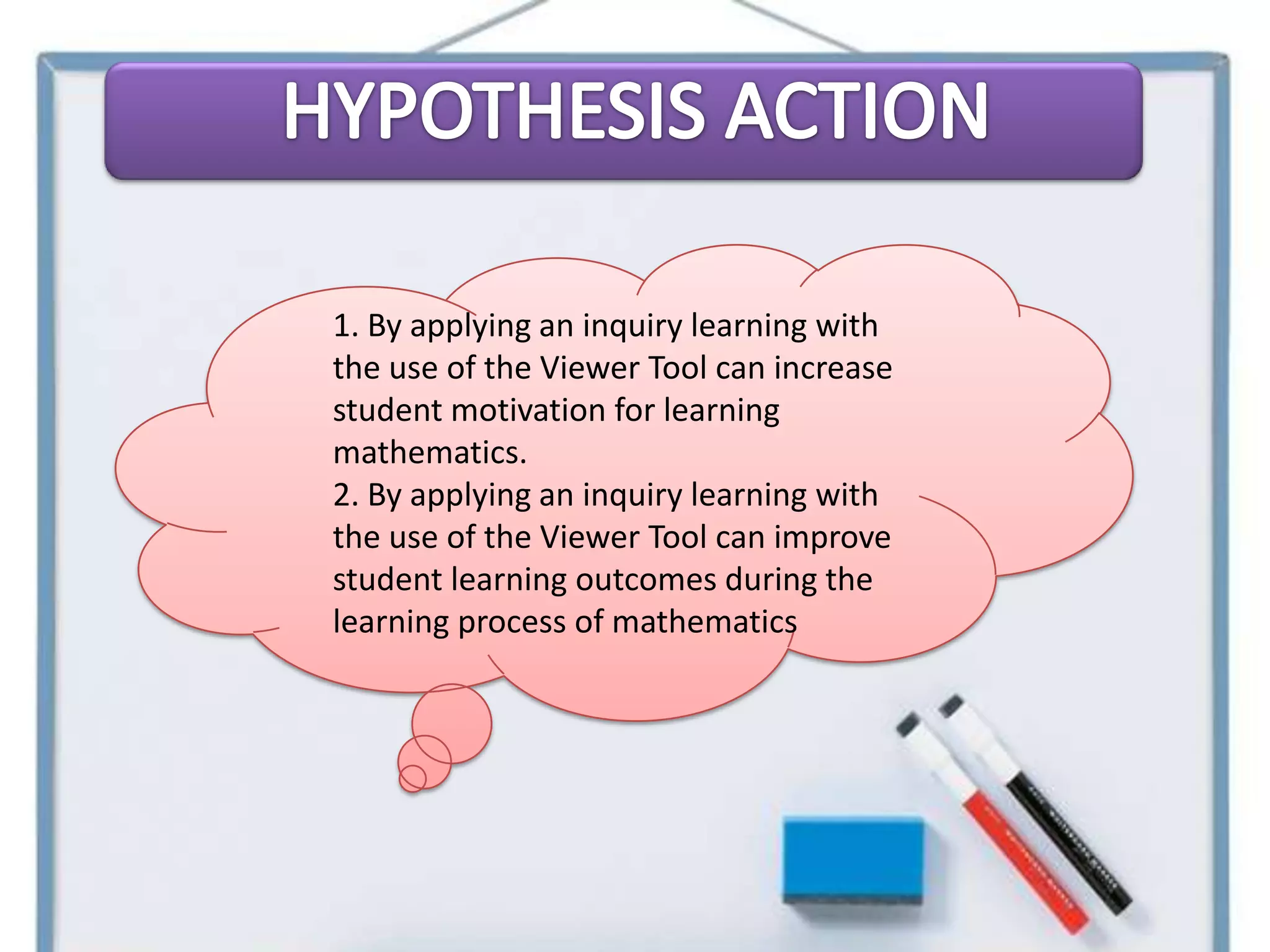
1. By applying an inquiry learning with
the use of the Viewer Tool can increase
student motivation for learning
mathematics.
2. By applying an inquiry learning with
the use of the Viewer Tool can improve
student learning outcomes during the
learning process of mathematics
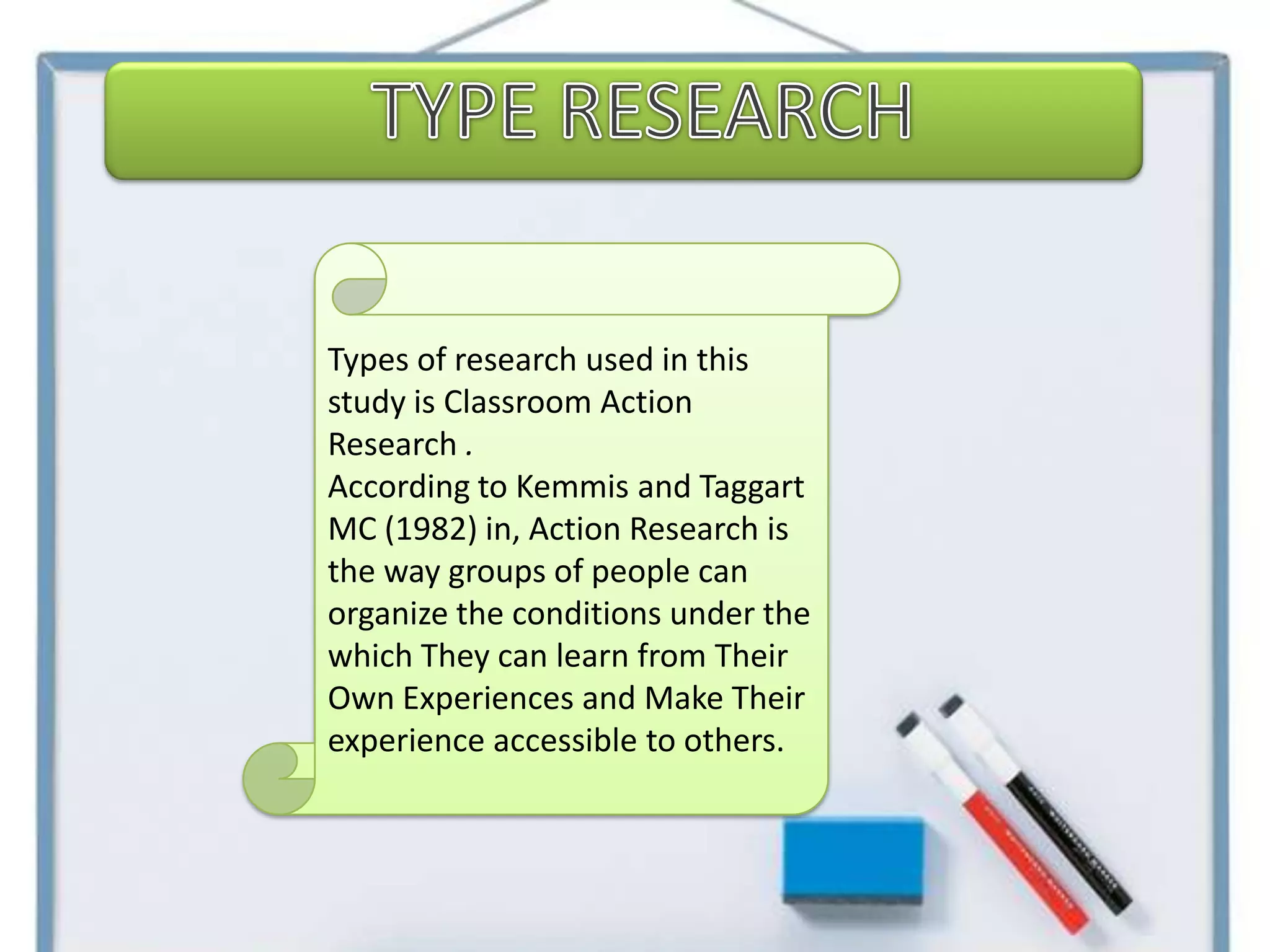
Types of research used in this
study is Classroom Action
Research .
According to Kemmis and Taggart
MC (1982) in, Action Research is
the way groups of people can
organize the conditions under the
which They can learn from Their
Own Experiences and Make Their
experience accessible to others.
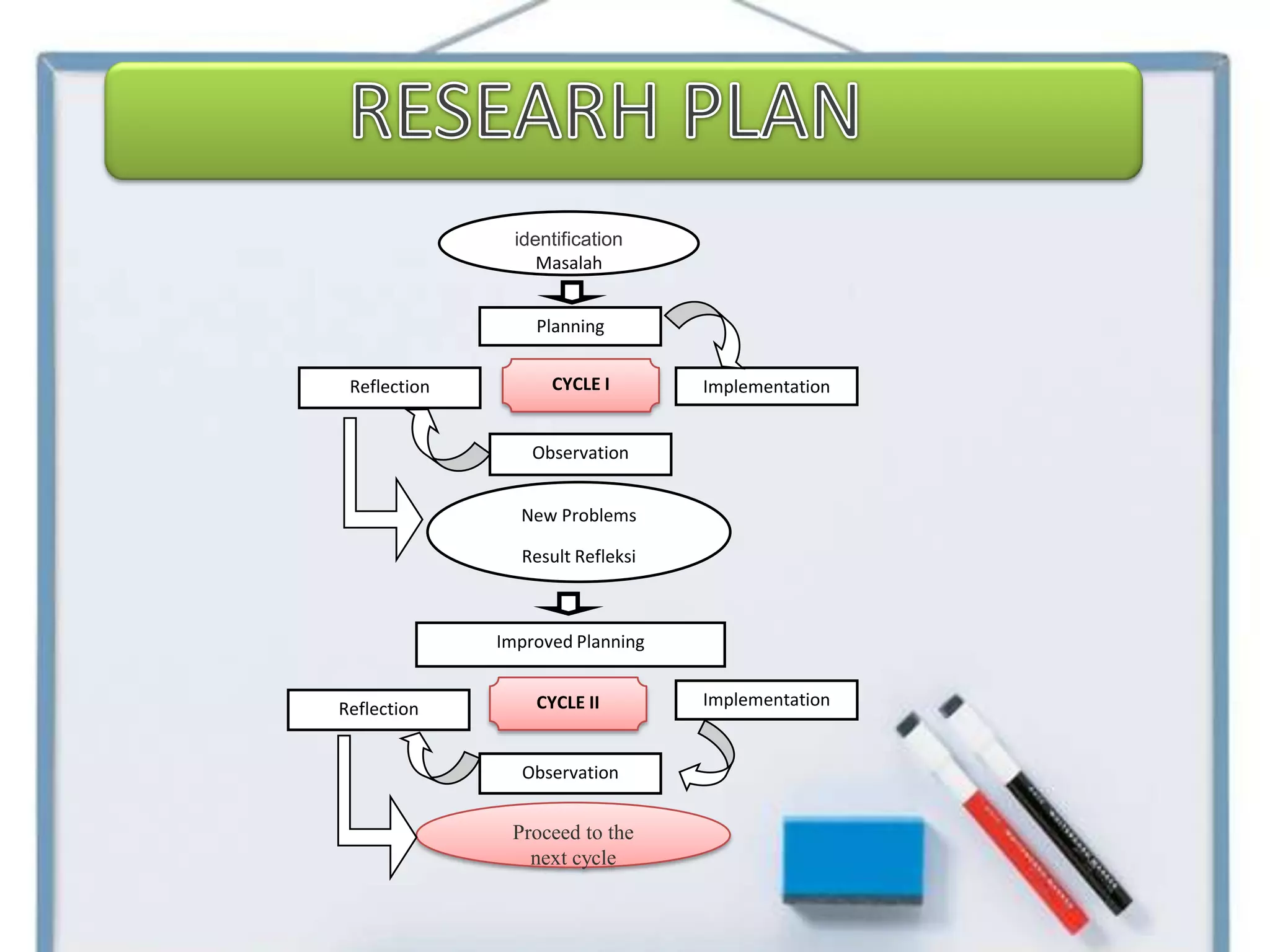
identification
                   Masalah


                  Planning


 Reflection         CYCLE I       Implementation


                  Observation


                New Problems

                Result Refleksi


              Improved Planning


Reflection        CYCLE II        Implementation


                Observation


               Proceed to the
                 next cycle
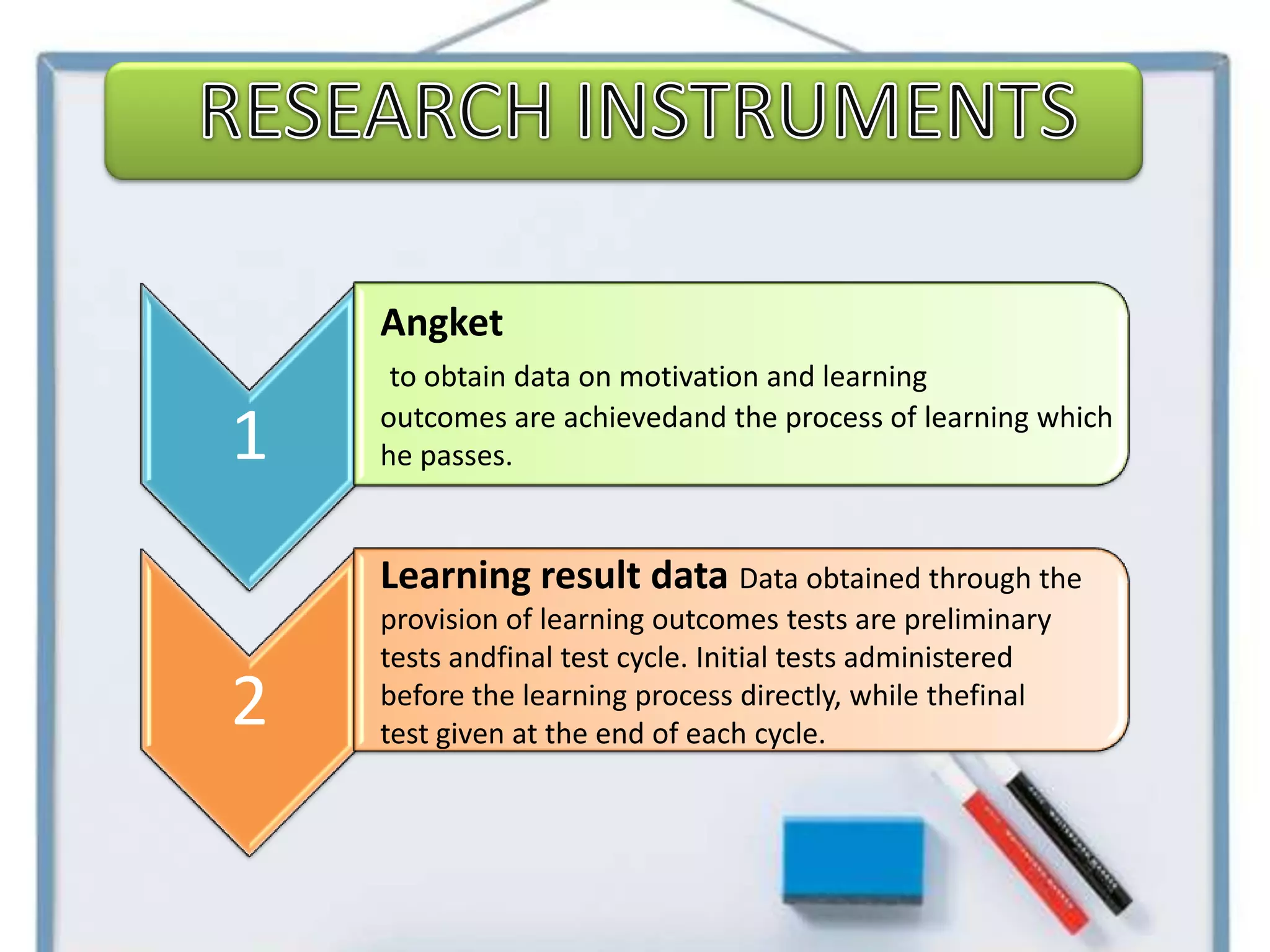
Angket
     to obtain data on motivation and learning

1   outcomes are achievedand the process of learning which
    he passes.


    Learning result data Data obtained through the
    provision of learning outcomes tests are preliminary
    tests andfinal test cycle. Initial tests administered
2   before the learning process directly, while thefinal
    test given at the end of each cycle.
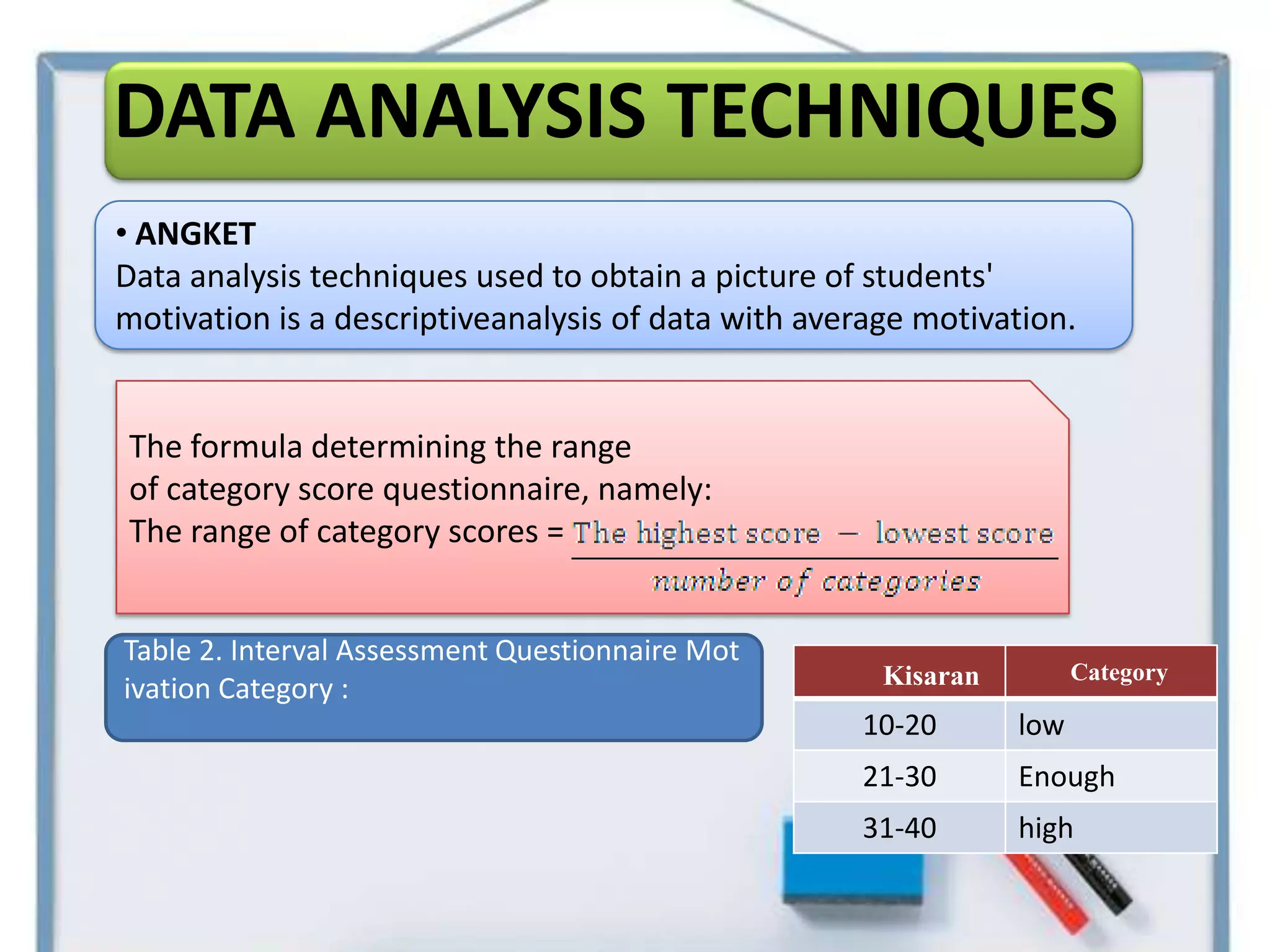
DATA ANALYSIS TECHNIQUES
• ANGKET
Data analysis techniques used to obtain a picture of students'
motivation is a descriptiveanalysis of data with average motivation.


The formula determining the range
of category score questionnaire, namely:
The range of category scores =


Table 2. Interval Assessment Questionnaire Mot
                                                      Kisaran         Category
ivation Category :
                                                    10-20       low
                                                    21-30       Enough
                                                    31-40       high
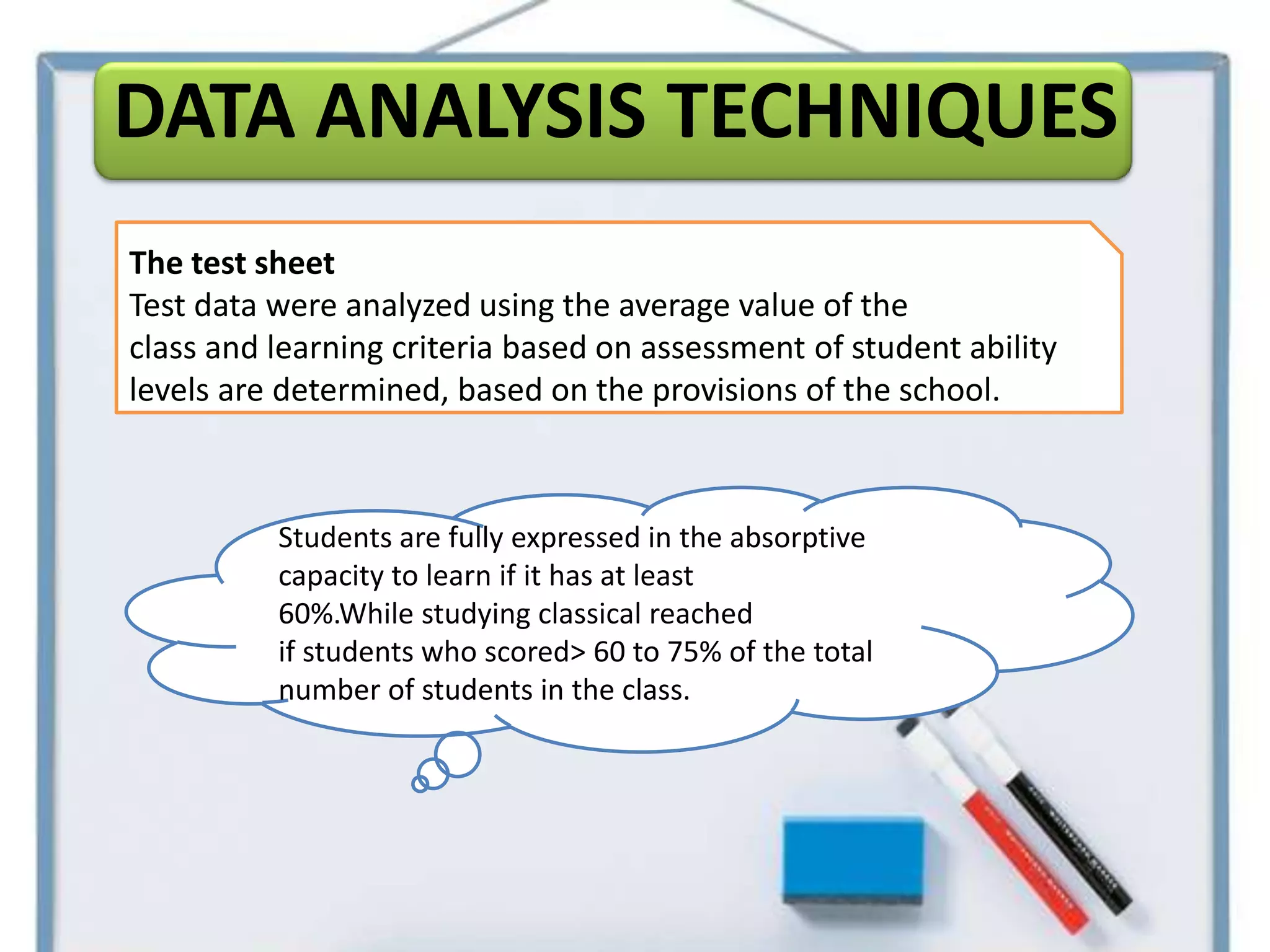
DATA ANALYSIS TECHNIQUES
The test sheet
Test data were analyzed using the average value of the
class and learning criteria based on assessment of student ability
levels are determined, based on the provisions of the school.


          Students are fully expressed in the absorptive
          capacity to learn if it has at least
          60%.While studying classical reached
          if students who scored> 60 to 75% of the total
          number of students in the class.
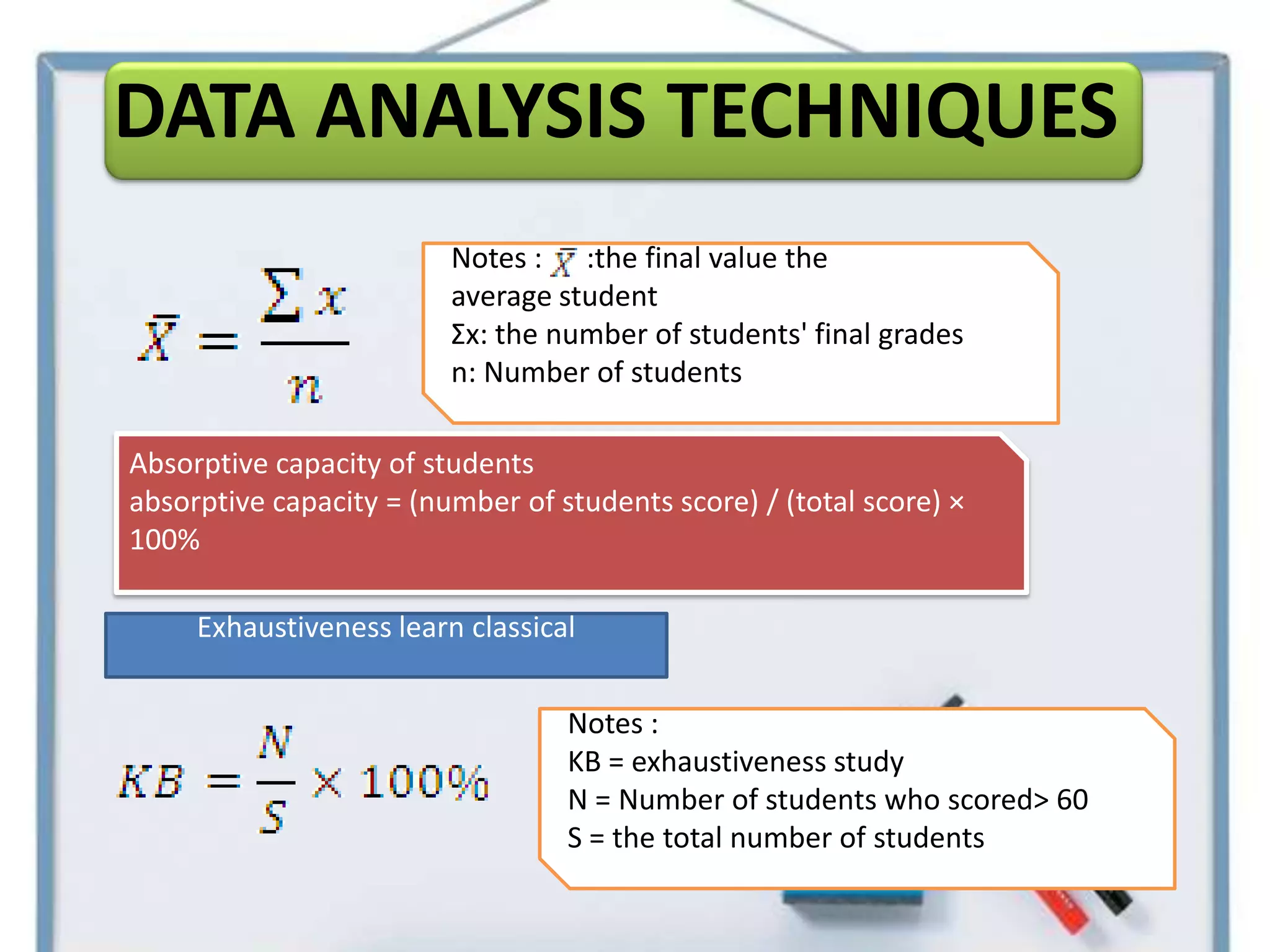
DATA ANALYSIS TECHNIQUES
                         Notes : :the final value the
                         average student
                         Σx: the number of students' final grades
                         n: Number of students

Absorptive capacity of students
absorptive capacity = (number of students score) / (total score) ×
100%

     Exhaustiveness learn classical


                                  Notes :
                                  KB = exhaustiveness study
                                  N = Number of students who scored> 60
                                  S = the total number of students
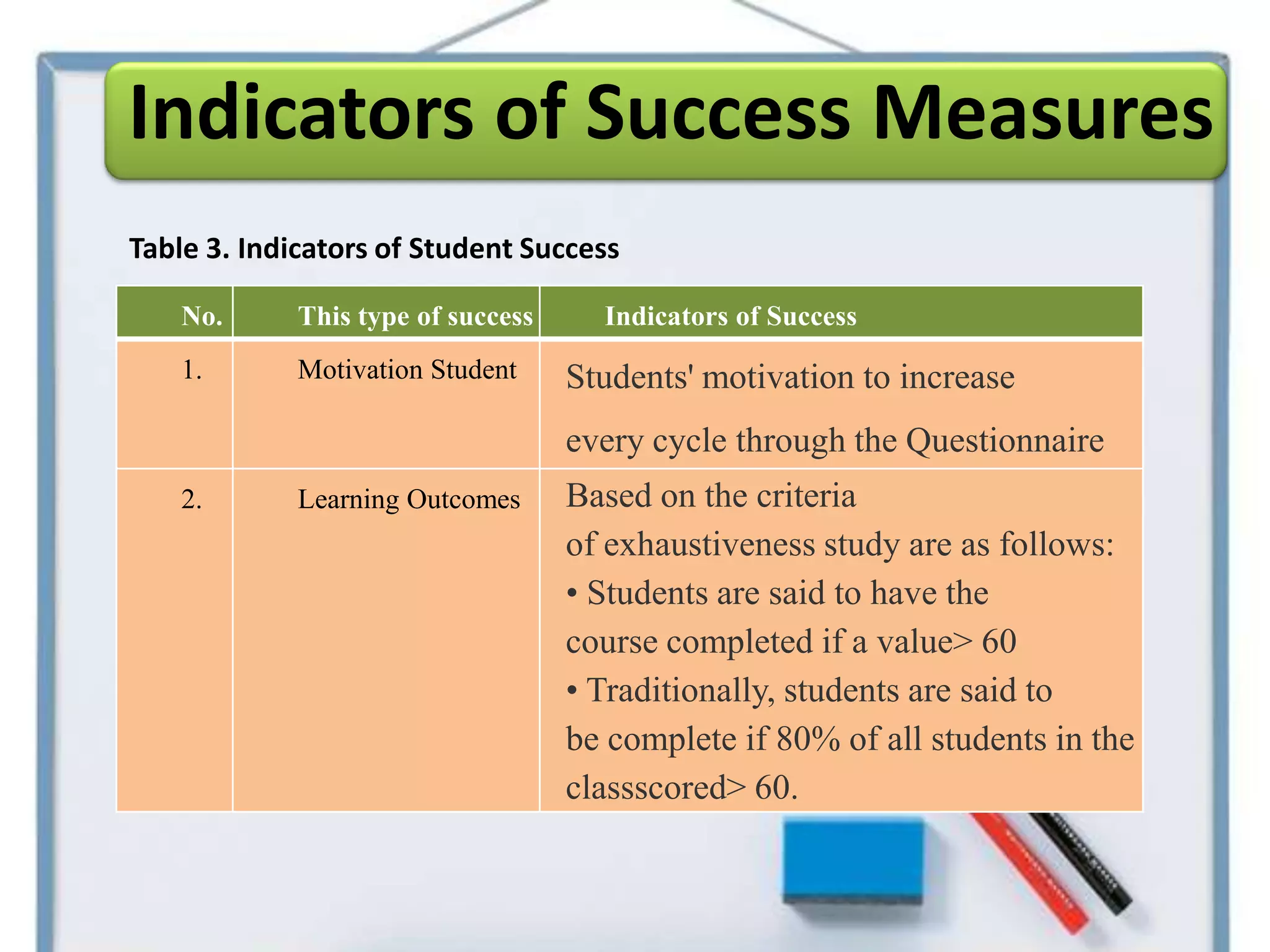
Indicators of Success Measures
Table 3. Indicators of Student Success

    No.      This type of success     Indicators of Success
    1.       Motivation Student     Students' motivation to increase
                                    every cycle through the Questionnaire
    2.       Learning Outcomes      Based on the criteria
                                    of exhaustiveness study are as follows:
                                    • Students are said to have the
                                    course completed if a value> 60
                                    • Traditionally, students are said to
                                    be complete if 80% of all students in the
                                    classscored> 60.
Method inquiry proposal

Method inquiry proposal

  • 1.
    ENHANCING EFFORTS OFLEARNING AND MOTIVATION LEARNING MATHEMATICAL MODEL STUDENT LEARNING THROUGH OF INQUIRY THE USE PROP IN JUNIOR HIGH SCHOOL
  • 3.
     Mathematics isone of the most important science in everyday life, but many students who think math is complicated and tedious  Lack of student motivation toward learning of mathematics especially, will hinder the learning process.  One of models for effective learning is Model Student Learning Through Of Inquiry
  • 4.
    How to improvestudents' mathematics learning outcomes through inquiry learning with props? How to increase students' motivation to learn mathematics through inquiry learning with material props?
  • 5.
    To find outhow to improve learning outcomes Students through the learning of mathematics inquiry with props in Junior High School To find out how to increase motivation Student to learn mathematics through inquiry learning with props in Junior High School.
  • 6.
    For teachers Teachers canhone skills in developing and using instructional media or props are effective and efficient to involve students actively in the learning process. For Students expected to cope with boredom, stress and interesting liking and motivation in learning mathematics and to improve students' mathematics learning outcomes. For Researchers Can provide insight to researchers and picture of the obstacles that may be faced in the creation of learning media For schools The results of this study are expected to contribute in improving the quality of learning mathematics
  • 7.
    1. Learning mathematicsis a process of interaction between educators and learners with learning resources on the subjects of mathematics in the school environment. 2. Motivation is an impulse or drive is given to students to do something that is learned. Motivation can also be regarded as an attempt to provide specific conditions, so that someone wanted and wanted to do something that is learned. 3. Learning outcomes the ability of a person as a learning process, or the acquisition of knowledge skills developed by eye learning, which is usually indicated by test scores or grades given by teachers. 4. Inquiry, According Gulo (2002) in Trianto (2011:135): Strategies inquiry means a series of learning activities that involve the most of all the students' ability to search and investigating in a systematic, critical, logical, analytical, so that they can formulate their own findings with confidence. 5. Viewer Tool communication channel or intermediary is used to carry or convey a message in order to achieve the goal of teaching.
  • 9.
    Teaching said tobe good or successful if it has the following characteristics: 1. The results were long lasting and can be used by students. 2. The result was a knowledge of "original" or "authentic". William Burton in Hamalik (2007: 28) argued that "A good learning situation consist of a rich and varied series of learning experience unified around a vigorous purpose and Carried on interaction with a rich, varied and provocative environment."
  • 10.
    Ismail (2004: 1.13)suggests that the process of learning mathematics is deliberately designed with the aim to create an atmosphere allowing si pelajar carry out activities to study mathematics, and the process is centered on the teachers to teach mathematics.
  • 11.
    Strategy of inquirymeans a series of learning activities that involve the most of all the students' ability to search and investigating in a systematic, critical, logical, a nalytical, so that they can formulate their own findings with confidence. (Gulo (2002) n Trianto (2011:135)
  • 12.
    Learning steps carriedout by teachers on Learning stage of inquiry (Eggen and Kauchak (1996) in Trianto (2011: 141)): • Presents a question or problem • Make a hypothesis • Designing the experiment • Conduct experiments to obtain information • Collect and analyze data • Make conclusion
  • 13.
    The mathematical propis a prop that its use be integrated with the objectives and content of teaching that has been poured in the outline of the teaching program (GBPPP) mathematics and aims to enhance the quality of teaching and learning activities.
  • 14.
    According to Mc.Donald in Hamalik (2007:158), motivation is an energy change witgoal reaction. hin the person characterized by affective arousal and anticipatory There are several forms that can be done in grow motivation in learning : 1. Give the numbers 2. Praise 3. Interest
  • 15.
    Student learning outcomes are essentiallychanges in behavior. (Sudjana, 19 95) According to Kingsley in Sudjana (1995: 22) the study is divided into three kinds : A. The skills and habits. B. Knowledge and understanding C. Attitudes and ideals
  • 16.
    Understanding of the understanding, learning steps, making props and use. Based Learning an Learning device with on learning the an inquiry about ory Dienes inquiry by the Use the matter Viewer of Display Tool Triangle Act of measures which include the following six phases: a) Present the question or problem b) Make a hypothesis c) Designing the experiment d) Conduct experiments to obtain information e) Collect and analyze data f) Make a conclusion Use of various techniques of data collection sheet that questionnaire, th e results oflearning. Data analysis followed Learning result Data analysis followed the three steps, namely data reduction, presentation of and increased the three steps, namely data reduction, presentation of data andinferences as well student motivati data andinferences as well as questionnaires and analysis on to learn. as questionnaires and analysis of learning result of learning result
  • 17.
    Cahyarini, Naning Dwi.(2008). " PENERAPAN MODEL PEMBELAJARAN INKUIRI UNTUK MENINGKATKAN PRESTASI BELAJAR SISWA KELAS IV MATA PELAJARAN IPA DI MI SENDEN TAHUN AJARAN 2007/2008" impulses that men do that inquiry learning model can improve the understanding of science concepts with the subject matter of Energy and its amendment, the skills of communicating the work and critical thinking attitudes of students in the MI Senden Axe District Race. Based on the results of this study suggested teachers implement inquiry learning models in science teaching and student- centered learning, thereby increasing student achievement and learning is made ​more meaningful.
  • 18.
    1. By applyingan inquiry learning with the use of the Viewer Tool can increase student motivation for learning mathematics. 2. By applying an inquiry learning with the use of the Viewer Tool can improve student learning outcomes during the learning process of mathematics
  • 20.
    Types of researchused in this study is Classroom Action Research . According to Kemmis and Taggart MC (1982) in, Action Research is the way groups of people can organize the conditions under the which They can learn from Their Own Experiences and Make Their experience accessible to others.
  • 21.
    identification Masalah Planning Reflection CYCLE I Implementation Observation New Problems Result Refleksi Improved Planning Reflection CYCLE II Implementation Observation Proceed to the next cycle
  • 22.
    Angket to obtain data on motivation and learning 1 outcomes are achievedand the process of learning which he passes. Learning result data Data obtained through the provision of learning outcomes tests are preliminary tests andfinal test cycle. Initial tests administered 2 before the learning process directly, while thefinal test given at the end of each cycle.
  • 23.
    DATA ANALYSIS TECHNIQUES •ANGKET Data analysis techniques used to obtain a picture of students' motivation is a descriptiveanalysis of data with average motivation. The formula determining the range of category score questionnaire, namely: The range of category scores = Table 2. Interval Assessment Questionnaire Mot Kisaran Category ivation Category : 10-20 low 21-30 Enough 31-40 high
  • 24.
    DATA ANALYSIS TECHNIQUES Thetest sheet Test data were analyzed using the average value of the class and learning criteria based on assessment of student ability levels are determined, based on the provisions of the school. Students are fully expressed in the absorptive capacity to learn if it has at least 60%.While studying classical reached if students who scored> 60 to 75% of the total number of students in the class.
  • 25.
    DATA ANALYSIS TECHNIQUES Notes : :the final value the average student Σx: the number of students' final grades n: Number of students Absorptive capacity of students absorptive capacity = (number of students score) / (total score) × 100% Exhaustiveness learn classical Notes : KB = exhaustiveness study N = Number of students who scored> 60 S = the total number of students
  • 26.
    Indicators of SuccessMeasures Table 3. Indicators of Student Success No. This type of success Indicators of Success 1. Motivation Student Students' motivation to increase every cycle through the Questionnaire 2. Learning Outcomes Based on the criteria of exhaustiveness study are as follows: • Students are said to have the course completed if a value> 60 • Traditionally, students are said to be complete if 80% of all students in the classscored> 60.