
Dr. Muhammad Riaz
Dr.Elsa Sofia Morote,
PHYSICS EDUCATIONAL TECHNOLOGY THAT EFFECTS ON
STUDENT PERFORMANCE
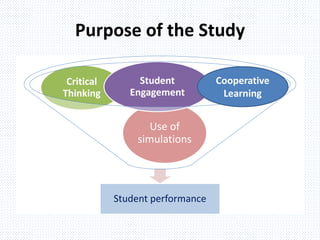
Purpose of the Study
Student performance
Use of
simulations
Critical
Thinking
Student
Engagement
Cooperative
Learning
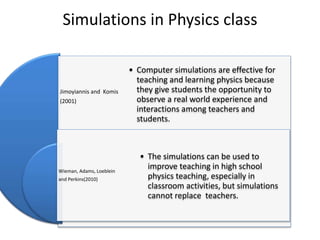
Simulations in Physics class
Jimoyiannis and Komis
(2001)
Wieman, Adams, Loeblein
and Perkins(2010)
• Computer simulations are effective for
teaching and learning physics because
they give students the opportunity to
observe a real world experience and
interactions among teachers and
students.
• The simulations can be used to
improve teaching in high school
physics teaching, especially in
classroom activities, but simulations
cannot replace teachers.
Student Engagement
Wells, Hestenes
and Swackhmer
(1995)
Rotgans and
Schmidt
(2011)
• If teachers use the scientific model to
describe, explain, predict and control
physical phenomena, they engage
students actively in understanding the
physical world.
• Students’ engagement is an important
factor to motivate students in learning
experiences and willingness to endeavor
continuous effort.
Woodward
and Gersten
(1988)
Browne( 2010)
• A combination of effective teaching
and strategic instructional processes
in combination with computer
simulations increase factual and
higher order thinking skill of
students.
• Students’ engagement is an
important factor to motivate
students in learning experiences
and willingness to endeavor
continuous effort.
Critical Thinking
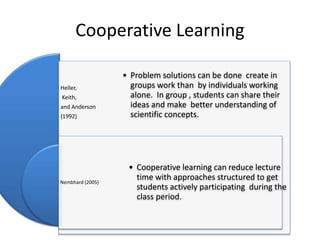
Cooperative Learning
Heller,
Keith,
and Anderson
(1992)
Nembhard (2005)
• Problem solutions can be done create in
groups work than by individuals working
alone. In group , students can share their
ideas and make better understanding of
scientific concepts.
• Cooperative learning can reduce lecture
time with approaches structured to get
students actively participating during the
class period.
Use of Simulations
Zietsman and Hewson
(1986)
Gabon and Ozkan
(1992)
• Science instruction that employs
conceptual change strategies is
effective, especially when provided
by computer simulation.
• The computer simulated experiment
approach and the problem solving
approach produced significantly
greater achievement in science
process skills than the conventional
approach did.
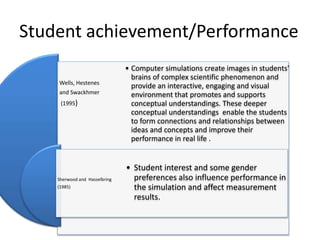
Student achievement/Performance
Wells, Hestenes
and Swackhmer
(1995)
Sherwood and Hasselbring
(1985)
• Computer simulations create images in students'
brains of complex scientific phenomenon and
provide an interactive, engaging and visual
environment that promotes and supports
conceptual understandings. These deeper
conceptual understandings enable the students
to form connections and relationships between
ideas and concepts and improve their
performance in real life .
• Student interest and some gender
preferences also influence performance in
the simulation and affect measurement
results.
Significance of the Study
The findings of this study may promote
interactive learning, connecting physical
phenomena with practical training, enhance
student learning, change of classroom
environment, provide opportunities to review
conceptual understanding of high school
physics. Specifically, this research study may
contribute to knowledge about computer
simulations and to changes in science
instruction in general.
This study was limited to secondary school physics
teachers who were Members of American Modeling
Teachers Association (AMTA) and use simulations in
their Science, Technology, Engineering and
Mathematics (STEM) teaching practice from 2013 to
2014.
Limitations
Eighty four subjects for this study were chosen
from male and female high school physics teachers
who were members of the American Modeling
Teachers Association (AMTA ). The chosen teachers
had participated in Science, Technology,
Engineering and Mathematics (STEM) teaching
practice workshops and had used simulations in
their teaching practice from 2013 to 2014.
Selection of Subjects
This study was conducted with the secondary
school physics teachers of American Modeling
Teachers Association (AMTA ), who used
simulations in their physics teaching practices
located in these the united states from 2013 to
2014.
Setting
The survey was constructed based on the literature
review by the researcher. A six-point Likert scale
was used to evaluate the response on simulations
in physics class, classroom management,
laboratory practice, student engagement, critical
thinking, cooperative learning, teacher self-
efficacy. Student performance was determined by
the teacher self reported percentage of students
achieving a grade of 85 or higher in physics.
Instrumentation
Content Validity
• The survey jury process was included five
professionals within the field of physics
education
• The jury asked to match each survey item to the
corresponding variable definition
• Items that did not receive 60 percent agreement
among the jurors were either discarded or
reworded to better fit the corresponding variable.
Student
Engagement
Critical Thinking
Cooperative
Learning
Simulations in
Physics Class
Student
Academic
Performance
Use of Simulations
β=.40
β=.48
β=.67
β=.11
β=.22
r=.67
r=.19
r=.08
r=.24
r=.48
r=.26
R=.58
R=.55
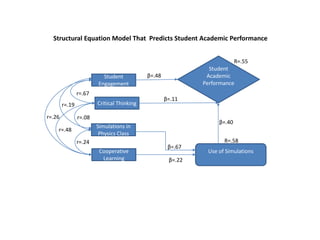
Structural Equation Model That Predicts Student Academic Performance
Questions and Comments

PHYSICS EDUCATIONAL TECHNOLOGY THAT EFFECTS ON STUDENT PERFORMANCE

  • 1.
    Dr. Muhammad Riaz Dr.ElsaSofia Morote, PHYSICS EDUCATIONAL TECHNOLOGY THAT EFFECTS ON STUDENT PERFORMANCE
  • 2.
    Purpose of theStudy Student performance Use of simulations Critical Thinking Student Engagement Cooperative Learning
  • 3.
    Simulations in Physicsclass Jimoyiannis and Komis (2001) Wieman, Adams, Loeblein and Perkins(2010) • Computer simulations are effective for teaching and learning physics because they give students the opportunity to observe a real world experience and interactions among teachers and students. • The simulations can be used to improve teaching in high school physics teaching, especially in classroom activities, but simulations cannot replace teachers.
  • 4.
    Student Engagement Wells, Hestenes andSwackhmer (1995) Rotgans and Schmidt (2011) • If teachers use the scientific model to describe, explain, predict and control physical phenomena, they engage students actively in understanding the physical world. • Students’ engagement is an important factor to motivate students in learning experiences and willingness to endeavor continuous effort.
  • 5.
    Woodward and Gersten (1988) Browne( 2010) •A combination of effective teaching and strategic instructional processes in combination with computer simulations increase factual and higher order thinking skill of students. • Students’ engagement is an important factor to motivate students in learning experiences and willingness to endeavor continuous effort. Critical Thinking
  • 6.
    Cooperative Learning Heller, Keith, and Anderson (1992) Nembhard(2005) • Problem solutions can be done create in groups work than by individuals working alone. In group , students can share their ideas and make better understanding of scientific concepts. • Cooperative learning can reduce lecture time with approaches structured to get students actively participating during the class period.
  • 7.
    Use of Simulations Zietsmanand Hewson (1986) Gabon and Ozkan (1992) • Science instruction that employs conceptual change strategies is effective, especially when provided by computer simulation. • The computer simulated experiment approach and the problem solving approach produced significantly greater achievement in science process skills than the conventional approach did.
  • 8.
    Student achievement/Performance Wells, Hestenes andSwackhmer (1995) Sherwood and Hasselbring (1985) • Computer simulations create images in students' brains of complex scientific phenomenon and provide an interactive, engaging and visual environment that promotes and supports conceptual understandings. These deeper conceptual understandings enable the students to form connections and relationships between ideas and concepts and improve their performance in real life . • Student interest and some gender preferences also influence performance in the simulation and affect measurement results.
  • 9.
    Significance of theStudy The findings of this study may promote interactive learning, connecting physical phenomena with practical training, enhance student learning, change of classroom environment, provide opportunities to review conceptual understanding of high school physics. Specifically, this research study may contribute to knowledge about computer simulations and to changes in science instruction in general.
  • 10.
    This study waslimited to secondary school physics teachers who were Members of American Modeling Teachers Association (AMTA) and use simulations in their Science, Technology, Engineering and Mathematics (STEM) teaching practice from 2013 to 2014. Limitations
  • 11.
    Eighty four subjectsfor this study were chosen from male and female high school physics teachers who were members of the American Modeling Teachers Association (AMTA ). The chosen teachers had participated in Science, Technology, Engineering and Mathematics (STEM) teaching practice workshops and had used simulations in their teaching practice from 2013 to 2014. Selection of Subjects
  • 12.
    This study wasconducted with the secondary school physics teachers of American Modeling Teachers Association (AMTA ), who used simulations in their physics teaching practices located in these the united states from 2013 to 2014. Setting
  • 13.
    The survey wasconstructed based on the literature review by the researcher. A six-point Likert scale was used to evaluate the response on simulations in physics class, classroom management, laboratory practice, student engagement, critical thinking, cooperative learning, teacher self- efficacy. Student performance was determined by the teacher self reported percentage of students achieving a grade of 85 or higher in physics. Instrumentation
  • 14.
    Content Validity • Thesurvey jury process was included five professionals within the field of physics education • The jury asked to match each survey item to the corresponding variable definition • Items that did not receive 60 percent agreement among the jurors were either discarded or reworded to better fit the corresponding variable.
  • 15.
    Student Engagement Critical Thinking Cooperative Learning Simulations in PhysicsClass Student Academic Performance Use of Simulations β=.40 β=.48 β=.67 β=.11 β=.22 r=.67 r=.19 r=.08 r=.24 r=.48 r=.26 R=.58 R=.55 Structural Equation Model That Predicts Student Academic Performance
  • 16.