CASE STUDY (HP) STRATEGIC ANALYSIS OF    “HEWLETT PACKARD CORPORATION”
Contents  Introduction & history Vision & mission SWOT  Formulation (stage #1) Input EFE IFE CPM Matching  SWOT IE MATRIX SPACE MATRIX  BCG MATRIX GRAND MATRIX Decision QSPM  Implementation (stage # 2) Evaluation stage (stage # 3)
Introduction  Strategic management is all about  Formulation Implementation & evaluation of strategies So our project will revolve on these critical parameters.
Strategic Management  Strategy Formulation Input /action stage Matching stage Decision stage Strategy Implementation Strategy evaluation
STAGE # 1 INTRODUCTION
Introduction of Hewlett Packard Corporation  Bill Hewlett & Dave Packard graduated in electrical engineering from STANFORD university in 1935.  The company originated in garage in nearby Palo Alto,California,USA during a fellowship in 1939 with initial capital investment of us $538  Hewlett Packard company commonly referred as ‘HP’  American multinational information technology corporation headquartered in Palo Alto , California , USA Nearly in each country  hp product lines include  01)personal computing devices  02)enterprise servers  03)related storage devices  04)diverse range of printers & imaging products  Hp markets it’s products to household, small to medium size consumers and enterprise directly as well as via online distribution
VISION & MISSION Vision statement  “ To view change in market as an opportunity to grow, to use our profit and our ability to develop & produce innovative products , services and solutions that satisfy emerging customers need ” Mission Statement “ To provide product, services and solution of highest quality and deliver more value to our customers that earn their respect and loyalty  ”
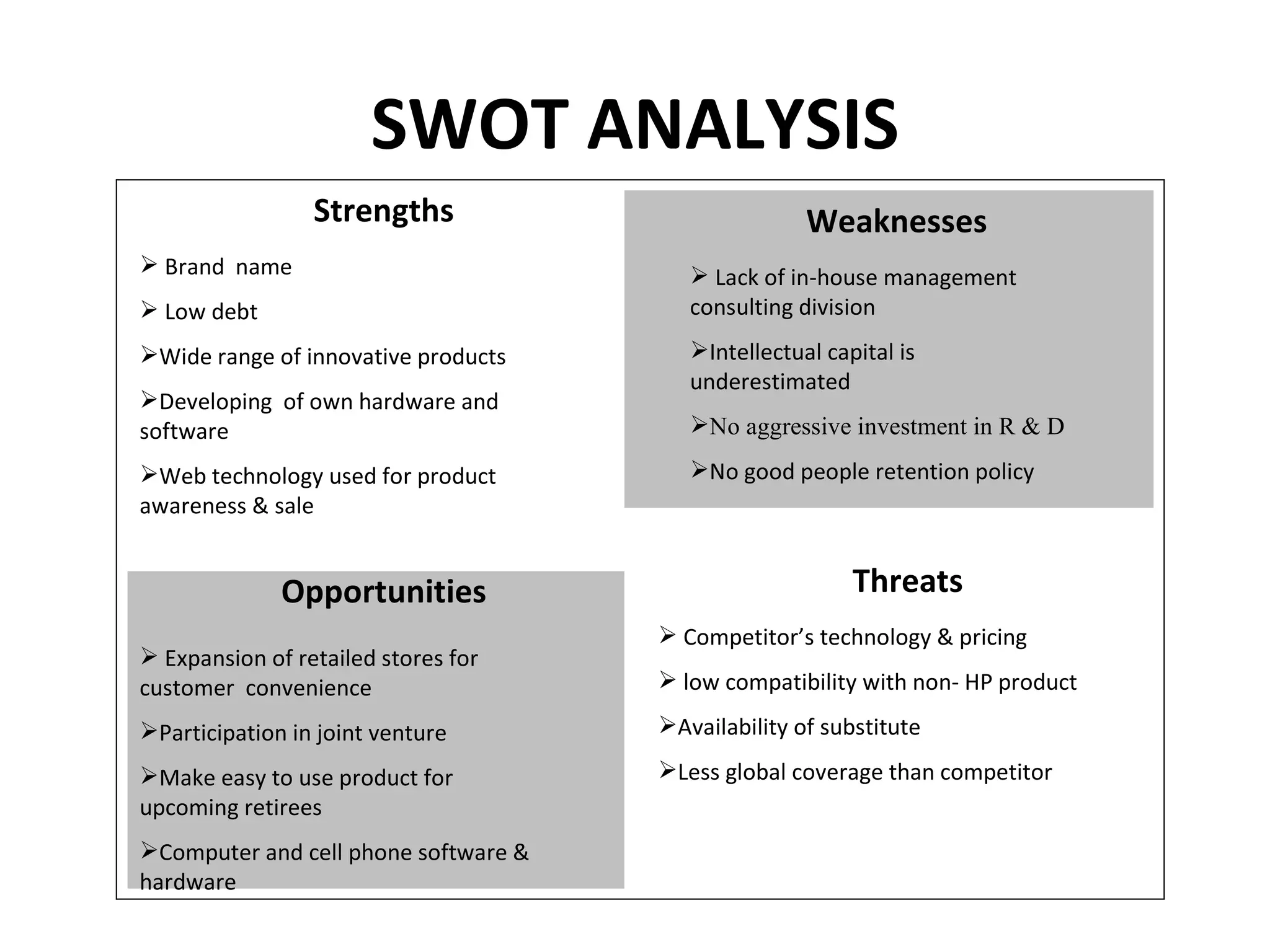
SWOT ANALYSIS Brand  name  Low debt Wide range of innovative products Developing  of own hardware and software Web technology used for product  awareness & sale Lack of in-house management consulting division Intellectual capital is underestimated No aggressive investment in R & D No good people retention policy Expansion of retailed stores for customer  convenience Participation in joint venture Make easy to use product for upcoming retirees Computer and cell phone software & hardware  Competitor’s technology & pricing low compatibility with non- HP product Availability of substitute Less global coverage than competitor  Strengths Weaknesses Opportunities Threats
STAGE # 2  INPUT STAGE
IFE  (INTERNAL FACTOR EVALUATION MATRIX)
Key Internal factors Weight Rating Weighted Score Strengths Brand  name  Low debt Wide range of innovative products Developing  of own hardware and software Web technology used for product  awareness & sale 0.14 0.13 0.13 0.11 0.10 4 4 4 4 3 0.56 0.52 0.52 0.44 0.30 Weaknesses Lack of in-house management consulting division Intellectual capital is underestimated No aggressive investment in R & D No good people retention policy 0.10 0.08 0.11 0.10 1 2 2 2 0.10 0.16 0.22 0.20 Total 1.00 3.02
EFE  (EXTERNAL FACTOR EVALUATION MATRIX)
Key External factors Weight Rating Weighted Score Opportunity Expansion of retailed stores for customer  convenience Participation in joint venture Make easy to use product for upcoming retirees Computer and cell phone software & hardware  0.11 0.20 0.09 0.12 3 3 2 4 0.33 0.60 0.18 0.48 Threat Competitor’s technology & pricing low compatibility with non- HP product Availability of substitute Less global coverage than competitor  0.14 0.13 0.10 0.11 4 3 4 2 0.56 0.39 0.40 0.22 Total 1.00 3.16
CPM (COMPETITIVE PROFILE MATRIX)
Critical success factor weight HP DELL CANON Rating Score Rating Score Rating Score Innovation 0.11 2 0.22 4 0.44 3 0.33 Management 0.08 3 0.24 4 0.32 2 0.16 Technology 0.12 4 0.48 2 0.24 3 0.36 Financial Position 0.10 4 0.40 3 0.30 2 0.20 Market share 0.09 3 0.27 4 0.36 2 0.18 Customer loyalty 0.10 4 0.40 3 0.30 2 0.20 Brand name 0.11 2 0.22 4 0.44 3 0.33 Pricing 0.11 4 0.44 3 0.33 2 0.22 Product Quality 0.09 4 0.18 3 0.27 2 0.18 Compatibility  0.10 2 0.20 3 0.30 4 0.40 Promotion 0.08 3 0.24 2 0.16 4 0.32 Total 1.00 3.29 3.46 2.88
STAGE # 3 MATCHING STAGE
TOWS MATRIX
TOWS MATRIX Strengths  - S Brand  name  Low debt Wide range of innovative products Developing  of own hardware and software Web technology used for product  awareness & sale Weakness – W Lack of in-house management consulting division Intellectual capital is underestimated No aggressive investment in R & D No good people retention policy Opportunities – O Expansion of retailed stores for customer  convenience Participation in joint venture Make easy to use product for upcoming retirees Computer and cell phone software & hardware  SO - strategies ( S1, S3,O1,) ( must open new retail stores throughout the world to take advantage of financial strength) ( S4, O3 ) (develop easy pc and cell phone for old generation)  WO – strategies (W1,W5,O2)  ( develop new HR policy in order to retain human capital by taking advantage or other firm management  ) Threats - T Competitor’s technology & pricing low compatibility with non- HP product Availability of substitute Less global coverage than competitor  ST – strategies (S4, T1) (developed low price and innovative pc & cell phone than competitors ) ( S5,T2) (developed such  hardware and software for computer & cell phone which are compatible with other companies software and accessories) WT – strategies (W1,T1) (give attention to management consulting division to have more focus on technology improvements)
Interpretation   Critical Region: “ ST” Managerial Decision: “ Market development  Horizontal Integration”
SPACE  (STRATEGIC POSITION & ACTION EVALUATION MATRIX)
Internal Strategic Position External Strategic position Financial Strengths (FS) Environmental Stability (ES) Return on Investment leverage Working Capital Liquidity Price earning  ratio Total Average +5 +3 +4 +5 +4 +21 +4.2 Technological changes Rate of Inflation Price range of Competing  products Competitive pressure Barriers to entry into market Demand variability Total Average -3 -2 -3 -5 -4 -2 -19 -3.17 Competitive Advantage (CA) Industry Strength (IS) Market Share Product Quality Customer Loyalty Technological know-how Control over suppliers and distributors Total Average -2 -3 -2 -2 -4 -13 -2.6 Growth Potential Profit Potential Financial Stability Labor cost Technological know-how Total Average +5 +5 +4 +3 +4 +21 +4.2
-6  -5  -4  -3  -2  -1 +1  +2  +3  +5  +6 +6 +5 +4 +3 +2 +1 -1 -2 -3 -4 -5 -6 Aggressive Conservative Competitive Defensive IS CA X-axis =CA + IS = -2.6+(4.20) = 1.60 Y-axis = FS + ES = 4.2+(-3.17) =1.03 FS ES
INTERPRETATION  According to the space matrix score HP falls in the “ AGGRESSIVE quadrant”  . Their strategies should be one of the following: Vertical and horizontal integration Market penetration Market development Product development Diversification
BCG (BOSTON CONSULTANTING GROUP MATRIX)
Table for BCG Matrix HP division ID SEGMENTS REVENUE % PROFIT % GROWTH RATE % MARKET SHRE % A ESS 19 2 11 0.8 B HPS 17 20 8 0.1 C SOFTWARE 1.4 5 14 0.6 D IPG 29.2 30 8 0.8 E PSG 32 42 -10 0.7 F HPHS 2.2 2 -14 0.2
HP BCG Matrix Relative market share Industry growth rate High    Medium   Low  1.0   .50   0.0   High  +20 Medium  0 Low  - 20 STARS  C A   II  D Question Mark I  B CASH COWS E III DOGS IV  F
IE  (INTERNAL-EXTERNAL MATRIX)
Strong 3.0 – 4.0 Average 2.0 – 2.99 Weak 1.0 – 1.99 2.0 3.0 4.0 IFE Total Weighted Score 3.02 1.0 2.0 3.0 Low 1.0 – 1.99 Medium 2.0 – 2.99 High 3.0 – 4.0 EFE TOTAL WEIGHTED SCORE 3.16 i HP ii iii iv v vi vii viii ix
INTERPRETATION HP falls in first region of IE matrix and there main focus will be on  “GROW AND BUILD”  and they will mainly focus on strategies which are: Market development Horizontal integration
GRAND STRATEGY MATRIX
Slow market growth Rapid market growth Strong  competitive position Weak competitive position Quadrant II Quadrant I HP Quadrant III Quadrant IV
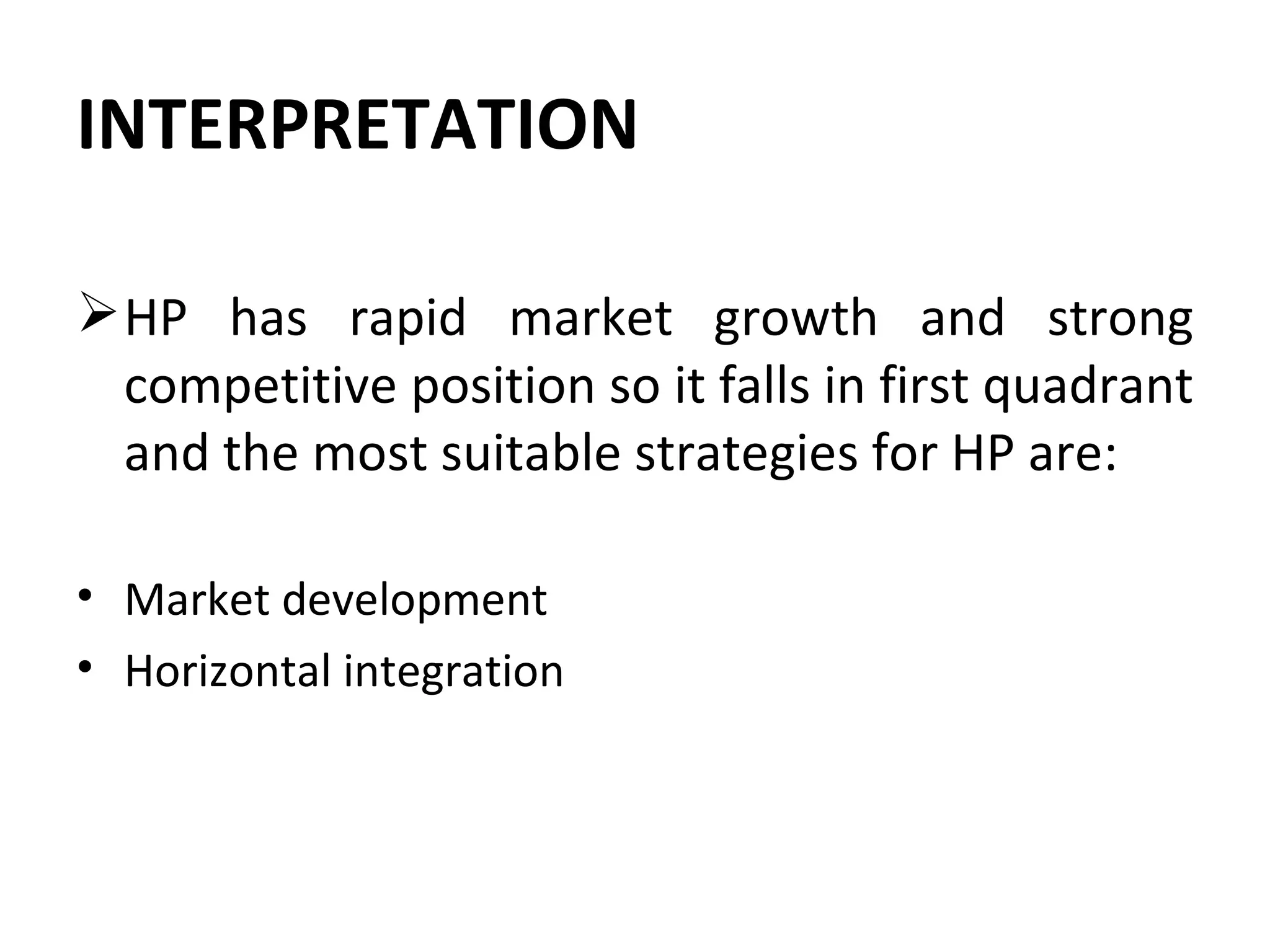
INTERPRETATION HP has rapid market growth and strong competitive position so it falls in first quadrant and the most suitable strategies for HP are: Market development  Horizontal integration
STAGE # 4 DECISION STAGE
QSPM (QUANTITATIVE STRATEGIC PLANNING MATRIX)
Key Internal Factors HORIZONTAL INTEGRATION MARKET DEVELOPEMNT  Strengths Weight AS TAS AS TAS Brand name 0.14 3 0.42 4 0.56 Low debt 0.13 3 0.39 2 0.26 Wide range of innovative products 0.13 4 0.52 3 0.39 Developing of own hardware and software 0.11 4 0.44 3 0.33 Web technology used for product awareness and sale  0.10 2 0.20 3 0.30 Weaknesses Lack of in-house management consulting division 0.10 2 0.20 3 0.30 Intellectual capital is underestimated 0.08 -- -- -- -- No aggressive investment in R & D 0.11 3 0.33 2 0.22 No good people retention policy 0.10 3 0.30 2 0.20 Total weight 1.00
Key External Factors HORIZONTAL INTEGRATION MARKET DEVELOMENT  Opportunities weight AS TAS AS TAS Expansion of retailed store for customer convenience 0.11 3 0.33 4 0.44 Participation in joint venture 0.20 4 0.80 2 0.40 Make easy to use product for upcoming retirees 0.09 3 0.27 2 0.18 Computer and cell phone software and hardware 0.12 3 0.36 2 0.24 Threats Competitors  technology and pricing 0.14 4 0.56 3 0.42 Low compatibility with non-HP product 0.13 3 0.39 2 0.26 Availability of substitutes 0.10 4 0.40 3 0.30 Less global coverage than competitors 0.11 3 0.33 2 0.22 Total weight 1.00 Total Attractive Score 6.24 5.02
INTERPRETATION   According to the total attractive score of QSPM HP should go for  “ HORIZONTAL INTEGRATION”

Hp case study

  • 1.
    CASE STUDY (HP)STRATEGIC ANALYSIS OF “HEWLETT PACKARD CORPORATION”
  • 2.
    Contents Introduction& history Vision & mission SWOT Formulation (stage #1) Input EFE IFE CPM Matching SWOT IE MATRIX SPACE MATRIX BCG MATRIX GRAND MATRIX Decision QSPM Implementation (stage # 2) Evaluation stage (stage # 3)
  • 3.
    Introduction Strategicmanagement is all about Formulation Implementation & evaluation of strategies So our project will revolve on these critical parameters.
  • 4.
    Strategic Management Strategy Formulation Input /action stage Matching stage Decision stage Strategy Implementation Strategy evaluation
  • 5.
    STAGE # 1INTRODUCTION
  • 6.
    Introduction of HewlettPackard Corporation Bill Hewlett & Dave Packard graduated in electrical engineering from STANFORD university in 1935. The company originated in garage in nearby Palo Alto,California,USA during a fellowship in 1939 with initial capital investment of us $538 Hewlett Packard company commonly referred as ‘HP’ American multinational information technology corporation headquartered in Palo Alto , California , USA Nearly in each country hp product lines include 01)personal computing devices 02)enterprise servers 03)related storage devices 04)diverse range of printers & imaging products Hp markets it’s products to household, small to medium size consumers and enterprise directly as well as via online distribution
  • 7.
    VISION & MISSIONVision statement “ To view change in market as an opportunity to grow, to use our profit and our ability to develop & produce innovative products , services and solutions that satisfy emerging customers need ” Mission Statement “ To provide product, services and solution of highest quality and deliver more value to our customers that earn their respect and loyalty ”
  • 8.
    SWOT ANALYSIS Brand name Low debt Wide range of innovative products Developing of own hardware and software Web technology used for product awareness & sale Lack of in-house management consulting division Intellectual capital is underestimated No aggressive investment in R & D No good people retention policy Expansion of retailed stores for customer convenience Participation in joint venture Make easy to use product for upcoming retirees Computer and cell phone software & hardware Competitor’s technology & pricing low compatibility with non- HP product Availability of substitute Less global coverage than competitor Strengths Weaknesses Opportunities Threats
  • 9.
    STAGE # 2 INPUT STAGE
  • 10.
    IFE (INTERNALFACTOR EVALUATION MATRIX)
  • 11.
    Key Internal factorsWeight Rating Weighted Score Strengths Brand name Low debt Wide range of innovative products Developing of own hardware and software Web technology used for product awareness & sale 0.14 0.13 0.13 0.11 0.10 4 4 4 4 3 0.56 0.52 0.52 0.44 0.30 Weaknesses Lack of in-house management consulting division Intellectual capital is underestimated No aggressive investment in R & D No good people retention policy 0.10 0.08 0.11 0.10 1 2 2 2 0.10 0.16 0.22 0.20 Total 1.00 3.02
  • 12.
    EFE (EXTERNALFACTOR EVALUATION MATRIX)
  • 13.
    Key External factorsWeight Rating Weighted Score Opportunity Expansion of retailed stores for customer convenience Participation in joint venture Make easy to use product for upcoming retirees Computer and cell phone software & hardware 0.11 0.20 0.09 0.12 3 3 2 4 0.33 0.60 0.18 0.48 Threat Competitor’s technology & pricing low compatibility with non- HP product Availability of substitute Less global coverage than competitor 0.14 0.13 0.10 0.11 4 3 4 2 0.56 0.39 0.40 0.22 Total 1.00 3.16
  • 14.
  • 15.
    Critical success factorweight HP DELL CANON Rating Score Rating Score Rating Score Innovation 0.11 2 0.22 4 0.44 3 0.33 Management 0.08 3 0.24 4 0.32 2 0.16 Technology 0.12 4 0.48 2 0.24 3 0.36 Financial Position 0.10 4 0.40 3 0.30 2 0.20 Market share 0.09 3 0.27 4 0.36 2 0.18 Customer loyalty 0.10 4 0.40 3 0.30 2 0.20 Brand name 0.11 2 0.22 4 0.44 3 0.33 Pricing 0.11 4 0.44 3 0.33 2 0.22 Product Quality 0.09 4 0.18 3 0.27 2 0.18 Compatibility 0.10 2 0.20 3 0.30 4 0.40 Promotion 0.08 3 0.24 2 0.16 4 0.32 Total 1.00 3.29 3.46 2.88
  • 16.
    STAGE # 3MATCHING STAGE
  • 17.
  • 18.
    TOWS MATRIX Strengths - S Brand name Low debt Wide range of innovative products Developing of own hardware and software Web technology used for product awareness & sale Weakness – W Lack of in-house management consulting division Intellectual capital is underestimated No aggressive investment in R & D No good people retention policy Opportunities – O Expansion of retailed stores for customer convenience Participation in joint venture Make easy to use product for upcoming retirees Computer and cell phone software & hardware SO - strategies ( S1, S3,O1,) ( must open new retail stores throughout the world to take advantage of financial strength) ( S4, O3 ) (develop easy pc and cell phone for old generation) WO – strategies (W1,W5,O2) ( develop new HR policy in order to retain human capital by taking advantage or other firm management ) Threats - T Competitor’s technology & pricing low compatibility with non- HP product Availability of substitute Less global coverage than competitor ST – strategies (S4, T1) (developed low price and innovative pc & cell phone than competitors ) ( S5,T2) (developed such hardware and software for computer & cell phone which are compatible with other companies software and accessories) WT – strategies (W1,T1) (give attention to management consulting division to have more focus on technology improvements)
  • 19.
    Interpretation Critical Region: “ ST” Managerial Decision: “ Market development Horizontal Integration”
  • 20.
    SPACE (STRATEGICPOSITION & ACTION EVALUATION MATRIX)
  • 21.
    Internal Strategic PositionExternal Strategic position Financial Strengths (FS) Environmental Stability (ES) Return on Investment leverage Working Capital Liquidity Price earning ratio Total Average +5 +3 +4 +5 +4 +21 +4.2 Technological changes Rate of Inflation Price range of Competing products Competitive pressure Barriers to entry into market Demand variability Total Average -3 -2 -3 -5 -4 -2 -19 -3.17 Competitive Advantage (CA) Industry Strength (IS) Market Share Product Quality Customer Loyalty Technological know-how Control over suppliers and distributors Total Average -2 -3 -2 -2 -4 -13 -2.6 Growth Potential Profit Potential Financial Stability Labor cost Technological know-how Total Average +5 +5 +4 +3 +4 +21 +4.2
  • 22.
    -6 -5 -4 -3 -2 -1 +1 +2 +3 +5 +6 +6 +5 +4 +3 +2 +1 -1 -2 -3 -4 -5 -6 Aggressive Conservative Competitive Defensive IS CA X-axis =CA + IS = -2.6+(4.20) = 1.60 Y-axis = FS + ES = 4.2+(-3.17) =1.03 FS ES
  • 23.
    INTERPRETATION Accordingto the space matrix score HP falls in the “ AGGRESSIVE quadrant” . Their strategies should be one of the following: Vertical and horizontal integration Market penetration Market development Product development Diversification
  • 24.
  • 25.
    Table for BCGMatrix HP division ID SEGMENTS REVENUE % PROFIT % GROWTH RATE % MARKET SHRE % A ESS 19 2 11 0.8 B HPS 17 20 8 0.1 C SOFTWARE 1.4 5 14 0.6 D IPG 29.2 30 8 0.8 E PSG 32 42 -10 0.7 F HPHS 2.2 2 -14 0.2
  • 26.
    HP BCG MatrixRelative market share Industry growth rate High Medium Low 1.0 .50 0.0 High +20 Medium 0 Low - 20 STARS C A II D Question Mark I B CASH COWS E III DOGS IV F
  • 27.
  • 28.
    Strong 3.0 –4.0 Average 2.0 – 2.99 Weak 1.0 – 1.99 2.0 3.0 4.0 IFE Total Weighted Score 3.02 1.0 2.0 3.0 Low 1.0 – 1.99 Medium 2.0 – 2.99 High 3.0 – 4.0 EFE TOTAL WEIGHTED SCORE 3.16 i HP ii iii iv v vi vii viii ix
  • 29.
    INTERPRETATION HP fallsin first region of IE matrix and there main focus will be on “GROW AND BUILD” and they will mainly focus on strategies which are: Market development Horizontal integration
  • 30.
  • 31.
    Slow market growthRapid market growth Strong competitive position Weak competitive position Quadrant II Quadrant I HP Quadrant III Quadrant IV
  • 32.
    INTERPRETATION HP hasrapid market growth and strong competitive position so it falls in first quadrant and the most suitable strategies for HP are: Market development Horizontal integration
  • 33.
    STAGE # 4DECISION STAGE
  • 34.
  • 35.
    Key Internal FactorsHORIZONTAL INTEGRATION MARKET DEVELOPEMNT Strengths Weight AS TAS AS TAS Brand name 0.14 3 0.42 4 0.56 Low debt 0.13 3 0.39 2 0.26 Wide range of innovative products 0.13 4 0.52 3 0.39 Developing of own hardware and software 0.11 4 0.44 3 0.33 Web technology used for product awareness and sale 0.10 2 0.20 3 0.30 Weaknesses Lack of in-house management consulting division 0.10 2 0.20 3 0.30 Intellectual capital is underestimated 0.08 -- -- -- -- No aggressive investment in R & D 0.11 3 0.33 2 0.22 No good people retention policy 0.10 3 0.30 2 0.20 Total weight 1.00
  • 36.
    Key External FactorsHORIZONTAL INTEGRATION MARKET DEVELOMENT Opportunities weight AS TAS AS TAS Expansion of retailed store for customer convenience 0.11 3 0.33 4 0.44 Participation in joint venture 0.20 4 0.80 2 0.40 Make easy to use product for upcoming retirees 0.09 3 0.27 2 0.18 Computer and cell phone software and hardware 0.12 3 0.36 2 0.24 Threats Competitors technology and pricing 0.14 4 0.56 3 0.42 Low compatibility with non-HP product 0.13 3 0.39 2 0.26 Availability of substitutes 0.10 4 0.40 3 0.30 Less global coverage than competitors 0.11 3 0.33 2 0.22 Total weight 1.00 Total Attractive Score 6.24 5.02
  • 37.
    INTERPRETATION According to the total attractive score of QSPM HP should go for “ HORIZONTAL INTEGRATION”