



HOWTO Empathy 
A primer on how I taught myself to be more empathetic. 
Emma Jane Hogbin Westby 
@emmajanehw
This is a Touchy 
Feely Woo woo talk.
“I can’t even imagine.” 
This talk came about because I’m not very good at empathy. I find it exceptionally difficult, 
actually. And I have to make a conscious effort IN THE WORKPLACE to do the things which 
would come naturally to me outside of work.
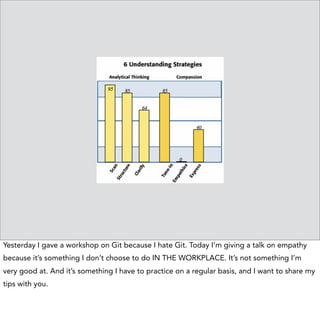
Yesterday I gave a workshop on Git because I hate Git. Today I’m giving a talk on empathy 
because it’s something I don’t choose to do IN THE WORKPLACE. It’s not something I’m 
very good at. And it’s something I have to practice on a regular basis, and I want to share my 
tips with you.
Normal people have an 
incredible lack of empathy. 
–Temple Grandin 
Fortunately, I’m not alone. Normal people don’t have a lot of empathy. 
http://en.wikipedia.org/wiki/Temple_Grandin 
Grandin is a prominent and widely cited proponent of the rights of autistic persons and of 
animal welfare.
define: empathy 
The ability to understand and share 
the feelings of another. 
Honestly? this just makes my skin crawl and gives me hives when I think about having 
empathy in the work place. I guess I’ve had too many bad experiences to want to throw my 
heart into someone else’s shoes.
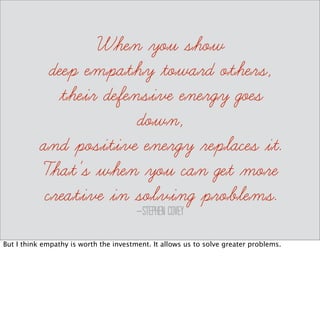
When you show 
deep empathy toward others, 
their defensive energy goes 
down, 
and positive energy replaces it. 
That's when you can get more 
creative in solving problems. 
–Stephen Covey 
But I think empathy is worth the investment. It allows us to solve greater problems.
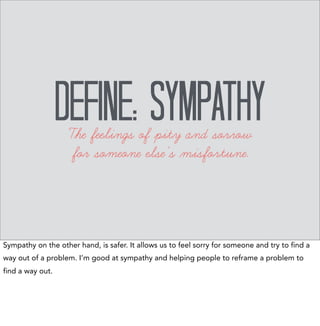
define: Sympathy 
The feelings of pity and sorrow 
for someone else's misfortune. 
Sympathy on the other hand, is safer. It allows us to feel sorry for someone and try to find a 
way out of a problem. I’m good at sympathy and helping people to reframe a problem to 
find a way out.
Why?
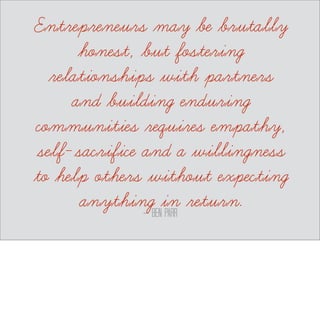
Entrepreneurs may be brutally 
honest, but fostering 
relationships with partners 
and building enduring 
communities requires empathy, 
self-sacrifice and a willingness 
to help others without expecting 
anything in return. 
– Ben Parr
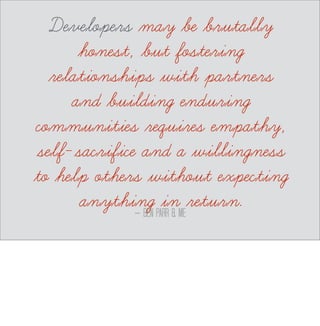
Developers may be brutally 
honest, but fostering 
relationships with partners 
and building enduring 
communities requires empathy, 
self-sacrifice and a willingness 
to help others without expecting 
anything in return. 
– Ben Parr & Me
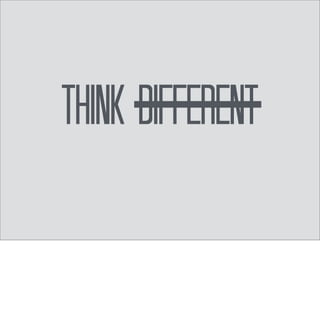
Think different
Think different
Think Deliberate
“How can I help 
[this|you|me] 
to be more awesome?” 
To improve the code, we need to improve our capacity. To improve our capacity we need to 
practice how we think.
Why do you build 
software?
And why do you 
Do that? 
Continue asking yourself “why” until you have found the root of why you enjoy building 
software.
My “Why” 
to understand and transform obstacles 
to achieve a state of flow. 
I’ve never built software for *myself*. I’ve always built it for other people. I build software 
because it will make someone’s life a little easier if I do. 
https://www.ted.com/speakers/simon_sinek
Practicing Empathy
Empathy is a tool for building 
people into groups, for allowing 
us to function as more than 
self-obsessed individuals. 
– Neil Gaiman
Level 1. 
Caring just enough 
Difficulty — Beginner. 
At this level you convert “resources” into people.
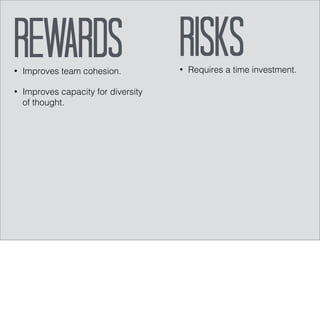
Rewards 
• Improves team cohesion. 
• Improves capacity for diversity 
of thought. 
Risks 
• Requires a time investment.
Collect stories. 
Learn about people by asking them questions.
STFU and listen. 
Listen until there is no more story. 
Then respond.
Refer back. 
Follow-up on a previous story 
to get the next instalment.
Compartmentalisation 
is way overrated. 
–Molly Ringwald 
Treat people like people, even at work. Allow yourself the time to be a little bit vulnerable. 
Invest in relationships.
Level 2. 
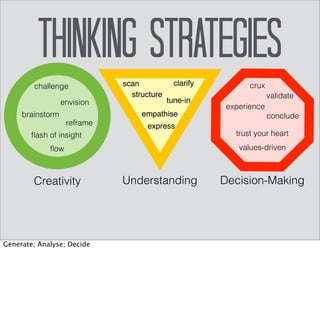
Thinking Strategies 
Difficulty — Intermediate.
Rewards 
• Improves your ability to 
“manipulate” situations into 
successful outcomes. 
Risks 
• Requires a time investment.
Uncover motivators. 
Unpack why a person behaves the way they do.
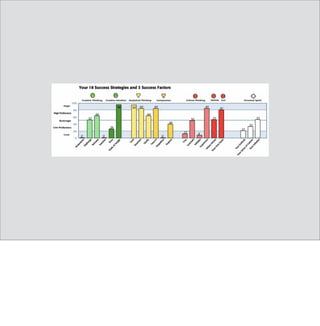
WWXD?
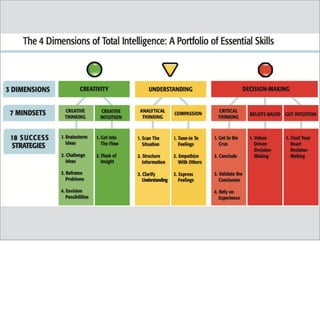
Thinking Strategies 
validate 
crux 
experience 
conclude 
trust your heart 
values-driven 
Decision-Making 
clarify 
tune-in 
structure 
empathise 
scan 
express 
Understanding 
challenge 
brainstorm 
envision 
reframe 
flash of insight 
flow 
Creativity 
Generate; Analyse; Decide
challenge 
envision 
brainstorm 
reframe 
flash of insight 
flow 
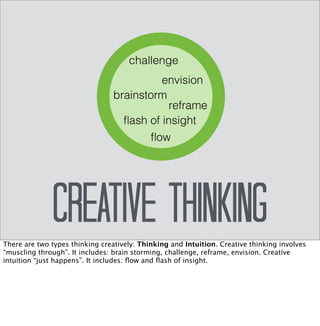
Creative Thinking 
There are two types thinking creatively: Thinking and Intuition. Creative thinking involves 
“muscling through”. It includes: brain storming, challenge, reframe, envision. Creative 
intuition “just happens”. It includes: flow and flash of insight.
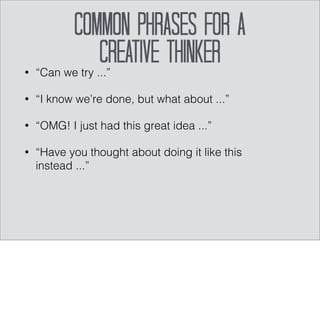
Common Phrases For a 
Creative Thinker 
• “Can we try ...” 
• “I know we’re done, but what about ...” 
• “OMG! I just had this great idea ...” 
• “Have you thought about doing it like this 
instead ...”
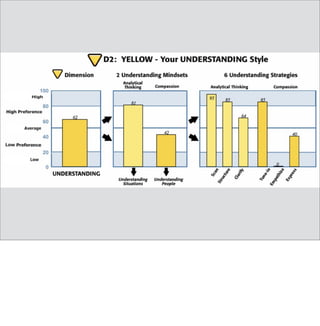
clarify 
tune-in 
scan 
structure 
empathise 
express 
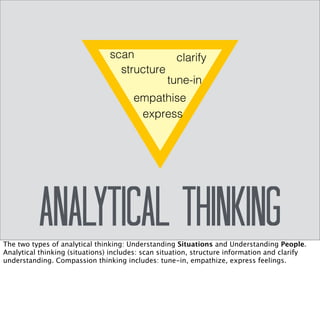
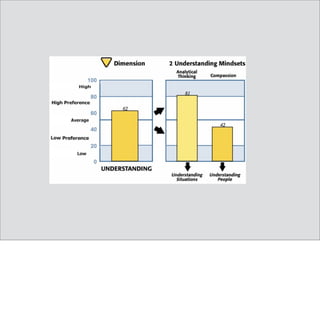
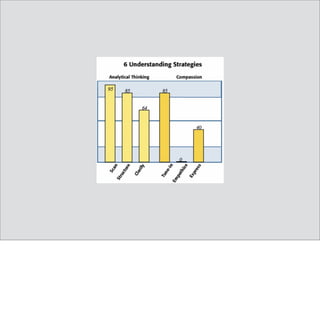
Analytical Thinking 
The two types of analytical thinking: Understanding Situations and Understanding People. 
Analytical thinking (situations) includes: scan situation, structure information and clarify 
understanding. Compassion thinking includes: tune-in, empathize, express feelings.
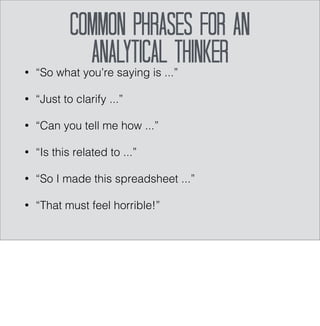
Common Phrases For an 
Analytical Thinker 
• “So what you’re saying is ...” 
• “Just to clarify ...” 
• “Can you tell me how ...” 
• “Is this related to ...” 
• “So I made this spreadsheet ...” 
• “That must feel horrible!”
crux 
validate 
experience 
conclude 
gut instinct 
values-driven 
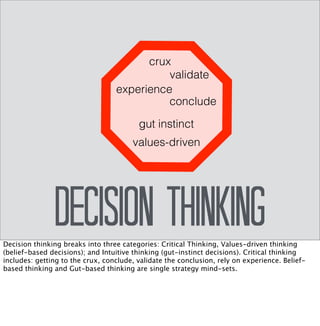
Decision Thinking 
Decision thinking breaks into three categories: Critical Thinking, Values-driven thinking 
(belief-based decisions); and Intuitive thinking (gut-instinct decisions). Critical thinking 
includes: getting to the crux, conclude, validate the conclusion, rely on experience. Belief-based 
thinking and Gut-based thinking are single strategy mind-sets.
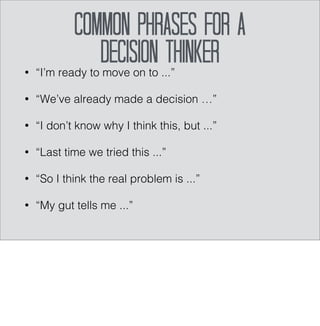
Common Phrases For a 
Decision Thinker 
• “I’m ready to move on to ...” 
• “We’ve already made a decision …” 
• “I don’t know why I think this, but ...” 
• “Last time we tried this ...” 
• “So I think the real problem is ...” 
• “My gut tells me ...”
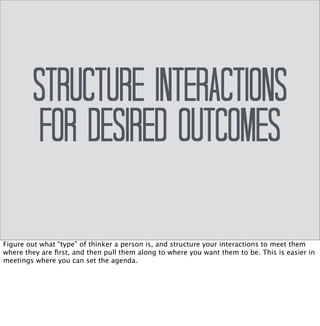
Structure Interactions 
for desired Outcomes 
Figure out what “type” of thinker a person is, and structure your interactions to meet them 
where they are first, and then pull them along to where you want them to be. This is easier in 
meetings where you can set the agenda.
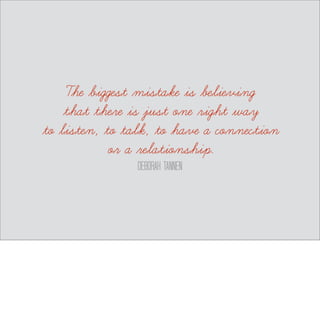
The biggest mistake is believing 
that there is just one right way 
to listen, to talk, to have a connection 
or a relationship. 
Deborah Tannen
Level 3. 
Imagination 
Difficulty — Advanced
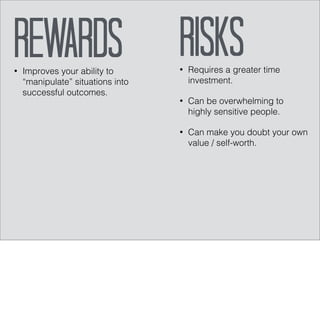
Rewards 
• Improves your ability to 
“manipulate” situations into 
successful outcomes. 
Risks 
• Requires a greater time 
investment. 
• Can be overwhelming to 
highly sensitive people. 
• Can make you doubt your own 
value / self-worth.
Use your imagination. 
Complain from the other perspective. 
The assumption is that the listener is on the side of the complainer. 
http://lifehacker.com/why-empathy-is-your-most-important-skill-and-how-to-pr- 
1505011685 
AKA play the devil’s advocate.
I think we all have empathy. 
We may not have 
enough courage to display it. 
–Maya Angelou
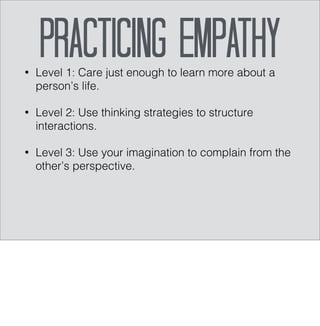
Practicing Empathy 
• Level 1: Care just enough to learn more about a 
person’s life. 
• Level 2: Use thinking strategies to structure 
interactions. 
• Level 3: Use your imagination to complain from the 
other’s perspective.
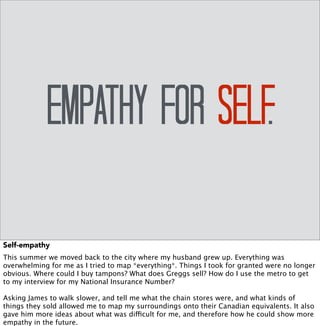
Empathy for self. 
Self-empathy 
This summer we moved back to the city where my husband grew up. Everything was 
overwhelming for me as I tried to map *everything*. Things I took for granted were no longer 
obvious. Where could I buy tampons? What does Greggs sell? How do I use the metro to get 
to my interview for my National Insurance Number? 
Asking James to walk slower, and tell me what the chain stores were, and what kinds of 
things they sold allowed me to map my surroundings onto their Canadian equivalents. It also 
gave him more ideas about what was difficult for me, and therefore how he could show more 
empathy in the future.
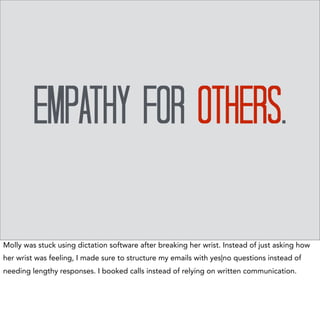
Empathy for others. 
Molly was stuck using dictation software after breaking her wrist. Instead of just asking how 
her wrist was feeling, I made sure to structure my emails with yes|no questions instead of 
needing lengthy responses. I booked calls instead of relying on written communication.
@emmajanehw 
http://joind.in/talk/view/12702

HOWTO Empathy

  • 1.
    HOWTO Empathy Aprimer on how I taught myself to be more empathetic. Emma Jane Hogbin Westby @emmajanehw
  • 2.
    This is aTouchy Feely Woo woo talk.
  • 3.
    “I can’t evenimagine.” This talk came about because I’m not very good at empathy. I find it exceptionally difficult, actually. And I have to make a conscious effort IN THE WORKPLACE to do the things which would come naturally to me outside of work.
  • 4.
    Yesterday I gavea workshop on Git because I hate Git. Today I’m giving a talk on empathy because it’s something I don’t choose to do IN THE WORKPLACE. It’s not something I’m very good at. And it’s something I have to practice on a regular basis, and I want to share my tips with you.
  • 5.
    Normal people havean incredible lack of empathy. –Temple Grandin Fortunately, I’m not alone. Normal people don’t have a lot of empathy. http://en.wikipedia.org/wiki/Temple_Grandin Grandin is a prominent and widely cited proponent of the rights of autistic persons and of animal welfare.
  • 6.
    define: empathy Theability to understand and share the feelings of another. Honestly? this just makes my skin crawl and gives me hives when I think about having empathy in the work place. I guess I’ve had too many bad experiences to want to throw my heart into someone else’s shoes.
  • 7.
    When you show deep empathy toward others, their defensive energy goes down, and positive energy replaces it. That's when you can get more creative in solving problems. –Stephen Covey But I think empathy is worth the investment. It allows us to solve greater problems.
  • 8.
    define: Sympathy Thefeelings of pity and sorrow for someone else's misfortune. Sympathy on the other hand, is safer. It allows us to feel sorry for someone and try to find a way out of a problem. I’m good at sympathy and helping people to reframe a problem to find a way out.
  • 9.
  • 10.
    Entrepreneurs may bebrutally honest, but fostering relationships with partners and building enduring communities requires empathy, self-sacrifice and a willingness to help others without expecting anything in return. – Ben Parr
  • 11.
    Developers may bebrutally honest, but fostering relationships with partners and building enduring communities requires empathy, self-sacrifice and a willingness to help others without expecting anything in return. – Ben Parr & Me
  • 12.
  • 13.
  • 14.
  • 15.
    “How can Ihelp [this|you|me] to be more awesome?” To improve the code, we need to improve our capacity. To improve our capacity we need to practice how we think.
  • 16.
    Why do youbuild software?
  • 17.
    And why doyou Do that? Continue asking yourself “why” until you have found the root of why you enjoy building software.
  • 18.
    My “Why” tounderstand and transform obstacles to achieve a state of flow. I’ve never built software for *myself*. I’ve always built it for other people. I build software because it will make someone’s life a little easier if I do. https://www.ted.com/speakers/simon_sinek
  • 19.
  • 20.
    Empathy is atool for building people into groups, for allowing us to function as more than self-obsessed individuals. – Neil Gaiman
  • 21.
    Level 1. Caringjust enough Difficulty — Beginner. At this level you convert “resources” into people.
  • 22.
    Rewards • Improvesteam cohesion. • Improves capacity for diversity of thought. Risks • Requires a time investment.
  • 23.
    Collect stories. Learnabout people by asking them questions.
  • 24.
    STFU and listen. Listen until there is no more story. Then respond.
  • 25.
    Refer back. Follow-upon a previous story to get the next instalment.
  • 26.
    Compartmentalisation is wayoverrated. –Molly Ringwald Treat people like people, even at work. Allow yourself the time to be a little bit vulnerable. Invest in relationships.
  • 27.
    Level 2. ThinkingStrategies Difficulty — Intermediate.
  • 28.
    Rewards • Improvesyour ability to “manipulate” situations into successful outcomes. Risks • Requires a time investment.
  • 29.
    Uncover motivators. Unpackwhy a person behaves the way they do.
  • 30.
  • 31.
    Thinking Strategies validate crux experience conclude trust your heart values-driven Decision-Making clarify tune-in structure empathise scan express Understanding challenge brainstorm envision reframe flash of insight flow Creativity Generate; Analyse; Decide
  • 32.
    challenge envision brainstorm reframe flash of insight flow Creative Thinking There are two types thinking creatively: Thinking and Intuition. Creative thinking involves “muscling through”. It includes: brain storming, challenge, reframe, envision. Creative intuition “just happens”. It includes: flow and flash of insight.
  • 33.
    Common Phrases Fora Creative Thinker • “Can we try ...” • “I know we’re done, but what about ...” • “OMG! I just had this great idea ...” • “Have you thought about doing it like this instead ...”
  • 34.
    clarify tune-in scan structure empathise express Analytical Thinking The two types of analytical thinking: Understanding Situations and Understanding People. Analytical thinking (situations) includes: scan situation, structure information and clarify understanding. Compassion thinking includes: tune-in, empathize, express feelings.
  • 35.
    Common Phrases Foran Analytical Thinker • “So what you’re saying is ...” • “Just to clarify ...” • “Can you tell me how ...” • “Is this related to ...” • “So I made this spreadsheet ...” • “That must feel horrible!”
  • 36.
    crux validate experience conclude gut instinct values-driven Decision Thinking Decision thinking breaks into three categories: Critical Thinking, Values-driven thinking (belief-based decisions); and Intuitive thinking (gut-instinct decisions). Critical thinking includes: getting to the crux, conclude, validate the conclusion, rely on experience. Belief-based thinking and Gut-based thinking are single strategy mind-sets.
  • 37.
    Common Phrases Fora Decision Thinker • “I’m ready to move on to ...” • “We’ve already made a decision …” • “I don’t know why I think this, but ...” • “Last time we tried this ...” • “So I think the real problem is ...” • “My gut tells me ...”
  • 38.
    Structure Interactions fordesired Outcomes Figure out what “type” of thinker a person is, and structure your interactions to meet them where they are first, and then pull them along to where you want them to be. This is easier in meetings where you can set the agenda.
  • 39.
    The biggest mistakeis believing that there is just one right way to listen, to talk, to have a connection or a relationship. Deborah Tannen
  • 40.
    Level 3. Imagination Difficulty — Advanced
  • 41.
    Rewards • Improvesyour ability to “manipulate” situations into successful outcomes. Risks • Requires a greater time investment. • Can be overwhelming to highly sensitive people. • Can make you doubt your own value / self-worth.
  • 42.
    Use your imagination. Complain from the other perspective. The assumption is that the listener is on the side of the complainer. http://lifehacker.com/why-empathy-is-your-most-important-skill-and-how-to-pr- 1505011685 AKA play the devil’s advocate.
  • 48.
    I think weall have empathy. We may not have enough courage to display it. –Maya Angelou
  • 49.
    Practicing Empathy •Level 1: Care just enough to learn more about a person’s life. • Level 2: Use thinking strategies to structure interactions. • Level 3: Use your imagination to complain from the other’s perspective.
  • 50.
    Empathy for self. Self-empathy This summer we moved back to the city where my husband grew up. Everything was overwhelming for me as I tried to map *everything*. Things I took for granted were no longer obvious. Where could I buy tampons? What does Greggs sell? How do I use the metro to get to my interview for my National Insurance Number? Asking James to walk slower, and tell me what the chain stores were, and what kinds of things they sold allowed me to map my surroundings onto their Canadian equivalents. It also gave him more ideas about what was difficult for me, and therefore how he could show more empathy in the future.
  • 51.
    Empathy for others. Molly was stuck using dictation software after breaking her wrist. Instead of just asking how her wrist was feeling, I made sure to structure my emails with yes|no questions instead of needing lengthy responses. I booked calls instead of relying on written communication.
  • 52.