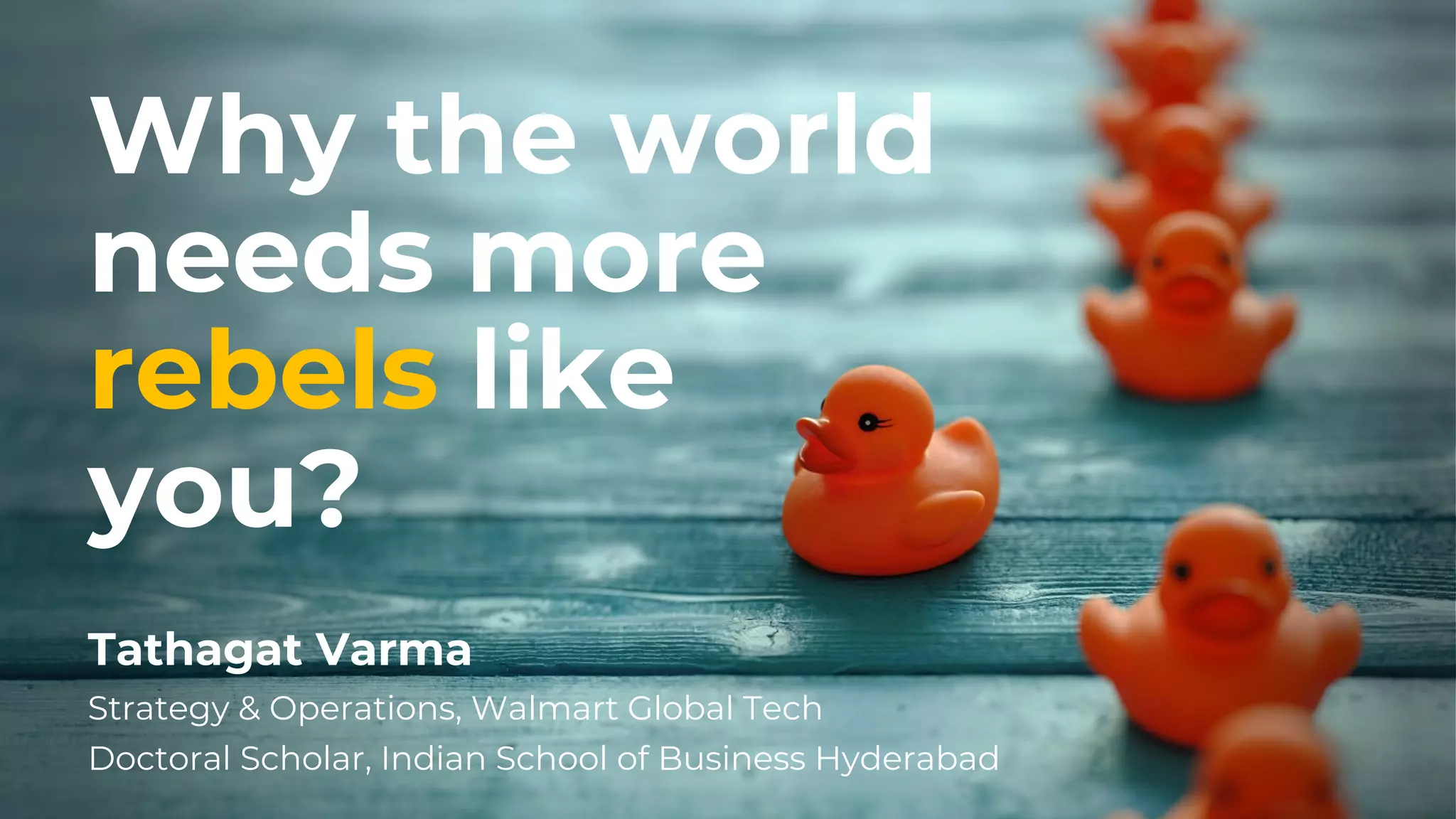
Why the world
needs more
rebels like
you?
Tathagat Varma
Strategy & Operations, Walmart Global Tech
Doctoral Scholar, Indian School of Business Hyderabad
Synopsis
Being conscious has several dimensions. To most, it is
about being aware of things around them. To some, it is
about being an integral part of something organic, or the
feeling of being connected, and so on. My take is that
being a rebel is the highest form of consciousness – the
ability to meaningfully disagree and make a definitive
difference. However, what does that mean, and how can
organizations harness the energy of a rebel to become a
more conscious organization? Let’s explore.
Disclaimer!
These are my personal views!
I am still learning to be a
better rebel J
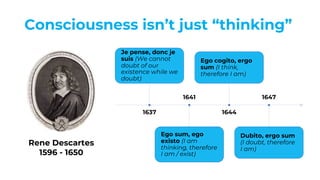
Consciousness isn’t just “thinking”
1637
Je pense, donc je
suis (We cannot
doubt of our
existence while we
doubt)
1641
Ego sum, ego
existo (I am
thinking, therefore
I am / exist)
1644
Ego cogito, ergo
sum (I think,
therefore I am)
1647
Dubito, ergo sum
(I doubt, therefore
I am)
Rene Descartes
1596 - 1650
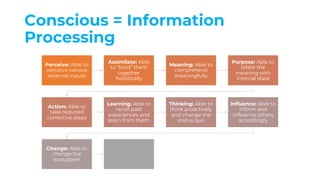
Conscious = Information
Processing
Perceive: Able to
perceive various
external inputs
Assimilate: Able
to “bind” them
together
holistically
Meaning: Able to
comprehend
meaningfully
Purpose: Able to
relate the
meaning with
internal state
Action: Able to
take required
corrective steps
Learning: Able to
recall past
experiences and
learn from them
Thinking: Able to
think proactively
and change the
status quo
Influence: Able to
inform and
influence others
accordingly
Change: Able to
change the
ecosystem
…
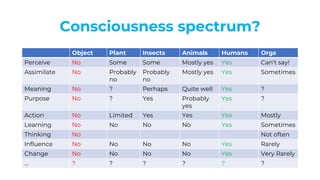
Consciousness spectrum?
Object Plant Insects Animals Humans Orgs
Perceive No Some Some Mostly yes Yes Can’t say!
Assimilate No Probably
no
Probably
no
Mostly yes Yes Sometimes
Meaning No ? Perhaps Quite well Yes ?
Purpose No ? Yes Probably
yes
Yes ?
Action No Limited Yes Yes Yes Mostly
Learning No No No No Yes Sometimes
Thinking No Not often
Influence No No No No Yes Rarely
Change No No No No Yes Very Rarely
… ? ? ? ? ? ?
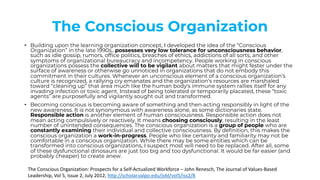
The Conscious Organization
• Building upon the learning organization concept, I developed the idea of the “Conscious
Organization” in the late 1990s…possesses very low tolerance for unconsciousness behavior,
such as idle gossip, rumors, office politics, breaches of ethics, addictions of all sorts, and other
symptoms of organizational bureaucracy and incompetency. People working in conscious
organizations possess the collective will to be vigilant about matters that might fester under the
surface of awareness or otherwise go unnoticed in organizations that do not embody this
commitment in their cultures. Whenever an unconscious element of a conscious organization’s
culture is recognized, a rallying cry emanates and the organization’s resources are marshaled
toward “cleaning up” that area much like the human body's immune system rallies itself for any
invading infection or toxic agent. Instead of being tolerated or temporarily placated, these “toxic
agents” are purposefully and vigilantly sought out and transformed.
• Becoming conscious is becoming aware of something and then acting responsibly in light of the
new awareness. It is not synonymous with awareness alone, as some dictionaries state.
Responsible action is another element of human consciousness. Responsible action does not
mean acting compulsively or reactively. It means choosing consciously, resulting in the least
number of unintended consequences. The conscious organization is a group of people who are
constantly examining their individual and collective consciousness. By definition, this makes the
conscious organization a work-in-progress. People who like certainty and familiarity may not be
comfortable in a conscious organization. While there may be some entities which can be
transformed into conscious organizations, I suspect most will need to be replaced. After all, some
of these dysfunctional dinosaurs are just too big and too dysfunctional. It would be far easier (and
probably cheaper) to create anew.
The Conscious Organization: Prospects for a Self-Actualized Workforce – John Renesch, The Journal of Values-Based
Leadership, Vol 5, Issue 2, July 2012, http://scholar.valpo.edu/jvbl/vol5/iss2/8
Conscious = Rebel
“Until they become
conscious they will
never rebel, and
until after they
have rebelled they
cannot become
conscious.” –
George Orwell,
1984
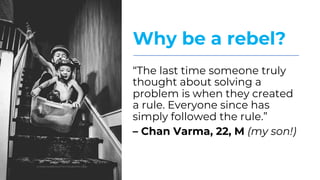
Why be a rebel?
“The last time someone truly
thought about solving a
problem is when they created
a rule. Everyone since has
simply followed the rule.”
– Chan Varma, 22, M (my son!)
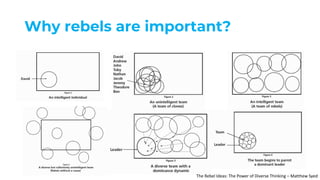
Why rebels are important?
The Rebel Ideas: The Power of Diverse Thinking – Matthew Syed
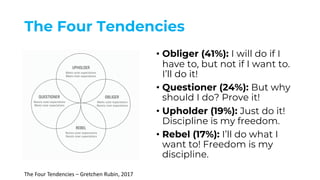
The Four Tendencies
• Obliger (41%): I will do if I
have to, but not if I want to.
I’ll do it!
• Questioner (24%): But why
should I do? Prove it!
• Upholder (19%): Just do it!
Discipline is my freedom.
• Rebel (17%): I’ll do what I
want to! Freedom is my
discipline.
The Four Tendencies – Gretchen Rubin, 2017
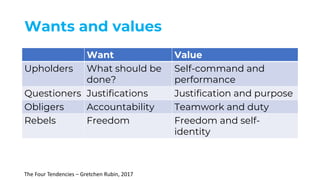
Wants and values
Want Value
Upholders What should be
done?
Self-command and
performance
Questioners Justifications Justification and purpose
Obligers Accountability Teamwork and duty
Rebels Freedom Freedom and self-
identity
The Four Tendencies – Gretchen Rubin, 2017
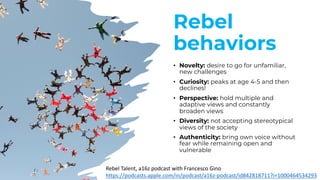
Rebel
behaviors
• Novelty: desire to go for unfamiliar,
new challenges
• Curiosity: peaks at age 4-5 and then
declines!
• Perspective: hold multiple and
adaptive views and constantly
broaden views
• Diversity: not accepting stereotypical
views of the society
• Authenticity: bring own voice without
fear while remaining open and
vulnerable
Rebel Talent, a16z podcast with Francesco Gino
https://podcasts.apple.com/in/podcast/a16z-podcast/id842818711?i=1000464534293
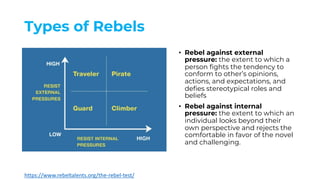
Types of Rebels
• Rebel against external
pressure: the extent to which a
person fights the tendency to
conform to other’s opinions,
actions, and expectations, and
defies stereotypical roles and
beliefs
• Rebel against internal
pressure: the extent to which an
individual looks beyond their
own perspective and rejects the
comfortable in favor of the novel
and challenging.
https://www.rebeltalents.org/the-rebel-test/
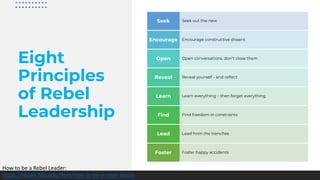
Eight
Principles
of Rebel
Leadership
Seek out the newSeek
Encourage constructive dissentEncourage
Open conversations, don’t close themOpen
Reveal yourself - and reflectReveal
Learn everything – then forget everythingLearn
Find freedom in constraintsFind
Lead from the trenchesLead
Foster happy accidentsFoster
How to be a Rebel Leader:
https://hbswk.hbs.edu/item/how-to-be-a-rebel-leader
Let’s
sum it
all up…
• We don’t quite know
the future
• Status quo isn’t an
option
• Experts don’t really
know
• Develop rebel
consciousness…

Why the world needs more rebels like you?

  • 1.
    Why the world needsmore rebels like you? Tathagat Varma Strategy & Operations, Walmart Global Tech Doctoral Scholar, Indian School of Business Hyderabad
  • 2.
    Synopsis Being conscious hasseveral dimensions. To most, it is about being aware of things around them. To some, it is about being an integral part of something organic, or the feeling of being connected, and so on. My take is that being a rebel is the highest form of consciousness – the ability to meaningfully disagree and make a definitive difference. However, what does that mean, and how can organizations harness the energy of a rebel to become a more conscious organization? Let’s explore.
  • 3.
    Disclaimer! These are mypersonal views! I am still learning to be a better rebel J
  • 4.
    Consciousness isn’t just“thinking” 1637 Je pense, donc je suis (We cannot doubt of our existence while we doubt) 1641 Ego sum, ego existo (I am thinking, therefore I am / exist) 1644 Ego cogito, ergo sum (I think, therefore I am) 1647 Dubito, ergo sum (I doubt, therefore I am) Rene Descartes 1596 - 1650
  • 5.
    Conscious = Information Processing Perceive:Able to perceive various external inputs Assimilate: Able to “bind” them together holistically Meaning: Able to comprehend meaningfully Purpose: Able to relate the meaning with internal state Action: Able to take required corrective steps Learning: Able to recall past experiences and learn from them Thinking: Able to think proactively and change the status quo Influence: Able to inform and influence others accordingly Change: Able to change the ecosystem …
  • 6.
    Consciousness spectrum? Object PlantInsects Animals Humans Orgs Perceive No Some Some Mostly yes Yes Can’t say! Assimilate No Probably no Probably no Mostly yes Yes Sometimes Meaning No ? Perhaps Quite well Yes ? Purpose No ? Yes Probably yes Yes ? Action No Limited Yes Yes Yes Mostly Learning No No No No Yes Sometimes Thinking No Not often Influence No No No No Yes Rarely Change No No No No Yes Very Rarely … ? ? ? ? ? ?
  • 7.
    The Conscious Organization •Building upon the learning organization concept, I developed the idea of the “Conscious Organization” in the late 1990s…possesses very low tolerance for unconsciousness behavior, such as idle gossip, rumors, office politics, breaches of ethics, addictions of all sorts, and other symptoms of organizational bureaucracy and incompetency. People working in conscious organizations possess the collective will to be vigilant about matters that might fester under the surface of awareness or otherwise go unnoticed in organizations that do not embody this commitment in their cultures. Whenever an unconscious element of a conscious organization’s culture is recognized, a rallying cry emanates and the organization’s resources are marshaled toward “cleaning up” that area much like the human body's immune system rallies itself for any invading infection or toxic agent. Instead of being tolerated or temporarily placated, these “toxic agents” are purposefully and vigilantly sought out and transformed. • Becoming conscious is becoming aware of something and then acting responsibly in light of the new awareness. It is not synonymous with awareness alone, as some dictionaries state. Responsible action is another element of human consciousness. Responsible action does not mean acting compulsively or reactively. It means choosing consciously, resulting in the least number of unintended consequences. The conscious organization is a group of people who are constantly examining their individual and collective consciousness. By definition, this makes the conscious organization a work-in-progress. People who like certainty and familiarity may not be comfortable in a conscious organization. While there may be some entities which can be transformed into conscious organizations, I suspect most will need to be replaced. After all, some of these dysfunctional dinosaurs are just too big and too dysfunctional. It would be far easier (and probably cheaper) to create anew. The Conscious Organization: Prospects for a Self-Actualized Workforce – John Renesch, The Journal of Values-Based Leadership, Vol 5, Issue 2, July 2012, http://scholar.valpo.edu/jvbl/vol5/iss2/8
  • 8.
    Conscious = Rebel “Untilthey become conscious they will never rebel, and until after they have rebelled they cannot become conscious.” – George Orwell, 1984
  • 9.
    Why be arebel? “The last time someone truly thought about solving a problem is when they created a rule. Everyone since has simply followed the rule.” – Chan Varma, 22, M (my son!)
  • 10.
    Why rebels areimportant? The Rebel Ideas: The Power of Diverse Thinking – Matthew Syed
  • 11.
    The Four Tendencies •Obliger (41%): I will do if I have to, but not if I want to. I’ll do it! • Questioner (24%): But why should I do? Prove it! • Upholder (19%): Just do it! Discipline is my freedom. • Rebel (17%): I’ll do what I want to! Freedom is my discipline. The Four Tendencies – Gretchen Rubin, 2017
  • 12.
    Wants and values WantValue Upholders What should be done? Self-command and performance Questioners Justifications Justification and purpose Obligers Accountability Teamwork and duty Rebels Freedom Freedom and self- identity The Four Tendencies – Gretchen Rubin, 2017
  • 13.
    Rebel behaviors • Novelty: desireto go for unfamiliar, new challenges • Curiosity: peaks at age 4-5 and then declines! • Perspective: hold multiple and adaptive views and constantly broaden views • Diversity: not accepting stereotypical views of the society • Authenticity: bring own voice without fear while remaining open and vulnerable Rebel Talent, a16z podcast with Francesco Gino https://podcasts.apple.com/in/podcast/a16z-podcast/id842818711?i=1000464534293
  • 14.
    Types of Rebels •Rebel against external pressure: the extent to which a person fights the tendency to conform to other’s opinions, actions, and expectations, and defies stereotypical roles and beliefs • Rebel against internal pressure: the extent to which an individual looks beyond their own perspective and rejects the comfortable in favor of the novel and challenging. https://www.rebeltalents.org/the-rebel-test/
  • 15.
    Eight Principles of Rebel Leadership Seek outthe newSeek Encourage constructive dissentEncourage Open conversations, don’t close themOpen Reveal yourself - and reflectReveal Learn everything – then forget everythingLearn Find freedom in constraintsFind Lead from the trenchesLead Foster happy accidentsFoster How to be a Rebel Leader: https://hbswk.hbs.edu/item/how-to-be-a-rebel-leader
  • 16.
    Let’s sum it all up… •We don’t quite know the future • Status quo isn’t an option • Experts don’t really know • Develop rebel consciousness…