Eng 101
e3 The “Summary + Response” ESSAY: Writing based on
reading about language, culture & identity
The summary+response essay requires you to use and engage
with other written materials - that is, ideas and quotations from
other writers - in an essay.
Articles: Tan, "Mother Tongue" (127-132)
In your essay, you will (A) present the writer's ideas accurately
and fairly, using your skills in summarizing, paraphrasing, and
using quotations. And you will (B) present a thoughtful
response, in which you take a stand on the major issue of the
original.
You don't need additional information from the internet and you
don't need to look for any more sources. If you do want to use
another source, you need to clear it with your instructor.
Preliminary Steps
1. Read, re-read, annotate the article you chose.
2. Complete the "Responding to Writing" worksheet to help
clarify and organize your thoughts on the issues.
3. Be able to summarize and paraphrase the material accurately.
A Possible Outline for Your Essay
Your essay might be organized something like this, in which
each of the first-level bullets would be one or more ¶s:
• Open: Introduce the issues in a general way, possibly without
mentioning the article/author yet.
• Introduce & briefly summarize the main article:
· Summarize the main, relevant ideas of the article and include
important details. (Include the author's full name and title of the
article.)
· Note that you will also refer to and summarize and quote from
the article in the response section of the essay, so you don't
need to provide a complete, detailed summary here.
• Respond:
· You will probably use some of the ideas you generated in the
"Responding to Writing" worksheet.
· Discuss and offer some analysis of the issues raised in the
article, and possibly comment on how the author has presented
them, how convincing her/his evidence is, and so on.
· Present your own perspectives, thoughts, and perhaps feelings
on the issues. You might describe your own life experiences or
experiences of friends, as they relate to the issues in question.
· In this response section you need to be sure to explain your
ideas clearly and support them (with logic, with illustrative
examples, maybe with more quotes from the article).
· If you wish, you can bring in a couple of ideas/quotes from
one or two of the additional articles to supplement or support
your points.
· This section should be presented in logically organized,
focused paragraphs.
• Close: Wrap up the essay in a meaningful and satisfying way.
Think it through!
Don't just grab onto the first thought that comes to you, an
initial and superficial reaction. Consider your thoughts and
feelings, think hard about the topic and what you have read
about it, and form a coherent and thoughtful response.
In a thoughtful response, you don't need to solve or resolve the
problem or the issue. You don't have to try to have the "last
word" on the topic. Saying that it's troubling (or not) or an
important issue (or not), and then explaining why may be a
perfectly adequate response. Describing the process of your own
reactions may be part of a thoughtful response.
Remember that a major emphasis in this project is to
demonstrate that you are able to use the ideas and words of
another writer within your own essay, and to do it responsibly.
This means you will need to summarize, paraphrase, and use
(and correctly punctuate!) direct quotations. Whenever you do
these things, you need to be very very careful that it is i00%
clear whose ideas or words you are using, if they are not your
own.
A Note on Citing Sources
For this essay you do NOT need to use parenthetical citations or
include a Works Cited list. The purpose of those things is to
provide a reader with necessary information for checking
sources; since I am your reader and I know all of your sources;
the citation and references list are unnecessary. You will learn
about these things in ENG 102.
A Note on Plagiarism
Using the ideas and words of other people is an essential skill
for college writing. If you mess this up - if you use another
writer's words and ideas without giving that person credit - it is
called plagiarism. This is considered one of the most serious
crimes that a student or scholar can commit. In many cases, if a
professor catches you plagiarizing, you will receive a failing
grade in the class and often a notation is entered into your
academic record. In some colleges/universities, plagiarism can
result in being expelled. But plagiarism is a gift that keeps
giving: Many people have had their professional lives disrupted
or ruined because it was discovered, sometimes many years
later, that they had plagiarized in college.
Length & Format
The draft (and final essay) should be a minimum of 900-1000
words, typed, using standard margins (1" all around), standard
font (Cambria, Constantia, or Times New Roman,12pt), double-
spaced.
Timeline
Friday, April 7 ROUGH DRAFT due. Bring to class on
paper for peer review.
Monday, April 10 FINAL due. Bring to class on paper
for proofreading.
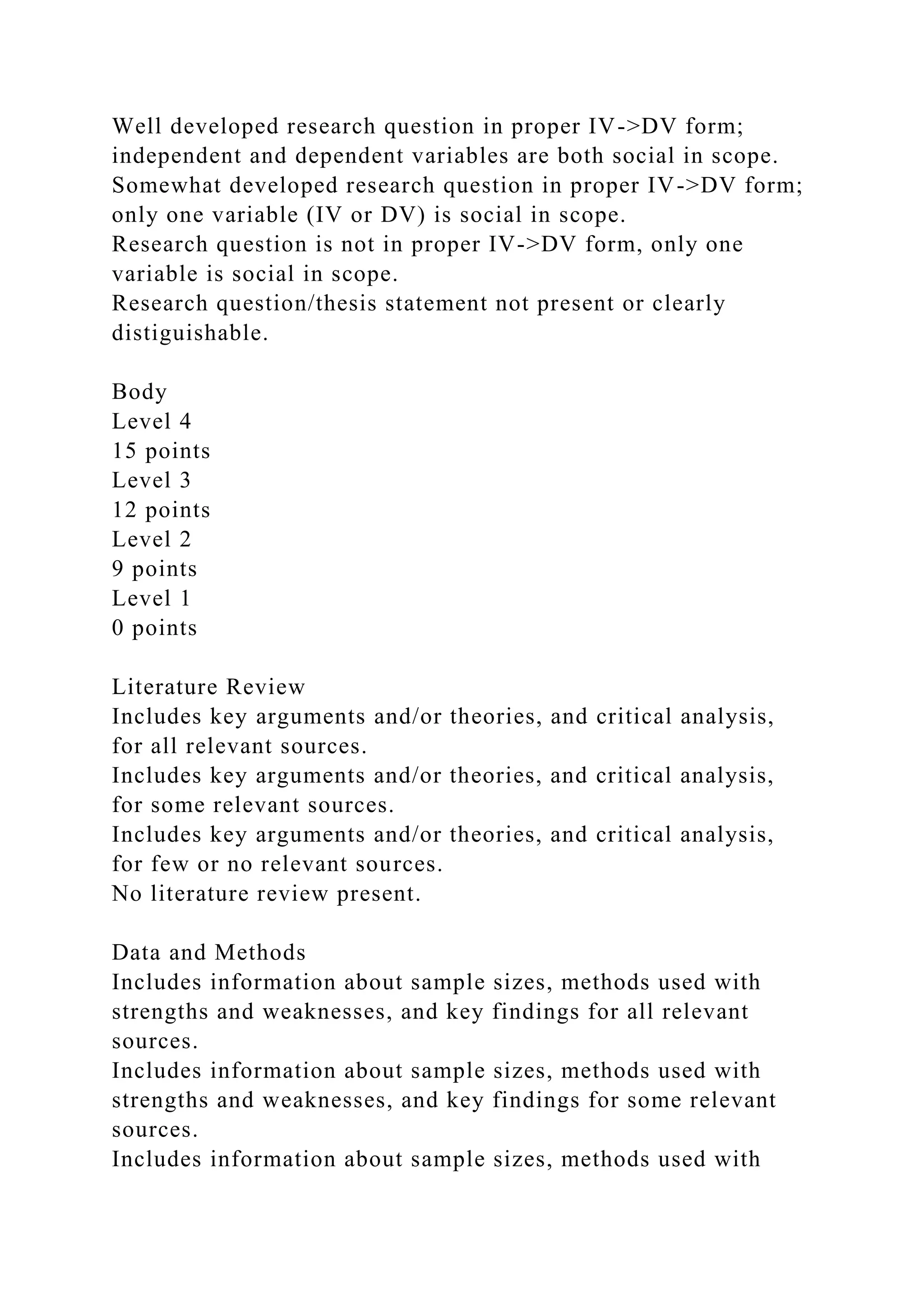
Criteria
Level 3
5 points
Level 2
3 points
Level 1
0 points
Introduction
Broad to narrow "funnel"-like style; properly contextualizes the
social problem being studied; aptly sets up the research
question/thesis statement.
Lacks clarity in contextualizing the social problem being
studied; does not adequately setup the research question/thesis
statement.
Introduction poorly crafted, or no introduction present.
Research Question/Thesis Statement
Level 4
10 points
Level 3
7 points
Level 2
5 points
Level 1
0 points
Research Question/Thesis Statement
Well developed research question in proper IV->DV form;
independent and dependent variables are both social in scope.
Somewhat developed research question in proper IV->DV form;
only one variable (IV or DV) is social in scope.
Research question is not in proper IV->DV form, only one
variable is social in scope.
Research question/thesis statement not present or clearly
distiguishable.
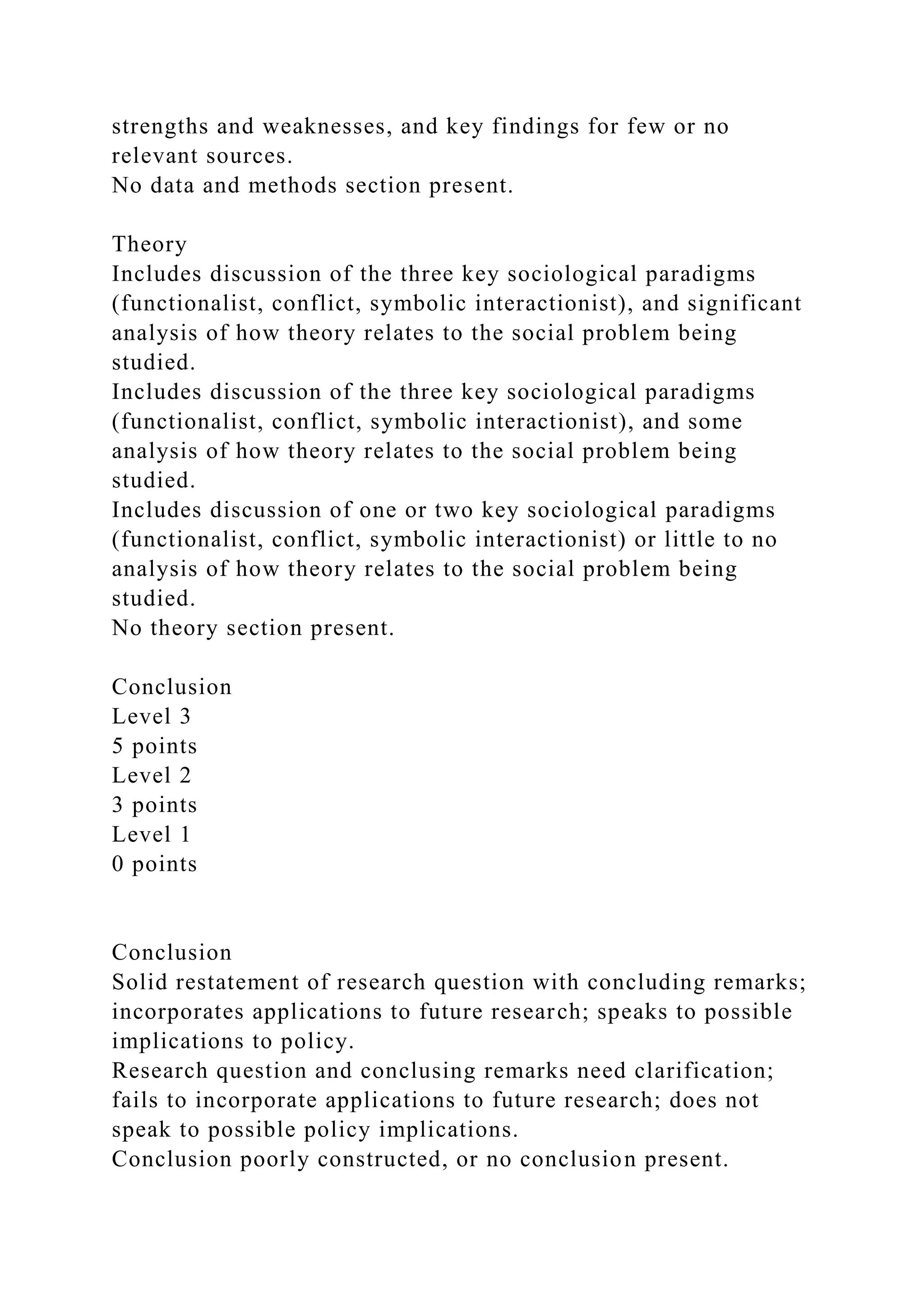
Body
Level 4
15 points
Level 3
12 points
Level 2
9 points
Level 1
0 points
Literature Review
Includes key arguments and/or theories, and critical analysis,
for all relevant sources.
Includes key arguments and/or theories, and critical analysis,
for some relevant sources.
Includes key arguments and/or theories, and critical analysis,
for few or no relevant sources.
No literature review present.
Data and Methods
Includes information about sample sizes, methods used with
strengths and weaknesses, and key findings for all relevant
sources.
Includes information about sample sizes, methods used with
strengths and weaknesses, and key findings for some relevant
sources.
Includes information about sample sizes, methods used with
strengths and weaknesses, and key findings for few or no
relevant sources.
No data and methods section present.
Theory
Includes discussion of the three key sociological paradigms
(functionalist, conflict, symbolic interactionist), and significant
analysis of how theory relates to the social problem being
studied.
Includes discussion of the three key sociological paradigms
(functionalist, conflict, symbolic interactionist), and some
analysis of how theory relates to the social problem being
studied.
Includes discussion of one or two key sociological paradigms
(functionalist, conflict, symbolic interactionist) or little to no
analysis of how theory relates to the social problem being
studied.
No theory section present.
Conclusion
Level 3
5 points
Level 2
3 points
Level 1
0 points
Conclusion
Solid restatement of research question with concluding remarks;
incorporates applications to future research; speaks to possible
implications to policy.
Research question and conclusing remarks need clarification;
fails to incorporate applications to future research; does not
speak to possible policy implications.
Conclusion poorly constructed, or no conclusion present.
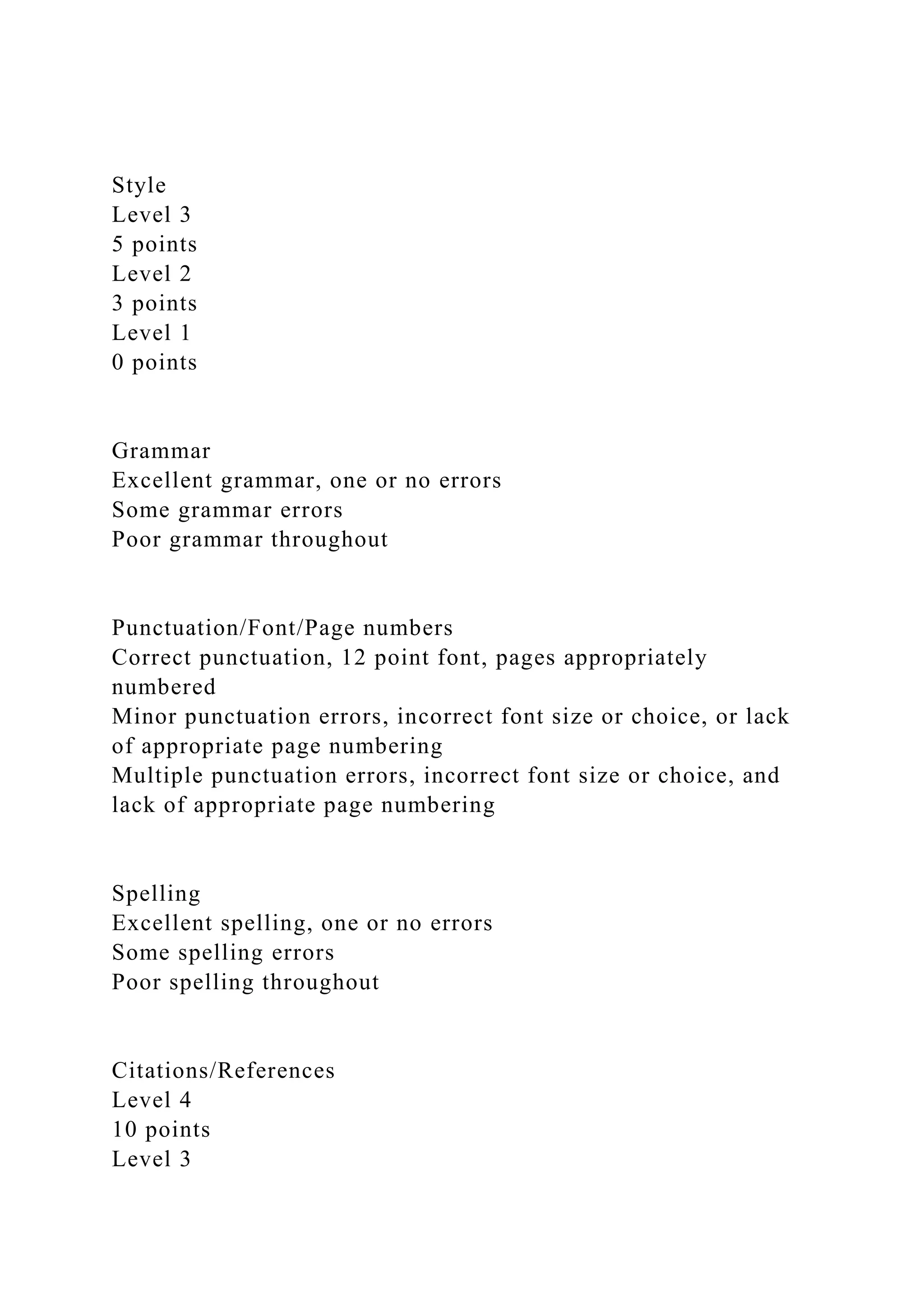
Style
Level 3
5 points
Level 2
3 points
Level 1
0 points
Grammar
Excellent grammar, one or no errors
Some grammar errors
Poor grammar throughout
Punctuation/Font/Page numbers
Correct punctuation, 12 point font, pages appropriately
numbered
Minor punctuation errors, incorrect font size or choice, or lack
of appropriate page numbering
Multiple punctuation errors, incorrect font size or choice, and
lack of appropriate page numbering
Spelling
Excellent spelling, one or no errors
Some spelling errors
Poor spelling throughout
Citations/References
Level 4
10 points
Level 3
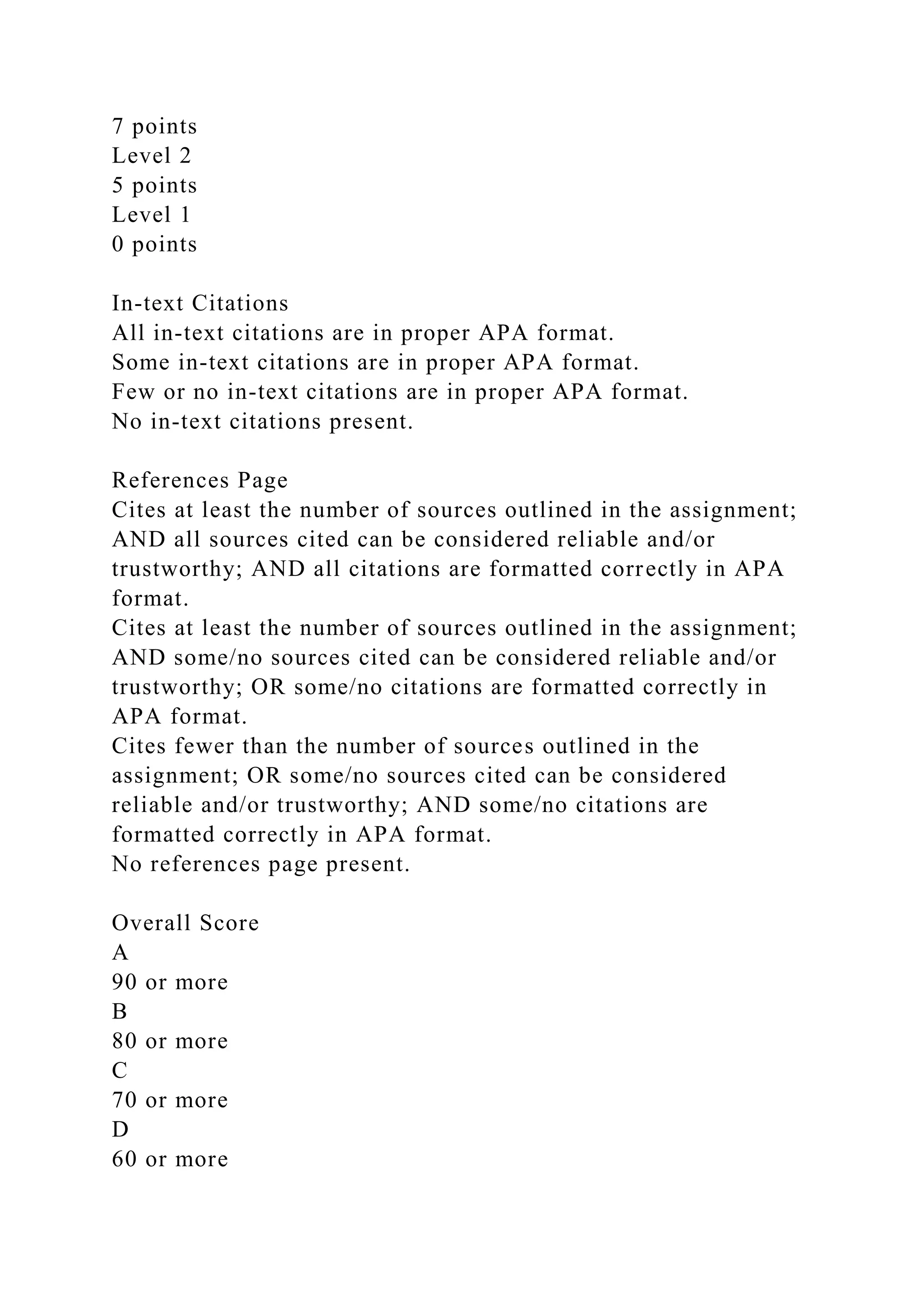
7 points
Level 2
5 points
Level 1
0 points
In-text Citations
All in-text citations are in proper APA format.
Some in-text citations are in proper APA format.
Few or no in-text citations are in proper APA format.
No in-text citations present.
References Page
Cites at least the number of sources outlined in the assignment;
AND all sources cited can be considered reliable and/or
trustworthy; AND all citations are formatted correctly in APA
format.
Cites at least the number of sources outlined in the assignment;
AND some/no sources cited can be considered reliable and/or
trustworthy; OR some/no citations are formatted correctly in
APA format.
Cites fewer than the number of sources outlined in the
assignment; OR some/no sources cited can be considered
reliable and/or trustworthy; AND some/no citations are
formatted correctly in APA format.
No references page present.
Overall Score
A
90 or more
B
80 or more
C
70 or more
D
60 or more
F
0 or more
Running Header: BULLYING
1
NETFLIX
4
BULLYING
2
Bullying
Submitted by: Mohammad Alansari
Instructor: Jonathan Varhola
Submitted Date: March 6th, 2017
· Introduction.
· Definition and analysis of the bullying concept.
· Professionals define bullying as the use of superior strength in
order for one to achieve an individual desire or want.
· Analysis of the bullying concept reveals that bullies bully
individuals for intimidation purposes, to exercise authority and
superiority, and to boost their self-esteem feeling.
· The different types of bullying that commonly exist in any
community.
· Analysist define physical bullying as the use of violence such
as kicking, hitting and damaging of property by a bully in order
to get something.
· Verbal bullying is an indirect form of intimidation that
involves the use of hurtful comments, tease, and name-calling to
degrade the self-respect that an individual has for oneself.
· Research on social bullying defines it as the use of
relationships to oppress someone.
· Cyber bullying is a modern type of bullying brought about by
technology and involves the use of cell phones and the internet
(Citron, 2014).
· Some of the major reasons why bullies oppress others.
· Most bullies usually engage in drug abuse especially if they
are in their adolescence stage.
· Behavior problem is a characteristic associated with many
bullies which may be due to bad parenting.
· Thesis Statement.
· The research paper discusses on some of the researched
techniques of handling bullying and the effect of the theme to
students.
· Literature Review
· Urban setting and intervention programs (Bacchinni, Esposito
& Affuso, 2015).
· The author reveals that the nature of an urban area will
influence the degree of bullying that the area will exhibit.
· Urban settings full of violence would likely influence a lot of
bullying in children who pick up habits from their environment.
· Strategies such as education of the impact of violence to
children perceptions on bullying is a great way of curbing the
negative effects of the theme.
· Stakeholders and preschool setting (Kraizer, 2008).
· The author reveals that there is a need for the stakeholders to
dael with the issue of bullying from a preschool setting angle.
· Children start manipulating their environment during the very
early stages of their childhood.
· Teaching these youngsters through role playing strategies that
can be used to overcome bullying and how to handle it
intellectual, physically, or mentally will help overcome the
negative effects of the theme.
· Social problems and intervention programs (Hurst,2015)
· The author reveals that bullying causes a lot of social
problems such as poor interpersonal communication with peers
and teachers.
· Intervention programs have proved to be very effective in
handling bullying problems through their capability of
involving both the victims and bullies.
· Countries like Scotland and Australia have benefited a lot
from these programs.
· Data and Methods
· Interviews and group discussion in two southwest primary
schools in London (Jennifer, 2007)
· Size of the sample=n=66
· It was important to use a large number of people as opinions
from this group size boosts the accuracy of the results.
· The cost inquired during the research was a major challenge
to the researchers.
· The study revealed that the victims and the bullies were
associated with negative emotions from their peers.
· Theory
· Conflict Theory
· The argument is based on the division of people naturally
which leads to the creation of the class-type systems.
· The class-type system divides people regarding money, power,
and intelligence into upper, lower, and middle class.
· The bullies are usually from the middle class and despise the
upper and lower classes which bring about the feeling of
inferiority.
· To cover up these feelings, bullies prey on individuals from
the lower division.
· Conclusion
· The paper analyses the impacts and effects of bullying in
schools and reveal that suicide, health complaints, academic
performance deterioration, and mental disorders are the major
side effects of the theme.
· However, most researcher done fails to involve teachers and
parents who deserve to play a major role in helping their
children deal with the issue of bullying.
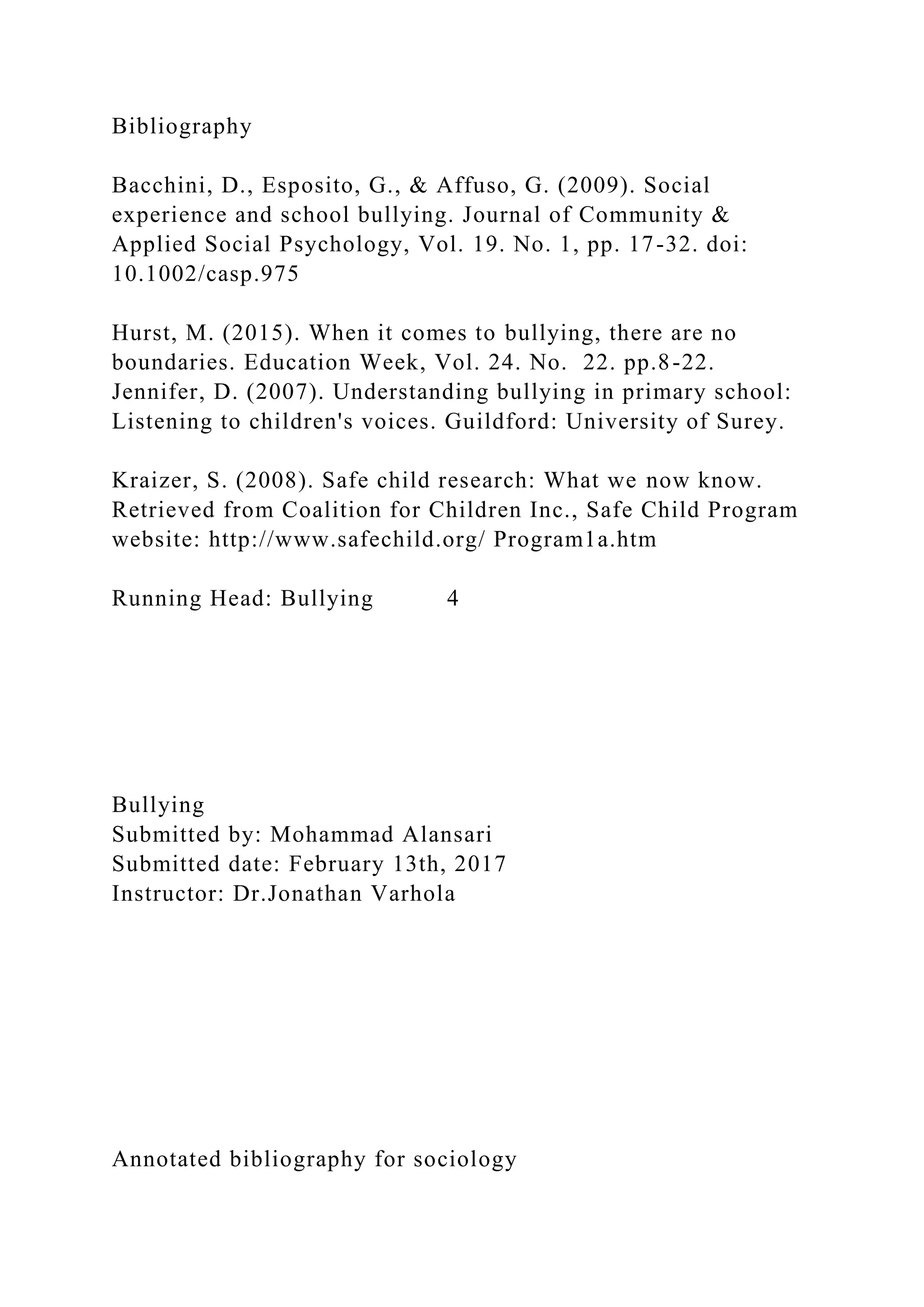
Bibliography
Bacchini, D., Esposito, G., & Affuso, G. (2009). Social
experience and school bullying. Journal of Community &
Applied Social Psychology, Vol. 19. No. 1, pp. 17-32. doi:
10.1002/casp.975
Hurst, M. (2015). When it comes to bullying, there are no
boundaries. Education Week, Vol. 24. No. 22. pp.8-22.
Jennifer, D. (2007). Understanding bullying in primary school:
Listening to children's voices. Guildford: University of Surey.
Kraizer, S. (2008). Safe child research: What we now know.
Retrieved from Coalition for Children Inc., Safe Child Program
website: http://www.safechild.org/ Program1a.htm
Running Head: Bullying 4
Bullying
Submitted by: Mohammad Alansari
Submitted date: February 13th, 2017
Instructor: Dr.Jonathan Varhola
Annotated bibliography for sociology
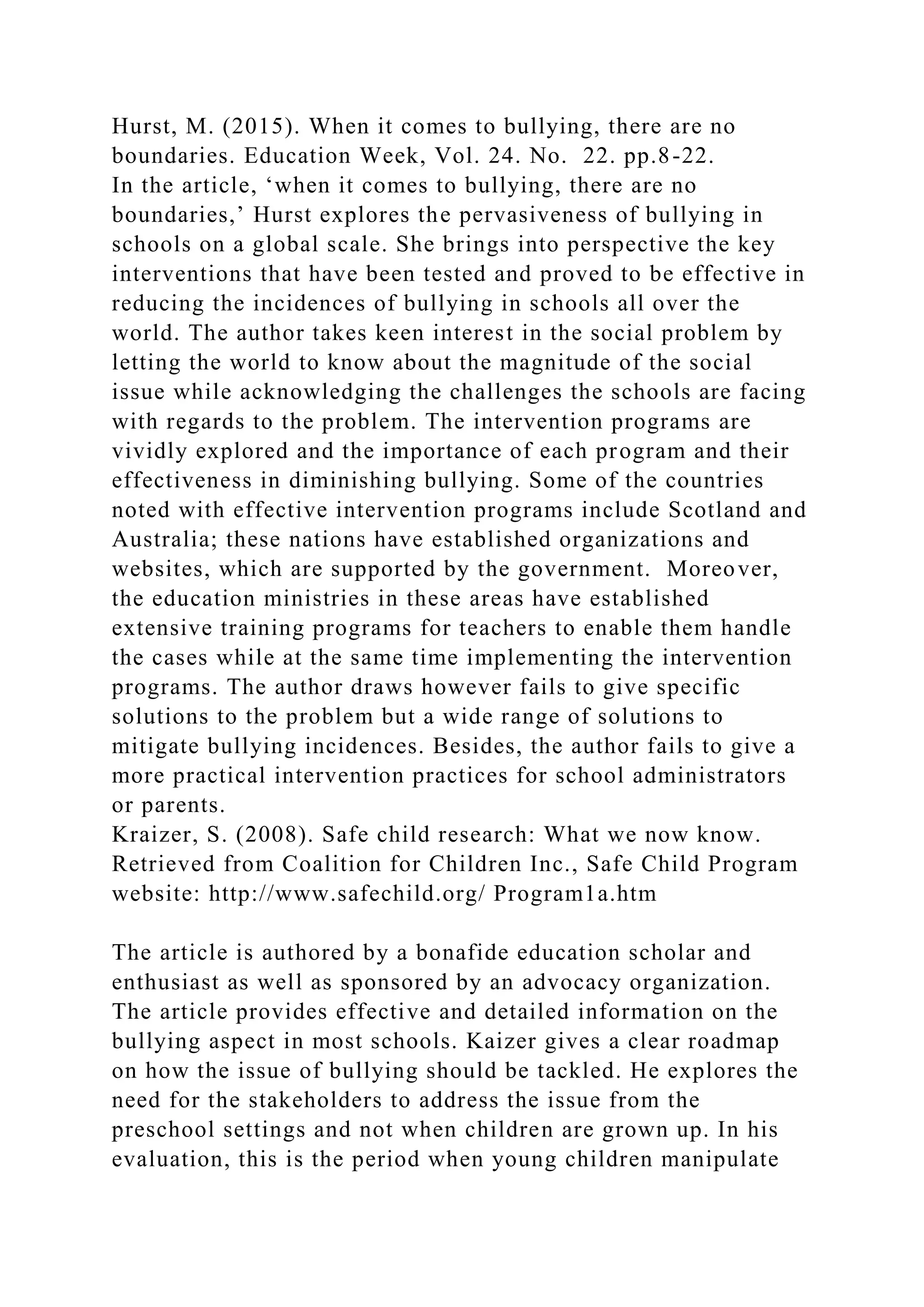
Hurst, M. (2015). When it comes to bullying, there are no
boundaries. Education Week, Vol. 24. No. 22. pp.8-22.
In the article, ‘when it comes to bullying, there are no
boundaries,’ Hurst explores the pervasiveness of bullying in
schools on a global scale. She brings into perspective the key
interventions that have been tested and proved to be effective in
reducing the incidences of bullying in schools all over the
world. The author takes keen interest in the social problem by
letting the world to know about the magnitude of the social
issue while acknowledging the challenges the schools are facing
with regards to the problem. The intervention programs are
vividly explored and the importance of each program and their
effectiveness in diminishing bullying. Some of the countries
noted with effective intervention programs include Scotland and
Australia; these nations have established organizations and
websites, which are supported by the government. Moreover,
the education ministries in these areas have established
extensive training programs for teachers to enable them handle
the cases while at the same time implementing the intervention
programs. The author draws however fails to give specific
solutions to the problem but a wide range of solutions to
mitigate bullying incidences. Besides, the author fails to give a
more practical intervention practices for school administrators
or parents.
Kraizer, S. (2008). Safe child research: What we now know.
Retrieved from Coalition for Children Inc., Safe Child Program
website: http://www.safechild.org/ Program1a.htm
The article is authored by a bonafide education scholar and
enthusiast as well as sponsored by an advocacy organization.
The article provides effective and detailed information on the
bullying aspect in most schools. Kaizer gives a clear roadmap
on how the issue of bullying should be tackled. He explores the
need for the stakeholders to address the issue from the
preschool settings and not when children are grown up. In his
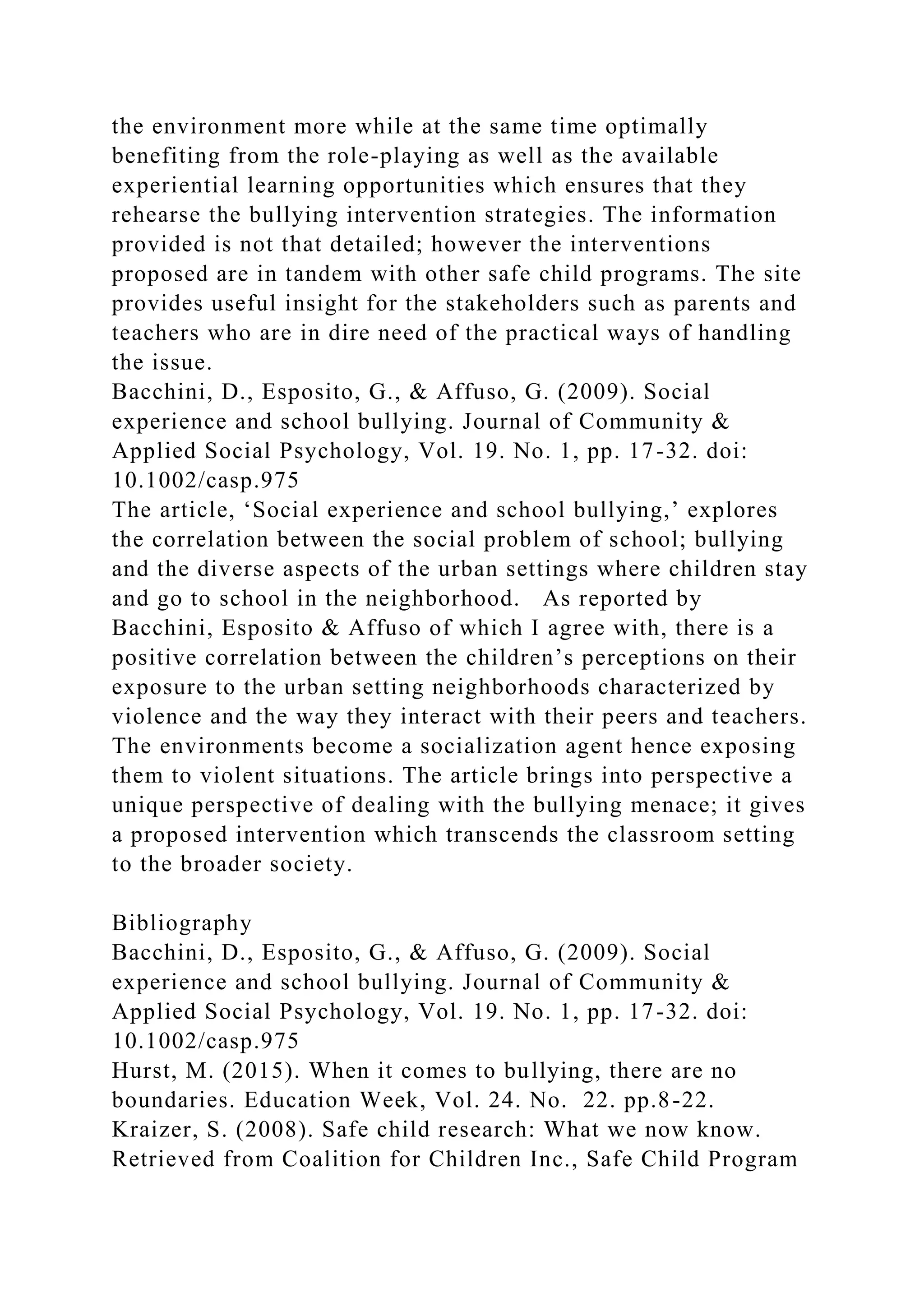
evaluation, this is the period when young children manipulate
the environment more while at the same time optimally
benefiting from the role-playing as well as the available
experiential learning opportunities which ensures that they
rehearse the bullying intervention strategies. The information
provided is not that detailed; however the interventions
proposed are in tandem with other safe child programs. The site
provides useful insight for the stakeholders such as parents and
teachers who are in dire need of the practical ways of handling
the issue.
Bacchini, D., Esposito, G., & Affuso, G. (2009). Social
experience and school bullying. Journal of Community &
Applied Social Psychology, Vol. 19. No. 1, pp. 17-32. doi:
10.1002/casp.975
The article, ‘Social experience and school bullying,’ explores
the correlation between the social problem of school; bullying
and the diverse aspects of the urban settings where children stay
and go to school in the neighborhood. As reported by
Bacchini, Esposito & Affuso of which I agree with, there is a
positive correlation between the children’s perceptions on their
exposure to the urban setting neighborhoods characterized by
violence and the way they interact with their peers and teachers.
The environments become a socialization agent hence exposing
them to violent situations. The article brings into perspective a
unique perspective of dealing with the bullying menace; it gives
a proposed intervention which transcends the classroom setting
to the broader society.
Bibliography
Bacchini, D., Esposito, G., & Affuso, G. (2009). Social
experience and school bullying. Journal of Community &
Applied Social Psychology, Vol. 19. No. 1, pp. 17-32. doi:
10.1002/casp.975
Hurst, M. (2015). When it comes to bullying, there are no
boundaries. Education Week, Vol. 24. No. 22. pp.8-22.
Kraizer, S. (2008). Safe child research: What we now know.
Retrieved from Coalition for Children Inc., Safe Child Program
website: http://www.safechild.org/ Program1a.htm

Eng 101 e3 The Summary + Response” ESSAY Writing based on read.docx

  • 1.
    Eng 101 e3 The“Summary + Response” ESSAY: Writing based on reading about language, culture & identity The summary+response essay requires you to use and engage with other written materials - that is, ideas and quotations from other writers - in an essay. Articles: Tan, "Mother Tongue" (127-132) In your essay, you will (A) present the writer's ideas accurately and fairly, using your skills in summarizing, paraphrasing, and using quotations. And you will (B) present a thoughtful response, in which you take a stand on the major issue of the original. You don't need additional information from the internet and you don't need to look for any more sources. If you do want to use another source, you need to clear it with your instructor. Preliminary Steps 1. Read, re-read, annotate the article you chose. 2. Complete the "Responding to Writing" worksheet to help clarify and organize your thoughts on the issues. 3. Be able to summarize and paraphrase the material accurately. A Possible Outline for Your Essay Your essay might be organized something like this, in which each of the first-level bullets would be one or more ¶s: • Open: Introduce the issues in a general way, possibly without mentioning the article/author yet. • Introduce & briefly summarize the main article: · Summarize the main, relevant ideas of the article and include important details. (Include the author's full name and title of the article.) · Note that you will also refer to and summarize and quote from the article in the response section of the essay, so you don't need to provide a complete, detailed summary here.
  • 2.
    • Respond: · Youwill probably use some of the ideas you generated in the "Responding to Writing" worksheet. · Discuss and offer some analysis of the issues raised in the article, and possibly comment on how the author has presented them, how convincing her/his evidence is, and so on. · Present your own perspectives, thoughts, and perhaps feelings on the issues. You might describe your own life experiences or experiences of friends, as they relate to the issues in question. · In this response section you need to be sure to explain your ideas clearly and support them (with logic, with illustrative examples, maybe with more quotes from the article). · If you wish, you can bring in a couple of ideas/quotes from one or two of the additional articles to supplement or support your points. · This section should be presented in logically organized, focused paragraphs. • Close: Wrap up the essay in a meaningful and satisfying way. Think it through! Don't just grab onto the first thought that comes to you, an initial and superficial reaction. Consider your thoughts and feelings, think hard about the topic and what you have read about it, and form a coherent and thoughtful response. In a thoughtful response, you don't need to solve or resolve the problem or the issue. You don't have to try to have the "last word" on the topic. Saying that it's troubling (or not) or an important issue (or not), and then explaining why may be a perfectly adequate response. Describing the process of your own reactions may be part of a thoughtful response. Remember that a major emphasis in this project is to
  • 3.
    demonstrate that youare able to use the ideas and words of another writer within your own essay, and to do it responsibly. This means you will need to summarize, paraphrase, and use (and correctly punctuate!) direct quotations. Whenever you do these things, you need to be very very careful that it is i00% clear whose ideas or words you are using, if they are not your own. A Note on Citing Sources For this essay you do NOT need to use parenthetical citations or include a Works Cited list. The purpose of those things is to provide a reader with necessary information for checking sources; since I am your reader and I know all of your sources; the citation and references list are unnecessary. You will learn about these things in ENG 102. A Note on Plagiarism Using the ideas and words of other people is an essential skill for college writing. If you mess this up - if you use another writer's words and ideas without giving that person credit - it is called plagiarism. This is considered one of the most serious crimes that a student or scholar can commit. In many cases, if a professor catches you plagiarizing, you will receive a failing grade in the class and often a notation is entered into your academic record. In some colleges/universities, plagiarism can result in being expelled. But plagiarism is a gift that keeps giving: Many people have had their professional lives disrupted or ruined because it was discovered, sometimes many years later, that they had plagiarized in college. Length & Format The draft (and final essay) should be a minimum of 900-1000 words, typed, using standard margins (1" all around), standard font (Cambria, Constantia, or Times New Roman,12pt), double- spaced. Timeline
  • 4.
    Friday, April 7ROUGH DRAFT due. Bring to class on paper for peer review. Monday, April 10 FINAL due. Bring to class on paper for proofreading. Criteria Level 3 5 points Level 2 3 points Level 1 0 points Introduction Broad to narrow "funnel"-like style; properly contextualizes the social problem being studied; aptly sets up the research question/thesis statement. Lacks clarity in contextualizing the social problem being studied; does not adequately setup the research question/thesis statement. Introduction poorly crafted, or no introduction present. Research Question/Thesis Statement Level 4 10 points Level 3 7 points Level 2 5 points Level 1 0 points Research Question/Thesis Statement
  • 5.
    Well developed researchquestion in proper IV->DV form; independent and dependent variables are both social in scope. Somewhat developed research question in proper IV->DV form; only one variable (IV or DV) is social in scope. Research question is not in proper IV->DV form, only one variable is social in scope. Research question/thesis statement not present or clearly distiguishable. Body Level 4 15 points Level 3 12 points Level 2 9 points Level 1 0 points Literature Review Includes key arguments and/or theories, and critical analysis, for all relevant sources. Includes key arguments and/or theories, and critical analysis, for some relevant sources. Includes key arguments and/or theories, and critical analysis, for few or no relevant sources. No literature review present. Data and Methods Includes information about sample sizes, methods used with strengths and weaknesses, and key findings for all relevant sources. Includes information about sample sizes, methods used with strengths and weaknesses, and key findings for some relevant sources. Includes information about sample sizes, methods used with
  • 6.
    strengths and weaknesses,and key findings for few or no relevant sources. No data and methods section present. Theory Includes discussion of the three key sociological paradigms (functionalist, conflict, symbolic interactionist), and significant analysis of how theory relates to the social problem being studied. Includes discussion of the three key sociological paradigms (functionalist, conflict, symbolic interactionist), and some analysis of how theory relates to the social problem being studied. Includes discussion of one or two key sociological paradigms (functionalist, conflict, symbolic interactionist) or little to no analysis of how theory relates to the social problem being studied. No theory section present. Conclusion Level 3 5 points Level 2 3 points Level 1 0 points Conclusion Solid restatement of research question with concluding remarks; incorporates applications to future research; speaks to possible implications to policy. Research question and conclusing remarks need clarification; fails to incorporate applications to future research; does not speak to possible policy implications. Conclusion poorly constructed, or no conclusion present.
  • 7.
    Style Level 3 5 points Level2 3 points Level 1 0 points Grammar Excellent grammar, one or no errors Some grammar errors Poor grammar throughout Punctuation/Font/Page numbers Correct punctuation, 12 point font, pages appropriately numbered Minor punctuation errors, incorrect font size or choice, or lack of appropriate page numbering Multiple punctuation errors, incorrect font size or choice, and lack of appropriate page numbering Spelling Excellent spelling, one or no errors Some spelling errors Poor spelling throughout Citations/References Level 4 10 points Level 3
  • 8.
    7 points Level 2 5points Level 1 0 points In-text Citations All in-text citations are in proper APA format. Some in-text citations are in proper APA format. Few or no in-text citations are in proper APA format. No in-text citations present. References Page Cites at least the number of sources outlined in the assignment; AND all sources cited can be considered reliable and/or trustworthy; AND all citations are formatted correctly in APA format. Cites at least the number of sources outlined in the assignment; AND some/no sources cited can be considered reliable and/or trustworthy; OR some/no citations are formatted correctly in APA format. Cites fewer than the number of sources outlined in the assignment; OR some/no sources cited can be considered reliable and/or trustworthy; AND some/no citations are formatted correctly in APA format. No references page present. Overall Score A 90 or more B 80 or more C 70 or more D 60 or more
  • 9.
    F 0 or more RunningHeader: BULLYING 1 NETFLIX 4 BULLYING 2 Bullying Submitted by: Mohammad Alansari Instructor: Jonathan Varhola Submitted Date: March 6th, 2017 · Introduction. · Definition and analysis of the bullying concept. · Professionals define bullying as the use of superior strength in order for one to achieve an individual desire or want. · Analysis of the bullying concept reveals that bullies bully individuals for intimidation purposes, to exercise authority and superiority, and to boost their self-esteem feeling. · The different types of bullying that commonly exist in any community. · Analysist define physical bullying as the use of violence such as kicking, hitting and damaging of property by a bully in order to get something. · Verbal bullying is an indirect form of intimidation that involves the use of hurtful comments, tease, and name-calling to
  • 10.
    degrade the self-respectthat an individual has for oneself. · Research on social bullying defines it as the use of relationships to oppress someone. · Cyber bullying is a modern type of bullying brought about by technology and involves the use of cell phones and the internet (Citron, 2014). · Some of the major reasons why bullies oppress others. · Most bullies usually engage in drug abuse especially if they are in their adolescence stage. · Behavior problem is a characteristic associated with many bullies which may be due to bad parenting. · Thesis Statement. · The research paper discusses on some of the researched techniques of handling bullying and the effect of the theme to students. · Literature Review · Urban setting and intervention programs (Bacchinni, Esposito & Affuso, 2015). · The author reveals that the nature of an urban area will influence the degree of bullying that the area will exhibit. · Urban settings full of violence would likely influence a lot of bullying in children who pick up habits from their environment. · Strategies such as education of the impact of violence to children perceptions on bullying is a great way of curbing the
  • 11.
    negative effects ofthe theme. · Stakeholders and preschool setting (Kraizer, 2008). · The author reveals that there is a need for the stakeholders to dael with the issue of bullying from a preschool setting angle. · Children start manipulating their environment during the very early stages of their childhood. · Teaching these youngsters through role playing strategies that can be used to overcome bullying and how to handle it intellectual, physically, or mentally will help overcome the negative effects of the theme. · Social problems and intervention programs (Hurst,2015) · The author reveals that bullying causes a lot of social problems such as poor interpersonal communication with peers and teachers. · Intervention programs have proved to be very effective in handling bullying problems through their capability of involving both the victims and bullies. · Countries like Scotland and Australia have benefited a lot from these programs. · Data and Methods · Interviews and group discussion in two southwest primary schools in London (Jennifer, 2007) · Size of the sample=n=66 · It was important to use a large number of people as opinions
  • 12.
    from this groupsize boosts the accuracy of the results. · The cost inquired during the research was a major challenge to the researchers. · The study revealed that the victims and the bullies were associated with negative emotions from their peers. · Theory · Conflict Theory · The argument is based on the division of people naturally which leads to the creation of the class-type systems. · The class-type system divides people regarding money, power, and intelligence into upper, lower, and middle class. · The bullies are usually from the middle class and despise the upper and lower classes which bring about the feeling of inferiority. · To cover up these feelings, bullies prey on individuals from the lower division. · Conclusion · The paper analyses the impacts and effects of bullying in schools and reveal that suicide, health complaints, academic performance deterioration, and mental disorders are the major side effects of the theme. · However, most researcher done fails to involve teachers and parents who deserve to play a major role in helping their children deal with the issue of bullying.
  • 13.
    Bibliography Bacchini, D., Esposito,G., & Affuso, G. (2009). Social experience and school bullying. Journal of Community & Applied Social Psychology, Vol. 19. No. 1, pp. 17-32. doi: 10.1002/casp.975 Hurst, M. (2015). When it comes to bullying, there are no boundaries. Education Week, Vol. 24. No. 22. pp.8-22. Jennifer, D. (2007). Understanding bullying in primary school: Listening to children's voices. Guildford: University of Surey. Kraizer, S. (2008). Safe child research: What we now know. Retrieved from Coalition for Children Inc., Safe Child Program website: http://www.safechild.org/ Program1a.htm Running Head: Bullying 4 Bullying Submitted by: Mohammad Alansari Submitted date: February 13th, 2017 Instructor: Dr.Jonathan Varhola Annotated bibliography for sociology
  • 14.
    Hurst, M. (2015).When it comes to bullying, there are no boundaries. Education Week, Vol. 24. No. 22. pp.8-22. In the article, ‘when it comes to bullying, there are no boundaries,’ Hurst explores the pervasiveness of bullying in schools on a global scale. She brings into perspective the key interventions that have been tested and proved to be effective in reducing the incidences of bullying in schools all over the world. The author takes keen interest in the social problem by letting the world to know about the magnitude of the social issue while acknowledging the challenges the schools are facing with regards to the problem. The intervention programs are vividly explored and the importance of each program and their effectiveness in diminishing bullying. Some of the countries noted with effective intervention programs include Scotland and Australia; these nations have established organizations and websites, which are supported by the government. Moreover, the education ministries in these areas have established extensive training programs for teachers to enable them handle the cases while at the same time implementing the intervention programs. The author draws however fails to give specific solutions to the problem but a wide range of solutions to mitigate bullying incidences. Besides, the author fails to give a more practical intervention practices for school administrators or parents. Kraizer, S. (2008). Safe child research: What we now know. Retrieved from Coalition for Children Inc., Safe Child Program website: http://www.safechild.org/ Program1a.htm The article is authored by a bonafide education scholar and enthusiast as well as sponsored by an advocacy organization. The article provides effective and detailed information on the bullying aspect in most schools. Kaizer gives a clear roadmap on how the issue of bullying should be tackled. He explores the need for the stakeholders to address the issue from the preschool settings and not when children are grown up. In his evaluation, this is the period when young children manipulate
  • 15.
    the environment morewhile at the same time optimally benefiting from the role-playing as well as the available experiential learning opportunities which ensures that they rehearse the bullying intervention strategies. The information provided is not that detailed; however the interventions proposed are in tandem with other safe child programs. The site provides useful insight for the stakeholders such as parents and teachers who are in dire need of the practical ways of handling the issue. Bacchini, D., Esposito, G., & Affuso, G. (2009). Social experience and school bullying. Journal of Community & Applied Social Psychology, Vol. 19. No. 1, pp. 17-32. doi: 10.1002/casp.975 The article, ‘Social experience and school bullying,’ explores the correlation between the social problem of school; bullying and the diverse aspects of the urban settings where children stay and go to school in the neighborhood. As reported by Bacchini, Esposito & Affuso of which I agree with, there is a positive correlation between the children’s perceptions on their exposure to the urban setting neighborhoods characterized by violence and the way they interact with their peers and teachers. The environments become a socialization agent hence exposing them to violent situations. The article brings into perspective a unique perspective of dealing with the bullying menace; it gives a proposed intervention which transcends the classroom setting to the broader society. Bibliography Bacchini, D., Esposito, G., & Affuso, G. (2009). Social experience and school bullying. Journal of Community & Applied Social Psychology, Vol. 19. No. 1, pp. 17-32. doi: 10.1002/casp.975 Hurst, M. (2015). When it comes to bullying, there are no boundaries. Education Week, Vol. 24. No. 22. pp.8-22. Kraizer, S. (2008). Safe child research: What we now know. Retrieved from Coalition for Children Inc., Safe Child Program
  • 16.