Introductions
Content, Aims, and Structure
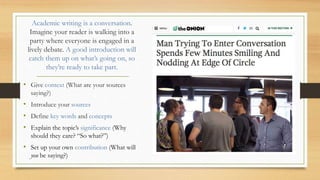
Academic writing is a conversation.
Imagine your reader is walking into a
party where everyone is engaged in a
lively debate. A good introduction will
catch them up on what’s going on, so
they’re ready to take part.
• Give context (What are your sources
saying?)
• Introduce your sources
• Define key words and concepts
• Explain the topic’s significance (Why
should they care? “So what?”)
• Set up your own contribution (What will
you be saying?)
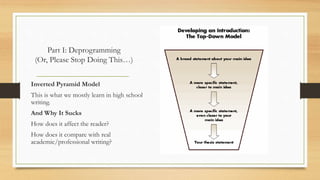
Part I: Deprogramming
(Or, Please Stop Doing This…)
Inverted Pyramid Model
This is what we mostly learn in high school
writing.
And Why It Sucks
How does it affect the reader?
How does it compare with real
academic/professional writing?
Discuss with a partner:
Which memo intro is more effective? Why?
Memo RE: Fall clothing line
Market research and analysis show that the
proposed advertising media for our new fall
lines need to be reprioritized and changed.
Findings from focus groups and surveys have
made it apparent that we need to update our
advertising efforts to align them with the styles
and trends of young adults today. No longer are
young adults interested in sitcoms as they watch
reality televisions shows. Also, it is has become
increasingly important to use the internet as a
tool to communicate with our target audience to
show our dominance in the clothing industry.
Memo RE: Fall clothing line
Focus groups can be useful for many things.
In marketing, focus groups can tell us what
prospective buyers want from the product. In
other industries, focus groups are used to trace
how audiences respond to movies or television
shows. In the clothing industry, specifically our
company, focus groups have often been
employed. Part of our effort to analyze our
marketing strategy has included using focus
groups. These groups show that we need to
update our advertising efforts to align them
with the styles and trends of young adults today.
Adapted from: Purdue OWL, “Memos: Sample Memo.” https://owl.english.purdue.edu/owl/resource/590/04/
Don't be afraid to dive into your argument. Trying to slowly "ease
readers into" your essay can result in a vague or off-topic intro.
"So long as you do not begin with a definition you may begin anyhow. An abrupt
beginning is much admired, after the fashion of the clown's entry through the
chemist's window. Then whack at your reader at once, hit him over the head
with the sausages, brisk him up with the poker, bundle him into the
wheelbarrow, and so carry him away with you before he knows where you are.
You can do what you like with a reader then, if you only keep him nicely on the
move. So long as you are happy your reader will be so too."
H. G. Wells, "The Writing of Essays" (1901)
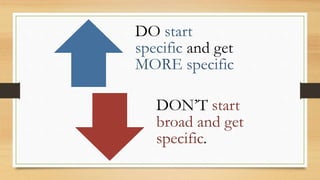
DO start
specific and get
MORE specific
DON’T start
broad and get
specific.
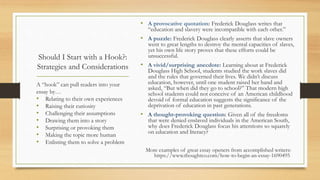
Should I Start with a Hook?:
Strategies and Considerations
• A provocative quotation: Frederick Douglass writes that
“education and slavery were incompatible with each other.”
• A puzzle: Frederick Douglass clearly asserts that slave owners
went to great lengths to destroy the mental capacities of slaves,
yet his own life story proves that these efforts could be
unsuccessful.
• A vivid/surprising anecdote: Learning about at Frederick
Douglass High School, students studied the work slaves did
and the rules that governed their lives. We didn’t discuss
education, however, until one student raised her hand and
asked, “But when did they go to school?” That modern high
school students could not conceive of an American childhood
devoid of formal education suggests the significance of the
deprivation of education in past generations.
• A thought-provoking question: Given all of the freedoms
that were denied enslaved individuals in the American South,
why does Frederick Douglass focus his attentions so squarely
on education and literacy?
More examples of great essay openers from accomplished writers:
https://www.thoughtco.com/how-to-begin-an-essay-1690495
A “hook” can pull readers into your
essay by…
• Relating to their own experiences
• Raising their curiosity
• Challenging their assumptions
• Drawing them into a story
• Surprising or provoking them
• Making the topic more human
• Enlisting them to solve a problem
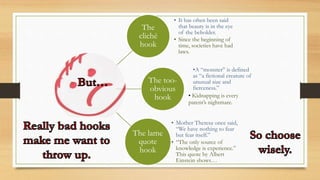
The
cliché
hook
• It has often been said
that beauty is in the eye
of the beholder.
• Since the beginning of
time, societies have had
laws.
The too-
obvious
hook
•A “monster” is defined
as “a fictional creature of
unusual size and
fierceness.”
• Kidnapping is every
parent’s nightmare.
The lame
quote
hook
• Mother Theresa once said,
“We have nothing to fear
but fear itself.”
• “The only source of
knowledge is experience.”
This quote by Albert
Einstein shows…
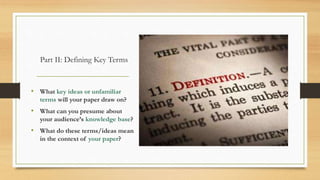
Part II: Defining Key Terms
• What key ideas or unfamiliar
terms will your paper draw on?
• What can you presume about
your audience’s knowledge base?
• What do these terms/ideas mean
in the context of your paper?
Discuss with a partner:
Which intro defines key terms appropriately? Why?
According to the Merriam-Webster
Dictionary, a video game is “an electronic
game in which players control images on
a television or computer screen” (2015).
Throughout this essay, the term classic
gaming will refer specifically to playing
video games produced for the Atari, the
original Nintendo Entertainment
System, and any systems in-between.
Adapted from: Purdue OWL, “Definitions.” https://owl.english.purdue.edu/owl/resource/622/01/
Part III: Introducing Sources
• Overview all sources you will be
using (author and title).
• Explain how and why you will
use these sources in your paper.
• Don’t pad out your intro with
long full titles or summaries.
Summarize later, if absolutely
necessary.
Part IV: Setting up the Conversation
• Map out how your sources
connect to each other.
• Explain how your own
contribution builds on the
existing conversation.
• Create a roadmap of what your
paper will address, in what order.
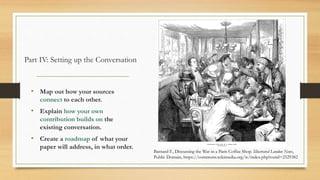
Barnard F., Discussing the War in a Paris Coffee Shop. Illustrated London News,
Public Domain, https://commons.wikimedia.org/w/index.php?curid=2529382
Discuss with a partner:
Who set up the conversation more effectively? Why?
In her essay “Constitutional Protection: A
Plea for Judicial Limitations in an Evolving
Society,” Dr. Judy Marshall from Cornell
School of Law supports the constitution
(2001 p. 59-66). Many other writers disagree
with her, including John Perez in his book
Court in Session: Exploring the Role of the
American Judiciary Branch and constitutional
law expert Aaron Myers in his article
“Presidential Appointment of Supreme
Court Justices: the 1930s to Today.” Scholars
do not agree on this issue.
Advocates for more expansive
constitutional protections routinely brush
aside, or outright ignore, the judiciary's
limited capacity. Opponents of such
protections routinely write as if
“government by judiciary” were a real and
worrisome possibility (Archer 2010 p. 4).
Meanwhile, there has been very little work
exploring why the judiciary has such limited
capacity or how we should expect this
limitation to affect the substance of its
constitutional decisions.
Adapted from: Invest in Your Introduction. The Writer’s Handbook, U of Wisconsin, http://writing.wisc.edu/Handbook/Introductions.html
Part V: Thesis or Central Point
• Usually last sentence(s) of intro
• Can be more than one sentence long
(make it as long as it needs to be)
• List main points in order they will
appear in your paper (i.e., create a road
map)
• No surprises; it should always reflect
the structure and content of your paper
• Revise, revise, revise
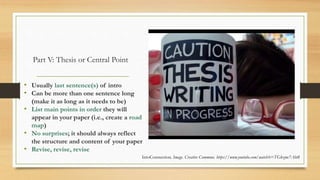
IntoConnection. Image. Creative Commons. https://www.youtube.com/watch?v=TGkzmc7Abt8
Remember:
• Hook readers in with an evocative detail or strong
claim.
• Be specific from the beginning.
• Lay out a roadmap to your paper.
• Set up your own place in the conversation.

Introductions

  • 1.
  • 2.
    Academic writing isa conversation. Imagine your reader is walking into a party where everyone is engaged in a lively debate. A good introduction will catch them up on what’s going on, so they’re ready to take part. • Give context (What are your sources saying?) • Introduce your sources • Define key words and concepts • Explain the topic’s significance (Why should they care? “So what?”) • Set up your own contribution (What will you be saying?)
  • 3.
    Part I: Deprogramming (Or,Please Stop Doing This…) Inverted Pyramid Model This is what we mostly learn in high school writing. And Why It Sucks How does it affect the reader? How does it compare with real academic/professional writing?
  • 4.
    Discuss with apartner: Which memo intro is more effective? Why? Memo RE: Fall clothing line Market research and analysis show that the proposed advertising media for our new fall lines need to be reprioritized and changed. Findings from focus groups and surveys have made it apparent that we need to update our advertising efforts to align them with the styles and trends of young adults today. No longer are young adults interested in sitcoms as they watch reality televisions shows. Also, it is has become increasingly important to use the internet as a tool to communicate with our target audience to show our dominance in the clothing industry. Memo RE: Fall clothing line Focus groups can be useful for many things. In marketing, focus groups can tell us what prospective buyers want from the product. In other industries, focus groups are used to trace how audiences respond to movies or television shows. In the clothing industry, specifically our company, focus groups have often been employed. Part of our effort to analyze our marketing strategy has included using focus groups. These groups show that we need to update our advertising efforts to align them with the styles and trends of young adults today. Adapted from: Purdue OWL, “Memos: Sample Memo.” https://owl.english.purdue.edu/owl/resource/590/04/
  • 5.
    Don't be afraidto dive into your argument. Trying to slowly "ease readers into" your essay can result in a vague or off-topic intro. "So long as you do not begin with a definition you may begin anyhow. An abrupt beginning is much admired, after the fashion of the clown's entry through the chemist's window. Then whack at your reader at once, hit him over the head with the sausages, brisk him up with the poker, bundle him into the wheelbarrow, and so carry him away with you before he knows where you are. You can do what you like with a reader then, if you only keep him nicely on the move. So long as you are happy your reader will be so too." H. G. Wells, "The Writing of Essays" (1901)
  • 6.
    DO start specific andget MORE specific DON’T start broad and get specific.
  • 7.
    Should I Startwith a Hook?: Strategies and Considerations • A provocative quotation: Frederick Douglass writes that “education and slavery were incompatible with each other.” • A puzzle: Frederick Douglass clearly asserts that slave owners went to great lengths to destroy the mental capacities of slaves, yet his own life story proves that these efforts could be unsuccessful. • A vivid/surprising anecdote: Learning about at Frederick Douglass High School, students studied the work slaves did and the rules that governed their lives. We didn’t discuss education, however, until one student raised her hand and asked, “But when did they go to school?” That modern high school students could not conceive of an American childhood devoid of formal education suggests the significance of the deprivation of education in past generations. • A thought-provoking question: Given all of the freedoms that were denied enslaved individuals in the American South, why does Frederick Douglass focus his attentions so squarely on education and literacy? More examples of great essay openers from accomplished writers: https://www.thoughtco.com/how-to-begin-an-essay-1690495 A “hook” can pull readers into your essay by… • Relating to their own experiences • Raising their curiosity • Challenging their assumptions • Drawing them into a story • Surprising or provoking them • Making the topic more human • Enlisting them to solve a problem
  • 8.
    The cliché hook • It hasoften been said that beauty is in the eye of the beholder. • Since the beginning of time, societies have had laws. The too- obvious hook •A “monster” is defined as “a fictional creature of unusual size and fierceness.” • Kidnapping is every parent’s nightmare. The lame quote hook • Mother Theresa once said, “We have nothing to fear but fear itself.” • “The only source of knowledge is experience.” This quote by Albert Einstein shows…
  • 9.
    Part II: DefiningKey Terms • What key ideas or unfamiliar terms will your paper draw on? • What can you presume about your audience’s knowledge base? • What do these terms/ideas mean in the context of your paper?
  • 10.
    Discuss with apartner: Which intro defines key terms appropriately? Why? According to the Merriam-Webster Dictionary, a video game is “an electronic game in which players control images on a television or computer screen” (2015). Throughout this essay, the term classic gaming will refer specifically to playing video games produced for the Atari, the original Nintendo Entertainment System, and any systems in-between. Adapted from: Purdue OWL, “Definitions.” https://owl.english.purdue.edu/owl/resource/622/01/
  • 11.
    Part III: IntroducingSources • Overview all sources you will be using (author and title). • Explain how and why you will use these sources in your paper. • Don’t pad out your intro with long full titles or summaries. Summarize later, if absolutely necessary.
  • 12.
    Part IV: Settingup the Conversation • Map out how your sources connect to each other. • Explain how your own contribution builds on the existing conversation. • Create a roadmap of what your paper will address, in what order. Barnard F., Discussing the War in a Paris Coffee Shop. Illustrated London News, Public Domain, https://commons.wikimedia.org/w/index.php?curid=2529382
  • 13.
    Discuss with apartner: Who set up the conversation more effectively? Why? In her essay “Constitutional Protection: A Plea for Judicial Limitations in an Evolving Society,” Dr. Judy Marshall from Cornell School of Law supports the constitution (2001 p. 59-66). Many other writers disagree with her, including John Perez in his book Court in Session: Exploring the Role of the American Judiciary Branch and constitutional law expert Aaron Myers in his article “Presidential Appointment of Supreme Court Justices: the 1930s to Today.” Scholars do not agree on this issue. Advocates for more expansive constitutional protections routinely brush aside, or outright ignore, the judiciary's limited capacity. Opponents of such protections routinely write as if “government by judiciary” were a real and worrisome possibility (Archer 2010 p. 4). Meanwhile, there has been very little work exploring why the judiciary has such limited capacity or how we should expect this limitation to affect the substance of its constitutional decisions. Adapted from: Invest in Your Introduction. The Writer’s Handbook, U of Wisconsin, http://writing.wisc.edu/Handbook/Introductions.html
  • 14.
    Part V: Thesisor Central Point • Usually last sentence(s) of intro • Can be more than one sentence long (make it as long as it needs to be) • List main points in order they will appear in your paper (i.e., create a road map) • No surprises; it should always reflect the structure and content of your paper • Revise, revise, revise IntoConnection. Image. Creative Commons. https://www.youtube.com/watch?v=TGkzmc7Abt8
  • 15.
    Remember: • Hook readersin with an evocative detail or strong claim. • Be specific from the beginning. • Lay out a roadmap to your paper. • Set up your own place in the conversation.