Agenda
My introduction to Tech
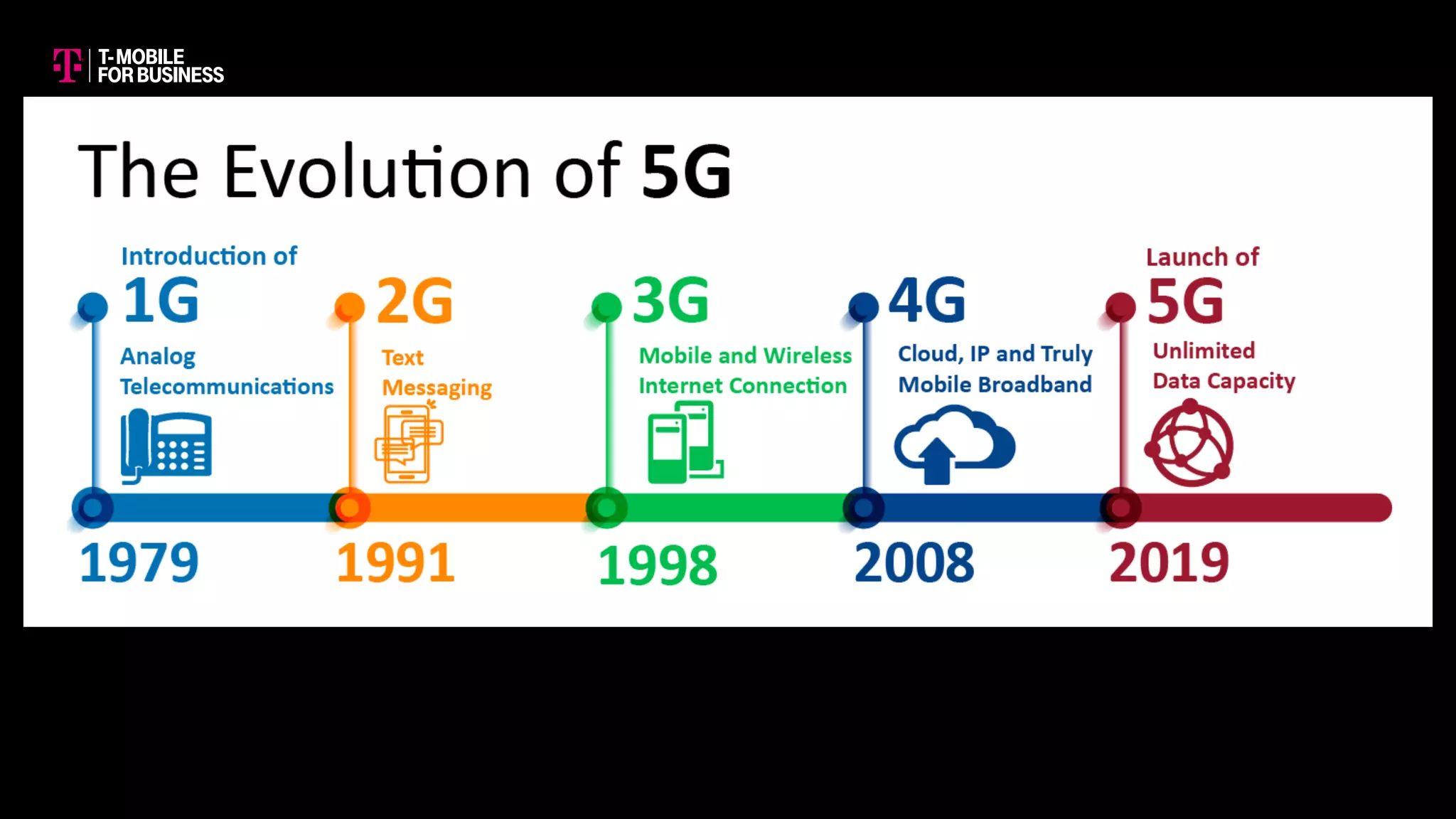
Network History
Why is 5G Relevant
IOT Expansion
The new T-Mobile will light up a broad
and deep 5G network for all—faster than
either company could separately.
T-Mobileisbringing
Sprintintothefamily
T-Mobile will light up a broad and deep
5G network for all—faster than either
company could separately.
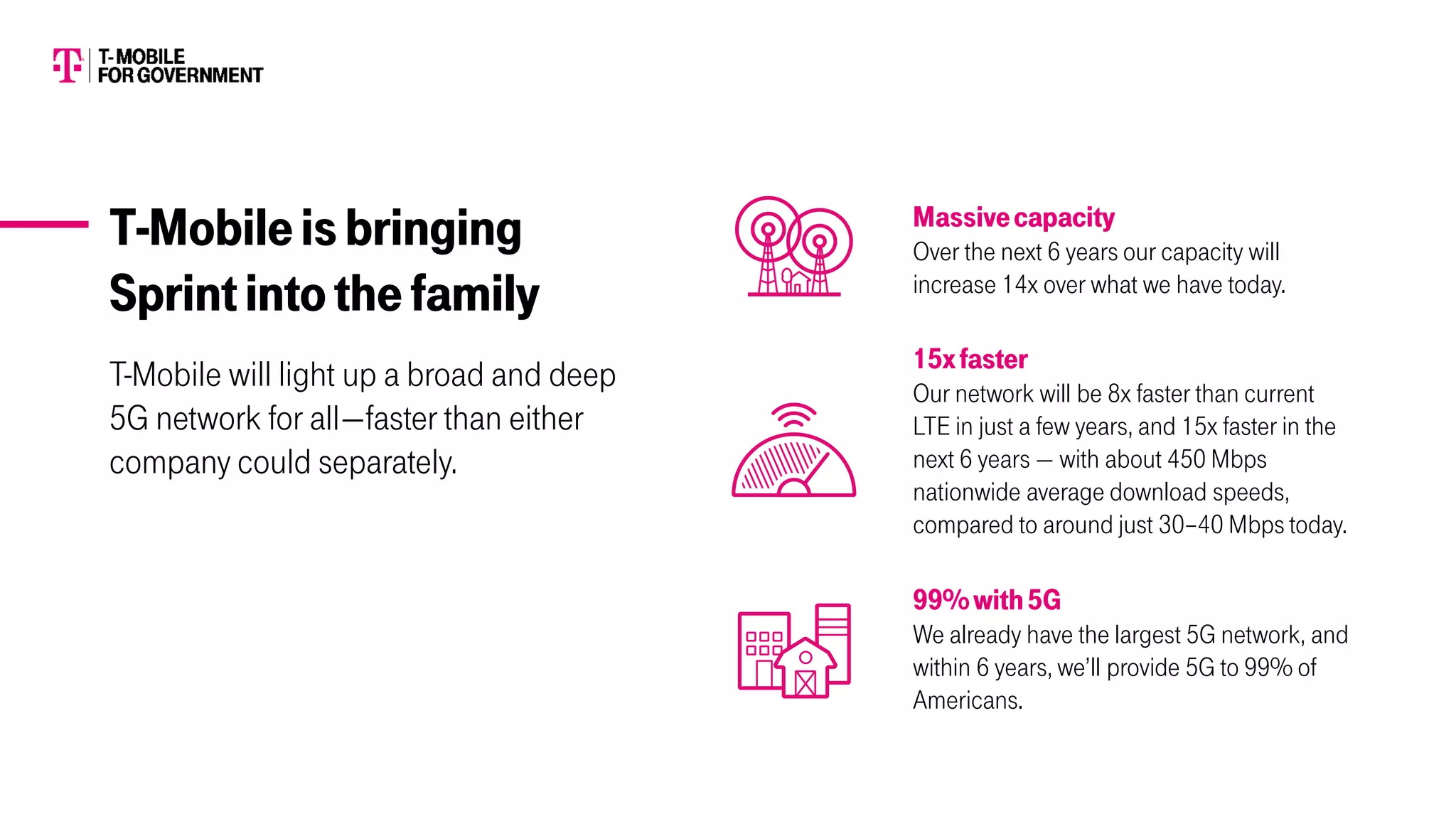
Massivecapacity
Over the next 6 years our capacity will
increase 14x over what we have today.
15xfaster
Our network will be 8x faster than current
LTE in just a few years, and 15x faster in the
next 6 years — with about 450 Mbps
nationwide average download speeds,
compared to around just 30–40 Mbps today.
T-Mobileisbringing
Sprintintothefamily
99%with5G
We already have the largest 5G network, and
within 6 years, we’ll provide 5G to 99% of
Americans.
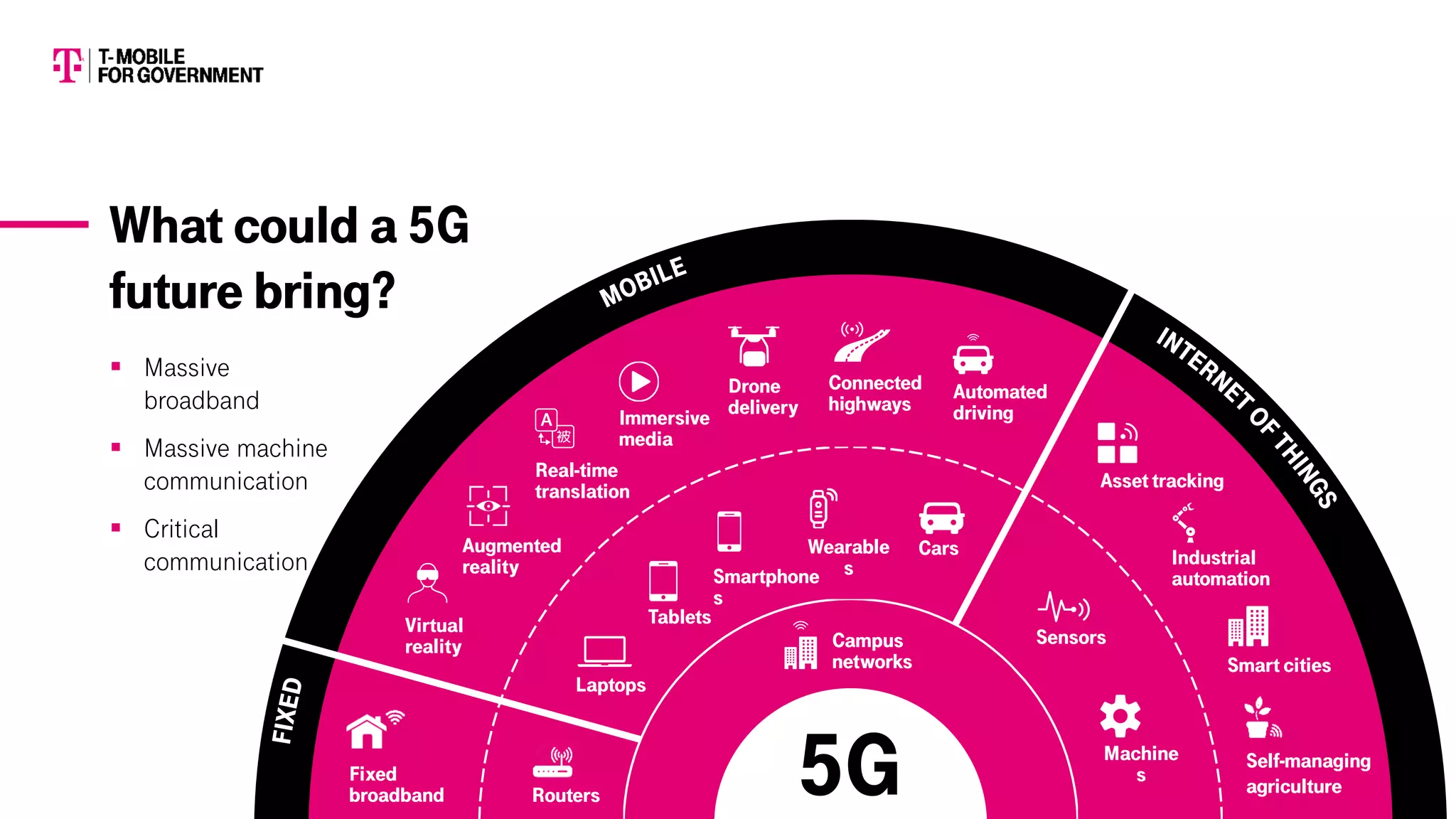
▪ Massive
broadband
▪ Massive machine
communication
▪ Critical
communication
Self-managing
agricultureRouters
Fixed
broadband
Augmented
reality
Virtual
reality
Real-time
translation
Drone
delivery
Tablets
Laptops
Smartphone
s
Wearable
s
Connected
highways
Sensors
Smart cities
Immersive
media
Industrial
automation
Cars
Automated
driving
Asset tracking
Machine
s
Campus
networks
5G
What could a 5G
future bring?
Constant networkinnovation
$30Binvestedinnetworkimprovementsand
another$40Bcommittedtobuildthebest networkinhistory
2016
First with
4x4 MIMO
APR
2017
Won 45% of
all low-band
spectrum
sold at FCC
auction
First to go live
nationwide in
U.S. with NB-
IoT network
JUL
2017
First in the
world to
light up
LTE in
600MHz
AUG
2017
SEP
2018
5G
partnerships
with Ericsson,
Cisco, and
Nokia
Completion of
world’s largest
virtualized EPC
JAN
2019
First 5G on
600MHz call
First to launch
Caller Verified
technology
MAY
2020
World’s first
standalone (SA) 5G
data session on a
multi-vendor radio
and core network
First NB-IoT asset
tracking solution
DEC
2019
First nationwide 5G
network to cover 200M
people
First 5G devices that work
nationwide
First end-to-end STIR/
SHAKEN caller verification
across three networks
100% of customers can
access VoLTE calls by
2020
First SA 5G data session
between commercial
modems from two
suppliers on a
production network
First low-band SA 5G
voice call using EPS
fallback to VoLTE
First low-band VoNR call
on a production network
First ViNR call on a
production network, first
low-band SA 5G data
session, first call with
EPS fallback, and first
VoNR and ViNR calls on
a commercial
smartphone,
Covering99% of
Americanswith4GLTE
andintroducing
nationwide5G
327million
Americans covered by 4G LTE
215 million
Americans covered by 5G
5G capable device required; coverage not available in some areas. Some uses may requirecertain plan or feature;see T-Mobile.com. No 5G signal is more reliable (traveling far and deep) than600MHz.
Agreatnetwork needsALL
spectrumbands
High-frequencybands
(28GHz 5G only)
Ultrafast data transmission but limited
range measured in city blocks
Mid-frequencybands
(1900MHz, 2100MHz, & 2.5GHz)
Transmits data faster but is targeted
Low-frequencybands
(600 and 700MHz)
Transmissions reach a wider area
T-Mobile’snetworkdifference
Combination of T-Mobile & Sprint spectrum in progress. Capable device required; coverage note available in some areas.
mmW
mid band
low band
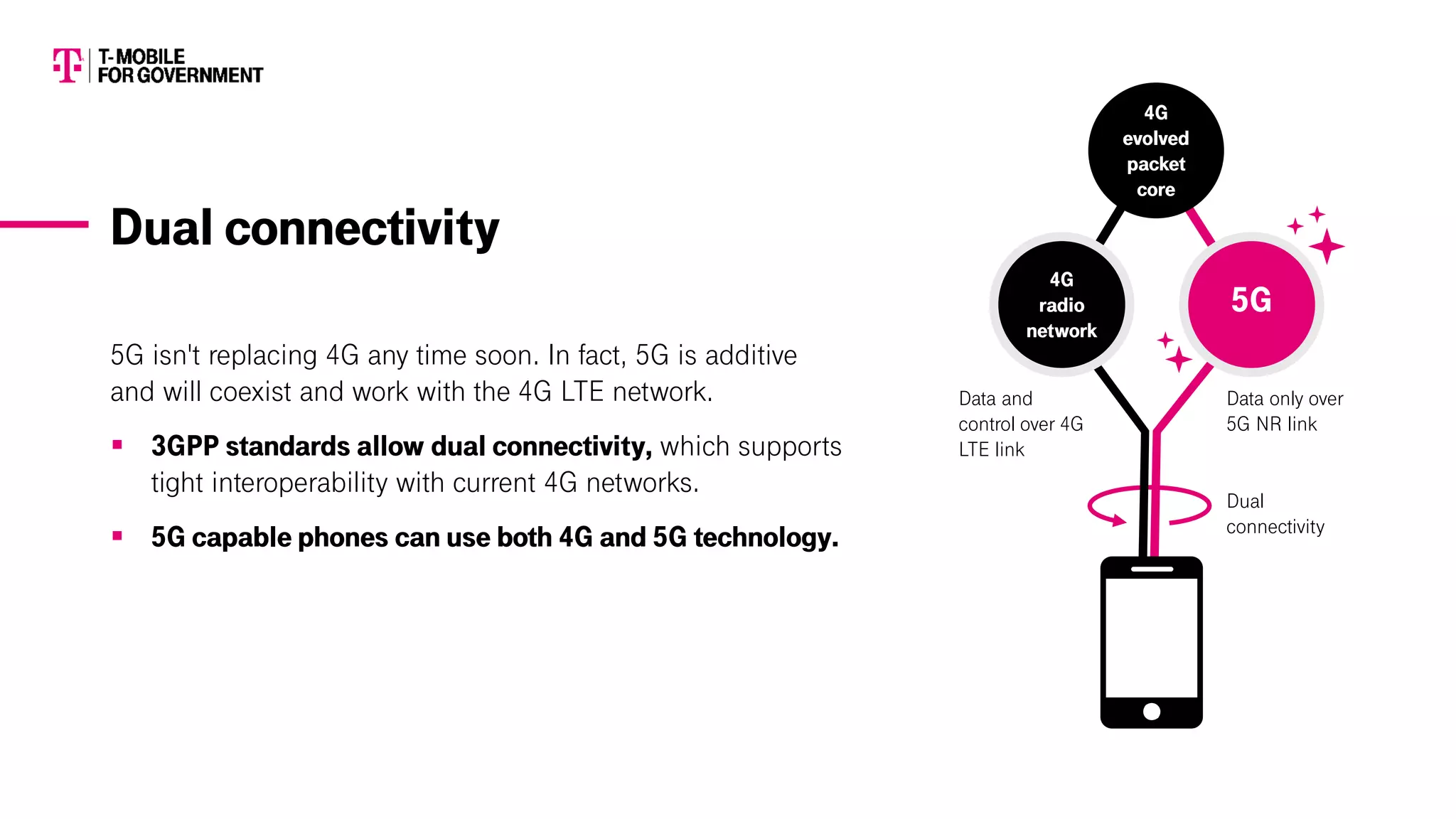
5G isn't replacing 4G any time soon. In fact, 5G is additive
and will coexist and work with the 4G LTE network.
▪ 3GPP standards allow dual connectivity, which supports
tight interoperability with current 4G networks.
▪ 5G capable phones can use both 4G and 5G technology.
4G
evolved
packet
core
4G
radio
network
5G
Data and
control over 4G
LTE link
Data only over
5G NR link
Dual
connectivity
Dual connectivity
The future of 5G:
Networks that work at
the speed of business
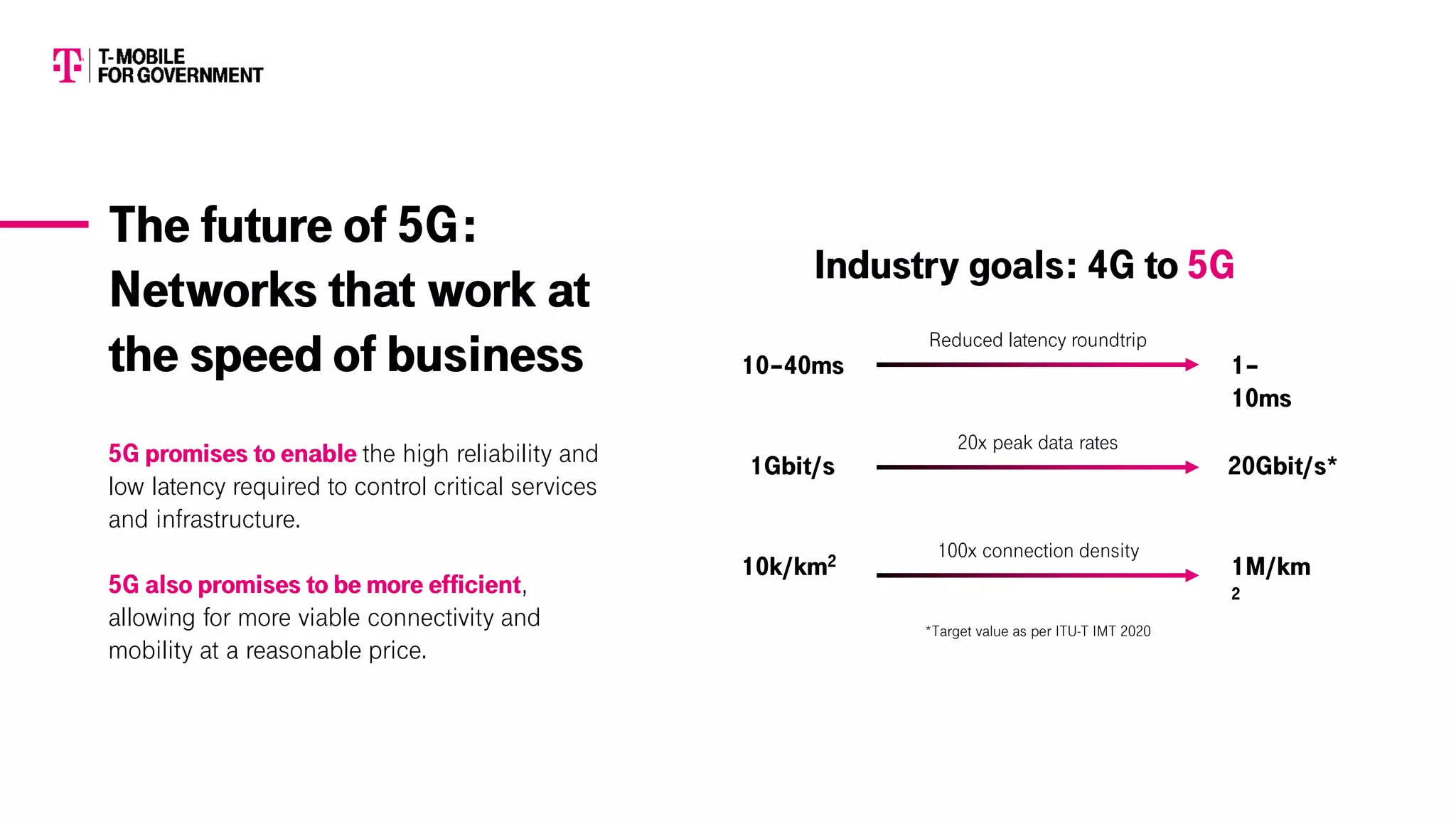
5G promises to enable the high reliability and
low latency required to control critical services
and infrastructure.
5G also promises to be more efficient,
allowing for more viable connectivity and
mobility at a reasonable price.
10–40ms 1–
10ms
1Gbit/s 20Gbit/s*
10k/km2 1M/km
2
Reduced latency roundtrip
20x peak data rates
100x connection density
*Target value as per ITU-T IMT 2020
Industry goals: 4G to 5G
Internet of
Things
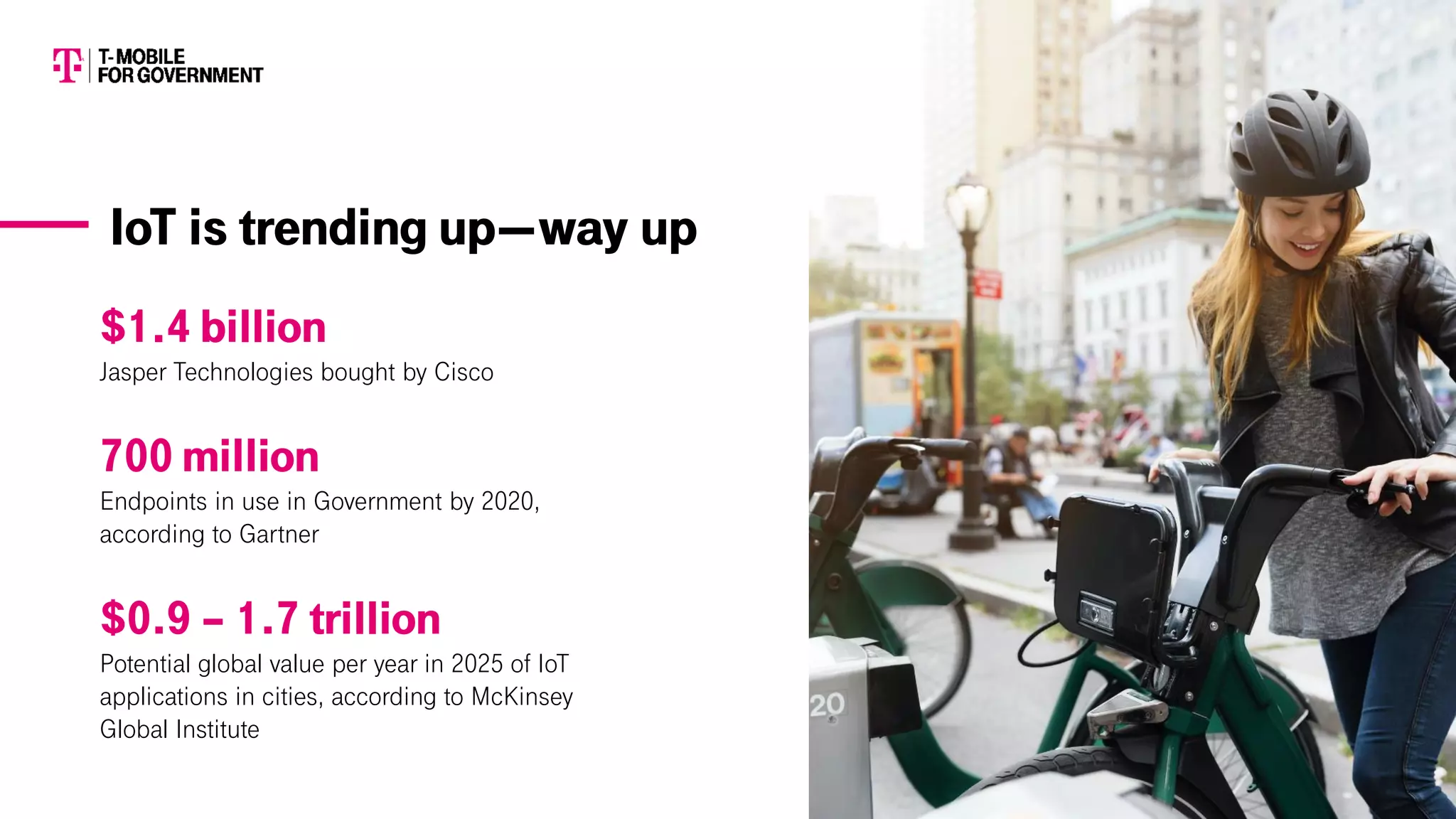
700 million
Endpoints in use in Government by 2020,
according to Gartner
$1.4 billion
Jasper Technologies bought by Cisco
$0.9 – 1.7 trillion
Potential global value per year in 2025 of IoT
applications in cities, according to McKinsey
Global Institute
IoT is trending up—way up
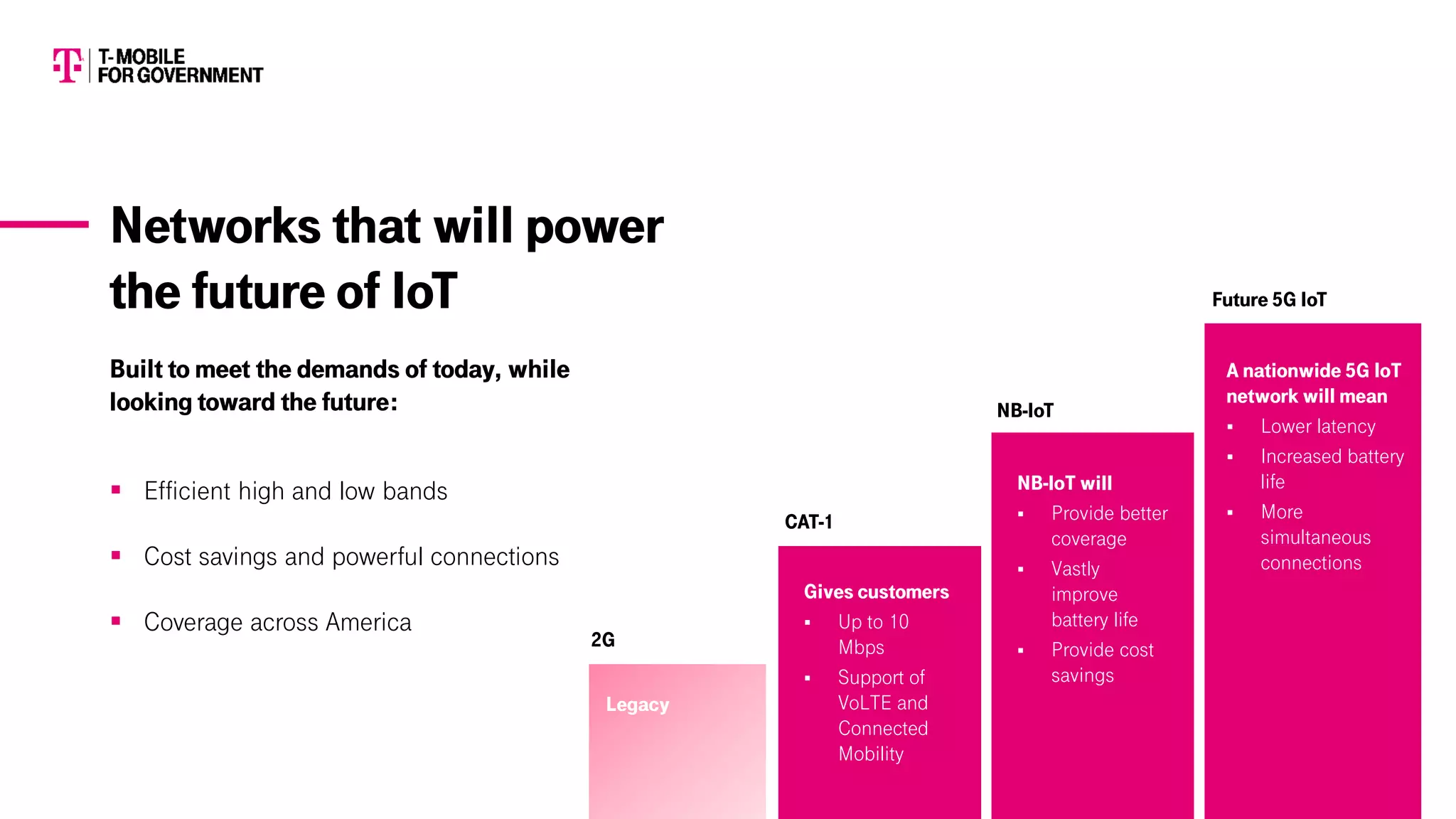
Networks that will power
the future of IoT
Built to meet the demands of today, while
looking toward the future:
▪ Efficient high and low bands
▪ Cost savings and powerful connections
▪ Coverage across America
CAT-1
NB-IoT
Future 5G IoT
2G
Legacy
Gives customers
▪ Up to 10
Mbps
▪ Support of
VoLTE and
Connected
Mobility
NB-IoT will
▪ Provide better
coverage
▪ Vastly
improve
battery life
▪ Provide cost
savings
A nationwide 5G IoT
network will mean
▪ Lower latency
▪ Increased battery
life
▪ More
simultaneous
connections
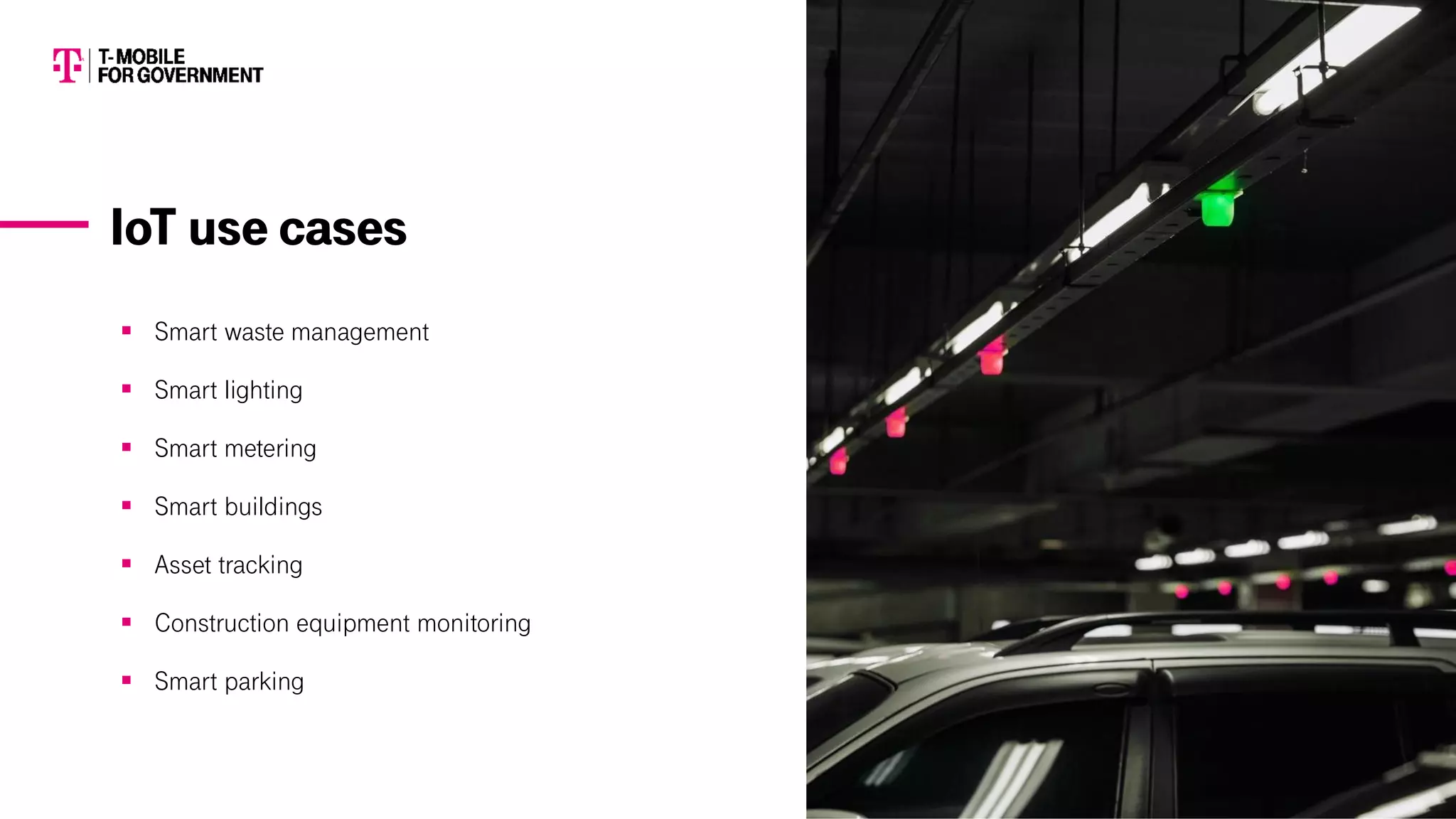
▪ Smart waste management
▪ Smart lighting
▪ Smart metering
▪ Smart buildings
▪ Asset tracking
▪ Construction equipment monitoring
▪ Smart parking
IoT use cases
▪ Enhanced UE security
▪ Better battery life
▪ Optimized data usage
▪ Buffered MT messages
NB-IoT key benefits:
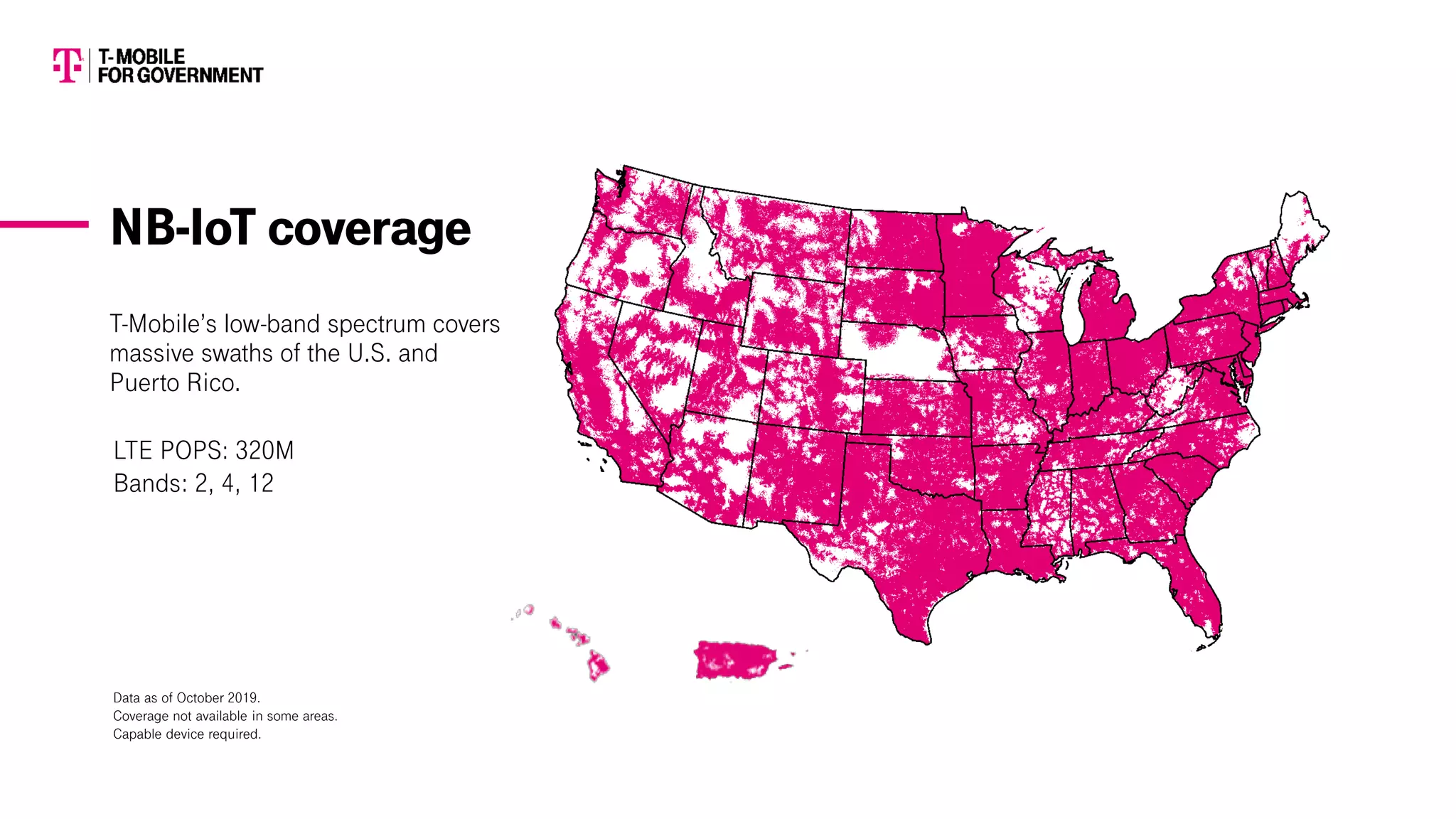
T-Mobile’s low-band spectrum covers
massive swaths of the U.S. and
Puerto Rico.
LTE POPS: 320M
Bands: 2, 4, 12
Data as of October 2019.
Coverage not available in some areas.
Capable device required.
NB-IoT coverage
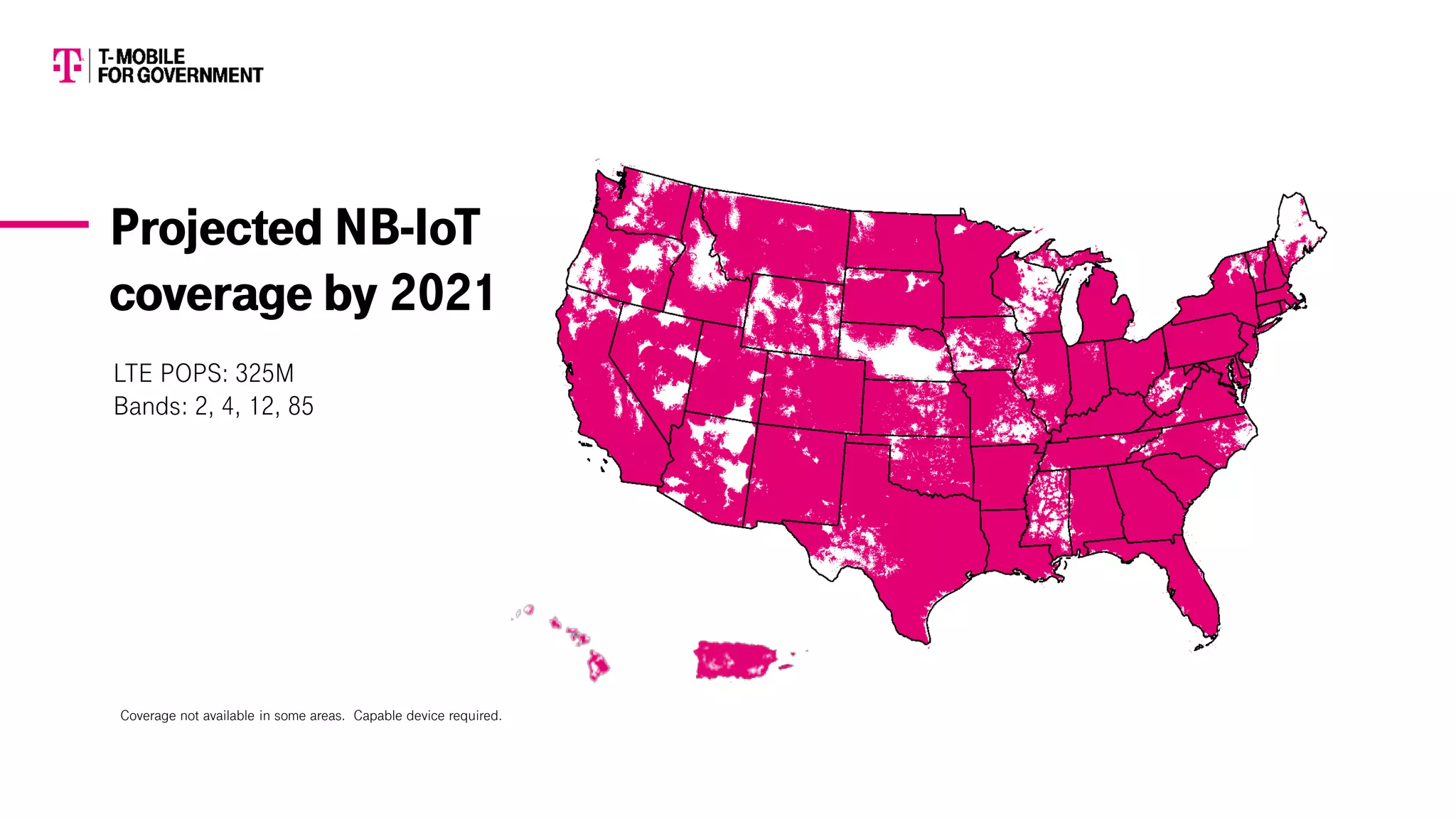
LTE POPS: 325M
Bands: 2, 4, 12, 85
Projected NB-IoT
coverage by 2021
Coverage not available in some areas. Capable device required.
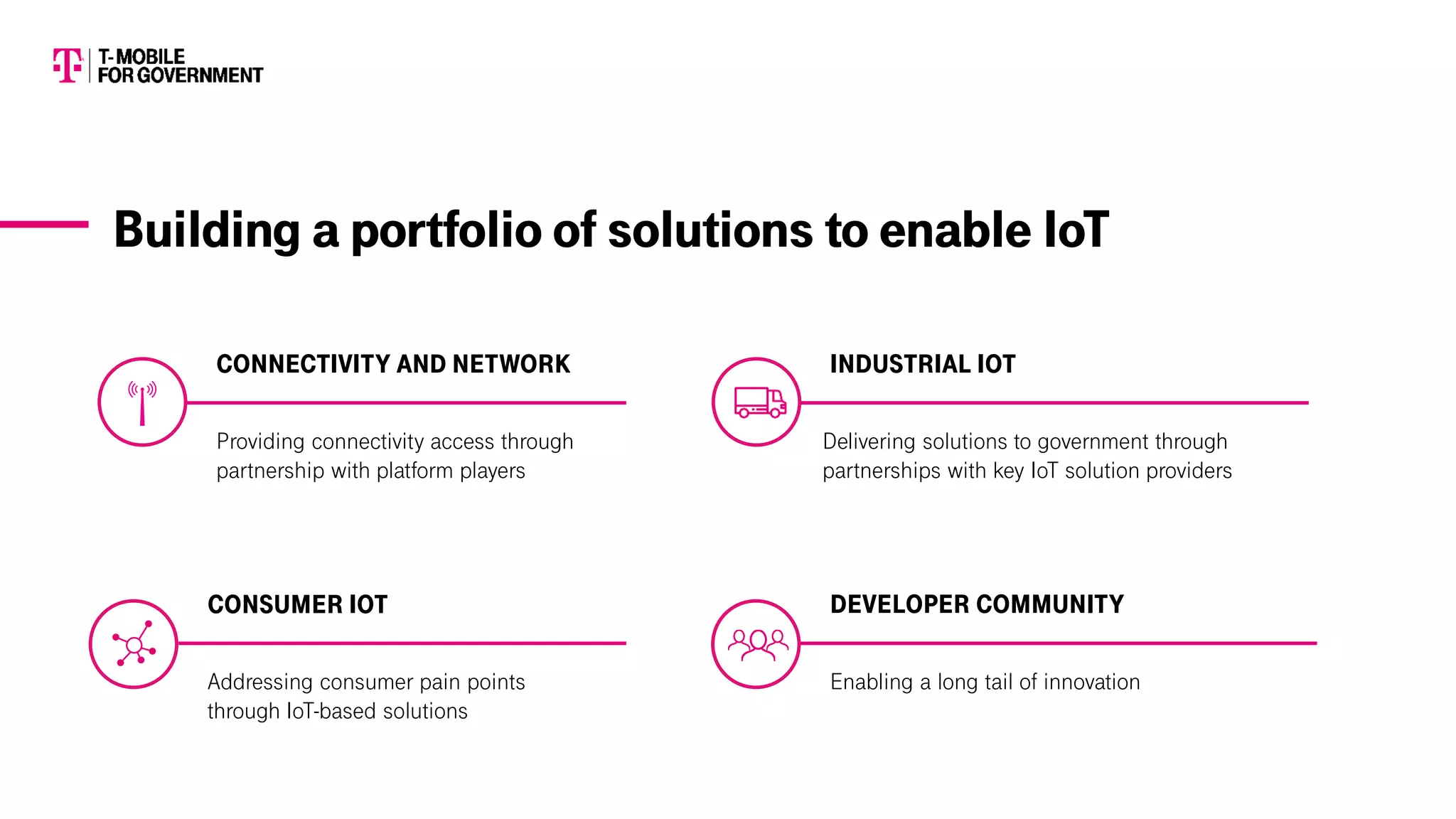
Building a portfolio of solutions to enable IoT
Providing connectivity access through
partnership with platform players
CONNECTIVITY AND NETWORK
Delivering solutions to government through
partnerships with key IoT solution providers
INDUSTRIAL IOT
Addressing consumer pain points
through IoT-based solutions
CONSUMER IOT
Enabling a long tail of innovation
DEVELOPER COMMUNITY
Leading the evolution
of government wireless

#NPTechClubATX: 5G: What Is It and Why Is It a Game Changer?

  • 1.
    Agenda My introduction toTech Network History Why is 5G Relevant IOT Expansion
  • 3.
    The new T-Mobilewill light up a broad and deep 5G network for all—faster than either company could separately. T-Mobileisbringing Sprintintothefamily
  • 4.
    T-Mobile will lightup a broad and deep 5G network for all—faster than either company could separately. Massivecapacity Over the next 6 years our capacity will increase 14x over what we have today. 15xfaster Our network will be 8x faster than current LTE in just a few years, and 15x faster in the next 6 years — with about 450 Mbps nationwide average download speeds, compared to around just 30–40 Mbps today. T-Mobileisbringing Sprintintothefamily 99%with5G We already have the largest 5G network, and within 6 years, we’ll provide 5G to 99% of Americans.
  • 6.
    ▪ Massive broadband ▪ Massivemachine communication ▪ Critical communication Self-managing agricultureRouters Fixed broadband Augmented reality Virtual reality Real-time translation Drone delivery Tablets Laptops Smartphone s Wearable s Connected highways Sensors Smart cities Immersive media Industrial automation Cars Automated driving Asset tracking Machine s Campus networks 5G What could a 5G future bring?
  • 7.
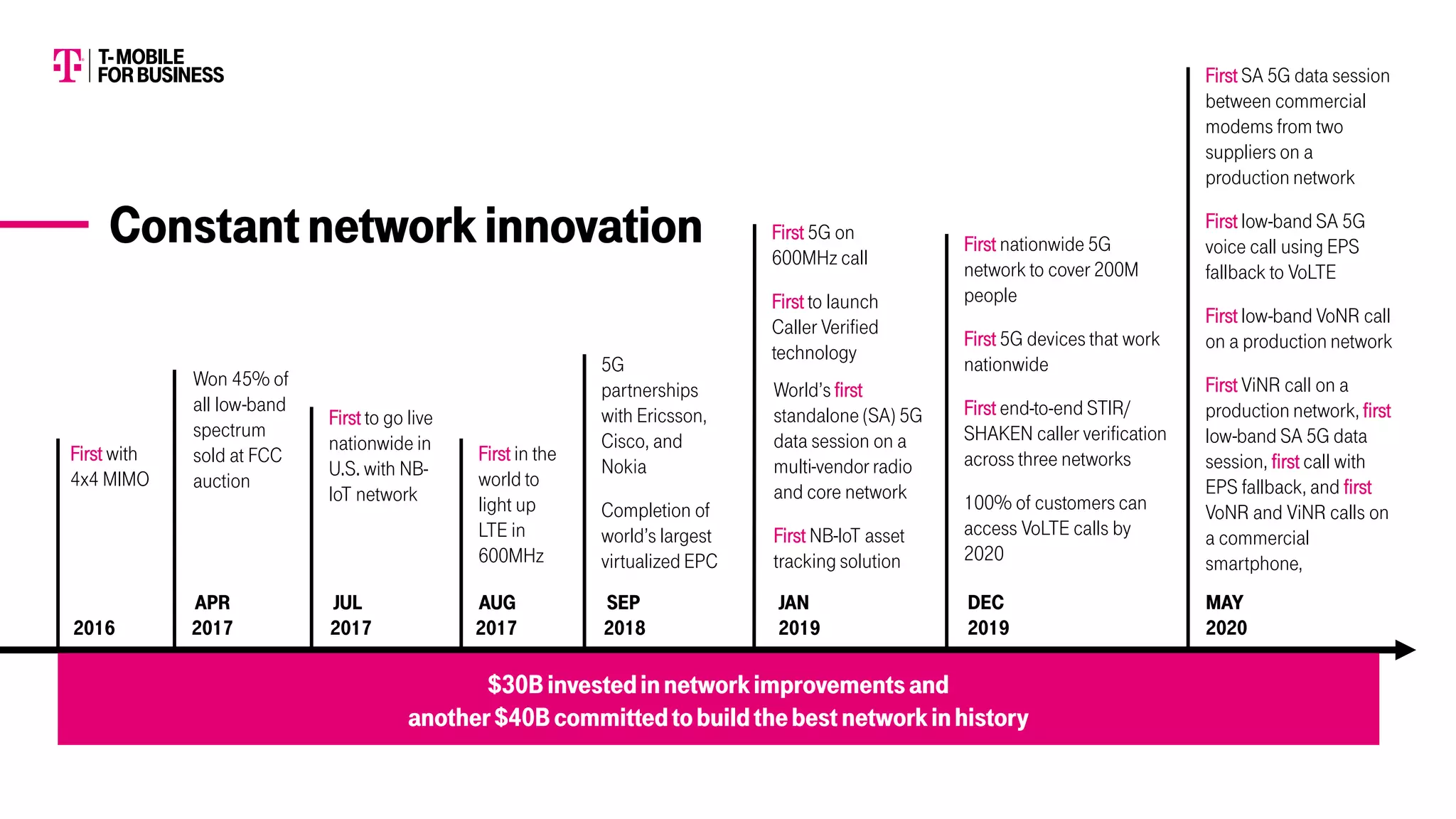
    Constant networkinnovation $30Binvestedinnetworkimprovementsand another$40Bcommittedtobuildthebest networkinhistory 2016 Firstwith 4x4 MIMO APR 2017 Won 45% of all low-band spectrum sold at FCC auction First to go live nationwide in U.S. with NB- IoT network JUL 2017 First in the world to light up LTE in 600MHz AUG 2017 SEP 2018 5G partnerships with Ericsson, Cisco, and Nokia Completion of world’s largest virtualized EPC JAN 2019 First 5G on 600MHz call First to launch Caller Verified technology MAY 2020 World’s first standalone (SA) 5G data session on a multi-vendor radio and core network First NB-IoT asset tracking solution DEC 2019 First nationwide 5G network to cover 200M people First 5G devices that work nationwide First end-to-end STIR/ SHAKEN caller verification across three networks 100% of customers can access VoLTE calls by 2020 First SA 5G data session between commercial modems from two suppliers on a production network First low-band SA 5G voice call using EPS fallback to VoLTE First low-band VoNR call on a production network First ViNR call on a production network, first low-band SA 5G data session, first call with EPS fallback, and first VoNR and ViNR calls on a commercial smartphone,
  • 8.
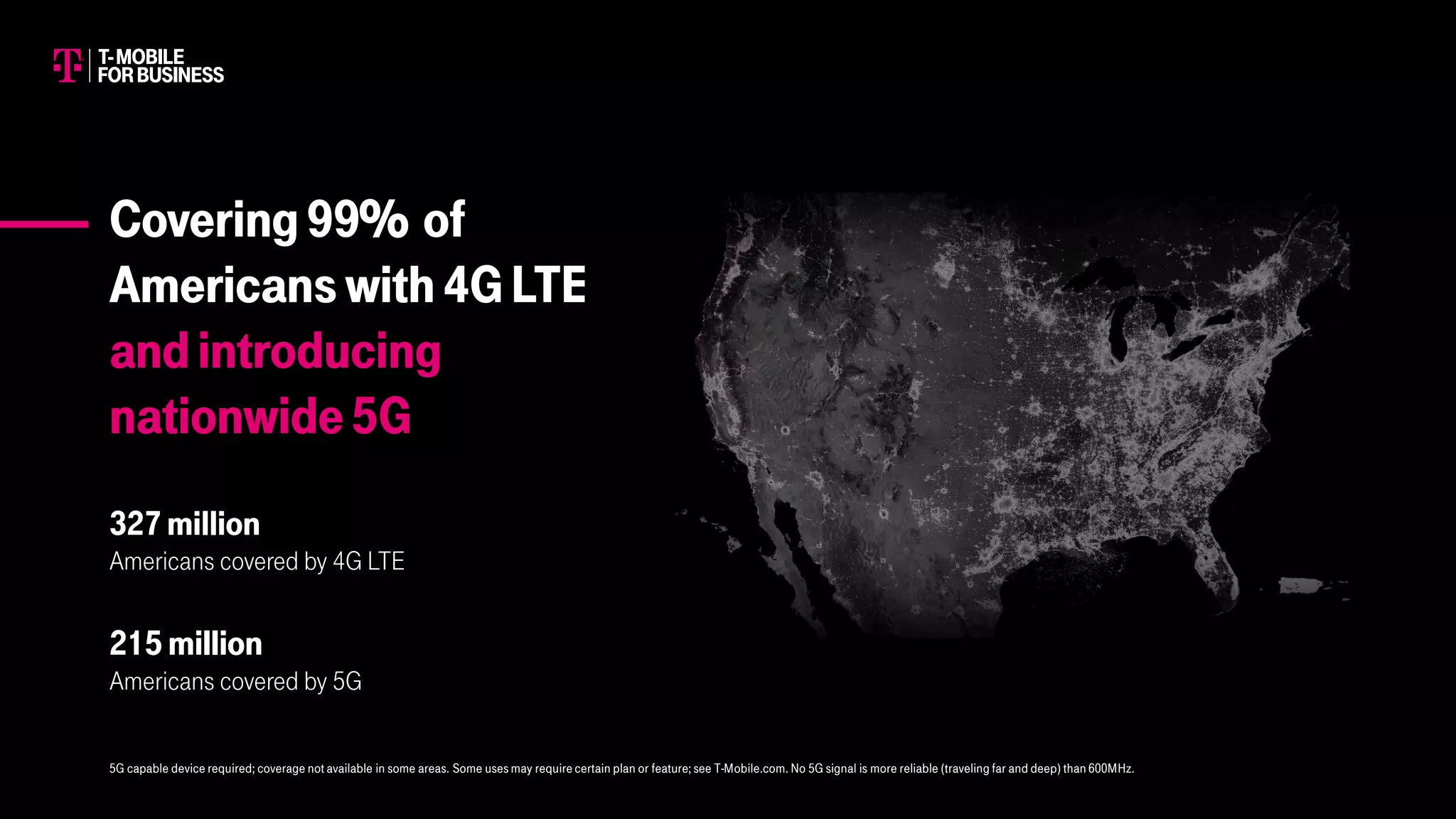
    Covering99% of Americanswith4GLTE andintroducing nationwide5G 327million Americans coveredby 4G LTE 215 million Americans covered by 5G 5G capable device required; coverage not available in some areas. Some uses may requirecertain plan or feature;see T-Mobile.com. No 5G signal is more reliable (traveling far and deep) than600MHz.
  • 9.
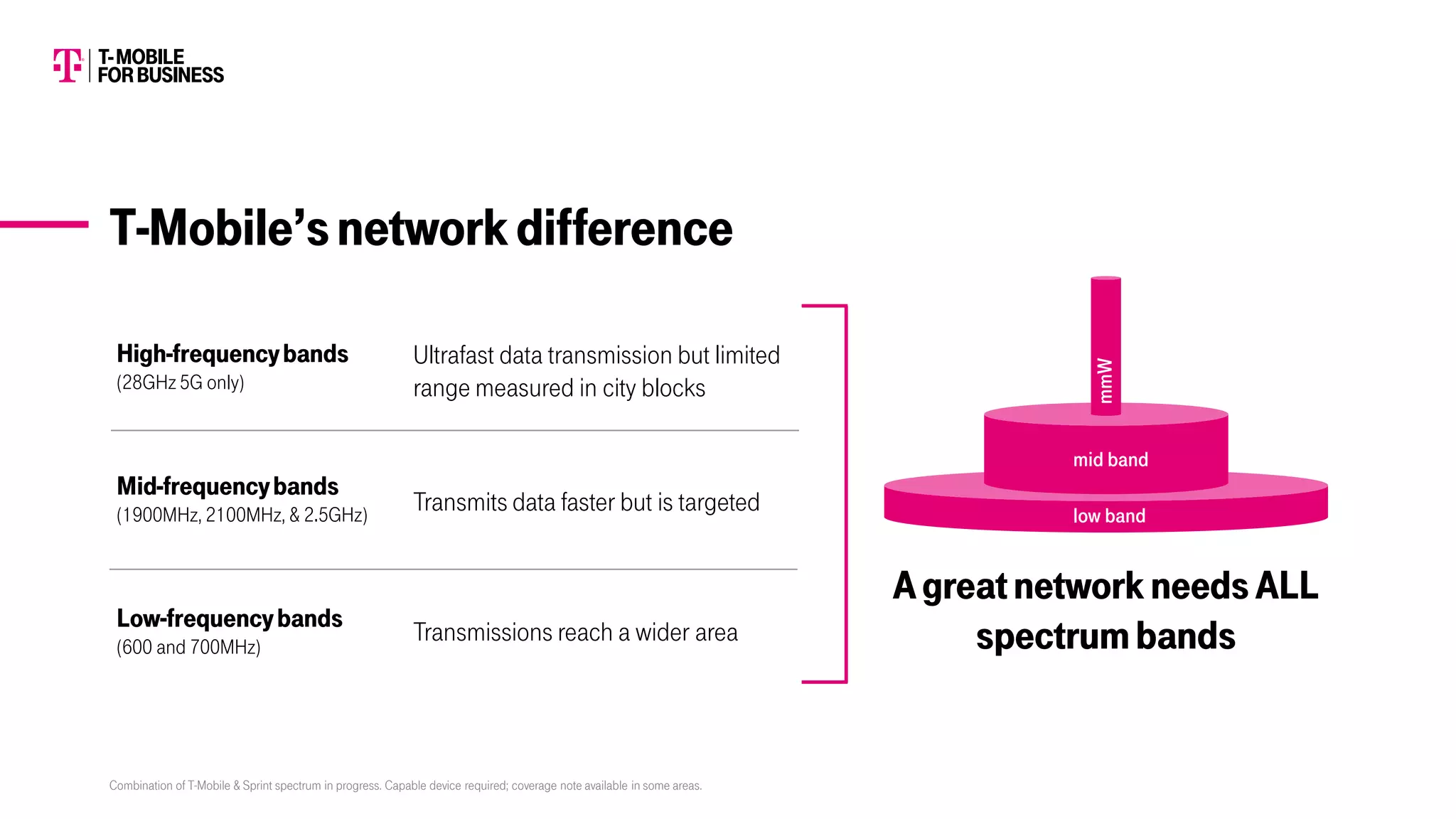
    Agreatnetwork needsALL spectrumbands High-frequencybands (28GHz 5Gonly) Ultrafast data transmission but limited range measured in city blocks Mid-frequencybands (1900MHz, 2100MHz, & 2.5GHz) Transmits data faster but is targeted Low-frequencybands (600 and 700MHz) Transmissions reach a wider area T-Mobile’snetworkdifference Combination of T-Mobile & Sprint spectrum in progress. Capable device required; coverage note available in some areas. mmW mid band low band
  • 10.
    5G isn't replacing4G any time soon. In fact, 5G is additive and will coexist and work with the 4G LTE network. ▪ 3GPP standards allow dual connectivity, which supports tight interoperability with current 4G networks. ▪ 5G capable phones can use both 4G and 5G technology. 4G evolved packet core 4G radio network 5G Data and control over 4G LTE link Data only over 5G NR link Dual connectivity Dual connectivity
  • 11.
    The future of5G: Networks that work at the speed of business 5G promises to enable the high reliability and low latency required to control critical services and infrastructure. 5G also promises to be more efficient, allowing for more viable connectivity and mobility at a reasonable price. 10–40ms 1– 10ms 1Gbit/s 20Gbit/s* 10k/km2 1M/km 2 Reduced latency roundtrip 20x peak data rates 100x connection density *Target value as per ITU-T IMT 2020 Industry goals: 4G to 5G
  • 12.
  • 13.
    700 million Endpoints inuse in Government by 2020, according to Gartner $1.4 billion Jasper Technologies bought by Cisco $0.9 – 1.7 trillion Potential global value per year in 2025 of IoT applications in cities, according to McKinsey Global Institute IoT is trending up—way up
  • 14.
    Networks that willpower the future of IoT Built to meet the demands of today, while looking toward the future: ▪ Efficient high and low bands ▪ Cost savings and powerful connections ▪ Coverage across America CAT-1 NB-IoT Future 5G IoT 2G Legacy Gives customers ▪ Up to 10 Mbps ▪ Support of VoLTE and Connected Mobility NB-IoT will ▪ Provide better coverage ▪ Vastly improve battery life ▪ Provide cost savings A nationwide 5G IoT network will mean ▪ Lower latency ▪ Increased battery life ▪ More simultaneous connections
  • 15.
    ▪ Smart wastemanagement ▪ Smart lighting ▪ Smart metering ▪ Smart buildings ▪ Asset tracking ▪ Construction equipment monitoring ▪ Smart parking IoT use cases
  • 16.
    ▪ Enhanced UEsecurity ▪ Better battery life ▪ Optimized data usage ▪ Buffered MT messages NB-IoT key benefits:
  • 17.
    T-Mobile’s low-band spectrumcovers massive swaths of the U.S. and Puerto Rico. LTE POPS: 320M Bands: 2, 4, 12 Data as of October 2019. Coverage not available in some areas. Capable device required. NB-IoT coverage
  • 18.
    LTE POPS: 325M Bands:2, 4, 12, 85 Projected NB-IoT coverage by 2021 Coverage not available in some areas. Capable device required.
  • 19.
    Building a portfolioof solutions to enable IoT Providing connectivity access through partnership with platform players CONNECTIVITY AND NETWORK Delivering solutions to government through partnerships with key IoT solution providers INDUSTRIAL IOT Addressing consumer pain points through IoT-based solutions CONSUMER IOT Enabling a long tail of innovation DEVELOPER COMMUNITY
  • 20.
    Leading the evolution ofgovernment wireless