Visit Plantronics.com/HowWeWork
for more information on the study
findings and research methodology
Communication Trends of Business Professionals
An International Study Conducted by Plantronics
HOW WE
WORK:Plantronics is a world leader in personal audio communications for professionals and consumers.
From Unified Communication solutions to Bluetooth® headsets, Plantronics delivers unparalleled
audio experiences and quality that reflect our nearly 50 years of innovation and customer
commitment. Plantronics is used by every company in the Fortune 100 and is the headset of choice
for air traffic control, 911 dispatch and the New York Stock Exchange. For more information, please
visit www.plantronics.com or call 1-800-544-4660.
© 2010 Plantronics, Inc. All Rights Reserved.
B
usiness as usual today
means global workforces,
telecommuting, flex time, and
an anywhere-anytime attitude about
office time and place.
So it’s no surprise that the ways we
brainstorm, collaborate and even chat
around the water cooler have also
been transformed...
B
Interestingly and contrary to the typical technology lifecycle,
new communications tools aren’t replacing the old today —
there are no Betamax-style extinctions. New tools are instead
partnering productively with the tried-and-true ways of
conversing and collaborating.
All respondents indicated a strong preference for utilizing a
mix of the traditional and new communications technologies:
sending IMs to get a simple question answered, scheduling an
audio conference to gain consensus on an important topic,
firing a quick text to let a colleague know they’re running late.
Rather than connecting via just one form of communication,
professionals are creating “tool belts” that enable them to
select exactly the right tool for the job at hand.
As communication options and needs increase, clear
preferences have emerged regarding the best ways to
exchange specific types of information. The modern
communications tool belt includes:
•	 Phone and Audio Conferences: Conveying complex 		
	 information clearly, clarifying meaning, collaborating, 	
	 building relationships, priority communications
•	 Video and Web Conferences: Brainstorming, collaboration, 	
	 planning, presentations
•  Email: Check-ins, status reports, follow-up, group 		
	 communications, attachments
•	 IM: Presence information, check-in (“R U there?”),
	 simple query
•	 Text (SMS): Uncomplicated time-sensitive information
•	 Social Media: Networking, news updates
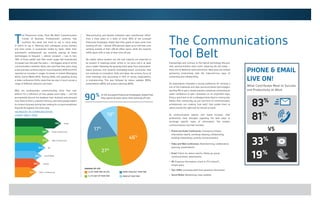
Telecommuting and flexible schedules have transformed “office”
from a fixed place to a state of mind. 90% of the surveyed
Enterprise Employees stated that they spend at least some time
working off site — almost 30% percent spent up to half their time
working outside of their official office space, while the majority
(46%) spent 25% or less of their time off site.
No matter where workers are, the vast majority are expected to
be present in meetings either online or via voice call-in at least
once a week. Following the growing trend away from automation-
based business and towards knowledge-based economies that
are centered on innovation, skills and ideas, the primary focus of
most meetings now (according to 91% of survey respondents),
is brainstorming. This was followed by status updates (89%),
presentations (86%) and project planning (80%).
P
he Plantronics study, “How We Work: Communication
Trends of Business Professionals” confirms that
business has never had more to say or more ways
in which to say it. Working with colleagues across borders
and time zones, in businesses fueled by ideas rather than
automation, professionals are certainly putting all these
technologies to frequent — almost constant — use. In fact,
78% of those polled said their email usage had dramatically
increased over the past five years — the biggest jump of all the
communication methods. Many also said that they were using
audio and web conferencing far more frequently (69% and 67%
reported an increase in usage). Increases in Instant Messaging
(64%), Social Media (61%), Texting (58%), and speaking during
a video conference (54%), show that we stay in touch across a
range of different mediums and tools.
Why are professionals communicating more than ever
before? It’s a reflection of how people work today — and the
permanently blurred line between their business and personal
lives. Nine-to-five is a distant memory, and many people expect
to conduct business during their waking ho urs (and sometimes
beyond) throughout the entire year.
The Communications
Tool Belt
Video Conferencing
69%
78%
67%
64%
61%
58%
54%
Social Media
IM
Web Conferencing
Audio Conferencing
Email
Texting
Increases in communication
usage since 2005
90% of the surveyed Enterprise Employees stated that
they spend at least some time working off site
Working off site:
1/4 of their time or less More than half their time
NONE OF THEIR TIME1/4 to Half OF THEIR TIME
10%
17%
27%
46%
83%
33%
81%
19%
IM
VS
PHONE & EMAIL
LIVE ON!
What Contributes Most to Success
and Productivity at Work
T
O
riginally intended to be nothing more than a sort of
virtual sticky note when it was introduced in 1965,
and quite probably the killer application that got
the general populace interested in the Internet, it’s hard to
remember how we did business in the pre-email days, back
when we’d actually ask people, “Do you have an email address?”
99% of “How We Work” respondents said they regularly send
and receive email on their personal computers, making it the
most popular business communications and collaboration
tool. Email via mobile devices was almost as popular with 81%
usage among respondents.
But although virtually everyone uses email, they don’t want to
use it all the time. When professionals are looking for the right
tool to use when communicating critical news or working in a
highly collaborative situation, they are unlikely to choose email.
Why? Partly due to the immediacy of voice and video, but
there’s another reason: email is likely to cause communications
confusion and anxiety.
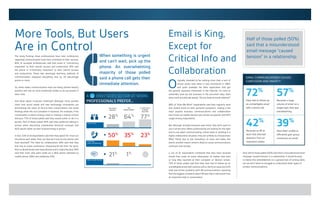
4 out of 10 respondents confessed that they have received
emails that made no sense whatsoever no matter how hard
or long they squinted at their computer or devices’ screen.
72% of those polled said that they have had to follow-up an
unintelligible email with a phone call to clarify an issue and 42%
have had similar problems with IM communications; reporting
that the biggest complaint about IM was that it distracted from
an important task or conversation.
Email is King,
Except for
Critical Info and
Collaboration
Half of those polled (50%)
said that a misunderstood
email message “caused
tension” in a relationship.
42%
39%
57%
Received a large
volume of email on a
single topic that was
overwhelming
72%
Have had to follow up
an unintelligible email
with a phone call
Received an IM at
work that diverted
attention from an
important matter
Have been unable to
efficiently gain group
consensus via email
Email communications causes
confusion and anxiety
And, half of those polled (50%) said that a misunderstood email
message “caused tension” in a relationship. It would be easy
to blame this befuddlement on a general lack of writing skills,
but we don’t seem to struggle to understand other types of
written communications.
The study findings show professionals have clear preferences
regarding communication tools that contribute to their success.
83% of surveyed professionals said that email is “critical/very
important” to their overall success and productivity. 81% said
the phone is “critical/very important” to their overall success
and productivity. These two seemingly declining methods of
communication outpaced everything else by 20 percentage
points or more.
So, while newer communication tools are being utilized heavily,
workers still rely on more traditional modes to be successful in
their roles.
And what about in-person meetings? Although many pundits
claim that social media and new technology innovations are
diminishing the value of face-to-face conversations, the study
findings show this isn’t prevalent in business. For example, if the
conversation is about closing a deal or making a mission-critical
decision, 77% of those polled said they would prefer to do it in
person. And of those polled, 65% said they preferred talking in
person when discussing complicated technical concepts and
64% would rather do their brainstorming in person.	
In fact, 53% of all respondents said that they spend 10+ hours on
the phone each week. How can that be if one-to-one phone calls
have declined? The need for collaboration: 83% said that they
dial into an audio conference “frequently/all the time” for work.
And, to demonstrate that desk phones aren’t collecting dust, 56%
said that most calls were made via a desk phone, followed by
mobile phone (39%) and softphone (5%).
When something is urgent
and can’t wait, pick up the
phone. An overwhelming
majority of those polled
said a phone call gets their
immediate attention.
More Tools, But Users
Are in Control
50%
35%
23%
audio and
video conferencing
28%
64%
77%
Face-to-Face
1%
21%
Email, IM and Texting
A       ONLY GOES SO FAR AT WORK.
PROFESSIONALS PREFER...
FOR Status
MEETINGS
FOR 
brainstormING
CLOSING deals 
& MAKING 
decisions
O
& Respondents’repliestoquestionsposedinthe“HowWeWork”study
revealed clear cultural preferences regarding how different types of
information can and should be best conveyed. However, there were
just as many global commonalities identified, particularly among
the communications tools respondents cited as indispensable for
collaboration, productivity and overall success.
•	 Respondents based in China and India reported the greatest
overall growth in their business communications usage.
•	 Email and voice ranked first and second in the line-up of business
tools in nearly every country. The only exception was India, where
audio conferences were slightly preferred over email.
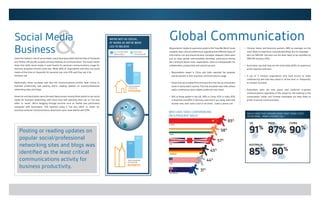
•	 91% of those polled in the UK, 90% in China, 87% in India, 85%
in Australia and 80% in Germany said that if you really need that
answer now, don’t send a text or an email...make a phone call.
Social Media
Business
Given the meteoric rise of social media, many have speculated that the likes of Facebook
and Twitter will quickly surpass existing methods of communication. The study results
show that while social media is used heavily for personal communications, usage for
business purposes remains quite low. While 66% of respondents said they use social
media all the time or frequently for personal use, only 43% said they use it for
business use.
Additionally, those surveyed said that the communications activity least critical to
business productivity was posting and/or reading updates on social/professional
networking sites and blogs.
American and Australians were the least likely groups among those polled to use social
media for business networking, with more than half reporting their use as “not very
often” or “never”. Micro blogging through services such as Twitter was particularly
unpopular with Australians; 74% reported using it “not very often” or “never” for
business-centered communications. Americans were close behind with 63%.
Posting or reading updates on
popular social/professional
networking sites and blogs was
identified as the least critical
communications activity for
business productivity.
•	 Chinese, Indian and American workers (38% on average), are the
most likely to experience misunderstandings due to messages
sent via SMS/IM. Germans are the least likely to be mystified by
SMS/IM missives (15%).
•	 Australians say that they are the most likely (62%) to experience
email-inspired confusion.
•	 2 out of 3 Chinese respondents who have access to video
conferencing said that they utilize it “all the time” or “frequently”
to conduct business.
•	 Australians were the only group who preferred in-person
communications regardless of the reason for the meeting or the
conversation. Indian and Chinese employees are least likely to
prefer in-person communication.
Global CommunicationWe’re Not As Social
At Work As We’ve Been
Led to Believe
ALL OF THE TIME/
FREQUENTLY
NOT VERY
OFTEN/NEVER
CHINA
INDIA
UK
GERMANY
USA
AUSTRALIA
58%
57%
45%
44%
31%
65%
Who uses video conferencing
on a frequent basis?
really need that answer now? don’t send a text
or an email...make a phone call.
91%
UK
90%
ChinA
85%
Australia
80%
Germany
87%
india
66%
43%
57%
34%
MethodologyTo understand how business is communicating in the
midst of these changes, Plantronics surveyed 1,800
enterprise employees in the US, UK, Germany, China,
India and Australia. All work in medium or large-size
companies (100+ employees) and identified themselves
as knowledge workers (people whose work centers on
developing/workingprimarilywithideasandinformation)
who use a variety of communications technologies to
stay in touch with colleagues, partners and clients. The
research was conducted in May and June of 2010.

How we-work

  • 1.
    Visit Plantronics.com/HowWeWork for moreinformation on the study findings and research methodology Communication Trends of Business Professionals An International Study Conducted by Plantronics HOW WE WORK:Plantronics is a world leader in personal audio communications for professionals and consumers. From Unified Communication solutions to Bluetooth® headsets, Plantronics delivers unparalleled audio experiences and quality that reflect our nearly 50 years of innovation and customer commitment. Plantronics is used by every company in the Fortune 100 and is the headset of choice for air traffic control, 911 dispatch and the New York Stock Exchange. For more information, please visit www.plantronics.com or call 1-800-544-4660. © 2010 Plantronics, Inc. All Rights Reserved.
  • 2.
    B usiness as usualtoday means global workforces, telecommuting, flex time, and an anywhere-anytime attitude about office time and place. So it’s no surprise that the ways we brainstorm, collaborate and even chat around the water cooler have also been transformed... B
  • 3.
    Interestingly and contraryto the typical technology lifecycle, new communications tools aren’t replacing the old today — there are no Betamax-style extinctions. New tools are instead partnering productively with the tried-and-true ways of conversing and collaborating. All respondents indicated a strong preference for utilizing a mix of the traditional and new communications technologies: sending IMs to get a simple question answered, scheduling an audio conference to gain consensus on an important topic, firing a quick text to let a colleague know they’re running late. Rather than connecting via just one form of communication, professionals are creating “tool belts” that enable them to select exactly the right tool for the job at hand. As communication options and needs increase, clear preferences have emerged regarding the best ways to exchange specific types of information. The modern communications tool belt includes: • Phone and Audio Conferences: Conveying complex information clearly, clarifying meaning, collaborating, building relationships, priority communications • Video and Web Conferences: Brainstorming, collaboration, planning, presentations • Email: Check-ins, status reports, follow-up, group communications, attachments • IM: Presence information, check-in (“R U there?”), simple query • Text (SMS): Uncomplicated time-sensitive information • Social Media: Networking, news updates Telecommuting and flexible schedules have transformed “office” from a fixed place to a state of mind. 90% of the surveyed Enterprise Employees stated that they spend at least some time working off site — almost 30% percent spent up to half their time working outside of their official office space, while the majority (46%) spent 25% or less of their time off site. No matter where workers are, the vast majority are expected to be present in meetings either online or via voice call-in at least once a week. Following the growing trend away from automation- based business and towards knowledge-based economies that are centered on innovation, skills and ideas, the primary focus of most meetings now (according to 91% of survey respondents), is brainstorming. This was followed by status updates (89%), presentations (86%) and project planning (80%). P he Plantronics study, “How We Work: Communication Trends of Business Professionals” confirms that business has never had more to say or more ways in which to say it. Working with colleagues across borders and time zones, in businesses fueled by ideas rather than automation, professionals are certainly putting all these technologies to frequent — almost constant — use. In fact, 78% of those polled said their email usage had dramatically increased over the past five years — the biggest jump of all the communication methods. Many also said that they were using audio and web conferencing far more frequently (69% and 67% reported an increase in usage). Increases in Instant Messaging (64%), Social Media (61%), Texting (58%), and speaking during a video conference (54%), show that we stay in touch across a range of different mediums and tools. Why are professionals communicating more than ever before? It’s a reflection of how people work today — and the permanently blurred line between their business and personal lives. Nine-to-five is a distant memory, and many people expect to conduct business during their waking ho urs (and sometimes beyond) throughout the entire year. The Communications Tool Belt Video Conferencing 69% 78% 67% 64% 61% 58% 54% Social Media IM Web Conferencing Audio Conferencing Email Texting Increases in communication usage since 2005 90% of the surveyed Enterprise Employees stated that they spend at least some time working off site Working off site: 1/4 of their time or less More than half their time NONE OF THEIR TIME1/4 to Half OF THEIR TIME 10% 17% 27% 46% 83% 33% 81% 19% IM VS PHONE & EMAIL LIVE ON! What Contributes Most to Success and Productivity at Work T
  • 4.
    O riginally intended tobe nothing more than a sort of virtual sticky note when it was introduced in 1965, and quite probably the killer application that got the general populace interested in the Internet, it’s hard to remember how we did business in the pre-email days, back when we’d actually ask people, “Do you have an email address?” 99% of “How We Work” respondents said they regularly send and receive email on their personal computers, making it the most popular business communications and collaboration tool. Email via mobile devices was almost as popular with 81% usage among respondents. But although virtually everyone uses email, they don’t want to use it all the time. When professionals are looking for the right tool to use when communicating critical news or working in a highly collaborative situation, they are unlikely to choose email. Why? Partly due to the immediacy of voice and video, but there’s another reason: email is likely to cause communications confusion and anxiety. 4 out of 10 respondents confessed that they have received emails that made no sense whatsoever no matter how hard or long they squinted at their computer or devices’ screen. 72% of those polled said that they have had to follow-up an unintelligible email with a phone call to clarify an issue and 42% have had similar problems with IM communications; reporting that the biggest complaint about IM was that it distracted from an important task or conversation. Email is King, Except for Critical Info and Collaboration Half of those polled (50%) said that a misunderstood email message “caused tension” in a relationship. 42% 39% 57% Received a large volume of email on a single topic that was overwhelming 72% Have had to follow up an unintelligible email with a phone call Received an IM at work that diverted attention from an important matter Have been unable to efficiently gain group consensus via email Email communications causes confusion and anxiety And, half of those polled (50%) said that a misunderstood email message “caused tension” in a relationship. It would be easy to blame this befuddlement on a general lack of writing skills, but we don’t seem to struggle to understand other types of written communications. The study findings show professionals have clear preferences regarding communication tools that contribute to their success. 83% of surveyed professionals said that email is “critical/very important” to their overall success and productivity. 81% said the phone is “critical/very important” to their overall success and productivity. These two seemingly declining methods of communication outpaced everything else by 20 percentage points or more. So, while newer communication tools are being utilized heavily, workers still rely on more traditional modes to be successful in their roles. And what about in-person meetings? Although many pundits claim that social media and new technology innovations are diminishing the value of face-to-face conversations, the study findings show this isn’t prevalent in business. For example, if the conversation is about closing a deal or making a mission-critical decision, 77% of those polled said they would prefer to do it in person. And of those polled, 65% said they preferred talking in person when discussing complicated technical concepts and 64% would rather do their brainstorming in person. In fact, 53% of all respondents said that they spend 10+ hours on the phone each week. How can that be if one-to-one phone calls have declined? The need for collaboration: 83% said that they dial into an audio conference “frequently/all the time” for work. And, to demonstrate that desk phones aren’t collecting dust, 56% said that most calls were made via a desk phone, followed by mobile phone (39%) and softphone (5%). When something is urgent and can’t wait, pick up the phone. An overwhelming majority of those polled said a phone call gets their immediate attention. More Tools, But Users Are in Control 50% 35% 23% audio and video conferencing 28% 64% 77% Face-to-Face 1% 21% Email, IM and Texting A ONLY GOES SO FAR AT WORK. PROFESSIONALS PREFER... FOR Status MEETINGS FOR brainstormING CLOSING deals & MAKING decisions O
  • 5.
    & Respondents’repliestoquestionsposedinthe“HowWeWork”study revealed clearcultural preferences regarding how different types of information can and should be best conveyed. However, there were just as many global commonalities identified, particularly among the communications tools respondents cited as indispensable for collaboration, productivity and overall success. • Respondents based in China and India reported the greatest overall growth in their business communications usage. • Email and voice ranked first and second in the line-up of business tools in nearly every country. The only exception was India, where audio conferences were slightly preferred over email. • 91% of those polled in the UK, 90% in China, 87% in India, 85% in Australia and 80% in Germany said that if you really need that answer now, don’t send a text or an email...make a phone call. Social Media Business Given the meteoric rise of social media, many have speculated that the likes of Facebook and Twitter will quickly surpass existing methods of communication. The study results show that while social media is used heavily for personal communications, usage for business purposes remains quite low. While 66% of respondents said they use social media all the time or frequently for personal use, only 43% said they use it for business use. Additionally, those surveyed said that the communications activity least critical to business productivity was posting and/or reading updates on social/professional networking sites and blogs. American and Australians were the least likely groups among those polled to use social media for business networking, with more than half reporting their use as “not very often” or “never”. Micro blogging through services such as Twitter was particularly unpopular with Australians; 74% reported using it “not very often” or “never” for business-centered communications. Americans were close behind with 63%. Posting or reading updates on popular social/professional networking sites and blogs was identified as the least critical communications activity for business productivity. • Chinese, Indian and American workers (38% on average), are the most likely to experience misunderstandings due to messages sent via SMS/IM. Germans are the least likely to be mystified by SMS/IM missives (15%). • Australians say that they are the most likely (62%) to experience email-inspired confusion. • 2 out of 3 Chinese respondents who have access to video conferencing said that they utilize it “all the time” or “frequently” to conduct business. • Australians were the only group who preferred in-person communications regardless of the reason for the meeting or the conversation. Indian and Chinese employees are least likely to prefer in-person communication. Global CommunicationWe’re Not As Social At Work As We’ve Been Led to Believe ALL OF THE TIME/ FREQUENTLY NOT VERY OFTEN/NEVER CHINA INDIA UK GERMANY USA AUSTRALIA 58% 57% 45% 44% 31% 65% Who uses video conferencing on a frequent basis? really need that answer now? don’t send a text or an email...make a phone call. 91% UK 90% ChinA 85% Australia 80% Germany 87% india 66% 43% 57% 34%
  • 6.
    MethodologyTo understand howbusiness is communicating in the midst of these changes, Plantronics surveyed 1,800 enterprise employees in the US, UK, Germany, China, India and Australia. All work in medium or large-size companies (100+ employees) and identified themselves as knowledge workers (people whose work centers on developing/workingprimarilywithideasandinformation) who use a variety of communications technologies to stay in touch with colleagues, partners and clients. The research was conducted in May and June of 2010.