Look Before You Leap………….
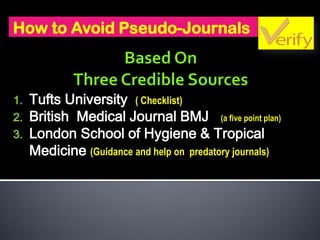
How to Avoid Pseudo-Journals
1. Tufts University ( Checklist)
2. British Medical Journal BMJ (a five point plan)
3. London School of Hygiene & Tropical
Medicine (Guidance and help on predatory journals)
TheTraditional (Old)
Vs
New “ Open Access”
Publishing Model
3www.slideshare.net/AhmedRefat
Open access stands for
 free online access to academic
documents, with the goal of
maximum dissemination and fast
availability of information on
research
 Unrestricted access &
Unrestricted reuse
4www.slideshare.net/AhmedRefat
 Publishers own the rights to the articles in their
journals.
 Anyone who wants to read the articles must pay to
access them.
 Anyone who wants to use the articles in any way
must obtain permission from the publisher and is
often required to pay an additional fee.
 The journals are sent/ viewed only for
Subscribers.
▪ Limited number of users = low visibility
▪ Expensive = economic barrier
5www.slideshare.net/AhmedRefat
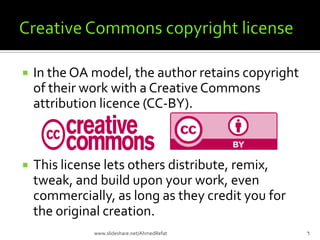
 In the OA model, the author retains copyright
of their work with a CreativeCommons
attribution licence (CC-BY).
 This license lets others distribute, remix,
tweak, and build upon your work, even
commercially, as long as they credit you for
the original creation.
6www.slideshare.net/AhmedRefat
 Predatory Publishers are primarily publish
online journals which have little or no academic
legality.
 They exist solely to make money for their
owners, and they make that money by charging
excessive “article processing fees”.
 There is minimal to no peer-review of published
articles, despite their claims.
 The scholarship of these journals is not reliable.
 They aggressively solicit new articles which
they publish, for a price.
7www.slideshare.net/AhmedRefat
Clarify : To ensure that you avoid pseudo journals:
 check the list of possible predatory publishers,
and the criteria used to identify them at Scholarly
Open Access ( https://scholarlyoa.com/ ) or
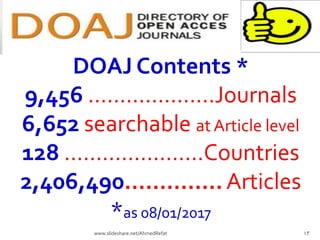
 select your journal from DOAJ, an online
directory that indexes and provides access
to quality open access, peer-reviewed journals.
( https://doaj.org/ )
Or Verify and critically appraise the publisher
8www.slideshare.net/AhmedRefat
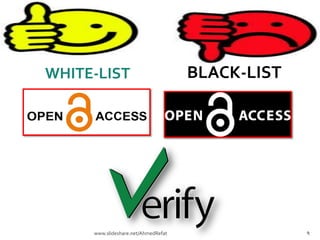
WHITE-LIST BLACK-LIST
9www.slideshare.net/AhmedRefat
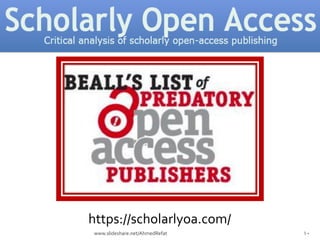
https://scholarlyoa.com/
10www.slideshare.net/AhmedRefat
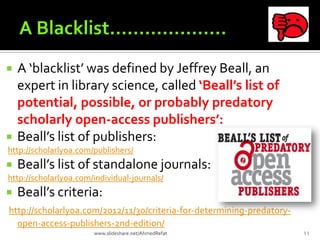
 A ‘blacklist’ was defined by Jeffrey Beall, an
expert in library science, called ‘Beall’s list of
potential, possible, or probably predatory
scholarly open-access publishers’:
 Beall’s list of publishers:
http://scholarlyoa.com/publishers/
 Beall’s list of standalone journals:
http://scholarlyoa.com/individual-journals/
 Beall’s criteria:
http://scholarlyoa.com/2012/11/30/criteria-for-determining-predatory-
open-access-publishers-2nd-edition/
11www.slideshare.net/AhmedRefat
12www.slideshare.net/AhmedRefat
13www.slideshare.net/AhmedRefat
How to Avoid Pseudo-Journals
1. British Medical Journal BMJ (a five point plan)
2. Tufts University ( Checklist)
3. London School of Hygiene & Tropical
Medicine (Guidance and help on predatory journals)
How to avoid predatory journals—
a five point plan
http://blogs.bmj.com/bmj/2015/01/19/jocalyn-clark-
how-to-avoid-predatory-journals-a-five-point-plan/
15www.slideshare.net/AhmedRefat
How to avoid predatory journals:
a five point plan-1
1. Is the journal or publisher listed
in Beall’s List ?
• If so, it should be avoided, as this
“blacklist” is regularly updated
and specifies criteria for
identifying predatory journals and
publishers.
16www.slideshare.net/AhmedRefat
How to avoid predatory journals:
a five point plan-2
2. If claiming to be an open access
journal, is the journal in
the Directory of Open Access
Journals (DOAJ)?
• This is a sort of “whitelist” and
journals here must meet specific
criteria.
17www.slideshare.net/AhmedRefat
How to avoid predatory journals:
a five point plan-3
• 3. Is the publisher a member of recognised
professional organisations that commit to
best practices in publishing, such as
the Committee on Publication Ethics (COPE);
the InternationalAssociation of Scientific,
Technical, & Medical Publishers (STM); or
the Open Access Scholarly Publishers
Association (OASPA)?
18www.slideshare.net/AhmedRefat
How to avoid predatory journals:
a five point plan-4
• 4. Is the journal indexed? Do not accept the
journal’s claims about being indexed. Instead
verify these claims by searching for the
journal in databases such
as PubMedCentral(free) or theWeb of
Science (requiring subscription).
19www.slideshare.net/AhmedRefat
How to avoid predatory journals:
a five point plan-5
• 5. Is the journal transparent and following best
practices regarding editorial and peer review
processes, governance, and ownership?
• Are there contact details for the journal and its
staff (email, postal address, working telephone
number)? Reputable journals have a named
editor and editorial board comprised of
recognised experts.
• Are the costs associated with publishing clear?
20www.slideshare.net/AhmedRefat
Field Guide to Predatory Publishers:
Critical Analysis Resources
Resources to assess if an open access journal
is a good place to publish your work 21www.slideshare.net/AhmedRefat
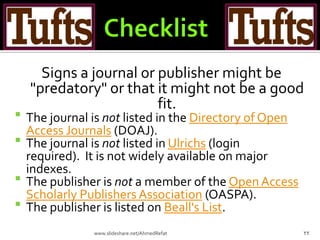
Signs a journal or publisher might be
"predatory" or that it might not be a good
fit.
 The journal is not listed in the Directory of Open
Access Journals (DOAJ).
 The journal is not listed in Ulrichs (login
required). It is not widely available on major
indexes.
 The publisher is not a member of the OpenAccess
Scholarly Publishers Association (OASPA).
 The publisher is listed on Beall's List.
22www.slideshare.net/AhmedRefat
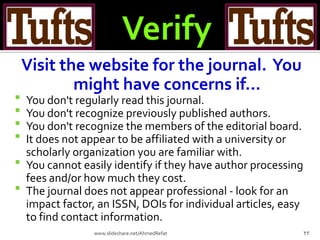
Visit the website for the journal. You
might have concerns if...
 You don't regularly read this journal.
 You don't recognize previously published authors.
 You don't recognize the members of the editorial board.
 It does not appear to be affiliated with a university or
scholarly organization you are familiar with.
 You cannot easily identify if they have author processing
fees and/or how much they cost.
 The journal does not appear professional - look for an
impact factor, an ISSN, DOIs for individual articles, easy
to find contact information.
23www.slideshare.net/AhmedRefat
http://www.lshtm.ac.uk/library/guidance/predatorypublishers/
24www.slideshare.net/AhmedRefat
Guidance and help on
predatory journals and
publishers
25www.slideshare.net/AhmedRefat
 If you are invited ( or want ) to submit your
article to an open access journals, you should
check whether it is legitimate through the
following criteria:
26www.slideshare.net/AhmedRefat
 The journal has an entry in the Directory of
Open Access Journals (DOAJ)
 DOAJ provides access to high quality, open
access, peer-reviewed journals
 inclusion in DOAJ has a strict criteria.
27www.slideshare.net/AhmedRefat
 Some journal web sites state that the journal is
in DOAJ when it is not.
 Often, the home page carries the DOAJ logo
along with logos from other indexing services.
 ALWAYS check at www.doaj.org that a journal
is indexed, even if its web site carries the DOAJ
logo or says that it is indexed in DOAJ.
28www.slideshare.net/AhmedRefat
 Publisher’s membership of OpenAccess
Scholarly Publishers Association (OASPA)
Members of OASPA are expected to adhere
to the OASPA MembershipCriteria of
transparency and best practice
29www.slideshare.net/AhmedRefat
 Publisher’s membership of the Committee on
Publication Ethics (COPE) – membership
demonstrates commitment to widely
accepted publishing practices
30www.slideshare.net/AhmedRefat
 Publisher’s membership of the International
Association of Scientific,Technical & Medical
Publishers (STM) – membership
demonstrates commitment to widely
accepted publishing practices
31www.slideshare.net/AhmedRefat
 Named editor and editorial board – recognised
experts in their field ….
 But be aware that some predatory publisher
list editors on their board without their
knowledge.
 Look at the editor’s profile on their university
website, links to their online profiles eg.,
on ResearchGate, Google Scholar or LinkedIn)
for evidence that they are actual editors.
32www.slideshare.net/AhmedRefat
 Further indicators are membership of
organisations such as the Council of Science
Editors (CSE), EuropeanAssociation of
Science Editors (EASE) andWorld Association
of Medical Editors (WAME
33www.slideshare.net/AhmedRefat
ThankYou
www.slideshare.net/AhmedRefat 34

How to-avoid-pseudojournals

  • 1.
    Look Before YouLeap…………. How to Avoid Pseudo-Journals
  • 2.
    How to AvoidPseudo-Journals 1. Tufts University ( Checklist) 2. British Medical Journal BMJ (a five point plan) 3. London School of Hygiene & Tropical Medicine (Guidance and help on predatory journals)
  • 3.
    TheTraditional (Old) Vs New “Open Access” Publishing Model 3www.slideshare.net/AhmedRefat
  • 4.
    Open access standsfor  free online access to academic documents, with the goal of maximum dissemination and fast availability of information on research  Unrestricted access & Unrestricted reuse 4www.slideshare.net/AhmedRefat
  • 5.
     Publishers ownthe rights to the articles in their journals.  Anyone who wants to read the articles must pay to access them.  Anyone who wants to use the articles in any way must obtain permission from the publisher and is often required to pay an additional fee.  The journals are sent/ viewed only for Subscribers. ▪ Limited number of users = low visibility ▪ Expensive = economic barrier 5www.slideshare.net/AhmedRefat
  • 6.
     In theOA model, the author retains copyright of their work with a CreativeCommons attribution licence (CC-BY).  This license lets others distribute, remix, tweak, and build upon your work, even commercially, as long as they credit you for the original creation. 6www.slideshare.net/AhmedRefat
  • 7.
     Predatory Publishersare primarily publish online journals which have little or no academic legality.  They exist solely to make money for their owners, and they make that money by charging excessive “article processing fees”.  There is minimal to no peer-review of published articles, despite their claims.  The scholarship of these journals is not reliable.  They aggressively solicit new articles which they publish, for a price. 7www.slideshare.net/AhmedRefat
  • 8.
    Clarify : Toensure that you avoid pseudo journals:  check the list of possible predatory publishers, and the criteria used to identify them at Scholarly Open Access ( https://scholarlyoa.com/ ) or  select your journal from DOAJ, an online directory that indexes and provides access to quality open access, peer-reviewed journals. ( https://doaj.org/ ) Or Verify and critically appraise the publisher 8www.slideshare.net/AhmedRefat
  • 9.
  • 10.
  • 11.
     A ‘blacklist’was defined by Jeffrey Beall, an expert in library science, called ‘Beall’s list of potential, possible, or probably predatory scholarly open-access publishers’:  Beall’s list of publishers: http://scholarlyoa.com/publishers/  Beall’s list of standalone journals: http://scholarlyoa.com/individual-journals/  Beall’s criteria: http://scholarlyoa.com/2012/11/30/criteria-for-determining-predatory- open-access-publishers-2nd-edition/ 11www.slideshare.net/AhmedRefat
  • 12.
  • 13.
  • 14.
    How to AvoidPseudo-Journals 1. British Medical Journal BMJ (a five point plan) 2. Tufts University ( Checklist) 3. London School of Hygiene & Tropical Medicine (Guidance and help on predatory journals)
  • 15.
    How to avoidpredatory journals— a five point plan http://blogs.bmj.com/bmj/2015/01/19/jocalyn-clark- how-to-avoid-predatory-journals-a-five-point-plan/ 15www.slideshare.net/AhmedRefat
  • 16.
    How to avoidpredatory journals: a five point plan-1 1. Is the journal or publisher listed in Beall’s List ? • If so, it should be avoided, as this “blacklist” is regularly updated and specifies criteria for identifying predatory journals and publishers. 16www.slideshare.net/AhmedRefat
  • 17.
    How to avoidpredatory journals: a five point plan-2 2. If claiming to be an open access journal, is the journal in the Directory of Open Access Journals (DOAJ)? • This is a sort of “whitelist” and journals here must meet specific criteria. 17www.slideshare.net/AhmedRefat
  • 18.
    How to avoidpredatory journals: a five point plan-3 • 3. Is the publisher a member of recognised professional organisations that commit to best practices in publishing, such as the Committee on Publication Ethics (COPE); the InternationalAssociation of Scientific, Technical, & Medical Publishers (STM); or the Open Access Scholarly Publishers Association (OASPA)? 18www.slideshare.net/AhmedRefat
  • 19.
    How to avoidpredatory journals: a five point plan-4 • 4. Is the journal indexed? Do not accept the journal’s claims about being indexed. Instead verify these claims by searching for the journal in databases such as PubMedCentral(free) or theWeb of Science (requiring subscription). 19www.slideshare.net/AhmedRefat
  • 20.
    How to avoidpredatory journals: a five point plan-5 • 5. Is the journal transparent and following best practices regarding editorial and peer review processes, governance, and ownership? • Are there contact details for the journal and its staff (email, postal address, working telephone number)? Reputable journals have a named editor and editorial board comprised of recognised experts. • Are the costs associated with publishing clear? 20www.slideshare.net/AhmedRefat
  • 21.
    Field Guide toPredatory Publishers: Critical Analysis Resources Resources to assess if an open access journal is a good place to publish your work 21www.slideshare.net/AhmedRefat
  • 22.
    Signs a journalor publisher might be "predatory" or that it might not be a good fit.  The journal is not listed in the Directory of Open Access Journals (DOAJ).  The journal is not listed in Ulrichs (login required). It is not widely available on major indexes.  The publisher is not a member of the OpenAccess Scholarly Publishers Association (OASPA).  The publisher is listed on Beall's List. 22www.slideshare.net/AhmedRefat
  • 23.
    Visit the websitefor the journal. You might have concerns if...  You don't regularly read this journal.  You don't recognize previously published authors.  You don't recognize the members of the editorial board.  It does not appear to be affiliated with a university or scholarly organization you are familiar with.  You cannot easily identify if they have author processing fees and/or how much they cost.  The journal does not appear professional - look for an impact factor, an ISSN, DOIs for individual articles, easy to find contact information. 23www.slideshare.net/AhmedRefat
  • 24.
  • 25.
    Guidance and helpon predatory journals and publishers 25www.slideshare.net/AhmedRefat
  • 26.
     If youare invited ( or want ) to submit your article to an open access journals, you should check whether it is legitimate through the following criteria: 26www.slideshare.net/AhmedRefat
  • 27.
     The journalhas an entry in the Directory of Open Access Journals (DOAJ)  DOAJ provides access to high quality, open access, peer-reviewed journals  inclusion in DOAJ has a strict criteria. 27www.slideshare.net/AhmedRefat
  • 28.
     Some journalweb sites state that the journal is in DOAJ when it is not.  Often, the home page carries the DOAJ logo along with logos from other indexing services.  ALWAYS check at www.doaj.org that a journal is indexed, even if its web site carries the DOAJ logo or says that it is indexed in DOAJ. 28www.slideshare.net/AhmedRefat
  • 29.
     Publisher’s membershipof OpenAccess Scholarly Publishers Association (OASPA) Members of OASPA are expected to adhere to the OASPA MembershipCriteria of transparency and best practice 29www.slideshare.net/AhmedRefat
  • 30.
     Publisher’s membershipof the Committee on Publication Ethics (COPE) – membership demonstrates commitment to widely accepted publishing practices 30www.slideshare.net/AhmedRefat
  • 31.
     Publisher’s membershipof the International Association of Scientific,Technical & Medical Publishers (STM) – membership demonstrates commitment to widely accepted publishing practices 31www.slideshare.net/AhmedRefat
  • 32.
     Named editorand editorial board – recognised experts in their field ….  But be aware that some predatory publisher list editors on their board without their knowledge.  Look at the editor’s profile on their university website, links to their online profiles eg., on ResearchGate, Google Scholar or LinkedIn) for evidence that they are actual editors. 32www.slideshare.net/AhmedRefat
  • 33.
     Further indicatorsare membership of organisations such as the Council of Science Editors (CSE), EuropeanAssociation of Science Editors (EASE) andWorld Association of Medical Editors (WAME 33www.slideshare.net/AhmedRefat
  • 34.