ACADEMIC ESSAYS
What are Academic Essays
These are the mostcommontype of academicpapersthatare significantastheycaterto almostall
levelsof academiaespeciallyhighschoolandundergraduate levels. Itisa short non-fictional
composition aboutasubjectthataimsto persuade,narrate,orargue a topicto the readersusing
selectedresearchevidence. Itisessentiallyastructuredformof writingthatservesa purpose of
presentingnewinformationorapplyingalreadyexistingknowledge to deliverapoint. Itisan
academictextthat istypicallyshortrangingfroma wordcount of 1,500 to 6,000 words. Thistype of
paperprovidesanillustrationof acertaintopic throughthe combination of keyfactsandopinions
backedup withreferences organizedtocreate a coherentstructure thatprovidesalogical
explanationof the topic.Mosthighschool studentsoftenhave to write essays ontopicsranging
frommarketingandeconomicstobusinessmanagement,biological sciences,andtechnology.Such
essaysmightbe argumentative, persuasive, orexpositorydependingonthe topicandpaper
requirements.
Focus
First,your essaymust have a purpose,which isclearlydefinedandeffectivelycommunicated.Thisis
the focus of your essay. Your essay must fulfil the requirements of the purpose it is trying to
accomplish. In addition, your work must be well balanced; you should neither do too much in the
essay, nor mark your goals too limited and inconsequential. Also, the needs, interests, and
expectationsof yourreadersshouldbe consideredandmet.
An essay could be made with the focus of providing information or shedding light to a subject.
The expositoryessay isaninformative piece of writingthatpresentsabalancedanalysisof a topic.In
an expository essay, the writer explains or defines a topic, using facts, statistics, and examples.
Expositorywritingencompassesawiderange of essayvariations,suchasthe comparisonandcontrast
essay, the cause and effect essay,and the “how to” or process essay. Because expository essays are
based on facts and not personal feelings, writers don’t reveal their emotions or write in the first
person.
While like an expository essay in its presentation of facts, the goal of the persuasive essayis to
convince the readerto accept the writer’spointof view orrecommendation.The writermustbuilda
case usingfactsandlogic,aswell asexamples,expertopinion,andsoundreasoning.The writershould
presentall sidesof the argument,butmust be able tocommunicate clearlyandwithoutequivocation
whya certainpositioniscorrect.
Establishingthe focusof anessayismade easierwiththe creationof a firmthesisstatement.
Your thesis statement is the central idea driving your paper. It expresses the writer’s position in
relationtoa certainsubject. It declareswhatyouwant your readersto know,believe,orunderstand
about your perspective. Typically, your thesis statement should contain three parts: a topic, a claim,
and a purpose:
ß The topicpresentsthe subjectof yourpaper.
ß The claimoffersyourcomment/opiniononthatsubject.
ß The purpose shouldanswerthe question,“sowhat?”Whyis yourclaimmeaningful?Whatare
youcontributingtothe discourse onyour topic?
Content
Besides focus, content is an essential part if your essay. Considering your controlling purpose,you
oughtto discoverwhetherthere isadequate supportandwhetheryouressaydevelopment fulfilsthe
commitmentstartedor impliedbythe controllingpurpose.Whatsupportingdetailsorevidenceyou
have providedandhowadequate theyare isequallyimportant.All yourdetails,evidence,orcounter
argumentsshouldnotonlyrelate clearlytoyourcontrollingpurpose,butshouldhave the purposeof
strengtheningthe essay. Thecontentofacademicessaycanrange fromdifferenttopicsonamultitude
of disciplines and bodies of knowledge. However, academic essays ought not to cover personal
subjects and topics that can’t be supported and substantiated by research evidences. An academic
essaycan talkaboutmedicine,economics,business,philosophy, andmanymore butitcan’tbe about
the life of the authorhimself because thatwouldbe personalandirrelevanttothe academe.
Parts and Structure
Parts
Introduction
The introduction guides your reader into the paper by introducing the topic. It should begin with a
hookthat catchesthe reader’sinterest.Thishookcouldbe aquote,an analogy,aquestion,etc.After
getting the reader’s attention, the introduction should give some background information on the
topic. The ideas within the introduction should be general enough for the reader to understand the
mainclaimandgradually becomemore specifictoleadintothe thesisstatement. The thesisstatement
conciselystatesthe mainideaorargumentof the essay,setslimitsonthe topic,and can indicate the
organization of the essay. The thesis works as a road map for the entire essay, showing the readers
whatyou have to say andwhich mainpointsyouwill use tosupportyour ideas
Body
The body of the essay supports the main points presented in the thesis. Each point is developed by
one or more paragraphs and supported with specific details. These detailscan include support from
researchandexperiences,dependingonthe assignment.Inadditiontothissupport,the author’sown
analysisanddiscussionof the topictiesideastogetheranddrawsconclusionsthatsupportthe thesis.
A. Topic Sentence
The mainideaof each paragraphis statedin a topic sentence thatshowshow the idearelatestothe
thesis. Generally,the topic sentence is placed at the beginning of a paragraph, but the location and
placementmayvary according to individual organizationandaudience expectation.Topicsentences
oftenserve astransitionsbetweenparagraphs.
B. Supporting Details
Supportingdetailselaborate uponthe topicsentencesandthesis.Supportingdetailsshouldbe drawn
froma varietyof sourcesdeterminedbythe assignmentguidelinesandgenre,andshouldincludethe
writer’sownanalysis.
C. Concluding Sentence
Each paragraph should end with a final statement that brings together the ideas brought up in the
paragraph.Sometimes,itcanserve asa transitiontothe nextparagraph.
Conclusion
The conclusionbringstogetherall the mainpointsof the essay.Itrefersback to the thesisstatement
and leavesreaderswithafinal thoughtand sense of closure byresolvinganyideasbroughtup inthe
essay.Itmayalsoaddressthe implicationsof the argument.Inthe conclusion,new topicsorideasthat
were notdevelopedinthe papershouldnotbe introduced.
Citations
If yourpaperincorporatesresearch,be sure togive creditto each source usingin-textcitationsanda
Works Cited/References/Bibliographypage.
Structure
How to Write an Academic Essay
1. Analyze Your Prompt
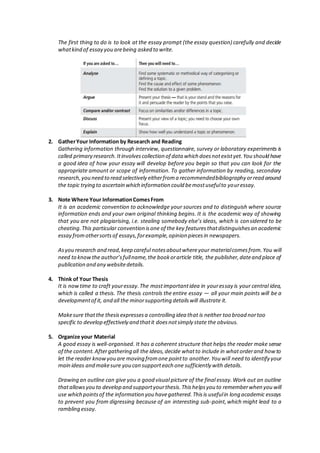
The first thing to do is to look at the essay prompt (the essay question) carefully and decide
whatkind of essay you arebeing asked to write.
2. GatherYour Information by Research and Reading
Gathering information through interview, questionnaire, survey or laboratory experiments is
called primary research.Itinvolvescollection of data which doesnotexistyet.You should have
a good idea of how your essay will develop before you begin so that you can look for the
appropriate amount or scope of information. To gather information by reading, secondary
research,you need to read selectively eitherfroma recommendedbibliography orread around
the topic trying to ascertain which information could bemostusefulto youressay.
3. Note Where Your InformationComesFrom
It is an academic convention to acknowledge your sources and to distinguish where source
information ends and your own original thinking begins. It is the academic way of showing
that you are not plagiarising, i.e. stealing somebody else’s ideas, which is considered to be
cheating.This particular convention isone of the key featuresthatdistinguishesan academic
essay fromothersortsof essays,forexample,opinion piecesin newspapers.
Asyou research and read,keep careful notesaboutwhereyour materialcomesfrom.You will
need to knowthe author’sfullname,the bookorarticle title, the publisher,dateand place of
publication and any websitedetails.
4. Think of Your Thesis
It is nowtime to craft youressay.The mostimportantidea in youressay is your central idea,
which is called a thesis. The thesis controls the entire essay — all your main points will be a
developmentof it, and all the minorsupporting detailswill illustrate it.
Makesure thatthe thesisexpressesa controlling idea that is neither too broad nortoo
specific to develop effectively and thatit doesnotsimply state the obvious.
5. Organize your Material
A good essay is well-organised. It has a coherent structure that helps the reader make sense
of the content.Aftergathering all the ideas,decide whatto include in whatorderand howto
let the reader knowyou are moving fromone pointto another.You will need to identify your
main ideas and makesure you can supporteach one sufficiently with details.
Drawing an outline can give you a good visual picture of the final essay.Work out an outline
thatallowsyou to develop and supportyourthesis.Thishelpsyou to rememberwhen you will
use which pointsof the information you havegathered.Thisis usefulin long academic essays
to prevent you from digressing because of an interesting sub-point,which might lead to a
rambling essay.
6. Draft Your Essay
Using youroutline,writeyouressay and getall yourthoughtsdown on paper.Itdoesnothave
to be perfect first time. Use formal English and aim for an objective tone. Choose the most
precise words and aim for a fluent and coherent style. When you are referring to sources,
paraphraseand usereported speech ratherthan a lot of direct quotation.
7. Revise your Essay
Revision is madeup of two steps:editing and proofreading.
Editing is the processof reading through youressay again and asking how well organised it is
and howwellyourideasaredeveloped.Do you havean objectivetone?Isyourchoiceof words
accurate?Is yourwriting concise? Are thelinks within and between paragraphsclear?
The final step is proofreading youressay.Read through youressay slowly looking forobvious
errors such as spelling, punctuation orgrammar and correct them. It is easier to do this on a
hard copy than a softone.
Whento Write an Academic Essay
An academicessayisusuallyacommon requirementinalmosteverybodyof knowledge andcourses
offered in universities and schools. We write an academic essay whenever there is a need to
substantiate a subject that requires thorough research but is not necessarily lengthy. An academic
essay is one of the most basic type of academic writing because it only requires evidences and the
capacitytowrite unlike thesesanddissertationswherethe authorhastobe aprofessionaloranexpert
on the subject.
What Makesan Essay “Academic”
An essay is a flexible literary form because it can be written in an academic or non-academic style.
However, there are characteristics and features that distinguishesan academic essay from a non-
academicessay.
A. An essay isacademic when it is objective andimpersonal.
A prominentfeatureof an academicessay is thatit only presentsobjective ideas.Opinionsof
the author are accommodated but it is necessary to provide supporting research evidences.
The emotions of the author are discredited to avoid bias and contaminating the essay with
subjectivethoughts.Itisusually written in a third-person pointof view.
B. An essay isacademic when it is thoroughlyresearched.
Being research-based is what sets academic essaysfrom other forms of essays. An academic
essay is like a condensed formof a lengthy research by which it aims to merge facts with the
art of writing.
C. An essay isacademic when it strictly observes language formalityand convention.
An ordinary essay would often encourageitswritersto channelcreativity to becomerelatable
and conversationalto thereaders.However,academicessaysaremorerefinedand meticulous
in its choice of wordsand observeprofessionaltones and conventions.

Academic essay topic outline

  • 1.
    ACADEMIC ESSAYS What areAcademic Essays These are the mostcommontype of academicpapersthatare significantastheycaterto almostall levelsof academiaespeciallyhighschoolandundergraduate levels. Itisa short non-fictional composition aboutasubjectthataimsto persuade,narrate,orargue a topicto the readersusing selectedresearchevidence. Itisessentiallyastructuredformof writingthatservesa purpose of presentingnewinformationorapplyingalreadyexistingknowledge to deliverapoint. Itisan academictextthat istypicallyshortrangingfroma wordcount of 1,500 to 6,000 words. Thistype of paperprovidesanillustrationof acertaintopic throughthe combination of keyfactsandopinions backedup withreferences organizedtocreate a coherentstructure thatprovidesalogical explanationof the topic.Mosthighschool studentsoftenhave to write essays ontopicsranging frommarketingandeconomicstobusinessmanagement,biological sciences,andtechnology.Such essaysmightbe argumentative, persuasive, orexpositorydependingonthe topicandpaper requirements. Focus First,your essaymust have a purpose,which isclearlydefinedandeffectivelycommunicated.Thisis the focus of your essay. Your essay must fulfil the requirements of the purpose it is trying to accomplish. In addition, your work must be well balanced; you should neither do too much in the essay, nor mark your goals too limited and inconsequential. Also, the needs, interests, and expectationsof yourreadersshouldbe consideredandmet. An essay could be made with the focus of providing information or shedding light to a subject. The expositoryessay isaninformative piece of writingthatpresentsabalancedanalysisof a topic.In an expository essay, the writer explains or defines a topic, using facts, statistics, and examples. Expositorywritingencompassesawiderange of essayvariations,suchasthe comparisonandcontrast essay, the cause and effect essay,and the “how to” or process essay. Because expository essays are based on facts and not personal feelings, writers don’t reveal their emotions or write in the first person. While like an expository essay in its presentation of facts, the goal of the persuasive essayis to convince the readerto accept the writer’spointof view orrecommendation.The writermustbuilda case usingfactsandlogic,aswell asexamples,expertopinion,andsoundreasoning.The writershould presentall sidesof the argument,butmust be able tocommunicate clearlyandwithoutequivocation whya certainpositioniscorrect. Establishingthe focusof anessayismade easierwiththe creationof a firmthesisstatement. Your thesis statement is the central idea driving your paper. It expresses the writer’s position in relationtoa certainsubject. It declareswhatyouwant your readersto know,believe,orunderstand about your perspective. Typically, your thesis statement should contain three parts: a topic, a claim, and a purpose: ß The topicpresentsthe subjectof yourpaper. ß The claimoffersyourcomment/opiniononthatsubject. ß The purpose shouldanswerthe question,“sowhat?”Whyis yourclaimmeaningful?Whatare youcontributingtothe discourse onyour topic? Content Besides focus, content is an essential part if your essay. Considering your controlling purpose,you oughtto discoverwhetherthere isadequate supportandwhetheryouressaydevelopment fulfilsthe
  • 2.
    commitmentstartedor impliedbythe controllingpurpose.Whatsupportingdetailsorevidenceyou haveprovidedandhowadequate theyare isequallyimportant.All yourdetails,evidence,orcounter argumentsshouldnotonlyrelate clearlytoyourcontrollingpurpose,butshouldhave the purposeof strengtheningthe essay. Thecontentofacademicessaycanrange fromdifferenttopicsonamultitude of disciplines and bodies of knowledge. However, academic essays ought not to cover personal subjects and topics that can’t be supported and substantiated by research evidences. An academic essaycan talkaboutmedicine,economics,business,philosophy, andmanymore butitcan’tbe about the life of the authorhimself because thatwouldbe personalandirrelevanttothe academe. Parts and Structure Parts Introduction The introduction guides your reader into the paper by introducing the topic. It should begin with a hookthat catchesthe reader’sinterest.Thishookcouldbe aquote,an analogy,aquestion,etc.After getting the reader’s attention, the introduction should give some background information on the topic. The ideas within the introduction should be general enough for the reader to understand the mainclaimandgradually becomemore specifictoleadintothe thesisstatement. The thesisstatement conciselystatesthe mainideaorargumentof the essay,setslimitsonthe topic,and can indicate the organization of the essay. The thesis works as a road map for the entire essay, showing the readers whatyou have to say andwhich mainpointsyouwill use tosupportyour ideas Body The body of the essay supports the main points presented in the thesis. Each point is developed by one or more paragraphs and supported with specific details. These detailscan include support from researchandexperiences,dependingonthe assignment.Inadditiontothissupport,the author’sown analysisanddiscussionof the topictiesideastogetheranddrawsconclusionsthatsupportthe thesis. A. Topic Sentence The mainideaof each paragraphis statedin a topic sentence thatshowshow the idearelatestothe thesis. Generally,the topic sentence is placed at the beginning of a paragraph, but the location and placementmayvary according to individual organizationandaudience expectation.Topicsentences oftenserve astransitionsbetweenparagraphs. B. Supporting Details Supportingdetailselaborate uponthe topicsentencesandthesis.Supportingdetailsshouldbe drawn froma varietyof sourcesdeterminedbythe assignmentguidelinesandgenre,andshouldincludethe writer’sownanalysis. C. Concluding Sentence Each paragraph should end with a final statement that brings together the ideas brought up in the paragraph.Sometimes,itcanserve asa transitiontothe nextparagraph. Conclusion The conclusionbringstogetherall the mainpointsof the essay.Itrefersback to the thesisstatement and leavesreaderswithafinal thoughtand sense of closure byresolvinganyideasbroughtup inthe essay.Itmayalsoaddressthe implicationsof the argument.Inthe conclusion,new topicsorideasthat were notdevelopedinthe papershouldnotbe introduced. Citations
  • 3.
    If yourpaperincorporatesresearch,be suretogive creditto each source usingin-textcitationsanda Works Cited/References/Bibliographypage. Structure How to Write an Academic Essay 1. Analyze Your Prompt
  • 4.
    The first thingto do is to look at the essay prompt (the essay question) carefully and decide whatkind of essay you arebeing asked to write. 2. GatherYour Information by Research and Reading Gathering information through interview, questionnaire, survey or laboratory experiments is called primary research.Itinvolvescollection of data which doesnotexistyet.You should have a good idea of how your essay will develop before you begin so that you can look for the appropriate amount or scope of information. To gather information by reading, secondary research,you need to read selectively eitherfroma recommendedbibliography orread around the topic trying to ascertain which information could bemostusefulto youressay. 3. Note Where Your InformationComesFrom It is an academic convention to acknowledge your sources and to distinguish where source information ends and your own original thinking begins. It is the academic way of showing that you are not plagiarising, i.e. stealing somebody else’s ideas, which is considered to be cheating.This particular convention isone of the key featuresthatdistinguishesan academic essay fromothersortsof essays,forexample,opinion piecesin newspapers. Asyou research and read,keep careful notesaboutwhereyour materialcomesfrom.You will need to knowthe author’sfullname,the bookorarticle title, the publisher,dateand place of publication and any websitedetails. 4. Think of Your Thesis It is nowtime to craft youressay.The mostimportantidea in youressay is your central idea, which is called a thesis. The thesis controls the entire essay — all your main points will be a developmentof it, and all the minorsupporting detailswill illustrate it. Makesure thatthe thesisexpressesa controlling idea that is neither too broad nortoo specific to develop effectively and thatit doesnotsimply state the obvious. 5. Organize your Material A good essay is well-organised. It has a coherent structure that helps the reader make sense of the content.Aftergathering all the ideas,decide whatto include in whatorderand howto let the reader knowyou are moving fromone pointto another.You will need to identify your main ideas and makesure you can supporteach one sufficiently with details. Drawing an outline can give you a good visual picture of the final essay.Work out an outline thatallowsyou to develop and supportyourthesis.Thishelpsyou to rememberwhen you will use which pointsof the information you havegathered.Thisis usefulin long academic essays to prevent you from digressing because of an interesting sub-point,which might lead to a rambling essay.
  • 5.
    6. Draft YourEssay Using youroutline,writeyouressay and getall yourthoughtsdown on paper.Itdoesnothave to be perfect first time. Use formal English and aim for an objective tone. Choose the most precise words and aim for a fluent and coherent style. When you are referring to sources, paraphraseand usereported speech ratherthan a lot of direct quotation. 7. Revise your Essay Revision is madeup of two steps:editing and proofreading. Editing is the processof reading through youressay again and asking how well organised it is and howwellyourideasaredeveloped.Do you havean objectivetone?Isyourchoiceof words accurate?Is yourwriting concise? Are thelinks within and between paragraphsclear? The final step is proofreading youressay.Read through youressay slowly looking forobvious errors such as spelling, punctuation orgrammar and correct them. It is easier to do this on a hard copy than a softone. Whento Write an Academic Essay An academicessayisusuallyacommon requirementinalmosteverybodyof knowledge andcourses offered in universities and schools. We write an academic essay whenever there is a need to substantiate a subject that requires thorough research but is not necessarily lengthy. An academic essay is one of the most basic type of academic writing because it only requires evidences and the capacitytowrite unlike thesesanddissertationswherethe authorhastobe aprofessionaloranexpert on the subject. What Makesan Essay “Academic” An essay is a flexible literary form because it can be written in an academic or non-academic style. However, there are characteristics and features that distinguishesan academic essay from a non- academicessay. A. An essay isacademic when it is objective andimpersonal. A prominentfeatureof an academicessay is thatit only presentsobjective ideas.Opinionsof the author are accommodated but it is necessary to provide supporting research evidences. The emotions of the author are discredited to avoid bias and contaminating the essay with subjectivethoughts.Itisusually written in a third-person pointof view. B. An essay isacademic when it is thoroughlyresearched. Being research-based is what sets academic essaysfrom other forms of essays. An academic essay is like a condensed formof a lengthy research by which it aims to merge facts with the art of writing. C. An essay isacademic when it strictly observes language formalityand convention. An ordinary essay would often encourageitswritersto channelcreativity to becomerelatable and conversationalto thereaders.However,academicessaysaremorerefinedand meticulous in its choice of wordsand observeprofessionaltones and conventions.