
Fast Track Impact
Training by researchers for researchers
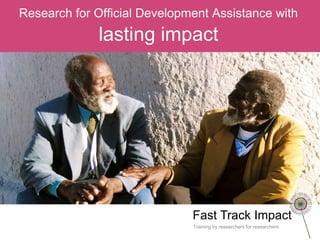
Research for Official Development Assistance with
lasting impact
Question:Question
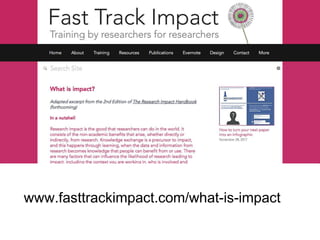
 What is impact?
www.fasttrackimpact.com/what-is-impact
 Significance is the degree to which the
impact has enriched, influence, informed or
changed policies, practices, products,
opportunities or perceptions of individuals,
communities or organisations
 Reach is the extent and diversity of the
communities, environments, individuals,
organisations or any other beneficiaries that
may have been impacted by the research
Evaluating ImpactEvaluating Impact
Question:Question
 What is Official Development
Assistance?
 Research that delivers significant, far-
reaching, measurable benefits for
economic growth and welfare that are
urgently needed in a DAC list country
Evaluating ImpactODA is impact with a purpose
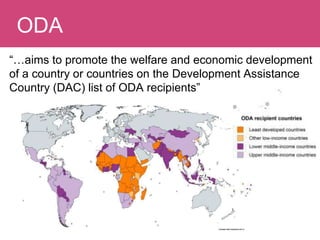
“…aims to promote the welfare and economic development
of a country or countries on the Development Assistance
Country (DAC) list of ODA recipients”
Evaluating ImpactODA
5 WAYS
to Fast Track your
Research Impact
How to write a winning
proposal
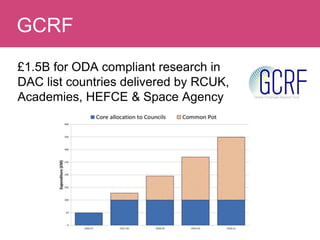
£1.5B for ODA compliant research in
DAC list countries delivered by RCUK,
Academies, HEFCE & Space Agency
Evaluating ImpactGCRF
Equitable access to sustainable development
 secure and resilient food systems supported by
sustainable marine resources and agriculture
 sustainable health and well being
 inclusive and equitable quality education
 clean air, water and sanitation
 affordable, reliable, sustainable energy
Evaluating ImpactChallenge areas (1 of 3)
Sustainable economies and societies
 Sustainable livelihoods supported by strong
foundations for inclusive economic growth and
innovation
 Resilience and action on short-term environmental
shocks and long-term environmental change
 Sustainable cities and communities
 Sustainable production and consumption of materials
and other resources
Evaluating ImpactChallenge areas (2 of 3)
Human rights, good governance & social justice
 Understand and respond effectively to forced
displacement and multiple refugee crises
 Reduce conflict and promote peace, justice and
humanitarian action
 Reduce poverty and inequality, including gender
inequalities
Evaluating ImpactChallenge areas (3 of 3)
Geographical focus:
 Development challenges are more clear-cut in Least
Developed Countries and Other Low Income Countries
 GCRF work in Lower and Upper Middle Income Countries
should strengthen Newton Fund partnerships where possible
 Current focus on all DAC list countries may come into line
with UK Aid policy in future
GCRF success will be measured by the government in terms
of:
 Maximising impact on the wellbeing of people in developing
countries, in line with the UK aid strategy objectives
 Maximising impact on UK research [not UK economy]
 Operating in the most cost-effective way possible
Evaluating ImpactGCRF strategy (June 2017)
Risks to successful implementation include:
 Lack of buy-in from the communities that need to be
mobilised to realise its ambitions, including researchers
and non-academic partners in UK and in Global South
 Poor coordination between delivery partners, leading to
duplication of efforts rather than complementarity
 Failures of governance, monitoring, evaluation,
reporting and/or communications, meaning that
confidence in the ODA compliance, value for money
and/or effectiveness of the GCRF as a whole is eroded
 Failure to create real impact in developing countries
 (Lack of active portfolio management by GCRF)
 Short timescales:
 Strategic team and concept building around key
themes
 Poised pre-review teams
 Build capacity/confidence with colleagues
whose work could be relevant in DAC countries
 In-country credibility
 Map and build strategic collaborations with
global and DAC list country NGOs and
research institutions
Evaluating ImpactStrategic challenges
“Cutting-edge research that addresses the
challenges faced by developing countries”
1. Deliver internationally excellent research
2. Effectively address a specific, evidenced
development need in a DAC country that will
deliver economic growth and wellbeing (note:
revisited every 3 years)
Evaluating Impact
2 key elements of a GCRF
proposal
 No different to any other RCUK call
 Demonstrate why your research is exciting, cutting-
edge, novel and significant
 Balance between disciplines
 If demanded in call for proposals
 Otherwise can be flexible
Evaluating ImpactResearch excellence
Evaluating Impact7 pathways to ODA compliance
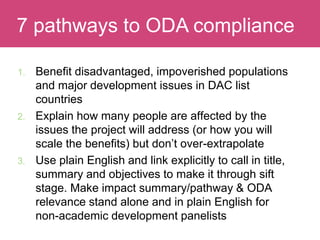
1. Benefit disadvantaged, impoverished populations
and major development issues in DAC list
countries
2. Explain how many people are affected by the
issues the project will address (or how you will
scale the benefits) but don’t over-extrapolate
3. Use plain English and link explicitly to call in title,
summary and objectives to make it through sift
stage. Make impact summary/pathway & ODA
relevance stand alone and in plain English for
non-academic development panelists
Evaluating Impact7 pathways to ODA compliance
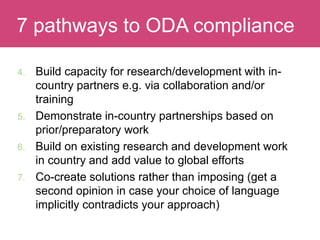
4. Build capacity for research/development with in-
country partners e.g. via collaboration and/or
training
5. Demonstrate in-country partnerships based on
prior/preparatory work
6. Build on existing research and development work
in country and add value to global efforts
7. Co-create solutions rather than imposing (get a
second opinion in case your choice of language
implicitly contradicts your approach)
Evaluating Impact7 pathways to ODA compliance
Evaluating ImpactDiscussion
Tools for Impact
Who has a stake in my research?
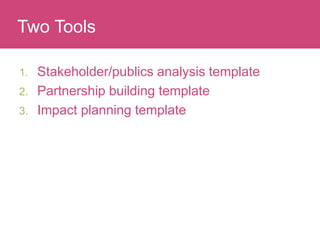
1. Stakeholder/publics analysis template
2. Partnership building template
3. Impact planning template
Two Tools
Who has a stake in my research?
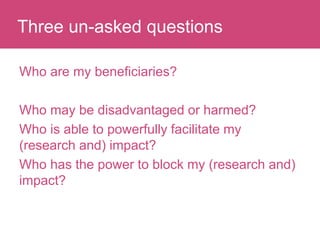
Who are my beneficiaries?
Who may be disadvantaged or harmed?
Who is able to powerfully facilitate my
(research and) impact?
Who has the power to block my (research and)
impact?
Three un-asked questions
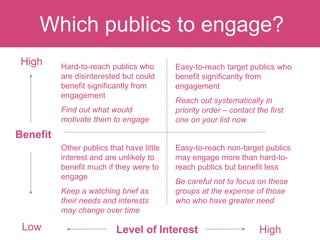
High
Low
Benefit
Hard-to-reach publics who
are disinterested but could
benefit significantly from
engagement
Find out what would
motivate them to engage
Easy-to-reach target publics who
benefit significantly from
engagement
Reach out systematically in
priority order – contact the first
one on your list now
Other publics that have little
interest and are unlikely to
benefit much if they were to
engage
Keep a watching brief as
their needs and interests
may change over time
Easy-to-reach non-target publics
may engage more than hard-to-
reach publics but benefit less
Be careful not to focus on these
groups at the expense of those
who who have greater need
Level of Interest High
Which publics to engage?
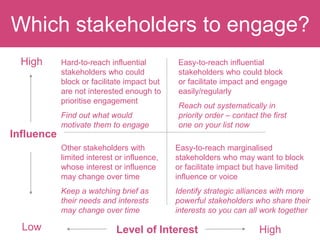
High
Influence
Hard-to-reach influential
stakeholders who could
block or facilitate impact but
are not interested enough to
prioritise engagement
Find out what would
motivate them to engage
Easy-to-reach influential
stakeholders who could block
or facilitate impact and engage
easily/regularly
Reach out systematically in
priority order – contact the first
one on your list now
Other stakeholders with
limited interest or influence,
whose interest or influence
may change over time
Keep a watching brief as
their needs and interests
may change over time
Easy-to-reach marginalised
stakeholders who may want to block
or facilitate impact but have limited
influence or voice
Identify strategic alliances with more
powerful stakeholders who share their
interests so you can all work together
Which stakeholders to engage?
Low Level of Interest High
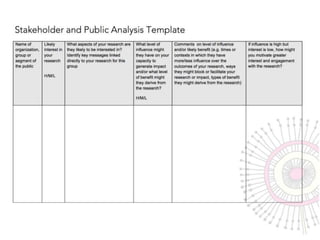
...adapt to your own needs
Stakeholder/publics analysis
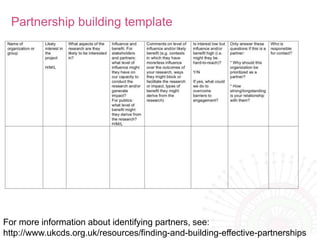
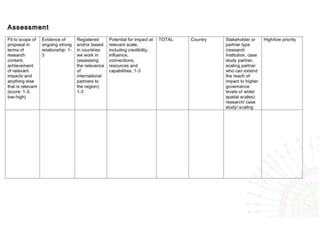
Partnership building template
For more information about identifying partners, see:
http://www.ukcds.org.uk/resources/finding-and-building-effective-partnerships
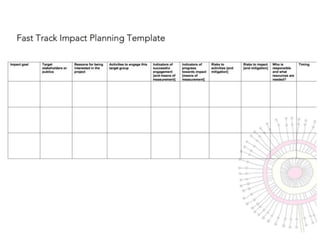
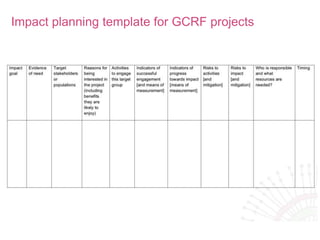
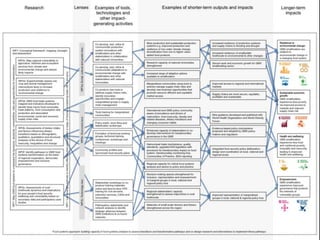
Impact planning template for GCRF projects
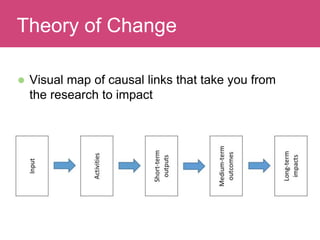
 Visual map of causal links that take you from
the research to impact
Evaluating ImpactTheory of Change
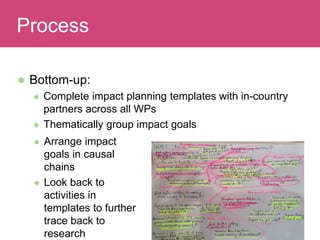
 Bottom-up:
 Complete impact planning templates with in-country
partners across all WPs
 Thematically group impact goals
Evaluating ImpactProcess
 Arrange impact
goals in causal
chains
 Look back to
activities in
templates to further
trace back to
research
 Top-down:
 Overall project goal
 Missing impact goals
 Missing links in causal chains
 Balance of activities across WPs, themes, countries
etc
 Go back to impact templates to write impact
summary (linking goals to beneficiaries) and
write up more detailed pathways to impact
(including risks and mitigation, impact track
record, resources and approach to monitoring,
evaluation, accountability and learning
Evaluating ImpactProcess
Evaluating impact
 Tracking
 Evaluating
 Evidencing
Evaluating ImpactScope
Read and discuss
 Hands up: do you systematically track
the impact of your research?
 University system…
 What are the barriers to impact tracking
and how can you overcome them?
Tracking impacts
Read and discuss
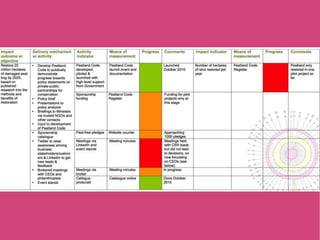
 Track indicators/milestones identified a
priori
 Formative feedback
 Summative feedback
Tracking impacts
Read and discuss
Read and discuss
 Capture other impacts as they occur
opportunistically…
Tracking impacts
Read and discussReporting impacts
 Find a way to continually track your
impacts easily to take the pain out of
reporting via your University system
 Email impacts/evidence to yourself and file
 Ring binder/scrap book
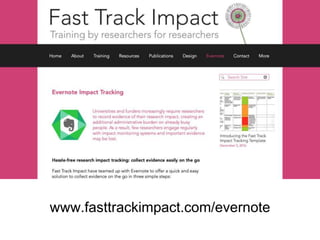
 Evernote: enable team members from any
institution to collate impacts in a shared
notebook without having to log into anything
www.fasttrackimpact.com/evernote
 The process of analysing, monitoring and
managing the intended and unintended
consequences, both positive and negative, of
research
 Seeks to identify causal links between:
 New knowledge
 Knowledge exchange and co-production activities
 Benefits for specific groups
 Typically significant contribution rather
than sole attribution
Evaluating ImpactWhat is impact evaluation?
 Significance and reach
 Design of your pathway to impact, delivery of
activities and mpacts
Evaluating ImpactWhat to evaluate?
1. Know what impacts you are looking for
2. Select an evaluation design to establish the
significance of the impact
3. Determine the reach of the impact
4. Communicate the findings of your evaluation
as evidence of impact
Evaluating ImpactHow to evaluate?
 Based on your impact planning template and
Theory of Change you should have selected
ambitious, yet feasible SMART impact goals
that you can evaluate
 An evaluation is typically driven by an
assessment of whether these goals were
reached, but you can identify and claim other
unplanned impacts
Evaluating Impact1. What are your impacts?
 Evaluation designs lie along three continua:
 Summative – formative
 Sole attribution – significant contribution
 A priori (what works in theory) – ex ante (effective
assessment)
 Factors influencing choice:
 Type of impact
 Data availability
 Resources
Evaluating Impact2. Select an evaluation design
 Eight types of evaluation design:
 Theory/logic-driven
 Experimental and quantitative survey work
 Statistical
 Contribution and pathway analysis
 Case-based and narrative analysis
 Participatory
 Evidence synthesis
 Arts-based
Evaluating Impact2. Select an evaluation design
 Impacts may:
 “Scale-out” if impacts spread from a one individual
or community to another
 “Scale-up” when an impact reaches a higher
institutional or governance level
 For example:
 Analyse how new ideas based on
research spread between communities
 Analyse how those ideas influence
decisions at different governance levels
Evaluating Impact3. Methods for determining reach
 Start early, use formative feedback to
shape your work
 Build in opportunities for longitudinal
evaluation
 Monitor indicators and progress towards goals,
and collect data opportunistically for other
benefits as they arise
 Be proportionate and credible: not all impacts
need an RCT to prove that benefits were felt
Evaluating Impact4. Collecte and analyse data
Read and discuss
 Choose a project you are familiar with
 Identify impact goals (consider by type)
 Identify activity indicators
 Identify impact indicators
 Prioritise relevant impact evaluation
methods, discussing their pros and cons
Small group exercise
Read and discuss
 How will you communicate your
evaluation findings?
 Write a peer-reviewed paper
 Include in a third party report
 Researching international policy impacts
 Getting powerful testimonials
Evidencing impact
Find out more
www.fasttrackimpact.com/resources
Fast Track Impact
Training by researchers for
researchers
www.fasttrackimpact.com
@fasttrackimpact

How to write a winning GCRF proposal

  • 1.
    Fast Track Impact Trainingby researchers for researchers Research for Official Development Assistance with lasting impact
  • 2.
  • 3.
  • 4.
     Significance isthe degree to which the impact has enriched, influence, informed or changed policies, practices, products, opportunities or perceptions of individuals, communities or organisations  Reach is the extent and diversity of the communities, environments, individuals, organisations or any other beneficiaries that may have been impacted by the research Evaluating ImpactEvaluating Impact
  • 5.
    Question:Question  What isOfficial Development Assistance?
  • 6.
     Research thatdelivers significant, far- reaching, measurable benefits for economic growth and welfare that are urgently needed in a DAC list country Evaluating ImpactODA is impact with a purpose
  • 7.
    “…aims to promotethe welfare and economic development of a country or countries on the Development Assistance Country (DAC) list of ODA recipients” Evaluating ImpactODA
  • 8.
    5 WAYS to FastTrack your Research Impact How to write a winning proposal
  • 9.
    £1.5B for ODAcompliant research in DAC list countries delivered by RCUK, Academies, HEFCE & Space Agency Evaluating ImpactGCRF
  • 10.
    Equitable access tosustainable development  secure and resilient food systems supported by sustainable marine resources and agriculture  sustainable health and well being  inclusive and equitable quality education  clean air, water and sanitation  affordable, reliable, sustainable energy Evaluating ImpactChallenge areas (1 of 3)
  • 11.
    Sustainable economies andsocieties  Sustainable livelihoods supported by strong foundations for inclusive economic growth and innovation  Resilience and action on short-term environmental shocks and long-term environmental change  Sustainable cities and communities  Sustainable production and consumption of materials and other resources Evaluating ImpactChallenge areas (2 of 3)
  • 12.
    Human rights, goodgovernance & social justice  Understand and respond effectively to forced displacement and multiple refugee crises  Reduce conflict and promote peace, justice and humanitarian action  Reduce poverty and inequality, including gender inequalities Evaluating ImpactChallenge areas (3 of 3)
  • 13.
    Geographical focus:  Developmentchallenges are more clear-cut in Least Developed Countries and Other Low Income Countries  GCRF work in Lower and Upper Middle Income Countries should strengthen Newton Fund partnerships where possible  Current focus on all DAC list countries may come into line with UK Aid policy in future GCRF success will be measured by the government in terms of:  Maximising impact on the wellbeing of people in developing countries, in line with the UK aid strategy objectives  Maximising impact on UK research [not UK economy]  Operating in the most cost-effective way possible Evaluating ImpactGCRF strategy (June 2017)
  • 14.
    Evaluating ImpactGCRF strategy(June 2017) Risks to successful implementation include:  Lack of buy-in from the communities that need to be mobilised to realise its ambitions, including researchers and non-academic partners in UK and in Global South  Poor coordination between delivery partners, leading to duplication of efforts rather than complementarity  Failures of governance, monitoring, evaluation, reporting and/or communications, meaning that confidence in the ODA compliance, value for money and/or effectiveness of the GCRF as a whole is eroded  Failure to create real impact in developing countries  (Lack of active portfolio management by GCRF)
  • 15.
     Short timescales: Strategic team and concept building around key themes  Poised pre-review teams  Build capacity/confidence with colleagues whose work could be relevant in DAC countries  In-country credibility  Map and build strategic collaborations with global and DAC list country NGOs and research institutions Evaluating ImpactStrategic challenges
  • 16.
    “Cutting-edge research thataddresses the challenges faced by developing countries” 1. Deliver internationally excellent research 2. Effectively address a specific, evidenced development need in a DAC country that will deliver economic growth and wellbeing (note: revisited every 3 years) Evaluating Impact 2 key elements of a GCRF proposal
  • 17.
     No differentto any other RCUK call  Demonstrate why your research is exciting, cutting- edge, novel and significant  Balance between disciplines  If demanded in call for proposals  Otherwise can be flexible Evaluating ImpactResearch excellence
  • 18.
    Evaluating Impact7 pathwaysto ODA compliance
  • 19.
    1. Benefit disadvantaged,impoverished populations and major development issues in DAC list countries 2. Explain how many people are affected by the issues the project will address (or how you will scale the benefits) but don’t over-extrapolate 3. Use plain English and link explicitly to call in title, summary and objectives to make it through sift stage. Make impact summary/pathway & ODA relevance stand alone and in plain English for non-academic development panelists Evaluating Impact7 pathways to ODA compliance
  • 20.
    4. Build capacityfor research/development with in- country partners e.g. via collaboration and/or training 5. Demonstrate in-country partnerships based on prior/preparatory work 6. Build on existing research and development work in country and add value to global efforts 7. Co-create solutions rather than imposing (get a second opinion in case your choice of language implicitly contradicts your approach) Evaluating Impact7 pathways to ODA compliance
  • 21.
  • 22.
  • 23.
    Who has astake in my research? 1. Stakeholder/publics analysis template 2. Partnership building template 3. Impact planning template Two Tools
  • 24.
    Who has astake in my research? Who are my beneficiaries? Who may be disadvantaged or harmed? Who is able to powerfully facilitate my (research and) impact? Who has the power to block my (research and) impact? Three un-asked questions
  • 25.
    High Low Benefit Hard-to-reach publics who aredisinterested but could benefit significantly from engagement Find out what would motivate them to engage Easy-to-reach target publics who benefit significantly from engagement Reach out systematically in priority order – contact the first one on your list now Other publics that have little interest and are unlikely to benefit much if they were to engage Keep a watching brief as their needs and interests may change over time Easy-to-reach non-target publics may engage more than hard-to- reach publics but benefit less Be careful not to focus on these groups at the expense of those who who have greater need Level of Interest High Which publics to engage?
  • 26.
    High Influence Hard-to-reach influential stakeholders whocould block or facilitate impact but are not interested enough to prioritise engagement Find out what would motivate them to engage Easy-to-reach influential stakeholders who could block or facilitate impact and engage easily/regularly Reach out systematically in priority order – contact the first one on your list now Other stakeholders with limited interest or influence, whose interest or influence may change over time Keep a watching brief as their needs and interests may change over time Easy-to-reach marginalised stakeholders who may want to block or facilitate impact but have limited influence or voice Identify strategic alliances with more powerful stakeholders who share their interests so you can all work together Which stakeholders to engage? Low Level of Interest High
  • 27.
    ...adapt to yourown needs Stakeholder/publics analysis
  • 28.
    Partnership building template Formore information about identifying partners, see: http://www.ukcds.org.uk/resources/finding-and-building-effective-partnerships
  • 31.
    Impact planning templatefor GCRF projects
  • 32.
     Visual mapof causal links that take you from the research to impact Evaluating ImpactTheory of Change
  • 34.
     Bottom-up:  Completeimpact planning templates with in-country partners across all WPs  Thematically group impact goals Evaluating ImpactProcess  Arrange impact goals in causal chains  Look back to activities in templates to further trace back to research
  • 35.
     Top-down:  Overallproject goal  Missing impact goals  Missing links in causal chains  Balance of activities across WPs, themes, countries etc  Go back to impact templates to write impact summary (linking goals to beneficiaries) and write up more detailed pathways to impact (including risks and mitigation, impact track record, resources and approach to monitoring, evaluation, accountability and learning Evaluating ImpactProcess
  • 36.
  • 37.
     Tracking  Evaluating Evidencing Evaluating ImpactScope
  • 38.
    Read and discuss Hands up: do you systematically track the impact of your research?  University system…  What are the barriers to impact tracking and how can you overcome them? Tracking impacts
  • 39.
    Read and discuss Track indicators/milestones identified a priori  Formative feedback  Summative feedback Tracking impacts
  • 40.
  • 41.
    Read and discuss Capture other impacts as they occur opportunistically… Tracking impacts
  • 42.
    Read and discussReportingimpacts  Find a way to continually track your impacts easily to take the pain out of reporting via your University system  Email impacts/evidence to yourself and file  Ring binder/scrap book  Evernote: enable team members from any institution to collate impacts in a shared notebook without having to log into anything
  • 43.
  • 44.
     The processof analysing, monitoring and managing the intended and unintended consequences, both positive and negative, of research  Seeks to identify causal links between:  New knowledge  Knowledge exchange and co-production activities  Benefits for specific groups  Typically significant contribution rather than sole attribution Evaluating ImpactWhat is impact evaluation?
  • 45.
     Significance andreach  Design of your pathway to impact, delivery of activities and mpacts Evaluating ImpactWhat to evaluate?
  • 46.
    1. Know whatimpacts you are looking for 2. Select an evaluation design to establish the significance of the impact 3. Determine the reach of the impact 4. Communicate the findings of your evaluation as evidence of impact Evaluating ImpactHow to evaluate?
  • 47.
     Based onyour impact planning template and Theory of Change you should have selected ambitious, yet feasible SMART impact goals that you can evaluate  An evaluation is typically driven by an assessment of whether these goals were reached, but you can identify and claim other unplanned impacts Evaluating Impact1. What are your impacts?
  • 48.
     Evaluation designslie along three continua:  Summative – formative  Sole attribution – significant contribution  A priori (what works in theory) – ex ante (effective assessment)  Factors influencing choice:  Type of impact  Data availability  Resources Evaluating Impact2. Select an evaluation design
  • 49.
     Eight typesof evaluation design:  Theory/logic-driven  Experimental and quantitative survey work  Statistical  Contribution and pathway analysis  Case-based and narrative analysis  Participatory  Evidence synthesis  Arts-based Evaluating Impact2. Select an evaluation design
  • 50.
     Impacts may: “Scale-out” if impacts spread from a one individual or community to another  “Scale-up” when an impact reaches a higher institutional or governance level  For example:  Analyse how new ideas based on research spread between communities  Analyse how those ideas influence decisions at different governance levels Evaluating Impact3. Methods for determining reach
  • 51.
     Start early,use formative feedback to shape your work  Build in opportunities for longitudinal evaluation  Monitor indicators and progress towards goals, and collect data opportunistically for other benefits as they arise  Be proportionate and credible: not all impacts need an RCT to prove that benefits were felt Evaluating Impact4. Collecte and analyse data
  • 52.
    Read and discuss Choose a project you are familiar with  Identify impact goals (consider by type)  Identify activity indicators  Identify impact indicators  Prioritise relevant impact evaluation methods, discussing their pros and cons Small group exercise
  • 53.
    Read and discuss How will you communicate your evaluation findings?  Write a peer-reviewed paper  Include in a third party report  Researching international policy impacts  Getting powerful testimonials Evidencing impact
  • 54.
  • 55.
    Fast Track Impact Trainingby researchers for researchers www.fasttrackimpact.com @fasttrackimpact