Global Challenges Research Fund
RCUK International Champion
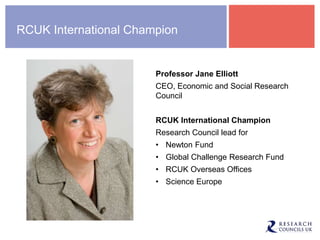
Professor Jane Elliott
CEO, Economic and Social Research
Council
RCUK International Champion
Research Council lead for
• Newton Fund
• Global Challenge Research Fund
• RCUK Overseas Offices
• Science Europe
CONTEXT
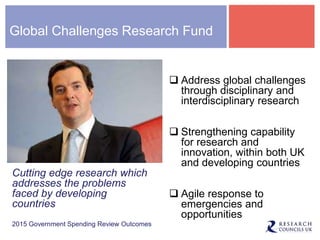
Global Challenges Research Fund
Cutting edge research which
addresses the problems
faced by developing
countries
2015 Government Spending Review Outcomes
 Address global challenges
through disciplinary and
interdisciplinary research
 Strengthening capability
for research and
innovation, within both UK
and developing countries
 Agile response to
emergencies and
opportunities
UK Context
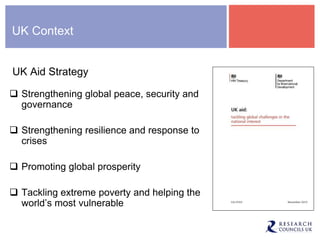
UK Aid Strategy
 Strengthening global peace, security and
governance
 Strengthening resilience and response to
crises
 Promoting global prosperity
 Tackling extreme poverty and helping the
world’s most vulnerable
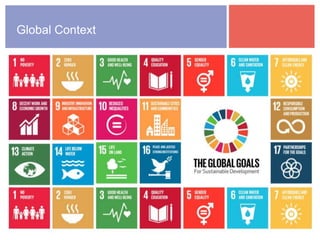
Global Context
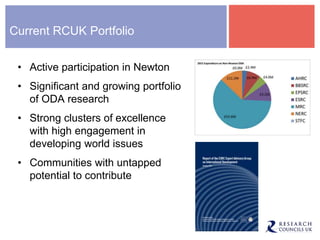
Current RCUK Portfolio
• Active participation in Newton
• Significant and growing portfolio
of ODA research
• Strong clusters of excellence
with high engagement in
developing world issues
• Communities with untapped
potential to contribute
INVESTMENT STRATEGY
Setting the context
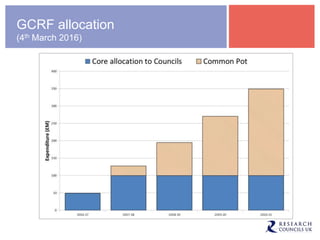
GCRF allocation
(4th March 2016)
Global Grand Challenges
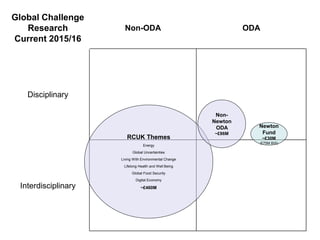
Global Challenge
Research
Current 2015/16
Non-ODA ODA
Disciplinary
Interdisciplinary
RCUK Themes
Energy
Global Uncertainties
Living With Environmental Change
Lifelong Health and Well Being
Global Food Security
Digital Economy
~£460M
Newton
Fund
~£30M
(£75M BIS)
Non-
Newton
ODA
~£86M
Global Grand Challenges
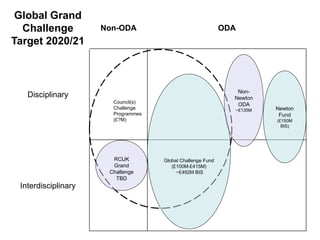
Global Grand
Challenge
Target 2020/21
Non-ODA ODA
Disciplinary
Interdisciplinary
Council(s)
Challenge
Programmes
(£?M)
Global Challenge Fund
(£100M-£415M)
~£492M BIS
RCUK
Grand
Challenge
TBD
Newton
Fund
(£150M
BIS)
Non-
Newton
ODA
~£135M
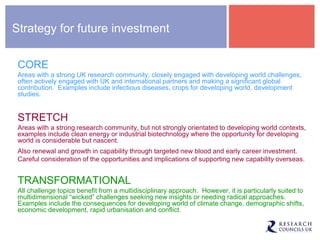
Strategy for future investment
CORE
Areas with a strong UK research community, closely engaged with developing world challenges,
often actively engaged with UK and international partners and making a significant global
contribution. Examples include infectious diseases, crops for developing world, development
studies.
STRETCH
Areas with a strong research community, but not strongly orientated to developing world contexts,
examples include clean energy or industrial biotechnology where the opportunity for developing
world is considerable but nascent.
Also renewal and growth in capability through targeted new blood and early career investment.
Careful consideration of the opportunities and implications of supporting new capability overseas.
TRANSFORMATIONAL
All challenge topics benefit from a multidisciplinary approach. However, it is particularly suited to
multidimensional “wicked” challenges seeking new insights or needing radical approaches.
Examples include the consequences for developing world of climate change, demographic shifts,
economic development, rapid urbanisation and conflict.
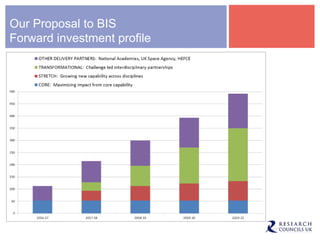
Our Proposal to BIS
Forward investment profile
FUTURE PLANS
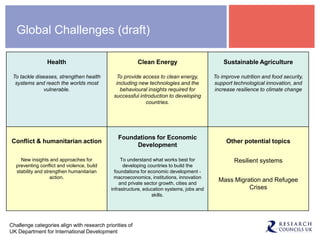
Global Challenges (draft)
Health Clean Energy Sustainable Agriculture
To tackle diseases, strengthen health
systems and reach the worlds most
vulnerable.
To provide access to clean energy,
including new technologies and the
behavioural insights required for
successful introduction to developing
countries.
To improve nutrition and food security,
support technological innovation, and
increase resilience to climate change
Conflict & humanitarian action
Foundations for Economic
Development
Other potential topics
New insights and approaches for
preventing conflict and violence, build
stability and strengthen humanitarian
action.
To understand what works best for
developing countries to build the
foundations for economic development -
macroeconomics, institutions, innovation
and private sector growth, cities and
infrastructure, education systems, jobs and
skills.
Resilient systems
Mass Migration and Refugee
Crises
Challenge categories align with research priorities of
UK Department for International Development
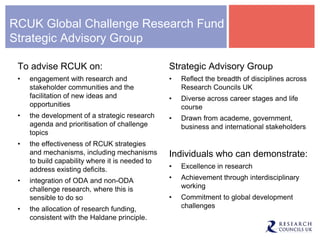
RCUK Global Challenge Research Fund
Strategic Advisory Group
To advise RCUK on:
• engagement with research and
stakeholder communities and the
facilitation of new ideas and
opportunities
• the development of a strategic research
agenda and prioritisation of challenge
topics
• the effectiveness of RCUK strategies
and mechanisms, including mechanisms
to build capability where it is needed to
address existing deficits.
• integration of ODA and non-ODA
challenge research, where this is
sensible to do so
• the allocation of research funding,
consistent with the Haldane principle.
Strategic Advisory Group
• Reflect the breadth of disciplines across
Research Councils UK
• Diverse across career stages and life
course
• Drawn from academe, government,
business and international stakeholders
Individuals who can demonstrate:
• Excellence in research
• Achievement through interdisciplinary
working
• Commitment to global development
challenges
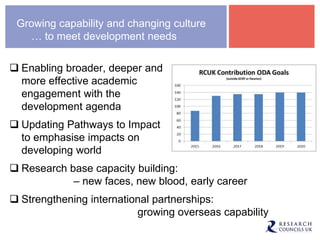
Growing capability and changing culture
… to meet development needs
 Enabling broader, deeper and
more effective academic
engagement with the
development agenda
 Updating Pathways to Impact
to emphasise impacts on
developing world
 Research base capacity building:
– new faces, new blood, early career
 Strengthening international partnerships:
growing overseas capability
PATHWAYS TO IMPACT
Securing benefit for the developing world
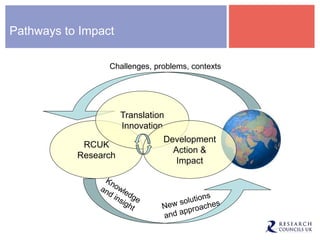
Pathways to Impact
RCUK
Research
Translation
Innovation
Development
Action &
Impact
Challenges, problems, contexts
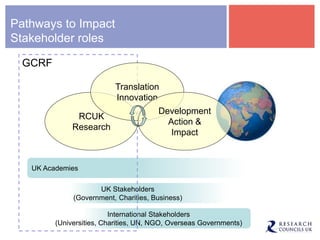
Pathways to Impact
Stakeholder roles
UK Academies
UK Stakeholders
(Government, Charities, Business)
International Stakeholders
(Universities, Charities, UN, NGO, Overseas Governments)
GCRF
RCUK
Research
Translation
Innovation
Development
Action &
Impact
Pathways to impact
… on the developing world
Impacts from research are always uncertain, often
unexpected and cannot be guaranteed – this includes
impacts on developing world.
The likelihood of impact is increased:
• If the research is orientated towards real world problems and
challenges
• If stakeholders that are close to the problem, or have a mandate to
implement any solutions, are involved in the progression of the
research
• If the academics and research team are motivated to achieve impact
and benefit.
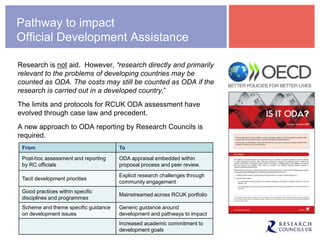
Pathway to impact
Official Development Assistance
Research is not aid. However, “research directly and primarily
relevant to the problems of developing countries may be
counted as ODA. The costs may still be counted as ODA if the
research is carried out in a developed country.”
The limits and protocols for RCUK ODA assessment have
evolved through case law and precedent.
A new approach to ODA reporting by Research Councils is
required.
From To
Post-hoc assessment and reporting
by RC officials
ODA appraisal embedded within
proposal process and peer review.
Tacit development priorities
Explicit research challenges through
community engagement
Good practices within specific
disciplines and programmes
Mainstreamed across RCUK portfolio
Scheme and theme specific guidance
on development issues
Generic guidance around
development and pathways to impact
Increased academic commitment to
development goals
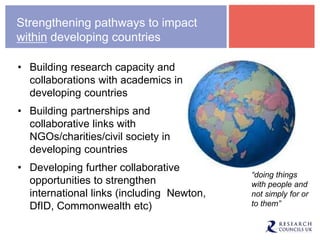
Strengthening pathways to impact
within developing countries
• Building research capacity and
collaborations with academics in
developing countries
• Building partnerships and
collaborative links with
NGOs/charities/civil society in
developing countries
• Developing further collaborative
opportunities to strengthen
international links (including Newton,
DfID, Commonwealth etc)
“doing things
with people and
not simply for or
to them”
CAUTIONARY THOUGHTS
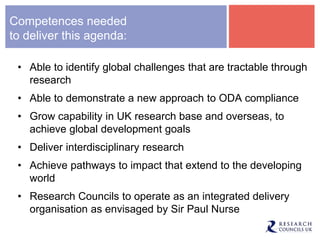
Competences needed
to deliver this agenda:
• Able to identify global challenges that are tractable through
research
• Able to demonstrate a new approach to ODA compliance
• Grow capability in UK research base and overseas, to
achieve global development goals
• Deliver interdisciplinary research
• Achieve pathways to impact that extend to the developing
world
• Research Councils to operate as an integrated delivery
organisation as envisaged by Sir Paul Nurse
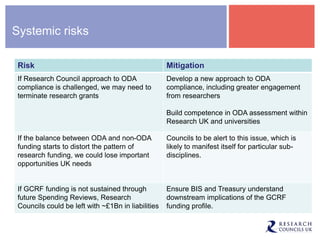
Systemic risks
Risk Mitigation
If Research Council approach to ODA
compliance is challenged, we may need to
terminate research grants
Develop a new approach to ODA
compliance, including greater engagement
from researchers
Build competence in ODA assessment within
Research UK and universities
If the balance between ODA and non-ODA
funding starts to distort the pattern of
research funding, we could lose important
opportunities UK needs
Councils to be alert to this issue, which is
likely to manifest itself for particular sub-
disciplines.
If GCRF funding is not sustained through
future Spending Reviews, Research
Councils could be left with ~£1Bn in liabilities
Ensure BIS and Treasury understand
downstream implications of the GCRF
funding profile.
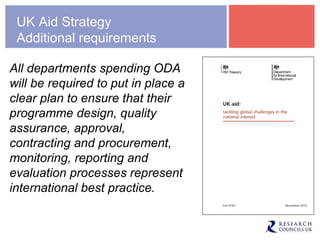
UK Aid Strategy
Additional requirements
All departments spending ODA
will be required to put in place a
clear plan to ensure that their
programme design, quality
assurance, approval,
contracting and procurement,
monitoring, reporting and
evaluation processes represent
international best practice.
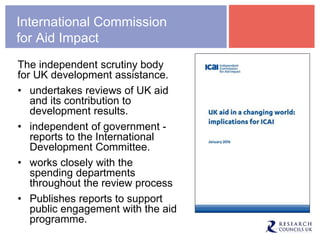
International Commission
for Aid Impact
The independent scrutiny body
for UK development assistance.
• undertakes reviews of UK aid
and its contribution to
development results.
• independent of government -
reports to the International
Development Committee.
• works closely with the
spending departments
throughout the review process
• Publishes reports to support
public engagement with the aid
programme.
Questions for discussion
How might we work together to make
the case for unallocated GCRF?
Examples of good (best) practices
– Interdisciplinary approaches
– Capability building UK & overseas
– Critical mass, networks, people
– Building global partnerships
What are the global challenges?
How might we strengthen pathways to impact?

GCRf: RCUK Global Challenges Research Fund

  • 1.
  • 2.
    RCUK International Champion ProfessorJane Elliott CEO, Economic and Social Research Council RCUK International Champion Research Council lead for • Newton Fund • Global Challenge Research Fund • RCUK Overseas Offices • Science Europe
  • 3.
  • 4.
    Global Challenges ResearchFund Cutting edge research which addresses the problems faced by developing countries 2015 Government Spending Review Outcomes  Address global challenges through disciplinary and interdisciplinary research  Strengthening capability for research and innovation, within both UK and developing countries  Agile response to emergencies and opportunities
  • 5.
    UK Context UK AidStrategy  Strengthening global peace, security and governance  Strengthening resilience and response to crises  Promoting global prosperity  Tackling extreme poverty and helping the world’s most vulnerable
  • 6.
  • 7.
    Current RCUK Portfolio •Active participation in Newton • Significant and growing portfolio of ODA research • Strong clusters of excellence with high engagement in developing world issues • Communities with untapped potential to contribute
  • 8.
  • 9.
  • 10.
    Global Grand Challenges GlobalChallenge Research Current 2015/16 Non-ODA ODA Disciplinary Interdisciplinary RCUK Themes Energy Global Uncertainties Living With Environmental Change Lifelong Health and Well Being Global Food Security Digital Economy ~£460M Newton Fund ~£30M (£75M BIS) Non- Newton ODA ~£86M
  • 11.
    Global Grand Challenges GlobalGrand Challenge Target 2020/21 Non-ODA ODA Disciplinary Interdisciplinary Council(s) Challenge Programmes (£?M) Global Challenge Fund (£100M-£415M) ~£492M BIS RCUK Grand Challenge TBD Newton Fund (£150M BIS) Non- Newton ODA ~£135M
  • 12.
    Strategy for futureinvestment CORE Areas with a strong UK research community, closely engaged with developing world challenges, often actively engaged with UK and international partners and making a significant global contribution. Examples include infectious diseases, crops for developing world, development studies. STRETCH Areas with a strong research community, but not strongly orientated to developing world contexts, examples include clean energy or industrial biotechnology where the opportunity for developing world is considerable but nascent. Also renewal and growth in capability through targeted new blood and early career investment. Careful consideration of the opportunities and implications of supporting new capability overseas. TRANSFORMATIONAL All challenge topics benefit from a multidisciplinary approach. However, it is particularly suited to multidimensional “wicked” challenges seeking new insights or needing radical approaches. Examples include the consequences for developing world of climate change, demographic shifts, economic development, rapid urbanisation and conflict.
  • 13.
    Our Proposal toBIS Forward investment profile
  • 14.
  • 15.
    Global Challenges (draft) HealthClean Energy Sustainable Agriculture To tackle diseases, strengthen health systems and reach the worlds most vulnerable. To provide access to clean energy, including new technologies and the behavioural insights required for successful introduction to developing countries. To improve nutrition and food security, support technological innovation, and increase resilience to climate change Conflict & humanitarian action Foundations for Economic Development Other potential topics New insights and approaches for preventing conflict and violence, build stability and strengthen humanitarian action. To understand what works best for developing countries to build the foundations for economic development - macroeconomics, institutions, innovation and private sector growth, cities and infrastructure, education systems, jobs and skills. Resilient systems Mass Migration and Refugee Crises Challenge categories align with research priorities of UK Department for International Development
  • 16.
    RCUK Global ChallengeResearch Fund Strategic Advisory Group To advise RCUK on: • engagement with research and stakeholder communities and the facilitation of new ideas and opportunities • the development of a strategic research agenda and prioritisation of challenge topics • the effectiveness of RCUK strategies and mechanisms, including mechanisms to build capability where it is needed to address existing deficits. • integration of ODA and non-ODA challenge research, where this is sensible to do so • the allocation of research funding, consistent with the Haldane principle. Strategic Advisory Group • Reflect the breadth of disciplines across Research Councils UK • Diverse across career stages and life course • Drawn from academe, government, business and international stakeholders Individuals who can demonstrate: • Excellence in research • Achievement through interdisciplinary working • Commitment to global development challenges
  • 17.
    Growing capability andchanging culture … to meet development needs  Enabling broader, deeper and more effective academic engagement with the development agenda  Updating Pathways to Impact to emphasise impacts on developing world  Research base capacity building: – new faces, new blood, early career  Strengthening international partnerships: growing overseas capability
  • 18.
    PATHWAYS TO IMPACT Securingbenefit for the developing world
  • 19.
  • 20.
    Pathways to Impact Stakeholderroles UK Academies UK Stakeholders (Government, Charities, Business) International Stakeholders (Universities, Charities, UN, NGO, Overseas Governments) GCRF RCUK Research Translation Innovation Development Action & Impact
  • 21.
    Pathways to impact …on the developing world Impacts from research are always uncertain, often unexpected and cannot be guaranteed – this includes impacts on developing world. The likelihood of impact is increased: • If the research is orientated towards real world problems and challenges • If stakeholders that are close to the problem, or have a mandate to implement any solutions, are involved in the progression of the research • If the academics and research team are motivated to achieve impact and benefit.
  • 22.
    Pathway to impact OfficialDevelopment Assistance Research is not aid. However, “research directly and primarily relevant to the problems of developing countries may be counted as ODA. The costs may still be counted as ODA if the research is carried out in a developed country.” The limits and protocols for RCUK ODA assessment have evolved through case law and precedent. A new approach to ODA reporting by Research Councils is required. From To Post-hoc assessment and reporting by RC officials ODA appraisal embedded within proposal process and peer review. Tacit development priorities Explicit research challenges through community engagement Good practices within specific disciplines and programmes Mainstreamed across RCUK portfolio Scheme and theme specific guidance on development issues Generic guidance around development and pathways to impact Increased academic commitment to development goals
  • 23.
    Strengthening pathways toimpact within developing countries • Building research capacity and collaborations with academics in developing countries • Building partnerships and collaborative links with NGOs/charities/civil society in developing countries • Developing further collaborative opportunities to strengthen international links (including Newton, DfID, Commonwealth etc) “doing things with people and not simply for or to them”
  • 24.
  • 25.
    Competences needed to deliverthis agenda: • Able to identify global challenges that are tractable through research • Able to demonstrate a new approach to ODA compliance • Grow capability in UK research base and overseas, to achieve global development goals • Deliver interdisciplinary research • Achieve pathways to impact that extend to the developing world • Research Councils to operate as an integrated delivery organisation as envisaged by Sir Paul Nurse
  • 26.
    Systemic risks Risk Mitigation IfResearch Council approach to ODA compliance is challenged, we may need to terminate research grants Develop a new approach to ODA compliance, including greater engagement from researchers Build competence in ODA assessment within Research UK and universities If the balance between ODA and non-ODA funding starts to distort the pattern of research funding, we could lose important opportunities UK needs Councils to be alert to this issue, which is likely to manifest itself for particular sub- disciplines. If GCRF funding is not sustained through future Spending Reviews, Research Councils could be left with ~£1Bn in liabilities Ensure BIS and Treasury understand downstream implications of the GCRF funding profile.
  • 27.
    UK Aid Strategy Additionalrequirements All departments spending ODA will be required to put in place a clear plan to ensure that their programme design, quality assurance, approval, contracting and procurement, monitoring, reporting and evaluation processes represent international best practice.
  • 28.
    International Commission for AidImpact The independent scrutiny body for UK development assistance. • undertakes reviews of UK aid and its contribution to development results. • independent of government - reports to the International Development Committee. • works closely with the spending departments throughout the review process • Publishes reports to support public engagement with the aid programme.
  • 29.
    Questions for discussion Howmight we work together to make the case for unallocated GCRF? Examples of good (best) practices – Interdisciplinary approaches – Capability building UK & overseas – Critical mass, networks, people – Building global partnerships What are the global challenges? How might we strengthen pathways to impact?

Editor's Notes

  • #33 Background on locust story: ASSETS is part of ESPA. ASSETS country coordinator in Malawi, Professor Sosten Chiotha had played a vital role in setting up a local radio station run by the Leadership for Environment and Development (LEAD) for Southern and Eastern Africa (ASSETS main partner in Africa) which focused mainly on development issues. Through it radio listener’s club people were able to talk about local issues affecting them and it was noticed that many were complaining about an outbreak of locusts damaging their crops. This notified the government that they had a problem and they later sprayed the affected areas to stop further damage. However it was known that the source of the problem was the drying up of a local lake which was increasing grazing for locusts. At the time the government did not have any meteorological information to help then produce models that would forecast when the lake may dry up. Through their connection with LEAD and the local government, ASSETS were able to provide use of their newly purchased weather and river/lake recording equipment (purchased with additional funding they secured through the NERC Strategic Environmental Science Capital Fund). Data gathered indicated that even a partial drying of the lake could trigger a locust outbreak and they discovered that there needed to be a certain amount of rainfall over three years to prevent this. Armed with this new knowledge they are now able to predict a year in advance when they might have a problem and act quickly through measures such as preventative spraying. The government now work closely with LEAD and the new equipment has strengthened local capacity, ensuring that an important threat to food security is now under control.
  • #39 With BBSRC investment, Professor Luke Alphey from the University of Oxford has pioneered a genetic technique to modify insects that spread disease and damage crops.   In 1999 Professor Alphey patented his genetic modification technique that prevents reproduction in mosquitoes that carry diseases like dengue fever and chikungunya virus. How it works is that the male mosquitoes have a pest control gene they pass to their offspring so that they do not survive to adulthood. The Oxitec males are released to mate with wild females and with successive releases the pest population is reduced. In 2002 commercial spin-out company Oxitec Ltd was created. The company currently employs 40 people and has attracted over £xxx funding from venture capitalists. The Oxitec GM mosquitoes have successfully cut target mosquito populations by at least 90% in field trials in the Cayman Islands, Malaysia and Brazil.   These mosquitoes also carry a colour marker so that they can be identified compared to wild pest mosquitoes. This ‘track and trace’ capability allows Oxitec to monitor pest population suppression in almost real time. Because the modified insects and their offspring die, the insects and their genes do not persist in the environment. The proteins of the introduced genes are non toxic and non allergenic and the pest control technology is species-specific. This approach can also help reduce reliance on insecticides so other beneficial predators and insects can thrive.