echnologyT
ournal ofJ
Education
Volume 7 Number 1 Fall, 1995
Journal of Technology Education Vol. 7 No. 1, Fall 1995
-1-
Contents
From the Editor
2 A Proposal for a Presence on the Web
by Mark E. Sanders
Articles
6 The Founders of Industrial Arts in the US
by Patrick N. Foster
22 Collaborative Learning Enhances Critical Thinking
by Anuradha A. Gokhale
31 Technology as Knowledge: Implications for Instruction
by Dennis R. Herschbach
43 For a History of Technology Education: Contexts, Systems, and
Narratives
by John R. Pannabecker
57 The Relationship Between Psychological Type and Professional Orien-
tation Among Technology Education Teachers
by Robert C. Wicklein and Jay W. Rojewski
Book Review
75 Narrative Schooling: Experiential Learning and the Transformation
of American Education
reviewed by Roger B. Hill
Miscellany
78 Scope of the JTE
Editorial/Review Process
Manuscript Submission Guidelines
Subscription information
JTE Co-sponsors
Electronic Access to the JTE
Journal of Technology Education Vol. 7 No. 1, Fall 1995
-2-
From the Editor
A Proposal for a Presence on the Web
Technology Education needs to create a presence on the World Wide
Web. For the uninitiated, the World Wide Web (WWW) is a network of file
servers (generally just desktop computers with hard drives) connected to the
Internet. Any file on one server can easily be linked to any file on any other
server in such a way as to allow users to navigate—assuming they have the
proper software—to one of these “links” with one click of the mouse on a word
or graphic appearing on their computer screen. Files accessible in this manner
may be text, graphics, audio, and/or video. Once one has Internet access and
the software (known as a “World Wide Web browser”) very little know-how is
required to navigate the “Web.” Moreover, anyone with a little interest and
perhaps a half-dozen hours of spare time can learn to develop WWW “pages”
(computer screens that contain the links just described). As a result, World
Wide Web use and development is booming!
Although there are a handful of notable Technology Education sites now
on the World Wide Web, we need to be more aggressive in this arena. The in-
tent of this brief monologue is to help encourage and stimulate calculated
World Wide Web development in our profession and to suggest the need for
enhanced and ongoing support for the type of WWW resources herein proposed
for development. In so doing, we would vastly enhance our visibility and stature
both within and beyond the educational community.
While some believe the dilemma confronting Technology Education may
be a matter of vision, I think it is more a problem of exposure. Exemplary
practice in Technology Education is among the best in all of education. We
teach the most innovative curriculum with the most innovative methods. Our
content has shifted from the category of “nice to know” to “need to know.”
Woodworking was “nice to know;” but the digital technologies and problem-
solving methods that pepper our curriculum are now considered essential by
most—the “new basic” as we like to say. It’s true; and when taught well, no
school subject does it better than Technology Education.
Nevertheless, though our content and method have never been more
timely or vital, many of our programs are in trouble—routinely being shut down
and/or filled by unqualified persons. Our teacher education programs have
dwindled to the point that there simply aren’t enough qualified new teachers to
Journal of Technology Education Vol. 7 No. 1, Fall 1995
-3-
fill the spots vacated by those retiring from our field. Most outside the profes-
sion have no idea what we are trying to accomplish in Technology Education.
We should ask ourselves why a school subject with as much potential as
Technology Education wallows in such anonymity. By and large, it’s a public
relations dilemma. Few even know our name. We have generally done a poor
job of communicating our work beyond the profession to the people who control
our future—policy makers, parents, administrators, prospective students, and
fellow educators.
The WWW provides us an unprecedented opportunity to make our case.
As a profession, we need to leverage that opportunity immediately for all it is
worth. To be sure, there is already far too much information floating around the
ether, and one might argue that an effort to develop a presence on the Net
would be pointless, as no one would ever find us among the cacophony that
already exists out there. I would agree, were it not for one important detail—
our name. Only a year or so ago, it was difficult to find anything on the Inter-
net. But WWW browsers—the software applications used to “cruise” the Inter-
net—have fantastic keyword search capabilities. To our great benefit, there are
droves of people around the planet who are interested in either “technology”
and/or “education.”
Shortly after the Journal of Technology Education went on-line in 1992,
there were a handful of other scholarly journals established on the same server.
From the beginning, however, the JTE has consistently had far more “hits”
than the other journals on the server. That is, a great many more people are ac-
cessing the electronic version of the JTE than these other electronic journals.
I believe this is because many people have discovered the JTE in searches con-
taining either “technology” or “education” or both. This works to our great ad-
vantage on the World Wide Web.
We have a start. The “ITEA Technology Education Hub” on the WWW
(http://www.tmn.com/Organizations/Iris/ITEA.html) already serves as a
“switching station,” allowing those who land there to instantly link to key in-
formation about our field. But, the information generated by our field and
available on-line is still very scarce. This is where we must beef up our efforts.
We should strive to establish a body of information on the Web that would de-
fine our profession to the world. Once established, each and all of these docu-
ments/sites should have a link established on the Hub. Thus, an individual
could quickly locate information on nearly any aspect of our field from the Hub.
The following is a brief annotated list of the type of resources I think our
profession needs to develop on the Web. Though this list represents only a
starting point, WWW sites such as these would capture the interest of the policy
makers, parents, administrators, current and prospective students, and fellow
Journal of Technology Education Vol. 7 No. 1, Fall 1995
-4-
educators who are actively seeking to find information relating to “technology”
and/or “education.”
• Technology Teacher Education Programs: Every teacher education program
should establish a WWW site that includes faculty resumés/portfolios, cur-
riculum, course offerings, program initiatives, graphic depictions of facili-
ties, TECA activities, etc.
• Secondary and Elementary Technology Education Programs: Imagine if
each outstanding Technology Education program developed a graphic
WWW site/ description of their program! I can think of no better way for
our field to showcase its work to the world. I am aware of a few such sites,
but there are hundreds more out there that would make for wonderful public
relations if they were also on-line and readily accessible.
• Teaching Opportunities: A place where any Technology Education teaching
opportunity in the world could be posted. In addition to teaching vacancies,
this might also include student teaching opportunities, faculty exchange in-
formation, internships, visiting professorships, consulting opportunities, etc.
• Recent Graduates: A place where those looking for work could post elec-
tronic portfolios—far more robust representations of their qualifications and
work than the standard resumé. Prospective employers would find this to be
an infinitely more efficient means of locating teachers than any current
method.
• Curriculum Materials: A place where curriculum developers would post
their materials for worldwide distribution. Some would be distributed freely,
others commercially. Some would be refereed, perhaps others not. Reviews
of and reactions to the materials could be posted here as well.
• General Information About the Profession: The ITEA has begun to develop
this on the Hub, but there is much more work to be done in this area.
• The literature of the profession: The JTE has been on-line since early 1992,
and is accessible from the Hub, but we should begin the process of putting
most of our literature on-line. Obvious candidates include the CTTE Year-
books, CTTE monographs, the Journal of Technology Studies, The Tech-
nology Teacher, and Ties Magazine. Again, some of these might be distrib-
uted freely, others commercially.
• The ITE Directory: This indispensable directory should be freely distributed
on-line to everyone in the profession. Non-CTTE/NAITTE members could
be charged for access, just as they are now.
Clearly the list of initiatives goes on, but the point here is not to generate
a comprehensive outline, but rather to illustrate the potential the World Wide
Web offers our field. Our profession needs to find the resources to support an
Journal of Technology Education Vol. 7 No. 1, Fall 1995
-5-
ongoing effort to first establish and then maintain (for years to come) WWW
resources such as those described above. This is not a task for one of us to take
on in addition to our already busy agendas. This task is too vital and time-
consuming for this “service” approach. It is critical that our profession imme-
diately begin to devote adequate resources to establish such a presence on the
World Wide Web.
MES
Journal of Technology Education Vol. 7 No. 1, Fall 1995
-6-
Articles
The Founders of Industrial Arts in the US
Patrick N. Foster
Although technology education in the United States may be regarded as
having been founded in the early twentieth century as industrial arts, the histori-
cal roots of the field have been traced back much further. At the same time,
it seems clear that the founding of industrial arts in the US was less an exten-
sion of any one of those roots than it was a philosophical convergence of them.
Perhaps the two educators who had the greatest influence on the genesis of
what is now known as technology education were Lois Coffey Mossman (1877-
1944) and Frederick Gordon Bonser (1875-1931), faculty members at Teachers
College, Columbia University. This paper will argue that histories of the field
have incorrectly overemphasized Bonser and ignored Mossman. The historical
record strongly suggests that the contributions of Mossman and Bonser to the
field of technology education should be viewed as collaborative.
Bonser has not been treated biographically in nearly a quarter-century;
Mossman apparently never has been. This paper will attempt to provide brief,
parallel biographies of Bonser and Mossman, at once synthesizing published
and unpublished information about them and opening dialogue about conflict-
ing source information.
This information is related to the degree to which Bonser and Mossman
influenced the “social-industrial theory” of industrial arts, relative to the con-
tributions of Russell, and to the nature of Mossman’s contribution to the
founding of industrial arts.
Context
Histories of American industrial arts and technology education often begin
between the stone age and ancient Sparta (e.g., Barlow, 1967; Hostetter, 1974;
Snyder, 1992), then proceed to furnish a litany of educator-heroes, first Euro-
pean, eventually American. Many of these heroes are well-known in the history
of education. Kirkwood (1994) identified Comenius, Rousseau, Pestalozzi,
Froebel, Herbart, Sheldon, and Dewey (see p. 76-78) as having had influence
Patrick N. Foster is an instructor in the Technology and Industry Education Program, University of
Missouri, Columbia, MO.
Journal of Technology Education Vol. 7 No. 1, Fall 1995
-7-
on those recognized as founders of American industrial arts and technology
education.
In many histories of industrial arts, the progression of the ideal of cultural
industrial education, exemplified by the works of Basedow, Comenius, and oth-
ers, is often presented simultaneously with the concurrent history of tool in-
struction and related historical figures such as Della Vos and Runkle (e.g., An-
derson, 1926, p. 155; Nelson, 1981; etc.), sometimes promoting a false impres-
sion of a single movement.
In fact, at least three distinct conceptions of industrial education are often
indiscriminately homogenized and presented as the “early history” of the field.
One justified industrial education psychopedagogically, as a teaching method.
Pestalozzi and Sheldon, for example, were advocates of “object teaching”
(Mossman, 1924, p. 3).
Programs of tool instruction for children and young adults have also been
included in the history of industrial arts (e.g., Barella & Wright, 1981) and
technology education (e.g., Snyder, 1992). Manual-training programs of the
late nineteenth century, such as those of Runkle, Woodward, and Adler, have
been presented as direct descendants of those of object-teaching or cultural-
industrial nature.1
Whereas in practice, late twentieth-century industrial arts
programs may have had “their roots in the manual training movement of the
latter part of the nineteenth century” (Lindbeck, 1972, p. 27), statements such
as “the first industrial arts programs in America were known as manual train-
ing classes” (Scobey, 1968, p. 4) point to the field’s confusion relative to its
historical roots.
Finally, the history of cultural industrial education, of which modern
American technology education is professedly based, has also been a implicit
constituent of many histories of the field. The rationale for cultural industrial
education was that children needed to learn about technologies of the home and
of commercial industry to understand their increasingly technological world.
According to Anderson (1926),
…this conception of industrial education is represented in a work by
Professors F.G. Bonser and L.C. Mossman of Teachers College en-
titled Industrial Arts for Elementary Schools. …In this recent move
in the field of cultural industrial education history is repeating it-
self…[cultural industrial education] was advocated by Rabelais in
the sixteenth, by Comenius in the seventeenth, and by Basedow in
1
Although there are undeniably cultural aspects to the curricula of Woodward (cf. Zuga, 1980,
1994; Lewis, 1994) and Adler, it should be considered that these programs were probably not
representative of the times, and that both are usually regarded as having been based upon the
“Russian system” of tool instruction displayed in the US in 1876 (see Barlow, 1967).
Journal of Technology Education Vol. 7 No. 1, Fall 1995
-8-
the eighteenth century (p. 223-224).2
Columbia University Teachers College faculty members Bonser and
Mossman (1923) used the term “manual training” to identify the prevailing
interpretation of industrial education in the 1920s. In Industrial Arts for Ele-
mentary Schools they listed “these prominent inadequacies in manual train-
ing:”
Want of relationship of the work to life…Failure to provide for the
individuality of the child…Lack of motivation…[and] Placing the
emphasis upon the product as the objective, rather than upon the
growth of the child (p. 479).
Bonser and Mossman, along with Teachers College Dean James E. Russell,
and many others never considered in histories of industrial arts, developed a
comprehensive system of industrial education which, although never imple-
mented on a large scale, has been the theoretical basis for technology education
for most of the past seventy years.
Before their Paths Crossed
Before they taught at Teachers College, both Bonser and Mossman were
elementary schoolteachers. Mossman had some background in the industrial
arts; Bonser almost certainly did not.
Frederick Gordon Bonser. Bonser’s upbringing and family background
epitomize romantic notions of American “rugged individualism.” Aaron Bonser
migrated to Illinois with his relatives in a covered wagon. Frederick, his first
son, was born in a log cabin on June 14, 1875.
Despite his early education in the rigors of frontier life, Bonser was hardly
a proponent of individualism in education. He recognized inherent strengths in
collectivism among students. Later he and Mossman would write that in indus-
trial arts, “there are definite values in group cooperation. Exchanges of ideas
are profitable, and division of work in a problem of common interest results in
the achievement of much more in both quantity and variety in a given time than
one could accomplish alone” (Bonser and Mossman, 1923, p. 38).
Nonetheless, Bonser at times displayed “his father’s sturdy pioneering atti-
tude toward life’s problems” (Bawden, 1950, p. 26). In response to “there being
no high school near his home,” he went to live with an uncle 160 miles away,
where he completed the full four years of high school in two years (Bawden,
2
Not all of these names are familiar to technology educators. For further discussions of Rabelais
(1495-1553) and Basedow (1723-1790), see Graves (1910, 1914), Anderson (1926), and Bennett
(1926).
Journal of Technology Education Vol. 7 No. 1, Fall 1995
-9-
1950, p. 27-28). Upon graduating in 1895, he immediately enrolled in the Uni-
versity of Illinois. But two years into the course of his bachelor’s degree, he left
to teach at a nearby rural school, and later at two schools in Washington
(Phipps, 1935). He fought a serious illness for some time toward the end of the
century, but returned to the university in 1899, and received a Bachelor of Sci-
ence in psychology in 1901 and a master’s degree the following year
(Luetkemeyer and McPherson, 1975, p. 260).
Lois Coffey Mossman. Unfortunately, available biographic information on
Mossman is limited to records, usually either difficult or impossible to obtain,
of events in some cases a century old.3
Her contemporaries are no longer living;
anecdotal observations and quotations with which to enliven a recounting of
her life do not seem to exist.
Anna Coffey, called “Lois” most or all of her life, was born October 13,
1877, to Adolphus and Susan Francis (Frances?) Coffey, in Newark, Indiana, a
tiny village in Beech Creek Township. Her father was a minister, and the fam-
ily appears to have moved from Newark within a few years of her birth. By her
18th birthday she had secured a teaching certificate and was teaching at a
“country school” in Pottawotomie County, Kansas. Her certificate was listed as
“grade 2.”
The following school year, 1897-1898, she taught at the Wamego, Kansas,
school, for $40 per month. She then spent two years studying at the Kansas
State Normal School in Emporia, where she was awarded an elementary di-
ploma in 1900. A straight-A student whose best subject was spelling, Coffey
apparently had no formal training in industrial arts.
She continued to teach in Kansas until 1902, when she was named princi-
pal of the Las Vegas, New Mexico, High School.
By then, Bonser had regained his health and was appointed professor of
education at the State Normal School in Cheney, Washington (Mossman,
1931). After three years, he resigned this position to begin work on his doctor-
ate at Columbia University in New York. Before he completed his first year
there, he left to accept the position of professor of education and director of the
training school at Western Illinois State Normal School in Macomb
(Luetkemeyer & McPherson, 1975, p. 260).
About three years before Coffey and Bonser were both hired at Macomb,
she enrolled in summer classes there. During the summer of 1903, she resigned
her Las Vegas principalship to become an English teacher at the Macomb High
School. During the following two summers she continued to study at Kansas
State Normal School at Emporia, receiving a Latin diploma after completing
her final course in June, 1905. In 1906 Coffey accepted the position of critic
3
Copies of records used here are in the possession of the author.
Journal of Technology Education Vol. 7 No. 1, Fall 1995
-10-
teacher at the Western Illinois State Normal School’s training school. It was
likely there that she first met Frederick Gordon Bonser, himself also new to the
school. They would work together until Bonser’s death twenty-six years later.
Bonser and Coffey at Macomb, 1906-1910
Before Bonser met Lois Coffey, he had never published an article about
elementary education, home economics, or industrial arts (see Bonser, 1932).
But despite the fact that Bonser’s most commonly cited work was written with
Mossman, Bonser has received virtually all of the attention for the ideas in the
book.
Their work together began at Western Illinois State Normal School in Ma-
comb, Illinois, in 1906. Lois Coffey was one of the most demanding teachers at
the school–but at the same time a very respected one. “Thou shall not cut
classes,” students warned in the school’s 1910 yearbook, “for thou wilt be
caught by Coffey” (Western Illinois State Normal School, 1910, p. 66).
At Macomb, Coffey repeatedly emphasized that the integration of school
subjects could be achieved through practical classroom activities. For example,
in illustrating this belief to prospective teachers, she discussed the use of poems
in a lesson in agriculture. She then went on to meaningfully connect the study
with arithmetic, geometry, reading, art, geography, nature study, physics, and
botany (Coffey, 1909).
In addition to aligning the school’s practical work with the traditional cur-
riculum, Coffey emphasized the need for students to design their own projects.
When learning about clothing, some students designed and made their own
shirtwaists; when learning about shelter, students planned and drew houses.
(“On the ground floor,” 1907, p. 123).
But while this new conception of industrial education was being formed at
Macomb, Bonser announced that he had been appointed to the faculty at
Teachers College in New York.4
Coffey reported this in the January 20, 1909
edition of the school’s Western Courier, which she edited. Two months later
she mentioned that Bonser had severed his ties with the school, apparently to
work on his dissertation. In reporting these events, Coffey gave no indication
that she too would be leaving for New York in the Fall.
4
Although a full discussion is beyond the scope of this paper, the magnitude of Bonser’s career
move should be briefly mentioned. In addition to his appointment as the head of the newly formed
department of industrial education at Teachers College–by far the largest college of education on
the continent–the deal Bonser struck with Russell concurrently made him the Director of the Col-
lege’s laboratory school, “with the power to appoint and remove its teachers” (“Facts Relative,”
1910, p. 132). His pre-negotiated second-year salary was $2875, considerable when compared to
Coffey’s instructor salary of $1200 that same year. Had he not accepted the Teachers College
appointments, his popularity at Macomb was such, Hicken (1970) ventured, that “he might have
become the next president of Western Illinois Normal” (p. 52).
Journal of Technology Education Vol. 7 No. 1, Fall 1995
-11-
Coffey left Macomb shortly before school started in late September 1910.
Her destination was also Teachers College, where she would complete her
bachelor’s degree. Hicken (1970) characterized Coffey’s departure from the
school as “regrettable, and a blow to Western’s reputation as a normal school”
(p. 53). Although the faculty and students at Macomb hoped that she would
return in 1911, Coffey was hired as an instructor of industrial arts at Teachers
College.
Mossman was both a faculty member (serving as instructor and assistant
and associate professor) and a student (earning the A.B., A.M., and Ph.D. de-
grees) at Teachers College. It should not be overlooked that, as Gordon (1990)
recounts, during this time
At coeducational colleges and universities, many male faculty, adminis-
trators, and students viewed women’s higher education as an unwelcome
threat to the social order. And at women’s colleges, administrators pro-
claimed their own and their institutions’ adherence to traditional gender
roles (p. 189).
After being hired at Teachers College, Coffey was confronted with the pay
and prestige gaps suffered by female employees of the College. Despite the fact
that “women philanthropists” founded Teachers College, “under the influence
of the men who subsequently led the College it focused mainly on men for pro-
fessional leadership in the nation’s schools” (Thomas, 1988, p. 3). Thomas’
research revealed that, while there were always more women than men em-
ployed as faculty members at Teachers College during the time of Mossman’s
tenure, women consistently held posts of lower prestige and almost always were
paid less than men who held the same rank. At most universities of the time,
“the percentage of women teachers decreased dramatically as the pay and pres-
tige rose” (Schwarz, 1986, p. 57)
Bonser and Mossman at Teachers College
Soon after Bonser began teaching in New York, he and Russell issued a
pamphlet entitled Industrial Education, which outlined the “social-industrial
theory” of industrial arts. Mossman began her thirty-year teaching career at
Teachers College the following year. She continued to write and speak about
industrial arts, co-authoring Industrial Arts for Elementary Schools with Bon-
ser in 1923. But while Bonser and Russell are remembered for their contribu-
tions to the founding of industrial arts and technology education, she has all but
been forgotten.
Russell, Bonser, and the “industrial-social theory.” Although its constitu-
ent parts had been published a few years earlier, Russell and Bonser’s Indus-
trial Education appeared in 1914. It consisted of one essay by each author, on
Journal of Technology Education Vol. 7 No. 1, Fall 1995
-12-
the topic of reforming elementary education to include industrial arts. Smith
(1981) referred to Russell’s plan as “revolutionary” (p. 196); Lewis (1994)
wrote that it “set curricular boundaries for the subject [industrial arts]” (p. 15);
Bawden (1950), Hoots (1974), Martin and Luetkemeyer (1979) and other his-
torians have attested to Russell’s influence on the development of general-
education industrial arts. But upon inspection it becomes clear that Russell’s
ideas probably originated with Bonser, and with Mossman as well.
In his apparently unpublished “A History of Industrial Arts in Teachers
College, to May, 1926” Bonser (1926) observed that in 1892, five years after
Teachers College was founded as an industrial education school, the following
were the industrial arts course offerings: two courses in mechanical drawing;
four in woodworking; one in woodcarving; and a “departmental conference” (p.
1). Each year from that time until Bonser and Mossman arrived at Teachers
College in 1910, at least one, and as many as six new courses were added.
Nearly all were technical in nature, although a few were methodological. There
is little indication that social issues were considered a primary concern in in-
dustrial education at Teachers College before 1910.
Sometime between 1906 and 1909, Russell visited the Western Illinois
State Normal School at Macomb, where Bonser was the director of, and Moss-
man a teacher at, the Training School (see Phipps, 1935; McPherson, 1972).
Unlike the Teachers College conception of industrial arts, the elementary indus-
trial arts curriculum at Macomb was not organized around tools or materials. In
the third grade in 1909, all but one of the 25 industrial arts activities were di-
vided evenly under the headings “History” and “Geography” (Phipps, 1935, p.
94). They included the “making of igloos by using clay, salt, and flour,” for
example, in a unit on Eskimos.
Two actions of Russell in 1909 demand attention. After visiting Macomb,
he affected a “drastic and rapid reorganization” of the manual subjects at
Teachers College (Toepfer, 1966, p. 194). Also that year, Russell (1909) wrote
his well-known “The School and Industrial Life,” originally published in Edu-
cational Review, and later reprinted and distributed by Teachers College.
Russell discussed the development of the two papers5
which comprised In-
dustrial Education when he eulogized Bonser in 1931. He carefully described
how, long before Bonser was appointed at Teachers College, he developed the
theory outlined in the paper. Once the philosophy was disseminated, it needed
to be put into practice. “And there,” he said pointedly, “is where Professor Bon-
ser came into the picture” (1931, p. 11). Russell reminded the audience that Bon-
ser did not finish his paper until 1912. In short, Russell did not credit Bon-
5
“The School and Industrial Life,” Russell (1909), and Bonser’s (1911) “Fundamental Values in
Industrial Education.”
Journal of Technology Education Vol. 7 No. 1, Fall 1995
-13-
ser with any of the ideas in “The School and Industrial Life.” Apparently, this
statement, along with several other factors, has caused some historians (e.g.,
Sredl, 1964; Martin & Luetkemeyer, 1979) to conclude that Bonser’s work was
a reworking of Russell’s. These factors include the similarities between the two
articles and the fact that Russell’s paper apparently was completed before Bon-
ser’s was begun. But as McPherson (1972) pointed out, many of the ideas in
Russell’s papers had existed in Bonser’s writings since at least 1904–the year
Russell claimed to have begun devising his theory. Bonser had been enrolled at
Teachers College as a student in 1905-06 (Phipps, 1935); and as previously
mentioned, Russell traveled to Macomb, Illinois (about 900 miles from New
York City) to visit Bonser sometime during the latter’s tenure there. Addi-
tionally, a 1902 letter to Russell from Edwin Dexter of the University of Illinois
at Urbana, suggests that Bonser and Russell met in the summer of 1901
(Dexter, 1902).
Based on evidence and argument in McPherson’s 1972 biography of Bon-
ser, especially on pages 175-177, it may be suggested that Russell got many of
the ideas in “The School and Industrial Life” from Bonser.
And it seems certain that Bonser got many of his ideas from Lois Coffey.
Lois Coffey Mossman and the Founding of Industrial Arts
By 1908, Lois Coffey had begun to attract attention for her work from the
state department of education in Illinois. While at Macomb, Coffey, probably
aided by several other teachers, set up the first “general shop,” in which stu-
dents alternated through experiences in shopwork, drawing, and home econom-
ics. This eventually led to the integration of manual training, drawing, and
home economics into “industrial arts,” a term Coffey was using by 1909. Wil-
liam E. Warner’s interpretation of the “general shop” would later revolutionize
industrial arts, and Warner would later credit Bonser with the general shop
theory (see Gemmill, 1979).
In earlier years, Bonser had viewed manual training for elementary stu-
dents as a means of self-expression. But Coffey’s integrated study of industrial
arts clearly had promise as social education–which was absent from contempo-
rary elementary schools. Coffey’s lengthy curriculum for industrial arts in the
seventh and eighth grades, accompanied by an editorial by Bonser, was pub-
lished in December 1909 by Western Illinois Normal School.
Well-known works. The culmination of Bonser and Coffey’s industrial arts
curriculum work heretofore, The Speyer School Curriculum, was published in
1913. “The significance of this new approach to education was manifested by
the continued demand and sale of the publication long after the Speyer School
[itself] was discontinued,” Luetkemeyer and McPherson (1975) wrote, adding
that “the publication passed through several reprints” (p. 261). Coffey was
Journal of Technology Education Vol. 7 No. 1, Fall 1995
-14-
married that summer to Niles Roy Mossman and apparently left teaching for
three years. She was reappointed at Teachers College in 1916.
After she returned, Mossman and Bonser produced what would become
their best-known work, Industrial Arts for Elementary Schools. The book was
clearly the culmination of many years of development.
Having focused increasingly on the elementary grades at Macomb, Bonser
and Mossman began to systematize the study of industrial arts in the elemen-
tary school at Teachers College. Although they did not use the term “general
education,” they repeatedly referred to industrial arts as being essential to every
child’s schooling. If all citizens “must know how to read, write, and use the
general process of number,” they reasoned, “is there not also a body of knowl-
edge relative to the industrial arts which is of common value to all(?)” (Bonser
and Mossman, 1923, p. 20).
But that body of knowledge is so large that it must be limited before it can
be taught, they said. The important determinant of what is appropriate for
study, they suggested, was the degree of association the technology in question
had with the “common needs of life. …By this standard, industries devoted to
the production of food, clothing, and shelter would stand at the top of the list”
(p. 22). In short, industrial arts was a study of societies and their essential tech-
nologies.
The “famous” definition. As the realization and crystallization of work
Mossman and Bonser had been doing for years before the book appeared, In-
dustrial Arts for Elementary Schools contained a definition for “industrial arts”
which Bawden suggested was “more widely and authoritatively quoted than any
other in the history of the movement” (1950, p. 38). The definition was charac-
terized later by Lux as “famous” and “widely accepted” (1981, p. 211), and by
Brown (1977) as the “only definition of industrial arts rendered thus far be-
cause most, if not all, industrial arts definitions since are simply a variation of
the original” (p. 2):
Industrial arts is a study of the changes made by man in the forms of ma-
terials to increase their values, and of the problems of life related to these
changes (Bonser & Mossman, 1923, p. 5).
Although both Bonser and Mossman continued to write and speak about
industrial arts, very little is remembered of them after their 1923 book. Bonser
died in 1931. He left much work unfinished, although at the time of his death
he apparently was not significantly involved in writing about industrial arts.6
6
Petrina and Volk (1995) suggested that “possibly because of Bonser’s death in 1931, direct
connections between industrial arts and social reconstructionists dissolved.” Seemingly, both Bon-
(con’t. on next)
Journal of Technology Education Vol. 7 No. 1, Fall 1995
-15-
After Bonser’s death, the Bonser-Mossman conception of industrial arts
did not always fare well. As Towers, Lux, and Ray recounted,
Bonser spelled out the major subdivisions of content, such as the activi-
ties to provide food, clothing, and shelter, but he did not develop a com-
plete subject matter structure.…during the very period when (general in-
dustrial education) should have been making a revolutionary response to
Dewey-Richards-Bonser thought (1906-1917), the movement to enlist
public support for vocational industrial education was being born…what
amounted to an ultimatum to conform to the vocational education pres-
sures or face extinction, proved overwhelming…The implementation of
the real essence and intent of that movement would need to await a more
opportune time (1966, p. 106).
Even in the elementary school, where vocational industrial education was
not as large an issue, Bonser’s philosophy was at times misconstrued. In ele-
mentary school industrial arts, sometime after Bonser’s death, “there was a
transition toward an arts and crafts and/or handicrafts approach. It is probable
that this approach, as well as the ‘method of teaching’ approach, stemmed from
an out-of-context application of the Bonser philosophy” (Hoots, 1974, p. 234).
However, Hoots implied that the difficulty may not have been entirely in mis-
application. “The manner of presentation utilized by Bonser was somewhat diffi-
cult to follow,” he said, “and somewhat difficult to implement” (1974, p. 227).
If Bonser’s theories were not clear to educators, then interpretation was neces-
sary, and, perhaps, misinterpretation was inevitable.
To be fair, it should be suggested that not all of this criticism is warranted.
To begin with, a complete subject-matter structure for Bonser and Mossman’s
industrial arts was developed (Foster, 1995), although Bonser did not complete
this task himself. Secondly, the popularity of viewing industrial arts or technol-
ogy education as a method is unlikely to have been the result of misapplication
of the Bonser-Mossman theory. Mossman (e.g., 1924) clearly advocated “object
teaching,” and there is little to suggest that Bonser opposed it. In fact, in light
of Mossman’s later works (e.g., 1929, 1938), what Hoots (1974) referred to as
the “‘method of teaching’ approach” (p. 234) may have been exactly what
Mossman had intended; at the least, the method view is not an out-of-context
interpretation of Bonser and Mossman.
Finally, some industrial arts leaders who succeeded Bonser and Mossman
and who claimed to adhere to their philosophy created a false dichotomy be-
tween vocational education and the Bonser-Mossman theory of industrial arts.
ser and Mossman were concerning themselves with broader issues in education by the late 1920s,
although each would be considered an industrial arts expert until their respective deaths.
Journal of Technology Education Vol. 7 No. 1, Fall 1995
-16-
In fact, Bonser and Mossman were both in favor of vocational training for stu-
dents who had completed industrial arts in elementary school. Despite this, the
convention of professional self-segregation between general and comprehensive
technology education continues today.
But this is not to suggest that the Bonser-Mossman philosophy was ever
studied widely by those in the field. “When the Bonser concept was added to
those of manual training and manual arts, confusion resulted. The Bonser plan
both clarified and clouded the issues involved.…Several inconsistencies devel-
oped throughout the years. They became increasingly annoying to teachers and
leaders in these fields, especially when the Bonser concept was interjected into
the thinking” (Olson, 1963, p. 9-10).
Synthesis
Recent efforts to reclaim parts of the Bonser-Mossman conception of indus-
trial arts, such as those by Zuga (e.g., 1994) and Petrina and Volk (1995; in
press) have undoubtedly been hampered by seventy years of the industrial arts
profession’s overestimation of Bonser’s personal contributions to the field and
its lack of recognition of the contributions of many others, including Mossman.
Bonser’s contributions were significant; but by focusing on Bonser and the
profession’s difficulties in understanding him and his theories, as outlined
above, historians have been able to rationalize the lack of implementation of his
ideas (Foster, 1995).
Bonser and Mossman had a sound plan for industrial arts. Many plans
since–such as the Industrial Arts Curriculum Project, the Jackson’s Mill Indus-
trial Arts Curriculum Theory, and the current Technology for All Americans
project–have also been the results of collaborative efforts among educators. But
whereas historically the profession has recognized these group efforts as such,
it has yet to acknowledge Lois Coffey Mossman as a primary contributor not
only to industrial arts, but to modern technology education.
Hoots (1974) suggested the “out-of-context application” of Bonser’s phi-
losophy as an explanation for an incomplete elementary industrial arts pro-
gram. But perhaps the larger problem of context is the failure to view Bon-
ser–the “founder of industrial arts” (e.g. McPherson, 1976, p. 336)–and Moss-
man as two educators who acted together to establish what is now known as
technology education.
Concluding Thoughts
Lois Coffey Mossman died fifty years ago. What, one may ask, is the pur-
pose of discerning and reporting her contributions to technology education?
Much effort has been expended in this study, and undoubtedly much more will
Journal of Technology Education Vol. 7 No. 1, Fall 1995
-17-
be. What can we hope to gain from looking backwards, other than reason to
bemoan the poor treatment of one woman in our history?
And why don’t those researchers who desire gender equity in technology
education use their resources to identify what can be done to correct the prob-
lems facing us in the present, rather than point out unfortunate events of the
past?
The flawed logic upon which questions such as these are based assumes we
are working with a clean slate–that errors of the past, regrettable as they may
be, are of little relevance to us today.
As technology educators, we pride ourselves on our ability to belittle the
past. We laugh at the thought of computers without hard drives and banks
without automatic-teller machines–even though these conveniences are in their
first decade of popular use. Our tutored overconfidence in progress leaves us
wont to concern ourselves with 70-year-old theories such as the original con-
cept of industrial arts.
But what would we find if we did?
The founders of industrial arts furnished elementary-school teachers and
students with a method of studying industriousness7
in contemporary society, as
well as in societies in other places and times. Industrial arts was to be a study of
people–not of transportation or materials or engineering. Its main subdivisions
were food, clothing, and shelter, but identifying its content didn’t need to in-
volve a pseudoscientific, “totally inclusive, internally-mutually exclusive” peri-
odic table of the technologies.
Industrial arts was explicitly intended to be a unifying force in the elemen-
tary-school classroom. It was not meant to be a discrete academic discipline–
“quite the contrary, it is rather the most general subject of all in its far-reaching
relationship” (Bonser & Mossman, 1923, p. 74). It was not meant to specifi-
cally include or exclude boys or girls, although it did unapologetically involve
areas traditionally reserved for only one of the sexes, such as construction and
sewing.
Finally, industrial arts was an outgrowth of liberal, progressive education
and had a vocational purpose. Where appropriate, it was fully intended to lead
to specific vocational training after elementary school.
It is not the purpose of this article to compare this original intent–which
we still claim as our philosophical base–with the present-day situation. But
many of our discrete problems today–infighting over content, lack of female
participation and interest at all levels, disagreement over discipline status, and
inability to reconcile the field’s general and vocational purposes–were ad-
7
“Their focus on industrial remained the general idea of ‘industriousness’ rather than ‘pertaining
to the economic enterprise of industry’” (Zuga, 1994, p. 82).
Journal of Technology Education Vol. 7 No. 1, Fall 1995
-18-
dressed straightforwardly in the original conception of the field. Is it unreason-
able to speculate that the major problems threatening the very existence of
technology education–most notably our severe lack of teachers and teacher-
preparation opportunities, decreased funding, and difficulty in justifying our
importance in the contemporary secondary curriculum–are related to this the-
ory-practice gap as well?
This is not a welcome message which history delivers–and until now, we
have been content to kill the messenger. But recently, several historians in the
field have begun an attempt to recapture some of its past. There is a sense that
history can help clarify the issues we face today.
The founders of industrial arts in the US were concerned with many of
these same issues. If we truly want to confront these issues, and if we really
embrace the philosophy of industrial arts and technology education, we may
need to seek their counsel.
References
Anderson, L. (1926). A history of manual and industrial school education. New
York: Appleton.
Barella, R. V. & Wright, R. T. (Eds). (1981). An interpretive history of indus-
trial arts. Bloomington, IL: McKnight.
Barlow, M. (1967). History of industrial education in the United States. Peoria:
Bennett.
Bawden, W. T. (1950). Leaders in industrial education. Milwaukee: Bruce.
Bennett, C. A. (1926). History of manual and industrial education up to 1870.
Peoria: Bennett.
Bonser, F. G. & Mossman, L. C. (1923). Industrial arts for elementary schools.
New York: Macmillan.
Bonser, F. G. (1911). Fundamental values in industrial education. Teachers
College Bulletin III (November 18). New York: Teacher’s College, Colum-
bia University.
Bonser, F. G. (1926). A history of industrial arts in Teachers College, to May,
1926. [Unpublished manuscript, Milbank Memorial Library, Teachers,
College, Columbia University, New York.]
Bonser, F. G. (1932). Bibliography. In Life needs and education (pp. 271-288).
New York: Teachers College, Columbia University.
Brown, K. W. (1977). Model of a theoretical base for industrial arts education.
Washington: American Industrial Arts Association.
Coffey, L. C. (1909). Lessons in corn. [Schools of Illinois Circular 38]. Spring-
field, IL: Illinois State Journal Co.
Dexter, W. (1902). [Letter to James Russell, May 23, 1902].
Journal of Technology Education Vol. 7 No. 1, Fall 1995
-19-
Facts relative to Mr. Bonser’s going to Columbia. (1910). The Western Courier,
7(17), 132-133.
Foster, P. N. (1995). Industrial arts/technology education as a social study: The
original intent? Journal of Technology Education, 6(2), 4-18.
Gemmill, P. (1979). Industrial arts laboratory facilities–Past, present, and future.
In G. E. Martin (Ed.) Industrial arts education: Retrospect, prospect (pp. 86-
112.) Bloomington, IL: McKnight & McKnight.
Gordon, L. D. Gender and higher education in the progressive era. New Haven,
CT: Yale.
Graves, F. (1910). A history of education during the middle ages and the transi-
tion to modern times. New York: Macmillan.
Graves, F. (1914). A history of education before the middle ages. New York:
Macmillan.
Hicken, V. (1970). The purple and the gold: The story of Western Illinois Uni-
versity. Macomb, IL: The Western Illinois University Press.
Hoots, W. (1974). Philosophical positions. In R. Thrower & R. Weber, (Eds.)
Industrial arts for the elementary school (p. 221-236). Bloomington, IL:
McKnight.
Hostetter, R, (1974). Historical reflections. In R. Thrower & R. Weber, (Eds.)
Industrial arts for the elementary school (p. 209-220). Bloomington, IL:
McKnight.
Kirkwood, J. J. (1994) Construction in elementary school technology education.
In J. W. Wescott & R. H. Henak (Eds), Construction in technology educa-
tion (p. 75-101). Peoria: Glencoe.
Lewis, T. (1994). Limits on change to technology education curriculum. Journal
of Industrial Teacher Education, 31(2), 8-27.
Lindbeck, J. (1972). Practical guide to industrial arts education. New York: The
Center for Applied Research in Education, Inc.
Luetkemeyer, J. & McPherson, W. (1975). The ideas, philosophy, and contribu-
tions of Frederick Gordon Bonser. Man/Society/Technology, 34(8), 260-3.
Lux, D. G. (1981). Industrial arts redirected. In Barella, R. V. and Wright, R. T.
(Eds.), An interpretive history of industrial arts. Bloomington, IL:
McKnight.
Martin, G. E. & Luetkemeyer, J. F. (1979). The movements that led to contem-
porary industrial arts education. In G. E. Martin, (Ed.) Industrial arts educa-
tion: Retrospect prospect: 28th yearbook of the American Council on Indus-
trial Arts Teacher Education (pp. 18-42). Bloomington, IL: McKnight.
Journal of Technology Education Vol. 7 No. 1, Fall 1995
-20-
McPherson, W. (1972). An interpretation of the ideas, philosophy, and contribu-
tions of Frederick Gordon Bonser. [Unpublished doctoral dissertation. Col-
lege Park: University of Maryland.]
McPherson, W. (1976). A historical look at the founder of industrial arts educa-
tion: Frederick Gordon Bonser. In Crossroads ‘76: Addresses and proceedings
of the 38th national and the 5th international conference of the American In-
dustrial Arts Association, Des Moines, Iowa (p. 336-345). Washington,
D.C.: American Industrial Arts Association.
Mossman, L. C. (1924). Changing conceptions relative to the planning of les-
sons. New York: Teachers College, Columbia University.
Mossman, L. C. (1929). The content of the social studies in the elementary
school. Teachers College Record, 30(4), 322-333.
Mossman, L. C. (1931). Frederick Gordon Bonser. Teachers College Record, 33,
1-8.
Mossman, L. C. (1938). The activity concept: An interpretation. New York:
Macmillan.
Nelson, L. (1981). Background: the European influence. In Wright, R. T. and
Barella, R. V.(eds.) An interpretive history of industrial arts. Bloomington,
IL: McKnight and McKnight.
Olson, D. W. (1963). Industrial arts and technology. Englewood Cliffs, NJ:
Prentice-Hall.
On the ground floor. (1907). The Western Courier, 5(16), 123.
Petrina, S. & Volk, K. (1995). Industrial arts movement’s history, vision, and
ideal: Relevant, contemporary, used but unrecognized–Part I. Journal of
Technological Studies, 21(1), 24-32.
Petrina, S. & Volk, K. (In press). Industrial arts movement’s history, vision,
and ideal: Relevant, contemporary, used but unrecognized–Part II. Journal of
Technological Studies.
Phipps, R. (1935). Frederick Gordon Bonser: A biographical study of his life and
works. [Unpublished Master’s Thesis, Ohio State University.]
Russell, J. E. & Bonser, F. G. (1914). Industrial education. New York: Teachers
College, Columbia University.
Russell, J. E. (1931). An appreciation of Frederick Gordon Bonser. Teachers
College Record, 33, 9-14.
Schwarz, J. (1986) Radical feminists of Heterodoxy: Greenwich Village 1912-
1940. Norwich, VT: New Victoria.
Scobey, M. M. (1968). Teaching children about technology. Bloomington, IL:
McKnight & McKnight.
Smith, D. F. (1981). Industrial arts founded. In R. V. Barella & R. T. Wright,
(Eds.) An interpretive history of industrial arts. Bloomington, IL:
McKnight.
Journal of Technology Education Vol. 7 No. 1, Fall 1995
-21-
Snyder, M. R. (1992). The transition from industrial arts to technology educa-
tion in the United States: A historical perspective. [Unpublished doctoral
dissertation, Virginia Polytechnic Institute and State University.]
Sredl, H. J. (1964). A history of industrial arts from 1920 to 1964. [Unpub-
lished doctoral dissertation, Ohio State University.]
Thomas, S. J. (1988). Out of the kitchen: The transformation of Teachers Col-
lege, Columbia University, 1913-1933. Paper presented at the Annual Meet-
ing of the Association for the Study of Higher Education (St. Louis, No-
vember 3-6). EDRS ED 303 072 (HE 022 092).
Toepfer, K. (1966). James Earl Russell and the rise of Teachers College: 1897-
1915.[Unpublished Doctoral Dissertation, Teachers College, Columbia
University, New York.]
Towers, E., Lux, D. G. & Ray, W. E. (1966). A rationale and structure for in-
dustrial arts subject matter. Columbus: The Ohio State University.
Western Illinois State Normal School. (1910). Sequel. [Yearbook.]
Zuga, K. F. (1980). The St. Louis Manual Training School–A future oriented
school. Industrial arts: The spirit of progress. Addresses and proceedings of
the 42nd National and 9th International Annual Conference of the American
Industrial Arts Association, St. Louis Missouri, March 24-28, 1980, (pp.
94-95). Washington DC: The American Industrial Arts Association.
Zuga, K. F. (1994). Whose authenticity? Journal of Industrial Teacher Educa-
tion, 31(3), 79-84.
Journal of Technology Education Vol. 7 No. 1, Fall 1995
-22-
Collaborative Learning Enhances
Critical Thinking
Anuradha A. Gokhale
The concept of collaborative learning, the grouping and pairing of
students for the purpose of achieving an academic goal, has been widely
researched and advocated throughout the professional literature. The term
“collaborative learning” refers to an instruction method in which students at
various performance levels work together in small groups toward a common
goal. The students are responsible for one another’s learning as well as their
own. Thus, the success of one student helps other students to be successful.
Proponents of collaborative learning claim that the active exchange of
ideas within small groups not only increases interest among the participants
but also promotes critical thinking. According to Johnson and Johnson (1986),
there is persuasive evidence that cooperative teams achieve at higher levels of
thought and retain information longer than students who work quietly as
individuals. The shared learning gives students an opportunity to engage in
discussion, take responsibility for their own learning, and thus become critical
thinkers (Totten, Sills, Digby, & Russ, 1991).
In spite of these advantages, most of the research studies on collaborative
learning have been done at the primary and secondary levels. As yet, there is
little empirical evidence on its effectiveness at the college level. However, the
need for noncompetitive, collaborative group work is emphasized in much of
the higher education literature. Also, majority of the research in collaborative
learning has been done in non-technical disciplines.
The advances in technology and changes in the organizational
infrastructure put an increased emphasis on teamwork within the workforce.
Workers need to be able to think creatively, solve problems, and make decisions
Anuradha A. Gokhale is an Associate Professor at Western Illinois University in the Department
of Industrial Education and Technology, and is currently a Visiting Associate Professor at Illinois
State University.
Journal of Technology Education Vol. 7 No. 1, Fall 1995
-23-
as a team. Therefore, the development and enhancement of critical-thinking
skills through collaborative learning is one of the primary goals of technology
education. The present research was designed to study the effectiveness of
collaborative learning as it relates to learning outcomes at the college level, for
students in technology.
Purpose of Study
This study examined the effectiveness of individual learning versus
collaborative learning in enhancing drill-and-practice skills and critical-
thinking skills. The subject matter was series and parallel dc circuits.
Research Questions
The research questions examined in this study were:
1. Will there be a significant difference in achievement on a test
comprised of “drill-and practice” items between students learning
individually and students learning collaboratively?
2. Will there be a significant difference in achievement on a test
comprised of “critical-thinking” items between students learning
individually and students learning collaboratively?
Definition of Terms
Collaborative Learning: An instruction method in which students work in
groups toward a common academic goal.
Individual Learning: An instruction method in which students work
individually at their own level and rate toward an academic goal.
Critical-thinking Items: Items that involve analysis, synthesis, and
evaluation of the concepts.
Drill-and-Practice Items: Items that pertain to factual knowledge and
comprehension of the concepts.
Methodology
The independent variable in this study was method of instruction, a
variable with two categories: individual learning and collaborative learning.
The dependent variable was the posttest score. The posttest was made up of
“drill-and-practice” items and “critical-thinking” items.
Subjects
The population for this study consisted of undergraduate students in
industrial technology, enrolled at Western Illinois University, Macomb,
Illinois. The sample was made up of students enrolled in the 271 Basic
Electronics course during Spring 1993. There were two sections of the 271
Journal of Technology Education Vol. 7 No. 1, Fall 1995
-24-
class. Each section had 24 students in it. Thus, a total of forty-eight students
participated in this study.
Treatment
The treatment comprised of two parts: lecture and worksheet. Initially,
the author delivered a common lecture to both treatment groups. The lecture
occurred simultaneously to both groups to prevent the effect of any extraneous
variables such as time of day, day of week, lighting of room, and others. The
lecture was 50 minutes in length. It was based on series dc circuits and parallel
dc circuits. Next, one section was randomly assigned to the “individual learning
group” while the other section was assigned to the “collaborative learning
group”. The two sections worked in separate classrooms.
The same worksheet was given to both treatment groups. It was comprised
of both drill-and-practice items and critical- thinking items. The full range of
cognitive operations were called into play in that single worksheet. It began
with factual questions asking for the units of electrical quantities. Next, the
questions involved simple applications of Ohm’s law and Watt’s law or power
formula. The factual questions and the simple application questions were
analogous to the drill-and-practice items on the posttest. The questions that
followed required analysis of the information, synthesis of concepts, and
evaluation of the solution. These questions were analogous to the
critical-thinking items on the posttest. When designing the critical-thinking
items it was ensured that they would require extensive thinking. Both sections
had the same treatment time.
Individual Learning
In individual learning, the academic task was first explained to the
students. The students then worked on the worksheet by themselves at their
own level and rate. They were given 30 minutes to work on it. At the end of 30
minutes, the students were given a sheet with answers to the questions on the
worksheet. In case of problems, the solution sheet showed how the problem was
solved. The students were given 15 minutes to compare their own answers with
those on the solution sheet and understand how the problems were to be solved.
The participants were then given a posttest that comprised of both
drill-and-practice items and critical-thinking items.
Collaborative Learning
When implementing collaborative learning, the first step was to clearly
specify the academic task. Next, the collaborative learning structure was
explained to the students. An instruction sheet that pointed out the key
elements of the collaborative process was distributed. As part of the
Journal of Technology Education Vol. 7 No. 1, Fall 1995
-25-
instructions, students were encouraged to discuss “why” they thought as they
did regarding solutions to the problems. They were also instructed to listen
carefully to comments of each member of the group and be willing to
reconsider their own judgments and opinions. As experience reveals, group
decision-making can easily be dominated by the loudest voice or by the student
who talks the longest. Hence, it was insisted that every group member must be
given an opportunity to contribute his or her ideas. After that the group will
arrive at a solution.
Group Selection and Size
Groups can be formed using self-selection, random assignment, or
criterion-based selection. This study used self-selection, where students chose
their own group members. The choice of group size involves difficult trade-offs.
According to Rau and Heyl (1990), smaller groups (of three) contain less
diversity; and may lack divergent thinking styles and varied expertise that help
to animate collective decision making. Conversely, in larger groups it is
difficult to ensure that all members participate. This study used a group size of
four. There were 24 students in the collaborative learning treatment group.
Thus, there were six groups of four students each.
Grading Procedure
According to Slavin (1989), for effective collaborative learning, there
must be “group goals” and “individual accountability”. When the group’s task
is to ensure that every group member has learned something, it is in the
interest of every group member to spend time explaining concepts to
groupmates. Research has consistently found that students who gain most from
cooperative work are those who give and receive elaborated explanations
(Webb, 1985). Therefore, this study incorporated both “group goals” and
“individual accountability”. The posttest grade was made up of two parts. Fifty
percent of the test grade was based on how that particular group performed on
the test. The test points of all group members were pooled together and fifty
percent of each student’s individual grade was based on the average score. The
remaining fifty percent of each student’s grade was individual. This was
explained to the students before they started working collaboratively.
After the task was explained, group members pulled chairs into close
circles and started working on the worksheet. They were given 30 minutes to
discuss the solutions within the group and come to a consensus. At the end of
30 minutes, the solution sheet was distributed. The participants discussed their
answers within the respective groups for 15 minutes. Finally, the students were
tested over the material they had studied.
Journal of Technology Education Vol. 7 No. 1, Fall 1995
-26-
Instruments
The instruments used in this study were developed by the author. The
pretest and posttest were designed to measure student understanding of series
and parallel dc circuits and hence belonged to the cognitive domain. Bloom’s
taxonomy (1956) was used as a guide to develop a blueprint for the pretest and
the posttest. On analyzing the pilot study data, the Cronbach Reliability
Coefficients for the pretest and the posttest were found to be 0.91 and 0.87
respectively.
The posttest was a paper-and-pencil test consisting of 15
“drill-and-practice” items and 15 “critical-thinking” items. The items that
belonged to the “knowledge,” “comprehension,” and “application”
classifications of Bloom’s Taxonomy were categorized as “drill-and-practice”
items. These items pertained to units and symbols of electrical quantities, total
resistance in series and parallel, and simple applications of Ohm’s Law. The
items that belonged to “synthesis,” “analysis,” and “evaluation” classifications
of Bloom’s Taxonomy were categorized as “critical-thinking” items. These
items required students to clarify information, combine the component parts
into a coherent whole, and then judge the solution against the laws of electric
circuits. The pretest consisted of 12 items, two items belonging to each
classification of Bloom’s Taxonomy.
Research Design
A nonequivalent control group design was used in this study. The level of
significance (alpha) was set at 0.05. A pretest was administered to all subjects
prior to the treatment. The pretest was helpful in assessing students’ prior
knowledge of dc circuits and also in testing initial equivalence among groups.
A posttest was administered to measure treatment effects. The total treatment
lasted for 95 minutes. In order to avoid the problem of the students becoming
“test-wise”, the pretest and posttest were not parallel forms of the same test.
Findings
A total of 48 subjects participated in this study. A nine item questionnaire
was developed to collect descriptive data on the participants. Results of the
questionnaire revealed that the average age of the participants was 22.55 years
with a range of 19 to 35. The mean grade point average was 2.89 on a 4-point
scale, with a range of 2.02 to 3.67.
The questionnaire also revealed that eight participants were females and
40 were males. Nineteen students were currently classified as sophomores and
29 were juniors. Forty-five participants reported that they had no formal
Journal of Technology Education Vol. 7 No. 1, Fall 1995
-27-
education or work experience in dc circuits either in high school or in college.
Three students stated that they had some work experience in electronics but no
formal education.
The pretest and posttest were not parallel forms of the same test. Hence,
the difference between the pretest and posttest score was not meaningful. The
posttest score was used as the criterion variable.
At first, a t-test was conducted on pretest scores for the two treatment
groups. The mean of the pretest scores for the participants in the group that
studied collaboratively (3.4) was not significantly different than the group that
studied individually (3.1). The t-test yielded a value (t=1.62, p>0.05) which
was not statistically significant. Hence, it was concluded that pretest
differences among treatment groups were not significant.
The posttest scores were then analyzed to determine the treatment effects
using the t-test groups procedure which is appropriate for this research design.
In addition, an analysis of covariance procedure was used to reduce the error
variance by an amount proportional to the correlation between the pre and
posttests. The correlation between the pretest and the posttest was significant
(r=0.21, p<0.05). In this approach, the pretest was used as a single covariate in a
simple ANCOVA analysis.
Research Question I
Will there be a significant difference in achievement on a test comprised
of “drill-and-practice” items between students learning individually and
students learning collaboratively?
The mean of the posttest scores for the participants in the group that
studied collaboratively (13.56) was slightly higher than the group that studied
individually (11.89). A t-test on the data did not show a significant difference
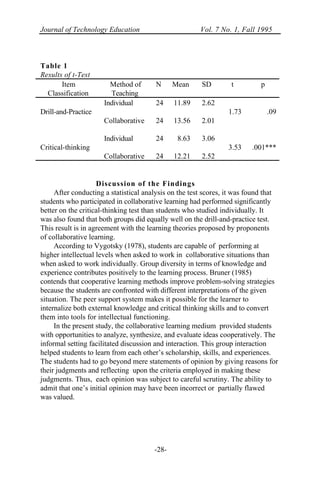
between the two groups. The result is given in Table 1. An analysis of
covariance procedure yielded a F-value that was not statistically significant
(F=1.91, p>0.05).
Research Question II
Will there be a significant difference in achievement on a test comprised
of “critical-thinking” items between students learning individually and students
learning collaboratively?
The mean of the posttest scores for the participants in the group that
studied collaboratively (12.21) was higher than the group that studied
individually (8.63). A t-test on the data showed that this difference was
significant at the 0.001 alpha level. This result is presented in Table 1. An
analysis of covariance yielded a F-value that was significant at the same alpha
level (F=3.69, p<0.001).
Journal of Technology Education Vol. 7 No. 1, Fall 1995
-28-
Table 1
Results of t-Test
Item
Classification
Method of
Teaching
N Mean SD t p
Individual 24 11.89 2.62
Drill-and-Practice 1.73 .09
Collaborative 24 13.56 2.01
Individual 24 8.63 3.06
Critical-thinking 3.53 .001***
Collaborative 24 12.21 2.52
Discussion of the Findings
After conducting a statistical analysis on the test scores, it was found that
students who participated in collaborative learning had performed significantly
better on the critical-thinking test than students who studied individually. It
was also found that both groups did equally well on the drill-and-practice test.
This result is in agreement with the learning theories proposed by proponents
of collaborative learning.
According to Vygotsky (1978), students are capable of performing at
higher intellectual levels when asked to work in collaborative situations than
when asked to work individually. Group diversity in terms of knowledge and
experience contributes positively to the learning process. Bruner (1985)
contends that cooperative learning methods improve problem-solving strategies
because the students are confronted with different interpretations of the given
situation. The peer support system makes it possible for the learner to
internalize both external knowledge and critical thinking skills and to convert
them into tools for intellectual functioning.
In the present study, the collaborative learning medium provided students
with opportunities to analyze, synthesize, and evaluate ideas cooperatively. The
informal setting facilitated discussion and interaction. This group interaction
helped students to learn from each other’s scholarship, skills, and experiences.
The students had to go beyond mere statements of opinion by giving reasons for
their judgments and reflecting upon the criteria employed in making these
judgments. Thus, each opinion was subject to careful scrutiny. The ability to
admit that one’s initial opinion may have been incorrect or partially flawed
was valued.
Journal of Technology Education Vol. 7 No. 1, Fall 1995
-29-
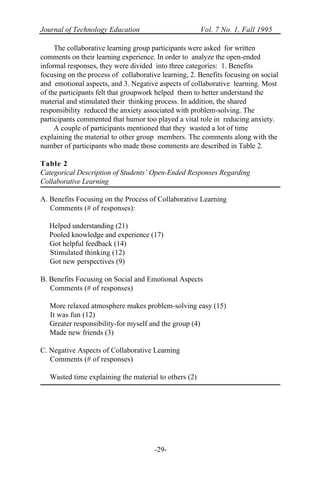
The collaborative learning group participants were asked for written
comments on their learning experience. In order to analyze the open-ended
informal responses, they were divided into three categories: 1. Benefits
focusing on the process of collaborative learning, 2. Benefits focusing on social
and emotional aspects, and 3. Negative aspects of collaborative learning. Most
of the participants felt that groupwork helped them to better understand the
material and stimulated their thinking process. In addition, the shared
responsibility reduced the anxiety associated with problem-solving. The
participants commented that humor too played a vital role in reducing anxiety.
A couple of participants mentioned that they wasted a lot of time
explaining the material to other group members. The comments along with the
number of participants who made those comments are described in Table 2.
Table 2
Categorical Description of Students’ Open-Ended Responses Regarding
Collaborative Learning
A. Benefits Focusing on the Process of Collaborative Learning
Comments (# of responses):
Helped understanding (21)
Pooled knowledge and experience (17)
Got helpful feedback (14)
Stimulated thinking (12)
Got new perspectives (9)
B. Benefits Focusing on Social and Emotional Aspects
Comments (# of responses)
More relaxed atmosphere makes problem-solving easy (15)
It was fun (12)
Greater responsibility-for myself and the group (4)
Made new friends (3)
C. Negative Aspects of Collaborative Learning
Comments (# of responses)
Wasted time explaining the material to others (2)
Journal of Technology Education Vol. 7 No. 1, Fall 1995
-30-
Implications for Instruction
From this research study, it can be concluded that collaborative learning
fosters the development of critical thinking through discussion, clarification of
ideas, and evaluation of others’ ideas. However, both methods of instruction
were found to be equally effective in gaining factual knowledge. Therefore, if
the purpose of instruction is to enhance critical-thinking and problem-solving
skills, then collaborative learning is more beneficial.
For collaborative learning to be effective, the instructor must view teaching
as a process of developing and enhancing students’ ability to learn. The
instructor’s role is not to transmit information, but to serve as a facilitator for
learning. This involves creating and managing meaningful learning
experiences and stimulating students’ thinking through real world problems.
Future research studies need to investigate the effect of different variables
in the collaborative learning process. Group composition: Heterogeneous versus
homogeneous, group selection and size, structure of collaborative
learning, amount of teacher intervention in the group learning process,
differences in preference for collaborative learning associated with gender and
ethnicity, and differences in preference and possibly effectiveness due to
different learning styles, all merit investigation. Also, a psycho-analysis of the
group discussions will reveal useful information.
References
Bruner, J. (1985). Vygotsky: An historical and conceptual perspective.
Culture, communication, and cognition: Vygotskian perspectives, 21-34.
London: Cambridge University Press.
Bloom, B. S. (1956). Taxonomy of educational objectives, handbook 1:
Cognitive domain. New York: Longmans Green.
Johnson, R. T., & Johnson, D. W. (1986). Action research: Cooperative
learning in the science classroom. Science and Children, 24, 31-32.
Rau, W. & Heyl, B. S. (1990). Humanizing the college classroom:
Collaborative learning and social organization among students. Teaching
Sociology, 18, 141-155.
Slavin, R. E. (1989). Research on cooperative learning: An international
perspective. Scandinavian Journal of Educational Research, 33(4), 231-243.
Totten, S., Sills, T., Digby, A., & Russ, P. (1991). Cooperative learning: A
guide to research. New York: Garland.
Vygotsky, L. (1978). Mind in society: The development of higher
psychological processes. Cambridge: Harvard University Press.
Webb, N. (1985). Student interaction and learning in small groups: A research
summary. Learning to Cooperate, Cooperating to Learn, 148-172.
Journal of Technology Education Vol. 7 No. 1, Fall 1995
-31-
Technology as Knowledge:
Implications for Instruction
Dennis R. Herschbach
Technology is organized knowledge for practical purposes
(Mesthene, The role of technology in society, 1969).
There is a strong belief among technology educators that technology consti-
tutes a type of formal knowledge that can be reduced to curricular elements. It
is suggested that since technology has its own knowledge and structure, its
study is similar to how one would organize the study of any other discipline in
the school, such as algebra or physics (DeVore, 1968; 1992; Erekson, 1992;
Savage and Sterry, 1990). Lewis and Gagle (1992), for example, contend that
technology educators “have two clear responsibilities; first to articulate the dis-
ciplinary structure of technology and, second, to provide for its authentic ex-
pression in the curriculum” (p. 136). Dugger (1988) argues that technology
should be considered a formal, academic discipline. Similarly, Waetjen (1993)
emphatically states that technology education “must take concrete steps to es-
tablish itself as an academic discipline” (p. 9).
This article suggests that technological knowledge is not a type of formal
knowledge similar to that associated with the recognized academic disciplines.
It has distinct epistemological characteristics that set it off from formal knowl-
edge. A deeper understanding of technological knowledge opens the curriculum
to possibilities that are obscured by a more restricted view. Greater direction is
also given to the task of curriculum development. As Taba (1962) observes,
confusion surrounding curriculum development often stems from insufficient
“analysis of what knowledge in any subject or discipline consists of. This lack
of analysis in turn causes misunderstandings about the role of knowledge in
learning and curriculum” (p. 172).
To be sure, technology embodies knowledge. Parayil (1991), for one,
Dennis R. Herschbach is an Associate Professor in the Department of Education Policy, Planning
and Administration, University of Maryland, College Park, MD.
Journal of Technology Education Vol. 7 No. 1, Fall 1995
-32-
observes that “Technology constitutes knowledge, and that all technologies are
embodiments of some form of human knowledge” (p. 292). But what kind of
knowledge, and how is it situated within the scope of human knowledge? And
how can technological knowledge be reduced to elements for inclusion in the
curriculum? It is the purpose of this article to examine these questions. It makes
little sense to talk about curricular strategies until the epistemological dimen-
sions of technological knowledge are first determined.
Technology includes important normative, social, political, and ethical as-
pects, among others. This article is limited to a discussion of the knowledge
dimension of technology, and makes no attempt to probe these other aspects.
Throughout, the discussion is informed by the work of individuals in the fields
of the history of technology and the philosophy of science and technology.
What is Technological Knowledge?
The etymology of the term “technology” is instructive. It comes from the
Greek technologia, which refers to the systematic treatment of an art (or craft).
The root techne “combines the meanings of an art and a technique, involving
both a knowledge of the relevant principles and an ability to achieve the appro-
priate results” (Wheelwright, 1966, p. 328). In other words, “technique” in-
volves the practical skills of knowing and doing. The root logos has wider
meaning, including argument, explanation, and principle, but its most relevant
use is probably “to reason.” Technology, thus, encompasses reasoned applica-
tion. Technology, however, has always meant more than abstract study because
of the emphasis on application, or doing, although the French use of the term
“implies a high degree of intellectual sophistication applied to the arts and
crafts” (Hall, 1978, p. 91). The French, in fact, are more precise in their defi-
nition and use two terms. “Technologie” is used to refer to the study of technical
processes and objects, and the term “technique” refers to the individual
technical means themselves, the actual application processes (Willoughby,
1990). The two concepts are mixed in the English use of “technology,” and this
leads to a failure to distinguish between its study and its application.
In the English language, the term “technology” acquired limited usage in
the late 19th century as a way to refer to the application of science (knowledge)
to the making and use of artifacts. In our century, formal knowledge is inextri-
cably linked with the development of science and technology. More recent schol-
ars generally emphasize the importance of knowledge in defining technol-
ogy (Layton, 1974; MacDonald, 1983; McGinn,1978;1991; Vincenti, 1984).
The recognition of the centrality of knowledge leads to conceiving technology
as more than artifact, and as more than technique and process.
The defining characteristic of technological knowledge, however, is its re-
lationship to activity. Although technological knowledge is considered to have
Journal of Technology Education Vol. 7 No. 1, Fall 1995
-33-
its own abstract concepts, theories, and rules, as well as its own structure and
dynamics of change, these are essentially applications to real situations. Tech-
nological knowledge arises from, and is embedded in, human activity, in con-
trast to scientific knowledge, for example, which is an expression of the physi-
cal world and its phenomena. As Landies (1980) observes, while the intellec-
tual is at the heart of the technological process, the process itself consists of
“the acquisition and application of a corpus of knowledge concerning tech-
nique, that is, ways of doing things” (p. 111). It is through activity that techno-
logical knowledge is defined; it is activity which establishes and orders the
framework within which technological knowledge is generated and used.
Because of the link with specific activity, technological knowledge cannot
be easily categorized and codified as in the case of scientific knowledge. Tech-
nology best finds expression through the specific application of knowledge and
technique to particular technological activities. For this reason it is not consid-
ered a discipline in the sense that math or physics is. Skolimowski (1972), for
example, suggests that there is no uniform pattern of “technological thinking,”
or, in other words, universals characterizing a “discipline of technology.” The
application of technology requires the integration of “a variety of heterogeneous
factors” which are both “multichanneled and multileveled,” and that specific
branches of technology “condition specific modes of thinking” (p. 46). Tech-
nology, in other words, makes use of formal knowledge, but its application is
interdisciplinary and specific to particular activities. There is a technology of
surveying, civil engineering, architecture, biochemistry, hog farming and
countless others, but technology is not a coherent discipline in the general
sense.
Technology and Science
The term “technology” is strongly associated with the application of
science to the solution of technical problems. Narin and Olivastro (1992)
suggest that there is a continuum stretching from vary basic scientific research,
through applied research and technology (p. 237). In some fields, on the other
hand, such as communications, computing, medicine, and chemicals, the dis-
tinction between science and technology is blurred. The most active areas of
high tech growth are often those that are very science intensive. Mackenzie and
Wacjman (1985), however, suggests that technology is more than the product of
scientific activity. In the case where “technology does draw on science the na-
ture of that relation is not one of technologies obediently working out the ‘im-
plications’ of scientific advance. . . . Technologists use science” (p. 9).
Feibleman (1972) distinguishes between pure science, which uses
the experimental method in order to formulate theoretical constructs, explicate
natural laws, and expand knowledge; applied science which focuses on applica
Journal of Technology Education Vol. 7 No. 1, Fall 1995
-34-
tions to purposeful activity; and technology which puts applied scientific
knowledge to work. Hindle (1966), however, cautions that there are fundamen-
tal, historical tensions between science and technology, and that technology is
more than applied science:
Science and technology have different objectives. Science
seeks basic understanding--ideas and concepts usually
expressed in linguistic or mathematical terms. Technology
seeks means for making and doing things. It is a question of
process, always expressible in terms of three dimensional
“things”(pp. 4-5).
One major way to distinguish between scientific and technological
knowledge is intention, or purpose (Layton, 1974; Mitcham, 1978). The pur-
pose of scientific knowledge is to understand phenomena and the laws of na-
ture. Science is about knowing. The purpose of technological knowledge, how-
ever, is praxiological, that is, to efficiently control or to manipulate the physical
world, to do things (Skolimowski, 1972). Efficiency is the end purpose of tech-
nology. Science is based on observation and predicts in order to confirm theory;
technology predicts in order to influence and control activity. Science values
the abstract and general; technology stresses instrumentation and application.
These distinctions set technology apart from science. “While science seeks to
expand knowledge through the investigation and comprehension of reality,”
suggests Layton (1974), “technology seeks to use knowledge to create a physical
and organizational reality according to human design”(p. 40).
Forms of Technological Knowledge
Vincenti (1984) identifies three categories of technological knowledge: a)
descriptive, b) prescriptive, and c) tacit. Both descriptive and prescriptive are
categories of explicit technological knowledge, but descriptive knowledge de-
scribes things as they are, while prescriptive knowledge prescribes what has to
be done in order to achieve the desired results. Tacit knowledge is implicit in
activity.
Descriptive knowledge
Descriptive knowledge represents statements of fact which provide the
framework within which the informed person works, such as material proper-
ties, technical information, and tool characteristics. These facts are often appli-
cations of scientific knowledge. Carpenter (1974), however, observes that while
mathematical formulae or scientific constructs are used, descriptive knowledge
is not scientific in the sense that the explanatory theoretical framework is not
fully developed, and Frey (1989) observes that while there may be correlates
Journal of Technology Education Vol. 7 No. 1, Fall 1995
-35-
between the two, in the case of technological knowledge there are “certain
properties not apparent in, or derived from, scientific theory” (p. 26). Neverthe-
less, descriptive knowledge approaches an approximation of the formal knowl-
edge of a “discipline” since it describes things as they are, it can be in the form
of rules, abstract concepts and general principles, and it often has a consistent
and generalizable structure. Like all technological knowledge, however, descrip-
tive knowledge finds its meaning in human activity.
Prescriptive knowledge
Prescriptive knowledge results from the successive efforts to achieve
greater effectiveness, such as improved procedures or operations, and is altered
and added to as greater experience is gained. McGinn (1978), however, cau-
tions that prescriptive knowledge is more than simple “nonintellectual know
how;” it may be “comparable with the achievement of new intellectual knowl-
edge;” and it is “often undergirded by such knowledge” (p. 186). Mitcham
(1978) identifies technical maxims or rules of thumb as “pre-scientific work”
and “first attempts to articulate generalizations about the successful making or
using skills” (p. 256). Prescriptive knowledge generated through experimenta-
tion, trial-and-error, and testing is used in specific ways to make predictions “at
what might be termed a pre-theoretical level” (McGinn, 1978, p. 187). Because
prescriptive knowledge is less wedded to scientific principles and law, however,
and because it is an outgrowth of specific application, it is not easily codified in
a general form, and therefore it is less amenable to the formulation of instruc-
tional generalizations that go beyond a particular activity. “The easier a knowl-
edge is codified, the easier it [can] be transmitted,” observes Perrin (1990, p. 6).
Tacit knowledge
Tacit knowledge is implicit, and is largely the outcome of individual
judgement, skill and practice (Polanyi, 1967). Tacit knowledge cannot be
easily expressed formally. Descriptions, diagrams, and pictures help to explain
tacit knowledge, but it largely results from individual practice and experience.
Tacit knowledge often constitutes the “tricks of the trade” experienced workers
learn, and it is often protected or restricted knowledge (Vincenti, 1984). “Many
of the crucial, incremental improvements in process technology, for instance,
occur on the shop-floor,” Scarbrough and Corbett (1992, p. 8) note. Specialists,
however, simply do not reveal all that they know. Tacit and prescriptive knowl-
edge is closely related in practice since in both cases it has to do with procedures.
Both types of knowledge are procedural (Vincenti, 1984).
A large part of tacit knowledge cannot be transmitted through
written or oral form. It is personal knowledge, it is subjective knowledge,
Journal of Technology Education Vol. 7 No. 1, Fall 1995
-36-
and it is immediate and specific knowledge. Tacit knowledge is primarily
learned by working side by side with the experienced technician or craftsman.
Tacit knowledge is mainly transmitted from one individual to another. Perrin
(1990) suggests that operational knowledge primarily “remains tacit because it
cannot be articulated fast enough, and because it is impossible to articulate all
that is necessary to a successful performance and also because exhaustive atten-
tion to details produces an incoherent message” (p. 7).
Tacit knowledge is embedded in technological activity to a greater extent
than is normally recognized. In addition, tacit knowledge has not disappeared
with the use of more sophisticated ways of manufacturing based on the applica-
tion of science and descriptive technical knowledge. “On the contrary, new
forms of know-how have appeared and all these non-codified techniques play
an important role in industrial production and in technical and technological in-
novation” (Perrin, 1990, p. 6). Rosenberg (1982) and Vincenti (1984) high-light
the fact that even the so-called high-tech industries, such as aircraft pro-duction,
electronics and telecommunications, rely heavily on tacit knowledge learned
through experience. Considerable industrial innovation is acquired through non-
codified techniques. Polyani (1967) has demonstrated that all human action in-
volves some form of tacit knowledge.
Levels of technological knowledge
While incorporating the categories of knowledge identified by Vincenti
(1984), Frey (1989) calls attention to different levels of technological knowl-
edge, and observes that “the amount of discursive knowledge increases as the
complexity of technological knowledge increases” (p. 29). Artisan, or craft
skills constitute the lowest level, and are largely tacit, although prescriptive,
and to a lesser degree descriptive knowledge is involved. Because of the high
level of tacit knowledge, artisan skills are best taught through observation, imi-
tation, and trial and error, rather than through discourse. Frey (1989) ob-
serves, for example, that “a highly skilled welder ‘knows’ how to weld but very
likely cannot articulate exactly how welding is accomplished” (p. 29).
Technical maxims comprise the next level of technological knowledge, and
consists of generalizations about the skills applied in making or using technol-
ogy. Technical maxims, however, are usually incomplete without the less rec-
ognized tacit knowledge accompanying the actual doing (Carpenter, 1974). For
this reason, technical maxims, rules, recipes, and procedures are usually
learned best in conjunction with on-going activity, often on the job.
Descriptive laws, the next level, are “scientific like” explicit, generalized
formulations derived directly from experience. Because they are derived from
experience they are referred to as empirical laws, and are mainly formulated on
the basis of try-out and observation (Mitcham, 1978). Descriptive laws are not
Journal of Technology Education Vol. 7 No. 1, Fall 1995
-37-
yet scientific because they lack sufficient explanatory theory, although they may
be highly sophisticated and use formula and mathematical equations in addition
to verbal description. Descriptive laws lend themselves to formalized instruc-
tion.
At the highest level are technological theories which systematically
relate a number of laws or provide a coherent explanatory framework.
Technological theories are applications of scientific knowledge to real situa-
tions. One characteristic of modern technology is that greater use is made of
theoretical knowledge, and in this sense technology approximates a
“discipline.” However, to say that theory is becoming an increasing part
of technological knowledge does not lessen the importance of prescriptive
and tacit knowledge generated through practical experience (Willoughby,
1990), or change the fact that the contextual meaning of technological
theories derives from application (Perrin, 1990).
There is an inexact, then, but nevertheless real correlation between
the complexity of technological knowledge, eventual work levels and formal-
ized instruction. Craft and artisan activities make considerable use of tacit
know-how associated with manual or process skills that can be best learned on
the job. At a highest level are descriptive laws and technological theories em-
bedded in job activity. Engineers and technicians work at this level and receive
most of their training through formal instruction. In between are technical jobs
which make heavy use of descriptive and prescriptive knowledge learned both
on and off the job. But all jobs use tacit knowledge.
Instructional Implications
Technological knowledge may have the appearance of a formal discipline,
but it is a qualified form of knowledge. There is not a clearly generalizable,
representative structure characterizing all of technology, as one finds in phys-
ics, biology or economics. Technological knowledge acquires form and purpose
in specific human activity; the character of technological knowledge is defined
by its use; and efficiency, rather than understanding is its objective (Layton,
1974; McGinn, 1978; 1989; Parayil, 1991; Perrin, 1990; Skolimowski, 1972).
Those who conceive of technology as a discipline confuse technique in the
French sense of the term, with the knowledge of a formal discipline. Although
technique embodies knowledge, it is a particular form of knowledge applied to
a discrete technological activity in contrast to the general abstractions which
characterize formal knowledge.
Technology draws from formal knowledge, such as that found in the
sciences and math, but it does so selectively and in response to specific appli-
cations. It is interdisciplinary in its use of formal knowledge. Technology also
includes its own abstract concepts, theories, rules, and maxims but again, these
Journal of Technology Education Vol. 7 No. 1, Fall 1995
-38-
are grounded in application, or praxis. A considerable proportion of techno-
logical knowledge is prescriptive and tacit, and difficult to codify and general-
ize. The form as well as the complexity of technological knowledge is related to
the kind and level of technological activity. Isolated from activity and removed
from the implementing context, much of technological knowledge loses its
meaning and identity.
Knowledge as discipline
The prevailing tendency among some technology educators to conceive of
technology as a discipline is understandable. There are enormous public pres-
sures for the school to become more academic and more rigorous. School re-
form has been promoted by social conservatives as an essential step in making
the country more productive and competitive (Giroux, 1988). “Soft” subjects,
such as art, music, technology education and health have been de-emphasized
in favor of renewed emphasis on language, science and math. Proponents of
“back to basics” have called for the teaching of explicit academic skills, student
assessment and national measures of performance as a way to strengthen
instruction (Newman, 1994). By couching technology in terms of a discipline,
the expectation is that technology education will have greater appeal to the
educational public, and that the subject can distance itself from its historical ap-
plicative roots. In other words, technology education too can emphasize the ac-
quisition of knowledge and the development of intellectual skills.
Historically and currently, disciplines are treated in the curriculum as sepa-
rate subjects and emphasis is on the ideational. To conceive of technology pri-
marily as a discipline, however, is not only erroneous but limiting for curricu-
lum development purposes. Important epistemological distinctions are ignored
which are at the heart of understanding technological knowledge and its instruc-
tional use. Technology education can make a distinctive educational contribution
even though it is not conceived of as a discipline.
Technology as instruction
The primary distinguishing characteristic of technological knowledge is
that it derives from, and finds meaning, in activity. Accordingly, there is a
number of implications for curriculum development. First, technological
knowledge is most clearly specified when it is linked to specific activity, such
as testing the strength of material, calculating environmental damage, pro-
gramming a computer, tuning a violin, or plucking poultry. The technological
activity conditions the use of knowledge. It is through activity that both the
structure and substance of technological knowledge can be identified, and
hence, generalized to instruction. Moreover, since much of technological
Journal of Technology Education Vol. 7 No. 1, Fall 1995
-39-
knowledge is difficult to codify, an abstract treatment is incomplete without the
accompanying activity.
Technology makes extensive use of formal, abstract knowledge, mainly
from the sciences and mathematics, but this knowledge does not constitute a
discipline because it is primarily a manifestation of the selective use of disci-
plines. Formal knowledge used in the technological sense lacks a coherent,
independent and generalizable conceptual framework, since it is the techno-
logical activity itself that is integrative and provides the intellectual structure.
For this reason, formal knowledge should not be conceived as a body of content
to be mastered, but as a correlative to activity. Technological activity conveys to
the learner the distinct ways that formal knowledge is used.
Technological knowledge, then, is more than a compendium of informa-
tion to be transferred to the student; it is more than various facts, laws, theories,
concepts and general information proffered to students. Technical knowledge is
dynamic, and meaning is constructed and reconstructed as individuals grapple
with the use of knowledge, whether it be conceptual, analytical or manipulative.
Generalizations, theories, principles, technical maxims and procedures take on
meaning as they are applied to practical applications. Activity helps make ex-
plicit to the learner how knowledge is generated, communicated and used to
analyze and solve technological problems. Then again, knowledge becomes intel-
ligible through activity as it is categorized, classified and given form; through
technological activity students are helped to perceive, understand, and assign
meaning. Effective instruction, in other words, includes the distinct ways
through which technological knowledge is generated, used, assigned meaning,
and reconstructed.
The intellectual processes which are employed are themselves a meaning-
ful focus of instruction (California Department of Education, 1990). Processes
are the integrative concepts that unite activity and knowledge. Technological
knowledge is created, used, and communicated through such processes as ob-
serving, formulating, comparing, ordering, categorizing, relating, inferring,
applying, correcting, and diagnosing. Technology, then, is not only content to
be learned but the vehicle though which the intellectual processes embedded in
technological activity can themselves be learned.
All three kinds of technological knowledge are important for instructional
purposes. There is probably a general tendency to underestimate the extent and
importance of the tacit dimensions of technological knowledge. But beyond the
more easily codified descriptive and prescriptive forms of knowledge that inform
technological activity, there is a wide array of subjective and tacit forms which
are not as readily communicable, but which, nevertheless, substantially influence
how technological activity is carried out.
Journal of Technology Education Vol. 7 No. 1, Fall 1995
-40-
For curriculum development purposes, it is difficult to generalize from
technological knowledge because of its contiguous link with a specific kind and
level of activity. If technological knowledge is broadly defined, it loses much of
its usefulness. When generic terms like “technological literacy” or
“technological method,” for example, are not associated directly with specific
activity they become operationally meaningless for developing curricula. They
mean very little outside of the context in which they are applied, and there are
few conceptual guidelines for selecting content (Taba, 1962).
Finally, technology education has not capitalized on what is probably
its most important potential educational value, namely, its interdisciplinary
character. Technology draws content from across different fields of inquiry. It
provides a way to integrate learning, not only with other fields, but with pur-
poseful activity. And knowledge is applied at the prescriptive, descriptive as
well as tacit levels. Learning is truly integrative. Few other subject fields have
the capability to integrate as fully interrelated fields of knowledge, based on the
ordered activities of these fields as they are applied to the acquisition, use and
reconstruction of technological knowledge and technique.
References
California Department of Education (1990). Science framework for California
public schools kindergarten through grade twelve. Sacramento.
Carpenter, S. (1974). Modes of knowing and technological action. Philosophy
Today, 18(2), 162-168.
DeVore, P.W. (1992). Introduction to transportation technology. In J.R. Wright
and S. Komacek (eds.). Transportation in technology education, 41st year-
book, Council of Technology Teacher Education. Columbus, OH: Glencoe,
1-32.
DeVore, P.W. (1968). Structure and content foundations for curriculum devel-
opment. Washington, DC: American Industrial Arts Association.
Dugger, W.E. (1988). Technology--the discipline. The Technology Teacher,
48 (1). 3-6.
Erekson, T. (1992). Technology education from the academic rationalist
theoretical perspective. Journal of Technology Education, 3(2), 7-16.
Feibleman, J.K. (1972). Pure science, applied science and technology: An
attempt at definitions. In C. Mitcham and R. Mackey (eds.). Philosophy and
technology. New York: Free Press.
Frey, R.E. (1989). A philosophical framework for understanding technology.
Journal of Industrial Teacher Education, 27(1), 23-35.
Giroux, H. (1999). Schooling and the struggle for public life. Grandby, Mass:
Bergin and Garvey.
Hall, R.A. (1978). On knowing, and knowing how to . . . . In A. R. Hall and
N.
Journal of Technology Education Vol. 7 No. 1, Fall 1995
-41-
Smith (eds.), History of technology. Third annual volume. London: Man-
sell.
Hindel, B. (1966). Technology in early America. Chapel Hill, N.C.: University
of North Carolina Press.
Landies, D. (1980). The creation of knowledge and technique: Today’s task
and yesterday’s experience. Deadalis, 109 (1), 11-120.
Layton, E. (1974). Technology as knowledge. Technology and culture, 15(1),
31-41.
Lewis, T. and Gagel, C. (1992). Technological literacy --A critical analysis.
Journal of Curriculum Studies, 24 (2), 117-138.
MacDonald, S. (1983). Technology beyond machines. In S. MacDonald, The
trouble with technology. London: Frances Pinter.
MacKenzie, D. and Wajcman, J. (1985). The social shaping of technology.
Milton Keynes: Open University.
McGinn, R.E. (1978). What is technology? Research in Philosophy and
Technology, 1,179-197.
Mesthene, E.G. (1979). The role of technology in society. In A. H. Teich (ed.),
Technology and the future. New York: St. Martin’s Press, pp. 77-99.
Mitcham, C. (1978). Types of technology. Research in philosophy and
technology, I, 229-294.
Narin, F. and Olivastro, D. (1992). Status report: Linkage between
technology and science. Research Policy, 21(3), pp. 237-249.
Newman, J.W. (1994). American teachers. New York: Longman.
Parayil, G. (1991). Technological knowledge and technological change.
Technology and Society, 13(2), 289-304.
Perrin, J (1990). The inseparability of technology and work organizations.
History and Technology, 7(1), 1-13.
Polanyi, M. (1967). The tacit dimension. New York: Doubleday Anchor.
Rosenberg, N. (1982). Inside the black box: Technology and economics.
Cambridge, UK: Cambridge University Press.
Scarbrough, H. and Corbett, J.M. (1992). Technology and organization
power, meaning and design. New York: Routledge.
Savage, E. and Sterry, L. (1990). A conceptual framework for technology
education. Reston: VA: International Technology Education Association.
Skolimowski, H (1972). The structure of thinking in technology. In C.
Mitcham and R. Mackey (eds.). Philosophy and technology: Readings in the
philosophical problems of technology. New York: Free Press, 42-49.
Taba, H. (1962). Curriculum development theory and practice. New York:
Harcourt Brace Jovanovich.
Vincenti, W.G. (1984). Technological knowledge without science: The
innovation of flush riveting in American airplanes, ca. 1930-ca. 1950.
Journal of Technology Education Vol. 7 No. 1, Fall 1995
-42-
Technology and Culture, 25(3), 540-576.
Waetjen, W.B. (1993). Technological literacy reconsidered. Journal of Technol-
ogy Education, 4(2), 5-11.
Wheelwright, P.E. (1966). The presocratics. New York: The Odyssey Press.
Willoughby, K.W. (1990). Technology choice a critique of the appropriate
technology movement. Boulder and San Francisco: Westview Press.
Journal of Technology Education Vol. 7 No. 1, Fall 1995
-43-
For a History of Technology Education:
Contexts, Systems, and Narratives
John R. Pannabecker
In his paper on “Shaping the Future of a Profession,” Waetjen (1992)
challenged technology education to establish itself as an academic discipline.
He emphasized four elements common to disciplines: domain, history, mode of
inquiry, and instructive capability. In assessing these elements, Waetjen noted
the lack of a history of technology education and also recommended the devel-
opment of a framework for such a history.
This paper focuses on several historiographical issues that need to be con-
sidered in developing a framework for a history of technology education. His-
toriography is concerned with how we select and interpret historical data and
how we conceptualize and write history. For example, Bennett (1926, 1937),
one of the best known American historians of industrial education, usually fo-
cused on aspects associated with industrial education but rarely interpreted
them in the broader social context.
Today, technology educators are expected to help students interpret tech-
nology in the context of society. Consequently, Bennett cannot be considered an
adequate guide to the heritage of technology education. Furthermore, technol-
ogy education claims a wider scope of content and more explicit reflection on
solving problems than industrial education. Thus, a history of industrial educa-
tion is not adequate for understanding the heritage of technology education.
This paper is divided into three main sections, the first of which is con-
cerned with technology education and society. The second section addresses
narrative and systems approaches to historical data and is followed by a third
section that illustrates these different approaches through two examples.
Technology Education in Society
In addition to having a general historical background, historians of tech-
nology education need to become familiar with specialized bodies of historical
literature such as the history of technology, social history, or history of educa-
John R. Pannabecker is a Professor in the Technology Department, McPherson College, McPher-
son, KS.
Journal of Technology Education Vol. 7 No. 1, Fall 1995
-44-
tion.1
The issues central to this essay arise out of recent literature in the history
of technology, especially as reflected in the work of members of the Society for
the History of Technology (SHOT) in its journal Technology and Culture.
Within SHOT, there has been much reflection on technology, its historical re-
lationships to other aspects of society, and alternate approaches to writing his-
tory. But as recently as 1974, two authors still stressed the lack of a “conceptual
framework” for the history of technology (Staudenmaier, 1985, p. 7).
In Technology’s Storytellers, published jointly by SHOT and MIT Press,
Staudenmaier (1985) analyzed the articles that had appeared in Technology
and Culture from 1959 to 1980. Staudenmaier (1985) initially classified articles
into three broad historiographical categories: internalist, externalist, and contex-
tualist. Although there is considerable historiographical diversity among articles
in these categories, the categories are pedagogically useful.
Definitions: Internalist, Externalist, and Contextualist
In internalist history, attention is focused primarily on the artifact rather
than on how it relates to social context. For example, an internalist history of
the bicycle or computer would focus primarily on the design and construction of
bicycles and computers and perhaps some of the people and places directly asso-
ciated with their development.
An externalist approach is almost the exact opposite of the internalist. Here
the artifact is granted only marginal attention or treated more as an illustration.
For example, the development of bicycles or computers might be included in a
broader study of social or political history. While there might be some attention
given to technical changes, the technological artifacts do not occupy a central
position.
1
The focus here on the history of technology education and the history of technology is not in-
tended to diminish the importance of other specialized historical literature such as the history of
education. Unfortunately space only permits several suggested readings that would contribute to a
better understanding of the possibilities for historical research in technology education. For exam-
ple, Cremin (1988), Tanner (1991), Tanner and Tanner (1990), Cuban (1984), and Kliebard
(1992) represent contemporary approaches for a historical background in education. Goodson and
Walker (1991), Short (1991), and Schubert (1986) include various approaches to curriculum in-
quiry and historiographical issues. Kantor and Tyack (1982), Kliebard (1987), and Wirth (1983)
take a critical historical approach to education, industry, work, and economic issues. DeBoer’s
(1991) treatment of American science education (including STS programs and scientific literacy)
and McCulloch, Jenkins, and Layton (1985) on the politics of school science and technology in
England and Wales are especially pertinent. Goodson (1987) combines issues in curriculum history
with an international perspective. See Jasanoff, Markle, Petersen, and Pinch (1994) for a compre-
hensive resource on science and technology studies published in cooperation with the Society for
Social Studies of Science (4S); and Restivo (1991) for a broad overview of sociological perspec-
tives.
Journal of Technology Education Vol. 7 No. 1, Fall 1995
-45-
A contextualist approach shows “the internal design of specific technolo-
gies as dynamically interacting with a complex of economic, political, and cul-
tural factors” (Staudenmaier, 1985, p. 11). Current trends in the history of
technology tend to favor contextualist history. Such approaches emphasize the
particularities of the social and historical conditions in which different technolo-
gies have developed. In so doing, they have avoided the excessively deterministic
implications of so many internalist histories.
Still, SHOT is not a monolithic group of historians. They may have, in
Staudenmaier’s terms, a “shared discourse,” but the lines between internalist,
contextualist, and sometimes externalist styles are not always sharply defined.
Many people would agree that contextualist history at its best includes detailed
accounts of technological systems. For example, Hughes (1983) has shown in
considerable detail how electrical power systems developed differently in several
different countries. Contextualist history builds on an earlier consciousness of
technical differences as illustrated in internalist history but also reflects a con-
comitant awareness of how social factors influence design and development.
Analysis: Contextualist History in Technology Education
In view of the importance that technology education places on understand-
ing technology in society, contextualist history might appear to be the most
appropriate approach. Yet there are potential problems as can be learned from
historians of technology. For instance, while SHOT has drifted towards a pre-
dominance of contextualist approaches, this drift seems to be linked to the most
recent generation of historians of technology, many of whom were trained as
historians, not as technologists. These historians have benefited from many of
the fine and extensive internalist histories of technology.
This issue will not go away easily. In fact, it was considered so important
by SHOT that the T&C [Technology and Culture] Editor Search Committee
(1994) recently required applicants to react to comments made by Leo Marx
(1991) that were critical of the contextualist trend. Marx recognized the
strengths and limitations of both sides of the issue. His argument was provoca-
tive and needs to be taken seriously by technology educators as well. “Yet its
[contextualist viewpoint] triumph, oddly enough, makes the rationale for this
specialty [history of technology] even more dubious than that put forward by
the internalists” (Marx, 1991, p. 395).
In contrast to historians of technology, technology educators do not do
history as their primary occupation. The history of industrial arts was primarily
internalist and was never as extensive in scope or depth as the history of tech-
nology. But while technology education is extremely broad in scope, the central
interest of technology educators is education in and about technology, that is,
Journal of Technology Education Vol. 7 No. 1, Fall 1995
-46-
how people teach, learn, and otherwise transmit technological knowledge and
how people can learn to (re)construct technological artifacts and culture.
While it may be philosophically sound to do contextualist history of tech-
nology education, practically it is difficult because of the time required to as-
similate the social context, technology, and educational practice of a given time
period. Initially, technology educators might start by writing in-depth articles
that focus on specific aspects of the heritage of technology education, but at the
same time, include sufficient background material to emphasize relationships
between education, technology, and society. This represents a kind of middle
ground, that is, internalist studies but presented in context.
Narratives and Systems
The second historiographical issue in this paper concerns narrative versus
systems interpretations. This issue was addressed through a debate format in
three articles in Technology and Culture on the strengths and weaknesses of
narrative versus systems theory as organizing methods in historical writing
(Buchanan, 1991; Law, 1991; Scranton, 1991).
Distinctions: Narrative and Systems Approaches
At one end of the spectrum, the historian collects evidence and then writes
an individualist, yet coherent, narrative account as response to the research
questions. At the other end of the spectrum, social science models or frame-
works are used to organize and interpret historical evidence.
Narrative history places considerable value on collecting all the available
evidence related to the particular questions posed for the study, and then sub-
jecting the evidence to an evaluation of its relative importance or influence. At
the same time, the historian searches for a coherent network of relationships
among the pieces of evidence in order to provide a satisfactory set of answers to
the research questions. Through this critical analysis of evidence, the historian
then writes a narrative that becomes a secondary account of the subject. Admit-
tedly, there exist certain biases in the posing of the questions, the evaluation of
evidence, and the construction of a coherent network and secondary text. Nar-
rative historians would claim, however, that to adopt an explicit theoretical
model to explain or organize historical evidence constitutes even more of a
bias.
Social science models used for historical analysis are usually contemporary
in design, for example, as illustrated in The Social Construction of Technology
(Bijker, Hughes, & Pinch, 1987) and thus lend an anachronistic element to the
account. Similarly, econometric approaches to history generally use contempo-
rary economic theory and quantitative analysis, not the theories prevalent at the
time of the historical topic under study. But Law’s position as a social scientist-
Journal of Technology Education Vol. 7 No. 1, Fall 1995
-47-
historian to this issue is relatively simple. “It is that narrative history and social
science theory are driven by different kinds of concerns and interests” (1991, p.
377). He further points out that narrative historians and social scientists have
much to learn from each other because of their different approaches.
Analysis: Systems and Narrative in Technology Education
The reason that this debate is so important for the history of technology
education is that technology educators (including industrial arts educators)
have traditionally been trained in educational methods heavily influenced by
social science methods. In addition, the notion of “systems” has become in-
creasingly influential in curriculum and methods design. Thus, one might think
that technology educators’ background in social science models, engineering
models, and quantitative methods would lead them towards the use of such
models in historical writing.
It is paradoxical then that the historical approach most common in the
field seems to be narrative as illustrated by Bennett (1926, 1937). For the most
part, subsequent historical writing has usually followed Bennett’s approach as
if there were no other approach. This situation can be explained largely by the
scarcity of historical inquiry and conservatism in research methods in technology
education.
Given the scarcity of historical research in technology education, both
critical narrative and social science approaches are needed, but their differences
affect the formulation of research questions and the representation of history.
For example, well-known “systems” such as the “input, process, output, feed-
back” model and the “content cluster” model are weak in explanatory power in
both technical and historical contexts. For historical research, the models found
in Bijker, Hughes, and Pinch (1987) are more integrative in terms of context
and serve at the same time to undercut the credibility of simple, linear models
such as the “input, process, output, feedback” model. Nevertheless, all models
risk presenting a distorted view if historical evidence is “force fit” into them.
Two Examples: Narrative and Systems Approaches
This section illustrates a narrative and a systems approach to the history of
technology education through a new look at two major educational artifacts.
The first artifact is Denis Diderot’s massive Encyclopédie, published from
1751-1772, distributed widely in Europe, and introduced into the United States
by Thomas Jefferson. The second artifact is the Russian system of tool instruc-
tion developed at the Moscow Imperial Technical School in the late 1860s and
adopted shortly thereafter in some schools in the United States. Both are rela-
tively well known and have generated secondary critical literature. Diderot’s
work sought to disseminate technological knowledge by representing the me
Journal of Technology Education Vol. 7 No. 1, Fall 1995
-48-
chanical arts systematically in texts and illustrations; the Russian system sought
to integrate systematic representation of the mechanical arts with practical in-
struction.
Historiographical Background
When Bennett (1937) discussed the Russian system of tool instruction, he
focused on the instructional system. Bennett acknowledged the role of some
people in the development of the Russian system (e.g., Della Vos) and in its
transfer to the United States (e.g., Runkle), but he did not examine the Russian
social context to understand why such a system was developed in Russia. Nor
did he examine the American social context in detail to understand why it was
transferred to America.
Bennett’s approach was primarily internalist in conception, though he did
attempt to connect the Russian system to something else, noting that “the theo-
retical instruction [of the Russian system] is said to have resembled that given
at the Ecole Centrale des Arts et Manufactures in Paris” (1937, p. 15). But he
did not say who said this nor did he elaborate on further connections. Nor do
we know from his chapter precisely how the Russian system differed from other
systems of technological education at the time. In all fairness to Bennett, it was
neither his main purpose nor did he have space to account for the influence of
similar programs or precursors. Although he recognized the existence of earlier
attempts to analyze the mechanical arts, he suggested that “there seems to be no
available evidence that any adequate analysis of the mechanic arts was made
until 1868 when the Russian system of workshop instruction was devised by
Della Vos and his associates for use in the Imperial Technical School at Mos-
cow” (Bennett, 1937, p. 14). It seems difficult to justify this claim since there
had already been many analyses of various arts and crafts prior to the Russian
system. But Bennett probably meant the first analysis of the mechanical arts
specifically for use in schools.
On the other hand, Marcus and Segal (1989), in a recent general history of
technology in America that is contextualist in orientation, referred to the Rus-
sian system of tool instruction as an educational example in engineering educa-
tion (p. 170). But they included few details and did not mention it in their
discussion of the growth of industrial education (pp. 241-243). Some historians
of American education have described briefly the influence of the Russian system
in American education, though without considering the Russian context of its
own development (e.g., Cremin, 1961, pp. 25-29; 361; Cremin, 1988, pp. 223-
224; Kliebard, 1987, pp. 130-131).
How then would a contextualist account treat the Russian system?
Schurter (1982) made a substantial contribution to understanding the original
context, development, and introduction of the Russian system into the United
Journal of Technology Education Vol. 7 No. 1, Fall 1995
-49-
States. Unfortunately, Schurter’s dissertation is not well known, but it repre-
sents a major step in providing context for a well-known educational endeavor
in the heritage of technology education. One might consider it internalist “in
context.”
Several years after Schurter’s work, I attempted to interpret the develop-
ment of the Russian system in the context of Russian history, economics, and
society and found that the Russian system occurred at about the same time as
the emancipation of serfs, increased importation of skilled foreign workers, and
a relatively high growth rate of the economy in certain sectors (e.g., iron, steel,
railroads) (Pannabecker, 1986). Neither Russia nor the United States had a
history of influential guild systems. Other similarities between the two coun-
tries can be identified, such as the emancipation of slaves and a high economic
growth rate in America. While my essay broadened the frame of reference, it
was really an attempt to understand why Russia and America might both have
been so receptive to such a teaching system. It did not develop a clearer under-
standing of the educational differences in style between the Russian system and
other influential educational endeavors and thus must be considered more exter-
nalist than contextualist. Unfortunately, it was somewhat deterministic in con-
ception (a perspective which I have since critiqued, Pannabecker, 1991). It is
unclear whether anyone has shown how the design of the Russian system and
other related systems developed interactively in social context.
Narrative Approach
This narrative approach is intended to illustrate briefly the complexity of
connections between the Russian system and earlier attempts to systematize and
disseminate technological knowledge, in this case, Diderot’s Encyclopédie. In
so doing, I enlarge the context for understanding the Russian system but at-
tempt to avoid a systems approach. I then suggest avenues of research that
would expand our knowledge of the heritage of technology education.
According to Schurter (1982), Ershov, the original designer of the Russian
system, had studied in western Europe and took courses from Morin at the
Conservatoire National des Arts et Métiers (CNAM) in Paris (pp. 95-98; 136).
Diderot’s work on the Encyclopédie was centered at Paris in the 1750s and
1760s and would have been well known at CNAM (founded in 1794) when
Ershov studied there in the nineteenth century. Of course, other earlier sys-
tematic descriptions of some of the arts and crafts would also have been avail-
able. But Diderot’s work was particularly important because of its scope and
extremely wide dissemination. For example, Durfee (1893) considered the
French to be a leader in precision tools for making clocks and watches and re-
ferred on several occasions to Diderot’s Encyclopédie as documentary evidence
Journal of Technology Education Vol. 7 No. 1, Fall 1995
-50-
of advanced machine tool design (e.g., milling machine [p. 1236]; lathe slide
rest [p. 1241]).
Catherine II of Russia (1729-1796) was so interested in the ideas of the
French Enlightenment that she invited Diderot to visit her in Russia. He com-
plied in 1773, despite his general adversity to long trips. Diderot was a friend
of Ivan Betskoi, educational advisor to Catherine II and director of the Moscow
Foundling Home which would eventually evolve into the Moscow Trade School
and then the Moscow Imperial Technical School. During his visit to Russia,
Diderot was made an honorary curator of the institution (Schurter, 1982, pp.
45-57). Prior to his visit, when Diderot was in debt, Catherine had purchased
his library in Paris on condition that it remain in his dwellings for his personal
use until she asked for it (Crocker, 1966, p. 344). The point here is that
Diderot’s work, his systematic representations of the arts and crafts, and Enlight-
enment ideas were well known in Russia. Ershov was following a tradition of
systematized knowledge, social ideas, and technological education that can be
easily traced to the French Enlightenment.
At the same time, there were numerous attempts to systematize actual pro-
duction, that is, to transform the arts and crafts into manufacturing systems.
For example, when Adam Smith published his now famous economic treatise
The Wealth of Nations in 1776, he referred to the systematic manufacture of
pins, as had been illustrated in Diderot’s Encyclopédie and Chambers’ Cyclopae-
dia (Smith, 1937, pp. 3-5 and editor’s note no. 6).
Somewhat later, Thomas Jefferson promoted the dissemination of
Diderot’s work and also encouraged the American government to pursue uni-
formity in the manufacture of arms as pioneered by two Frenchmen--
Gribeauval in the 1760s and Blanc in the 1780s. Jefferson wrote of Blanc’s
ideas to John Jay in 1785 and discussed with Blanc in 1788 the possibility of
moving his operations to the United States (Durfee, 1893, 1893-94; Hounshell,
1984, pp. 25-26). Eventually, some of these ideas could be found in the work of
Eli Whitney (Hounshell, 1984, pp. 25-26). In America in the 1820s, Thomas
Blanchard made gunstock-making machinery for producing uniform stocks and
included an acknowledgment of Diderot’s Encyclopédie as one of the sources
for his ideas of turning objects through the use of cams (Durfee, 1893, p. 1243;
Smith, 1977, p. 125).
The particular emphasis that the American government placed on uni-
formity or interchangeability in parts in the nineteenth century led to what has
come to be known as the “American system of manufacturing.” Still, Houn-
shell mentioned the case of an armsmaking plant at Tula in Russia that, accord-
ing to Richard Prosser, was carrying out mechanized arms production using
English machinery in the 1820s. Prosser called this the “Russian plan”
(Hounshell, 1984, p. 24).
Journal of Technology Education Vol. 7 No. 1, Fall 1995
-51-
The preceding narrative illustrates some of the connections that existed
among people, places, and systematic approaches to the diffusion of technology
prior to the Russian system of tool instruction. To avoid confusion, it is impor-
tant to note that three different types of technology-related systems are in-
cluded: (a) industrial production systems; (b) representational systems of tech-
nology in books (texts and drawings); and (c) instructional systems, in this
case, the Russian system of tool instruction. Nevertheless, the historiographical
approach is narrative; it describes connections, without organizing the data
according to a system.
Systems Approach
How then might one approach some of the historical evidence from a sys-
tems approach? Probably the most comprehensive single source for identifying
possible systems approaches can be found in Bijker, Hughes, and Pinch (1987)
and its 24-page bibliography. This work also discusses the limitations of differ-
ent approaches.
The Russian system as described and illustrated by Bennett (1937) has
some similarities with the representations of the mechanical arts in Diderot’s
Encyclopédie. In each case, an attempt was made to reduce practice into small
elements and then to represent these elements as part of a system for instruction
or another form of disseminating knowledge. A systems approach might help to
distinguish between these two systems and to show how technological knowl-
edge was viewed in different contexts.
For example, in order to analyze technological knowledge as represented in
Diderot’s Encyclopédie, I adapted Collins’(1987) model for analyzing know-
ledge (Pannabecker, 1992). Collins illustrated this model in The Social Con-
struction of Technology, applying it to the various types of knowledge he found
in the process of designing a particular kind of laser. He identified four basic
categories of technological knowledge: (a) facts and rules; (b) heuristics; (c)
perceptual and manipulative skills; and (d) cultural skills. He also explained
how various types of knowledge can shift across categories or boundaries over
time. Collins’ model can be considered representative of a social science ap-
proach, though as Law (1991) has noted, there is considerable diversity among
such models.
I selected two known contributors to Diderot’s Encyclopédie and their re-
spective contributions on printing. Brullé wrote the article on letterpress print-
ing and Goussier designed the accompanying plates and wrote their descrip-
tions. Through this systems approach, I was able to distinguish their styles of
describing printing technology and the extent to which they adhered to or de-
viated from Diderot’s explicit system. Little detailed research of this type has
been done to date, except for a few cases (e.g., Proust, 1967; 1972). Most his-
Journal of Technology Education Vol. 7 No. 1, Fall 1995
-52-
torians have not been interested in the distinctions of how people tried to analyze
the mechanical arts.
If one applied this same systems approach to the Russian system of tool
instruction, it would then be possible to compare the Russian system and
Diderot’s system, thus going beyond some of the superficial similarities in the
pictorial illustrations of the two systems. Then, by comparing these two sys-
tems and posing research questions about relationships with other systems, one
could begin to appreciate the richness of a central aspect of technology education,
that is, how technological knowledge has been conceptualized, packaged, and dis-
seminated.
For example, what were the relationships between the “Russian plan” of
mechanized production at Tula in the 1820s, the extensive machine building in
the Moscow Imperial Technical School in the 1840s (Schurter, 1982, p. 91), and
the development of the Russian system of tool instruction in the 1860s? What
kind of curriculum and instruction was Ershov exposed to during his studies at
CNAM in Paris and in what ways did the program at CNAM influence Ershov’s
design of the Russian system? What relationships existed among people in-
volved in the American system of manufacturing in the nineteenth century, in-
structors in American technical schools, and those who promoted the Russian
system in America? These types of questions would be excellent subjects for
historical research and could contribute much to our understanding of the concep-
tualization, representation, and dissemination of technological education in the
past.
Bennett’s (1937) approach to the Russian system was narrative history, but
not really “critical narrative” history. He did not present enough data to make his
far-reaching claims about the Russian system’s precocity as a systematic ap-
proach in education. An analysis of various systems of representing the me-
chanical arts could complement narrative history and contribute to a revision or
confirmation of the dominant position that the Russian system has gained
through Bennett’s work and subsequent derivative literature.
Conclusion
The two major issues discussed here, the importance of context and choice
of narrative or social science approaches, have been central in the development
of the history of technology and need to be considered in historical work in
technology education. Contextualist history may be an appropriate goal, consis-
tent with the philosophy of technology education, but it may be more practical
to begin writing focused, internalist history “in context.” Either critical narra-
tive or social science systems approaches can be appropriate depending upon the
nature of the research questions.
Journal of Technology Education Vol. 7 No. 1, Fall 1995
-53-
Beyond these methodological concerns, however, lie a host of other issues
or themes not discussed in this paper. For example, the heritage of technology
education could include such themes as international relationships, the transfer
of technological knowledge, expert systems and automation, and issues of gen-
der, race and religion. Contemporary research and curriculum development in
technology education continue to be framed in narrow perspectives that ignore
how and why technological education has developed differently in different
contexts. There is very little research on how differences in gender, race, and
religion have influenced forms of technological education.
Theoretical and conceptual issues affect our views of the past and inform
our approaches to understanding the present. For example, our studies of con-
temporary curricula are usually internalist. Studies of successful educational
endeavors in one institution or locality are often narrowly conceived and then
recommended for all contexts, as if context did not matter. Was the Russian sys-
tem of tool instruction transplanted intact from Moscow to St. Louis? We
might learn important lessons from trying to understand what aspects of the
Russian system did not fit other contexts. In general, historical studies of tech-
nology education programs will be more useful than the rhetoric of success and
promotion that follows in the paths of narrowly conceived accounts of contem-
porary curricular change.
This paper began with a reference to Waetjen’s (1992) articulation of a
goal--that technology education establish itself as an academic discipline.
Among his recommendations to further that goal was that the field produce
historical writing about technology education. I do not know whether develop-
ing a history will have an important influence on technology education’s dis-
ciplinary status. But regardless of disciplinary status, technology education does
need a better understanding of the heritage that has so influenced its contempo-
rary domain, modes of inquiry, and instructive capability.
References
Bennett, C. A. (1926). History of manual and industrial education up to 1870.
Peoria, IL: The Manual Arts Press.
Bennett, C. A. (1937). History of manual and industrial education 1870-1917.
Peoria, IL: The Manual Arts Press.
Bijker, W. E., Hughes, T. P., & Pinch, T. J. (Eds.). (1987). The social con-
struction of technological systems: New directions in the sociology and his-
tory of technology. Cambridge, MA: MIT Press.
Buchanan, R. A. (1991). Theory and narrative in the history of technology.
Technology and Culture, 32, 365-376.
Collins, H. M. (1987). Expert systems and the science of knowledge. In W. E.
Bijker, T. P. Hughes, & T. J. Pinch (Eds.), The social construction of tech-
Journal of Technology Education Vol. 7 No. 1, Fall 1995
-54-
nological systems: New directions in the sociology and history of technol-
ogy (pp. 329-348). Cambridge, MA: MIT Press.
Cremin, L. A. (1961). The transformation of the school: Progressivism in
American education, 1876-1957. New York: Alfred A. Knopf.
Cremin, L. A. (1988). American education: The metropolitan experience, 1876-
1980. New York: Harper & Row.
Crocker, L. G. (1966). Diderot: The embattled philosopher. New York: Free
Press.
Cuban, L. (1984). How teachers taught: Constancy and change in American
classrooms, 1890-1980. New York: Longman.
DeBoer, G. E. (1991). A history of ideas in science education: Implications for
practice. New York: Teachers College Press.
Diderot, D., & d’Alembert, J. (Eds.). (1751-1772). Encyclopédie ou dictionnaire
raisonné des sciences, des arts et des métiers [Encyclopedia or systematic dic-
tionary of the sciences, arts and crafts]. Paris: Briasson, David, Le Breton,
Durand.
Durfee, W. F. (1893). The history and modern development of the art of inter-
changeable construction in mechanism. Transactions of the American Soci-
ety of Mechanical Engineers, 14, 1225-1257.
Durfee, W. F. (1893-94). The first systematic attempt at interchangeability in
firearms. Cassier’s Magazine, 5, 469-477.
Goodson, I. (Ed.). (1987). International perspectives in curriculum history. Lon-
don: Croom Helm.
Goodson, I. F., & Walker, R. (Eds.). (1991). Biography, identity, and school-
ing: Episodes in educational research. London: Falmer.
Hounshell, D. A. (1984). From the American system to mass production 1800-
1932: The development of manufacturing technology in the United States.
Baltimore: Johns Hopkins University Press.
Hughes, T. P. (1983). Networks of power: Electrification in western society,
1880-1930. Baltimore: Johns Hopkins University Press.
Jasanoff, S., Markle, G. E., Petersen, J. C., & Pinch, T. (Eds). (1994). Hand-
book of science and technology studies. Thousand Oaks, CA: Sage.
Kantor, H., & Tyack, D. B. (Eds.). (1982). Work, youth, and schooling: His-
torical perspectives on vocationalism in American education. Stanford, CA:
Stanford University Press.
Kliebard, H. M. (1987). The struggle for the American curriculum 1893-1958.
New York: Routledge & Kegan Paul.
Kliebard, H. M. (1992). Forging the American curriculum: Essays in curriculum
history and theory. New York: Routledge.
Law, J. (1991). Theory and narrative in the history of technology: Response.
Technology and Culture, 32, 377-384.
Journal of Technology Education Vol. 7 No. 1, Fall 1995
-55-
Marcus, A. I., & Segal, H. P. (1989). Technology in America: A brief history.
San Diego: Harcourt Brace Jovanovich.
Marx, L. (1991). [Review of In context: History and the history of technology--
Essays in honor of Melvin Kranzberg]. Technology and Culture, 32, 394-
396.
McCulloch, G., Jenkins, E., & Layton, D. (1985). Technological revolution?
The politics of school science and technology in England and Wales since
1945. London: Falmer.
Pannabecker, J. R. (1986). Industrial education and the Russian system: A study
in economic, social, and technical change. Journal of Industrial Teacher Edu-
cation, 24(1), 19-31.
Pannabecker, J. R. (1991). Technological impacts and determinism in technol-
ogy education: Alternate metaphors from social constructivism. Journal of
Technology Education, 3(1), pp. 43-54.
Pannabecker, J. R. (1992). Printing technology in the Encyclopédie: Construct-
ing systematic knowledge. Journal of Industrial Teacher Education, 29(4),
73-91.
Proust, J. (1967). Diderot et ‘l’Encyclopédie’[Diderot and the ‘Encyclopedia’].
Paris: Colin.
Proust, J. (1972). De l’Encyclopédie au Neveu de Rameau: L’objet et le texte
[From the Encyclopedia to the Nephew of Rameau: The object and the text].
In J. Proust (Ed.), Recherches nouvelles sur quelques écrivains des lumières
( pp. 273-340). Génève, Switzerland: Droz.
Restivo, S. (1991). The sociological worldview. Cambridge, MA: Basil Black-
well.
Schubert, W. H. (1986). Curriculum: Perspective, paradigm, and possibility.
New York: Macmillan.
Schurter, W. J. (1982). The development of the Russian system of tool instruc-
tion (1763-1893) and its introduction into U.S. industrial education pro-
grams (1876-1893) (Doctoral dissertation, University of Maryland). Disser-
tation Abstracts International, 43, 1861-A.
Scranton, P. (1991). Theory and narrative in the history of technology: Com-
ment. Technology and Culture, 32, 385-393.
Short, E. C. (Ed.). (1991). Forms of curriculum inquiry. Albany, NY: State
University of New York Press.
Smith, A. (1937). An inquiry into the nature and causes of the wealth of na-
tions. New York: Modern Library. (Originally published 1776).
Smith, M. R. (1977). Harpers Ferry armory and the new technology: The chal-
lenge of change. Ithaca, NY: Cornell University Press.
Staudenmaier, J. M. (1985). Technology’s storytellers: Reweaving the human
fabric. Cambridge, MA: Society for the History of Technology/MIT Press.
Journal of Technology Education Vol. 7 No. 1, Fall 1995
-56-
Tanner, D. (1991). Crusade for democracy: Progressive education at the cross-
roads. Albany, NY: State University of New York Press.
Tanner, D., & Tanner, L. (1990). History of the school curriculum. New York:
Macmillan.
T&C Editor Search Committee. (1994, March). Some thoughts about the soci-
ety and the history of technology: A report from the T&C Editor Search
Committee. SHOT Newsletter, pp. 2-4.
Waetjen, W. B. (1992). Shaping the future of a profession. In Critical issues in
technology education (pp. 25-30). Reston, VA: International Technology
Education Association.
Wirth, A. G. (1983). Productive work--In industry and schools: Becoming per-
sons again. Lanham, MD: University Press of America.
Journal of Technology Education Vol. 7 No. 1, Fall 1995
-57-
The Relationship Between Psychological Type
and Professional Orientation
Among Technology Education Teachers
Robert C. Wicklein and Jay W. Rojewski
Technological change in the work force is a critical problem in business
and industry, precipitating the quick obsolescence and emergence of job skills
and training (Fairhurst, 1990). Cornish (1977) describes the tremendous
change that has occurred within our society as convulsive. Change is also per-
haps, the most appropriate term to describe the reformation that is currently
taking place in the field of technology education. Changes in the goals, activi-
ties, instructional methodologies, and types of instructional programs within
technology education has caused considerable debate within the profession.
Indeed, the instructional field of technology education has undergone radi-
cal changes in past years. Ever since the pioneering curricular efforts of Wil-
liam Warner in the late 1940’s technology education has progressively strived
to move beyond a product-based curriculum to a more process-based curriculum
that strives to encourage and develop higher-order thinking in students
(Wicklein, 1993).
The decade of the 1990s promises to bring even more significant changes
to the field of technology education. The development of the Conceptual
Framework for Technology Education (Savage & Sterry, 1991) presented both
a theoretical and practical approach to understanding the instructional goals
and objectives of technology education. Further, current efforts to develop cur-
ricula that integrates technology education with science and mathematics is
currently viewed as a significant focus of change for the field (LaPorte & Sand-
ers, 1993; Wicklein & Schell, 1995) that will have serious impact on the field
of technology education in the coming years (LaPorte & Sanders, 1993; Scar-
borough, 1993; Wicklein & Schell, 1995).
The debate over changes that have been made in the field of technology
education and the current direction of the field has created a certain degree of
Robert C. Wicklein is an Assistant Professor in the Technological Studies Program, Department of
Occupational Studies at the University of Georgia, Athens, GA. Jay W. Rojewski is an Associate
Professor in the Department of Occupational Studies, University of Georgia, Athens, GA.
Journal of Technology Education Vol. 7 No. 1, Fall 1995
-58-
tension within the profession (Bell & Erekson, 1991; Clark, 1989; Hansen,
1993; Justice, 1986; Lewis, 1992; Schilleman, 1897; Sinn, 1991; Zuga, 1989).
Differing and sometimes opposing views regarding the successes and failures of
the technology education movement continue to influence the direction and
composition of technology education programs. Despite the philosophical
changes proposed by the profession, there exist several concerns about accep-
tance, implementation, and program survival. Without exception, every state
has orchestrated some form of technology education however, divergence of
acceptance and application continues to pervade the profession at all levels
(Rogers, 1992).
The current study investigated the relationship between psychological type
and professional orientation among educators in the technology education field
of study. Psychological type theory (Myers & Briggs, 1975) provides a construct
that explains individual propensities toward favored or natural behaviors and
abilities. By understanding psychological type preferences of technology educa-
tion professionals, we may be able to gain insights into the reasons for specific
professional orientation.
Theoretical Framework
Jung’s theory of psychological type is one of the most comprehensive
theories developed to explain human personality (Lawrence, 1982; Plessman,
1985). Jung (1923) theorized that what appears to be random variation in hu-
man behavior is actually quite orderly, logical, and consistent, and is the result
of a few basic differences in mental functioning and attitude. These observable
differences affect what people perceive, as well as how they draw conclusions
about those perceptions (Lamberth, Rappaport, & Rappaport, 1978; Myers,
1980; Myers & McCaulley, 1985; Vogt & Holder, 1988; Weade & Gritz-
macher, 1987; Zeisset, 1989).
Jung categorized and explained individual differences in terms of function
and attitude. Four basic mental functions (processes) each represent a charac-
teristic way of approaching experience and are considered to be the essence of
Jung’s personality theory. Each of the four functions - sensing, intuition, think-
ing, and feeling - involve an individual’s orientation toward self and the envi-
ronment through the use of perception and judgment (Myers & McCaulley,
1985). Jung believed that in order for individuals to function well they must
have a way to perceive a stimulus (i.e., perception through sensing or intuition)
and to make an adequate response to that perception, i.e., making a decision or
judgement through thinking or feeling (Lamberth et al., 1978; McCaulley,
1980).
Perception refers to ways in which an individual becomes aware of things,
people, events, or ideas in the environment and is divided into two catego
Journal of Technology Education Vol. 7 No. 1, Fall 1995
-59-
ries–sensing and intuition. Sensing describes a preference to focus on concrete
aspects of a situation by using one or more of the five senses. Alternately, intui-
tion describes the focus of attention on abstract ideas made through possibili-
ties, meanings, and relationships (i.e., hunches) associated with a concrete
situation. Judgement is used to describe the way in which a conclusion is
reached about that which has been perceived and includes decision making,
evaluation, and selection of an appropriate response to a stimulus. Judgement
is also divided into two categories - thinking and feeling. Thinking is a function
which links ideas together through logical connections and leads to an imper-
sonal finding. Feeling, on the other hand, describes a rational act of evaluation
using subjective values and relative merits of the issues (Lawrence, 1982;
Myers, 1980; Plessman, 1985; Weade & Gritzmacher, 1987; Zeisset, 1989).
The two attitude types, extraversion and introversion, describe how an in-
dividual prefers to engage the environment and use the four basic mental func-
tions. Extraversion and introversion are seen as complementary orientations
toward life (Jung, 1923). Extraversion defines the actions of individuals who
prefer an orientation to the outer world of people, places, and things. Introver-
sion describes a preferred orientation toward the inner world of thoughts, con-
cepts, and ideas (Lamberth et al., 1978; Lawrence, 1982; Myers & McCaulley,
1985).
Past Studies on Psychological Type
The Keirsey-Bates Temperament Sorter (Keirsey & Bates, 1978) is one of
several instruments used to measure personality type preference. Modeled after
the Myers-Briggs Type Indicator (MBTI) (Myers & Briggs, 1975), the Keirsey-
Bates Temperament Sorter provides a framework for determining predisposi-
tions toward favored or natural tendencies in human behavior (Fairhurst,
1990). Based on Jungian psychological theory (Plessman, 1985) both type pref-
erence instruments seek to determine how people consciously prefer to attend to
the world, how they choose to perceive that to which they attend, and how
judgements are made about those perceptions (Lawrence, 1982; Schultz, 1985).
Knowledge of an individual’s psychological type preference can have far-
reaching implications for understanding and interpreting human behavior
(Foster & Horner, 1988). Research has demonstrated that career choice, as well
as success and satisfaction with one’s chosen career, is often consistent with
one’s personality characteristics (Plessman, 1985; Vogt & Holder, 1988). Psy-
chological type has been shown to affect how students learn, how teachers
teach, how leaders lead, and how everyone works and communicates (Elias &
Stewart, 1991; Foster & Horner, 1988). Lawrence (1982) asserted that teachers
with distinct personality types were predictably attracted to different levels of
teaching and to different subject matter. Howard (1992) has used the MBTI to
Journal of Technology Education Vol. 7 No. 1, Fall 1995
-60-
measure career issues related to medical career specialties. His research evalu-
ated the effects of personality type differences on education and career guid-
ance, physician well-being and satisfaction, and physician ordering of labora-
tory tests. Although Howard (1992) indicated varying degrees of criticism re-
garding inappropriate uses of MBTI, his results provided a strong rationale for
use of psychological type preference research in career guidance and planning.
Barrett (1991) evaluated the relationship of observable teaching effective-
ness with personality type preferences in teaching vocational-related courses.
He found that certain personality styles had greater ease or difficulty in
achieving high teaching effectiveness scores. Felder and Silverman (1988)
analyzed the teaching and learning styles of engineering professors and their
students using the MBTI. Their findings identified that the learning styles of
most engineering students and teaching styles of most engineering professors
were incompatible on several dimensions. Whereas most engineering students
were visual, sensing, inductive, and active, most engineering education centers
around auditory, abstract, deductive, passive, and sequential instruction. These
researchers summarized that the disparity of instructional and learning preference
they observed had created a negative impact on the field of engineering.
In a somewhat similar analysis, McCaulley (1976) evaluated 3,867 college
students to determine psychological type preference using the MBTI. A subset
of this student sample was comprised of 194 engineering majors. McCaulley
sought to determine whether certain psychological types were significantly in-
terested or uninterested in specific engineering specialties. Overall analysis
revealed that 62% of engineering majors were classified as introverts (I), 52%
preferred a sensing (S) approach to perceiving and learning, 59% preferred an
analytical or thinking (T) approach to decision making, and 60% preferred a
judging (J) classification pertaining to applying decisions to specific environ-
ments. This type profile differed from the total student sample who displayed
the following psychological type preferences: 52% extroversion (E), 53% intui-
tion (N), 63% feeling (F), 50% judging (J) and 50% perceptive (P) preferences.
Differences in the type preferences of engineering majors compared with
non-engineering majors are one indicator of the impact that psychological type
preference has on career choice. McCaulley (1976) postulated that the premise
of type theory on predicting attainment of career satisfaction is based on the fol-
lowing criteria:
1. Individuals finding occupations whose tasks require them to use their
preferred styles of perception and judgment in the attitudes they prefer,
so that the tasks have intrinsic interest and satisfaction;
2. High standards constantly challenging them to develop their powers,
so that they continue to grow in the excellence of their type;
3. Individuals that are also required to “go against the grain” from time
Journal of Technology Education Vol. 7 No. 1, Fall 1995
-61-
to time, so that they develop those aspects of their personalities not yet
perfected. (p. 735)
McCaulley’s application of psychological type theory may have a signifi-
cant influence on the field of technology education as the profession changes in
scope and purpose.
Edmunds & Schultz (1989) sought to determine the psychological type
groupings of secondary-aged students in Nebraska who were enrolled in indus-
trial arts classes, and compared these groupings with established norms for a
high school population. Additionally, they sought to determine the career and
educational plans of the group when compared to psychological type prefer-
ences. Their analysis identified that a disproportionate number (60%) were
classified as having a preference for sensing and thinking (ST) dimensions.
Based on psychological type profile and career and educational plans, Edmunds
and Schultz recommended that a traditional industrial arts curriculum was ap-
propriate for most students. Unfortunately, this recommendation does not con-
sider a number of competing issues (e.g., instructional standards, student acces-
sibility, workforce needs).
Purpose and Objectives of the Study
Given the potential that psychological type may have on the teaching-
learning process and current discussion regarding orientation of industrial-
technical studies, the present study sought to examine psychological type of
technology education professionals. Specific research objectives included:
1. Describe psychological preferences of technology educators and in-
dustrial arts educators using Myers-Briggs Type Indicator personal-
ity profiles and Keirsey-Bates temperament type.
2. Compare psychological type profiles of technology and industrial arts
educators using the Keirsey-Bates temperament typology. Compare
these results with norms established for the general population and
for secondary educators.
Methods
Participants
This investigation examined the psychological type preference of secondary
industrial arts and technology educators. Members of the International Tech-
nology Education Association (ITEA; N=6500) were used to construct an ac-
cessible sampling frame. ITEA is an international organization with a mission
to promote excellence in technology teaching and works to increase the effec-
tiveness of educators to empower all people to understand, apply, and assess
technology. A stratified random sampling procedure was used to obtain a pro-
Journal of Technology Education Vol. 7 No. 1, Fall 1995
-62-
portionate number of respondents from each of the four ITEA regions. First, the
percentage of technology professionals in each region, in relation to the total
population, was calculated. Then, a subset was randomly selected from each
region to reflect the varying contributions of regional representation to the to-
tal. Sample size was determined at a 90% confidence level using standards re-
ported by Krecjie and Morgan (1970) and Nunnery and Kimbrough (1971).
A total of 254 questionnaires were returned from the final research sample.
In terms of professional orientation, slightly more than one-half of respondents
were identified as technology educators (n=136), while most of the remainder
(n=110) were considered industrial arts educators. Eight respondents were unde-
cided about their professional orientation. For purposes of this study, this small
undecided group was excluded from further analysis, leaving a final sample size
of 246.
The final sample contained more males (n=199) than females (n=47) and
was predominantly White (81.3%). Half of all participants were between the
ages of 39 and 52 years (M=45.5 years). Comparable number of respondents
were represented from ITEA Region 1/Eastern(n=72), Region 2/East Central
(n=65), and Region 3/West Central (n=70); however a smaller number of par-
ticipants represented Region 4/Western (n=27). Participants reported working
in urban (29.3%), rural (30.5%), and suburban settings (35.8%). The sample
possessed a high level of education with three-fourths of all respondents
(n=185) holding graduate-level (master’s or doctoral) degrees. Years of teach-
ing experience ranged from 1 to 42 years, averaging 20.23 years (SD=9.72).
Respondents who reported current teaching duties held assignments in middle
school (n=61), senior high school (n=116), and college/university settings
(n=52).
Instrumentation
Self-report questionnaire. Individuals selected for participation in this
study were mailed a two-page questionnaire which included the Keirsey-Bates
personality profile instrument. The self-report questionnaire was divided into
three main sections. The first section asked for demographic information in-
cluding gender, age, race, years of teaching experience, location of school (i.e.,
rural, suburban, or urban), grade levels taught (if applicable), and highest educa-
tional degree attained.
The second section of the questionnaire requested information regarding
the type of technology education program taught or administered. Respondents
were asked to indicate types of learning activities, identify appropriate program
philosophies and descriptions, determine major instructional program goals,
and specific pedagogical methodologies used in their classrooms. Respondents
were subsequently categorized according to their professional orientation
Journal of Technology Education Vol. 7 No. 1, Fall 1995
-63-
(technology education vs. industrial arts education) in the following manner. A
designation of technology education was assigned for classroom activities such
as desktop publishing, applied physics, and impacts of technology; a program
philosophy reflecting an emphasis on communication, production, transporta-
tion, bio-related technologies, and technological impacts on society; program
goals that include application of knowledge about the dynamics of technology
to solve technical problems and extend human potential; and instructional
methods like the use of discovery, inquiry, and experimentation. On the other
hand, industrial arts educators were those who noted woodworking, drafting,
and sheet metal as classroom activities; placed an emphasis on material usage
and tool development skills with instruction centered on student project forma-
tion as their program philosophy; declared that student ability to understand the
world of work through project construction and development of prevocational
skills was a major program goal; and relied on formal presentations and labora-
tory demonstrations as a major focus of their instructional methods. These
guidelines were compiled from Dugger, French, Peckham, & Starkweather,
(1991, 1992), Kemp & Schwaller (1988), and Ritz (1992) and generally have
wide consensus in the field of technology education and industrial arts
education.
The third section on the questionnaire contained the Keirsey-Bates Tem-
perament Sorter (KBTS; Keirsey & Bates, 1984) which was selected as the in-
strument for determining psychological type. The KBTS, along with the Myers-
Briggs Type Indicator, are among several instruments that can be used to meas-
ure personality type preference and are based on the work of Jung (1923). The
KBTS is a 70-item forced-choice questionnaire designed to elicit an individual’s
preference on four dichotomous scales or dimensions, similar to those originally
designed for the Myers-Briggs Type Indicator (MBTI; Myers & Briggs, 1975).
Both the MBTI and KBTS allow separate indices for the four basic preferences of
extraversion (E)–introversion (I), sensation (S)–intuition (N), thinking
(T)–feeling (F), and judging (J)–perception (P) (Foster & Horner, 1988; Pless-
man, 1985). Specific relationships between the four dichotomous scales lead to
descriptions and characteristics for 16 separate psychological types (Myers &
McCaulley, 1985). Personality types are expressed by a four-letter composite
that represents an individual’s preference on each of the four indices. The four
personality dimensions, based on Jung’s attitude (extraversion and introversion)
and functions (perception and judgment) are:
EI Index: Extraversion (E) Active involvement with people as a
source of energy. Perception and judgment are focused on people and
things. Introversion (I) A preference for solitude to recover energy.
Perceptions and judgment are focused on concepts and ideas. Seventy-
Journal of Technology Education Vol. 7 No. 1, Fall 1995
-64-
five percent of the general population prefer an extraverted orientation,
while twenty-five percent prefer an introverted one.
SN Index: Sensing (S) Receiving or gathering information directly
through use of the five senses. Intuition (N) Perceiving things indi-
rectly, through hunches or a “sixth sense.” Represents the unconscious
incorporation of ideas or associations with outside perceptions. Three-
fourths of the general population report a sensing preference, while the
remaining one-fourth prefer intuition as a means of perceiving and gath-
ering information.
TF Index: Thinking (T) Drawing conclusions based on logical proc-
ess using impersonal and objective facts. Feeling (F) Drawing con-
clusions based on personal values and subjective observations. The gen-
eral population is divided equally between a preference for thinking
(50%) and feeling (50%).
JP Index: Judgment (J) A preference to live in a structured, orderly,
and planned fashion. Perception (P) A preference to live in a more
spontaneous and flexible fashion. Fifty percent of the general popula-
tion report to be judging, while the other half report a preference for
perception (Foster & Horner, 1988; Keirsey & Bates, 1984; Lawrence,
1982; Myers, 1980; Myers & McCaulley, 1985).
Keirsey and Bates (1984) have taken the MBTI typology and used it to ex-
amine Jungian psychological preferences known as temperament types. While
the MBTI uses 16 psychological types, Keirsey and Bates have categorized ob-
served behavior into four broad temperament groups; sensing and judging (SJ),
sensing and perceptive (SP), intuitive and thinking (NT), and intuitive and feel-
ing (NF) (Barrett, Sorenson, & Hartung, 1987). These specific combinations of
Myers-Briggs’ dichotomous indices were selected to mirror four temperament
groups proposed by past researchers.
Keirsey and Bates (1984) viewed their four temperament types as the base
for the 16 Myers-Briggs psychological types and felt that each of the 16 psycho-
logical preferences could be categorized into one of the four temperament types.
They held this view even though temperament types were described some time
after the development of the Myers-Briggs typology (Barrett, 1985). Research
has shown that SP and SJ temperaments each represent approximately 38% of
the general population, while NT and NF temperament types each represent
roughly 12% of the general population (Keirsey & Bates).
Design and Procedure
A total of 600 members of ITEA were randomly sampled from the accessi-
ble sampling frame. Each member of the sample was mailed a one-page cover
Journal of Technology Education Vol. 7 No. 1, Fall 1995
-65-
letter, questionnaire, and a pre-addressed postage paid envelope during the Fall of
1992. A follow-up mailing was made for those not responding to the initial sur-
vey request after a 3-week waiting period. Responses were collected for an addi-
tional 3-week period at which time data collection ceased. This procedure resulted
in a total of 246 usable questionnaires being returned for a response rate of 41%.
While the response rate was not as high as was hoped, it was considered accept-
able given Fowler’s (1988) declaration that samples larger than 150 typically did
not change the degree of generalizability of the sample to the population. Re-
sponse rate may have been low for several reasons - perhaps the most plausible
explanation is the length of the KBTS (although not exorbitantly long, it did
take approximately 15 minutes to complete). Further, no response bias was de-
tected from a comparison of early and late respondents. Whipple and Muffo
(1982) demonstrated that late respondents are similar to nonrespondents in terms
of questionnaire completion. Therefore, the researchers concluded that the number
returned would be representative of the entire sample.
Results
One goal of this investigation was to describe the personality and tempera-
ment types of technology and industrial arts educators. An overall distribution of
respondents on the 16 MBTI personality types revealed a higher prevalence of the
personality type preferences ESTJ, ENTJ, ENFJ, ISTJ than that found in the
general population. In contrast, the personality types ESTP, ESFJ, and ESFP
were lower than found in the general population. When professional orientation
was considered, a higher proportion of industrial arts educators reported an ESFJ
or ISFJ type than technology educators. Technology educators had a higher per-
centage of ENTJ, ENFJ, and ENFP personality profiles than their counterparts
(see Table 1).
MBTI personality types are composed of an individual’s preference from
each of the four type components or dimensions (extraversion-introversion, sens-
ing-intuition, thinking-feeling, judgment-perception). The distribution of educa-
tors within each of these four type dimensions (see Table 2) revealed two signifi-
cant relationships between educators on the basis of professional orientation.
Chi-square analysis indicated that technology educators preferred extraversion on
the EI dimension, X2
(1, N=219)=4.04, p<.05, and were more intuitive than their
industrial arts counterparts on the SN dimension, X2
(1, N=228)=20.95, p<.001.
No significant relationships were found between teacher preferences for thinking
or feeling on the TF index, X2
(1, N=237)=.0692, ns; or for judgment or percep-
tion on the JP dimension, X2
(1, N=233)=.278, ns.
Journal of Technology Education Vol. 7 No. 1, Fall 1995
-66-
Table 1
Distribution of Technology and Industrial Arts Educators by MBTI Type
MBTI
Type
All
Participants
(n=194)a
Technology
Educators
(n=105)
Industrial Arts
Educators
(n=89)
General
Population
n (%)b
n (%) n (%) (%)
ESTJ 60 (30.9) 30 (28.6) 30 (33.7) 13
ESTP 2 (1.0) 2 (1.9) 0 (0.0) 13
ESFJ 15 (7.7) 4 (3.8) 11 (12.4) 13
ESFP 1 (0.5) 0 (0.0) 1 (1.1) 13
ENTJ 25 (12.9) 17 (16.2) 8 (9.0) 5
ENTP 9 (4.6) 6 (5.7) 3 (3.4) 5
ENFJ 23 (11.9) 17 (16.2) 6 (6.7) 5
ENFP 9 (4.6) 8 (7.6) 1 (1.1) 5
ISTJ 26 (13.4) 12 (11.4) 14 (15.7) 6
ISTP 1 (0.5) 0 (0.0) 1 (1.1) 6
ISFJ 12 (6.2) 3 (2.9) 9 (10.1) 6
ISFP 2 (1.0) 0 (0.0) 2 (2.3) 6
INTJ 5 (2.6) 3 (2.9) 2 (2.3) 1
INTP 1 (0.5) 0 (0.0) 1 (1.1) 1
INFJ 1 (0.5) 1 (0.9) 0 (0.0) 1
INFP 2 (1.0) 2 (1.9) 0 (0.0) 1
a
A total of 52 respondents were tied on one or more MBTI dimension and are not
included in this table (technology orientation, n=31; industrial arts orientation,
n=21).
b
Percentages represent share of all respondents who stated a preference (n=194)and
are rounded to the nearest full point. Totals may not equal 100 % due to round-
ing error.
Journal of Technology Education Vol. 7 No. 1, Fall 1995
- 67 -
Table 2
Percentage of Respondents in MBTI Type Components by Professional Orientation
Personality Factorsa
E I S N T F J P
n % n % n % n % n % n % n % n % n
All Respon-
dents
246b
74 182 26 64 60 148 40 98 67 165 33 81 88 216 12 30
Technology
Orientation
136 79 107 21 29 46 63 54 73 66 90 34 46 86 117 14 19
Industrial
Arts Orienta-
tion
110 67 74 33 36 77 85 23 25 69 76 31 34 89 98 11 12
High School
Teachersc
70 30 70 30 50 50 55 45
General
Populationd
75 25 75 25 50 50 50 50
a
Components of MBTI personality type: E=extraversion, I=introversion, S=sensing, N=intuitive, T=thinking, F=feeling,
J=judgement, P=perception.
b
Missing data reflects those participants who did not show a preference for one of the two components on a particular dimen-
sion.
c
Type component data for high school teachers taken from Lawrence (1982), included for comparative purposes.
d
Type component data for the general population taken from Keirsey and Bates (1978) and Barrett (1985), included for com-
parative purposes.
Journal of Technology Education Vol. 7 No. 1, Fall 1995
- 68 -
Data were also analyzed according to Keirsey-Bates’ temperament type
groupings (see Table 3 for type distribution). Overall, the largest represented
temperament type was that of sensing-judging (SJ=57%) followed by intuitive-
thinking (NT=21%), intuitive-feeling (NF=19%), and sensing-perceptive
(SP=3%). A Chi-square analysis was performed to determine if this profile was
independent from that of the general population. Results found that, as a group,
technology educators reported a stated preference for an SJ temperament and held
a lower preference for an SP temperament, X2
(3,N=224) = 117.00, p<.001. Pos-
sible relationships between technology and industrial arts educators were also
examined. Chi-square analysis indicated a significant relationship in preferred
temperament types on the basis of professional orientation, X2
(3,
N=224)=22.31, p<.001. In this sample industrial arts educators stated a greater
preference for a sensing-judging (SJ) temperament type, while technology educa-
tors reported greater preferences for intuitive-thinking (NT) and intuitive-feeling
(NF) temperament types.
Table 3
Percentage of Respondents in Four Temperament Types by Professional Orienta-
tion
Temperament Typesa
SP SJ NT NF
n Percentage(s)
All
Respondents
246b
3.0 57.0 21.0 19.0
Technology Orien-
tation
136 1.5 41.9 24.3 25.0
Industrial Arts Ori-
entation
110 4.6 63.6 13.6 7.3
General Populationc
38.0 38.0 12.0 12.0
a
Components of temperament type: SP=sensing-perceptive; SJ=sensing-judging;
NT=intuitive-thinking; NF=intuitive-feeling.
b
Missing data (n=22) (TE: n=10 (7.4%); IA: n=12 (10.9%) was unable to be
calculated due to uncertain preference in one or more KTBS dimensions.
c
Type component data in the general population taken from Kiersey and Bates
(1978), included for comparative purposes only.
Journal of Technology Education Vol. 7 No. 1, Fall 1995
-69-
Discussion
This study found a relationship between professional orientation and psycho-
logical type preference. Industrial arts educators were more likely to prefer intro-
version, sensing, and judging orientations while technology educators indicated a
preference for extroversion, intuition, and feeling orientations. A brief examina-
tion of these relationships are offered in the remainder of this section.
Four MBTI personality types -- ESTJ, ISTJ, ENTJ, and ENFJ -- accounted
for 69% of all technology professionals included in this study. Individuals with
an ESTJ or ISTJ psychological type (accounting for 44% of the sample) are of-
ten described as being practical and realistic. These individuals tend to solve
problems in a more concrete fashion, relying on past experiences. These indi-
viduals also prefer organization and structure. This profile described industrial
arts educators a significantly greater portion of the time. This finding supports
past studies that examined psychological type for students and educators who
maintain an industrial arts orientation (Edmunds & Schultz, 1989; Rojewski &
Holder, 1990).
In contrast, ENTJ and ENFJ psychological types prefer to solve problems
conceptually through structured investigation and inquiry. These personality
types rely more on intuition and the consideration of multiple possibilities when
solving problems than other types. They tend to be structured and organized, yet
a general concern for others is often evident. This second profile was more repre-
sentative of technology educators.
Does personality preference manifest itself in the philosophical differences
espoused by industrial arts and technology educators? Can psychological type be
used as a means of understanding different and, sometimes, opposing views to-
ward recent developments in secondary technology education curriculum and in-
struction? The authors believe that the results of this study can shed some light
on these questions. Today, the content of technology education curricula is more
geared toward learning cognitive processes (e.g., problem-solving, analyzing,
modeling, experimenting) than is evident in industrial arts courses which tend to
concentrate on technical skill development. Results of this study help to explain
the conceptual orientation of technology educators toward curriculum develop-
ment and program goals. Likewise, the focus of industrial arts curriculum on the
physical and concrete nature of work can be partially understood by taking psy-
chological type into account.
Findings of this study are generally consistent with prior research involving
individuals in technical fields (Edmunds & Schultz, 1989; McCaulley, 1976;
Rojewski & Holder, 1990). Lawrence (1982) hypothesized that educators with a
high sensing (S) preference often teach practical courses, whereas individuals
preferring intuition (N) choose theory-based courses. The findings of this re-
search supported this hypothesis.
Journal of Technology Education Vol. 7 No. 1, Fall 1995
-70-
Conclusion
Several implications for practice emerge from the findings of this study.
First, awareness of differing preferences for industrial arts and technology educa-
tors will help promote understanding throughout the profession (i.e., profession-
als will have a partial understanding of how opposing views have developed and
what they represent). This understanding will provide a basis of need for the con-
tinued expansion of program development. Specifically, technology education
programs will attract individuals in greater numbers that prefer conceptual ap-
proaches to problem solving, critical thinking, and creativity. Their instructional
activities will be geared more to the development of the mental processes and
methods of inquiry for their students and less on specific technical skill devel-
opment. Professionals within the field need to make a concerted effort to inform
the public with regard to the changes in program goals and objectives and to
energetically recruit individuals from non-traditional technology educa-
tion/industrial arts backgrounds (i.e., artistic, enterprising, and social types vs.
conventional, realistic, and analytical types). The profession needs an infusion of
enthusiastic, creative, intelligent individuals who can approach the study of tech-
nology from the “big picture” or a more holistic perspective. Second, it seems
possible that the strengths of both orientations might be merged to support
technology education programs that address both concrete, practical technical
skills development while at the same time allowing students to develop prob-
lem-solving, analyzing, and reasoning skills. This approach may be more suc-
cessful if students address problem solving as it relates to critical technologies as
determined by substantiated technology needs (Office of Science and Technology
Policy, 1995) and less on the random choices of instruction that are currently
being implemented in many technology education programs.
A question not addressed in the present study is whether the personality type
preferences of students in industrial arts or technology education programs are
similar or dissimilar to the preferences held by teachers. A need exists to deter-
mine whether students are attracted to these programs because of their personality
preference or if the program gradually influences their perceptions and psycho-
logical preferences. In any event, results of this study do have ramifications for
student recruitment and interaction in teacher training programs. Educators
should be aware that students type preferences may differ from the predominant
types found for industrial arts or technology education. Thus, all technology
educators, regardless of professional orientation should be aware of the potential
impact that psychological type preference may have on orientation toward learn-
ing. It seems that educators might be aware of student differences and adopt
methods that address the needs and concerns of all students, regardless of prefer-
ences, through curricular orientation and classroom activities.
Journal of Technology Education Vol. 7 No. 1, Fall 1995
-71-
The limits of using psychological type preferences for understanding one’s
personal and professional orientation must be recognized. Rojewski and Holder
(1990) cautioned that “a tendency may exist to categorize or stereotype students
based on reported MBTI preferences without regard for the individual” (p. 89).
Instead, psychological type should be viewed as an individual’s preferred style of
approaching and dealing with the world. As such, this data should not be used as
an excuse or justification for the superiority of one program over another, or as a
way to eliminate or discourage students from programs when they do not meet
prescribed personality profiles. A better understanding of personality preferences
can lead to a greater appreciation of professional differences and individual student
learning needs, as well as create an opportunity for educators to ensure that an
optimal learning environment is provided.
References
Barrett, L. A. (1991). Relationship of observable teaching effectiveness behav-
iors to MBTI personality types. Paper presented at the International Confer-
ence of the Association for Psychological Type. Richmond, VA.
Barrett, L. A. (1985). Personality type differences of students and faculty and
their effect on student achievement. Journal of the American Association of
Teacher Educators in Agriculture, 26(3), 48-56.
Barrett, L. A., Sorenson, R., & Hartung, T. (1987). Personality types of agri-
cultural college students: Implications for teaching, retention, and recruit-
ment. NACTA Journal, 31, 14- 19.
Bell, T., & Erekson, T. (1991). Technology education: New purposes, new stu-
dents. School Shop Tech Directions, 50(9), 21-22.
Clark, S. (1989). The industrial arts paradigm: Adjustment, replacement or ex-
tinction? Journal of Technology Education, 1(1), 7-21.
Cornish, E. (1977). The study of the future: An introduction to the art and sci-
ence of understanding and shaping tomorrow’s world. Paper presented at the
annual meeting of the World Future Society. Washington, DC.
Dugger, W. E., French, B. J., Peckham, S., & Starkweather, K. N. (1991).
Sixth annual survey of the profession. The Technology Teacher, 50(4), 10-
14.
Dugger, W. E., French, B. J., Peckham, S., & Starkweather, K. N. (1992).
Seventh annual survey of the profession. The Technology Teacher,
51(4), 13-16.
Edmunds, N., & Schultz, A. H. (1989). Personality type and temperament in
industrial education students: A descriptive study. Journal of Studies in
Technical Careers, 11, 183-201.
Journal of Technology Education Vol. 7 No. 1, Fall 1995
-72-
Elias, J. A., & Stewart, B. R. (1991). The effects of similarity and dissimilarity
of student and teacher personality type on student grades. The Marketing
Educator, 17, 42-51.
Fairhurst, A. M. (1990). Cars and temperament theory, lifetime skills and the
rapidly changing job market. Career Planning and Adult Development Jour-
nal, 6(1), 18-22.
Felder, R. M., & Silverman, L. K. (1988). Learning and teaching styles in en-
gineering education. Engineering Education, 78, 674-681.
Foster, R. M., & Horner, J. T. (1988). National profile of agricultural teacher
educators and state supervisors of vocational agriculture by MBTI preference
type. Journal of the American Association of Teacher Educators in Agricul-
ture, 29(3), 20-27.
Fowler, F. J., Jr. (1988). Survey research methods (rev. ed.). Beverly Hills, CA:
Sage.
Hansen, R. (1993). A technological teacher education program planning model.
Journal of Technology Education, 5(1), 21-28.
Howard, D. H. (1992). Use of the Myers-Briggs type indicator (MBTI) with
physicians: A review of the literature. (Doctoral dissertation: Biola Univer-
sity). ERIC Document, Reproduction Service No. ED 344150
Jung, C. (1923). Psychological types. New York: Harcourt Brace.
Justice, J. (1986). Use realism and moderation in redefining industrial arts.
School Shop, 46(4), 37-40.
Keirsey, D., & Bates, M. (1978). Please understand me: Character & tempera-
ment types (4th ed.). Del Mar, CA: Prometheus Nemesis Books.
Kemp, W. H., & Schwaller, A. E. (1988). Instructional strategies for technol-
ogy education. (37th Yearbook) Mission Hills, CA: Glencoe.
Krecjie, R. V., & Morgan, D. W. (1970). Determining sample size for research
activities. Educational and Psychological Measurement, 30, 607-610.
Lamberth, J., Rappaport, H., & Rappaport, M. (1978). Personality: An intro-
duction. New York: Alfred A. Knopf.
LaPorte, J., & Sanders, M. (1993). The T/S/M integration project. The Tech-
nology Teacher, 52(6), 17-22.
Lawrence, G. D. (1982). People types and tiger stripes: A practical guide to
learning styles (2nd ed.). Gainesville, FL: Center for Application of Psycho-
logical Type.
Lewis, T. (1992). The nature of technology and the subject matter of technology
education–A survey of industrial teacher educators. Journal of Industrial
Teacher Education, 30(1), 5-30.
McCaulley, M. H. (1980). Introduction to the MBTI for researchers. Gainesville,
FL: Center for Application of Psychological Type.
Journal of Technology Education Vol. 7 No. 1, Fall 1995
-73-
McCaulley, M. H. (1976). Psychological types in engineering: Implication for
teaching. Engineering Education, 66, 729-736.
Myers, I. B. (1980). Gifts differing. Palo Alto, CA: Consulting Psychological
Press.
Myers, I. B., & McCaulley, M. H. (1985). Manual: A guide to the development
and use of the Myers-Briggs Type Indicator (2nd ed.). Palo Alto, CA: Con-
sulting Psychological Press.
Myers, I. B., & Briggs, K. (1975). The Myers-Briggs type indicator (Form G).
Palo Alto, CA: Consulting Psychologists Press.
Nunnery, M. Y., & Kimbrough, R. B. (1971). Politics, power, and school elec-
tions. Berkeley, CA: McCutchan.
Office of Science and Technology Policy (1995). National critical technologies
report. Washington, D. C. Rand Corporation.
Plessman, C. K. (1985). The relationship between personality characteristics and
job satisfaction of secondary marketing education teachers. (Doctoral disser-
tation, University of Nebraska-Lincoln). Dissertation Abstracts Interna-
tional, 47, 2345.
Ritz, J. M. (1992). Establishing evaluative criteria for technology education
programs. Paper presented at symposium on critical issues in technology
education. Technical Foundation of America. Phoenix, AZ.
Rogers, G. E. (1992). Industrial arts/technology education: Have Omaha teachers
accepted the change? Journal of Industrial Teacher Education, 30(1), 46-58.
Rojewski, J. W., & Holder, B. H. (1990). Personality type profiles of students
in vocational education teacher preparation programs. Journal of Vocational
Education Research, 15(2), 77-91.
Scarborough, J. D. (1993). Phys-MA-TECH: Operating strategies, barriers, and
attitudes. The Technology Teacher, 52(6), 35-38.
Savage, E., & Sterry, L. (1991). A conceptual framework for technology educa-
tion. Research report from the International Technology Education Associa-
tion and Technical Foundation of America. Reston, VA. and San Marcos,
TX.: Author.
Sinn, J. (1991). Woodworking: A necessary part of technology education?
School Shop Tech Directions, 51(2), 40-41.
Schilleman, J. (1987). Should high tech education replace more traditional indus-
trial arts? School Shop, 47(1), 28-30.
Schultz, A. E. (1985). Temperaments and learning styles in industrial education
students: A correlational study. (Doctoral dissertation, University of Ne-
braska-Lincoln). Dissertation Abstracts International, 45.
Journal of Technology Education Vol. 7 No. 1, Fall 1995
-74-
Vogt, G., & Holder, B. H. (1988). Myers-Briggs type indicator personality char-
acteristics of business teacher education majors. NABTE Review, 15, 39-41.
Weade, R., & Gritzmacher, J. (1987). Personality characteristics and curriculum
design preferences of vocational home economics educators. Journal of Vo-
cational Education Research, 12(2), 1-18.
Whipple, T. W., & Muffo, J. A. (1982). Adjusting for nonresponse bias: The
case of an alumni survey. Paper presented at the 22nd annual meeting of the
Association for Institutional Research, Denver, CO.
Wicklein, R. C. (1993). Developing goals and objectives for a process-based
technology education curriculum. Journal of Industrial Teacher Education,
30(3), 7-21.
Wicklein, R. C., & Schell, J. W. (1995). Case studies of multidisciplinary ap-
proaches to integrating mathematics, science, and technology education.
Journal of Technology Education, 6(2), 59-76.
Zeisset, C. (1989). Many ways to cut a pie. Bulletin of Psychological Type,
12(1), 7, 22.
Zuga, K. F. (1989). Relating technology education goals to curriculum plan-
ning. Journal of Technology Education, 1(1), 34-58.
Journal of Technology Education Vol. 7 No. 1, Fall 1995
-75-
Book Review
Hopkins, R. L. (1994). Narrative schooling: Experiential
learning and the transformation of American education. Teachers
College Press, $28.00 (hardback), 204 pp. (ISBN 0-8077-3333-4)
Reviewed by Roger B. Hill
Richard Hopkin’s, Narrative Schooling, challenges the mechanistic root
metaphor which is so prevalent in American schooling, and proposes a narrative
root metaphor upon which to base educational reform. Building on Deweyan
principles, Hopkins blends phenomenology and pragmatism in a proposal to do
away with schools based on the traditional mechanistic conduit model and to
create new learning environments where firsthand experience is central to the
learning process and the perspective of the learner is considered in all that is
undertaken. On a theoretical level, this work provides a robust argument which
would support an experience-based curriculum such as technology education, but
would challenge technology educators to provide a learner-centered instructional
approach.
Hopkins begins his book with a critical examination of the underlying
assumptions, educational philosophies, and characteristic practice which has
dominated our educational system. He then provides a detailed discussion of
phenomenology, using this philosophical perspective to establish a theoretical
base for experiential learning. Phenomenology provides a framework in which
affective attitudes, emotions, and feelings can be considered as they interact in
the learning process. It places an emphasis on what is experienced by the learner
and the ways in which people assign unique meaning to their individual stream
of consciousness. Control of physical activity and movement is addressed and
concerns are raised regarding the extent to which traditional school mechanisms
restrict the permissible activities of learners. Hopkins encourages educators to
emphasize the processes, the choices, and the lived experiences from the
perspectives of the learners. The role of the educator should be that of
facilitator—not director, to teach processes of problem-solving rather than
solving all the problems, and to help learners establish feeling-thinking linkages
rather than to prescribe outcomes.
Roger B. Hill is an Assistant Professor in the Program of Technological Studies at the University of
Georgia.
Journal of Technology Education Vol. 7 No. 1, Fall 1995
-76-
In the later parts of Hopkin’s text, the advantages and benefits of
experiential learning are further discussed and recommended changes for schools
are described. He points out that as people learn through experience, they must
struggle with conflict when things do not fit with their previous structure of
experience. The learning process which results involves efforts to put things
back into order and to find some logical theme for what is observed. Learning
through the conduit model is likened to the expertise of an automatic pilot in an
aircraft. It works fine as long as the standard conditions exist. If anomalies occur,
however, there is no substitute for an experienced pilot. When the pilot takes
over, problems which have not been previously faced may arise. The pilot
knows more than mere procedures and can devise new solutions as the occasion
demands them. Learning occurs in the process—not altogether prior to the
process. This new learning builds on prior knowledge, and the process is
constructive rather than simply being based on the application of some heuristic
or set of rules.
The central element in the system Hopkins proposes is a continuing
narrative portfolio to be developed and maintained by individual students using
any and all available media. Students would be organized into learning
communities with 9 or 10 students in each group. A full range of students would
be included in each group with regard to socioeconomic background, race,
ethnicity, gender, prior preparation, and age. The students in each group would
establish the goals, limitations, and social dynamic which would guide the
development of portfolios. Teachers function to guide the work of individuals in
groups by acting as a resource person and facilitator for learning activities.
Subject-matter courses would be available to serve the narrative curriculum
and students could drop in and out of them as needed. No course would be
required. Master teachers would work with student groups and would encourage
students to pursue challenging and relevant areas of new learning based on
awareness of individual student’s interests and needs. Students would present
their portfolios to peers in their group as well as to teachers and other relevant
audiences. The end result would be learner controlled educational experiences
which are relevant, of interest to students, and connected to learners’ lived
experiences.
With regard to technology education, certainly implementation of Hopkins
proposal would have dramatic consequences. While the modular design of
contemporary technology education labs would provide the diversity necessary
to meet a wide range of needs for learning about technology, the present system
of managing student use of the modules would be eliminated. The resources of
the technology education program would be integrated with those of the entire
school and groups of students with an agenda including study of technology
Journal of Technology Education Vol. 7 No. 1, Fall 1995
-77-
would pass through as they pursued their established goals. Irrespective of the
objections and potential problems such a proposal would raise, Hopkin’s model
would likely result in exposure of technology education to all students in the
school. He suggests that the separation and discontinuity between school and the
world outside would be reduced or eliminated, and were this the case, the
technological nature of our world would result in technology being a significant
part of each student’s narrative portfolio.
In conclusion, Narrative Schooling is a thought provoking work. It provides
a compelling critique of traditional educational theory and practice. While it is
not light reading, and the detail in the proposal for implementing a narrative
system is sketchy at best, it is recommended reading for those who are interested
in developing further insight into theory related to situated cognition, the
importance of context in learning, constructivism, and experiential education.
The text should also be included on reading lists for upper level graduate courses
in technology education to stimulate and challenge students to consider a well-
reasoned alternative to the conduit model of educational delivery still prevalent in
our profession.
Journal of Technology Education Vol. 7 No. 1, Fall 1995
-78-
Miscellany
Scope of the JTE
The Journal of Technology Education provides a forum for scholarly discussion
on topics relating to technology education. Manuscripts should focus on tech-
nology education research, philosophy, theory, or practice. In addition, the Jour-
nal publishes book reviews, editorials, guest articles, comprehensive literature
reviews, and reactions to previously published articles.
Editorial/Review Process
Manuscripts that appear in the Articles section have been subjected to a blind
review by three or more members of the editorial board. This process generally
takes from six to eight weeks, at which time authors are promptly notified of the
status of their manuscript. Book reviews, editorials, and re- actions are reviewed
“in house,” which generally takes about two weeks.
Manuscript Submission Guidelines
1. Five copies of each manuscript should be submitted to: Mark Sanders, JTE
Editor, 144 Smyth Hall, Virginia Tech, Blacksburg, VA 24061-0432
(703)231-8173. Internet: msanders@vt.edu.
2. All manuscripts must be double-spaced and must adhere strictly to the guide-
lines published in Publication Guidelines of the American Psychological
Association (3rd Edition).
3. Manuscripts that are accepted for publication must be resubmitted (follow-
ing any necessary revisions) both in hard copy and on a floppy disk (either
MS-DOS or Macintosh format). Moreover, the floppy disk version must be
in both the native word processor format (such as WordPerfect or MS Word)
and in ASCII format.
4. Manuscripts for articles should generally be 15-20 (22,000-36,000 charac-
ters) pages in length (36,000 characters is an absolute maximum). Book re-
views, editorials, and reactions should be three to eight manuscript pages.
5. All figures and artwork must scale to fit on the JTE pages, and be submitted
in camera-ready form.
Journal of Technology Education Vol. 7 No. 1, Fall 1995
-79-
Subscription Information
The Journal of Technology Education will be published twice annually (Fall and
Spring issues). New subscribers should copy and mail the form below:
Name
Mailing Address
Make checks payable to: Journal of Technology Education.
Regular (USA): $8
Regular (Canada/Overseas): $12
Library (USA): $15
Library (Canada/Overseas): $18
Return check and this form to:
Mark Sanders, JTE Editor
144 Smyth Hall
Virginia Tech
Blacksburg, VA 24061-0432
JTE Co-sponsors
The International Technology Education Association (ITEA) is a non-profit edu-
cational association concerned with advancing technological literacy. The Asso-
ciation functions at many levels – from international to local – in responding to
member concerns. The Council on Technology Teacher Education (CTTE), af-
filiated with the ITEA, is concerned primarily with technology teacher education
issues and activities. For more information, contact: ITEA, 1914 Association
Drive, Reston, VA 22091 (703)860-2100.
Electronic Access to the JTE
All issues of the Journal of Technology Education may be accessed electronically
by anyone who has bitnet or internet access. There is no “subscription fee” for
electronic access. Text is be available in ASCII format, and graphics are included
as separate postscript files. You will need a postscript printer to output the post-
script graphics, but any printer will work for the ASCII text files.
Listserv Access: To become an electronic subscriber of the JTE, send the follow-
ing e-mail message to LISTSERV @ VTVM1.CC.VT.EDU: SUBSCRIBE
JTE-L First Name Last Name.
Journal of Technology Education Vol. 7 No. 1, Fall 1995
-80-
After becoming an electronic subscriber, you may see what files (articles) are
available by sending the following e-mail message to LISTSERV @ VTVM1:
INDEX JTE-L.
To retrieve a file (article), send the following e-mail message to LISTSERV @
VTVM1: GET File name File type.
To retrieve a Table of Contents for a particular issue of the JTE, send an e-mail
message to LISTSERV @ VTVM1 like the following example: GET CON-
TENTS V3N2. In this message, V3 refers to Volume 3 and N2 refers to issue
number 2.
If there are graphics files associated with the document, they will be listed as
FIGURE1 JTE-V3N2. These files are in PostScript. DOS users who are con-
nected to a PostScript printer may download these to their PC and copy each file
to the printer: COPY FIGURE1.JTE LPT1. Users with various brands of UNIX
workstations supporting display PostScript should be able to view these online.
Macintosh users should be able to download and print these files.
More information on LISTSERV commands can be found in the “General In-
troduction Guide”, which you can retrieve by sending an “INFO GENINTRO”
command to LISTSERV@VTVM1.CC.VT.EDU.
FTP Access:
Both ASCII and complete Postscript versions of ALL current and back issues of
the JTE are available via FTP. The ftp site is: ftp borg.lib.vt.edu.
Gopher Access: The JTE is available via gopher at borg.lib.vt.edu.
World Wide Web Access: The JTE is available via World Wide Web at
http://borg.lib.vt.edu/.
Published by:
Technology Education Program
Virginia Polytechnic Institute and State University
Colophon
All manuscripts for the JTE were received in
digital format and translated into Microsoft
Word using the MacLink Plus (Data Viz, Inc.)
translators. The manuscripts were then format-
ted in 12 point Times. Page galleys were output
to an Apple LaserWriter 16/600PS. The JTE
was printed at the Virginia Tech Printing
Center. Concurrently, the electronic versions of
the files were formatted for electronic distribu-
tion via the World Wide Web, and may be found
at http://scholar.lib.vt.edu/ejournals/JTE/
jte.html. All back issues of the JTE are archived
electronically at this URL.
Co-sponsored by:
International Technology Education Association
Council on Technology Teacher Education
The JTE is printed on recycled paper

Collaborative learning enhances critical thinking by anuradha 1995

  • 1.
  • 2.
    Journal of TechnologyEducation Vol. 7 No. 1, Fall 1995 -1- Contents From the Editor 2 A Proposal for a Presence on the Web by Mark E. Sanders Articles 6 The Founders of Industrial Arts in the US by Patrick N. Foster 22 Collaborative Learning Enhances Critical Thinking by Anuradha A. Gokhale 31 Technology as Knowledge: Implications for Instruction by Dennis R. Herschbach 43 For a History of Technology Education: Contexts, Systems, and Narratives by John R. Pannabecker 57 The Relationship Between Psychological Type and Professional Orien- tation Among Technology Education Teachers by Robert C. Wicklein and Jay W. Rojewski Book Review 75 Narrative Schooling: Experiential Learning and the Transformation of American Education reviewed by Roger B. Hill Miscellany 78 Scope of the JTE Editorial/Review Process Manuscript Submission Guidelines Subscription information JTE Co-sponsors Electronic Access to the JTE
  • 3.
    Journal of TechnologyEducation Vol. 7 No. 1, Fall 1995 -2- From the Editor A Proposal for a Presence on the Web Technology Education needs to create a presence on the World Wide Web. For the uninitiated, the World Wide Web (WWW) is a network of file servers (generally just desktop computers with hard drives) connected to the Internet. Any file on one server can easily be linked to any file on any other server in such a way as to allow users to navigate—assuming they have the proper software—to one of these “links” with one click of the mouse on a word or graphic appearing on their computer screen. Files accessible in this manner may be text, graphics, audio, and/or video. Once one has Internet access and the software (known as a “World Wide Web browser”) very little know-how is required to navigate the “Web.” Moreover, anyone with a little interest and perhaps a half-dozen hours of spare time can learn to develop WWW “pages” (computer screens that contain the links just described). As a result, World Wide Web use and development is booming! Although there are a handful of notable Technology Education sites now on the World Wide Web, we need to be more aggressive in this arena. The in- tent of this brief monologue is to help encourage and stimulate calculated World Wide Web development in our profession and to suggest the need for enhanced and ongoing support for the type of WWW resources herein proposed for development. In so doing, we would vastly enhance our visibility and stature both within and beyond the educational community. While some believe the dilemma confronting Technology Education may be a matter of vision, I think it is more a problem of exposure. Exemplary practice in Technology Education is among the best in all of education. We teach the most innovative curriculum with the most innovative methods. Our content has shifted from the category of “nice to know” to “need to know.” Woodworking was “nice to know;” but the digital technologies and problem- solving methods that pepper our curriculum are now considered essential by most—the “new basic” as we like to say. It’s true; and when taught well, no school subject does it better than Technology Education. Nevertheless, though our content and method have never been more timely or vital, many of our programs are in trouble—routinely being shut down and/or filled by unqualified persons. Our teacher education programs have dwindled to the point that there simply aren’t enough qualified new teachers to
  • 4.
    Journal of TechnologyEducation Vol. 7 No. 1, Fall 1995 -3- fill the spots vacated by those retiring from our field. Most outside the profes- sion have no idea what we are trying to accomplish in Technology Education. We should ask ourselves why a school subject with as much potential as Technology Education wallows in such anonymity. By and large, it’s a public relations dilemma. Few even know our name. We have generally done a poor job of communicating our work beyond the profession to the people who control our future—policy makers, parents, administrators, prospective students, and fellow educators. The WWW provides us an unprecedented opportunity to make our case. As a profession, we need to leverage that opportunity immediately for all it is worth. To be sure, there is already far too much information floating around the ether, and one might argue that an effort to develop a presence on the Net would be pointless, as no one would ever find us among the cacophony that already exists out there. I would agree, were it not for one important detail— our name. Only a year or so ago, it was difficult to find anything on the Inter- net. But WWW browsers—the software applications used to “cruise” the Inter- net—have fantastic keyword search capabilities. To our great benefit, there are droves of people around the planet who are interested in either “technology” and/or “education.” Shortly after the Journal of Technology Education went on-line in 1992, there were a handful of other scholarly journals established on the same server. From the beginning, however, the JTE has consistently had far more “hits” than the other journals on the server. That is, a great many more people are ac- cessing the electronic version of the JTE than these other electronic journals. I believe this is because many people have discovered the JTE in searches con- taining either “technology” or “education” or both. This works to our great ad- vantage on the World Wide Web. We have a start. The “ITEA Technology Education Hub” on the WWW (http://www.tmn.com/Organizations/Iris/ITEA.html) already serves as a “switching station,” allowing those who land there to instantly link to key in- formation about our field. But, the information generated by our field and available on-line is still very scarce. This is where we must beef up our efforts. We should strive to establish a body of information on the Web that would de- fine our profession to the world. Once established, each and all of these docu- ments/sites should have a link established on the Hub. Thus, an individual could quickly locate information on nearly any aspect of our field from the Hub. The following is a brief annotated list of the type of resources I think our profession needs to develop on the Web. Though this list represents only a starting point, WWW sites such as these would capture the interest of the policy makers, parents, administrators, current and prospective students, and fellow
  • 5.
    Journal of TechnologyEducation Vol. 7 No. 1, Fall 1995 -4- educators who are actively seeking to find information relating to “technology” and/or “education.” • Technology Teacher Education Programs: Every teacher education program should establish a WWW site that includes faculty resumés/portfolios, cur- riculum, course offerings, program initiatives, graphic depictions of facili- ties, TECA activities, etc. • Secondary and Elementary Technology Education Programs: Imagine if each outstanding Technology Education program developed a graphic WWW site/ description of their program! I can think of no better way for our field to showcase its work to the world. I am aware of a few such sites, but there are hundreds more out there that would make for wonderful public relations if they were also on-line and readily accessible. • Teaching Opportunities: A place where any Technology Education teaching opportunity in the world could be posted. In addition to teaching vacancies, this might also include student teaching opportunities, faculty exchange in- formation, internships, visiting professorships, consulting opportunities, etc. • Recent Graduates: A place where those looking for work could post elec- tronic portfolios—far more robust representations of their qualifications and work than the standard resumé. Prospective employers would find this to be an infinitely more efficient means of locating teachers than any current method. • Curriculum Materials: A place where curriculum developers would post their materials for worldwide distribution. Some would be distributed freely, others commercially. Some would be refereed, perhaps others not. Reviews of and reactions to the materials could be posted here as well. • General Information About the Profession: The ITEA has begun to develop this on the Hub, but there is much more work to be done in this area. • The literature of the profession: The JTE has been on-line since early 1992, and is accessible from the Hub, but we should begin the process of putting most of our literature on-line. Obvious candidates include the CTTE Year- books, CTTE monographs, the Journal of Technology Studies, The Tech- nology Teacher, and Ties Magazine. Again, some of these might be distrib- uted freely, others commercially. • The ITE Directory: This indispensable directory should be freely distributed on-line to everyone in the profession. Non-CTTE/NAITTE members could be charged for access, just as they are now. Clearly the list of initiatives goes on, but the point here is not to generate a comprehensive outline, but rather to illustrate the potential the World Wide Web offers our field. Our profession needs to find the resources to support an
  • 6.
    Journal of TechnologyEducation Vol. 7 No. 1, Fall 1995 -5- ongoing effort to first establish and then maintain (for years to come) WWW resources such as those described above. This is not a task for one of us to take on in addition to our already busy agendas. This task is too vital and time- consuming for this “service” approach. It is critical that our profession imme- diately begin to devote adequate resources to establish such a presence on the World Wide Web. MES
  • 7.
    Journal of TechnologyEducation Vol. 7 No. 1, Fall 1995 -6- Articles The Founders of Industrial Arts in the US Patrick N. Foster Although technology education in the United States may be regarded as having been founded in the early twentieth century as industrial arts, the histori- cal roots of the field have been traced back much further. At the same time, it seems clear that the founding of industrial arts in the US was less an exten- sion of any one of those roots than it was a philosophical convergence of them. Perhaps the two educators who had the greatest influence on the genesis of what is now known as technology education were Lois Coffey Mossman (1877- 1944) and Frederick Gordon Bonser (1875-1931), faculty members at Teachers College, Columbia University. This paper will argue that histories of the field have incorrectly overemphasized Bonser and ignored Mossman. The historical record strongly suggests that the contributions of Mossman and Bonser to the field of technology education should be viewed as collaborative. Bonser has not been treated biographically in nearly a quarter-century; Mossman apparently never has been. This paper will attempt to provide brief, parallel biographies of Bonser and Mossman, at once synthesizing published and unpublished information about them and opening dialogue about conflict- ing source information. This information is related to the degree to which Bonser and Mossman influenced the “social-industrial theory” of industrial arts, relative to the con- tributions of Russell, and to the nature of Mossman’s contribution to the founding of industrial arts. Context Histories of American industrial arts and technology education often begin between the stone age and ancient Sparta (e.g., Barlow, 1967; Hostetter, 1974; Snyder, 1992), then proceed to furnish a litany of educator-heroes, first Euro- pean, eventually American. Many of these heroes are well-known in the history of education. Kirkwood (1994) identified Comenius, Rousseau, Pestalozzi, Froebel, Herbart, Sheldon, and Dewey (see p. 76-78) as having had influence Patrick N. Foster is an instructor in the Technology and Industry Education Program, University of Missouri, Columbia, MO.
  • 8.
    Journal of TechnologyEducation Vol. 7 No. 1, Fall 1995 -7- on those recognized as founders of American industrial arts and technology education. In many histories of industrial arts, the progression of the ideal of cultural industrial education, exemplified by the works of Basedow, Comenius, and oth- ers, is often presented simultaneously with the concurrent history of tool in- struction and related historical figures such as Della Vos and Runkle (e.g., An- derson, 1926, p. 155; Nelson, 1981; etc.), sometimes promoting a false impres- sion of a single movement. In fact, at least three distinct conceptions of industrial education are often indiscriminately homogenized and presented as the “early history” of the field. One justified industrial education psychopedagogically, as a teaching method. Pestalozzi and Sheldon, for example, were advocates of “object teaching” (Mossman, 1924, p. 3). Programs of tool instruction for children and young adults have also been included in the history of industrial arts (e.g., Barella & Wright, 1981) and technology education (e.g., Snyder, 1992). Manual-training programs of the late nineteenth century, such as those of Runkle, Woodward, and Adler, have been presented as direct descendants of those of object-teaching or cultural- industrial nature.1 Whereas in practice, late twentieth-century industrial arts programs may have had “their roots in the manual training movement of the latter part of the nineteenth century” (Lindbeck, 1972, p. 27), statements such as “the first industrial arts programs in America were known as manual train- ing classes” (Scobey, 1968, p. 4) point to the field’s confusion relative to its historical roots. Finally, the history of cultural industrial education, of which modern American technology education is professedly based, has also been a implicit constituent of many histories of the field. The rationale for cultural industrial education was that children needed to learn about technologies of the home and of commercial industry to understand their increasingly technological world. According to Anderson (1926), …this conception of industrial education is represented in a work by Professors F.G. Bonser and L.C. Mossman of Teachers College en- titled Industrial Arts for Elementary Schools. …In this recent move in the field of cultural industrial education history is repeating it- self…[cultural industrial education] was advocated by Rabelais in the sixteenth, by Comenius in the seventeenth, and by Basedow in 1 Although there are undeniably cultural aspects to the curricula of Woodward (cf. Zuga, 1980, 1994; Lewis, 1994) and Adler, it should be considered that these programs were probably not representative of the times, and that both are usually regarded as having been based upon the “Russian system” of tool instruction displayed in the US in 1876 (see Barlow, 1967).
  • 9.
    Journal of TechnologyEducation Vol. 7 No. 1, Fall 1995 -8- the eighteenth century (p. 223-224).2 Columbia University Teachers College faculty members Bonser and Mossman (1923) used the term “manual training” to identify the prevailing interpretation of industrial education in the 1920s. In Industrial Arts for Ele- mentary Schools they listed “these prominent inadequacies in manual train- ing:” Want of relationship of the work to life…Failure to provide for the individuality of the child…Lack of motivation…[and] Placing the emphasis upon the product as the objective, rather than upon the growth of the child (p. 479). Bonser and Mossman, along with Teachers College Dean James E. Russell, and many others never considered in histories of industrial arts, developed a comprehensive system of industrial education which, although never imple- mented on a large scale, has been the theoretical basis for technology education for most of the past seventy years. Before their Paths Crossed Before they taught at Teachers College, both Bonser and Mossman were elementary schoolteachers. Mossman had some background in the industrial arts; Bonser almost certainly did not. Frederick Gordon Bonser. Bonser’s upbringing and family background epitomize romantic notions of American “rugged individualism.” Aaron Bonser migrated to Illinois with his relatives in a covered wagon. Frederick, his first son, was born in a log cabin on June 14, 1875. Despite his early education in the rigors of frontier life, Bonser was hardly a proponent of individualism in education. He recognized inherent strengths in collectivism among students. Later he and Mossman would write that in indus- trial arts, “there are definite values in group cooperation. Exchanges of ideas are profitable, and division of work in a problem of common interest results in the achievement of much more in both quantity and variety in a given time than one could accomplish alone” (Bonser and Mossman, 1923, p. 38). Nonetheless, Bonser at times displayed “his father’s sturdy pioneering atti- tude toward life’s problems” (Bawden, 1950, p. 26). In response to “there being no high school near his home,” he went to live with an uncle 160 miles away, where he completed the full four years of high school in two years (Bawden, 2 Not all of these names are familiar to technology educators. For further discussions of Rabelais (1495-1553) and Basedow (1723-1790), see Graves (1910, 1914), Anderson (1926), and Bennett (1926).
  • 10.
    Journal of TechnologyEducation Vol. 7 No. 1, Fall 1995 -9- 1950, p. 27-28). Upon graduating in 1895, he immediately enrolled in the Uni- versity of Illinois. But two years into the course of his bachelor’s degree, he left to teach at a nearby rural school, and later at two schools in Washington (Phipps, 1935). He fought a serious illness for some time toward the end of the century, but returned to the university in 1899, and received a Bachelor of Sci- ence in psychology in 1901 and a master’s degree the following year (Luetkemeyer and McPherson, 1975, p. 260). Lois Coffey Mossman. Unfortunately, available biographic information on Mossman is limited to records, usually either difficult or impossible to obtain, of events in some cases a century old.3 Her contemporaries are no longer living; anecdotal observations and quotations with which to enliven a recounting of her life do not seem to exist. Anna Coffey, called “Lois” most or all of her life, was born October 13, 1877, to Adolphus and Susan Francis (Frances?) Coffey, in Newark, Indiana, a tiny village in Beech Creek Township. Her father was a minister, and the fam- ily appears to have moved from Newark within a few years of her birth. By her 18th birthday she had secured a teaching certificate and was teaching at a “country school” in Pottawotomie County, Kansas. Her certificate was listed as “grade 2.” The following school year, 1897-1898, she taught at the Wamego, Kansas, school, for $40 per month. She then spent two years studying at the Kansas State Normal School in Emporia, where she was awarded an elementary di- ploma in 1900. A straight-A student whose best subject was spelling, Coffey apparently had no formal training in industrial arts. She continued to teach in Kansas until 1902, when she was named princi- pal of the Las Vegas, New Mexico, High School. By then, Bonser had regained his health and was appointed professor of education at the State Normal School in Cheney, Washington (Mossman, 1931). After three years, he resigned this position to begin work on his doctor- ate at Columbia University in New York. Before he completed his first year there, he left to accept the position of professor of education and director of the training school at Western Illinois State Normal School in Macomb (Luetkemeyer & McPherson, 1975, p. 260). About three years before Coffey and Bonser were both hired at Macomb, she enrolled in summer classes there. During the summer of 1903, she resigned her Las Vegas principalship to become an English teacher at the Macomb High School. During the following two summers she continued to study at Kansas State Normal School at Emporia, receiving a Latin diploma after completing her final course in June, 1905. In 1906 Coffey accepted the position of critic 3 Copies of records used here are in the possession of the author.
  • 11.
    Journal of TechnologyEducation Vol. 7 No. 1, Fall 1995 -10- teacher at the Western Illinois State Normal School’s training school. It was likely there that she first met Frederick Gordon Bonser, himself also new to the school. They would work together until Bonser’s death twenty-six years later. Bonser and Coffey at Macomb, 1906-1910 Before Bonser met Lois Coffey, he had never published an article about elementary education, home economics, or industrial arts (see Bonser, 1932). But despite the fact that Bonser’s most commonly cited work was written with Mossman, Bonser has received virtually all of the attention for the ideas in the book. Their work together began at Western Illinois State Normal School in Ma- comb, Illinois, in 1906. Lois Coffey was one of the most demanding teachers at the school–but at the same time a very respected one. “Thou shall not cut classes,” students warned in the school’s 1910 yearbook, “for thou wilt be caught by Coffey” (Western Illinois State Normal School, 1910, p. 66). At Macomb, Coffey repeatedly emphasized that the integration of school subjects could be achieved through practical classroom activities. For example, in illustrating this belief to prospective teachers, she discussed the use of poems in a lesson in agriculture. She then went on to meaningfully connect the study with arithmetic, geometry, reading, art, geography, nature study, physics, and botany (Coffey, 1909). In addition to aligning the school’s practical work with the traditional cur- riculum, Coffey emphasized the need for students to design their own projects. When learning about clothing, some students designed and made their own shirtwaists; when learning about shelter, students planned and drew houses. (“On the ground floor,” 1907, p. 123). But while this new conception of industrial education was being formed at Macomb, Bonser announced that he had been appointed to the faculty at Teachers College in New York.4 Coffey reported this in the January 20, 1909 edition of the school’s Western Courier, which she edited. Two months later she mentioned that Bonser had severed his ties with the school, apparently to work on his dissertation. In reporting these events, Coffey gave no indication that she too would be leaving for New York in the Fall. 4 Although a full discussion is beyond the scope of this paper, the magnitude of Bonser’s career move should be briefly mentioned. In addition to his appointment as the head of the newly formed department of industrial education at Teachers College–by far the largest college of education on the continent–the deal Bonser struck with Russell concurrently made him the Director of the Col- lege’s laboratory school, “with the power to appoint and remove its teachers” (“Facts Relative,” 1910, p. 132). His pre-negotiated second-year salary was $2875, considerable when compared to Coffey’s instructor salary of $1200 that same year. Had he not accepted the Teachers College appointments, his popularity at Macomb was such, Hicken (1970) ventured, that “he might have become the next president of Western Illinois Normal” (p. 52).
  • 12.
    Journal of TechnologyEducation Vol. 7 No. 1, Fall 1995 -11- Coffey left Macomb shortly before school started in late September 1910. Her destination was also Teachers College, where she would complete her bachelor’s degree. Hicken (1970) characterized Coffey’s departure from the school as “regrettable, and a blow to Western’s reputation as a normal school” (p. 53). Although the faculty and students at Macomb hoped that she would return in 1911, Coffey was hired as an instructor of industrial arts at Teachers College. Mossman was both a faculty member (serving as instructor and assistant and associate professor) and a student (earning the A.B., A.M., and Ph.D. de- grees) at Teachers College. It should not be overlooked that, as Gordon (1990) recounts, during this time At coeducational colleges and universities, many male faculty, adminis- trators, and students viewed women’s higher education as an unwelcome threat to the social order. And at women’s colleges, administrators pro- claimed their own and their institutions’ adherence to traditional gender roles (p. 189). After being hired at Teachers College, Coffey was confronted with the pay and prestige gaps suffered by female employees of the College. Despite the fact that “women philanthropists” founded Teachers College, “under the influence of the men who subsequently led the College it focused mainly on men for pro- fessional leadership in the nation’s schools” (Thomas, 1988, p. 3). Thomas’ research revealed that, while there were always more women than men em- ployed as faculty members at Teachers College during the time of Mossman’s tenure, women consistently held posts of lower prestige and almost always were paid less than men who held the same rank. At most universities of the time, “the percentage of women teachers decreased dramatically as the pay and pres- tige rose” (Schwarz, 1986, p. 57) Bonser and Mossman at Teachers College Soon after Bonser began teaching in New York, he and Russell issued a pamphlet entitled Industrial Education, which outlined the “social-industrial theory” of industrial arts. Mossman began her thirty-year teaching career at Teachers College the following year. She continued to write and speak about industrial arts, co-authoring Industrial Arts for Elementary Schools with Bon- ser in 1923. But while Bonser and Russell are remembered for their contribu- tions to the founding of industrial arts and technology education, she has all but been forgotten. Russell, Bonser, and the “industrial-social theory.” Although its constitu- ent parts had been published a few years earlier, Russell and Bonser’s Indus- trial Education appeared in 1914. It consisted of one essay by each author, on
  • 13.
    Journal of TechnologyEducation Vol. 7 No. 1, Fall 1995 -12- the topic of reforming elementary education to include industrial arts. Smith (1981) referred to Russell’s plan as “revolutionary” (p. 196); Lewis (1994) wrote that it “set curricular boundaries for the subject [industrial arts]” (p. 15); Bawden (1950), Hoots (1974), Martin and Luetkemeyer (1979) and other his- torians have attested to Russell’s influence on the development of general- education industrial arts. But upon inspection it becomes clear that Russell’s ideas probably originated with Bonser, and with Mossman as well. In his apparently unpublished “A History of Industrial Arts in Teachers College, to May, 1926” Bonser (1926) observed that in 1892, five years after Teachers College was founded as an industrial education school, the following were the industrial arts course offerings: two courses in mechanical drawing; four in woodworking; one in woodcarving; and a “departmental conference” (p. 1). Each year from that time until Bonser and Mossman arrived at Teachers College in 1910, at least one, and as many as six new courses were added. Nearly all were technical in nature, although a few were methodological. There is little indication that social issues were considered a primary concern in in- dustrial education at Teachers College before 1910. Sometime between 1906 and 1909, Russell visited the Western Illinois State Normal School at Macomb, where Bonser was the director of, and Moss- man a teacher at, the Training School (see Phipps, 1935; McPherson, 1972). Unlike the Teachers College conception of industrial arts, the elementary indus- trial arts curriculum at Macomb was not organized around tools or materials. In the third grade in 1909, all but one of the 25 industrial arts activities were di- vided evenly under the headings “History” and “Geography” (Phipps, 1935, p. 94). They included the “making of igloos by using clay, salt, and flour,” for example, in a unit on Eskimos. Two actions of Russell in 1909 demand attention. After visiting Macomb, he affected a “drastic and rapid reorganization” of the manual subjects at Teachers College (Toepfer, 1966, p. 194). Also that year, Russell (1909) wrote his well-known “The School and Industrial Life,” originally published in Edu- cational Review, and later reprinted and distributed by Teachers College. Russell discussed the development of the two papers5 which comprised In- dustrial Education when he eulogized Bonser in 1931. He carefully described how, long before Bonser was appointed at Teachers College, he developed the theory outlined in the paper. Once the philosophy was disseminated, it needed to be put into practice. “And there,” he said pointedly, “is where Professor Bon- ser came into the picture” (1931, p. 11). Russell reminded the audience that Bon- ser did not finish his paper until 1912. In short, Russell did not credit Bon- 5 “The School and Industrial Life,” Russell (1909), and Bonser’s (1911) “Fundamental Values in Industrial Education.”
  • 14.
    Journal of TechnologyEducation Vol. 7 No. 1, Fall 1995 -13- ser with any of the ideas in “The School and Industrial Life.” Apparently, this statement, along with several other factors, has caused some historians (e.g., Sredl, 1964; Martin & Luetkemeyer, 1979) to conclude that Bonser’s work was a reworking of Russell’s. These factors include the similarities between the two articles and the fact that Russell’s paper apparently was completed before Bon- ser’s was begun. But as McPherson (1972) pointed out, many of the ideas in Russell’s papers had existed in Bonser’s writings since at least 1904–the year Russell claimed to have begun devising his theory. Bonser had been enrolled at Teachers College as a student in 1905-06 (Phipps, 1935); and as previously mentioned, Russell traveled to Macomb, Illinois (about 900 miles from New York City) to visit Bonser sometime during the latter’s tenure there. Addi- tionally, a 1902 letter to Russell from Edwin Dexter of the University of Illinois at Urbana, suggests that Bonser and Russell met in the summer of 1901 (Dexter, 1902). Based on evidence and argument in McPherson’s 1972 biography of Bon- ser, especially on pages 175-177, it may be suggested that Russell got many of the ideas in “The School and Industrial Life” from Bonser. And it seems certain that Bonser got many of his ideas from Lois Coffey. Lois Coffey Mossman and the Founding of Industrial Arts By 1908, Lois Coffey had begun to attract attention for her work from the state department of education in Illinois. While at Macomb, Coffey, probably aided by several other teachers, set up the first “general shop,” in which stu- dents alternated through experiences in shopwork, drawing, and home econom- ics. This eventually led to the integration of manual training, drawing, and home economics into “industrial arts,” a term Coffey was using by 1909. Wil- liam E. Warner’s interpretation of the “general shop” would later revolutionize industrial arts, and Warner would later credit Bonser with the general shop theory (see Gemmill, 1979). In earlier years, Bonser had viewed manual training for elementary stu- dents as a means of self-expression. But Coffey’s integrated study of industrial arts clearly had promise as social education–which was absent from contempo- rary elementary schools. Coffey’s lengthy curriculum for industrial arts in the seventh and eighth grades, accompanied by an editorial by Bonser, was pub- lished in December 1909 by Western Illinois Normal School. Well-known works. The culmination of Bonser and Coffey’s industrial arts curriculum work heretofore, The Speyer School Curriculum, was published in 1913. “The significance of this new approach to education was manifested by the continued demand and sale of the publication long after the Speyer School [itself] was discontinued,” Luetkemeyer and McPherson (1975) wrote, adding that “the publication passed through several reprints” (p. 261). Coffey was
  • 15.
    Journal of TechnologyEducation Vol. 7 No. 1, Fall 1995 -14- married that summer to Niles Roy Mossman and apparently left teaching for three years. She was reappointed at Teachers College in 1916. After she returned, Mossman and Bonser produced what would become their best-known work, Industrial Arts for Elementary Schools. The book was clearly the culmination of many years of development. Having focused increasingly on the elementary grades at Macomb, Bonser and Mossman began to systematize the study of industrial arts in the elemen- tary school at Teachers College. Although they did not use the term “general education,” they repeatedly referred to industrial arts as being essential to every child’s schooling. If all citizens “must know how to read, write, and use the general process of number,” they reasoned, “is there not also a body of knowl- edge relative to the industrial arts which is of common value to all(?)” (Bonser and Mossman, 1923, p. 20). But that body of knowledge is so large that it must be limited before it can be taught, they said. The important determinant of what is appropriate for study, they suggested, was the degree of association the technology in question had with the “common needs of life. …By this standard, industries devoted to the production of food, clothing, and shelter would stand at the top of the list” (p. 22). In short, industrial arts was a study of societies and their essential tech- nologies. The “famous” definition. As the realization and crystallization of work Mossman and Bonser had been doing for years before the book appeared, In- dustrial Arts for Elementary Schools contained a definition for “industrial arts” which Bawden suggested was “more widely and authoritatively quoted than any other in the history of the movement” (1950, p. 38). The definition was charac- terized later by Lux as “famous” and “widely accepted” (1981, p. 211), and by Brown (1977) as the “only definition of industrial arts rendered thus far be- cause most, if not all, industrial arts definitions since are simply a variation of the original” (p. 2): Industrial arts is a study of the changes made by man in the forms of ma- terials to increase their values, and of the problems of life related to these changes (Bonser & Mossman, 1923, p. 5). Although both Bonser and Mossman continued to write and speak about industrial arts, very little is remembered of them after their 1923 book. Bonser died in 1931. He left much work unfinished, although at the time of his death he apparently was not significantly involved in writing about industrial arts.6 6 Petrina and Volk (1995) suggested that “possibly because of Bonser’s death in 1931, direct connections between industrial arts and social reconstructionists dissolved.” Seemingly, both Bon- (con’t. on next)
  • 16.
    Journal of TechnologyEducation Vol. 7 No. 1, Fall 1995 -15- After Bonser’s death, the Bonser-Mossman conception of industrial arts did not always fare well. As Towers, Lux, and Ray recounted, Bonser spelled out the major subdivisions of content, such as the activi- ties to provide food, clothing, and shelter, but he did not develop a com- plete subject matter structure.…during the very period when (general in- dustrial education) should have been making a revolutionary response to Dewey-Richards-Bonser thought (1906-1917), the movement to enlist public support for vocational industrial education was being born…what amounted to an ultimatum to conform to the vocational education pres- sures or face extinction, proved overwhelming…The implementation of the real essence and intent of that movement would need to await a more opportune time (1966, p. 106). Even in the elementary school, where vocational industrial education was not as large an issue, Bonser’s philosophy was at times misconstrued. In ele- mentary school industrial arts, sometime after Bonser’s death, “there was a transition toward an arts and crafts and/or handicrafts approach. It is probable that this approach, as well as the ‘method of teaching’ approach, stemmed from an out-of-context application of the Bonser philosophy” (Hoots, 1974, p. 234). However, Hoots implied that the difficulty may not have been entirely in mis- application. “The manner of presentation utilized by Bonser was somewhat diffi- cult to follow,” he said, “and somewhat difficult to implement” (1974, p. 227). If Bonser’s theories were not clear to educators, then interpretation was neces- sary, and, perhaps, misinterpretation was inevitable. To be fair, it should be suggested that not all of this criticism is warranted. To begin with, a complete subject-matter structure for Bonser and Mossman’s industrial arts was developed (Foster, 1995), although Bonser did not complete this task himself. Secondly, the popularity of viewing industrial arts or technol- ogy education as a method is unlikely to have been the result of misapplication of the Bonser-Mossman theory. Mossman (e.g., 1924) clearly advocated “object teaching,” and there is little to suggest that Bonser opposed it. In fact, in light of Mossman’s later works (e.g., 1929, 1938), what Hoots (1974) referred to as the “‘method of teaching’ approach” (p. 234) may have been exactly what Mossman had intended; at the least, the method view is not an out-of-context interpretation of Bonser and Mossman. Finally, some industrial arts leaders who succeeded Bonser and Mossman and who claimed to adhere to their philosophy created a false dichotomy be- tween vocational education and the Bonser-Mossman theory of industrial arts. ser and Mossman were concerning themselves with broader issues in education by the late 1920s, although each would be considered an industrial arts expert until their respective deaths.
  • 17.
    Journal of TechnologyEducation Vol. 7 No. 1, Fall 1995 -16- In fact, Bonser and Mossman were both in favor of vocational training for stu- dents who had completed industrial arts in elementary school. Despite this, the convention of professional self-segregation between general and comprehensive technology education continues today. But this is not to suggest that the Bonser-Mossman philosophy was ever studied widely by those in the field. “When the Bonser concept was added to those of manual training and manual arts, confusion resulted. The Bonser plan both clarified and clouded the issues involved.…Several inconsistencies devel- oped throughout the years. They became increasingly annoying to teachers and leaders in these fields, especially when the Bonser concept was interjected into the thinking” (Olson, 1963, p. 9-10). Synthesis Recent efforts to reclaim parts of the Bonser-Mossman conception of indus- trial arts, such as those by Zuga (e.g., 1994) and Petrina and Volk (1995; in press) have undoubtedly been hampered by seventy years of the industrial arts profession’s overestimation of Bonser’s personal contributions to the field and its lack of recognition of the contributions of many others, including Mossman. Bonser’s contributions were significant; but by focusing on Bonser and the profession’s difficulties in understanding him and his theories, as outlined above, historians have been able to rationalize the lack of implementation of his ideas (Foster, 1995). Bonser and Mossman had a sound plan for industrial arts. Many plans since–such as the Industrial Arts Curriculum Project, the Jackson’s Mill Indus- trial Arts Curriculum Theory, and the current Technology for All Americans project–have also been the results of collaborative efforts among educators. But whereas historically the profession has recognized these group efforts as such, it has yet to acknowledge Lois Coffey Mossman as a primary contributor not only to industrial arts, but to modern technology education. Hoots (1974) suggested the “out-of-context application” of Bonser’s phi- losophy as an explanation for an incomplete elementary industrial arts pro- gram. But perhaps the larger problem of context is the failure to view Bon- ser–the “founder of industrial arts” (e.g. McPherson, 1976, p. 336)–and Moss- man as two educators who acted together to establish what is now known as technology education. Concluding Thoughts Lois Coffey Mossman died fifty years ago. What, one may ask, is the pur- pose of discerning and reporting her contributions to technology education? Much effort has been expended in this study, and undoubtedly much more will
  • 18.
    Journal of TechnologyEducation Vol. 7 No. 1, Fall 1995 -17- be. What can we hope to gain from looking backwards, other than reason to bemoan the poor treatment of one woman in our history? And why don’t those researchers who desire gender equity in technology education use their resources to identify what can be done to correct the prob- lems facing us in the present, rather than point out unfortunate events of the past? The flawed logic upon which questions such as these are based assumes we are working with a clean slate–that errors of the past, regrettable as they may be, are of little relevance to us today. As technology educators, we pride ourselves on our ability to belittle the past. We laugh at the thought of computers without hard drives and banks without automatic-teller machines–even though these conveniences are in their first decade of popular use. Our tutored overconfidence in progress leaves us wont to concern ourselves with 70-year-old theories such as the original con- cept of industrial arts. But what would we find if we did? The founders of industrial arts furnished elementary-school teachers and students with a method of studying industriousness7 in contemporary society, as well as in societies in other places and times. Industrial arts was to be a study of people–not of transportation or materials or engineering. Its main subdivisions were food, clothing, and shelter, but identifying its content didn’t need to in- volve a pseudoscientific, “totally inclusive, internally-mutually exclusive” peri- odic table of the technologies. Industrial arts was explicitly intended to be a unifying force in the elemen- tary-school classroom. It was not meant to be a discrete academic discipline– “quite the contrary, it is rather the most general subject of all in its far-reaching relationship” (Bonser & Mossman, 1923, p. 74). It was not meant to specifi- cally include or exclude boys or girls, although it did unapologetically involve areas traditionally reserved for only one of the sexes, such as construction and sewing. Finally, industrial arts was an outgrowth of liberal, progressive education and had a vocational purpose. Where appropriate, it was fully intended to lead to specific vocational training after elementary school. It is not the purpose of this article to compare this original intent–which we still claim as our philosophical base–with the present-day situation. But many of our discrete problems today–infighting over content, lack of female participation and interest at all levels, disagreement over discipline status, and inability to reconcile the field’s general and vocational purposes–were ad- 7 “Their focus on industrial remained the general idea of ‘industriousness’ rather than ‘pertaining to the economic enterprise of industry’” (Zuga, 1994, p. 82).
  • 19.
    Journal of TechnologyEducation Vol. 7 No. 1, Fall 1995 -18- dressed straightforwardly in the original conception of the field. Is it unreason- able to speculate that the major problems threatening the very existence of technology education–most notably our severe lack of teachers and teacher- preparation opportunities, decreased funding, and difficulty in justifying our importance in the contemporary secondary curriculum–are related to this the- ory-practice gap as well? This is not a welcome message which history delivers–and until now, we have been content to kill the messenger. But recently, several historians in the field have begun an attempt to recapture some of its past. There is a sense that history can help clarify the issues we face today. The founders of industrial arts in the US were concerned with many of these same issues. If we truly want to confront these issues, and if we really embrace the philosophy of industrial arts and technology education, we may need to seek their counsel. References Anderson, L. (1926). A history of manual and industrial school education. New York: Appleton. Barella, R. V. & Wright, R. T. (Eds). (1981). An interpretive history of indus- trial arts. Bloomington, IL: McKnight. Barlow, M. (1967). History of industrial education in the United States. Peoria: Bennett. Bawden, W. T. (1950). Leaders in industrial education. Milwaukee: Bruce. Bennett, C. A. (1926). History of manual and industrial education up to 1870. Peoria: Bennett. Bonser, F. G. & Mossman, L. C. (1923). Industrial arts for elementary schools. New York: Macmillan. Bonser, F. G. (1911). Fundamental values in industrial education. Teachers College Bulletin III (November 18). New York: Teacher’s College, Colum- bia University. Bonser, F. G. (1926). A history of industrial arts in Teachers College, to May, 1926. [Unpublished manuscript, Milbank Memorial Library, Teachers, College, Columbia University, New York.] Bonser, F. G. (1932). Bibliography. In Life needs and education (pp. 271-288). New York: Teachers College, Columbia University. Brown, K. W. (1977). Model of a theoretical base for industrial arts education. Washington: American Industrial Arts Association. Coffey, L. C. (1909). Lessons in corn. [Schools of Illinois Circular 38]. Spring- field, IL: Illinois State Journal Co. Dexter, W. (1902). [Letter to James Russell, May 23, 1902].
  • 20.
    Journal of TechnologyEducation Vol. 7 No. 1, Fall 1995 -19- Facts relative to Mr. Bonser’s going to Columbia. (1910). The Western Courier, 7(17), 132-133. Foster, P. N. (1995). Industrial arts/technology education as a social study: The original intent? Journal of Technology Education, 6(2), 4-18. Gemmill, P. (1979). Industrial arts laboratory facilities–Past, present, and future. In G. E. Martin (Ed.) Industrial arts education: Retrospect, prospect (pp. 86- 112.) Bloomington, IL: McKnight & McKnight. Gordon, L. D. Gender and higher education in the progressive era. New Haven, CT: Yale. Graves, F. (1910). A history of education during the middle ages and the transi- tion to modern times. New York: Macmillan. Graves, F. (1914). A history of education before the middle ages. New York: Macmillan. Hicken, V. (1970). The purple and the gold: The story of Western Illinois Uni- versity. Macomb, IL: The Western Illinois University Press. Hoots, W. (1974). Philosophical positions. In R. Thrower & R. Weber, (Eds.) Industrial arts for the elementary school (p. 221-236). Bloomington, IL: McKnight. Hostetter, R, (1974). Historical reflections. In R. Thrower & R. Weber, (Eds.) Industrial arts for the elementary school (p. 209-220). Bloomington, IL: McKnight. Kirkwood, J. J. (1994) Construction in elementary school technology education. In J. W. Wescott & R. H. Henak (Eds), Construction in technology educa- tion (p. 75-101). Peoria: Glencoe. Lewis, T. (1994). Limits on change to technology education curriculum. Journal of Industrial Teacher Education, 31(2), 8-27. Lindbeck, J. (1972). Practical guide to industrial arts education. New York: The Center for Applied Research in Education, Inc. Luetkemeyer, J. & McPherson, W. (1975). The ideas, philosophy, and contribu- tions of Frederick Gordon Bonser. Man/Society/Technology, 34(8), 260-3. Lux, D. G. (1981). Industrial arts redirected. In Barella, R. V. and Wright, R. T. (Eds.), An interpretive history of industrial arts. Bloomington, IL: McKnight. Martin, G. E. & Luetkemeyer, J. F. (1979). The movements that led to contem- porary industrial arts education. In G. E. Martin, (Ed.) Industrial arts educa- tion: Retrospect prospect: 28th yearbook of the American Council on Indus- trial Arts Teacher Education (pp. 18-42). Bloomington, IL: McKnight.
  • 21.
    Journal of TechnologyEducation Vol. 7 No. 1, Fall 1995 -20- McPherson, W. (1972). An interpretation of the ideas, philosophy, and contribu- tions of Frederick Gordon Bonser. [Unpublished doctoral dissertation. Col- lege Park: University of Maryland.] McPherson, W. (1976). A historical look at the founder of industrial arts educa- tion: Frederick Gordon Bonser. In Crossroads ‘76: Addresses and proceedings of the 38th national and the 5th international conference of the American In- dustrial Arts Association, Des Moines, Iowa (p. 336-345). Washington, D.C.: American Industrial Arts Association. Mossman, L. C. (1924). Changing conceptions relative to the planning of les- sons. New York: Teachers College, Columbia University. Mossman, L. C. (1929). The content of the social studies in the elementary school. Teachers College Record, 30(4), 322-333. Mossman, L. C. (1931). Frederick Gordon Bonser. Teachers College Record, 33, 1-8. Mossman, L. C. (1938). The activity concept: An interpretation. New York: Macmillan. Nelson, L. (1981). Background: the European influence. In Wright, R. T. and Barella, R. V.(eds.) An interpretive history of industrial arts. Bloomington, IL: McKnight and McKnight. Olson, D. W. (1963). Industrial arts and technology. Englewood Cliffs, NJ: Prentice-Hall. On the ground floor. (1907). The Western Courier, 5(16), 123. Petrina, S. & Volk, K. (1995). Industrial arts movement’s history, vision, and ideal: Relevant, contemporary, used but unrecognized–Part I. Journal of Technological Studies, 21(1), 24-32. Petrina, S. & Volk, K. (In press). Industrial arts movement’s history, vision, and ideal: Relevant, contemporary, used but unrecognized–Part II. Journal of Technological Studies. Phipps, R. (1935). Frederick Gordon Bonser: A biographical study of his life and works. [Unpublished Master’s Thesis, Ohio State University.] Russell, J. E. & Bonser, F. G. (1914). Industrial education. New York: Teachers College, Columbia University. Russell, J. E. (1931). An appreciation of Frederick Gordon Bonser. Teachers College Record, 33, 9-14. Schwarz, J. (1986) Radical feminists of Heterodoxy: Greenwich Village 1912- 1940. Norwich, VT: New Victoria. Scobey, M. M. (1968). Teaching children about technology. Bloomington, IL: McKnight & McKnight. Smith, D. F. (1981). Industrial arts founded. In R. V. Barella & R. T. Wright, (Eds.) An interpretive history of industrial arts. Bloomington, IL: McKnight.
  • 22.
    Journal of TechnologyEducation Vol. 7 No. 1, Fall 1995 -21- Snyder, M. R. (1992). The transition from industrial arts to technology educa- tion in the United States: A historical perspective. [Unpublished doctoral dissertation, Virginia Polytechnic Institute and State University.] Sredl, H. J. (1964). A history of industrial arts from 1920 to 1964. [Unpub- lished doctoral dissertation, Ohio State University.] Thomas, S. J. (1988). Out of the kitchen: The transformation of Teachers Col- lege, Columbia University, 1913-1933. Paper presented at the Annual Meet- ing of the Association for the Study of Higher Education (St. Louis, No- vember 3-6). EDRS ED 303 072 (HE 022 092). Toepfer, K. (1966). James Earl Russell and the rise of Teachers College: 1897- 1915.[Unpublished Doctoral Dissertation, Teachers College, Columbia University, New York.] Towers, E., Lux, D. G. & Ray, W. E. (1966). A rationale and structure for in- dustrial arts subject matter. Columbus: The Ohio State University. Western Illinois State Normal School. (1910). Sequel. [Yearbook.] Zuga, K. F. (1980). The St. Louis Manual Training School–A future oriented school. Industrial arts: The spirit of progress. Addresses and proceedings of the 42nd National and 9th International Annual Conference of the American Industrial Arts Association, St. Louis Missouri, March 24-28, 1980, (pp. 94-95). Washington DC: The American Industrial Arts Association. Zuga, K. F. (1994). Whose authenticity? Journal of Industrial Teacher Educa- tion, 31(3), 79-84.
  • 23.
    Journal of TechnologyEducation Vol. 7 No. 1, Fall 1995 -22- Collaborative Learning Enhances Critical Thinking Anuradha A. Gokhale The concept of collaborative learning, the grouping and pairing of students for the purpose of achieving an academic goal, has been widely researched and advocated throughout the professional literature. The term “collaborative learning” refers to an instruction method in which students at various performance levels work together in small groups toward a common goal. The students are responsible for one another’s learning as well as their own. Thus, the success of one student helps other students to be successful. Proponents of collaborative learning claim that the active exchange of ideas within small groups not only increases interest among the participants but also promotes critical thinking. According to Johnson and Johnson (1986), there is persuasive evidence that cooperative teams achieve at higher levels of thought and retain information longer than students who work quietly as individuals. The shared learning gives students an opportunity to engage in discussion, take responsibility for their own learning, and thus become critical thinkers (Totten, Sills, Digby, & Russ, 1991). In spite of these advantages, most of the research studies on collaborative learning have been done at the primary and secondary levels. As yet, there is little empirical evidence on its effectiveness at the college level. However, the need for noncompetitive, collaborative group work is emphasized in much of the higher education literature. Also, majority of the research in collaborative learning has been done in non-technical disciplines. The advances in technology and changes in the organizational infrastructure put an increased emphasis on teamwork within the workforce. Workers need to be able to think creatively, solve problems, and make decisions Anuradha A. Gokhale is an Associate Professor at Western Illinois University in the Department of Industrial Education and Technology, and is currently a Visiting Associate Professor at Illinois State University.
  • 24.
    Journal of TechnologyEducation Vol. 7 No. 1, Fall 1995 -23- as a team. Therefore, the development and enhancement of critical-thinking skills through collaborative learning is one of the primary goals of technology education. The present research was designed to study the effectiveness of collaborative learning as it relates to learning outcomes at the college level, for students in technology. Purpose of Study This study examined the effectiveness of individual learning versus collaborative learning in enhancing drill-and-practice skills and critical- thinking skills. The subject matter was series and parallel dc circuits. Research Questions The research questions examined in this study were: 1. Will there be a significant difference in achievement on a test comprised of “drill-and practice” items between students learning individually and students learning collaboratively? 2. Will there be a significant difference in achievement on a test comprised of “critical-thinking” items between students learning individually and students learning collaboratively? Definition of Terms Collaborative Learning: An instruction method in which students work in groups toward a common academic goal. Individual Learning: An instruction method in which students work individually at their own level and rate toward an academic goal. Critical-thinking Items: Items that involve analysis, synthesis, and evaluation of the concepts. Drill-and-Practice Items: Items that pertain to factual knowledge and comprehension of the concepts. Methodology The independent variable in this study was method of instruction, a variable with two categories: individual learning and collaborative learning. The dependent variable was the posttest score. The posttest was made up of “drill-and-practice” items and “critical-thinking” items. Subjects The population for this study consisted of undergraduate students in industrial technology, enrolled at Western Illinois University, Macomb, Illinois. The sample was made up of students enrolled in the 271 Basic Electronics course during Spring 1993. There were two sections of the 271
  • 25.
    Journal of TechnologyEducation Vol. 7 No. 1, Fall 1995 -24- class. Each section had 24 students in it. Thus, a total of forty-eight students participated in this study. Treatment The treatment comprised of two parts: lecture and worksheet. Initially, the author delivered a common lecture to both treatment groups. The lecture occurred simultaneously to both groups to prevent the effect of any extraneous variables such as time of day, day of week, lighting of room, and others. The lecture was 50 minutes in length. It was based on series dc circuits and parallel dc circuits. Next, one section was randomly assigned to the “individual learning group” while the other section was assigned to the “collaborative learning group”. The two sections worked in separate classrooms. The same worksheet was given to both treatment groups. It was comprised of both drill-and-practice items and critical- thinking items. The full range of cognitive operations were called into play in that single worksheet. It began with factual questions asking for the units of electrical quantities. Next, the questions involved simple applications of Ohm’s law and Watt’s law or power formula. The factual questions and the simple application questions were analogous to the drill-and-practice items on the posttest. The questions that followed required analysis of the information, synthesis of concepts, and evaluation of the solution. These questions were analogous to the critical-thinking items on the posttest. When designing the critical-thinking items it was ensured that they would require extensive thinking. Both sections had the same treatment time. Individual Learning In individual learning, the academic task was first explained to the students. The students then worked on the worksheet by themselves at their own level and rate. They were given 30 minutes to work on it. At the end of 30 minutes, the students were given a sheet with answers to the questions on the worksheet. In case of problems, the solution sheet showed how the problem was solved. The students were given 15 minutes to compare their own answers with those on the solution sheet and understand how the problems were to be solved. The participants were then given a posttest that comprised of both drill-and-practice items and critical-thinking items. Collaborative Learning When implementing collaborative learning, the first step was to clearly specify the academic task. Next, the collaborative learning structure was explained to the students. An instruction sheet that pointed out the key elements of the collaborative process was distributed. As part of the
  • 26.
    Journal of TechnologyEducation Vol. 7 No. 1, Fall 1995 -25- instructions, students were encouraged to discuss “why” they thought as they did regarding solutions to the problems. They were also instructed to listen carefully to comments of each member of the group and be willing to reconsider their own judgments and opinions. As experience reveals, group decision-making can easily be dominated by the loudest voice or by the student who talks the longest. Hence, it was insisted that every group member must be given an opportunity to contribute his or her ideas. After that the group will arrive at a solution. Group Selection and Size Groups can be formed using self-selection, random assignment, or criterion-based selection. This study used self-selection, where students chose their own group members. The choice of group size involves difficult trade-offs. According to Rau and Heyl (1990), smaller groups (of three) contain less diversity; and may lack divergent thinking styles and varied expertise that help to animate collective decision making. Conversely, in larger groups it is difficult to ensure that all members participate. This study used a group size of four. There were 24 students in the collaborative learning treatment group. Thus, there were six groups of four students each. Grading Procedure According to Slavin (1989), for effective collaborative learning, there must be “group goals” and “individual accountability”. When the group’s task is to ensure that every group member has learned something, it is in the interest of every group member to spend time explaining concepts to groupmates. Research has consistently found that students who gain most from cooperative work are those who give and receive elaborated explanations (Webb, 1985). Therefore, this study incorporated both “group goals” and “individual accountability”. The posttest grade was made up of two parts. Fifty percent of the test grade was based on how that particular group performed on the test. The test points of all group members were pooled together and fifty percent of each student’s individual grade was based on the average score. The remaining fifty percent of each student’s grade was individual. This was explained to the students before they started working collaboratively. After the task was explained, group members pulled chairs into close circles and started working on the worksheet. They were given 30 minutes to discuss the solutions within the group and come to a consensus. At the end of 30 minutes, the solution sheet was distributed. The participants discussed their answers within the respective groups for 15 minutes. Finally, the students were tested over the material they had studied.
  • 27.
    Journal of TechnologyEducation Vol. 7 No. 1, Fall 1995 -26- Instruments The instruments used in this study were developed by the author. The pretest and posttest were designed to measure student understanding of series and parallel dc circuits and hence belonged to the cognitive domain. Bloom’s taxonomy (1956) was used as a guide to develop a blueprint for the pretest and the posttest. On analyzing the pilot study data, the Cronbach Reliability Coefficients for the pretest and the posttest were found to be 0.91 and 0.87 respectively. The posttest was a paper-and-pencil test consisting of 15 “drill-and-practice” items and 15 “critical-thinking” items. The items that belonged to the “knowledge,” “comprehension,” and “application” classifications of Bloom’s Taxonomy were categorized as “drill-and-practice” items. These items pertained to units and symbols of electrical quantities, total resistance in series and parallel, and simple applications of Ohm’s Law. The items that belonged to “synthesis,” “analysis,” and “evaluation” classifications of Bloom’s Taxonomy were categorized as “critical-thinking” items. These items required students to clarify information, combine the component parts into a coherent whole, and then judge the solution against the laws of electric circuits. The pretest consisted of 12 items, two items belonging to each classification of Bloom’s Taxonomy. Research Design A nonequivalent control group design was used in this study. The level of significance (alpha) was set at 0.05. A pretest was administered to all subjects prior to the treatment. The pretest was helpful in assessing students’ prior knowledge of dc circuits and also in testing initial equivalence among groups. A posttest was administered to measure treatment effects. The total treatment lasted for 95 minutes. In order to avoid the problem of the students becoming “test-wise”, the pretest and posttest were not parallel forms of the same test. Findings A total of 48 subjects participated in this study. A nine item questionnaire was developed to collect descriptive data on the participants. Results of the questionnaire revealed that the average age of the participants was 22.55 years with a range of 19 to 35. The mean grade point average was 2.89 on a 4-point scale, with a range of 2.02 to 3.67. The questionnaire also revealed that eight participants were females and 40 were males. Nineteen students were currently classified as sophomores and 29 were juniors. Forty-five participants reported that they had no formal
  • 28.
    Journal of TechnologyEducation Vol. 7 No. 1, Fall 1995 -27- education or work experience in dc circuits either in high school or in college. Three students stated that they had some work experience in electronics but no formal education. The pretest and posttest were not parallel forms of the same test. Hence, the difference between the pretest and posttest score was not meaningful. The posttest score was used as the criterion variable. At first, a t-test was conducted on pretest scores for the two treatment groups. The mean of the pretest scores for the participants in the group that studied collaboratively (3.4) was not significantly different than the group that studied individually (3.1). The t-test yielded a value (t=1.62, p>0.05) which was not statistically significant. Hence, it was concluded that pretest differences among treatment groups were not significant. The posttest scores were then analyzed to determine the treatment effects using the t-test groups procedure which is appropriate for this research design. In addition, an analysis of covariance procedure was used to reduce the error variance by an amount proportional to the correlation between the pre and posttests. The correlation between the pretest and the posttest was significant (r=0.21, p<0.05). In this approach, the pretest was used as a single covariate in a simple ANCOVA analysis. Research Question I Will there be a significant difference in achievement on a test comprised of “drill-and-practice” items between students learning individually and students learning collaboratively? The mean of the posttest scores for the participants in the group that studied collaboratively (13.56) was slightly higher than the group that studied individually (11.89). A t-test on the data did not show a significant difference between the two groups. The result is given in Table 1. An analysis of covariance procedure yielded a F-value that was not statistically significant (F=1.91, p>0.05). Research Question II Will there be a significant difference in achievement on a test comprised of “critical-thinking” items between students learning individually and students learning collaboratively? The mean of the posttest scores for the participants in the group that studied collaboratively (12.21) was higher than the group that studied individually (8.63). A t-test on the data showed that this difference was significant at the 0.001 alpha level. This result is presented in Table 1. An analysis of covariance yielded a F-value that was significant at the same alpha level (F=3.69, p<0.001).
  • 29.
    Journal of TechnologyEducation Vol. 7 No. 1, Fall 1995 -28- Table 1 Results of t-Test Item Classification Method of Teaching N Mean SD t p Individual 24 11.89 2.62 Drill-and-Practice 1.73 .09 Collaborative 24 13.56 2.01 Individual 24 8.63 3.06 Critical-thinking 3.53 .001*** Collaborative 24 12.21 2.52 Discussion of the Findings After conducting a statistical analysis on the test scores, it was found that students who participated in collaborative learning had performed significantly better on the critical-thinking test than students who studied individually. It was also found that both groups did equally well on the drill-and-practice test. This result is in agreement with the learning theories proposed by proponents of collaborative learning. According to Vygotsky (1978), students are capable of performing at higher intellectual levels when asked to work in collaborative situations than when asked to work individually. Group diversity in terms of knowledge and experience contributes positively to the learning process. Bruner (1985) contends that cooperative learning methods improve problem-solving strategies because the students are confronted with different interpretations of the given situation. The peer support system makes it possible for the learner to internalize both external knowledge and critical thinking skills and to convert them into tools for intellectual functioning. In the present study, the collaborative learning medium provided students with opportunities to analyze, synthesize, and evaluate ideas cooperatively. The informal setting facilitated discussion and interaction. This group interaction helped students to learn from each other’s scholarship, skills, and experiences. The students had to go beyond mere statements of opinion by giving reasons for their judgments and reflecting upon the criteria employed in making these judgments. Thus, each opinion was subject to careful scrutiny. The ability to admit that one’s initial opinion may have been incorrect or partially flawed was valued.
  • 30.
    Journal of TechnologyEducation Vol. 7 No. 1, Fall 1995 -29- The collaborative learning group participants were asked for written comments on their learning experience. In order to analyze the open-ended informal responses, they were divided into three categories: 1. Benefits focusing on the process of collaborative learning, 2. Benefits focusing on social and emotional aspects, and 3. Negative aspects of collaborative learning. Most of the participants felt that groupwork helped them to better understand the material and stimulated their thinking process. In addition, the shared responsibility reduced the anxiety associated with problem-solving. The participants commented that humor too played a vital role in reducing anxiety. A couple of participants mentioned that they wasted a lot of time explaining the material to other group members. The comments along with the number of participants who made those comments are described in Table 2. Table 2 Categorical Description of Students’ Open-Ended Responses Regarding Collaborative Learning A. Benefits Focusing on the Process of Collaborative Learning Comments (# of responses): Helped understanding (21) Pooled knowledge and experience (17) Got helpful feedback (14) Stimulated thinking (12) Got new perspectives (9) B. Benefits Focusing on Social and Emotional Aspects Comments (# of responses) More relaxed atmosphere makes problem-solving easy (15) It was fun (12) Greater responsibility-for myself and the group (4) Made new friends (3) C. Negative Aspects of Collaborative Learning Comments (# of responses) Wasted time explaining the material to others (2)
  • 31.
    Journal of TechnologyEducation Vol. 7 No. 1, Fall 1995 -30- Implications for Instruction From this research study, it can be concluded that collaborative learning fosters the development of critical thinking through discussion, clarification of ideas, and evaluation of others’ ideas. However, both methods of instruction were found to be equally effective in gaining factual knowledge. Therefore, if the purpose of instruction is to enhance critical-thinking and problem-solving skills, then collaborative learning is more beneficial. For collaborative learning to be effective, the instructor must view teaching as a process of developing and enhancing students’ ability to learn. The instructor’s role is not to transmit information, but to serve as a facilitator for learning. This involves creating and managing meaningful learning experiences and stimulating students’ thinking through real world problems. Future research studies need to investigate the effect of different variables in the collaborative learning process. Group composition: Heterogeneous versus homogeneous, group selection and size, structure of collaborative learning, amount of teacher intervention in the group learning process, differences in preference for collaborative learning associated with gender and ethnicity, and differences in preference and possibly effectiveness due to different learning styles, all merit investigation. Also, a psycho-analysis of the group discussions will reveal useful information. References Bruner, J. (1985). Vygotsky: An historical and conceptual perspective. Culture, communication, and cognition: Vygotskian perspectives, 21-34. London: Cambridge University Press. Bloom, B. S. (1956). Taxonomy of educational objectives, handbook 1: Cognitive domain. New York: Longmans Green. Johnson, R. T., & Johnson, D. W. (1986). Action research: Cooperative learning in the science classroom. Science and Children, 24, 31-32. Rau, W. & Heyl, B. S. (1990). Humanizing the college classroom: Collaborative learning and social organization among students. Teaching Sociology, 18, 141-155. Slavin, R. E. (1989). Research on cooperative learning: An international perspective. Scandinavian Journal of Educational Research, 33(4), 231-243. Totten, S., Sills, T., Digby, A., & Russ, P. (1991). Cooperative learning: A guide to research. New York: Garland. Vygotsky, L. (1978). Mind in society: The development of higher psychological processes. Cambridge: Harvard University Press. Webb, N. (1985). Student interaction and learning in small groups: A research summary. Learning to Cooperate, Cooperating to Learn, 148-172.
  • 32.
    Journal of TechnologyEducation Vol. 7 No. 1, Fall 1995 -31- Technology as Knowledge: Implications for Instruction Dennis R. Herschbach Technology is organized knowledge for practical purposes (Mesthene, The role of technology in society, 1969). There is a strong belief among technology educators that technology consti- tutes a type of formal knowledge that can be reduced to curricular elements. It is suggested that since technology has its own knowledge and structure, its study is similar to how one would organize the study of any other discipline in the school, such as algebra or physics (DeVore, 1968; 1992; Erekson, 1992; Savage and Sterry, 1990). Lewis and Gagle (1992), for example, contend that technology educators “have two clear responsibilities; first to articulate the dis- ciplinary structure of technology and, second, to provide for its authentic ex- pression in the curriculum” (p. 136). Dugger (1988) argues that technology should be considered a formal, academic discipline. Similarly, Waetjen (1993) emphatically states that technology education “must take concrete steps to es- tablish itself as an academic discipline” (p. 9). This article suggests that technological knowledge is not a type of formal knowledge similar to that associated with the recognized academic disciplines. It has distinct epistemological characteristics that set it off from formal knowl- edge. A deeper understanding of technological knowledge opens the curriculum to possibilities that are obscured by a more restricted view. Greater direction is also given to the task of curriculum development. As Taba (1962) observes, confusion surrounding curriculum development often stems from insufficient “analysis of what knowledge in any subject or discipline consists of. This lack of analysis in turn causes misunderstandings about the role of knowledge in learning and curriculum” (p. 172). To be sure, technology embodies knowledge. Parayil (1991), for one, Dennis R. Herschbach is an Associate Professor in the Department of Education Policy, Planning and Administration, University of Maryland, College Park, MD.
  • 33.
    Journal of TechnologyEducation Vol. 7 No. 1, Fall 1995 -32- observes that “Technology constitutes knowledge, and that all technologies are embodiments of some form of human knowledge” (p. 292). But what kind of knowledge, and how is it situated within the scope of human knowledge? And how can technological knowledge be reduced to elements for inclusion in the curriculum? It is the purpose of this article to examine these questions. It makes little sense to talk about curricular strategies until the epistemological dimen- sions of technological knowledge are first determined. Technology includes important normative, social, political, and ethical as- pects, among others. This article is limited to a discussion of the knowledge dimension of technology, and makes no attempt to probe these other aspects. Throughout, the discussion is informed by the work of individuals in the fields of the history of technology and the philosophy of science and technology. What is Technological Knowledge? The etymology of the term “technology” is instructive. It comes from the Greek technologia, which refers to the systematic treatment of an art (or craft). The root techne “combines the meanings of an art and a technique, involving both a knowledge of the relevant principles and an ability to achieve the appro- priate results” (Wheelwright, 1966, p. 328). In other words, “technique” in- volves the practical skills of knowing and doing. The root logos has wider meaning, including argument, explanation, and principle, but its most relevant use is probably “to reason.” Technology, thus, encompasses reasoned applica- tion. Technology, however, has always meant more than abstract study because of the emphasis on application, or doing, although the French use of the term “implies a high degree of intellectual sophistication applied to the arts and crafts” (Hall, 1978, p. 91). The French, in fact, are more precise in their defi- nition and use two terms. “Technologie” is used to refer to the study of technical processes and objects, and the term “technique” refers to the individual technical means themselves, the actual application processes (Willoughby, 1990). The two concepts are mixed in the English use of “technology,” and this leads to a failure to distinguish between its study and its application. In the English language, the term “technology” acquired limited usage in the late 19th century as a way to refer to the application of science (knowledge) to the making and use of artifacts. In our century, formal knowledge is inextri- cably linked with the development of science and technology. More recent schol- ars generally emphasize the importance of knowledge in defining technol- ogy (Layton, 1974; MacDonald, 1983; McGinn,1978;1991; Vincenti, 1984). The recognition of the centrality of knowledge leads to conceiving technology as more than artifact, and as more than technique and process. The defining characteristic of technological knowledge, however, is its re- lationship to activity. Although technological knowledge is considered to have
  • 34.
    Journal of TechnologyEducation Vol. 7 No. 1, Fall 1995 -33- its own abstract concepts, theories, and rules, as well as its own structure and dynamics of change, these are essentially applications to real situations. Tech- nological knowledge arises from, and is embedded in, human activity, in con- trast to scientific knowledge, for example, which is an expression of the physi- cal world and its phenomena. As Landies (1980) observes, while the intellec- tual is at the heart of the technological process, the process itself consists of “the acquisition and application of a corpus of knowledge concerning tech- nique, that is, ways of doing things” (p. 111). It is through activity that techno- logical knowledge is defined; it is activity which establishes and orders the framework within which technological knowledge is generated and used. Because of the link with specific activity, technological knowledge cannot be easily categorized and codified as in the case of scientific knowledge. Tech- nology best finds expression through the specific application of knowledge and technique to particular technological activities. For this reason it is not consid- ered a discipline in the sense that math or physics is. Skolimowski (1972), for example, suggests that there is no uniform pattern of “technological thinking,” or, in other words, universals characterizing a “discipline of technology.” The application of technology requires the integration of “a variety of heterogeneous factors” which are both “multichanneled and multileveled,” and that specific branches of technology “condition specific modes of thinking” (p. 46). Tech- nology, in other words, makes use of formal knowledge, but its application is interdisciplinary and specific to particular activities. There is a technology of surveying, civil engineering, architecture, biochemistry, hog farming and countless others, but technology is not a coherent discipline in the general sense. Technology and Science The term “technology” is strongly associated with the application of science to the solution of technical problems. Narin and Olivastro (1992) suggest that there is a continuum stretching from vary basic scientific research, through applied research and technology (p. 237). In some fields, on the other hand, such as communications, computing, medicine, and chemicals, the dis- tinction between science and technology is blurred. The most active areas of high tech growth are often those that are very science intensive. Mackenzie and Wacjman (1985), however, suggests that technology is more than the product of scientific activity. In the case where “technology does draw on science the na- ture of that relation is not one of technologies obediently working out the ‘im- plications’ of scientific advance. . . . Technologists use science” (p. 9). Feibleman (1972) distinguishes between pure science, which uses the experimental method in order to formulate theoretical constructs, explicate natural laws, and expand knowledge; applied science which focuses on applica
  • 35.
    Journal of TechnologyEducation Vol. 7 No. 1, Fall 1995 -34- tions to purposeful activity; and technology which puts applied scientific knowledge to work. Hindle (1966), however, cautions that there are fundamen- tal, historical tensions between science and technology, and that technology is more than applied science: Science and technology have different objectives. Science seeks basic understanding--ideas and concepts usually expressed in linguistic or mathematical terms. Technology seeks means for making and doing things. It is a question of process, always expressible in terms of three dimensional “things”(pp. 4-5). One major way to distinguish between scientific and technological knowledge is intention, or purpose (Layton, 1974; Mitcham, 1978). The pur- pose of scientific knowledge is to understand phenomena and the laws of na- ture. Science is about knowing. The purpose of technological knowledge, how- ever, is praxiological, that is, to efficiently control or to manipulate the physical world, to do things (Skolimowski, 1972). Efficiency is the end purpose of tech- nology. Science is based on observation and predicts in order to confirm theory; technology predicts in order to influence and control activity. Science values the abstract and general; technology stresses instrumentation and application. These distinctions set technology apart from science. “While science seeks to expand knowledge through the investigation and comprehension of reality,” suggests Layton (1974), “technology seeks to use knowledge to create a physical and organizational reality according to human design”(p. 40). Forms of Technological Knowledge Vincenti (1984) identifies three categories of technological knowledge: a) descriptive, b) prescriptive, and c) tacit. Both descriptive and prescriptive are categories of explicit technological knowledge, but descriptive knowledge de- scribes things as they are, while prescriptive knowledge prescribes what has to be done in order to achieve the desired results. Tacit knowledge is implicit in activity. Descriptive knowledge Descriptive knowledge represents statements of fact which provide the framework within which the informed person works, such as material proper- ties, technical information, and tool characteristics. These facts are often appli- cations of scientific knowledge. Carpenter (1974), however, observes that while mathematical formulae or scientific constructs are used, descriptive knowledge is not scientific in the sense that the explanatory theoretical framework is not fully developed, and Frey (1989) observes that while there may be correlates
  • 36.
    Journal of TechnologyEducation Vol. 7 No. 1, Fall 1995 -35- between the two, in the case of technological knowledge there are “certain properties not apparent in, or derived from, scientific theory” (p. 26). Neverthe- less, descriptive knowledge approaches an approximation of the formal knowl- edge of a “discipline” since it describes things as they are, it can be in the form of rules, abstract concepts and general principles, and it often has a consistent and generalizable structure. Like all technological knowledge, however, descrip- tive knowledge finds its meaning in human activity. Prescriptive knowledge Prescriptive knowledge results from the successive efforts to achieve greater effectiveness, such as improved procedures or operations, and is altered and added to as greater experience is gained. McGinn (1978), however, cau- tions that prescriptive knowledge is more than simple “nonintellectual know how;” it may be “comparable with the achievement of new intellectual knowl- edge;” and it is “often undergirded by such knowledge” (p. 186). Mitcham (1978) identifies technical maxims or rules of thumb as “pre-scientific work” and “first attempts to articulate generalizations about the successful making or using skills” (p. 256). Prescriptive knowledge generated through experimenta- tion, trial-and-error, and testing is used in specific ways to make predictions “at what might be termed a pre-theoretical level” (McGinn, 1978, p. 187). Because prescriptive knowledge is less wedded to scientific principles and law, however, and because it is an outgrowth of specific application, it is not easily codified in a general form, and therefore it is less amenable to the formulation of instruc- tional generalizations that go beyond a particular activity. “The easier a knowl- edge is codified, the easier it [can] be transmitted,” observes Perrin (1990, p. 6). Tacit knowledge Tacit knowledge is implicit, and is largely the outcome of individual judgement, skill and practice (Polanyi, 1967). Tacit knowledge cannot be easily expressed formally. Descriptions, diagrams, and pictures help to explain tacit knowledge, but it largely results from individual practice and experience. Tacit knowledge often constitutes the “tricks of the trade” experienced workers learn, and it is often protected or restricted knowledge (Vincenti, 1984). “Many of the crucial, incremental improvements in process technology, for instance, occur on the shop-floor,” Scarbrough and Corbett (1992, p. 8) note. Specialists, however, simply do not reveal all that they know. Tacit and prescriptive knowl- edge is closely related in practice since in both cases it has to do with procedures. Both types of knowledge are procedural (Vincenti, 1984). A large part of tacit knowledge cannot be transmitted through written or oral form. It is personal knowledge, it is subjective knowledge,
  • 37.
    Journal of TechnologyEducation Vol. 7 No. 1, Fall 1995 -36- and it is immediate and specific knowledge. Tacit knowledge is primarily learned by working side by side with the experienced technician or craftsman. Tacit knowledge is mainly transmitted from one individual to another. Perrin (1990) suggests that operational knowledge primarily “remains tacit because it cannot be articulated fast enough, and because it is impossible to articulate all that is necessary to a successful performance and also because exhaustive atten- tion to details produces an incoherent message” (p. 7). Tacit knowledge is embedded in technological activity to a greater extent than is normally recognized. In addition, tacit knowledge has not disappeared with the use of more sophisticated ways of manufacturing based on the applica- tion of science and descriptive technical knowledge. “On the contrary, new forms of know-how have appeared and all these non-codified techniques play an important role in industrial production and in technical and technological in- novation” (Perrin, 1990, p. 6). Rosenberg (1982) and Vincenti (1984) high-light the fact that even the so-called high-tech industries, such as aircraft pro-duction, electronics and telecommunications, rely heavily on tacit knowledge learned through experience. Considerable industrial innovation is acquired through non- codified techniques. Polyani (1967) has demonstrated that all human action in- volves some form of tacit knowledge. Levels of technological knowledge While incorporating the categories of knowledge identified by Vincenti (1984), Frey (1989) calls attention to different levels of technological knowl- edge, and observes that “the amount of discursive knowledge increases as the complexity of technological knowledge increases” (p. 29). Artisan, or craft skills constitute the lowest level, and are largely tacit, although prescriptive, and to a lesser degree descriptive knowledge is involved. Because of the high level of tacit knowledge, artisan skills are best taught through observation, imi- tation, and trial and error, rather than through discourse. Frey (1989) ob- serves, for example, that “a highly skilled welder ‘knows’ how to weld but very likely cannot articulate exactly how welding is accomplished” (p. 29). Technical maxims comprise the next level of technological knowledge, and consists of generalizations about the skills applied in making or using technol- ogy. Technical maxims, however, are usually incomplete without the less rec- ognized tacit knowledge accompanying the actual doing (Carpenter, 1974). For this reason, technical maxims, rules, recipes, and procedures are usually learned best in conjunction with on-going activity, often on the job. Descriptive laws, the next level, are “scientific like” explicit, generalized formulations derived directly from experience. Because they are derived from experience they are referred to as empirical laws, and are mainly formulated on the basis of try-out and observation (Mitcham, 1978). Descriptive laws are not
  • 38.
    Journal of TechnologyEducation Vol. 7 No. 1, Fall 1995 -37- yet scientific because they lack sufficient explanatory theory, although they may be highly sophisticated and use formula and mathematical equations in addition to verbal description. Descriptive laws lend themselves to formalized instruc- tion. At the highest level are technological theories which systematically relate a number of laws or provide a coherent explanatory framework. Technological theories are applications of scientific knowledge to real situa- tions. One characteristic of modern technology is that greater use is made of theoretical knowledge, and in this sense technology approximates a “discipline.” However, to say that theory is becoming an increasing part of technological knowledge does not lessen the importance of prescriptive and tacit knowledge generated through practical experience (Willoughby, 1990), or change the fact that the contextual meaning of technological theories derives from application (Perrin, 1990). There is an inexact, then, but nevertheless real correlation between the complexity of technological knowledge, eventual work levels and formal- ized instruction. Craft and artisan activities make considerable use of tacit know-how associated with manual or process skills that can be best learned on the job. At a highest level are descriptive laws and technological theories em- bedded in job activity. Engineers and technicians work at this level and receive most of their training through formal instruction. In between are technical jobs which make heavy use of descriptive and prescriptive knowledge learned both on and off the job. But all jobs use tacit knowledge. Instructional Implications Technological knowledge may have the appearance of a formal discipline, but it is a qualified form of knowledge. There is not a clearly generalizable, representative structure characterizing all of technology, as one finds in phys- ics, biology or economics. Technological knowledge acquires form and purpose in specific human activity; the character of technological knowledge is defined by its use; and efficiency, rather than understanding is its objective (Layton, 1974; McGinn, 1978; 1989; Parayil, 1991; Perrin, 1990; Skolimowski, 1972). Those who conceive of technology as a discipline confuse technique in the French sense of the term, with the knowledge of a formal discipline. Although technique embodies knowledge, it is a particular form of knowledge applied to a discrete technological activity in contrast to the general abstractions which characterize formal knowledge. Technology draws from formal knowledge, such as that found in the sciences and math, but it does so selectively and in response to specific appli- cations. It is interdisciplinary in its use of formal knowledge. Technology also includes its own abstract concepts, theories, rules, and maxims but again, these
  • 39.
    Journal of TechnologyEducation Vol. 7 No. 1, Fall 1995 -38- are grounded in application, or praxis. A considerable proportion of techno- logical knowledge is prescriptive and tacit, and difficult to codify and general- ize. The form as well as the complexity of technological knowledge is related to the kind and level of technological activity. Isolated from activity and removed from the implementing context, much of technological knowledge loses its meaning and identity. Knowledge as discipline The prevailing tendency among some technology educators to conceive of technology as a discipline is understandable. There are enormous public pres- sures for the school to become more academic and more rigorous. School re- form has been promoted by social conservatives as an essential step in making the country more productive and competitive (Giroux, 1988). “Soft” subjects, such as art, music, technology education and health have been de-emphasized in favor of renewed emphasis on language, science and math. Proponents of “back to basics” have called for the teaching of explicit academic skills, student assessment and national measures of performance as a way to strengthen instruction (Newman, 1994). By couching technology in terms of a discipline, the expectation is that technology education will have greater appeal to the educational public, and that the subject can distance itself from its historical ap- plicative roots. In other words, technology education too can emphasize the ac- quisition of knowledge and the development of intellectual skills. Historically and currently, disciplines are treated in the curriculum as sepa- rate subjects and emphasis is on the ideational. To conceive of technology pri- marily as a discipline, however, is not only erroneous but limiting for curricu- lum development purposes. Important epistemological distinctions are ignored which are at the heart of understanding technological knowledge and its instruc- tional use. Technology education can make a distinctive educational contribution even though it is not conceived of as a discipline. Technology as instruction The primary distinguishing characteristic of technological knowledge is that it derives from, and finds meaning, in activity. Accordingly, there is a number of implications for curriculum development. First, technological knowledge is most clearly specified when it is linked to specific activity, such as testing the strength of material, calculating environmental damage, pro- gramming a computer, tuning a violin, or plucking poultry. The technological activity conditions the use of knowledge. It is through activity that both the structure and substance of technological knowledge can be identified, and hence, generalized to instruction. Moreover, since much of technological
  • 40.
    Journal of TechnologyEducation Vol. 7 No. 1, Fall 1995 -39- knowledge is difficult to codify, an abstract treatment is incomplete without the accompanying activity. Technology makes extensive use of formal, abstract knowledge, mainly from the sciences and mathematics, but this knowledge does not constitute a discipline because it is primarily a manifestation of the selective use of disci- plines. Formal knowledge used in the technological sense lacks a coherent, independent and generalizable conceptual framework, since it is the techno- logical activity itself that is integrative and provides the intellectual structure. For this reason, formal knowledge should not be conceived as a body of content to be mastered, but as a correlative to activity. Technological activity conveys to the learner the distinct ways that formal knowledge is used. Technological knowledge, then, is more than a compendium of informa- tion to be transferred to the student; it is more than various facts, laws, theories, concepts and general information proffered to students. Technical knowledge is dynamic, and meaning is constructed and reconstructed as individuals grapple with the use of knowledge, whether it be conceptual, analytical or manipulative. Generalizations, theories, principles, technical maxims and procedures take on meaning as they are applied to practical applications. Activity helps make ex- plicit to the learner how knowledge is generated, communicated and used to analyze and solve technological problems. Then again, knowledge becomes intel- ligible through activity as it is categorized, classified and given form; through technological activity students are helped to perceive, understand, and assign meaning. Effective instruction, in other words, includes the distinct ways through which technological knowledge is generated, used, assigned meaning, and reconstructed. The intellectual processes which are employed are themselves a meaning- ful focus of instruction (California Department of Education, 1990). Processes are the integrative concepts that unite activity and knowledge. Technological knowledge is created, used, and communicated through such processes as ob- serving, formulating, comparing, ordering, categorizing, relating, inferring, applying, correcting, and diagnosing. Technology, then, is not only content to be learned but the vehicle though which the intellectual processes embedded in technological activity can themselves be learned. All three kinds of technological knowledge are important for instructional purposes. There is probably a general tendency to underestimate the extent and importance of the tacit dimensions of technological knowledge. But beyond the more easily codified descriptive and prescriptive forms of knowledge that inform technological activity, there is a wide array of subjective and tacit forms which are not as readily communicable, but which, nevertheless, substantially influence how technological activity is carried out.
  • 41.
    Journal of TechnologyEducation Vol. 7 No. 1, Fall 1995 -40- For curriculum development purposes, it is difficult to generalize from technological knowledge because of its contiguous link with a specific kind and level of activity. If technological knowledge is broadly defined, it loses much of its usefulness. When generic terms like “technological literacy” or “technological method,” for example, are not associated directly with specific activity they become operationally meaningless for developing curricula. They mean very little outside of the context in which they are applied, and there are few conceptual guidelines for selecting content (Taba, 1962). Finally, technology education has not capitalized on what is probably its most important potential educational value, namely, its interdisciplinary character. Technology draws content from across different fields of inquiry. It provides a way to integrate learning, not only with other fields, but with pur- poseful activity. And knowledge is applied at the prescriptive, descriptive as well as tacit levels. Learning is truly integrative. Few other subject fields have the capability to integrate as fully interrelated fields of knowledge, based on the ordered activities of these fields as they are applied to the acquisition, use and reconstruction of technological knowledge and technique. References California Department of Education (1990). Science framework for California public schools kindergarten through grade twelve. Sacramento. Carpenter, S. (1974). Modes of knowing and technological action. Philosophy Today, 18(2), 162-168. DeVore, P.W. (1992). Introduction to transportation technology. In J.R. Wright and S. Komacek (eds.). Transportation in technology education, 41st year- book, Council of Technology Teacher Education. Columbus, OH: Glencoe, 1-32. DeVore, P.W. (1968). Structure and content foundations for curriculum devel- opment. Washington, DC: American Industrial Arts Association. Dugger, W.E. (1988). Technology--the discipline. The Technology Teacher, 48 (1). 3-6. Erekson, T. (1992). Technology education from the academic rationalist theoretical perspective. Journal of Technology Education, 3(2), 7-16. Feibleman, J.K. (1972). Pure science, applied science and technology: An attempt at definitions. In C. Mitcham and R. Mackey (eds.). Philosophy and technology. New York: Free Press. Frey, R.E. (1989). A philosophical framework for understanding technology. Journal of Industrial Teacher Education, 27(1), 23-35. Giroux, H. (1999). Schooling and the struggle for public life. Grandby, Mass: Bergin and Garvey. Hall, R.A. (1978). On knowing, and knowing how to . . . . In A. R. Hall and N.
  • 42.
    Journal of TechnologyEducation Vol. 7 No. 1, Fall 1995 -41- Smith (eds.), History of technology. Third annual volume. London: Man- sell. Hindel, B. (1966). Technology in early America. Chapel Hill, N.C.: University of North Carolina Press. Landies, D. (1980). The creation of knowledge and technique: Today’s task and yesterday’s experience. Deadalis, 109 (1), 11-120. Layton, E. (1974). Technology as knowledge. Technology and culture, 15(1), 31-41. Lewis, T. and Gagel, C. (1992). Technological literacy --A critical analysis. Journal of Curriculum Studies, 24 (2), 117-138. MacDonald, S. (1983). Technology beyond machines. In S. MacDonald, The trouble with technology. London: Frances Pinter. MacKenzie, D. and Wajcman, J. (1985). The social shaping of technology. Milton Keynes: Open University. McGinn, R.E. (1978). What is technology? Research in Philosophy and Technology, 1,179-197. Mesthene, E.G. (1979). The role of technology in society. In A. H. Teich (ed.), Technology and the future. New York: St. Martin’s Press, pp. 77-99. Mitcham, C. (1978). Types of technology. Research in philosophy and technology, I, 229-294. Narin, F. and Olivastro, D. (1992). Status report: Linkage between technology and science. Research Policy, 21(3), pp. 237-249. Newman, J.W. (1994). American teachers. New York: Longman. Parayil, G. (1991). Technological knowledge and technological change. Technology and Society, 13(2), 289-304. Perrin, J (1990). The inseparability of technology and work organizations. History and Technology, 7(1), 1-13. Polanyi, M. (1967). The tacit dimension. New York: Doubleday Anchor. Rosenberg, N. (1982). Inside the black box: Technology and economics. Cambridge, UK: Cambridge University Press. Scarbrough, H. and Corbett, J.M. (1992). Technology and organization power, meaning and design. New York: Routledge. Savage, E. and Sterry, L. (1990). A conceptual framework for technology education. Reston: VA: International Technology Education Association. Skolimowski, H (1972). The structure of thinking in technology. In C. Mitcham and R. Mackey (eds.). Philosophy and technology: Readings in the philosophical problems of technology. New York: Free Press, 42-49. Taba, H. (1962). Curriculum development theory and practice. New York: Harcourt Brace Jovanovich. Vincenti, W.G. (1984). Technological knowledge without science: The innovation of flush riveting in American airplanes, ca. 1930-ca. 1950.
  • 43.
    Journal of TechnologyEducation Vol. 7 No. 1, Fall 1995 -42- Technology and Culture, 25(3), 540-576. Waetjen, W.B. (1993). Technological literacy reconsidered. Journal of Technol- ogy Education, 4(2), 5-11. Wheelwright, P.E. (1966). The presocratics. New York: The Odyssey Press. Willoughby, K.W. (1990). Technology choice a critique of the appropriate technology movement. Boulder and San Francisco: Westview Press.
  • 44.
    Journal of TechnologyEducation Vol. 7 No. 1, Fall 1995 -43- For a History of Technology Education: Contexts, Systems, and Narratives John R. Pannabecker In his paper on “Shaping the Future of a Profession,” Waetjen (1992) challenged technology education to establish itself as an academic discipline. He emphasized four elements common to disciplines: domain, history, mode of inquiry, and instructive capability. In assessing these elements, Waetjen noted the lack of a history of technology education and also recommended the devel- opment of a framework for such a history. This paper focuses on several historiographical issues that need to be con- sidered in developing a framework for a history of technology education. His- toriography is concerned with how we select and interpret historical data and how we conceptualize and write history. For example, Bennett (1926, 1937), one of the best known American historians of industrial education, usually fo- cused on aspects associated with industrial education but rarely interpreted them in the broader social context. Today, technology educators are expected to help students interpret tech- nology in the context of society. Consequently, Bennett cannot be considered an adequate guide to the heritage of technology education. Furthermore, technol- ogy education claims a wider scope of content and more explicit reflection on solving problems than industrial education. Thus, a history of industrial educa- tion is not adequate for understanding the heritage of technology education. This paper is divided into three main sections, the first of which is con- cerned with technology education and society. The second section addresses narrative and systems approaches to historical data and is followed by a third section that illustrates these different approaches through two examples. Technology Education in Society In addition to having a general historical background, historians of tech- nology education need to become familiar with specialized bodies of historical literature such as the history of technology, social history, or history of educa- John R. Pannabecker is a Professor in the Technology Department, McPherson College, McPher- son, KS.
  • 45.
    Journal of TechnologyEducation Vol. 7 No. 1, Fall 1995 -44- tion.1 The issues central to this essay arise out of recent literature in the history of technology, especially as reflected in the work of members of the Society for the History of Technology (SHOT) in its journal Technology and Culture. Within SHOT, there has been much reflection on technology, its historical re- lationships to other aspects of society, and alternate approaches to writing his- tory. But as recently as 1974, two authors still stressed the lack of a “conceptual framework” for the history of technology (Staudenmaier, 1985, p. 7). In Technology’s Storytellers, published jointly by SHOT and MIT Press, Staudenmaier (1985) analyzed the articles that had appeared in Technology and Culture from 1959 to 1980. Staudenmaier (1985) initially classified articles into three broad historiographical categories: internalist, externalist, and contex- tualist. Although there is considerable historiographical diversity among articles in these categories, the categories are pedagogically useful. Definitions: Internalist, Externalist, and Contextualist In internalist history, attention is focused primarily on the artifact rather than on how it relates to social context. For example, an internalist history of the bicycle or computer would focus primarily on the design and construction of bicycles and computers and perhaps some of the people and places directly asso- ciated with their development. An externalist approach is almost the exact opposite of the internalist. Here the artifact is granted only marginal attention or treated more as an illustration. For example, the development of bicycles or computers might be included in a broader study of social or political history. While there might be some attention given to technical changes, the technological artifacts do not occupy a central position. 1 The focus here on the history of technology education and the history of technology is not in- tended to diminish the importance of other specialized historical literature such as the history of education. Unfortunately space only permits several suggested readings that would contribute to a better understanding of the possibilities for historical research in technology education. For exam- ple, Cremin (1988), Tanner (1991), Tanner and Tanner (1990), Cuban (1984), and Kliebard (1992) represent contemporary approaches for a historical background in education. Goodson and Walker (1991), Short (1991), and Schubert (1986) include various approaches to curriculum in- quiry and historiographical issues. Kantor and Tyack (1982), Kliebard (1987), and Wirth (1983) take a critical historical approach to education, industry, work, and economic issues. DeBoer’s (1991) treatment of American science education (including STS programs and scientific literacy) and McCulloch, Jenkins, and Layton (1985) on the politics of school science and technology in England and Wales are especially pertinent. Goodson (1987) combines issues in curriculum history with an international perspective. See Jasanoff, Markle, Petersen, and Pinch (1994) for a compre- hensive resource on science and technology studies published in cooperation with the Society for Social Studies of Science (4S); and Restivo (1991) for a broad overview of sociological perspec- tives.
  • 46.
    Journal of TechnologyEducation Vol. 7 No. 1, Fall 1995 -45- A contextualist approach shows “the internal design of specific technolo- gies as dynamically interacting with a complex of economic, political, and cul- tural factors” (Staudenmaier, 1985, p. 11). Current trends in the history of technology tend to favor contextualist history. Such approaches emphasize the particularities of the social and historical conditions in which different technolo- gies have developed. In so doing, they have avoided the excessively deterministic implications of so many internalist histories. Still, SHOT is not a monolithic group of historians. They may have, in Staudenmaier’s terms, a “shared discourse,” but the lines between internalist, contextualist, and sometimes externalist styles are not always sharply defined. Many people would agree that contextualist history at its best includes detailed accounts of technological systems. For example, Hughes (1983) has shown in considerable detail how electrical power systems developed differently in several different countries. Contextualist history builds on an earlier consciousness of technical differences as illustrated in internalist history but also reflects a con- comitant awareness of how social factors influence design and development. Analysis: Contextualist History in Technology Education In view of the importance that technology education places on understand- ing technology in society, contextualist history might appear to be the most appropriate approach. Yet there are potential problems as can be learned from historians of technology. For instance, while SHOT has drifted towards a pre- dominance of contextualist approaches, this drift seems to be linked to the most recent generation of historians of technology, many of whom were trained as historians, not as technologists. These historians have benefited from many of the fine and extensive internalist histories of technology. This issue will not go away easily. In fact, it was considered so important by SHOT that the T&C [Technology and Culture] Editor Search Committee (1994) recently required applicants to react to comments made by Leo Marx (1991) that were critical of the contextualist trend. Marx recognized the strengths and limitations of both sides of the issue. His argument was provoca- tive and needs to be taken seriously by technology educators as well. “Yet its [contextualist viewpoint] triumph, oddly enough, makes the rationale for this specialty [history of technology] even more dubious than that put forward by the internalists” (Marx, 1991, p. 395). In contrast to historians of technology, technology educators do not do history as their primary occupation. The history of industrial arts was primarily internalist and was never as extensive in scope or depth as the history of tech- nology. But while technology education is extremely broad in scope, the central interest of technology educators is education in and about technology, that is,
  • 47.
    Journal of TechnologyEducation Vol. 7 No. 1, Fall 1995 -46- how people teach, learn, and otherwise transmit technological knowledge and how people can learn to (re)construct technological artifacts and culture. While it may be philosophically sound to do contextualist history of tech- nology education, practically it is difficult because of the time required to as- similate the social context, technology, and educational practice of a given time period. Initially, technology educators might start by writing in-depth articles that focus on specific aspects of the heritage of technology education, but at the same time, include sufficient background material to emphasize relationships between education, technology, and society. This represents a kind of middle ground, that is, internalist studies but presented in context. Narratives and Systems The second historiographical issue in this paper concerns narrative versus systems interpretations. This issue was addressed through a debate format in three articles in Technology and Culture on the strengths and weaknesses of narrative versus systems theory as organizing methods in historical writing (Buchanan, 1991; Law, 1991; Scranton, 1991). Distinctions: Narrative and Systems Approaches At one end of the spectrum, the historian collects evidence and then writes an individualist, yet coherent, narrative account as response to the research questions. At the other end of the spectrum, social science models or frame- works are used to organize and interpret historical evidence. Narrative history places considerable value on collecting all the available evidence related to the particular questions posed for the study, and then sub- jecting the evidence to an evaluation of its relative importance or influence. At the same time, the historian searches for a coherent network of relationships among the pieces of evidence in order to provide a satisfactory set of answers to the research questions. Through this critical analysis of evidence, the historian then writes a narrative that becomes a secondary account of the subject. Admit- tedly, there exist certain biases in the posing of the questions, the evaluation of evidence, and the construction of a coherent network and secondary text. Nar- rative historians would claim, however, that to adopt an explicit theoretical model to explain or organize historical evidence constitutes even more of a bias. Social science models used for historical analysis are usually contemporary in design, for example, as illustrated in The Social Construction of Technology (Bijker, Hughes, & Pinch, 1987) and thus lend an anachronistic element to the account. Similarly, econometric approaches to history generally use contempo- rary economic theory and quantitative analysis, not the theories prevalent at the time of the historical topic under study. But Law’s position as a social scientist-
  • 48.
    Journal of TechnologyEducation Vol. 7 No. 1, Fall 1995 -47- historian to this issue is relatively simple. “It is that narrative history and social science theory are driven by different kinds of concerns and interests” (1991, p. 377). He further points out that narrative historians and social scientists have much to learn from each other because of their different approaches. Analysis: Systems and Narrative in Technology Education The reason that this debate is so important for the history of technology education is that technology educators (including industrial arts educators) have traditionally been trained in educational methods heavily influenced by social science methods. In addition, the notion of “systems” has become in- creasingly influential in curriculum and methods design. Thus, one might think that technology educators’ background in social science models, engineering models, and quantitative methods would lead them towards the use of such models in historical writing. It is paradoxical then that the historical approach most common in the field seems to be narrative as illustrated by Bennett (1926, 1937). For the most part, subsequent historical writing has usually followed Bennett’s approach as if there were no other approach. This situation can be explained largely by the scarcity of historical inquiry and conservatism in research methods in technology education. Given the scarcity of historical research in technology education, both critical narrative and social science approaches are needed, but their differences affect the formulation of research questions and the representation of history. For example, well-known “systems” such as the “input, process, output, feed- back” model and the “content cluster” model are weak in explanatory power in both technical and historical contexts. For historical research, the models found in Bijker, Hughes, and Pinch (1987) are more integrative in terms of context and serve at the same time to undercut the credibility of simple, linear models such as the “input, process, output, feedback” model. Nevertheless, all models risk presenting a distorted view if historical evidence is “force fit” into them. Two Examples: Narrative and Systems Approaches This section illustrates a narrative and a systems approach to the history of technology education through a new look at two major educational artifacts. The first artifact is Denis Diderot’s massive Encyclopédie, published from 1751-1772, distributed widely in Europe, and introduced into the United States by Thomas Jefferson. The second artifact is the Russian system of tool instruc- tion developed at the Moscow Imperial Technical School in the late 1860s and adopted shortly thereafter in some schools in the United States. Both are rela- tively well known and have generated secondary critical literature. Diderot’s work sought to disseminate technological knowledge by representing the me
  • 49.
    Journal of TechnologyEducation Vol. 7 No. 1, Fall 1995 -48- chanical arts systematically in texts and illustrations; the Russian system sought to integrate systematic representation of the mechanical arts with practical in- struction. Historiographical Background When Bennett (1937) discussed the Russian system of tool instruction, he focused on the instructional system. Bennett acknowledged the role of some people in the development of the Russian system (e.g., Della Vos) and in its transfer to the United States (e.g., Runkle), but he did not examine the Russian social context to understand why such a system was developed in Russia. Nor did he examine the American social context in detail to understand why it was transferred to America. Bennett’s approach was primarily internalist in conception, though he did attempt to connect the Russian system to something else, noting that “the theo- retical instruction [of the Russian system] is said to have resembled that given at the Ecole Centrale des Arts et Manufactures in Paris” (1937, p. 15). But he did not say who said this nor did he elaborate on further connections. Nor do we know from his chapter precisely how the Russian system differed from other systems of technological education at the time. In all fairness to Bennett, it was neither his main purpose nor did he have space to account for the influence of similar programs or precursors. Although he recognized the existence of earlier attempts to analyze the mechanical arts, he suggested that “there seems to be no available evidence that any adequate analysis of the mechanic arts was made until 1868 when the Russian system of workshop instruction was devised by Della Vos and his associates for use in the Imperial Technical School at Mos- cow” (Bennett, 1937, p. 14). It seems difficult to justify this claim since there had already been many analyses of various arts and crafts prior to the Russian system. But Bennett probably meant the first analysis of the mechanical arts specifically for use in schools. On the other hand, Marcus and Segal (1989), in a recent general history of technology in America that is contextualist in orientation, referred to the Rus- sian system of tool instruction as an educational example in engineering educa- tion (p. 170). But they included few details and did not mention it in their discussion of the growth of industrial education (pp. 241-243). Some historians of American education have described briefly the influence of the Russian system in American education, though without considering the Russian context of its own development (e.g., Cremin, 1961, pp. 25-29; 361; Cremin, 1988, pp. 223- 224; Kliebard, 1987, pp. 130-131). How then would a contextualist account treat the Russian system? Schurter (1982) made a substantial contribution to understanding the original context, development, and introduction of the Russian system into the United
  • 50.
    Journal of TechnologyEducation Vol. 7 No. 1, Fall 1995 -49- States. Unfortunately, Schurter’s dissertation is not well known, but it repre- sents a major step in providing context for a well-known educational endeavor in the heritage of technology education. One might consider it internalist “in context.” Several years after Schurter’s work, I attempted to interpret the develop- ment of the Russian system in the context of Russian history, economics, and society and found that the Russian system occurred at about the same time as the emancipation of serfs, increased importation of skilled foreign workers, and a relatively high growth rate of the economy in certain sectors (e.g., iron, steel, railroads) (Pannabecker, 1986). Neither Russia nor the United States had a history of influential guild systems. Other similarities between the two coun- tries can be identified, such as the emancipation of slaves and a high economic growth rate in America. While my essay broadened the frame of reference, it was really an attempt to understand why Russia and America might both have been so receptive to such a teaching system. It did not develop a clearer under- standing of the educational differences in style between the Russian system and other influential educational endeavors and thus must be considered more exter- nalist than contextualist. Unfortunately, it was somewhat deterministic in con- ception (a perspective which I have since critiqued, Pannabecker, 1991). It is unclear whether anyone has shown how the design of the Russian system and other related systems developed interactively in social context. Narrative Approach This narrative approach is intended to illustrate briefly the complexity of connections between the Russian system and earlier attempts to systematize and disseminate technological knowledge, in this case, Diderot’s Encyclopédie. In so doing, I enlarge the context for understanding the Russian system but at- tempt to avoid a systems approach. I then suggest avenues of research that would expand our knowledge of the heritage of technology education. According to Schurter (1982), Ershov, the original designer of the Russian system, had studied in western Europe and took courses from Morin at the Conservatoire National des Arts et Métiers (CNAM) in Paris (pp. 95-98; 136). Diderot’s work on the Encyclopédie was centered at Paris in the 1750s and 1760s and would have been well known at CNAM (founded in 1794) when Ershov studied there in the nineteenth century. Of course, other earlier sys- tematic descriptions of some of the arts and crafts would also have been avail- able. But Diderot’s work was particularly important because of its scope and extremely wide dissemination. For example, Durfee (1893) considered the French to be a leader in precision tools for making clocks and watches and re- ferred on several occasions to Diderot’s Encyclopédie as documentary evidence
  • 51.
    Journal of TechnologyEducation Vol. 7 No. 1, Fall 1995 -50- of advanced machine tool design (e.g., milling machine [p. 1236]; lathe slide rest [p. 1241]). Catherine II of Russia (1729-1796) was so interested in the ideas of the French Enlightenment that she invited Diderot to visit her in Russia. He com- plied in 1773, despite his general adversity to long trips. Diderot was a friend of Ivan Betskoi, educational advisor to Catherine II and director of the Moscow Foundling Home which would eventually evolve into the Moscow Trade School and then the Moscow Imperial Technical School. During his visit to Russia, Diderot was made an honorary curator of the institution (Schurter, 1982, pp. 45-57). Prior to his visit, when Diderot was in debt, Catherine had purchased his library in Paris on condition that it remain in his dwellings for his personal use until she asked for it (Crocker, 1966, p. 344). The point here is that Diderot’s work, his systematic representations of the arts and crafts, and Enlight- enment ideas were well known in Russia. Ershov was following a tradition of systematized knowledge, social ideas, and technological education that can be easily traced to the French Enlightenment. At the same time, there were numerous attempts to systematize actual pro- duction, that is, to transform the arts and crafts into manufacturing systems. For example, when Adam Smith published his now famous economic treatise The Wealth of Nations in 1776, he referred to the systematic manufacture of pins, as had been illustrated in Diderot’s Encyclopédie and Chambers’ Cyclopae- dia (Smith, 1937, pp. 3-5 and editor’s note no. 6). Somewhat later, Thomas Jefferson promoted the dissemination of Diderot’s work and also encouraged the American government to pursue uni- formity in the manufacture of arms as pioneered by two Frenchmen-- Gribeauval in the 1760s and Blanc in the 1780s. Jefferson wrote of Blanc’s ideas to John Jay in 1785 and discussed with Blanc in 1788 the possibility of moving his operations to the United States (Durfee, 1893, 1893-94; Hounshell, 1984, pp. 25-26). Eventually, some of these ideas could be found in the work of Eli Whitney (Hounshell, 1984, pp. 25-26). In America in the 1820s, Thomas Blanchard made gunstock-making machinery for producing uniform stocks and included an acknowledgment of Diderot’s Encyclopédie as one of the sources for his ideas of turning objects through the use of cams (Durfee, 1893, p. 1243; Smith, 1977, p. 125). The particular emphasis that the American government placed on uni- formity or interchangeability in parts in the nineteenth century led to what has come to be known as the “American system of manufacturing.” Still, Houn- shell mentioned the case of an armsmaking plant at Tula in Russia that, accord- ing to Richard Prosser, was carrying out mechanized arms production using English machinery in the 1820s. Prosser called this the “Russian plan” (Hounshell, 1984, p. 24).
  • 52.
    Journal of TechnologyEducation Vol. 7 No. 1, Fall 1995 -51- The preceding narrative illustrates some of the connections that existed among people, places, and systematic approaches to the diffusion of technology prior to the Russian system of tool instruction. To avoid confusion, it is impor- tant to note that three different types of technology-related systems are in- cluded: (a) industrial production systems; (b) representational systems of tech- nology in books (texts and drawings); and (c) instructional systems, in this case, the Russian system of tool instruction. Nevertheless, the historiographical approach is narrative; it describes connections, without organizing the data according to a system. Systems Approach How then might one approach some of the historical evidence from a sys- tems approach? Probably the most comprehensive single source for identifying possible systems approaches can be found in Bijker, Hughes, and Pinch (1987) and its 24-page bibliography. This work also discusses the limitations of differ- ent approaches. The Russian system as described and illustrated by Bennett (1937) has some similarities with the representations of the mechanical arts in Diderot’s Encyclopédie. In each case, an attempt was made to reduce practice into small elements and then to represent these elements as part of a system for instruction or another form of disseminating knowledge. A systems approach might help to distinguish between these two systems and to show how technological knowl- edge was viewed in different contexts. For example, in order to analyze technological knowledge as represented in Diderot’s Encyclopédie, I adapted Collins’(1987) model for analyzing know- ledge (Pannabecker, 1992). Collins illustrated this model in The Social Con- struction of Technology, applying it to the various types of knowledge he found in the process of designing a particular kind of laser. He identified four basic categories of technological knowledge: (a) facts and rules; (b) heuristics; (c) perceptual and manipulative skills; and (d) cultural skills. He also explained how various types of knowledge can shift across categories or boundaries over time. Collins’ model can be considered representative of a social science ap- proach, though as Law (1991) has noted, there is considerable diversity among such models. I selected two known contributors to Diderot’s Encyclopédie and their re- spective contributions on printing. Brullé wrote the article on letterpress print- ing and Goussier designed the accompanying plates and wrote their descrip- tions. Through this systems approach, I was able to distinguish their styles of describing printing technology and the extent to which they adhered to or de- viated from Diderot’s explicit system. Little detailed research of this type has been done to date, except for a few cases (e.g., Proust, 1967; 1972). Most his-
  • 53.
    Journal of TechnologyEducation Vol. 7 No. 1, Fall 1995 -52- torians have not been interested in the distinctions of how people tried to analyze the mechanical arts. If one applied this same systems approach to the Russian system of tool instruction, it would then be possible to compare the Russian system and Diderot’s system, thus going beyond some of the superficial similarities in the pictorial illustrations of the two systems. Then, by comparing these two sys- tems and posing research questions about relationships with other systems, one could begin to appreciate the richness of a central aspect of technology education, that is, how technological knowledge has been conceptualized, packaged, and dis- seminated. For example, what were the relationships between the “Russian plan” of mechanized production at Tula in the 1820s, the extensive machine building in the Moscow Imperial Technical School in the 1840s (Schurter, 1982, p. 91), and the development of the Russian system of tool instruction in the 1860s? What kind of curriculum and instruction was Ershov exposed to during his studies at CNAM in Paris and in what ways did the program at CNAM influence Ershov’s design of the Russian system? What relationships existed among people in- volved in the American system of manufacturing in the nineteenth century, in- structors in American technical schools, and those who promoted the Russian system in America? These types of questions would be excellent subjects for historical research and could contribute much to our understanding of the concep- tualization, representation, and dissemination of technological education in the past. Bennett’s (1937) approach to the Russian system was narrative history, but not really “critical narrative” history. He did not present enough data to make his far-reaching claims about the Russian system’s precocity as a systematic ap- proach in education. An analysis of various systems of representing the me- chanical arts could complement narrative history and contribute to a revision or confirmation of the dominant position that the Russian system has gained through Bennett’s work and subsequent derivative literature. Conclusion The two major issues discussed here, the importance of context and choice of narrative or social science approaches, have been central in the development of the history of technology and need to be considered in historical work in technology education. Contextualist history may be an appropriate goal, consis- tent with the philosophy of technology education, but it may be more practical to begin writing focused, internalist history “in context.” Either critical narra- tive or social science systems approaches can be appropriate depending upon the nature of the research questions.
  • 54.
    Journal of TechnologyEducation Vol. 7 No. 1, Fall 1995 -53- Beyond these methodological concerns, however, lie a host of other issues or themes not discussed in this paper. For example, the heritage of technology education could include such themes as international relationships, the transfer of technological knowledge, expert systems and automation, and issues of gen- der, race and religion. Contemporary research and curriculum development in technology education continue to be framed in narrow perspectives that ignore how and why technological education has developed differently in different contexts. There is very little research on how differences in gender, race, and religion have influenced forms of technological education. Theoretical and conceptual issues affect our views of the past and inform our approaches to understanding the present. For example, our studies of con- temporary curricula are usually internalist. Studies of successful educational endeavors in one institution or locality are often narrowly conceived and then recommended for all contexts, as if context did not matter. Was the Russian sys- tem of tool instruction transplanted intact from Moscow to St. Louis? We might learn important lessons from trying to understand what aspects of the Russian system did not fit other contexts. In general, historical studies of tech- nology education programs will be more useful than the rhetoric of success and promotion that follows in the paths of narrowly conceived accounts of contem- porary curricular change. This paper began with a reference to Waetjen’s (1992) articulation of a goal--that technology education establish itself as an academic discipline. Among his recommendations to further that goal was that the field produce historical writing about technology education. I do not know whether develop- ing a history will have an important influence on technology education’s dis- ciplinary status. But regardless of disciplinary status, technology education does need a better understanding of the heritage that has so influenced its contempo- rary domain, modes of inquiry, and instructive capability. References Bennett, C. A. (1926). History of manual and industrial education up to 1870. Peoria, IL: The Manual Arts Press. Bennett, C. A. (1937). History of manual and industrial education 1870-1917. Peoria, IL: The Manual Arts Press. Bijker, W. E., Hughes, T. P., & Pinch, T. J. (Eds.). (1987). The social con- struction of technological systems: New directions in the sociology and his- tory of technology. Cambridge, MA: MIT Press. Buchanan, R. A. (1991). Theory and narrative in the history of technology. Technology and Culture, 32, 365-376. Collins, H. M. (1987). Expert systems and the science of knowledge. In W. E. Bijker, T. P. Hughes, & T. J. Pinch (Eds.), The social construction of tech-
  • 55.
    Journal of TechnologyEducation Vol. 7 No. 1, Fall 1995 -54- nological systems: New directions in the sociology and history of technol- ogy (pp. 329-348). Cambridge, MA: MIT Press. Cremin, L. A. (1961). The transformation of the school: Progressivism in American education, 1876-1957. New York: Alfred A. Knopf. Cremin, L. A. (1988). American education: The metropolitan experience, 1876- 1980. New York: Harper & Row. Crocker, L. G. (1966). Diderot: The embattled philosopher. New York: Free Press. Cuban, L. (1984). How teachers taught: Constancy and change in American classrooms, 1890-1980. New York: Longman. DeBoer, G. E. (1991). A history of ideas in science education: Implications for practice. New York: Teachers College Press. Diderot, D., & d’Alembert, J. (Eds.). (1751-1772). Encyclopédie ou dictionnaire raisonné des sciences, des arts et des métiers [Encyclopedia or systematic dic- tionary of the sciences, arts and crafts]. Paris: Briasson, David, Le Breton, Durand. Durfee, W. F. (1893). The history and modern development of the art of inter- changeable construction in mechanism. Transactions of the American Soci- ety of Mechanical Engineers, 14, 1225-1257. Durfee, W. F. (1893-94). The first systematic attempt at interchangeability in firearms. Cassier’s Magazine, 5, 469-477. Goodson, I. (Ed.). (1987). International perspectives in curriculum history. Lon- don: Croom Helm. Goodson, I. F., & Walker, R. (Eds.). (1991). Biography, identity, and school- ing: Episodes in educational research. London: Falmer. Hounshell, D. A. (1984). From the American system to mass production 1800- 1932: The development of manufacturing technology in the United States. Baltimore: Johns Hopkins University Press. Hughes, T. P. (1983). Networks of power: Electrification in western society, 1880-1930. Baltimore: Johns Hopkins University Press. Jasanoff, S., Markle, G. E., Petersen, J. C., & Pinch, T. (Eds). (1994). Hand- book of science and technology studies. Thousand Oaks, CA: Sage. Kantor, H., & Tyack, D. B. (Eds.). (1982). Work, youth, and schooling: His- torical perspectives on vocationalism in American education. Stanford, CA: Stanford University Press. Kliebard, H. M. (1987). The struggle for the American curriculum 1893-1958. New York: Routledge & Kegan Paul. Kliebard, H. M. (1992). Forging the American curriculum: Essays in curriculum history and theory. New York: Routledge. Law, J. (1991). Theory and narrative in the history of technology: Response. Technology and Culture, 32, 377-384.
  • 56.
    Journal of TechnologyEducation Vol. 7 No. 1, Fall 1995 -55- Marcus, A. I., & Segal, H. P. (1989). Technology in America: A brief history. San Diego: Harcourt Brace Jovanovich. Marx, L. (1991). [Review of In context: History and the history of technology-- Essays in honor of Melvin Kranzberg]. Technology and Culture, 32, 394- 396. McCulloch, G., Jenkins, E., & Layton, D. (1985). Technological revolution? The politics of school science and technology in England and Wales since 1945. London: Falmer. Pannabecker, J. R. (1986). Industrial education and the Russian system: A study in economic, social, and technical change. Journal of Industrial Teacher Edu- cation, 24(1), 19-31. Pannabecker, J. R. (1991). Technological impacts and determinism in technol- ogy education: Alternate metaphors from social constructivism. Journal of Technology Education, 3(1), pp. 43-54. Pannabecker, J. R. (1992). Printing technology in the Encyclopédie: Construct- ing systematic knowledge. Journal of Industrial Teacher Education, 29(4), 73-91. Proust, J. (1967). Diderot et ‘l’Encyclopédie’[Diderot and the ‘Encyclopedia’]. Paris: Colin. Proust, J. (1972). De l’Encyclopédie au Neveu de Rameau: L’objet et le texte [From the Encyclopedia to the Nephew of Rameau: The object and the text]. In J. Proust (Ed.), Recherches nouvelles sur quelques écrivains des lumières ( pp. 273-340). Génève, Switzerland: Droz. Restivo, S. (1991). The sociological worldview. Cambridge, MA: Basil Black- well. Schubert, W. H. (1986). Curriculum: Perspective, paradigm, and possibility. New York: Macmillan. Schurter, W. J. (1982). The development of the Russian system of tool instruc- tion (1763-1893) and its introduction into U.S. industrial education pro- grams (1876-1893) (Doctoral dissertation, University of Maryland). Disser- tation Abstracts International, 43, 1861-A. Scranton, P. (1991). Theory and narrative in the history of technology: Com- ment. Technology and Culture, 32, 385-393. Short, E. C. (Ed.). (1991). Forms of curriculum inquiry. Albany, NY: State University of New York Press. Smith, A. (1937). An inquiry into the nature and causes of the wealth of na- tions. New York: Modern Library. (Originally published 1776). Smith, M. R. (1977). Harpers Ferry armory and the new technology: The chal- lenge of change. Ithaca, NY: Cornell University Press. Staudenmaier, J. M. (1985). Technology’s storytellers: Reweaving the human fabric. Cambridge, MA: Society for the History of Technology/MIT Press.
  • 57.
    Journal of TechnologyEducation Vol. 7 No. 1, Fall 1995 -56- Tanner, D. (1991). Crusade for democracy: Progressive education at the cross- roads. Albany, NY: State University of New York Press. Tanner, D., & Tanner, L. (1990). History of the school curriculum. New York: Macmillan. T&C Editor Search Committee. (1994, March). Some thoughts about the soci- ety and the history of technology: A report from the T&C Editor Search Committee. SHOT Newsletter, pp. 2-4. Waetjen, W. B. (1992). Shaping the future of a profession. In Critical issues in technology education (pp. 25-30). Reston, VA: International Technology Education Association. Wirth, A. G. (1983). Productive work--In industry and schools: Becoming per- sons again. Lanham, MD: University Press of America.
  • 58.
    Journal of TechnologyEducation Vol. 7 No. 1, Fall 1995 -57- The Relationship Between Psychological Type and Professional Orientation Among Technology Education Teachers Robert C. Wicklein and Jay W. Rojewski Technological change in the work force is a critical problem in business and industry, precipitating the quick obsolescence and emergence of job skills and training (Fairhurst, 1990). Cornish (1977) describes the tremendous change that has occurred within our society as convulsive. Change is also per- haps, the most appropriate term to describe the reformation that is currently taking place in the field of technology education. Changes in the goals, activi- ties, instructional methodologies, and types of instructional programs within technology education has caused considerable debate within the profession. Indeed, the instructional field of technology education has undergone radi- cal changes in past years. Ever since the pioneering curricular efforts of Wil- liam Warner in the late 1940’s technology education has progressively strived to move beyond a product-based curriculum to a more process-based curriculum that strives to encourage and develop higher-order thinking in students (Wicklein, 1993). The decade of the 1990s promises to bring even more significant changes to the field of technology education. The development of the Conceptual Framework for Technology Education (Savage & Sterry, 1991) presented both a theoretical and practical approach to understanding the instructional goals and objectives of technology education. Further, current efforts to develop cur- ricula that integrates technology education with science and mathematics is currently viewed as a significant focus of change for the field (LaPorte & Sand- ers, 1993; Wicklein & Schell, 1995) that will have serious impact on the field of technology education in the coming years (LaPorte & Sanders, 1993; Scar- borough, 1993; Wicklein & Schell, 1995). The debate over changes that have been made in the field of technology education and the current direction of the field has created a certain degree of Robert C. Wicklein is an Assistant Professor in the Technological Studies Program, Department of Occupational Studies at the University of Georgia, Athens, GA. Jay W. Rojewski is an Associate Professor in the Department of Occupational Studies, University of Georgia, Athens, GA.
  • 59.
    Journal of TechnologyEducation Vol. 7 No. 1, Fall 1995 -58- tension within the profession (Bell & Erekson, 1991; Clark, 1989; Hansen, 1993; Justice, 1986; Lewis, 1992; Schilleman, 1897; Sinn, 1991; Zuga, 1989). Differing and sometimes opposing views regarding the successes and failures of the technology education movement continue to influence the direction and composition of technology education programs. Despite the philosophical changes proposed by the profession, there exist several concerns about accep- tance, implementation, and program survival. Without exception, every state has orchestrated some form of technology education however, divergence of acceptance and application continues to pervade the profession at all levels (Rogers, 1992). The current study investigated the relationship between psychological type and professional orientation among educators in the technology education field of study. Psychological type theory (Myers & Briggs, 1975) provides a construct that explains individual propensities toward favored or natural behaviors and abilities. By understanding psychological type preferences of technology educa- tion professionals, we may be able to gain insights into the reasons for specific professional orientation. Theoretical Framework Jung’s theory of psychological type is one of the most comprehensive theories developed to explain human personality (Lawrence, 1982; Plessman, 1985). Jung (1923) theorized that what appears to be random variation in hu- man behavior is actually quite orderly, logical, and consistent, and is the result of a few basic differences in mental functioning and attitude. These observable differences affect what people perceive, as well as how they draw conclusions about those perceptions (Lamberth, Rappaport, & Rappaport, 1978; Myers, 1980; Myers & McCaulley, 1985; Vogt & Holder, 1988; Weade & Gritz- macher, 1987; Zeisset, 1989). Jung categorized and explained individual differences in terms of function and attitude. Four basic mental functions (processes) each represent a charac- teristic way of approaching experience and are considered to be the essence of Jung’s personality theory. Each of the four functions - sensing, intuition, think- ing, and feeling - involve an individual’s orientation toward self and the envi- ronment through the use of perception and judgment (Myers & McCaulley, 1985). Jung believed that in order for individuals to function well they must have a way to perceive a stimulus (i.e., perception through sensing or intuition) and to make an adequate response to that perception, i.e., making a decision or judgement through thinking or feeling (Lamberth et al., 1978; McCaulley, 1980). Perception refers to ways in which an individual becomes aware of things, people, events, or ideas in the environment and is divided into two catego
  • 60.
    Journal of TechnologyEducation Vol. 7 No. 1, Fall 1995 -59- ries–sensing and intuition. Sensing describes a preference to focus on concrete aspects of a situation by using one or more of the five senses. Alternately, intui- tion describes the focus of attention on abstract ideas made through possibili- ties, meanings, and relationships (i.e., hunches) associated with a concrete situation. Judgement is used to describe the way in which a conclusion is reached about that which has been perceived and includes decision making, evaluation, and selection of an appropriate response to a stimulus. Judgement is also divided into two categories - thinking and feeling. Thinking is a function which links ideas together through logical connections and leads to an imper- sonal finding. Feeling, on the other hand, describes a rational act of evaluation using subjective values and relative merits of the issues (Lawrence, 1982; Myers, 1980; Plessman, 1985; Weade & Gritzmacher, 1987; Zeisset, 1989). The two attitude types, extraversion and introversion, describe how an in- dividual prefers to engage the environment and use the four basic mental func- tions. Extraversion and introversion are seen as complementary orientations toward life (Jung, 1923). Extraversion defines the actions of individuals who prefer an orientation to the outer world of people, places, and things. Introver- sion describes a preferred orientation toward the inner world of thoughts, con- cepts, and ideas (Lamberth et al., 1978; Lawrence, 1982; Myers & McCaulley, 1985). Past Studies on Psychological Type The Keirsey-Bates Temperament Sorter (Keirsey & Bates, 1978) is one of several instruments used to measure personality type preference. Modeled after the Myers-Briggs Type Indicator (MBTI) (Myers & Briggs, 1975), the Keirsey- Bates Temperament Sorter provides a framework for determining predisposi- tions toward favored or natural tendencies in human behavior (Fairhurst, 1990). Based on Jungian psychological theory (Plessman, 1985) both type pref- erence instruments seek to determine how people consciously prefer to attend to the world, how they choose to perceive that to which they attend, and how judgements are made about those perceptions (Lawrence, 1982; Schultz, 1985). Knowledge of an individual’s psychological type preference can have far- reaching implications for understanding and interpreting human behavior (Foster & Horner, 1988). Research has demonstrated that career choice, as well as success and satisfaction with one’s chosen career, is often consistent with one’s personality characteristics (Plessman, 1985; Vogt & Holder, 1988). Psy- chological type has been shown to affect how students learn, how teachers teach, how leaders lead, and how everyone works and communicates (Elias & Stewart, 1991; Foster & Horner, 1988). Lawrence (1982) asserted that teachers with distinct personality types were predictably attracted to different levels of teaching and to different subject matter. Howard (1992) has used the MBTI to
  • 61.
    Journal of TechnologyEducation Vol. 7 No. 1, Fall 1995 -60- measure career issues related to medical career specialties. His research evalu- ated the effects of personality type differences on education and career guid- ance, physician well-being and satisfaction, and physician ordering of labora- tory tests. Although Howard (1992) indicated varying degrees of criticism re- garding inappropriate uses of MBTI, his results provided a strong rationale for use of psychological type preference research in career guidance and planning. Barrett (1991) evaluated the relationship of observable teaching effective- ness with personality type preferences in teaching vocational-related courses. He found that certain personality styles had greater ease or difficulty in achieving high teaching effectiveness scores. Felder and Silverman (1988) analyzed the teaching and learning styles of engineering professors and their students using the MBTI. Their findings identified that the learning styles of most engineering students and teaching styles of most engineering professors were incompatible on several dimensions. Whereas most engineering students were visual, sensing, inductive, and active, most engineering education centers around auditory, abstract, deductive, passive, and sequential instruction. These researchers summarized that the disparity of instructional and learning preference they observed had created a negative impact on the field of engineering. In a somewhat similar analysis, McCaulley (1976) evaluated 3,867 college students to determine psychological type preference using the MBTI. A subset of this student sample was comprised of 194 engineering majors. McCaulley sought to determine whether certain psychological types were significantly in- terested or uninterested in specific engineering specialties. Overall analysis revealed that 62% of engineering majors were classified as introverts (I), 52% preferred a sensing (S) approach to perceiving and learning, 59% preferred an analytical or thinking (T) approach to decision making, and 60% preferred a judging (J) classification pertaining to applying decisions to specific environ- ments. This type profile differed from the total student sample who displayed the following psychological type preferences: 52% extroversion (E), 53% intui- tion (N), 63% feeling (F), 50% judging (J) and 50% perceptive (P) preferences. Differences in the type preferences of engineering majors compared with non-engineering majors are one indicator of the impact that psychological type preference has on career choice. McCaulley (1976) postulated that the premise of type theory on predicting attainment of career satisfaction is based on the fol- lowing criteria: 1. Individuals finding occupations whose tasks require them to use their preferred styles of perception and judgment in the attitudes they prefer, so that the tasks have intrinsic interest and satisfaction; 2. High standards constantly challenging them to develop their powers, so that they continue to grow in the excellence of their type; 3. Individuals that are also required to “go against the grain” from time
  • 62.
    Journal of TechnologyEducation Vol. 7 No. 1, Fall 1995 -61- to time, so that they develop those aspects of their personalities not yet perfected. (p. 735) McCaulley’s application of psychological type theory may have a signifi- cant influence on the field of technology education as the profession changes in scope and purpose. Edmunds & Schultz (1989) sought to determine the psychological type groupings of secondary-aged students in Nebraska who were enrolled in indus- trial arts classes, and compared these groupings with established norms for a high school population. Additionally, they sought to determine the career and educational plans of the group when compared to psychological type prefer- ences. Their analysis identified that a disproportionate number (60%) were classified as having a preference for sensing and thinking (ST) dimensions. Based on psychological type profile and career and educational plans, Edmunds and Schultz recommended that a traditional industrial arts curriculum was ap- propriate for most students. Unfortunately, this recommendation does not con- sider a number of competing issues (e.g., instructional standards, student acces- sibility, workforce needs). Purpose and Objectives of the Study Given the potential that psychological type may have on the teaching- learning process and current discussion regarding orientation of industrial- technical studies, the present study sought to examine psychological type of technology education professionals. Specific research objectives included: 1. Describe psychological preferences of technology educators and in- dustrial arts educators using Myers-Briggs Type Indicator personal- ity profiles and Keirsey-Bates temperament type. 2. Compare psychological type profiles of technology and industrial arts educators using the Keirsey-Bates temperament typology. Compare these results with norms established for the general population and for secondary educators. Methods Participants This investigation examined the psychological type preference of secondary industrial arts and technology educators. Members of the International Tech- nology Education Association (ITEA; N=6500) were used to construct an ac- cessible sampling frame. ITEA is an international organization with a mission to promote excellence in technology teaching and works to increase the effec- tiveness of educators to empower all people to understand, apply, and assess technology. A stratified random sampling procedure was used to obtain a pro-
  • 63.
    Journal of TechnologyEducation Vol. 7 No. 1, Fall 1995 -62- portionate number of respondents from each of the four ITEA regions. First, the percentage of technology professionals in each region, in relation to the total population, was calculated. Then, a subset was randomly selected from each region to reflect the varying contributions of regional representation to the to- tal. Sample size was determined at a 90% confidence level using standards re- ported by Krecjie and Morgan (1970) and Nunnery and Kimbrough (1971). A total of 254 questionnaires were returned from the final research sample. In terms of professional orientation, slightly more than one-half of respondents were identified as technology educators (n=136), while most of the remainder (n=110) were considered industrial arts educators. Eight respondents were unde- cided about their professional orientation. For purposes of this study, this small undecided group was excluded from further analysis, leaving a final sample size of 246. The final sample contained more males (n=199) than females (n=47) and was predominantly White (81.3%). Half of all participants were between the ages of 39 and 52 years (M=45.5 years). Comparable number of respondents were represented from ITEA Region 1/Eastern(n=72), Region 2/East Central (n=65), and Region 3/West Central (n=70); however a smaller number of par- ticipants represented Region 4/Western (n=27). Participants reported working in urban (29.3%), rural (30.5%), and suburban settings (35.8%). The sample possessed a high level of education with three-fourths of all respondents (n=185) holding graduate-level (master’s or doctoral) degrees. Years of teach- ing experience ranged from 1 to 42 years, averaging 20.23 years (SD=9.72). Respondents who reported current teaching duties held assignments in middle school (n=61), senior high school (n=116), and college/university settings (n=52). Instrumentation Self-report questionnaire. Individuals selected for participation in this study were mailed a two-page questionnaire which included the Keirsey-Bates personality profile instrument. The self-report questionnaire was divided into three main sections. The first section asked for demographic information in- cluding gender, age, race, years of teaching experience, location of school (i.e., rural, suburban, or urban), grade levels taught (if applicable), and highest educa- tional degree attained. The second section of the questionnaire requested information regarding the type of technology education program taught or administered. Respondents were asked to indicate types of learning activities, identify appropriate program philosophies and descriptions, determine major instructional program goals, and specific pedagogical methodologies used in their classrooms. Respondents were subsequently categorized according to their professional orientation
  • 64.
    Journal of TechnologyEducation Vol. 7 No. 1, Fall 1995 -63- (technology education vs. industrial arts education) in the following manner. A designation of technology education was assigned for classroom activities such as desktop publishing, applied physics, and impacts of technology; a program philosophy reflecting an emphasis on communication, production, transporta- tion, bio-related technologies, and technological impacts on society; program goals that include application of knowledge about the dynamics of technology to solve technical problems and extend human potential; and instructional methods like the use of discovery, inquiry, and experimentation. On the other hand, industrial arts educators were those who noted woodworking, drafting, and sheet metal as classroom activities; placed an emphasis on material usage and tool development skills with instruction centered on student project forma- tion as their program philosophy; declared that student ability to understand the world of work through project construction and development of prevocational skills was a major program goal; and relied on formal presentations and labora- tory demonstrations as a major focus of their instructional methods. These guidelines were compiled from Dugger, French, Peckham, & Starkweather, (1991, 1992), Kemp & Schwaller (1988), and Ritz (1992) and generally have wide consensus in the field of technology education and industrial arts education. The third section on the questionnaire contained the Keirsey-Bates Tem- perament Sorter (KBTS; Keirsey & Bates, 1984) which was selected as the in- strument for determining psychological type. The KBTS, along with the Myers- Briggs Type Indicator, are among several instruments that can be used to meas- ure personality type preference and are based on the work of Jung (1923). The KBTS is a 70-item forced-choice questionnaire designed to elicit an individual’s preference on four dichotomous scales or dimensions, similar to those originally designed for the Myers-Briggs Type Indicator (MBTI; Myers & Briggs, 1975). Both the MBTI and KBTS allow separate indices for the four basic preferences of extraversion (E)–introversion (I), sensation (S)–intuition (N), thinking (T)–feeling (F), and judging (J)–perception (P) (Foster & Horner, 1988; Pless- man, 1985). Specific relationships between the four dichotomous scales lead to descriptions and characteristics for 16 separate psychological types (Myers & McCaulley, 1985). Personality types are expressed by a four-letter composite that represents an individual’s preference on each of the four indices. The four personality dimensions, based on Jung’s attitude (extraversion and introversion) and functions (perception and judgment) are: EI Index: Extraversion (E) Active involvement with people as a source of energy. Perception and judgment are focused on people and things. Introversion (I) A preference for solitude to recover energy. Perceptions and judgment are focused on concepts and ideas. Seventy-
  • 65.
    Journal of TechnologyEducation Vol. 7 No. 1, Fall 1995 -64- five percent of the general population prefer an extraverted orientation, while twenty-five percent prefer an introverted one. SN Index: Sensing (S) Receiving or gathering information directly through use of the five senses. Intuition (N) Perceiving things indi- rectly, through hunches or a “sixth sense.” Represents the unconscious incorporation of ideas or associations with outside perceptions. Three- fourths of the general population report a sensing preference, while the remaining one-fourth prefer intuition as a means of perceiving and gath- ering information. TF Index: Thinking (T) Drawing conclusions based on logical proc- ess using impersonal and objective facts. Feeling (F) Drawing con- clusions based on personal values and subjective observations. The gen- eral population is divided equally between a preference for thinking (50%) and feeling (50%). JP Index: Judgment (J) A preference to live in a structured, orderly, and planned fashion. Perception (P) A preference to live in a more spontaneous and flexible fashion. Fifty percent of the general popula- tion report to be judging, while the other half report a preference for perception (Foster & Horner, 1988; Keirsey & Bates, 1984; Lawrence, 1982; Myers, 1980; Myers & McCaulley, 1985). Keirsey and Bates (1984) have taken the MBTI typology and used it to ex- amine Jungian psychological preferences known as temperament types. While the MBTI uses 16 psychological types, Keirsey and Bates have categorized ob- served behavior into four broad temperament groups; sensing and judging (SJ), sensing and perceptive (SP), intuitive and thinking (NT), and intuitive and feel- ing (NF) (Barrett, Sorenson, & Hartung, 1987). These specific combinations of Myers-Briggs’ dichotomous indices were selected to mirror four temperament groups proposed by past researchers. Keirsey and Bates (1984) viewed their four temperament types as the base for the 16 Myers-Briggs psychological types and felt that each of the 16 psycho- logical preferences could be categorized into one of the four temperament types. They held this view even though temperament types were described some time after the development of the Myers-Briggs typology (Barrett, 1985). Research has shown that SP and SJ temperaments each represent approximately 38% of the general population, while NT and NF temperament types each represent roughly 12% of the general population (Keirsey & Bates). Design and Procedure A total of 600 members of ITEA were randomly sampled from the accessi- ble sampling frame. Each member of the sample was mailed a one-page cover
  • 66.
    Journal of TechnologyEducation Vol. 7 No. 1, Fall 1995 -65- letter, questionnaire, and a pre-addressed postage paid envelope during the Fall of 1992. A follow-up mailing was made for those not responding to the initial sur- vey request after a 3-week waiting period. Responses were collected for an addi- tional 3-week period at which time data collection ceased. This procedure resulted in a total of 246 usable questionnaires being returned for a response rate of 41%. While the response rate was not as high as was hoped, it was considered accept- able given Fowler’s (1988) declaration that samples larger than 150 typically did not change the degree of generalizability of the sample to the population. Re- sponse rate may have been low for several reasons - perhaps the most plausible explanation is the length of the KBTS (although not exorbitantly long, it did take approximately 15 minutes to complete). Further, no response bias was de- tected from a comparison of early and late respondents. Whipple and Muffo (1982) demonstrated that late respondents are similar to nonrespondents in terms of questionnaire completion. Therefore, the researchers concluded that the number returned would be representative of the entire sample. Results One goal of this investigation was to describe the personality and tempera- ment types of technology and industrial arts educators. An overall distribution of respondents on the 16 MBTI personality types revealed a higher prevalence of the personality type preferences ESTJ, ENTJ, ENFJ, ISTJ than that found in the general population. In contrast, the personality types ESTP, ESFJ, and ESFP were lower than found in the general population. When professional orientation was considered, a higher proportion of industrial arts educators reported an ESFJ or ISFJ type than technology educators. Technology educators had a higher per- centage of ENTJ, ENFJ, and ENFP personality profiles than their counterparts (see Table 1). MBTI personality types are composed of an individual’s preference from each of the four type components or dimensions (extraversion-introversion, sens- ing-intuition, thinking-feeling, judgment-perception). The distribution of educa- tors within each of these four type dimensions (see Table 2) revealed two signifi- cant relationships between educators on the basis of professional orientation. Chi-square analysis indicated that technology educators preferred extraversion on the EI dimension, X2 (1, N=219)=4.04, p<.05, and were more intuitive than their industrial arts counterparts on the SN dimension, X2 (1, N=228)=20.95, p<.001. No significant relationships were found between teacher preferences for thinking or feeling on the TF index, X2 (1, N=237)=.0692, ns; or for judgment or percep- tion on the JP dimension, X2 (1, N=233)=.278, ns.
  • 67.
    Journal of TechnologyEducation Vol. 7 No. 1, Fall 1995 -66- Table 1 Distribution of Technology and Industrial Arts Educators by MBTI Type MBTI Type All Participants (n=194)a Technology Educators (n=105) Industrial Arts Educators (n=89) General Population n (%)b n (%) n (%) (%) ESTJ 60 (30.9) 30 (28.6) 30 (33.7) 13 ESTP 2 (1.0) 2 (1.9) 0 (0.0) 13 ESFJ 15 (7.7) 4 (3.8) 11 (12.4) 13 ESFP 1 (0.5) 0 (0.0) 1 (1.1) 13 ENTJ 25 (12.9) 17 (16.2) 8 (9.0) 5 ENTP 9 (4.6) 6 (5.7) 3 (3.4) 5 ENFJ 23 (11.9) 17 (16.2) 6 (6.7) 5 ENFP 9 (4.6) 8 (7.6) 1 (1.1) 5 ISTJ 26 (13.4) 12 (11.4) 14 (15.7) 6 ISTP 1 (0.5) 0 (0.0) 1 (1.1) 6 ISFJ 12 (6.2) 3 (2.9) 9 (10.1) 6 ISFP 2 (1.0) 0 (0.0) 2 (2.3) 6 INTJ 5 (2.6) 3 (2.9) 2 (2.3) 1 INTP 1 (0.5) 0 (0.0) 1 (1.1) 1 INFJ 1 (0.5) 1 (0.9) 0 (0.0) 1 INFP 2 (1.0) 2 (1.9) 0 (0.0) 1 a A total of 52 respondents were tied on one or more MBTI dimension and are not included in this table (technology orientation, n=31; industrial arts orientation, n=21). b Percentages represent share of all respondents who stated a preference (n=194)and are rounded to the nearest full point. Totals may not equal 100 % due to round- ing error.
  • 68.
    Journal of TechnologyEducation Vol. 7 No. 1, Fall 1995 - 67 - Table 2 Percentage of Respondents in MBTI Type Components by Professional Orientation Personality Factorsa E I S N T F J P n % n % n % n % n % n % n % n % n All Respon- dents 246b 74 182 26 64 60 148 40 98 67 165 33 81 88 216 12 30 Technology Orientation 136 79 107 21 29 46 63 54 73 66 90 34 46 86 117 14 19 Industrial Arts Orienta- tion 110 67 74 33 36 77 85 23 25 69 76 31 34 89 98 11 12 High School Teachersc 70 30 70 30 50 50 55 45 General Populationd 75 25 75 25 50 50 50 50 a Components of MBTI personality type: E=extraversion, I=introversion, S=sensing, N=intuitive, T=thinking, F=feeling, J=judgement, P=perception. b Missing data reflects those participants who did not show a preference for one of the two components on a particular dimen- sion. c Type component data for high school teachers taken from Lawrence (1982), included for comparative purposes. d Type component data for the general population taken from Keirsey and Bates (1978) and Barrett (1985), included for com- parative purposes.
  • 69.
    Journal of TechnologyEducation Vol. 7 No. 1, Fall 1995 - 68 - Data were also analyzed according to Keirsey-Bates’ temperament type groupings (see Table 3 for type distribution). Overall, the largest represented temperament type was that of sensing-judging (SJ=57%) followed by intuitive- thinking (NT=21%), intuitive-feeling (NF=19%), and sensing-perceptive (SP=3%). A Chi-square analysis was performed to determine if this profile was independent from that of the general population. Results found that, as a group, technology educators reported a stated preference for an SJ temperament and held a lower preference for an SP temperament, X2 (3,N=224) = 117.00, p<.001. Pos- sible relationships between technology and industrial arts educators were also examined. Chi-square analysis indicated a significant relationship in preferred temperament types on the basis of professional orientation, X2 (3, N=224)=22.31, p<.001. In this sample industrial arts educators stated a greater preference for a sensing-judging (SJ) temperament type, while technology educa- tors reported greater preferences for intuitive-thinking (NT) and intuitive-feeling (NF) temperament types. Table 3 Percentage of Respondents in Four Temperament Types by Professional Orienta- tion Temperament Typesa SP SJ NT NF n Percentage(s) All Respondents 246b 3.0 57.0 21.0 19.0 Technology Orien- tation 136 1.5 41.9 24.3 25.0 Industrial Arts Ori- entation 110 4.6 63.6 13.6 7.3 General Populationc 38.0 38.0 12.0 12.0 a Components of temperament type: SP=sensing-perceptive; SJ=sensing-judging; NT=intuitive-thinking; NF=intuitive-feeling. b Missing data (n=22) (TE: n=10 (7.4%); IA: n=12 (10.9%) was unable to be calculated due to uncertain preference in one or more KTBS dimensions. c Type component data in the general population taken from Kiersey and Bates (1978), included for comparative purposes only.
  • 70.
    Journal of TechnologyEducation Vol. 7 No. 1, Fall 1995 -69- Discussion This study found a relationship between professional orientation and psycho- logical type preference. Industrial arts educators were more likely to prefer intro- version, sensing, and judging orientations while technology educators indicated a preference for extroversion, intuition, and feeling orientations. A brief examina- tion of these relationships are offered in the remainder of this section. Four MBTI personality types -- ESTJ, ISTJ, ENTJ, and ENFJ -- accounted for 69% of all technology professionals included in this study. Individuals with an ESTJ or ISTJ psychological type (accounting for 44% of the sample) are of- ten described as being practical and realistic. These individuals tend to solve problems in a more concrete fashion, relying on past experiences. These indi- viduals also prefer organization and structure. This profile described industrial arts educators a significantly greater portion of the time. This finding supports past studies that examined psychological type for students and educators who maintain an industrial arts orientation (Edmunds & Schultz, 1989; Rojewski & Holder, 1990). In contrast, ENTJ and ENFJ psychological types prefer to solve problems conceptually through structured investigation and inquiry. These personality types rely more on intuition and the consideration of multiple possibilities when solving problems than other types. They tend to be structured and organized, yet a general concern for others is often evident. This second profile was more repre- sentative of technology educators. Does personality preference manifest itself in the philosophical differences espoused by industrial arts and technology educators? Can psychological type be used as a means of understanding different and, sometimes, opposing views to- ward recent developments in secondary technology education curriculum and in- struction? The authors believe that the results of this study can shed some light on these questions. Today, the content of technology education curricula is more geared toward learning cognitive processes (e.g., problem-solving, analyzing, modeling, experimenting) than is evident in industrial arts courses which tend to concentrate on technical skill development. Results of this study help to explain the conceptual orientation of technology educators toward curriculum develop- ment and program goals. Likewise, the focus of industrial arts curriculum on the physical and concrete nature of work can be partially understood by taking psy- chological type into account. Findings of this study are generally consistent with prior research involving individuals in technical fields (Edmunds & Schultz, 1989; McCaulley, 1976; Rojewski & Holder, 1990). Lawrence (1982) hypothesized that educators with a high sensing (S) preference often teach practical courses, whereas individuals preferring intuition (N) choose theory-based courses. The findings of this re- search supported this hypothesis.
  • 71.
    Journal of TechnologyEducation Vol. 7 No. 1, Fall 1995 -70- Conclusion Several implications for practice emerge from the findings of this study. First, awareness of differing preferences for industrial arts and technology educa- tors will help promote understanding throughout the profession (i.e., profession- als will have a partial understanding of how opposing views have developed and what they represent). This understanding will provide a basis of need for the con- tinued expansion of program development. Specifically, technology education programs will attract individuals in greater numbers that prefer conceptual ap- proaches to problem solving, critical thinking, and creativity. Their instructional activities will be geared more to the development of the mental processes and methods of inquiry for their students and less on specific technical skill devel- opment. Professionals within the field need to make a concerted effort to inform the public with regard to the changes in program goals and objectives and to energetically recruit individuals from non-traditional technology educa- tion/industrial arts backgrounds (i.e., artistic, enterprising, and social types vs. conventional, realistic, and analytical types). The profession needs an infusion of enthusiastic, creative, intelligent individuals who can approach the study of tech- nology from the “big picture” or a more holistic perspective. Second, it seems possible that the strengths of both orientations might be merged to support technology education programs that address both concrete, practical technical skills development while at the same time allowing students to develop prob- lem-solving, analyzing, and reasoning skills. This approach may be more suc- cessful if students address problem solving as it relates to critical technologies as determined by substantiated technology needs (Office of Science and Technology Policy, 1995) and less on the random choices of instruction that are currently being implemented in many technology education programs. A question not addressed in the present study is whether the personality type preferences of students in industrial arts or technology education programs are similar or dissimilar to the preferences held by teachers. A need exists to deter- mine whether students are attracted to these programs because of their personality preference or if the program gradually influences their perceptions and psycho- logical preferences. In any event, results of this study do have ramifications for student recruitment and interaction in teacher training programs. Educators should be aware that students type preferences may differ from the predominant types found for industrial arts or technology education. Thus, all technology educators, regardless of professional orientation should be aware of the potential impact that psychological type preference may have on orientation toward learn- ing. It seems that educators might be aware of student differences and adopt methods that address the needs and concerns of all students, regardless of prefer- ences, through curricular orientation and classroom activities.
  • 72.
    Journal of TechnologyEducation Vol. 7 No. 1, Fall 1995 -71- The limits of using psychological type preferences for understanding one’s personal and professional orientation must be recognized. Rojewski and Holder (1990) cautioned that “a tendency may exist to categorize or stereotype students based on reported MBTI preferences without regard for the individual” (p. 89). Instead, psychological type should be viewed as an individual’s preferred style of approaching and dealing with the world. As such, this data should not be used as an excuse or justification for the superiority of one program over another, or as a way to eliminate or discourage students from programs when they do not meet prescribed personality profiles. A better understanding of personality preferences can lead to a greater appreciation of professional differences and individual student learning needs, as well as create an opportunity for educators to ensure that an optimal learning environment is provided. References Barrett, L. A. (1991). Relationship of observable teaching effectiveness behav- iors to MBTI personality types. Paper presented at the International Confer- ence of the Association for Psychological Type. Richmond, VA. Barrett, L. A. (1985). Personality type differences of students and faculty and their effect on student achievement. Journal of the American Association of Teacher Educators in Agriculture, 26(3), 48-56. Barrett, L. A., Sorenson, R., & Hartung, T. (1987). Personality types of agri- cultural college students: Implications for teaching, retention, and recruit- ment. NACTA Journal, 31, 14- 19. Bell, T., & Erekson, T. (1991). Technology education: New purposes, new stu- dents. School Shop Tech Directions, 50(9), 21-22. Clark, S. (1989). The industrial arts paradigm: Adjustment, replacement or ex- tinction? Journal of Technology Education, 1(1), 7-21. Cornish, E. (1977). The study of the future: An introduction to the art and sci- ence of understanding and shaping tomorrow’s world. Paper presented at the annual meeting of the World Future Society. Washington, DC. Dugger, W. E., French, B. J., Peckham, S., & Starkweather, K. N. (1991). Sixth annual survey of the profession. The Technology Teacher, 50(4), 10- 14. Dugger, W. E., French, B. J., Peckham, S., & Starkweather, K. N. (1992). Seventh annual survey of the profession. The Technology Teacher, 51(4), 13-16. Edmunds, N., & Schultz, A. H. (1989). Personality type and temperament in industrial education students: A descriptive study. Journal of Studies in Technical Careers, 11, 183-201.
  • 73.
    Journal of TechnologyEducation Vol. 7 No. 1, Fall 1995 -72- Elias, J. A., & Stewart, B. R. (1991). The effects of similarity and dissimilarity of student and teacher personality type on student grades. The Marketing Educator, 17, 42-51. Fairhurst, A. M. (1990). Cars and temperament theory, lifetime skills and the rapidly changing job market. Career Planning and Adult Development Jour- nal, 6(1), 18-22. Felder, R. M., & Silverman, L. K. (1988). Learning and teaching styles in en- gineering education. Engineering Education, 78, 674-681. Foster, R. M., & Horner, J. T. (1988). National profile of agricultural teacher educators and state supervisors of vocational agriculture by MBTI preference type. Journal of the American Association of Teacher Educators in Agricul- ture, 29(3), 20-27. Fowler, F. J., Jr. (1988). Survey research methods (rev. ed.). Beverly Hills, CA: Sage. Hansen, R. (1993). A technological teacher education program planning model. Journal of Technology Education, 5(1), 21-28. Howard, D. H. (1992). Use of the Myers-Briggs type indicator (MBTI) with physicians: A review of the literature. (Doctoral dissertation: Biola Univer- sity). ERIC Document, Reproduction Service No. ED 344150 Jung, C. (1923). Psychological types. New York: Harcourt Brace. Justice, J. (1986). Use realism and moderation in redefining industrial arts. School Shop, 46(4), 37-40. Keirsey, D., & Bates, M. (1978). Please understand me: Character & tempera- ment types (4th ed.). Del Mar, CA: Prometheus Nemesis Books. Kemp, W. H., & Schwaller, A. E. (1988). Instructional strategies for technol- ogy education. (37th Yearbook) Mission Hills, CA: Glencoe. Krecjie, R. V., & Morgan, D. W. (1970). Determining sample size for research activities. Educational and Psychological Measurement, 30, 607-610. Lamberth, J., Rappaport, H., & Rappaport, M. (1978). Personality: An intro- duction. New York: Alfred A. Knopf. LaPorte, J., & Sanders, M. (1993). The T/S/M integration project. The Tech- nology Teacher, 52(6), 17-22. Lawrence, G. D. (1982). People types and tiger stripes: A practical guide to learning styles (2nd ed.). Gainesville, FL: Center for Application of Psycho- logical Type. Lewis, T. (1992). The nature of technology and the subject matter of technology education–A survey of industrial teacher educators. Journal of Industrial Teacher Education, 30(1), 5-30. McCaulley, M. H. (1980). Introduction to the MBTI for researchers. Gainesville, FL: Center for Application of Psychological Type.
  • 74.
    Journal of TechnologyEducation Vol. 7 No. 1, Fall 1995 -73- McCaulley, M. H. (1976). Psychological types in engineering: Implication for teaching. Engineering Education, 66, 729-736. Myers, I. B. (1980). Gifts differing. Palo Alto, CA: Consulting Psychological Press. Myers, I. B., & McCaulley, M. H. (1985). Manual: A guide to the development and use of the Myers-Briggs Type Indicator (2nd ed.). Palo Alto, CA: Con- sulting Psychological Press. Myers, I. B., & Briggs, K. (1975). The Myers-Briggs type indicator (Form G). Palo Alto, CA: Consulting Psychologists Press. Nunnery, M. Y., & Kimbrough, R. B. (1971). Politics, power, and school elec- tions. Berkeley, CA: McCutchan. Office of Science and Technology Policy (1995). National critical technologies report. Washington, D. C. Rand Corporation. Plessman, C. K. (1985). The relationship between personality characteristics and job satisfaction of secondary marketing education teachers. (Doctoral disser- tation, University of Nebraska-Lincoln). Dissertation Abstracts Interna- tional, 47, 2345. Ritz, J. M. (1992). Establishing evaluative criteria for technology education programs. Paper presented at symposium on critical issues in technology education. Technical Foundation of America. Phoenix, AZ. Rogers, G. E. (1992). Industrial arts/technology education: Have Omaha teachers accepted the change? Journal of Industrial Teacher Education, 30(1), 46-58. Rojewski, J. W., & Holder, B. H. (1990). Personality type profiles of students in vocational education teacher preparation programs. Journal of Vocational Education Research, 15(2), 77-91. Scarborough, J. D. (1993). Phys-MA-TECH: Operating strategies, barriers, and attitudes. The Technology Teacher, 52(6), 35-38. Savage, E., & Sterry, L. (1991). A conceptual framework for technology educa- tion. Research report from the International Technology Education Associa- tion and Technical Foundation of America. Reston, VA. and San Marcos, TX.: Author. Sinn, J. (1991). Woodworking: A necessary part of technology education? School Shop Tech Directions, 51(2), 40-41. Schilleman, J. (1987). Should high tech education replace more traditional indus- trial arts? School Shop, 47(1), 28-30. Schultz, A. E. (1985). Temperaments and learning styles in industrial education students: A correlational study. (Doctoral dissertation, University of Ne- braska-Lincoln). Dissertation Abstracts International, 45.
  • 75.
    Journal of TechnologyEducation Vol. 7 No. 1, Fall 1995 -74- Vogt, G., & Holder, B. H. (1988). Myers-Briggs type indicator personality char- acteristics of business teacher education majors. NABTE Review, 15, 39-41. Weade, R., & Gritzmacher, J. (1987). Personality characteristics and curriculum design preferences of vocational home economics educators. Journal of Vo- cational Education Research, 12(2), 1-18. Whipple, T. W., & Muffo, J. A. (1982). Adjusting for nonresponse bias: The case of an alumni survey. Paper presented at the 22nd annual meeting of the Association for Institutional Research, Denver, CO. Wicklein, R. C. (1993). Developing goals and objectives for a process-based technology education curriculum. Journal of Industrial Teacher Education, 30(3), 7-21. Wicklein, R. C., & Schell, J. W. (1995). Case studies of multidisciplinary ap- proaches to integrating mathematics, science, and technology education. Journal of Technology Education, 6(2), 59-76. Zeisset, C. (1989). Many ways to cut a pie. Bulletin of Psychological Type, 12(1), 7, 22. Zuga, K. F. (1989). Relating technology education goals to curriculum plan- ning. Journal of Technology Education, 1(1), 34-58.
  • 76.
    Journal of TechnologyEducation Vol. 7 No. 1, Fall 1995 -75- Book Review Hopkins, R. L. (1994). Narrative schooling: Experiential learning and the transformation of American education. Teachers College Press, $28.00 (hardback), 204 pp. (ISBN 0-8077-3333-4) Reviewed by Roger B. Hill Richard Hopkin’s, Narrative Schooling, challenges the mechanistic root metaphor which is so prevalent in American schooling, and proposes a narrative root metaphor upon which to base educational reform. Building on Deweyan principles, Hopkins blends phenomenology and pragmatism in a proposal to do away with schools based on the traditional mechanistic conduit model and to create new learning environments where firsthand experience is central to the learning process and the perspective of the learner is considered in all that is undertaken. On a theoretical level, this work provides a robust argument which would support an experience-based curriculum such as technology education, but would challenge technology educators to provide a learner-centered instructional approach. Hopkins begins his book with a critical examination of the underlying assumptions, educational philosophies, and characteristic practice which has dominated our educational system. He then provides a detailed discussion of phenomenology, using this philosophical perspective to establish a theoretical base for experiential learning. Phenomenology provides a framework in which affective attitudes, emotions, and feelings can be considered as they interact in the learning process. It places an emphasis on what is experienced by the learner and the ways in which people assign unique meaning to their individual stream of consciousness. Control of physical activity and movement is addressed and concerns are raised regarding the extent to which traditional school mechanisms restrict the permissible activities of learners. Hopkins encourages educators to emphasize the processes, the choices, and the lived experiences from the perspectives of the learners. The role of the educator should be that of facilitator—not director, to teach processes of problem-solving rather than solving all the problems, and to help learners establish feeling-thinking linkages rather than to prescribe outcomes. Roger B. Hill is an Assistant Professor in the Program of Technological Studies at the University of Georgia.
  • 77.
    Journal of TechnologyEducation Vol. 7 No. 1, Fall 1995 -76- In the later parts of Hopkin’s text, the advantages and benefits of experiential learning are further discussed and recommended changes for schools are described. He points out that as people learn through experience, they must struggle with conflict when things do not fit with their previous structure of experience. The learning process which results involves efforts to put things back into order and to find some logical theme for what is observed. Learning through the conduit model is likened to the expertise of an automatic pilot in an aircraft. It works fine as long as the standard conditions exist. If anomalies occur, however, there is no substitute for an experienced pilot. When the pilot takes over, problems which have not been previously faced may arise. The pilot knows more than mere procedures and can devise new solutions as the occasion demands them. Learning occurs in the process—not altogether prior to the process. This new learning builds on prior knowledge, and the process is constructive rather than simply being based on the application of some heuristic or set of rules. The central element in the system Hopkins proposes is a continuing narrative portfolio to be developed and maintained by individual students using any and all available media. Students would be organized into learning communities with 9 or 10 students in each group. A full range of students would be included in each group with regard to socioeconomic background, race, ethnicity, gender, prior preparation, and age. The students in each group would establish the goals, limitations, and social dynamic which would guide the development of portfolios. Teachers function to guide the work of individuals in groups by acting as a resource person and facilitator for learning activities. Subject-matter courses would be available to serve the narrative curriculum and students could drop in and out of them as needed. No course would be required. Master teachers would work with student groups and would encourage students to pursue challenging and relevant areas of new learning based on awareness of individual student’s interests and needs. Students would present their portfolios to peers in their group as well as to teachers and other relevant audiences. The end result would be learner controlled educational experiences which are relevant, of interest to students, and connected to learners’ lived experiences. With regard to technology education, certainly implementation of Hopkins proposal would have dramatic consequences. While the modular design of contemporary technology education labs would provide the diversity necessary to meet a wide range of needs for learning about technology, the present system of managing student use of the modules would be eliminated. The resources of the technology education program would be integrated with those of the entire school and groups of students with an agenda including study of technology
  • 78.
    Journal of TechnologyEducation Vol. 7 No. 1, Fall 1995 -77- would pass through as they pursued their established goals. Irrespective of the objections and potential problems such a proposal would raise, Hopkin’s model would likely result in exposure of technology education to all students in the school. He suggests that the separation and discontinuity between school and the world outside would be reduced or eliminated, and were this the case, the technological nature of our world would result in technology being a significant part of each student’s narrative portfolio. In conclusion, Narrative Schooling is a thought provoking work. It provides a compelling critique of traditional educational theory and practice. While it is not light reading, and the detail in the proposal for implementing a narrative system is sketchy at best, it is recommended reading for those who are interested in developing further insight into theory related to situated cognition, the importance of context in learning, constructivism, and experiential education. The text should also be included on reading lists for upper level graduate courses in technology education to stimulate and challenge students to consider a well- reasoned alternative to the conduit model of educational delivery still prevalent in our profession.
  • 79.
    Journal of TechnologyEducation Vol. 7 No. 1, Fall 1995 -78- Miscellany Scope of the JTE The Journal of Technology Education provides a forum for scholarly discussion on topics relating to technology education. Manuscripts should focus on tech- nology education research, philosophy, theory, or practice. In addition, the Jour- nal publishes book reviews, editorials, guest articles, comprehensive literature reviews, and reactions to previously published articles. Editorial/Review Process Manuscripts that appear in the Articles section have been subjected to a blind review by three or more members of the editorial board. This process generally takes from six to eight weeks, at which time authors are promptly notified of the status of their manuscript. Book reviews, editorials, and re- actions are reviewed “in house,” which generally takes about two weeks. Manuscript Submission Guidelines 1. Five copies of each manuscript should be submitted to: Mark Sanders, JTE Editor, 144 Smyth Hall, Virginia Tech, Blacksburg, VA 24061-0432 (703)231-8173. Internet: msanders@vt.edu. 2. All manuscripts must be double-spaced and must adhere strictly to the guide- lines published in Publication Guidelines of the American Psychological Association (3rd Edition). 3. Manuscripts that are accepted for publication must be resubmitted (follow- ing any necessary revisions) both in hard copy and on a floppy disk (either MS-DOS or Macintosh format). Moreover, the floppy disk version must be in both the native word processor format (such as WordPerfect or MS Word) and in ASCII format. 4. Manuscripts for articles should generally be 15-20 (22,000-36,000 charac- ters) pages in length (36,000 characters is an absolute maximum). Book re- views, editorials, and reactions should be three to eight manuscript pages. 5. All figures and artwork must scale to fit on the JTE pages, and be submitted in camera-ready form.
  • 80.
    Journal of TechnologyEducation Vol. 7 No. 1, Fall 1995 -79- Subscription Information The Journal of Technology Education will be published twice annually (Fall and Spring issues). New subscribers should copy and mail the form below: Name Mailing Address Make checks payable to: Journal of Technology Education. Regular (USA): $8 Regular (Canada/Overseas): $12 Library (USA): $15 Library (Canada/Overseas): $18 Return check and this form to: Mark Sanders, JTE Editor 144 Smyth Hall Virginia Tech Blacksburg, VA 24061-0432 JTE Co-sponsors The International Technology Education Association (ITEA) is a non-profit edu- cational association concerned with advancing technological literacy. The Asso- ciation functions at many levels – from international to local – in responding to member concerns. The Council on Technology Teacher Education (CTTE), af- filiated with the ITEA, is concerned primarily with technology teacher education issues and activities. For more information, contact: ITEA, 1914 Association Drive, Reston, VA 22091 (703)860-2100. Electronic Access to the JTE All issues of the Journal of Technology Education may be accessed electronically by anyone who has bitnet or internet access. There is no “subscription fee” for electronic access. Text is be available in ASCII format, and graphics are included as separate postscript files. You will need a postscript printer to output the post- script graphics, but any printer will work for the ASCII text files. Listserv Access: To become an electronic subscriber of the JTE, send the follow- ing e-mail message to LISTSERV @ VTVM1.CC.VT.EDU: SUBSCRIBE JTE-L First Name Last Name.
  • 81.
    Journal of TechnologyEducation Vol. 7 No. 1, Fall 1995 -80- After becoming an electronic subscriber, you may see what files (articles) are available by sending the following e-mail message to LISTSERV @ VTVM1: INDEX JTE-L. To retrieve a file (article), send the following e-mail message to LISTSERV @ VTVM1: GET File name File type. To retrieve a Table of Contents for a particular issue of the JTE, send an e-mail message to LISTSERV @ VTVM1 like the following example: GET CON- TENTS V3N2. In this message, V3 refers to Volume 3 and N2 refers to issue number 2. If there are graphics files associated with the document, they will be listed as FIGURE1 JTE-V3N2. These files are in PostScript. DOS users who are con- nected to a PostScript printer may download these to their PC and copy each file to the printer: COPY FIGURE1.JTE LPT1. Users with various brands of UNIX workstations supporting display PostScript should be able to view these online. Macintosh users should be able to download and print these files. More information on LISTSERV commands can be found in the “General In- troduction Guide”, which you can retrieve by sending an “INFO GENINTRO” command to LISTSERV@VTVM1.CC.VT.EDU. FTP Access: Both ASCII and complete Postscript versions of ALL current and back issues of the JTE are available via FTP. The ftp site is: ftp borg.lib.vt.edu. Gopher Access: The JTE is available via gopher at borg.lib.vt.edu. World Wide Web Access: The JTE is available via World Wide Web at http://borg.lib.vt.edu/.
  • 82.
    Published by: Technology EducationProgram Virginia Polytechnic Institute and State University Colophon All manuscripts for the JTE were received in digital format and translated into Microsoft Word using the MacLink Plus (Data Viz, Inc.) translators. The manuscripts were then format- ted in 12 point Times. Page galleys were output to an Apple LaserWriter 16/600PS. The JTE was printed at the Virginia Tech Printing Center. Concurrently, the electronic versions of the files were formatted for electronic distribu- tion via the World Wide Web, and may be found at http://scholar.lib.vt.edu/ejournals/JTE/ jte.html. All back issues of the JTE are archived electronically at this URL.
  • 83.
    Co-sponsored by: International TechnologyEducation Association Council on Technology Teacher Education The JTE is printed on recycled paper