
How to Use Spatial Data to
Create a Wildfire Risk Index
Follow @CARTO on Twitter
CARTO — Unlock the power of spatial analysis
Introductions
Lucía García-Duarte
Data Scientist at CARTO
Mark Gibbas
CEO at Weather Source
CARTO — Unlock the power of spatial analysis
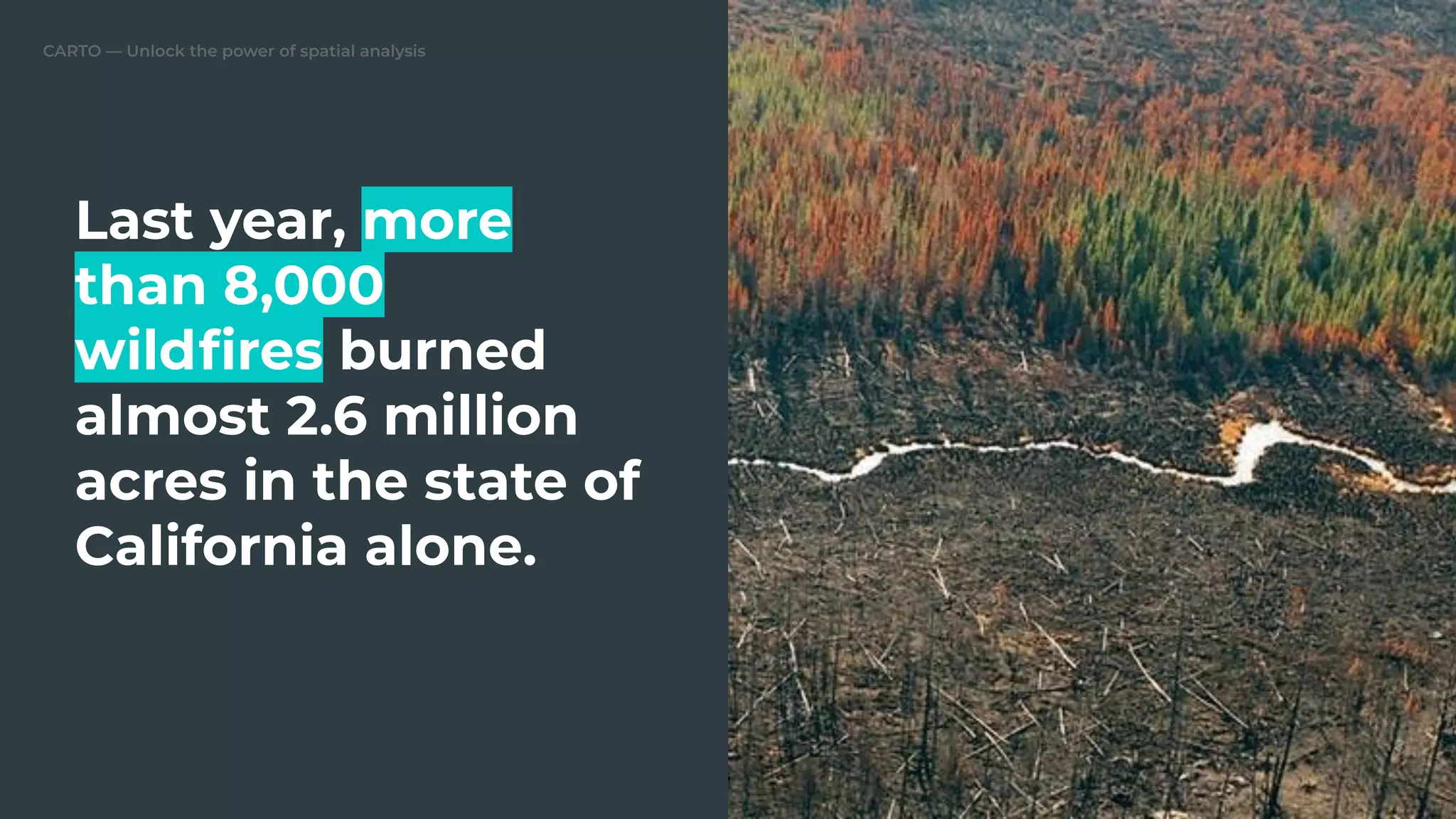
Last year, more
than 8,000
wildfires burned
almost 2.6 million
acres in the state of
California alone.
CARTO — Unlock the power of spatial analysis
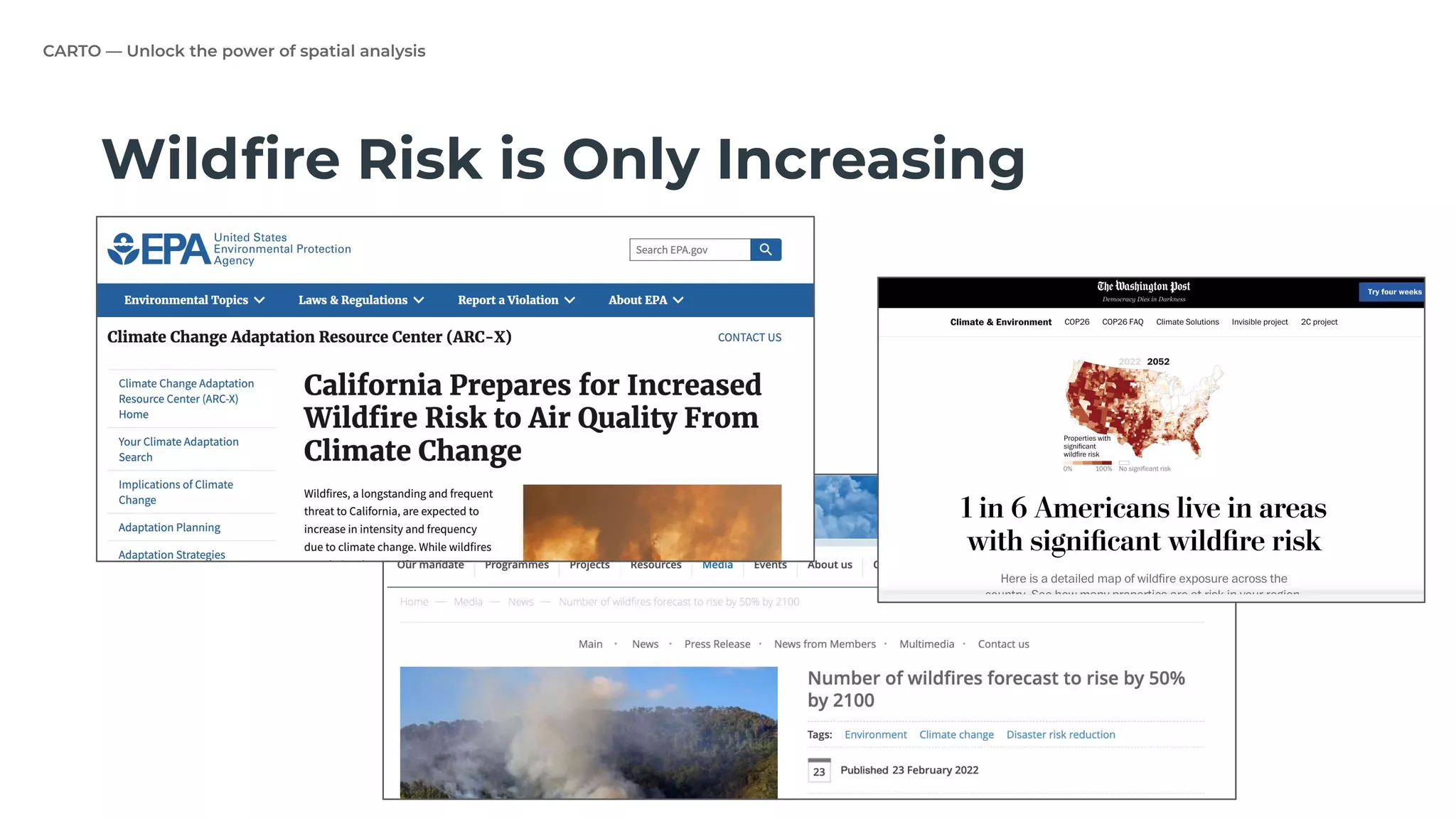
Wildfire Risk is Only Increasing
CARTO — Unlock the power of spatial analysis
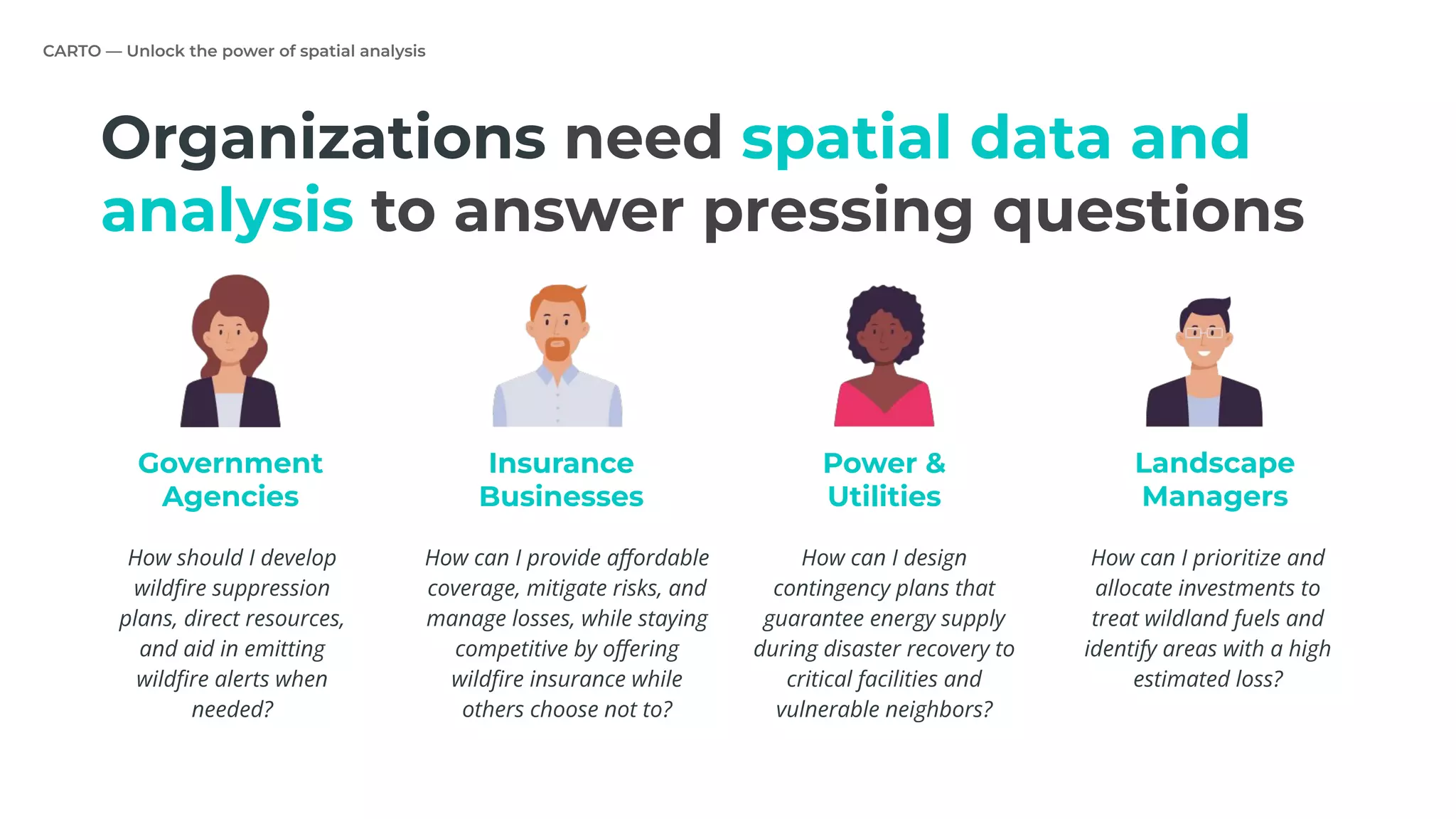
Organizations need spatial data and
analysis to answer pressing questions
Government
Agencies
Insurance
Businesses
Power &
Utilities
How should I develop
wildfire suppression
plans, direct resources,
and aid in emitting
wildfire alerts when
needed?
Landscape
Managers
How can I design
contingency plans that
guarantee energy supply
during disaster recovery to
critical facilities and
vulnerable neighbors?
How can I prioritize and
allocate investments to
treat wildland fuels and
identify areas with a high
estimated loss?
How can I provide affordable
coverage, mitigate risks, and
manage losses, while staying
competitive by offering
wildfire insurance while
others choose not to?
CARTO — Unlock the power of spatial analysis
POLL 1
Are you currently using weather data and/or spatial analysis
when analyzing wildfire risk?
Yes, I use it almost every day
Somewhat, I use it occasionally
No, I have never used location data or spatial analysis
before
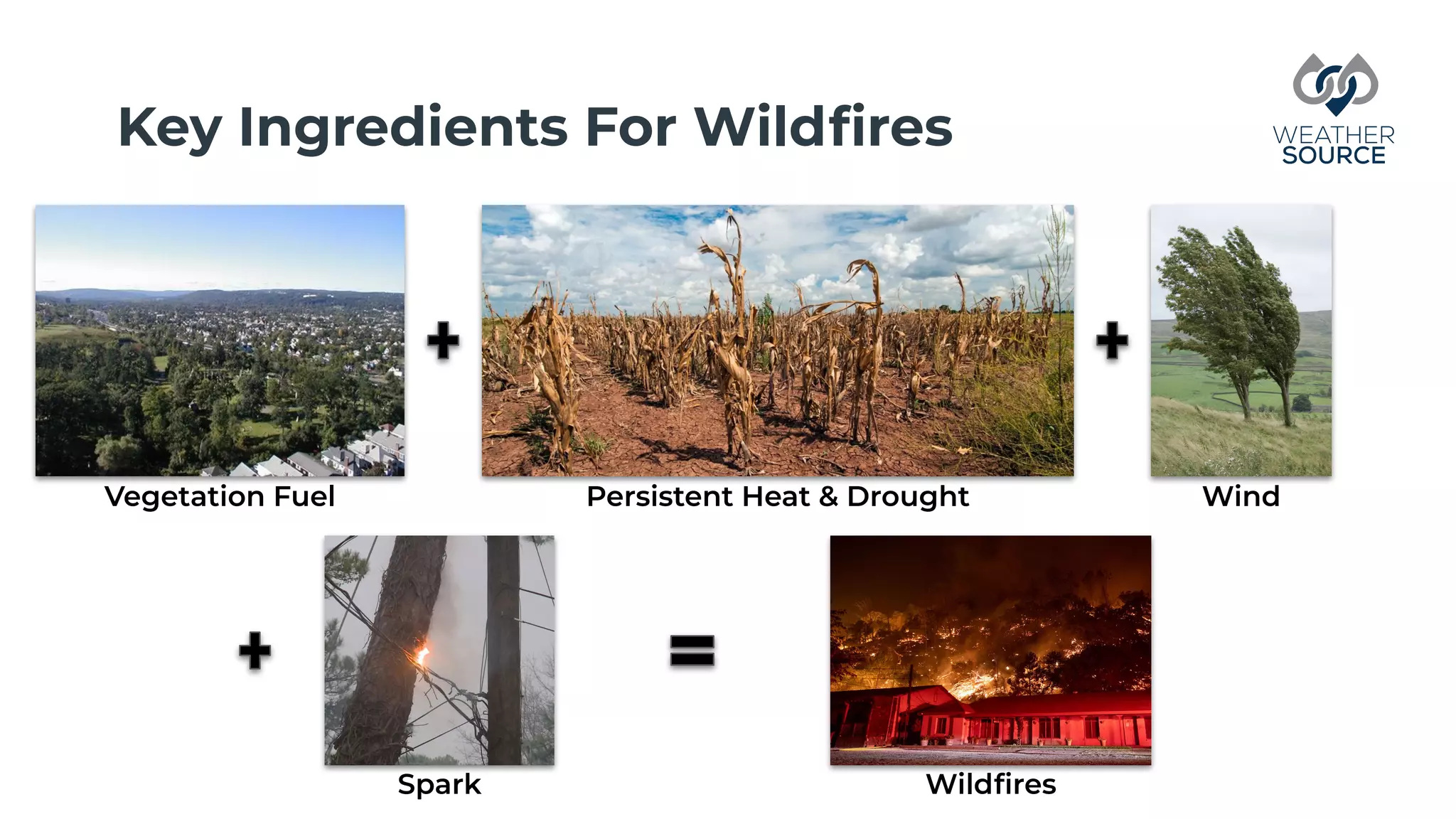
Key Ingredients For Wildfires
Vegetation Fuel Persistent Heat & Drought Wind
Spark Wildfires
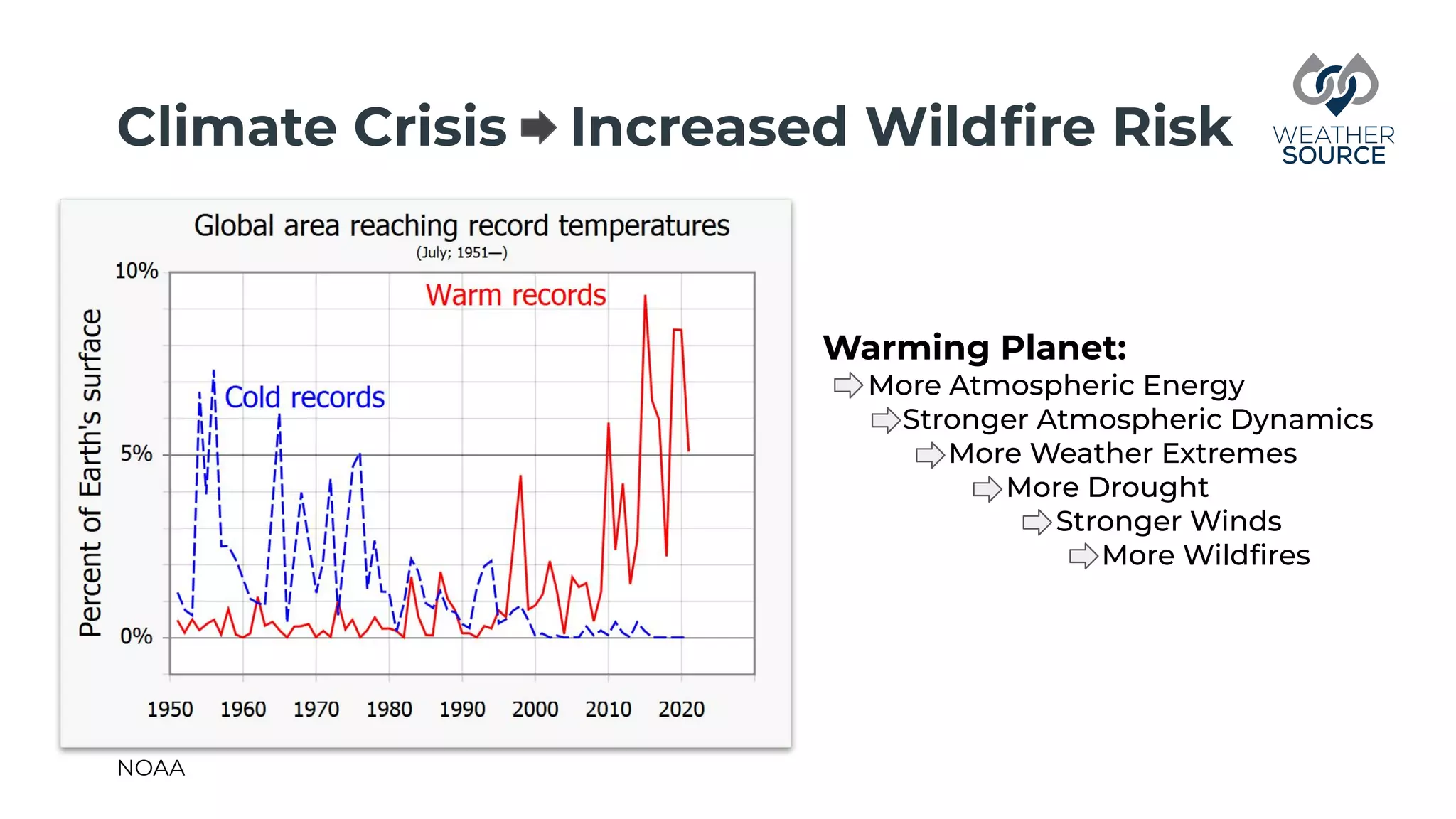
Climate Crisis Increased Wildfire Risk
Warming Planet:
More Atmospheric Energy
Stronger Atmospheric Dynamics
More Weather Extremes
More Drought
Stronger Winds
More Wildfires
NOAA
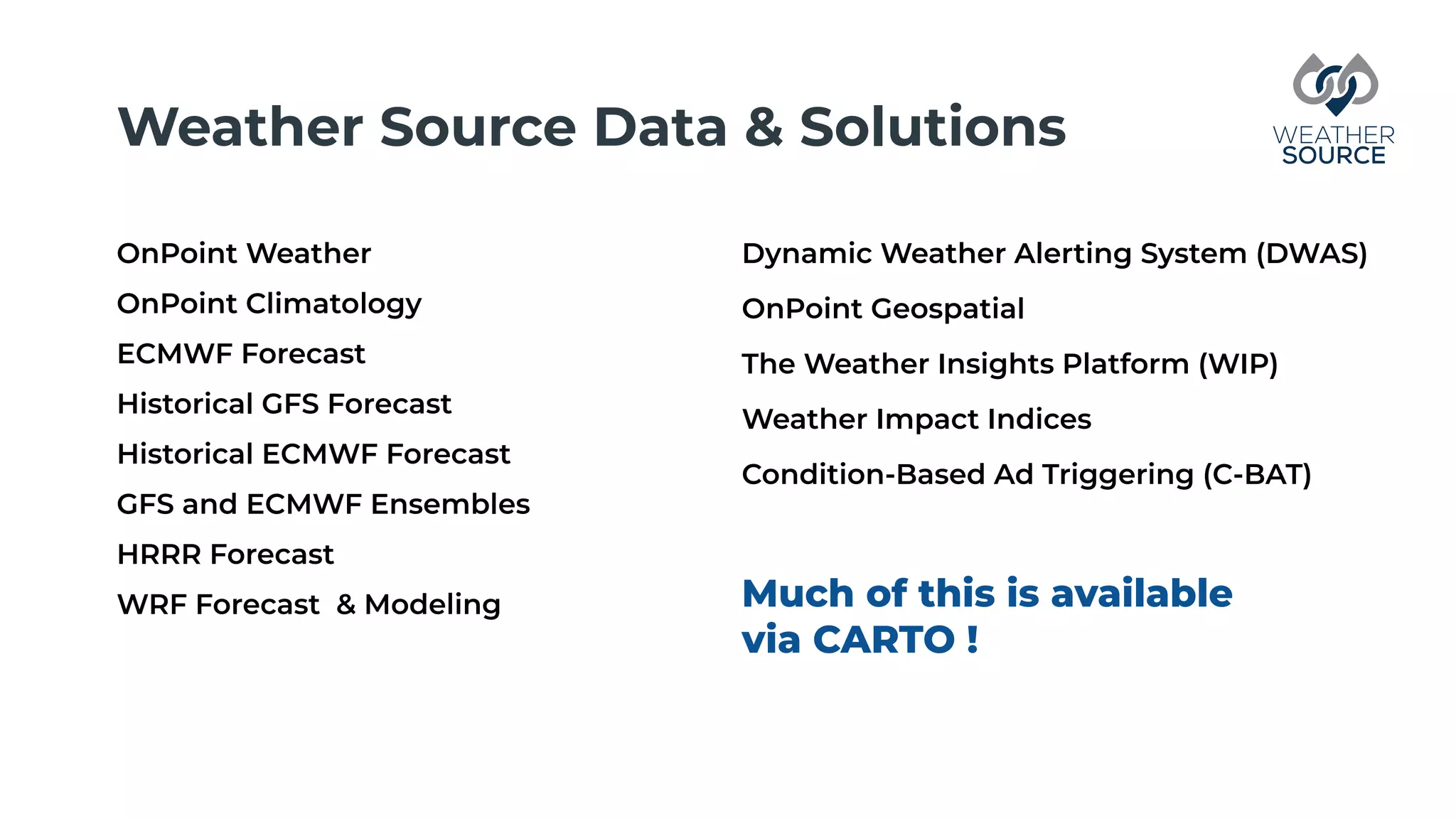
Weather Source Data & Solutions
OnPoint Weather
OnPoint Climatology
ECMWF Forecast
Historical GFS Forecast
Historical ECMWF Forecast
GFS and ECMWF Ensembles
HRRR Forecast
WRF Forecast & Modeling
Dynamic Weather Alerting System (DWAS)
OnPoint Geospatial
The Weather Insights Platform (WIP)
Weather Impact Indices
Condition-Based Ad Triggering (C-BAT)
Much of this is available
via CARTO !
CARTO — Unlock the power of spatial analysis
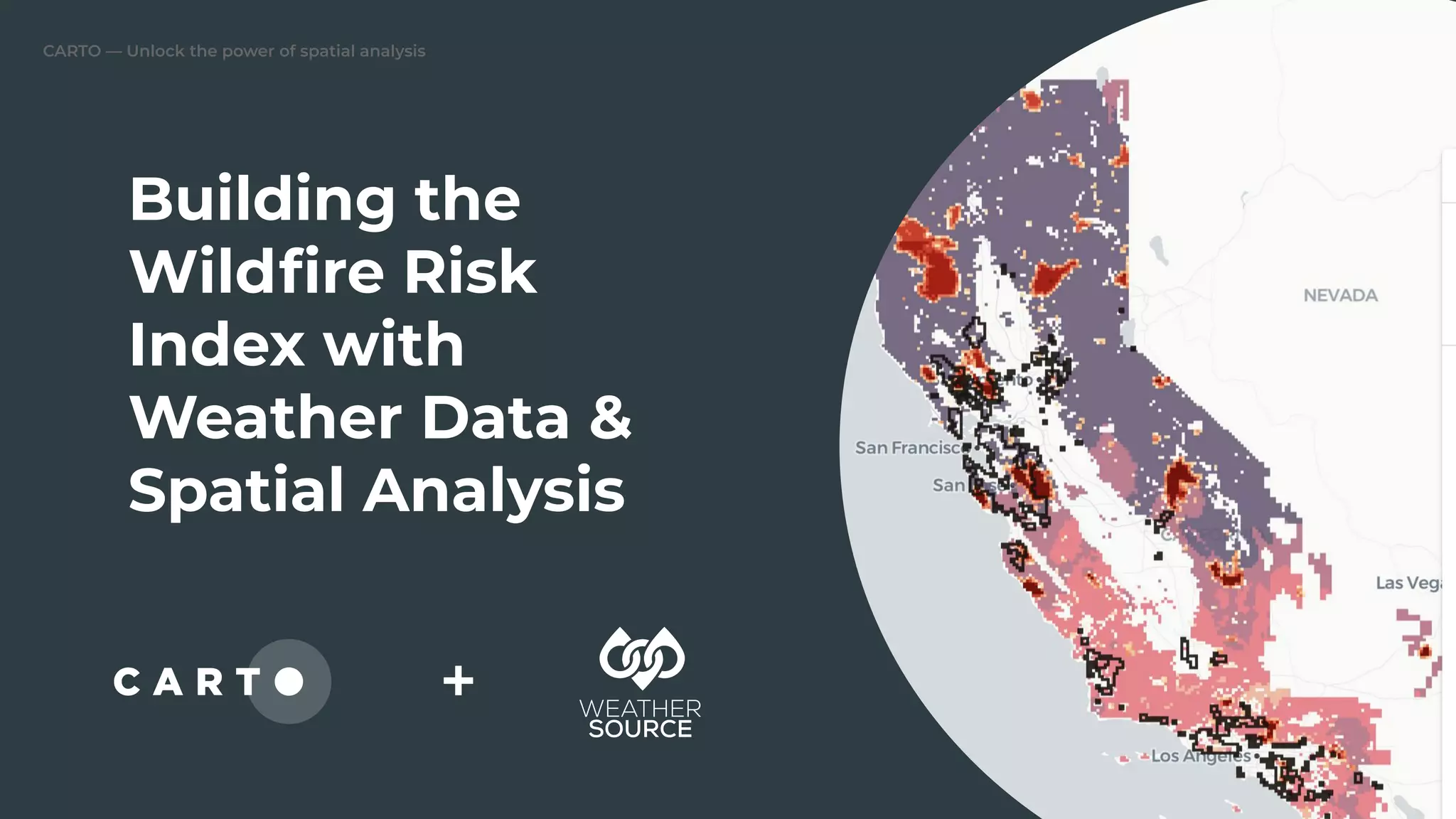
Building the
Wildfire Risk
Index with
Weather Data &
Spatial Analysis
+
CARTO — Unlock the power of spatial analysis
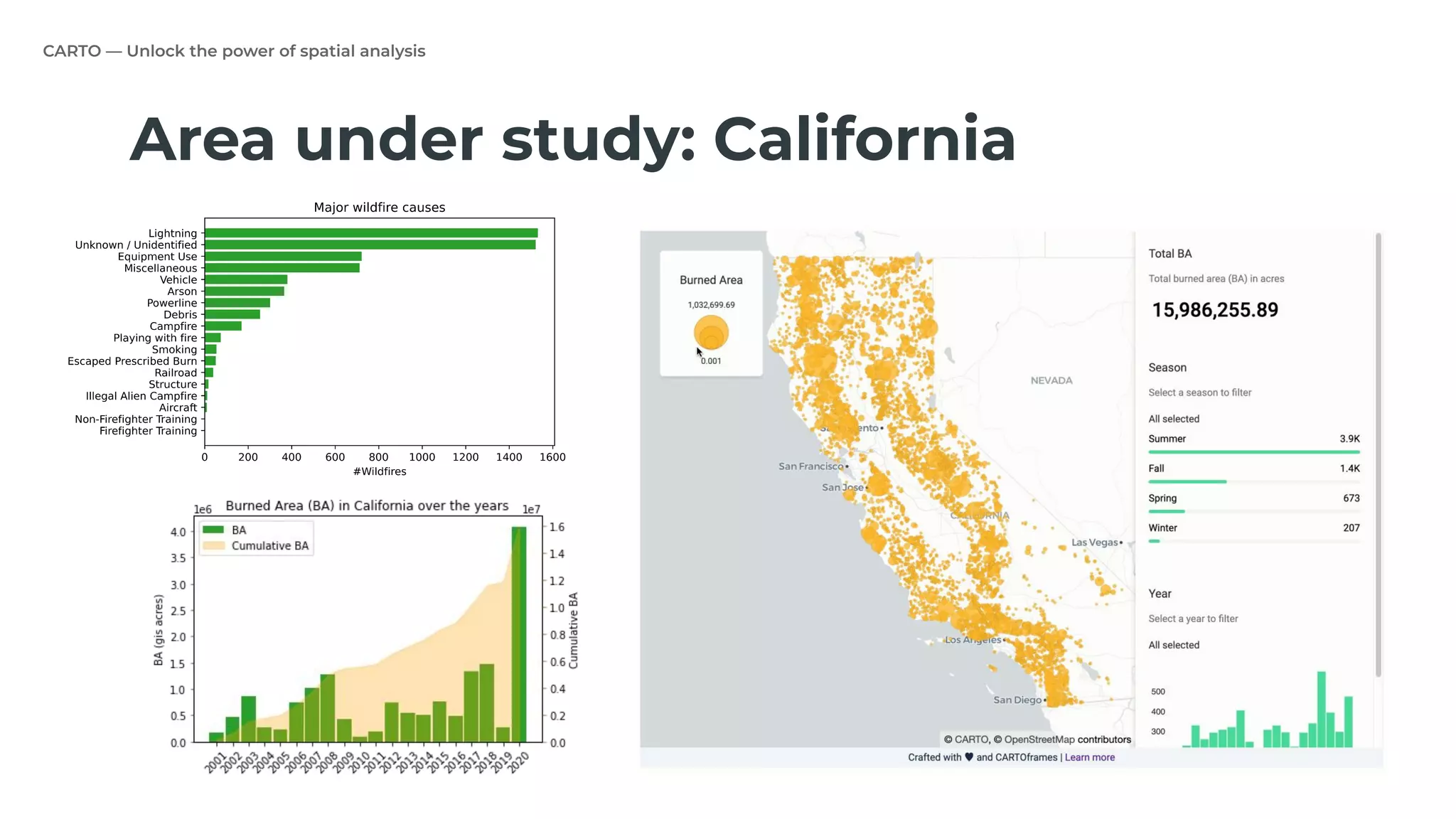
Area under study: California
CARTO — Unlock the power of spatial analysis
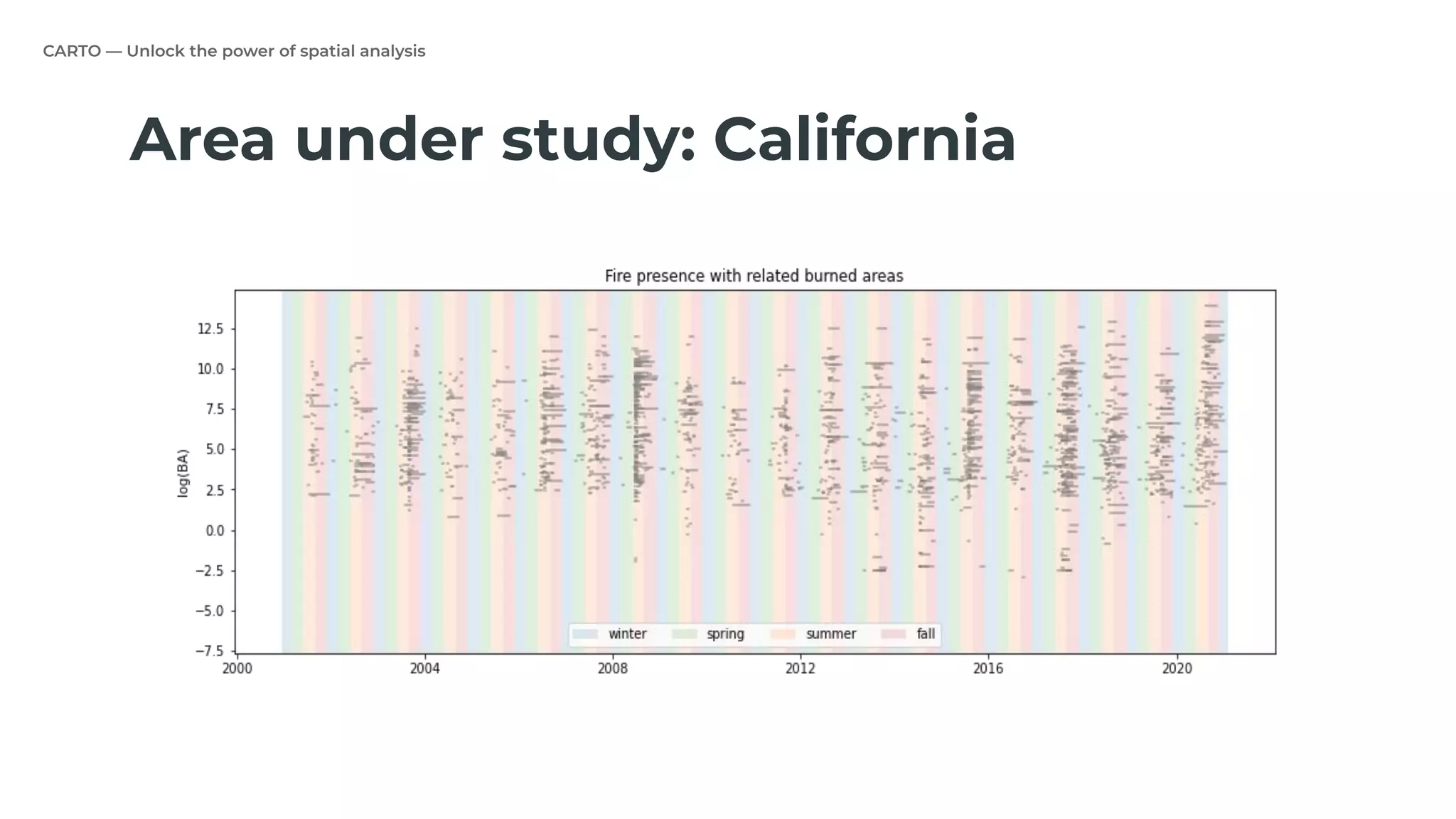
Area under study: California
CARTO — Unlock the power of spatial analysis
Data Sources
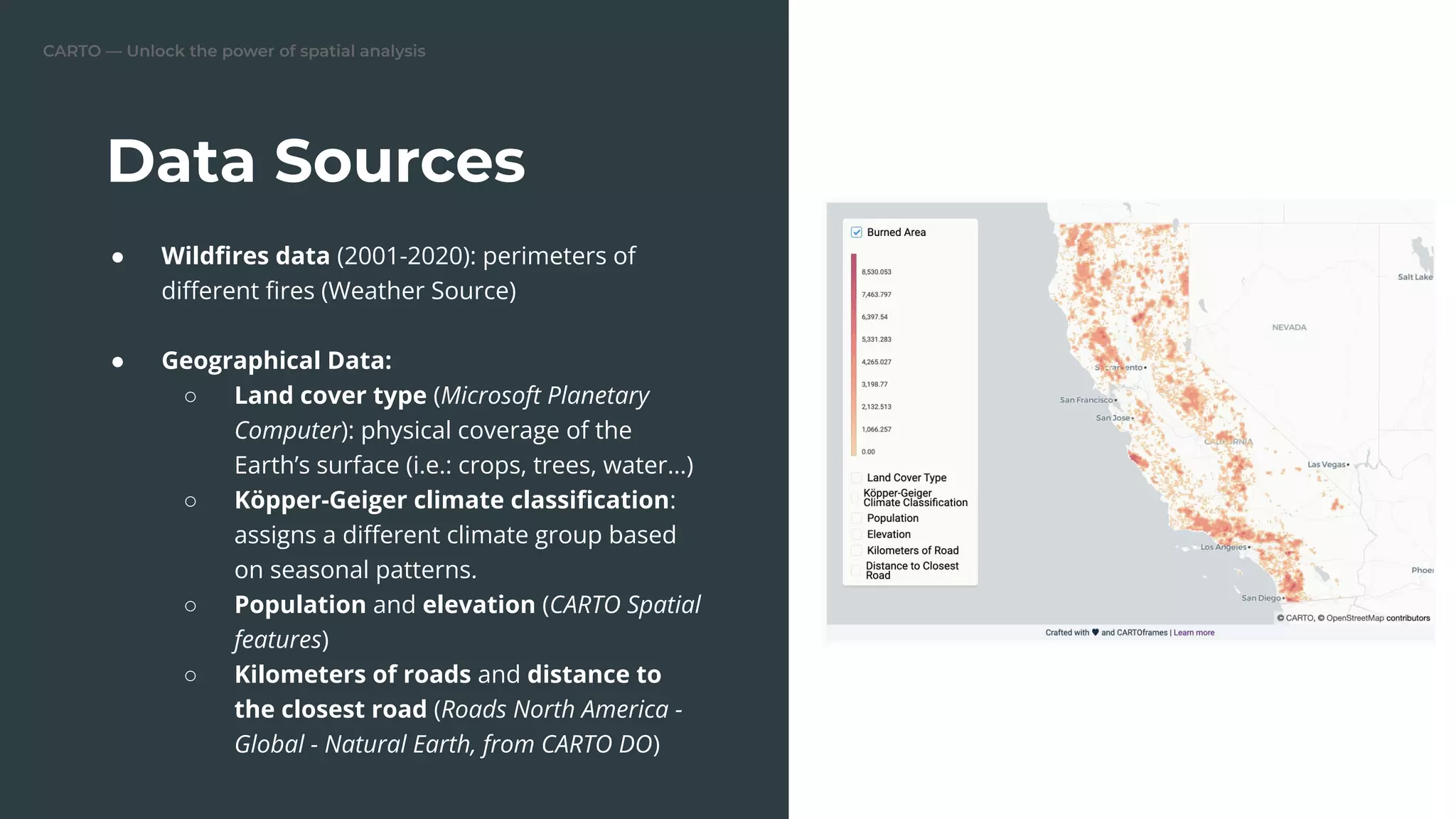
● Wildfires data (2001-2020): perimeters of
different fires (Weather Source)
● Geographical Data:
○ Land cover type (Microsoft Planetary
Computer): physical coverage of the
Earth’s surface (i.e.: crops, trees, water…)
○ Köpper-Geiger climate classification:
assigns a different climate group based
on seasonal patterns.
○ Population and elevation (CARTO Spatial
features)
○ Kilometers of roads and distance to
the closest road (Roads North America -
Global - Natural Earth, from CARTO DO)
CARTO — Unlock the power of spatial analysis
Data Sources
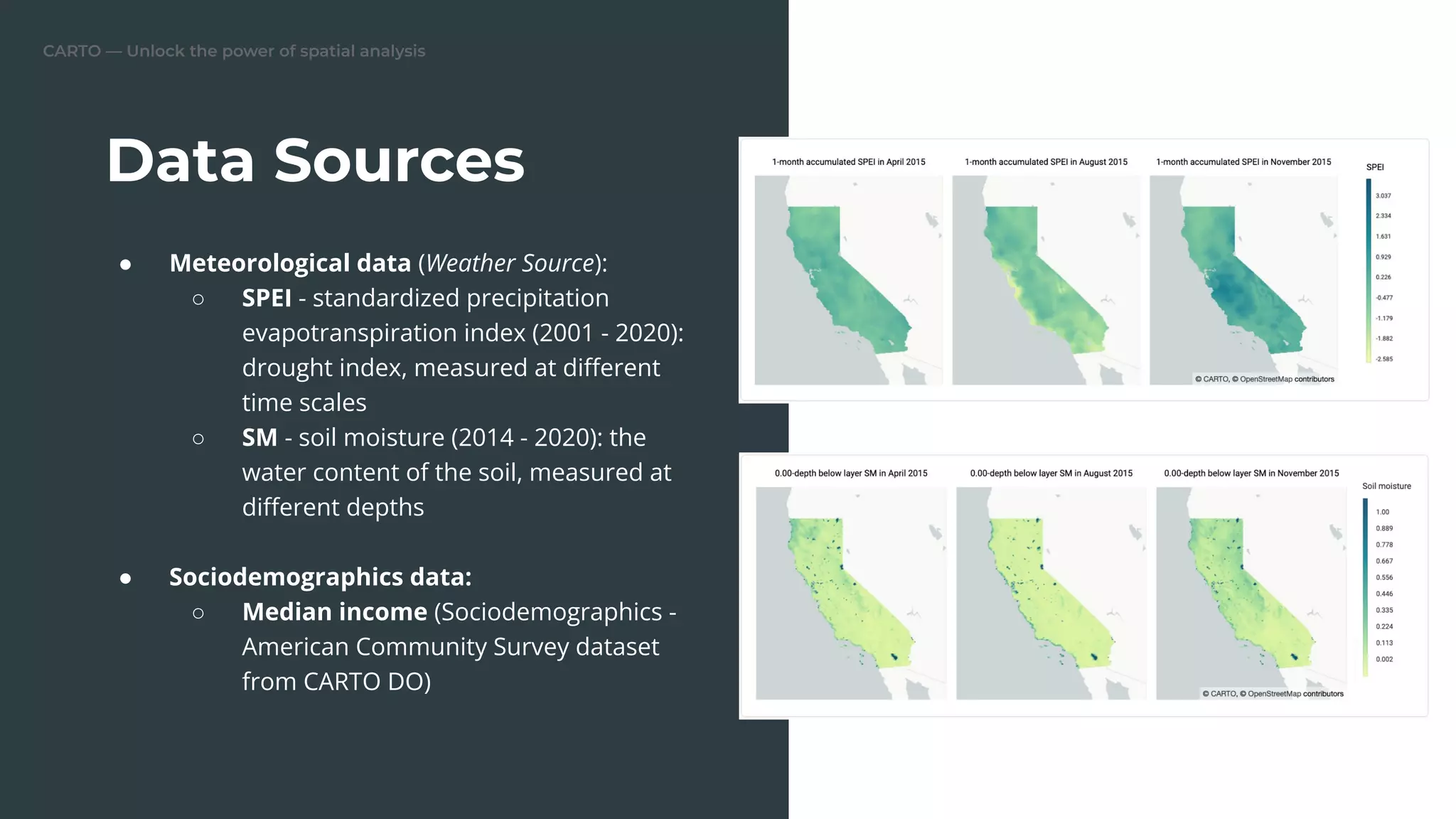
● Meteorological data (Weather Source):
○ SPEI - standardized precipitation
evapotranspiration index (2001 - 2020):
drought index, measured at different
time scales
○ SM - soil moisture (2014 - 2020): the
water content of the soil, measured at
different depths
● Sociodemographics data:
○ Median income (Sociodemographics -
American Community Survey dataset
from CARTO DO)
CARTO — Unlock the power of spatial analysis
Building the WRI
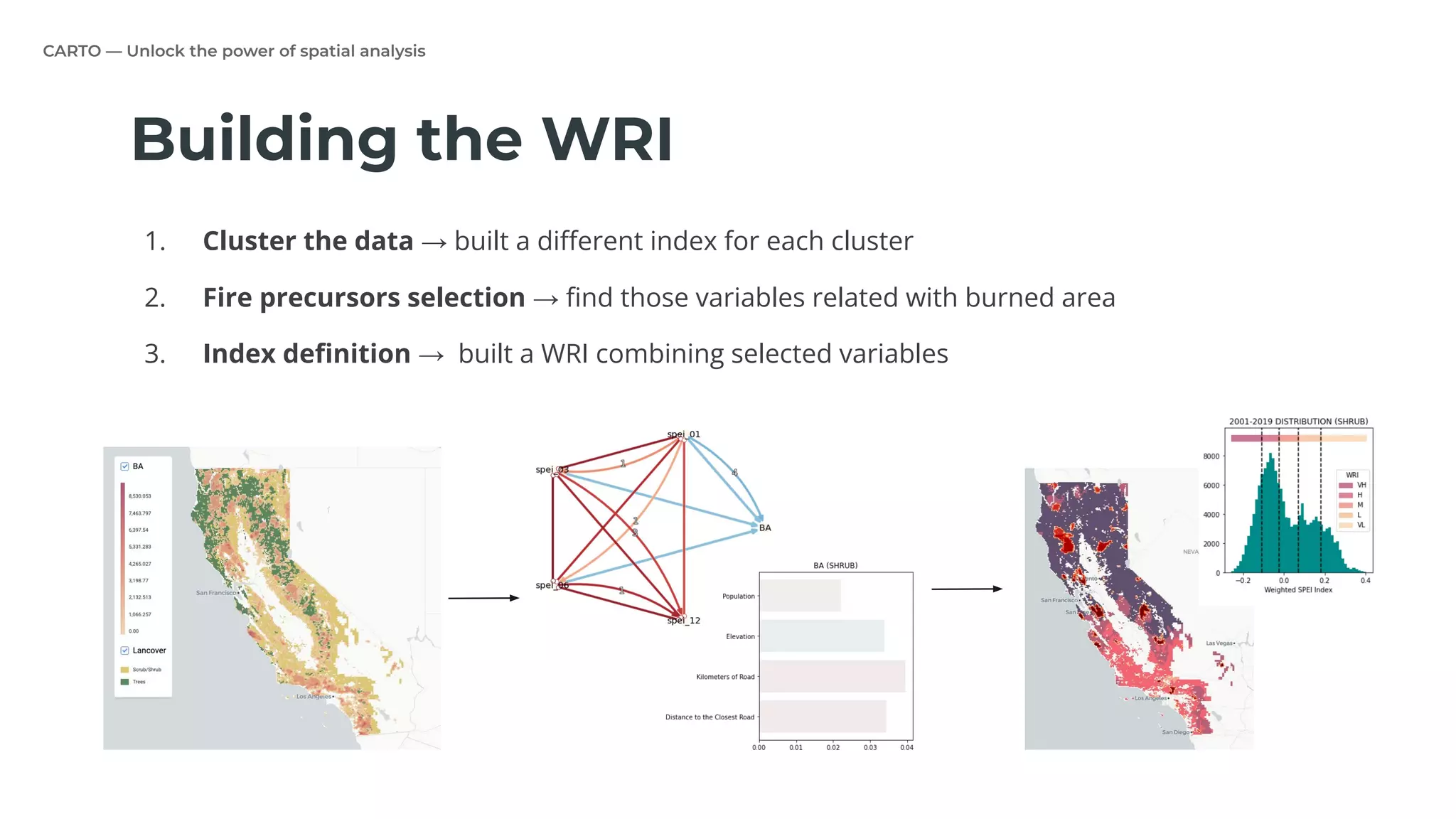
1. Cluster the data → built a different index for each cluster
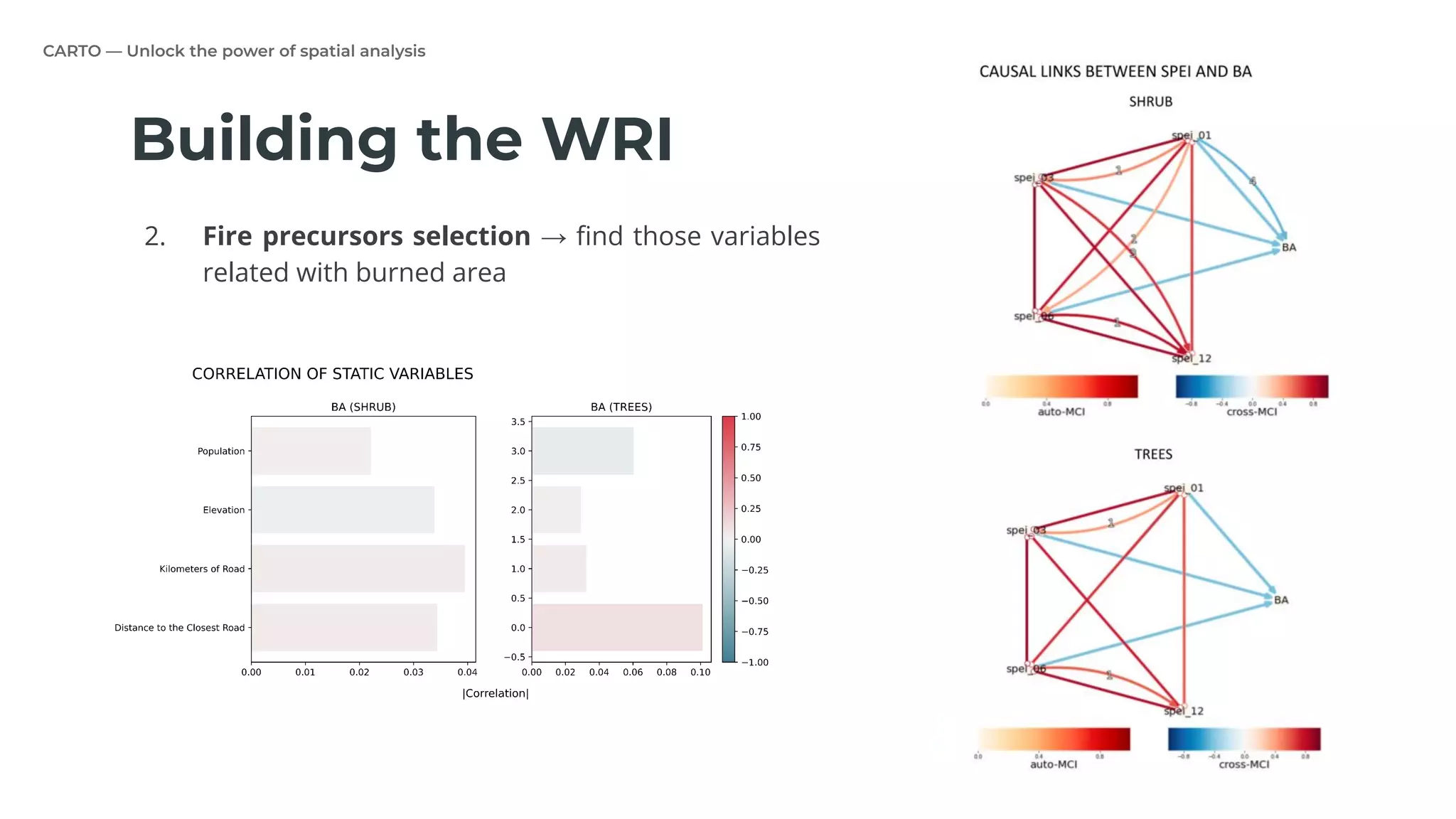
2. Fire precursors selection → find those variables related with burned area
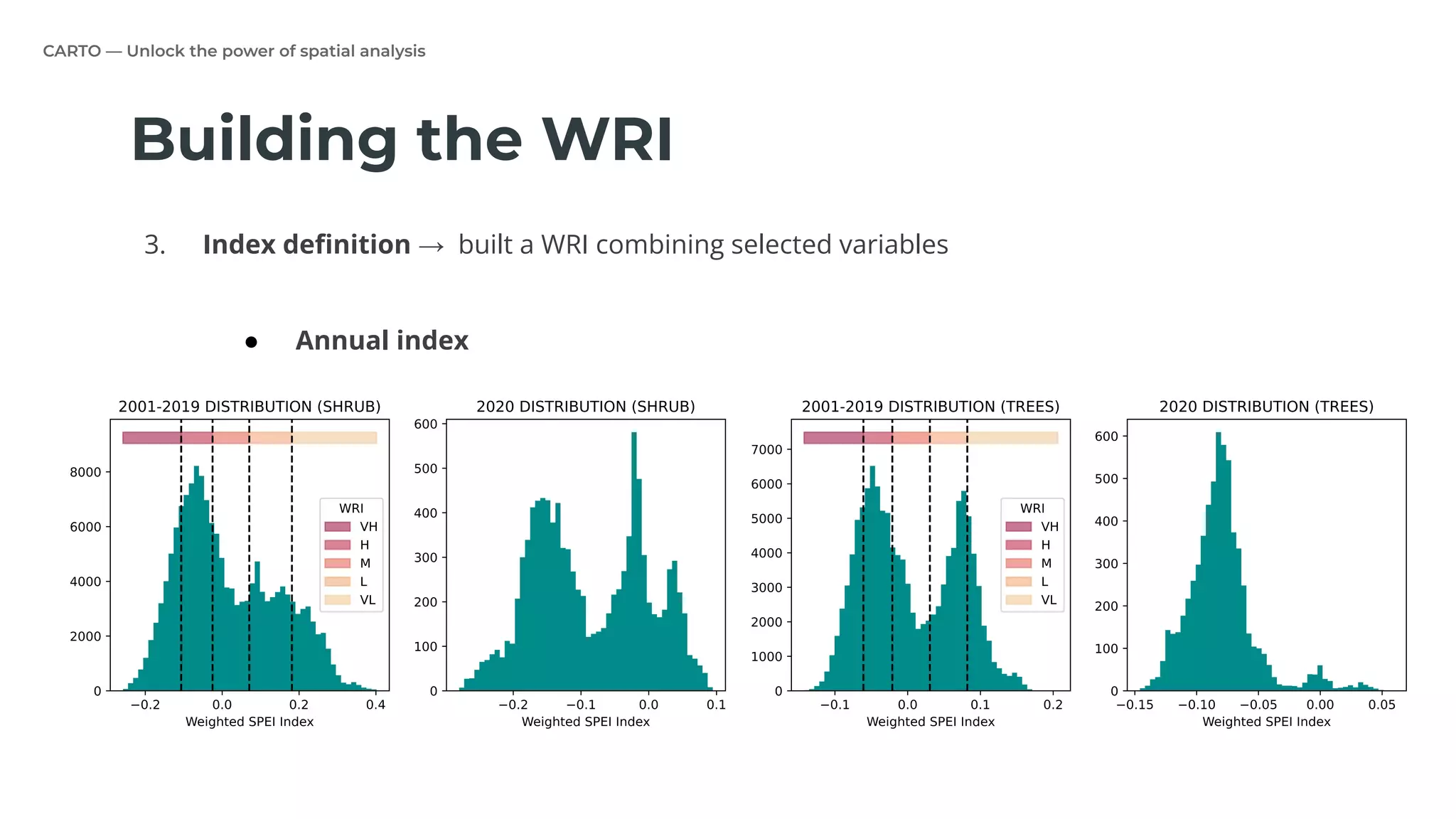
3. Index definition → built a WRI combining selected variables
CARTO — Unlock the power of spatial analysis
Building the WRI
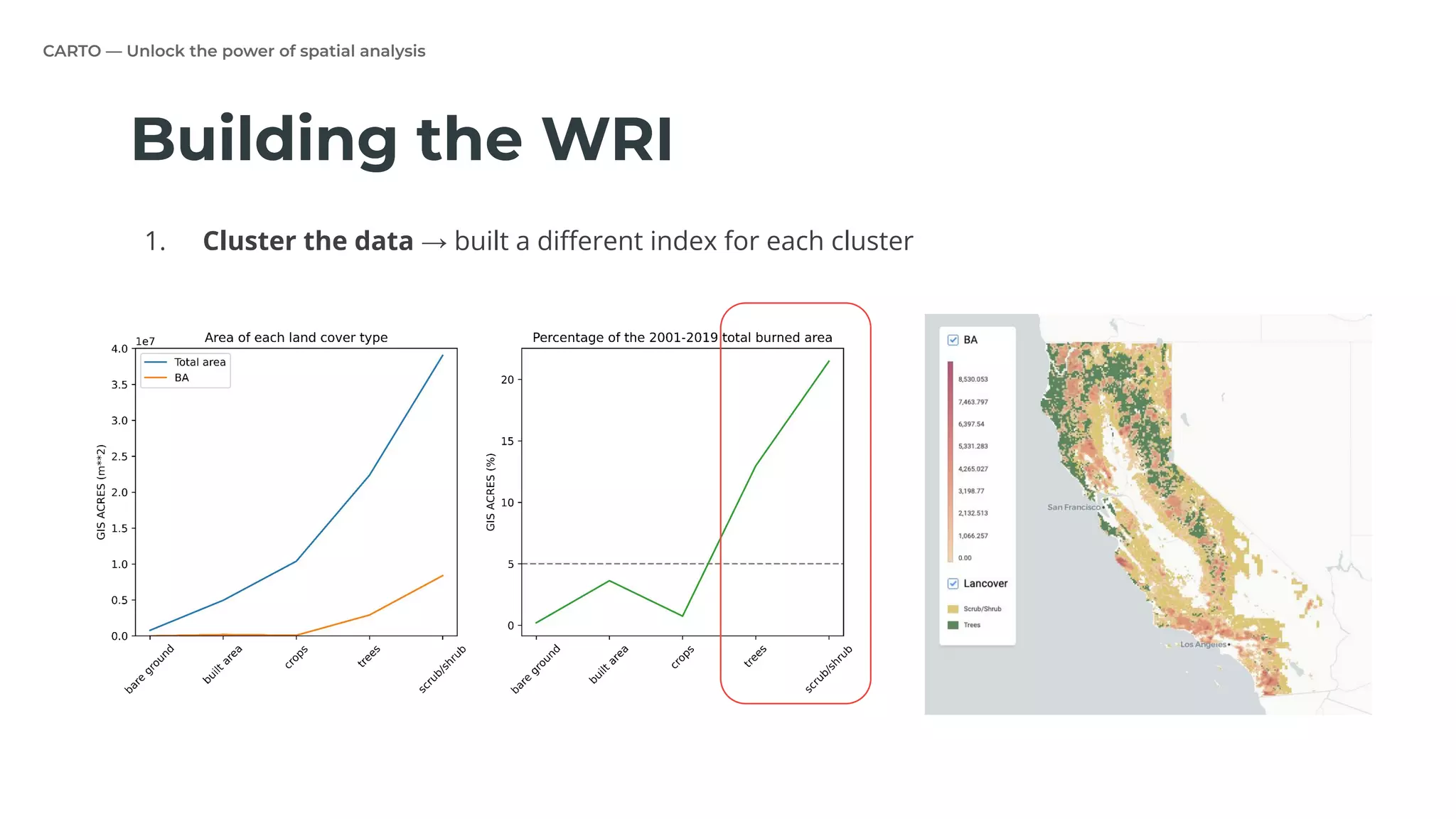
1. Cluster the data → built a different index for each cluster
Building the WRI
CARTO — Unlock the power of spatial analysis
Building the WRI
1. T
2. Fire precursors selection → find those variables
related with burned area
CARTO — Unlock the power of spatial analysis
1. Cluster the data → built a different index for each cluster
2. Fire precursors selection → find those variables related with burned area
3. Index definition → built a WRI combining selected variables
Building the WRI
● Annual index
CARTO — Unlock the power of spatial analysis
1. Cluster the data → built a different index for each cluster
2. Fire precursors selection → find those variables related with burned area
Building the WRI
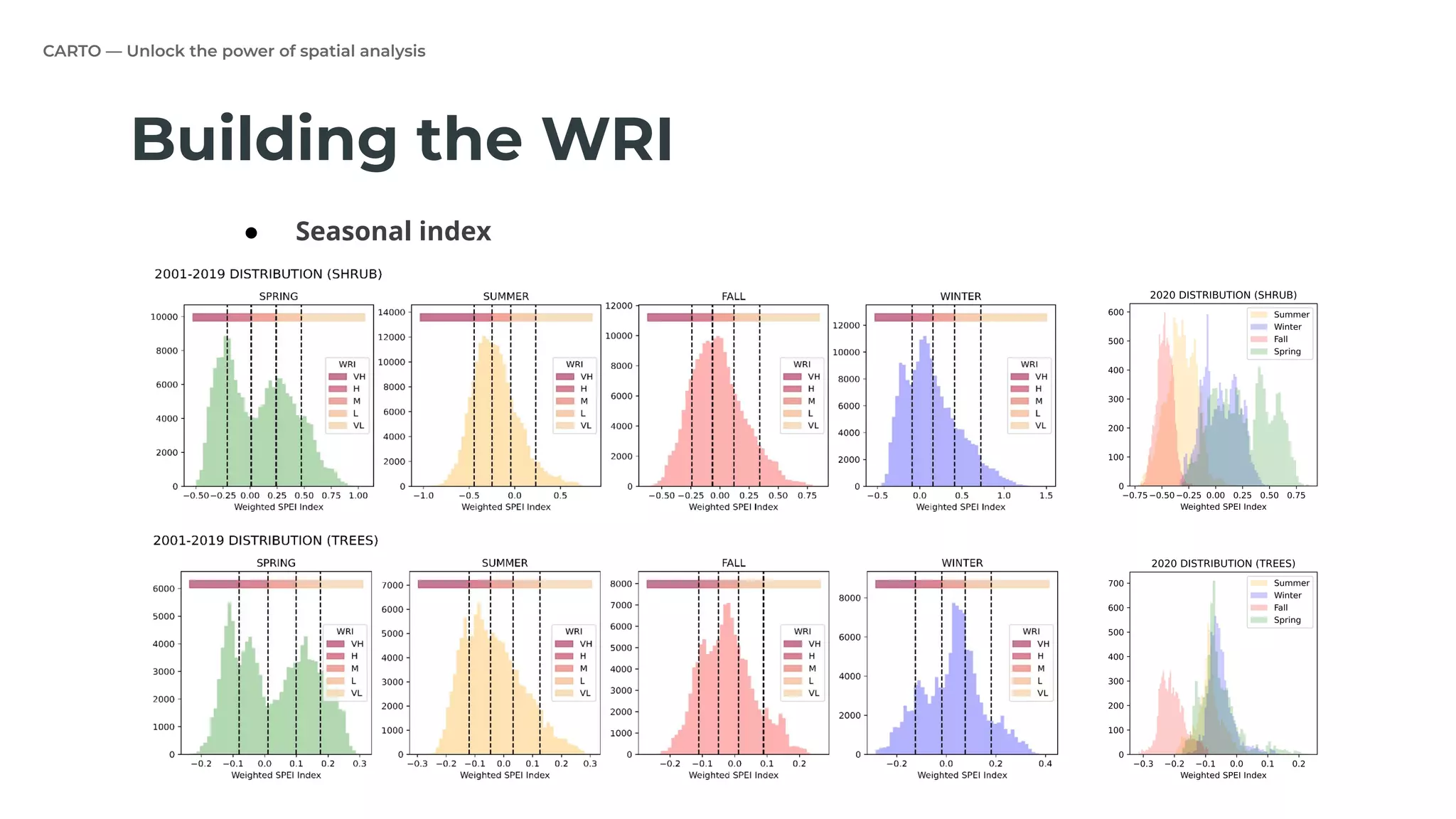
● Seasonal index
CARTO — Unlock the power of spatial analysis
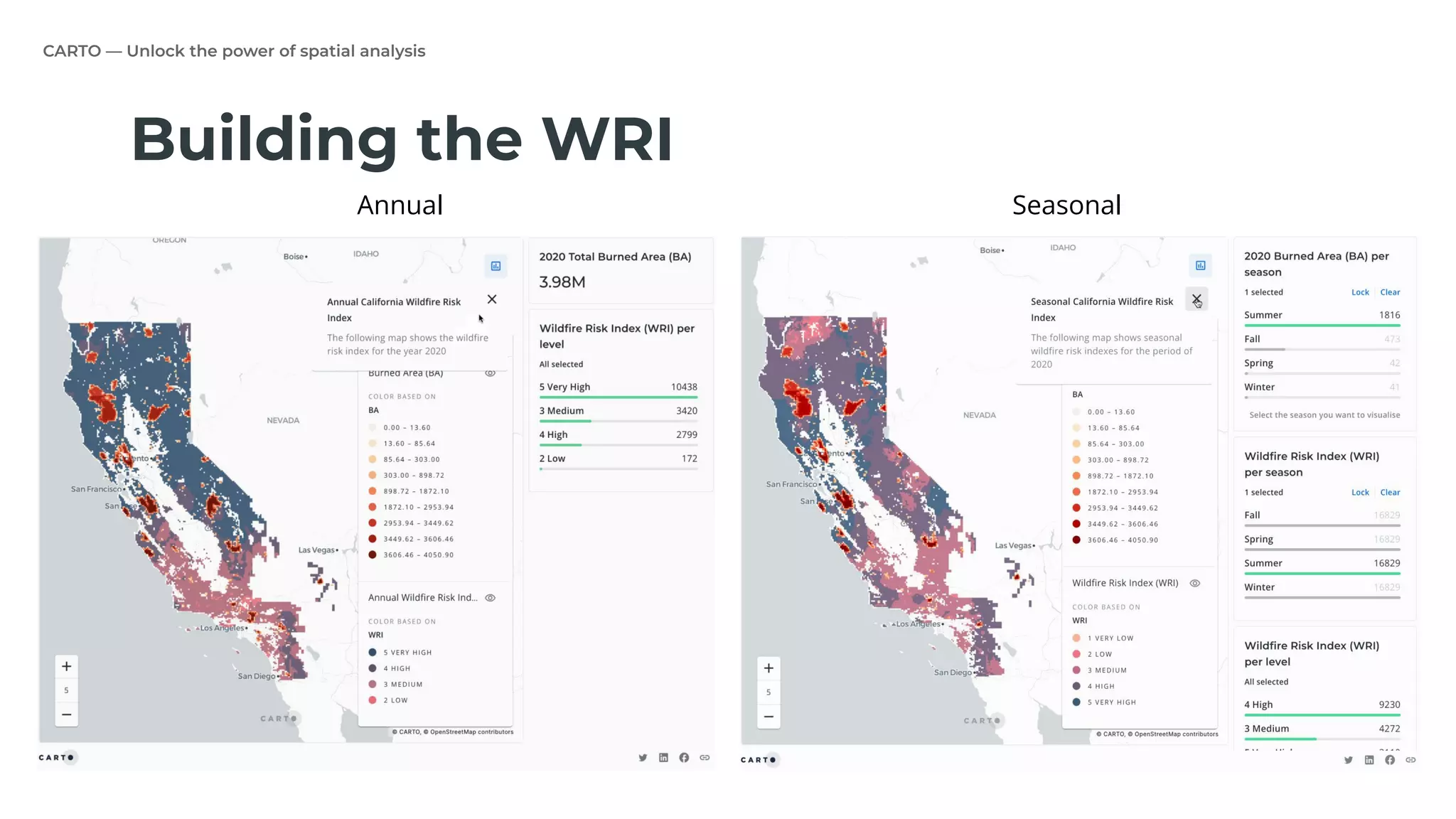
Building the WRI
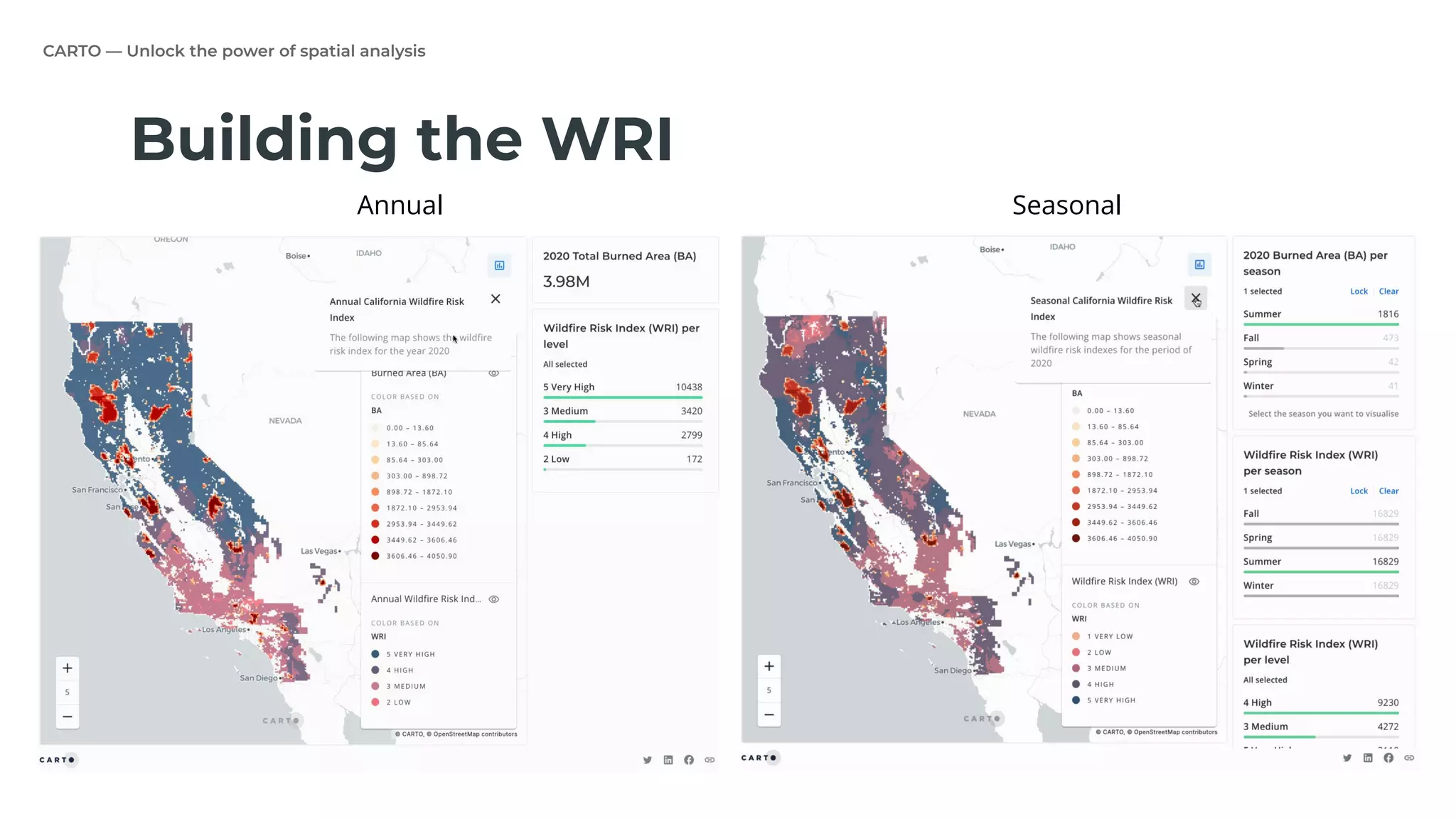
Annual Seasonal
CARTO — Unlock the power of spatial analysis
Building the WRI
Annual Seasonal
CARTO — Unlock the power of spatial analysis
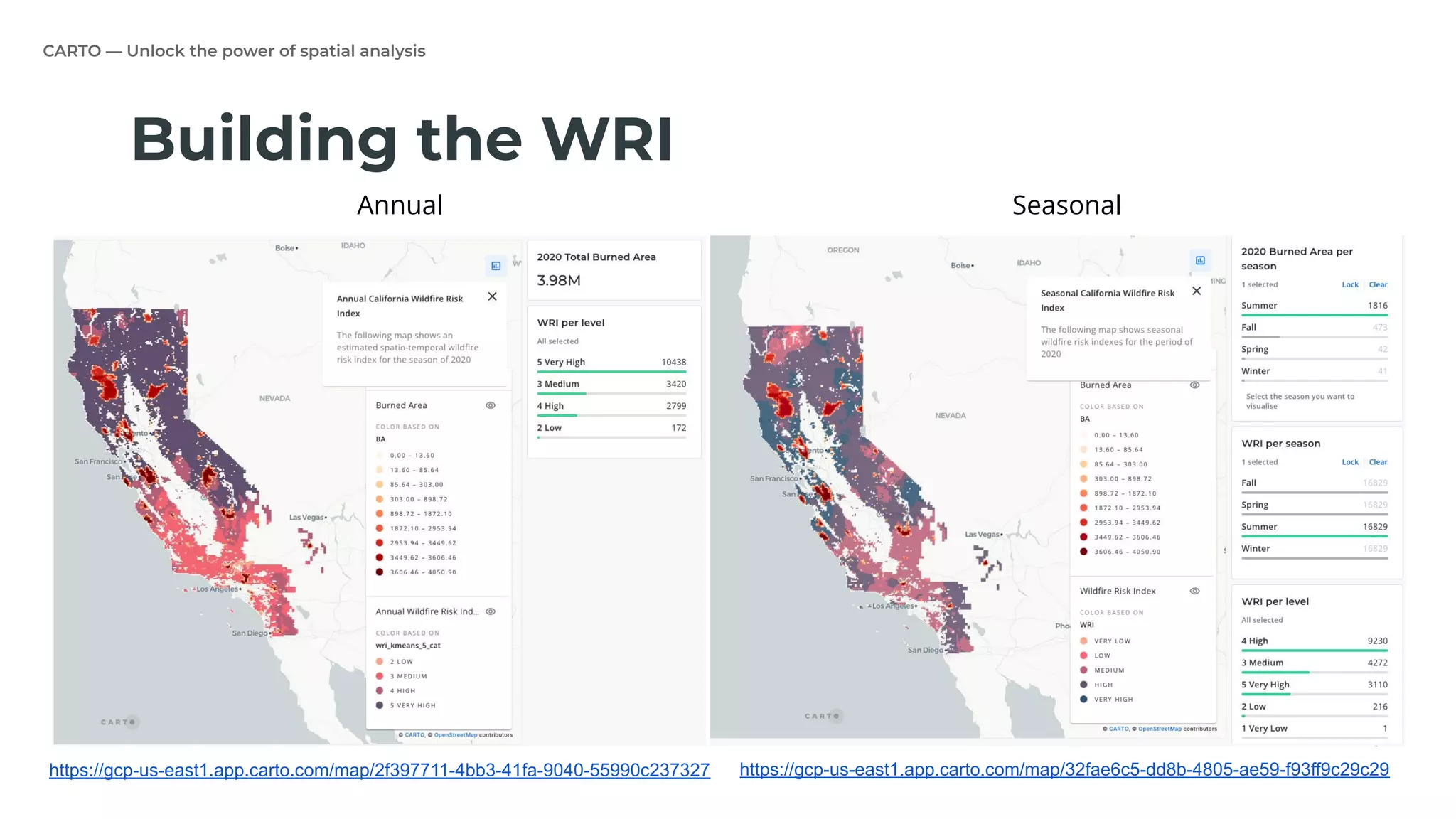
Building the WRI
Annual Seasonal
https://gcp-us-east1.app.carto.com/map/2f397711-4bb3-41fa-9040-55990c237327 https://gcp-us-east1.app.carto.com/map/32fae6c5-dd8b-4805-ae59-f93ff9c29c29
CARTO — Unlock the power of spatial analysis
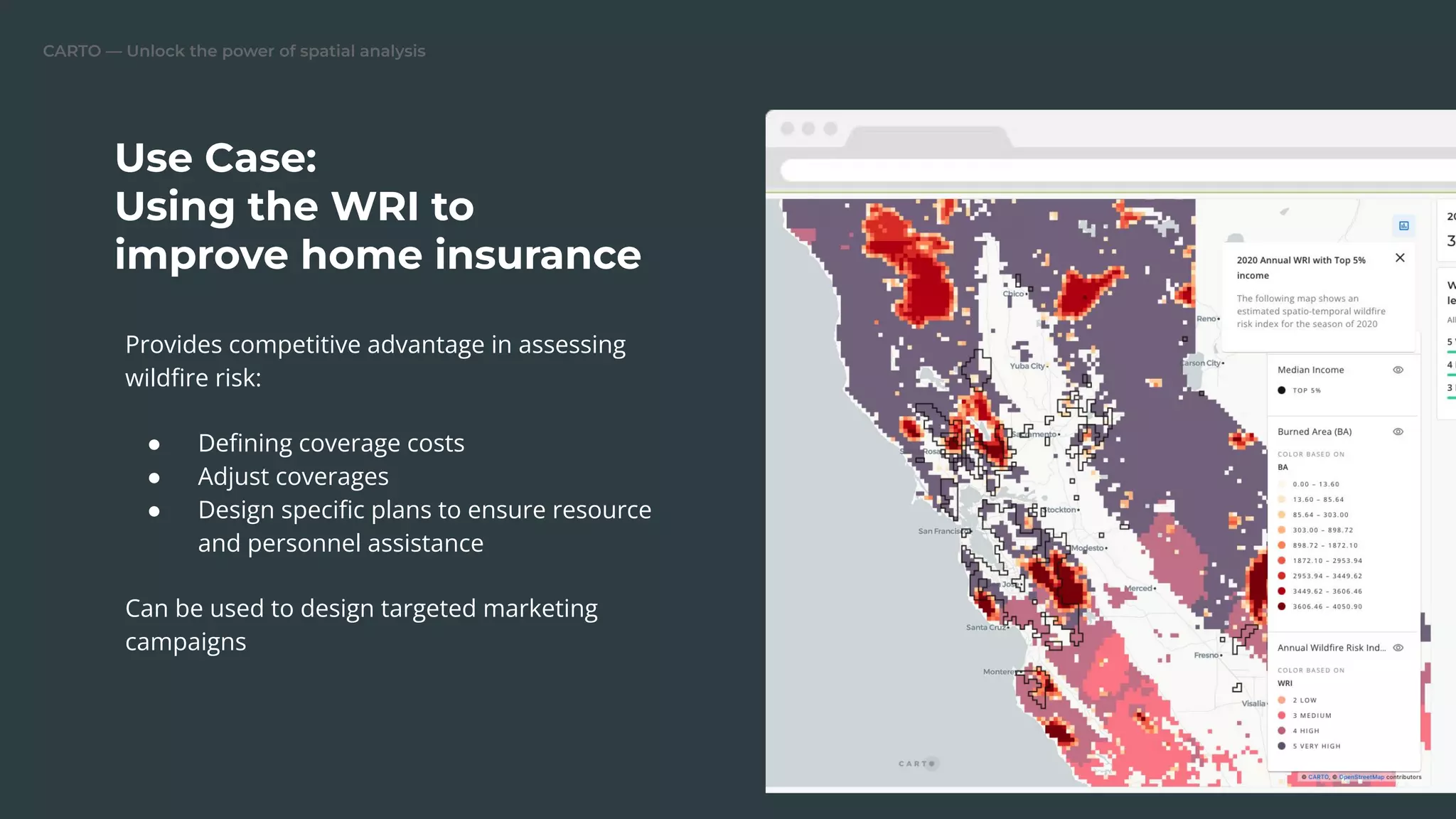
Provides competitive advantage in assessing
wildfire risk:
● Defining coverage costs
● Adjust coverages
● Design specific plans to ensure resource
and personnel assistance
Can be used to design targeted marketing
campaigns
Use Case:
Using the WRI to
improve home insurance
CARTO — Unlock the power of spatial analysis
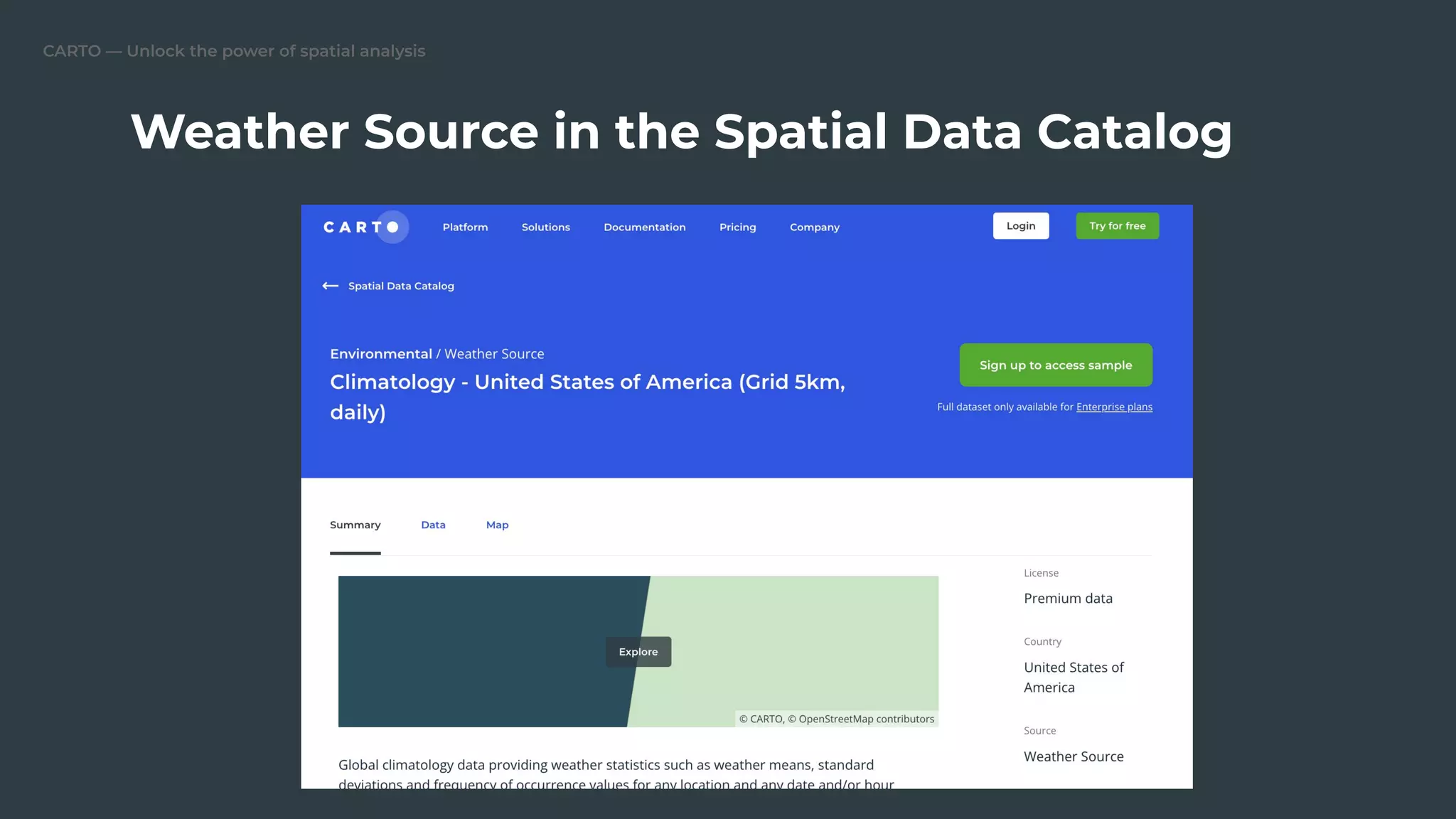
Weather Source in the Spatial Data Catalog
Thanks for listening!
Any questions?
Request a demo at CARTO.COM
Mark Gibbas
CEO at Weather Source // mark.gibbas@weathersource.com
Lucía García-Duarte
Data Scientist at CARTO // lgarciaduarte@cartodb.com

How to Use Spatial Data to Create a Wildfire Risk Index.pdf

  • 1.
    How to UseSpatial Data to Create a Wildfire Risk Index Follow @CARTO on Twitter
  • 2.
    CARTO — Unlockthe power of spatial analysis Introductions Lucía García-Duarte Data Scientist at CARTO Mark Gibbas CEO at Weather Source
  • 3.
    CARTO — Unlockthe power of spatial analysis Last year, more than 8,000 wildfires burned almost 2.6 million acres in the state of California alone.
  • 4.
    CARTO — Unlockthe power of spatial analysis Wildfire Risk is Only Increasing
  • 5.
    CARTO — Unlockthe power of spatial analysis Organizations need spatial data and analysis to answer pressing questions Government Agencies Insurance Businesses Power & Utilities How should I develop wildfire suppression plans, direct resources, and aid in emitting wildfire alerts when needed? Landscape Managers How can I design contingency plans that guarantee energy supply during disaster recovery to critical facilities and vulnerable neighbors? How can I prioritize and allocate investments to treat wildland fuels and identify areas with a high estimated loss? How can I provide affordable coverage, mitigate risks, and manage losses, while staying competitive by offering wildfire insurance while others choose not to?
  • 6.
    CARTO — Unlockthe power of spatial analysis POLL 1 Are you currently using weather data and/or spatial analysis when analyzing wildfire risk? Yes, I use it almost every day Somewhat, I use it occasionally No, I have never used location data or spatial analysis before
  • 7.
    Key Ingredients ForWildfires Vegetation Fuel Persistent Heat & Drought Wind Spark Wildfires
  • 8.
    Climate Crisis IncreasedWildfire Risk Warming Planet: More Atmospheric Energy Stronger Atmospheric Dynamics More Weather Extremes More Drought Stronger Winds More Wildfires NOAA
  • 9.
    Weather Source Data& Solutions OnPoint Weather OnPoint Climatology ECMWF Forecast Historical GFS Forecast Historical ECMWF Forecast GFS and ECMWF Ensembles HRRR Forecast WRF Forecast & Modeling Dynamic Weather Alerting System (DWAS) OnPoint Geospatial The Weather Insights Platform (WIP) Weather Impact Indices Condition-Based Ad Triggering (C-BAT) Much of this is available via CARTO !
  • 10.
    CARTO — Unlockthe power of spatial analysis Building the Wildfire Risk Index with Weather Data & Spatial Analysis +
  • 11.
    CARTO — Unlockthe power of spatial analysis Area under study: California
  • 12.
    CARTO — Unlockthe power of spatial analysis Area under study: California
  • 13.
    CARTO — Unlockthe power of spatial analysis Data Sources ● Wildfires data (2001-2020): perimeters of different fires (Weather Source) ● Geographical Data: ○ Land cover type (Microsoft Planetary Computer): physical coverage of the Earth’s surface (i.e.: crops, trees, water…) ○ Köpper-Geiger climate classification: assigns a different climate group based on seasonal patterns. ○ Population and elevation (CARTO Spatial features) ○ Kilometers of roads and distance to the closest road (Roads North America - Global - Natural Earth, from CARTO DO)
  • 14.
    CARTO — Unlockthe power of spatial analysis Data Sources ● Meteorological data (Weather Source): ○ SPEI - standardized precipitation evapotranspiration index (2001 - 2020): drought index, measured at different time scales ○ SM - soil moisture (2014 - 2020): the water content of the soil, measured at different depths ● Sociodemographics data: ○ Median income (Sociodemographics - American Community Survey dataset from CARTO DO)
  • 15.
    CARTO — Unlockthe power of spatial analysis Building the WRI 1. Cluster the data → built a different index for each cluster 2. Fire precursors selection → find those variables related with burned area 3. Index definition → built a WRI combining selected variables
  • 16.
    CARTO — Unlockthe power of spatial analysis Building the WRI 1. Cluster the data → built a different index for each cluster Building the WRI
  • 17.
    CARTO — Unlockthe power of spatial analysis Building the WRI 1. T 2. Fire precursors selection → find those variables related with burned area
  • 18.
    CARTO — Unlockthe power of spatial analysis 1. Cluster the data → built a different index for each cluster 2. Fire precursors selection → find those variables related with burned area 3. Index definition → built a WRI combining selected variables Building the WRI ● Annual index
  • 19.
    CARTO — Unlockthe power of spatial analysis 1. Cluster the data → built a different index for each cluster 2. Fire precursors selection → find those variables related with burned area Building the WRI ● Seasonal index
  • 20.
    CARTO — Unlockthe power of spatial analysis Building the WRI Annual Seasonal
  • 21.
    CARTO — Unlockthe power of spatial analysis Building the WRI Annual Seasonal
  • 22.
    CARTO — Unlockthe power of spatial analysis Building the WRI Annual Seasonal https://gcp-us-east1.app.carto.com/map/2f397711-4bb3-41fa-9040-55990c237327 https://gcp-us-east1.app.carto.com/map/32fae6c5-dd8b-4805-ae59-f93ff9c29c29
  • 23.
    CARTO — Unlockthe power of spatial analysis Provides competitive advantage in assessing wildfire risk: ● Defining coverage costs ● Adjust coverages ● Design specific plans to ensure resource and personnel assistance Can be used to design targeted marketing campaigns Use Case: Using the WRI to improve home insurance
  • 24.
    CARTO — Unlockthe power of spatial analysis Weather Source in the Spatial Data Catalog
  • 25.
    Thanks for listening! Anyquestions? Request a demo at CARTO.COM Mark Gibbas CEO at Weather Source // mark.gibbas@weathersource.com Lucía García-Duarte Data Scientist at CARTO // lgarciaduarte@cartodb.com