Forest fire
August 3, 2023 2 min read
Ambee’s Historical Wildfire Data:
Everything You Need To Know
Barsha Sharma
CONTENT LEAD
ἸExciting news! Ambee is proud to announce the availability of Ambee's
extensive historical fire data, spanning over 6 years, for the entire North American
Region.
You can seamlessly download the data and get insights that will empower your
decision-making process, drive strategic growth, identify trends, and mitigate
risks. In this blog, we will provide you with a list of features and use cases for
Ambee’s historical data.
But first, here’s why historical fire data is crucial in today’s world.
The crucial role of historical fire data
The destructive impact of fires, particularly those triggered by human activities
and left uncontrolled, is undeniable. These infernos have inflicted immense harm,
leaving behind a trail of destruction affecting lives, properties, and the delicate
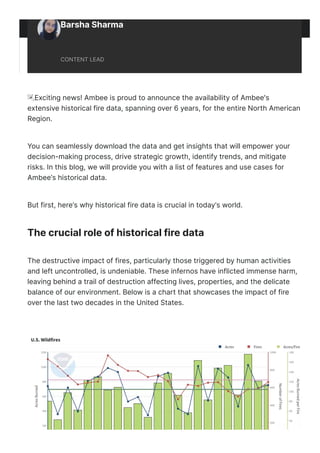
balance of our environment. Below is a chart that showcases the impact of fire
over the last two decades in the United States.
The Annual 2021 Wildfires Report also revealed the impact of wildfires with an
alarming statistic: a staggering 7 million acres of wildland were engulfed in flames
during that year. The report served as a reminder of the pressing challenges of
wildfires and emphasized the urgent need to address this issue.
While real-time and forecast data for wildfires are essential in determining the
extent of impacts and finding solutions for risk-mitigation strategies, historical fire
Source: National Centers for Environmental Information
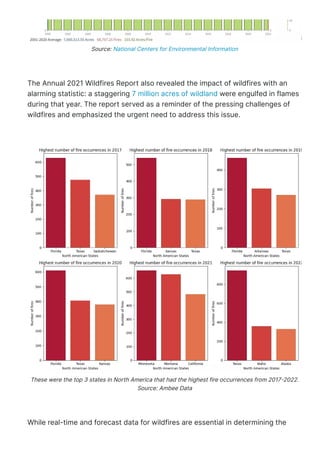
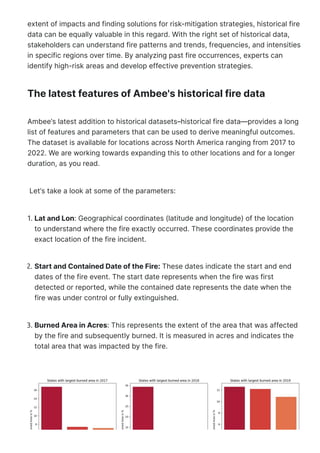
These were the top 3 states in North America that had the highest fire occurrences from 2017몭2022.
Source: Ambee Data
extent of impacts and finding solutions for risk-mitigation strategies, historical fire
data can be equally valuable in this regard. With the right set of historical data,
stakeholders can understand fire patterns and trends, frequencies, and intensities
in specific regions over time. By analyzing past fire occurrences, experts can
identify high-risk areas and develop effective prevention strategies.
The latest features of Ambee's historical fire data
Ambee’s latest addition to historical datasets–historical fire data—provides a long
list of features and parameters that can be used to derive meaningful outcomes.
The dataset is available for locations across North America ranging from 2017 to
2022. We are working towards expanding this to other locations and for a longer
duration, as you read.
Let’s take a look at some of the parameters:
1. Lat and Lon: Geographical coordinates (latitude and longitude) of the location
to understand where the fire exactly occurred. These coordinates provide the
exact location of the fire incident.
2. Start and Contained Date of the Fire: These dates indicate the start and end
dates of the fire event. The start date represents when the fire was first
detected or reported, while the contained date represents the date when the
fire was under control or fully extinguished.
3. Burned Area in Acres: This represents the extent of the area that was affected
by the fire and subsequently burned. It is measured in acres and indicates the
total area that was impacted by the fire.
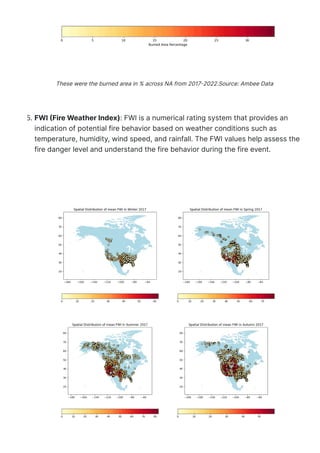
4. Burned Area Polygon Coordinates: These are polygon data of all the lat/long
points of the burned area of the fire location. It refers to a collection of
geographical coordinates that outline the extent and boundaries of the area
affected by a wildfire or fire incident.
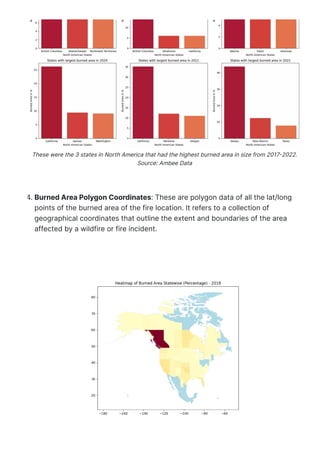
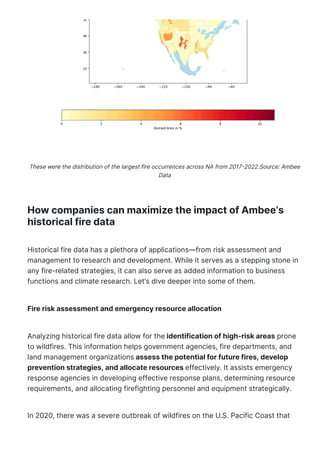
These were the 3 states in North America that had the highest burned area in size from 2017몭2022.
Source: Ambee Data
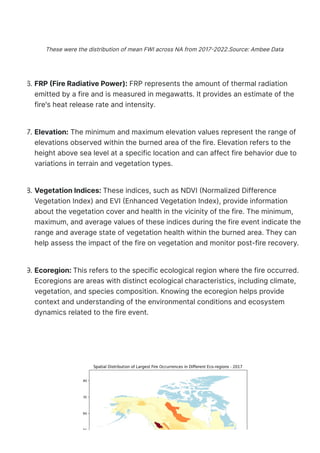
5. FWI 몭Fire Weather Index): FWI is a numerical rating system that provides an
indication of potential fire behavior based on weather conditions such as
temperature, humidity, wind speed, and rainfall. The FWI values help assess the
fire danger level and understand the fire behavior during the fire event.
These were the burned area in % across NA from 2017몭2022.Source: Ambee Data
6. FRP 몭Fire Radiative Power): FRP represents the amount of thermal radiation
emitted by a fire and is measured in megawatts. It provides an estimate of the
fire's heat release rate and intensity.
7. Elevation: The minimum and maximum elevation values represent the range of
elevations observed within the burned area of the fire. Elevation refers to the
height above sea level at a specific location and can affect fire behavior due to
variations in terrain and vegetation types.
8. Vegetation Indices: These indices, such as NDVI 몭Normalized Difference
Vegetation Index) and EVI 몭Enhanced Vegetation Index), provide information
about the vegetation cover and health in the vicinity of the fire. The minimum,
maximum, and average values of these indices during the fire event indicate the
range and average state of vegetation health within the burned area. They can
help assess the impact of the fire on vegetation and monitor post-fire recovery.
9. Ecoregion: This refers to the specific ecological region where the fire occurred.
Ecoregions are areas with distinct ecological characteristics, including climate,
vegetation, and species composition. Knowing the ecoregion helps provide
context and understanding of the environmental conditions and ecosystem
dynamics related to the fire event.
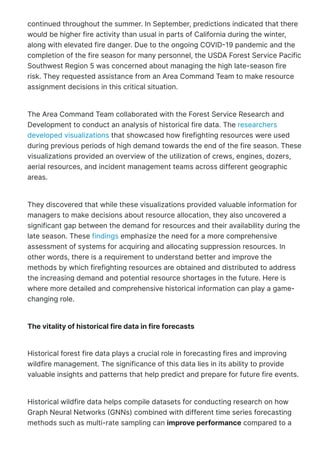
These were the distribution of mean FWI across NA from 2017몭2022.Source: Ambee Data
How companies can maximize the impact of Ambee’s
historical fire data
Historical fire data has a plethora of applications—from risk assessment and
management to research and development. While it serves as a stepping stone in
any fire-related strategies, it can also serve as added information to business
functions and climate research. Let’s dive deeper into some of them.
Fire risk assessment and emergency resource allocation
Analyzing historical fire data allow for the identification of high-risk areas prone
to wildfires. This information helps government agencies, fire departments, and
land management organizations assess the potential for future fires, develop
prevention strategies, and allocate resources effectively. It assists emergency
response agencies in developing effective response plans, determining resource
requirements, and allocating firefighting personnel and equipment strategically.
In 2020, there was a severe outbreak of wildfires on the U.S. Pacific Coast that
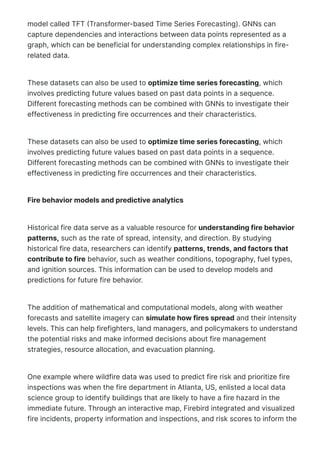
These were the distribution of the largest fire occurrences across NA from 2017몭2022.Source: Ambee
Data
continued throughout the summer. In September, predictions indicated that there
would be higher fire activity than usual in parts of California during the winter,
along with elevated fire danger. Due to the ongoing COVID몭19 pandemic and the
completion of the fire season for many personnel, the USDA Forest Service Pacific
Southwest Region 5 was concerned about managing the high late-season fire
risk. They requested assistance from an Area Command Team to make resource
assignment decisions in this critical situation.
The Area Command Team collaborated with the Forest Service Research and
Development to conduct an analysis of historical fire data. The researchers
developed visualizations that showcased how firefighting resources were used
during previous periods of high demand towards the end of the fire season. These
visualizations provided an overview of the utilization of crews, engines, dozers,
aerial resources, and incident management teams across different geographic
areas.
They discovered that while these visualizations provided valuable information for
managers to make decisions about resource allocation, they also uncovered a
significant gap between the demand for resources and their availability during the
late season. These findings emphasize the need for a more comprehensive
assessment of systems for acquiring and allocating suppression resources. In
other words, there is a requirement to understand better and improve the
methods by which firefighting resources are obtained and distributed to address
the increasing demand and potential resource shortages in the future. Here is
where more detailed and comprehensive historical information can play a game-
changing role.
The vitality of historical fire data in fire forecasts
Historical forest fire data plays a crucial role in forecasting fires and improving
wildfire management. The significance of this data lies in its ability to provide
valuable insights and patterns that help predict and prepare for future fire events.
Historical wildfire data helps compile datasets for conducting research on how
Graph Neural Networks 몭GNNs) combined with different time series forecasting
methods such as multi-rate sampling can improve performance compared to a
model called TFT 몭Transformer-based Time Series Forecasting). GNNs can
capture dependencies and interactions between data points represented as a
graph, which can be beneficial for understanding complex relationships in fire-
related data.
These datasets can also be used to optimize time series forecasting, which
involves predicting future values based on past data points in a sequence.
Different forecasting methods can be combined with GNNs to investigate their
effectiveness in predicting fire occurrences and their characteristics.
These datasets can also be used to optimize time series forecasting, which
involves predicting future values based on past data points in a sequence.
Different forecasting methods can be combined with GNNs to investigate their
effectiveness in predicting fire occurrences and their characteristics.
Fire behavior models and predictive analytics
Historical fire data serve as a valuable resource for understanding fire behavior
patterns, such as the rate of spread, intensity, and direction. By studying
historical fire data, researchers can identify patterns, trends, and factors that
contribute to fire behavior, such as weather conditions, topography, fuel types,
and ignition sources. This information can be used to develop models and
predictions for future fire behavior.
The addition of mathematical and computational models, along with weather
forecasts and satellite imagery can simulate how fires spread and their intensity
levels. This can help firefighters, land managers, and policymakers to understand
the potential risks and make informed decisions about fire management
strategies, resource allocation, and evacuation planning.
One example where wildfire data was used to predict fire risk and prioritize fire
inspections was when the fire department in Atlanta, US, enlisted a local data
science group to identify buildings that are likely to have a fire hazard in the
immediate future. Through an interactive map, Firebird integrated and visualized
fire incidents, property information and inspections, and risk scores to inform the
decision-making processes. Since implementation, it has been used to accurately
predict 71% of commercial fires in Atlanta.
Risk-proof insurance planning and underwriting
In the past several decades, large wildfires across the globe have become more
frequent and more severe. The 2018 Camp Fire in California, for example, caused
85 deaths and destroyed nearly 18,000 properties. Increasing wildfire risks have
posed challenges for the insurance markets. These challenges include higher
premiums and deductibles for insurance policies, as well as a decrease in
coverage options.
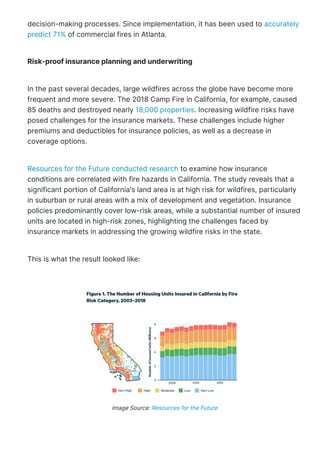
Resources for the Future conducted research to examine how insurance
conditions are correlated with fire hazards in California. The study reveals that a
significant portion of California's land area is at high risk for wildfires, particularly
in suburban or rural areas with a mix of development and vegetation. Insurance
policies predominantly cover low-risk areas, while a substantial number of insured
units are located in high-risk zones, highlighting the challenges faced by
insurance markets in addressing the growing wildfire risks in the state.
This is what the result looked like:
Image Source: Resources for the Future
Historical fire data can inform insurance companies about fire-prone areas,
helping them develop policies and guidelines for building codes and insurance
underwriting ahead of time. This data assists in assessing the level of fire risk and
determining appropriate mitigation measures and insurance coverage. Historical
data helps identify high-risk areas and areas with recent fires which are highly
unlikely to be impacted by fire any time soon, mainly due to the lack of vegetation.
Insurers can use this data to make decisions about whether to provide coverage
for property and at what price while calculating the financial risk associated with
insuring properties in fire-prone areas. Historical fire data serves as a reference
point for insurers when processing claims related to wildfire damage.
Climate change research and education
As climate change intensifies, large-scale wildfires such as the August Complex
Fire and Dixie Fire are becoming more frequent in the United States. Since 2000
wildfires have burned 7 million acres annually, which is more than double the
average of 3.3 million acres burned in the 1990s.
Historical fire data plays a crucial role in studying the relationship between climate
change and fire frequency, intensity, and seasonality. By analyzing long-term fire
trends, scientists can assess the impact of climate change on fire regimes and
develop strategies to adapt to changing fire patterns.
Historical fire data can also be used to raise public awareness about fire risks,
promote fire safety practices, and educate communities on wildfire prevention
and preparedness. By understanding past fire events, individuals can take
proactive measures to protect their properties and enhance their personal safety
while working towards mitigating the effects of wildfires on climate change.
What are the other fire-related products that Ambee
provides?
Ambee provides a comprehensive suite of fire-related products that deliver
accurate, actionable data and insights to customers. This suite of products
includes the historical fire dataset that we have discussed in this blog.
Ambee provides a comprehensive suite of fire-related products that deliver
accurate, actionable data and insights to customers. This suite of products
includes the historical fire dataset that we have discussed in this blog.
Additionally, we provide fire data and intelligence through two other products:
Global Forest Fire API몭 Precise fire data for locations across the globe. Our data
provides you with critical information on the location, intensity, and size, among
other parameters. Some of our new parameters also include the Fire Risk Index
and burnedArea polygon coordinates, which can be highly beneficial to analyze
the burnt locations with greater depth. You can find this in our API dashboard.
Fire Risk Analytics Tool: This tool will help you visualize fires across the USA and
Canada and offers active fire tracking with added 48 hrs of historical weather and
air quality data. It uses current and local environmental factors and predictive
analytics of fire behavior to provide near real-time active forest fire data.
Refreshed hourly, the tool offers detailed information on fire risk levels, rate of
spread, size, cause, and more. The data is visualized through an interactive active
wildfire heatmap to aid businesses and administrators in better understanding the
risks of wildfires. This tool is the perfect choice for businesses looking to enhance
their risk assessment capabilities.
Easily access 6몭 years of Ambee’s historical wildfire data today. If you require
data for a longer time period, all you need to do is contact us.
Do you have a use case in mind for historical fire data?
Get in touch with us today or leave a comment below!
Liked what you just read? Share it with a friend.
Related Posts
Forest fire
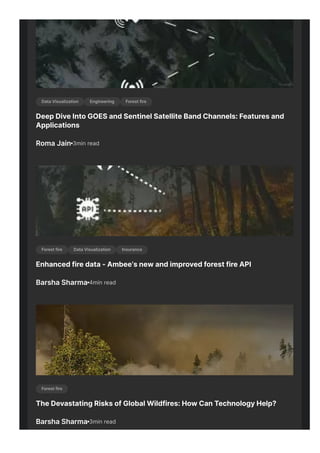
Ambee’s Fire Data For Early Fire Detection and Rapid Response
Barsha Sharma 4min read
Have questions?
Get in touch!
EMAIL ID
Enter your Email ID
MESSAGE
Write you message here
SUBMIT
Data Visualization Engineering Forest fire
Deep Dive Into GOES and Sentinel Satellite Band Channels: Features and
Applications
Roma Jain 3min read
Forest fire Data Visualization Insurance
Enhanced fire data - Ambee’s new and improved forest fire API
Barsha Sharma 4min read
Forest fire
The Devastating Risks of Global Wildfires: How Can Technology Help?
Barsha Sharma 3min read
Air Quality Forest fire
How Organisations Can Use Air Quality and Fire Data to Tackle Fire-
Related Issues
Barsha Sharma 5min read
Power your Climate
Actions with Ambee
Products
C6
Ambee app
APIs
Pollen
Air Quality
Industries
Marketing & Download
TALK TO US
E&C Devices
Devices API
About us
Climate
Pricing
Weather
Active Forest Fire
Severe Weather
NDVI
GHG
Natural Disasters
Advertising
Pharma & Digital Health
Banking & Finance
Logistics & Supply
Chain
Smart Cities
Retail and Consumer
Goods
App
Privacy
Policy
Terms and
conditions
Refund
Policy
All Rights Reserved © Datair Technology Private Limited. Built at Parallel

Ambee Historical Wildfire Data Everything You Need To Know

  • 1.
    Forest fire August 3,2023 2 min read Ambee’s Historical Wildfire Data: Everything You Need To Know
  • 2.
    Barsha Sharma CONTENT LEAD ἸExcitingnews! Ambee is proud to announce the availability of Ambee's extensive historical fire data, spanning over 6 years, for the entire North American Region. You can seamlessly download the data and get insights that will empower your decision-making process, drive strategic growth, identify trends, and mitigate risks. In this blog, we will provide you with a list of features and use cases for Ambee’s historical data. But first, here’s why historical fire data is crucial in today’s world. The crucial role of historical fire data The destructive impact of fires, particularly those triggered by human activities and left uncontrolled, is undeniable. These infernos have inflicted immense harm, leaving behind a trail of destruction affecting lives, properties, and the delicate balance of our environment. Below is a chart that showcases the impact of fire over the last two decades in the United States.
  • 3.
    The Annual 2021Wildfires Report also revealed the impact of wildfires with an alarming statistic: a staggering 7 million acres of wildland were engulfed in flames during that year. The report served as a reminder of the pressing challenges of wildfires and emphasized the urgent need to address this issue. While real-time and forecast data for wildfires are essential in determining the extent of impacts and finding solutions for risk-mitigation strategies, historical fire Source: National Centers for Environmental Information These were the top 3 states in North America that had the highest fire occurrences from 2017몭2022. Source: Ambee Data
  • 4.
    extent of impactsand finding solutions for risk-mitigation strategies, historical fire data can be equally valuable in this regard. With the right set of historical data, stakeholders can understand fire patterns and trends, frequencies, and intensities in specific regions over time. By analyzing past fire occurrences, experts can identify high-risk areas and develop effective prevention strategies. The latest features of Ambee's historical fire data Ambee’s latest addition to historical datasets–historical fire data—provides a long list of features and parameters that can be used to derive meaningful outcomes. The dataset is available for locations across North America ranging from 2017 to 2022. We are working towards expanding this to other locations and for a longer duration, as you read. Let’s take a look at some of the parameters: 1. Lat and Lon: Geographical coordinates (latitude and longitude) of the location to understand where the fire exactly occurred. These coordinates provide the exact location of the fire incident. 2. Start and Contained Date of the Fire: These dates indicate the start and end dates of the fire event. The start date represents when the fire was first detected or reported, while the contained date represents the date when the fire was under control or fully extinguished. 3. Burned Area in Acres: This represents the extent of the area that was affected by the fire and subsequently burned. It is measured in acres and indicates the total area that was impacted by the fire.
  • 5.
    4. Burned AreaPolygon Coordinates: These are polygon data of all the lat/long points of the burned area of the fire location. It refers to a collection of geographical coordinates that outline the extent and boundaries of the area affected by a wildfire or fire incident. These were the 3 states in North America that had the highest burned area in size from 2017몭2022. Source: Ambee Data
  • 6.
    5. FWI 몭FireWeather Index): FWI is a numerical rating system that provides an indication of potential fire behavior based on weather conditions such as temperature, humidity, wind speed, and rainfall. The FWI values help assess the fire danger level and understand the fire behavior during the fire event. These were the burned area in % across NA from 2017몭2022.Source: Ambee Data
  • 7.
    6. FRP 몭FireRadiative Power): FRP represents the amount of thermal radiation emitted by a fire and is measured in megawatts. It provides an estimate of the fire's heat release rate and intensity. 7. Elevation: The minimum and maximum elevation values represent the range of elevations observed within the burned area of the fire. Elevation refers to the height above sea level at a specific location and can affect fire behavior due to variations in terrain and vegetation types. 8. Vegetation Indices: These indices, such as NDVI 몭Normalized Difference Vegetation Index) and EVI 몭Enhanced Vegetation Index), provide information about the vegetation cover and health in the vicinity of the fire. The minimum, maximum, and average values of these indices during the fire event indicate the range and average state of vegetation health within the burned area. They can help assess the impact of the fire on vegetation and monitor post-fire recovery. 9. Ecoregion: This refers to the specific ecological region where the fire occurred. Ecoregions are areas with distinct ecological characteristics, including climate, vegetation, and species composition. Knowing the ecoregion helps provide context and understanding of the environmental conditions and ecosystem dynamics related to the fire event. These were the distribution of mean FWI across NA from 2017몭2022.Source: Ambee Data
  • 8.
    How companies canmaximize the impact of Ambee’s historical fire data Historical fire data has a plethora of applications—from risk assessment and management to research and development. While it serves as a stepping stone in any fire-related strategies, it can also serve as added information to business functions and climate research. Let’s dive deeper into some of them. Fire risk assessment and emergency resource allocation Analyzing historical fire data allow for the identification of high-risk areas prone to wildfires. This information helps government agencies, fire departments, and land management organizations assess the potential for future fires, develop prevention strategies, and allocate resources effectively. It assists emergency response agencies in developing effective response plans, determining resource requirements, and allocating firefighting personnel and equipment strategically. In 2020, there was a severe outbreak of wildfires on the U.S. Pacific Coast that These were the distribution of the largest fire occurrences across NA from 2017몭2022.Source: Ambee Data
  • 9.
    continued throughout thesummer. In September, predictions indicated that there would be higher fire activity than usual in parts of California during the winter, along with elevated fire danger. Due to the ongoing COVID몭19 pandemic and the completion of the fire season for many personnel, the USDA Forest Service Pacific Southwest Region 5 was concerned about managing the high late-season fire risk. They requested assistance from an Area Command Team to make resource assignment decisions in this critical situation. The Area Command Team collaborated with the Forest Service Research and Development to conduct an analysis of historical fire data. The researchers developed visualizations that showcased how firefighting resources were used during previous periods of high demand towards the end of the fire season. These visualizations provided an overview of the utilization of crews, engines, dozers, aerial resources, and incident management teams across different geographic areas. They discovered that while these visualizations provided valuable information for managers to make decisions about resource allocation, they also uncovered a significant gap between the demand for resources and their availability during the late season. These findings emphasize the need for a more comprehensive assessment of systems for acquiring and allocating suppression resources. In other words, there is a requirement to understand better and improve the methods by which firefighting resources are obtained and distributed to address the increasing demand and potential resource shortages in the future. Here is where more detailed and comprehensive historical information can play a game- changing role. The vitality of historical fire data in fire forecasts Historical forest fire data plays a crucial role in forecasting fires and improving wildfire management. The significance of this data lies in its ability to provide valuable insights and patterns that help predict and prepare for future fire events. Historical wildfire data helps compile datasets for conducting research on how Graph Neural Networks 몭GNNs) combined with different time series forecasting methods such as multi-rate sampling can improve performance compared to a
  • 10.
    model called TFT몭Transformer-based Time Series Forecasting). GNNs can capture dependencies and interactions between data points represented as a graph, which can be beneficial for understanding complex relationships in fire- related data. These datasets can also be used to optimize time series forecasting, which involves predicting future values based on past data points in a sequence. Different forecasting methods can be combined with GNNs to investigate their effectiveness in predicting fire occurrences and their characteristics. These datasets can also be used to optimize time series forecasting, which involves predicting future values based on past data points in a sequence. Different forecasting methods can be combined with GNNs to investigate their effectiveness in predicting fire occurrences and their characteristics. Fire behavior models and predictive analytics Historical fire data serve as a valuable resource for understanding fire behavior patterns, such as the rate of spread, intensity, and direction. By studying historical fire data, researchers can identify patterns, trends, and factors that contribute to fire behavior, such as weather conditions, topography, fuel types, and ignition sources. This information can be used to develop models and predictions for future fire behavior. The addition of mathematical and computational models, along with weather forecasts and satellite imagery can simulate how fires spread and their intensity levels. This can help firefighters, land managers, and policymakers to understand the potential risks and make informed decisions about fire management strategies, resource allocation, and evacuation planning. One example where wildfire data was used to predict fire risk and prioritize fire inspections was when the fire department in Atlanta, US, enlisted a local data science group to identify buildings that are likely to have a fire hazard in the immediate future. Through an interactive map, Firebird integrated and visualized fire incidents, property information and inspections, and risk scores to inform the decision-making processes. Since implementation, it has been used to accurately
  • 11.
    decision-making processes. Sinceimplementation, it has been used to accurately predict 71% of commercial fires in Atlanta. Risk-proof insurance planning and underwriting In the past several decades, large wildfires across the globe have become more frequent and more severe. The 2018 Camp Fire in California, for example, caused 85 deaths and destroyed nearly 18,000 properties. Increasing wildfire risks have posed challenges for the insurance markets. These challenges include higher premiums and deductibles for insurance policies, as well as a decrease in coverage options. Resources for the Future conducted research to examine how insurance conditions are correlated with fire hazards in California. The study reveals that a significant portion of California's land area is at high risk for wildfires, particularly in suburban or rural areas with a mix of development and vegetation. Insurance policies predominantly cover low-risk areas, while a substantial number of insured units are located in high-risk zones, highlighting the challenges faced by insurance markets in addressing the growing wildfire risks in the state. This is what the result looked like: Image Source: Resources for the Future
  • 12.
    Historical fire datacan inform insurance companies about fire-prone areas, helping them develop policies and guidelines for building codes and insurance underwriting ahead of time. This data assists in assessing the level of fire risk and determining appropriate mitigation measures and insurance coverage. Historical data helps identify high-risk areas and areas with recent fires which are highly unlikely to be impacted by fire any time soon, mainly due to the lack of vegetation. Insurers can use this data to make decisions about whether to provide coverage for property and at what price while calculating the financial risk associated with insuring properties in fire-prone areas. Historical fire data serves as a reference point for insurers when processing claims related to wildfire damage. Climate change research and education As climate change intensifies, large-scale wildfires such as the August Complex Fire and Dixie Fire are becoming more frequent in the United States. Since 2000 wildfires have burned 7 million acres annually, which is more than double the average of 3.3 million acres burned in the 1990s. Historical fire data plays a crucial role in studying the relationship between climate change and fire frequency, intensity, and seasonality. By analyzing long-term fire trends, scientists can assess the impact of climate change on fire regimes and develop strategies to adapt to changing fire patterns. Historical fire data can also be used to raise public awareness about fire risks, promote fire safety practices, and educate communities on wildfire prevention and preparedness. By understanding past fire events, individuals can take proactive measures to protect their properties and enhance their personal safety while working towards mitigating the effects of wildfires on climate change. What are the other fire-related products that Ambee provides?
  • 13.
    Ambee provides acomprehensive suite of fire-related products that deliver accurate, actionable data and insights to customers. This suite of products includes the historical fire dataset that we have discussed in this blog. Ambee provides a comprehensive suite of fire-related products that deliver accurate, actionable data and insights to customers. This suite of products includes the historical fire dataset that we have discussed in this blog. Additionally, we provide fire data and intelligence through two other products: Global Forest Fire API몭 Precise fire data for locations across the globe. Our data provides you with critical information on the location, intensity, and size, among other parameters. Some of our new parameters also include the Fire Risk Index and burnedArea polygon coordinates, which can be highly beneficial to analyze the burnt locations with greater depth. You can find this in our API dashboard. Fire Risk Analytics Tool: This tool will help you visualize fires across the USA and Canada and offers active fire tracking with added 48 hrs of historical weather and air quality data. It uses current and local environmental factors and predictive analytics of fire behavior to provide near real-time active forest fire data. Refreshed hourly, the tool offers detailed information on fire risk levels, rate of spread, size, cause, and more. The data is visualized through an interactive active wildfire heatmap to aid businesses and administrators in better understanding the risks of wildfires. This tool is the perfect choice for businesses looking to enhance their risk assessment capabilities. Easily access 6몭 years of Ambee’s historical wildfire data today. If you require data for a longer time period, all you need to do is contact us. Do you have a use case in mind for historical fire data? Get in touch with us today or leave a comment below!
  • 14.
    Liked what youjust read? Share it with a friend. Related Posts Forest fire Ambee’s Fire Data For Early Fire Detection and Rapid Response Barsha Sharma 4min read Have questions? Get in touch! EMAIL ID Enter your Email ID MESSAGE Write you message here SUBMIT
  • 15.
    Data Visualization EngineeringForest fire Deep Dive Into GOES and Sentinel Satellite Band Channels: Features and Applications Roma Jain 3min read Forest fire Data Visualization Insurance Enhanced fire data - Ambee’s new and improved forest fire API Barsha Sharma 4min read Forest fire The Devastating Risks of Global Wildfires: How Can Technology Help? Barsha Sharma 3min read
  • 16.
    Air Quality Forestfire How Organisations Can Use Air Quality and Fire Data to Tackle Fire- Related Issues Barsha Sharma 5min read Power your Climate Actions with Ambee Products C6 Ambee app APIs Pollen Air Quality Industries Marketing & Download TALK TO US
  • 17.
    E&C Devices Devices API Aboutus Climate Pricing Weather Active Forest Fire Severe Weather NDVI GHG Natural Disasters Advertising Pharma & Digital Health Banking & Finance Logistics & Supply Chain Smart Cities Retail and Consumer Goods App Privacy Policy Terms and conditions Refund Policy All Rights Reserved © Datair Technology Private Limited. Built at Parallel