VET & the HSC It’s about time! and It’s ALL about YOU!
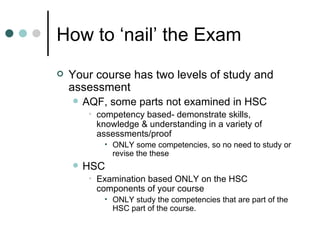
How to ‘nail’ the Exam Your course has two levels of study and assessment AQF, some parts not examined in HSC competency based- demonstrate skills, knowledge & understanding in a variety of assessments/proof ONLY some competencies, so no need to study or revise the these HSC Examination based ONLY on the HSC components of your course ONLY study the competencies that are part of the HSC part of the course.
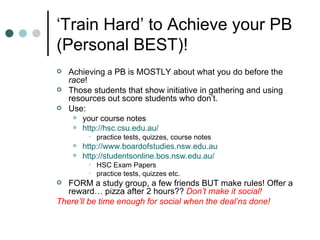
‘ Train Hard’ to Achieve your PB (Personal BEST)! Achieving a PB is MOSTLY about what you do before the  race ! Those students that show initiative in gathering and using resources out score students who don’t. Use: your course notes http://hsc.csu.edu.au/ practice tests, quizzes, course notes http://www.boardofstudies.nsw.edu.au http://studentsonline.bos.nsw.edu.au/ HSC Exam Papers practice tests, quizzes etc. FORM a study group, a few friends BUT make rules! Offer a reward… pizza after 2 hours??  Don’t make it social! There’ll be time enough for social when the deal’ns done!
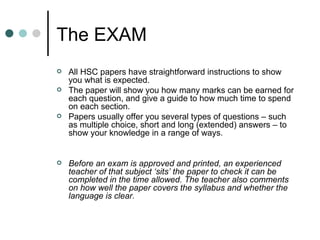
The EXAM All HSC papers have straightforward instructions to show you what is expected. The paper will show you how many marks can be earned for each question, and give a guide to how much time to spend on each section. Papers usually offer you several types of questions – such as multiple choice, short and long (extended) answers – to show your knowledge in a range of ways. Before an exam is approved and printed, an experienced teacher of that subject ‘sits’ the paper to check it can be completed in the time allowed. The teacher also comments on how well the paper covers the syllabus and whether the language is clear.
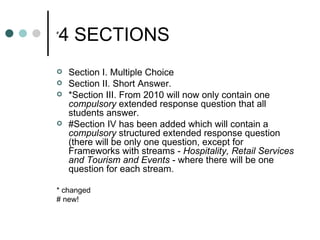
# 4 SECTIONS Section I. Multiple Choice Section II. Short Answer. *Section III. From 2010 will now only contain one  compulsory  extended response question that all students answer. #Section IV has been added which will contain a  compulsory  structured extended response question (there will be only one question, except for Frameworks with streams -  Hospitality, Retail Services and Tourism and Events  - where there will be one question for each stream. * changed # new!
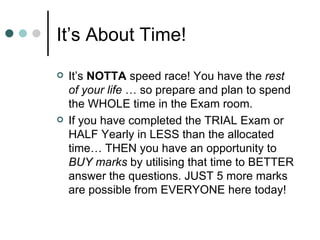
It’s About Time! It’s  NOTTA  speed race! You have the  rest of your life  … so prepare and plan to spend the WHOLE time in the Exam room. If you have completed the TRIAL Exam or HALF Yearly in LESS than the allocated time… THEN you have an opportunity to  BUY marks  by utilising that time to BETTER answer the questions. JUST 5 more marks are possible from EVERYONE here today!
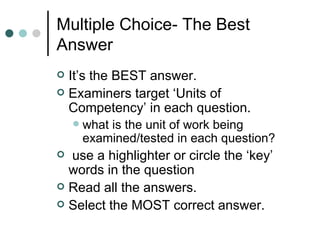
Multiple Choice- The Best Answer It’s the BEST answer. Examiners target ‘Units of Competency’ in each question. what is the unit of work being examined/tested in each question? use a highlighter or circle the ‘key’ words in the question Read all the answers. Select the MOST correct answer.
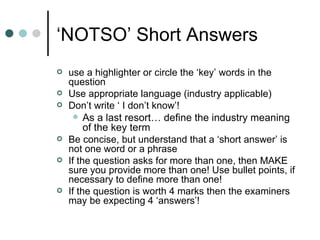
‘ NOTSO’ Short Answers use a highlighter or circle the ‘key’ words in the question Use appropriate language (industry applicable) Don’t write ‘ I don’t know’! As a last resort… define the industry meaning of the key term Be concise, but understand that a ‘short answer’ is not one word or a phrase If the question asks for more than one, then MAKE sure you provide more than one! Use bullet points, if necessary to define more than one! If the question is worth 4 marks then the examiners may be expecting 4 ‘answers’!
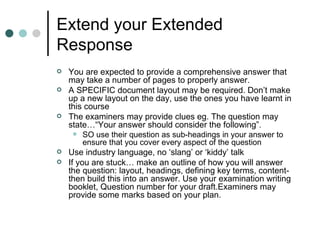
Extend your Extended Response You are expected to provide a comprehensive answer that may take a number of pages to properly answer. A SPECIFIC document layout may be required. Don’t make up a new layout on the day, use the ones you have learnt in this course The examiners may provide clues eg. The question may state…“Your answer should consider the following”. SO use their question as sub-headings in your answer to ensure that you cover every aspect of the question Use industry language, no ‘slang’ or ‘kiddy’ talk If you are stuck… make an outline of how you will answer the question: layout, headings, defining key terms, content- then build this into an answer. Use your examination writing booklet, Question number for your draft.Examiners may provide some marks based on your plan.
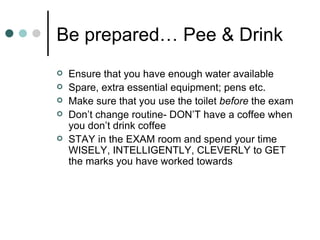
Be prepared… Pee & Drink  Ensure that you have enough water available Spare, extra essential equipment; pens etc. Make sure that you use the toilet  before  the exam Don’t change routine- DON’T have a coffee when you don’t drink coffee STAY in the EXAM room and spend your time WISELY, INTELLIGENTLY, CLEVERLY to GET the marks you have worked towards
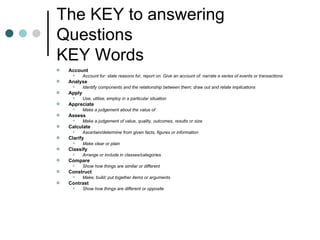
The KEY to answering Questions KEY Words Account  Account for: state reasons for, report on. Give an account of: narrate a series of events or transactions  Analyse  Identify components and the relationship between them; draw out and relate implications  Apply  Use, utilise, employ in a particular situation  Appreciate  Make a judgement about the value of  Assess  Make a judgement of value, quality, outcomes, results or size  Calculate  Ascertain/determine from given facts, figures or information  Clarify  Make clear or plain  Classify  Arrange or include in classes/categories  Compare  Show how things are similar or different  Construct  Make; build; put together items or arguments  Contrast  Show how things are different or opposite
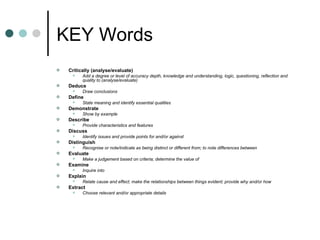
KEY Words Critically (analyse/evaluate)  Add a degree or level of accuracy depth, knowledge and understanding, logic, questioning, reflection and quality to (analyse/evaluate)  Deduce  Draw conclusions  Define  State meaning and identify essential qualities  Demonstrate  Show by example  Describe  Provide characteristics and features  Discuss  Identify issues and provide points for and/or against  Distinguish  Recognise or note/indicate as being distinct or different from; to note differences between  Evaluate  Make a judgement based on criteria; determine the value of  Examine  Inquire into  Explain  Relate cause and effect; make the relationships between things evident; provide why and/or how  Extract  Choose relevant and/or appropriate details
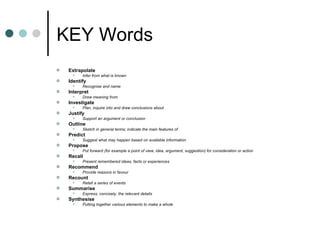
KEY Words Extrapolate  Infer from what is known  Identify  Recognise and name  Interpret  Draw meaning from  Investigate  Plan, inquire into and draw conclusions about  Justify  Support an argument or conclusion  Outline  Sketch in general terms; indicate the main features of  Predict  Suggest what may happen based on available information  Propose  Put forward (for example a point of view, idea, argument, suggestion) for consideration or action  Recall  Present remembered ideas, facts or experiences  Recommend  Provide reasons in favour  Recount  Retell a series of events  Summarise  Express, concisely, the relevant details  Synthesise  Putting together various elements to make a whole
dO iT NoW!
NoW!

Vet & The HSC 2010

  • 1.
    VET & theHSC It’s about time! and It’s ALL about YOU!
  • 2.
    How to ‘nail’the Exam Your course has two levels of study and assessment AQF, some parts not examined in HSC competency based- demonstrate skills, knowledge & understanding in a variety of assessments/proof ONLY some competencies, so no need to study or revise the these HSC Examination based ONLY on the HSC components of your course ONLY study the competencies that are part of the HSC part of the course.
  • 3.
    ‘ Train Hard’to Achieve your PB (Personal BEST)! Achieving a PB is MOSTLY about what you do before the race ! Those students that show initiative in gathering and using resources out score students who don’t. Use: your course notes http://hsc.csu.edu.au/ practice tests, quizzes, course notes http://www.boardofstudies.nsw.edu.au http://studentsonline.bos.nsw.edu.au/ HSC Exam Papers practice tests, quizzes etc. FORM a study group, a few friends BUT make rules! Offer a reward… pizza after 2 hours?? Don’t make it social! There’ll be time enough for social when the deal’ns done!
  • 4.
    The EXAM AllHSC papers have straightforward instructions to show you what is expected. The paper will show you how many marks can be earned for each question, and give a guide to how much time to spend on each section. Papers usually offer you several types of questions – such as multiple choice, short and long (extended) answers – to show your knowledge in a range of ways. Before an exam is approved and printed, an experienced teacher of that subject ‘sits’ the paper to check it can be completed in the time allowed. The teacher also comments on how well the paper covers the syllabus and whether the language is clear.
  • 5.
    # 4 SECTIONSSection I. Multiple Choice Section II. Short Answer. *Section III. From 2010 will now only contain one compulsory extended response question that all students answer. #Section IV has been added which will contain a compulsory structured extended response question (there will be only one question, except for Frameworks with streams - Hospitality, Retail Services and Tourism and Events - where there will be one question for each stream. * changed # new!
  • 6.
    It’s About Time!It’s NOTTA speed race! You have the rest of your life … so prepare and plan to spend the WHOLE time in the Exam room. If you have completed the TRIAL Exam or HALF Yearly in LESS than the allocated time… THEN you have an opportunity to BUY marks by utilising that time to BETTER answer the questions. JUST 5 more marks are possible from EVERYONE here today!
  • 7.
    Multiple Choice- TheBest Answer It’s the BEST answer. Examiners target ‘Units of Competency’ in each question. what is the unit of work being examined/tested in each question? use a highlighter or circle the ‘key’ words in the question Read all the answers. Select the MOST correct answer.
  • 8.
    ‘ NOTSO’ ShortAnswers use a highlighter or circle the ‘key’ words in the question Use appropriate language (industry applicable) Don’t write ‘ I don’t know’! As a last resort… define the industry meaning of the key term Be concise, but understand that a ‘short answer’ is not one word or a phrase If the question asks for more than one, then MAKE sure you provide more than one! Use bullet points, if necessary to define more than one! If the question is worth 4 marks then the examiners may be expecting 4 ‘answers’!
  • 9.
    Extend your ExtendedResponse You are expected to provide a comprehensive answer that may take a number of pages to properly answer. A SPECIFIC document layout may be required. Don’t make up a new layout on the day, use the ones you have learnt in this course The examiners may provide clues eg. The question may state…“Your answer should consider the following”. SO use their question as sub-headings in your answer to ensure that you cover every aspect of the question Use industry language, no ‘slang’ or ‘kiddy’ talk If you are stuck… make an outline of how you will answer the question: layout, headings, defining key terms, content- then build this into an answer. Use your examination writing booklet, Question number for your draft.Examiners may provide some marks based on your plan.
  • 10.
    Be prepared… Pee& Drink Ensure that you have enough water available Spare, extra essential equipment; pens etc. Make sure that you use the toilet before the exam Don’t change routine- DON’T have a coffee when you don’t drink coffee STAY in the EXAM room and spend your time WISELY, INTELLIGENTLY, CLEVERLY to GET the marks you have worked towards
  • 11.
    The KEY toanswering Questions KEY Words Account Account for: state reasons for, report on. Give an account of: narrate a series of events or transactions Analyse Identify components and the relationship between them; draw out and relate implications Apply Use, utilise, employ in a particular situation Appreciate Make a judgement about the value of Assess Make a judgement of value, quality, outcomes, results or size Calculate Ascertain/determine from given facts, figures or information Clarify Make clear or plain Classify Arrange or include in classes/categories Compare Show how things are similar or different Construct Make; build; put together items or arguments Contrast Show how things are different or opposite
  • 12.
    KEY Words Critically(analyse/evaluate) Add a degree or level of accuracy depth, knowledge and understanding, logic, questioning, reflection and quality to (analyse/evaluate) Deduce Draw conclusions Define State meaning and identify essential qualities Demonstrate Show by example Describe Provide characteristics and features Discuss Identify issues and provide points for and/or against Distinguish Recognise or note/indicate as being distinct or different from; to note differences between Evaluate Make a judgement based on criteria; determine the value of Examine Inquire into Explain Relate cause and effect; make the relationships between things evident; provide why and/or how Extract Choose relevant and/or appropriate details
  • 13.
    KEY Words Extrapolate Infer from what is known Identify Recognise and name Interpret Draw meaning from Investigate Plan, inquire into and draw conclusions about Justify Support an argument or conclusion Outline Sketch in general terms; indicate the main features of Predict Suggest what may happen based on available information Propose Put forward (for example a point of view, idea, argument, suggestion) for consideration or action Recall Present remembered ideas, facts or experiences Recommend Provide reasons in favour Recount Retell a series of events Summarise Express, concisely, the relevant details Synthesise Putting together various elements to make a whole
  • 14.
  • 15.