How to Perfectly Construct an RFP in 8 Steps
The RFP (request for proposal) is a document that describes
project specific requirements and expectations to suppliers with
the aim of getting proposed solutions from qualified companies
or vendors. The document is helpful for suppliers to establish
joint understanding of requirements for a project. The details of
RFP depend on scope of the project (Wilkinson & Thorson,
1998). It might involve specific services, products, or outline
the expected use of technology and the requirements for project
implementation. This means that RFP should be well-conceived,
concise, and well-written to attract good vendors. A poorly
written RFP attract unsuitable vendors for the project.
Ambiguous requirements prevent the qualified candidates from
bidding properly. The RFP detail aspects of proposed
requirement and what is expected of vendor in meeting the
requirement. The final proposal and RFP when agreed become
statement of work for contract (Wilkinson & Thorson, 1998).
Let’s begin exploring how an RFP is constructed.
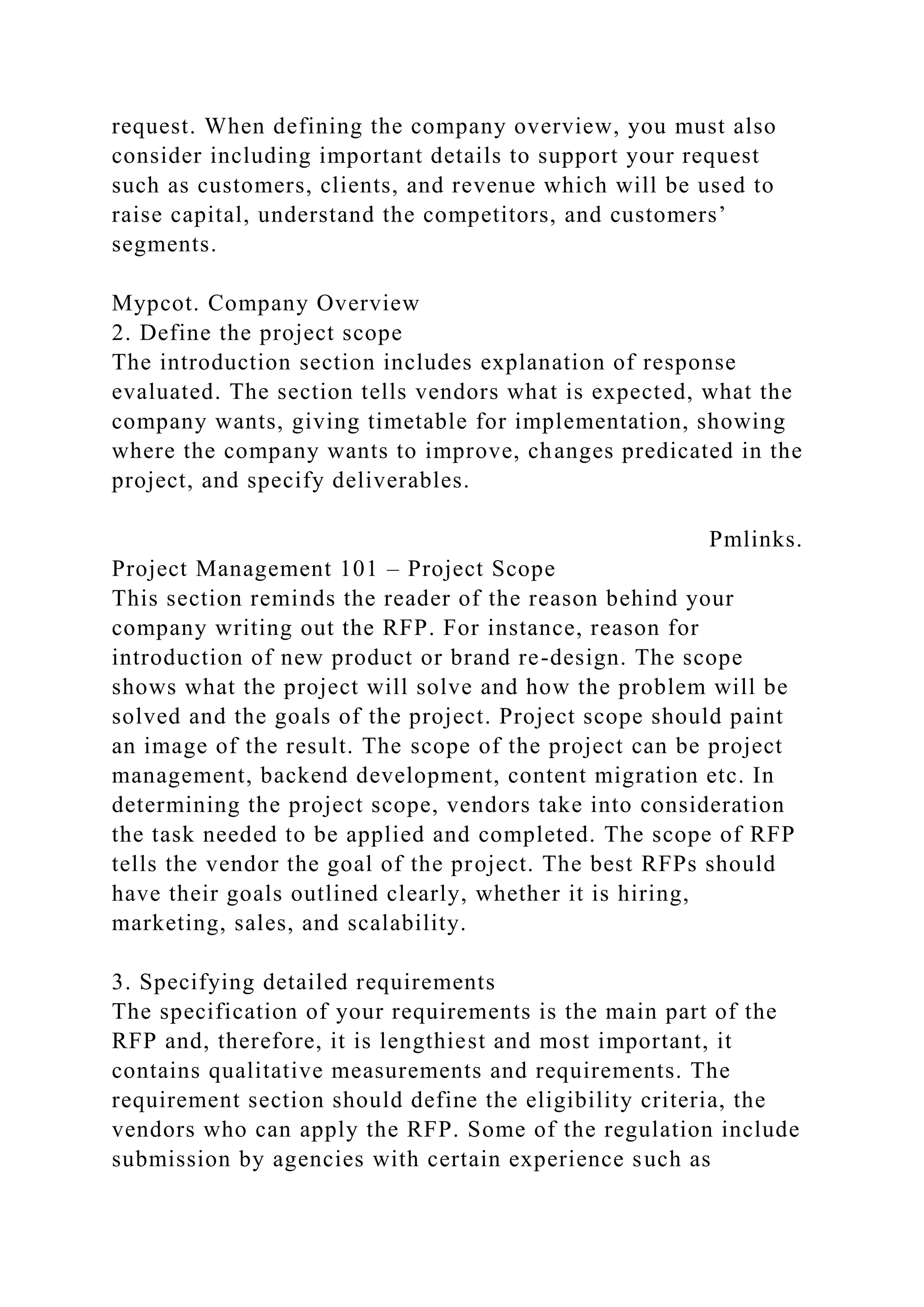
Calonico. S (2018) Kumulos.
1. Define company overview
This section of RFP helps managers contextualize decisions
made in the project by considering whether they will be able to
provide your company’s specific field with the appropriate
material and/or services. It captures information about the
organization, what it does and what it is currently doing.
Further, the section should culture the uniqueness of the
company. The company overview should tell reader about the
company values. By describing the value, you are likely to get
an organization which has value fit for processes and goals. It
defines the reason for writing the RFP. When writing the RFP
you are required to introduce the product, the requirements for
the product, and the summary of the main points of your
request. When defining the company overview, you must also
consider including important details to support your request
such as customers, clients, and revenue which will be used to
raise capital, understand the competitors, and customers’
segments.
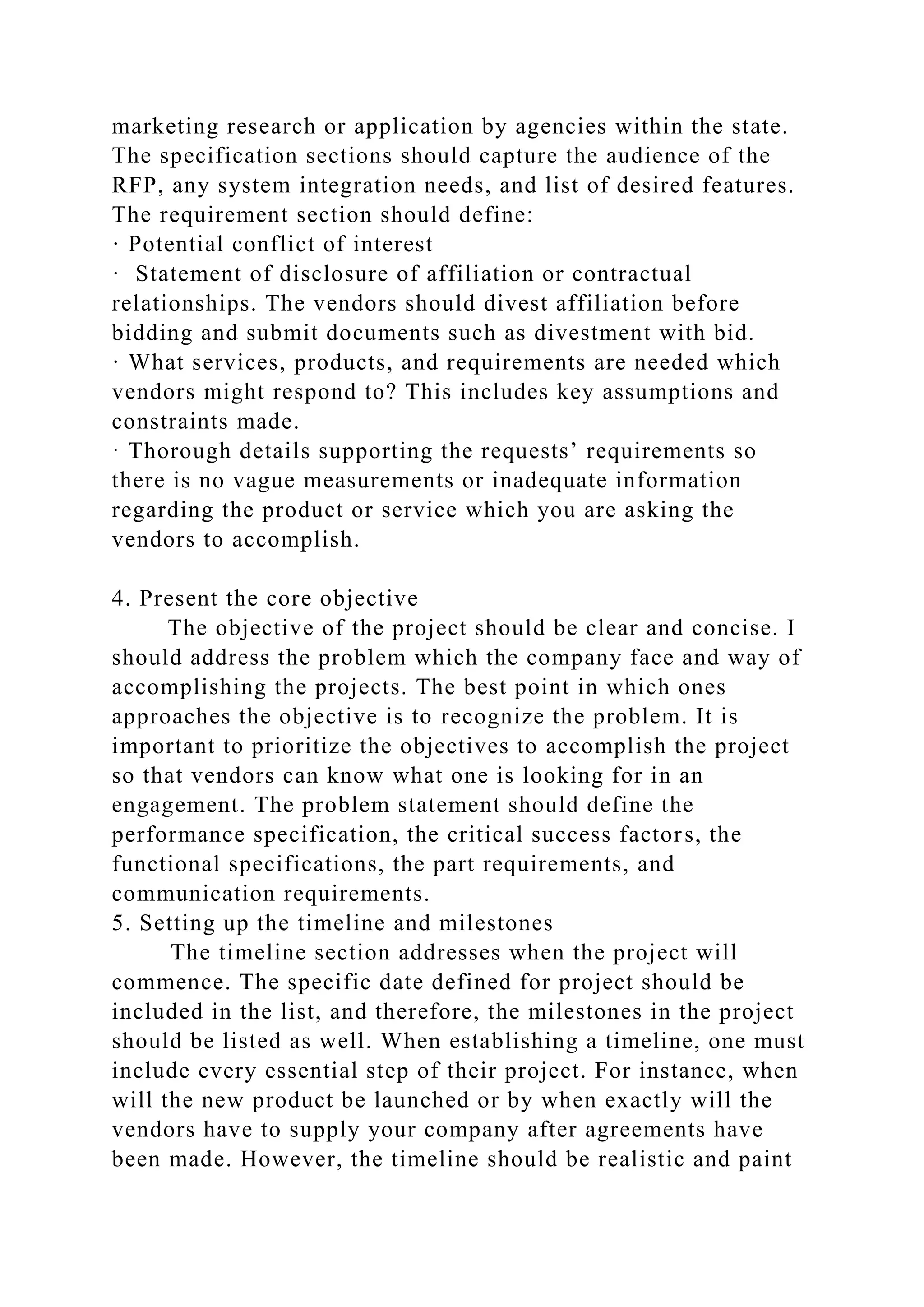
Mypcot. Company Overview
2. Define the project scope
The introduction section includes explanation of response
evaluated. The section tells vendors what is expected, what the
company wants, giving timetable for implementation, showing
where the company wants to improve, changes predicated in the
project, and specify deliverables.
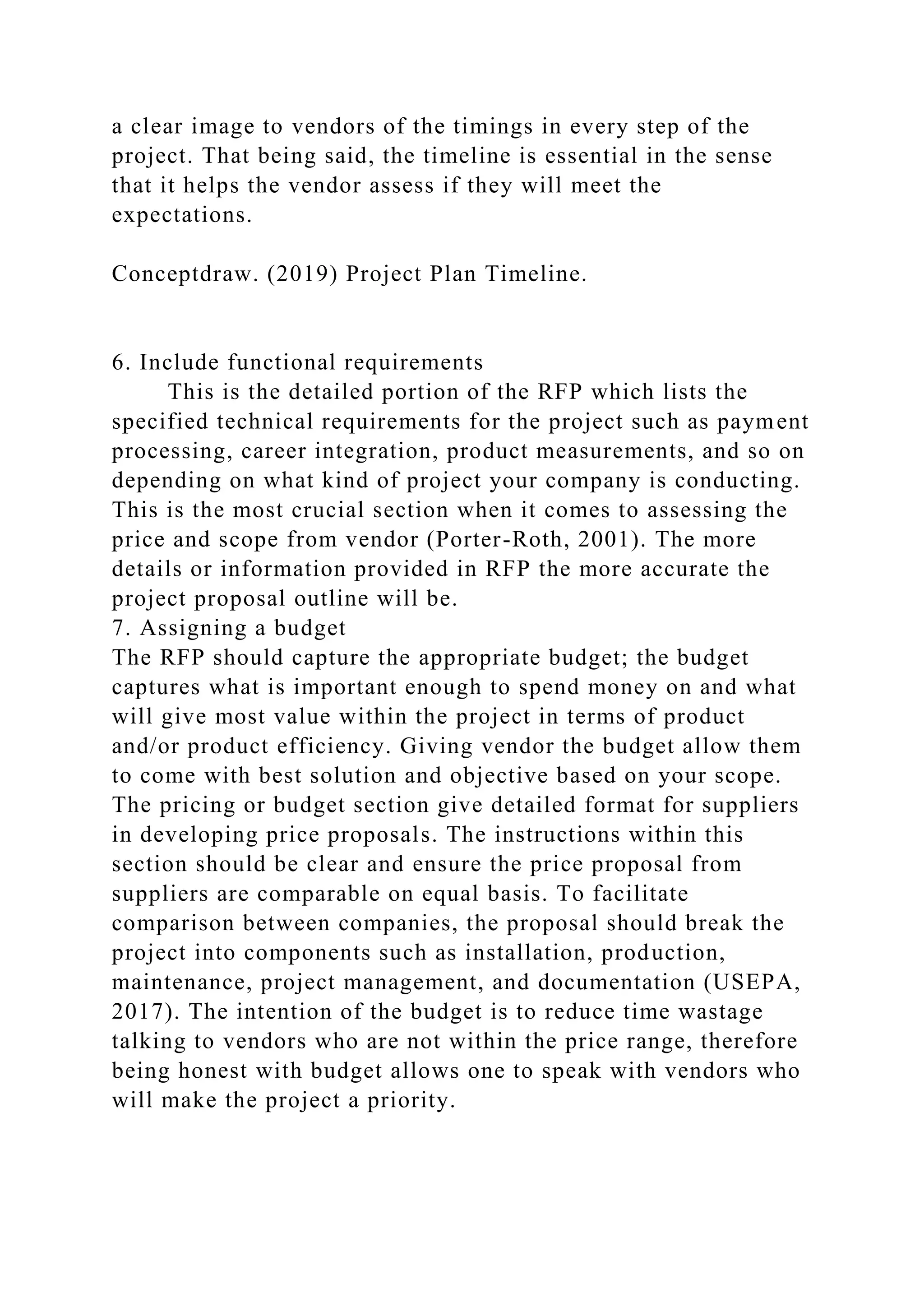
Pmlinks.
Project Management 101 – Project Scope
This section reminds the reader of the reason behind your
company writing out the RFP. For instance, reason for
introduction of new product or brand re-design. The scope
shows what the project will solve and how the problem will be
solved and the goals of the project. Project scope should paint
an image of the result. The scope of the project can be project
management, backend development, content migration etc. In
determining the project scope, vendors take into consideration
the task needed to be applied and completed. The scope of RFP
tells the vendor the goal of the project. The best RFPs should
have their goals outlined clearly, whether it is hiring,
marketing, sales, and scalability.
3. Specifying detailed requirements
The specification of your requirements is the main part of the
RFP and, therefore, it is lengthiest and most important, it
contains qualitative measurements and requirements. The
requirement section should define the eligibility criteria, the
vendors who can apply the RFP. Some of the regulation include
submission by agencies with certain experience such as
marketing research or application by agencies within the state.
The specification sections should capture the audience of the
RFP, any system integration needs, and list of desired features.
The requirement section should define:
· Potential conflict of interest
· Statement of disclosure of affiliation or contractual
relationships. The vendors should divest affiliation before
bidding and submit documents such as divestment with bid.
· What services, products, and requirements are needed which
vendors might respond to? This includes key assumptions and
constraints made.
· Thorough details supporting the requests’ requirements so
there is no vague measurements or inadequate information
regarding the product or service which you are asking the
vendors to accomplish.
4. Present the core objective
The objective of the project should be clear and concise. I
should address the problem which the company face and way of
accomplishing the projects. The best point in which ones
approaches the objective is to recognize the problem. It is
important to prioritize the objectives to accomplish the project
so that vendors can know what one is looking for in an
engagement. The problem statement should define the
performance specification, the critical success factors, the
functional specifications, the part requirements, and
communication requirements.
5. Setting up the timeline and milestones
The timeline section addresses when the project will
commence. The specific date defined for project should be
included in the list, and therefore, the milestones in the project
should be listed as well. When establishing a timeline, one must
include every essential step of their project. For instance, when
will the new product be launched or by when exactly will the
vendors have to supply your company after agreements have
been made. However, the timeline should be realistic and paint
a clear image to vendors of the timings in every step of the
project. That being said, the timeline is essential in the sense
that it helps the vendor assess if they will meet the
expectations.
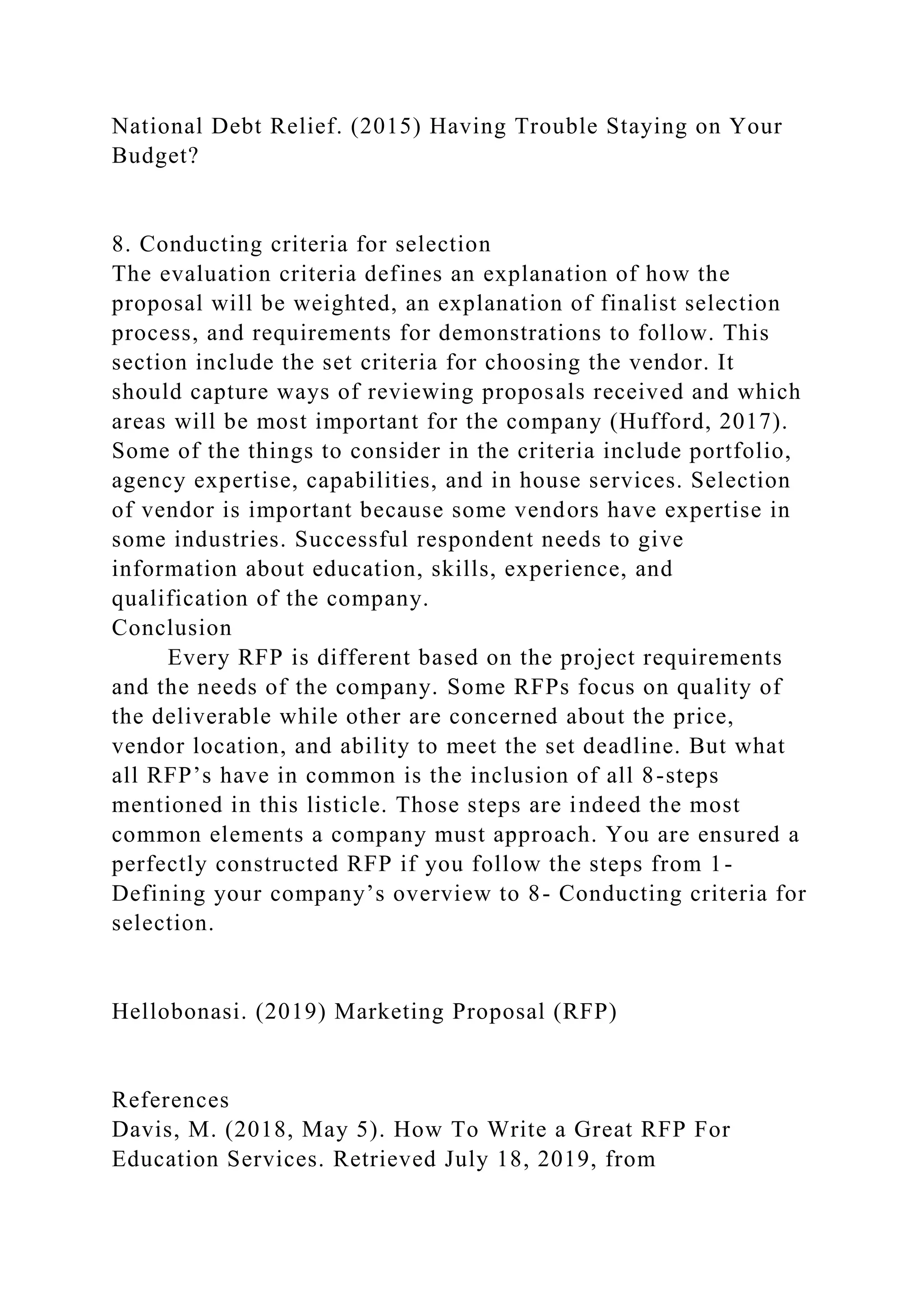
Conceptdraw. (2019) Project Plan Timeline.
6. Include functional requirements
This is the detailed portion of the RFP which lists the
specified technical requirements for the project such as payment
processing, career integration, product measurements, and so on
depending on what kind of project your company is conducting.
This is the most crucial section when it comes to assessing the
price and scope from vendor (Porter-Roth, 2001). The more
details or information provided in RFP the more accurate the
project proposal outline will be.
7. Assigning a budget
The RFP should capture the appropriate budget; the budget
captures what is important enough to spend money on and what
will give most value within the project in terms of product
and/or product efficiency. Giving vendor the budget allow them
to come with best solution and objective based on your scope.
The pricing or budget section give detailed format for suppliers
in developing price proposals. The instructions within this
section should be clear and ensure the price proposal from
suppliers are comparable on equal basis. To facilitate
comparison between companies, the proposal should break the
project into components such as installation, production,
maintenance, project management, and documentation (USEPA,
2017). The intention of the budget is to reduce time wastage
talking to vendors who are not within the price range, therefore
being honest with budget allows one to speak with vendors who
will make the project a priority.
National Debt Relief. (2015) Having Trouble Staying on Your
Budget?
8. Conducting criteria for selection
The evaluation criteria defines an explanation of how the
proposal will be weighted, an explanation of finalist selection
process, and requirements for demonstrations to follow. This
section include the set criteria for choosing the vendor. It
should capture ways of reviewing proposals received and which
areas will be most important for the company (Hufford, 2017).
Some of the things to consider in the criteria include portfolio,
agency expertise, capabilities, and in house services. Selection
of vendor is important because some vendors have expertise in
some industries. Successful respondent needs to give
information about education, skills, experience, and
qualification of the company.
Conclusion
Every RFP is different based on the project requirements
and the needs of the company. Some RFPs focus on quality of
the deliverable while other are concerned about the price,
vendor location, and ability to meet the set deadline. But what
all RFP’s have in common is the inclusion of all 8-steps
mentioned in this listicle. Those steps are indeed the most
common elements a company must approach. You are ensured a
perfectly constructed RFP if you follow the steps from 1-
Defining your company’s overview to 8- Conducting criteria for
selection.
Hellobonasi. (2019) Marketing Proposal (RFP)
References
Davis, M. (2018, May 5). How To Write a Great RFP For
Education Services. Retrieved July 18, 2019, from
https://www.macroconnect.net/how-to-write-a-great-rfp-for-
education-services/
HUFFORD, B. (2017, November 21). RFP: the ultimate guide to
writing a request for proposal. Retrieved July 18, 2019, from
https://cliquestudios.com/rfp-request-for-proposal/
Porter-Roth. (2001, Nov 1). Introduction to Writing RFPs.
(Porter-Roth, Producer) Retrieved July 18, 2019, from
http://catalogue.pearsoned.co.uk/samplechapter/0201775751.pdf
USEPA. (2017). Sample Requests for Proposals. Retrieved July
18, 2019, from United States Environmental Protection Agency:
https://www.epa.gov/smartgrowth/sample-requests-proposals
Wilkinson, F. C., & Thorson, C. C. (1998). The RFP Process :
Effective Management of the Acquisition of Library Materials.
ABD- CLIO.
IMAGES:
“Company Overview.” Mypcot Infotech,
www.mypcot.com/company_overview.
“Kumulos.” Kumulos, Scott Calonico,
www.kumulos.com/2018/03/21/5-questions-to-ask-mobile-app-
rfp/.
Davis, Michael. “Project Management 101 – Project
Scope.” Pmlinks, pmlinks.com/project-management-101-
project-scope/.
“Having Trouble Staying On Your Budget? .” National Debt
Relief, 18 Jan. 2015, www.nationaldebtrelief.com/trouble-
staying-budget-heres-8-tips-help/.
“Marketing Proposal (RFP).” Hellobonsai, Narrafy.co, 2019,
www.hellobonsai.com/a/marketing-rfp.
“Project Plan Timeline - Request for Proposal
(RFP).” Conceptdraw, 2019,
www.conceptdraw.com/examples/request-for-proposal.
Early Childhood Education Journal, Vol. 30, No. 1, Fall 2002
Children and Their Basic Needs
Debra Lindsey Prince1,2 and Esther M. Howard1
The purpose of this article is to present many of the obstacles
presented by poverty in the fulfill-
ment of the basic needs of children. Each of the 5 basic needs
identified by Maslow are addressed
with regard to children reared in poverty. The article concludes
by reiterating the need to do more
to ensure that the basic needs of all American children are met.
KEY WORDS: poverty; basic needs; care and education of
young children.
INTRODUCTION properly and care for many of the nation’s
most vulnera-
ble children, the poor. Despite America’s vast wealth,
During a tour of Mitchell Memorial Library on the
enormous resources, and robust economy, far too many
campus of Mississippi State University, an exhibit de-
children, like their counterparts on the Titanic, continue
picting replicas of items found on the Titanic was dis-
to live disadvantaged lives as evidenced by the follow-
played. One placard that discussed the casualties on the
ing statistics:
tragic night that Titanic embarked on its maiden voyage
1. Although children only constitute 26% (70.2 million) of
thenoted that the ship once thought of as unsinkable did just
total population of the United States (269.3 million), they rep-
that—taking with it 1,500 adults and children. Although
resent 40% of America’s poor (U.S. Bureau of the Census,most
have heard that the instructions were for women
1999).
and children to be saved first, that did not occur, for the 2. In
1998, 20.6% of all children younger than six lived in pov-
final placard reported that all the children were not erty; 18.9%
of all children under the age of 18 lived in poverty
(Children’s Defense Fund [CDF], 2000).saved. It read: “All five
of the children in first class and
3. Eight percent of American children live in extreme povertyall
24 of the children in second class were saved. Third
with incomes less than 50% of the poverty level ($6,502 for
aclass children were not as lucky: Only 23 of the 76 chil-
family of three) (Children’s Defense Fund [CDF], 2000).
dren escaped the icy waters.” On the Titanic, tragedy was 4.
Eleven percent of white children live in poverty compared
unequally distributed along class lines (Hewison, 1998). with
37% of black children and 36% of Hispanic children (Fo-
rum on Child and Family Statistics, 1999).Nearly 90 years later,
inequities based on socioeconomic
status can still be found when it comes to the care and As
evidenced by the previous statistics, millions of
well-being of children. American children are living in poverty.
While much
For centuries now, great philosophers and educa- debate
continues throughout the country about the edu-
tors have proclaimed that the cure of societal ills and the cation,
or lack of education, all children receive, the sit-
future well-being of society could only be found in the uation
for America’s poor is by far more serious. Not
proper care and education of children. As the 21st cen- only do
children who are poor have higher drop-out
tury begins, even though the United States is the richest rates,
higher rates of retention at grade level, and higher
nation in the world, it has not made an honest commit- special
education placement rates than children who are
ment to care for and educate all children. Specifically, as not
poor (Duncan & Brooks-Gunn, 1997; Duncan, Brooks-
a nation, the United States is still neglecting to educate Gunn,
& Klebanov, 1994; Ford, 1992; Haynes &
Comer, 1990; Sherman, 1997), they are also more likely
to have serious physical and mental disabilities and
ill1Mississippi State University.
health. Being poor is also associated with poor
nutrition,2Correspondence should be directed to Debra L.
Prince, Mail Stop
9705, Mississippi State, Mississippi; e-mail: [email protected]
living in substandard housing and dangerous neighbor-
27
1082-3301/02/0900-
Prince and Howard28
hoods, receiving substandard child care, teen pregnancy, can &
Brooks-Gunn, 1997). Many of these deaths can
be attributed to the lack of access to health care. Manyjuvenile
delinquencies, child abuse, and death in child-
hood (CDF, 2000). Therefore, not only is poverty a poor
families cannot afford health care or insurance.
Simpson, Bloom, Cohen, and Parson (1997) found thatpowerful
predictor of children’s academic achievement,
it is also an indicator highly associated with the care and
uninsured children either use the emergency room as
their regular source of health care or receive no healthwell-
being of children or, in this case, the lack of it. In
spite of the fact that one component of America’s Goals care
services at all. Although efforts are being made to
ensure all children have health care coverage, it has not2000
was that every child would come to school ready
to learn (National Governors’ Association, 1992), that become a
reality. Nearly 12 million children under the
age of 18 are still uninsured (CDF, 2000). Coinciden-has not
been the case for millions of American children.
Many of the nation’s children are not coming to school tally,
many children continue to suffer from not only
treatable but also preventable illnesses.physically, socially,
emotionally, or cognitively ready to
learn. Approximately 13 million American children Many
children who are poor also experience hun-
ger on a daily basis. According to a report released byreared in
poverty come to school with poor health and
nutrition, low self-esteem, attention problems, violent the
United States Department of Agriculture, the number
of families experiencing difficulty in providing
enoughexperiences, and low expectations (Hootstein, 1996;
Huston, McLoyd, & Coll, 1994). Consequently, many for their
families is rising. For example, in 1997 14.6%
of American children did not have enough food to meetof these
children come to school with their own agenda,
and their agenda focuses on survival and the attainment their
basic needs. By 1998, the percentage of American
children without enough food to meet their basic needsof basic
needs. Children who are poor, particularly those
experiencing long-term poverty, often come to school had
escalated to 19.7% (CDF, 2000). It appears that the
drastic measures taken with the welfare reform may bewith
many of what Maslow refers to as basic needs un-
fulfilled (Lewis, 1994). Therefore, before we can even be- part
of this problem. Many parents who have found em-
ployment are either not aware of the fact that they maygin to
address the educational needs of these children, we
must begin to understand the multidimensional obstacles still be
eligible for food stamps or are unable to cut
through the administrative red tape to receive food
stamps.presented by poverty in the fulfilment of the basic
needs.
It is only when we begin to understand these obstacles that
While starvation is uncommon in the United States, the
diets of many poor children fail to supply the neededwe will
begin to address them adequately. Therefore, the
purpose of this article is to highlight the obstacles pre- nutrients
for healthy development. The consequences of
malnourishment are most devastating for children undersented
by poverty in the attainment of basic needs.
In his hierarchy, Maslow detailed five basic needs the age of
three. Malnourished children are not only
more likely to have lifelong disabilities and weakenedof all
humans. The five basic needs identified by Mas-
low were: (a) physiological needs, (b) safety needs, (c) immune
systems but also to be less motivated and less
curious than their well-nourished peers (UNICEF,
1998).belonging and love needs, (d) self-esteem needs, and (e)
self-actualization needs. Moreover, Maslow also empha-
Schools have been somewhat successful in meeting the
dietary needs of millions of school age children for 9sized that
before higher level needs are even perceived,
lower level needs must be satisfied (Maslow, 1998). Un- months
of the year through the free lunch and breakfast
programs. However, the damages brought on by malnu-
fortunately, for children reared in poverty, the attain-
ment of each level of need is jeopardized by the many trition
may have occurred long before the child reaches
compulsory school age.obstacles presented by poverty.
Given the nature of a hierarchy, the physiological
needs should be relatively easy to fulfill. However, a
PHYSIOLOGICAL NEEDS
the review of the literature shows that children reared in
poverty struggle in their attempts to fulfill this need. TheThe
first level of basic needs identified by Maslow
are physiological, including life sustaining necessities
consequences of growing up poor are so intertwined. For
example, the literature reports that many poor child dosuch as
food, shelter, and clothing. There is no doubt
that unless these needs are met, the child will perish. For not
receive routine health care. The literature also reports
that the diets of children who are poor fail to meet theirmany
poor children this need is not met, as evidenced by
the rate of death for infants born to poor parents. Chil- dietary
needs. As a result, malnourished children are
more likely to suffer from illnesses for which they havedren
who are poor are two times more likely to die dur-
ing infancy than children who are not poor. Poor chil- little
access to health care. Moreover, while malnutrition
causes illnesses, many times illnesses will lead to mal-dren are
also one and a half times more likely than
nonpoor children to die between birth and age 14 (Dun-
nutrition. All too often, the cycle of devastation contin-
29Children and Their Basic Needs
meltdown—rising crime rates, high levels of drug abuseues to
spiral out of control for poor families and chil-
and alcoholism, accelerated family breakdown, neigh-dren.
However, if by chance the child is able to fulfill
borhood deterioration—ignites. Bad neighborhoods de-
this need, then poverty presents an even greater chal- stroy good
people. (p. 1)
lenge to the fulfillment of the second basic need—safety.
Children in poor neighborhoods, particularly poor Afri-
can American neighborhoods, are in mortal danger. Sta-
SAFETY NEEDS
tistics indicate that the leading cause of death for black
The need for safety includes security, stability, de- men
between the ages of 15 and 44 is murder. More
pendency, protection, and freedom from fear, anxiety, often
than not, children in these dangerous neighbor-
and chaos (Elton, 1996). It is with this need for safety hoods
have experienced or even witnessed the pain
that poverty presents probably its greatest challenge for brought
on by violent events. Sadder still is the fact that
children to fulfill subsequent needs. Unfortunately, many many
children are exposed to chronic violence and pain
children reared in poverty live in environments that are within
their own homes.
both unsafe and unhealthy (National Governors Associa-
Children who are poor often live in environments
tion, 1992). Children who are poor are more than twice where
fear, anxiety, chaos, and unpredictability are ever
as likely as their nonpoor peers to live in homes that present.
When you think of the bond that so many chil-
are overcrowded and dangerously substandard. Many of dren
have to their mothers, it is distressing to know that
these homes are old and have serious upkeep problems an
estimated 3.3 to 10 million of them have witnessed
that present health hazards. Although federal regulations
violence against their mothers. The figures indicate that
banned the use of lead-based paints in houses built after poor
children are disproportionately represented in the
1978, many of the substandard homes poor children live number
of substantiated cases of child abuse and neglect
in were built before that time, which places them at a (CDF,
2000). Moreover, the younger the child is, the
greater risk of lead poisoning and the health problems more
likely that child is to be abused or neglected. Ac-
associated with it. In fact, poor children are eight times cording
to Edleson (1999), 40% of all victims of child
more likely than nonpoor children to have elevated abuse and
neglect are under the age of 6. It is hard not
blood-lead levels (CDF, 2000). Despite the fact that re- to feel
empathy for these children in their current situa-
search has confirmed that exposure to lead can cause tions and
offer reassurances that conditions will improve
irreversible damage to the brain, many health care agen-
someday. But the effects of trauma caused by either wit-
cies fail to even screen for blood-lead levels. Whatever nessing
violence or being the victim of violence can,
the reason is for this lack of screening, many of these and often
do, last a lifetime.
children are placed at serious risk of developing lifetime Bruce
Perry (1993), a child psychiatrist at Texas
problems. Considering the multidimensional characteris-
Children’s Hospital, has conducted extensive research
tic of poverty, living conditions could have logically on the
effects of trauma, fear, and stress on brain devel-
been addressed with the child’s physiological needs con-
opment and ultimately the lives of children. According
sidering the life or death consequences presented by to Perry:
many of the homes in which these children live, but health
Understanding the traumatized child requires recogni-risks are
not the only elements of safety with which poor
tion of a key principle of developmental neurobiology:children
have to cope. According to James Garbarino
the brain develops and organizes as a reflection of de-
(1999), children who are poor not only live in houses
velopmental experience, organizing in response to the
that are physically toxic but they live in neighborhoods pattern,
intensity and nature of sensory and perceptual
experience. The experience of the traumatized is fear,that are
socially toxic as well. Oftentimes, the environ-
threat, unpredictability, frustration, chaos, hunger, andment of
their neighborhood presents an even greater
pain. Therefore, the traumatized child’s template forchallenge
to their safety than the physical toxicity within
brain organization is the stress response. (p. 14)
their homes.
In order for children to thrive and develop properly,
Technological advances have helped researchers
they must feel a sense of safety. The quest for safety is not only
confirm the long held belief that the template
a real issue for children growing up in poor neighbor- is formed
in the early years but also confirms the notion
hoods. Poor neighborhoods are often plagued by drugs, that the
brain is a very use-dependent organ. When
violence, and crime. In summarizing poor neighborhoods, young
children are exposed to chronically stressful situ-
the Rusk Report (1996) states: ations, the brain development of
the lower portions of
the brain, responsible for “fight or flight” reactions, areWhen
many poor households are lumped up together, a
strengthened while the development in the cortex re-critical
mass is created. As more stable, middle-class
households move away, a chain reaction begins. Social gions of
the brain, which are responsible for functions
Prince and Howard30
such as abstract and rational thinking, are weakened children
continue to feel unloved and out of place. In the
absence of feeling a sense of belonging and love, many(Begley,
1996). In fact, Perry (1993) found the cortex
region of the brain of neglected children to be 20% children fail
to identify with the establishments of schools.
Longitudinal studies have confirmed that earlysmaller than a
control group of children who had not
been neglected. childhood nonidentification with school leads to
long-
term negative consequences (Finn & Cox, 1992). In
fact,Damage in the cortex region of the brain has been
associated with memory lapses, anxiety, attention defi-
behaviors such as absenteeism, noncompliance, disrup-
tiveness, and inattentiveness seen as early as the thirdcits, and
an inability to control emotional outbursts. Not
surprisingly, these are some of the same characteristics grade
are reliable predictors as to whether or not the
child will ever graduate from high school (Finn & Cox,found in
children who fail to achieve academically. Of-
tentimes these children spend so much time evaluating 1992).
Quigley (1992) found that one of the most fre-
quently cited reasons for dropping out of school was thetheir
environment, looking for potential threats or dan-
ger, that they fail to comprehend or even attend to cogni-
student’s feeling of not belonging and being out of
place. After years of not fitting in, many children, eagertive
tasks. Consequently, partly due to the development
of their brain and their quest to fulfill their need for to belong,
join gangs. Having achieved this new sense
of belonging and love through inclusion in such groups,safety,
many children who are poor and live in danger-
ous environments develop behaviors that are counterpro- the
goal of high school graduation may be abandoned.
ductive in educational settings. The child’s refusal or
inability to disregard his survival instincts places him at
SELF-ESTEEM NEEDS
serious risk for academic failure because he is suspended
from school three times more often than his peers (Ser- As with
the lower level needs, poverty may se-
verely affect the attainment of the higher level needs.watka,
Deering, & Grant, 1995). Although there are many
obstacles related to the first two basic needs identified All
people have the need to have a high evaluation of
themselves. The more competent a person perceivesby Maslow,
some resilient children are able to overcome
them only to be challenged in fulfilling the third basic himself
to be at any activity, the greater the intrinsic
motivation will be for that activity. Moreover, the moreneed,
the need for belonging and love.
competent a person perceives himself to be the more
likely he is to persevere in the presence of challenges.
BELONGING AND LOVE NEEDS
However, perceived competence is only acquired through
successful experience. This is not a new ideology. InFrom the
first moment of life, human beings con-
tinually seek the reassurances of belonging and love. fact, one
of the first concepts taught in teacher education
programs is “success builds success.” If that concept isChildren
who receive sensitive and reliable responses from
their parents or caregivers during the early years of their in fact
true, would it not be logical to deduce that “fail-
ure builds failure”?life are able to develop successful, secure
relationships.
However, in research conducted by Hashima and Amato
Growing up in poverty has been shown to be one of
the greatest risk factors for children’s failing in school.(1994),
they found that economic hardships influence
how parents interact with the children, and as the hard-
Repeatedly receiving low and failing grades has a detri-
mental affect on achievement expectancies and aca-ships
intensify, parents tend to become less nurturing
and more inconsistent with discipline and punishment. demic
self-concepts, both of which have been found to
be powerful predictors of grade performance (House,Hashima
and Amato’s research is consistent with statis-
tics that highlight the disproportionate representation of 1995).
Consequently, if children do not expect to suc-
ceed, they seldom put forth the effort required for suc-children
who are poor on child abuse victim lists. In fact,
only alcohol and drug abuse are cited more often than cess.
Once again, these children often turn to peers from
whom they receive powerful rewards and sanctions forpoverty
as a factor relating to child abuse (Jaudes &
Voohis, 1995). The fact that drug and alcohol abuse are
behaviors that may even discourage classroom learning
(Hootstein, 1996).highly related to poverty compounds the
issue. Neverthe-
less, this abuse and lack of nurturing leaves many children
with a sense of feeling unloved even within their own
SELF-ACTUALIZATION NEEDS
families. As the child gets older, these feelings of being
unloved intensify. Many times these children come to Self-
actualization, the fifth need addressed by Mas-
low, suggests that what people are capable of being, theychild
care establishments and schools still seeking love
and a sense of belonging. Unfortunately, these establish- must
be in order to maintain their self-esteem. Children
reared in poverty may not recognize education as a viablements
seldom fulfill or even recognize this need, and the
31Children and Their Basic Needs
Duncan, G., & Brooks-Gunn, J. (1997). The consequences of
growingmeans of attaining their goals. The Plowden Report of
up poor. New York: Sage Foundation.
1967 summarized the feelings of many children living in
Duncan, G. L., Brooks-Gunn, J., & Klebanov, P. K. (1994).
Economic
deprivation and early childhood development. Child Develop-
poverty regarding education: “In a neighborhood where
ment, 65, 296–318.the jobs people hold owe little to their
education, it is
Edleson, J. L. (1999). The overlap between child maltreatment
and
natural for children, as they grow older, to regard school woman
battering. Violence Against Women, 5(2), 134–154.
Elton, L. (1996). Strategies to enhance student motivation: A
concep-as a brief prelude to work rather than as a avenue to
tual analysis. Studies in Higher Education, 21(1), 57–67.future
opportunities” (Garner & Raudenbush, 1991, p.
Finn, J. D., & Cox, D. (1992). Participation and withdrawal
among
252). Today, children living in poor neighborhoods are fourth-
grade pupils. American Educational Research Journal,
29(1), 141–162.faced with so many conflicting messages.
Because of
Ford, D. Y. (1992). The American achievement ideology as
perceivedtechnological advances, more and more of the jobs
peo-
by urban African Americans: Exploration by gender and aca-
ple hold are due to their education, and children in pov- demic
program. Urban Education, 27(2), 196–211.
Forum on Child and Family Statistics. (1999). Child’s stats [On-
line].erty seldom see the attractiveness of these jobs. Further-
Available: www.childstats.govmore, employment no longer
protects families from
Garbarino, J. (1999). How can we save violent boys. Education
Di-
poverty. Thirty-three percent of all poor children live in gest,
65(4), 28–32.
Garner, C. L., & Raudenbush, S. W. (1991). Neighborhood
effectsfamilies with a least one parent working full time (CDF,
on educational attainment: A multi-leveled analysis. Sociology
of2000). Many poor children see their parents working
Education, 64, 251–262.
hard each day yet continue to suffer the pains brought Hashima,
P. Y., & Amato, R. R. (1994). Poverty, social support, and
parental behavior. Child Development, 65, 394–403.on by
poverty. At the same time, because so many poor
Haynes, N. M., & Comer, J. (1990). Helping black children
succeed:neighborhoods are infested with crime and drugs, these
The significance of some social factors. In K. Lomotey (Ed.),
children see images of success that owe little to formal Going to
school: The African American experience (pp. 103–
112). Albany: State University of New York Press.education.
They often see the nice clothes and fancy cars
Hewison, R. (1998). Arts. New Statesman, 127(43), 38–39.of
drug dealers and criminals and want to emulate them.
Hootstein, E. W. (1996). Motivating at-risk students to learn.
Clearing
Therefore, while much has changed since The Plowden House,
70(2), 97–102.
House, J. D. (1995). Cognitive-motivational variables and
priorReport, the mindset of many children reared in poverty
achievement as predictors of grade performance of
academicallyhas remained consistent. Since education has not
under-prepared students. International Journal of Instruction
Me-
“worked” for many adults they see, they regard class- dia,
22(4), 293–304.
Huston, A. C., McLoyd, V. C., & Coll, C. G. (1994). Children
androom learning as being irrelevant to their lives.
poverty: Issues in contemporary research. Child Development,
65,
275–282.
Jaudes, P., & Voohis, J. (1995). Association of drug abuse and
child
THE TITANIC REVISITED abuse. Child Abuse and Neglect,
19(9), 1065–1075.
Lewis, B. F. (1994). Helping Johnny be good. Vocational
Educational
The Titanic was a ship many thought unsinkable. Journal, 69(2),
62–63.
In efforts to economize and save space, the builders Maslow, A.
H. (1998). Toward a psychology of being (3rd ed.). New
York: John Wiley & Sons.made the decision not to reserve
space for the needed
National Governors’ Association. (1992). Every child ready for
number of lifeboats. As a result, more than 1,500 adults school:
Report of the Action Team on School Readiness (Report
and children, most of them poor, perished. Today, al- No.
ISBN-1-55877-155-7). Washington, DC: National Gover-
nors’ Association Publications. (ERIC Document
Reproductionmost 90 years later, our nation continues to
economize
Service No. ED 351 125)
when it comes to the well-being of poor children and Perry, B.
(1993). Neuro-development and the neurophysiology of
their families. Maslow’s ideas are not the complete an- trauma
I: Conceptual considerations for clinical work with mal-
treated children. The Advisor, 6(1), 1–17.swer, but they
certainly must be a part of the solution.
Plowden. (1967). Children and their primary schools: Report of
the
We know what children need to not only survive but Central
Advisory Council for Education. London: HMSO.
also to thrive. Our personal experience and scientific re-
Quigley, A. (1992). Looking back in anger: The influence of
schooling
on illiterate adults. Journal of Education, 174(1), 104–
121.search has taught us this. We also know how poverty
Rusk Report. (1996). York struggles under yoke of segregation
[On-
presents obstacles to fulfilling basic needs. If we are to line].
Available: www.ydr.com/rusk/rusk19.htm
alter the tragic destiny of many of our nation’s most Serwatka,
T. S., Deering, S., & Grant, P. (1995). Disproportionate rep-
resentation of African Americans in emotionally
handicappedvulnerable citizens, children, we must begin to act
on
classes. Journal of Black Studies, 25(4), 492–506.
what we know. More resources must be utilized to ensure
Sherman, A. (1997). Poverty matters: The cost of child poverty
in
that all American children have their basic needs met. America.
Washington DC: Children’s Defense Fund.
Simpson, G., Bloom, B., Cohen, R. A., & Parson, P. E. (1997).
Access
to health care, part I: Children. Vital Health Statistics, 196, 1–
46.
UNICEF (1998). The state of the world’s children [On-line].
Avail-REFERENCES
able: www.unicef.org.sowc98
United States Bureau of the Census. (1999). Poverty [On-line].
Avail-
Begley, S. (1996, February 19). Your child’s brain. Newsweek,
55–62. able: www.census.gov
Children’s Defense Fund. (2000). Yearbook 2000. The state of
Ameri-
ca’s children. Washington, DC: Author.
Copyright of Early Childhood Education Journal is the property
of Springer Science & Business Media B.V.
and its content may not be copied or emailed to multiple sites or
posted to a listserv without the copyright
holder's express written permission. However, users may print,
download, or email articles for individual use.
86 Young Children July 2017
V
ie
w
p
oi
nt
If you’re an educator, you have probably heard of Jean Piaget.
Born in 1896, in Switzerland, he is arguably the most influential
child development theorist and researcher
of all time. When I was a student, learning about theorists
was one of my least favorite topics. My mind would wander,
and a dull cloud filled the room. I simply did not understand
their importance, and I certainly never thought I’d want to
chat with one over coffee. Eventually though, through life
experience and education, I began to enjoy learning about
theorists and what they have contributed to the welfare of
children and the world of education. In fact, I’d like to get
together with Piaget and thank him for his work.
The next time you hear his name in an education course or
a teacher training, let people know that Jean Piaget would
actually be a fascinating coffee date. He made significant
contributions to the study of children, and he was passionate
about the same things we are.
Coffee Date
with Piaget
Amy C. Johnson
1 Piaget showed the importance of naturalistic
observation. Beginning with his own children,
he took detailed notes and filled journals,
painstakingly marking their accomplishments
at different ages. This is actually one criticism of
Piaget; researchers are not supposed to study
their own children because it’s too hard to be
objective and the findings are unlikely to be
representative of all children. However, Piaget
did expand out from his own children, continuing
with the naturalistic approach to thousands of
other children throughout his career.
87July 2017 Young Children
V
ie
w
p
oi
nt2 Piaget laid a lasting foundation for
developmentally appropriate practice. He discovered
that children have a limited view of events at certain
ages. One of his most well-known experiments is
the conservation task. A young child is asked to look
at two short, wide cups of liquid. They are identical,
and the child correctly states that they both hold the
same amount of liquid. Then, with the child watching,
the adult pours one of the containers of liquid into
a tall, skinny glass. It’s the same liquid as before, so
obviously it’s the same amount, but the young
child thinks that the tall, skinny glass now contains
more liquid than the short, wide one. Repeating
this experiment many times, he found that toddlers
and preschoolers were consistently fooled, but
older children were not. His experiments provided
groundwork for understanding what we can expect
from children at different ages. Wouldn’t you love to
peek into children’s minds and discover new ways
of thinking? When we have our sit-down with Piaget,
we’ll talk about all the things we’ve observed about
children in our care.
3 Piaget was among the first to help us understand
the benefits of more authentic testing among
children. When Piaget first started out, he had a job
recording the right and wrong answers children gave
to standardized questions. He soon found that he was
more interested in why the children were choosing
those answers than the answers themselves. He
believed that to understand a child, we should not
look at an end product, but how the child arrives at
that conclusion. This resonated with me because of
an experience in which a colleague and I were asked
to take an IQ test. It was just for fun, but it was an
actual test. My colleague and I picked different
answers for one of the questions, but after discussion,
we both explained exactly how we came to our
conclusions. I looked at the problem in a completely
different way than my colleague did, and both ways
made perfect sense. Now, if that had been a real
testing situation one of us would have been right
and one of us would have been wrong. Piaget stated
that every child approaches problems and new
experiences through the lens of prior experiences.
Each child is made up of unique experiences. He
encouraged testing as a means of focusing on where
a child is in the thinking process—not on whether the
child’s answers are right or wrong.
4 Piaget was a model of lifelong learning
devoted to understanding children. He
dedicated his life to better understanding
children as individuals. He believed they are
unique and different from adults. He valued
them and worked to educate others on the
importance of childhood. If you are a teacher,
I believe I just described you. Teachers spend
their days with little individuals who are
unique and valuable. Teachers understand the
importance of these little beings and work not
only to educate children but also to educate
parents about the importance of childhood.
Our life work fits right alongside Piaget’s.
Viewpoint, a periodic feature of the journal, provides
a forum for sharing opinions and perspectives
on topics relevant to the field of early childhood
education. The commentary published in Viewpoint
is the opinion of the author and does not necessarily
reflect the view or position of NAEYC. NAEYC’s position
statements on a range of topics can be found at
www.NAEYC.org/positionstatements. If you would like to
write a Viewpoint, please see www.NAEYC.org/writeYC.
About the Author
Amy C. Johnson, PhD, is an adjunct instructor for Texas
Woman’s University and University of North Texas, both
located
in Denton. Amy teaches child development courses that
include information on theorists prominent in the field.
Photographs: p. 86 (top), © Jean Mohr, Musée de l’Elysée,
Lausanne, Switzerland; (other photos) © Fondation Jean Piaget
pour recherches
psychologiques et épistémologiques and © Archives Jean
Piaget, Geneva, Switzerland
Copyright © 2017 by the National Association for the Education
of Young Children. See Permissions and Reprints online at
www.naeyc.org/yc/permissions.
http://www.NAEYC.org/positionstatements
http://www.NAEYC.org/writeYC
Reproduced with permission of copyright owner.
Further reproduction prohibited without permission.

How to Perfectly Construct an RFP in 8 StepsThe RFP (request for.docx

  • 1.
    How to PerfectlyConstruct an RFP in 8 Steps The RFP (request for proposal) is a document that describes project specific requirements and expectations to suppliers with the aim of getting proposed solutions from qualified companies or vendors. The document is helpful for suppliers to establish joint understanding of requirements for a project. The details of RFP depend on scope of the project (Wilkinson & Thorson, 1998). It might involve specific services, products, or outline the expected use of technology and the requirements for project implementation. This means that RFP should be well-conceived, concise, and well-written to attract good vendors. A poorly written RFP attract unsuitable vendors for the project. Ambiguous requirements prevent the qualified candidates from bidding properly. The RFP detail aspects of proposed requirement and what is expected of vendor in meeting the requirement. The final proposal and RFP when agreed become statement of work for contract (Wilkinson & Thorson, 1998). Let’s begin exploring how an RFP is constructed. Calonico. S (2018) Kumulos. 1. Define company overview This section of RFP helps managers contextualize decisions made in the project by considering whether they will be able to provide your company’s specific field with the appropriate material and/or services. It captures information about the organization, what it does and what it is currently doing. Further, the section should culture the uniqueness of the company. The company overview should tell reader about the company values. By describing the value, you are likely to get an organization which has value fit for processes and goals. It defines the reason for writing the RFP. When writing the RFP you are required to introduce the product, the requirements for the product, and the summary of the main points of your
  • 2.
    request. When definingthe company overview, you must also consider including important details to support your request such as customers, clients, and revenue which will be used to raise capital, understand the competitors, and customers’ segments. Mypcot. Company Overview 2. Define the project scope The introduction section includes explanation of response evaluated. The section tells vendors what is expected, what the company wants, giving timetable for implementation, showing where the company wants to improve, changes predicated in the project, and specify deliverables. Pmlinks. Project Management 101 – Project Scope This section reminds the reader of the reason behind your company writing out the RFP. For instance, reason for introduction of new product or brand re-design. The scope shows what the project will solve and how the problem will be solved and the goals of the project. Project scope should paint an image of the result. The scope of the project can be project management, backend development, content migration etc. In determining the project scope, vendors take into consideration the task needed to be applied and completed. The scope of RFP tells the vendor the goal of the project. The best RFPs should have their goals outlined clearly, whether it is hiring, marketing, sales, and scalability. 3. Specifying detailed requirements The specification of your requirements is the main part of the RFP and, therefore, it is lengthiest and most important, it contains qualitative measurements and requirements. The requirement section should define the eligibility criteria, the vendors who can apply the RFP. Some of the regulation include submission by agencies with certain experience such as
  • 3.
    marketing research orapplication by agencies within the state. The specification sections should capture the audience of the RFP, any system integration needs, and list of desired features. The requirement section should define: · Potential conflict of interest · Statement of disclosure of affiliation or contractual relationships. The vendors should divest affiliation before bidding and submit documents such as divestment with bid. · What services, products, and requirements are needed which vendors might respond to? This includes key assumptions and constraints made. · Thorough details supporting the requests’ requirements so there is no vague measurements or inadequate information regarding the product or service which you are asking the vendors to accomplish. 4. Present the core objective The objective of the project should be clear and concise. I should address the problem which the company face and way of accomplishing the projects. The best point in which ones approaches the objective is to recognize the problem. It is important to prioritize the objectives to accomplish the project so that vendors can know what one is looking for in an engagement. The problem statement should define the performance specification, the critical success factors, the functional specifications, the part requirements, and communication requirements. 5. Setting up the timeline and milestones The timeline section addresses when the project will commence. The specific date defined for project should be included in the list, and therefore, the milestones in the project should be listed as well. When establishing a timeline, one must include every essential step of their project. For instance, when will the new product be launched or by when exactly will the vendors have to supply your company after agreements have been made. However, the timeline should be realistic and paint
  • 4.
    a clear imageto vendors of the timings in every step of the project. That being said, the timeline is essential in the sense that it helps the vendor assess if they will meet the expectations. Conceptdraw. (2019) Project Plan Timeline. 6. Include functional requirements This is the detailed portion of the RFP which lists the specified technical requirements for the project such as payment processing, career integration, product measurements, and so on depending on what kind of project your company is conducting. This is the most crucial section when it comes to assessing the price and scope from vendor (Porter-Roth, 2001). The more details or information provided in RFP the more accurate the project proposal outline will be. 7. Assigning a budget The RFP should capture the appropriate budget; the budget captures what is important enough to spend money on and what will give most value within the project in terms of product and/or product efficiency. Giving vendor the budget allow them to come with best solution and objective based on your scope. The pricing or budget section give detailed format for suppliers in developing price proposals. The instructions within this section should be clear and ensure the price proposal from suppliers are comparable on equal basis. To facilitate comparison between companies, the proposal should break the project into components such as installation, production, maintenance, project management, and documentation (USEPA, 2017). The intention of the budget is to reduce time wastage talking to vendors who are not within the price range, therefore being honest with budget allows one to speak with vendors who will make the project a priority.
  • 5.
    National Debt Relief.(2015) Having Trouble Staying on Your Budget? 8. Conducting criteria for selection The evaluation criteria defines an explanation of how the proposal will be weighted, an explanation of finalist selection process, and requirements for demonstrations to follow. This section include the set criteria for choosing the vendor. It should capture ways of reviewing proposals received and which areas will be most important for the company (Hufford, 2017). Some of the things to consider in the criteria include portfolio, agency expertise, capabilities, and in house services. Selection of vendor is important because some vendors have expertise in some industries. Successful respondent needs to give information about education, skills, experience, and qualification of the company. Conclusion Every RFP is different based on the project requirements and the needs of the company. Some RFPs focus on quality of the deliverable while other are concerned about the price, vendor location, and ability to meet the set deadline. But what all RFP’s have in common is the inclusion of all 8-steps mentioned in this listicle. Those steps are indeed the most common elements a company must approach. You are ensured a perfectly constructed RFP if you follow the steps from 1- Defining your company’s overview to 8- Conducting criteria for selection. Hellobonasi. (2019) Marketing Proposal (RFP) References Davis, M. (2018, May 5). How To Write a Great RFP For Education Services. Retrieved July 18, 2019, from
  • 6.
    https://www.macroconnect.net/how-to-write-a-great-rfp-for- education-services/ HUFFORD, B. (2017,November 21). RFP: the ultimate guide to writing a request for proposal. Retrieved July 18, 2019, from https://cliquestudios.com/rfp-request-for-proposal/ Porter-Roth. (2001, Nov 1). Introduction to Writing RFPs. (Porter-Roth, Producer) Retrieved July 18, 2019, from http://catalogue.pearsoned.co.uk/samplechapter/0201775751.pdf USEPA. (2017). Sample Requests for Proposals. Retrieved July 18, 2019, from United States Environmental Protection Agency: https://www.epa.gov/smartgrowth/sample-requests-proposals Wilkinson, F. C., & Thorson, C. C. (1998). The RFP Process : Effective Management of the Acquisition of Library Materials. ABD- CLIO. IMAGES: “Company Overview.” Mypcot Infotech, www.mypcot.com/company_overview. “Kumulos.” Kumulos, Scott Calonico, www.kumulos.com/2018/03/21/5-questions-to-ask-mobile-app- rfp/. Davis, Michael. “Project Management 101 – Project Scope.” Pmlinks, pmlinks.com/project-management-101- project-scope/. “Having Trouble Staying On Your Budget? .” National Debt Relief, 18 Jan. 2015, www.nationaldebtrelief.com/trouble- staying-budget-heres-8-tips-help/. “Marketing Proposal (RFP).” Hellobonsai, Narrafy.co, 2019, www.hellobonsai.com/a/marketing-rfp. “Project Plan Timeline - Request for Proposal
  • 7.
    (RFP).” Conceptdraw, 2019, www.conceptdraw.com/examples/request-for-proposal. EarlyChildhood Education Journal, Vol. 30, No. 1, Fall 2002 Children and Their Basic Needs Debra Lindsey Prince1,2 and Esther M. Howard1 The purpose of this article is to present many of the obstacles presented by poverty in the fulfill- ment of the basic needs of children. Each of the 5 basic needs identified by Maslow are addressed with regard to children reared in poverty. The article concludes by reiterating the need to do more to ensure that the basic needs of all American children are met. KEY WORDS: poverty; basic needs; care and education of young children. INTRODUCTION properly and care for many of the nation’s most vulnera- ble children, the poor. Despite America’s vast wealth,
  • 8.
    During a tourof Mitchell Memorial Library on the enormous resources, and robust economy, far too many campus of Mississippi State University, an exhibit de- children, like their counterparts on the Titanic, continue picting replicas of items found on the Titanic was dis- to live disadvantaged lives as evidenced by the follow- played. One placard that discussed the casualties on the ing statistics: tragic night that Titanic embarked on its maiden voyage 1. Although children only constitute 26% (70.2 million) of thenoted that the ship once thought of as unsinkable did just total population of the United States (269.3 million), they rep- that—taking with it 1,500 adults and children. Although resent 40% of America’s poor (U.S. Bureau of the Census,most have heard that the instructions were for women 1999). and children to be saved first, that did not occur, for the 2. In 1998, 20.6% of all children younger than six lived in pov- final placard reported that all the children were not erty; 18.9% of all children under the age of 18 lived in poverty (Children’s Defense Fund [CDF], 2000).saved. It read: “All five of the children in first class and 3. Eight percent of American children live in extreme povertyall 24 of the children in second class were saved. Third with incomes less than 50% of the poverty level ($6,502 for aclass children were not as lucky: Only 23 of the 76 chil- family of three) (Children’s Defense Fund [CDF], 2000).
  • 9.
    dren escaped theicy waters.” On the Titanic, tragedy was 4. Eleven percent of white children live in poverty compared unequally distributed along class lines (Hewison, 1998). with 37% of black children and 36% of Hispanic children (Fo- rum on Child and Family Statistics, 1999).Nearly 90 years later, inequities based on socioeconomic status can still be found when it comes to the care and As evidenced by the previous statistics, millions of well-being of children. American children are living in poverty. While much For centuries now, great philosophers and educa- debate continues throughout the country about the edu- tors have proclaimed that the cure of societal ills and the cation, or lack of education, all children receive, the sit- future well-being of society could only be found in the uation for America’s poor is by far more serious. Not proper care and education of children. As the 21st cen- only do children who are poor have higher drop-out tury begins, even though the United States is the richest rates, higher rates of retention at grade level, and higher nation in the world, it has not made an honest commit- special education placement rates than children who are ment to care for and educate all children. Specifically, as not poor (Duncan & Brooks-Gunn, 1997; Duncan, Brooks- a nation, the United States is still neglecting to educate Gunn, & Klebanov, 1994; Ford, 1992; Haynes & Comer, 1990; Sherman, 1997), they are also more likely to have serious physical and mental disabilities and ill1Mississippi State University. health. Being poor is also associated with poor nutrition,2Correspondence should be directed to Debra L. Prince, Mail Stop
  • 10.
    9705, Mississippi State,Mississippi; e-mail: [email protected] living in substandard housing and dangerous neighbor- 27 1082-3301/02/0900- Prince and Howard28 hoods, receiving substandard child care, teen pregnancy, can & Brooks-Gunn, 1997). Many of these deaths can be attributed to the lack of access to health care. Manyjuvenile delinquencies, child abuse, and death in child- hood (CDF, 2000). Therefore, not only is poverty a poor families cannot afford health care or insurance. Simpson, Bloom, Cohen, and Parson (1997) found thatpowerful predictor of children’s academic achievement, it is also an indicator highly associated with the care and uninsured children either use the emergency room as their regular source of health care or receive no healthwell- being of children or, in this case, the lack of it. In spite of the fact that one component of America’s Goals care services at all. Although efforts are being made to ensure all children have health care coverage, it has not2000 was that every child would come to school ready to learn (National Governors’ Association, 1992), that become a reality. Nearly 12 million children under the age of 18 are still uninsured (CDF, 2000). Coinciden-has not been the case for millions of American children. Many of the nation’s children are not coming to school tally,
  • 11.
    many children continueto suffer from not only treatable but also preventable illnesses.physically, socially, emotionally, or cognitively ready to learn. Approximately 13 million American children Many children who are poor also experience hun- ger on a daily basis. According to a report released byreared in poverty come to school with poor health and nutrition, low self-esteem, attention problems, violent the United States Department of Agriculture, the number of families experiencing difficulty in providing enoughexperiences, and low expectations (Hootstein, 1996; Huston, McLoyd, & Coll, 1994). Consequently, many for their families is rising. For example, in 1997 14.6% of American children did not have enough food to meetof these children come to school with their own agenda, and their agenda focuses on survival and the attainment their basic needs. By 1998, the percentage of American children without enough food to meet their basic needsof basic needs. Children who are poor, particularly those experiencing long-term poverty, often come to school had escalated to 19.7% (CDF, 2000). It appears that the drastic measures taken with the welfare reform may bewith many of what Maslow refers to as basic needs un- fulfilled (Lewis, 1994). Therefore, before we can even be- part of this problem. Many parents who have found em- ployment are either not aware of the fact that they maygin to address the educational needs of these children, we must begin to understand the multidimensional obstacles still be eligible for food stamps or are unable to cut
  • 12.
    through the administrativered tape to receive food stamps.presented by poverty in the fulfilment of the basic needs. It is only when we begin to understand these obstacles that While starvation is uncommon in the United States, the diets of many poor children fail to supply the neededwe will begin to address them adequately. Therefore, the purpose of this article is to highlight the obstacles pre- nutrients for healthy development. The consequences of malnourishment are most devastating for children undersented by poverty in the attainment of basic needs. In his hierarchy, Maslow detailed five basic needs the age of three. Malnourished children are not only more likely to have lifelong disabilities and weakenedof all humans. The five basic needs identified by Mas- low were: (a) physiological needs, (b) safety needs, (c) immune systems but also to be less motivated and less curious than their well-nourished peers (UNICEF, 1998).belonging and love needs, (d) self-esteem needs, and (e) self-actualization needs. Moreover, Maslow also empha- Schools have been somewhat successful in meeting the dietary needs of millions of school age children for 9sized that before higher level needs are even perceived, lower level needs must be satisfied (Maslow, 1998). Un- months of the year through the free lunch and breakfast programs. However, the damages brought on by malnu- fortunately, for children reared in poverty, the attain- ment of each level of need is jeopardized by the many trition may have occurred long before the child reaches
  • 13.
    compulsory school age.obstaclespresented by poverty. Given the nature of a hierarchy, the physiological needs should be relatively easy to fulfill. However, a PHYSIOLOGICAL NEEDS the review of the literature shows that children reared in poverty struggle in their attempts to fulfill this need. TheThe first level of basic needs identified by Maslow are physiological, including life sustaining necessities consequences of growing up poor are so intertwined. For example, the literature reports that many poor child dosuch as food, shelter, and clothing. There is no doubt that unless these needs are met, the child will perish. For not receive routine health care. The literature also reports that the diets of children who are poor fail to meet theirmany poor children this need is not met, as evidenced by the rate of death for infants born to poor parents. Chil- dietary needs. As a result, malnourished children are more likely to suffer from illnesses for which they havedren who are poor are two times more likely to die dur- ing infancy than children who are not poor. Poor chil- little access to health care. Moreover, while malnutrition causes illnesses, many times illnesses will lead to mal-dren are also one and a half times more likely than nonpoor children to die between birth and age 14 (Dun- nutrition. All too often, the cycle of devastation contin- 29Children and Their Basic Needs
  • 14.
    meltdown—rising crime rates,high levels of drug abuseues to spiral out of control for poor families and chil- and alcoholism, accelerated family breakdown, neigh-dren. However, if by chance the child is able to fulfill borhood deterioration—ignites. Bad neighborhoods de- this need, then poverty presents an even greater chal- stroy good people. (p. 1) lenge to the fulfillment of the second basic need—safety. Children in poor neighborhoods, particularly poor Afri- can American neighborhoods, are in mortal danger. Sta- SAFETY NEEDS tistics indicate that the leading cause of death for black The need for safety includes security, stability, de- men between the ages of 15 and 44 is murder. More pendency, protection, and freedom from fear, anxiety, often than not, children in these dangerous neighbor- and chaos (Elton, 1996). It is with this need for safety hoods have experienced or even witnessed the pain that poverty presents probably its greatest challenge for brought on by violent events. Sadder still is the fact that children to fulfill subsequent needs. Unfortunately, many many children are exposed to chronic violence and pain children reared in poverty live in environments that are within their own homes. both unsafe and unhealthy (National Governors Associa- Children who are poor often live in environments tion, 1992). Children who are poor are more than twice where fear, anxiety, chaos, and unpredictability are ever as likely as their nonpoor peers to live in homes that present. When you think of the bond that so many chil- are overcrowded and dangerously substandard. Many of dren have to their mothers, it is distressing to know that
  • 15.
    these homes areold and have serious upkeep problems an estimated 3.3 to 10 million of them have witnessed that present health hazards. Although federal regulations violence against their mothers. The figures indicate that banned the use of lead-based paints in houses built after poor children are disproportionately represented in the 1978, many of the substandard homes poor children live number of substantiated cases of child abuse and neglect in were built before that time, which places them at a (CDF, 2000). Moreover, the younger the child is, the greater risk of lead poisoning and the health problems more likely that child is to be abused or neglected. Ac- associated with it. In fact, poor children are eight times cording to Edleson (1999), 40% of all victims of child more likely than nonpoor children to have elevated abuse and neglect are under the age of 6. It is hard not blood-lead levels (CDF, 2000). Despite the fact that re- to feel empathy for these children in their current situa- search has confirmed that exposure to lead can cause tions and offer reassurances that conditions will improve irreversible damage to the brain, many health care agen- someday. But the effects of trauma caused by either wit- cies fail to even screen for blood-lead levels. Whatever nessing violence or being the victim of violence can, the reason is for this lack of screening, many of these and often do, last a lifetime. children are placed at serious risk of developing lifetime Bruce Perry (1993), a child psychiatrist at Texas problems. Considering the multidimensional characteris- Children’s Hospital, has conducted extensive research tic of poverty, living conditions could have logically on the effects of trauma, fear, and stress on brain devel- been addressed with the child’s physiological needs con- opment and ultimately the lives of children. According sidering the life or death consequences presented by to Perry: many of the homes in which these children live, but health
  • 16.
    Understanding the traumatizedchild requires recogni-risks are not the only elements of safety with which poor tion of a key principle of developmental neurobiology:children have to cope. According to James Garbarino the brain develops and organizes as a reflection of de- (1999), children who are poor not only live in houses velopmental experience, organizing in response to the that are physically toxic but they live in neighborhoods pattern, intensity and nature of sensory and perceptual experience. The experience of the traumatized is fear,that are socially toxic as well. Oftentimes, the environ- threat, unpredictability, frustration, chaos, hunger, andment of their neighborhood presents an even greater pain. Therefore, the traumatized child’s template forchallenge to their safety than the physical toxicity within brain organization is the stress response. (p. 14) their homes. In order for children to thrive and develop properly, Technological advances have helped researchers they must feel a sense of safety. The quest for safety is not only confirm the long held belief that the template a real issue for children growing up in poor neighbor- is formed in the early years but also confirms the notion hoods. Poor neighborhoods are often plagued by drugs, that the brain is a very use-dependent organ. When violence, and crime. In summarizing poor neighborhoods, young children are exposed to chronically stressful situ- the Rusk Report (1996) states: ations, the brain development of the lower portions of the brain, responsible for “fight or flight” reactions, areWhen
  • 17.
    many poor householdsare lumped up together, a strengthened while the development in the cortex re-critical mass is created. As more stable, middle-class households move away, a chain reaction begins. Social gions of the brain, which are responsible for functions Prince and Howard30 such as abstract and rational thinking, are weakened children continue to feel unloved and out of place. In the absence of feeling a sense of belonging and love, many(Begley, 1996). In fact, Perry (1993) found the cortex region of the brain of neglected children to be 20% children fail to identify with the establishments of schools. Longitudinal studies have confirmed that earlysmaller than a control group of children who had not been neglected. childhood nonidentification with school leads to long- term negative consequences (Finn & Cox, 1992). In fact,Damage in the cortex region of the brain has been associated with memory lapses, anxiety, attention defi- behaviors such as absenteeism, noncompliance, disrup- tiveness, and inattentiveness seen as early as the thirdcits, and an inability to control emotional outbursts. Not surprisingly, these are some of the same characteristics grade are reliable predictors as to whether or not the child will ever graduate from high school (Finn & Cox,found in children who fail to achieve academically. Of-
  • 18.
    tentimes these childrenspend so much time evaluating 1992). Quigley (1992) found that one of the most fre- quently cited reasons for dropping out of school was thetheir environment, looking for potential threats or dan- ger, that they fail to comprehend or even attend to cogni- student’s feeling of not belonging and being out of place. After years of not fitting in, many children, eagertive tasks. Consequently, partly due to the development of their brain and their quest to fulfill their need for to belong, join gangs. Having achieved this new sense of belonging and love through inclusion in such groups,safety, many children who are poor and live in danger- ous environments develop behaviors that are counterpro- the goal of high school graduation may be abandoned. ductive in educational settings. The child’s refusal or inability to disregard his survival instincts places him at SELF-ESTEEM NEEDS serious risk for academic failure because he is suspended from school three times more often than his peers (Ser- As with the lower level needs, poverty may se- verely affect the attainment of the higher level needs.watka, Deering, & Grant, 1995). Although there are many obstacles related to the first two basic needs identified All people have the need to have a high evaluation of themselves. The more competent a person perceivesby Maslow, some resilient children are able to overcome them only to be challenged in fulfilling the third basic himself to be at any activity, the greater the intrinsic motivation will be for that activity. Moreover, the moreneed,
  • 19.
    the need forbelonging and love. competent a person perceives himself to be the more likely he is to persevere in the presence of challenges. BELONGING AND LOVE NEEDS However, perceived competence is only acquired through successful experience. This is not a new ideology. InFrom the first moment of life, human beings con- tinually seek the reassurances of belonging and love. fact, one of the first concepts taught in teacher education programs is “success builds success.” If that concept isChildren who receive sensitive and reliable responses from their parents or caregivers during the early years of their in fact true, would it not be logical to deduce that “fail- ure builds failure”?life are able to develop successful, secure relationships. However, in research conducted by Hashima and Amato Growing up in poverty has been shown to be one of the greatest risk factors for children’s failing in school.(1994), they found that economic hardships influence how parents interact with the children, and as the hard- Repeatedly receiving low and failing grades has a detri- mental affect on achievement expectancies and aca-ships intensify, parents tend to become less nurturing and more inconsistent with discipline and punishment. demic self-concepts, both of which have been found to be powerful predictors of grade performance (House,Hashima and Amato’s research is consistent with statis- tics that highlight the disproportionate representation of 1995). Consequently, if children do not expect to suc-
  • 20.
    ceed, they seldomput forth the effort required for suc-children who are poor on child abuse victim lists. In fact, only alcohol and drug abuse are cited more often than cess. Once again, these children often turn to peers from whom they receive powerful rewards and sanctions forpoverty as a factor relating to child abuse (Jaudes & Voohis, 1995). The fact that drug and alcohol abuse are behaviors that may even discourage classroom learning (Hootstein, 1996).highly related to poverty compounds the issue. Neverthe- less, this abuse and lack of nurturing leaves many children with a sense of feeling unloved even within their own SELF-ACTUALIZATION NEEDS families. As the child gets older, these feelings of being unloved intensify. Many times these children come to Self- actualization, the fifth need addressed by Mas- low, suggests that what people are capable of being, theychild care establishments and schools still seeking love and a sense of belonging. Unfortunately, these establish- must be in order to maintain their self-esteem. Children reared in poverty may not recognize education as a viablements seldom fulfill or even recognize this need, and the 31Children and Their Basic Needs Duncan, G., & Brooks-Gunn, J. (1997). The consequences of growingmeans of attaining their goals. The Plowden Report of up poor. New York: Sage Foundation.
  • 21.
    1967 summarized thefeelings of many children living in Duncan, G. L., Brooks-Gunn, J., & Klebanov, P. K. (1994). Economic deprivation and early childhood development. Child Develop- poverty regarding education: “In a neighborhood where ment, 65, 296–318.the jobs people hold owe little to their education, it is Edleson, J. L. (1999). The overlap between child maltreatment and natural for children, as they grow older, to regard school woman battering. Violence Against Women, 5(2), 134–154. Elton, L. (1996). Strategies to enhance student motivation: A concep-as a brief prelude to work rather than as a avenue to tual analysis. Studies in Higher Education, 21(1), 57–67.future opportunities” (Garner & Raudenbush, 1991, p. Finn, J. D., & Cox, D. (1992). Participation and withdrawal among 252). Today, children living in poor neighborhoods are fourth- grade pupils. American Educational Research Journal, 29(1), 141–162.faced with so many conflicting messages. Because of Ford, D. Y. (1992). The American achievement ideology as perceivedtechnological advances, more and more of the jobs peo- by urban African Americans: Exploration by gender and aca- ple hold are due to their education, and children in pov- demic program. Urban Education, 27(2), 196–211. Forum on Child and Family Statistics. (1999). Child’s stats [On- line].erty seldom see the attractiveness of these jobs. Further-
  • 22.
    Available: www.childstats.govmore, employmentno longer protects families from Garbarino, J. (1999). How can we save violent boys. Education Di- poverty. Thirty-three percent of all poor children live in gest, 65(4), 28–32. Garner, C. L., & Raudenbush, S. W. (1991). Neighborhood effectsfamilies with a least one parent working full time (CDF, on educational attainment: A multi-leveled analysis. Sociology of2000). Many poor children see their parents working Education, 64, 251–262. hard each day yet continue to suffer the pains brought Hashima, P. Y., & Amato, R. R. (1994). Poverty, social support, and parental behavior. Child Development, 65, 394–403.on by poverty. At the same time, because so many poor Haynes, N. M., & Comer, J. (1990). Helping black children succeed:neighborhoods are infested with crime and drugs, these The significance of some social factors. In K. Lomotey (Ed.), children see images of success that owe little to formal Going to school: The African American experience (pp. 103– 112). Albany: State University of New York Press.education. They often see the nice clothes and fancy cars Hewison, R. (1998). Arts. New Statesman, 127(43), 38–39.of drug dealers and criminals and want to emulate them. Hootstein, E. W. (1996). Motivating at-risk students to learn. Clearing Therefore, while much has changed since The Plowden House, 70(2), 97–102. House, J. D. (1995). Cognitive-motivational variables and
  • 23.
    priorReport, the mindsetof many children reared in poverty achievement as predictors of grade performance of academicallyhas remained consistent. Since education has not under-prepared students. International Journal of Instruction Me- “worked” for many adults they see, they regard class- dia, 22(4), 293–304. Huston, A. C., McLoyd, V. C., & Coll, C. G. (1994). Children androom learning as being irrelevant to their lives. poverty: Issues in contemporary research. Child Development, 65, 275–282. Jaudes, P., & Voohis, J. (1995). Association of drug abuse and child THE TITANIC REVISITED abuse. Child Abuse and Neglect, 19(9), 1065–1075. Lewis, B. F. (1994). Helping Johnny be good. Vocational Educational The Titanic was a ship many thought unsinkable. Journal, 69(2), 62–63. In efforts to economize and save space, the builders Maslow, A. H. (1998). Toward a psychology of being (3rd ed.). New York: John Wiley & Sons.made the decision not to reserve space for the needed National Governors’ Association. (1992). Every child ready for number of lifeboats. As a result, more than 1,500 adults school: Report of the Action Team on School Readiness (Report and children, most of them poor, perished. Today, al- No. ISBN-1-55877-155-7). Washington, DC: National Gover-
  • 24.
    nors’ Association Publications.(ERIC Document Reproductionmost 90 years later, our nation continues to economize Service No. ED 351 125) when it comes to the well-being of poor children and Perry, B. (1993). Neuro-development and the neurophysiology of their families. Maslow’s ideas are not the complete an- trauma I: Conceptual considerations for clinical work with mal- treated children. The Advisor, 6(1), 1–17.swer, but they certainly must be a part of the solution. Plowden. (1967). Children and their primary schools: Report of the We know what children need to not only survive but Central Advisory Council for Education. London: HMSO. also to thrive. Our personal experience and scientific re- Quigley, A. (1992). Looking back in anger: The influence of schooling on illiterate adults. Journal of Education, 174(1), 104– 121.search has taught us this. We also know how poverty Rusk Report. (1996). York struggles under yoke of segregation [On- presents obstacles to fulfilling basic needs. If we are to line]. Available: www.ydr.com/rusk/rusk19.htm alter the tragic destiny of many of our nation’s most Serwatka, T. S., Deering, S., & Grant, P. (1995). Disproportionate rep- resentation of African Americans in emotionally handicappedvulnerable citizens, children, we must begin to act on classes. Journal of Black Studies, 25(4), 492–506.
  • 25.
    what we know.More resources must be utilized to ensure Sherman, A. (1997). Poverty matters: The cost of child poverty in that all American children have their basic needs met. America. Washington DC: Children’s Defense Fund. Simpson, G., Bloom, B., Cohen, R. A., & Parson, P. E. (1997). Access to health care, part I: Children. Vital Health Statistics, 196, 1– 46. UNICEF (1998). The state of the world’s children [On-line]. Avail-REFERENCES able: www.unicef.org.sowc98 United States Bureau of the Census. (1999). Poverty [On-line]. Avail- Begley, S. (1996, February 19). Your child’s brain. Newsweek, 55–62. able: www.census.gov Children’s Defense Fund. (2000). Yearbook 2000. The state of Ameri- ca’s children. Washington, DC: Author. Copyright of Early Childhood Education Journal is the property of Springer Science & Business Media B.V. and its content may not be copied or emailed to multiple sites or posted to a listserv without the copyright holder's express written permission. However, users may print,
  • 26.
    download, or emailarticles for individual use. 86 Young Children July 2017 V ie w p oi nt If you’re an educator, you have probably heard of Jean Piaget. Born in 1896, in Switzerland, he is arguably the most influential child development theorist and researcher of all time. When I was a student, learning about theorists was one of my least favorite topics. My mind would wander, and a dull cloud filled the room. I simply did not understand their importance, and I certainly never thought I’d want to chat with one over coffee. Eventually though, through life experience and education, I began to enjoy learning about theorists and what they have contributed to the welfare of children and the world of education. In fact, I’d like to get together with Piaget and thank him for his work. The next time you hear his name in an education course or a teacher training, let people know that Jean Piaget would actually be a fascinating coffee date. He made significant contributions to the study of children, and he was passionate about the same things we are. Coffee Date
  • 27.
    with Piaget Amy C.Johnson 1 Piaget showed the importance of naturalistic observation. Beginning with his own children, he took detailed notes and filled journals, painstakingly marking their accomplishments at different ages. This is actually one criticism of Piaget; researchers are not supposed to study their own children because it’s too hard to be objective and the findings are unlikely to be representative of all children. However, Piaget did expand out from his own children, continuing with the naturalistic approach to thousands of other children throughout his career. 87July 2017 Young Children V ie w p oi nt2 Piaget laid a lasting foundation for developmentally appropriate practice. He discovered that children have a limited view of events at certain ages. One of his most well-known experiments is the conservation task. A young child is asked to look at two short, wide cups of liquid. They are identical, and the child correctly states that they both hold the
  • 28.
    same amount ofliquid. Then, with the child watching, the adult pours one of the containers of liquid into a tall, skinny glass. It’s the same liquid as before, so obviously it’s the same amount, but the young child thinks that the tall, skinny glass now contains more liquid than the short, wide one. Repeating this experiment many times, he found that toddlers and preschoolers were consistently fooled, but older children were not. His experiments provided groundwork for understanding what we can expect from children at different ages. Wouldn’t you love to peek into children’s minds and discover new ways of thinking? When we have our sit-down with Piaget, we’ll talk about all the things we’ve observed about children in our care. 3 Piaget was among the first to help us understand the benefits of more authentic testing among children. When Piaget first started out, he had a job recording the right and wrong answers children gave to standardized questions. He soon found that he was more interested in why the children were choosing those answers than the answers themselves. He believed that to understand a child, we should not look at an end product, but how the child arrives at that conclusion. This resonated with me because of an experience in which a colleague and I were asked to take an IQ test. It was just for fun, but it was an actual test. My colleague and I picked different answers for one of the questions, but after discussion, we both explained exactly how we came to our conclusions. I looked at the problem in a completely different way than my colleague did, and both ways
  • 29.
    made perfect sense.Now, if that had been a real testing situation one of us would have been right and one of us would have been wrong. Piaget stated that every child approaches problems and new experiences through the lens of prior experiences. Each child is made up of unique experiences. He encouraged testing as a means of focusing on where a child is in the thinking process—not on whether the child’s answers are right or wrong. 4 Piaget was a model of lifelong learning devoted to understanding children. He dedicated his life to better understanding children as individuals. He believed they are unique and different from adults. He valued them and worked to educate others on the importance of childhood. If you are a teacher, I believe I just described you. Teachers spend their days with little individuals who are unique and valuable. Teachers understand the importance of these little beings and work not only to educate children but also to educate parents about the importance of childhood. Our life work fits right alongside Piaget’s. Viewpoint, a periodic feature of the journal, provides a forum for sharing opinions and perspectives on topics relevant to the field of early childhood education. The commentary published in Viewpoint is the opinion of the author and does not necessarily reflect the view or position of NAEYC. NAEYC’s position statements on a range of topics can be found at www.NAEYC.org/positionstatements. If you would like to write a Viewpoint, please see www.NAEYC.org/writeYC. About the Author
  • 30.
    Amy C. Johnson,PhD, is an adjunct instructor for Texas Woman’s University and University of North Texas, both located in Denton. Amy teaches child development courses that include information on theorists prominent in the field. Photographs: p. 86 (top), © Jean Mohr, Musée de l’Elysée, Lausanne, Switzerland; (other photos) © Fondation Jean Piaget pour recherches psychologiques et épistémologiques and © Archives Jean Piaget, Geneva, Switzerland Copyright © 2017 by the National Association for the Education of Young Children. See Permissions and Reprints online at www.naeyc.org/yc/permissions. http://www.NAEYC.org/positionstatements http://www.NAEYC.org/writeYC Reproduced with permission of copyright owner. Further reproduction prohibited without permission.