How to listen effectively? 1 st  PRESENTATION OF SOFT SKILLS
Topics differences in between hearing and listening  the main listening mistakes & negative factors  how to listen effectively?  empathy as goal of listening  examples   listening test and conclusion
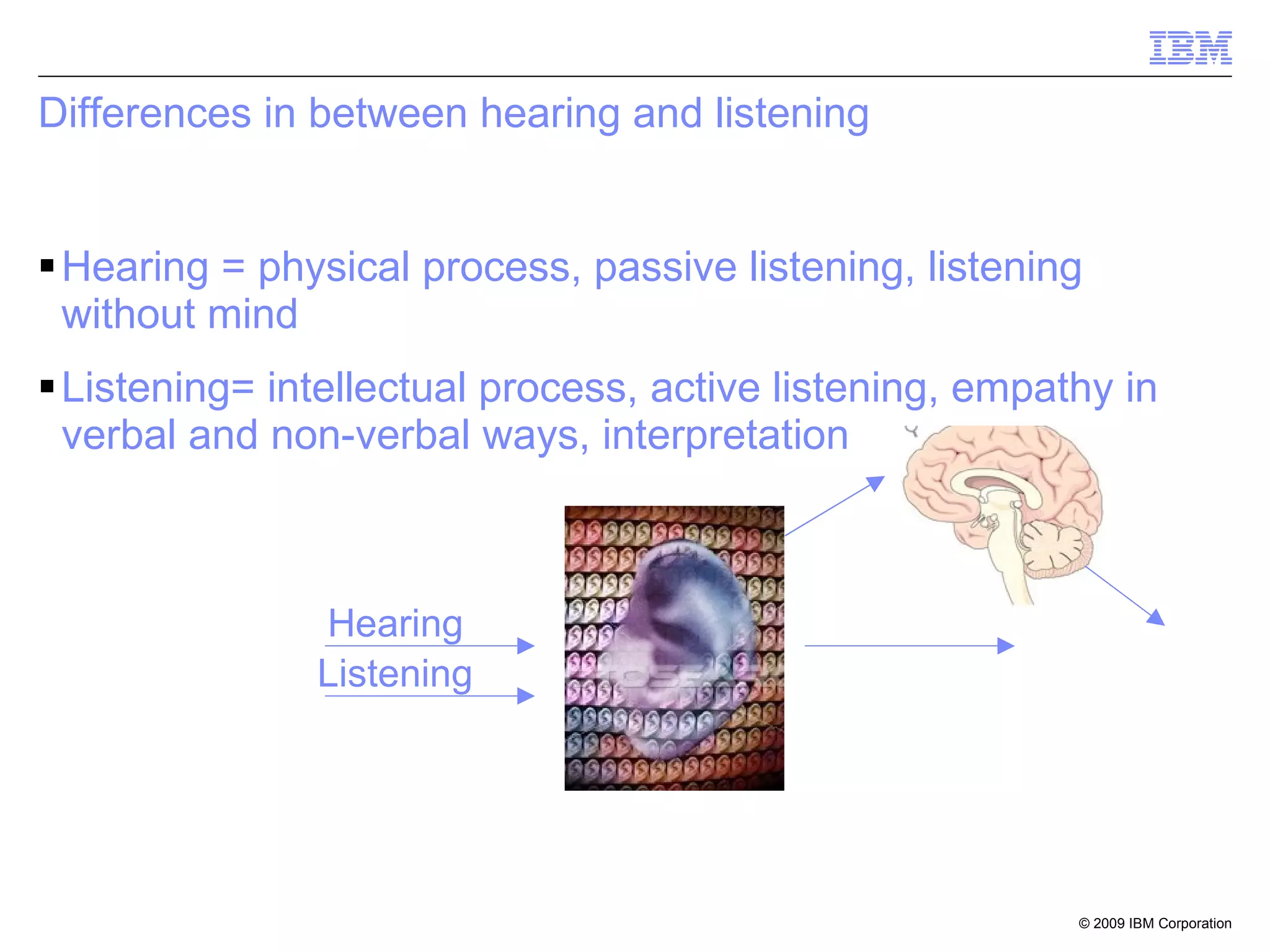
Differences in between hearing and listening Hearing = physical process, passive listening, listening without mind Listening= intellectual process, active listening, empathy in verbal and non-verbal ways, interpretation Hearing Listening
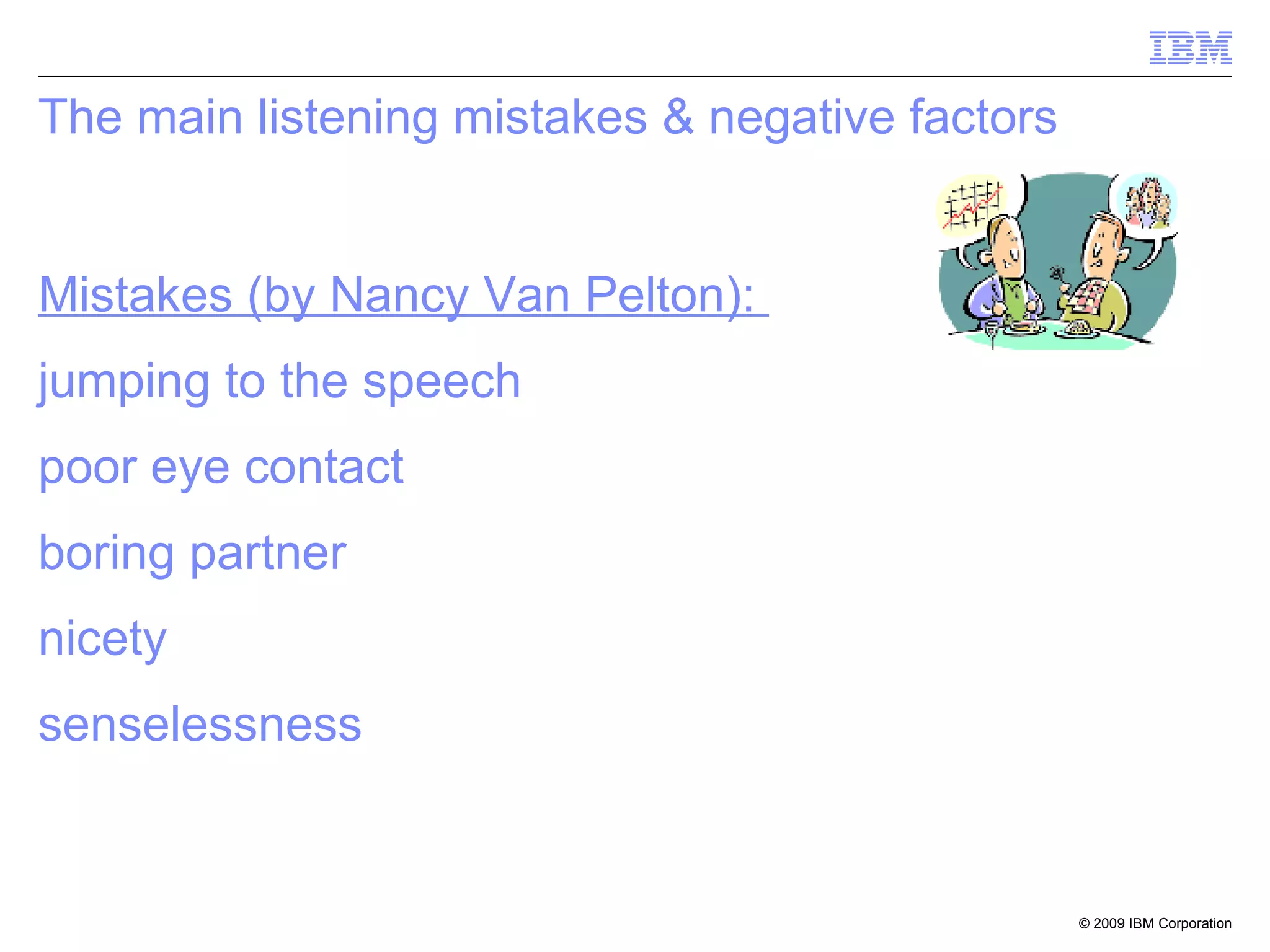
The main listening mistakes & negative factors Mistakes (by Nancy Van Pelton):  jumping to the speech poor eye contact boring partner nicety senselessness  
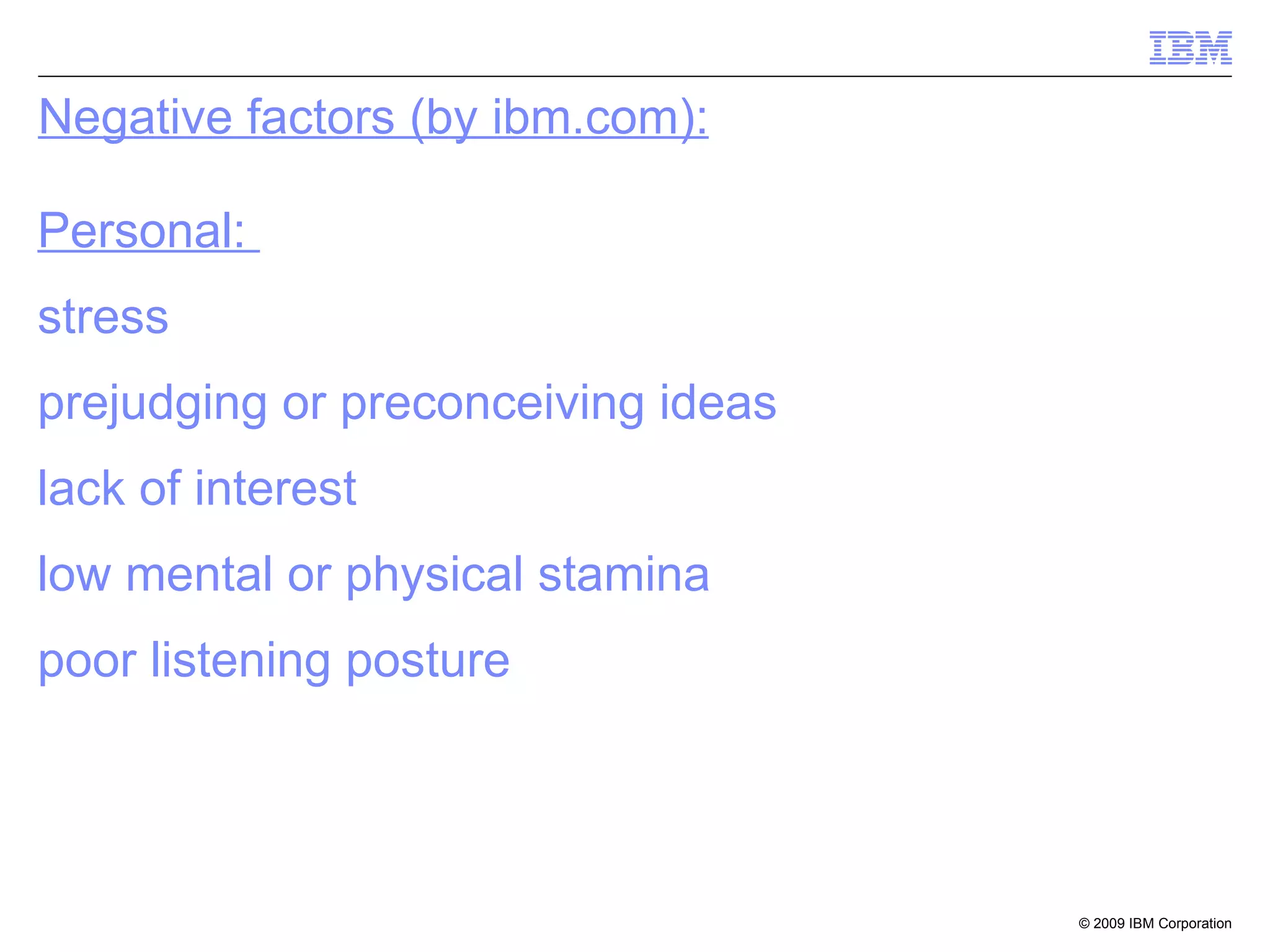
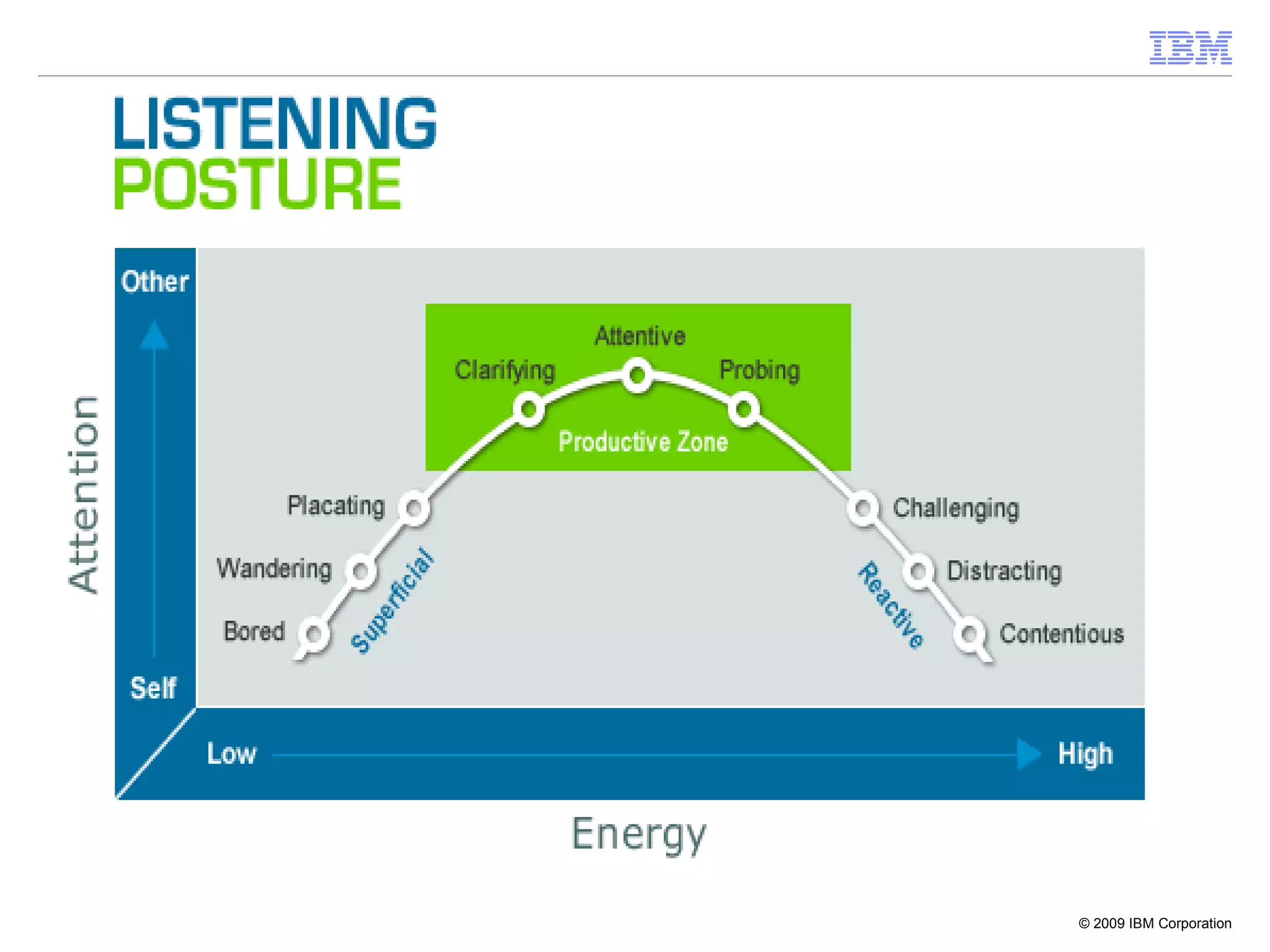
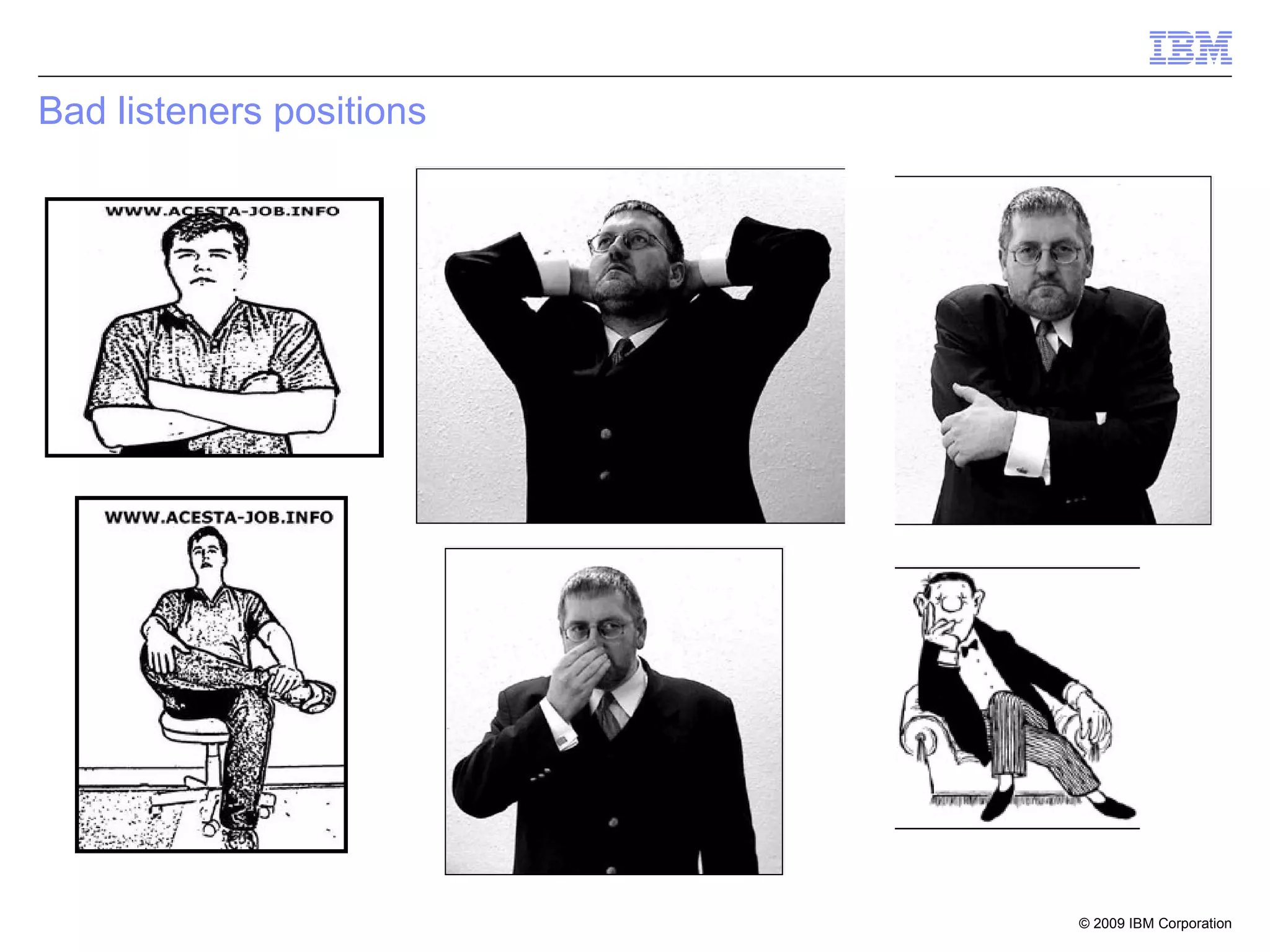
Negative factors (by ibm.com): Personal:  stress prejudging or preconceiving ideas lack of interest low mental or physical stamina poor listening posture
 
Environmental:  high noisy level poor telephone or internet connection high or low temperature in office
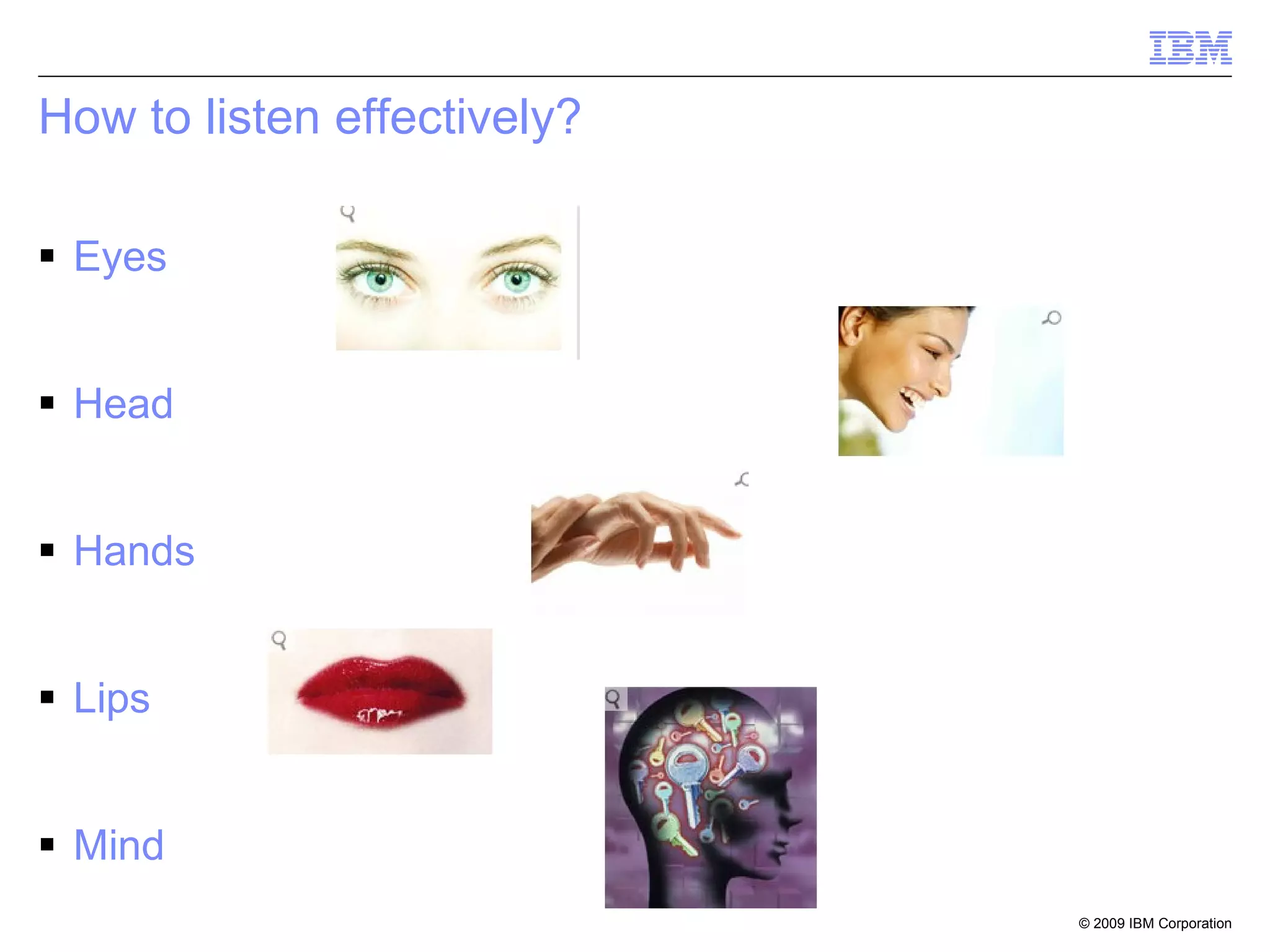
How to listen effectively? Eyes Head Hands Lips Mind
Bad listeners positions
Empathy as goal of listening What is empathy? Empathy depends  about:  time background (how long we know the people) frequency of meeting with people   Other empathy need professor, priest, colleague, partner….
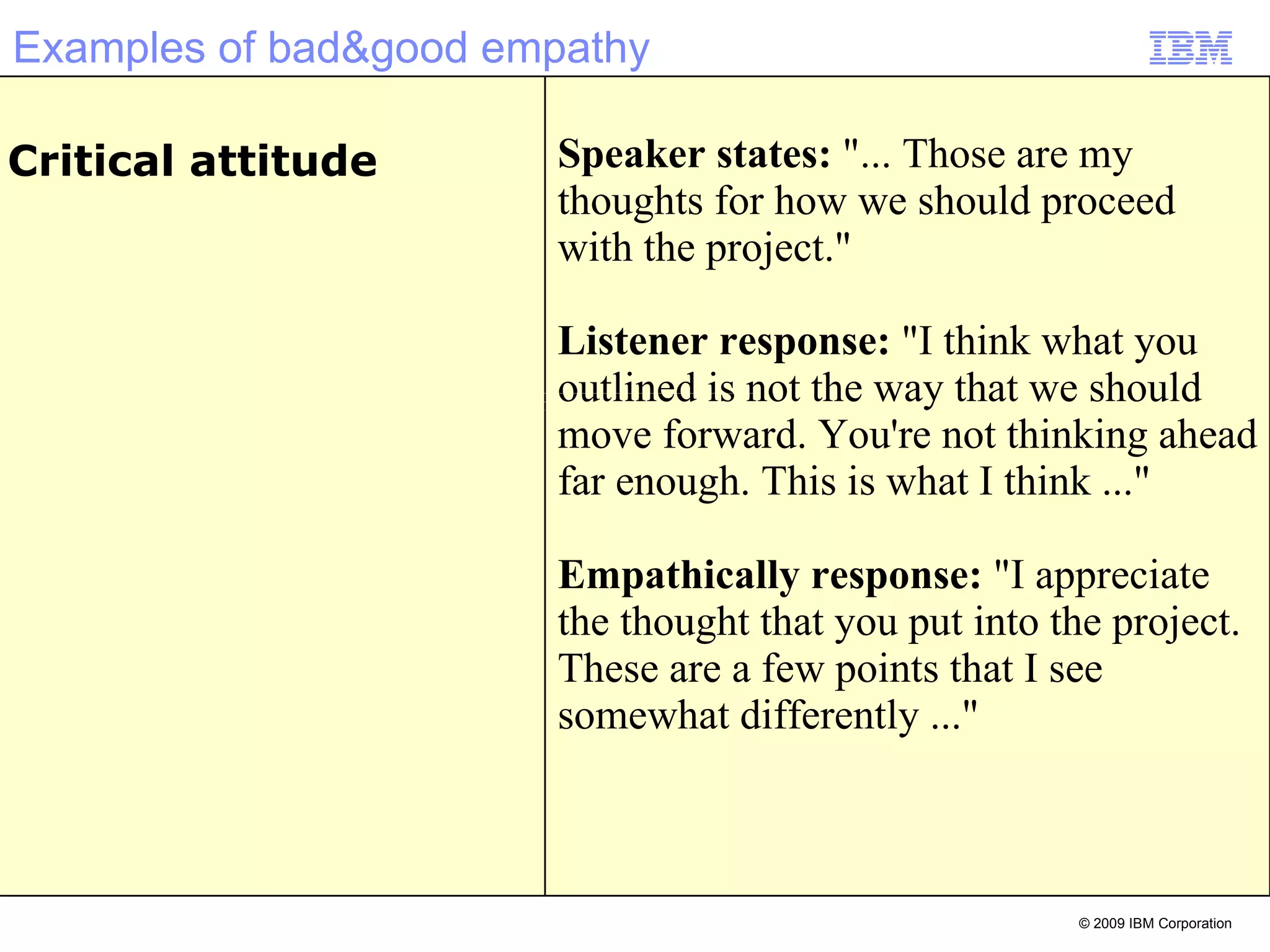
Examples of bad&good empathy Speaker stat es :  "... Those are my thoughts for how we should proceed with the project."  Listener response:  "I think what you outlined is not the way that we should move forward. You're not thinking ahead far enough. This is what I think ..." Empathically response :  "I appreciate the thought that you put into the project. These are a few points that I see somewhat differently ..." Critical  attitude
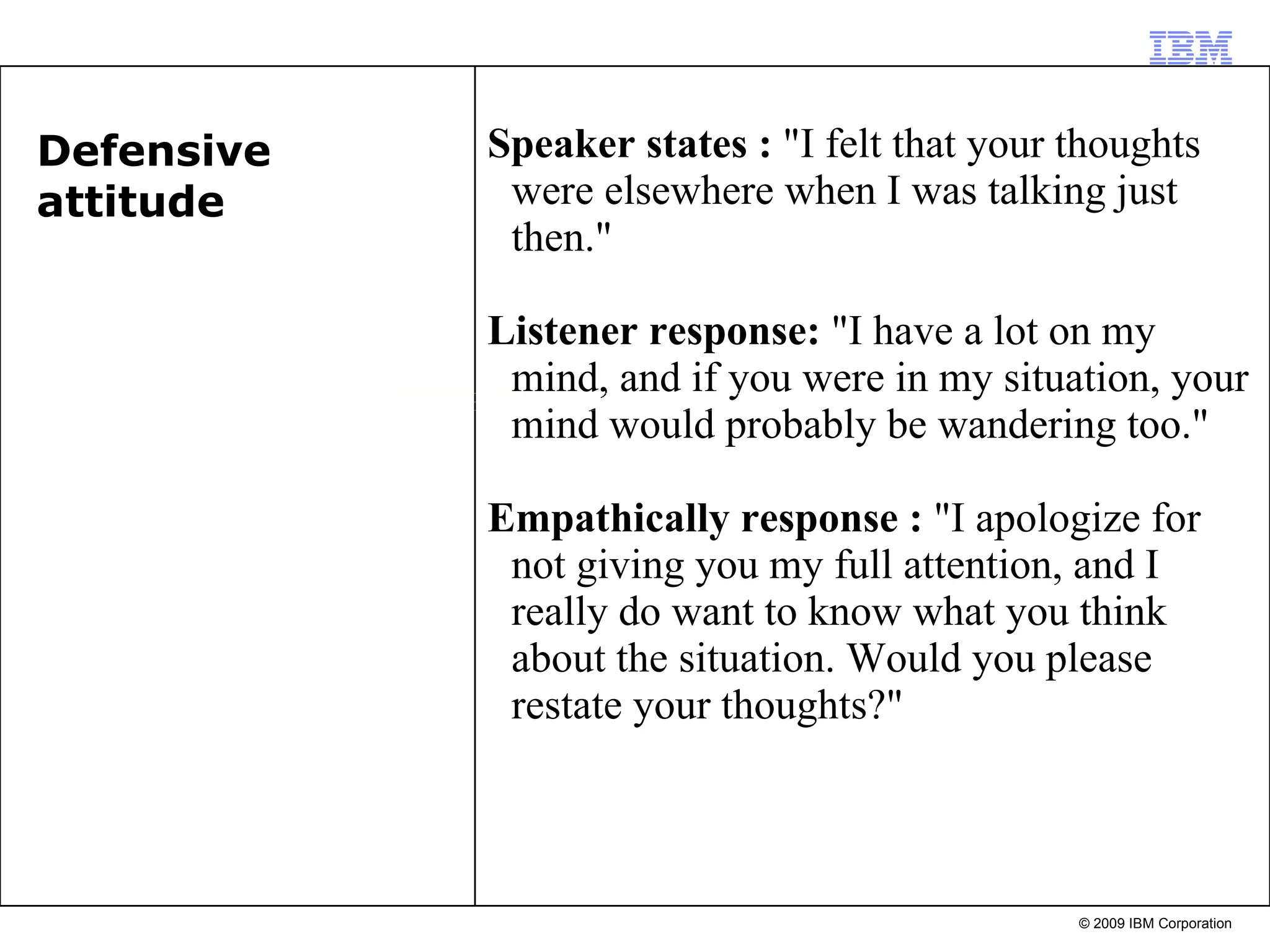
Speaker stat es  :  "I felt that your thoughts were elsewhere when I was talking just then." Listener response:  "I have a lot on my mind, and if you were in my situation, your mind would probably be wandering too." Empathically response  :  "I apologize for not giving you my full attention, and I really do want to know what you think about the situation. Would you please restate your thoughts?" Defensive  attitude
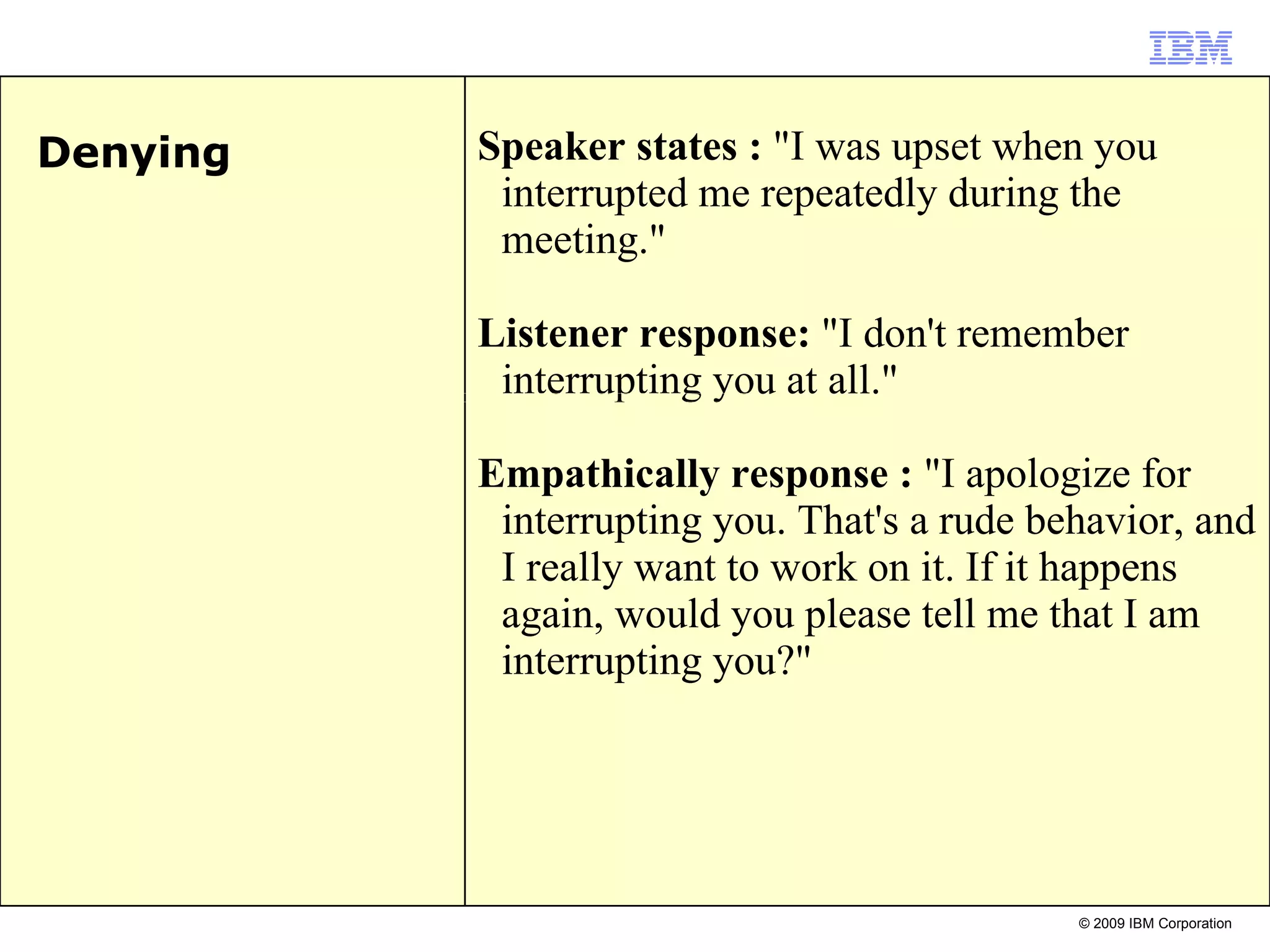
Speaker stat es  :  "I was upset when you interrupted me repeatedly during the meeting."  Listener response:  "I don't remember interrupting you at all." Empathically response  :  "I apologize for interrupting you. That's a rude behavior, and I really want to work on it. If it happens again, would you please tell me that I am interrupting you?" Denying
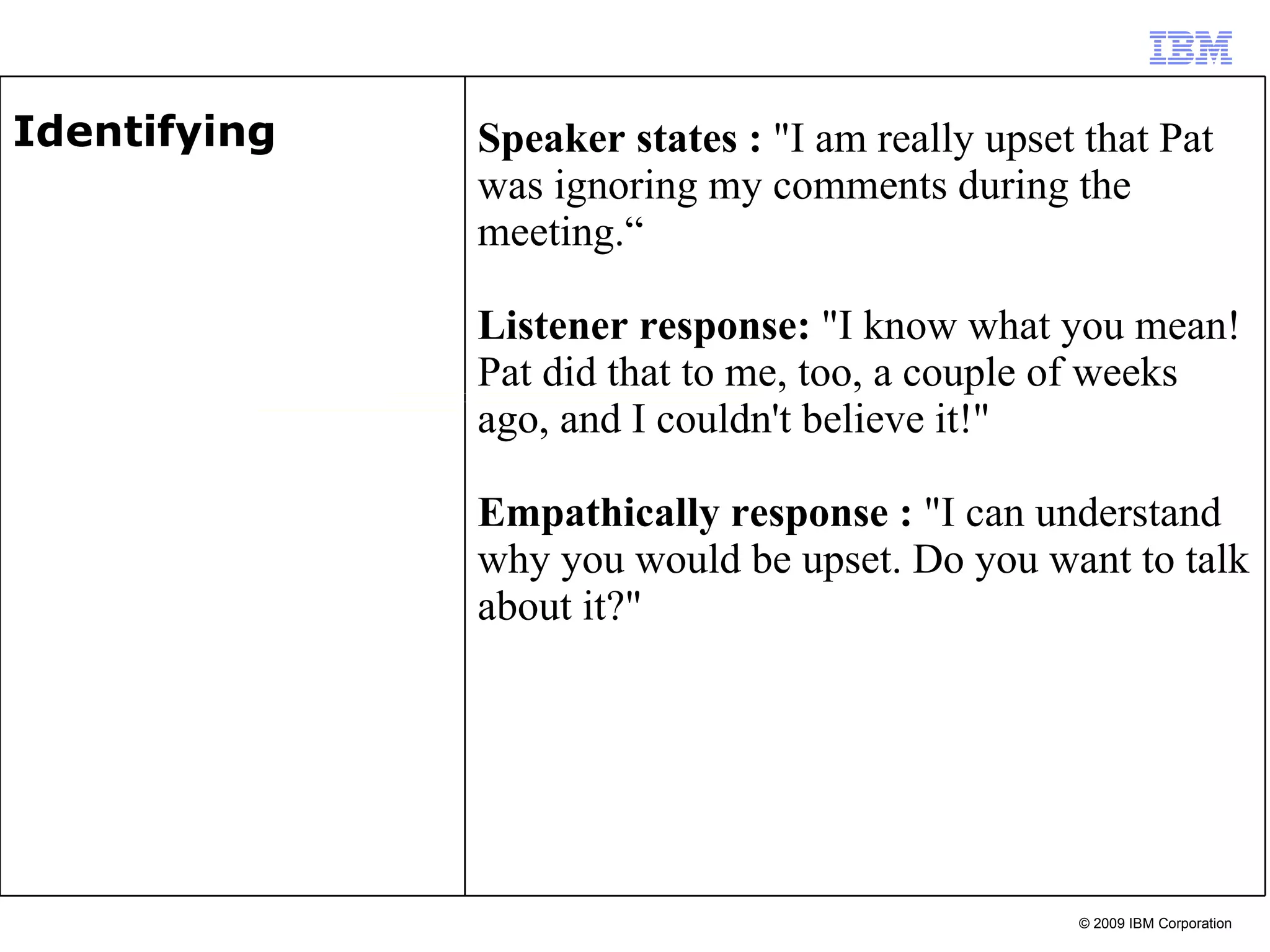
Speaker stat es  :  "I am really upset that Pat was ignoring my comments during the meeting.“ Listener response:  "I know what you mean! Pat did that to me, too, a couple of weeks ago, and I couldn't believe it!" Empathically response  :  "I can understand why you would be upset. Do you want to talk about it?" Identifying
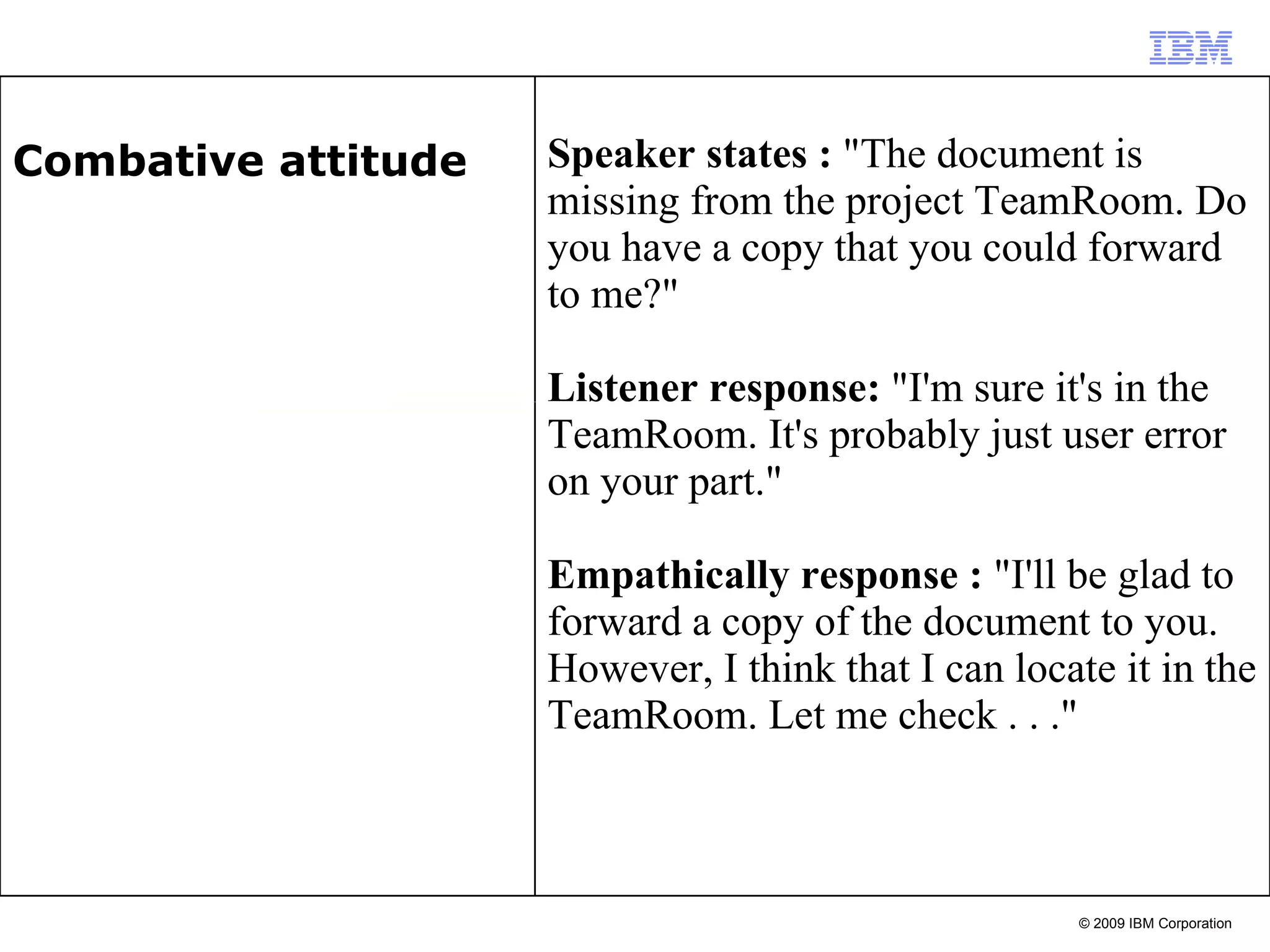
Speaker stat es  :  "The document is missing from the project TeamRoom. Do you have a copy that you could forward to me?" Listener response:  "I'm sure it's in the TeamRoom. It's probably just user error on your part." Empathically response  :  "I'll be glad to forward a copy of the document to you. However, I think that I can locate it in the TeamRoom. Let me check . . ." Combative  attitude
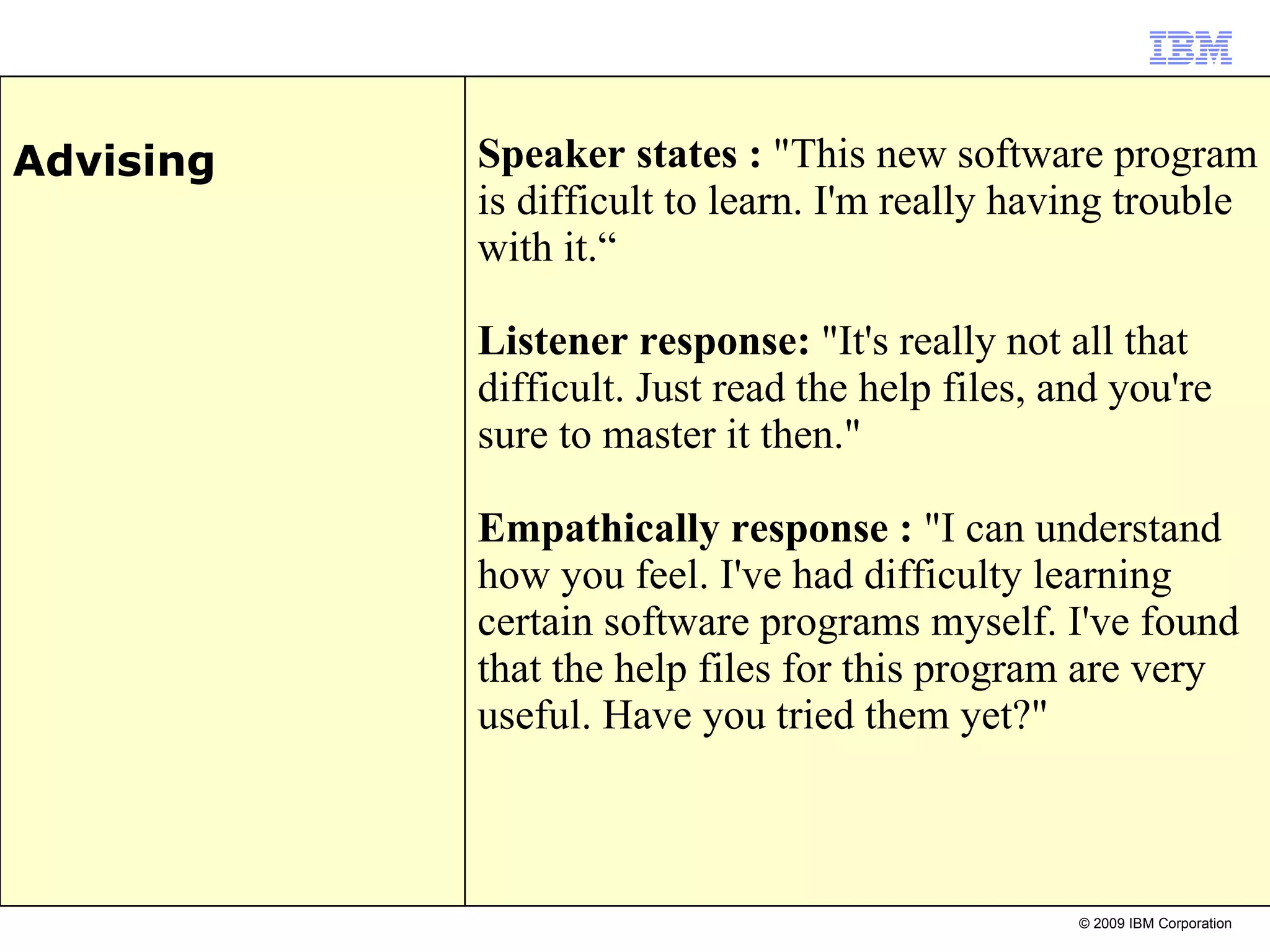
Speaker stat es  :  "This new software program is difficult to learn. I'm really having trouble with it.“ Listener response:  "It's really not all that difficult. Just read the help files, and you're sure to master it then." Empathically response  :  "I can understand how you feel. I've had difficulty learning certain software programs myself. I've found that the help files for this program are very useful. Have you tried them yet?" Advising
Bibliography Peltonová van Nancy.: Umenie komunikovať bez zábran. Advent- Orion, Bratislava 1999. Birkenbihlová, V.F.: Umenie komunikácie alebo ako úspešne utvárať vzťahy k ľuďom. Aktuell, Bratislava 1999 http://learning.atlanta.ibm.com/hr/your_career/learning/employee_learning/eli01.nsf/Content/85256C5B:006B6260 http://learning.atlanta.ibm.com/hr/your_career/learning/employee_learning/eli05.nsf/Content/85257177:0055D720 http://learning.atlanta.ibm.com/manager/mdweb.nsf/Content/85256DAC:00645BAC

How to listen effectively

  • 1.
    How to listeneffectively? 1 st PRESENTATION OF SOFT SKILLS
  • 2.
    Topics differences inbetween hearing and listening the main listening mistakes & negative factors how to listen effectively? empathy as goal of listening examples listening test and conclusion
  • 3.
    Differences in betweenhearing and listening Hearing = physical process, passive listening, listening without mind Listening= intellectual process, active listening, empathy in verbal and non-verbal ways, interpretation Hearing Listening
  • 4.
    The main listeningmistakes & negative factors Mistakes (by Nancy Van Pelton): jumping to the speech poor eye contact boring partner nicety senselessness  
  • 5.
    Negative factors (byibm.com): Personal: stress prejudging or preconceiving ideas lack of interest low mental or physical stamina poor listening posture
  • 6.
  • 7.
    Environmental: highnoisy level poor telephone or internet connection high or low temperature in office
  • 8.
    How to listeneffectively? Eyes Head Hands Lips Mind
  • 9.
  • 10.
    Empathy as goalof listening What is empathy? Empathy depends about: time background (how long we know the people) frequency of meeting with people Other empathy need professor, priest, colleague, partner….
  • 11.
    Examples of bad&goodempathy Speaker stat es : "... Those are my thoughts for how we should proceed with the project." Listener response: "I think what you outlined is not the way that we should move forward. You're not thinking ahead far enough. This is what I think ..." Empathically response : "I appreciate the thought that you put into the project. These are a few points that I see somewhat differently ..." Critical attitude
  • 12.
    Speaker stat es : "I felt that your thoughts were elsewhere when I was talking just then." Listener response: "I have a lot on my mind, and if you were in my situation, your mind would probably be wandering too." Empathically response : "I apologize for not giving you my full attention, and I really do want to know what you think about the situation. Would you please restate your thoughts?" Defensive attitude
  • 13.
    Speaker stat es : "I was upset when you interrupted me repeatedly during the meeting." Listener response: "I don't remember interrupting you at all." Empathically response : "I apologize for interrupting you. That's a rude behavior, and I really want to work on it. If it happens again, would you please tell me that I am interrupting you?" Denying
  • 14.
    Speaker stat es : "I am really upset that Pat was ignoring my comments during the meeting.“ Listener response: "I know what you mean! Pat did that to me, too, a couple of weeks ago, and I couldn't believe it!" Empathically response : "I can understand why you would be upset. Do you want to talk about it?" Identifying
  • 15.
    Speaker stat es : "The document is missing from the project TeamRoom. Do you have a copy that you could forward to me?" Listener response: "I'm sure it's in the TeamRoom. It's probably just user error on your part." Empathically response : "I'll be glad to forward a copy of the document to you. However, I think that I can locate it in the TeamRoom. Let me check . . ." Combative attitude
  • 16.
    Speaker stat es : "This new software program is difficult to learn. I'm really having trouble with it.“ Listener response: "It's really not all that difficult. Just read the help files, and you're sure to master it then." Empathically response : "I can understand how you feel. I've had difficulty learning certain software programs myself. I've found that the help files for this program are very useful. Have you tried them yet?" Advising
  • 17.
    Bibliography Peltonová vanNancy.: Umenie komunikovať bez zábran. Advent- Orion, Bratislava 1999. Birkenbihlová, V.F.: Umenie komunikácie alebo ako úspešne utvárať vzťahy k ľuďom. Aktuell, Bratislava 1999 http://learning.atlanta.ibm.com/hr/your_career/learning/employee_learning/eli01.nsf/Content/85256C5B:006B6260 http://learning.atlanta.ibm.com/hr/your_career/learning/employee_learning/eli05.nsf/Content/85257177:0055D720 http://learning.atlanta.ibm.com/manager/mdweb.nsf/Content/85256DAC:00645BAC