Media relationships 201: Seven
Steps For Success
1. Know your media
2. Localize
3. Be available/responsive
4. Be honest and fair
5. Be sensitive to deadlines
6. Be persistent, not annoying
7. Be wary of offering free stuff
If There is One Thing
You Remember
• Have Message Points.
• Three is a magic number.
• If you can have the message points
in front of you, do it.
• This is great for phone interviews.
• It an also help you with Skype
Presentation Ideas
That Apply To Interviews Too
• Assume there will be a good cop.
• Assume there will be a bad cop.
• Prepare your message points.
• Assume someone will ask you a question
out of left field.
• Be extemporaneous, not a memorizer.
• Create fonts for the back of the room.
Six ways to answer
questions
• Open with a Short Answer
• Eyes on the Message Points
• Pick One Question: If asked multiple questions,
answer the easiest one
Six ways to answer
questions
• NEVER Repeat Negative Words
• Eliminate Complexity
• It’s OK to say, “I don’t know” BUT then bridge to
your message points.
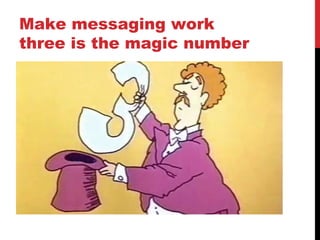
Make messaging work
three is the magic number
Build a bridge
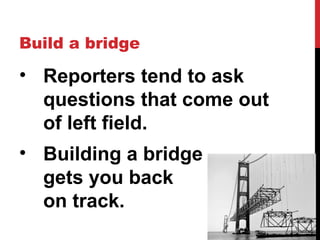
• Reporters tend to ask
questions that come out
of left field.
• Building a bridge
gets you back
on track.
Build a bridge
some examples….
• What’s important to remember…
• Let me just add…
• That brings up an good point…
• That information is confidential,
however I can tell you…
• That’s an interesting
question. From our
perspective….
Plant a flag
• Some reporters don’t pay
attention to what you’re saying
during an interview.
• In some cases, the person writing
the story isn’t even the
person talking to you.
Plant a flag
examples
• “Say name of reporter….that’s a
great question.” The fact is…
• I can’t stress this enough…
• I hope you’ll remember this…
• The one thing I hope
your readers will
remember is….
After the interview
• Watch, listen, or read
your coverage.
• Be nice.
• Promote yourself.

3700 media message points

  • 1.
    Media relationships 201:Seven Steps For Success 1. Know your media 2. Localize 3. Be available/responsive 4. Be honest and fair 5. Be sensitive to deadlines 6. Be persistent, not annoying 7. Be wary of offering free stuff
  • 2.
    If There isOne Thing You Remember • Have Message Points. • Three is a magic number. • If you can have the message points in front of you, do it. • This is great for phone interviews. • It an also help you with Skype
  • 3.
    Presentation Ideas That ApplyTo Interviews Too • Assume there will be a good cop. • Assume there will be a bad cop. • Prepare your message points. • Assume someone will ask you a question out of left field. • Be extemporaneous, not a memorizer. • Create fonts for the back of the room.
  • 4.
    Six ways toanswer questions • Open with a Short Answer • Eyes on the Message Points • Pick One Question: If asked multiple questions, answer the easiest one
  • 5.
    Six ways toanswer questions • NEVER Repeat Negative Words • Eliminate Complexity • It’s OK to say, “I don’t know” BUT then bridge to your message points.
  • 6.
    Make messaging work threeis the magic number
  • 7.
    Build a bridge •Reporters tend to ask questions that come out of left field. • Building a bridge gets you back on track.
  • 8.
    Build a bridge someexamples…. • What’s important to remember… • Let me just add… • That brings up an good point… • That information is confidential, however I can tell you… • That’s an interesting question. From our perspective….
  • 9.
    Plant a flag •Some reporters don’t pay attention to what you’re saying during an interview. • In some cases, the person writing the story isn’t even the person talking to you.
  • 10.
    Plant a flag examples •“Say name of reporter….that’s a great question.” The fact is… • I can’t stress this enough… • I hope you’ll remember this… • The one thing I hope your readers will remember is….
  • 11.
    After the interview •Watch, listen, or read your coverage. • Be nice. • Promote yourself.