Seema Gupta
Assistant Professor
Indian Institute of Management
Bangalore
DigitalMarketingTadka.com
dmtadka@gmail.com
So What is
Augmented
Reality?

© Seema Gupta
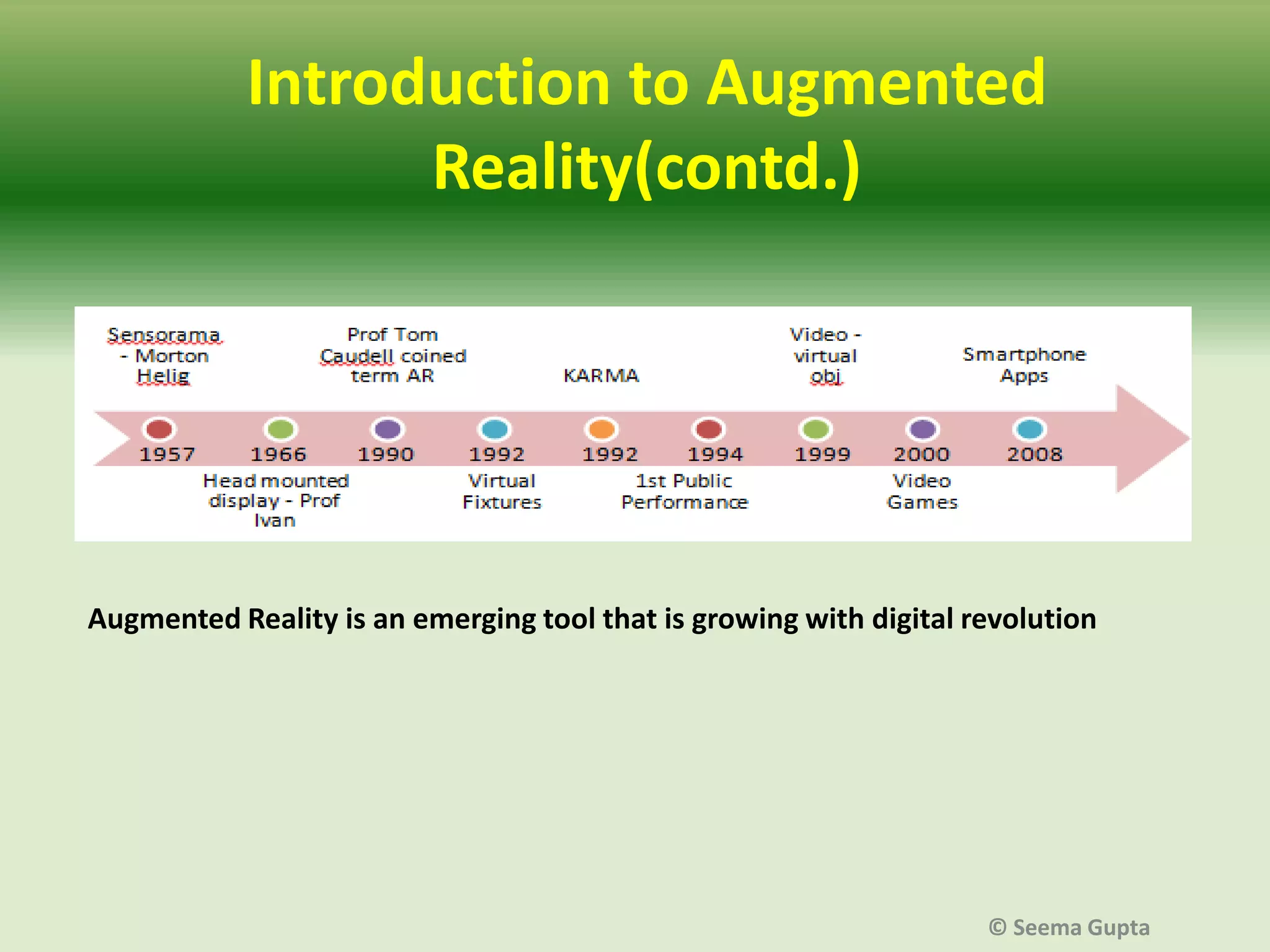
Introduction to Augmented Reality
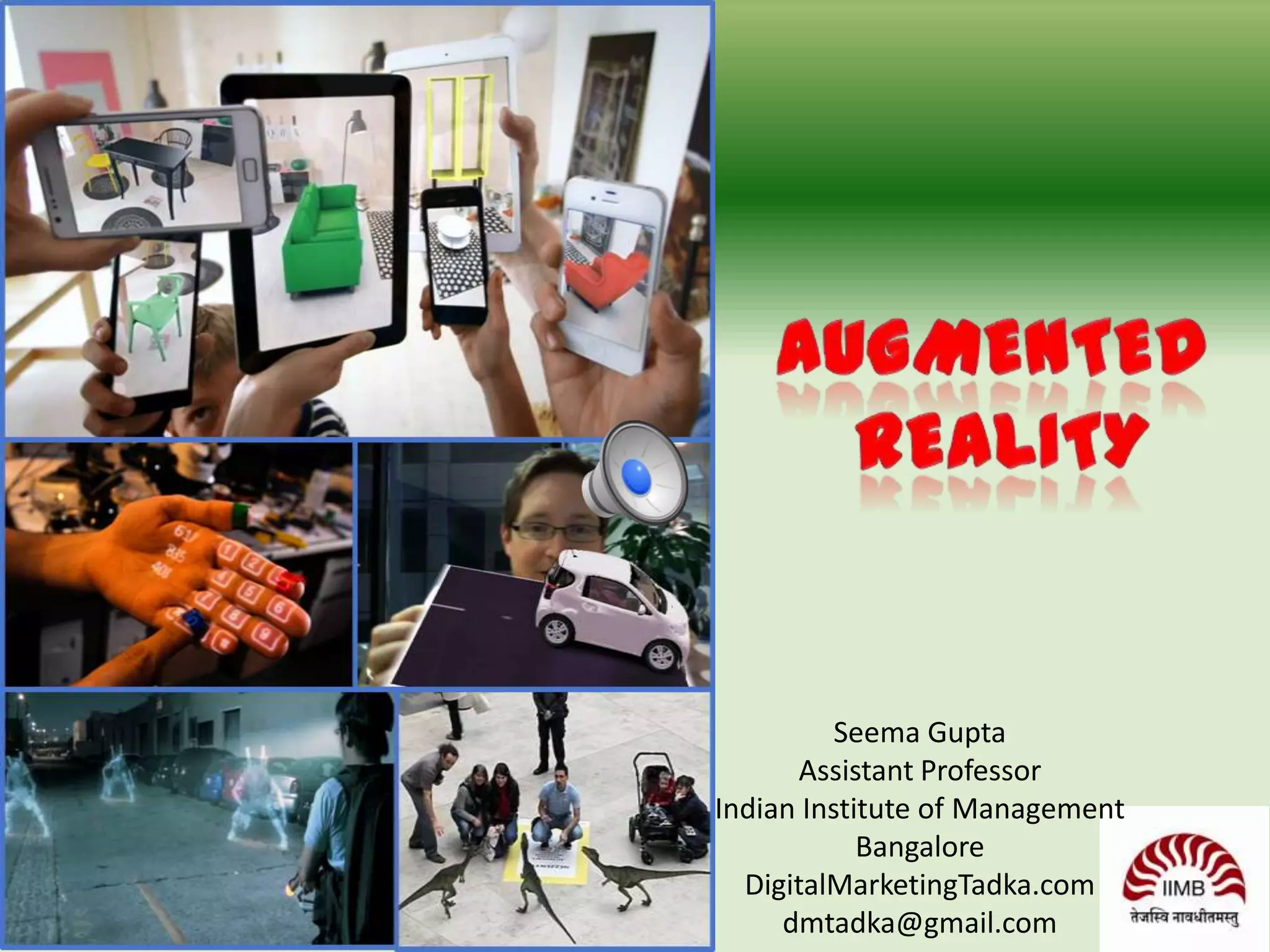
• Augmented reality (AR) is
the augmentation of the
real physical world that
we live in with virtual
objects through a
technological medium.

Meaning
© Seema Gupta
Introduction to Augmented
Reality(contd.)
•High customer interactivity
& engagement level
•Customer behaviour can
be monitored
•Point of sale promotional
tool
•Form of Experiential
Marketing

Relevance
© Seema Gupta
Introduction to Augmented
Reality(contd.)

Augmented Reality is an emerging tool that is growing with digital revolution

© Seema Gupta
Why use AR?

© Seema Gupta
Applications of Augmented Reality

Augmented Reality has applications across
fields and marketing activities

© Seema Gupta
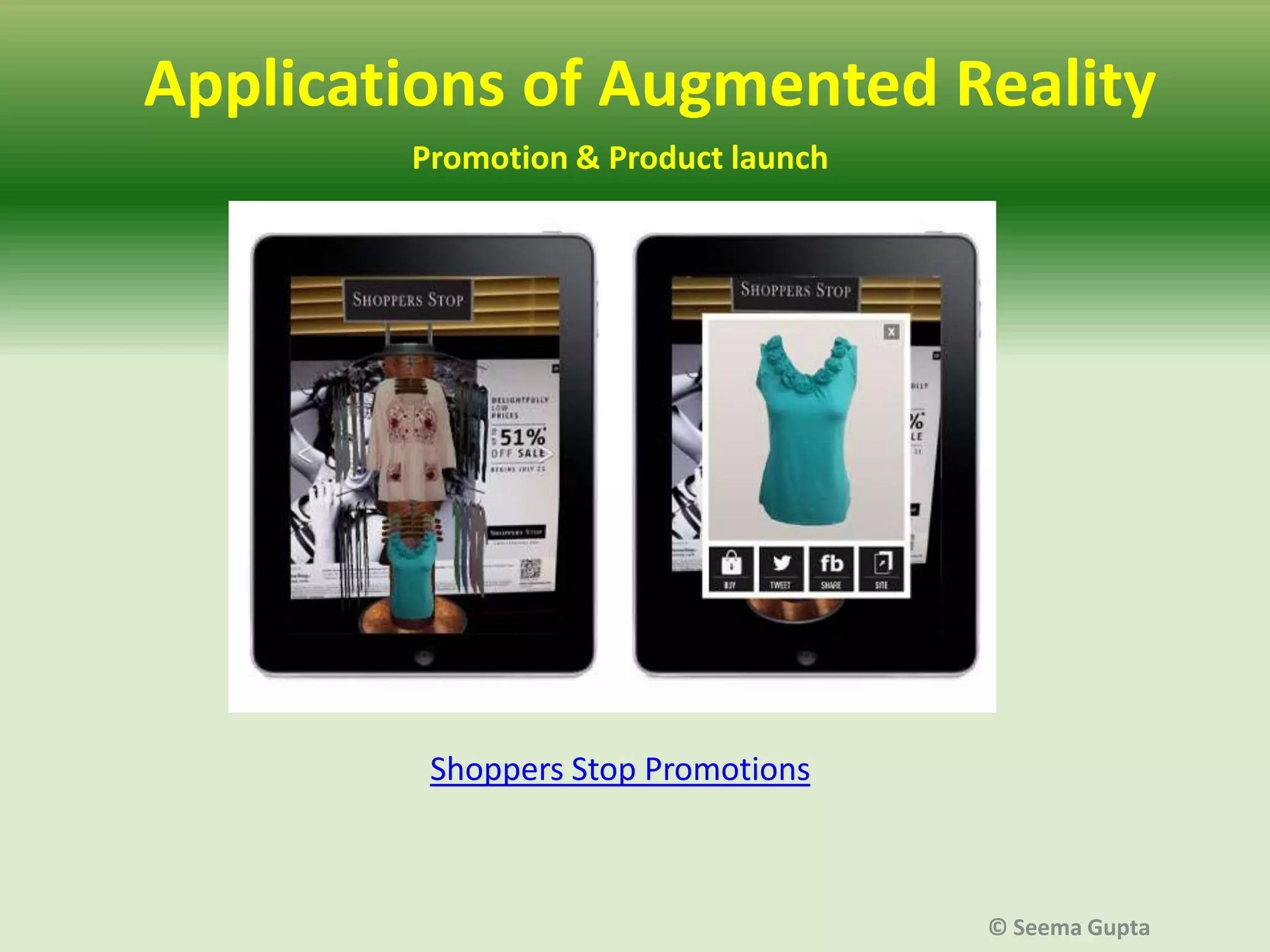
Applications of Augmented Reality
Promotion & Product launch

Shoppers Stop Promotions

© Seema Gupta
Applications of Augmented Reality
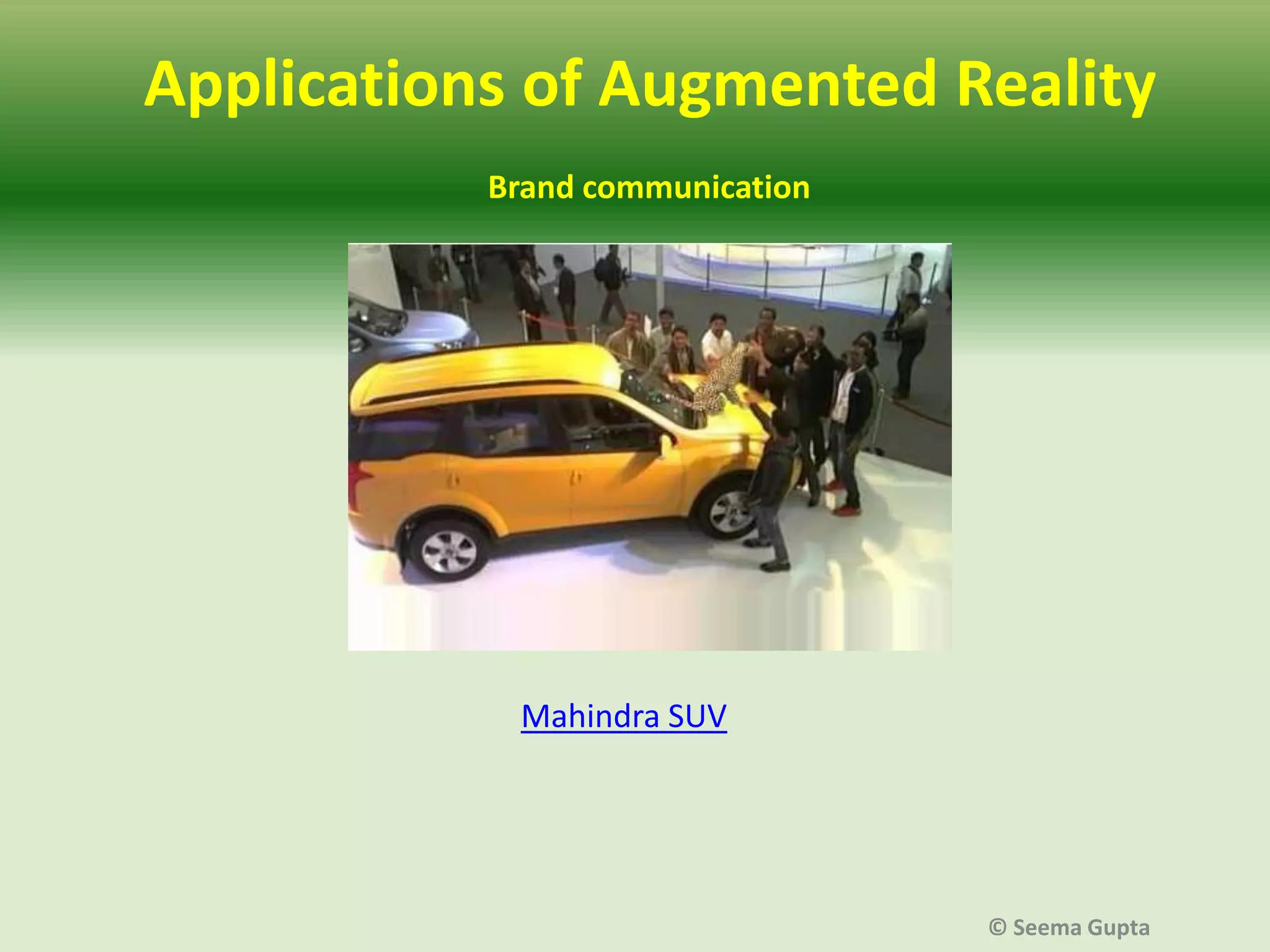
Brand communication

Mahindra SUV

© Seema Gupta
Applications of Augmented Reality
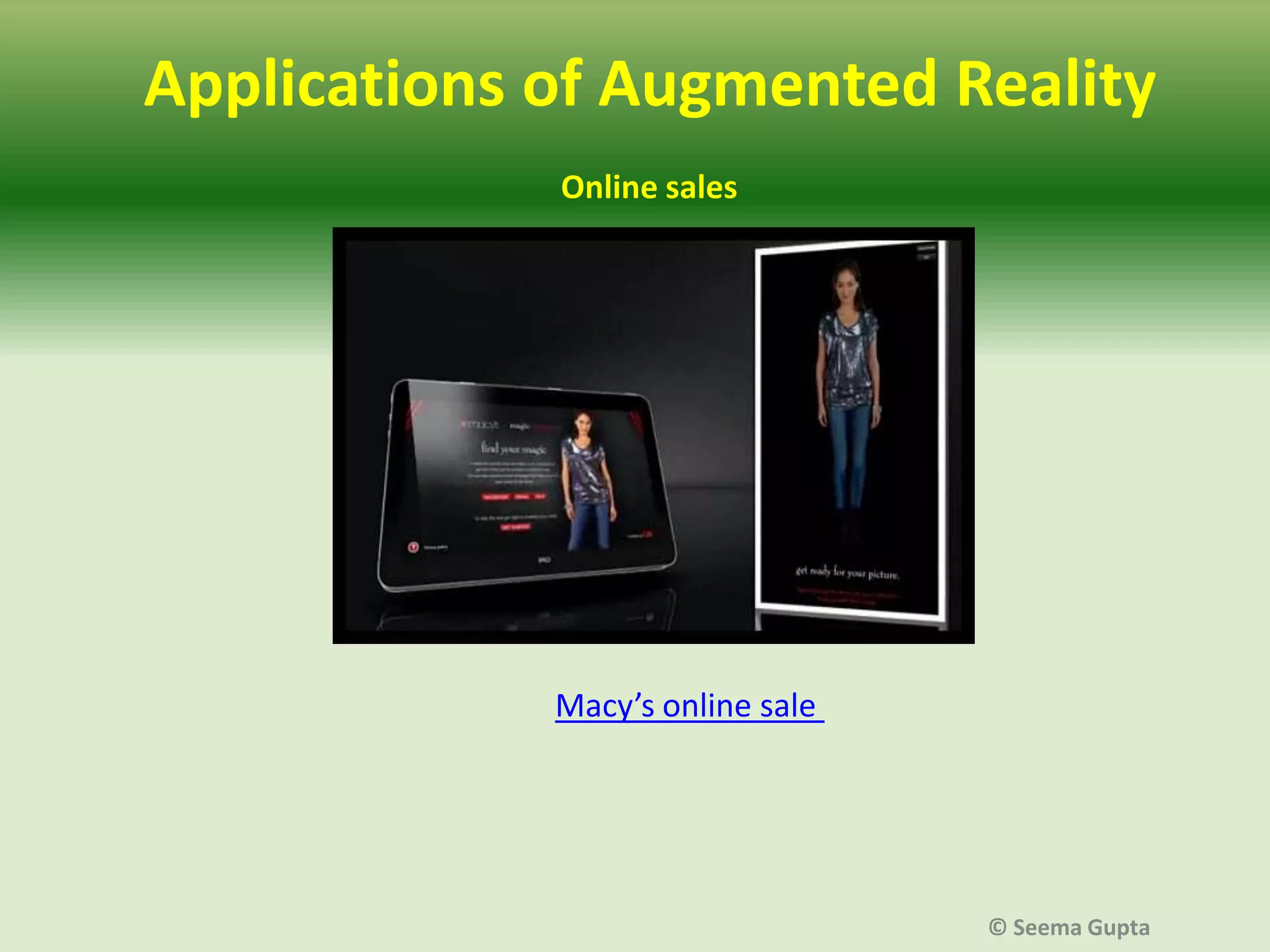
Online sales

Macy’s online sale

© Seema Gupta
Applications of Augmented Reality
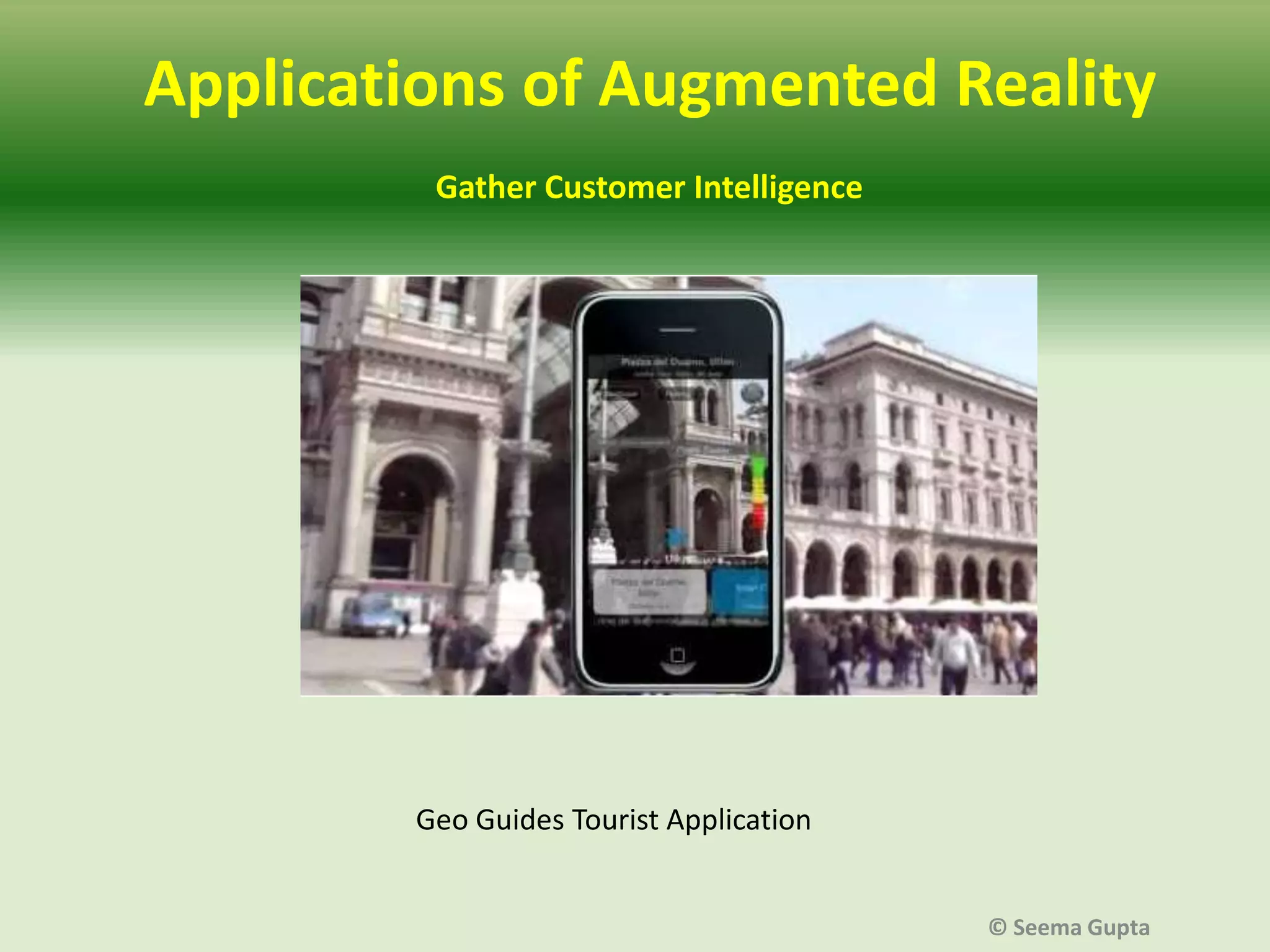
Gather Customer Intelligence

Geo Guides Tourist Application
© Seema Gupta
Applications of Augmented Reality
Industrial Application

Metaio Engineering Solutions
© Seema Gupta
Applications of Augmented Reality
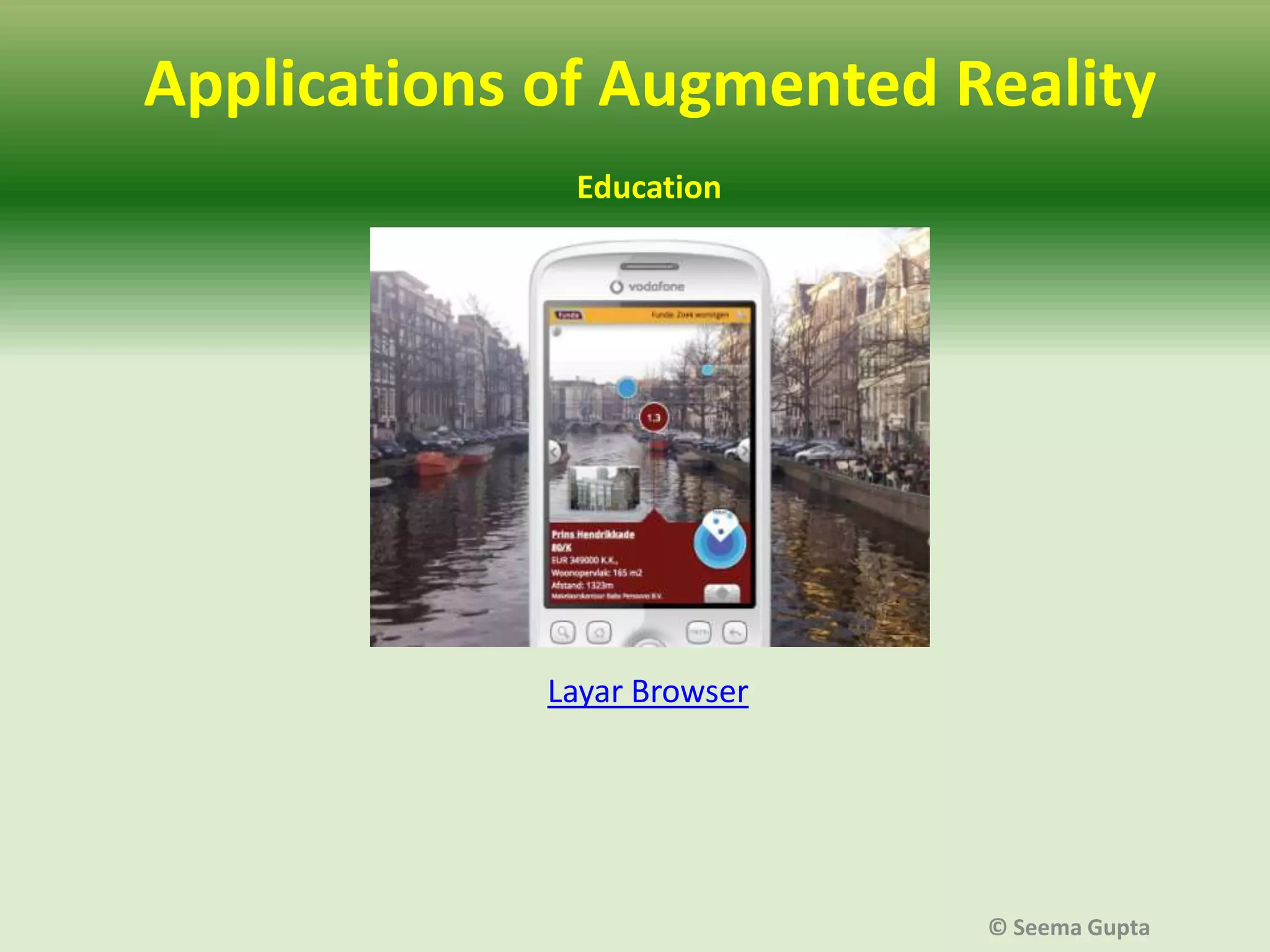
Education

Layar Browser

© Seema Gupta
Applications of Augmented Reality
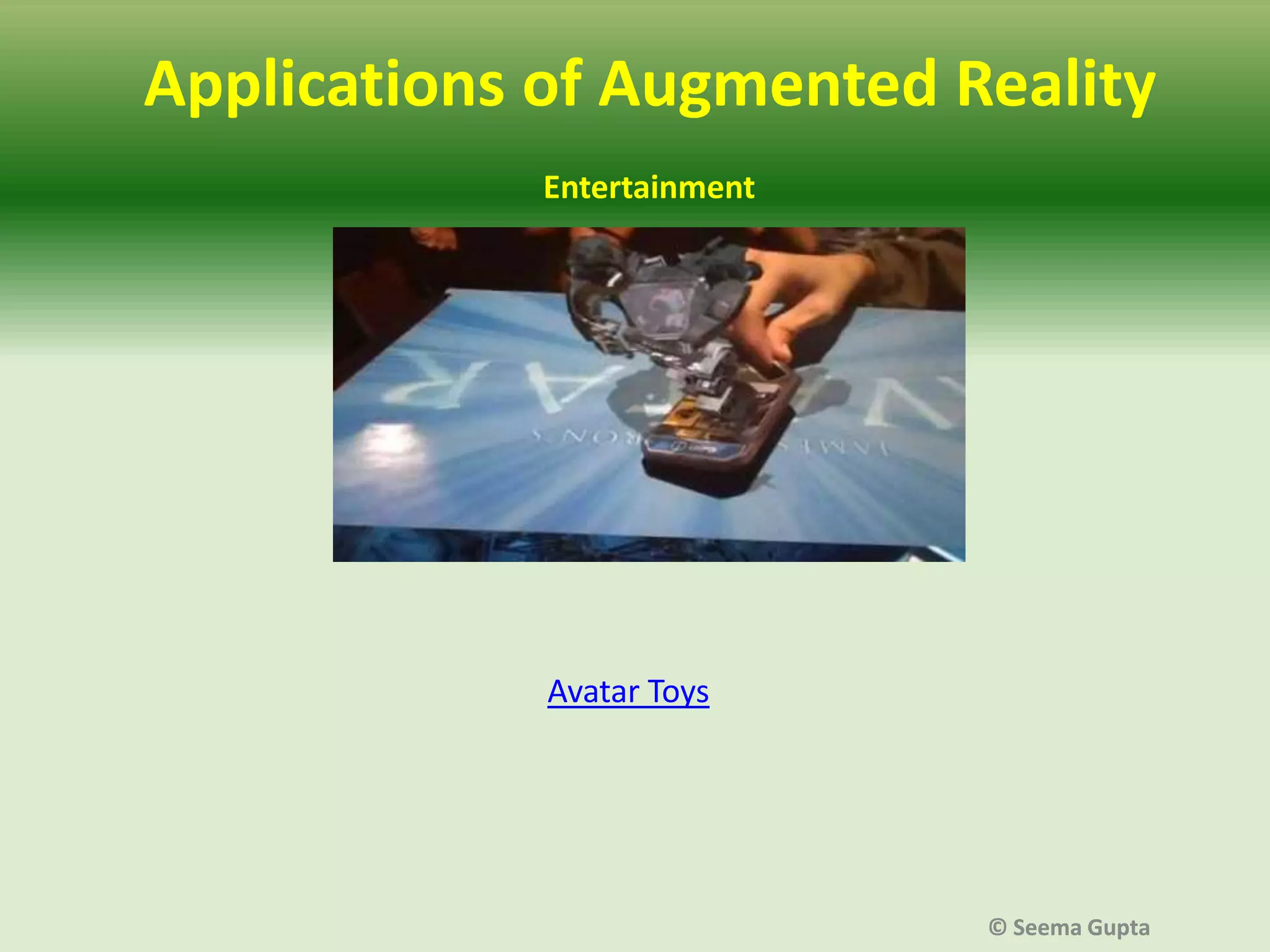
Entertainment

Avatar Toys

© Seema Gupta
Literature Review

Effectiveness
of AR

• Consumers exposed to AR advertisement had more
incentive to view the manufacturer’s website after
viewing the advertisement
• Print media was more effective in delivering
factual, especially text-based, information for later
recall
• Need for an integrated marketing communication
program

Augmented Reality is effective in getting the attention of the user but not in conveying information

Source: http://edgd.asee.org/conferences/proceedings/65th%20Midyear/Connolly_Chambers_Augmented_Reality
© Seema Gupta
Literature Review
Three measures of the perceived value

AR manages to create short term ‘wow factor’ but may not create long term brand
attitude
Source: Yuan, Y.E and Wu, C.K (2008). “Relationship Among Experiential Marketing, Experiential Value and
customer Satisfaction”, Journal of Hospitality & Tourism Research, Vol 32(3), pp. 387-410.
© Seema Gupta
Is
Augmented Reality
Beneficial for Brands?

© Seema Gupta
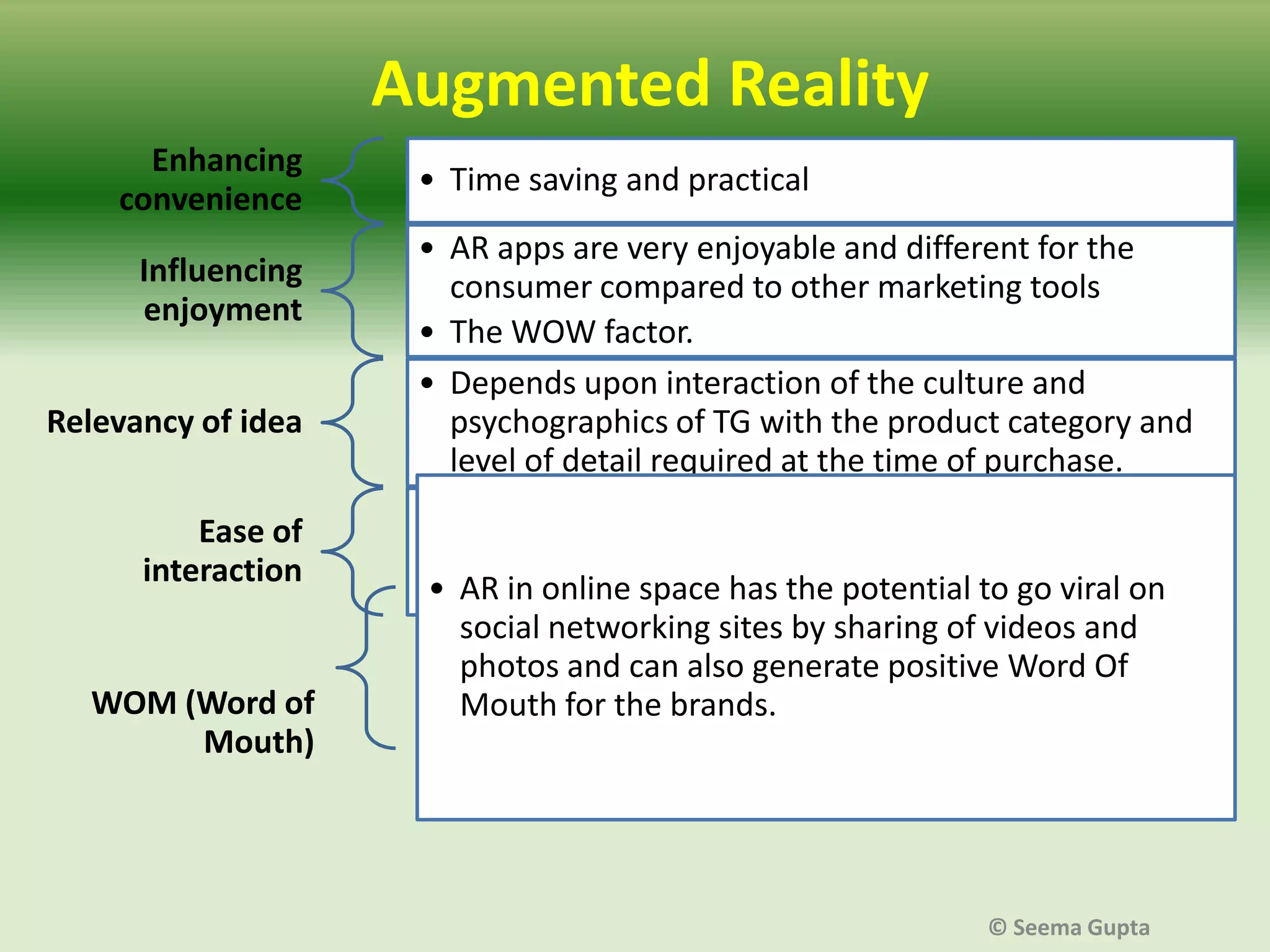
Augmented Reality
Enhancing
convenience
Influencing
enjoyment
Relevancy of idea
Ease of
interaction

WOM (Word of
Mouth)

• Time saving and practical
• AR apps are very enjoyable and different for the
consumer compared to other marketing tools
• The WOW factor.
• Depends upon interaction of the culture and
psychographics of TG with the product category and
level of detail required at the time of purchase.
• The effectiveness of AR depends upon how
personalized and interactive the execution of AR is for
• the user.
AR in online space has the potential to go viral on
social networking sites by sharing of videos and
photos and can also generate positive Word Of
Mouth for the brands.

© Seema Gupta
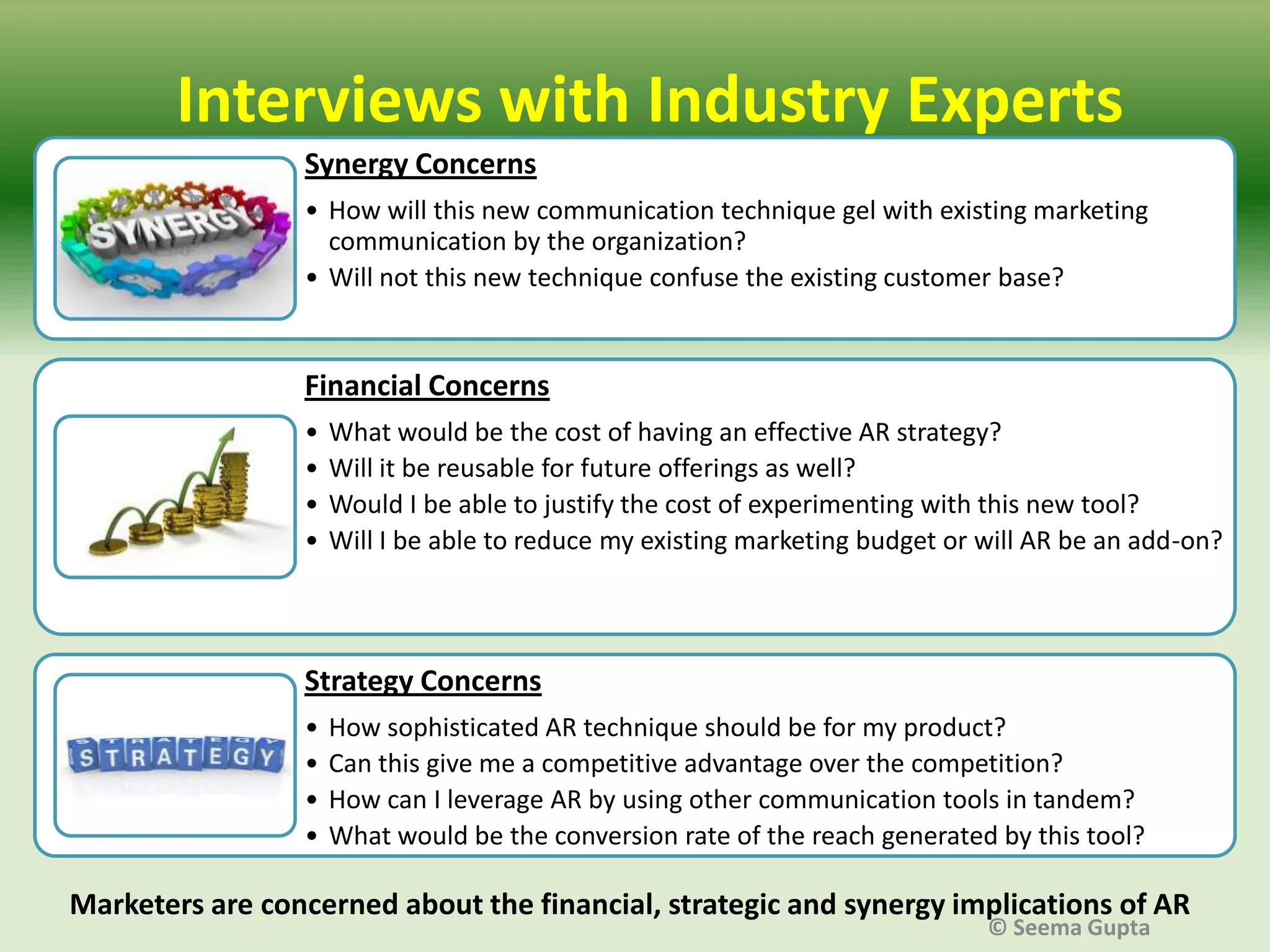
Interviews with Industry Experts
Synergy Concerns
• How will this new communication technique gel with existing marketing
communication by the organization?
• Will not this new technique confuse the existing customer base?

Financial Concerns
•
•
•
•

What would be the cost of having an effective AR strategy?
Will it be reusable for future offerings as well?
Would I be able to justify the cost of experimenting with this new tool?
Will I be able to reduce my existing marketing budget or will AR be an add-on?

Strategy Concerns
•
•
•
•

How sophisticated AR technique should be for my product?
Can this give me a competitive advantage over the competition?
How can I leverage AR by using other communication tools in tandem?
What would be the conversion rate of the reach generated by this tool?

Marketers are concerned about the financial, strategic and synergy implications of AR
© Seema Gupta
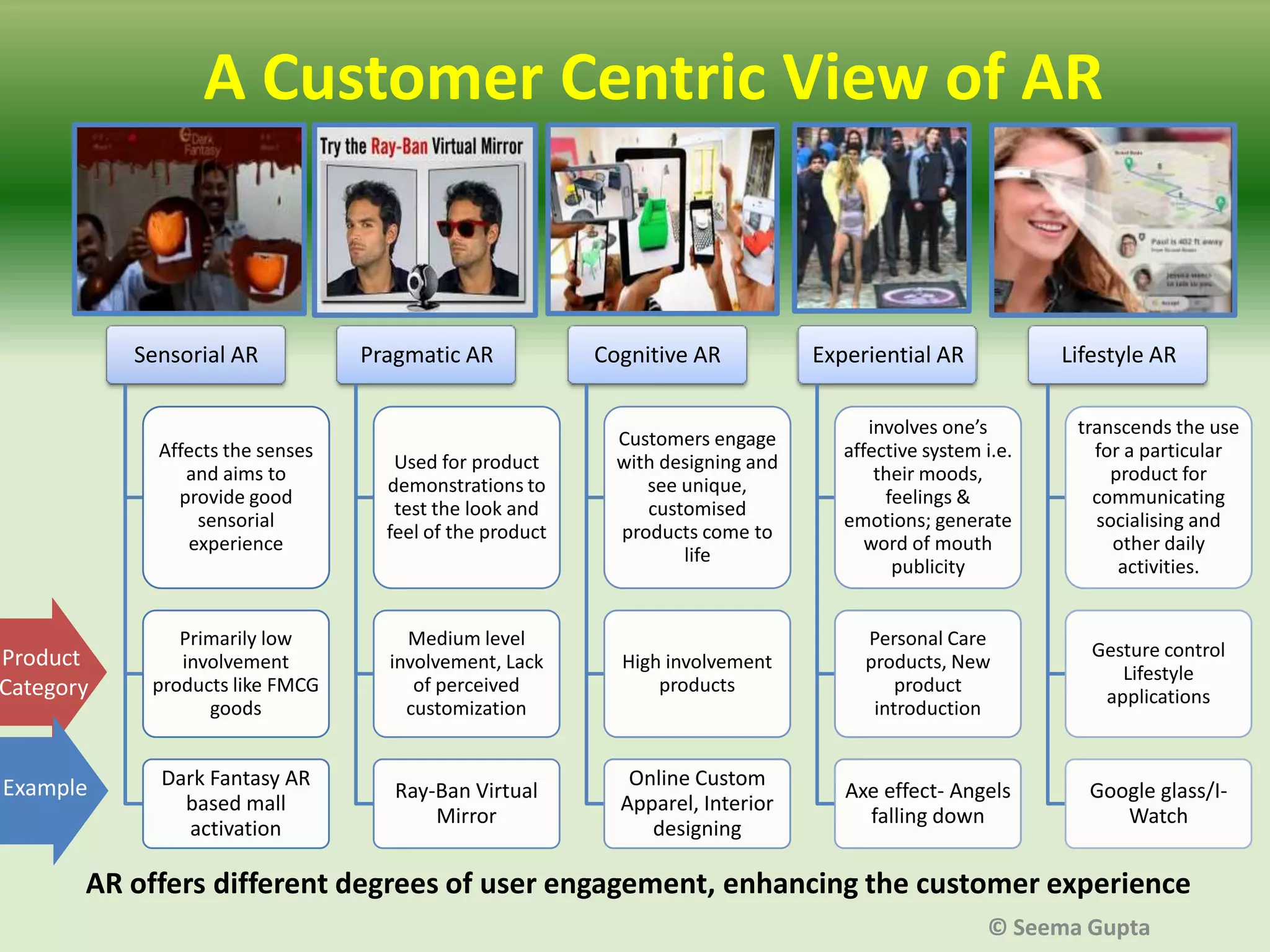
A Customer Centric View of AR

Sensorial AR

Example

Cognitive AR

Experiential AR

Lifestyle AR

Used for product
demonstrations to
test the look and
feel of the product

Customers engage
with designing and
see unique,
customised
products come to
life

involves one’s
affective system i.e.
their moods,
feelings &
emotions; generate
word of mouth
publicity

transcends the use
for a particular
product for
communicating
socialising and
other daily
activities.

Primarily low
involvement
products like FMCG
goods

Medium level
involvement, Lack
of perceived
customization

High involvement
products

Personal Care
products, New
product
introduction

Gesture control
Lifestyle
applications

Dark Fantasy AR
based mall
activation

Ray-Ban Virtual
Mirror

Online Custom
Apparel, Interior
designing

Axe effect- Angels
falling down

Google glass/IWatch

Affects the senses
and aims to
provide good
sensorial
experience

Product
Category

Pragmatic AR

AR offers different degrees of user engagement, enhancing the customer experience
© Seema Gupta
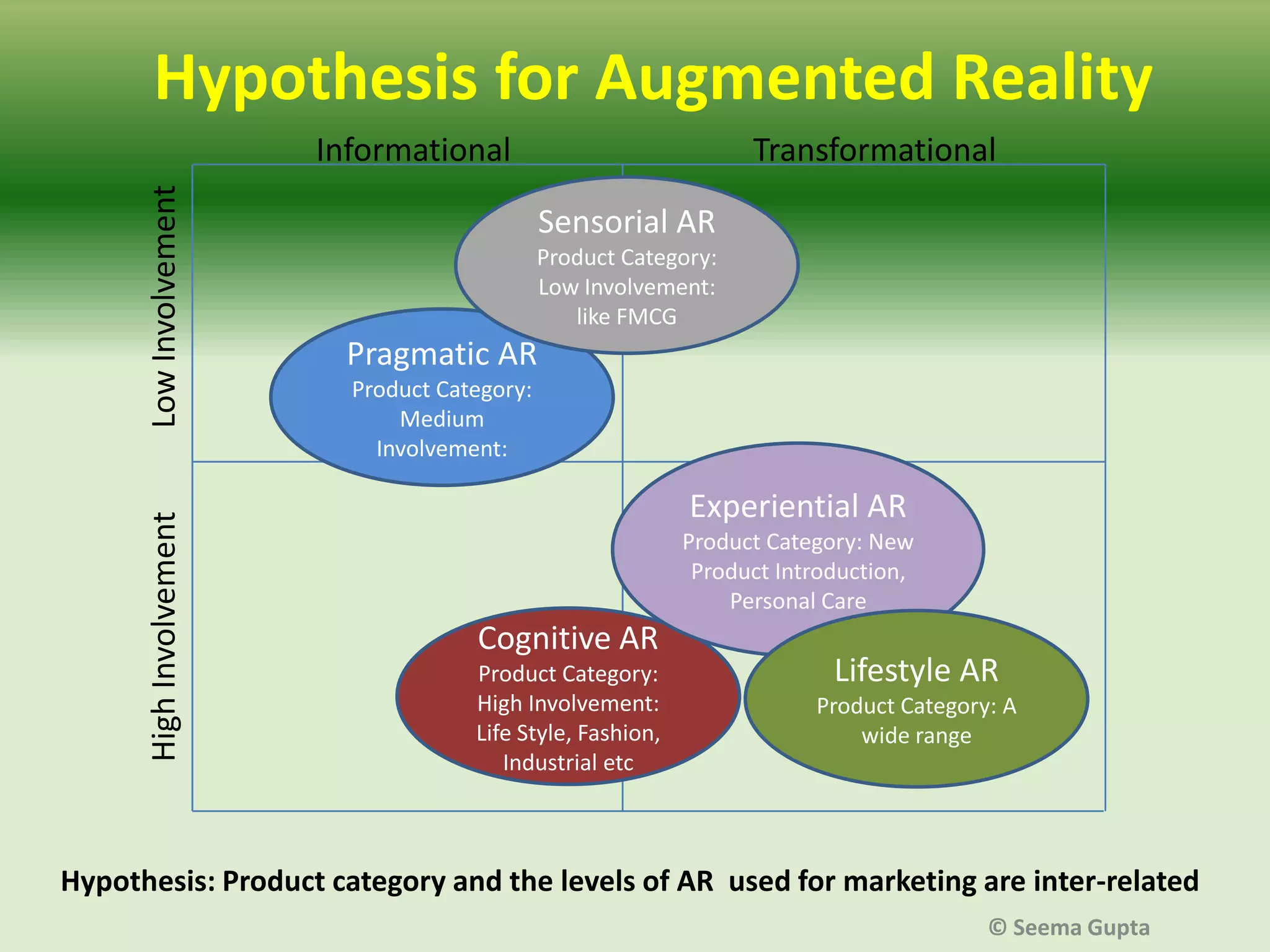
Hypothesis for Augmented Reality

High Involvement

Low Involvement

Informational

Transformational
Sensorial AR
Product Category:
Low Involvement:
like FMCG

Pragmatic AR
Product Category:
Medium
Involvement:

Experiential AR
Product Category: New
Product Introduction,
Personal Care

Cognitive AR
Product Category:
High Involvement:
Life Style, Fashion,
Industrial etc

Lifestyle AR
Product Category: A
wide range

Hypothesis: Product category and the levels of AR used for marketing are inter-related
© Seema Gupta
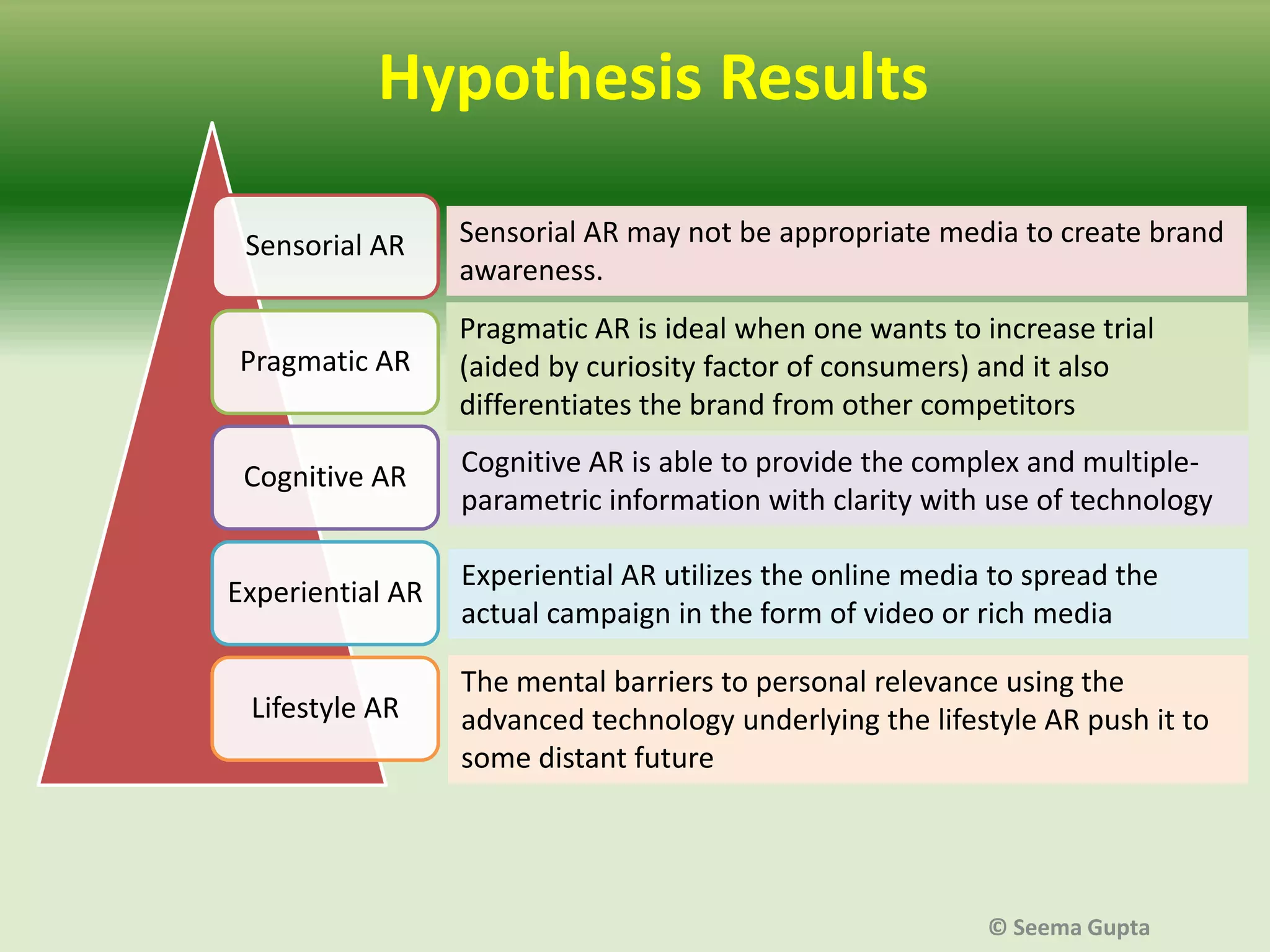
Hypothesis Results
Sensorial AR

Sensorial AR may not be appropriate media to create brand
awareness.

Pragmatic AR

Pragmatic AR is ideal when one wants to increase trial
(aided by curiosity factor of consumers) and it also
differentiates the brand from other competitors

Cognitive AR

Cognitive AR is able to provide the complex and multipleparametric information with clarity with use of technology

Experiential AR

Lifestyle AR

Experiential AR utilizes the online media to spread the
actual campaign in the form of video or rich media

The mental barriers to personal relevance using the
advanced technology underlying the lifestyle AR push it to
some distant future

© Seema Gupta
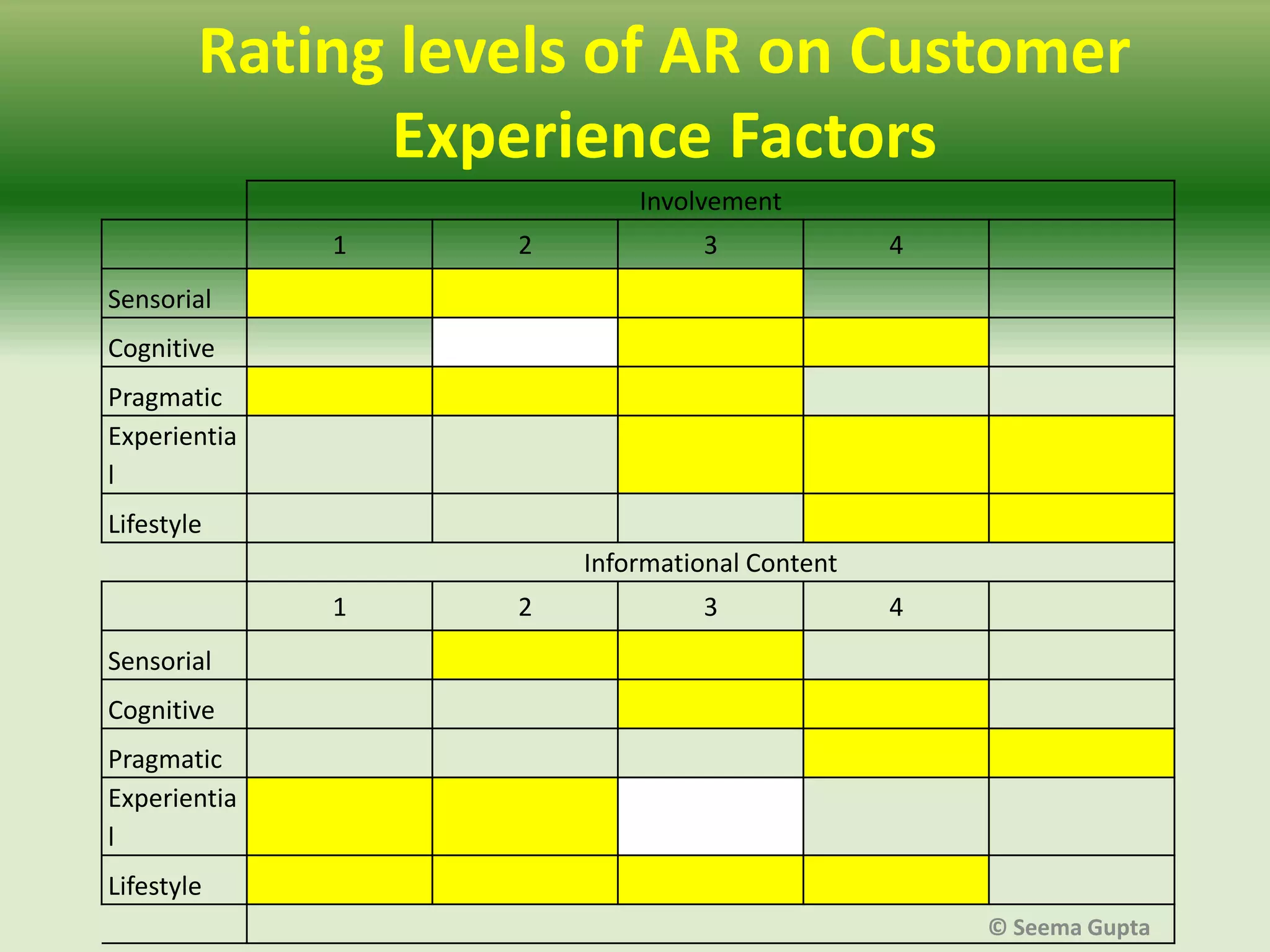
Rating levels of AR on Customer
Experience Factors
Involvement
1

2

3

4

Sensorial
Cognitive
Pragmatic
Experientia
l
Lifestyle
Informational Content

1

2

3

4

Sensorial
Cognitive
Pragmatic
Experientia
l

Lifestyle
© Seema Gupta
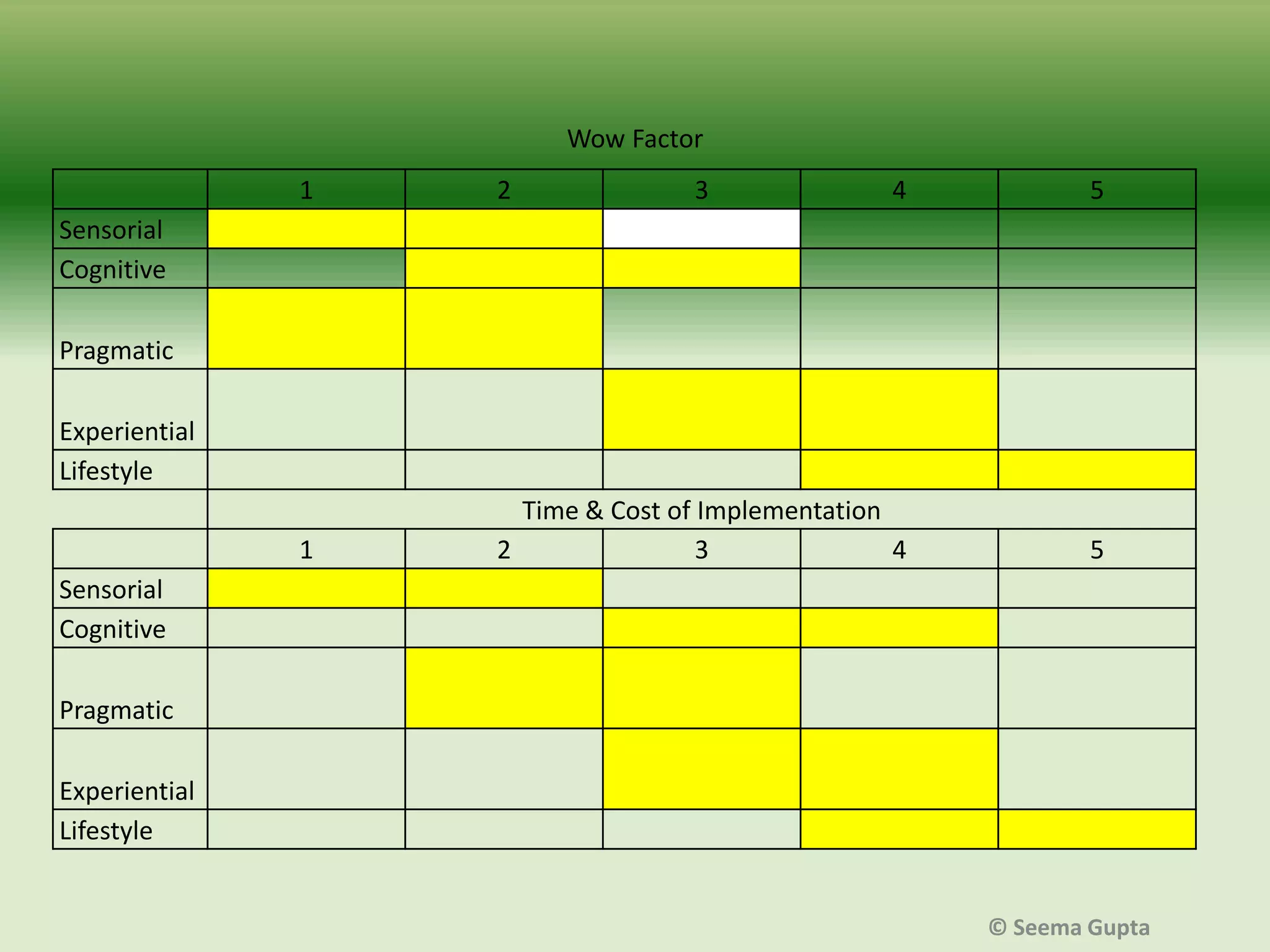
Wow Factor
1

2

3

4

5

1

Time & Cost of Implementation
2
3
4

5

Sensorial
Cognitive
Pragmatic

Experiential
Lifestyle

Sensorial
Cognitive
Pragmatic
Experiential
Lifestyle
© Seema Gupta
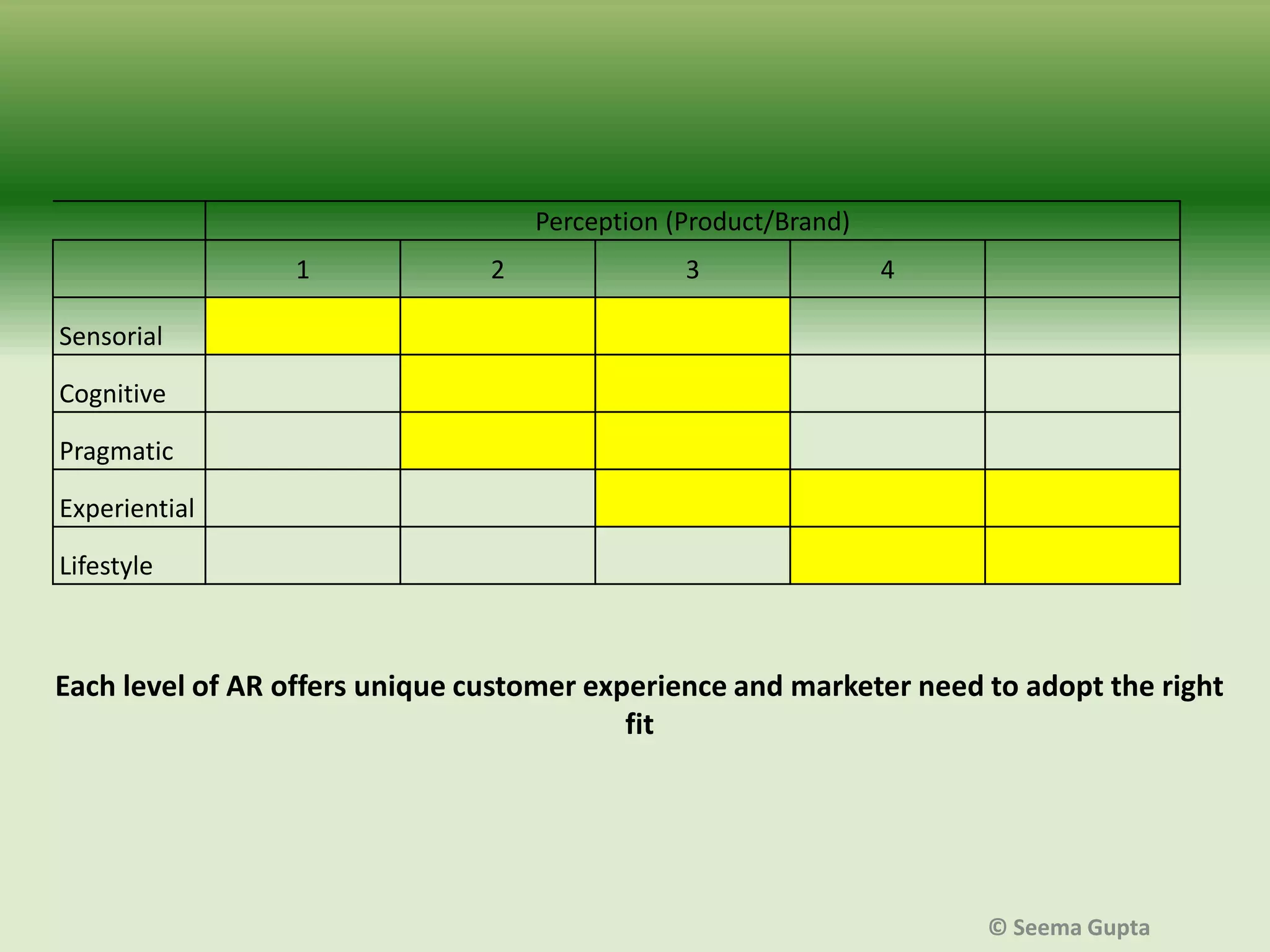
Perception (Product/Brand)
1

2

3

4

Sensorial
Cognitive
Pragmatic
Experiential

Lifestyle

Each level of AR offers unique customer experience and marketer need to adopt the right
fit

© Seema Gupta
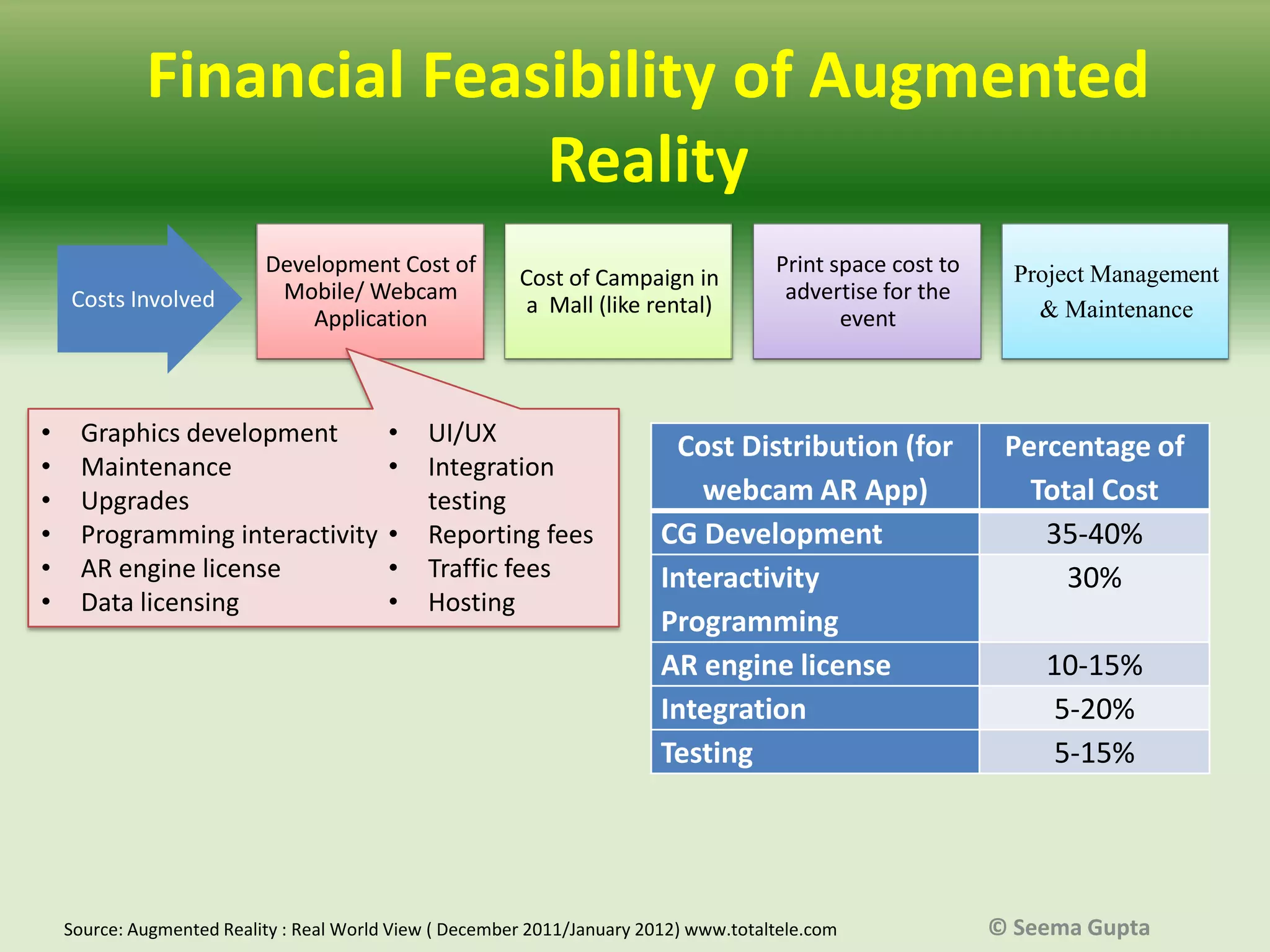
Financial Feasibility of Augmented
Reality
Costs Involved

•
•
•
•
•
•

Development Cost of
Mobile/ Webcam
Application

Graphics development
Maintenance
Upgrades
Programming interactivity
AR engine license
Data licensing

•
•
•
•
•

Cost of Campaign in
a Mall (like rental)

UI/UX
Integration
testing
Reporting fees
Traffic fees
Hosting

Print space cost to
advertise for the
event

Cost Distribution (for
webcam AR App)
CG Development
Interactivity
Programming
AR engine license
Integration
Testing

Source: Augmented Reality : Real World View ( December 2011/January 2012) www.totaltele.com

Project Management
& Maintenance

Percentage of
Total Cost
35-40%
30%
10-15%
5-20%
5-15%

© Seema Gupta
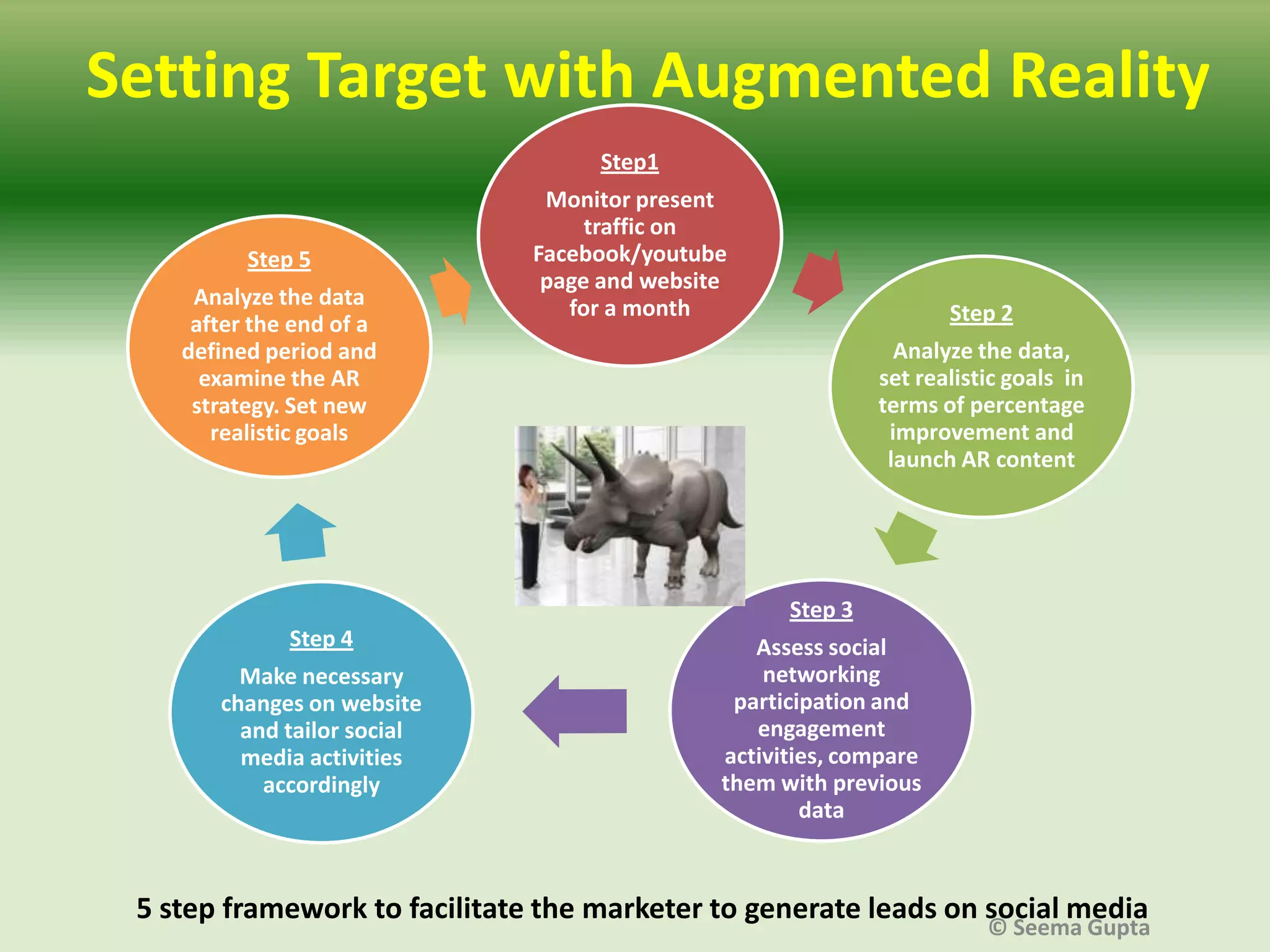
Setting Target with Augmented Reality
Step1

Step 5
Analyze the data
after the end of a
defined period and
examine the AR
strategy. Set new
realistic goals

Monitor present
traffic on
Facebook/youtube
page and website
for a month

Step 2
Analyze the data,
set realistic goals in
terms of percentage
improvement and
launch AR content

Step 3
Step 4
Make necessary
changes on website
and tailor social
media activities
accordingly

Assess social
networking
participation and
engagement
activities, compare
them with previous
data

5 step framework to facilitate the marketer to generate leads on social media

© Seema Gupta
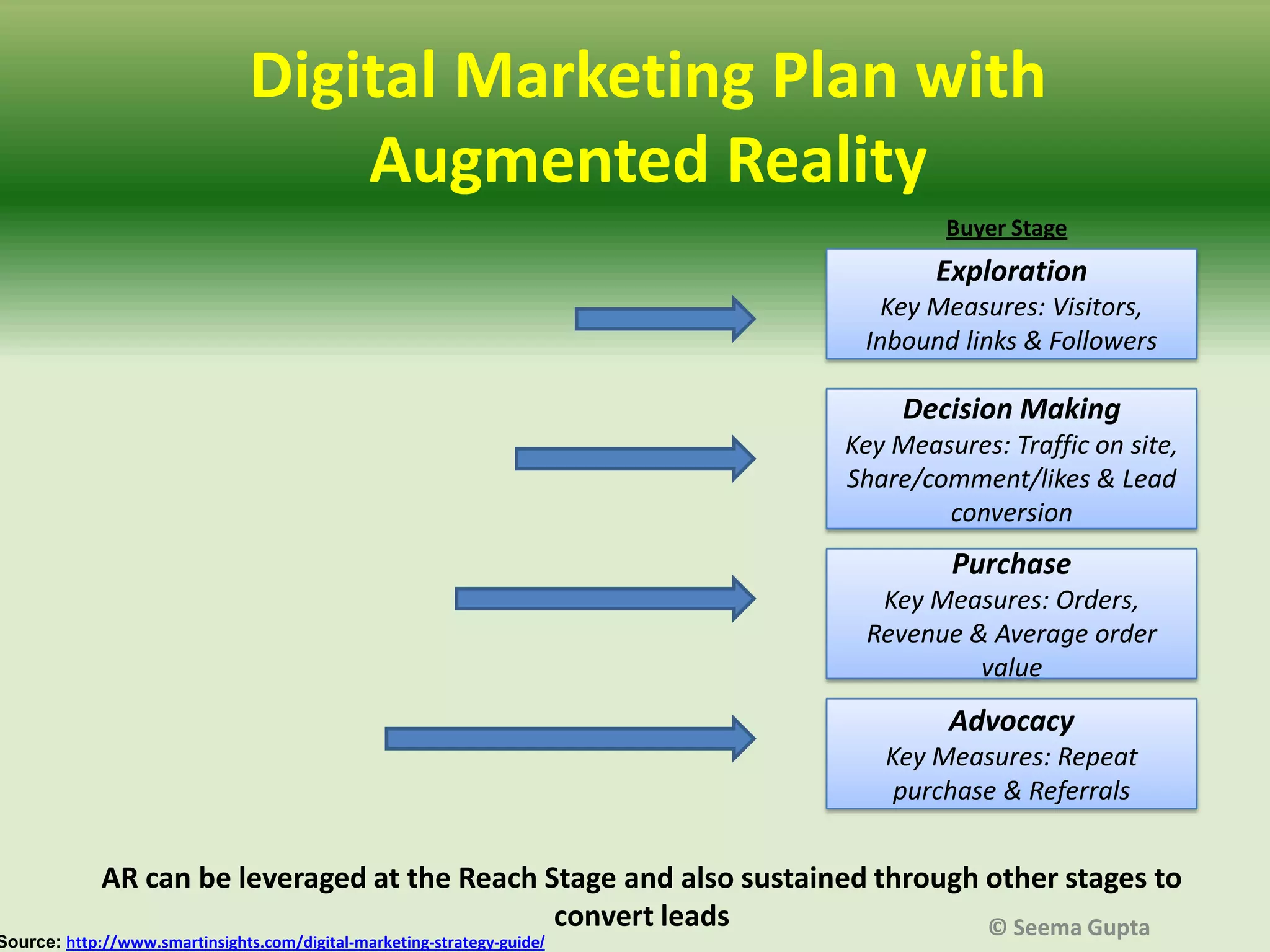
Digital Marketing Plan with
Augmented Reality
Buyer Stage

Exploration
Key Measures: Visitors,
Inbound links & Followers

Decision Making
Key Measures: Traffic on site,
Share/comment/likes & Lead
conversion

Purchase
Key Measures: Orders,
Revenue & Average order
value

Advocacy
Key Measures: Repeat
purchase & Referrals

AR can be leveraged at the Reach Stage and also sustained through other stages to
convert leads
© Seema Gupta

Source: http://www.smartinsights.com/digital-marketing-strategy-guide/
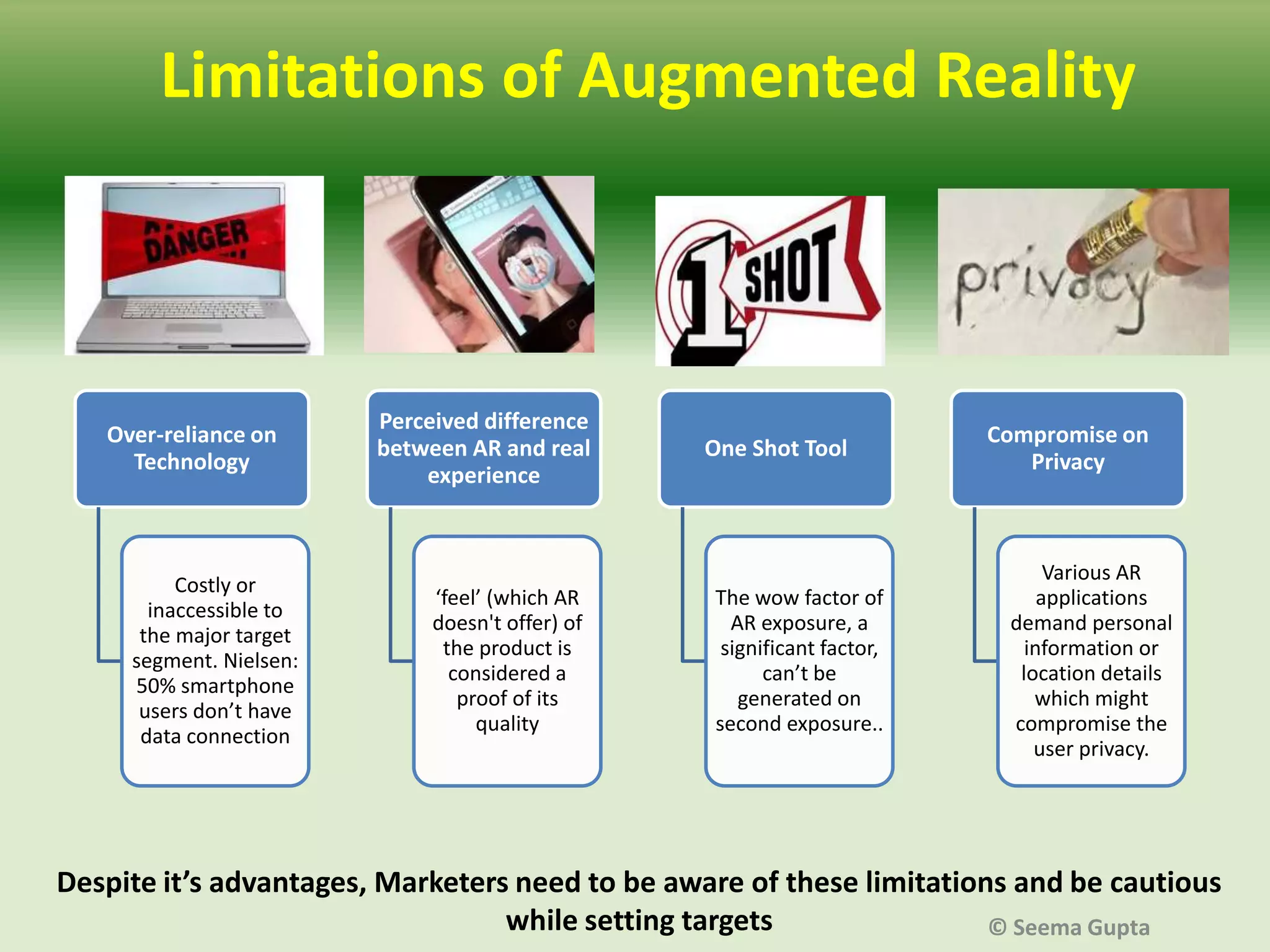
Limitations of Augmented Reality

Over-reliance on
Technology

Costly or
inaccessible to
the major target
segment. Nielsen:
50% smartphone
users don’t have
data connection

Perceived difference
between AR and real
experience

‘feel’ (which AR
doesn't offer) of
the product is
considered a
proof of its
quality

One Shot Tool

The wow factor of
AR exposure, a
significant factor,
can’t be
generated on
second exposure..

Compromise on
Privacy

Various AR
applications
demand personal
information or
location details
which might
compromise the
user privacy.

Despite it’s advantages, Marketers need to be aware of these limitations and be cautious
while setting targets
© Seema Gupta
How would you use
Augmented Reality?
Read more on
DigitalMarketingTadka.com
Acknowledgement: Report on Augmented Reality by Aniket Batra, Ravali Reddy, Ravi Purohit, Arun Bagaria, Rohit
Jaiswal (IIMB students)
© Seema Gupta

How to Leverage Augmented Reality for Marketing

  • 1.
    Seema Gupta Assistant Professor IndianInstitute of Management Bangalore DigitalMarketingTadka.com dmtadka@gmail.com
  • 2.
  • 3.
    Introduction to AugmentedReality • Augmented reality (AR) is the augmentation of the real physical world that we live in with virtual objects through a technological medium. Meaning © Seema Gupta
  • 4.
    Introduction to Augmented Reality(contd.) •Highcustomer interactivity & engagement level •Customer behaviour can be monitored •Point of sale promotional tool •Form of Experiential Marketing Relevance © Seema Gupta
  • 5.
    Introduction to Augmented Reality(contd.) AugmentedReality is an emerging tool that is growing with digital revolution © Seema Gupta
  • 6.
    Why use AR? ©Seema Gupta
  • 7.
    Applications of AugmentedReality Augmented Reality has applications across fields and marketing activities © Seema Gupta
  • 8.
    Applications of AugmentedReality Promotion & Product launch Shoppers Stop Promotions © Seema Gupta
  • 9.
    Applications of AugmentedReality Brand communication Mahindra SUV © Seema Gupta
  • 10.
    Applications of AugmentedReality Online sales Macy’s online sale © Seema Gupta
  • 11.
    Applications of AugmentedReality Gather Customer Intelligence Geo Guides Tourist Application © Seema Gupta
  • 12.
    Applications of AugmentedReality Industrial Application Metaio Engineering Solutions © Seema Gupta
  • 13.
    Applications of AugmentedReality Education Layar Browser © Seema Gupta
  • 14.
    Applications of AugmentedReality Entertainment Avatar Toys © Seema Gupta
  • 15.
    Literature Review Effectiveness of AR •Consumers exposed to AR advertisement had more incentive to view the manufacturer’s website after viewing the advertisement • Print media was more effective in delivering factual, especially text-based, information for later recall • Need for an integrated marketing communication program Augmented Reality is effective in getting the attention of the user but not in conveying information Source: http://edgd.asee.org/conferences/proceedings/65th%20Midyear/Connolly_Chambers_Augmented_Reality © Seema Gupta
  • 16.
    Literature Review Three measuresof the perceived value AR manages to create short term ‘wow factor’ but may not create long term brand attitude Source: Yuan, Y.E and Wu, C.K (2008). “Relationship Among Experiential Marketing, Experiential Value and customer Satisfaction”, Journal of Hospitality & Tourism Research, Vol 32(3), pp. 387-410. © Seema Gupta
  • 17.
  • 18.
    Augmented Reality Enhancing convenience Influencing enjoyment Relevancy ofidea Ease of interaction WOM (Word of Mouth) • Time saving and practical • AR apps are very enjoyable and different for the consumer compared to other marketing tools • The WOW factor. • Depends upon interaction of the culture and psychographics of TG with the product category and level of detail required at the time of purchase. • The effectiveness of AR depends upon how personalized and interactive the execution of AR is for • the user. AR in online space has the potential to go viral on social networking sites by sharing of videos and photos and can also generate positive Word Of Mouth for the brands. © Seema Gupta
  • 19.
    Interviews with IndustryExperts Synergy Concerns • How will this new communication technique gel with existing marketing communication by the organization? • Will not this new technique confuse the existing customer base? Financial Concerns • • • • What would be the cost of having an effective AR strategy? Will it be reusable for future offerings as well? Would I be able to justify the cost of experimenting with this new tool? Will I be able to reduce my existing marketing budget or will AR be an add-on? Strategy Concerns • • • • How sophisticated AR technique should be for my product? Can this give me a competitive advantage over the competition? How can I leverage AR by using other communication tools in tandem? What would be the conversion rate of the reach generated by this tool? Marketers are concerned about the financial, strategic and synergy implications of AR © Seema Gupta
  • 20.
    A Customer CentricView of AR Sensorial AR Example Cognitive AR Experiential AR Lifestyle AR Used for product demonstrations to test the look and feel of the product Customers engage with designing and see unique, customised products come to life involves one’s affective system i.e. their moods, feelings & emotions; generate word of mouth publicity transcends the use for a particular product for communicating socialising and other daily activities. Primarily low involvement products like FMCG goods Medium level involvement, Lack of perceived customization High involvement products Personal Care products, New product introduction Gesture control Lifestyle applications Dark Fantasy AR based mall activation Ray-Ban Virtual Mirror Online Custom Apparel, Interior designing Axe effect- Angels falling down Google glass/IWatch Affects the senses and aims to provide good sensorial experience Product Category Pragmatic AR AR offers different degrees of user engagement, enhancing the customer experience © Seema Gupta
  • 21.
    Hypothesis for AugmentedReality High Involvement Low Involvement Informational Transformational Sensorial AR Product Category: Low Involvement: like FMCG Pragmatic AR Product Category: Medium Involvement: Experiential AR Product Category: New Product Introduction, Personal Care Cognitive AR Product Category: High Involvement: Life Style, Fashion, Industrial etc Lifestyle AR Product Category: A wide range Hypothesis: Product category and the levels of AR used for marketing are inter-related © Seema Gupta
  • 22.
    Hypothesis Results Sensorial AR SensorialAR may not be appropriate media to create brand awareness. Pragmatic AR Pragmatic AR is ideal when one wants to increase trial (aided by curiosity factor of consumers) and it also differentiates the brand from other competitors Cognitive AR Cognitive AR is able to provide the complex and multipleparametric information with clarity with use of technology Experiential AR Lifestyle AR Experiential AR utilizes the online media to spread the actual campaign in the form of video or rich media The mental barriers to personal relevance using the advanced technology underlying the lifestyle AR push it to some distant future © Seema Gupta
  • 23.
    Rating levels ofAR on Customer Experience Factors Involvement 1 2 3 4 Sensorial Cognitive Pragmatic Experientia l Lifestyle Informational Content 1 2 3 4 Sensorial Cognitive Pragmatic Experientia l Lifestyle © Seema Gupta
  • 24.
    Wow Factor 1 2 3 4 5 1 Time &Cost of Implementation 2 3 4 5 Sensorial Cognitive Pragmatic Experiential Lifestyle Sensorial Cognitive Pragmatic Experiential Lifestyle © Seema Gupta
  • 25.
    Perception (Product/Brand) 1 2 3 4 Sensorial Cognitive Pragmatic Experiential Lifestyle Each levelof AR offers unique customer experience and marketer need to adopt the right fit © Seema Gupta
  • 26.
    Financial Feasibility ofAugmented Reality Costs Involved • • • • • • Development Cost of Mobile/ Webcam Application Graphics development Maintenance Upgrades Programming interactivity AR engine license Data licensing • • • • • Cost of Campaign in a Mall (like rental) UI/UX Integration testing Reporting fees Traffic fees Hosting Print space cost to advertise for the event Cost Distribution (for webcam AR App) CG Development Interactivity Programming AR engine license Integration Testing Source: Augmented Reality : Real World View ( December 2011/January 2012) www.totaltele.com Project Management & Maintenance Percentage of Total Cost 35-40% 30% 10-15% 5-20% 5-15% © Seema Gupta
  • 27.
    Setting Target withAugmented Reality Step1 Step 5 Analyze the data after the end of a defined period and examine the AR strategy. Set new realistic goals Monitor present traffic on Facebook/youtube page and website for a month Step 2 Analyze the data, set realistic goals in terms of percentage improvement and launch AR content Step 3 Step 4 Make necessary changes on website and tailor social media activities accordingly Assess social networking participation and engagement activities, compare them with previous data 5 step framework to facilitate the marketer to generate leads on social media © Seema Gupta
  • 28.
    Digital Marketing Planwith Augmented Reality Buyer Stage Exploration Key Measures: Visitors, Inbound links & Followers Decision Making Key Measures: Traffic on site, Share/comment/likes & Lead conversion Purchase Key Measures: Orders, Revenue & Average order value Advocacy Key Measures: Repeat purchase & Referrals AR can be leveraged at the Reach Stage and also sustained through other stages to convert leads © Seema Gupta Source: http://www.smartinsights.com/digital-marketing-strategy-guide/
  • 29.
    Limitations of AugmentedReality Over-reliance on Technology Costly or inaccessible to the major target segment. Nielsen: 50% smartphone users don’t have data connection Perceived difference between AR and real experience ‘feel’ (which AR doesn't offer) of the product is considered a proof of its quality One Shot Tool The wow factor of AR exposure, a significant factor, can’t be generated on second exposure.. Compromise on Privacy Various AR applications demand personal information or location details which might compromise the user privacy. Despite it’s advantages, Marketers need to be aware of these limitations and be cautious while setting targets © Seema Gupta
  • 30.
    How would youuse Augmented Reality? Read more on DigitalMarketingTadka.com Acknowledgement: Report on Augmented Reality by Aniket Batra, Ravali Reddy, Ravi Purohit, Arun Bagaria, Rohit Jaiswal (IIMB students) © Seema Gupta

Editor's Notes

  • #16 P. Connolly, C. Chambers, E. Eagleson, D. Matthews, and T. Rogers Purdue University, Department of Computer Graphics Technology - Augmented Reality Effectiveness in Advertising