KRACK attack (802.11i four-
way handshake attack)
Vadim Davydov
19/03/2018
1
Presentation agenda
• History of 802.11 security protocols family
• 802.11i protocol
• 4-way handshake
• Techniques for confidentiality over 802.11i: TKIP, AES CCMP, AES
GCMP
• Key re-installation attack on 4 way handshake
• Group key handshake
• Group key handshake break
• Countermeasures
2
History of 802.11 security protocols family
IEEE 802.11 is the set of standards that define communication for
wireless local area networks (WLANs). The technology behind 802.11 is
branded to consumers as Wi-Fi.
3
History of 802.11 security protocols family
• WEP (Wired Equivalent Privacy) is the first standard for Wi-Fi
protection
• WPA (Wi-Fi Protected Access)
• WPA2
4
Wireless security
Encryption standard Fast facts How it works
WEP First standard for Wi-Fi protection.
Can be easily hacked due to its 24-bit
initialization vector and weak
authentication
It uses RC4 stream cipher and 64- or
128-bit keys. Static master key must
be manually entered into each device
WPA Security protocol developed by
the Wi-Fi Alliance to secure wireless
computer networks. The Alliance
defined these in response to serious
weaknesses researchers had found in
WEP
Also uses RC4 but longer IVs and 256-
bit keys are added. Each client gets
new keys with TKIP
WPA2 WPA2 replaced WPA. It implements
the mandatory elements of IEEE
802.11i. In particular, it includes
mandatory support for CCMP, an AES-
based encryption mode with strong
security
Replaces RC4 and TKIP with CCMP
and AES algorithm for stronger
authentication and encryption
5
802.11i Protocol
6
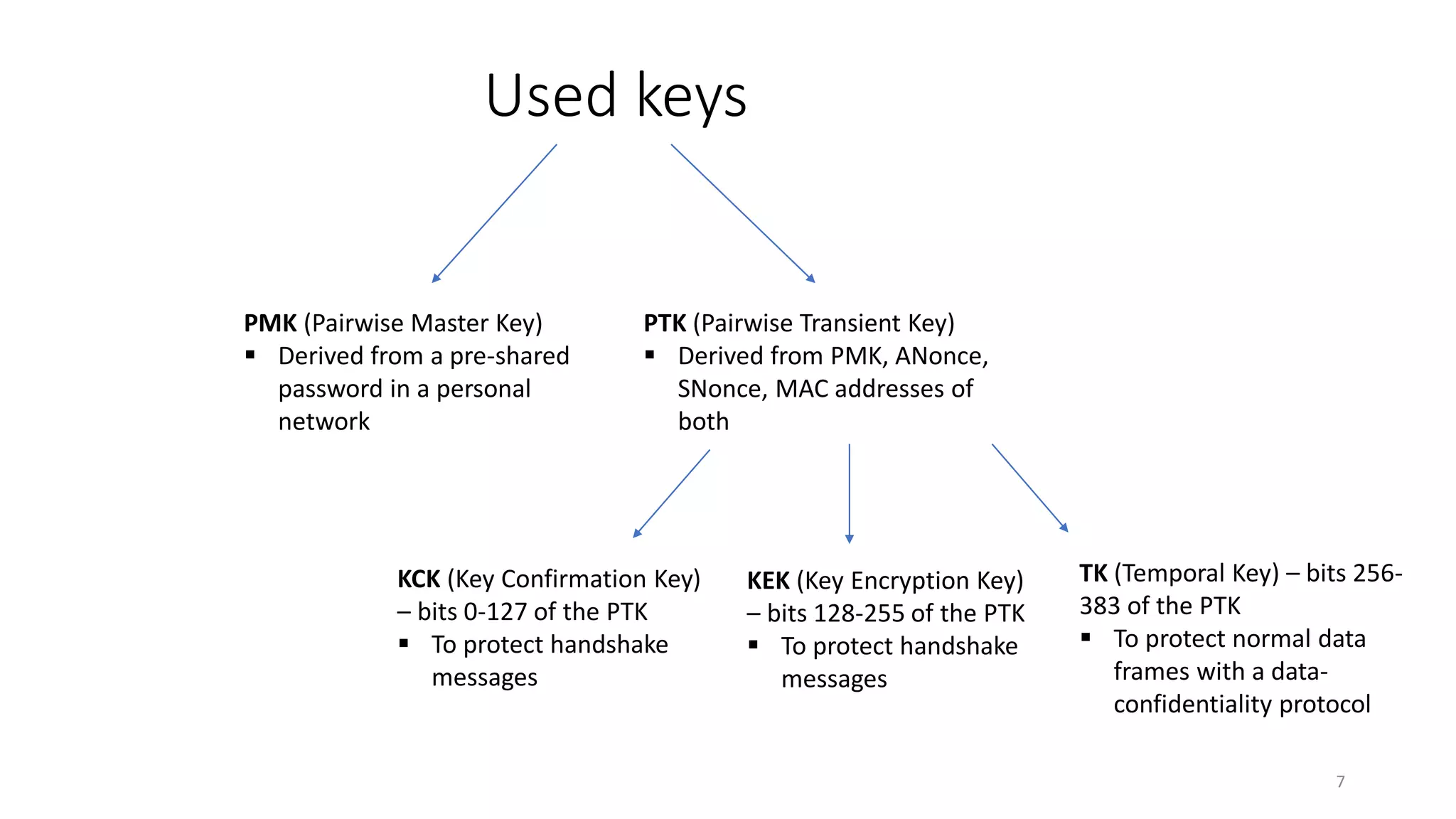
Used keys
PMK (Pairwise Master Key)
▪ Derived from a pre-shared
password in a personal
network
PTK (Pairwise Transient Key)
▪ Derived from PMK, ANonce,
SNonce, MAC addresses of
both
KCK (Key Confirmation Key)
– bits 0-127 of the PTK
▪ To protect handshake
messages
KEK (Key Encryption Key)
– bits 128-255 of the PTK
▪ To protect handshake
messages
TK (Temporal Key) – bits 256-
383 of the PTK
▪ To protect normal data
frames with a data-
confidentiality protocol
7
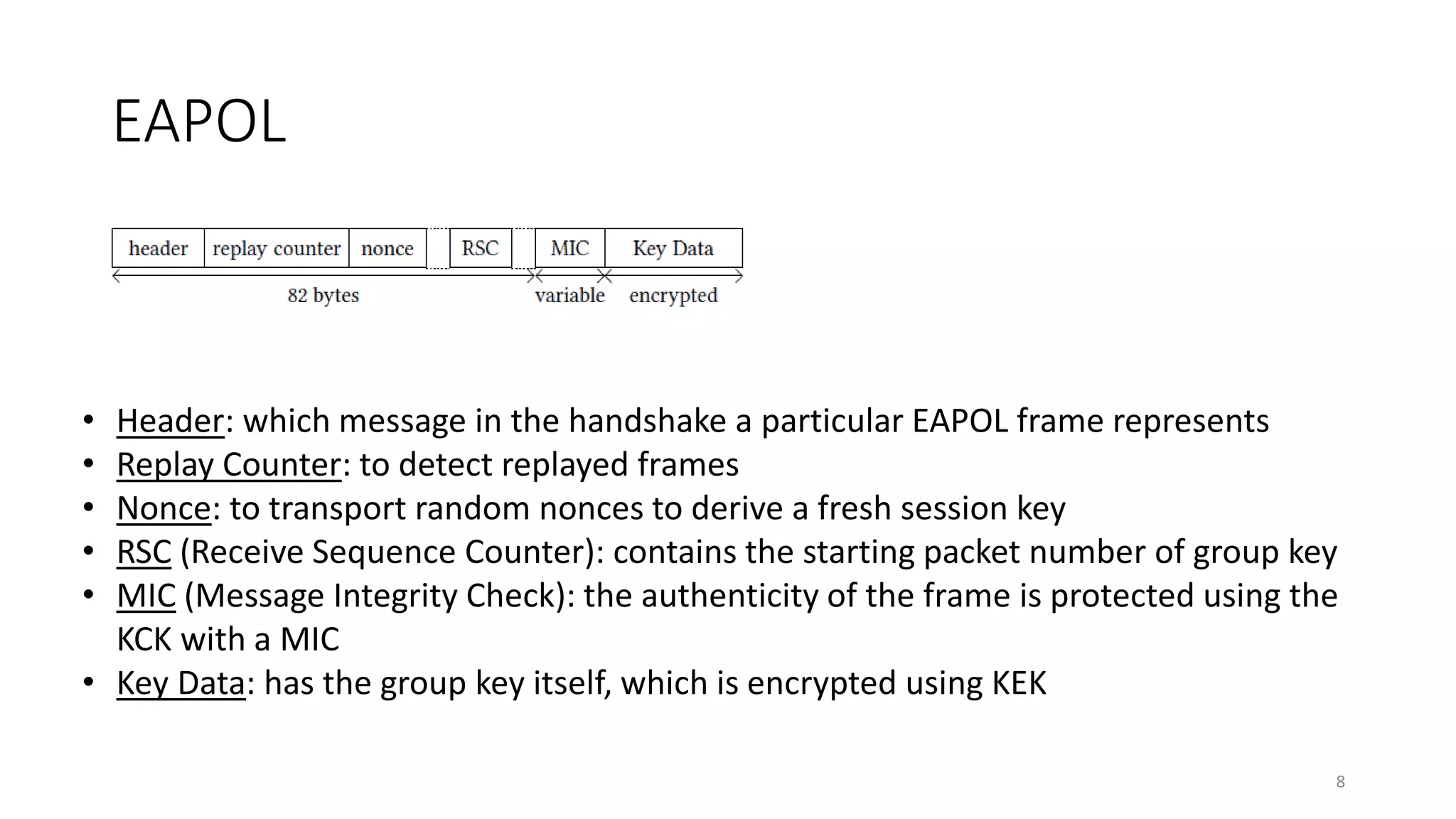
EAPOL
• Header: which message in the handshake a particular EAPOL frame represents
• Replay Counter: to detect replayed frames
• Nonce: to transport random nonces to derive a fresh session key
• RSC (Receive Sequence Counter): contains the starting packet number of group key
• MIC (Message Integrity Check): the authenticity of the frame is protected using the
KCK with a MIC
• Key Data: has the group key itself, which is encrypted using KEK
8
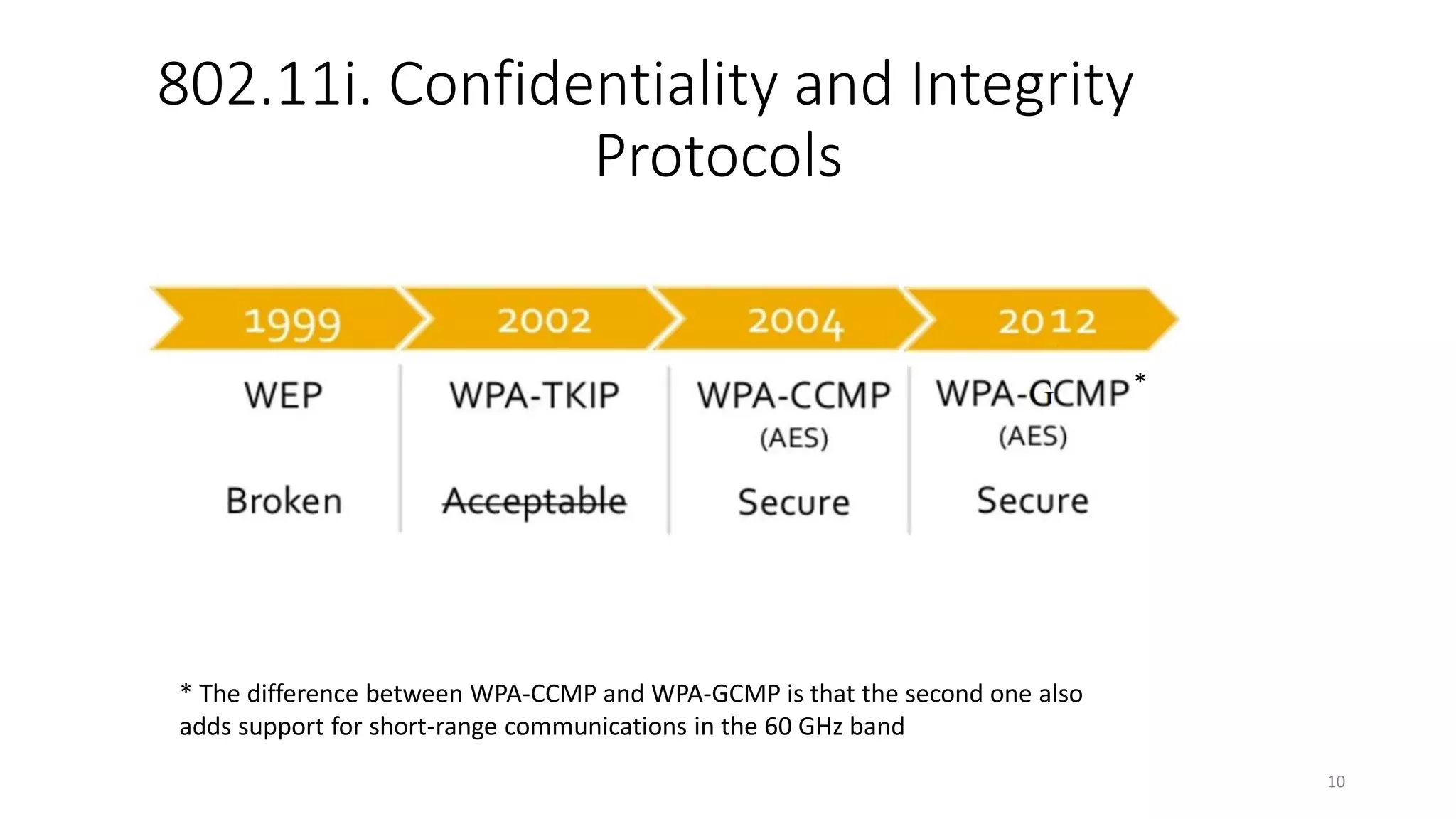
802.11i. Confidentiality and Integrity
Protocols
TKIP (Temporal Key Integrity
Protocol) CCMP (Counter Mode Cipher
Block Chaining Message
Authentication Code Protocol)
GCMP (Galios Counter Mode
Protocol)
9
802.11i. Confidentiality and Integrity
Protocols
* The difference between WPA-CCMP and WPA-GCMP is that the second one also
adds support for short-range communications in the 60 GHz band
*
10
802.11i. Authentication
• Authenticating the client as valid and
having permission to access the
network
• Allows any client to authenticate
• After this step, the client associates
with the network
11
802.11i. 4-way Handshake
• At the starting state, no keys are known, the
MIC cannot be computed
• Msg1: the authenticator uses this message only
to send its value of ANonce to the supplicant
• Msg2: After successful delivery of the first
message, the supplicant generates its own
value of SNonce
12
802.11i. 4-way Handshake
• Msg3:
• verifies to the supplicant that the
authenticator knows the PMK and is thus a
trusted party
• it tells the supplicant that the authenticator
is ready to install and start using the data
encryption keys
• it gives the supplicant the group key
• Msg4: verifies to the authenticator that the keys
are about to be installed
13
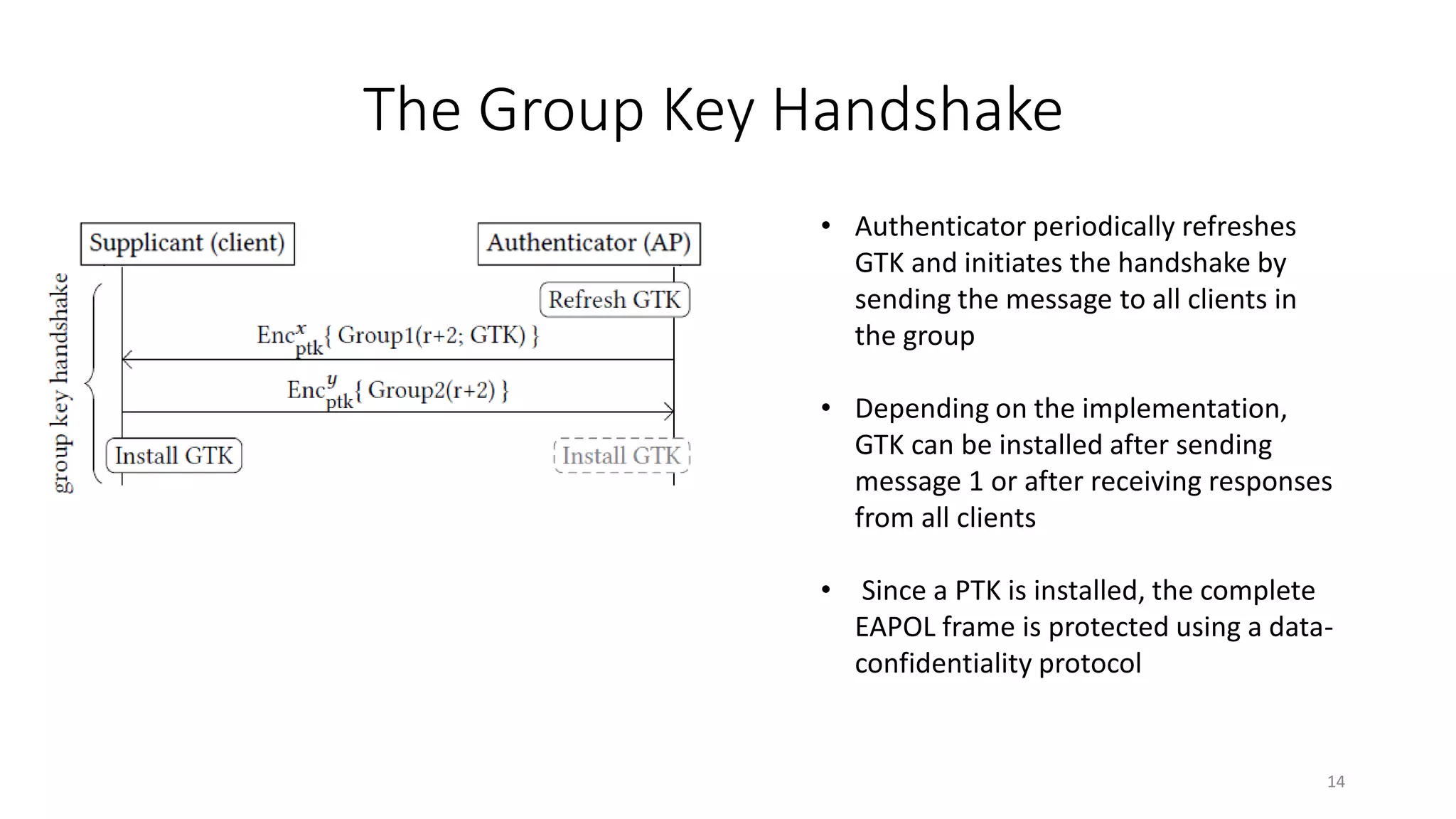
The Group Key Handshake
• Authenticator periodically refreshes
GTK and initiates the handshake by
sending the message to all clients in
the group
• Depending on the implementation,
GTK can be installed after sending
message 1 or after receiving responses
from all clients
• Since a PTK is installed, the complete
EAPOL frame is protected using a data-
confidentiality protocol
14
15
Problem
4-way handshake
Can be retransmitted if the
AP didn’t receive a reply
16
Why is it a critical moment?
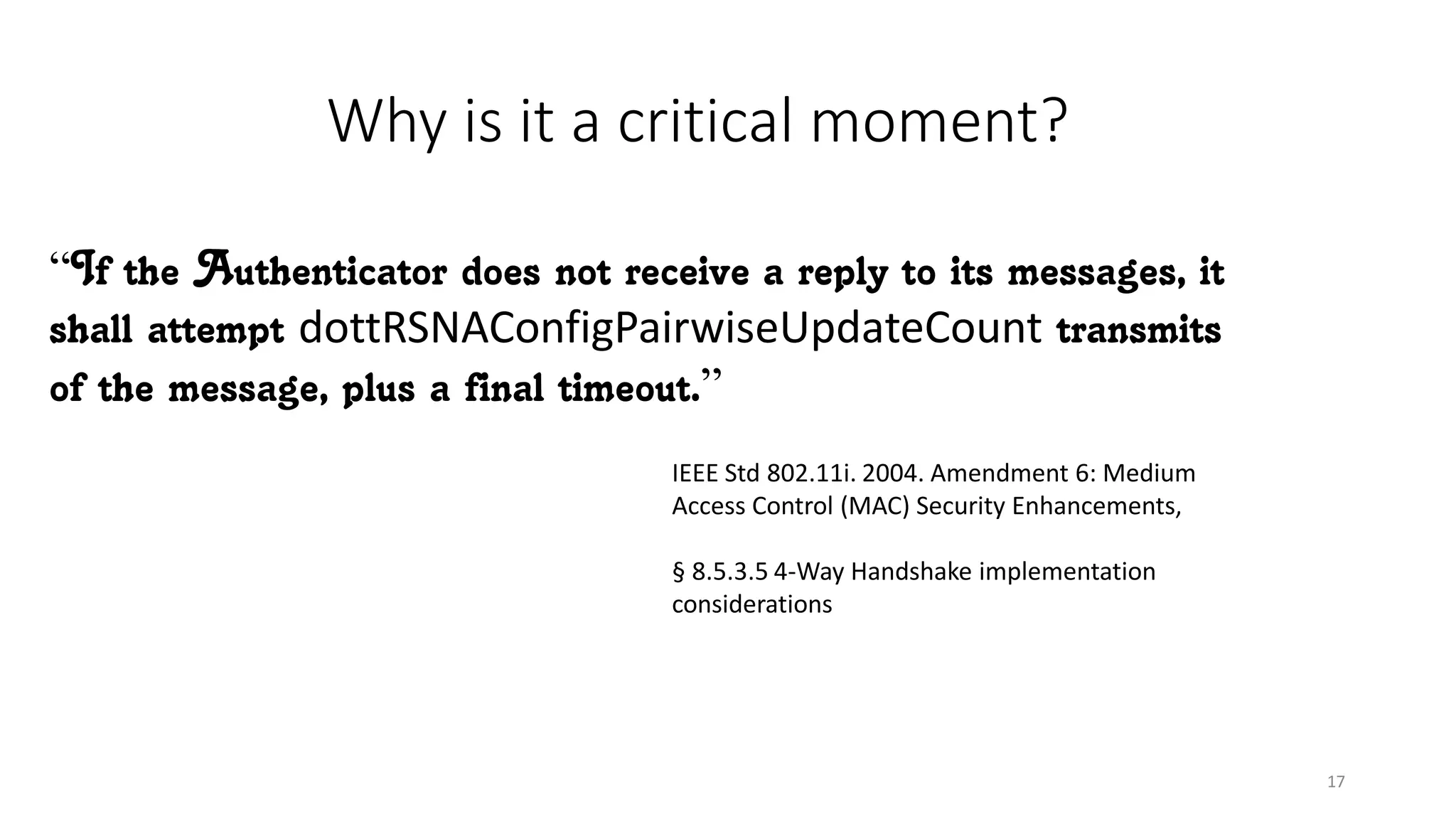
“If the Authenticator does not receive a reply to its messages, it
shall attempt dottRSNAConfigPairwiseUpdateCount transmits
of the message, plus a final timeout.”
IEEE Std 802.11i. 2004. Amendment 6: Medium
Access Control (MAC) Security Enhancements,
§ 8.5.3.5 4-Way Handshake implementation
considerations
17
Why is it a critical moment?
18
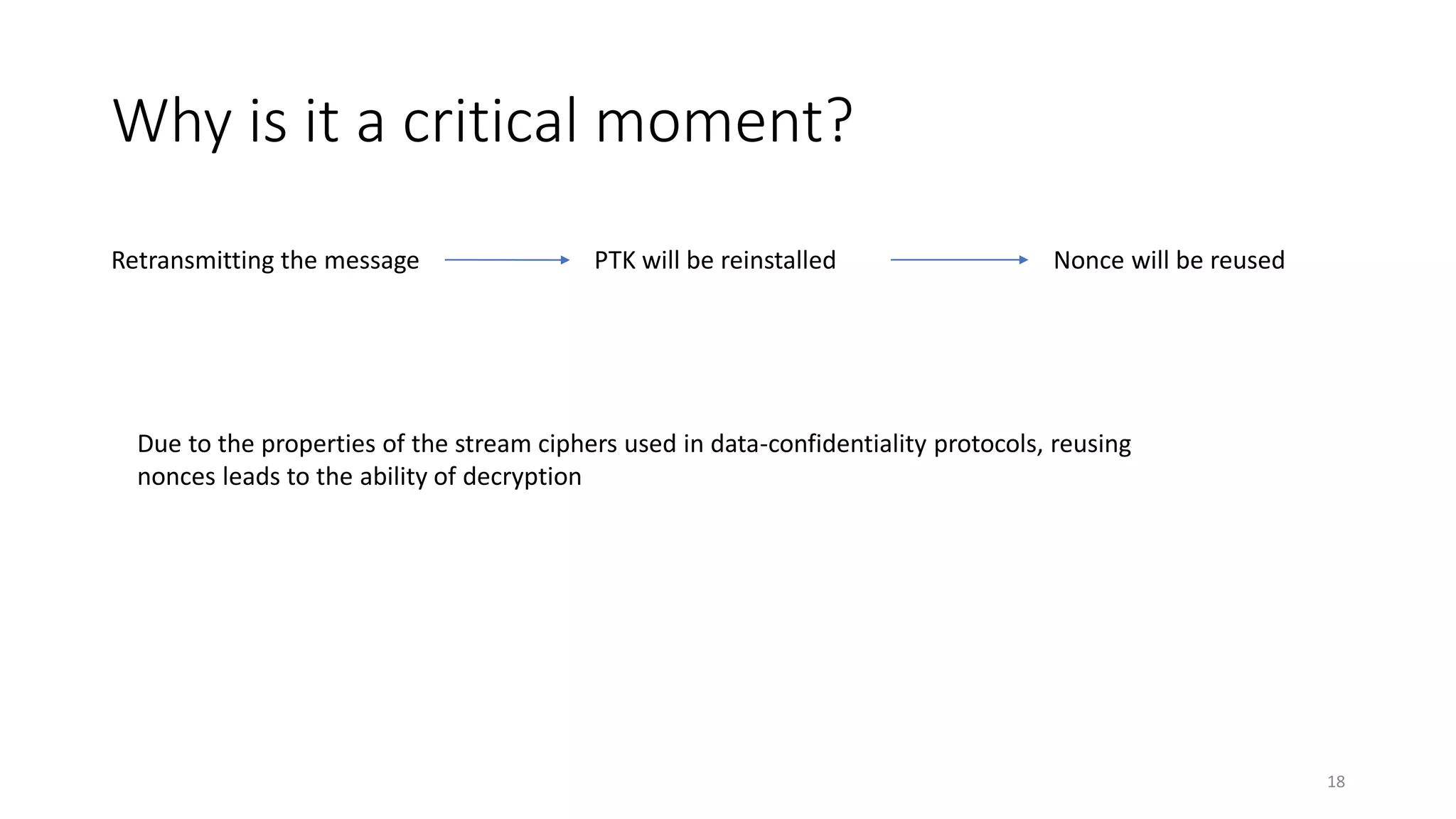
Retransmitting the message PTK will be reinstalled Nonce will be reused
Due to the properties of the stream ciphers used in data-confidentiality protocols, reusing
nonces leads to the ability of decryption
Plaintext retransmission attack
• Using Man-in-the-middle attack to
manipulate messages
• Blocking message 4 from arriving at the
authenticator
• The authenticator retransmits Msg3 due
to he didn’t receive Msg4
19
• Supplicant installs PTK & GTK
• Authenticator sends Msg3 again which
the adversary doesn’t block, and the
supplicant reinstalls PTK & GTK
• As a result, it resets the nonce and replay
counter used by the data-confidentiality
protocol
20
Plaintext retransmission attack
• Since the authenticator did not yet
install the PTK, it will normally reject
the encrypted Msg4
• BUT the authenticator may accept any
replay counter that was used in the 4-
way handshake
• When the victim transmits its next
data frame, the data-confidentiality
protocol reuses nonces
21
Group Key Handshake Break (Immediate Key installation)
• The adversary blocks the response (group Msg2) from
arriving at the AP
22
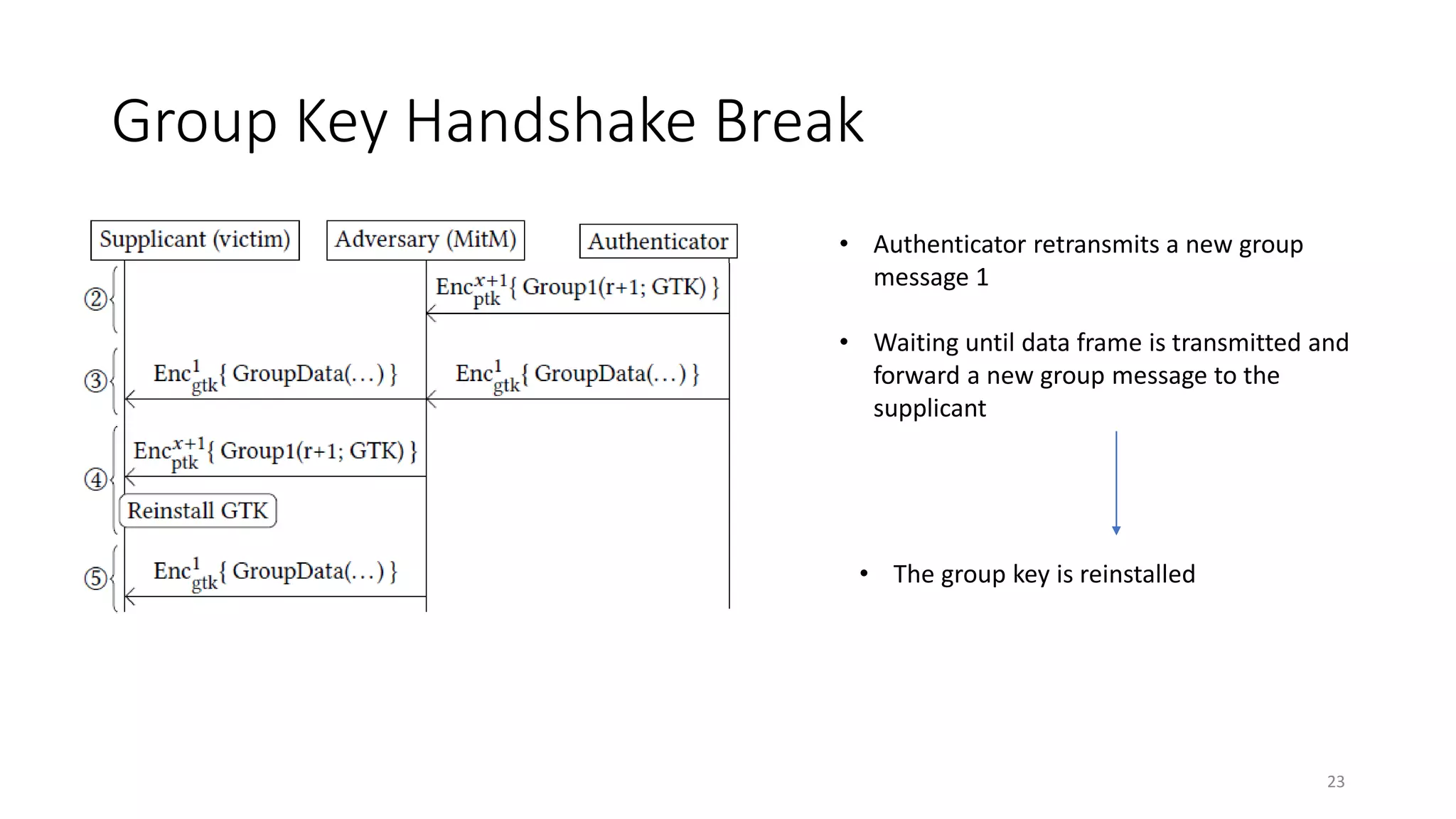
Group Key Handshake Break
• Authenticator retransmits a new group
message 1
• Waiting until data frame is transmitted and
forward a new group message to the
supplicant
• The group key is reinstalled
23
Other attacks
There are several attacks which depend on the using system and how
the protocol 802.11i is implemented:
▪ Attacking 4-way handshake when the victim only accepts encrypted
message 3 retransmission
▪ Attacking the Group Key Handshake with a delayed key installation
24
Countermeasures
• Check if the new key has already been installed and avoid repetition
of the replay counters
• Changing the data-confidentiality protocols
25
References
• Key reinstallation attacks. https://www.krackattacks.com/
• I. W. Group et al. Ieee standard for information technology–
telecommunications and information exchange between systems–local
and metropolitan area networks–specific requirements–part 11:
Wireless lan medium access control (mac) and physical layer (phy)
specifications amendment 6: Wireless access in vehicular environments.
IEEE Std, 802(11), 2010.
• M. Vanhoef and F. Piessens. Key reinstallation attacks: Forcing nonce
reuse in wpa2. In Proceedings of the 2017 ACM SIGSAC Conference on
Computer and Communications Security, pages 1313–1328. ACM, 2017.
26
Q&A
27

KRACK attack

  • 1.
    KRACK attack (802.11ifour- way handshake attack) Vadim Davydov 19/03/2018 1
  • 2.
    Presentation agenda • Historyof 802.11 security protocols family • 802.11i protocol • 4-way handshake • Techniques for confidentiality over 802.11i: TKIP, AES CCMP, AES GCMP • Key re-installation attack on 4 way handshake • Group key handshake • Group key handshake break • Countermeasures 2
  • 3.
    History of 802.11security protocols family IEEE 802.11 is the set of standards that define communication for wireless local area networks (WLANs). The technology behind 802.11 is branded to consumers as Wi-Fi. 3
  • 4.
    History of 802.11security protocols family • WEP (Wired Equivalent Privacy) is the first standard for Wi-Fi protection • WPA (Wi-Fi Protected Access) • WPA2 4
  • 5.
    Wireless security Encryption standardFast facts How it works WEP First standard for Wi-Fi protection. Can be easily hacked due to its 24-bit initialization vector and weak authentication It uses RC4 stream cipher and 64- or 128-bit keys. Static master key must be manually entered into each device WPA Security protocol developed by the Wi-Fi Alliance to secure wireless computer networks. The Alliance defined these in response to serious weaknesses researchers had found in WEP Also uses RC4 but longer IVs and 256- bit keys are added. Each client gets new keys with TKIP WPA2 WPA2 replaced WPA. It implements the mandatory elements of IEEE 802.11i. In particular, it includes mandatory support for CCMP, an AES- based encryption mode with strong security Replaces RC4 and TKIP with CCMP and AES algorithm for stronger authentication and encryption 5
  • 6.
  • 7.
    Used keys PMK (PairwiseMaster Key) ▪ Derived from a pre-shared password in a personal network PTK (Pairwise Transient Key) ▪ Derived from PMK, ANonce, SNonce, MAC addresses of both KCK (Key Confirmation Key) – bits 0-127 of the PTK ▪ To protect handshake messages KEK (Key Encryption Key) – bits 128-255 of the PTK ▪ To protect handshake messages TK (Temporal Key) – bits 256- 383 of the PTK ▪ To protect normal data frames with a data- confidentiality protocol 7
  • 8.
    EAPOL • Header: whichmessage in the handshake a particular EAPOL frame represents • Replay Counter: to detect replayed frames • Nonce: to transport random nonces to derive a fresh session key • RSC (Receive Sequence Counter): contains the starting packet number of group key • MIC (Message Integrity Check): the authenticity of the frame is protected using the KCK with a MIC • Key Data: has the group key itself, which is encrypted using KEK 8
  • 9.
    802.11i. Confidentiality andIntegrity Protocols TKIP (Temporal Key Integrity Protocol) CCMP (Counter Mode Cipher Block Chaining Message Authentication Code Protocol) GCMP (Galios Counter Mode Protocol) 9
  • 10.
    802.11i. Confidentiality andIntegrity Protocols * The difference between WPA-CCMP and WPA-GCMP is that the second one also adds support for short-range communications in the 60 GHz band * 10
  • 11.
    802.11i. Authentication • Authenticatingthe client as valid and having permission to access the network • Allows any client to authenticate • After this step, the client associates with the network 11
  • 12.
    802.11i. 4-way Handshake •At the starting state, no keys are known, the MIC cannot be computed • Msg1: the authenticator uses this message only to send its value of ANonce to the supplicant • Msg2: After successful delivery of the first message, the supplicant generates its own value of SNonce 12
  • 13.
    802.11i. 4-way Handshake •Msg3: • verifies to the supplicant that the authenticator knows the PMK and is thus a trusted party • it tells the supplicant that the authenticator is ready to install and start using the data encryption keys • it gives the supplicant the group key • Msg4: verifies to the authenticator that the keys are about to be installed 13
  • 14.
    The Group KeyHandshake • Authenticator periodically refreshes GTK and initiates the handshake by sending the message to all clients in the group • Depending on the implementation, GTK can be installed after sending message 1 or after receiving responses from all clients • Since a PTK is installed, the complete EAPOL frame is protected using a data- confidentiality protocol 14
  • 15.
  • 16.
    Problem 4-way handshake Can beretransmitted if the AP didn’t receive a reply 16
  • 17.
    Why is ita critical moment? “If the Authenticator does not receive a reply to its messages, it shall attempt dottRSNAConfigPairwiseUpdateCount transmits of the message, plus a final timeout.” IEEE Std 802.11i. 2004. Amendment 6: Medium Access Control (MAC) Security Enhancements, § 8.5.3.5 4-Way Handshake implementation considerations 17
  • 18.
    Why is ita critical moment? 18 Retransmitting the message PTK will be reinstalled Nonce will be reused Due to the properties of the stream ciphers used in data-confidentiality protocols, reusing nonces leads to the ability of decryption
  • 19.
    Plaintext retransmission attack •Using Man-in-the-middle attack to manipulate messages • Blocking message 4 from arriving at the authenticator • The authenticator retransmits Msg3 due to he didn’t receive Msg4 19
  • 20.
    • Supplicant installsPTK & GTK • Authenticator sends Msg3 again which the adversary doesn’t block, and the supplicant reinstalls PTK & GTK • As a result, it resets the nonce and replay counter used by the data-confidentiality protocol 20
  • 21.
    Plaintext retransmission attack •Since the authenticator did not yet install the PTK, it will normally reject the encrypted Msg4 • BUT the authenticator may accept any replay counter that was used in the 4- way handshake • When the victim transmits its next data frame, the data-confidentiality protocol reuses nonces 21
  • 22.
    Group Key HandshakeBreak (Immediate Key installation) • The adversary blocks the response (group Msg2) from arriving at the AP 22
  • 23.
    Group Key HandshakeBreak • Authenticator retransmits a new group message 1 • Waiting until data frame is transmitted and forward a new group message to the supplicant • The group key is reinstalled 23
  • 24.
    Other attacks There areseveral attacks which depend on the using system and how the protocol 802.11i is implemented: ▪ Attacking 4-way handshake when the victim only accepts encrypted message 3 retransmission ▪ Attacking the Group Key Handshake with a delayed key installation 24
  • 25.
    Countermeasures • Check ifthe new key has already been installed and avoid repetition of the replay counters • Changing the data-confidentiality protocols 25
  • 26.
    References • Key reinstallationattacks. https://www.krackattacks.com/ • I. W. Group et al. Ieee standard for information technology– telecommunications and information exchange between systems–local and metropolitan area networks–specific requirements–part 11: Wireless lan medium access control (mac) and physical layer (phy) specifications amendment 6: Wireless access in vehicular environments. IEEE Std, 802(11), 2010. • M. Vanhoef and F. Piessens. Key reinstallation attacks: Forcing nonce reuse in wpa2. In Proceedings of the 2017 ACM SIGSAC Conference on Computer and Communications Security, pages 1313–1328. ACM, 2017. 26
  • 27.