Proving Security Protocols Correct 
Lawrence C. Paulson 
Computer Laboratory
How Detailed Should a Model Be? 
too detailed 
too simple 
concrete abstract 
not usable not credible 
``proves'' 
everything 
``attacks'' 
everything 
publications 
1 L. C. Paulson
Case Study: the Plight of Monica and Bill 
2 L. C. Paulson
A,Na,Sid,Pa 
client server 
client hello 
Nb,Sid,Pb 
server hello 
cert(B,Kb) 
server certificate 
cert(A,Ka) 
client certificate 
{PMS}Kb 
client key exchange 
-1 
{Hash(Nb,B,PMS)}Ka 
certificate verify 
M = PRF(PMS,Na,Nb) 
Finished = Hash(M,messages) 
{Finished}clientK(Na,Nb,M) 
client finished 
{Finished}serverK(Na,Nb,M) 
server finished 
An Internet Security 
Protocol (TLS) 
3 L. C. Paulson
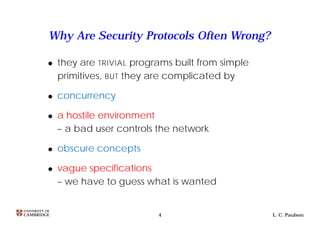
Why Are Security Protocols Often Wrong? 
 they are TRIVIAL programs built from simple 
primitives, BUT they are complicated by 
 concurrency 
 a hostile environment 
– a bad user controls the network 
 obscure concepts 
 vague specifications 
– we have to guess what is wanted 
4 L. C. Paulson
Typical Protocol Goals 
 Authenticity: who sent it? 
 Integrity: has it been altered? 
 Secrecy: who can receive it? 
 Anonymity 
 Non-repudiation : : : 
all SAFETY properties 
5 L. C. Paulson
What Are Session Keys? 
 used for a single session 
 not safeguarded forever 
 distributed using long-term keys 
 could eventually become compromised 
 can only be trusted if FRESH 
6 L. C. Paulson
Freshness, or Would You Eat This Fish? 
wine: six years old 
fish: ? weeks old 
7 L. C. Paulson
Packaging a Session Key for Bill 
fjK; A; NbjgKb 
session key 
person it's 
shared with nonce specified 
sealed using 
Bill's key 
by Bill: 
proof of freshness 
8 L. C. Paulson
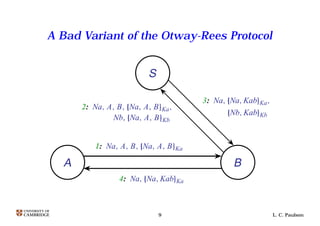
A Bad Variant of the Otway-Rees Protocol 
3: Na; fjNa; KabjgKa; 
fjNb; KabjgKb 
1: Na; A; B; fjNa; A; BjgKa 
B 
S 
A 
2: Na; A; B; fjNa; A; BjgKa; 
Nb; fjNa; A; BjgKb 
4: Na; fjNa; KabjgKa 
9 L. C. Paulson
A Splicing Attack with Interleaved Runs 
1: A !CB : Na; A; B; fjNa; A; BjgKa 
10 
: C ! A : Nc;C; A; fjNc;C; AjgKc 
20 
: A !CS : Nc;C; A; fjNc;C; AjgKc; Na0 
; fjNc;C; AjgKa 
200 
: CA ! S : Nc;C; A; fjNc;C; AjgKc; Na; fjNc;C; AjgKa 
30 
: S !CA : Nc; fjNc; KcajgKc; fjNa; KcajgKa 
4: CB ! A : Na; fjNa; KcajgKa 
Alice thinks the key Kca is shared 
with Bill, butÊit's shared with Carol! 
10 L. C. Paulson
A Bad Variant of the Yahalom Protocol 
2: B; Nb; fjA; NajgKb 
B 
S 
3: fjB; Kab; Na; NbjgKa; 
fjA; KabjgKb 
A 
1: A; Na 
4: fjA; KabjgKb; fjNbjgKab 
11 L. C. Paulson
A Replay Attack 
1: CA ! B : A; Nc 
2: B !CS : B; Nb; fjA; NcjgKb 
4: CA ! B : fjA; Kjg 
Kb; fjNbjgK 
Carol has broken the old key, K. She 
makes Bill think it is shared with Alice. 
12 L. C. Paulson
Verification Method I: Authentication Logics 
BAN logic: Burrows, Abadi, Needham (1989) 
Short proofs using high-level primitives: 
Nonce N is fresh 
Key Kab is good 
Agent S can be trusted 
 good for freshness 
 not-so-good for secrecy or splicing attacks 
13 L. C. Paulson
Verification Method II: State Enumeration 
Specialized tools (Meadows) 
General model-checkers (Lowe) 
Model protocol as a finite-state system 
 automatically finds splicing attacks 
 freshness is hard to model 
Try using formal proof! 
14 L. C. Paulson
Why An Operational Model? 
 good fit to informal protocol proofs: inductive 
 simple foundations 
 readable protocol specifications 
 easily explained to security experts 
 easily mechanized using Isabelle 
15 L. C. Paulson
An Overview of Isabelle 
 uses higher-order logic as a logical framework 
 generic treatment of inference rules 
 logics supported include ZF set theory  HOL 
 powerful simplifier  classical reasoner 
 strong support for inductive definitions 
16 L. C. Paulson
Overview of the Model 
 Traces of events 
– A sends B message X 
– A receives X 
– A stores X 
 A powerful attacker 
– is an accepted user 
– attempts all possible splicing attacks 
– has the same specification in all protocols 
17 L. C. Paulson
Agents and Messages 
agent A; B; : : : D Server j Friend i j Spy 
message X; Y; : : : D Agent A 
j Nonce N 
j Key K 
j fjX; X0jg compound message 
j Crypt K X 
free algebras: we assume PERFECT ENCRYPTION 
18 L. C. Paulson
Functions over Sets of Messages 
 parts H: message components 
Crypt K X7! X 
 analz H: accessible components 
Crypt K X; K−17! X 
 synth H: expressible messages 
X; K7! Crypt K X 
RELATIONS are traditional, but FUNCTIONS give us 
an equational theory 
19 L. C. Paulson
Operational Definition: analz H 
Crypt K X 2 analzH K−1 2 analz H 
X 2 analz H 
X 2 H 
X 2 analz H 
fjX; Y jg 2 analz H 
X 2 analz H 
fjX; Y jg 2 analz H 
Y 2 analz H 
Typical derived law: 
analz G [ analz H  analz.G [ H/ 
20 L. C. Paulson
Operational Definition: synth H 
X 2 H 
X 2 synth H 
Agent A 2 synth H 
X 2 synthH Y2 synth H 
fjX; Y jg 2 synth H 
X 2 synthH K2 H 
Crypt K X 2 synth H 
 agent names can be guessed 
 nonces  keys cannot be! 
21 L. C. Paulson
A Few Equations 
parts.parts H/ D parts H transitivity 
analz.synth H/ D analz H [ synth H “cut elimination” 
Symbolic Evaluation: 
analz.fCrypt K Xg [ H/ D 
8 
fCrypt K Xg [ analz.fXg [ H/ if K−1 2 analz H 
fCrypt K Xg [ analz H otherwise 
: 
22 L. C. Paulson
What About Freshness? 
23 L. C. Paulson
Modelling Attacks and Key Losses 
If X 2 synth.analz.spies evs// 
may add Says Spy B X (Fake rule) 
If the server distributes session key K 
may add Notes Spy fjNa; Nb; Kjg (Oops rule) 
Nonces show the TIME of the loss 
24 L. C. Paulson
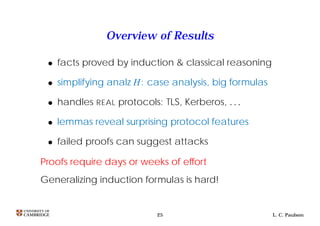
Overview of Results 
 facts proved by induction  classical reasoning 
 simplifying analz H: case analysis, big formulas 
 handles REAL protocols: TLS, Kerberos, : : : 
 lemmas reveal surprising protocol features 
 failed proofs can suggest attacks 
Proofs require days or weeks of effort 
Generalizing induction formulas is hard! 
25 L. C. Paulson
The Recursive Authentication Protocol 
 designed in industry (APM Ltd) 
 novel recursive structure: variable length 
 VERIFIED by Paulson 
– assuming perfect encryption 
 ATTACKED by Ryan and Schneider 
– using the specified encryption (XOR) 
Doesn’t proof give certainty? Not in the real world! 
26 L. C. Paulson
So Then, How Detailed Should a Model Be? 
 detailed enough to answer the relevant 
questions 
 abstract enough to fit our budget 
 model-checking is almost free 
(thanks to Lowe, Roscoe, Schneider) 
 formal proofs give more, but cost more 
27 L. C. Paulson
Don’t let theory displace reality

Proving Security Protocols Correct

  • 1.
    Proving Security ProtocolsCorrect Lawrence C. Paulson Computer Laboratory
  • 2.
    How Detailed Shoulda Model Be? too detailed too simple concrete abstract not usable not credible ``proves'' everything ``attacks'' everything publications 1 L. C. Paulson
  • 3.
    Case Study: thePlight of Monica and Bill 2 L. C. Paulson
  • 4.
    A,Na,Sid,Pa client server client hello Nb,Sid,Pb server hello cert(B,Kb) server certificate cert(A,Ka) client certificate {PMS}Kb client key exchange -1 {Hash(Nb,B,PMS)}Ka certificate verify M = PRF(PMS,Na,Nb) Finished = Hash(M,messages) {Finished}clientK(Na,Nb,M) client finished {Finished}serverK(Na,Nb,M) server finished An Internet Security Protocol (TLS) 3 L. C. Paulson
  • 5.
    Why Are SecurityProtocols Often Wrong? they are TRIVIAL programs built from simple primitives, BUT they are complicated by concurrency a hostile environment – a bad user controls the network obscure concepts vague specifications – we have to guess what is wanted 4 L. C. Paulson
  • 6.
    Typical Protocol Goals Authenticity: who sent it? Integrity: has it been altered? Secrecy: who can receive it? Anonymity Non-repudiation : : : all SAFETY properties 5 L. C. Paulson
  • 7.
    What Are SessionKeys? used for a single session not safeguarded forever distributed using long-term keys could eventually become compromised can only be trusted if FRESH 6 L. C. Paulson
  • 8.
    Freshness, or WouldYou Eat This Fish? wine: six years old fish: ? weeks old 7 L. C. Paulson
  • 9.
    Packaging a SessionKey for Bill fjK; A; NbjgKb session key person it's shared with nonce specified sealed using Bill's key by Bill: proof of freshness 8 L. C. Paulson
  • 10.
    A Bad Variantof the Otway-Rees Protocol 3: Na; fjNa; KabjgKa; fjNb; KabjgKb 1: Na; A; B; fjNa; A; BjgKa B S A 2: Na; A; B; fjNa; A; BjgKa; Nb; fjNa; A; BjgKb 4: Na; fjNa; KabjgKa 9 L. C. Paulson
  • 11.
    A Splicing Attackwith Interleaved Runs 1: A !CB : Na; A; B; fjNa; A; BjgKa 10 : C ! A : Nc;C; A; fjNc;C; AjgKc 20 : A !CS : Nc;C; A; fjNc;C; AjgKc; Na0 ; fjNc;C; AjgKa 200 : CA ! S : Nc;C; A; fjNc;C; AjgKc; Na; fjNc;C; AjgKa 30 : S !CA : Nc; fjNc; KcajgKc; fjNa; KcajgKa 4: CB ! A : Na; fjNa; KcajgKa Alice thinks the key Kca is shared with Bill, butÊit's shared with Carol! 10 L. C. Paulson
  • 12.
    A Bad Variantof the Yahalom Protocol 2: B; Nb; fjA; NajgKb B S 3: fjB; Kab; Na; NbjgKa; fjA; KabjgKb A 1: A; Na 4: fjA; KabjgKb; fjNbjgKab 11 L. C. Paulson
  • 13.
    A Replay Attack 1: CA ! B : A; Nc 2: B !CS : B; Nb; fjA; NcjgKb 4: CA ! B : fjA; Kjg Kb; fjNbjgK Carol has broken the old key, K. She makes Bill think it is shared with Alice. 12 L. C. Paulson
  • 14.
    Verification Method I:Authentication Logics BAN logic: Burrows, Abadi, Needham (1989) Short proofs using high-level primitives: Nonce N is fresh Key Kab is good Agent S can be trusted good for freshness not-so-good for secrecy or splicing attacks 13 L. C. Paulson
  • 15.
    Verification Method II:State Enumeration Specialized tools (Meadows) General model-checkers (Lowe) Model protocol as a finite-state system automatically finds splicing attacks freshness is hard to model Try using formal proof! 14 L. C. Paulson
  • 16.
    Why An OperationalModel? good fit to informal protocol proofs: inductive simple foundations readable protocol specifications easily explained to security experts easily mechanized using Isabelle 15 L. C. Paulson
  • 17.
    An Overview ofIsabelle uses higher-order logic as a logical framework generic treatment of inference rules logics supported include ZF set theory HOL powerful simplifier classical reasoner strong support for inductive definitions 16 L. C. Paulson
  • 18.
    Overview of theModel Traces of events – A sends B message X – A receives X – A stores X A powerful attacker – is an accepted user – attempts all possible splicing attacks – has the same specification in all protocols 17 L. C. Paulson
  • 19.
    Agents and Messages agent A; B; : : : D Server j Friend i j Spy message X; Y; : : : D Agent A j Nonce N j Key K j fjX; X0jg compound message j Crypt K X free algebras: we assume PERFECT ENCRYPTION 18 L. C. Paulson
  • 20.
    Functions over Setsof Messages parts H: message components Crypt K X7! X analz H: accessible components Crypt K X; K−17! X synth H: expressible messages X; K7! Crypt K X RELATIONS are traditional, but FUNCTIONS give us an equational theory 19 L. C. Paulson
  • 21.
    Operational Definition: analzH Crypt K X 2 analzH K−1 2 analz H X 2 analz H X 2 H X 2 analz H fjX; Y jg 2 analz H X 2 analz H fjX; Y jg 2 analz H Y 2 analz H Typical derived law: analz G [ analz H analz.G [ H/ 20 L. C. Paulson
  • 22.
    Operational Definition: synthH X 2 H X 2 synth H Agent A 2 synth H X 2 synthH Y2 synth H fjX; Y jg 2 synth H X 2 synthH K2 H Crypt K X 2 synth H agent names can be guessed nonces keys cannot be! 21 L. C. Paulson
  • 23.
    A Few Equations parts.parts H/ D parts H transitivity analz.synth H/ D analz H [ synth H “cut elimination” Symbolic Evaluation: analz.fCrypt K Xg [ H/ D 8 fCrypt K Xg [ analz.fXg [ H/ if K−1 2 analz H fCrypt K Xg [ analz H otherwise : 22 L. C. Paulson
  • 24.
    What About Freshness? 23 L. C. Paulson
  • 25.
    Modelling Attacks andKey Losses If X 2 synth.analz.spies evs// may add Says Spy B X (Fake rule) If the server distributes session key K may add Notes Spy fjNa; Nb; Kjg (Oops rule) Nonces show the TIME of the loss 24 L. C. Paulson
  • 26.
    Overview of Results facts proved by induction classical reasoning simplifying analz H: case analysis, big formulas handles REAL protocols: TLS, Kerberos, : : : lemmas reveal surprising protocol features failed proofs can suggest attacks Proofs require days or weeks of effort Generalizing induction formulas is hard! 25 L. C. Paulson
  • 27.
    The Recursive AuthenticationProtocol designed in industry (APM Ltd) novel recursive structure: variable length VERIFIED by Paulson – assuming perfect encryption ATTACKED by Ryan and Schneider – using the specified encryption (XOR) Doesn’t proof give certainty? Not in the real world! 26 L. C. Paulson
  • 28.
    So Then, HowDetailed Should a Model Be? detailed enough to answer the relevant questions abstract enough to fit our budget model-checking is almost free (thanks to Lowe, Roscoe, Schneider) formal proofs give more, but cost more 27 L. C. Paulson
  • 29.
    Don’t let theorydisplace reality