COMMUNICATIVE ENGLISH SKILLS(I)
StudySkills
The purpose of this unit is:
➢ To familiarize you with the skills and academic
practices that you need to develop as university
students.
➢ The unit revolves around two important aspects
of academic study, namely, taking notes while
listening to lectures and reading for academic
study.
➢ To take effective notes during lectures and to
practice reading for different purposes.
2.
Taking lecture note
➢At university, you will be exposed to a lot of
information in relation to your field of study. This
information will reach you mainly through
reading and listening to lectures.
Receptive Skills
➢ Since it will not be possible for you to remember
all the information that you have read or heard
that you want to use later for different purposes,
you need to take notes when reading and listening
to lectures.
3.
Note taking andnote making
❖ Note-taking and note-making are among many
essential skills for success at university (college).
❖ Building on your existing skills to start to move
towards advanced level study.
❖ Working on these skills helps you to get the
most out of your studies and aids you in
independent learning.
4.
Conti…
➢ Taking notesis an important skill that you need
to develop in order to be successful in your
university studies.
Answer the following questions on study skills
1. What is lecture? How many types of lecture are
there?
2. What is note taking study skill?
3. What is note making study skill?
4. What is scanning technique (study skill)?
5. What is skimming technique (study skill)?
6. What summarizing, time management, reference
skill?
5.
What is notetaking study skill?
➢ Note-taking is a process that involves writing or
recording information you hear (from spoken
source) or read in a descriptive way.
➢ When you take note don’t be tempted to write
down every single word.
➢ You are not required to understand and write every
flow of speech.
➢ You should focus on relevant points only.
➢ we have to be selective when taking note.
➢ When taking note, be brief and use acronyms that
make sense to you.
6.
Conti…
Note-taking can alsobe explained in the way
written in the table below
➢ Note-taking is when you simply
write what you hear in lectures, or from printed
texts. If the subject is an unfamiliar one, this is
often inevitable, particularly with international
students who are trying hard to understand, follow
and note what the lecturer is saying.
7.
Conti…
In addition, wetake note:
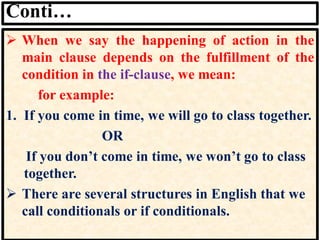
1. To relieve boredom.
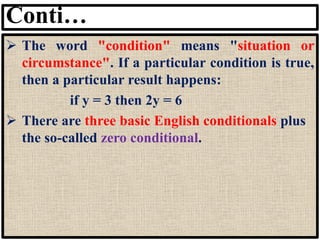
2. To recall the content of lectures better in the future.
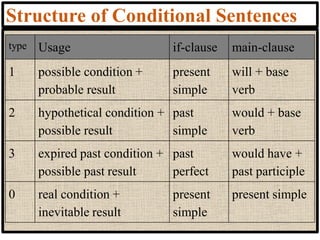
3. To be more organized with our revision.
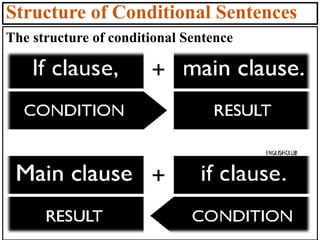
Summary
➢ There is some evidence that writing and keeping notes
can help you recall what you have learned.
➢ However, to be most effective notes must be well-
organized and reviewed afterwards.
➢ There is evidence that discussing your notes with another
person is effective in aiding recall.
➢ Research attention has turned in recent years to what
types of notes are most effective in aiding recall.
8.
How to takeeffective note
➢ Prepare - What questions are you trying to answer; what
do you already know; check out the topic etc.
Focus on: Main ideas/concepts
Line of argument
Some illustrative detail
Information about other sources of
information/ideas
➢ Keep it brief and to the point – focus on what’s important
➢ Use symbols & abbreviations – some are conventional but
it’s fine to use your own – as long as you remember what
they are! (see below.)
➢ Keywords can come from your preparation and questions
you have set for yourself.
9.
How to takeeffective note
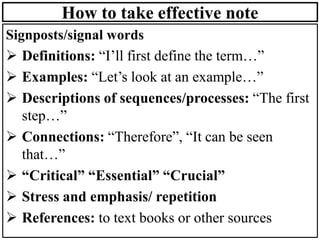
Signposts/signal words
➢ Definitions: “I’ll first define the term…”
➢ Examples: “Let’s look at an example…”
➢ Descriptions of sequences/processes: “The first
step…”
➢ Connections: “Therefore”, “It can be seen
that…”
➢ “Critical” “Essential” “Crucial”
➢ Stress and emphasis/ repetition
➢ References: to text books or other sources
10.
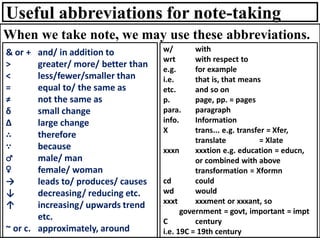
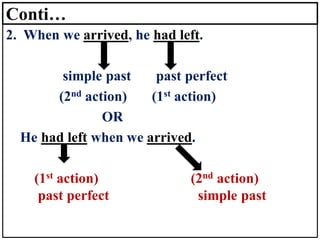
Useful abbreviations fornote-taking
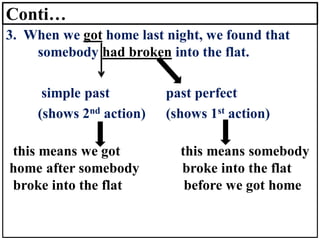
When we take note, we may use these abbreviations.
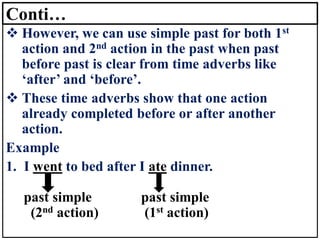
& or + and/ in addition to
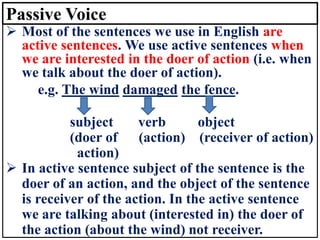
> greater/ more/ better than
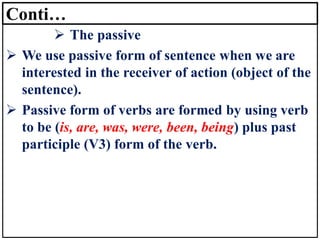
< less/fewer/smaller than
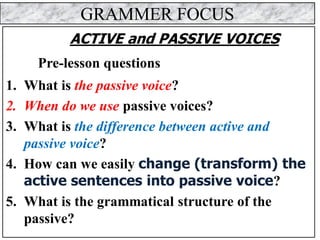
= equal to/ the same as
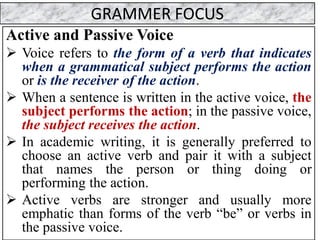
≠ not the same as
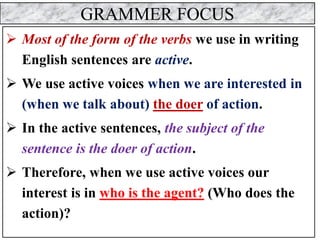
δ small change
Δ large change
∴ therefore
∵ because
♂ male/ man
♀ female/ woman
→ leads to/ produces/ causes
↓ decreasing/ reducing etc.
↑ increasing/ upwards trend
etc.
~ or c. approximately, around
w/ with
wrt with respect to
e.g. for example
i.e. that is, that means
etc. and so on
p. page, pp. = pages
para. paragraph
info. Information
X trans... e.g. transfer = Xfer,
translate = Xlate
xxxn xxxtion e.g. education = educn,
or combined with above
transformation = Xformn
cd could
wd would
xxxt xxxment or xxxant, so
government = govt, important = impt
C century
i.e. 19C = 19th century
11.
Effective ways oftaking note
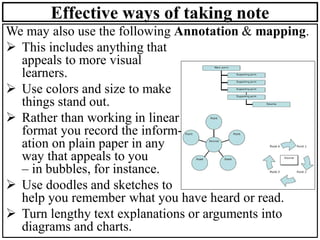
We may also use the following Annotation & mapping.
➢ This includes anything that
appeals to more visual
learners.
➢ Use colors and size to make
things stand out.
➢ Rather than working in linear
format you record the inform- -
ation on plain paper in any
way that appeals to you
– in bubbles, for instance.
➢ Use doodles and sketches to
help you remember what you have heard or read.
➢ Turn lengthy text explanations or arguments into
diagrams and charts.
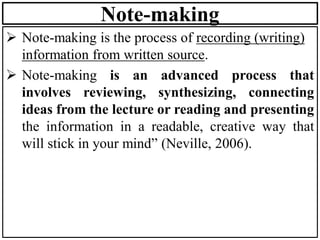
Note-making
➢ Note-making isthe process of recording (writing)
information from written source.
➢ Note-making is an advanced process that
involves reviewing, synthesizing, connecting
ideas from the lecture or reading and presenting
the information in a readable, creative way that
will stick in your mind” (Neville, 2006).
14.
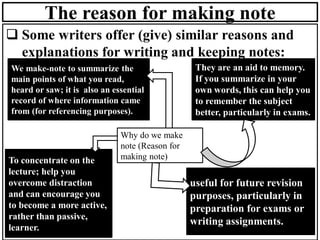
The reason formaking note
❑ Some writers offer (give) similar reasons and
explanations for writing and keeping notes:
We make-note to summarize the
main points of what you read,
heard or saw; it is also an essential
record of where information came
from (for referencing purposes).
They are an aid to memory.
If you summarize in your
own words, this can help you
to remember the subject
better, particularly in exams.
useful for future revision
purposes, particularly in
preparation for exams or
writing assignments.
Why do we make
note (Reason for
making note)
To concentrate on the
lecture; help you
overcome distraction
and can encourage you
to become a more active,
rather than passive,
learner.
15.
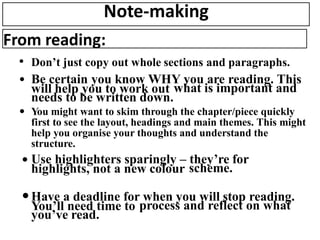
Note-making
From reading:
• Don’tjust copy out whole sections and paragraphs.
• Be certain you know WHY you are reading. This
will help you to work out what is important and
needs to be written down.
• You might want to skim through the chapter/piece quickly
first to see the layout, headings and main themes. This might
help you organise your thoughts and understand the
structure.
• Use highlighters sparingly – they’re for
highlights, not a new colour scheme.
•Have a deadline for when you will stop reading.
You’ll need time to process and reflect on what
you’ve read.
16.
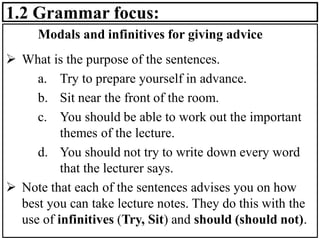
1.2 Grammar focus:
Modalsand infinitives for giving advice
➢ What is the purpose of the sentences.
a. Try to prepare yourself in advance.
b. Sit near the front of the room.
c. You should be able to work out the important
themes of the lecture.
d. You should not try to write down every word
that the lecturer says.
➢ Note that each of the sentences advises you on how
best you can take lecture notes. They do this with the
use of infinitives (Try, Sit) and should (should not).
17.
Asking for information/adviceand Giving Advice
➢ One of the functions of language is giving
advice/information when others want us to offer
them. Answer these questions
1. Do you know how to give advice in English?
2. Have you ever given advice for someone in
English? When? Whom did you advise? What
was the situation in which he/she asked your
advice?
3. Do you know expressions used for giving advice
and asking for advice? Make a list.
18.
Conti…
➢ Modal verbsare special verbs which behave
very differently from normal verbs.
➢ Here are some important differences:
1. Modal verbs do not take ‘-s’ in the third
person.
e.g. 1. He can speak Chinese.
2. She should be here by 9:00.
2. We use ‘not’ to make modal verbs negative,
even in simple present and in simple past.
e.g. 1. He should not be late.
2. They might not come to the party.
19.
Asking for Information/Advice
Askingfor advice and giving advice
▪ The most common expressions that can be
used in both formal and informal situations
to ask for advice and to give advice include
the following phrases.
▪ Study the following phrases (expressions)
used to ask for advice and used to give advice
as shown in the table below. Then try to use
them in actual conversation in giving advice
and asking for it.
20.
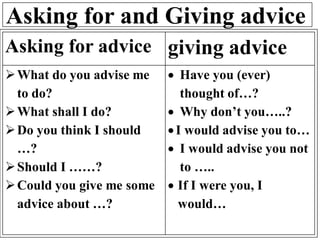
Asking for andGiving advice
Asking for advice giving advice
➢What do you advise me
to do?
➢What shall I do?
➢Do you think I should
…?
➢Should I ……?
➢Could you give me some
advice about …?
• Have you (ever)
thought of…?
• Why don’t you…..?
•I would advise you to…
• I would advise you not
to …..
• If I were you, I
would…
21.
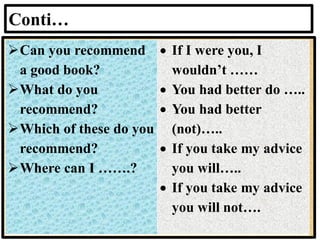
Conti…
➢Can you recommend
agood book?
➢What do you
recommend?
➢Which of these do you
recommend?
➢Where can I …….?
• If I were you, I
wouldn’t ……
• You had better do …..
• You had better
(not)…..
• If you take my advice
you will…..
• If you take my advice
you will not….
22.
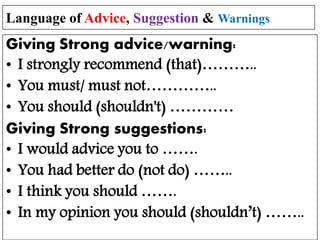
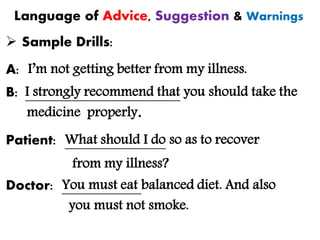
Language of Advice,Suggestion & Warnings
Giving Strong advice/warning:
• I strongly recommend (that)………..
• You must/ must not…………..
• You should (shouldn't) …………
Giving Strong suggestions:
• I would advice you to …….
• You had better do (not do) ……..
• I think you should …….
• In my opinion you should (shouldn’t) ……..
23.
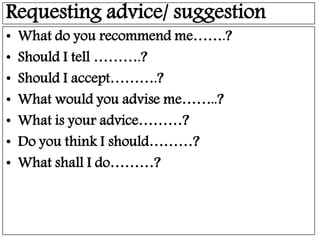
Requesting advice/ suggestion
•What do you recommend me…….?
• Should I tell ……….?
• Should I accept……….?
• What would you advise me……..?
• What is your advice………?
• Do you think I should………?
• What shall I do………?
24.
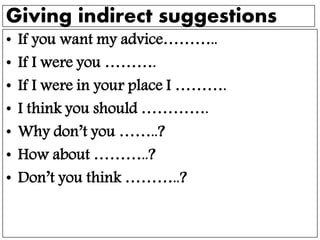
Giving indirect suggestions
•If you want my advice………..
• If I were you ……….
• If I were in your place I ……….
• I think you should ………….
• Why don’t you ……..?
• How about ………..?
• Don’t you think ………..?
25.
Language of Advice,Suggestion & Warnings
➢ Sample Drills:
A: I’m not getting better from my illness.
B: I strongly recommend that you should take the
medicine properly.
Patient: What should I do so as to recover
from my illness?
Doctor: You must eat balanced diet. And also
you must not smoke.
26.
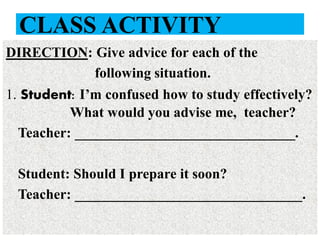
CLASS ACTIVITY
DIRECTION: Giveadvice for each of the
following situation.
1. Student: I’m confused how to study effectively?
What would you advise me, teacher?
Teacher: _______________________________.
Student: Should I prepare it soon?
Teacher: ________________________________.
27.
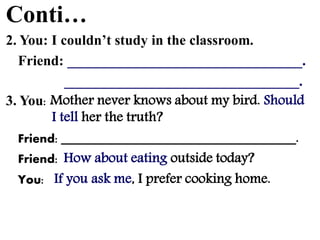
Conti…
2. You: Icouldn’t study in the classroom.
Friend: _________________________________.
_________________________________.
3. You: Mother never knows about my bird. Should
I tell her the truth?
Friend: _________________________________.
Friend: How about eating outside today?
You: If you ask me, I prefer cooking home.
28.
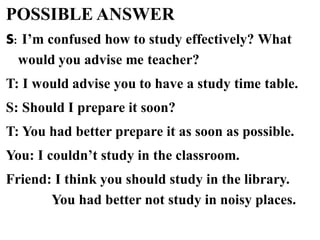
POSSIBLE ANSWER
S: I’mconfused how to study effectively? What
would you advise me teacher?
T: I would advise you to have a study time table.
S: Should I prepare it soon?
T: You had better prepare it as soon as possible.
You: I couldn’t study in the classroom.
Friend: I think you should study in the library.
You had better not study in noisy places.
29.
POSSIBLE ANSWER
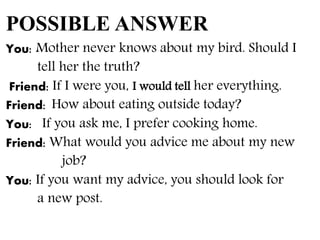
You: Mothernever knows about my bird. Should I
tell her the truth?
Friend: If I were you, I would tell her everything.
Friend: How about eating outside today?
You: If you ask me, I prefer cooking home.
Friend: What would you advice me about my new
job?
You: If you want my advice, you should look for
a new post.
30.
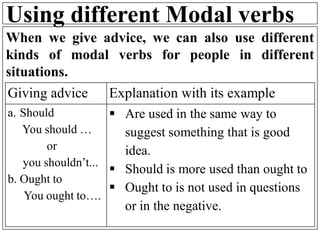
Using different Modalverbs
When we give advice, we can also use different
kinds of modal verbs for people in different
situations.
Giving advice Explanation with its example
a. Should
You should …
or
you shouldn’t...
b. Ought to
You ought to….
▪ Are used in the same way to
suggest something that is good
idea.
▪ Should is more used than ought to
▪ Ought to is not used in questions
or in the negative.
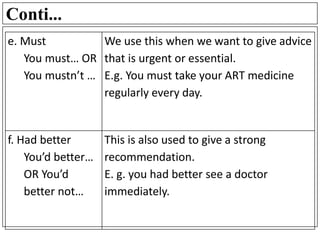
Conti...
e. Must
You must…OR
You mustn’t …
We use this when we want to give advice
that is urgent or essential.
E.g. You must take your ART medicine
regularly every day.
f. Had better
You’d better…
OR You’d
better not…
This is also used to give a strong
recommendation.
E. g. you had better see a doctor
immediately.
33.
Conti...
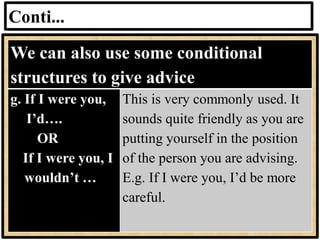
We can alsouse some conditional
structures to give advice
g. If I were you,
I’d….
OR
If I were you, I
wouldn’t …
This is very commonly used. It
sounds quite friendly as you are
putting yourself in the position
of the person you are advising.
E.g. If I were you, I’d be more
careful.
34.
Conti...
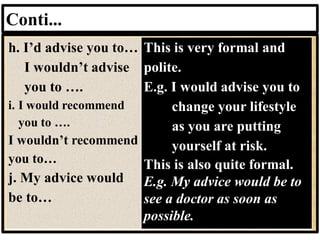
h. I’d adviseyou to…
I wouldn’t advise
you to ….
i. I would recommend
you to ….
I wouldn’t recommend
you to…
j. My advice would
be to…
This is very formal and
polite.
E.g. I would advise you to
change your lifestyle
as you are putting
yourself at risk.
This is also quite formal.
E.g. My advice would be to
see a doctor as soon as
possible.
35.
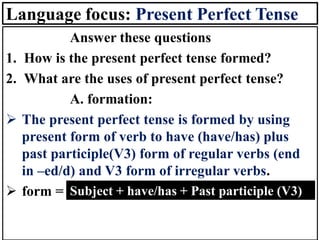
Language focus: PresentPerfect Tense
Answer these questions
1. How is the present perfect tense formed?
2. What are the uses of present perfect tense?
A. formation:
➢ The present perfect tense is formed by using
present form of verb to have (have/has) plus
past participle(V3) form of regular verbs (end
in –ed/d) and V3 form of irregular verbs.
➢ form = Subject + have/has + Past participle (V3)
36.
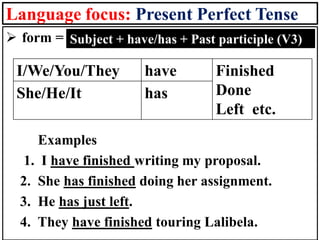
Language focus: PresentPerfect Tense
➢ form =
Examples
1. I have finished writing my proposal.
2. She has finished doing her assignment.
3. He has just left.
4. They have finished touring Lalibela.
Subject + have/has + Past participle (V3)
I/We/You/They have Finished
Done
Left etc.
She/He/It has
37.
Uses of thepresent perfect tense
➢ The present perfect tense has different uses in
English.
1. The present perfect tense is used to express an
action which has been completed and which
continues to influence the present.
Examples
1. Abel: Where is your keys?
Abel: I don’t know. I have lost it. (= I can’t
open the door now/ I haven’t got it
now )
2. I have seen monkey in Simien Mountain.
(=it is still possible to see it there)
38.
Conti…
2. The presentperfect tense is used to express a
recently completed action/to announce recent
happening.
e.g. 1. Jemal: Let me invite you a cup of
coffee.
Hayat: Thanks, I have just had.
2. Emebet: What happen to your finger?
Look! It is bleeding.
Hana: I have cut my finger while
chopping onion. (to announce
recent happening)
39.
Conti…
3. The presentperfect tense is used with the
present time expressions to express an action
which beginning in the past and still
continuing. Most of the time when used with
‘for’ and ‘since’.
Examples
1. I have lived here for nine years. (= I am
still living here)
2. The class has already started.(= it has
started and still going on)
40.
Conti…
4. The presentperfect tense is used to express
actions that happened at unspecified time
before the present. It is used when the time of
past action is not mentioned.
Examples
1. They have finished eating.
2. I have written a letter.
3. I have visited London twice.
In each of the above sentence the specific time
when the action happened is not mentioned.
41.
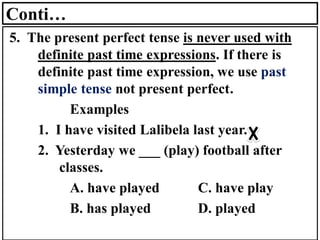
Conti…
5. The presentperfect tense is never used with
definite past time expressions. If there is
definite past time expression, we use past
simple tense not present perfect.
Examples
1. I have visited Lalibela last year.
2. Yesterday we ___ (play) football after
classes.
A. have played C. have play
B. has played D. played
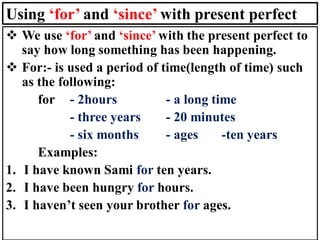
42.
Using ‘for’ and‘since’ with present perfect
❖ We use ‘for’ and ‘since’ with the present perfect to
say how long something has been happening.
❖ For:- is used a period of time(length of time) such
as the following:
for - 2hours - a long time
- three years - 20 minutes
- six months - ages -ten years
Examples:
1. I have known Sami for ten years.
2. I have been hungry for hours.
3. I haven’t seen your brother for ages.
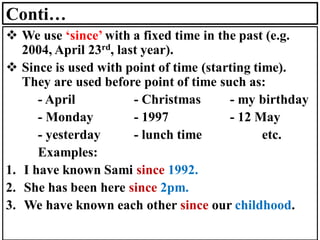
43.
Conti…
❖ We use‘since’ with a fixed time in the past (e.g.
2004, April 23rd, last year).
❖ Since is used with point of time (starting time).
They are used before point of time such as:
- April - Christmas - my birthday
- Monday - 1997 - 12 May
- yesterday - lunch time etc.
Examples:
1. I have known Sami since 1992.
2. She has been here since 2pm.
3. We have known each other since our childhood.
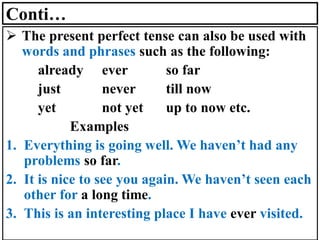
44.
Conti…
➢ The presentperfect tense can also be used with
words and phrases such as the following:
already ever so far
just never till now
yet not yet up to now etc.
Examples
1. Everything is going well. We haven’t had any
problems so far.
2. It is nice to see you again. We haven’t seen each
other for a long time.
3. This is an interesting place I have ever visited.
45.
Conti…
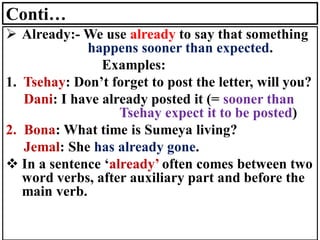
➢ Already:- Weuse already to say that something
happens sooner than expected.
Examples:
1. Tsehay: Don’t forget to post the letter, will you?
Dani: I have already posted it (= sooner than
Tsehay expect it to be posted)
2. Bona: What time is Sumeya living?
Jemal: She has already gone.
❖ In a sentence ‘already’ often comes between two
word verbs, after auxiliary part and before the
main verb.
46.
Conti…
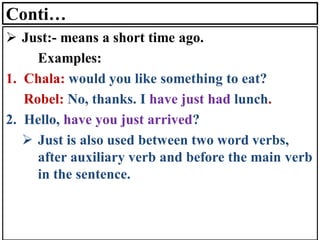
➢ Just:- meansa short time ago.
Examples:
1. Chala: would you like something to eat?
Robel: No, thanks. I have just had lunch.
2. Hello, have you just arrived?
➢ Just is also used between two word verbs,
after auxiliary verb and before the main verb
in the sentence.
47.
Conti…
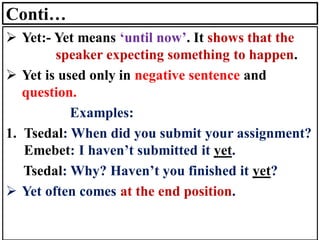
➢ Yet:- Yetmeans ‘until now’. It shows that the
speaker expecting something to happen.
➢ Yet is used only in negative sentence and
question.
Examples:
1. Tsedal: When did you submit your assignment?
Emebet: I haven’t submitted it yet.
Tsedal: Why? Haven’t you finished it yet?
➢ Yet often comes at the end position.
48.
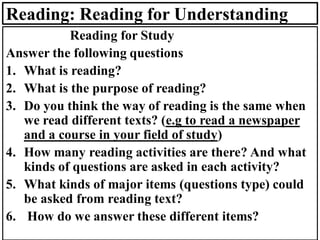
Reading: Reading forUnderstanding
Reading for Study
Answer the following questions
1. What is reading?
2. What is the purpose of reading?
3. Do you think the way of reading is the same when
we read different texts? (e.g to read a newspaper
and a course in your field of study)
4. How many reading activities are there? And what
kinds of questions are asked in each activity?
5. What kinds of major items (questions type) could
be asked from reading text?
6. How do we answer these different items?
49.
Reading: Reading forUnderstanding
1. What is Reading?
Reading:- reading is the process of receiving
information from written texts.
➢ It is the act of gaining (acquiring) knowledge
from written information.
➢ Reading is an important aspect of learning
language.
➢ It is a fundamental aspect of academic works
(i.e. if you want to be successful in your
academic career, you are required to read).
50.
Conti…
➢ Reading developability to think about the world
and describe it in terms of a particular
approach.
➢ It will be one of the keys that unlock the door to a
career (profession)as a business manager,
psychologist, engineer, chemist teacher, scientist,
etc.
➢ It is an invaluable learning tools in the world of
employment.
➢ It opens up the possibilities of gaining access to &
an understanding of the thinking of all the people
who have developed models and theories or written
about a particular discipline.
51.
Conti…
Major objective ofreading for study is:
➢ To gather ideas and information, to assimilate the
gathered information into your own view of the
world, and then to be able to express that view
when you are asked in the assessment program or
in seminars.
2. What is the Purpose of Reading?
A student will read for many different reasons.
➢ The purpose of our reading may be:
1. To understand courses (subject) for the assessment
program (pass the exam).
2. To receive information and assimilate it.
3. To pick out the main news items (e.g. in a
newspaper).
52.
Conti…
➢ Do youthink the ways we read all written
information the same or different (e.g to read
a newspaper and a course in your field of
study)? How?
➢ The way of our reading should be changed
according to our purpose of reading.
➢ For example, we simply glance through to pick out
the main news items. It is quicker and different
from reading for study.
➢ When we read a newspaper, we simply look for
main news not for details.
➢ When we read a textbook (our course), we are
required to study in detail to extract the essential
knowledge it contains.
53.
Conti…
5. How manyreading activities are there? And
what kinds of questions are asked in each
activity?
➢ There are three reading activities.
1. Pre-reading activity
2. While-reading activity and
3. Post-reading activity
1. Pre-reading activity
➢ Pre-reading activities are activities (questions)
we are asked to answer before reading the given
reading text.
54.
Conti…
➢ In thistype of reading activity, the questions
which students can answer from their
background knowledge (previous knowledge)
about the text is asked.
➢ For example, we may be asked to predict what
we are going to read in the text looking at the
topic of the passage.
2. While-reading Activity
➢ In while-reading activity, questions (activities)
that can be answered during reading the text
are asked. For example, specific questions like
date, expressions, when something happen, etc.
55.
Conti…
-Comprehension questions
-Vocabulary questionsaccording to the
passage
-Reference questions are asked in while
reading stage.
3. Post-reading Activity
➢ This type of reading activity is the activity
(questions) asked after reading the whole
reading text from beginning up to the end.
➢ For example, questions like summarizing the
information given in the whole text.
56.
Conti…
4. What kindsof major items (questions type) could
be asked from reading text?
➢ From the reading text, the following possible
item types can be asked.
1. Comprehension questions
2. Vocabulary questions
3. Reference questions
➢ There are different strategies and techniques
used to answer the above three types of items.
57.
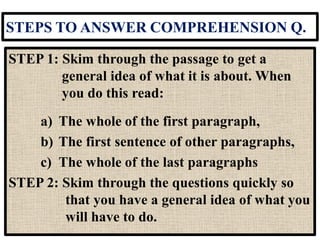
STEPS TO ANSWERCOMPREHENSION Q.
STEP 1: Skim through the passage to get a
general idea of what it is about. When
you do this read:
a) The whole of the first paragraph,
b) The first sentence of other paragraphs,
c) The whole of the last paragraphs
STEP 2: Skim through the questions quickly so
that you have a general idea of what you
will have to do.
58.
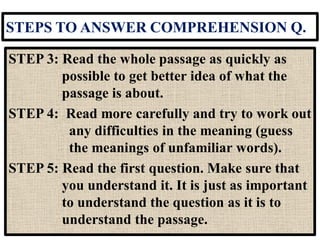
STEPS TO ANSWERCOMPREHENSION Q.
STEP 3: Read the whole passage as quickly as
possible to get better idea of what the
passage is about.
STEP 4: Read more carefully and try to work out
any difficulties in the meaning (guess
the meanings of unfamiliar words).
STEP 5: Read the first question. Make sure that
you understand it. It is just as important
to understand the question as it is to
understand the passage.
59.
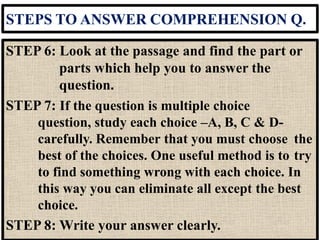
STEPS TO ANSWERCOMPREHENSION Q.
STEP 6: Look at the passage and find the part or
parts which help you to answer the
question.
STEP 7: If the question is multiple choice
question, study each choice –A, B, C & D-
carefully. Remember that you must choose the
best of the choices. One useful method is to try
to find something wrong with each choice. In
this way you can eliminate all except the best
choice.
STEP 8: Write your answer clearly.
HOW TO GUESSTHE MEANINGS OF WORDS
There are different ways of guessing the
meanings of unknown words from a passage.
These includes:
1. Using contextual and structural clues
2. Using your knowledge of word formation.
3. Using antonyms or synonyms and using a
words part of speech.
4. Using Punctuations
Let’s see them one by one
62.
HOW TO GUESSTHE MEANINGS OF WORDS
Method 1: Guessing the meaning from the
context
Guessing the meaning from the context
means guessing unfamiliar words from
surrounding word or from sense of the
sentence. There are often ideas or hints
which help us to guess the meaning of the
difficult word.
63.
HOW TO GUESSTHE MEANINGS OF WORDS
➢ The most common way to guess the meaning of
a word is to use the context. That is to say, you
can use the other words in the same sentence or
other sentences in the same paragraph to guess
the meaning of an unfamiliar word.
64.
HOW TO GUESSTHE MEANINGS OF WORDS
E.g. The government is encouraging people to set
up new shops, factories, and other
businesses. Some are owned by foreigners
but most of the proprietors are local people.
What is the meaning of the highlighted word?
Here, which words or phrases are clue for the
meaning of proprietors? Discuss and find the
equivalent meaning from the given sentence using
the context.
Answer: ‘Proprietor’ means ‘owner of business’.
65.
HOW TO GUESSTHE MEANINGS OF WORDS
Method 2: Using our knowledge of word
formation
Many words can be divided onto two or more parts
that is, prefixes, suffixes and roots. Understanding
these parts can lead us to recognize the meaning of
unknown words by means of word analysis.
E.g. The mistake he made is unpardonable.
Here the word ‘unpardonable’ has a prefix and a
suffix that is ‘pardon’ is the root, meaning ‘forgive’
or ‘excuse,’ the ‘un’ prefix means ‘not’ and the
‘able’ suffix means ‘can’
66.
HOW TO GUESSTHE MEANINGS OF WORDS
Therefore, ‘unpardonable’ means ‘that cannot be
forgiven or excused’
Method 3: Using synonyms context clue
➢ Synonyms are words phrases that are similar in
meaning to other words. You can recognize some
synonym context clues because they appear as
the same part of speech as the unknown word.
e.g. The roof is in the shape of cupola, or dome,
and is similar to the one in the top of the city
hall. Here ‘cupola’ means ‘dome’ and is
highlighted by the additional comma
67.
HOW TO GUESSTHE MEANINGS OF WORDS
Example:
1. Paper is biodegradable, so it does not pose as
much threat to the environment when it is
discarded.
➢ Suppose the word you want to guess its meaning
is biodegradable, we can break down this word
into bio-de-grad-able.
➢ The prefix ‘Bio-’ relates to life and nature.
‘Grad’ comes from the word grade and degrade
means to break down something complex into
simple pieces.
68.
HOW TO GUESSTHE MEANINGS OF WORDS
➢ The suffix ‘-able’ indicates that the word is an
adjective. Therefore, a good guess for this word
would be capable of being naturally broken
down into small parts.
69.
HOW TO GUESSTHE MEANINGS OF WORDS
But these are not always necessary.
Method 4: Using punctuation mark
➢ sometimes we may use punctuation marks to
guess the meaning of new words.
Example:
1. He told me to take lesson from the
‘Kaubure’ the village headman of the
Tabiang.
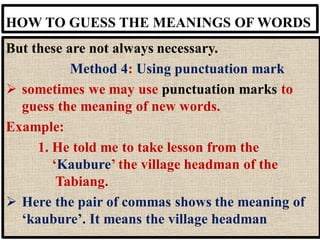
➢ Here the pair of commas shows the meaning of
‘kaubure’. It means the village headman
70.
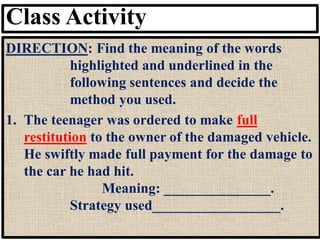
Class Activity
DIRECTION: Findthe meaning of the words
highlighted and underlined in the
following sentences and decide the
method you used.
1. The teenager was ordered to make full
restitution to the owner of the damaged vehicle.
He swiftly made full payment for the damage to
the car he had hit.
Meaning: _______________.
Strategy used__________________.
71.
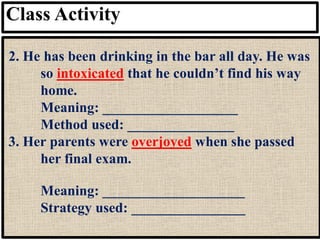
Class Activity
2. Hehas been drinking in the bar all day. He was
so intoxicated that he couldn’t find his way
home.
Meaning: ___________________
Method used: _______________
3. Her parents were overjoyed when she passed
her final exam.
Meaning: ____________________
Strategy used: ________________
72.
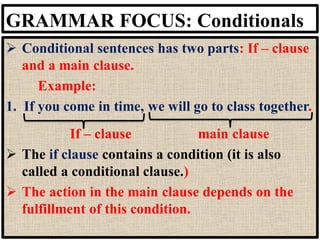
GRAMMAR FOCUS: Conditionals
➢Conditional sentences has two parts: If – clause
and a main clause.
Example:
1. If you come in time, we will go to class together.
If – clause main clause
➢ The if clause contains a condition (it is also
called a conditional clause.)
➢ The action in the main clause depends on the
fulfillment of this condition.
73.
Conti…
➢ When wesay the happening of action in the
main clause depends on the fulfillment of the
condition in the if-clause, we mean:
for example:
1. If you come in time, we will go to class together.
OR
If you don’t come in time, we won’t go to class
together.
➢ There are several structures in English that we
call conditionals or if conditionals.
74.
Conti…
➢ The word"condition" means "situation or
circumstance". If a particular condition is true,
then a particular result happens:
if y = 3 then 2y = 6
➢ There are three basic English conditionals plus
the so-called zero conditional.
75.
Structure of ConditionalSentences
type Usage if-clause main-clause
1 possible condition +
probable result
present
simple
will + base
verb
2 hypothetical condition +
possible result
past
simple
would + base
verb
3 expired past condition +
possible past result
past
perfect
would have +
past participle
0 real condition +
inevitable result
present
simple
present simple
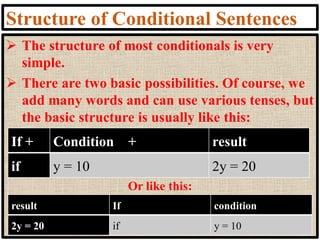
Structure of ConditionalSentences
➢ The structure of most conditionals is very
simple.
➢ There are two basic possibilities. Of course, we
add many words and can use various tenses, but
the basic structure is usually like this:
Or like this:
If + Condition + result
if y = 10 2y = 20
result If condition
2y = 20 if y = 10
78.
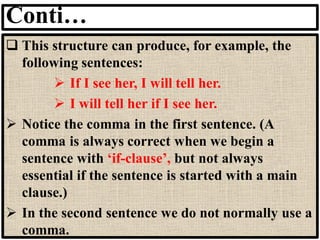
Conti…
❑ This structurecan produce, for example, the
following sentences:
➢ If I see her, I will tell her.
➢ I will tell her if I see her.
➢ Notice the comma in the first sentence. (A
comma is always correct when we begin a
sentence with ‘if-clause’, but not always
essential if the sentence is started with a main
clause.)
➢ In the second sentence we do not normally use a
comma.
79.
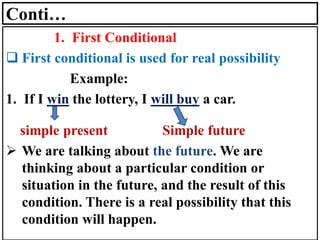
Conti…
1. First Conditional
❑First conditional is used for real possibility
Example:
1. If I win the lottery, I will buy a car.
simple present Simple future
➢ We are talking about the future. We are
thinking about a particular condition or
situation in the future, and the result of this
condition. There is a real possibility that this
condition will happen.
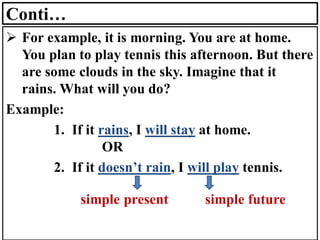
80.
Conti…
➢ For example,it is morning. You are at home.
You plan to play tennis this afternoon. But there
are some clouds in the sky. Imagine that it
rains. What will you do?
Example:
1. If it rains, I will stay at home.
OR
2. If it doesn’t rain, I will play tennis.
simple present simple future
81.
Conti…
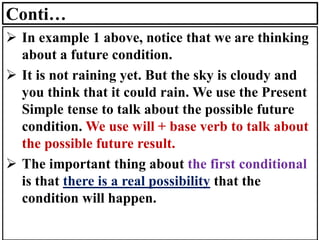
➢ In example1 above, notice that we are thinking
about a future condition.
➢ It is not raining yet. But the sky is cloudy and
you think that it could rain. We use the Present
Simple tense to talk about the possible future
condition. We use will + base verb to talk about
the possible future result.
➢ The important thing about the first conditional
is that there is a real possibility that the
condition will happen.
82.
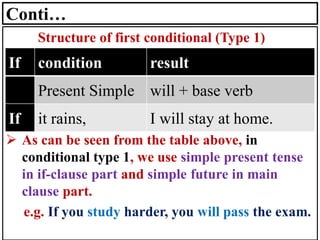
Conti…
Structure of firstconditional (Type 1)
➢ As can be seen from the table above, in
conditional type 1, we use simple present tense
in if-clause part and simple future in main
clause part.
e.g. If you study harder, you will pass the exam.
If condition result
Present Simple will + base verb
If it rains, I will stay at home.
83.
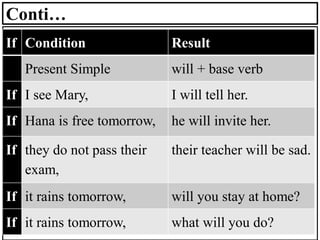
Conti…
If Condition Result
PresentSimple will + base verb
If I see Mary, I will tell her.
If Hana is free tomorrow, he will invite her.
If they do not pass their
exam,
their teacher will be sad.
If it rains tomorrow, will you stay at home?
If it rains tomorrow, what will you do?
84.
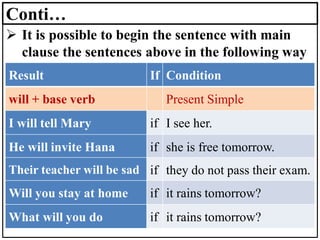
Conti…
➢ It ispossible to begin the sentence with main
clause the sentences above in the following way
Result If Condition
will + base verb Present Simple
I will tell Mary if I see her.
He will invite Hana if she is free tomorrow.
Their teacher will be sad if they do not pass their exam.
Will you stay at home if it rains tomorrow?
What will you do if it rains tomorrow?
85.
Conti…
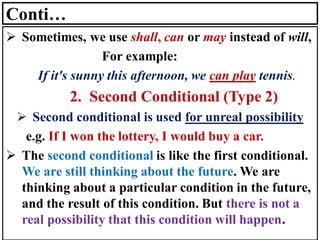
➢ Sometimes, weuse shall, can or may instead of will,
For example:
If it's sunny this afternoon, we can play tennis.
2. Second Conditional (Type 2)
➢ Second conditional is used for unreal possibility
e.g. If I won the lottery, I would buy a car.
➢ The second conditional is like the first conditional.
We are still thinking about the future. We are
thinking about a particular condition in the future,
and the result of this condition. But there is not a
real possibility that this condition will happen.
86.
Conti…
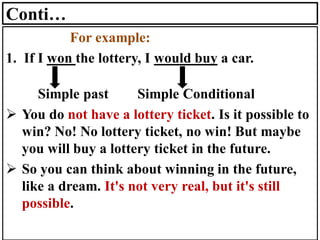
For example:
1. IfI won the lottery, I would buy a car.
Simple past Simple Conditional
➢ You do not have a lottery ticket. Is it possible to
win? No! No lottery ticket, no win! But maybe
you will buy a lottery ticket in the future.
➢ So you can think about winning in the future,
like a dream. It's not very real, but it's still
possible.
87.
Conti…
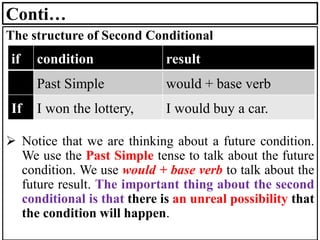
The structure ofSecond Conditional
➢ Notice that we are thinking about a future condition.
We use the Past Simple tense to talk about the future
condition. We use would + base verb to talk about the
future result. The important thing about the second
conditional is that there is an unreal possibility that
the condition will happen.
if condition result
Past Simple would + base verb
If I won the lottery, I would buy a car.
88.
Conti…
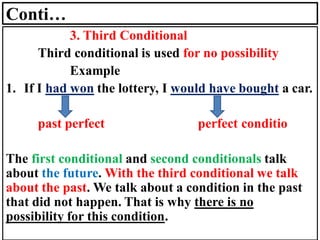
3. Third Conditional
Thirdconditional is used for no possibility
Example
1. If I had won the lottery, I would have bought a car.
past perfect perfect conditio
The first conditional and second conditionals talk
about the future. With the third conditional we talk
about the past. We talk about a condition in the past
that did not happen. That is why there is no
possibility for this condition.
89.
Conti…
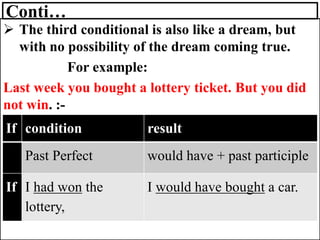
➢ The thirdconditional is also like a dream, but
with no possibility of the dream coming true.
For example:
Last week you bought a lottery ticket. But you did
not win. :-
If condition result
Past Perfect would have + past participle
If I had won the
lottery,
I would have bought a car.
90.
Conti…
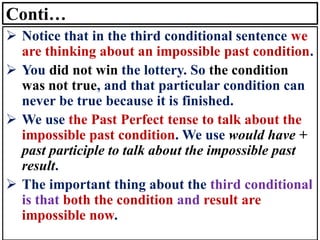
➢ Notice thatin the third conditional sentence we
are thinking about an impossible past condition.
➢ You did not win the lottery. So the condition
was not true, and that particular condition can
never be true because it is finished.
➢ We use the Past Perfect tense to talk about the
impossible past condition. We use would have +
past participle to talk about the impossible past
result.
➢ The important thing about the third conditional
is that both the condition and result are
impossible now.
91.
Conti…
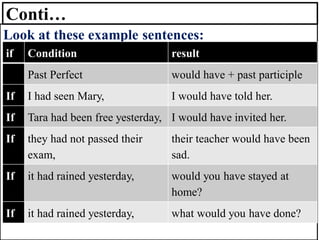
Look at theseexample sentences:
if Condition result
Past Perfect would have + past participle
If I had seen Mary, I would have told her.
If Tara had been free yesterday, I would have invited her.
If they had not passed their
exam,
their teacher would have been
sad.
If it had rained yesterday, would you have stayed at
home?
If it had rained yesterday, what would you have done?
92.
Conti…
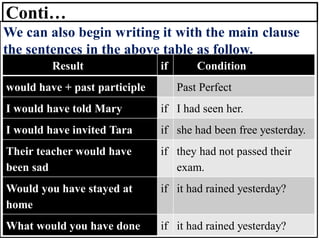
We can alsobegin writing it with the main clause
the sentences in the above table as follow.
Result if Condition
would have + past participle Past Perfect
I would have told Mary if I had seen her.
I would have invited Tara if she had been free yesterday.
Their teacher would have
been sad
if they had not passed their
exam.
Would you have stayed at
home
if it had rained yesterday?
What would you have done if it had rained yesterday?
93.
Conti…
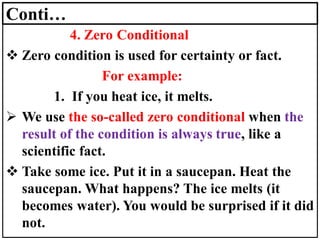
4. Zero Conditional
❖Zero condition is used for certainty or fact.
For example:
1. If you heat ice, it melts.
➢ We use the so-called zero conditional when the
result of the condition is always true, like a
scientific fact.
❖ Take some ice. Put it in a saucepan. Heat the
saucepan. What happens? The ice melts (it
becomes water). You would be surprised if it did
not.
94.
Conti…
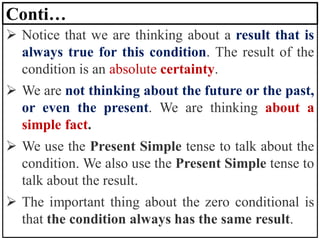
➢ Notice thatwe are thinking about a result that is
always true for this condition. The result of the
condition is an absolute certainty.
➢ We are not thinking about the future or the past,
or even the present. We are thinking about a
simple fact.
➢ We use the Present Simple tense to talk about the
condition. We also use the Present Simple tense to
talk about the result.
➢ The important thing about the zero conditional is
that the condition always has the same result.
95.
Conti…
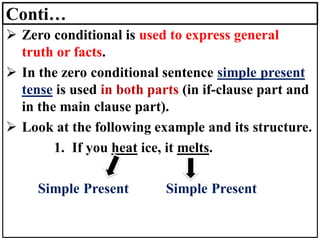
➢ Zero conditionalis used to express general
truth or facts.
➢ In the zero conditional sentence simple present
tense is used in both parts (in if-clause part and
in the main clause part).
➢ Look at the following example and its structure.
1. If you heat ice, it melts.
Simple Present Simple Present
96.
Conti…
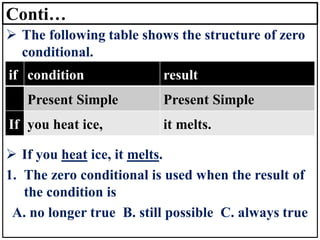
➢ The followingtable shows the structure of zero
conditional.
➢ If you heat ice, it melts.
1. The zero conditional is used when the result of
the condition is
A. no longer true B. still possible C. always true
if condition result
Present Simple Present Simple
If you heat ice, it melts.
97.
3.2. Grammar Focus:
ThePresent simple, Past simple, Present
Perfect and past perfect in contrast.
1. The Present Simple tense
➢ USES:
➢ The present Simple Tense is used to express
action which is habitually or usually done in the
present line.
➢ Examples:
1. The milkman brings milk.
2. The woman goes to church every Sunday.
3. They run around the stadium everyday.
98.
Conti…
➢ We canalso use the present simple to talk about
things in general, we are not thinking only
about now.
➢ We use it to say that some thing happens all the
time or repeatedly (for repeatedly done action).
➢ It is also used to express that something is true
in general (general truth or facts). It is not
important whether the action is happening at
the time of speaking.
➢ Examples:
1. Nurses look after patients in hospital.
2. The earth goes round the sun.
3. I usually go away at weekends.
99.
Conti…
More examples:
1. Thesun rises in the east. (fact or
general truth)
2. Heat dissolves ice.
3. She goes to school everyday. (Repeated action)
4. Dogs bark when they see a stranger. (truth)
5. The Ethiopians celebrate New Year on
September 11. (Customs & habits)
100.
Conti…
➢ We canalso use the present simple to show
ability.
➢ Examples:
1. She dances very well.
2. She sings beautifully.
We can also use it to express the future.
i. When used with time reference.
E.g. We leave tomorrow.
ii. After time conjunctions such as when, until,
after, before.
E.g. When he comes, we shall start.
I will wait until he comes.
We won’t go out before the bell rings.
101.
Conti…
iii. With probablecondition after “if”
E.g. If you come, I will go with you.
➢ We can also use the present simple instead of
the continues tense with non-continuous verbs
(state verbs)
➢ Examples:
1. I love you. I understand now.
2. I want you to help me.
3. Do you like banana?
102.
Conti…
➢ In thesimple present tense the most important
thing to remember is that the third person
singular takes ‘-s’ or ‘-es’.
➢ In the present simple tense verbs ending in:
‘ss’, ‘sh’, ‘ch’, ‘x’, and ‘o’ take ‘-es’
➢ Examples:
1. Kiss – He kisses his wife.
2. Rush – She rushes out of the class now.
3. Watch – She often watches the television.
4. Do – It does work.
103.
Conti…
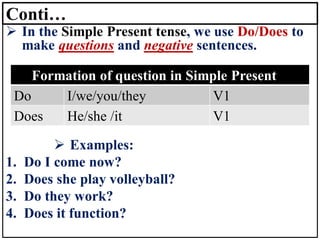
➢ In theSimple Present tense, we use Do/Does to
make questions and negative sentences.
➢ Examples:
1. Do I come now?
2. Does she play volleyball?
3. Do they work?
4. Does it function?
Formation of question in Simple Present
Do I/we/you/they V1
Does He/she /it V1
104.
Conti…
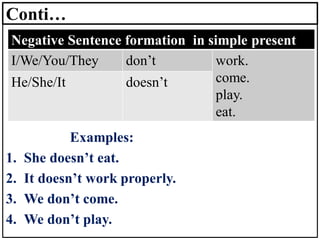
Examples:
1. She doesn’teat.
2. It doesn’t work properly.
3. We don’t come.
4. We don’t play.
Negative Sentence formation in simple present
I/We/You/They don’t work.
come.
play.
eat.
He/She/It doesn’t
105.
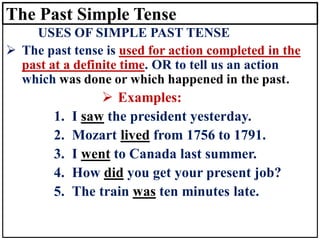
The Past SimpleTense
USES OF SIMPLE PAST TENSE
➢ The past tense is used for action completed in the
past at a definite time. OR to tell us an action
which was done or which happened in the past.
➢ Examples:
1. I saw the president yesterday.
2. Mozart lived from 1756 to 1791.
3. I went to Canada last summer.
4. How did you get your present job?
5. The train was ten minutes late.
106.
Conti…
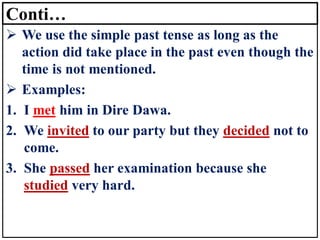
➢ We usethe simple past tense as long as the
action did take place in the past even though the
time is not mentioned.
➢ Examples:
1. I met him in Dire Dawa.
2. We invited to our party but they decided not to
come.
3. She passed her examination because she
studied very hard.
107.
Conti…
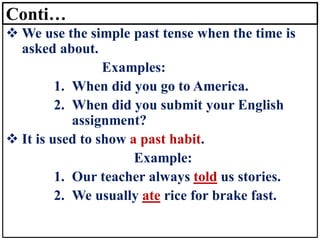
❖ We usethe simple past tense when the time is
asked about.
Examples:
1. When did you go to America.
2. When did you submit your English
assignment?
❖ It is used to show a past habit.
Example:
1. Our teacher always told us stories.
2. We usually ate rice for brake fast.
108.
Conti…
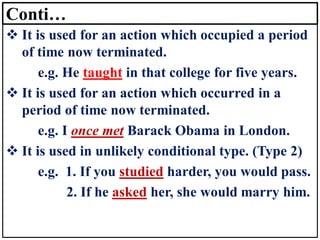
❖ It isused for an action which occupied a period
of time now terminated.
e.g. He taught in that college for five years.
❖ It is used for an action which occurred in a
period of time now terminated.
e.g. I once met Barack Obama in London.
❖ It is used in unlikely conditional type. (Type 2)
e.g. 1. If you studied harder, you would pass.
2. If he asked her, she would marry him.
109.
Conti…
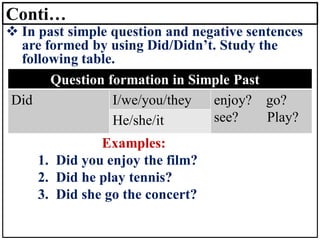
❖ In pastsimple question and negative sentences
are formed by using Did/Didn’t. Study the
following table.
Examples:
1. Did you enjoy the film?
2. Did he play tennis?
3. Did she go the concert?
Question formation in Simple Past
Did I/we/you/they enjoy? go?
see? Play?
He/she/it
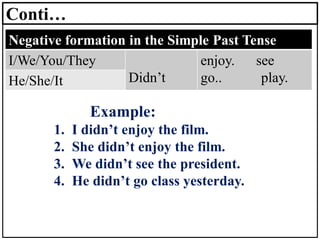
110.
Conti…
Example:
1. I didn’tenjoy the film.
2. She didn’t enjoy the film.
3. We didn’t see the president.
4. He didn’t go class yesterday.
Negative formation in the Simple Past Tense
I/We/You/They
Didn’t
enjoy. see
go.. play.
He/She/It
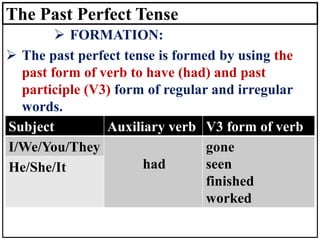
111.
The Past PerfectTense
➢ FORMATION:
➢ The past perfect tense is formed by using the
past form of verb to have (had) and past
participle (V3) form of regular and irregular
words.
Subject Auxiliary verb V3 form of verb
I/We/You/They
had
gone
seen
finished
worked
He/She/It
112.
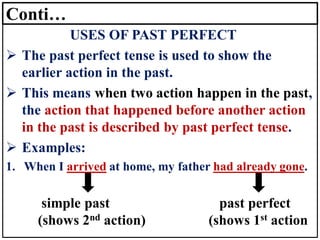
Conti…
USES OF PASTPERFECT
➢ The past perfect tense is used to show the
earlier action in the past.
➢ This means when two action happen in the past,
the action that happened before another action
in the past is described by past perfect tense.
➢ Examples:
1. When I arrived at home, my father had already gone.
simple past past perfect
(shows 2nd action) (shows 1st action
113.
Conti…
2. When wearrived, he had left.
simple past past perfect
(2nd action) (1st action)
OR
He had left when we arrived.
(1st action) (2nd action)
past perfect simple past
114.
Conti…
3. When wegot home last night, we found that
somebody had broken into the flat.
simple past past perfect
(shows 2nd action) (shows 1st action)
this means we got this means somebody
home after somebody broke into the flat
broke into the flat before we got home
115.
Conti…
❖ However, wecan use simple past for both 1st
action and 2nd action in the past when past
before past is clear from time adverbs like
‘after’ and ‘before’.
❖ These time adverbs show that one action
already completed before or after another
action.
Example
1. I went to bed after I ate dinner.
past simple past simple
(2nd action) (1st action)
116.
Passive Voice
➢ Mostof the sentences we use in English are
active sentences. We use active sentences when
we are interested in the doer of action (i.e. when
we talk about the doer of action).
e.g. The wind damaged the fence.
subject verb object
(doer of (action) (receiver of action)
action)
➢ In active sentence subject of the sentence is the
doer of an action, and the object of the sentence
is receiver of the action. In the active sentence
we are talking about (interested in) the doer of
the action (about the wind) not receiver.
117.
Conti…
➢ The passive
➢We use passive form of sentence when we are
interested in the receiver of action (object of the
sentence).
➢ Passive form of verbs are formed by using verb
to be (is, are, was, were, been, being) plus past
participle (V3) form of the verb.
118.
GRAMMER FOCUS
ACTIVE andPASSIVE VOICES
Pre-lesson questions
1. What is the passive voice?
2. When do we use passive voices?
3. What is the difference between active and
passive voice?
4. How can we easily change (transform) the
active sentences into passive voice?
5. What is the grammatical structure of the
passive?
119.
GRAMMER FOCUS
Active andPassive Voice
➢ Voice refers to the form of a verb that indicates
when a grammatical subject performs the action
or is the receiver of the action.
➢ When a sentence is written in the active voice, the
subject performs the action; in the passive voice,
the subject receives the action.
➢ In academic writing, it is generally preferred to
choose an active verb and pair it with a subject
that names the person or thing doing or
performing the action.
➢ Active verbs are stronger and usually more
emphatic than forms of the verb “be” or verbs in
the passive voice.
120.
GRAMMER FOCUS
➢ Mostof the form of the verbs we use in writing
English sentences are active.
➢ We use active voices when we are interested in
(when we talk about) the doer of action.
➢ In the active sentences, the subject of the
sentence is the doer of action.
➢ Therefore, when we use active voices our
interest is in who is the agent? (Who does the
action)?
121.
GRAMMER FOCUS
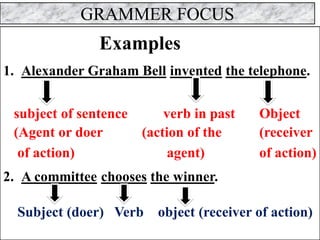
Examples
1. AlexanderGraham Bell invented the telephone.
subject of sentence verb in past Object
(Agent or doer (action of the (receiver
of action) agent) of action)
2. A committee chooses the winner.
Subject (doer) Verb object (receiver of action)
122.
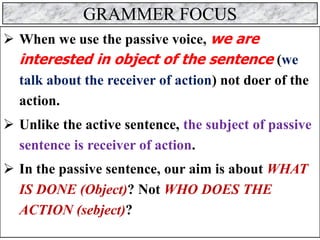
GRAMMER FOCUS
➢ Whenwe use the passive voice, we are
interested in object of the sentence (we
talk about the receiver of action) not doer of the
action.
➢ Unlike the active sentence, the subject of passive
sentence is receiver of action.
➢ In the passive sentence, our aim is about WHAT
IS DONE (Object)? Not WHO DOES THE
ACTION (sebject)?
123.
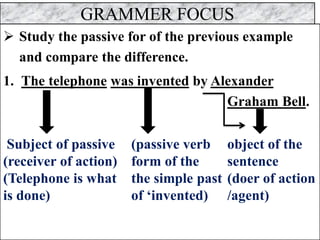
GRAMMER FOCUS
➢ Studythe passive for of the previous example
and compare the difference.
1. The telephone was invented by Alexander
Graham Bell.
Subject of passive (passive verb object of the
(receiver of action) form of the sentence
(Telephone is what the simple past (doer of action
is done) of ‘invented) /agent)
124.
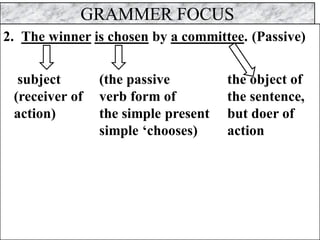
GRAMMER FOCUS
2. Thewinner is chosen by a committee. (Passive)
subject (the passive the object of
(receiver of verb form of the sentence,
action) the simple present but doer of
simple ‘chooses) action
125.
GRAMMER FOCUS
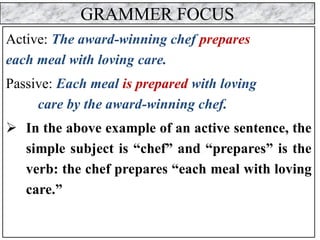
Active: Theaward-winning chef prepares
each meal with loving care.
Passive: Each meal is prepared with loving
care by the award-winning chef.
➢ In the above example of an active sentence, the
simple subject is “chef” and “prepares” is the
verb: the chef prepares “each meal with loving
care.”
Conti…
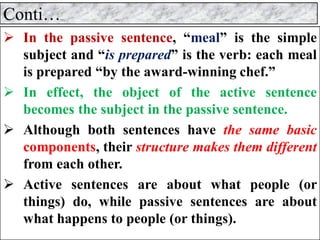
➢ In thepassive sentence, “meal” is the simple
subject and “is prepared” is the verb: each meal
is prepared “by the award-winning chef.”
➢ In effect, the object of the active sentence
becomes the subject in the passive sentence.
➢ Although both sentences have the same basic
components, their structure makes them different
from each other.
➢ Active sentences are about what people (or
things) do, while passive sentences are about
what happens to people (or things).
128.
GRAMMER FOCUS
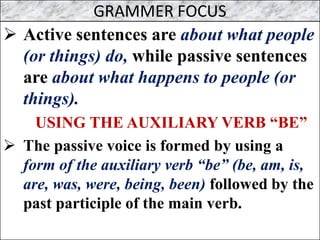
➢ Activesentences are about what people
(or things) do, while passive sentences
are about what happens to people (or
things).
USING THE AUXILIARY VERB “BE”
➢ The passive voice is formed by using a
form of the auxiliary verb “be” (be, am, is,
are, was, were, being, been) followed by the
past participle of the main verb.
129.
Conti…
➢ Study thefollowing examples
1. He loves me. (Active)
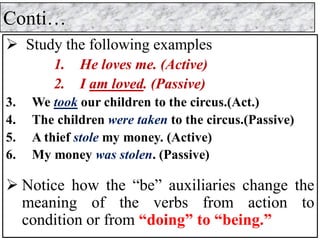
2. I am loved. (Passive)
3. We took our children to the circus.(Act.)
4. The children were taken to the circus.(Passive)
5. A thief stole my money. (Active)
6. My money was stolen. (Passive)
➢ Notice how the “be” auxiliaries change the
meaning of the verbs from action to
condition or from “doing” to “being.”
130.
Conti…
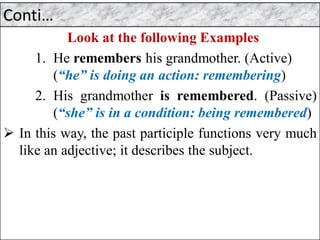
Look at thefollowing Examples
1. He remembers his grandmother. (Active)
(“he” is doing an action: remembering)
2. His grandmother is remembered. (Passive)
(“she” is in a condition: being remembered)
➢ In this way, the past participle functions very much
like an adjective; it describes the subject.
131.
Conti…
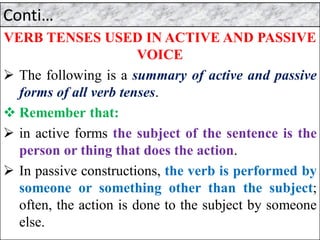
VERB TENSES USEDIN ACTIVE AND PASSIVE
VOICE
➢ The following is a summary of active and passive
forms of all verb tenses.
❖ Remember that:
➢ in active forms the subject of the sentence is the
person or thing that does the action.
➢ In passive constructions, the verb is performed by
someone or something other than the subject;
often, the action is done to the subject by someone
else.
132.
Conti…
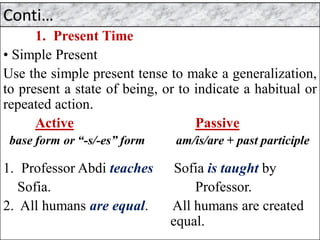
1. Present Time
•Simple Present
Use the simple present tense to make a generalization,
to present a state of being, or to indicate a habitual or
repeated action.
Active Passive
base form or “-s/-es” form am/is/are + past participle
1. Professor Abdi teaches Sofia is taught by
Sofia. Professor.
2. All humans are equal. All humans are created
equal.
133.
Conti…
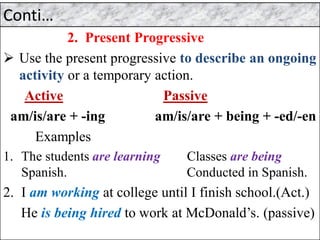
2. Present Progressive
➢Use the present progressive to describe an ongoing
activity or a temporary action.
Active Passive
am/is/are + -ing am/is/are + being + -ed/-en
Examples
1. The students are learning Classes are being
Spanish. Conducted in Spanish.
2. I am working at college until I finish school.(Act.)
He is being hired to work at McDonald’s. (passive)
134.
Conti…
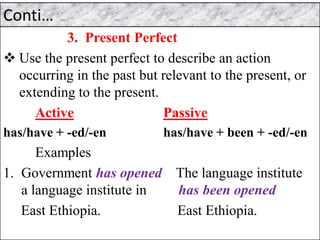
3. Present Perfect
❖Use the present perfect to describe an action
occurring in the past but relevant to the present, or
extending to the present.
Active Passive
has/have + -ed/-en has/have + been + -ed/-en
Examples
1. Government has opened The language institute
a language institute in has been opened
East Ethiopia. East Ethiopia.
135.
Conti…
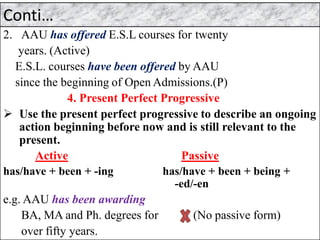
2. AAU hasoffered E.S.L courses for twenty
years. (Active)
E.S.L. courses have been offered by AAU
since the beginning of Open Admissions.(P)
4. Present Perfect Progressive
➢ Use the present perfect progressive to describe an ongoing
action beginning before now and is still relevant to the
present.
Active Passive
has/have + been + -ing has/have + been + being +
-ed/-en
e.g. AAU has been awarding
BA, MA and Ph. degrees for (No passive form)
over fifty years.
136.
Conti…
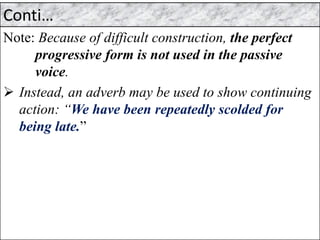
Note: Because ofdifficult construction, the perfect
progressive form is not used in the passive
voice.
➢ Instead, an adverb may be used to show continuing
action: “We have been repeatedly scolded for
being late.”
137.
Conti…
Past Time
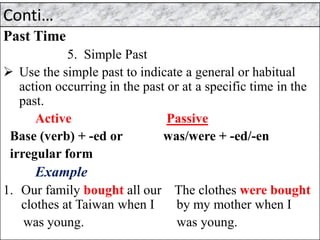
5. SimplePast
➢ Use the simple past to indicate a general or habitual
action occurring in the past or at a specific time in the
past.
Active Passive
Base (verb) + -ed or was/were + -ed/-en
irregular form
Example
1. Our family bought all our The clothes were bought
clothes at Taiwan when I by my mother when I
was young. was young.
138.
Conti…
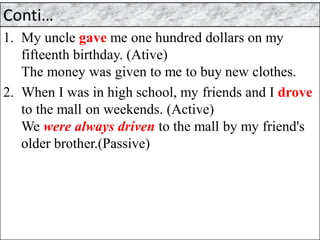
1. My unclegave me one hundred dollars on my
fifteenth birthday. (Ative)
The money was given to me to buy new clothes.
2. When I was in high school, my friends and I drove
to the mall on weekends. (Active)
We were always driven to the mall by my friend's
older brother.(Passive)
139.
Conti…
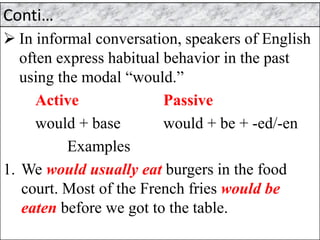
➢ In informalconversation, speakers of English
often express habitual behavior in the past
using the modal “would.”
Active Passive
would + base would + be + -ed/-en
Examples
1. We would usually eat burgers in the food
court. Most of the French fries would be
eaten before we got to the table.
140.
Conti…
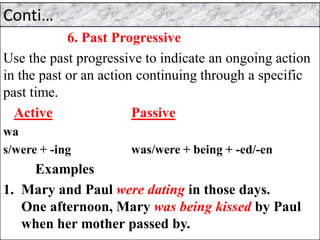
6. Past Progressive
Usethe past progressive to indicate an ongoing action
in the past or an action continuing through a specific
past time.
Active Passive
wa
s/were + -ing was/were + being + -ed/-en
Examples
1. Mary and Paul were dating in those days.
One afternoon, Mary was being kissed by Paul
when her mother passed by.
Vocabulary
Denotative and connotativemeanings
Pre-lesson questions
➢ What is the dictionary definition of the word?
➢ Can words have meanings other than their
dictionary meanings?
➢ Connotation and Denotation are two principal
methods of describing the meanings of words.
➢ Connotation refers to the wide range of positive
and negative associations that most words
naturally carry with them.
143.
Vocabulary
Denotative and connotativemeanings
Pre-lesson questions
➢ When you look up a word in the dictionary, you
will find its literal meaning.
➢ The literal or dictionary meaning of the words
is called denotative meaning.
➢ Denotative meaning is the basic definition of the
word. However, many
144.
Conti…
❖ The termdenotation is originally derived from
Latin word, ‘denotare’ which means ‘to mark’.
❖ This latin word means the act of marking
something through a sign.
❖ Denotation is the strict dictionary meaning of a
word.
❖ Denotation is the act of using a word or symbol
to indicate an explicit (obvious) meaning or set
of meanings.
❖ Connotation is the emotional and imaginative
association surrounding a word.
145.
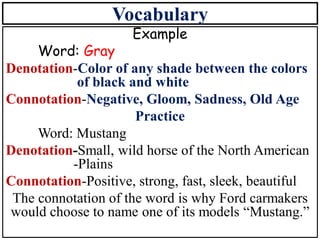
Vocabulary
Example
Word: Gray
Denotation-Color ofany shade between the colors
of black and white
Connotation-Negative, Gloom, Sadness, Old Age
Practice
Word: Mustang
Denotation-Small, wild horse of the North American
-Plains
Connotation-Positive, strong, fast, sleek, beautiful
The connotation of the word is why Ford carmakers
would choose to name one of its models “Mustang.”
146.
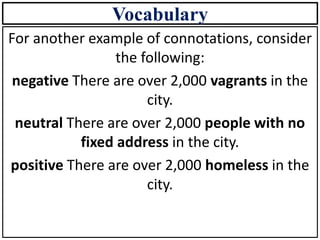
Vocabulary
For another exampleof connotations, consider
the following:
negative There are over 2,000 vagrants in the
city.
neutral There are over 2,000 people with no
fixed address in the city.
positive There are over 2,000 homeless in the
city.
147.
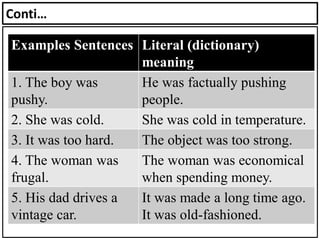
Conti…
Examples Sentences Literal(dictionary)
meaning
1. The boy was
pushy.
He was factually pushing
people.
2. She was cold. She was cold in temperature.
3. It was too hard. The object was too strong.
4. The woman was
frugal.
The woman was economical
when spending money.
5. His dad drives a
vintage car.
It was made a long time ago.
It was old-fashioned.
148.
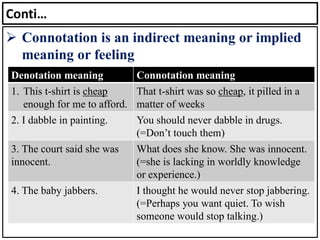
Conti…
➢ Connotation isan indirect meaning or implied
meaning or feeling
Denotation meaning Connotation meaning
1. This t-shirt is cheap
enough for me to afford.
That t-shirt was so cheap, it pilled in a
matter of weeks
2. I dabble in painting. You should never dabble in drugs.
(=Don’t touch them)
3. The court said she was
innocent.
What does she know. She was innocent.
(=she is lacking in worldly knowledge
or experience.)
4. The baby jabbers. I thought he would never stop jabbering.
(=Perhaps you want quiet. To wish
someone would stop talking.)
149.
Conti…
Examples
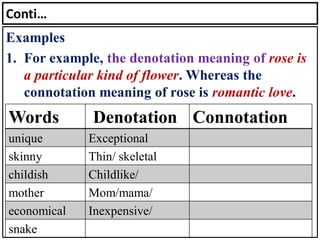
1. For example,the denotation meaning of rose is
a particular kind of flower. Whereas the
connotation meaning of rose is romantic love.
Words Denotation Connotation
unique Exceptional
skinny Thin/ skeletal
childish Childlike/
mother Mom/mama/
economical Inexpensive/
snake
150.
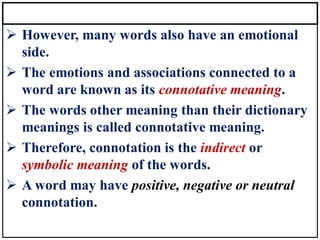
➢ However, manywords also have an emotional
side.
➢ The emotions and associations connected to a
word are known as its connotative meaning.
➢ The words other meaning than their dictionary
meanings is called connotative meaning.
➢ Therefore, connotation is the indirect or
symbolic meaning of the words.
➢ A word may have positive, negative or neutral
connotation.
151.
Conti…
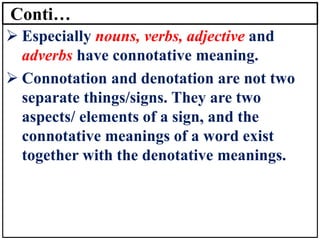
➢ Especially nouns,verbs, adjective and
adverbs have connotative meaning.
➢ Connotation and denotation are not two
separate things/signs. They are two
aspects/ elements of a sign, and the
connotative meanings of a word exist
together with the denotative meanings.
152.
Conti…
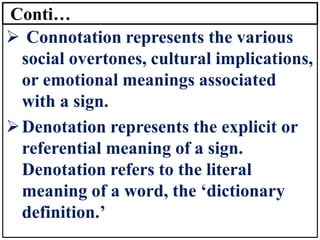
➢ Connotation representsthe various
social overtones, cultural implications,
or emotional meanings associated
with a sign.
➢Denotation represents the explicit or
referential meaning of a sign.
Denotation refers to the literal
meaning of a word, the ‘dictionary
definition.’
153.
Conti…
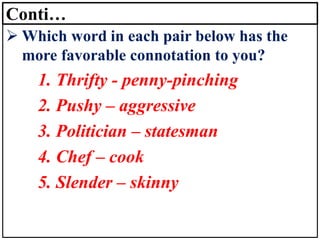
➢ Which wordin each pair below has the
more favorable connotation to you?
1. Thrifty - penny-pinching
2. Pushy – aggressive
3. Politician – statesman
4. Chef – cook
5. Slender – skinny