PROJECT WRITING WORKSHOP
Dr Dorcas Krubu
Department of Library and Information Science
Ambrose Alli University
Ekpoma, Edo State
Nigeria
dorcas.krubu@aauekpoma.edu.ng
 Use simple everyday language
 Be formal/professional
 Do not write in abbreviations
 Avoid questions on multiple dimensions
 Avoid leading questions
 Write a brief on the purpose of the research
 Promise and ensure anonymity, careful and
confident treatment of data
 Organise questions into sections or common
topics
 Demographic information (gender, age,
education, etc)should come at the end
(Techlaw, 2012)
Close ended questions: respondents are given options from
which they are bound to choose.
Examples of close ended questions are:
Dichotomous question- question with two options/answers
Polychotomous question- question with more than one
option/answer
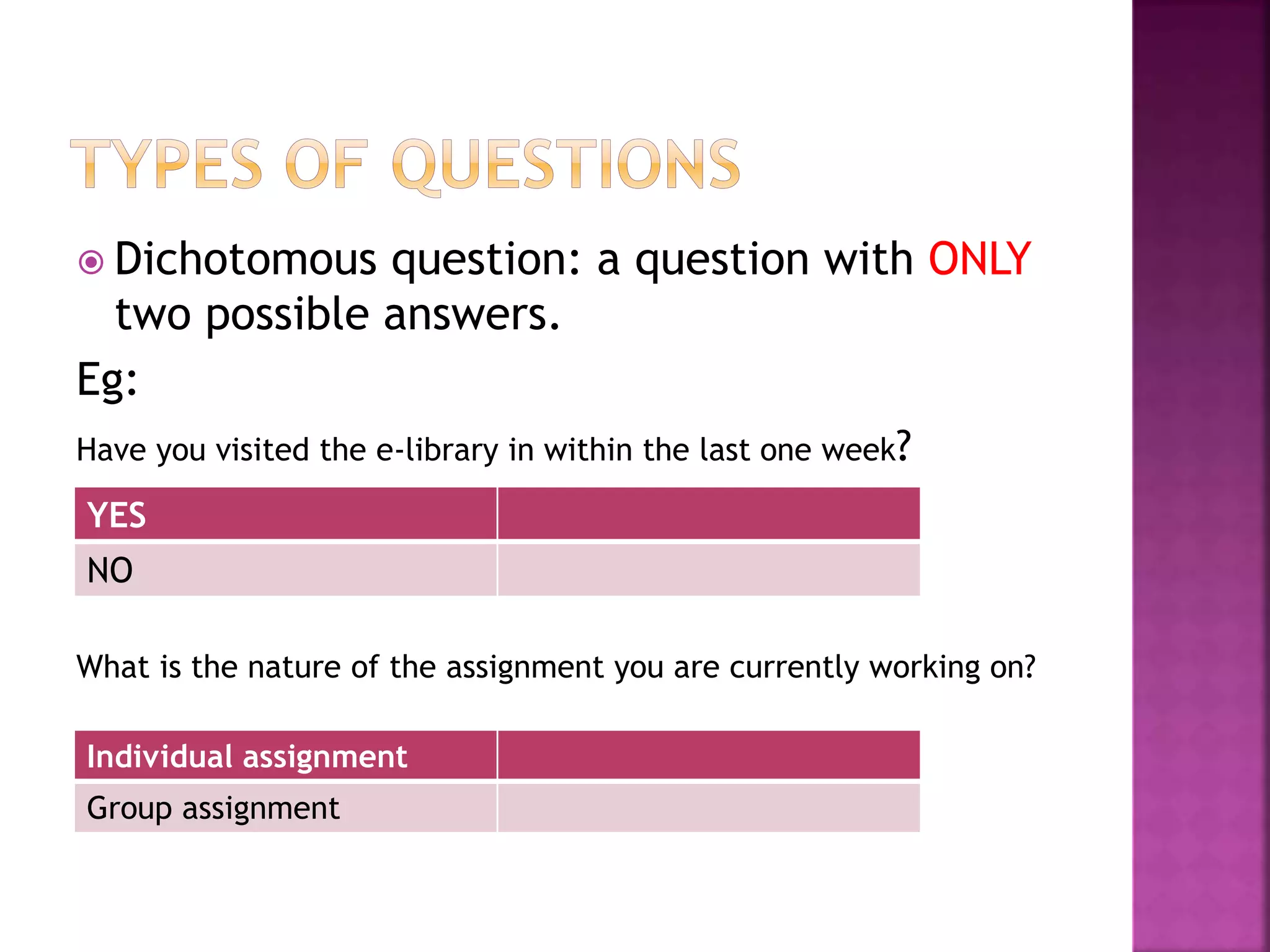
 Dichotomous question: a question with ONLY
two possible answers.
Eg:
Have you visited the e-library in within the last one week?
What is the nature of the assignment you are currently working on?
YES
NO
Individual assignment
Group assignment
 Polychotomous question: a question with multiple options in
which a respondent can choose one or a number of options
applicable.
•What is your current level of study?
100 level
200 level
300 level
400 level
500 level
Item Tick as
applicable
Desktop computer
Laptop
iPad or other tablet device
Smart phone
Do you own any of the following personal electronic devices on which you can access the Internet
to aid your academic information seeking?
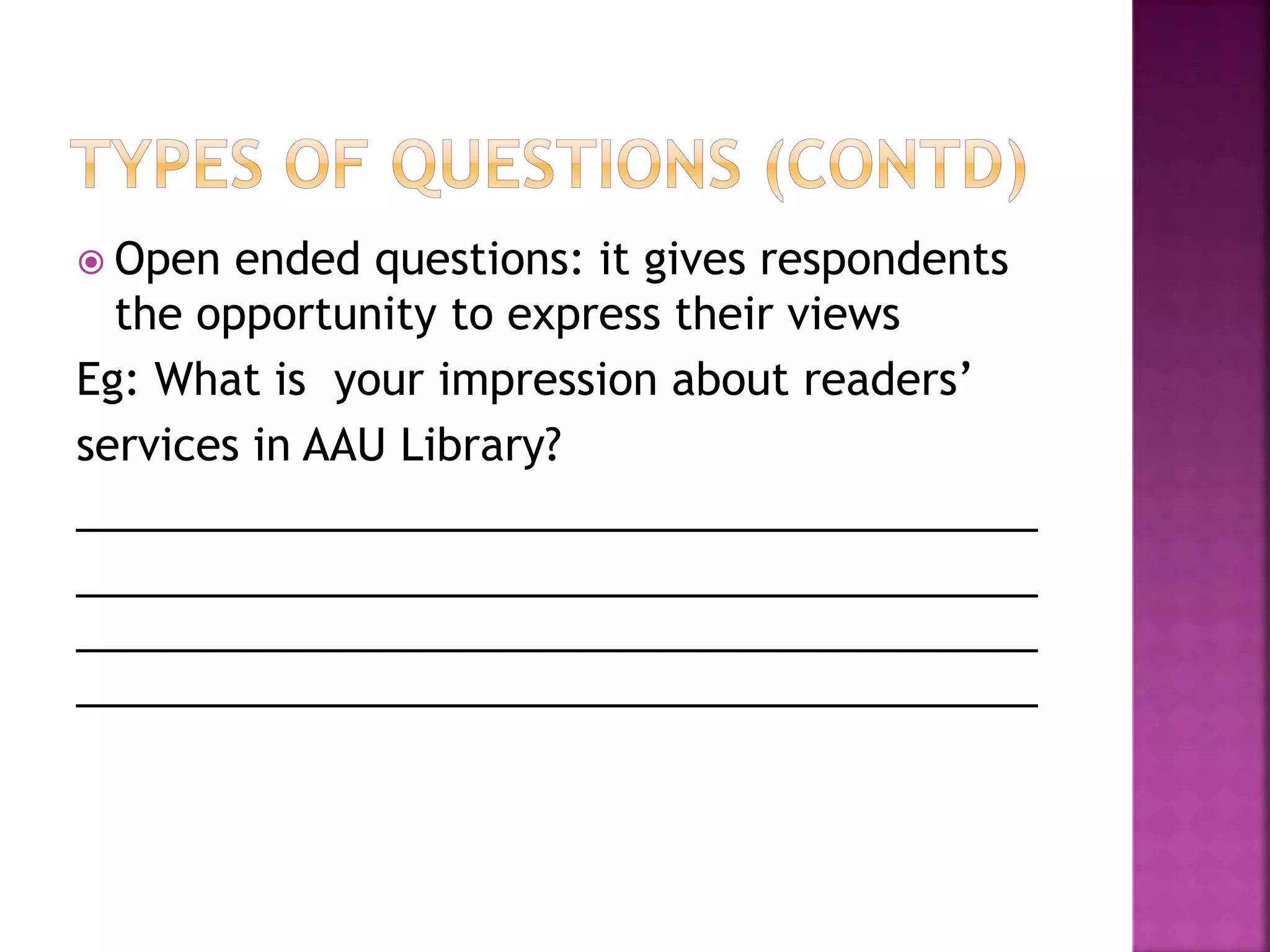
 Open ended questions: it gives respondents
the opportunity to express their views
Eg: What is your impression about readers’
services in AAU Library?
________________________________________
________________________________________
________________________________________
________________________________________
 Likert scale is a bipolar scaling method, measuring either positive or
negative response to a statement.
•How do you feel at this point in your assignment?
Item Scale
Disagree Agree Neutral Agree Strongly
Agree
I am not clear about the assignment topic and
the type of information I need
I do not understand the scope of the topic and
what is expected of me
In searching for information I am overloaded,
hence I feel frustrated
The information I have is broad, I feel
overwhelmed and unable to deepen my focus
I am unable to engage with and analyse the
information and their sources
I am unable to synthesize information from
various sources in order to work with focus in
mind
I am not satisfied after the completion of my
assignment
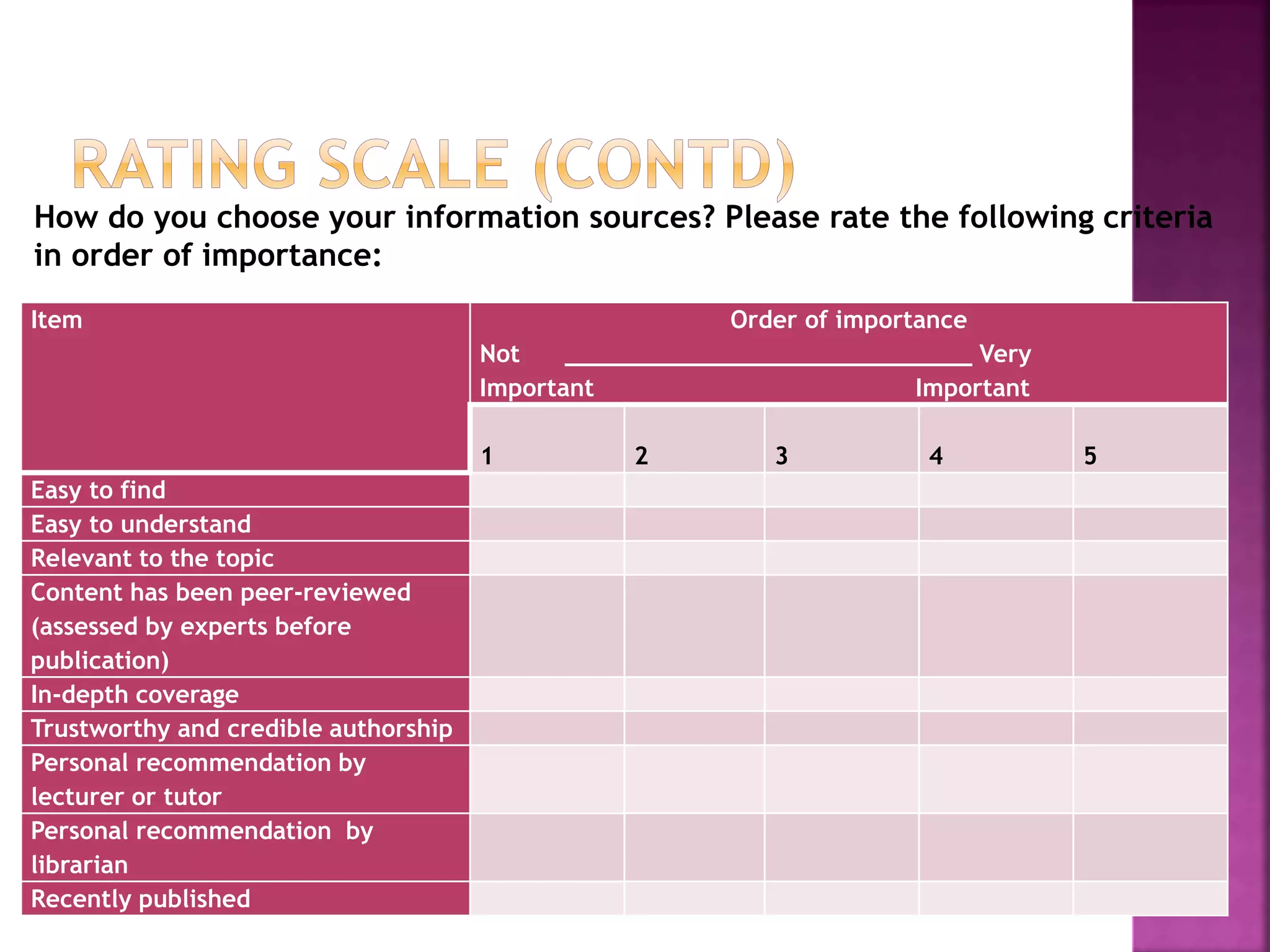
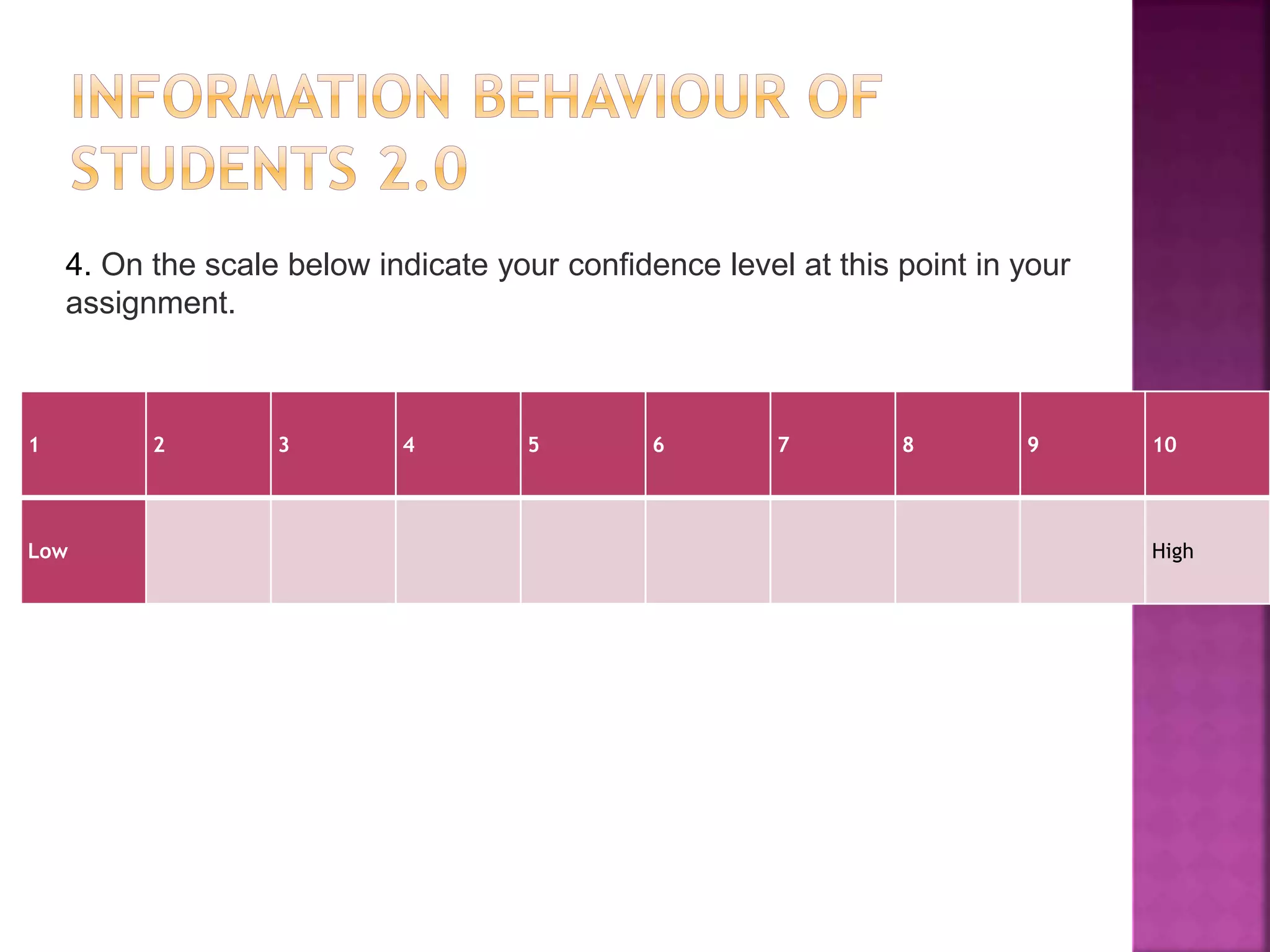
 Rating scale: respondents are presented with a statement and then asked
to rate their feeling/assessment
1 2 3 4 5 6 7 8 9 10
Low High
•On the scale below indicate your confidence level at this point in your assignment.
Item Order of importance
Not ____________________________ Very
Important Important
1 2 3 4 5
Easy to find
Easy to understand
Relevant to the topic
Content has been peer-reviewed
(assessed by experts before
publication)
In-depth coverage
Trustworthy and credible authorship
Personal recommendation by
lecturer or tutor
Personal recommendation by
librarian
Recently published
How do you choose your information sources? Please rate the following criteria
in order of importance:
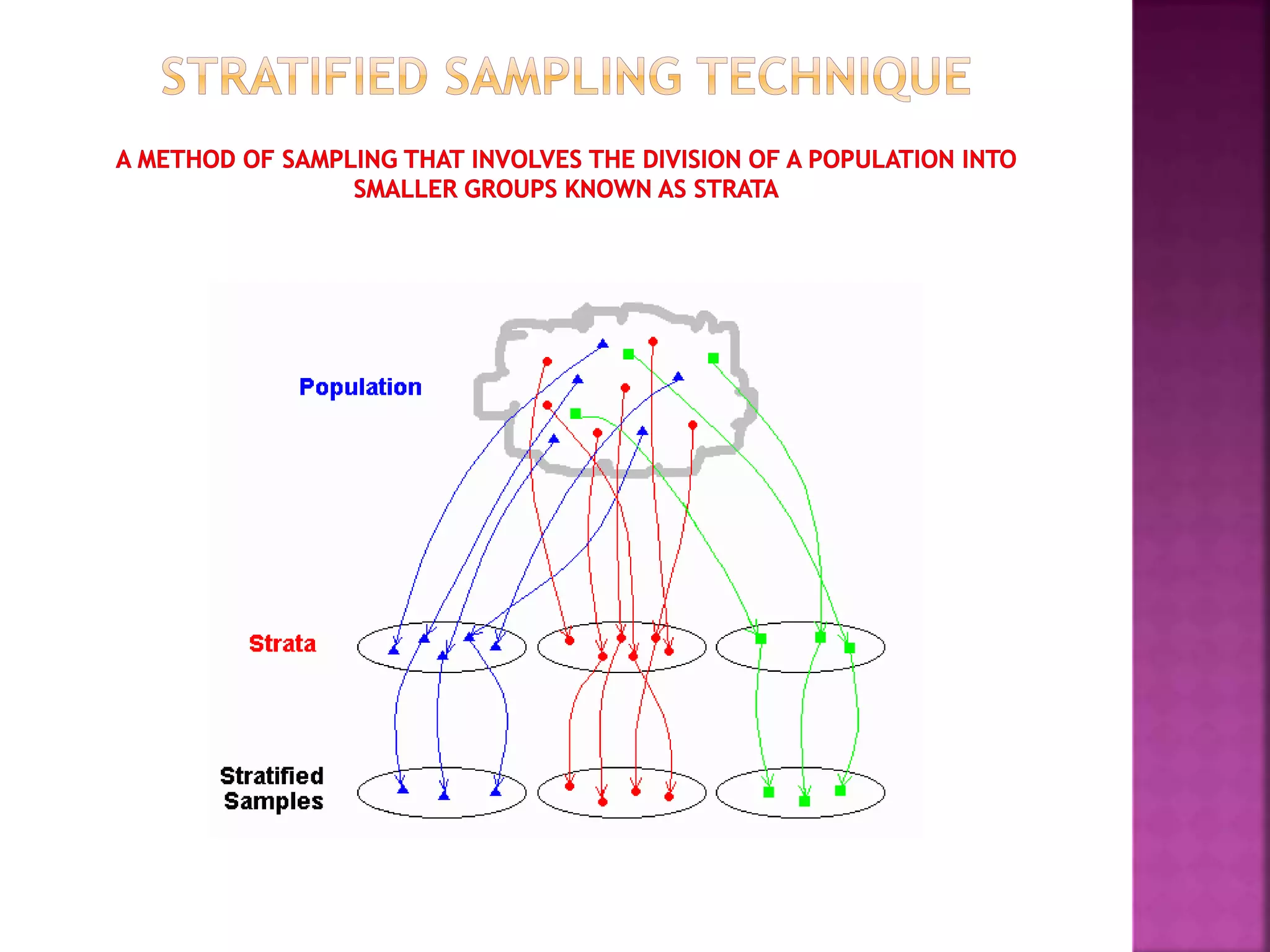
Population:Population is a well-defined collection of individuals or
objects known to have similar characteristics
Sample: A sample is a subset of individuals or objects from a
larger population that you collect and analyse to make inferences.
Individuals in a population have equal
likelihood of being chosen
 Cluster sampling is a sampling technique used when "natural"
but relatively heterogeneous groupings are evident in a statistical
population.
Subjects are selected based on their convenient accessibility and
proximity to the Researcher
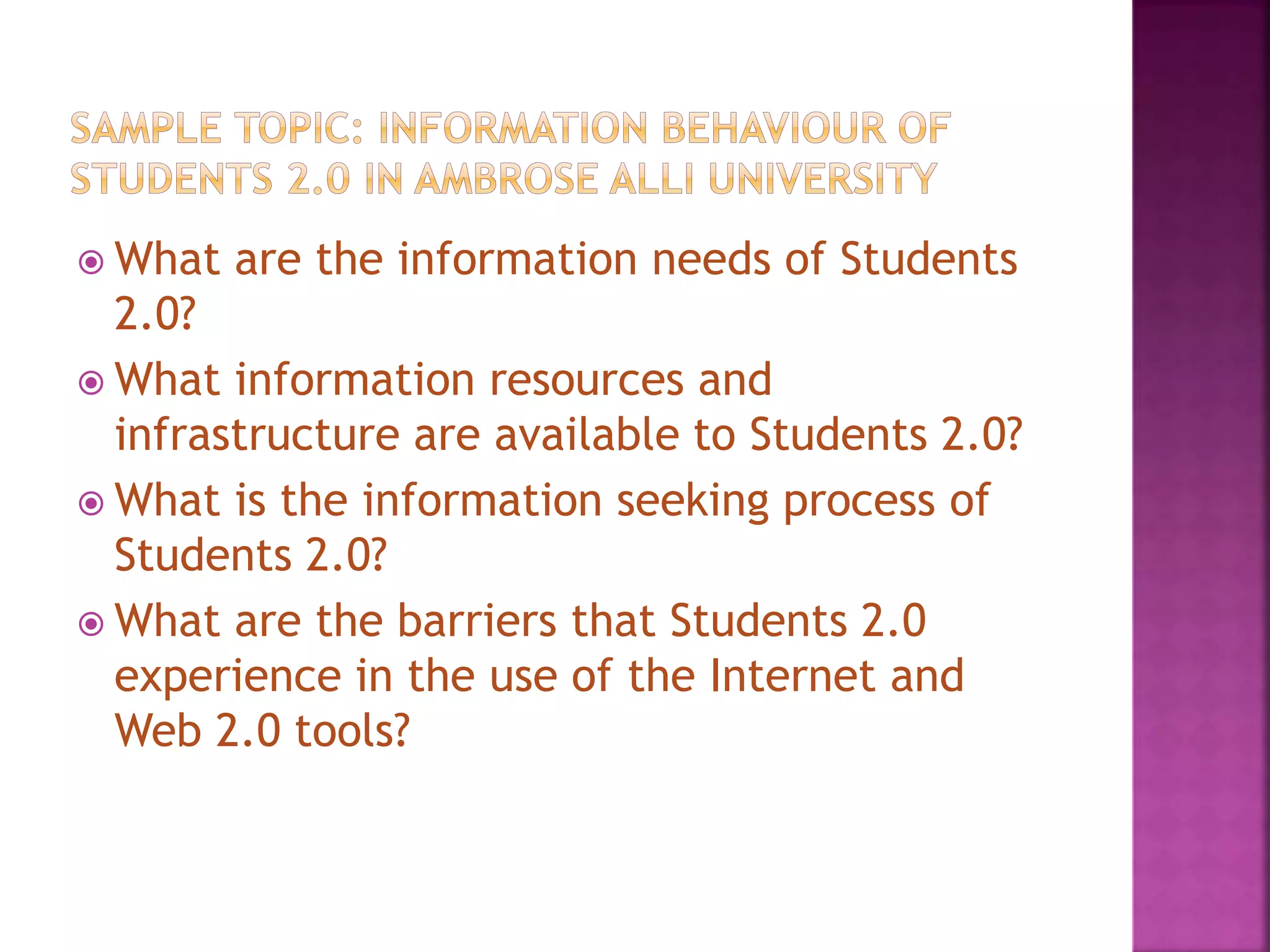
 What are the information needs of Students
2.0?
 What information resources and
infrastructure are available to Students 2.0?
 What is the information seeking process of
Students 2.0?
 What are the barriers that Students 2.0
experience in the use of the Internet and
Web 2.0 tools?
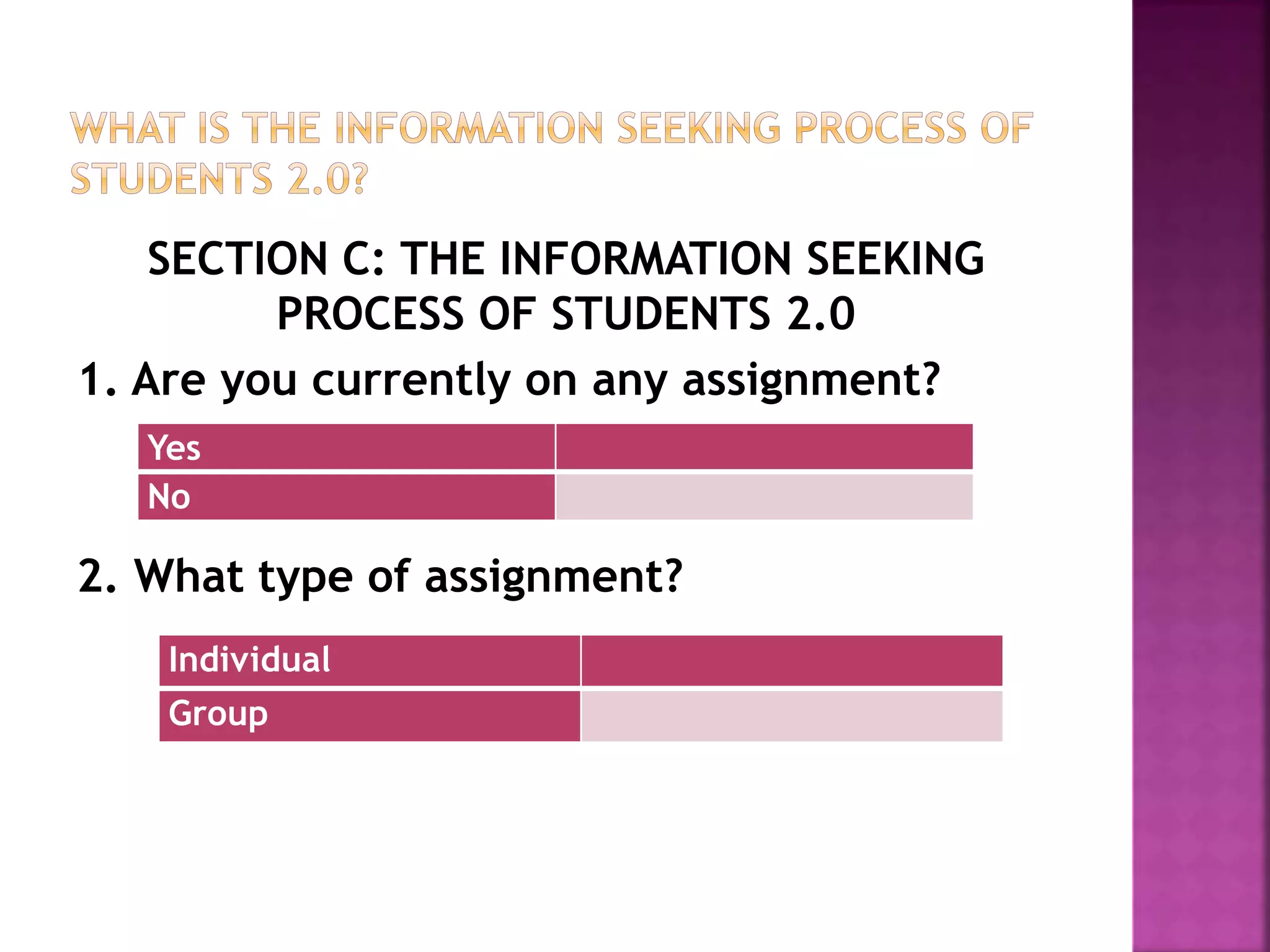
SECTION C: THE INFORMATION SEEKING
PROCESS OF STUDENTS 2.0
1. Are you currently on any assignment?
2. What type of assignment?
Yes
No
Individual
Group
Item Tick as
applicable
Reading list provided by lecturer or in assignment hand-
out
Library catalogue (OPAC)
Online bibliographic & full text databases to find journal
articles
Google or another search engine
Google Scholar
Wikipedia
Other? Please specify
3. In looking for the sources you need(ed) for your assignment what search
tools/sources have you used?
Item Tick as many as
applicable
Course notes (print or electronic)
Readings given in course (shortlists etc)
Print textbooks
e-Textbooks
Personal interaction with lecturer or tutor (face to face or by email/sms)
Personal interaction with librarian (face to face or by email/sms)
Technical reports
Theses and dissertations
Newspaper articles
Journal articles
Government web sites
Web pages
Wikipedia articles
Online discussion groups (Iistservs, chat rooms)
Blogs
Facebook postings
Other social media (e.g. Twitter, Del.icio.us, SlideShare)
4. Which of the following information resources have you used so far in the assignment?
3. Choose the word that best describes how
you feel about your assignment?
Confused
Frustrated
Confident
Satisfied
1 2 3 4 5 6 7 8 9 10
Low High
4. On the scale below indicate your confidence level at this point in your
assignment.
HOW TO CONSTRUCT A QUESTIONNAIRE

HOW TO CONSTRUCT A QUESTIONNAIRE

  • 1.
    PROJECT WRITING WORKSHOP DrDorcas Krubu Department of Library and Information Science Ambrose Alli University Ekpoma, Edo State Nigeria dorcas.krubu@aauekpoma.edu.ng
  • 2.
     Use simpleeveryday language  Be formal/professional  Do not write in abbreviations  Avoid questions on multiple dimensions  Avoid leading questions
  • 3.
     Write abrief on the purpose of the research  Promise and ensure anonymity, careful and confident treatment of data  Organise questions into sections or common topics  Demographic information (gender, age, education, etc)should come at the end (Techlaw, 2012)
  • 4.
    Close ended questions:respondents are given options from which they are bound to choose. Examples of close ended questions are: Dichotomous question- question with two options/answers Polychotomous question- question with more than one option/answer
  • 5.
     Dichotomous question:a question with ONLY two possible answers. Eg: Have you visited the e-library in within the last one week? What is the nature of the assignment you are currently working on? YES NO Individual assignment Group assignment
  • 6.
     Polychotomous question:a question with multiple options in which a respondent can choose one or a number of options applicable. •What is your current level of study? 100 level 200 level 300 level 400 level 500 level Item Tick as applicable Desktop computer Laptop iPad or other tablet device Smart phone Do you own any of the following personal electronic devices on which you can access the Internet to aid your academic information seeking?
  • 7.
     Open endedquestions: it gives respondents the opportunity to express their views Eg: What is your impression about readers’ services in AAU Library? ________________________________________ ________________________________________ ________________________________________ ________________________________________
  • 8.
     Likert scaleis a bipolar scaling method, measuring either positive or negative response to a statement. •How do you feel at this point in your assignment? Item Scale Disagree Agree Neutral Agree Strongly Agree I am not clear about the assignment topic and the type of information I need I do not understand the scope of the topic and what is expected of me In searching for information I am overloaded, hence I feel frustrated The information I have is broad, I feel overwhelmed and unable to deepen my focus I am unable to engage with and analyse the information and their sources I am unable to synthesize information from various sources in order to work with focus in mind I am not satisfied after the completion of my assignment
  • 9.
     Rating scale:respondents are presented with a statement and then asked to rate their feeling/assessment 1 2 3 4 5 6 7 8 9 10 Low High •On the scale below indicate your confidence level at this point in your assignment.
  • 10.
    Item Order ofimportance Not ____________________________ Very Important Important 1 2 3 4 5 Easy to find Easy to understand Relevant to the topic Content has been peer-reviewed (assessed by experts before publication) In-depth coverage Trustworthy and credible authorship Personal recommendation by lecturer or tutor Personal recommendation by librarian Recently published How do you choose your information sources? Please rate the following criteria in order of importance:
  • 11.
    Population:Population is awell-defined collection of individuals or objects known to have similar characteristics Sample: A sample is a subset of individuals or objects from a larger population that you collect and analyse to make inferences.
  • 12.
    Individuals in apopulation have equal likelihood of being chosen
  • 14.
     Cluster samplingis a sampling technique used when "natural" but relatively heterogeneous groupings are evident in a statistical population.
  • 15.
    Subjects are selectedbased on their convenient accessibility and proximity to the Researcher
  • 16.
     What arethe information needs of Students 2.0?  What information resources and infrastructure are available to Students 2.0?  What is the information seeking process of Students 2.0?  What are the barriers that Students 2.0 experience in the use of the Internet and Web 2.0 tools?
  • 17.
    SECTION C: THEINFORMATION SEEKING PROCESS OF STUDENTS 2.0 1. Are you currently on any assignment? 2. What type of assignment? Yes No Individual Group
  • 18.
    Item Tick as applicable Readinglist provided by lecturer or in assignment hand- out Library catalogue (OPAC) Online bibliographic & full text databases to find journal articles Google or another search engine Google Scholar Wikipedia Other? Please specify 3. In looking for the sources you need(ed) for your assignment what search tools/sources have you used?
  • 19.
    Item Tick asmany as applicable Course notes (print or electronic) Readings given in course (shortlists etc) Print textbooks e-Textbooks Personal interaction with lecturer or tutor (face to face or by email/sms) Personal interaction with librarian (face to face or by email/sms) Technical reports Theses and dissertations Newspaper articles Journal articles Government web sites Web pages Wikipedia articles Online discussion groups (Iistservs, chat rooms) Blogs Facebook postings Other social media (e.g. Twitter, Del.icio.us, SlideShare) 4. Which of the following information resources have you used so far in the assignment?
  • 20.
    3. Choose theword that best describes how you feel about your assignment? Confused Frustrated Confident Satisfied
  • 21.
    1 2 34 5 6 7 8 9 10 Low High 4. On the scale below indicate your confidence level at this point in your assignment.