Lin Lin, Sr. UX Researcher
EBSCO Information Services
UK EDS Conference
July 6 , 2016
llin@ebsco.com
The Student Search Experience
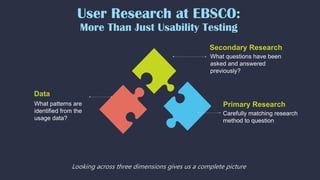
User Research at EBSCO:
More Than Just Usability Testing
Data
Secondary Research
What questions have been
asked and answered
previously?
Primary Research
Carefully matching research
method to question
Looking across three dimensions gives us a complete picture
What patterns are
identified from the
usage data?
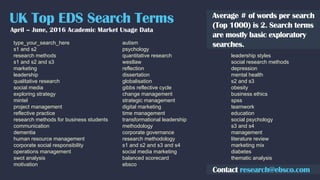
type_your_search_here
s1 and s2
research methods
s1 and s2 and s3
marketing
leadership
qualitative research
social media
exploring strategy
mintel
project management
reflective practice
research methods for business students
communication
dementia
human resource management
corporate social responsibility
operations management
swot analysis
motivation
autism
psychology
quantitative research
westlaw
reflection
dissertation
globalisation
gibbs reflective cycle
change management
strategic management
digital marketing
time management
transformational leadership
methodology
corporate governance
research methodology
s1 and s2 and s3 and s4
social media marketing
balanced scorecard
ebsco
leadership styles
social research methods
depression
mental health
s2 and s3
obesity
business ethics
spss
teamwork
education
social psychology
s3 and s4
management
literature review
marketing mix
diabetes
thematic analysis
UK Top EDS Search Terms
April – June, 2016 Academic Market Usage Data
Contact research@ebsco.com
Average # of words per search
(Top 1000) is 2. Search terms
are mostly basic exploratory
searches.
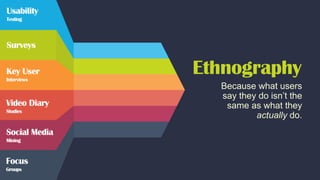
Usability
Testing
Ethnography
Because what users
say they do isn’t the
same as what they
actually do.
Surveys
Key User
Interviews
Video Diary
Studies
Social Media
Mining
Focus
Groups
Ethnography
Lets you see the tools &
services students are using to
do research
And how they fit into the rest of their lives.
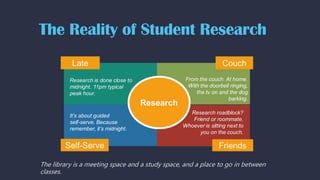
The Reality of Student Research
The library is a meeting space and a study space, and a place to go in between
classes.
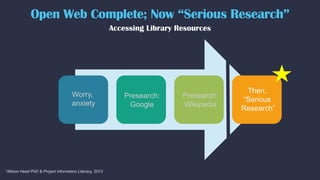
Worry,
anxiety
Presearch:
Google
Presearch:
Wikipedia
Then,
“Serious
Research”
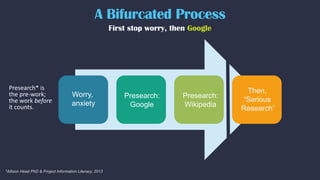
Presearch* is
the pre-work;
the work before
it counts.
*Allison Head PhD & Project Information Literacy, 2013
First stop worry, then Google
A Bifurcated Process
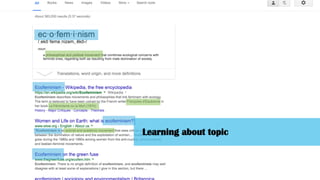
Learning about topic
1
2
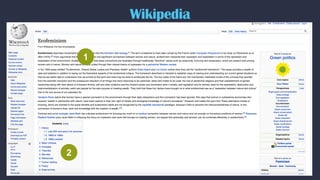
Wikipedia
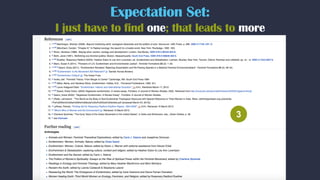
Expectation Set:
I just have to find one; that leads to more
3
Worry,
anxiety
Presearch:
Google
Presearch:
Wikipedia
Then,
“Serious
Research”
*Allison Head PhD & Project Information Literacy, 2013
Accessing Library Resources
Open Web Complete; Now “Serious Research”
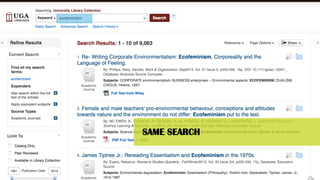
SAME SEARCH
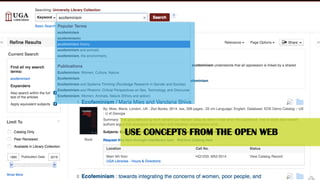
USE CONCEPTS FROM THE OPEN WEB
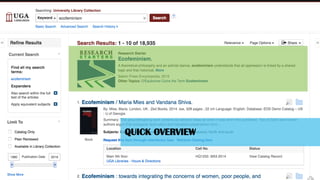
QUICK OVERVIEW
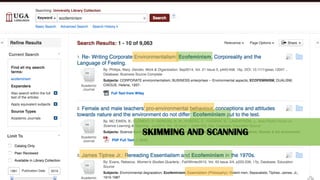
SKIMMING AND SCANNING
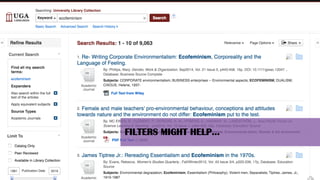
FILTERS MIGHT HELP…
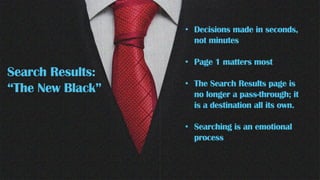
• Decisions made in seconds,
not minutes
• Page 1 matters most
• The Search Results page is
no longer a pass-through; it
is a destination all its own.
• Searching is an emotional
process
Search Results:
“The New Black”
LIBRARY-ESE.”
“I DON’T
SPEAK
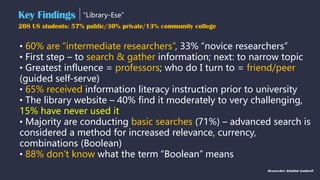
Key Findings “Library-Ese”
Researcher: Khalilah Gambrell
• 60% are “intermediate researchers”, 33% “novice researchers”
• First step – to search & gather information; next: to narrow topic
• Greatest influence = professors; who do I turn to = friend/peer
(guided self-serve)
• 65% received information literacy instruction prior to university
• The library website – 40% find it moderately to very challenging,
15% have never used it
• Majority are conducting basic searches (71%) – advanced search is
considered a method for increased relevance, currency,
combinations (Boolean)
• 88% don’t know what the term “Boolean” means
208 US students: 57% public/30% private/13% community college
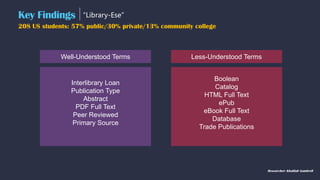
Key Findings “Library-Ese”
Researcher: Khalilah Gambrell
208 US students: 57% public/30% private/13% community college
Well-Understood Terms Less-Understood Terms
Interlibrary Loan
Publication Type
Abstract
PDF Full Text
Peer Reviewed
Primary Source
Boolean
Catalog
HTML Full Text
ePub
eBook Full Text
Database
Trade Publications
• Students navigate both physical and online environments with a focus on immediate
goals, there is limited to no exploration
• Key messages about information literacy only communicated once (“one-shot”
approach) are quickly forgotten
• Pre-survey showed top areas students need help:
Using databases to find articles
Getting better search results
Getting to the Full Text from off-campus
2015 Oxford Brookes Study UK* Hazel Rothera
*Rothera H. Picking up the cool tools: Working with strategic students to get bite-sized information literacy tutorials created, promoted, embedded, remembered and
used. Journal Of Information Literacy [serial online]. December 1, 2015
• Without frequent reminders of library tools, students devise their own workarounds, with
varying degrees of success. Examples of creative workarounds:
 Due to limited success searching keywords in the library catalog, students reported
they go to Google Books or Amazon and do the search, then return to the catalog to
find the identified known-item
 Catalog search > Shelfmark location > Shelf browsing to find 1 relevant item > back to
catalog with items from that bibliography
 Failure to find leads them back to Google or Google Scholar.
 Failure to find full-text leads them again, back to Google. They may not find it in full, but
find enough to piece it together.
 Students are searching with an end-goal in mind, looking for resources to back up their
decision/theory.
2015 Oxford Brookes Study UK* Hazel Rothera
*Rothera H. Picking up the cool tools: Working with strategic students to get bite-sized information literacy tutorials created, promoted, embedded, remembered and
used. Journal Of Information Literacy [serial online]. December 1, 2015
Influencing the Student Research Process:
Recent Findings
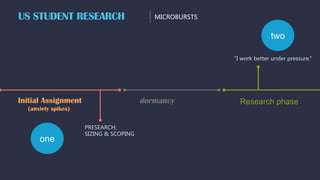
dormancy
PRESEARCH;
SIZING & SCOPING
“I work better under pressure.”
Initial Assignment
(anxiety spikes)
Research phase
US STUDENT RESEARCH MICROBURSTS
one
two
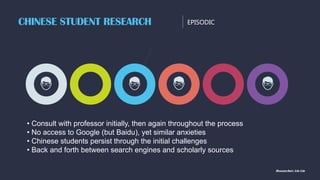
CHINESE STUDENT RESEARCH EPISODIC
• Consult with professor initially, then again throughout the process
• No access to Google (but Baidu), yet similar anxieties
• Chinese students persist through the initial challenges
• Back and forth between search engines and scholarly sources
Researcher: Lin Lin
INGESTED INTO
THEIR
ECOSYSTEM
UP NEXT:
 FACULTY CONTEXTUAL INQUIRY
 EBOOK RESEARCH
Faculty and student referrals needed
Contact research@ebsco.com
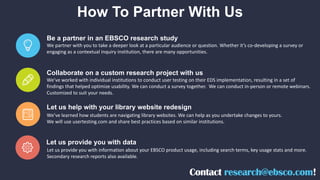
How To Partner With Us
Be a partner in an EBSCO research study
We partner with you to take a deeper look at a particular audience or question. Whether it’s co-developing a survey or
engaging as a contextual inquiry institution, there are many opportunities.
Collaborate on a custom research project with us
We’ve worked with individual institutions to conduct user testing on their EDS implementation, resulting in a set of
findings that helped optimize usability. We can conduct a survey together. We can conduct in-person or remote webinars.
Customized to suit your needs.
Let us help with your library website redesign
We’ve learned how students are navigating library websites. We can help as you undertake changes to yours.
We will use usertesting.com and share best practices based on similar institutions.
Let us provide you with data
Let us provide you with information about your EBSCO product usage, including search terms, key usage stats and more.
Secondary research reports also available.
Contact research@ebsco.com!
llin@ebsco.com
research@ebsco.com
Be in Touch.

The student search experience

  • 1.
    Lin Lin, Sr.UX Researcher EBSCO Information Services UK EDS Conference July 6 , 2016 llin@ebsco.com The Student Search Experience
  • 2.
    User Research atEBSCO: More Than Just Usability Testing Data Secondary Research What questions have been asked and answered previously? Primary Research Carefully matching research method to question Looking across three dimensions gives us a complete picture What patterns are identified from the usage data?
  • 3.
    type_your_search_here s1 and s2 researchmethods s1 and s2 and s3 marketing leadership qualitative research social media exploring strategy mintel project management reflective practice research methods for business students communication dementia human resource management corporate social responsibility operations management swot analysis motivation autism psychology quantitative research westlaw reflection dissertation globalisation gibbs reflective cycle change management strategic management digital marketing time management transformational leadership methodology corporate governance research methodology s1 and s2 and s3 and s4 social media marketing balanced scorecard ebsco leadership styles social research methods depression mental health s2 and s3 obesity business ethics spss teamwork education social psychology s3 and s4 management literature review marketing mix diabetes thematic analysis UK Top EDS Search Terms April – June, 2016 Academic Market Usage Data Contact research@ebsco.com Average # of words per search (Top 1000) is 2. Search terms are mostly basic exploratory searches.
  • 4.
    Usability Testing Ethnography Because what users saythey do isn’t the same as what they actually do. Surveys Key User Interviews Video Diary Studies Social Media Mining Focus Groups
  • 5.
    Ethnography Lets you seethe tools & services students are using to do research
  • 6.
    And how theyfit into the rest of their lives.
  • 7.
    The Reality ofStudent Research The library is a meeting space and a study space, and a place to go in between classes.
  • 8.
    Worry, anxiety Presearch: Google Presearch: Wikipedia Then, “Serious Research” Presearch* is the pre-work; thework before it counts. *Allison Head PhD & Project Information Literacy, 2013 First stop worry, then Google A Bifurcated Process
  • 10.
  • 11.
  • 12.
    Expectation Set: I justhave to find one; that leads to more 3
  • 13.
    Worry, anxiety Presearch: Google Presearch: Wikipedia Then, “Serious Research” *Allison Head PhD& Project Information Literacy, 2013 Accessing Library Resources Open Web Complete; Now “Serious Research”
  • 14.
  • 15.
    USE CONCEPTS FROMTHE OPEN WEB
  • 16.
  • 17.
  • 18.
  • 19.
    • Decisions madein seconds, not minutes • Page 1 matters most • The Search Results page is no longer a pass-through; it is a destination all its own. • Searching is an emotional process Search Results: “The New Black”
  • 20.
  • 21.
    Key Findings “Library-Ese” Researcher:Khalilah Gambrell • 60% are “intermediate researchers”, 33% “novice researchers” • First step – to search & gather information; next: to narrow topic • Greatest influence = professors; who do I turn to = friend/peer (guided self-serve) • 65% received information literacy instruction prior to university • The library website – 40% find it moderately to very challenging, 15% have never used it • Majority are conducting basic searches (71%) – advanced search is considered a method for increased relevance, currency, combinations (Boolean) • 88% don’t know what the term “Boolean” means 208 US students: 57% public/30% private/13% community college
  • 22.
    Key Findings “Library-Ese” Researcher:Khalilah Gambrell 208 US students: 57% public/30% private/13% community college Well-Understood Terms Less-Understood Terms Interlibrary Loan Publication Type Abstract PDF Full Text Peer Reviewed Primary Source Boolean Catalog HTML Full Text ePub eBook Full Text Database Trade Publications
  • 23.
    • Students navigateboth physical and online environments with a focus on immediate goals, there is limited to no exploration • Key messages about information literacy only communicated once (“one-shot” approach) are quickly forgotten • Pre-survey showed top areas students need help: Using databases to find articles Getting better search results Getting to the Full Text from off-campus 2015 Oxford Brookes Study UK* Hazel Rothera *Rothera H. Picking up the cool tools: Working with strategic students to get bite-sized information literacy tutorials created, promoted, embedded, remembered and used. Journal Of Information Literacy [serial online]. December 1, 2015
  • 24.
    • Without frequentreminders of library tools, students devise their own workarounds, with varying degrees of success. Examples of creative workarounds:  Due to limited success searching keywords in the library catalog, students reported they go to Google Books or Amazon and do the search, then return to the catalog to find the identified known-item  Catalog search > Shelfmark location > Shelf browsing to find 1 relevant item > back to catalog with items from that bibliography  Failure to find leads them back to Google or Google Scholar.  Failure to find full-text leads them again, back to Google. They may not find it in full, but find enough to piece it together.  Students are searching with an end-goal in mind, looking for resources to back up their decision/theory. 2015 Oxford Brookes Study UK* Hazel Rothera *Rothera H. Picking up the cool tools: Working with strategic students to get bite-sized information literacy tutorials created, promoted, embedded, remembered and used. Journal Of Information Literacy [serial online]. December 1, 2015
  • 25.
    Influencing the StudentResearch Process: Recent Findings
  • 26.
    dormancy PRESEARCH; SIZING & SCOPING “Iwork better under pressure.” Initial Assignment (anxiety spikes) Research phase US STUDENT RESEARCH MICROBURSTS one two
  • 27.
    CHINESE STUDENT RESEARCHEPISODIC • Consult with professor initially, then again throughout the process • No access to Google (but Baidu), yet similar anxieties • Chinese students persist through the initial challenges • Back and forth between search engines and scholarly sources Researcher: Lin Lin
  • 28.
  • 29.
    UP NEXT:  FACULTYCONTEXTUAL INQUIRY  EBOOK RESEARCH Faculty and student referrals needed Contact research@ebsco.com
  • 30.
    How To PartnerWith Us Be a partner in an EBSCO research study We partner with you to take a deeper look at a particular audience or question. Whether it’s co-developing a survey or engaging as a contextual inquiry institution, there are many opportunities. Collaborate on a custom research project with us We’ve worked with individual institutions to conduct user testing on their EDS implementation, resulting in a set of findings that helped optimize usability. We can conduct a survey together. We can conduct in-person or remote webinars. Customized to suit your needs. Let us help with your library website redesign We’ve learned how students are navigating library websites. We can help as you undertake changes to yours. We will use usertesting.com and share best practices based on similar institutions. Let us provide you with data Let us provide you with information about your EBSCO product usage, including search terms, key usage stats and more. Secondary research reports also available. Contact research@ebsco.com!
  • 31.