Visit https://testbankdeal.com to download the full version and
explore more testbank or solutions manual
Communication in Business International Edition
8th Edition Ober Test Bank
_____ Click the link below to download _____
https://testbankdeal.com/product/communication-in-business-
international-edition-8th-edition-ober-test-bank/
Explore and download more testbank or solutions manual at testbankdeal.com
Here are some recommended products that we believe you will be
interested in. You can click the link to download.
Communication in Business International Edition 8th
Edition Ober Solutions Manual
https://testbankdeal.com/product/communication-in-business-
international-edition-8th-edition-ober-solutions-manual/
Business Communication In Person In Print Online 8th
Edition Newman Test Bank
https://testbankdeal.com/product/business-communication-in-person-in-
print-online-8th-edition-newman-test-bank/
Business Communication In Person In Print Online 8th
Edition Newman Solutions Manual
https://testbankdeal.com/product/business-communication-in-person-in-
print-online-8th-edition-newman-solutions-manual/
Maders Understanding Human Anatomy and Physiology 9th
Edition Longenbaker Solutions Manual
https://testbankdeal.com/product/maders-understanding-human-anatomy-
and-physiology-9th-edition-longenbaker-solutions-manual/
Experiments in Physiology 11th Edition Woodman Solutions
Manual
https://testbankdeal.com/product/experiments-in-physiology-11th-
edition-woodman-solutions-manual/
Essentials of Negotiation 5th Edition Lewicki Test Bank
https://testbankdeal.com/product/essentials-of-negotiation-5th-
edition-lewicki-test-bank/
Introduction to Operations and Supply Chain Management 4th
Edition Bozarth Solutions Manual
https://testbankdeal.com/product/introduction-to-operations-and-
supply-chain-management-4th-edition-bozarth-solutions-manual/
Consumer Behaviour 6th Edition Schiffman Test Bank
https://testbankdeal.com/product/consumer-behaviour-6th-edition-
schiffman-test-bank/
Entrepreneurial Finance 5th Edition Adelman Test Bank
https://testbankdeal.com/product/entrepreneurial-finance-5th-edition-
adelman-test-bank/
Using Financial Accounting Information The Alternative to
Debits and Credits 8th Edition Porter Test Bank
https://testbankdeal.com/product/using-financial-accounting-
information-the-alternative-to-debits-and-credits-8th-edition-porter-
test-bank/
© 2011 Cengage Learning. All Rights Reserved. This edition is intended for use outside of the U.S. only, with content that may be different
from the U.S. Edition. May not be scanned, copied, duplicated, or posted to a publicly accessible website, in whole or in part.
Chapter 10—Business Research and Report Writing
TRUE/FALSE
1. Formal reports use side headings; informal reports do not.
ANS: F PTS: 1
2. Memo reports are written for an internal audience; letter reports may be written for either an internal or
an external audience.
ANS: F PTS: 1
3. Standardizing the format of a technical report makes it easy for readers to scan the document for the
specific item(s) of interest to them.
ANS: T PTS: 1
4. Research problems may be phrased as statements or questions.
ANS: T PTS: 1
5. Brainstorming and cluster diagramming can help researchers set the scope of a project.
ANS: T PTS: 1
6. When setting the time schedule for a research project, work back from the deadline date.
ANS: T PTS: 1
7. Research studies conducted by current employees using data obtained from the organization’s files
do not need to have a budget.
ANS: F PTS: 1
8. Research procedures vary from project to project.
ANS: T PTS: 1
9. The standards for documenting information obtained from web sources are less rigid than the
standards for documenting print secondary sources.
ANS: F PTS: 1
10. The primary receivers (readers) of a message must be analyzed; the secondary receivers need not be
analyzed.
ANS: F PTS: 1
11. Face-to-face surveys can be costly, but they produce the most in-depth responses.
ANS: T PTS: 1
© 2011 Cengage Learning. All Rights Reserved. This edition is intended for use outside of the U.S. only, with content that may be different
from the U.S. Edition. May not be scanned, copied, duplicated, or posted to a publicly accessible website, in whole or in part.
12. Pilot testing or field testing a survey can help to identify questions that need to be reworded to improve
clarity.
ANS: T PTS: 1
13. Focus group participants may be less open with their responses if they know they are being taped;
therefore, it is better not to tell them they are being recorded.
ANS: F PTS: 1
14. The conclusions and recommendations sections of a report allow the researcher to infuse his or her
opinions into a report.
ANS: F PTS: 1
15. The introduction of a report helps the reader understand the scope and sequence of the report.
ANS: T PTS: 1
16. The executive summary of a report emphasizes the findings, conclusions, and recommendations of the
study.
ANS: T PTS: 1
17. The guidelines and policies of an organization must be considered when deciding how to format a
formal report.
ANS: T PTS: 1
18. All appendixes included with a report must be referred to within the body of the report.
ANS: T PTS: 1
19. Headings must be parallel within and between levels.
ANS: F PTS: 1
20. It is unnecessary to include a source citation for paraphrased material.
ANS: F PTS: 1
MULTIPLE CHOICE
1. The formality of a report is
a. based on the culture of the writer’s organization.
b. based on the content.
c. determined by the preference of the writer.
d. determined by the receiver.
ANS: A PTS: 1
© 2011 Cengage Learning. All Rights Reserved. This edition is intended for use outside of the U.S. only, with content that may be different
from the U.S. Edition. May not be scanned, copied, duplicated, or posted to a publicly accessible website, in whole or in part.
2. Which of the following report types is also known as a status report?
a. Periodic
b. Progress
c. Technical
d. Unsolicited
ANS: B PTS: 1
3. You start planning a research study by
a. determining the factors.
b. determining the solutions.
c. scheduling the study.
d. stating the problem.
ANS: D PTS: 1
4. What is a Gantt chart?
a. A budget spreadsheet
b. A cluster diagram
c. A statistical analysis tool
d. A time schedule
ANS: D PTS: 1
5. Buchan Molding manufactures plastic tubing used in various industries. Which of the following
represents the best way for Buchan to gather customer satisfaction data about the service received
during the lengthy, complicated transactions common in its business?
a. Conduct a telephone survey.
b. Send a comment card with the customer’s order.
c. Send a letter of inquiry.
d. Visit each customer personally.
ANS: A PTS: 1
6. All but which of the following is a primary date source?
a. A personal interview
b. A website located through an Internet search
c. An observation
d. Company records
ANS: B PTS: 1
7. Experiments
a. are used to identify a better way of doing things.
b. have high personnel costs.
c. represent a common business research method.
d. require less control than other business research methods.
ANS: A PTS: 1
8. The solution to a research problem is presented in the report as a part of the
a. Appendix.
b. Conclusions.
c. Findings.
© 2011 Cengage Learning. All Rights Reserved. This edition is intended for use outside of the U.S. only, with content that may be different
from the U.S. Edition. May not be scanned, copied, duplicated, or posted to a publicly accessible website, in whole or in part.
d. Recommendations.
ANS: D PTS: 1
9. If a formal report contains a comprehensive letter of transmittal, the report will not contain a/an
a. bibliography.
b. executive summary
c. introduction.
d. table of contents.
ANS: B PTS: 1
10. Which of the following headings is NOT grammatically parallel to the others?
a. Fringe Benefits
b. Income Generated from Patents
c. Quarterly Dividends
d. Unanticipated Losses
ANS: B PTS: 1
ESSAY
1. Describe how to arrive at a clear, accurate written statement of the problem for a research study.
ANS:
Prior to arriving at the statement of the problem, there may be discussions within the organization
about what the research should accomplish. A preliminary investigation of the situation that prompted
the research may be made to help define the problem. You may look at files, talk to employees, read
other similar reports, talk to vendors, or make any number of preliminary inquiries to help you clarify
what needs to be studied.
PTS: 1
2. List the five steps for conducting research.
ANS:
The five steps for conducting research are:
1. Plan the research
2. Gather information
3. Analyze the information
4. Determine the solution(s)
5. Write the report
PTS: 1
3. In what ways are brainstorming and cluster diagramming similar? In what ways are they different?
ANS:
Brainstorming and cluster diagramming are similar in that both (a) are useful in narrowing the scope of
a research project and (b) can be done individually or in a group.
© 2011 Cengage Learning. All Rights Reserved. This edition is intended for use outside of the U.S. only, with content that may be different
from the U.S. Edition. May not be scanned, copied, duplicated, or posted to a publicly accessible website, in whole or in part.
The techniques are different in that brainstormed ideas are not evaluated or sequenced until after a list
has been developed. In cluster diagramming, ideas are grouped as they are introduced.
PTS: 1
4. When your research plan includes gathering data from both primary and secondary sources, which
should be gathered first? Why?
ANS:
Secondary source information should be gathered first because it might contain good ideas about what
primary information should be gathered and how to collect it.
PTS: 1
5. Comment on the credibility of information obtained through online forums such as newsgroups, blogs,
and chatrooms.
ANS:
Although online forums may lead to credible information sources, they generally are not viewed as
credible in and of themselves.
PTS: 1
6. Distinguish between commercial and open-access sources of data/information.
ANS:
A commercial source provides data/information for a fee; an open-access source makes
data/information available free to anyone who has access to the Internet.
PTS: 1
7. What should be included in the procedures section of a formal report? What purposes does the
procedures section serve?
ANS:
The procedures section describes the steps that were taken in conducting the study. Purposes of the
section are to allow readers to determine whether or not all aspects of the problem were investigated
adequately and to aid another researcher to conduct a similar study that could validate or disprove the
results of the original study.
PTS: 1
8. Compare the conclusions and recommendations sections of a formal report.
ANS:
Conclusions are statements of reasoning that a researcher makes after a thorough analysis of the
findings. Recommendations are the writer's suggestions to the reader as to the action(s) that should be
taken to solve the problem that was studied. Recommendations should develop logically from the
findings and conclusions.
PTS: 1
© 2011 Cengage Learning. All Rights Reserved. This edition is intended for use outside of the U.S. only, with content that may be different
from the U.S. Edition. May not be scanned, copied, duplicated, or posted to a publicly accessible website, in whole or in part.
9. Why are the mechanics of a written report important?
ANS:
The mechanics of a written report are important because they make the first impression on the
reader--an impression that reflects on the report writer and his or her credibility.
PTS: 1
10. After analyzing the receiver of your report, you determine that he or she will not understand some of
the terms in your report. What should you do?
ANS:
Depending on the number of unfamiliar terms, the writer has two choices. If the number of unfamiliar
terms is small, the terms may be listed and defined as part of the report introduction. If numerous
terms are to be defined, the words and their definitions should be listed in a glossary at as a
supplementary part of the report
PTS: 1
Another Random Scribd Document
with Unrelated Content
noblest and most perfect Saxon arches now extant.
The inside, instead of an open yard, was filled up with floors of most
magnificent and spacious apartments; traces of which may yet be
seen by persons accustomed to examine buildings of this sort. On
the ground floor they were vaulted over with stone, for a great part
of the old vault still remains; also the great stone arches of the
buttresses, and a stone vaulting where the present chapel is. It was
used as a prison so early as the reign of Henry I. but not for that
purpose solely:—the upper apartments of these towers, were state
apartments, for the residence of great officers and their attendants.
Its length is 92 feet, 10 inches; the length of the North and South
fronts, 98 feet each: the walls are 50 feet in heighth.
Somewhat resembling the architecture of the Old, is the New Castle,
adjoining to it on the East side, built with Scotch granite in the year
1793; apparently of great strength and durability.
The Castle-Hill appears to have been raised by art, with incredible
labour: it stands nearly in the center of the city, and commands an
agreeable prospect of the surrounding buildings, interspersed with
gardens, which, with the adjacent country and river, form a most
delightful landscape.
Since the addition of the Gardens round the bottom of the Hill,
strangers have acknowledged the view from the summit to be
superior to any thing of the kind in Europe, and have justly styled
Norwich ‘The City in an Orchard.’
In the Shire-House, which adjoins the Castle on the North side, the
Summer Assizes and Quarter-Sessions are held, and other county
business transacted.
THE CATHEDRAL
Was founded by Bishop Herbert in 1096, and was chiefly composed
of wood, which, by various accidents, and the turbulence of the
times, was often greatly damaged.
The present Cathedral is a fine Gothic free-stone building, brought to
the magnificent state in which it now appears by the bounty of
numerous benefactors, at various times, and completed by William
Middleton, the thirty-sixth Bishop, in the year 1284. The roof is
adorned with various well-carved images, from the historical
passages of scripture. On the windows at the East end of the
church is most curiously painted the transfiguration, and the twelve
apostles, by Dean Lloyd’s lady.
The shaft, or spire, is handsome and well proportioned. Except
Salisbury, it is the highest in the kingdom, being 105 yards, 2 feet,
from the pavement to the top of the pinnacle, strongly built with
free-stone on the outside and brick within. The top stone of the
spire consists of half a globe, 1 yard, 2 inches broad, with a channel
round it; whence extend eight leaves of stone, spreading outward,
under which commence the eight rows of crockets, continued down
the spire, at 5 feet distance from each other. The weather-cock
placed here at the restoration, is three quarters of a yard high, and
one yard, two inches broad, as is also the crossbar.
The Cloister on the South side of the church is the largest
quadrangle of the kind in England, each side measuring 58 yards in
length, near 14 feet in breadth, and 16 feet, 6 inches in heighth;—
the stone roof is ornamented with elegant carvings, representing the
visions of the Revelations, the Crucifixion and Resurrection, the
Legends of St. Christopher, St. Lawrence, &c.
At the South-West corner, the Espousals, or Sacrament of Marriage,
are carved in stone, and at the entrance of the Cloister from hence,
on the left hand, are the two lavatories, where the monks used to
wash their hands. Over one of them is carved a fox in a pulpit, in
the habit of a secular priest, holding up a goose to has auditory,
intended as a reflection on the secular clergy, or parish priests, to
whom the monks bore an inveterate hatred.
On the North side of the Cathedral stands the Bishop’s Palace, to
which are most elegant gardens.
The Free Grammar school, near this, is a neat, spacious, gothic
building, formerly used as a charnel-house.
ST. ANDREW’S HALL,
Formerly the monastery church of the Black Friars, or Benedictine
Monks, is a beautiful structure, about 50 yards in length, and 30 in
width: the roof is supported by twelve neat and very slender pillars.
It was built by Sir Thomas Erpingham, Knt. in 1428; and was the
place where the company of St. George used to hold their meetings
of business and pleasure.
The Mayor’s guild-feast is always held here.
Over a clock, in the center of the East end, is carved the effigies of
Justice, and underneath, the royal arms of England. On each side,
the pictures of Queen Anne, George Prince of Denmark, Robert Earl
of Orford, John Lord Hobart, afterwards Earl of Buckenhamshire,
Horatio Walpole, Esq. Lord Suffield, and two Historical Paintings of
Edward and Eleonora, and the Death of Lady Jane Grey, by Mr. W.
Martin, between which is placed, in a splendid and emblematical
frame, a highly-finished portrait of the brave Lord Nelson, painted by
Sir William Beachey, with several Aldermen and Benefactors to the
city. The figure of St. George killing the dragon, neatly carved, was
placed here in 1686, by order of the St. George’s Company. On the
walls of the North and South ailes are placed elegant paintings at full
length, superbly framed, of those Gentlemen who have gone
through the public offices of the Corporation with dignity and
honour.
Against the further pillar on the North side, is an Ensign, 60 feet in
length, supported by a flag-staff, near the top of which is an
ornamented Shield, with the following Inscription:
“The Ensign of the French Ship,
Genereux,
Taken in the Mediterranean, Feb. 18th, 1800,
By His Majesty’s Ship, Foudroyant, and Squadron,
Commanded by
LORD NELSON:
The Genereux, with the Guillaume Tell, since taken by the
Foudroyant, Lion, and Penelope, were the only Ships which
escaped the memorable Victory obtained by Lord Nelson over
the French, at the Nile, Aug. 1st, 1798.
In testimony of his Gratitude for the Honours conferred on him
by the City of Norwich, this Trophy is presented, in the second
Mayoralty of Robert Harvey, Esq. by
SIR EDWARD BERRY, KNT.
Captain of his Majesty’s Ship, Foudroyant,
1800.”
Herein is a handsome room for the city Library, re-built in the Gothic
taste, under the direction of the late Mr. Rawlins.
THE GUILD-HALL.
In this Hall, the assizes and quarter sessions for the city are held.
Also the Mayor’s office, for the daily administration of justice; the
town-clerk’s and chamberlain’s offices: and all elections for Mayor,
Aldermen, Sheriffs and Common-councilmen are here determined.
The windows contained many stories on painted or stained glass,
relating to the administration of justice;—there now remain perfect
only one large and two small windows, to perpetuate the
remembrance of this beautiful art.
The room is adorned with the pictures of King William and Queen
Mary, many eminent men of the county, mayors of the city, and
other benefactors.
Herein is the following inscription, suspended from a Golden Anchor,
at the bottom of which are Lord Nelson’s arms, neatly executed—in
the center Tria junca in uno, on one side a Lion, on the other a
Sailor, at foot Faith and Works.
“The Sword of the Spanish Admiral Don Xavier Winthuysen, who
died of the wounds he received in an engagement with the
British Fleet under the command of Admiral Earl St. Vincent,
14th Feb. 1797, which ended in the most brilliant victory ever
obtained by this Country over the Enemy at Sea: wherein the
heroic Valour and cool determined Courage of Rear Admiral Sir
Horatio Nelson, K. B. had ample scope for their display. He
being a Native of Norfolk, honoured the City by presenting this
Sword, surrendered to him in that Action.”
The City Prison is directly opposite.
ST. PETER OF MANCROFT CHURCH
Was begun in 1430, and finished in 1455. It is esteemed a very
handsome parish church: has a fine square tower steeple, 98 feet
high, though designed at first to have been much higher, as appears
from the double buttresses reaching to the top, and the thickness of
the walls: this tower contains an excellent peal of twelve bells, cast
by Messrs. Pack and Chapman, of London, in 1775; the Tenor
weighing 41 cwt. The whole is covered with lead, and supported by
two rows of pillars, remarkably neat and slender, forming eliptic
arches at their top.
The altar-piece, representing the story of St. Peter being delivered
out of prison, was painted by that ingenious artist Mr. Catton, and
presented to the parish by Alderman Starling, in 1768. The furniture
of the altar is crimson velvet, and the plate exceedingly grand, all
but one cup being double gilt: one piece of it is remarkably curious,
being an elegant standing cup and cover of silver, double gilt,
weighing 46 oz. 1 gr. 1 pt. given by Sir Peter Gleane, Knight,
whereon is beautifully chased the story of Abigail bringing presents
to David.
In the vestry hangs a neat old painted carving in alabaster, of nine
female saints, probably designed for some altar of St. Margaret, who
is the principal figure, and here represented as holding down a
dragon; among others, St. Hilda, holding a book and pastoral staff;
St. Barbara, a tower and palm-branch. There is also an octavo
manuscript bible upon vellum, written in 1340, and a folio
manuscript much more ancient, containing all St. Paul’s epistles, with
a comment.
THE NORFOLK AND NORWICH HOSPITAL,
St. Stephen’s road, is a very neat edifice: was erected in 1772, and
is still supported by voluntary contributions.
The Public Library is now kept at the building formerly the Roman
Catholic chapel, in Wymer-street, and contains 5000 volumes, where
books are delivered by the Librarian to the subscribers every day
between the hours of eleven and two, Sundays and the following
days excepted, 29th of May, 4th of June, the Guild-day, and the day
preceding; 25th of October and 5th of November.
BRIDEWELL,
Was built by Bartholomew Appleyard, about the year 1370. William
Appleyard, his son, the first Mayor of Norwich, served his Mayoralty
here in 1403. The North wall of this Bridewell is encrusted with cut
flints, and is seventy-six feet in length, by about twenty-five high: it
is considered one of the greatest curiosities of the kind in England.
The flints are squared to such a nicety, that the edge of a knife can
scarcely be insinuated between the joints: most of them are about
three inches square, the surface is very smooth, and no brick-work
can appear more regular.
Several churches and other buildings in the city are thus built.
Mr. Talman says, that the Jews introduced the art of squaring flints:
and Dr. Cromwell Mortimer, Secretary to the Royal Society, in a note
on a paper of Mr. Arderon’s on this very wall, observes, that the gate
of the Austin Friars, at Canterbury, that of St. John’s Abbey, at
Colchester, and the gate near Whitehall, Westminster, are in the
same taste. But the platform on the top of the Royal Observatory at
Paris, which, in instead of being covered with lead, is paved with flint
after this manner, is an instance that the French have in some
measure recovered this art. Phil. Trans. Abr. vol. 10. p. 1304.
THE THEATRE
Was built by the late Mr. Thomas Ivory, after the model of old Drury-
lane house; and in 1800 underwent an entire, elegant, and spirited
alteration, under the direction, and highly to the credit of, the
present Patentee, Mr. Wilkins.
The house now contains two circles of Boxes, with side ones on the
same tier as the Gallery. There are Stage Boxes the same as those
of Drury-lane. The Stage doors are semi-circular, and a Box over
them, both of these are filled with a triliage of gold and a small
pilaster. The Boxes are supported by small reeded columns of gold,
and the front of every Box decorated with coloured Raphael
ornaments, on a ground of French grey. At each column are lamps
(patent), in the Grecian style, suspended from an antique branch of
gold, which gives a brilliancy to the whole. The general tone of
colour is a quiet fawn, which is pleasing to the eye, and relieves the
pannels of coloured ornaments. The mouldings are gold and white,
which give a lightness to the whole. From the entablature or cornice
in front, descends a cove, with the Imperial Arms in the centre,
admirably executed, painted yellow, and heightened in gold, with
this motto, Conabimur (we will endeavour); below this is a rich
crimson curtain, with gold fringe, supported by two statues, and on
each side of the stage doors are pilasters of gold, reeded, in which
every reed plays in the light, and produces the most pleasing effect.
There are distinct entrances to each part of the house, Boxes, Pit,
and Gallery, and the Box Lobbies are roomy and commodious. At
the back of the upper circle is a bar-room, where coffee, tea,
sweets, &c. may be procured.
The Assembly-Rooms next it are spacious and brilliant.
There are five Hospitals: one of them, St Giles’, founded originally for
the entertainment of strangers, was, by Henry VIII. appropriated to
the poor of the city; which maintains 104 poor men and women,
who are all cloathed in grey, and must be sixty years of age.
Another for 16 poor men and 8 women, whose livery is purple.
Cooke’s Hospital, in the Rose-lane, maintains 10 poor women; and
Doughty’s, which was founded in 1687, supports 24 poor men and 8
women. The Boys and Girls’ Hospital contain 30 of each, and the
boys are from thence put out apprentices. Besides 5 Charity
Schools, where 111 boys and 22 girls are taught, clothed, and
supplied with books. A number of Sunday Schools under the care of
the Rev. Lancaster Adkin, where 133 boys and girls receive every
attention, with many advantages—and several other Charity and
Sunday Schools, on foundations, or supported by voluntary
contributions from dissenting meetings, &c. taking the whole
together, educating, clothing, &c. 300 boys and 150 girls.
The City of Norwich has local advantages superior to most cities in
the kingdom: a navigable stream to the port of Yarmouth passes
through the middle of it, with great convenience for the Wharfage
and Delivery of goods of all kinds to and from London.
It is situated on a mixed soil of ground, in a salubrious air, neither
subject to violent or scorching heat, nor to moist or watery vapours.
The upper stratum of earth is light soil, of sufficient depth for the
plough; the under stratum is chalk, gravel, and sand.
It is happily screened and defended from the Easterly winds by a
considerable rising ground, called Moushold Heath, which is higher
than the tops of the churches in the lower parts of the city.
If abounds in springs of water of the purest kind, nearly equal to the
celebrated Bristol water, supplied to the inhabitants by a variety of
public pumps.
The City is governed by a mayor, recorder, steward, 2 sheriffs, 24
aldermen, and 60 common council-men; a town-clerk, sword-bearer,
&c. The mayor is elected by the freemen on the first day of May,
and sworn into office on the Guild-day, the Tuesday before
Midsummer-day; except when Midsummer-day falls on a Wednesday,
and then the Guild is kept on the Tuesday se’nnight before
Midsummer-day. He is chosen from among the Aldermen, is justice
of the quorum during his mayoralty, and afterwards justice of the
peace for life.
The sheriffs are also annually elected, one by the Aldermen, the
other by the freemen, on the last Tuesday in August, and sworn
Sept. 29.
The city is divided into twelve wards, viz. Ber-street, Colegate, North
Conisford, South Conisford, Coslany, Fyebridge, Mancroft, St. Giles,
St. Stephen, East Wymer, Middle Wymer, Weft Wymer; each of which
elects two Aldermen.
These twelve wards are again divided into four great wards;
I. Conisford ward contains South Conisford, North Conisford, Ber-
street, with the hamlets of Lakenham, Trowse, Milgate, Bracondale,
and Carrowe; which is represented by 12 common council-men.
II. Mancroft ward contains St. Stephen’s, St. Peter’s of Mancroft, St.
Giles’, with the hamlet of Eaton; and is represented by 16 common
council-men.
III. Wymer ward contains East Wymer, Middle Wymer, West Wymer,
with the hamlets of Heigham and Earlham; and is represented by 20
common council-men.
IV. The Northern Ward Coslany, Colgate, Fye-bridge, with the
hamlet of Pockthorpe; and is represented by 12 common council-
men.
The freemen for each ward elect Three Nominees, and the
Nominees appoint the other common council-men.
The city sends two members to parliament, elected by the
freeholders and freemen; the latter are free by inheritance,
purchase, or servitude, in number about 3000. The freemen must
have been admitted to their freedom twelve months before they are
entitled to a vote.
The Markets are on Wednesdays and Saturdays.
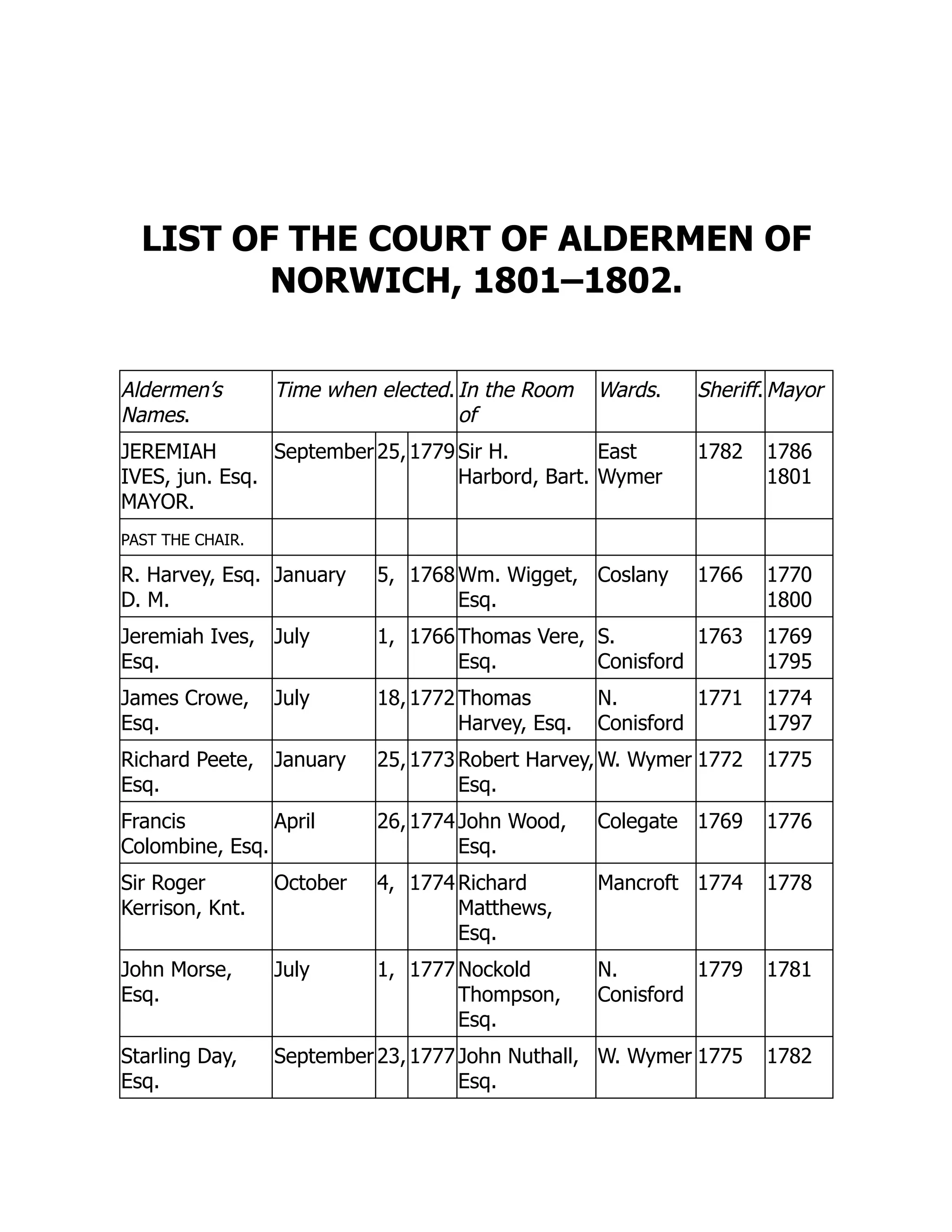
LIST OF THE COURT OF ALDERMEN OF
NORWICH, 1801–1802.
Aldermen’s
Names.
Time when elected. In the Room
of
Wards. Sheriff. Mayor
JEREMIAH
IVES, jun. Esq.
MAYOR.
September 25,1779 Sir H.
Harbord, Bart.
East
Wymer
1782 1786
1801
PAST THE CHAIR.
R. Harvey, Esq.
D. M.
January 5, 1768 Wm. Wigget,
Esq.
Coslany 1766 1770
1800
Jeremiah Ives,
Esq.
July 1, 1766 Thomas Vere,
Esq.
S.
Conisford
1763 1769
1795
James Crowe,
Esq.
July 18,1772 Thomas
Harvey, Esq.
N.
Conisford
1771 1774
1797
Richard Peete,
Esq.
January 25,1773 Robert Harvey,
Esq.
W. Wymer 1772 1775
Francis
Colombine, Esq.
April 26,1774 John Wood,
Esq.
Colegate 1769 1776
Sir Roger
Kerrison, Knt.
October 4, 1774 Richard
Matthews,
Esq.
Mancroft 1774 1778
John Morse,
Esq.
July 1, 1777 Nockold
Thompson,
Esq.
N.
Conisford
1779 1781
Starling Day,
Esq.
September 23,1777 John Nuthall,
Esq.
W. Wymer 1775 1782
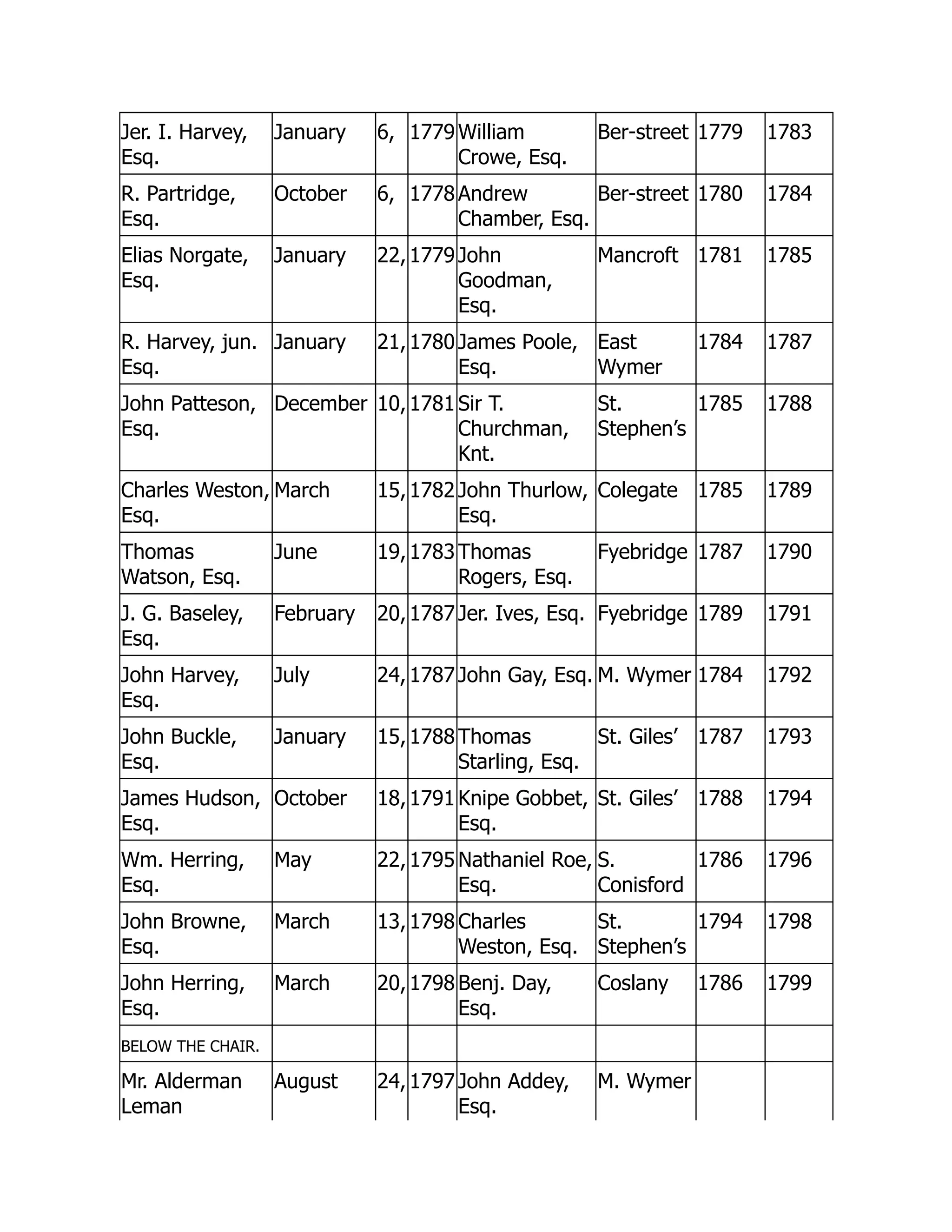
Jer. I. Harvey,
Esq.
January 6, 1779 William
Crowe, Esq.
Ber-street 1779 1783
R. Partridge,
Esq.
October 6, 1778 Andrew
Chamber, Esq.
Ber-street 1780 1784
Elias Norgate,
Esq.
January 22,1779 John
Goodman,
Esq.
Mancroft 1781 1785
R. Harvey, jun.
Esq.
January 21,1780 James Poole,
Esq.
East
Wymer
1784 1787
John Patteson,
Esq.
December 10,1781 Sir T.
Churchman,
Knt.
St.
Stephen’s
1785 1788
Charles Weston,
Esq.
March 15,1782 John Thurlow,
Esq.
Colegate 1785 1789
Thomas
Watson, Esq.
June 19,1783 Thomas
Rogers, Esq.
Fyebridge 1787 1790
J. G. Baseley,
Esq.
February 20,1787 Jer. Ives, Esq. Fyebridge 1789 1791
John Harvey,
Esq.
July 24, 1787 John Gay, Esq. M. Wymer 1784 1792
John Buckle,
Esq.
January 15,1788 Thomas
Starling, Esq.
St. Giles’ 1787 1793
James Hudson,
Esq.
October 18,1791 Knipe Gobbet,
Esq.
St. Giles’ 1788 1794
Wm. Herring,
Esq.
May 22,1795 Nathaniel Roe,
Esq.
S.
Conisford
1786 1796
John Browne,
Esq.
March 13,1798 Charles
Weston, Esq.
St.
Stephen’s
1794 1798
John Herring,
Esq.
March 20,1798 Benj. Day,
Esq.
Coslany 1786 1799
BELOW THE CHAIR.
Mr. Alderman
Leman
August 24, 1797 John Addey,
Esq.
M. Wymer
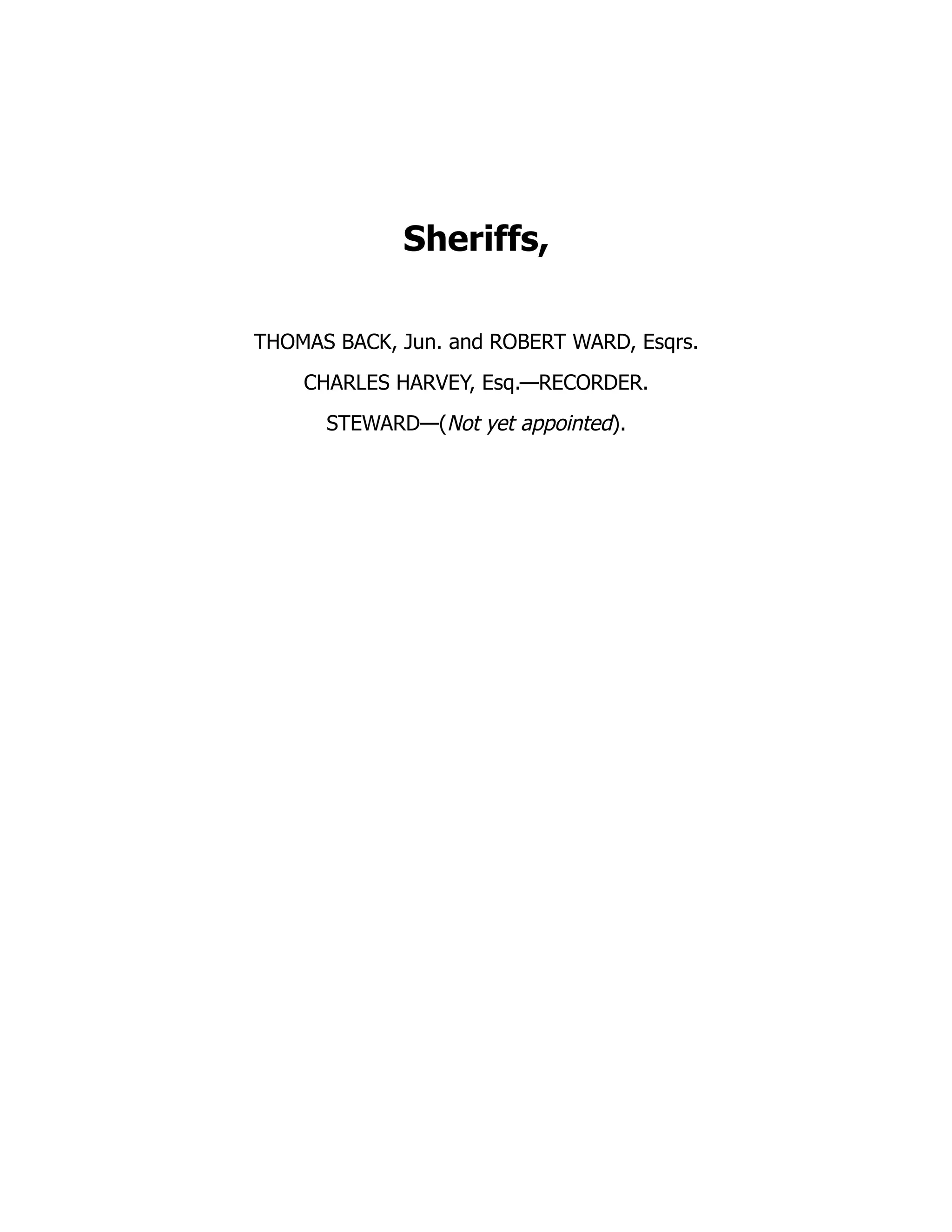
Sheriffs,
THOMAS BACK, Jun. and ROBERT WARD, Esqrs.
CHARLES HARVEY, Esq.—RECORDER.
STEWARD—(Not yet appointed).
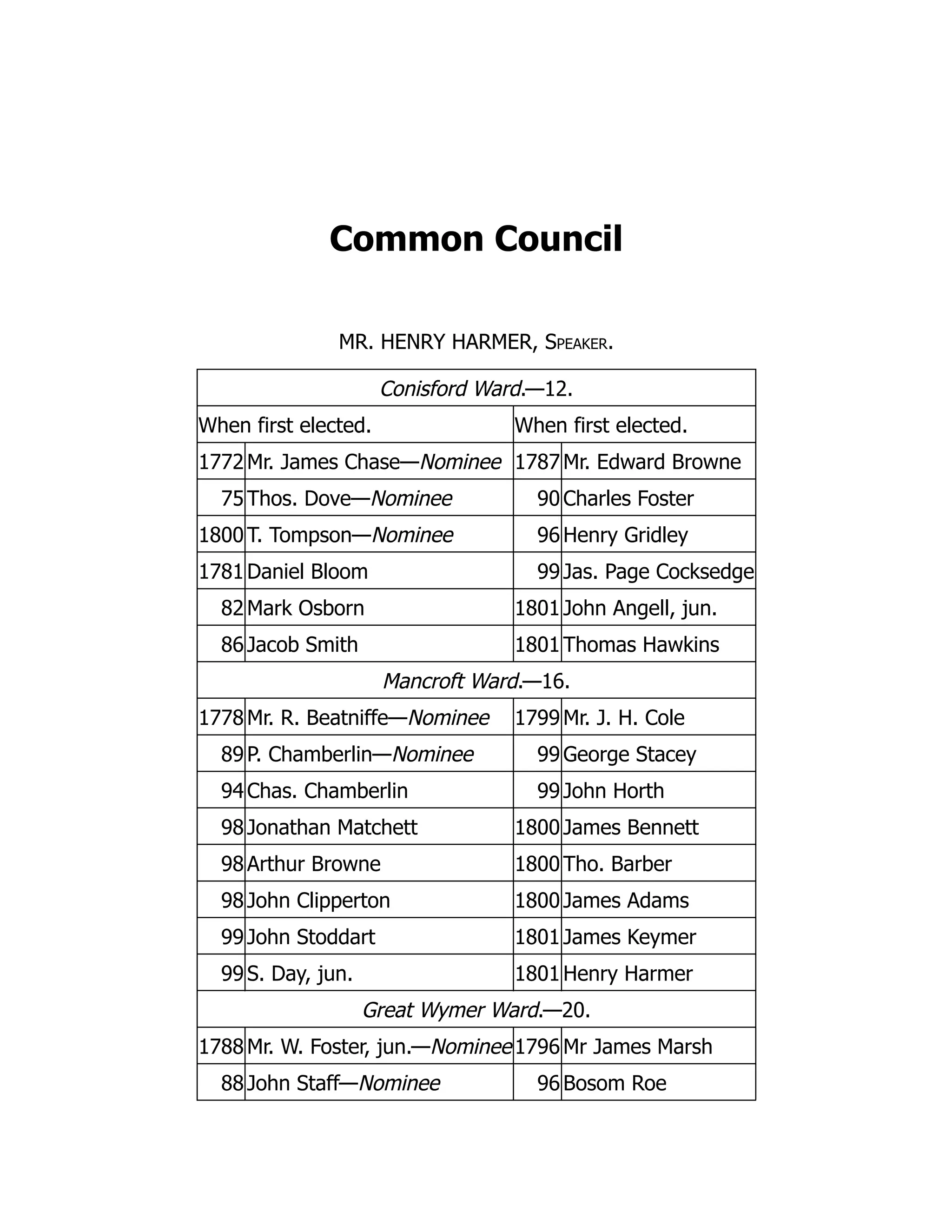
Common Council
MR. HENRY HARMER, Speaker.
Conisford Ward.—12.
When first elected. When first elected.
1772Mr. James Chase—Nominee 1787 Mr. Edward Browne
75 Thos. Dove—Nominee 90 Charles Foster
1800T. Tompson—Nominee 96 Henry Gridley
1781Daniel Bloom 99 Jas. Page Cocksedge
82 Mark Osborn 1801 John Angell, jun.
86 Jacob Smith 1801 Thomas Hawkins
Mancroft Ward.—16.
1778Mr. R. Beatniffe—Nominee 1799 Mr. J. H. Cole
89 P. Chamberlin—Nominee 99 George Stacey
94 Chas. Chamberlin 99 John Horth
98 Jonathan Matchett 1800 James Bennett
98 Arthur Browne 1800 Tho. Barber
98 John Clipperton 1800 James Adams
99 John Stoddart 1801 James Keymer
99 S. Day, jun. 1801 Henry Harmer
Great Wymer Ward.—20.
1788Mr. W. Foster, jun.—Nominee1796 Mr James Marsh
88 John Staff—Nominee 96 Bosom Roe
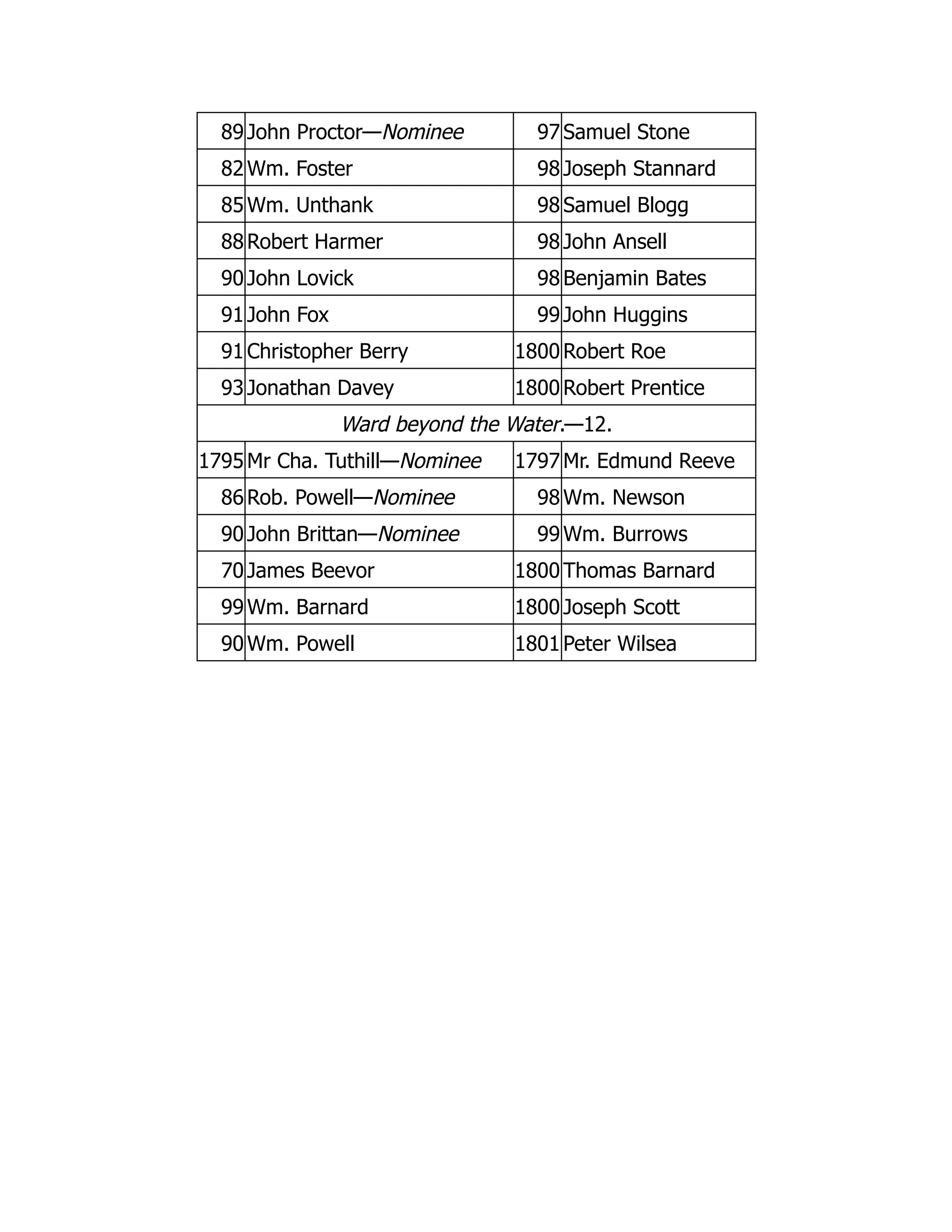
89 John Proctor—Nominee 97 Samuel Stone
82 Wm. Foster 98 Joseph Stannard
85 Wm. Unthank 98 Samuel Blogg
88 Robert Harmer 98 John Ansell
90 John Lovick 98 Benjamin Bates
91 John Fox 99 John Huggins
91 Christopher Berry 1800 Robert Roe
93 Jonathan Davey 1800 Robert Prentice
Ward beyond the Water.—12.
1795Mr Cha. Tuthill—Nominee 1797 Mr. Edmund Reeve
86 Rob. Powell—Nominee 98 Wm. Newson
90 John Brittan—Nominee 99 Wm. Burrows
70 James Beevor 1800 Thomas Barnard
99 Wm. Barnard 1800 Joseph Scott
90 Wm. Powell 1801 Peter Wilsea
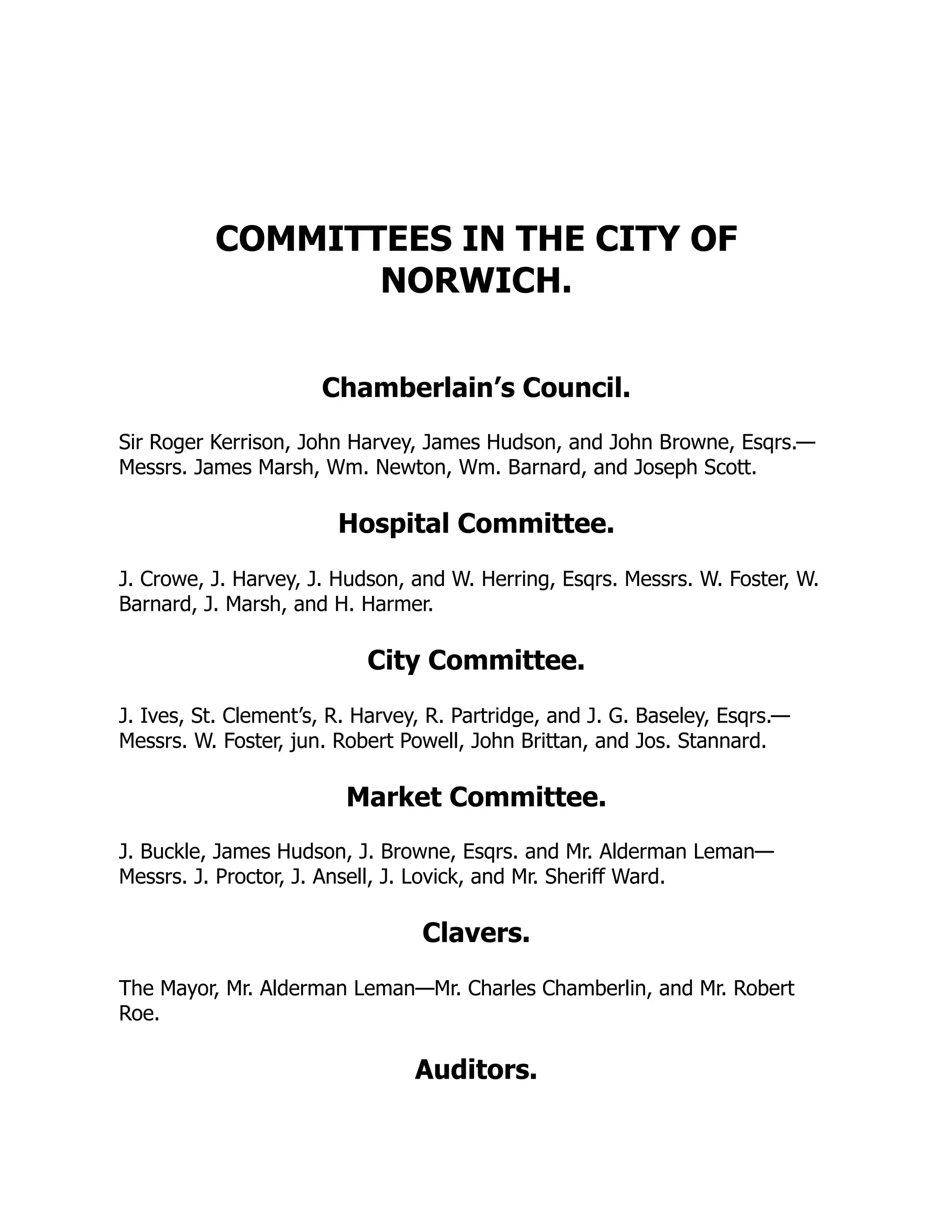
COMMITTEES IN THE CITY OF
NORWICH.
Chamberlain’s Council.
Sir Roger Kerrison, John Harvey, James Hudson, and John Browne, Esqrs.—
Messrs. James Marsh, Wm. Newton, Wm. Barnard, and Joseph Scott.
Hospital Committee.
J. Crowe, J. Harvey, J. Hudson, and W. Herring, Esqrs. Messrs. W. Foster, W.
Barnard, J. Marsh, and H. Harmer.
City Committee.
J. Ives, St. Clement’s, R. Harvey, R. Partridge, and J. G. Baseley, Esqrs.—
Messrs. W. Foster, jun. Robert Powell, John Brittan, and Jos. Stannard.
Market Committee.
J. Buckle, James Hudson, J. Browne, Esqrs. and Mr. Alderman Leman—
Messrs. J. Proctor, J. Ansell, J. Lovick, and Mr. Sheriff Ward.
Clavers.
The Mayor, Mr. Alderman Leman—Mr. Charles Chamberlin, and Mr. Robert
Roe.
Auditors.
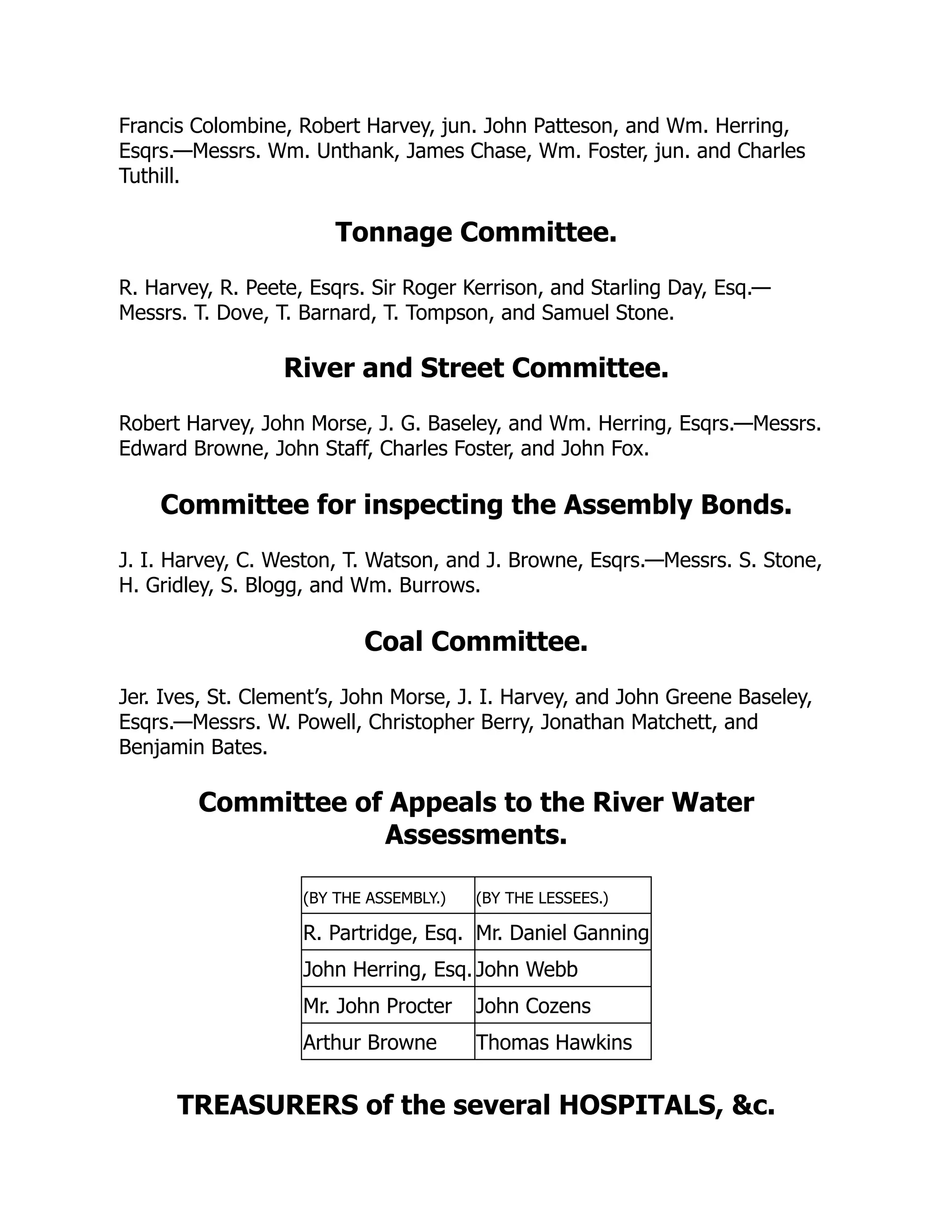
Francis Colombine, Robert Harvey, jun. John Patteson, and Wm. Herring,
Esqrs.—Messrs. Wm. Unthank, James Chase, Wm. Foster, jun. and Charles
Tuthill.
Tonnage Committee.
R. Harvey, R. Peete, Esqrs. Sir Roger Kerrison, and Starling Day, Esq.—
Messrs. T. Dove, T. Barnard, T. Tompson, and Samuel Stone.
River and Street Committee.
Robert Harvey, John Morse, J. G. Baseley, and Wm. Herring, Esqrs.—Messrs.
Edward Browne, John Staff, Charles Foster, and John Fox.
Committee for inspecting the Assembly Bonds.
J. I. Harvey, C. Weston, T. Watson, and J. Browne, Esqrs.—Messrs. S. Stone,
H. Gridley, S. Blogg, and Wm. Burrows.
Coal Committee.
Jer. Ives, St. Clement’s, John Morse, J. I. Harvey, and John Greene Baseley,
Esqrs.—Messrs. W. Powell, Christopher Berry, Jonathan Matchett, and
Benjamin Bates.
Committee of Appeals to the River Water
Assessments.
(BY THE ASSEMBLY.) (BY THE LESSEES.)
R. Partridge, Esq. Mr. Daniel Ganning
John Herring, Esq. John Webb
Mr. John Procter John Cozens
Arthur Browne Thomas Hawkins
TREASURERS of the several HOSPITALS, &c.
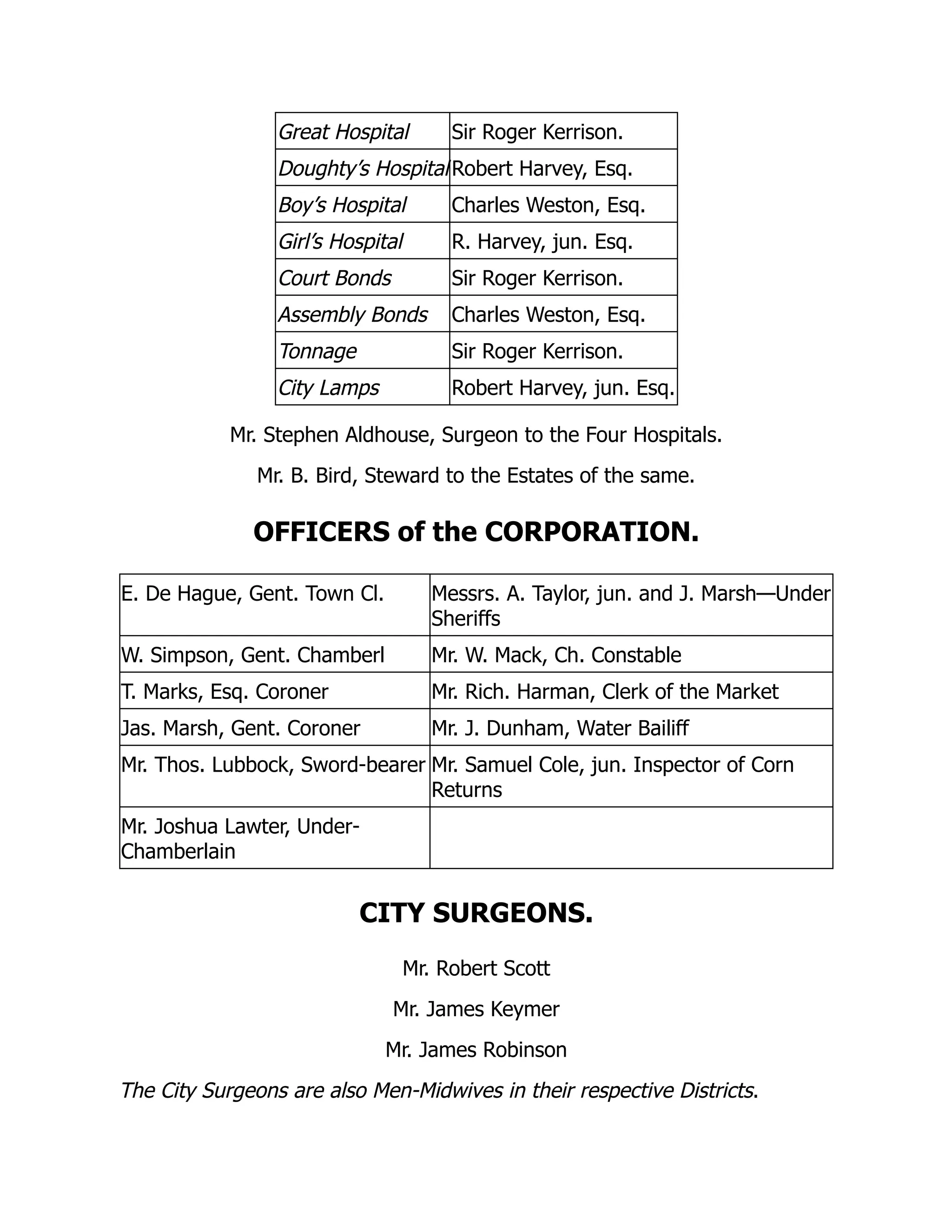
Great Hospital Sir Roger Kerrison.
Doughty’s HospitalRobert Harvey, Esq.
Boy’s Hospital Charles Weston, Esq.
Girl’s Hospital R. Harvey, jun. Esq.
Court Bonds Sir Roger Kerrison.
Assembly Bonds Charles Weston, Esq.
Tonnage Sir Roger Kerrison.
City Lamps Robert Harvey, jun. Esq.
Mr. Stephen Aldhouse, Surgeon to the Four Hospitals.
Mr. B. Bird, Steward to the Estates of the same.
OFFICERS of the CORPORATION.
E. De Hague, Gent. Town Cl. Messrs. A. Taylor, jun. and J. Marsh—Under
Sheriffs
W. Simpson, Gent. Chamberl Mr. W. Mack, Ch. Constable
T. Marks, Esq. Coroner Mr. Rich. Harman, Clerk of the Market
Jas. Marsh, Gent. Coroner Mr. J. Dunham, Water Bailiff
Mr. Thos. Lubbock, Sword-bearer Mr. Samuel Cole, jun. Inspector of Corn
Returns
Mr. Joshua Lawter, Under-
Chamberlain
CITY SURGEONS.
Mr. Robert Scott
Mr. James Keymer
Mr. James Robinson
The City Surgeons are also Men-Midwives in their respective Districts.
The CORPORATION of GUARDIANS of the POOR in
NORWICH.
CHARLES HARVEY, Esq. Governor.
ROBERT PARTRIDGE, Esq. Deputy Governor.
ROBERT HARVEY, Esq. Treasurer.
The MAYOR, RECORDER, STEWARD, SHERIFFS, and ALDERMEN for the time
being.
For the Great Ward of Conisford, Ber-street, and Trowse.
Elected in 1800. Elected in 1801.
Edward Squire, corn-merch. Edw. Browne, carpenter
James Chase, liquor-merch. Francis Sillis, farmer
Thomas Dove, carpenter John Angell, jun. currier
Thos. Tompson, merchant Mark Osborn, grocer
For the Great Ward of Mancroft.
Rich. Beatniffe, bookseller John C. Hampp, merchant
Thomas Back, backer Peter Chamberlin, grocer
Wm. Burt, upholder Samuel Harmer, Gent.
John Athow, stone-mason Mr. Sheriff Ward
For the Great Ward of Wymer.
Jas. Buttivant, manufacturer John Rodwell, dyer
Richard Bacon, printer Samuel Blogg, mason
William Unthank, Gent. Wm. Foster, jun. Gent.
Jonathan Davey, merchant James Marsh, Gent.
For the Ward beyond the Water.
William Cutting, merchant John Brittan, woolcomber
James Angier, merchant John Webb, woolcomber
Robert Powell, woolcomber Wm. Barnard, merchant
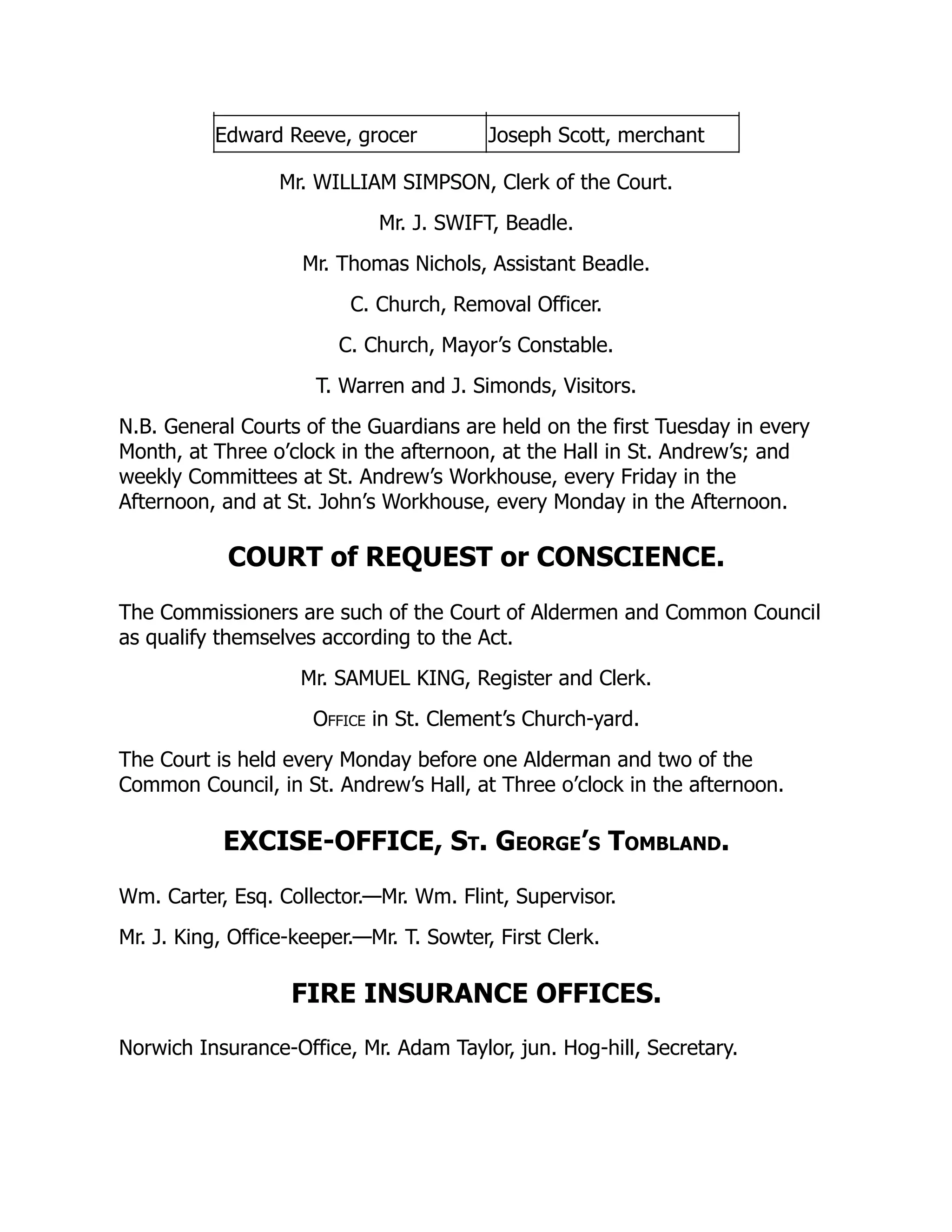
Edward Reeve, grocer Joseph Scott, merchant
Mr. WILLIAM SIMPSON, Clerk of the Court.
Mr. J. SWIFT, Beadle.
Mr. Thomas Nichols, Assistant Beadle.
C. Church, Removal Officer.
C. Church, Mayor’s Constable.
T. Warren and J. Simonds, Visitors.
N.B. General Courts of the Guardians are held on the first Tuesday in every
Month, at Three o’clock in the afternoon, at the Hall in St. Andrew’s; and
weekly Committees at St. Andrew’s Workhouse, every Friday in the
Afternoon, and at St. John’s Workhouse, every Monday in the Afternoon.
COURT of REQUEST or CONSCIENCE.
The Commissioners are such of the Court of Aldermen and Common Council
as qualify themselves according to the Act.
Mr. SAMUEL KING, Register and Clerk.
Office in St. Clement’s Church-yard.
The Court is held every Monday before one Alderman and two of the
Common Council, in St. Andrew’s Hall, at Three o’clock in the afternoon.
EXCISE-OFFICE, St. George’s Tombland.
Wm. Carter, Esq. Collector.—Mr. Wm. Flint, Supervisor.
Mr. J. King, Office-keeper.—Mr. T. Sowter, First Clerk.
FIRE INSURANCE OFFICES.
Norwich Insurance-Office, Mr. Adam Taylor, jun. Hog-hill, Secretary.
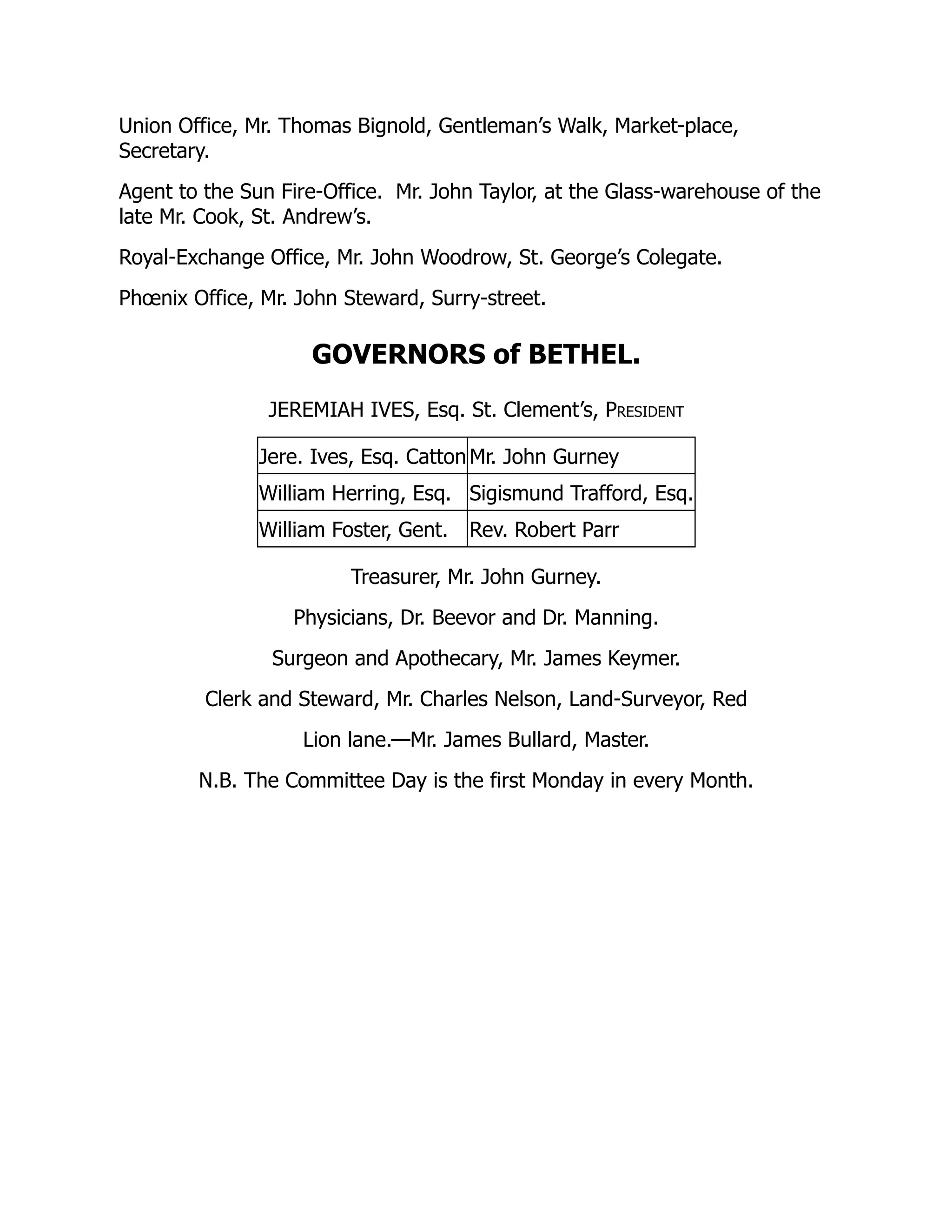
Union Office, Mr. Thomas Bignold, Gentleman’s Walk, Market-place,
Secretary.
Agent to the Sun Fire-Office. Mr. John Taylor, at the Glass-warehouse of the
late Mr. Cook, St. Andrew’s.
Royal-Exchange Office, Mr. John Woodrow, St. George’s Colegate.
Phœnix Office, Mr. John Steward, Surry-street.
GOVERNORS of BETHEL.
JEREMIAH IVES, Esq. St. Clement’s, President
Jere. Ives, Esq. Catton Mr. John Gurney
William Herring, Esq. Sigismund Trafford, Esq.
William Foster, Gent. Rev. Robert Parr
Treasurer, Mr. John Gurney.
Physicians, Dr. Beevor and Dr. Manning.
Surgeon and Apothecary, Mr. James Keymer.
Clerk and Steward, Mr. Charles Nelson, Land-Surveyor, Red
Lion lane.—Mr. James Bullard, Master.
N.B. The Committee Day is the first Monday in every Month.
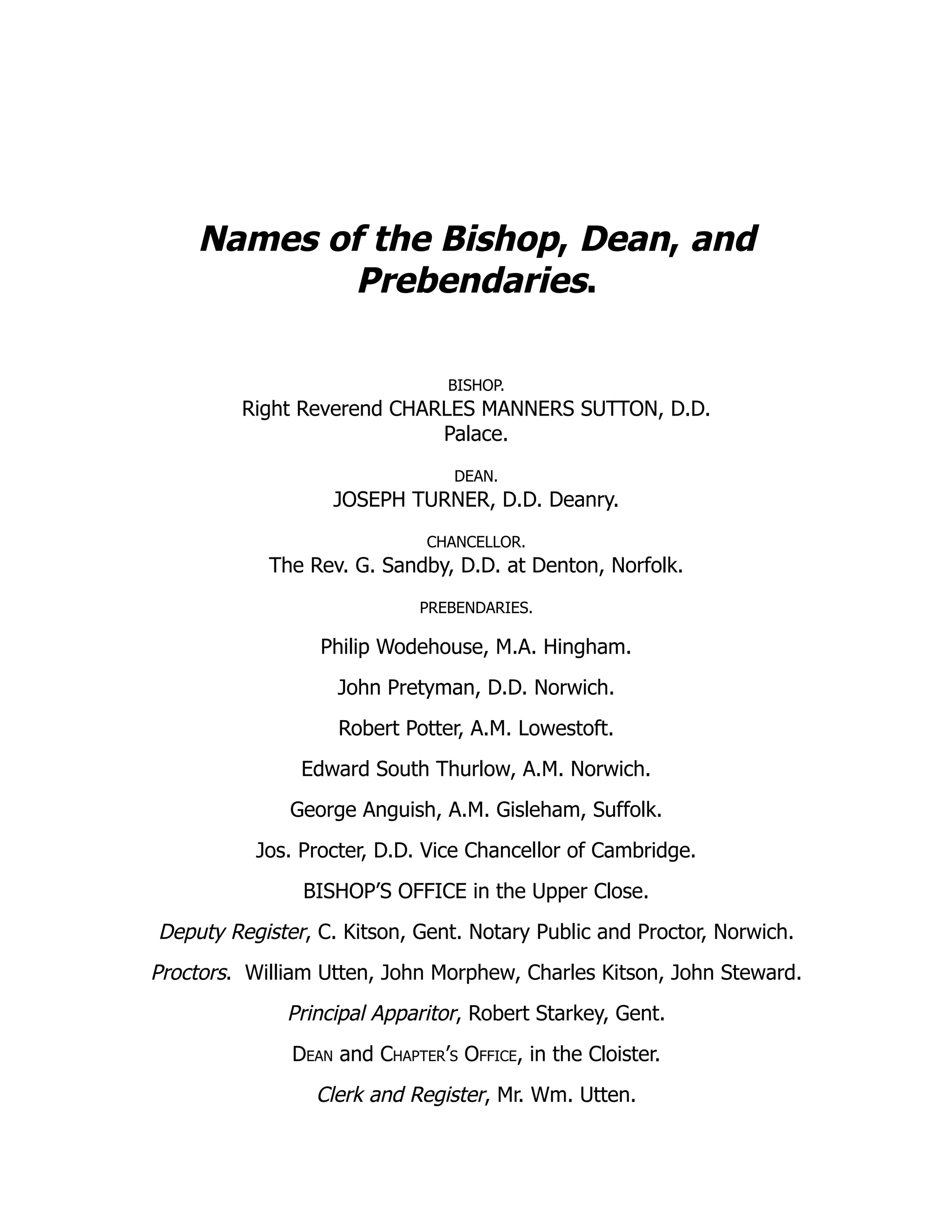
Names of the Bishop, Dean, and
Prebendaries.
BISHOP.
Right Reverend CHARLES MANNERS SUTTON, D.D.
Palace.
DEAN.
JOSEPH TURNER, D.D. Deanry.
CHANCELLOR.
The Rev. G. Sandby, D.D. at Denton, Norfolk.
PREBENDARIES.
Philip Wodehouse, M.A. Hingham.
John Pretyman, D.D. Norwich.
Robert Potter, A.M. Lowestoft.
Edward South Thurlow, A.M. Norwich.
George Anguish, A.M. Gisleham, Suffolk.
Jos. Procter, D.D. Vice Chancellor of Cambridge.
BISHOP’S OFFICE in the Upper Close.
Deputy Register, C. Kitson, Gent. Notary Public and Proctor, Norwich.
Proctors. William Utten, John Morphew, Charles Kitson, John Steward.
Principal Apparitor, Robert Starkey, Gent.
Dean and Chapter’s Office, in the Cloister.
Clerk and Register, Mr. Wm. Utten.
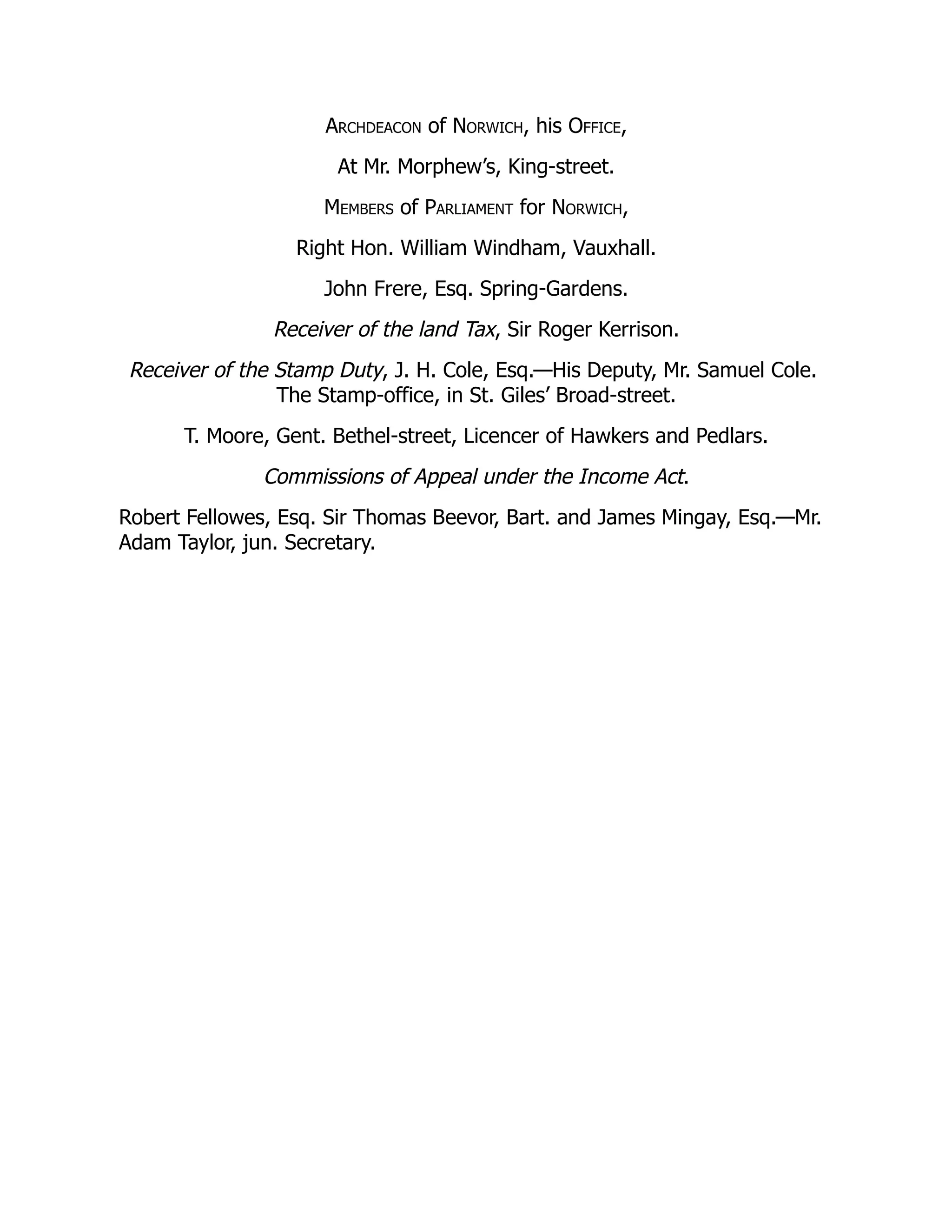
Archdeacon of Norwich, his Office,
At Mr. Morphew’s, King-street.
Members of Parliament for Norwich,
Right Hon. William Windham, Vauxhall.
John Frere, Esq. Spring-Gardens.
Receiver of the land Tax, Sir Roger Kerrison.
Receiver of the Stamp Duty, J. H. Cole, Esq.—His Deputy, Mr. Samuel Cole.
The Stamp-office, in St. Giles’ Broad-street.
T. Moore, Gent. Bethel-street, Licencer of Hawkers and Pedlars.
Commissions of Appeal under the Income Act.
Robert Fellowes, Esq. Sir Thomas Beevor, Bart. and James Mingay, Esq.—Mr.
Adam Taylor, jun. Secretary.
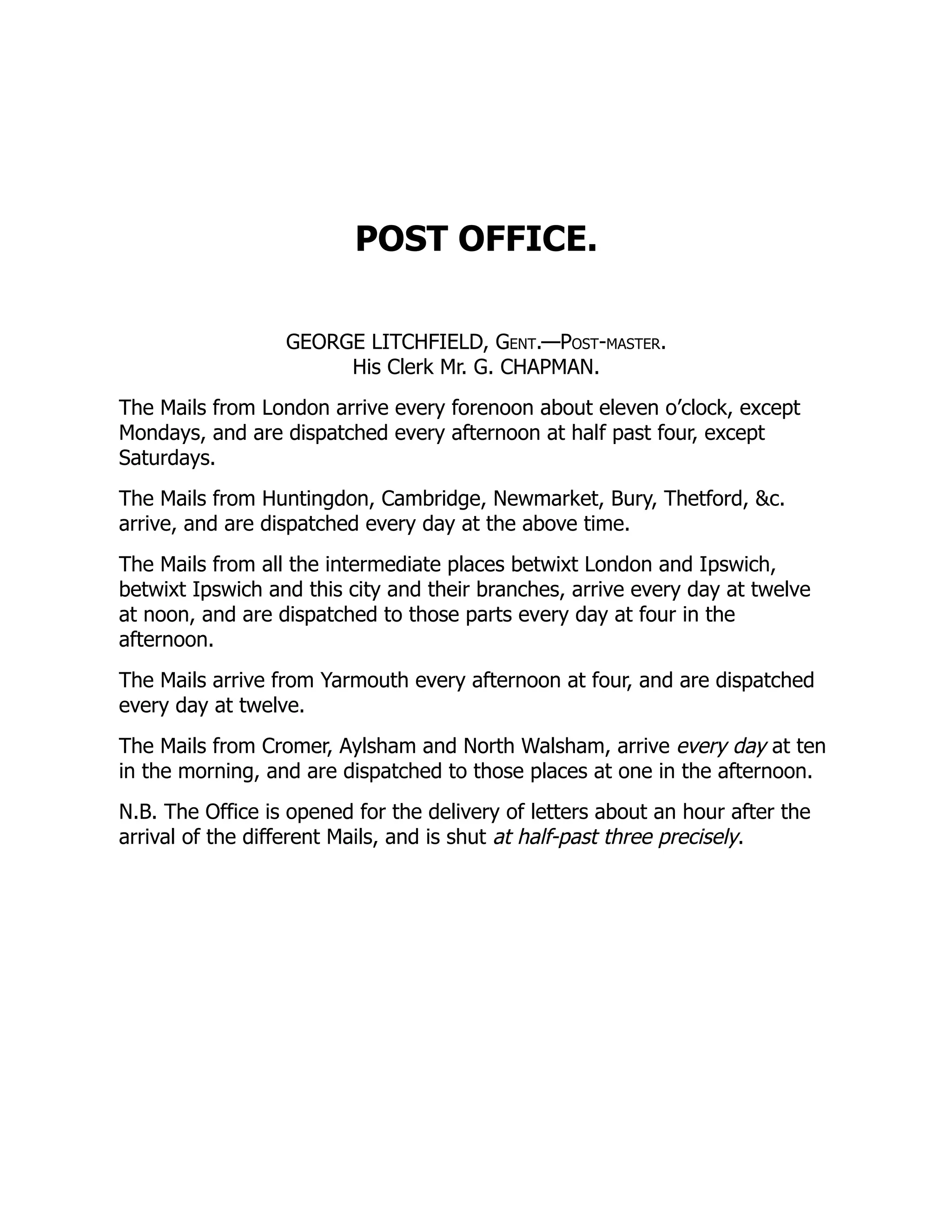
POST OFFICE.
GEORGE LITCHFIELD, Gent.—Post-master.
His Clerk Mr. G. CHAPMAN.
The Mails from London arrive every forenoon about eleven o’clock, except
Mondays, and are dispatched every afternoon at half past four, except
Saturdays.
The Mails from Huntingdon, Cambridge, Newmarket, Bury, Thetford, &c.
arrive, and are dispatched every day at the above time.
The Mails from all the intermediate places betwixt London and Ipswich,
betwixt Ipswich and this city and their branches, arrive every day at twelve
at noon, and are dispatched to those parts every day at four in the
afternoon.
The Mails arrive from Yarmouth every afternoon at four, and are dispatched
every day at twelve.
The Mails from Cromer, Aylsham and North Walsham, arrive every day at ten
in the morning, and are dispatched to those places at one in the afternoon.
N.B. The Office is opened for the delivery of letters about an hour after the
arrival of the different Mails, and is shut at half-past three precisely.
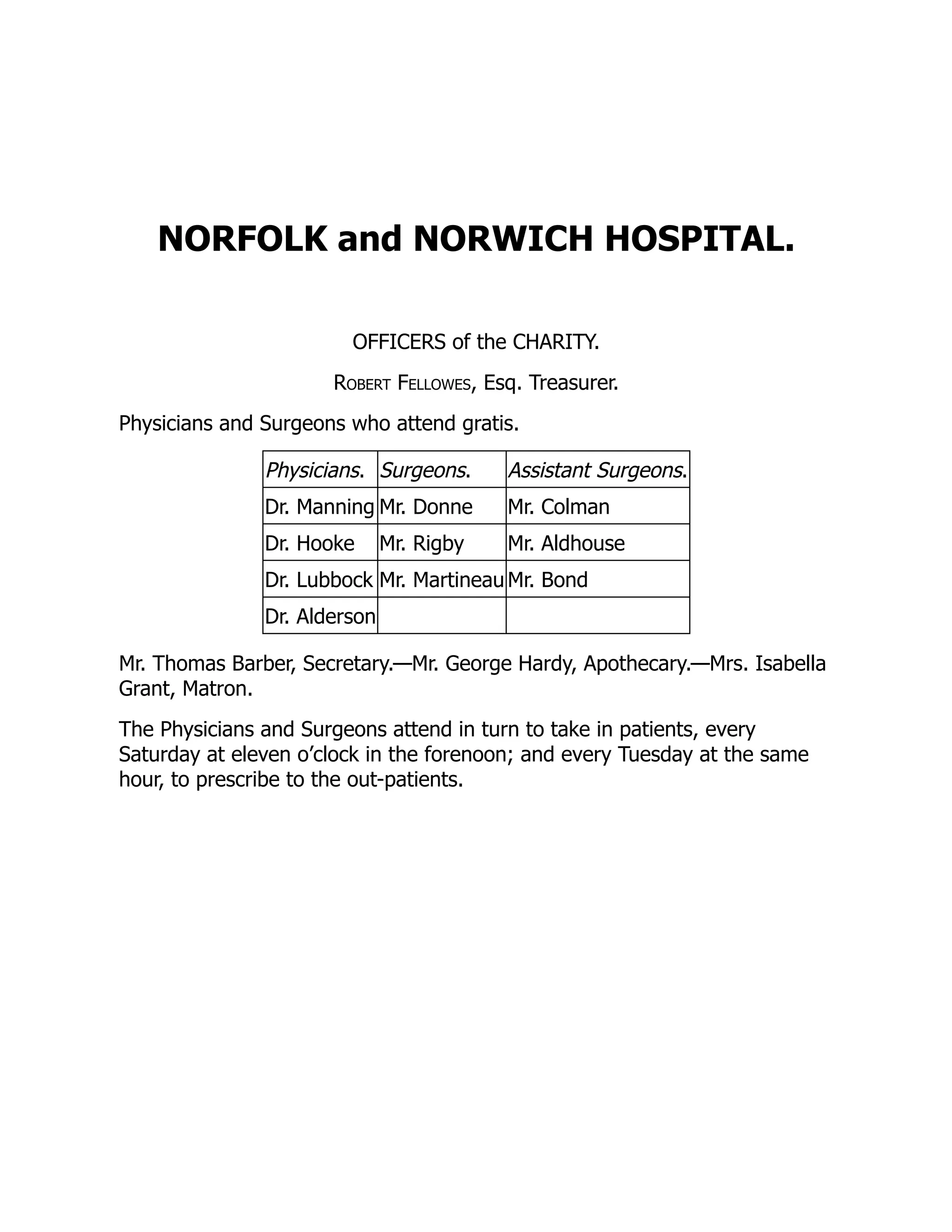
NORFOLK and NORWICH HOSPITAL.
OFFICERS of the CHARITY.
Robert Fellowes, Esq. Treasurer.
Physicians and Surgeons who attend gratis.
Physicians. Surgeons. Assistant Surgeons.
Dr. Manning Mr. Donne Mr. Colman
Dr. Hooke Mr. Rigby Mr. Aldhouse
Dr. Lubbock Mr. Martineau Mr. Bond
Dr. Alderson
Mr. Thomas Barber, Secretary.—Mr. George Hardy, Apothecary.—Mrs. Isabella
Grant, Matron.
The Physicians and Surgeons attend in turn to take in patients, every
Saturday at eleven o’clock in the forenoon; and every Tuesday at the same
hour, to prescribe to the out-patients.
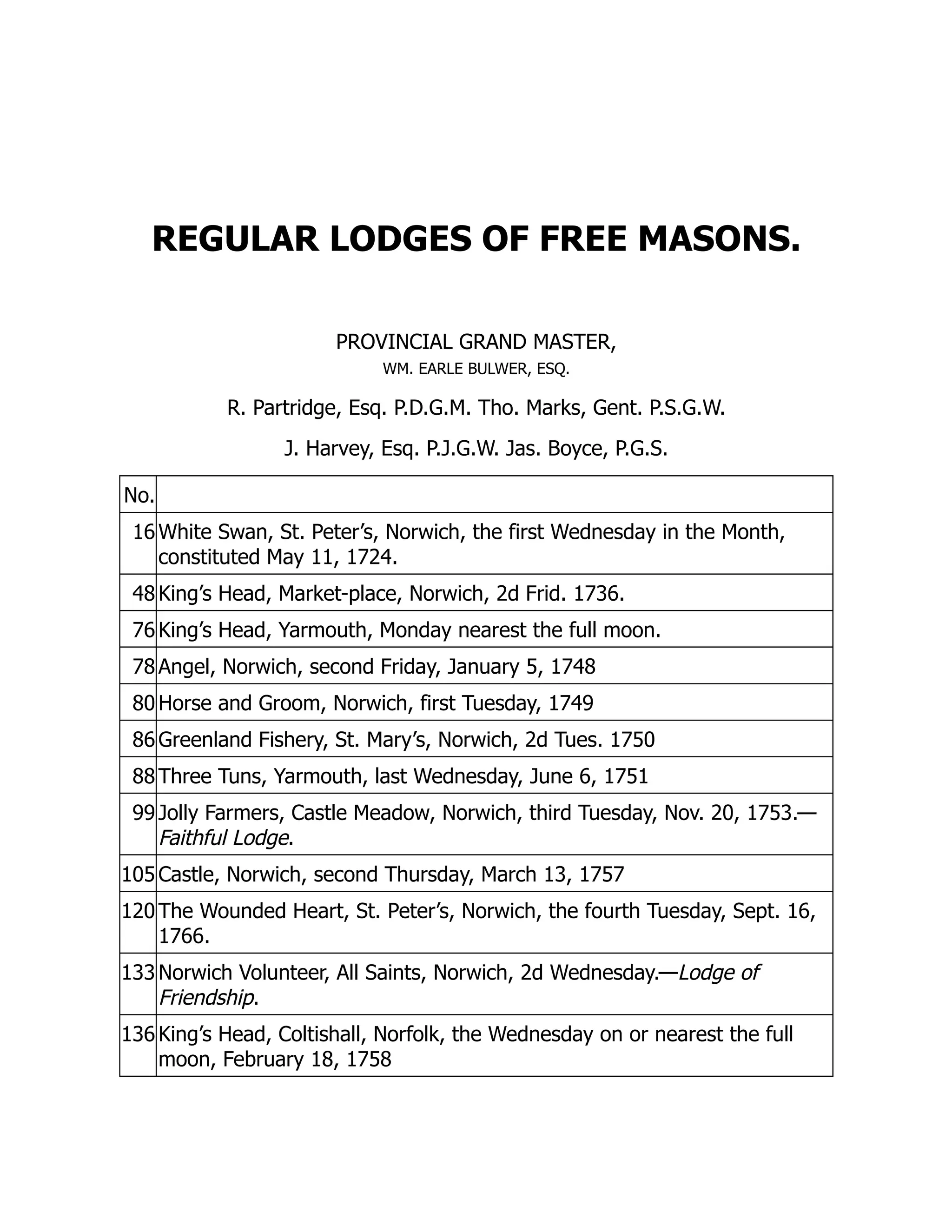
REGULAR LODGES OF FREE MASONS.
PROVINCIAL GRAND MASTER,
WM. EARLE BULWER, ESQ.
R. Partridge, Esq. P.D.G.M. Tho. Marks, Gent. P.S.G.W.
J. Harvey, Esq. P.J.G.W. Jas. Boyce, P.G.S.
No.
16 White Swan, St. Peter’s, Norwich, the first Wednesday in the Month,
constituted May 11, 1724.
48 King’s Head, Market-place, Norwich, 2d Frid. 1736.
76 King’s Head, Yarmouth, Monday nearest the full moon.
78 Angel, Norwich, second Friday, January 5, 1748
80 Horse and Groom, Norwich, first Tuesday, 1749
86 Greenland Fishery, St. Mary’s, Norwich, 2d Tues. 1750
88 Three Tuns, Yarmouth, last Wednesday, June 6, 1751
99 Jolly Farmers, Castle Meadow, Norwich, third Tuesday, Nov. 20, 1753.—
Faithful Lodge.
105 Castle, Norwich, second Thursday, March 13, 1757
120 The Wounded Heart, St. Peter’s, Norwich, the fourth Tuesday, Sept. 16,
1766.
133 Norwich Volunteer, All Saints, Norwich, 2d Wednesday.—Lodge of
Friendship.
136 King’s Head, Coltishall, Norfolk, the Wednesday on or nearest the full
moon, February 18, 1758
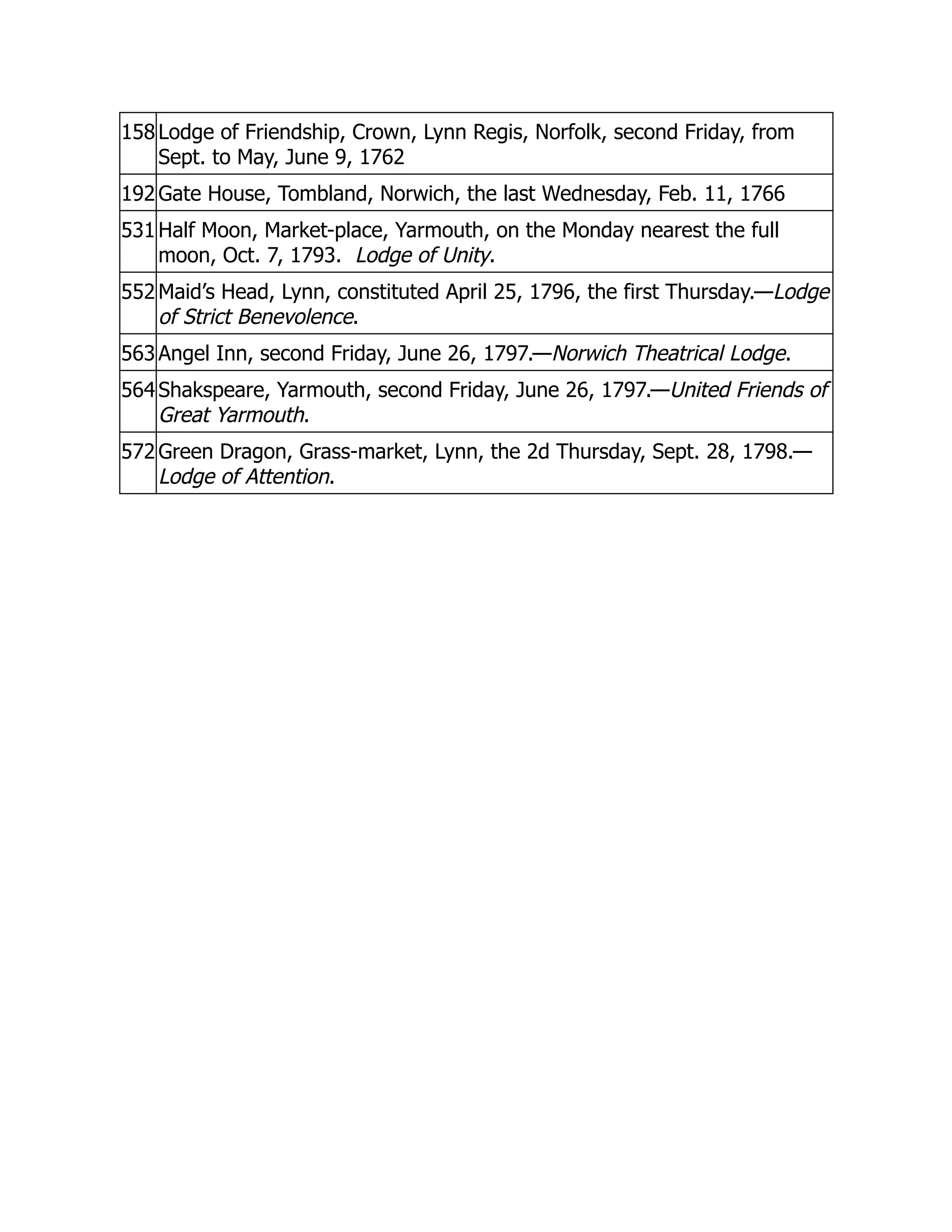
158 Lodge of Friendship, Crown, Lynn Regis, Norfolk, second Friday, from
Sept. to May, June 9, 1762
192 Gate House, Tombland, Norwich, the last Wednesday, Feb. 11, 1766
531 Half Moon, Market-place, Yarmouth, on the Monday nearest the full
moon, Oct. 7, 1793. Lodge of Unity.
552 Maid’s Head, Lynn, constituted April 25, 1796, the first Thursday.—Lodge
of Strict Benevolence.
563 Angel Inn, second Friday, June 26, 1797.—Norwich Theatrical Lodge.
564 Shakspeare, Yarmouth, second Friday, June 26, 1797.—United Friends of
Great Yarmouth.
572 Green Dragon, Grass-market, Lynn, the 2d Thursday, Sept. 28, 1798.—
Lodge of Attention.
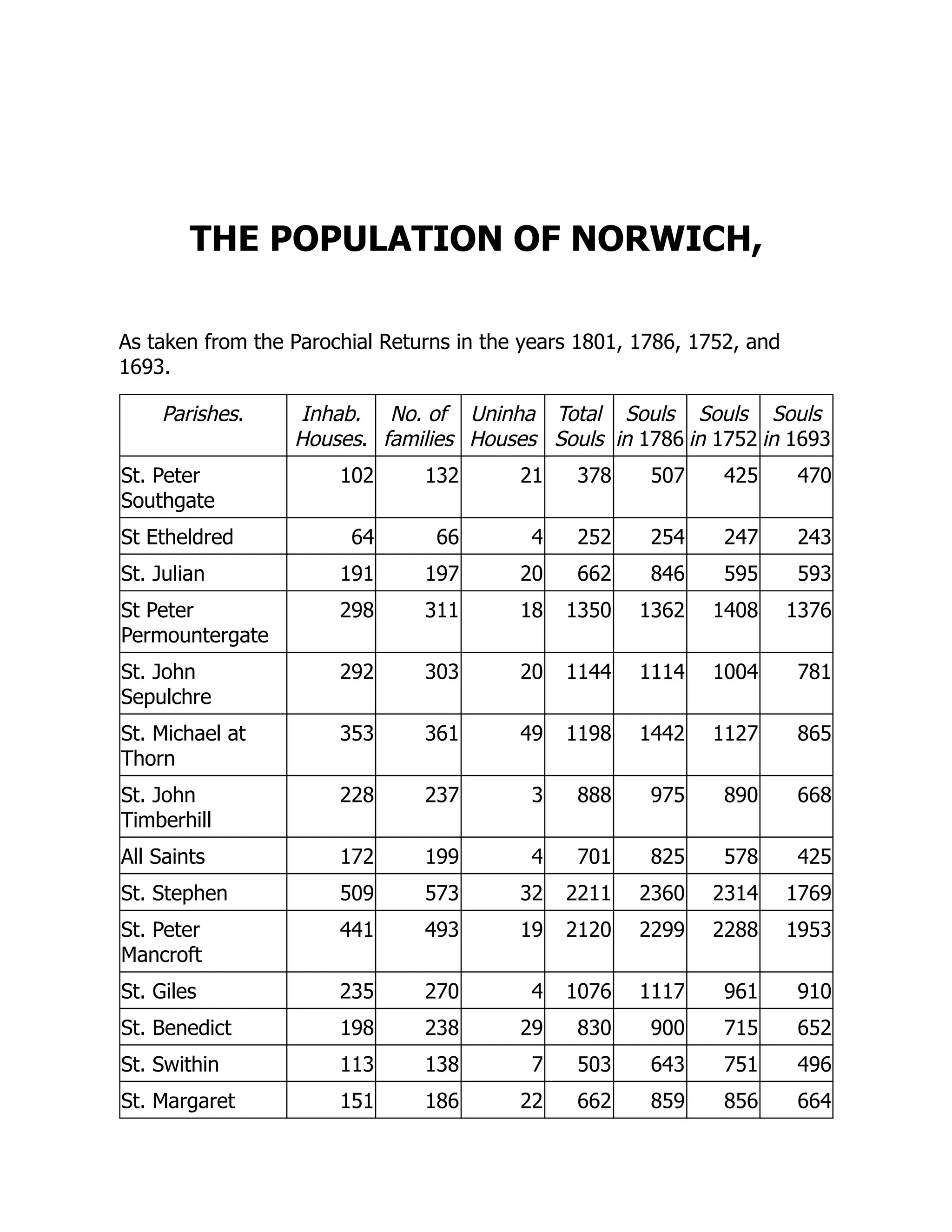
THE POPULATION OF NORWICH,
As taken from the Parochial Returns in the years 1801, 1786, 1752, and
1693.
Parishes. Inhab.
Houses.
No. of
families
Uninha
Houses
Total
Souls
Souls
in 1786
Souls
in 1752
Souls
in 1693
St. Peter
Southgate
102 132 21 378 507 425 470
St Etheldred 64 66 4 252 254 247 243
St. Julian 191 197 20 662 846 595 593
St Peter
Permountergate
298 311 18 1350 1362 1408 1376
St. John
Sepulchre
292 303 20 1144 1114 1004 781
St. Michael at
Thorn
353 361 49 1198 1442 1127 865
St. John
Timberhill
228 237 3 888 975 890 668
All Saints 172 199 4 701 825 578 425
St. Stephen 509 573 32 2211 2360 2314 1769
St. Peter
Mancroft
441 493 19 2120 2299 2288 1953
St. Giles 235 270 4 1076 1117 961 910
St. Benedict 198 238 29 830 900 715 652
St. Swithin 113 138 7 503 643 751 496
St. Margaret 151 186 22 662 859 856 664
Welcome to our website – the ideal destination for book lovers and
knowledge seekers. With a mission to inspire endlessly, we offer a
vast collection of books, ranging from classic literary works to
specialized publications, self-development books, and children's
literature. Each book is a new journey of discovery, expanding
knowledge and enriching the soul of the reade
Our website is not just a platform for buying books, but a bridge
connecting readers to the timeless values of culture and wisdom. With
an elegant, user-friendly interface and an intelligent search system,
we are committed to providing a quick and convenient shopping
experience. Additionally, our special promotions and home delivery
services ensure that you save time and fully enjoy the joy of reading.
Let us accompany you on the journey of exploring knowledge and
personal growth!
testbankdeal.com


Communication in Business International Edition 8th Edition Ober Test Bank

  • 1.
    Visit https://testbankdeal.com todownload the full version and explore more testbank or solutions manual Communication in Business International Edition 8th Edition Ober Test Bank _____ Click the link below to download _____ https://testbankdeal.com/product/communication-in-business- international-edition-8th-edition-ober-test-bank/ Explore and download more testbank or solutions manual at testbankdeal.com
  • 2.
    Here are somerecommended products that we believe you will be interested in. You can click the link to download. Communication in Business International Edition 8th Edition Ober Solutions Manual https://testbankdeal.com/product/communication-in-business- international-edition-8th-edition-ober-solutions-manual/ Business Communication In Person In Print Online 8th Edition Newman Test Bank https://testbankdeal.com/product/business-communication-in-person-in- print-online-8th-edition-newman-test-bank/ Business Communication In Person In Print Online 8th Edition Newman Solutions Manual https://testbankdeal.com/product/business-communication-in-person-in- print-online-8th-edition-newman-solutions-manual/ Maders Understanding Human Anatomy and Physiology 9th Edition Longenbaker Solutions Manual https://testbankdeal.com/product/maders-understanding-human-anatomy- and-physiology-9th-edition-longenbaker-solutions-manual/
  • 3.
    Experiments in Physiology11th Edition Woodman Solutions Manual https://testbankdeal.com/product/experiments-in-physiology-11th- edition-woodman-solutions-manual/ Essentials of Negotiation 5th Edition Lewicki Test Bank https://testbankdeal.com/product/essentials-of-negotiation-5th- edition-lewicki-test-bank/ Introduction to Operations and Supply Chain Management 4th Edition Bozarth Solutions Manual https://testbankdeal.com/product/introduction-to-operations-and- supply-chain-management-4th-edition-bozarth-solutions-manual/ Consumer Behaviour 6th Edition Schiffman Test Bank https://testbankdeal.com/product/consumer-behaviour-6th-edition- schiffman-test-bank/ Entrepreneurial Finance 5th Edition Adelman Test Bank https://testbankdeal.com/product/entrepreneurial-finance-5th-edition- adelman-test-bank/
  • 4.
    Using Financial AccountingInformation The Alternative to Debits and Credits 8th Edition Porter Test Bank https://testbankdeal.com/product/using-financial-accounting- information-the-alternative-to-debits-and-credits-8th-edition-porter- test-bank/
  • 5.
    © 2011 CengageLearning. All Rights Reserved. This edition is intended for use outside of the U.S. only, with content that may be different from the U.S. Edition. May not be scanned, copied, duplicated, or posted to a publicly accessible website, in whole or in part. Chapter 10—Business Research and Report Writing TRUE/FALSE 1. Formal reports use side headings; informal reports do not. ANS: F PTS: 1 2. Memo reports are written for an internal audience; letter reports may be written for either an internal or an external audience. ANS: F PTS: 1 3. Standardizing the format of a technical report makes it easy for readers to scan the document for the specific item(s) of interest to them. ANS: T PTS: 1 4. Research problems may be phrased as statements or questions. ANS: T PTS: 1 5. Brainstorming and cluster diagramming can help researchers set the scope of a project. ANS: T PTS: 1 6. When setting the time schedule for a research project, work back from the deadline date. ANS: T PTS: 1 7. Research studies conducted by current employees using data obtained from the organization’s files do not need to have a budget. ANS: F PTS: 1 8. Research procedures vary from project to project. ANS: T PTS: 1 9. The standards for documenting information obtained from web sources are less rigid than the standards for documenting print secondary sources. ANS: F PTS: 1 10. The primary receivers (readers) of a message must be analyzed; the secondary receivers need not be analyzed. ANS: F PTS: 1 11. Face-to-face surveys can be costly, but they produce the most in-depth responses. ANS: T PTS: 1
  • 6.
    © 2011 CengageLearning. All Rights Reserved. This edition is intended for use outside of the U.S. only, with content that may be different from the U.S. Edition. May not be scanned, copied, duplicated, or posted to a publicly accessible website, in whole or in part. 12. Pilot testing or field testing a survey can help to identify questions that need to be reworded to improve clarity. ANS: T PTS: 1 13. Focus group participants may be less open with their responses if they know they are being taped; therefore, it is better not to tell them they are being recorded. ANS: F PTS: 1 14. The conclusions and recommendations sections of a report allow the researcher to infuse his or her opinions into a report. ANS: F PTS: 1 15. The introduction of a report helps the reader understand the scope and sequence of the report. ANS: T PTS: 1 16. The executive summary of a report emphasizes the findings, conclusions, and recommendations of the study. ANS: T PTS: 1 17. The guidelines and policies of an organization must be considered when deciding how to format a formal report. ANS: T PTS: 1 18. All appendixes included with a report must be referred to within the body of the report. ANS: T PTS: 1 19. Headings must be parallel within and between levels. ANS: F PTS: 1 20. It is unnecessary to include a source citation for paraphrased material. ANS: F PTS: 1 MULTIPLE CHOICE 1. The formality of a report is a. based on the culture of the writer’s organization. b. based on the content. c. determined by the preference of the writer. d. determined by the receiver. ANS: A PTS: 1
  • 7.
    © 2011 CengageLearning. All Rights Reserved. This edition is intended for use outside of the U.S. only, with content that may be different from the U.S. Edition. May not be scanned, copied, duplicated, or posted to a publicly accessible website, in whole or in part. 2. Which of the following report types is also known as a status report? a. Periodic b. Progress c. Technical d. Unsolicited ANS: B PTS: 1 3. You start planning a research study by a. determining the factors. b. determining the solutions. c. scheduling the study. d. stating the problem. ANS: D PTS: 1 4. What is a Gantt chart? a. A budget spreadsheet b. A cluster diagram c. A statistical analysis tool d. A time schedule ANS: D PTS: 1 5. Buchan Molding manufactures plastic tubing used in various industries. Which of the following represents the best way for Buchan to gather customer satisfaction data about the service received during the lengthy, complicated transactions common in its business? a. Conduct a telephone survey. b. Send a comment card with the customer’s order. c. Send a letter of inquiry. d. Visit each customer personally. ANS: A PTS: 1 6. All but which of the following is a primary date source? a. A personal interview b. A website located through an Internet search c. An observation d. Company records ANS: B PTS: 1 7. Experiments a. are used to identify a better way of doing things. b. have high personnel costs. c. represent a common business research method. d. require less control than other business research methods. ANS: A PTS: 1 8. The solution to a research problem is presented in the report as a part of the a. Appendix. b. Conclusions. c. Findings.
  • 8.
    © 2011 CengageLearning. All Rights Reserved. This edition is intended for use outside of the U.S. only, with content that may be different from the U.S. Edition. May not be scanned, copied, duplicated, or posted to a publicly accessible website, in whole or in part. d. Recommendations. ANS: D PTS: 1 9. If a formal report contains a comprehensive letter of transmittal, the report will not contain a/an a. bibliography. b. executive summary c. introduction. d. table of contents. ANS: B PTS: 1 10. Which of the following headings is NOT grammatically parallel to the others? a. Fringe Benefits b. Income Generated from Patents c. Quarterly Dividends d. Unanticipated Losses ANS: B PTS: 1 ESSAY 1. Describe how to arrive at a clear, accurate written statement of the problem for a research study. ANS: Prior to arriving at the statement of the problem, there may be discussions within the organization about what the research should accomplish. A preliminary investigation of the situation that prompted the research may be made to help define the problem. You may look at files, talk to employees, read other similar reports, talk to vendors, or make any number of preliminary inquiries to help you clarify what needs to be studied. PTS: 1 2. List the five steps for conducting research. ANS: The five steps for conducting research are: 1. Plan the research 2. Gather information 3. Analyze the information 4. Determine the solution(s) 5. Write the report PTS: 1 3. In what ways are brainstorming and cluster diagramming similar? In what ways are they different? ANS: Brainstorming and cluster diagramming are similar in that both (a) are useful in narrowing the scope of a research project and (b) can be done individually or in a group.
  • 9.
    © 2011 CengageLearning. All Rights Reserved. This edition is intended for use outside of the U.S. only, with content that may be different from the U.S. Edition. May not be scanned, copied, duplicated, or posted to a publicly accessible website, in whole or in part. The techniques are different in that brainstormed ideas are not evaluated or sequenced until after a list has been developed. In cluster diagramming, ideas are grouped as they are introduced. PTS: 1 4. When your research plan includes gathering data from both primary and secondary sources, which should be gathered first? Why? ANS: Secondary source information should be gathered first because it might contain good ideas about what primary information should be gathered and how to collect it. PTS: 1 5. Comment on the credibility of information obtained through online forums such as newsgroups, blogs, and chatrooms. ANS: Although online forums may lead to credible information sources, they generally are not viewed as credible in and of themselves. PTS: 1 6. Distinguish between commercial and open-access sources of data/information. ANS: A commercial source provides data/information for a fee; an open-access source makes data/information available free to anyone who has access to the Internet. PTS: 1 7. What should be included in the procedures section of a formal report? What purposes does the procedures section serve? ANS: The procedures section describes the steps that were taken in conducting the study. Purposes of the section are to allow readers to determine whether or not all aspects of the problem were investigated adequately and to aid another researcher to conduct a similar study that could validate or disprove the results of the original study. PTS: 1 8. Compare the conclusions and recommendations sections of a formal report. ANS: Conclusions are statements of reasoning that a researcher makes after a thorough analysis of the findings. Recommendations are the writer's suggestions to the reader as to the action(s) that should be taken to solve the problem that was studied. Recommendations should develop logically from the findings and conclusions. PTS: 1
  • 10.
    © 2011 CengageLearning. All Rights Reserved. This edition is intended for use outside of the U.S. only, with content that may be different from the U.S. Edition. May not be scanned, copied, duplicated, or posted to a publicly accessible website, in whole or in part. 9. Why are the mechanics of a written report important? ANS: The mechanics of a written report are important because they make the first impression on the reader--an impression that reflects on the report writer and his or her credibility. PTS: 1 10. After analyzing the receiver of your report, you determine that he or she will not understand some of the terms in your report. What should you do? ANS: Depending on the number of unfamiliar terms, the writer has two choices. If the number of unfamiliar terms is small, the terms may be listed and defined as part of the report introduction. If numerous terms are to be defined, the words and their definitions should be listed in a glossary at as a supplementary part of the report PTS: 1
  • 11.
    Another Random ScribdDocument with Unrelated Content
  • 12.
    noblest and mostperfect Saxon arches now extant. The inside, instead of an open yard, was filled up with floors of most magnificent and spacious apartments; traces of which may yet be seen by persons accustomed to examine buildings of this sort. On the ground floor they were vaulted over with stone, for a great part of the old vault still remains; also the great stone arches of the buttresses, and a stone vaulting where the present chapel is. It was used as a prison so early as the reign of Henry I. but not for that purpose solely:—the upper apartments of these towers, were state apartments, for the residence of great officers and their attendants. Its length is 92 feet, 10 inches; the length of the North and South fronts, 98 feet each: the walls are 50 feet in heighth. Somewhat resembling the architecture of the Old, is the New Castle, adjoining to it on the East side, built with Scotch granite in the year 1793; apparently of great strength and durability. The Castle-Hill appears to have been raised by art, with incredible labour: it stands nearly in the center of the city, and commands an agreeable prospect of the surrounding buildings, interspersed with gardens, which, with the adjacent country and river, form a most delightful landscape. Since the addition of the Gardens round the bottom of the Hill, strangers have acknowledged the view from the summit to be superior to any thing of the kind in Europe, and have justly styled Norwich ‘The City in an Orchard.’ In the Shire-House, which adjoins the Castle on the North side, the Summer Assizes and Quarter-Sessions are held, and other county business transacted. THE CATHEDRAL
  • 13.
    Was founded byBishop Herbert in 1096, and was chiefly composed of wood, which, by various accidents, and the turbulence of the times, was often greatly damaged. The present Cathedral is a fine Gothic free-stone building, brought to the magnificent state in which it now appears by the bounty of numerous benefactors, at various times, and completed by William Middleton, the thirty-sixth Bishop, in the year 1284. The roof is adorned with various well-carved images, from the historical passages of scripture. On the windows at the East end of the church is most curiously painted the transfiguration, and the twelve apostles, by Dean Lloyd’s lady. The shaft, or spire, is handsome and well proportioned. Except Salisbury, it is the highest in the kingdom, being 105 yards, 2 feet, from the pavement to the top of the pinnacle, strongly built with free-stone on the outside and brick within. The top stone of the spire consists of half a globe, 1 yard, 2 inches broad, with a channel round it; whence extend eight leaves of stone, spreading outward, under which commence the eight rows of crockets, continued down the spire, at 5 feet distance from each other. The weather-cock placed here at the restoration, is three quarters of a yard high, and one yard, two inches broad, as is also the crossbar. The Cloister on the South side of the church is the largest quadrangle of the kind in England, each side measuring 58 yards in length, near 14 feet in breadth, and 16 feet, 6 inches in heighth;— the stone roof is ornamented with elegant carvings, representing the visions of the Revelations, the Crucifixion and Resurrection, the Legends of St. Christopher, St. Lawrence, &c. At the South-West corner, the Espousals, or Sacrament of Marriage, are carved in stone, and at the entrance of the Cloister from hence, on the left hand, are the two lavatories, where the monks used to wash their hands. Over one of them is carved a fox in a pulpit, in the habit of a secular priest, holding up a goose to has auditory,
  • 14.
    intended as areflection on the secular clergy, or parish priests, to whom the monks bore an inveterate hatred. On the North side of the Cathedral stands the Bishop’s Palace, to which are most elegant gardens. The Free Grammar school, near this, is a neat, spacious, gothic building, formerly used as a charnel-house. ST. ANDREW’S HALL, Formerly the monastery church of the Black Friars, or Benedictine Monks, is a beautiful structure, about 50 yards in length, and 30 in width: the roof is supported by twelve neat and very slender pillars. It was built by Sir Thomas Erpingham, Knt. in 1428; and was the place where the company of St. George used to hold their meetings of business and pleasure. The Mayor’s guild-feast is always held here. Over a clock, in the center of the East end, is carved the effigies of Justice, and underneath, the royal arms of England. On each side, the pictures of Queen Anne, George Prince of Denmark, Robert Earl of Orford, John Lord Hobart, afterwards Earl of Buckenhamshire, Horatio Walpole, Esq. Lord Suffield, and two Historical Paintings of Edward and Eleonora, and the Death of Lady Jane Grey, by Mr. W. Martin, between which is placed, in a splendid and emblematical frame, a highly-finished portrait of the brave Lord Nelson, painted by Sir William Beachey, with several Aldermen and Benefactors to the city. The figure of St. George killing the dragon, neatly carved, was placed here in 1686, by order of the St. George’s Company. On the walls of the North and South ailes are placed elegant paintings at full length, superbly framed, of those Gentlemen who have gone through the public offices of the Corporation with dignity and honour.
  • 15.
    Against the furtherpillar on the North side, is an Ensign, 60 feet in length, supported by a flag-staff, near the top of which is an ornamented Shield, with the following Inscription: “The Ensign of the French Ship, Genereux, Taken in the Mediterranean, Feb. 18th, 1800, By His Majesty’s Ship, Foudroyant, and Squadron, Commanded by LORD NELSON: The Genereux, with the Guillaume Tell, since taken by the Foudroyant, Lion, and Penelope, were the only Ships which escaped the memorable Victory obtained by Lord Nelson over the French, at the Nile, Aug. 1st, 1798. In testimony of his Gratitude for the Honours conferred on him by the City of Norwich, this Trophy is presented, in the second Mayoralty of Robert Harvey, Esq. by SIR EDWARD BERRY, KNT. Captain of his Majesty’s Ship, Foudroyant, 1800.” Herein is a handsome room for the city Library, re-built in the Gothic taste, under the direction of the late Mr. Rawlins. THE GUILD-HALL. In this Hall, the assizes and quarter sessions for the city are held. Also the Mayor’s office, for the daily administration of justice; the town-clerk’s and chamberlain’s offices: and all elections for Mayor, Aldermen, Sheriffs and Common-councilmen are here determined. The windows contained many stories on painted or stained glass, relating to the administration of justice;—there now remain perfect only one large and two small windows, to perpetuate the remembrance of this beautiful art.
  • 16.
    The room isadorned with the pictures of King William and Queen Mary, many eminent men of the county, mayors of the city, and other benefactors. Herein is the following inscription, suspended from a Golden Anchor, at the bottom of which are Lord Nelson’s arms, neatly executed—in the center Tria junca in uno, on one side a Lion, on the other a Sailor, at foot Faith and Works. “The Sword of the Spanish Admiral Don Xavier Winthuysen, who died of the wounds he received in an engagement with the British Fleet under the command of Admiral Earl St. Vincent, 14th Feb. 1797, which ended in the most brilliant victory ever obtained by this Country over the Enemy at Sea: wherein the heroic Valour and cool determined Courage of Rear Admiral Sir Horatio Nelson, K. B. had ample scope for their display. He being a Native of Norfolk, honoured the City by presenting this Sword, surrendered to him in that Action.” The City Prison is directly opposite. ST. PETER OF MANCROFT CHURCH Was begun in 1430, and finished in 1455. It is esteemed a very handsome parish church: has a fine square tower steeple, 98 feet high, though designed at first to have been much higher, as appears from the double buttresses reaching to the top, and the thickness of the walls: this tower contains an excellent peal of twelve bells, cast by Messrs. Pack and Chapman, of London, in 1775; the Tenor weighing 41 cwt. The whole is covered with lead, and supported by two rows of pillars, remarkably neat and slender, forming eliptic arches at their top. The altar-piece, representing the story of St. Peter being delivered out of prison, was painted by that ingenious artist Mr. Catton, and presented to the parish by Alderman Starling, in 1768. The furniture
  • 17.
    of the altaris crimson velvet, and the plate exceedingly grand, all but one cup being double gilt: one piece of it is remarkably curious, being an elegant standing cup and cover of silver, double gilt, weighing 46 oz. 1 gr. 1 pt. given by Sir Peter Gleane, Knight, whereon is beautifully chased the story of Abigail bringing presents to David. In the vestry hangs a neat old painted carving in alabaster, of nine female saints, probably designed for some altar of St. Margaret, who is the principal figure, and here represented as holding down a dragon; among others, St. Hilda, holding a book and pastoral staff; St. Barbara, a tower and palm-branch. There is also an octavo manuscript bible upon vellum, written in 1340, and a folio manuscript much more ancient, containing all St. Paul’s epistles, with a comment. THE NORFOLK AND NORWICH HOSPITAL, St. Stephen’s road, is a very neat edifice: was erected in 1772, and is still supported by voluntary contributions. The Public Library is now kept at the building formerly the Roman Catholic chapel, in Wymer-street, and contains 5000 volumes, where books are delivered by the Librarian to the subscribers every day between the hours of eleven and two, Sundays and the following days excepted, 29th of May, 4th of June, the Guild-day, and the day preceding; 25th of October and 5th of November. BRIDEWELL, Was built by Bartholomew Appleyard, about the year 1370. William Appleyard, his son, the first Mayor of Norwich, served his Mayoralty here in 1403. The North wall of this Bridewell is encrusted with cut flints, and is seventy-six feet in length, by about twenty-five high: it is considered one of the greatest curiosities of the kind in England.
  • 18.
    The flints aresquared to such a nicety, that the edge of a knife can scarcely be insinuated between the joints: most of them are about three inches square, the surface is very smooth, and no brick-work can appear more regular. Several churches and other buildings in the city are thus built. Mr. Talman says, that the Jews introduced the art of squaring flints: and Dr. Cromwell Mortimer, Secretary to the Royal Society, in a note on a paper of Mr. Arderon’s on this very wall, observes, that the gate of the Austin Friars, at Canterbury, that of St. John’s Abbey, at Colchester, and the gate near Whitehall, Westminster, are in the same taste. But the platform on the top of the Royal Observatory at Paris, which, in instead of being covered with lead, is paved with flint after this manner, is an instance that the French have in some measure recovered this art. Phil. Trans. Abr. vol. 10. p. 1304. THE THEATRE Was built by the late Mr. Thomas Ivory, after the model of old Drury- lane house; and in 1800 underwent an entire, elegant, and spirited alteration, under the direction, and highly to the credit of, the present Patentee, Mr. Wilkins. The house now contains two circles of Boxes, with side ones on the same tier as the Gallery. There are Stage Boxes the same as those of Drury-lane. The Stage doors are semi-circular, and a Box over them, both of these are filled with a triliage of gold and a small pilaster. The Boxes are supported by small reeded columns of gold, and the front of every Box decorated with coloured Raphael ornaments, on a ground of French grey. At each column are lamps (patent), in the Grecian style, suspended from an antique branch of gold, which gives a brilliancy to the whole. The general tone of colour is a quiet fawn, which is pleasing to the eye, and relieves the pannels of coloured ornaments. The mouldings are gold and white, which give a lightness to the whole. From the entablature or cornice
  • 19.
    in front, descendsa cove, with the Imperial Arms in the centre, admirably executed, painted yellow, and heightened in gold, with this motto, Conabimur (we will endeavour); below this is a rich crimson curtain, with gold fringe, supported by two statues, and on each side of the stage doors are pilasters of gold, reeded, in which every reed plays in the light, and produces the most pleasing effect. There are distinct entrances to each part of the house, Boxes, Pit, and Gallery, and the Box Lobbies are roomy and commodious. At the back of the upper circle is a bar-room, where coffee, tea, sweets, &c. may be procured. The Assembly-Rooms next it are spacious and brilliant. There are five Hospitals: one of them, St Giles’, founded originally for the entertainment of strangers, was, by Henry VIII. appropriated to the poor of the city; which maintains 104 poor men and women, who are all cloathed in grey, and must be sixty years of age. Another for 16 poor men and 8 women, whose livery is purple. Cooke’s Hospital, in the Rose-lane, maintains 10 poor women; and Doughty’s, which was founded in 1687, supports 24 poor men and 8 women. The Boys and Girls’ Hospital contain 30 of each, and the boys are from thence put out apprentices. Besides 5 Charity Schools, where 111 boys and 22 girls are taught, clothed, and supplied with books. A number of Sunday Schools under the care of the Rev. Lancaster Adkin, where 133 boys and girls receive every attention, with many advantages—and several other Charity and Sunday Schools, on foundations, or supported by voluntary contributions from dissenting meetings, &c. taking the whole together, educating, clothing, &c. 300 boys and 150 girls. The City of Norwich has local advantages superior to most cities in the kingdom: a navigable stream to the port of Yarmouth passes through the middle of it, with great convenience for the Wharfage and Delivery of goods of all kinds to and from London. It is situated on a mixed soil of ground, in a salubrious air, neither subject to violent or scorching heat, nor to moist or watery vapours.
  • 20.
    The upper stratumof earth is light soil, of sufficient depth for the plough; the under stratum is chalk, gravel, and sand. It is happily screened and defended from the Easterly winds by a considerable rising ground, called Moushold Heath, which is higher than the tops of the churches in the lower parts of the city. If abounds in springs of water of the purest kind, nearly equal to the celebrated Bristol water, supplied to the inhabitants by a variety of public pumps. The City is governed by a mayor, recorder, steward, 2 sheriffs, 24 aldermen, and 60 common council-men; a town-clerk, sword-bearer, &c. The mayor is elected by the freemen on the first day of May, and sworn into office on the Guild-day, the Tuesday before Midsummer-day; except when Midsummer-day falls on a Wednesday, and then the Guild is kept on the Tuesday se’nnight before Midsummer-day. He is chosen from among the Aldermen, is justice of the quorum during his mayoralty, and afterwards justice of the peace for life. The sheriffs are also annually elected, one by the Aldermen, the other by the freemen, on the last Tuesday in August, and sworn Sept. 29. The city is divided into twelve wards, viz. Ber-street, Colegate, North Conisford, South Conisford, Coslany, Fyebridge, Mancroft, St. Giles, St. Stephen, East Wymer, Middle Wymer, Weft Wymer; each of which elects two Aldermen. These twelve wards are again divided into four great wards; I. Conisford ward contains South Conisford, North Conisford, Ber- street, with the hamlets of Lakenham, Trowse, Milgate, Bracondale, and Carrowe; which is represented by 12 common council-men. II. Mancroft ward contains St. Stephen’s, St. Peter’s of Mancroft, St. Giles’, with the hamlet of Eaton; and is represented by 16 common council-men.
  • 21.
    III. Wymer wardcontains East Wymer, Middle Wymer, West Wymer, with the hamlets of Heigham and Earlham; and is represented by 20 common council-men. IV. The Northern Ward Coslany, Colgate, Fye-bridge, with the hamlet of Pockthorpe; and is represented by 12 common council- men. The freemen for each ward elect Three Nominees, and the Nominees appoint the other common council-men. The city sends two members to parliament, elected by the freeholders and freemen; the latter are free by inheritance, purchase, or servitude, in number about 3000. The freemen must have been admitted to their freedom twelve months before they are entitled to a vote. The Markets are on Wednesdays and Saturdays.
  • 22.
    LIST OF THECOURT OF ALDERMEN OF NORWICH, 1801–1802. Aldermen’s Names. Time when elected. In the Room of Wards. Sheriff. Mayor JEREMIAH IVES, jun. Esq. MAYOR. September 25,1779 Sir H. Harbord, Bart. East Wymer 1782 1786 1801 PAST THE CHAIR. R. Harvey, Esq. D. M. January 5, 1768 Wm. Wigget, Esq. Coslany 1766 1770 1800 Jeremiah Ives, Esq. July 1, 1766 Thomas Vere, Esq. S. Conisford 1763 1769 1795 James Crowe, Esq. July 18,1772 Thomas Harvey, Esq. N. Conisford 1771 1774 1797 Richard Peete, Esq. January 25,1773 Robert Harvey, Esq. W. Wymer 1772 1775 Francis Colombine, Esq. April 26,1774 John Wood, Esq. Colegate 1769 1776 Sir Roger Kerrison, Knt. October 4, 1774 Richard Matthews, Esq. Mancroft 1774 1778 John Morse, Esq. July 1, 1777 Nockold Thompson, Esq. N. Conisford 1779 1781 Starling Day, Esq. September 23,1777 John Nuthall, Esq. W. Wymer 1775 1782
  • 23.
    Jer. I. Harvey, Esq. January6, 1779 William Crowe, Esq. Ber-street 1779 1783 R. Partridge, Esq. October 6, 1778 Andrew Chamber, Esq. Ber-street 1780 1784 Elias Norgate, Esq. January 22,1779 John Goodman, Esq. Mancroft 1781 1785 R. Harvey, jun. Esq. January 21,1780 James Poole, Esq. East Wymer 1784 1787 John Patteson, Esq. December 10,1781 Sir T. Churchman, Knt. St. Stephen’s 1785 1788 Charles Weston, Esq. March 15,1782 John Thurlow, Esq. Colegate 1785 1789 Thomas Watson, Esq. June 19,1783 Thomas Rogers, Esq. Fyebridge 1787 1790 J. G. Baseley, Esq. February 20,1787 Jer. Ives, Esq. Fyebridge 1789 1791 John Harvey, Esq. July 24, 1787 John Gay, Esq. M. Wymer 1784 1792 John Buckle, Esq. January 15,1788 Thomas Starling, Esq. St. Giles’ 1787 1793 James Hudson, Esq. October 18,1791 Knipe Gobbet, Esq. St. Giles’ 1788 1794 Wm. Herring, Esq. May 22,1795 Nathaniel Roe, Esq. S. Conisford 1786 1796 John Browne, Esq. March 13,1798 Charles Weston, Esq. St. Stephen’s 1794 1798 John Herring, Esq. March 20,1798 Benj. Day, Esq. Coslany 1786 1799 BELOW THE CHAIR. Mr. Alderman Leman August 24, 1797 John Addey, Esq. M. Wymer
  • 25.
    Sheriffs, THOMAS BACK, Jun.and ROBERT WARD, Esqrs. CHARLES HARVEY, Esq.—RECORDER. STEWARD—(Not yet appointed).
  • 26.
    Common Council MR. HENRYHARMER, Speaker. Conisford Ward.—12. When first elected. When first elected. 1772Mr. James Chase—Nominee 1787 Mr. Edward Browne 75 Thos. Dove—Nominee 90 Charles Foster 1800T. Tompson—Nominee 96 Henry Gridley 1781Daniel Bloom 99 Jas. Page Cocksedge 82 Mark Osborn 1801 John Angell, jun. 86 Jacob Smith 1801 Thomas Hawkins Mancroft Ward.—16. 1778Mr. R. Beatniffe—Nominee 1799 Mr. J. H. Cole 89 P. Chamberlin—Nominee 99 George Stacey 94 Chas. Chamberlin 99 John Horth 98 Jonathan Matchett 1800 James Bennett 98 Arthur Browne 1800 Tho. Barber 98 John Clipperton 1800 James Adams 99 John Stoddart 1801 James Keymer 99 S. Day, jun. 1801 Henry Harmer Great Wymer Ward.—20. 1788Mr. W. Foster, jun.—Nominee1796 Mr James Marsh 88 John Staff—Nominee 96 Bosom Roe
  • 27.
    89 John Proctor—Nominee97 Samuel Stone 82 Wm. Foster 98 Joseph Stannard 85 Wm. Unthank 98 Samuel Blogg 88 Robert Harmer 98 John Ansell 90 John Lovick 98 Benjamin Bates 91 John Fox 99 John Huggins 91 Christopher Berry 1800 Robert Roe 93 Jonathan Davey 1800 Robert Prentice Ward beyond the Water.—12. 1795Mr Cha. Tuthill—Nominee 1797 Mr. Edmund Reeve 86 Rob. Powell—Nominee 98 Wm. Newson 90 John Brittan—Nominee 99 Wm. Burrows 70 James Beevor 1800 Thomas Barnard 99 Wm. Barnard 1800 Joseph Scott 90 Wm. Powell 1801 Peter Wilsea
  • 28.
    COMMITTEES IN THECITY OF NORWICH. Chamberlain’s Council. Sir Roger Kerrison, John Harvey, James Hudson, and John Browne, Esqrs.— Messrs. James Marsh, Wm. Newton, Wm. Barnard, and Joseph Scott. Hospital Committee. J. Crowe, J. Harvey, J. Hudson, and W. Herring, Esqrs. Messrs. W. Foster, W. Barnard, J. Marsh, and H. Harmer. City Committee. J. Ives, St. Clement’s, R. Harvey, R. Partridge, and J. G. Baseley, Esqrs.— Messrs. W. Foster, jun. Robert Powell, John Brittan, and Jos. Stannard. Market Committee. J. Buckle, James Hudson, J. Browne, Esqrs. and Mr. Alderman Leman— Messrs. J. Proctor, J. Ansell, J. Lovick, and Mr. Sheriff Ward. Clavers. The Mayor, Mr. Alderman Leman—Mr. Charles Chamberlin, and Mr. Robert Roe. Auditors.
  • 29.
    Francis Colombine, RobertHarvey, jun. John Patteson, and Wm. Herring, Esqrs.—Messrs. Wm. Unthank, James Chase, Wm. Foster, jun. and Charles Tuthill. Tonnage Committee. R. Harvey, R. Peete, Esqrs. Sir Roger Kerrison, and Starling Day, Esq.— Messrs. T. Dove, T. Barnard, T. Tompson, and Samuel Stone. River and Street Committee. Robert Harvey, John Morse, J. G. Baseley, and Wm. Herring, Esqrs.—Messrs. Edward Browne, John Staff, Charles Foster, and John Fox. Committee for inspecting the Assembly Bonds. J. I. Harvey, C. Weston, T. Watson, and J. Browne, Esqrs.—Messrs. S. Stone, H. Gridley, S. Blogg, and Wm. Burrows. Coal Committee. Jer. Ives, St. Clement’s, John Morse, J. I. Harvey, and John Greene Baseley, Esqrs.—Messrs. W. Powell, Christopher Berry, Jonathan Matchett, and Benjamin Bates. Committee of Appeals to the River Water Assessments. (BY THE ASSEMBLY.) (BY THE LESSEES.) R. Partridge, Esq. Mr. Daniel Ganning John Herring, Esq. John Webb Mr. John Procter John Cozens Arthur Browne Thomas Hawkins TREASURERS of the several HOSPITALS, &c.
  • 30.
    Great Hospital SirRoger Kerrison. Doughty’s HospitalRobert Harvey, Esq. Boy’s Hospital Charles Weston, Esq. Girl’s Hospital R. Harvey, jun. Esq. Court Bonds Sir Roger Kerrison. Assembly Bonds Charles Weston, Esq. Tonnage Sir Roger Kerrison. City Lamps Robert Harvey, jun. Esq. Mr. Stephen Aldhouse, Surgeon to the Four Hospitals. Mr. B. Bird, Steward to the Estates of the same. OFFICERS of the CORPORATION. E. De Hague, Gent. Town Cl. Messrs. A. Taylor, jun. and J. Marsh—Under Sheriffs W. Simpson, Gent. Chamberl Mr. W. Mack, Ch. Constable T. Marks, Esq. Coroner Mr. Rich. Harman, Clerk of the Market Jas. Marsh, Gent. Coroner Mr. J. Dunham, Water Bailiff Mr. Thos. Lubbock, Sword-bearer Mr. Samuel Cole, jun. Inspector of Corn Returns Mr. Joshua Lawter, Under- Chamberlain CITY SURGEONS. Mr. Robert Scott Mr. James Keymer Mr. James Robinson The City Surgeons are also Men-Midwives in their respective Districts.
  • 31.
    The CORPORATION ofGUARDIANS of the POOR in NORWICH. CHARLES HARVEY, Esq. Governor. ROBERT PARTRIDGE, Esq. Deputy Governor. ROBERT HARVEY, Esq. Treasurer. The MAYOR, RECORDER, STEWARD, SHERIFFS, and ALDERMEN for the time being. For the Great Ward of Conisford, Ber-street, and Trowse. Elected in 1800. Elected in 1801. Edward Squire, corn-merch. Edw. Browne, carpenter James Chase, liquor-merch. Francis Sillis, farmer Thomas Dove, carpenter John Angell, jun. currier Thos. Tompson, merchant Mark Osborn, grocer For the Great Ward of Mancroft. Rich. Beatniffe, bookseller John C. Hampp, merchant Thomas Back, backer Peter Chamberlin, grocer Wm. Burt, upholder Samuel Harmer, Gent. John Athow, stone-mason Mr. Sheriff Ward For the Great Ward of Wymer. Jas. Buttivant, manufacturer John Rodwell, dyer Richard Bacon, printer Samuel Blogg, mason William Unthank, Gent. Wm. Foster, jun. Gent. Jonathan Davey, merchant James Marsh, Gent. For the Ward beyond the Water. William Cutting, merchant John Brittan, woolcomber James Angier, merchant John Webb, woolcomber Robert Powell, woolcomber Wm. Barnard, merchant
  • 32.
    Edward Reeve, grocerJoseph Scott, merchant Mr. WILLIAM SIMPSON, Clerk of the Court. Mr. J. SWIFT, Beadle. Mr. Thomas Nichols, Assistant Beadle. C. Church, Removal Officer. C. Church, Mayor’s Constable. T. Warren and J. Simonds, Visitors. N.B. General Courts of the Guardians are held on the first Tuesday in every Month, at Three o’clock in the afternoon, at the Hall in St. Andrew’s; and weekly Committees at St. Andrew’s Workhouse, every Friday in the Afternoon, and at St. John’s Workhouse, every Monday in the Afternoon. COURT of REQUEST or CONSCIENCE. The Commissioners are such of the Court of Aldermen and Common Council as qualify themselves according to the Act. Mr. SAMUEL KING, Register and Clerk. Office in St. Clement’s Church-yard. The Court is held every Monday before one Alderman and two of the Common Council, in St. Andrew’s Hall, at Three o’clock in the afternoon. EXCISE-OFFICE, St. George’s Tombland. Wm. Carter, Esq. Collector.—Mr. Wm. Flint, Supervisor. Mr. J. King, Office-keeper.—Mr. T. Sowter, First Clerk. FIRE INSURANCE OFFICES. Norwich Insurance-Office, Mr. Adam Taylor, jun. Hog-hill, Secretary.
  • 33.
    Union Office, Mr.Thomas Bignold, Gentleman’s Walk, Market-place, Secretary. Agent to the Sun Fire-Office. Mr. John Taylor, at the Glass-warehouse of the late Mr. Cook, St. Andrew’s. Royal-Exchange Office, Mr. John Woodrow, St. George’s Colegate. Phœnix Office, Mr. John Steward, Surry-street. GOVERNORS of BETHEL. JEREMIAH IVES, Esq. St. Clement’s, President Jere. Ives, Esq. Catton Mr. John Gurney William Herring, Esq. Sigismund Trafford, Esq. William Foster, Gent. Rev. Robert Parr Treasurer, Mr. John Gurney. Physicians, Dr. Beevor and Dr. Manning. Surgeon and Apothecary, Mr. James Keymer. Clerk and Steward, Mr. Charles Nelson, Land-Surveyor, Red Lion lane.—Mr. James Bullard, Master. N.B. The Committee Day is the first Monday in every Month.
  • 34.
    Names of theBishop, Dean, and Prebendaries. BISHOP. Right Reverend CHARLES MANNERS SUTTON, D.D. Palace. DEAN. JOSEPH TURNER, D.D. Deanry. CHANCELLOR. The Rev. G. Sandby, D.D. at Denton, Norfolk. PREBENDARIES. Philip Wodehouse, M.A. Hingham. John Pretyman, D.D. Norwich. Robert Potter, A.M. Lowestoft. Edward South Thurlow, A.M. Norwich. George Anguish, A.M. Gisleham, Suffolk. Jos. Procter, D.D. Vice Chancellor of Cambridge. BISHOP’S OFFICE in the Upper Close. Deputy Register, C. Kitson, Gent. Notary Public and Proctor, Norwich. Proctors. William Utten, John Morphew, Charles Kitson, John Steward. Principal Apparitor, Robert Starkey, Gent. Dean and Chapter’s Office, in the Cloister. Clerk and Register, Mr. Wm. Utten.
  • 35.
    Archdeacon of Norwich,his Office, At Mr. Morphew’s, King-street. Members of Parliament for Norwich, Right Hon. William Windham, Vauxhall. John Frere, Esq. Spring-Gardens. Receiver of the land Tax, Sir Roger Kerrison. Receiver of the Stamp Duty, J. H. Cole, Esq.—His Deputy, Mr. Samuel Cole. The Stamp-office, in St. Giles’ Broad-street. T. Moore, Gent. Bethel-street, Licencer of Hawkers and Pedlars. Commissions of Appeal under the Income Act. Robert Fellowes, Esq. Sir Thomas Beevor, Bart. and James Mingay, Esq.—Mr. Adam Taylor, jun. Secretary.
  • 36.
    POST OFFICE. GEORGE LITCHFIELD,Gent.—Post-master. His Clerk Mr. G. CHAPMAN. The Mails from London arrive every forenoon about eleven o’clock, except Mondays, and are dispatched every afternoon at half past four, except Saturdays. The Mails from Huntingdon, Cambridge, Newmarket, Bury, Thetford, &c. arrive, and are dispatched every day at the above time. The Mails from all the intermediate places betwixt London and Ipswich, betwixt Ipswich and this city and their branches, arrive every day at twelve at noon, and are dispatched to those parts every day at four in the afternoon. The Mails arrive from Yarmouth every afternoon at four, and are dispatched every day at twelve. The Mails from Cromer, Aylsham and North Walsham, arrive every day at ten in the morning, and are dispatched to those places at one in the afternoon. N.B. The Office is opened for the delivery of letters about an hour after the arrival of the different Mails, and is shut at half-past three precisely.
  • 37.
    NORFOLK and NORWICHHOSPITAL. OFFICERS of the CHARITY. Robert Fellowes, Esq. Treasurer. Physicians and Surgeons who attend gratis. Physicians. Surgeons. Assistant Surgeons. Dr. Manning Mr. Donne Mr. Colman Dr. Hooke Mr. Rigby Mr. Aldhouse Dr. Lubbock Mr. Martineau Mr. Bond Dr. Alderson Mr. Thomas Barber, Secretary.—Mr. George Hardy, Apothecary.—Mrs. Isabella Grant, Matron. The Physicians and Surgeons attend in turn to take in patients, every Saturday at eleven o’clock in the forenoon; and every Tuesday at the same hour, to prescribe to the out-patients.
  • 38.
    REGULAR LODGES OFFREE MASONS. PROVINCIAL GRAND MASTER, WM. EARLE BULWER, ESQ. R. Partridge, Esq. P.D.G.M. Tho. Marks, Gent. P.S.G.W. J. Harvey, Esq. P.J.G.W. Jas. Boyce, P.G.S. No. 16 White Swan, St. Peter’s, Norwich, the first Wednesday in the Month, constituted May 11, 1724. 48 King’s Head, Market-place, Norwich, 2d Frid. 1736. 76 King’s Head, Yarmouth, Monday nearest the full moon. 78 Angel, Norwich, second Friday, January 5, 1748 80 Horse and Groom, Norwich, first Tuesday, 1749 86 Greenland Fishery, St. Mary’s, Norwich, 2d Tues. 1750 88 Three Tuns, Yarmouth, last Wednesday, June 6, 1751 99 Jolly Farmers, Castle Meadow, Norwich, third Tuesday, Nov. 20, 1753.— Faithful Lodge. 105 Castle, Norwich, second Thursday, March 13, 1757 120 The Wounded Heart, St. Peter’s, Norwich, the fourth Tuesday, Sept. 16, 1766. 133 Norwich Volunteer, All Saints, Norwich, 2d Wednesday.—Lodge of Friendship. 136 King’s Head, Coltishall, Norfolk, the Wednesday on or nearest the full moon, February 18, 1758
  • 39.
    158 Lodge ofFriendship, Crown, Lynn Regis, Norfolk, second Friday, from Sept. to May, June 9, 1762 192 Gate House, Tombland, Norwich, the last Wednesday, Feb. 11, 1766 531 Half Moon, Market-place, Yarmouth, on the Monday nearest the full moon, Oct. 7, 1793. Lodge of Unity. 552 Maid’s Head, Lynn, constituted April 25, 1796, the first Thursday.—Lodge of Strict Benevolence. 563 Angel Inn, second Friday, June 26, 1797.—Norwich Theatrical Lodge. 564 Shakspeare, Yarmouth, second Friday, June 26, 1797.—United Friends of Great Yarmouth. 572 Green Dragon, Grass-market, Lynn, the 2d Thursday, Sept. 28, 1798.— Lodge of Attention.
  • 40.
    THE POPULATION OFNORWICH, As taken from the Parochial Returns in the years 1801, 1786, 1752, and 1693. Parishes. Inhab. Houses. No. of families Uninha Houses Total Souls Souls in 1786 Souls in 1752 Souls in 1693 St. Peter Southgate 102 132 21 378 507 425 470 St Etheldred 64 66 4 252 254 247 243 St. Julian 191 197 20 662 846 595 593 St Peter Permountergate 298 311 18 1350 1362 1408 1376 St. John Sepulchre 292 303 20 1144 1114 1004 781 St. Michael at Thorn 353 361 49 1198 1442 1127 865 St. John Timberhill 228 237 3 888 975 890 668 All Saints 172 199 4 701 825 578 425 St. Stephen 509 573 32 2211 2360 2314 1769 St. Peter Mancroft 441 493 19 2120 2299 2288 1953 St. Giles 235 270 4 1076 1117 961 910 St. Benedict 198 238 29 830 900 715 652 St. Swithin 113 138 7 503 643 751 496 St. Margaret 151 186 22 662 859 856 664
  • 41.
    Welcome to ourwebsite – the ideal destination for book lovers and knowledge seekers. With a mission to inspire endlessly, we offer a vast collection of books, ranging from classic literary works to specialized publications, self-development books, and children's literature. Each book is a new journey of discovery, expanding knowledge and enriching the soul of the reade Our website is not just a platform for buying books, but a bridge connecting readers to the timeless values of culture and wisdom. With an elegant, user-friendly interface and an intelligent search system, we are committed to providing a quick and convenient shopping experience. Additionally, our special promotions and home delivery services ensure that you save time and fully enjoy the joy of reading. Let us accompany you on the journey of exploring knowledge and personal growth! testbankdeal.com