LinkedIn Training: How to Become a
Master Networker with LinkedIn
Last Updated: <2014.04.28>
LinkedIn is one of the biggest social
networks, just behind Google+ and
Facebook.
OVERVIEW
OVERVIEW
LinkedIn can be very powerful tool for various
professional and business purposes.
CONTENT
• Strategy – decide what you want to achieve on LinkedIn
and build from there.
• Personal profile – your professional alter-ego
• Connections – strategy for connecting with others
• Engagement – setting up a profile is not enough
• Statistics and ROI – how to track your progress
STRATEGY
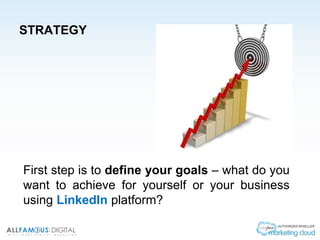
First step is to define your goals – what do you
want to achieve for yourself or your business
using LinkedIn platform?
STRATEGY
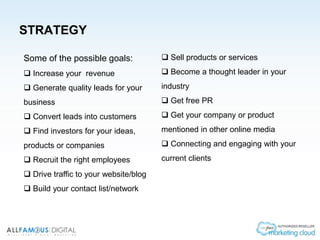
Some of the possible goals:
 Increase your revenue
 Generate quality leads for your
business
 Convert leads into customers
 Find investors for your ideas,
products or companies
 Recruit the right employees
 Drive traffic to your website/blog
 Build your contact list/network
 Sell products or services
 Become a thought leader in your
industry
 Get free PR
 Get your company or product
mentioned in other online media
 Connecting and engaging with your
current clients
STRATEGY
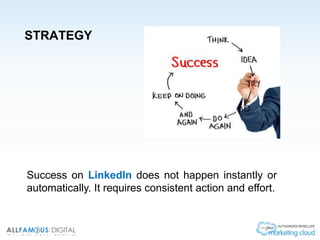
Success on LinkedIn does not happen instantly or
automatically. It requires consistent action and effort.
STRATEGY
One of most important actions you need to take is to
optimize your profile with keywords of your
industry, so that people can easily find you.
STRATEGY
LinkedIn search ranking factors:
• Number of keywords in profile
• Number of recommendations
• Number of connections and shared connections
STRATEGY
Ask questions:
1. What keywords would a person use, if they would
search LinkedIn for your business?
2. What kind of keywords you already have in your
profile.
3. What kind of keywords does your competitor use.
STRATEGY
 What do YOU want achieve on LinkedIn?
 Where can YOU become a through leader?
 What keywords do you want other people to find YOU with?
PERSONAL PROFILE
Having a well written, informative, keyword adjusted
and full profile is of utmost importance. Treat is as your
online professional alter-ego.
PERSONAL PROFILE
How to create an outstanding profile
Name line
Add full name and no other information (do not add “LION”
or other abbreviations that might hinder your searchability).
PERSONAL PROFILE
Professional headline
Make the headline informative and interesting; write the essence of who
you are, who you help and how you help them.
Ex. “Online Marketing Expert | Motivational Speaker | Author of book
“Motivation and marketing”;
“HR Specialist | Talent Manager | We Find the Right Employees for Your
Company”, etc.
PERSONAL PROFILE
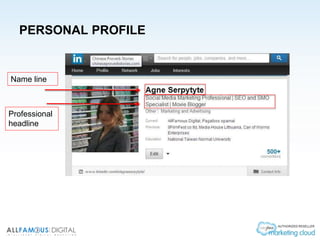
Name line
Professional
headline
PERSONAL PROFILE
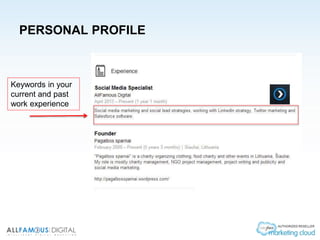
Keywords in your
current and past
work experience
PERSONAL PROFILE
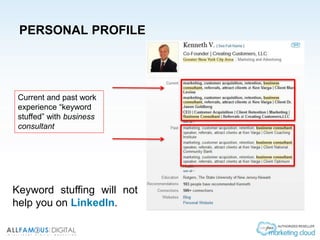
Keyword stuffing will not
help you on LinkedIn.
Current and past work
experience “keyword
stuffed” with business
consultant
PERSONAL PROFILE
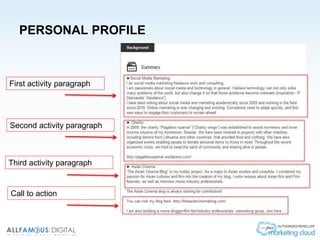
First activity paragraph
Second activity paragraph
Third activity paragraph
Call to action
PERSONAL PROFILE
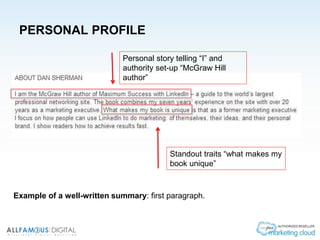
Example of a well-written summary: first paragraph.
Personal story telling “I” and
authority set-up “McGraw Hill
author”
Standout traits “what makes my
book unique”
PERSONAL PROFILE
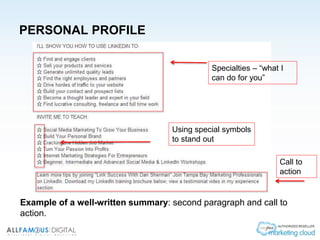
Example of a well-written summary: second paragraph and call to
action.
Specialties – “what I
can do for you”
Using special symbols
to stand out
Call to
action
PERSONAL PROFILE
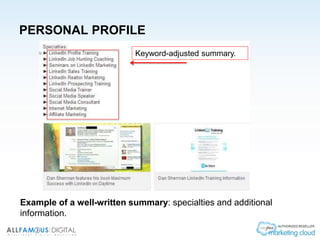
Example of a well-written summary: specialties and additional
information.
Keyword-adjusted summary.
PERSONAL PROFILE
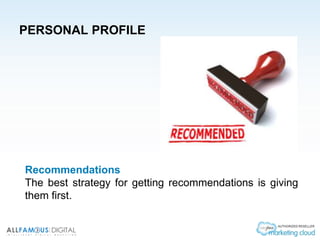
Recommendations
The best strategy for getting recommendations is giving
them first.
PERSONAL PROFILE
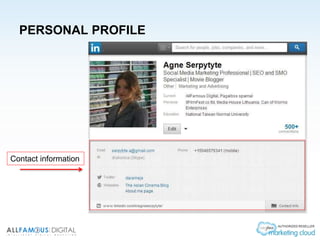
10. Contact information:
In contact information add:
• Email
• Twitter account
• Blog
• Phone number
and other ways for people to connect with you and see your
information.
PERSONAL PROFILE
Contact information
PERSONAL PROFILE
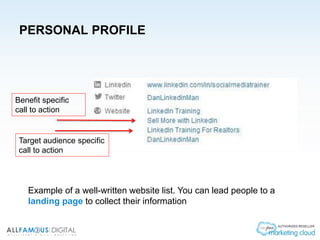
Example of a well-written website list. You can lead people to a
landing page to collect their information
Target audience specific
call to action
Benefit specific
call to action
PERSONAL PROFILE
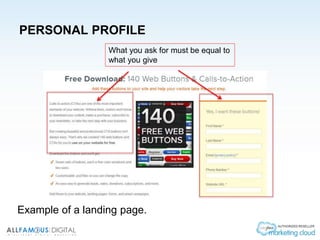
Example of a landing page.
What you ask for must be equal to
what you give
PERSONAL PROFILE
5. Updating
Do not forget to update your profile when there is new information.
6. Interests
Add interests to your profile, it will give more personality.
7. Groups and Associations
Add associations and groups of real world that you are a part of that are
important to you.
8. Honors and awards
Display awards and achievements to build your credibility.
PERSONAL PROFILE
 How would you summarize what you can do for your clients in few
sentences?
 What are your key specialties?
 How should people contact you and for what reasons?
 Do you have any blogs, portfolio websites, Twitter account where
others can see your professional work?
CONNECTIONS
Add everyone to your connections. Every LinkedIn
connection can be a potential client/customer or
someone that can lead you to one.
CONNECTIONS
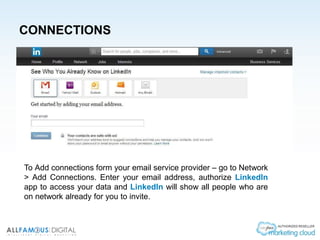
To Add connections form your email service provider – go to Network
> Add Connections. Enter your email address, authorize LinkedIn
app to access your data and LinkedIn will show all people who are
on network already for you to invite.
CONNECTIONS
• InMail messages can be used to contact people that
are not in your professional network yet.
CONNECTIONS
• To further increase your network potential add the link to your
LinkedIn profile to your business card, email signature,
Facebook, Twitter, your website and any other online outlet.
• Identify the profiles of your key customers and clients (existing
and potential), follow their LinkedIn status updates, “like” and
comment on them to get a closer connection with them.
CONNECTIONS
 Did you search your Email accounts for potential LinkedIn
connections?
 Do you have additional database/excel file of potential connections?
Are there any people you always wanted to connect and they are on
LinkedIn? Write then an InMail.
ENGAGEMENT
LinkedIn will work only if you work it.
ENGAGEMENT
LinkedIn status:
• Update your LinkedIn status daily. This way you will be
constantly featured on the home page of your connections.
ENGAGEMENT
Company page
• Provide full information about your company. Description of your
business should be compelling, write the essence of your business,
your mission and vision.
• Add specialties of your company.
• Add the keywords of your industry in description and specialties.
• Update your company status with relevant information at least once
weekly.
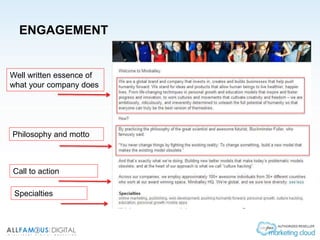
ENGAGEMENT
Well written essence of
what your company does
Philosophy and motto
Call to action
Specialties
ENGAGEMENT
Join all the groups that are relevant to you and
your business.
ENGAGEMENT
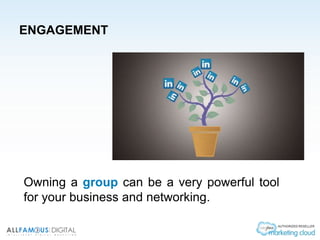
Owning a group can be a very powerful tool
for your business and networking.
ENGAGEMENT
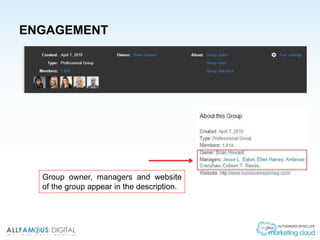
Group owner, managers and website
of the group appear in the description.
ENGAGEMENT
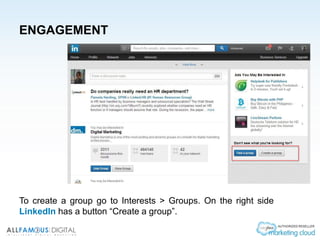
To create a group go to Interests > Groups. On the right side
LinkedIn has a button “Create a group”.
ENGAGEMENT
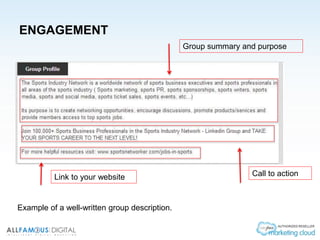
Example of a well-written group description.
Group summary and purpose
Call to actionLink to your website
ENGAGEMENT
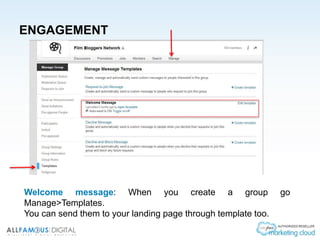
Welcome message: When you create a group go
Manage>Templates.
You can send them to your landing page through template too.
ENGAGEMENT
Companies
You can find and follow different companies that are on LinkedIn.
• Follow your existing and potential client companies
• Comment and “like” their status updates to keep “fresh” in
their minds.
• Follow your competitors to see their strategy on LinkedIn and
what they are up to.
ENGAGEMENT
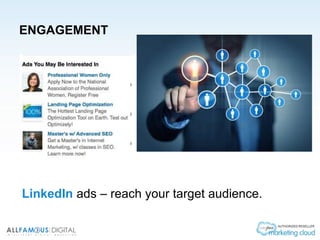
LinkedIn ads – reach your target audience.
ENGAGEMENT
 What content you read every day that you can share with your
LinkedIn connections?
What professional and interests groups on LinkedIn can you join?
Do you have company page on LinkedIn?
How can you utilize LinkedIn ads for your business?
STATISTICS
LinkedIn – track your performance with
statistics.
STATISTICS
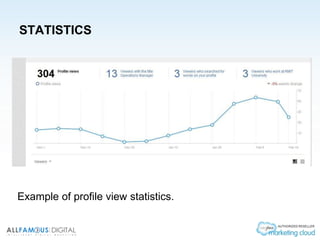
Example of profile view statistics.
ROI
ROI – increase in revenue or decrease in cost.
Possible ROI metrics:
• Earned Media Value vs. Marketing Spend
• Lead Value vs. Marketing Spend
• Brand Equity Growth vs. Marketing Spend
ROI
Counting ROI for LinkedIn will depends on your goals:
1. Define success metrics of your goal. (ex.
acquired/potential sales leads; acquired/potential
investors; increased % of visitors in your website;
increased sign-up % to your newsletter; etc)
ROI
2. Track the time/money you spend for LinkedIn. Best
practice is to dedicate some portion of time
Daily/Weekly to developing your LinkedIn network –
adding connections, participating in groups, etc.
ROI
3. Convert the goal metrics and time spent to monetary
value and compare.
Equation: ROI= Benefit – Cost/Cost * 100
ROI
4. Compare the value gained to alternatives – if you
would spend same time on other social media channels,
going to tradeshows/business meetings; calling leads via
phone; etc.
END NOTES
Compelling profile, clear goals, consistent action and
engaging with community are the key elements in
establishing yourself as thought leader and influencer
in your field on LinkedIn platform.
“Patience, persistence and perspiration make
an unbeatable combination for success” –
Napoleon Hill
How to Become a Master Networker with LinkedIn

How to Become a Master Networker with LinkedIn

  • 1.
    LinkedIn Training: Howto Become a Master Networker with LinkedIn Last Updated: <2014.04.28>
  • 2.
    LinkedIn is oneof the biggest social networks, just behind Google+ and Facebook. OVERVIEW
  • 3.
    OVERVIEW LinkedIn can bevery powerful tool for various professional and business purposes.
  • 4.
    CONTENT • Strategy –decide what you want to achieve on LinkedIn and build from there. • Personal profile – your professional alter-ego • Connections – strategy for connecting with others • Engagement – setting up a profile is not enough • Statistics and ROI – how to track your progress
  • 5.
    STRATEGY First step isto define your goals – what do you want to achieve for yourself or your business using LinkedIn platform?
  • 6.
    STRATEGY Some of thepossible goals:  Increase your revenue  Generate quality leads for your business  Convert leads into customers  Find investors for your ideas, products or companies  Recruit the right employees  Drive traffic to your website/blog  Build your contact list/network  Sell products or services  Become a thought leader in your industry  Get free PR  Get your company or product mentioned in other online media  Connecting and engaging with your current clients
  • 7.
    STRATEGY Success on LinkedIndoes not happen instantly or automatically. It requires consistent action and effort.
  • 8.
    STRATEGY One of mostimportant actions you need to take is to optimize your profile with keywords of your industry, so that people can easily find you.
  • 9.
    STRATEGY LinkedIn search rankingfactors: • Number of keywords in profile • Number of recommendations • Number of connections and shared connections
  • 10.
    STRATEGY Ask questions: 1. Whatkeywords would a person use, if they would search LinkedIn for your business? 2. What kind of keywords you already have in your profile. 3. What kind of keywords does your competitor use.
  • 11.
    STRATEGY  What doYOU want achieve on LinkedIn?  Where can YOU become a through leader?  What keywords do you want other people to find YOU with?
  • 12.
    PERSONAL PROFILE Having awell written, informative, keyword adjusted and full profile is of utmost importance. Treat is as your online professional alter-ego.
  • 13.
    PERSONAL PROFILE How tocreate an outstanding profile Name line Add full name and no other information (do not add “LION” or other abbreviations that might hinder your searchability).
  • 14.
    PERSONAL PROFILE Professional headline Makethe headline informative and interesting; write the essence of who you are, who you help and how you help them. Ex. “Online Marketing Expert | Motivational Speaker | Author of book “Motivation and marketing”; “HR Specialist | Talent Manager | We Find the Right Employees for Your Company”, etc.
  • 15.
  • 16.
    PERSONAL PROFILE Keywords inyour current and past work experience
  • 17.
    PERSONAL PROFILE Keyword stuffingwill not help you on LinkedIn. Current and past work experience “keyword stuffed” with business consultant
  • 18.
    PERSONAL PROFILE First activityparagraph Second activity paragraph Third activity paragraph Call to action
  • 19.
    PERSONAL PROFILE Example ofa well-written summary: first paragraph. Personal story telling “I” and authority set-up “McGraw Hill author” Standout traits “what makes my book unique”
  • 20.
    PERSONAL PROFILE Example ofa well-written summary: second paragraph and call to action. Specialties – “what I can do for you” Using special symbols to stand out Call to action
  • 21.
    PERSONAL PROFILE Example ofa well-written summary: specialties and additional information. Keyword-adjusted summary.
  • 22.
    PERSONAL PROFILE Recommendations The beststrategy for getting recommendations is giving them first.
  • 23.
    PERSONAL PROFILE 10. Contactinformation: In contact information add: • Email • Twitter account • Blog • Phone number and other ways for people to connect with you and see your information.
  • 24.
  • 25.
    PERSONAL PROFILE Example ofa well-written website list. You can lead people to a landing page to collect their information Target audience specific call to action Benefit specific call to action
  • 26.
    PERSONAL PROFILE Example ofa landing page. What you ask for must be equal to what you give
  • 27.
    PERSONAL PROFILE 5. Updating Donot forget to update your profile when there is new information. 6. Interests Add interests to your profile, it will give more personality. 7. Groups and Associations Add associations and groups of real world that you are a part of that are important to you. 8. Honors and awards Display awards and achievements to build your credibility.
  • 28.
    PERSONAL PROFILE  Howwould you summarize what you can do for your clients in few sentences?  What are your key specialties?  How should people contact you and for what reasons?  Do you have any blogs, portfolio websites, Twitter account where others can see your professional work?
  • 29.
    CONNECTIONS Add everyone toyour connections. Every LinkedIn connection can be a potential client/customer or someone that can lead you to one.
  • 30.
    CONNECTIONS To Add connectionsform your email service provider – go to Network > Add Connections. Enter your email address, authorize LinkedIn app to access your data and LinkedIn will show all people who are on network already for you to invite.
  • 31.
    CONNECTIONS • InMail messagescan be used to contact people that are not in your professional network yet.
  • 32.
    CONNECTIONS • To furtherincrease your network potential add the link to your LinkedIn profile to your business card, email signature, Facebook, Twitter, your website and any other online outlet. • Identify the profiles of your key customers and clients (existing and potential), follow their LinkedIn status updates, “like” and comment on them to get a closer connection with them.
  • 33.
    CONNECTIONS  Did yousearch your Email accounts for potential LinkedIn connections?  Do you have additional database/excel file of potential connections? Are there any people you always wanted to connect and they are on LinkedIn? Write then an InMail.
  • 34.
    ENGAGEMENT LinkedIn will workonly if you work it.
  • 35.
    ENGAGEMENT LinkedIn status: • Updateyour LinkedIn status daily. This way you will be constantly featured on the home page of your connections.
  • 36.
    ENGAGEMENT Company page • Providefull information about your company. Description of your business should be compelling, write the essence of your business, your mission and vision. • Add specialties of your company. • Add the keywords of your industry in description and specialties. • Update your company status with relevant information at least once weekly.
  • 37.
    ENGAGEMENT Well written essenceof what your company does Philosophy and motto Call to action Specialties
  • 38.
    ENGAGEMENT Join all thegroups that are relevant to you and your business.
  • 39.
    ENGAGEMENT Owning a groupcan be a very powerful tool for your business and networking.
  • 40.
    ENGAGEMENT Group owner, managersand website of the group appear in the description.
  • 41.
    ENGAGEMENT To create agroup go to Interests > Groups. On the right side LinkedIn has a button “Create a group”.
  • 42.
    ENGAGEMENT Example of awell-written group description. Group summary and purpose Call to actionLink to your website
  • 43.
    ENGAGEMENT Welcome message: Whenyou create a group go Manage>Templates. You can send them to your landing page through template too.
  • 44.
    ENGAGEMENT Companies You can findand follow different companies that are on LinkedIn. • Follow your existing and potential client companies • Comment and “like” their status updates to keep “fresh” in their minds. • Follow your competitors to see their strategy on LinkedIn and what they are up to.
  • 45.
    ENGAGEMENT LinkedIn ads –reach your target audience.
  • 46.
    ENGAGEMENT  What contentyou read every day that you can share with your LinkedIn connections? What professional and interests groups on LinkedIn can you join? Do you have company page on LinkedIn? How can you utilize LinkedIn ads for your business?
  • 47.
    STATISTICS LinkedIn – trackyour performance with statistics.
  • 48.
  • 49.
    ROI ROI – increasein revenue or decrease in cost. Possible ROI metrics: • Earned Media Value vs. Marketing Spend • Lead Value vs. Marketing Spend • Brand Equity Growth vs. Marketing Spend
  • 50.
    ROI Counting ROI forLinkedIn will depends on your goals: 1. Define success metrics of your goal. (ex. acquired/potential sales leads; acquired/potential investors; increased % of visitors in your website; increased sign-up % to your newsletter; etc)
  • 51.
    ROI 2. Track thetime/money you spend for LinkedIn. Best practice is to dedicate some portion of time Daily/Weekly to developing your LinkedIn network – adding connections, participating in groups, etc.
  • 52.
    ROI 3. Convert thegoal metrics and time spent to monetary value and compare. Equation: ROI= Benefit – Cost/Cost * 100
  • 53.
    ROI 4. Compare thevalue gained to alternatives – if you would spend same time on other social media channels, going to tradeshows/business meetings; calling leads via phone; etc.
  • 54.
    END NOTES Compelling profile,clear goals, consistent action and engaging with community are the key elements in establishing yourself as thought leader and influencer in your field on LinkedIn platform.
  • 55.
    “Patience, persistence andperspiration make an unbeatable combination for success” – Napoleon Hill