Predatory journals send me daily messages thatthey would be delighted for me
to submit a manuscriptfor publication in their excellent journal. Especially if I
submit it this week, or sometime very soon. The names of many of these journals
sound pretty familiar as they are often slight variations on names of respected,
peer-reviewed journals. Thereare however severaldifferences with these peer-
reviewed journals:
- They do not providepeer-review, so the papers published in these journals
can contain mistakes or total nonsense. Nobody checks.
- They are not indexed in PubMed or any other publication databaseso
hardly anybody will ever find, read, or reference the publications in them. These
journals, therefore, haveno impact and no impact factor.
- They ask for a huge publication fee without offering any editorial services.
- Some are not even available anywhere(online or in print), so no one would
read your publication.
- There are also advantages to publishing in predatory journals: there are no
difficult questions by peer-reviewers and publication turnaround time is a lot
shorter than for peer-reviewed journals.
Hoaxes in predatory journals
That predatory journals do not providepeer-review has resulted in many
examples of bad research published in them. Some authors fed up by the
annoying, insistentemails requesting submissions haveeven sent in hoax papers
to proveit. Such as the brilliant piece of work thatthe British scientist Gary Lewis
published in the journalPsychology and Psychotherapy: Research Study under the
synonymGerry Jay Louis. Hefound that right-wing politicians wipe their ass with
their left hand (and vice versa). You can read his article here. It has unfortunately
since been retracted by the publisher.
Two American computer scientists, David Mazières and Eddie Kohler, fed up by
the annoying emails wrotea more rude article as a joke that was sent around to
friends. An Australian colleague sent it to the InternationalJournalof Advanced
Computer Technology as a reply to spamwhereit was accepted for publication
immediately. Its publication clearly proved that not only do these journals not
providepeer-review but that apparently nobody even opens the submitted article
before acceptance and publication. The last article has unfortunately been
removed after journalists began to approach the journalwith questions.
How to avoid predatory journals
Publishing in predatory journals is a waste of your hard work. Thesejournals are
not taken seriously by your peers (when deciding on tenure, or a job application)
and will not get your research noticed by anyone. So you should try to avoid
them at all costs. A list of predatory journals is available here. The list was started
by Jeffrey Beall and is continued by others. If you wantto read moreon predatory
journals you may want to read the articles by Bohannon 2013 - who proved most
of the publishers on Beall´s list were indeed predatory- and Shamseer 2017 who
studied the characteristics of predatory journals to help scientists identify them.
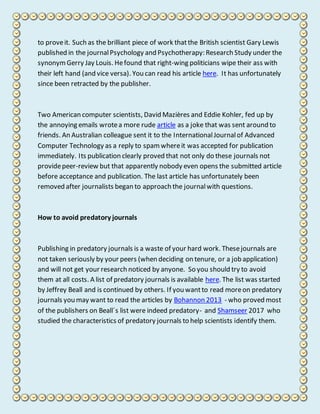
Illustration:EduardoLuzzatti for the NewYork Times

Predatory journals: Why and How to Avoid Them

  • 1.
    Predatory journals sendme daily messages thatthey would be delighted for me to submit a manuscriptfor publication in their excellent journal. Especially if I submit it this week, or sometime very soon. The names of many of these journals sound pretty familiar as they are often slight variations on names of respected, peer-reviewed journals. Thereare however severaldifferences with these peer- reviewed journals: - They do not providepeer-review, so the papers published in these journals can contain mistakes or total nonsense. Nobody checks. - They are not indexed in PubMed or any other publication databaseso hardly anybody will ever find, read, or reference the publications in them. These journals, therefore, haveno impact and no impact factor. - They ask for a huge publication fee without offering any editorial services. - Some are not even available anywhere(online or in print), so no one would read your publication. - There are also advantages to publishing in predatory journals: there are no difficult questions by peer-reviewers and publication turnaround time is a lot shorter than for peer-reviewed journals. Hoaxes in predatory journals That predatory journals do not providepeer-review has resulted in many examples of bad research published in them. Some authors fed up by the annoying, insistentemails requesting submissions haveeven sent in hoax papers
  • 2.
    to proveit. Suchas the brilliant piece of work thatthe British scientist Gary Lewis published in the journalPsychology and Psychotherapy: Research Study under the synonymGerry Jay Louis. Hefound that right-wing politicians wipe their ass with their left hand (and vice versa). You can read his article here. It has unfortunately since been retracted by the publisher. Two American computer scientists, David Mazières and Eddie Kohler, fed up by the annoying emails wrotea more rude article as a joke that was sent around to friends. An Australian colleague sent it to the InternationalJournalof Advanced Computer Technology as a reply to spamwhereit was accepted for publication immediately. Its publication clearly proved that not only do these journals not providepeer-review but that apparently nobody even opens the submitted article before acceptance and publication. The last article has unfortunately been removed after journalists began to approach the journalwith questions. How to avoid predatory journals Publishing in predatory journals is a waste of your hard work. Thesejournals are not taken seriously by your peers (when deciding on tenure, or a job application) and will not get your research noticed by anyone. So you should try to avoid them at all costs. A list of predatory journals is available here. The list was started by Jeffrey Beall and is continued by others. If you wantto read moreon predatory journals you may want to read the articles by Bohannon 2013 - who proved most of the publishers on Beall´s list were indeed predatory- and Shamseer 2017 who studied the characteristics of predatory journals to help scientists identify them.
  • 3.