
Are there covariates?
The purpose of this presentation is to help you 
determine if there are covariates in the problem 
you are working with.
The purpose of this presentation is to help you 
determine if there are covariates in the problem 
you are working with. 
There ARE Covariates 
or 
There ARE NO Covariates
Here is an explanation of a covariate:
Let’s say you want to know the relationship 
between X and Y.
Let’s say you want to know the relationship 
between X and Y. 
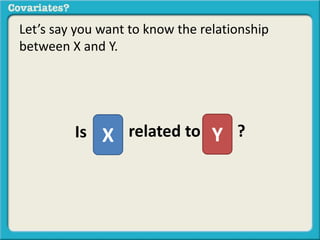
Is X related to Y ?
Let’s say you want to know the relationship 
between X and Y. 
Is X related to Y ? 
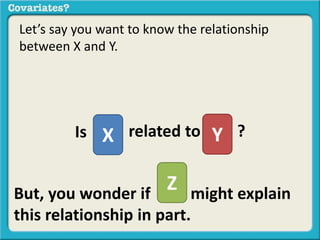
Z But, you wonder if might explain 
this relationship in part.
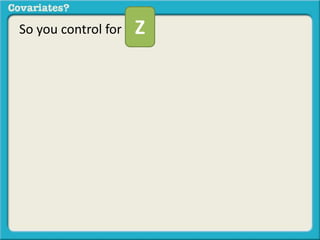
So you control for Z
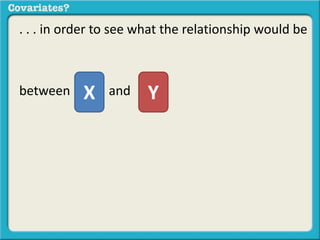
. . . in order to see what the relationship would be 
between and 
if you took out the effect of
. . . in order to see what the relationship would be 
X Y 
between and 
if you took out the effect of
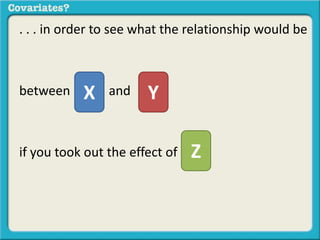
. . . in order to see what the relationship would be 
X Y 
between and 
if you took out the effect of 
Z
Let’s consider this example:
Let’s say you want to know if there is a 
relationship between socio-economic status and 
student ACT scores.
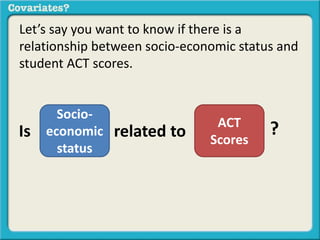
Let’s say you want to know if there is a 
relationship between socio-economic status and 
student ACT scores. 
Socio-economic 
Is related to ACT ? 
status 
Scores
Let’s say you want to know if there is a 
relationship between socio-economic status and 
student ACT scores. 
Socio-economic 
Is related to ACT ? 
status 
Scores 
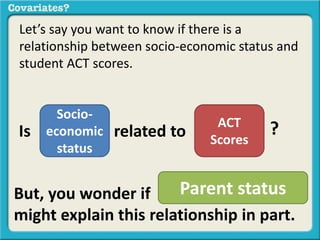
But, you wonder if P arent status 
might explain this relationship in part.
By parent status, we are referring to whether 
there are two parents or a single parent in the 
home.
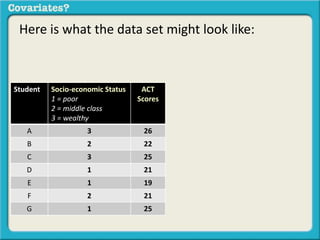
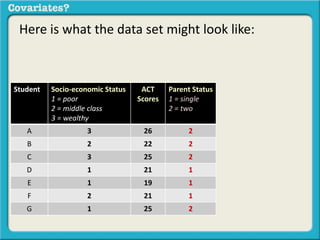
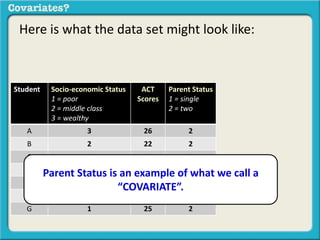
Here is what the data set might look like:
Here is what the data set might look like: 
Student Socio-economic Status 
1 = poor 
2 = middle class 
3 = wealthy 
ACT 
Scores 
A 3 26 
B 2 22 
C 3 25 
D 1 21 
E 1 19 
F 2 21 
G 1 25
Here is what the data set might look like: 
Student Socio-economic Status 
1 = poor 
2 = middle class 
3 = wealthy 
ACT 
Scores 
A 3 26 
B 2 22 
C 3 25 
D 1 21 
E 1 19 
F 2 21 
G 1 25 
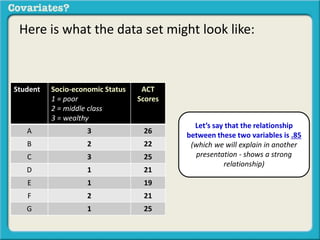
Let’s say that the relationship 
between these two variables is .85 
(which we will explain in another 
presentation - shows a strong 
relationship)
Here is what the data set might look like: 
Student Socio-economic Status 
1 = poor 
2 = middle class 
3 = wealthy 
ACT 
Scores 
A 3 26 
B 2 22 
C 3 25 
D 1 21 
E 1 19 
F 2 21 
G 1 25 
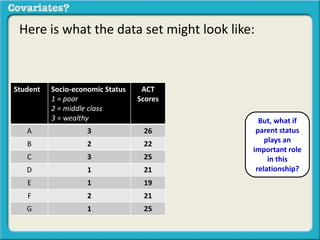
But, what if 
parent status 
plays an 
important role 
in this 
relationship?
Here is what the data set might look like: 
Student Socio-economic Status 
1 = poor 
2 = middle class 
3 = wealthy 
ACT 
Scores 
Parent Status 
1 = single 
2 = two 
A 3 26 2 
B 2 22 2 
C 3 25 2 
D 1 21 1 
E 1 19 1 
F 2 21 1 
G 1 25 2
Here is what the data set might look like: 
Student Socio-economic Status 
1 = poor 
2 = middle class 
3 = wealthy 
ACT 
Scores 
Parent Status 
1 = single 
2 = two 
A 3 26 2 
B 2 22 2 
C 3 25 2 
D 1 21 1 
E 1 19 1 
F 2 21 1 
G 1 25 2 
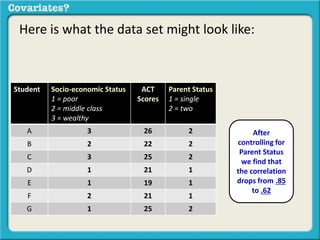
After 
controlling for 
Parent Status 
we find that 
the correlation 
drops from .85 
to .62
Here is what the data set might look like: 
Student Socio-economic Status 
1 = poor 
2 = middle class 
3 = wealthy 
ACT 
Scores 
Parent Status 
1 = single 
2 = two 
A 3 26 2 
B 2 22 2 
C 3 25 2 
D 1 21 1 
E 1 19 1 
F 2 21 1 
G 1 25 2 
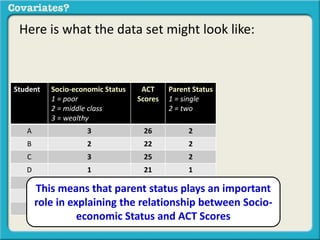
This means that parent status plays an important 
role in explaining the relationship between Socio-economic 
Status and ACT Scores
Here is what the data set might look like: 
Student Socio-economic Status 
1 = poor 
2 = middle class 
3 = wealthy 
ACT 
Scores 
Parent Status 
1 = single 
2 = two 
A 3 26 2 
B 2 22 2 
C 3 25 2 
D 1 21 1 
E 1 19 1 
F 2 21 1 
G 1 25 2 
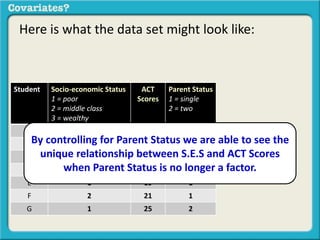
By controlling for Parent Status we are able to see the 
unique relationship between S.E.S and ACT Scores 
when Parent Status is no longer a factor.
Here is what the data set might look like: 
Student Socio-economic Status 
1 = poor 
2 = middle class 
3 = wealthy 
ACT 
Scores 
Parent Status 
1 = single 
2 = two 
A 3 26 2 
B 2 22 2 
C 3 25 2 
D 1 21 1 
E 1 19 1 
F 2 21 1 
G 1 25 2 
Parent Status is an example of what we call a 
“COVARIATE”.
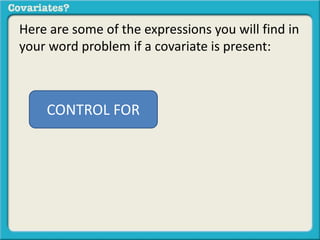
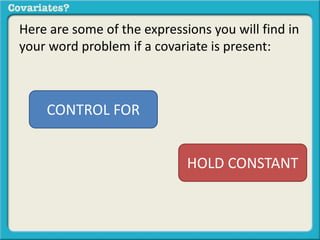
Here are some of the expressions you will find in 
your word problem if a covariate is present:
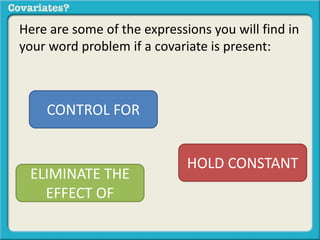
Here are some of the expressions you will find in 
your word problem if a covariate is present: 
CONTROL FOR
Here are some of the expressions you will find in 
your word problem if a covariate is present: 
CONTROL FOR 
HOLD CONSTANT
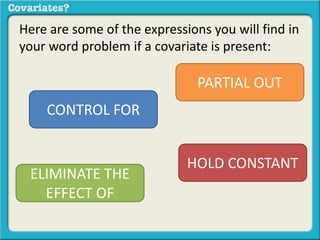
Here are some of the expressions you will find in 
your word problem if a covariate is present: 
CONTROL FOR 
HOLD CONSTANT 
ELIMINATE THE 
EFFECT OF
Here are some of the expressions you will find in 
your word problem if a covariate is present: 
CONTROL FOR 
HOLD CONSTANT 
ELIMINATE THE 
EFFECT OF 
PARTIAL OUT
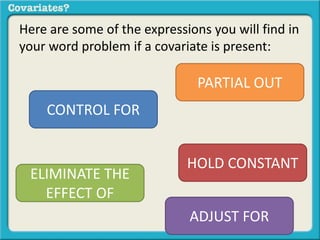
Here are some of the expressions you will find in 
your word problem if a covariate is present: 
CONTROL FOR 
HOLD CONSTANT 
ELIMINATE THE 
EFFECT OF 
PARTIAL OUT 
ADJUST FOR
Now examine your word problem and 
determine if . . .
Now examine your word problem and 
determine if . . . 
There ARE Covariates 
or 
There ARE NO Covariates

Are there covariates?

  • 1.
  • 2.
    The purpose ofthis presentation is to help you determine if there are covariates in the problem you are working with.
  • 3.
    The purpose ofthis presentation is to help you determine if there are covariates in the problem you are working with. There ARE Covariates or There ARE NO Covariates
  • 4.
    Here is anexplanation of a covariate:
  • 5.
    Let’s say youwant to know the relationship between X and Y.
  • 6.
    Let’s say youwant to know the relationship between X and Y. Is X related to Y ?
  • 7.
    Let’s say youwant to know the relationship between X and Y. Is X related to Y ? Z But, you wonder if might explain this relationship in part.
  • 8.
  • 9.
    . . .in order to see what the relationship would be between and if you took out the effect of
  • 10.
    . . .in order to see what the relationship would be X Y between and if you took out the effect of
  • 11.
    . . .in order to see what the relationship would be X Y between and if you took out the effect of Z
  • 12.
  • 13.
    Let’s say youwant to know if there is a relationship between socio-economic status and student ACT scores.
  • 14.
    Let’s say youwant to know if there is a relationship between socio-economic status and student ACT scores. Socio-economic Is related to ACT ? status Scores
  • 15.
    Let’s say youwant to know if there is a relationship between socio-economic status and student ACT scores. Socio-economic Is related to ACT ? status Scores But, you wonder if P arent status might explain this relationship in part.
  • 16.
    By parent status,we are referring to whether there are two parents or a single parent in the home.
  • 17.
    Here is whatthe data set might look like:
  • 18.
    Here is whatthe data set might look like: Student Socio-economic Status 1 = poor 2 = middle class 3 = wealthy ACT Scores A 3 26 B 2 22 C 3 25 D 1 21 E 1 19 F 2 21 G 1 25
  • 19.
    Here is whatthe data set might look like: Student Socio-economic Status 1 = poor 2 = middle class 3 = wealthy ACT Scores A 3 26 B 2 22 C 3 25 D 1 21 E 1 19 F 2 21 G 1 25 Let’s say that the relationship between these two variables is .85 (which we will explain in another presentation - shows a strong relationship)
  • 20.
    Here is whatthe data set might look like: Student Socio-economic Status 1 = poor 2 = middle class 3 = wealthy ACT Scores A 3 26 B 2 22 C 3 25 D 1 21 E 1 19 F 2 21 G 1 25 But, what if parent status plays an important role in this relationship?
  • 21.
    Here is whatthe data set might look like: Student Socio-economic Status 1 = poor 2 = middle class 3 = wealthy ACT Scores Parent Status 1 = single 2 = two A 3 26 2 B 2 22 2 C 3 25 2 D 1 21 1 E 1 19 1 F 2 21 1 G 1 25 2
  • 22.
    Here is whatthe data set might look like: Student Socio-economic Status 1 = poor 2 = middle class 3 = wealthy ACT Scores Parent Status 1 = single 2 = two A 3 26 2 B 2 22 2 C 3 25 2 D 1 21 1 E 1 19 1 F 2 21 1 G 1 25 2 After controlling for Parent Status we find that the correlation drops from .85 to .62
  • 23.
    Here is whatthe data set might look like: Student Socio-economic Status 1 = poor 2 = middle class 3 = wealthy ACT Scores Parent Status 1 = single 2 = two A 3 26 2 B 2 22 2 C 3 25 2 D 1 21 1 E 1 19 1 F 2 21 1 G 1 25 2 This means that parent status plays an important role in explaining the relationship between Socio-economic Status and ACT Scores
  • 24.
    Here is whatthe data set might look like: Student Socio-economic Status 1 = poor 2 = middle class 3 = wealthy ACT Scores Parent Status 1 = single 2 = two A 3 26 2 B 2 22 2 C 3 25 2 D 1 21 1 E 1 19 1 F 2 21 1 G 1 25 2 By controlling for Parent Status we are able to see the unique relationship between S.E.S and ACT Scores when Parent Status is no longer a factor.
  • 25.
    Here is whatthe data set might look like: Student Socio-economic Status 1 = poor 2 = middle class 3 = wealthy ACT Scores Parent Status 1 = single 2 = two A 3 26 2 B 2 22 2 C 3 25 2 D 1 21 1 E 1 19 1 F 2 21 1 G 1 25 2 Parent Status is an example of what we call a “COVARIATE”.
  • 26.
    Here are someof the expressions you will find in your word problem if a covariate is present:
  • 27.
    Here are someof the expressions you will find in your word problem if a covariate is present: CONTROL FOR
  • 28.
    Here are someof the expressions you will find in your word problem if a covariate is present: CONTROL FOR HOLD CONSTANT
  • 29.
    Here are someof the expressions you will find in your word problem if a covariate is present: CONTROL FOR HOLD CONSTANT ELIMINATE THE EFFECT OF
  • 30.
    Here are someof the expressions you will find in your word problem if a covariate is present: CONTROL FOR HOLD CONSTANT ELIMINATE THE EFFECT OF PARTIAL OUT
  • 31.
    Here are someof the expressions you will find in your word problem if a covariate is present: CONTROL FOR HOLD CONSTANT ELIMINATE THE EFFECT OF PARTIAL OUT ADJUST FOR
  • 32.
    Now examine yourword problem and determine if . . .
  • 33.
    Now examine yourword problem and determine if . . . There ARE Covariates or There ARE NO Covariates