Teaching Toward Global
      Competence
Classroom Teacher Exchange Program
In-Service Workshop for International
      Teachers and Host Schools
Here’s what Fulbright Exchange
Teachers are doing, and planning to
  do, to help students develop the
four domains of global competence.
Key Ideas around
    Teaching Toward Global Competence
•   Finding global/local connections
•   Raising awareness of others’ perspectives
•   Retaining one’s unique culture
•   Considering access/equity, ability to participate
•   Embracing plurality
•   Using visuals, case studies, personal examples
•   Importance of world languages
•   Respect for self as well as others
Key Ideas around
 Teaching Toward Global Competence
• Empathy
• Compassion
• Seeing the world from someone else’s
  perspective
• Knowing the world is bigger than your immediate
  environment
• Understanding our common biological humanity
• Seeing case studies (where food comes
  from, etc.) as examples of globalization
Investigating the World
•   Guest speakers, interview visitors
•   Personal stories with world experience
•   Prompts for writing
•   Visual aids, world cinema
•   Research projects with worldwide publications
•   International games
•   Literature, plays, poetry w/ cultural diversity
•   Art: exploring multicultural art & artists
Investigating the World
• Using different ways to construct knowledge
• Observation and data collection
• Comparing & contrasting sources of information
• Getting students out of their comfort zone
• Teaching students how to access & use these
  resources
• Looking at environmental issues, biodiversity, etc.
  from a “one ocean”/“one planet” perspective
Investigating the World
• Math/science: climates – impacts on people in
  geography, earth/sun geometry
• Projects that require students to
  explore/investigate global issues
• Celebrate cultural days (cuisines of the
  world, dance, music, art, sport, hobbies)
• Research where you food, clothing, etc. comes
  from; exploring fair trade issues
• Google Earth
Investigating the World
• Geography, geographical literacy
• Understanding that geographical and political
  circumstances can affect economics
• Literature choices, world literature
• Video conferencing
• School trips
• Current events and news
Investigating the World
• Sharing images
• World map – discussion, pinpointing where
  students are from, what languages are in the
  school – celebrate
• Letter writing to soldiers around the world
• Ethnic festivals & conferences & guest
  speakers
Investigating the World
Looks Like . . .                     Sounds Like . . .
• Art, writing, artifacts, travel,   • Songs, music, musical
   maps, flags on display              instruments from other
• Social-media, technology             parts of the world
• Welcome in different               • Greetings and speaking in
  languages                            different languages
• Personal coat of arms              • Foreign films
• International family links
                                     • World literature
• International
  foods, traditional to              • Students’ life experiences
  country/culture                      brought into conversation
Investigating the World
Looks Like . . .                 Sounds Like . . .
• Posters                        • Drum circle
• T-shirts created by students   • Dancing
• Video clips                    • Video clips
• Monthly focus                  • International music
• Cultural corner                • Foreign language
• Cultural food
• World languages
Recognizing Perspectives
• Sharing first-hand experiences
• Reading books, watching films
• Comparing & contrasting literature
• Analyzing world news reports from different
  countries
• Analyzing language through cultural lens
• Partnerships/pen pals with classrooms across the
  world (handwritten letters, too)
• Global genes, family history, heritage pride
Recognizing Perspectives
• Starting with students’ experiences, questions
• Observation and data collection locally and
  internationally with a comparative analysis
   – e.g. conservation efforts in different countries
   – e.g. statistics problems using international numbers
• Involving the community
• Learning about history of discrimination against
  minorities
• Recognizing bias
• Making world connections through technology
  (skype, youtube, etc.)
Recognizing Perspectives
• Earth/science: understand why people make
  devices that impact day-to-day life
  (food, economy, life-styles)
• Literature: introduce students to experiences
  of diverse cultures
• Celebrate differences/diversity
• Learning about other countries/cultures help
  to get broader perspectives
Recognizing Perspectives
• Teaching POV in literature, art, history,
  environmental issues
• Global stories appropriate for age group
• Relate to ethnic/cultural background of the
  children
• Pen pals provide personal connection
• One Day Without Shoes
• Sole trader, Chocolate trade game, World
  resources game
Recognizing Perspectives
• Activities to put yourself in others’ shoes
• Comparing/contrasting images
• Contrasting videos and persuasive/empathetic
  writing
• International films
• Guest speakers
• Role playing
• Model UN
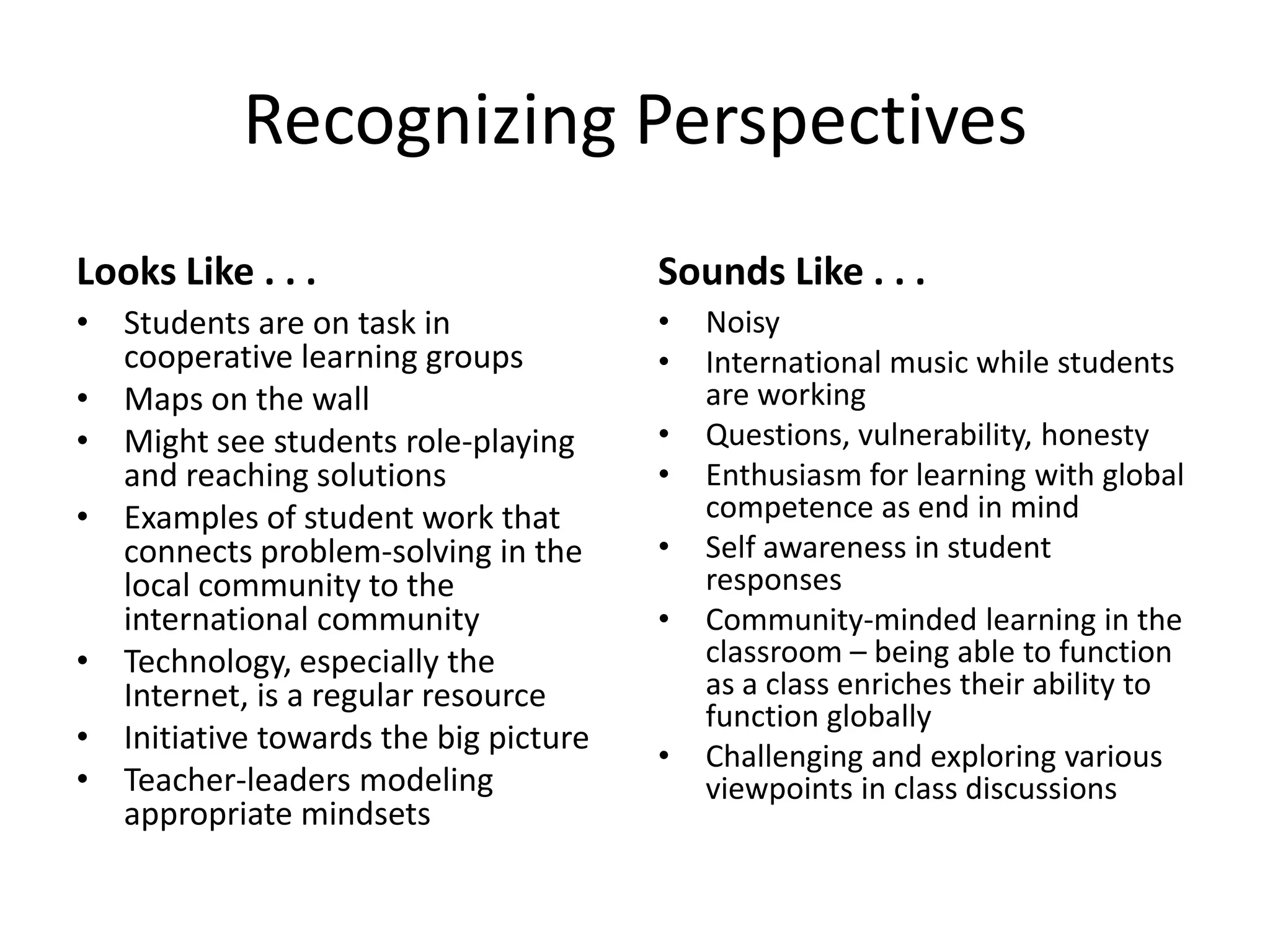
Recognizing Perspectives
Looks Like . . .                       Sounds Like . . .
• Students are on task in              •   Noisy
  cooperative learning groups          •   International music while students
• Maps on the wall                         are working
• Might see students role-playing      •   Questions, vulnerability, honesty
  and reaching solutions               •   Enthusiasm for learning with global
• Examples of student work that            competence as end in mind
  connects problem-solving in the      •   Self awareness in student
  local community to the                   responses
  international community              •   Community-minded learning in the
• Technology, especially the               classroom – being able to function
  Internet, is a regular resource          as a class enriches their ability to
                                           function globally
• Initiative towards the big picture
                                       •   Challenging and exploring various
• Teacher-leaders modeling                 viewpoints in class discussions
  appropriate mindsets
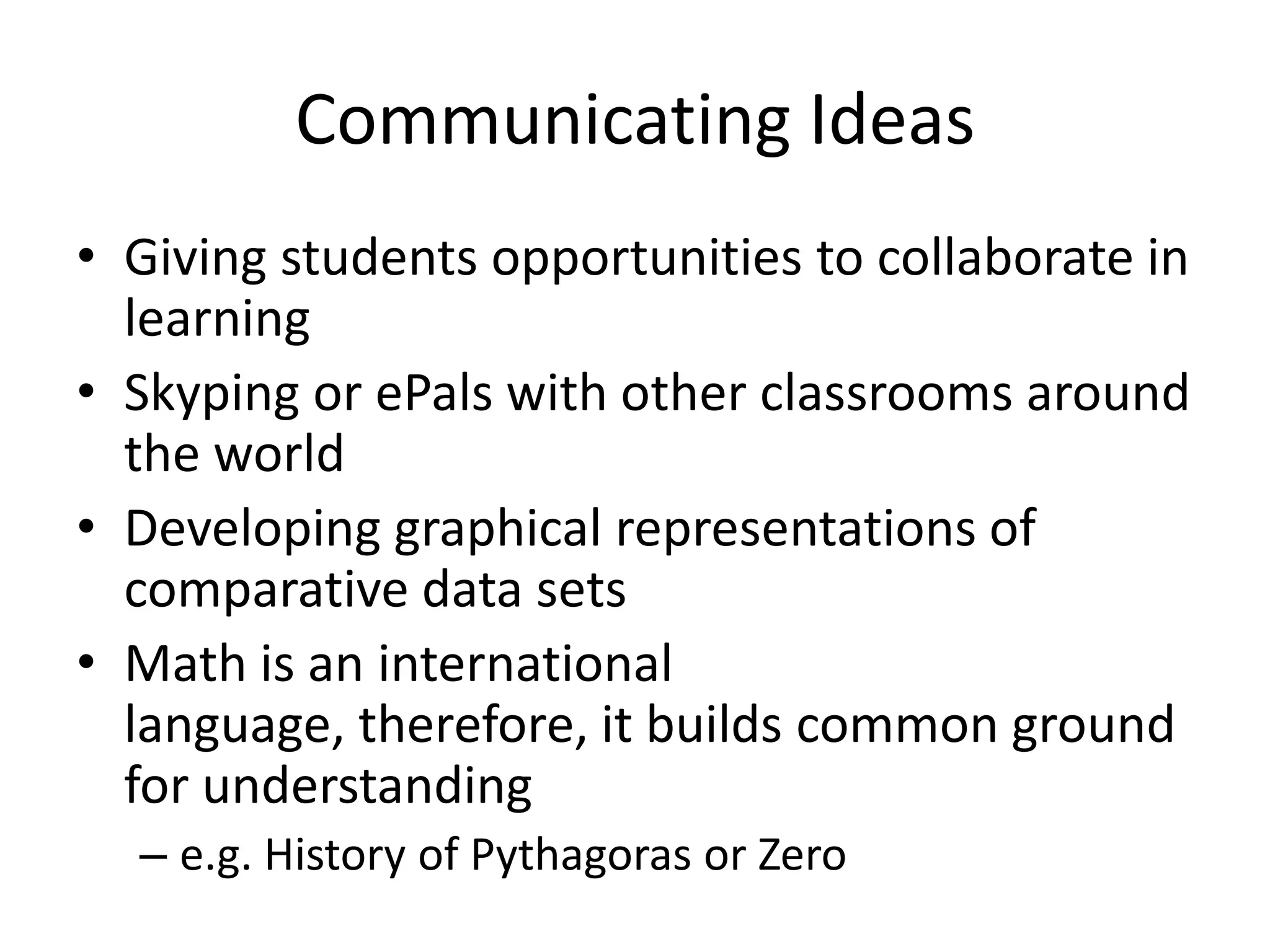
Communicating Ideas
• Giving students opportunities to collaborate in
  learning
• Skyping or ePals with other classrooms around
  the world
• Developing graphical representations of
  comparative data sets
• Math is an international
  language, therefore, it builds common ground
  for understanding
  – e.g. History of Pythagoras or Zero
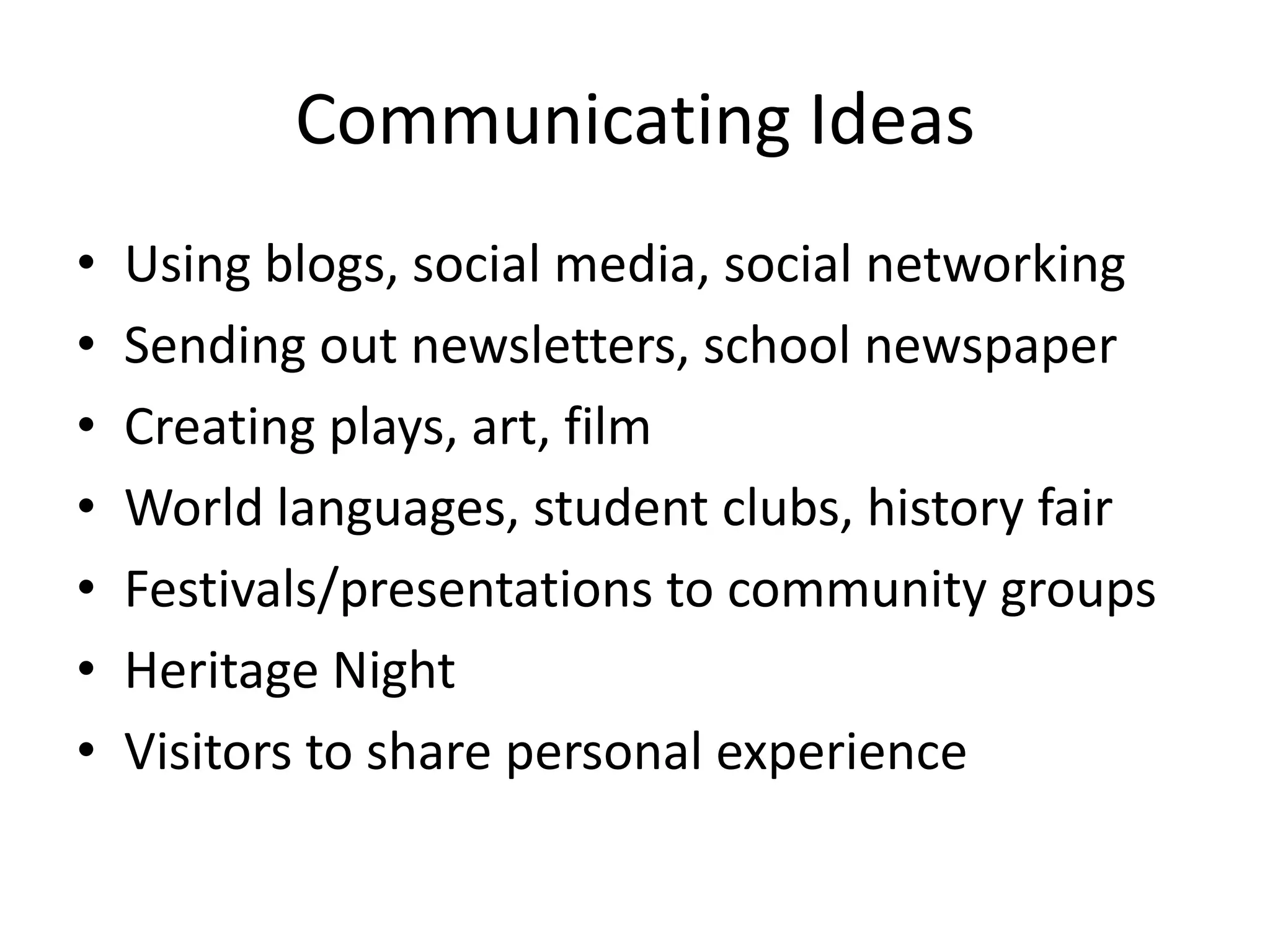
Communicating Ideas
•   Using blogs, social media, social networking
•   Sending out newsletters, school newspaper
•   Creating plays, art, film
•   World languages, student clubs, history fair
•   Festivals/presentations to community groups
•   Heritage Night
•   Visitors to share personal experience
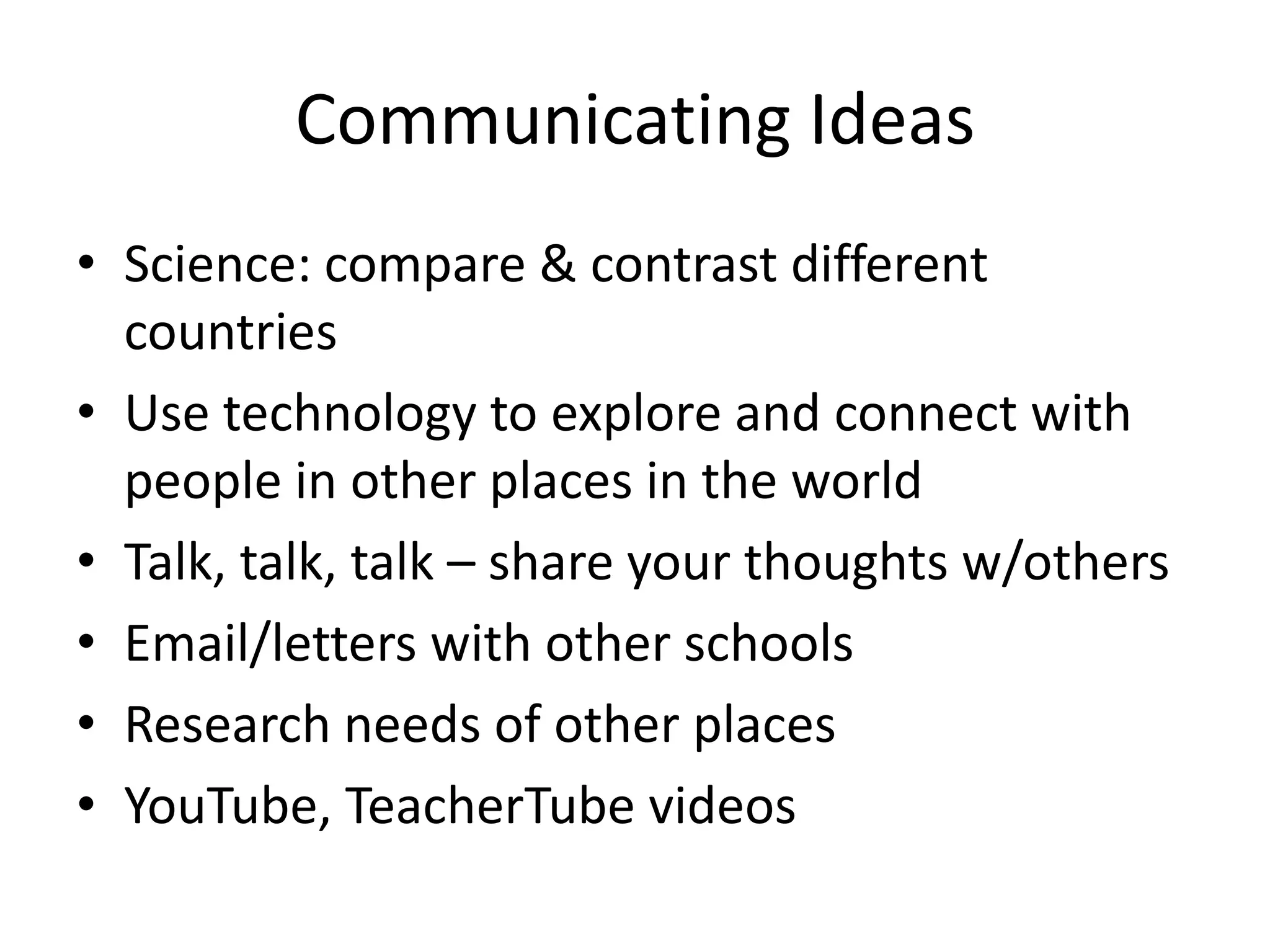
Communicating Ideas
• Science: compare & contrast different
  countries
• Use technology to explore and connect with
  people in other places in the world
• Talk, talk, talk – share your thoughts w/others
• Email/letters with other schools
• Research needs of other places
• YouTube, TeacherTube videos
Communicating Ideas
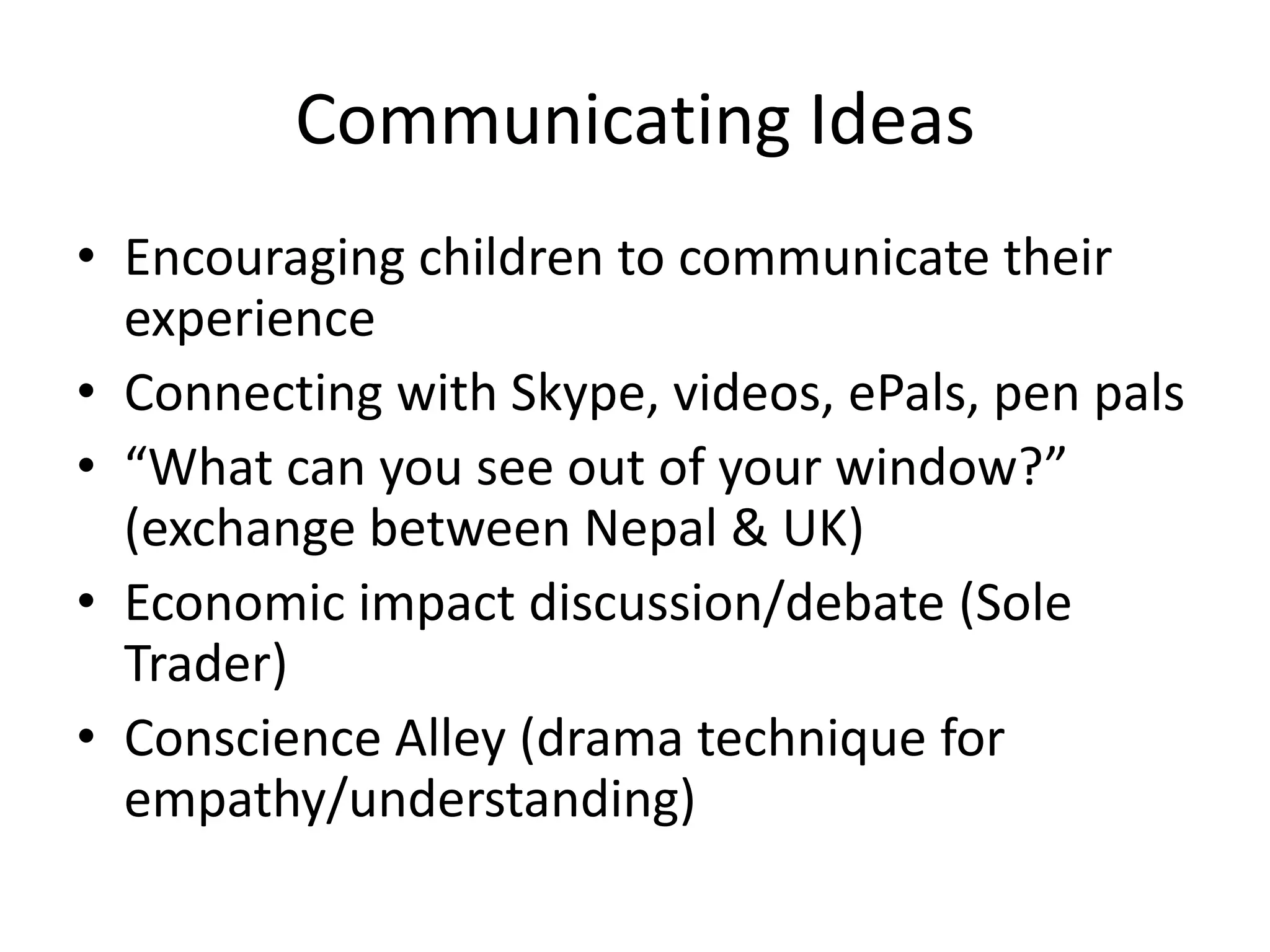
• Encouraging children to communicate their
  experience
• Connecting with Skype, videos, ePals, pen pals
• “What can you see out of your window?”
  (exchange between Nepal & UK)
• Economic impact discussion/debate (Sole
  Trader)
• Conscience Alley (drama technique for
  empathy/understanding)
Communicating Ideas
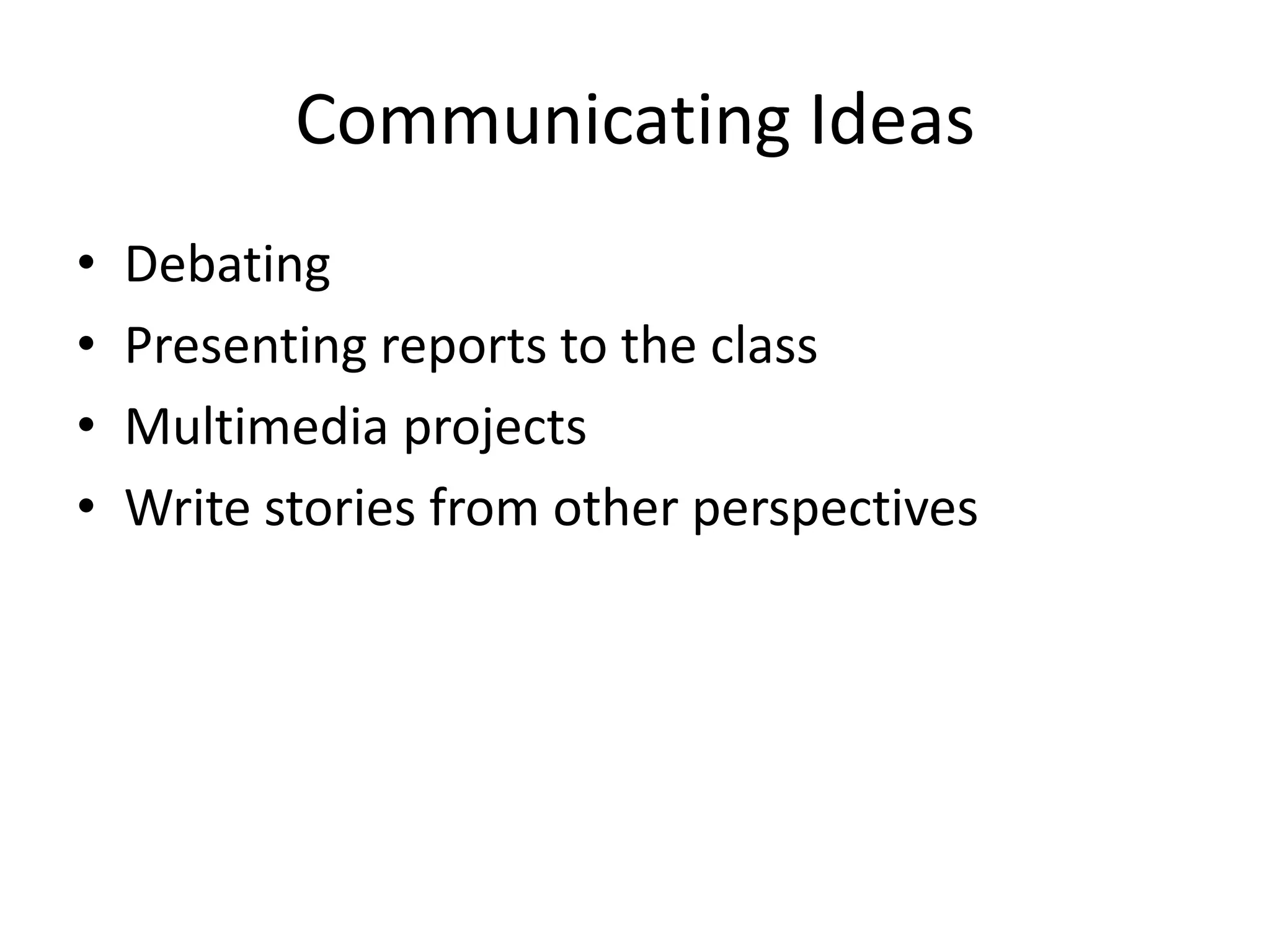
•   Debating
•   Presenting reports to the class
•   Multimedia projects
•   Write stories from other perspectives
Communicating Ideas
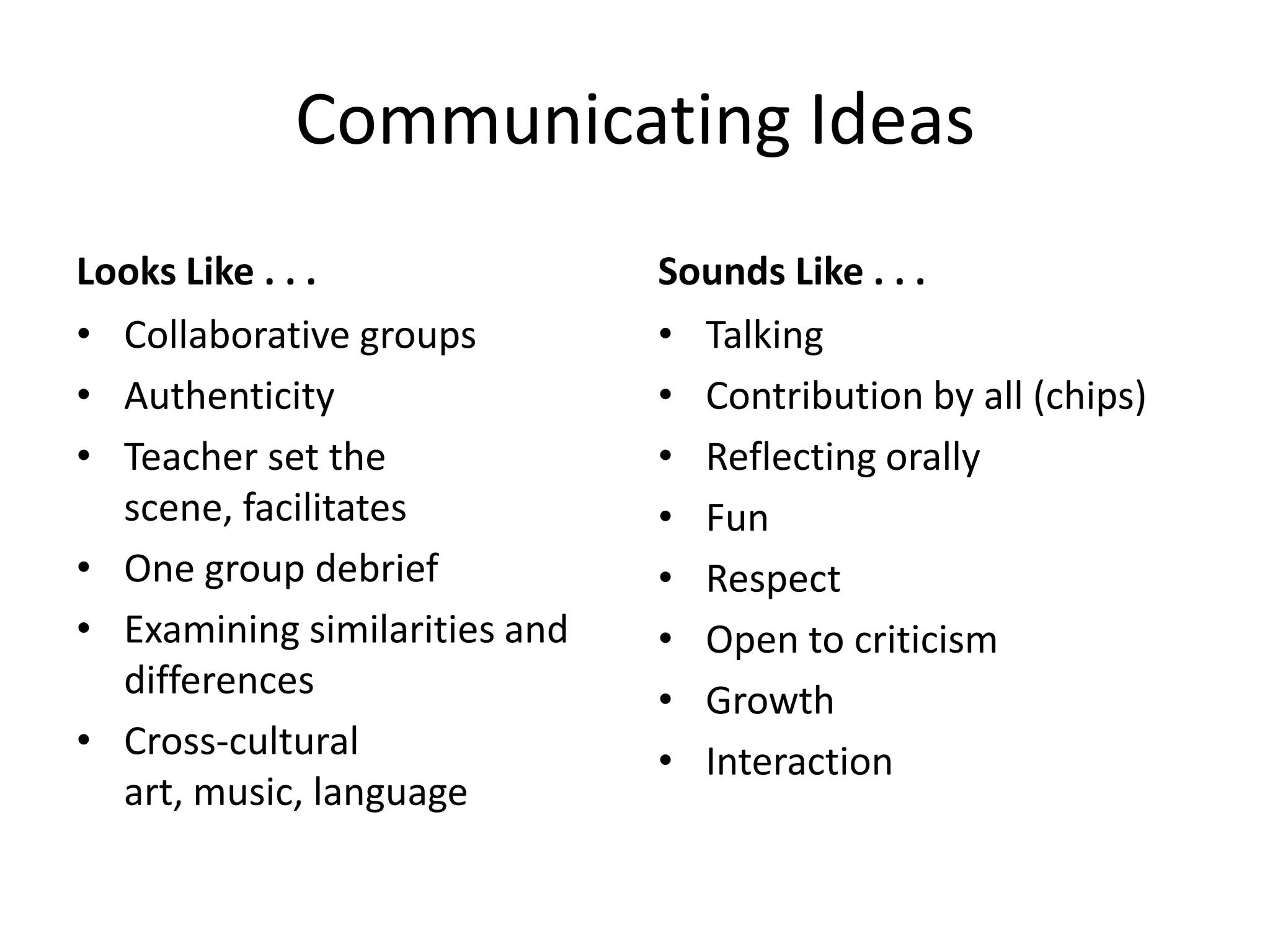
Looks Like . . .               Sounds Like . . .
• Collaborative groups         • Talking
• Authenticity                 • Contribution by all (chips)
• Teacher set the              • Reflecting orally
  scene, facilitates           • Fun
• One group debrief            • Respect
• Examining similarities and   • Open to criticism
  differences                  • Growth
• Cross-cultural               • Interaction
  art, music, language
Communicating Ideas
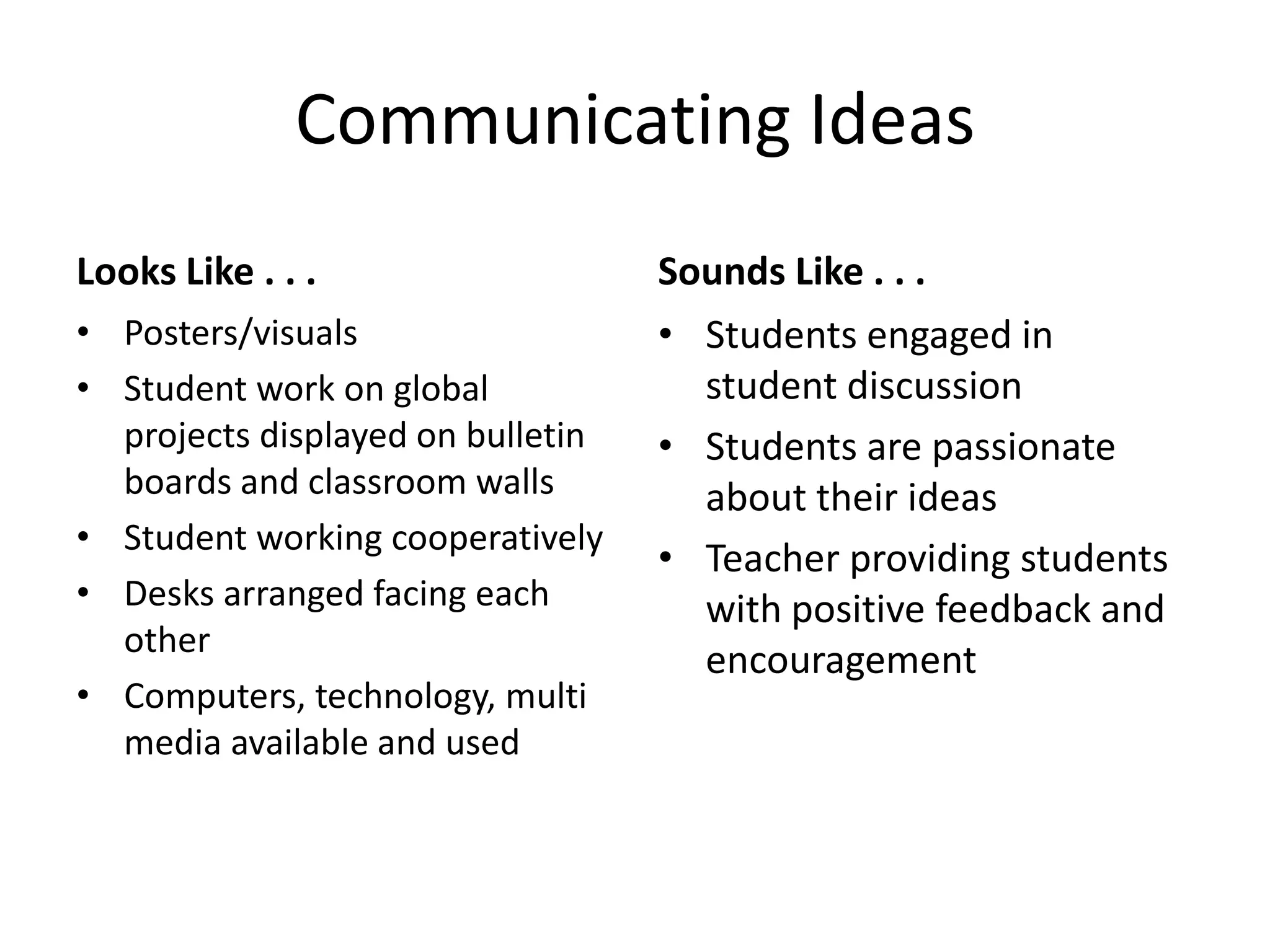
Looks Like . . .                   Sounds Like . . .
• Posters/visuals                  • Students engaged in
• Student work on global             student discussion
  projects displayed on bulletin   • Students are passionate
  boards and classroom walls         about their ideas
• Student working cooperatively
                                   • Teacher providing students
• Desks arranged facing each         with positive feedback and
  other
                                     encouragement
• Computers, technology, multi
  media available and used
Taking Action
• Teaching with guiding questions, activating
  students’ prior knowledge
• Teaching students to question/critical thinking
• Project-based learning from investigations
• Simulating real-world situations
• Giving students challenges and opportunities to
  creatively problem-solve
• Problem-solving through engineering solutions to
  global issues
Taking Action
• Think global, act local
• Creating campaigns, petitions, performances,
• Writing to pen pals and using social media to
  make the world smaller
• Putting projects online for comments
• Projects with objectives for improvement
• Service learning projects and trips
• Fundraising, community service
• Involving parents and community
Taking Action
• IB PYP (International Baccalaureate Primary
  Years Programme): exhibition – find a
  problem, research, and take action
• Earth science: respond to global natural
  disasters
• Community-based service learning in both
  local & global communities
• Communicate with other countries
• Fundraising, charity drives
Taking Action
•   Global links, find global w/local
•   Reciprocal visits, links between schools
•   Clean water projects
•   Local problem-solving projects
•   Take a stand
•   International festival or assembly to
    demonstrate various cultural perspectives
Taking Action
• Community organizations, international
  organizations
• Heifer foundation
• Trick or Treat for UNICEF
• Send my friend to school
• Operation Christmas Child plus a “Why” assembly
• National Honors Society – responsible for an
  action project
Taking Action
Looks Like . . .                         Sounds Like . . .
•   Student collaboration                •   Multilingual
•   Team/group teaching, kids teaching
•   Round tables                         •   Student voices
•   Building/environment represents      •   Critical thinking
    the outside community
•   Environmental print from many        •   Students and teacher asking
    sources                                  lots of questions
•   Technology – “techknowledge”
                                         •   Quiet time for reflection
•   Students and community
    constantly in and out of building    •   Informed conversations
•   Interdisciplinary project-based      •   Voices from community/world
    learning
•   Visual arts from the world –         •   Music and language from the
    connected to thinking                    world

Fulbright teacher exchange global competence

  • 1.
    Teaching Toward Global Competence Classroom Teacher Exchange Program In-Service Workshop for International Teachers and Host Schools
  • 2.
    Here’s what FulbrightExchange Teachers are doing, and planning to do, to help students develop the four domains of global competence.
  • 3.
    Key Ideas around Teaching Toward Global Competence • Finding global/local connections • Raising awareness of others’ perspectives • Retaining one’s unique culture • Considering access/equity, ability to participate • Embracing plurality • Using visuals, case studies, personal examples • Importance of world languages • Respect for self as well as others
  • 4.
    Key Ideas around Teaching Toward Global Competence • Empathy • Compassion • Seeing the world from someone else’s perspective • Knowing the world is bigger than your immediate environment • Understanding our common biological humanity • Seeing case studies (where food comes from, etc.) as examples of globalization
  • 5.
    Investigating the World • Guest speakers, interview visitors • Personal stories with world experience • Prompts for writing • Visual aids, world cinema • Research projects with worldwide publications • International games • Literature, plays, poetry w/ cultural diversity • Art: exploring multicultural art & artists
  • 6.
    Investigating the World •Using different ways to construct knowledge • Observation and data collection • Comparing & contrasting sources of information • Getting students out of their comfort zone • Teaching students how to access & use these resources • Looking at environmental issues, biodiversity, etc. from a “one ocean”/“one planet” perspective
  • 7.
    Investigating the World •Math/science: climates – impacts on people in geography, earth/sun geometry • Projects that require students to explore/investigate global issues • Celebrate cultural days (cuisines of the world, dance, music, art, sport, hobbies) • Research where you food, clothing, etc. comes from; exploring fair trade issues • Google Earth
  • 8.
    Investigating the World •Geography, geographical literacy • Understanding that geographical and political circumstances can affect economics • Literature choices, world literature • Video conferencing • School trips • Current events and news
  • 9.
    Investigating the World •Sharing images • World map – discussion, pinpointing where students are from, what languages are in the school – celebrate • Letter writing to soldiers around the world • Ethnic festivals & conferences & guest speakers
  • 10.
    Investigating the World LooksLike . . . Sounds Like . . . • Art, writing, artifacts, travel, • Songs, music, musical maps, flags on display instruments from other • Social-media, technology parts of the world • Welcome in different • Greetings and speaking in languages different languages • Personal coat of arms • Foreign films • International family links • World literature • International foods, traditional to • Students’ life experiences country/culture brought into conversation
  • 11.
    Investigating the World LooksLike . . . Sounds Like . . . • Posters • Drum circle • T-shirts created by students • Dancing • Video clips • Video clips • Monthly focus • International music • Cultural corner • Foreign language • Cultural food • World languages
  • 12.
    Recognizing Perspectives • Sharingfirst-hand experiences • Reading books, watching films • Comparing & contrasting literature • Analyzing world news reports from different countries • Analyzing language through cultural lens • Partnerships/pen pals with classrooms across the world (handwritten letters, too) • Global genes, family history, heritage pride
  • 13.
    Recognizing Perspectives • Startingwith students’ experiences, questions • Observation and data collection locally and internationally with a comparative analysis – e.g. conservation efforts in different countries – e.g. statistics problems using international numbers • Involving the community • Learning about history of discrimination against minorities • Recognizing bias • Making world connections through technology (skype, youtube, etc.)
  • 14.
    Recognizing Perspectives • Earth/science:understand why people make devices that impact day-to-day life (food, economy, life-styles) • Literature: introduce students to experiences of diverse cultures • Celebrate differences/diversity • Learning about other countries/cultures help to get broader perspectives
  • 15.
    Recognizing Perspectives • TeachingPOV in literature, art, history, environmental issues • Global stories appropriate for age group • Relate to ethnic/cultural background of the children • Pen pals provide personal connection • One Day Without Shoes • Sole trader, Chocolate trade game, World resources game
  • 16.
    Recognizing Perspectives • Activitiesto put yourself in others’ shoes • Comparing/contrasting images • Contrasting videos and persuasive/empathetic writing • International films • Guest speakers • Role playing • Model UN
  • 17.
    Recognizing Perspectives Looks Like. . . Sounds Like . . . • Students are on task in • Noisy cooperative learning groups • International music while students • Maps on the wall are working • Might see students role-playing • Questions, vulnerability, honesty and reaching solutions • Enthusiasm for learning with global • Examples of student work that competence as end in mind connects problem-solving in the • Self awareness in student local community to the responses international community • Community-minded learning in the • Technology, especially the classroom – being able to function Internet, is a regular resource as a class enriches their ability to function globally • Initiative towards the big picture • Challenging and exploring various • Teacher-leaders modeling viewpoints in class discussions appropriate mindsets
  • 18.
    Communicating Ideas • Givingstudents opportunities to collaborate in learning • Skyping or ePals with other classrooms around the world • Developing graphical representations of comparative data sets • Math is an international language, therefore, it builds common ground for understanding – e.g. History of Pythagoras or Zero
  • 19.
    Communicating Ideas • Using blogs, social media, social networking • Sending out newsletters, school newspaper • Creating plays, art, film • World languages, student clubs, history fair • Festivals/presentations to community groups • Heritage Night • Visitors to share personal experience
  • 20.
    Communicating Ideas • Science:compare & contrast different countries • Use technology to explore and connect with people in other places in the world • Talk, talk, talk – share your thoughts w/others • Email/letters with other schools • Research needs of other places • YouTube, TeacherTube videos
  • 21.
    Communicating Ideas • Encouragingchildren to communicate their experience • Connecting with Skype, videos, ePals, pen pals • “What can you see out of your window?” (exchange between Nepal & UK) • Economic impact discussion/debate (Sole Trader) • Conscience Alley (drama technique for empathy/understanding)
  • 22.
    Communicating Ideas • Debating • Presenting reports to the class • Multimedia projects • Write stories from other perspectives
  • 23.
    Communicating Ideas Looks Like. . . Sounds Like . . . • Collaborative groups • Talking • Authenticity • Contribution by all (chips) • Teacher set the • Reflecting orally scene, facilitates • Fun • One group debrief • Respect • Examining similarities and • Open to criticism differences • Growth • Cross-cultural • Interaction art, music, language
  • 24.
    Communicating Ideas Looks Like. . . Sounds Like . . . • Posters/visuals • Students engaged in • Student work on global student discussion projects displayed on bulletin • Students are passionate boards and classroom walls about their ideas • Student working cooperatively • Teacher providing students • Desks arranged facing each with positive feedback and other encouragement • Computers, technology, multi media available and used
  • 25.
    Taking Action • Teachingwith guiding questions, activating students’ prior knowledge • Teaching students to question/critical thinking • Project-based learning from investigations • Simulating real-world situations • Giving students challenges and opportunities to creatively problem-solve • Problem-solving through engineering solutions to global issues
  • 26.
    Taking Action • Thinkglobal, act local • Creating campaigns, petitions, performances, • Writing to pen pals and using social media to make the world smaller • Putting projects online for comments • Projects with objectives for improvement • Service learning projects and trips • Fundraising, community service • Involving parents and community
  • 27.
    Taking Action • IBPYP (International Baccalaureate Primary Years Programme): exhibition – find a problem, research, and take action • Earth science: respond to global natural disasters • Community-based service learning in both local & global communities • Communicate with other countries • Fundraising, charity drives
  • 28.
    Taking Action • Global links, find global w/local • Reciprocal visits, links between schools • Clean water projects • Local problem-solving projects • Take a stand • International festival or assembly to demonstrate various cultural perspectives
  • 29.
    Taking Action • Communityorganizations, international organizations • Heifer foundation • Trick or Treat for UNICEF • Send my friend to school • Operation Christmas Child plus a “Why” assembly • National Honors Society – responsible for an action project
  • 30.
    Taking Action Looks Like. . . Sounds Like . . . • Student collaboration • Multilingual • Team/group teaching, kids teaching • Round tables • Student voices • Building/environment represents • Critical thinking the outside community • Environmental print from many • Students and teacher asking sources lots of questions • Technology – “techknowledge” • Quiet time for reflection • Students and community constantly in and out of building • Informed conversations • Interdisciplinary project-based • Voices from community/world learning • Visual arts from the world – • Music and language from the connected to thinking world