Media Evaluation Question 2:

    How effective is the
 combination of your main
product and ancillary texts?

         By Emily Lee
Summary
• Overall I thought that the 3 products we produced was amateur, there are
  many things that could be improved to make the 3 media products seem
  more professional. Out of the 3 media products I thought the radio trailer
  was the best one because it wasn’t a visual aspect, it was mostly sound
  extracts put together. Our strategy that we agreed at the start completely
  failed, as we wanted to do one media product first then another then
  another. We started off with the documentary, filming went to schedule
  but when we started editing, the progress was slow, and therefore I knew
  keeping to the deadline would be a problem, so I wanted to rectify the
  problem however wasn’t allowed to. There was 2 weeks before the
  deadline, we still hadn’t finished the documentary or even started on the
  magazine article or even the radio trailer. Last 2 weeks we were panicking
  and rushed finishing all 3 of the products and trying to sort out what
  needed to go on to the blog. As a group we were not very organised and
  the products that we produced, could have been much better and at a
  much high professional standard if we spent more time on them. We
  spent so much time on the documentary and the documentary didn’t even
  turn out how we expected it to be.
Target Audience
• The target audience is the centre of all 3 media products as it
  affects the way in which all 3 media products are presented to the
  audience. We distinguished the target audience for our
  documentary quite early on when we were planning. For our
  documentary our target audience is mainly focused on the parents
  of the young people in education or trying to find a job, 35 – 55
  year olds and its secondary target audience is the young people
  themselves who are struggling to make choices based on their
  education or seeking for employment so 16 – 22 year olds. It is
  aimed at both genders. Our target audience does not target any
  particular race, religion or disability in order to watch this
  programme. In terms of location we have decided to set it in the
  Birmingham as it is currently the highest unemployed in the UK
  with Ladywood’s unemployment rate of 11.7% out of 9157, Hodge
  Hill’s unemployment rate of 10% out of 4807 and Sparkbrook’s
  unemployment rate of 9.3% out of 6917.
Documentary
• One of the pros that I thought we did well in was
  conveying the mise-en-scene. Mise-en-scene is vitally
  important in conveying the topic of the documentary. I
  felt that the establishing shots in our documentary
  gave the audience an idea of what our topic was about.
Documentary
• In addition, we decided to broadcast our
  programme on BBC1 because many people
  watch BBC1 compared to BBC 2, 3 or 4.
  Documentaries on BBC 1 tend to evolve more
  around people than nature, historical or other
  documentaries. I think we made a good
  decision if we were to broadcast our
  documentary on this channel.
Magazine
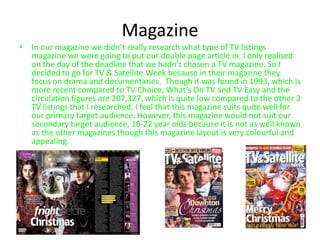
• In our magazine we didn’t really research what type of TV listings
  magazine we were going to put our double page article in. I only realised
  on the day of the deadline that we hadn’t chosen a TV magazine. So I
  decided to go for TV & Satellite Week because in their magazine they
  focus on drama and documentaries. Though it was found in 1993, which is
  more recent compared to TV Choice, What’s On TV and TV Easy and the
  circulation figures are 207,327, which is quite low compared to the other 3
  TV listings that I researched, I feel that this magazine suits quite well for
  our primary target audience. However, this magazine would not suit our
  secondary target audience, 16-22 year olds because it is not as well known
  as the other magazines though this magazine layout is very colourful and
  appealing.
Comparing the 2 magazines


In our magazine we used still pictures that were from our documentary, the top half of the
magazine that I designed was good, but didn’t have enough time to make it seem like the
one on the right hand side, a double page spread magazine article from TV & Satellite
Week. The photo of the Houses of Parliament and Big Ben was when I went to London a
year ago and I decided that the picture particularly suited our topic of education,
universities and careers as it represents the busy city life which is associated with people,
businesses and work. In addition, I had to add more into the article as the article didn’t
cover the 3 columns so I had to extend it to fill up the page.
Radio Trailer
• In our radio trailer we used extracts from our
  documentary to engage the listeners to our
  programme. We created similar background music
  for our radio trailer and our documentary so the
  audience are easily able to recognise that what they
  heard on the radio is what they are watching on TV. I
  feel that our radio trailer definitely advertise our
  documentary with the enthusiastic voice over, the
  well chosen extracts and the background music.
Radio Trailer


• We didn’t really discuss what radio channel this radio
  trailer would be on too but I think we settled for BBC
  Radio 4. I’m not sure why but I think it was the wrong
  decision. Although BBC Radio 4’s target audience is for
  our primary target audience, BBC Radio 4 is normally
  associated with well educated and quite upper class
  people and since we are focusing on the
  unemployment and generally working class people,
  BBC Radio 4 may not have been the ideal radio station
  to broadcast our radio trailer.
Overall
• After analyzing all 3 products, I felt that if we
  researched more into the radio trailer and
  magazine article and split our time equally, we
  would have got more knowledge and
  therefore would have been able to complete
  all the 3 products on time as we would have
  known what to include in our media products
  and therefore would have got more marks
  without being rushed.

Media evaluation question 2

  • 1.
    Media Evaluation Question2: How effective is the combination of your main product and ancillary texts? By Emily Lee
  • 2.
    Summary • Overall Ithought that the 3 products we produced was amateur, there are many things that could be improved to make the 3 media products seem more professional. Out of the 3 media products I thought the radio trailer was the best one because it wasn’t a visual aspect, it was mostly sound extracts put together. Our strategy that we agreed at the start completely failed, as we wanted to do one media product first then another then another. We started off with the documentary, filming went to schedule but when we started editing, the progress was slow, and therefore I knew keeping to the deadline would be a problem, so I wanted to rectify the problem however wasn’t allowed to. There was 2 weeks before the deadline, we still hadn’t finished the documentary or even started on the magazine article or even the radio trailer. Last 2 weeks we were panicking and rushed finishing all 3 of the products and trying to sort out what needed to go on to the blog. As a group we were not very organised and the products that we produced, could have been much better and at a much high professional standard if we spent more time on them. We spent so much time on the documentary and the documentary didn’t even turn out how we expected it to be.
  • 3.
    Target Audience • Thetarget audience is the centre of all 3 media products as it affects the way in which all 3 media products are presented to the audience. We distinguished the target audience for our documentary quite early on when we were planning. For our documentary our target audience is mainly focused on the parents of the young people in education or trying to find a job, 35 – 55 year olds and its secondary target audience is the young people themselves who are struggling to make choices based on their education or seeking for employment so 16 – 22 year olds. It is aimed at both genders. Our target audience does not target any particular race, religion or disability in order to watch this programme. In terms of location we have decided to set it in the Birmingham as it is currently the highest unemployed in the UK with Ladywood’s unemployment rate of 11.7% out of 9157, Hodge Hill’s unemployment rate of 10% out of 4807 and Sparkbrook’s unemployment rate of 9.3% out of 6917.
  • 4.
    Documentary • One ofthe pros that I thought we did well in was conveying the mise-en-scene. Mise-en-scene is vitally important in conveying the topic of the documentary. I felt that the establishing shots in our documentary gave the audience an idea of what our topic was about.
  • 5.
    Documentary • In addition,we decided to broadcast our programme on BBC1 because many people watch BBC1 compared to BBC 2, 3 or 4. Documentaries on BBC 1 tend to evolve more around people than nature, historical or other documentaries. I think we made a good decision if we were to broadcast our documentary on this channel.
  • 6.
    Magazine • In ourmagazine we didn’t really research what type of TV listings magazine we were going to put our double page article in. I only realised on the day of the deadline that we hadn’t chosen a TV magazine. So I decided to go for TV & Satellite Week because in their magazine they focus on drama and documentaries. Though it was found in 1993, which is more recent compared to TV Choice, What’s On TV and TV Easy and the circulation figures are 207,327, which is quite low compared to the other 3 TV listings that I researched, I feel that this magazine suits quite well for our primary target audience. However, this magazine would not suit our secondary target audience, 16-22 year olds because it is not as well known as the other magazines though this magazine layout is very colourful and appealing.
  • 7.
    Comparing the 2magazines In our magazine we used still pictures that were from our documentary, the top half of the magazine that I designed was good, but didn’t have enough time to make it seem like the one on the right hand side, a double page spread magazine article from TV & Satellite Week. The photo of the Houses of Parliament and Big Ben was when I went to London a year ago and I decided that the picture particularly suited our topic of education, universities and careers as it represents the busy city life which is associated with people, businesses and work. In addition, I had to add more into the article as the article didn’t cover the 3 columns so I had to extend it to fill up the page.
  • 8.
    Radio Trailer • Inour radio trailer we used extracts from our documentary to engage the listeners to our programme. We created similar background music for our radio trailer and our documentary so the audience are easily able to recognise that what they heard on the radio is what they are watching on TV. I feel that our radio trailer definitely advertise our documentary with the enthusiastic voice over, the well chosen extracts and the background music.
  • 9.
    Radio Trailer • Wedidn’t really discuss what radio channel this radio trailer would be on too but I think we settled for BBC Radio 4. I’m not sure why but I think it was the wrong decision. Although BBC Radio 4’s target audience is for our primary target audience, BBC Radio 4 is normally associated with well educated and quite upper class people and since we are focusing on the unemployment and generally working class people, BBC Radio 4 may not have been the ideal radio station to broadcast our radio trailer.
  • 10.
    Overall • After analyzingall 3 products, I felt that if we researched more into the radio trailer and magazine article and split our time equally, we would have got more knowledge and therefore would have been able to complete all the 3 products on time as we would have known what to include in our media products and therefore would have got more marks without being rushed.