SOKOINE UNIVERSITY OF AGRICULTURE
SCHOOL OF AGRICULTURAL ECONOMICS AND BUSINESS STUDIES
DEPARTMENT OF AGRICULTURAL ECONOMICS AND AGRIBUSINESS
AEA 202:INTRODUCTION TO AGRICULTURAL MARKETING MANAGEMENT
BSC.IWRE GROUP 02
Date:January,2018
Instructor name :MR SELUYINGA
NO NAME REG.NUMBER SIGNATURE
01. DOTO,MUSA GESE IWR/D/2016/0011
02. HENRY,PAULO B IWR/D/2016/0012
03. CHRISPIN, GEBRA SHAO IWR/D/2016/0008
04. DAUD,DERICK L IWR/D/2016/0009
05. BIRUSYA LILIAN MEDARD IWR/D/2016/0063
06. HILONGA NOEL P IWR/D/2016/0013
07. DAUDI,SAIDI JAFARI IWR/D/2016/0010
08. DAMIANO,FADHIL P IWR/D/2016/0069
PRESENTATION QUESTION
How could the linkage between upstream and downstream value chain activities
be enhanced?
1. INTRODUCTION
What is a chain?
Is the full range of activities that businesses go through to bring a productor
service to their customers.
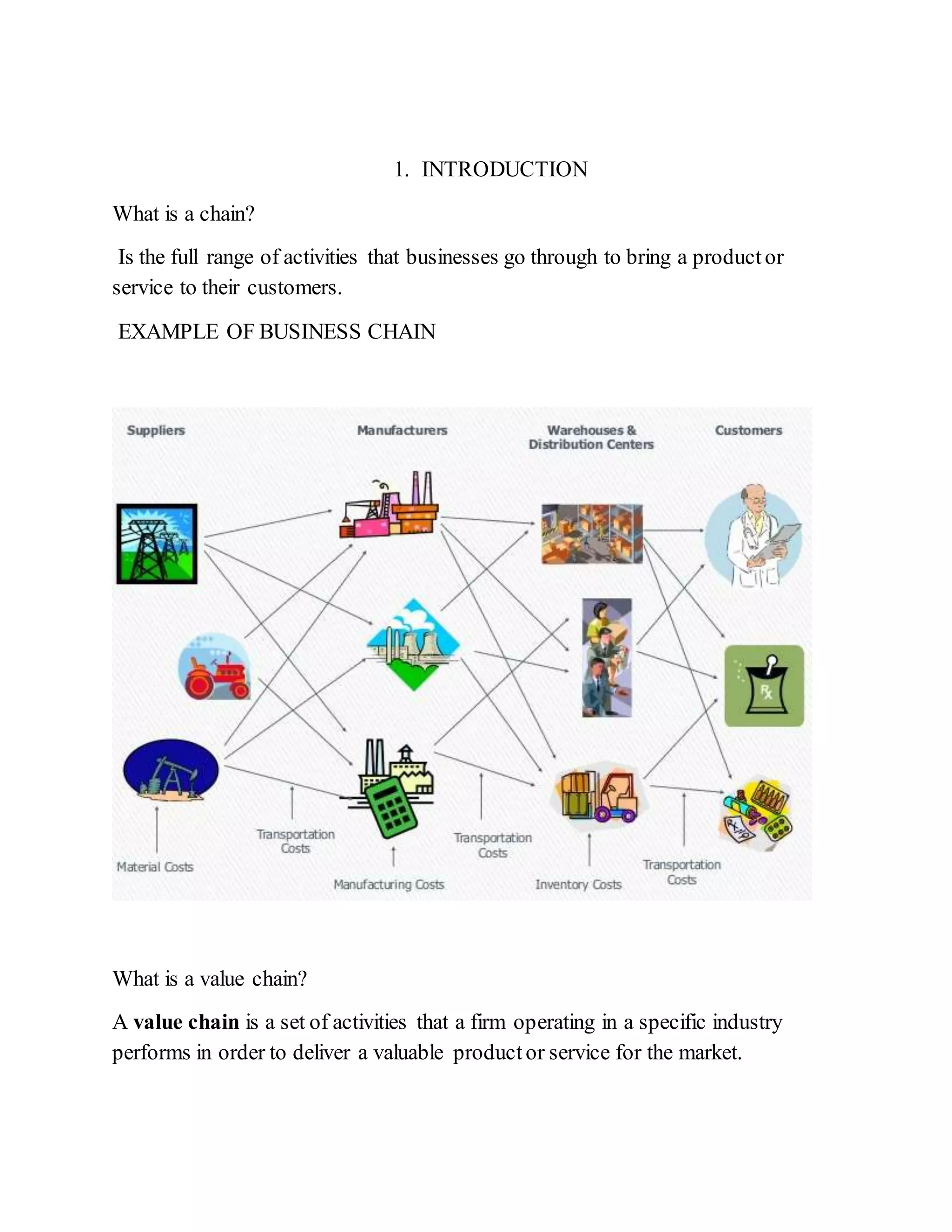
EXAMPLE OF BUSINESS CHAIN
What is a value chain?
A value chain is a set of activities that a firm operating in a specific industry
performs in order to deliver a valuable product or service for the market.
UPSTREAM AND DOWNSTREAM
"Upstream" and "downstream" are business terms applicable to the production processes that
exist within several industries. Industries that commonly use this terminology include the metals
industry, oil, gas, biopharmaceutical and biotechnology industries. Upstream, downstream and
midstream make up the stages of the production process for these and other industries.
A. Upstream definition
The upstream stage of the production process involves searching for and extracting raw
materials. The upstream part of the production process does not do anything with the material
itself, such as processing the material. This part of the process simply finds and extracts the raw
material. Thus, any industry that relies on the extraction of raw materials commonly has an
upstream stage in its production process.
 In a more general sense, "upstream" can also refer to any part of the production process
relating to the extraction stages.
Examples of Upstream Processes
In the petroleum industry, locating underground or underwater oil reserves characterizes the
upstream process. Additionally, the upstream process in this industry involves bringing oil and
gas to the surface. Extraction wells represent an example of a structure operating in this stage in
the process. The upstream stage in the production process may also manifest itself as a supplier
providing raw materials to manufacturers or other businesses that ultimately process the
materials
B. Downstream definition
The downstream stage in the production process involves processing the materials collected
during the upstream stage into a finished product. The downstream stage further includes the
actual sale of that product to other businesses, governments or private individuals. The type of
end user will vary depending on the finished product. Regardless of the industry involved, the
downstream process has direct contact with customers through the finished product.
Examples of Downstream Processes
In the oil and gas industry, the downstream process consists of converting crude oil into other
products and then selling those products to customers. Thus, oil refineries represent structures
that operate within the downstream process. However, any kind of plant that processes raw
materials may qualify as operating within the downstream stage of production. A company that
combines both upstream and downstream processes is an integrated company.
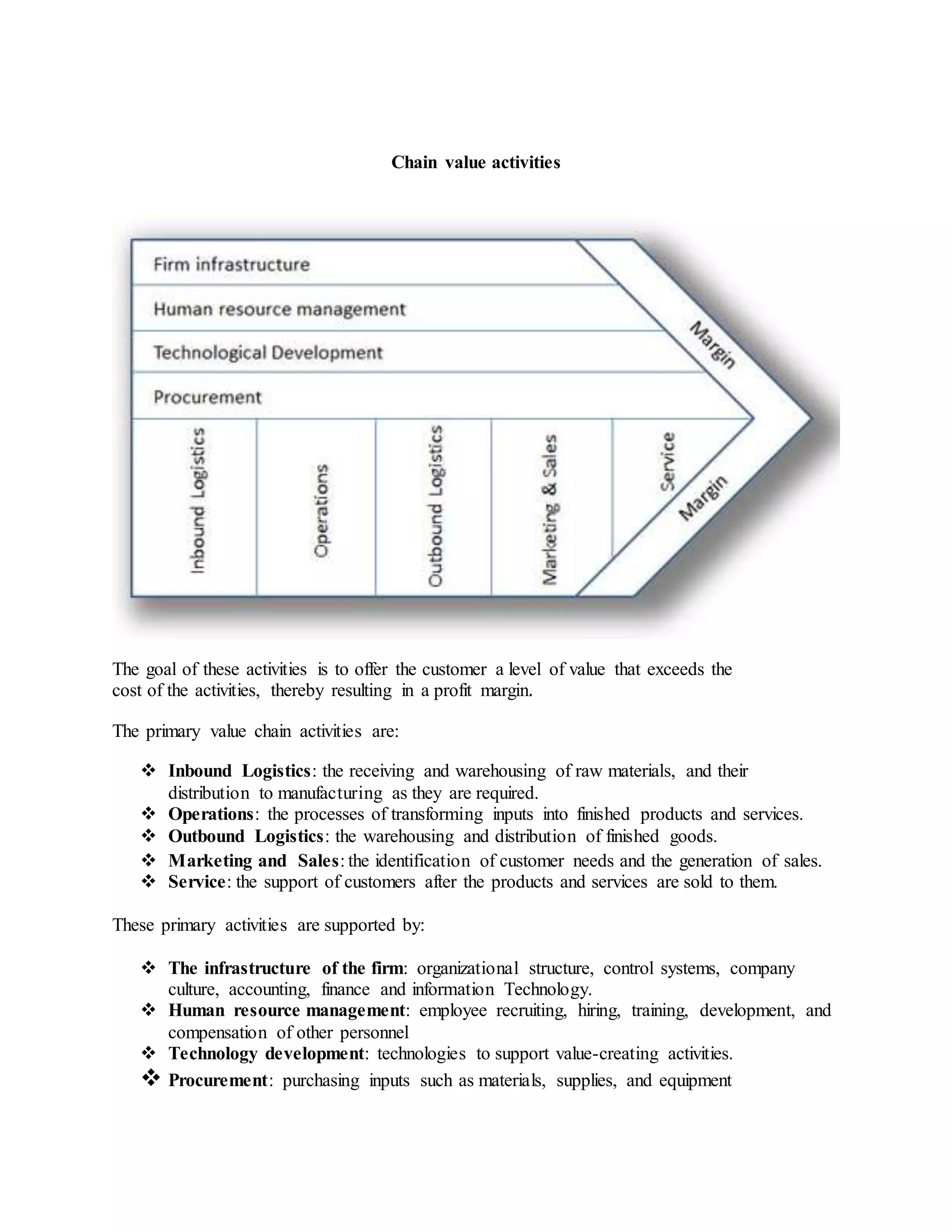
Chain value activities
The goal of these activities is to offer the customer a level of value that exceeds the
cost of the activities, thereby resulting in a profit margin.
The primary value chain activities are:
 Inbound Logistics: the receiving and warehousing of raw materials, and their
distribution to manufacturing as they are required.
 Operations: the processes of transforming inputs into finished products and services.
 Outbound Logistics: the warehousing and distribution of finished goods.
 Marketing and Sales: the identification of customer needs and the generation of sales.
 Service: the support of customers after the products and services are sold to them.
These primary activities are supported by:
 The infrastructure of the firm: organizational structure, control systems, company
culture, accounting, finance and information Technology.
 Human resource management: employee recruiting, hiring, training, development, and
compensation of other personnel
 Technology development: technologies to support value-creating activities.
 Procurement: purchasing inputs such as materials, supplies, and equipment
2. LINKAGE BETWEEN UPSTREAM AND DOWNSTREAM IN VALUE CHAIN
ACTIVITIES
Value chain activities are not isolated from one another. Rather, one value chain activity often
affects the cost or performance of other ones. Linkages may exist between primary activities and
also between primary and support activities.
Consider the case in which the design of a product is changed in order to reduce manufacturing
costs. Suppose that inadvertently the new product design results in increased service costs; the
cost reduction could be less than anticipated and even worse, there could be a net cost increase.
Sometimes however, the firm may be able to reduce cost in one activity and consequently enjoy
a cost reduction in another, such as when a design change simultaneously reduces manufacturing
costs and improves reliability so that the service costs also are reduced. Through such
improvements the firm has the potential to develop a competitive advantage.
Chain value activities that enhance linkage between Upstream and downstream
1. Firm infrastructure -involves organization unit and different means of transport such as
road, railway lines which supports the production of identical or differentiated goods and
services .
 General management
 Finance
 Information Technology
 Accounting
2.Human resource management
 Recruiting
 Hiring
 Training
 Developing and compensating all personnel
3.Technological development
 Process design
 Product design
4. Procurement
 Purchasing raw materials
 Supplies
 Fixed assets
5.Inbound logistic- the receiving and warehousing of raw materials, and their distribution to
manufacturing as they are required .
 Call-off to suppliers
 Materials handling
 Warehousing
 Inventory control
6.Operations- the processes of transforming inputs into finished products and services.
 Conversion
 Assembly
 Packaging
 maintenance
7.Outbond logistic- the warehousing and distribution of finished goods
 Warehousing
 Order processing
 Picking
 Shipment
 Delivery
8.Marketing and sales
 Channel to markets
 Product, picking, advertising and promotion, distribution
 Customer values, Cost to consumer, Communication, Convenience
 Sales force effectiveness
9.Service
 Installation
 Repair
 Training
Conclusion
The firm's margin or profit then depends on its effectiveness in performing these activities
efficiently, so that the amount that the customer is willing to pay for the products exceeds the
cost of the activities in the value chain. It is in these activities that a firm has the opportunity to
generate superior value. A competitive advantage may be achieved by reconfiguring the value
chain to provide lower cost or better differentiation.
The value chain model is a useful analysis tool for defining a firm's core competencies and the
activities in which it can pursue a competitive advantage in terms of Cost advantage(by better
understanding costs and squeezing them out of the value-adding activities) and Differentiation(
by focusing on those activities associated with core competencies and capabilities in order to
perform them better than do competitors.
REFERENCES
Ministry of Agriculture, Livestock and Fisheries. 3rd annual agricultural policy conference
serena hotel, dar es salaam 1-3 march 201.7.AAP press conference
http://foodsecuritypolicy.msu.edu/uploads/files/News/3rd_Conf_TZ/AAP_conference_Abs
tracts_PRESS.pdf
NetMBA. Valuechain analysis.Retrievedon 02/01/2018 http://www.netmba.com/strategy/value-
chain/
Chron. The Definitions of "Upstream" and "Downstream" in the Production Proces., Retrieved
on 03/01/2018. http://smallbusiness.chron.com/definitions-upstream-downstream-production-
process-30971.html
AEA 202, MR Seluyinga .lecture notes 2017-2018.

How could the linkage between upstream and downstream value chain activities be enhanced?

  • 1.
    SOKOINE UNIVERSITY OFAGRICULTURE SCHOOL OF AGRICULTURAL ECONOMICS AND BUSINESS STUDIES DEPARTMENT OF AGRICULTURAL ECONOMICS AND AGRIBUSINESS AEA 202:INTRODUCTION TO AGRICULTURAL MARKETING MANAGEMENT BSC.IWRE GROUP 02 Date:January,2018 Instructor name :MR SELUYINGA NO NAME REG.NUMBER SIGNATURE 01. DOTO,MUSA GESE IWR/D/2016/0011 02. HENRY,PAULO B IWR/D/2016/0012 03. CHRISPIN, GEBRA SHAO IWR/D/2016/0008 04. DAUD,DERICK L IWR/D/2016/0009 05. BIRUSYA LILIAN MEDARD IWR/D/2016/0063 06. HILONGA NOEL P IWR/D/2016/0013 07. DAUDI,SAIDI JAFARI IWR/D/2016/0010 08. DAMIANO,FADHIL P IWR/D/2016/0069
  • 2.
    PRESENTATION QUESTION How couldthe linkage between upstream and downstream value chain activities be enhanced?
  • 3.
    1. INTRODUCTION What isa chain? Is the full range of activities that businesses go through to bring a productor service to their customers. EXAMPLE OF BUSINESS CHAIN What is a value chain? A value chain is a set of activities that a firm operating in a specific industry performs in order to deliver a valuable product or service for the market.
  • 4.
    UPSTREAM AND DOWNSTREAM "Upstream"and "downstream" are business terms applicable to the production processes that exist within several industries. Industries that commonly use this terminology include the metals industry, oil, gas, biopharmaceutical and biotechnology industries. Upstream, downstream and midstream make up the stages of the production process for these and other industries. A. Upstream definition The upstream stage of the production process involves searching for and extracting raw materials. The upstream part of the production process does not do anything with the material itself, such as processing the material. This part of the process simply finds and extracts the raw material. Thus, any industry that relies on the extraction of raw materials commonly has an upstream stage in its production process.  In a more general sense, "upstream" can also refer to any part of the production process relating to the extraction stages. Examples of Upstream Processes In the petroleum industry, locating underground or underwater oil reserves characterizes the upstream process. Additionally, the upstream process in this industry involves bringing oil and gas to the surface. Extraction wells represent an example of a structure operating in this stage in the process. The upstream stage in the production process may also manifest itself as a supplier providing raw materials to manufacturers or other businesses that ultimately process the materials B. Downstream definition The downstream stage in the production process involves processing the materials collected during the upstream stage into a finished product. The downstream stage further includes the actual sale of that product to other businesses, governments or private individuals. The type of end user will vary depending on the finished product. Regardless of the industry involved, the downstream process has direct contact with customers through the finished product. Examples of Downstream Processes In the oil and gas industry, the downstream process consists of converting crude oil into other products and then selling those products to customers. Thus, oil refineries represent structures that operate within the downstream process. However, any kind of plant that processes raw materials may qualify as operating within the downstream stage of production. A company that combines both upstream and downstream processes is an integrated company.
  • 5.
    Chain value activities Thegoal of these activities is to offer the customer a level of value that exceeds the cost of the activities, thereby resulting in a profit margin. The primary value chain activities are:  Inbound Logistics: the receiving and warehousing of raw materials, and their distribution to manufacturing as they are required.  Operations: the processes of transforming inputs into finished products and services.  Outbound Logistics: the warehousing and distribution of finished goods.  Marketing and Sales: the identification of customer needs and the generation of sales.  Service: the support of customers after the products and services are sold to them. These primary activities are supported by:  The infrastructure of the firm: organizational structure, control systems, company culture, accounting, finance and information Technology.  Human resource management: employee recruiting, hiring, training, development, and compensation of other personnel  Technology development: technologies to support value-creating activities.  Procurement: purchasing inputs such as materials, supplies, and equipment
  • 6.
    2. LINKAGE BETWEENUPSTREAM AND DOWNSTREAM IN VALUE CHAIN ACTIVITIES Value chain activities are not isolated from one another. Rather, one value chain activity often affects the cost or performance of other ones. Linkages may exist between primary activities and also between primary and support activities. Consider the case in which the design of a product is changed in order to reduce manufacturing costs. Suppose that inadvertently the new product design results in increased service costs; the cost reduction could be less than anticipated and even worse, there could be a net cost increase. Sometimes however, the firm may be able to reduce cost in one activity and consequently enjoy a cost reduction in another, such as when a design change simultaneously reduces manufacturing costs and improves reliability so that the service costs also are reduced. Through such improvements the firm has the potential to develop a competitive advantage. Chain value activities that enhance linkage between Upstream and downstream 1. Firm infrastructure -involves organization unit and different means of transport such as road, railway lines which supports the production of identical or differentiated goods and services .  General management  Finance  Information Technology  Accounting 2.Human resource management  Recruiting  Hiring  Training  Developing and compensating all personnel 3.Technological development  Process design  Product design 4. Procurement  Purchasing raw materials  Supplies  Fixed assets
  • 7.
    5.Inbound logistic- thereceiving and warehousing of raw materials, and their distribution to manufacturing as they are required .  Call-off to suppliers  Materials handling  Warehousing  Inventory control 6.Operations- the processes of transforming inputs into finished products and services.  Conversion  Assembly  Packaging  maintenance 7.Outbond logistic- the warehousing and distribution of finished goods  Warehousing  Order processing  Picking  Shipment  Delivery 8.Marketing and sales  Channel to markets  Product, picking, advertising and promotion, distribution  Customer values, Cost to consumer, Communication, Convenience  Sales force effectiveness 9.Service  Installation  Repair  Training
  • 8.
    Conclusion The firm's marginor profit then depends on its effectiveness in performing these activities efficiently, so that the amount that the customer is willing to pay for the products exceeds the cost of the activities in the value chain. It is in these activities that a firm has the opportunity to generate superior value. A competitive advantage may be achieved by reconfiguring the value chain to provide lower cost or better differentiation. The value chain model is a useful analysis tool for defining a firm's core competencies and the activities in which it can pursue a competitive advantage in terms of Cost advantage(by better understanding costs and squeezing them out of the value-adding activities) and Differentiation( by focusing on those activities associated with core competencies and capabilities in order to perform them better than do competitors.
  • 9.
    REFERENCES Ministry of Agriculture,Livestock and Fisheries. 3rd annual agricultural policy conference serena hotel, dar es salaam 1-3 march 201.7.AAP press conference http://foodsecuritypolicy.msu.edu/uploads/files/News/3rd_Conf_TZ/AAP_conference_Abs tracts_PRESS.pdf NetMBA. Valuechain analysis.Retrievedon 02/01/2018 http://www.netmba.com/strategy/value- chain/ Chron. The Definitions of "Upstream" and "Downstream" in the Production Proces., Retrieved on 03/01/2018. http://smallbusiness.chron.com/definitions-upstream-downstream-production- process-30971.html AEA 202, MR Seluyinga .lecture notes 2017-2018.