


DEPARTMENT OF ENGINEERING SCIENCES AND TECHNOLOGY
AE 217
MATERIALS TECHNOLOGY FOR ENGINEERS
IWRE 2 -GROUP 5
PRESENTATION
2018
FRESH CONCRETE
PRESENTATION OUTLINES
General introduction
Fresh concrete properties
Fresh concrete Testing
The Admixture
The Hardened mixture
FRESH CONCRETE
FRESH CONCRETE
General introduction
CONCRETE
is a building Material made from a
mixture of gravel ,sand ,cement,water
and air ,forming a stone like mass on
hardenning.
FRESH CONCRETE
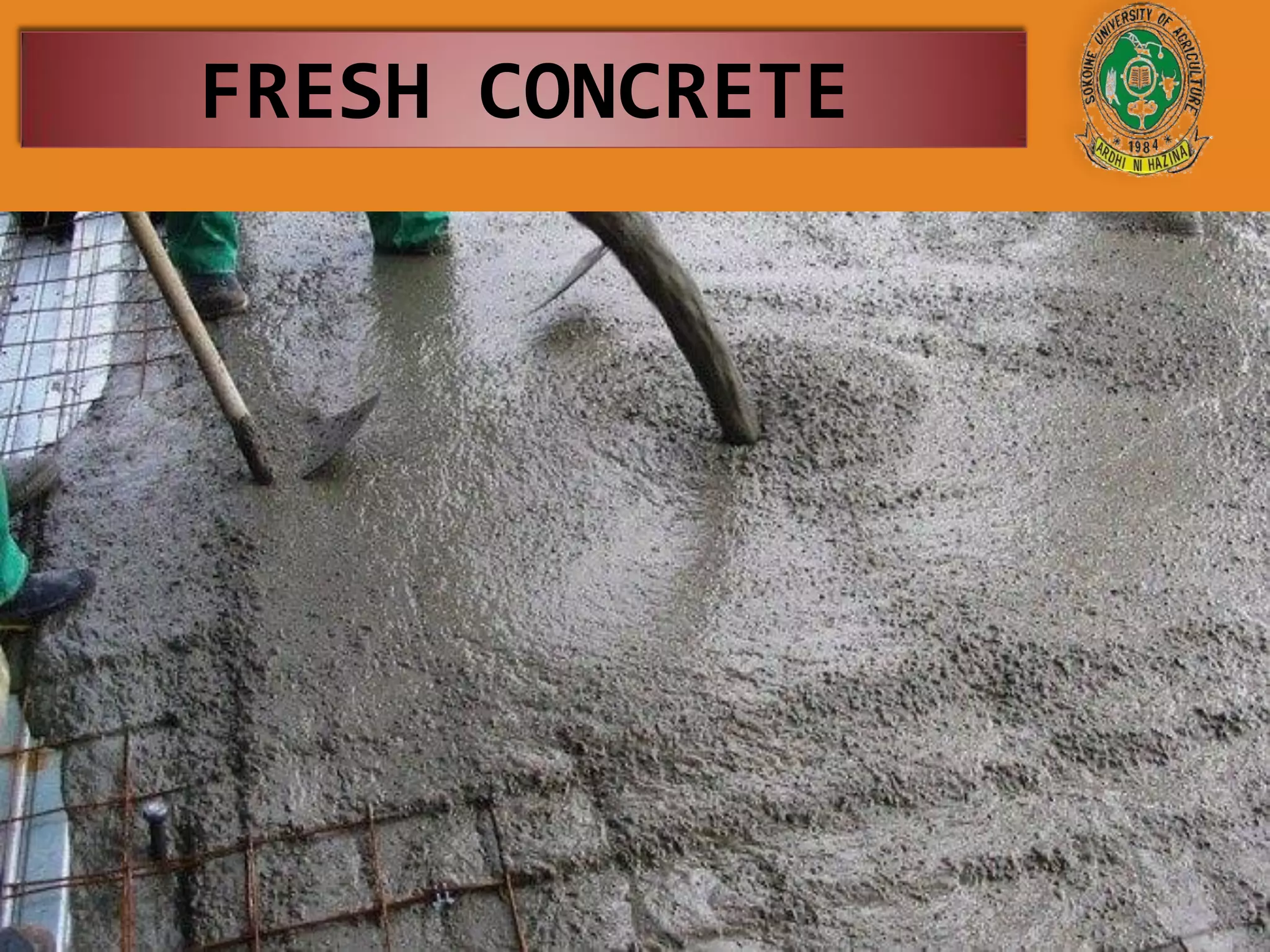
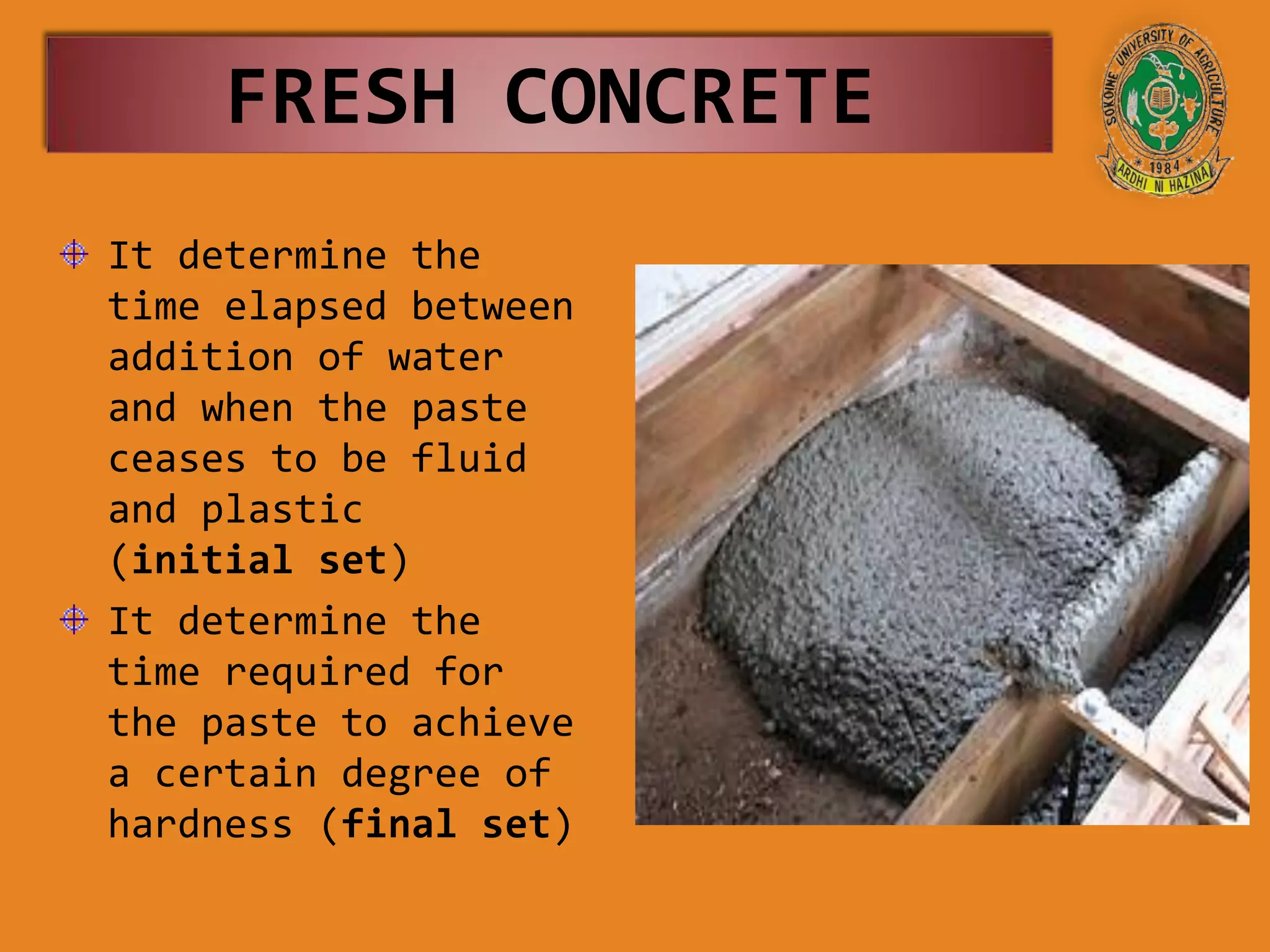
It is a concrete that has not reached
the final setting time.
FRESH CONCRETE
The strength of concrete of a given mix
proportions is very seriously affected by
the degree of its compaction;
it is vital, that the consistency (ability
to flow) of the mix be such that, the
concrete can be transported, placed and
finished sufficiently easily and without
segregation.
The first 48 hours are very important for
the performance of the concrete structure.
FRESH CONCRETE
Fresh concrete properties
Workability
Slump Loss
Segregation/Bleeding
Plastic Shrinkage
Time of Set
Temperature
FRESH CONCRETE
1. WORKABILITY
The amount of useful internal work necessary to
produce full compaction without occurrence of the
known concrete problems.
The useful internal work is the work or energy
required to overcome the internal friction between the
individual particles in the concrete.
Factors affecting workability
1. Water content of the mix: Adding water increases
workability and decreases strength.
2. Maximum size of aggregate: Less surface area to be
wetted and more water in medium.
3. Grading of aggregate: Poor grading reduces the
consistency.
4. Shape and texture of aggregates: Smooth surfaces give
better workability.
FRESH CONCRETE
Measurement of Workability
There are 5 types of test, which can measure workability
indirectly. Unfortunately, there are no accepted tests,
which can measure directly the workability.
1. Slump Test: Gives good results for rich mixes.
2. Compacting Factor Test: Used for low workable concretes.
3. Flow Table Test: Used for high workable concretes.
4. VeBe Test: Used for low workable concretes (fiber
reinforced concrete).
5. Kelly Ball Test: It is practical in field test.
See more details in fresh concrete Testing, next later
FRESH CONCRETE
2.Slump loss
• Slump describes the consistency of
fluidity of a concrete mixture.
• Slump loss is the reduction in slump
from the time of original batching to
the point when concrete is discharged
from a mixture track or other delivery
vehicle
• Slump value represents the workability
property of concrete.
• Slump should be achieved within delivery
time range of 45- 90 min
FRESH CONCRETE
Why is controlling slump loss
important?
 Slump is an important consideration for
the contractor as it impacts the ability
to place, consolidate and finish
concrete
 The rate of slump loss should be
predictable so that loads of concrete
arrive the jobsite at a consistency
slump.
 Excess water causes problems with
strength and potential cracking.
FRESH CONCRETE
How can the slump loss be controlled?
It is important to understand the concrete material
used and how the fresh concrete properties are
affected by ambient conditions when it is delivered
and placed.
The following is a list of controllable factors that
influence slump loss:
1. Use the correct amount of mixing water needed to
archive the specified slump within tolerances at the
job site with consideration temperature and delivery
time.
2. Maintain aggregate stockpiles through stock rotation
and proper loading procedures to archive consistent
gradation and moisture content of aggregates being
batched .
FRESH CONCRETE
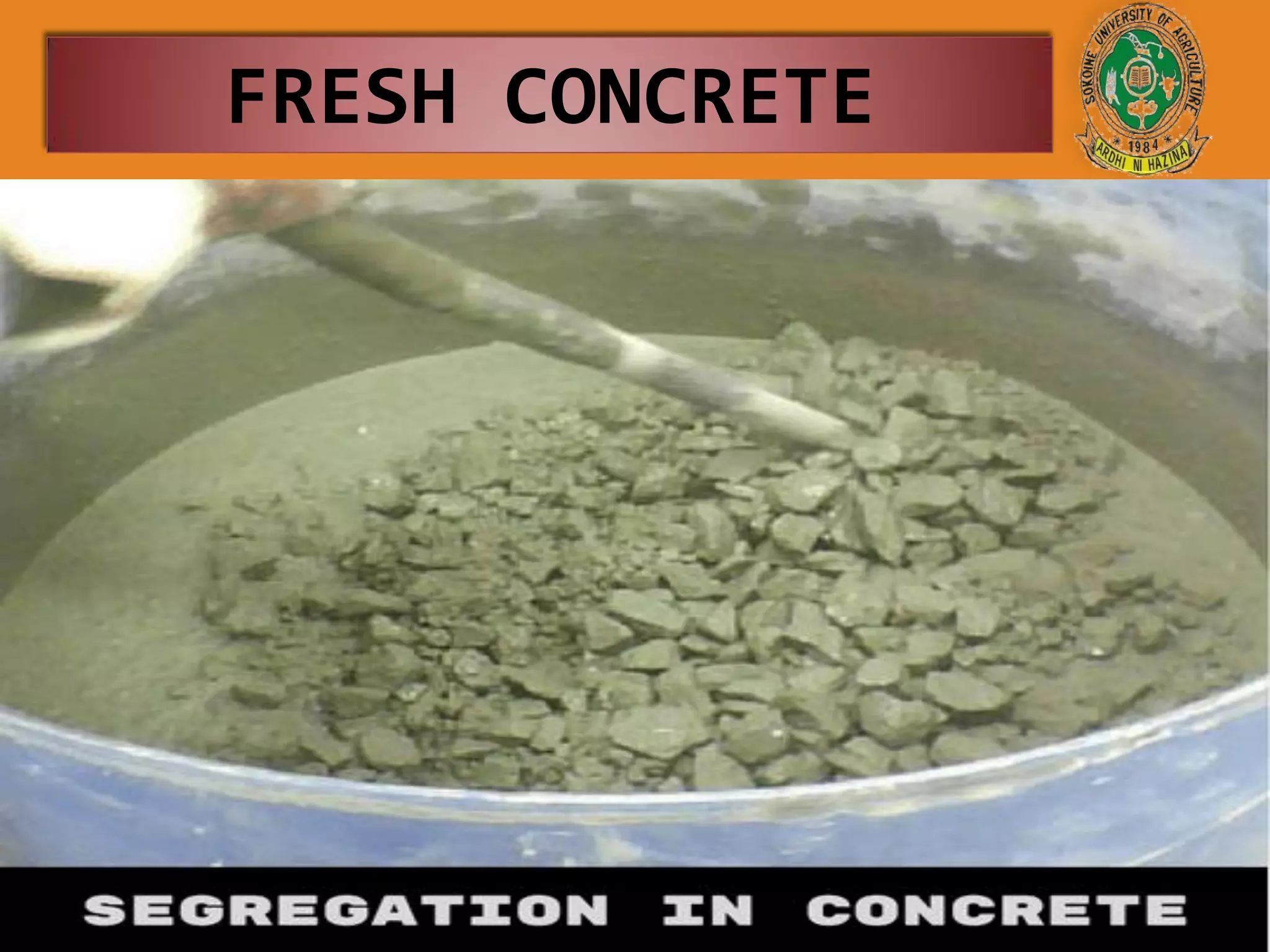
3. Segregation/Bleeding
Segregation is the “Separation of constituent
materials in concrete.”
In concrete technology, segregation is of three
type
1. Separation of Coarse aggregate from the
concrete mixture,
2. Separation of Cement paste from the
concrete during its plastic stage.
3. Separation of water from the concrete mix
(Bleeding in concrete)
FRESH CONCRETE
FRESH CONCRETE
FRESH CONCRETE
Factors causing segregation in concrete:-
• Transporting concrete mixes for long distances.
• Poorly proportioned mix, where sufficient
matrix is not there to bind the aggregates
• Dropping concrete from more than 1m.
• Vibrating concrete for a long time.
How to minimize segregation in concrete:-
1. Segregation can be controlled by maintaining
proper proportioning the mix.
2. by peculiar handling, placing, transporting,
compacting and finishing,
3. By Using air entraining agents, admixtures and
pozzolanic materials in the mix segregation
controlled to some extent.
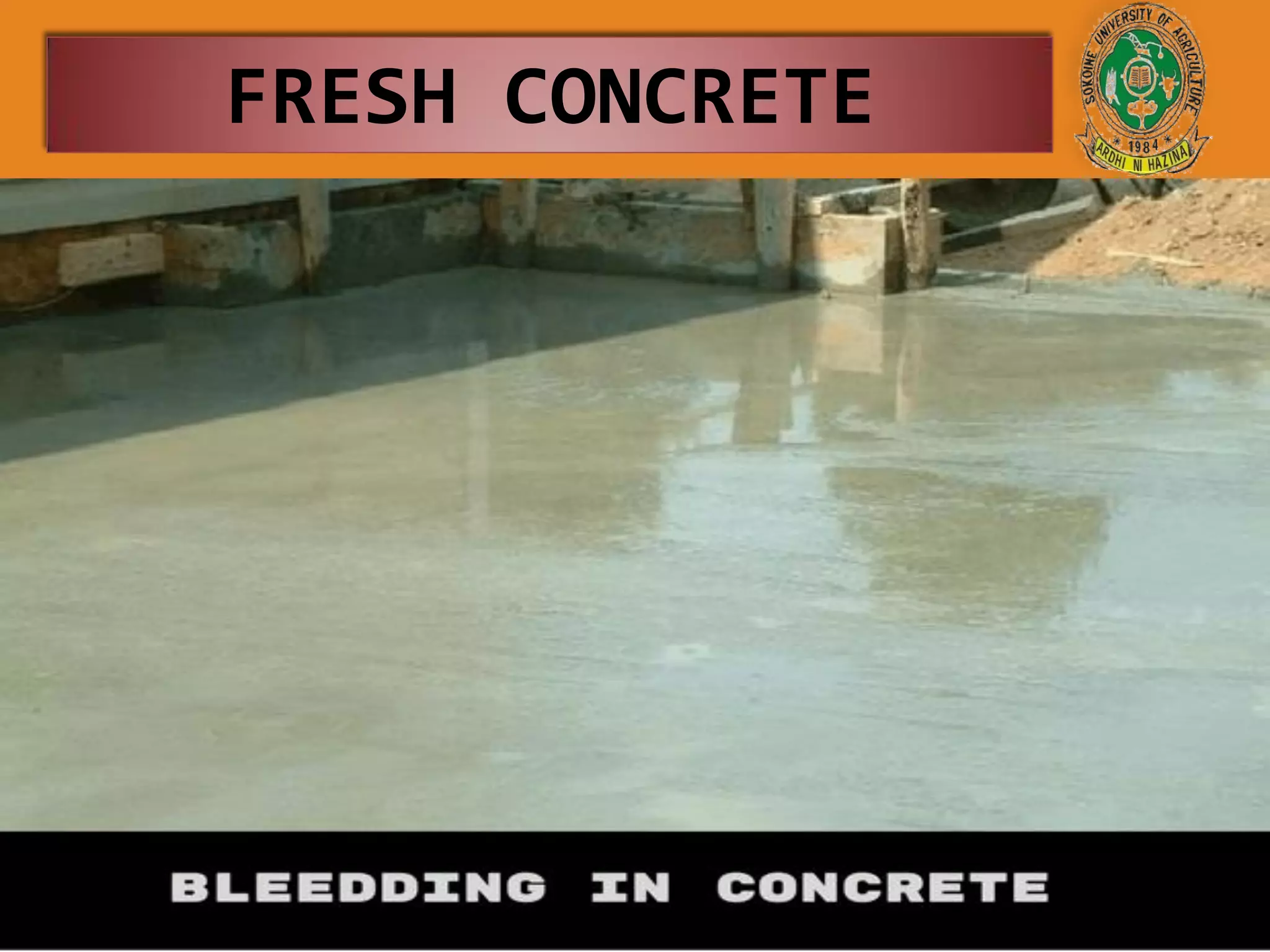
Bleeding in concrete
Bleeding is a form of segregation in which
water present in the concrete mix is pushed
upwards due to the settlement of cement and
aggregate. The specific gravity of water is
low, due to this water tends to move upwards.
Bleeding ordinarily occurs in the wet mix of
concrete.
The bleeding in concrete is not harmful if
the rate of evaporation of water is equal to
the rate of bleeding. Normal bleeding is
quite good, and it enhances the workability
of concrete.
FRESH CONCRETE
FRESH CONCRETE
FRESH CONCRETE
How bleeding affects concrete stability:-
 Formation of laitance in concrete, structures may lose
its wearing capacity and decreases its life.
 Forming of water at the top surface of concrete, results
in delaying the surface finishing.
 Concrete becomes permeable and loses its homogeneity.
 Excessive bleeding breaks the bond between the
reinforcement and concrete.
How the bleeding in concrete is controlled:-
 Bleeding in concrete is controlled by Adding minimum
water content in the concrete mix.
 Encouraging the use of air en-training admixtures in the
mix.
 By adding more cement in the mix.
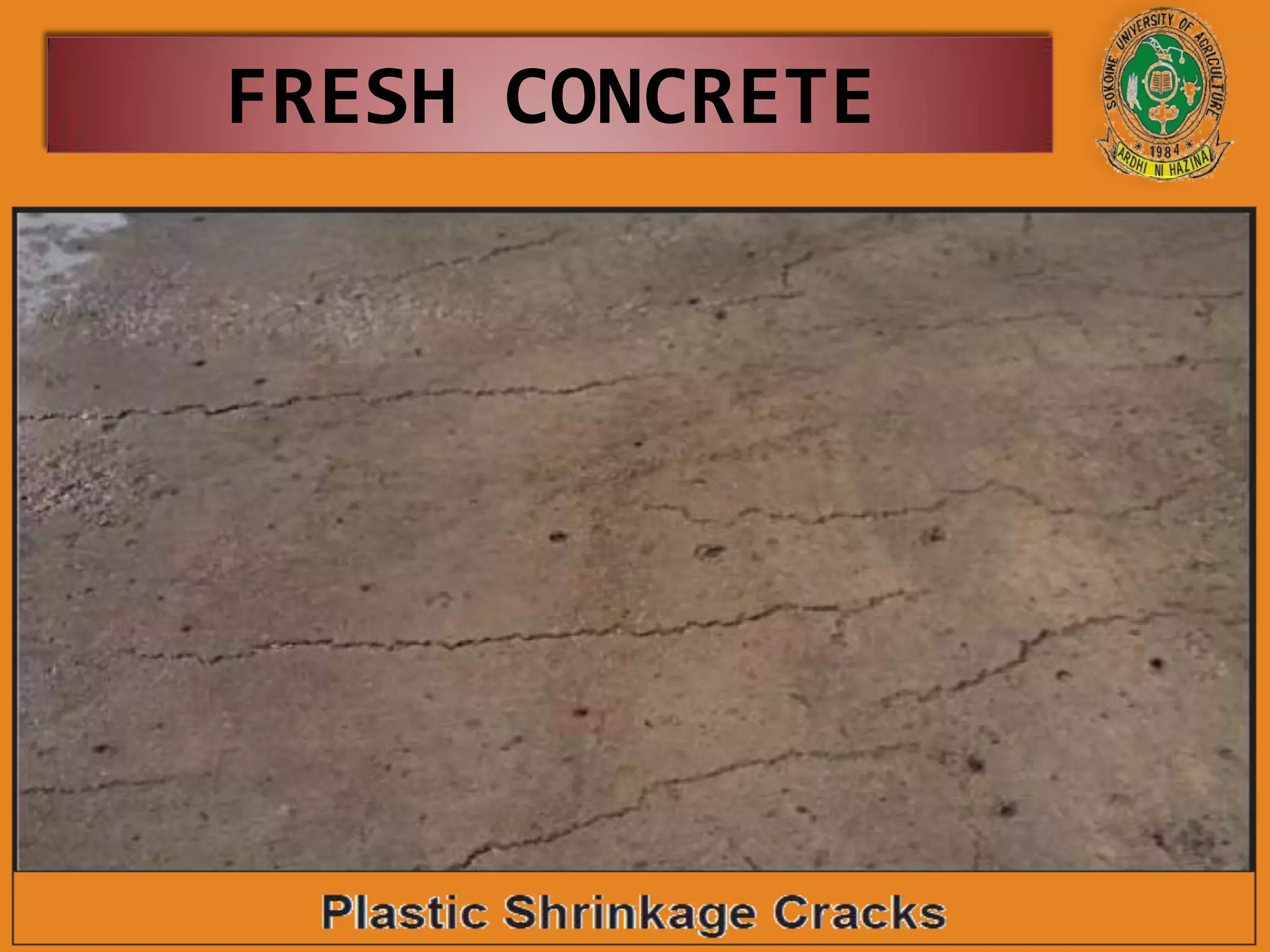
4. Plastic shrinkage
Plastic shrinkage is mainly a problem
with large exposed surfaces like floor
slabs and paving placed in
environmental conditions with a high
evaporation rate. The faster water
evaporates from the concrete
Plastic shrinkage cracks typically
occur on horizontal surfaces exposed to
the atmosphere
FRESH CONCRETE
FRESH CONCRETE
FRESH CONCRETE
There are several corrective procedures listed below to
reduce the risk of experiencing plastic shrinkage cracks.
 Moisten subgrades and forms to prevent absorption.
 Dampen dry aggregates that are absorptive.
 Reduce the temperature of the concrete by
 Precooling aggregate with water.
 Cooling the cement.
 Shading aggregates, water tanks, and lines.
 Avoid over mixing.
 Place concrete early in the morning or late
afternoon.
 Construct temporary walls to reduce wind velocity.
 Provide sunshades for concrete.
 Use evaporation retardant (usually polymers).
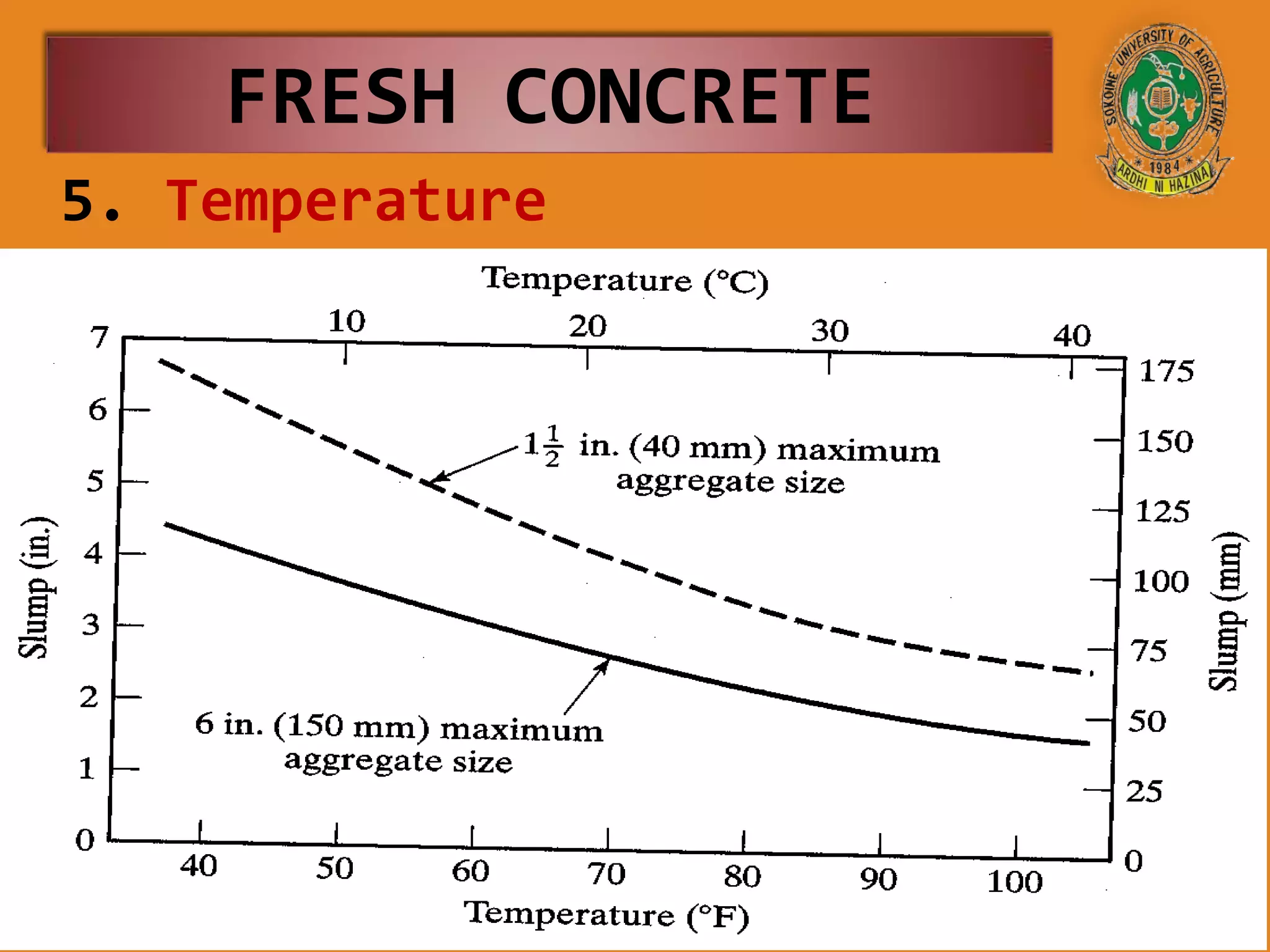
5. Temperature
FRESH CONCRETE
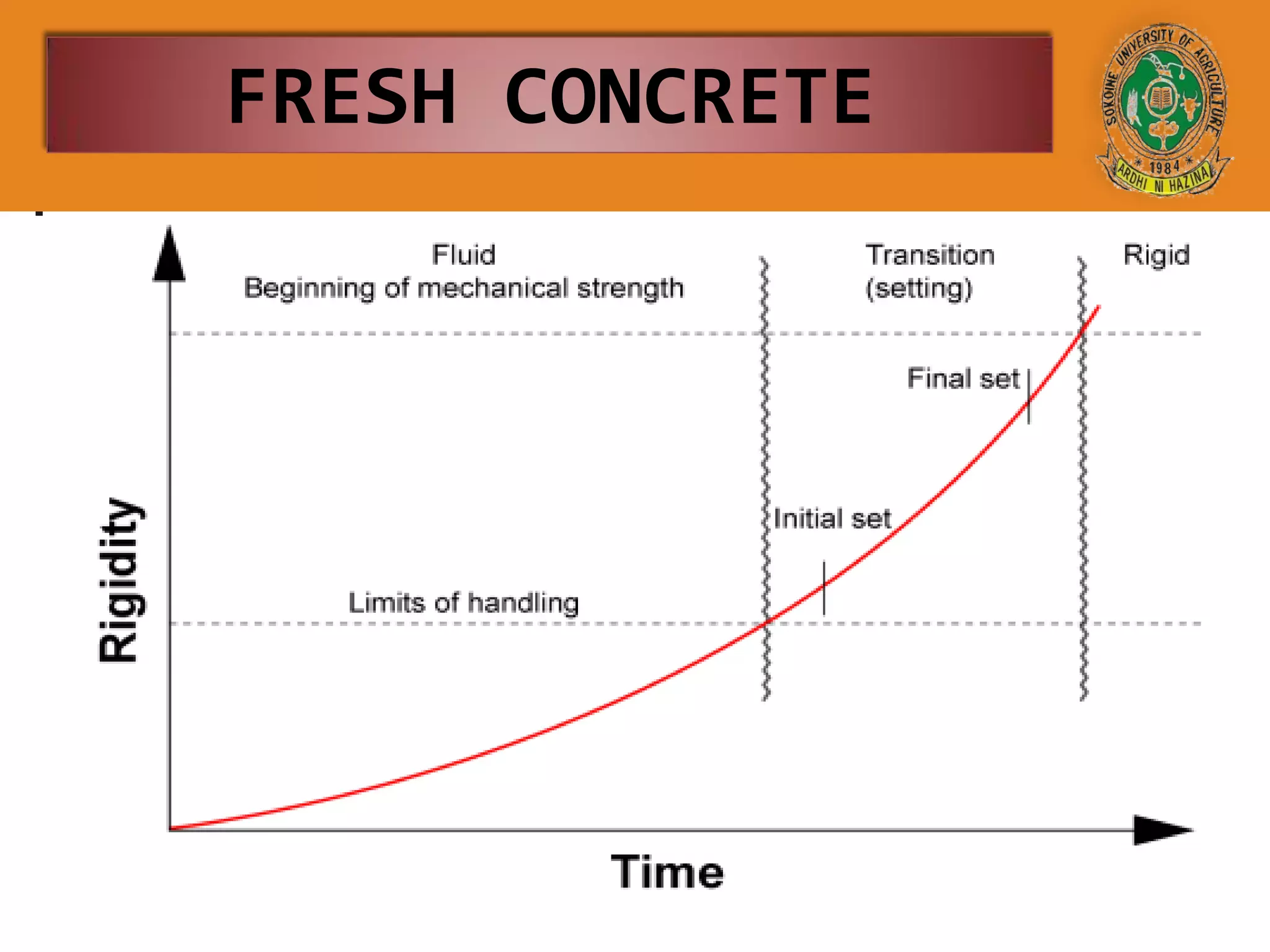
6. Time of set
Changing the concrete state from
plastic to hardened state is called
setting of concrete.
The time concrete takes to change
the state is the setting time.
Setting time depend upon
the properties of cement.
To increase or decrease the setting
time admixtures can use in concrete
mix.
FRESH CONCRETE
It determine the
time elapsed between
addition of water
and when the paste
ceases to be fluid
and plastic
(initial set)
It determine the
time required for
the paste to achieve
a certain degree of
hardness (final set)
FRESH CONCRETE
FRESH CONCRETE
Fresh concrete testing
methods
1. Slump Test.
2. Compacting Factor Tests.
3. Flow Table Test.
4. VeBe Test.
5. Kelly Ball Test.
FRESH CONCRETE
Slump test
FRESH CONCRETE
A cone 300 mm high is placed on smooth surface
and filled with concrete in 4 layers, which are
compacted in a prescribed manner. The cone is
then removed and the decrease in height of the
unsupported concrete, “Slump” is measured.
Concrete with very low to low workability 0 – 50
mm slump are used for Roads vibrated by power or
hand operated machines.
Concrete with high workability are used in
sections with congested reinforcement where
vibration cannot easily be done
FRESH CONCRETE
Compacting factor test
FRESH CONCRETE
Vebe Test
FRESH CONCRETE
FRESH CONCRETE
Flow table test
Admixture
• Admixtures are those ingredients
in concrete other than portland
cement, water, and aggregates that
are added to the mixture
immediately before or during
mixing
FRESH CONCRETE
Admixtures can be classified by function as
follows:
1. Air-entraining admixtures
2. Water-reducing admixtures
3. Plasticizers
4. Accelerating admixtures
5. Retarding admixtures
6. Hydration-control admixtures
7. Corrosion inhibitors
8. Shrinkage reducers
9. Alkali-silica reactivity inhibitors
10. Coloring admixtures
11. Miscellaneous admixtures such as workability,
bonding, damp proofing, permeability
reducing, grouting, gas-forming, antiwashout,
foaming, and pumping admixtures
FRESH CONCRETE
Air-entraining admixtures
Air-entraining admixtures are used to purposely
introduce and stabilize microscopic air bubbles in
concrete. Air entrainment will dramatically improve
the durability of concrete exposed to cycles of
freezing and thawing.
Entrained air greatly improves concrete’s resistance
to surface scaling caused by chemical deicers.
Furthermore, the workability of fresh concrete is
improved significantly, and segregation and bleeding
are reduced or eliminated.
Air-entrained concrete contains minute air bubbles
that are distributed uniformly throughout the cement
paste. Entrained air can be produced in concrete by
use of an air-entraining cement, by introduction of
an air entraining admixture, or by a combination of
both methods.
FRESH CONCRETE
water-reducing admixtures
Water-reducing admixtures are used to reduce the
quantity of mixing water required to produce
concrete of a certain slump, reduce water-cement
ratio, reduce cement content, or increase slump.
Typical water reducers reduce the water content by
approximately 5% to 10%. Adding a water-reducing
admixture to concrete without reducing the water
content can produce a mixture with a higher slump.
The rate of slump loss, however, is not reduced
and in most cases is increased Rapid slump loss
results in reduced workability and less time to
place concrete.
An increase in strength is generally obtained with
water-reducing admixtures as the water-cement
ratio is cracks in concrete.
FRESH CONCRETE
Hardened concrete
Properties:
• Very Hard (15 – 40 kN/m2)
• Water resistant
• Weather resistant
• High grade concrete is resistant to
abrasion (e.g. by high water flows on
bridge piers)
• Resistant to impact loads (e.g. on roads
• Thermal insulation
• Prevents corrosion
FRESH CONCRETE
Hardened concrete Testing
1. Rebound hammer test
2. Cube Test
FRESH CONCRETE
FRESH CONCRETE
FRESH CONCRETE
ANY QUESTION ?

Fresh concrete -building materials for engineers

  • 1.
    DEPARTMENT OF ENGINEERINGSCIENCES AND TECHNOLOGY AE 217 MATERIALS TECHNOLOGY FOR ENGINEERS IWRE 2 -GROUP 5 PRESENTATION 2018
  • 2.
  • 3.
    PRESENTATION OUTLINES General introduction Freshconcrete properties Fresh concrete Testing The Admixture The Hardened mixture FRESH CONCRETE
  • 4.
    FRESH CONCRETE General introduction CONCRETE isa building Material made from a mixture of gravel ,sand ,cement,water and air ,forming a stone like mass on hardenning. FRESH CONCRETE It is a concrete that has not reached the final setting time.
  • 5.
  • 6.
    The strength ofconcrete of a given mix proportions is very seriously affected by the degree of its compaction; it is vital, that the consistency (ability to flow) of the mix be such that, the concrete can be transported, placed and finished sufficiently easily and without segregation. The first 48 hours are very important for the performance of the concrete structure. FRESH CONCRETE
  • 7.
    Fresh concrete properties Workability SlumpLoss Segregation/Bleeding Plastic Shrinkage Time of Set Temperature FRESH CONCRETE
  • 8.
    1. WORKABILITY The amountof useful internal work necessary to produce full compaction without occurrence of the known concrete problems. The useful internal work is the work or energy required to overcome the internal friction between the individual particles in the concrete. Factors affecting workability 1. Water content of the mix: Adding water increases workability and decreases strength. 2. Maximum size of aggregate: Less surface area to be wetted and more water in medium. 3. Grading of aggregate: Poor grading reduces the consistency. 4. Shape and texture of aggregates: Smooth surfaces give better workability. FRESH CONCRETE
  • 9.
    Measurement of Workability Thereare 5 types of test, which can measure workability indirectly. Unfortunately, there are no accepted tests, which can measure directly the workability. 1. Slump Test: Gives good results for rich mixes. 2. Compacting Factor Test: Used for low workable concretes. 3. Flow Table Test: Used for high workable concretes. 4. VeBe Test: Used for low workable concretes (fiber reinforced concrete). 5. Kelly Ball Test: It is practical in field test. See more details in fresh concrete Testing, next later FRESH CONCRETE
  • 10.
    2.Slump loss • Slumpdescribes the consistency of fluidity of a concrete mixture. • Slump loss is the reduction in slump from the time of original batching to the point when concrete is discharged from a mixture track or other delivery vehicle • Slump value represents the workability property of concrete. • Slump should be achieved within delivery time range of 45- 90 min FRESH CONCRETE
  • 11.
    Why is controllingslump loss important?  Slump is an important consideration for the contractor as it impacts the ability to place, consolidate and finish concrete  The rate of slump loss should be predictable so that loads of concrete arrive the jobsite at a consistency slump.  Excess water causes problems with strength and potential cracking. FRESH CONCRETE
  • 12.
    How can theslump loss be controlled? It is important to understand the concrete material used and how the fresh concrete properties are affected by ambient conditions when it is delivered and placed. The following is a list of controllable factors that influence slump loss: 1. Use the correct amount of mixing water needed to archive the specified slump within tolerances at the job site with consideration temperature and delivery time. 2. Maintain aggregate stockpiles through stock rotation and proper loading procedures to archive consistent gradation and moisture content of aggregates being batched . FRESH CONCRETE
  • 13.
    3. Segregation/Bleeding Segregation isthe “Separation of constituent materials in concrete.” In concrete technology, segregation is of three type 1. Separation of Coarse aggregate from the concrete mixture, 2. Separation of Cement paste from the concrete during its plastic stage. 3. Separation of water from the concrete mix (Bleeding in concrete) FRESH CONCRETE
  • 14.
  • 15.
    FRESH CONCRETE Factors causingsegregation in concrete:- • Transporting concrete mixes for long distances. • Poorly proportioned mix, where sufficient matrix is not there to bind the aggregates • Dropping concrete from more than 1m. • Vibrating concrete for a long time. How to minimize segregation in concrete:- 1. Segregation can be controlled by maintaining proper proportioning the mix. 2. by peculiar handling, placing, transporting, compacting and finishing, 3. By Using air entraining agents, admixtures and pozzolanic materials in the mix segregation controlled to some extent.
  • 16.
    Bleeding in concrete Bleedingis a form of segregation in which water present in the concrete mix is pushed upwards due to the settlement of cement and aggregate. The specific gravity of water is low, due to this water tends to move upwards. Bleeding ordinarily occurs in the wet mix of concrete. The bleeding in concrete is not harmful if the rate of evaporation of water is equal to the rate of bleeding. Normal bleeding is quite good, and it enhances the workability of concrete. FRESH CONCRETE
  • 17.
  • 18.
    FRESH CONCRETE How bleedingaffects concrete stability:-  Formation of laitance in concrete, structures may lose its wearing capacity and decreases its life.  Forming of water at the top surface of concrete, results in delaying the surface finishing.  Concrete becomes permeable and loses its homogeneity.  Excessive bleeding breaks the bond between the reinforcement and concrete. How the bleeding in concrete is controlled:-  Bleeding in concrete is controlled by Adding minimum water content in the concrete mix.  Encouraging the use of air en-training admixtures in the mix.  By adding more cement in the mix.
  • 19.
    4. Plastic shrinkage Plasticshrinkage is mainly a problem with large exposed surfaces like floor slabs and paving placed in environmental conditions with a high evaporation rate. The faster water evaporates from the concrete Plastic shrinkage cracks typically occur on horizontal surfaces exposed to the atmosphere FRESH CONCRETE
  • 20.
  • 21.
    FRESH CONCRETE There areseveral corrective procedures listed below to reduce the risk of experiencing plastic shrinkage cracks.  Moisten subgrades and forms to prevent absorption.  Dampen dry aggregates that are absorptive.  Reduce the temperature of the concrete by  Precooling aggregate with water.  Cooling the cement.  Shading aggregates, water tanks, and lines.  Avoid over mixing.  Place concrete early in the morning or late afternoon.  Construct temporary walls to reduce wind velocity.  Provide sunshades for concrete.  Use evaporation retardant (usually polymers).
  • 22.
  • 23.
    6. Time ofset Changing the concrete state from plastic to hardened state is called setting of concrete. The time concrete takes to change the state is the setting time. Setting time depend upon the properties of cement. To increase or decrease the setting time admixtures can use in concrete mix. FRESH CONCRETE
  • 24.
    It determine the timeelapsed between addition of water and when the paste ceases to be fluid and plastic (initial set) It determine the time required for the paste to achieve a certain degree of hardness (final set) FRESH CONCRETE
  • 25.
  • 26.
    Fresh concrete testing methods 1.Slump Test. 2. Compacting Factor Tests. 3. Flow Table Test. 4. VeBe Test. 5. Kelly Ball Test. FRESH CONCRETE
  • 27.
    Slump test FRESH CONCRETE Acone 300 mm high is placed on smooth surface and filled with concrete in 4 layers, which are compacted in a prescribed manner. The cone is then removed and the decrease in height of the unsupported concrete, “Slump” is measured. Concrete with very low to low workability 0 – 50 mm slump are used for Roads vibrated by power or hand operated machines. Concrete with high workability are used in sections with congested reinforcement where vibration cannot easily be done
  • 28.
  • 29.
  • 30.
  • 31.
  • 32.
    Admixture • Admixtures arethose ingredients in concrete other than portland cement, water, and aggregates that are added to the mixture immediately before or during mixing FRESH CONCRETE
  • 33.
    Admixtures can beclassified by function as follows: 1. Air-entraining admixtures 2. Water-reducing admixtures 3. Plasticizers 4. Accelerating admixtures 5. Retarding admixtures 6. Hydration-control admixtures 7. Corrosion inhibitors 8. Shrinkage reducers 9. Alkali-silica reactivity inhibitors 10. Coloring admixtures 11. Miscellaneous admixtures such as workability, bonding, damp proofing, permeability reducing, grouting, gas-forming, antiwashout, foaming, and pumping admixtures FRESH CONCRETE
  • 34.
    Air-entraining admixtures Air-entraining admixturesare used to purposely introduce and stabilize microscopic air bubbles in concrete. Air entrainment will dramatically improve the durability of concrete exposed to cycles of freezing and thawing. Entrained air greatly improves concrete’s resistance to surface scaling caused by chemical deicers. Furthermore, the workability of fresh concrete is improved significantly, and segregation and bleeding are reduced or eliminated. Air-entrained concrete contains minute air bubbles that are distributed uniformly throughout the cement paste. Entrained air can be produced in concrete by use of an air-entraining cement, by introduction of an air entraining admixture, or by a combination of both methods. FRESH CONCRETE
  • 35.
    water-reducing admixtures Water-reducing admixturesare used to reduce the quantity of mixing water required to produce concrete of a certain slump, reduce water-cement ratio, reduce cement content, or increase slump. Typical water reducers reduce the water content by approximately 5% to 10%. Adding a water-reducing admixture to concrete without reducing the water content can produce a mixture with a higher slump. The rate of slump loss, however, is not reduced and in most cases is increased Rapid slump loss results in reduced workability and less time to place concrete. An increase in strength is generally obtained with water-reducing admixtures as the water-cement ratio is cracks in concrete. FRESH CONCRETE
  • 36.
    Hardened concrete Properties: • VeryHard (15 – 40 kN/m2) • Water resistant • Weather resistant • High grade concrete is resistant to abrasion (e.g. by high water flows on bridge piers) • Resistant to impact loads (e.g. on roads • Thermal insulation • Prevents corrosion FRESH CONCRETE
  • 37.
    Hardened concrete Testing 1.Rebound hammer test 2. Cube Test FRESH CONCRETE
  • 38.
  • 39.