VALUE CHAINS CHAPTER 2 DAVID A. COLLIER AND JAMES R. EVANS OM
Chapter 2  Learning Outcomes LO1   Explain the concept of value and how it can be    increased. LO2   Describe a value chain and the two major   perspectives that characterize it. LO3   Describe a supply chain and how it differs from a   value chain. LO4   Discuss key value chain decisions.  LO5   Explain offshoring and the key issues associated   with it. LO6   Identify important issues associated with value   chains in a global business environment. l e a r n i n g  o u t c o m e s
t a time when more than 98% of all shoes sold in the United States are   made in other countries, Allen-Edmonds Shoe Corp. is a lonely holdout   against offshoring.  Moving to China could have saved as much as 60 percent.  However, John Stollenwerk, Chief Executive, will not compromise on quality, and believes that Allen-Edmonds can make better shoes, and serve customers faster, in the United States.  An experiment in producing one model in Portugal resulted in lining that wasn’t quite right and stitching that wasn’t as fine.  Stollenwerk noted “We could take out a few stitches and you’d never notice it – and then we could take out a few more.  Pretty soon you’ve cheapened the product, and you don’t stand for what you’re about.”  Instead, Allen-Edmonds invested more than $1 million to completely overhaul its manufacturing process into a leaner and more efficient system that could reduce 5 percent off the cost of each pair of shoes.  One year after implementing its new production processes, productivity was up 30 percent, damages were down 14 percent, and order fulfillment neared 100 percent, enabling the company to serve customers better than ever.   What do  you  think?   What is your opinion of companies that move operations to other countries with cheaper labor rates?  Should governments influence or legislate such decisions?  Chapter 2  Value Chains
Value Chains The underlying purpose of every organization is to provide value to its customer and stakeholders. Value   is the perception of the benefits associated with a good, service, or bundle of goods and services (i.e., the customer benefit package) in relation to what buyers are willing to pay for them.  Chapter 2  Value Chains
Value Chains The decision to purchase a good or service, or a customer benefit package, is based on an assessment by the customer of the perceived benefits in relation to its price.  The customer's cumulative judgment of the perceived benefits leads to either satisfaction or dissatisfaction.  Chapter 2  Value Chains
One of the simplest functional forms of value is: Value = Perceived benefits/Price (cost) to the customer If the value ratio is high, the good or service is perceived favorably by customers, and the organization providing it is more likely to be successful.  To increase value, an organization must: (a) increase perceived benefits while holding price or cost  constant,  (b) increase perceived benefits while reducing price or cost, or  (c) decrease price or cost while holding perceived benefits  constant.  Chapter 2  Value Chains
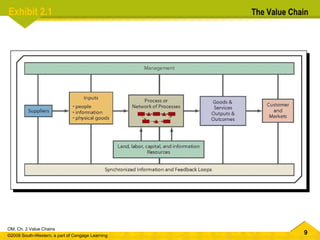
Value Chains A  value chain  is a network of facilities and processes that describes the flow of goods, services, information, and financial transactions from suppliers through the facilities and processes that create goods and services and deliver them to customer.  A  value chain  is a “cradle-to-grave” model of the operations function (see Exhibit 2.1).  Chapter 2  Value Chains
Chapter 2  Value Chains Value Chains The  value chain  begins with suppliers.  Suppliers might be distributors, employment agencies, dealers, financing and leasing agents, information and Internet companies, field maintenance and repair services, architectural and engineering design firms, and contractors, as well as manufacturers of materials and components.
Exhibit 2.1  The Value Chain
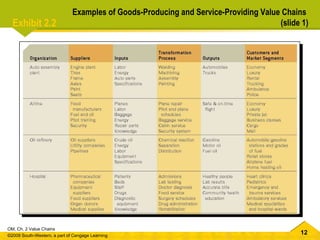
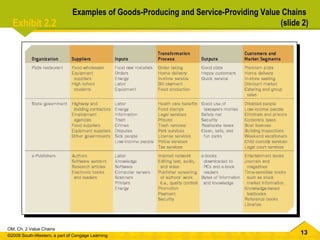
Chapter 2  Value Chains Value Chains The inputs suppliers provide might be physical goods such as: automobile engines or microprocessors provided to an assembly plant;  meat, fish, and vegetables provided to a restaurant;  trained employees provided to organizations by universities and technical schools; or information such as computer specifications or a medical diagnosis.
Value Chains Inputs are transformed into value-added goods and services through processes or networks of work activities, which are supported by such resources as land, labor, money, and information.  The value chain outputs — goods and services — are delivered or provided to customers and targeted market segments.  Chapter 2  Value Chains
Exhibit 2.2  Examples of Goods-Producing and Service-Providing Value Chains  (slide 1)
Exhibit 2.2  Examples of Goods-Producing and Service-Providing Value Chains  (slide 2)
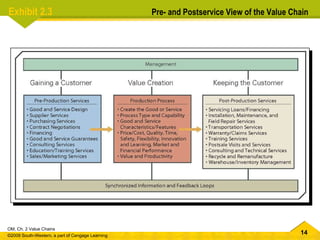
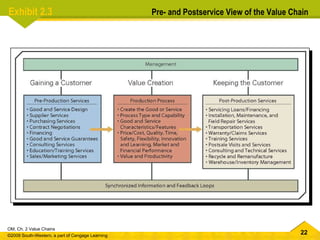
Exhibit 2.3  Pre- and Postservice View of the Value Chain
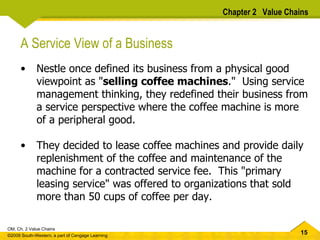
A Service View of a Business Nestle once defined its business from a physical good viewpoint as " selling coffee machines ."  Using service management thinking, they redefined their business from a service perspective where the coffee machine is more of a peripheral good.  They decided to lease coffee machines and provide daily replenishment of the coffee and maintenance of the machine for a contracted service fee.  This "primary leasing service" was offered to organizations that sold more than 50 cups of coffee per day.  Chapter 2  Value Chains
Chapter 2  Value Chains A Service View of a Business The results were greatly increased Nestle coffee sales, new revenue opportunities, and much stronger profits.  Nestle's service vision of their business required a completely new service and logistical value chain capability.
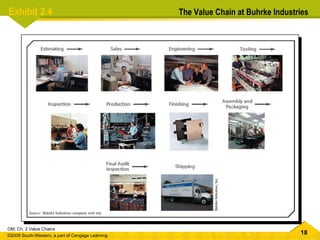
Chapter 2  Value Chains Buhrke Industries, Inc. Value Chain Buhrke Industries Inc., located in Arlington Heights, Illinois, provides stamped metal parts to many industries, including automotive, appliance, computer, electronics, hardware, housewares, power tools, medical, and telecommunications.   Buhrke’s objective is to be a customer’s best total-value producer with on-time delivery, fewer rejects, and high-quality stampings.  However, the company goes beyond manufacturing goods; it prides itself in providing the best service available as part of its customer value chain.
Source:  Buhrke Industries company web site Exhibit 2.4  The Value Chain at Buhrke Industries
Chapter 2  Value Chains Buhrke Industries, Inc. Value Chain Service is more than delivering a product  on-time.  It's also partnering with customers  by providing personalized service for fast, accurate response; customized engineering designs to meet customer needs; preventive maintenance systems to ensure high machine uptime; experienced, highly trained, long-term employees; and troubleshooting by a knowledgeable sales staff.
Chapter 2  Value Chains Value and Supply Chains A  supply chain  is the portion of the value chain that focuses primarily on the physical movement of goods and materials, and supporting flows of information and financial transactions through the supply, production, and distribution processes.  Many organizations use the terms “value chain” and “supply chain” interchangeably; however, we differentiate these two terms in this book.
Chapter 2  Value Chains Value and Supply Chains A  value chain  is broader in scope than a  supply chain , and encompasses all pre- and post- production services (see Exhibit 2.3) to create and deliver the entire customer benefit package.  A  value chain  views an organization from the customer's perspective — the integration of goods and services to create value — while a  supply chain  is more internally-focused on the creation of physical goods.
Exhibit 2.3  Pre- and Postservice View of the Value Chain
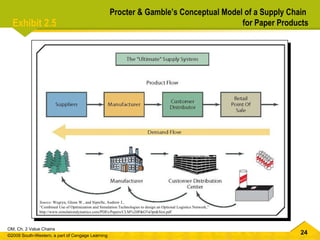
Procter & Gamble’s Supply Chain Structure A model of a supply chain developed by Procter & Gamble — P&G’s “Ultimate Supply System” — is shown in Exhibit 2.5. The supply chain focus is on understanding the impact of tightly coupling supply chain partners to integrate information, physical material, product flow, and financial activities to increase sales, reduce costs, increase cash flow, and provide the right product at the right time at the right price to customers. Chapter 2  Value Chains
Exhibit 2.5  Procter & Gamble’s Conceptual Model of a Supply Chain  for Paper Products Source : Wegryn, Glenn W., and Siprelle, Andrew J.,  “Combined Use of Optimization and Simulation Technologies to design an Optional Logistics Network,” http://www.simulationdynamics.com/PDFs/Papers/CLM%20P&G%Opt&Sim.pdf
Value Chain Design and Management Outsourcing  is the opposite of vertical integration in the sense that the organization is shedding (not acquiring) a part of its organization.  Chapter 2  Value Chains
Value Chain Design and Management Vertical integration  refers to the process of acquiring and consolidating elements of a value chain to achieve more control.  Outsourcing   is the process of having suppliers provide goods and services that were previously provided internally.  Chapter 2  Value Chains
Value Chain Design and Management Backward integration  refers to acquiring capabilities at the front-end of the supply chain (for instance, suppliers), while  forward integration  refers to acquiring capabilities toward the back-end of the supply chain (for instance, distribution or even customers).   Companies must decide whether to integrate backward (acquiring suppliers) or forward (acquiring distributors), or both. Chapter 2  Value Chains
The U.S. has experienced three waves of outsourcing: The first wave involved the exodus of  goods-producing jobs  from the U.S. in many industries several decades ago.  Gibson Guitars, for example, produces its Epiphone line in Korea.  The second wave involved  simple service work , such as standard credit card processing, billing and other forms of transaction processing, keying information into computers, and writing simple software programs.  Accenture, for example, does much of its bookkeeping operations in Costa Rica.  Chapter 2  Value Chains
The U.S. has experienced three waves of outsourcing: The third, and current wave, involves  skilled knowledge work , such as engineering design, graphic artists, architectural plans, call center customer service representatives, and computer chip design.  For example, Massachusetts General Hospital uses radiologists located in Bangalore, India, to interpret CT scans.  Chapter 2  Value Chains
Chapter 2  Value Chains Solved Problem — Outsourcing & Breakeven Analysis Suppose that a manufacturer needs to produce a custom aluminum housing for a special customer order.  Because it currently does not have the equipment necessary to make the housing, it would have to acquire machines and tooling at a fixed cost (net of salvage value after the project is completed) of $250,000.  The variable cost of production is estimated to be $20 per unit.  The company can outsource the housing to a metal fabricator at a cost of $35 per unit. The customer order is for 12,000 units.  What should they do?
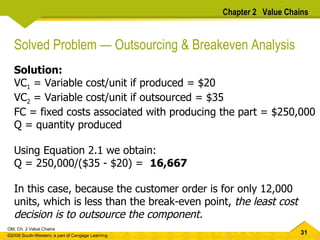
Solved Problem — Outsourcing & Breakeven Analysis Solution: VC 1  = Variable cost/unit if produced = $20 VC 2  = Variable cost/unit if outsourced = $35 FC = fixed costs associated with producing the part = $250,000 Q = quantity produced Using Equation 2.1 we obtain:  Q = 250,000/($35 - $20) =  16,667   In this case, because the customer order is for only 12,000 units, which is less than the break-even point,  the least cost decision is to outsource the component. Chapter 2  Value Chains
Value chain integration  is the process of managing information, physical goods, and services to ensure their availability at the right place, at the right time, at the right cost, at the right quantity, and with the highest attention to quality.   Chapter 2  Value Chains
Value chain integration in services — where value is in the form of low prices, convenience, and access to special time-sensitive deals and travel packages — takes many forms.  Examples include: Third-party integrators for the leisure and travel industry value chains include Orbitz, Expedia, Priceline, and Travelocity.  Many financial services use information networks provided by third-party information technology integrators, such as AT&T, Sprint, IBM, and Verizon, to coordinate their value chains.  Hospitals also use third-party integrators for both their information and physical goods, such as managing patient billing and hospital inventories.  Chapter 2  Value Chains
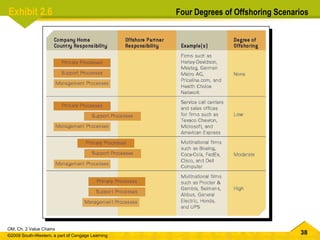
Offshoring  is the building, acquiring, or moving of process capabilities from a domestic location to another country location while maintaining ownership and control.  According to one framework, foreign factories can be classified into one of six categories: Offshore factories  established to gain access to low wages and other ways to reduce costs, such as avoiding trade tariffs.  An offshore factory is the way most multinational firms begin their venture into global markets and value chains. Chapter 2  Value Chains
According to one framework, foreign factories can Be classified into one of six categories: Outpost factories  established primarily to gain access to local employee skills and knowledge.  Such skills and knowledge might include software programming or call center service management.  Server factories  established to supply specific national or regional markets.  Chapter 2  Value Chains
According to one framework, foreign factories can Be classified into one of six categories: Source factories , like offshore factories, established to gain access to low cost production but also have the expertise to design and produce a component part for the company's global value chain. Contributor factories  established to serve a local market and conduct activities like product design and customization.  Primary manufacturing, accounting, engineering design, and marketing and sales processes often reside at contributor factories.  Chapter 2  Value Chains
According to one framework, foreign factories can be classified into one of six categories: Lead factories  established to innovate and create new processes, products, and technologies.  Lead factories must have the skills and knowledge to design and manufacturer "the next generation of products."  Chapter 2  Value Chains
Exhibit 2.6  Four Degrees of Offshoring Scenarios
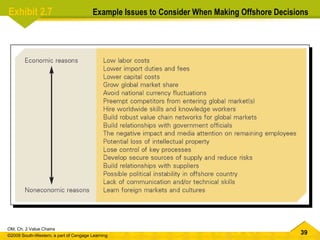
Exhibit 2.7  Example Issues to Consider When Making Offshore Decisions
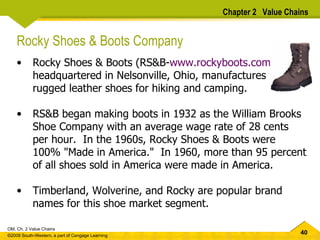
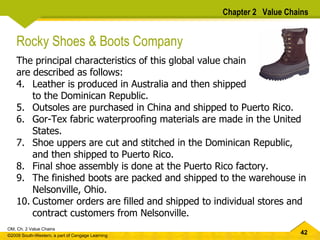
Rocky Shoes & Boots Company Rocky Shoes & Boots (RS&B- www.rockyboots.com ) headquartered in Nelsonville, Ohio, manufactures  rugged leather shoes for hiking and camping.  RS&B began making boots in 1932 as the William Brooks Shoe Company with an average wage rate of 28 cents per hour.  In the 1960s, Rocky Shoes & Boots were 100% "Made in America."  In 1960, more than 95 percent of all shoes sold in America were made in America.  Timberland, Wolverine, and Rocky are popular brand names for this shoe market segment.  Chapter 2  Value Chains
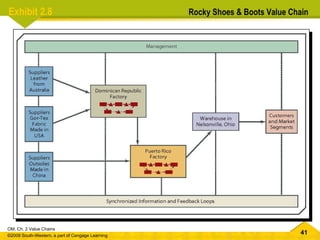
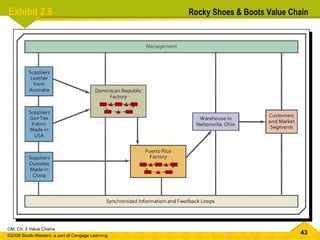
Exhibit 2.8  Rocky Shoes & Boots Value Chain
Rocky Shoes & Boots Company The principal characteristics of this global value chain  are described as follows: Leather is produced in Australia and then shipped  to the Dominican Republic. Outsoles are purchased in China and shipped to Puerto Rico. Gor-Tex fabric waterproofing materials are made in the United States. Shoe uppers are cut and stitched in the Dominican Republic, and then shipped to Puerto Rico. Final shoe assembly is done at the Puerto Rico factory. The finished boots are packed and shipped to the warehouse in Nelsonville, Ohio. Customer orders are filled and shipped to individual stores and contract customers from Nelsonville.  Chapter 2  Value Chains
Exhibit 2.8  Rocky Shoes & Boots Value Chain
Rocky Shoes & Boots Company Global Challenges Rocky profit margins are only about 2 percent on sales of over $100 million, while Timberland sales top $1 billion and have a 9 percent profit margin.  After seventy years in Nelsonville, the main factory closed in 2002.  At that time, local labor costs were about $11 per hour without benefits, while in Puerto Rico the hourly rate was $6; in the Dominican Republic, $1.25; and in China, 40 cents.  Chapter 2  Value Chains
Rocky Shoes & Boots Company Global Challenges The price of boots continues to decline globally from roughly $95 a pair to $85, and is heading toward $75. The grandson of the founder of RS&B said, "We've got to get there, or we're not going to be able to compete."  Chapter 2  Value Chains
Complex global value chains are more difficult to manage than small domestic value chains.  Some of the many issues include the following: Global supply chains face higher levels of risk and uncertainty, requiring more inventory and day-to-day monitoring to prevent product shortages.  Workforce disruptions, such as labor strikes and government turmoil in foreign countries, can create inventory shortages and disrupting surges in orders.  Chapter 2  Value Chains
Some of the many issues include: Transportation is more complex in global value chains.  For example, tracing global shipments normally involves more than one mode of transportation and foreign company.  The transportation infrastructure may vary considerably in foreign countries.  The coast of China, for example, enjoys much better transportation, distribution, and retail infrastructures than the vast interior of the country.  Chapter 2  Value Chains
Global purchasing can be a difficult process to manage when sources of supply, regional economies, and even governments change.  Daily changes in international currencies necessitate careful planning and in the case of commodities, consideration of futures contracts.  International purchasing can lead to disputes and legal challenges relating to such things as price fixing and quality defects.  Privatizing companies and property is another form of major changes in global trade and regulatory issues.   Chapter 2  Value Chains

Om chapter 02

  • 1.
    VALUE CHAINS CHAPTER2 DAVID A. COLLIER AND JAMES R. EVANS OM
  • 2.
    Chapter 2 Learning Outcomes LO1 Explain the concept of value and how it can be increased. LO2 Describe a value chain and the two major perspectives that characterize it. LO3 Describe a supply chain and how it differs from a value chain. LO4 Discuss key value chain decisions. LO5 Explain offshoring and the key issues associated with it. LO6 Identify important issues associated with value chains in a global business environment. l e a r n i n g o u t c o m e s
  • 3.
    t a timewhen more than 98% of all shoes sold in the United States are made in other countries, Allen-Edmonds Shoe Corp. is a lonely holdout against offshoring. Moving to China could have saved as much as 60 percent. However, John Stollenwerk, Chief Executive, will not compromise on quality, and believes that Allen-Edmonds can make better shoes, and serve customers faster, in the United States. An experiment in producing one model in Portugal resulted in lining that wasn’t quite right and stitching that wasn’t as fine. Stollenwerk noted “We could take out a few stitches and you’d never notice it – and then we could take out a few more. Pretty soon you’ve cheapened the product, and you don’t stand for what you’re about.” Instead, Allen-Edmonds invested more than $1 million to completely overhaul its manufacturing process into a leaner and more efficient system that could reduce 5 percent off the cost of each pair of shoes. One year after implementing its new production processes, productivity was up 30 percent, damages were down 14 percent, and order fulfillment neared 100 percent, enabling the company to serve customers better than ever.   What do you think? What is your opinion of companies that move operations to other countries with cheaper labor rates? Should governments influence or legislate such decisions? Chapter 2 Value Chains
  • 4.
    Value Chains Theunderlying purpose of every organization is to provide value to its customer and stakeholders. Value is the perception of the benefits associated with a good, service, or bundle of goods and services (i.e., the customer benefit package) in relation to what buyers are willing to pay for them. Chapter 2 Value Chains
  • 5.
    Value Chains Thedecision to purchase a good or service, or a customer benefit package, is based on an assessment by the customer of the perceived benefits in relation to its price. The customer's cumulative judgment of the perceived benefits leads to either satisfaction or dissatisfaction. Chapter 2 Value Chains
  • 6.
    One of thesimplest functional forms of value is: Value = Perceived benefits/Price (cost) to the customer If the value ratio is high, the good or service is perceived favorably by customers, and the organization providing it is more likely to be successful. To increase value, an organization must: (a) increase perceived benefits while holding price or cost constant, (b) increase perceived benefits while reducing price or cost, or (c) decrease price or cost while holding perceived benefits constant. Chapter 2 Value Chains
  • 7.
    Value Chains A value chain is a network of facilities and processes that describes the flow of goods, services, information, and financial transactions from suppliers through the facilities and processes that create goods and services and deliver them to customer. A value chain is a “cradle-to-grave” model of the operations function (see Exhibit 2.1). Chapter 2 Value Chains
  • 8.
    Chapter 2 Value Chains Value Chains The value chain begins with suppliers. Suppliers might be distributors, employment agencies, dealers, financing and leasing agents, information and Internet companies, field maintenance and repair services, architectural and engineering design firms, and contractors, as well as manufacturers of materials and components.
  • 9.
    Exhibit 2.1 The Value Chain
  • 10.
    Chapter 2 Value Chains Value Chains The inputs suppliers provide might be physical goods such as: automobile engines or microprocessors provided to an assembly plant; meat, fish, and vegetables provided to a restaurant; trained employees provided to organizations by universities and technical schools; or information such as computer specifications or a medical diagnosis.
  • 11.
    Value Chains Inputsare transformed into value-added goods and services through processes or networks of work activities, which are supported by such resources as land, labor, money, and information. The value chain outputs — goods and services — are delivered or provided to customers and targeted market segments. Chapter 2 Value Chains
  • 12.
    Exhibit 2.2 Examples of Goods-Producing and Service-Providing Value Chains (slide 1)
  • 13.
    Exhibit 2.2 Examples of Goods-Producing and Service-Providing Value Chains (slide 2)
  • 14.
    Exhibit 2.3 Pre- and Postservice View of the Value Chain
  • 15.
    A Service Viewof a Business Nestle once defined its business from a physical good viewpoint as " selling coffee machines ." Using service management thinking, they redefined their business from a service perspective where the coffee machine is more of a peripheral good. They decided to lease coffee machines and provide daily replenishment of the coffee and maintenance of the machine for a contracted service fee. This "primary leasing service" was offered to organizations that sold more than 50 cups of coffee per day. Chapter 2 Value Chains
  • 16.
    Chapter 2 Value Chains A Service View of a Business The results were greatly increased Nestle coffee sales, new revenue opportunities, and much stronger profits. Nestle's service vision of their business required a completely new service and logistical value chain capability.
  • 17.
    Chapter 2 Value Chains Buhrke Industries, Inc. Value Chain Buhrke Industries Inc., located in Arlington Heights, Illinois, provides stamped metal parts to many industries, including automotive, appliance, computer, electronics, hardware, housewares, power tools, medical, and telecommunications. Buhrke’s objective is to be a customer’s best total-value producer with on-time delivery, fewer rejects, and high-quality stampings. However, the company goes beyond manufacturing goods; it prides itself in providing the best service available as part of its customer value chain.
  • 18.
    Source: BuhrkeIndustries company web site Exhibit 2.4 The Value Chain at Buhrke Industries
  • 19.
    Chapter 2 Value Chains Buhrke Industries, Inc. Value Chain Service is more than delivering a product on-time. It's also partnering with customers by providing personalized service for fast, accurate response; customized engineering designs to meet customer needs; preventive maintenance systems to ensure high machine uptime; experienced, highly trained, long-term employees; and troubleshooting by a knowledgeable sales staff.
  • 20.
    Chapter 2 Value Chains Value and Supply Chains A supply chain is the portion of the value chain that focuses primarily on the physical movement of goods and materials, and supporting flows of information and financial transactions through the supply, production, and distribution processes. Many organizations use the terms “value chain” and “supply chain” interchangeably; however, we differentiate these two terms in this book.
  • 21.
    Chapter 2 Value Chains Value and Supply Chains A value chain is broader in scope than a supply chain , and encompasses all pre- and post- production services (see Exhibit 2.3) to create and deliver the entire customer benefit package. A value chain views an organization from the customer's perspective — the integration of goods and services to create value — while a supply chain is more internally-focused on the creation of physical goods.
  • 22.
    Exhibit 2.3 Pre- and Postservice View of the Value Chain
  • 23.
    Procter & Gamble’sSupply Chain Structure A model of a supply chain developed by Procter & Gamble — P&G’s “Ultimate Supply System” — is shown in Exhibit 2.5. The supply chain focus is on understanding the impact of tightly coupling supply chain partners to integrate information, physical material, product flow, and financial activities to increase sales, reduce costs, increase cash flow, and provide the right product at the right time at the right price to customers. Chapter 2 Value Chains
  • 24.
    Exhibit 2.5 Procter & Gamble’s Conceptual Model of a Supply Chain for Paper Products Source : Wegryn, Glenn W., and Siprelle, Andrew J., “Combined Use of Optimization and Simulation Technologies to design an Optional Logistics Network,” http://www.simulationdynamics.com/PDFs/Papers/CLM%20P&G%Opt&Sim.pdf
  • 25.
    Value Chain Designand Management Outsourcing is the opposite of vertical integration in the sense that the organization is shedding (not acquiring) a part of its organization. Chapter 2 Value Chains
  • 26.
    Value Chain Designand Management Vertical integration refers to the process of acquiring and consolidating elements of a value chain to achieve more control. Outsourcing is the process of having suppliers provide goods and services that were previously provided internally. Chapter 2 Value Chains
  • 27.
    Value Chain Designand Management Backward integration refers to acquiring capabilities at the front-end of the supply chain (for instance, suppliers), while forward integration refers to acquiring capabilities toward the back-end of the supply chain (for instance, distribution or even customers). Companies must decide whether to integrate backward (acquiring suppliers) or forward (acquiring distributors), or both. Chapter 2 Value Chains
  • 28.
    The U.S. hasexperienced three waves of outsourcing: The first wave involved the exodus of goods-producing jobs from the U.S. in many industries several decades ago. Gibson Guitars, for example, produces its Epiphone line in Korea. The second wave involved simple service work , such as standard credit card processing, billing and other forms of transaction processing, keying information into computers, and writing simple software programs. Accenture, for example, does much of its bookkeeping operations in Costa Rica. Chapter 2 Value Chains
  • 29.
    The U.S. hasexperienced three waves of outsourcing: The third, and current wave, involves skilled knowledge work , such as engineering design, graphic artists, architectural plans, call center customer service representatives, and computer chip design. For example, Massachusetts General Hospital uses radiologists located in Bangalore, India, to interpret CT scans. Chapter 2 Value Chains
  • 30.
    Chapter 2 Value Chains Solved Problem — Outsourcing & Breakeven Analysis Suppose that a manufacturer needs to produce a custom aluminum housing for a special customer order. Because it currently does not have the equipment necessary to make the housing, it would have to acquire machines and tooling at a fixed cost (net of salvage value after the project is completed) of $250,000. The variable cost of production is estimated to be $20 per unit. The company can outsource the housing to a metal fabricator at a cost of $35 per unit. The customer order is for 12,000 units. What should they do?
  • 31.
    Solved Problem —Outsourcing & Breakeven Analysis Solution: VC 1 = Variable cost/unit if produced = $20 VC 2 = Variable cost/unit if outsourced = $35 FC = fixed costs associated with producing the part = $250,000 Q = quantity produced Using Equation 2.1 we obtain: Q = 250,000/($35 - $20) = 16,667 In this case, because the customer order is for only 12,000 units, which is less than the break-even point, the least cost decision is to outsource the component. Chapter 2 Value Chains
  • 32.
    Value chain integration is the process of managing information, physical goods, and services to ensure their availability at the right place, at the right time, at the right cost, at the right quantity, and with the highest attention to quality. Chapter 2 Value Chains
  • 33.
    Value chain integrationin services — where value is in the form of low prices, convenience, and access to special time-sensitive deals and travel packages — takes many forms. Examples include: Third-party integrators for the leisure and travel industry value chains include Orbitz, Expedia, Priceline, and Travelocity. Many financial services use information networks provided by third-party information technology integrators, such as AT&T, Sprint, IBM, and Verizon, to coordinate their value chains. Hospitals also use third-party integrators for both their information and physical goods, such as managing patient billing and hospital inventories. Chapter 2 Value Chains
  • 34.
    Offshoring isthe building, acquiring, or moving of process capabilities from a domestic location to another country location while maintaining ownership and control. According to one framework, foreign factories can be classified into one of six categories: Offshore factories established to gain access to low wages and other ways to reduce costs, such as avoiding trade tariffs. An offshore factory is the way most multinational firms begin their venture into global markets and value chains. Chapter 2 Value Chains
  • 35.
    According to oneframework, foreign factories can Be classified into one of six categories: Outpost factories established primarily to gain access to local employee skills and knowledge. Such skills and knowledge might include software programming or call center service management. Server factories established to supply specific national or regional markets. Chapter 2 Value Chains
  • 36.
    According to oneframework, foreign factories can Be classified into one of six categories: Source factories , like offshore factories, established to gain access to low cost production but also have the expertise to design and produce a component part for the company's global value chain. Contributor factories established to serve a local market and conduct activities like product design and customization. Primary manufacturing, accounting, engineering design, and marketing and sales processes often reside at contributor factories. Chapter 2 Value Chains
  • 37.
    According to oneframework, foreign factories can be classified into one of six categories: Lead factories established to innovate and create new processes, products, and technologies. Lead factories must have the skills and knowledge to design and manufacturer "the next generation of products." Chapter 2 Value Chains
  • 38.
    Exhibit 2.6 Four Degrees of Offshoring Scenarios
  • 39.
    Exhibit 2.7 Example Issues to Consider When Making Offshore Decisions
  • 40.
    Rocky Shoes &Boots Company Rocky Shoes & Boots (RS&B- www.rockyboots.com ) headquartered in Nelsonville, Ohio, manufactures rugged leather shoes for hiking and camping. RS&B began making boots in 1932 as the William Brooks Shoe Company with an average wage rate of 28 cents per hour. In the 1960s, Rocky Shoes & Boots were 100% "Made in America." In 1960, more than 95 percent of all shoes sold in America were made in America. Timberland, Wolverine, and Rocky are popular brand names for this shoe market segment. Chapter 2 Value Chains
  • 41.
    Exhibit 2.8 Rocky Shoes & Boots Value Chain
  • 42.
    Rocky Shoes &Boots Company The principal characteristics of this global value chain are described as follows: Leather is produced in Australia and then shipped to the Dominican Republic. Outsoles are purchased in China and shipped to Puerto Rico. Gor-Tex fabric waterproofing materials are made in the United States. Shoe uppers are cut and stitched in the Dominican Republic, and then shipped to Puerto Rico. Final shoe assembly is done at the Puerto Rico factory. The finished boots are packed and shipped to the warehouse in Nelsonville, Ohio. Customer orders are filled and shipped to individual stores and contract customers from Nelsonville. Chapter 2 Value Chains
  • 43.
    Exhibit 2.8 Rocky Shoes & Boots Value Chain
  • 44.
    Rocky Shoes &Boots Company Global Challenges Rocky profit margins are only about 2 percent on sales of over $100 million, while Timberland sales top $1 billion and have a 9 percent profit margin. After seventy years in Nelsonville, the main factory closed in 2002. At that time, local labor costs were about $11 per hour without benefits, while in Puerto Rico the hourly rate was $6; in the Dominican Republic, $1.25; and in China, 40 cents. Chapter 2 Value Chains
  • 45.
    Rocky Shoes &Boots Company Global Challenges The price of boots continues to decline globally from roughly $95 a pair to $85, and is heading toward $75. The grandson of the founder of RS&B said, "We've got to get there, or we're not going to be able to compete." Chapter 2 Value Chains
  • 46.
    Complex global valuechains are more difficult to manage than small domestic value chains. Some of the many issues include the following: Global supply chains face higher levels of risk and uncertainty, requiring more inventory and day-to-day monitoring to prevent product shortages. Workforce disruptions, such as labor strikes and government turmoil in foreign countries, can create inventory shortages and disrupting surges in orders. Chapter 2 Value Chains
  • 47.
    Some of themany issues include: Transportation is more complex in global value chains. For example, tracing global shipments normally involves more than one mode of transportation and foreign company. The transportation infrastructure may vary considerably in foreign countries. The coast of China, for example, enjoys much better transportation, distribution, and retail infrastructures than the vast interior of the country. Chapter 2 Value Chains
  • 48.
    Global purchasing canbe a difficult process to manage when sources of supply, regional economies, and even governments change. Daily changes in international currencies necessitate careful planning and in the case of commodities, consideration of futures contracts. International purchasing can lead to disputes and legal challenges relating to such things as price fixing and quality defects. Privatizing companies and property is another form of major changes in global trade and regulatory issues. Chapter 2 Value Chains