VALUE CHAIN ANALYSIS
What is a value chain?
 To understand how to conduct a value chain
analysis, a business must first know what their
value chain is.
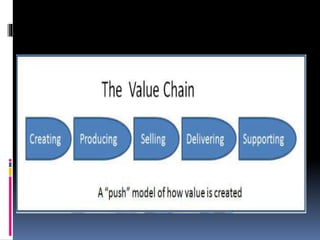
 A value chain is the full range of activities — such
as design, production, marketing and distribution
— businesses go through to bring a product or
service from conception to their customers.
 For companies that produce goods, the value chain
starts with the raw materials used to make their
products and consists of everything that is added to
it before it ends up being sold to consumers.
 The process of actually organizing all of these
activities so they can be properly analyzed is
called value chain management.
 The goal of value chain management is to
ensure that those in charge of each stage of the
value chain are communicating with each other
to help make sure the product is getting in the
hands of customers as seamlessly and quickly as
possible.
VALUE CHAIN ANALYSIS
 Value chain analysis (VCA) is a “process where a
firm identifies its primary and support activities that
add value to its final product and then analyze these
activities to reduce costs or increase differentiation.”
 It involves identifying each part of the value chain
and seeing where improvements can be made either
from a production standpoint or a cost perspective to
ensure consumers are getting the most bang for their
buck. When consumers are getting the most out of a
product for the cheapest cost, businesses will benefit
in the long run.
Primary Activities
 Primary activities relate directly to the physical creation, sale, maintenance and
support of a product or service. They consist of the following:
 Inbound logistics – These are all the processes related to receiving, storing, and
distributing inputs internally. The supplier relationships are a key factor in creating
value here.
 Operations – These are the transformation activities that change inputs into outputs
that are sold to customers. Here, the operational systems create value.
 Outbound logistics – These activities deliver your product or service to the
customer. These are things like collection, storage, and distribution systems, and
they may be internal or external to your organization.
 Marketing and sales – These are the processes you use to persuade clients to
purchase from you instead of your competitors. The benefits you offer, and how
well you communicate them, are sources of value here.
 Service – These are the activities related to maintaining the value of your product
or service to your customers, once it's been purchased.
SUPPORT ACTIVITIES
 Procurement (purchasing) – This is what the organization does to
get the resources it needs to operate. This includes finding vendors
and negotiating best prices.
 Human resource management – This is how well a company
recruits, hires, trains, motivates, rewards, and retains its workers.
People are a significant source of value, so businesses can create a
clear advantage with good HR practices.
 Technological development – These activities relate to managing
and processing information, as well as protecting a company's
knowledge base. Minimizing information technology costs, staying
current with technological advances, and maintaining technical
excellence are sources of value creation.
 Infrastructure – These are a company's support systems, and the
functions that allow it to maintain daily operations. Accounting,
legal, administrative, and general management are examples of
necessary infrastructure that businesses can use to their advantage.
VALUE CHAIN ANALYSIS OF STARBUCKS
 Starbucks’ value chain starts with product
development. The firm is always looking to
improve and provide the highest tasting products.
 Starbucks pays over the market price for its beans
in order to procure premium beans. Besides
acquiring highest quality coffee, the ethics of
paying a fair price for coffee producers, most of
whom are very low income farmers, provides an
ethical aspect to the value proposition.
 Starbucks stores aim to be a part of the community, to be
a meeting place and a central hub in which people come
to spend time and money. Starbucks does this both by
providing a very pleasant environment in which people
can spend time. Every little detail is taken into account.
Starbucks has even covered its foods and started to grind
the beans in stores to maintain the atmospheric scent of
coffee.
 Starbucks’ marketing is designed for strengthening the
relationship between the customer and her barista. The
marketing is also focused not on the traditional TV
advertisements but it does buy the occasional
advertisement for new products. It instead focuses on
events and community involvement.

Value Chain Analyisis.pptx

  • 1.
  • 2.
    What is avalue chain?  To understand how to conduct a value chain analysis, a business must first know what their value chain is.  A value chain is the full range of activities — such as design, production, marketing and distribution — businesses go through to bring a product or service from conception to their customers.  For companies that produce goods, the value chain starts with the raw materials used to make their products and consists of everything that is added to it before it ends up being sold to consumers.
  • 3.
     The processof actually organizing all of these activities so they can be properly analyzed is called value chain management.  The goal of value chain management is to ensure that those in charge of each stage of the value chain are communicating with each other to help make sure the product is getting in the hands of customers as seamlessly and quickly as possible.
  • 5.
    VALUE CHAIN ANALYSIS Value chain analysis (VCA) is a “process where a firm identifies its primary and support activities that add value to its final product and then analyze these activities to reduce costs or increase differentiation.”  It involves identifying each part of the value chain and seeing where improvements can be made either from a production standpoint or a cost perspective to ensure consumers are getting the most bang for their buck. When consumers are getting the most out of a product for the cheapest cost, businesses will benefit in the long run.
  • 7.
    Primary Activities  Primaryactivities relate directly to the physical creation, sale, maintenance and support of a product or service. They consist of the following:  Inbound logistics – These are all the processes related to receiving, storing, and distributing inputs internally. The supplier relationships are a key factor in creating value here.  Operations – These are the transformation activities that change inputs into outputs that are sold to customers. Here, the operational systems create value.  Outbound logistics – These activities deliver your product or service to the customer. These are things like collection, storage, and distribution systems, and they may be internal or external to your organization.  Marketing and sales – These are the processes you use to persuade clients to purchase from you instead of your competitors. The benefits you offer, and how well you communicate them, are sources of value here.  Service – These are the activities related to maintaining the value of your product or service to your customers, once it's been purchased.
  • 8.
    SUPPORT ACTIVITIES  Procurement(purchasing) – This is what the organization does to get the resources it needs to operate. This includes finding vendors and negotiating best prices.  Human resource management – This is how well a company recruits, hires, trains, motivates, rewards, and retains its workers. People are a significant source of value, so businesses can create a clear advantage with good HR practices.  Technological development – These activities relate to managing and processing information, as well as protecting a company's knowledge base. Minimizing information technology costs, staying current with technological advances, and maintaining technical excellence are sources of value creation.  Infrastructure – These are a company's support systems, and the functions that allow it to maintain daily operations. Accounting, legal, administrative, and general management are examples of necessary infrastructure that businesses can use to their advantage.
  • 9.
    VALUE CHAIN ANALYSISOF STARBUCKS  Starbucks’ value chain starts with product development. The firm is always looking to improve and provide the highest tasting products.  Starbucks pays over the market price for its beans in order to procure premium beans. Besides acquiring highest quality coffee, the ethics of paying a fair price for coffee producers, most of whom are very low income farmers, provides an ethical aspect to the value proposition.
  • 10.
     Starbucks storesaim to be a part of the community, to be a meeting place and a central hub in which people come to spend time and money. Starbucks does this both by providing a very pleasant environment in which people can spend time. Every little detail is taken into account. Starbucks has even covered its foods and started to grind the beans in stores to maintain the atmospheric scent of coffee.  Starbucks’ marketing is designed for strengthening the relationship between the customer and her barista. The marketing is also focused not on the traditional TV advertisements but it does buy the occasional advertisement for new products. It instead focuses on events and community involvement.