Backpacking
and
My Gut Microbiome
Richard Sprague
October 14, 2015
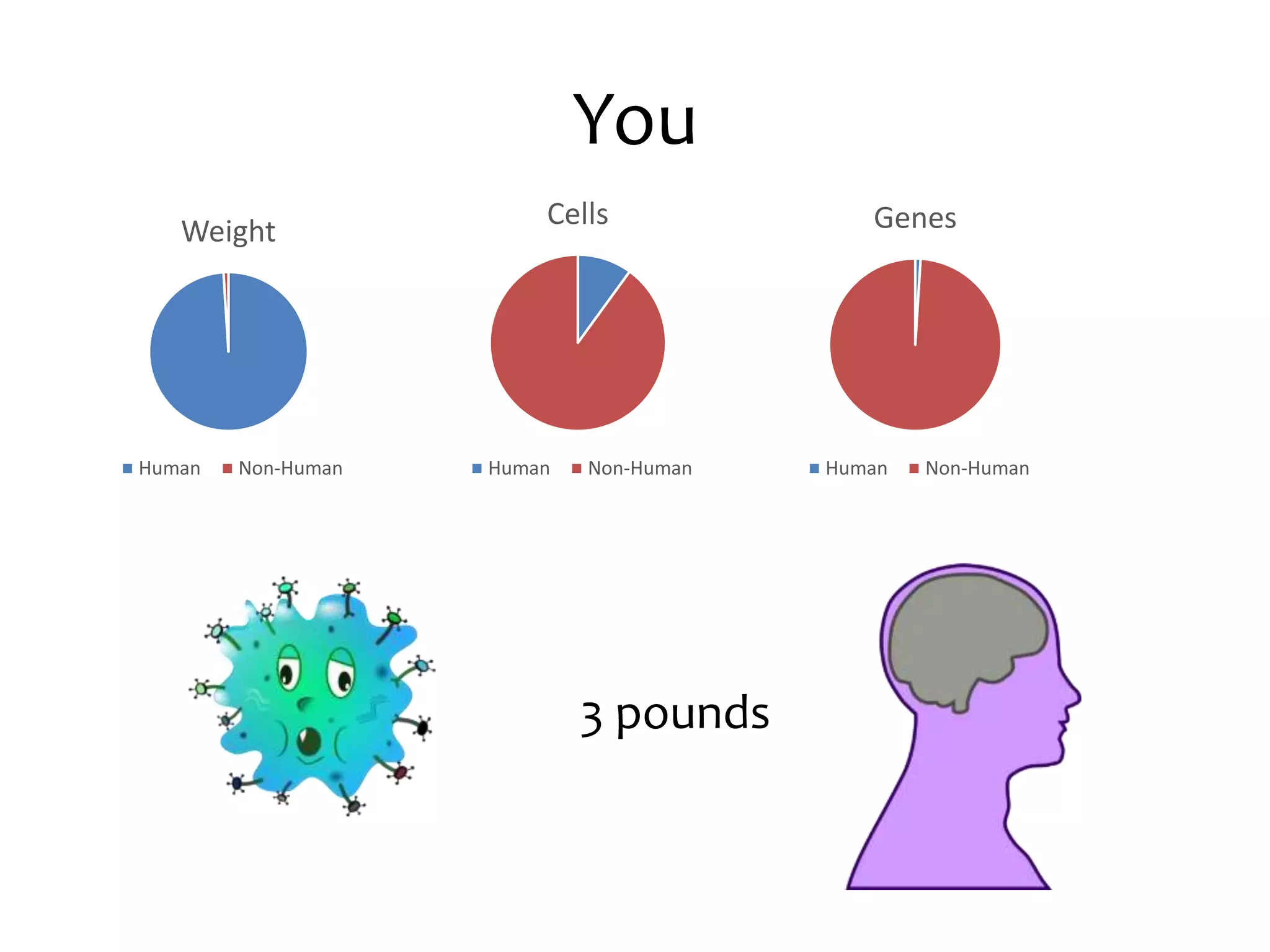
You
Weight
Human Non-Human
Cells
Human Non-Human
Genes
Human Non-Human
3 pounds
Find which microbes you have
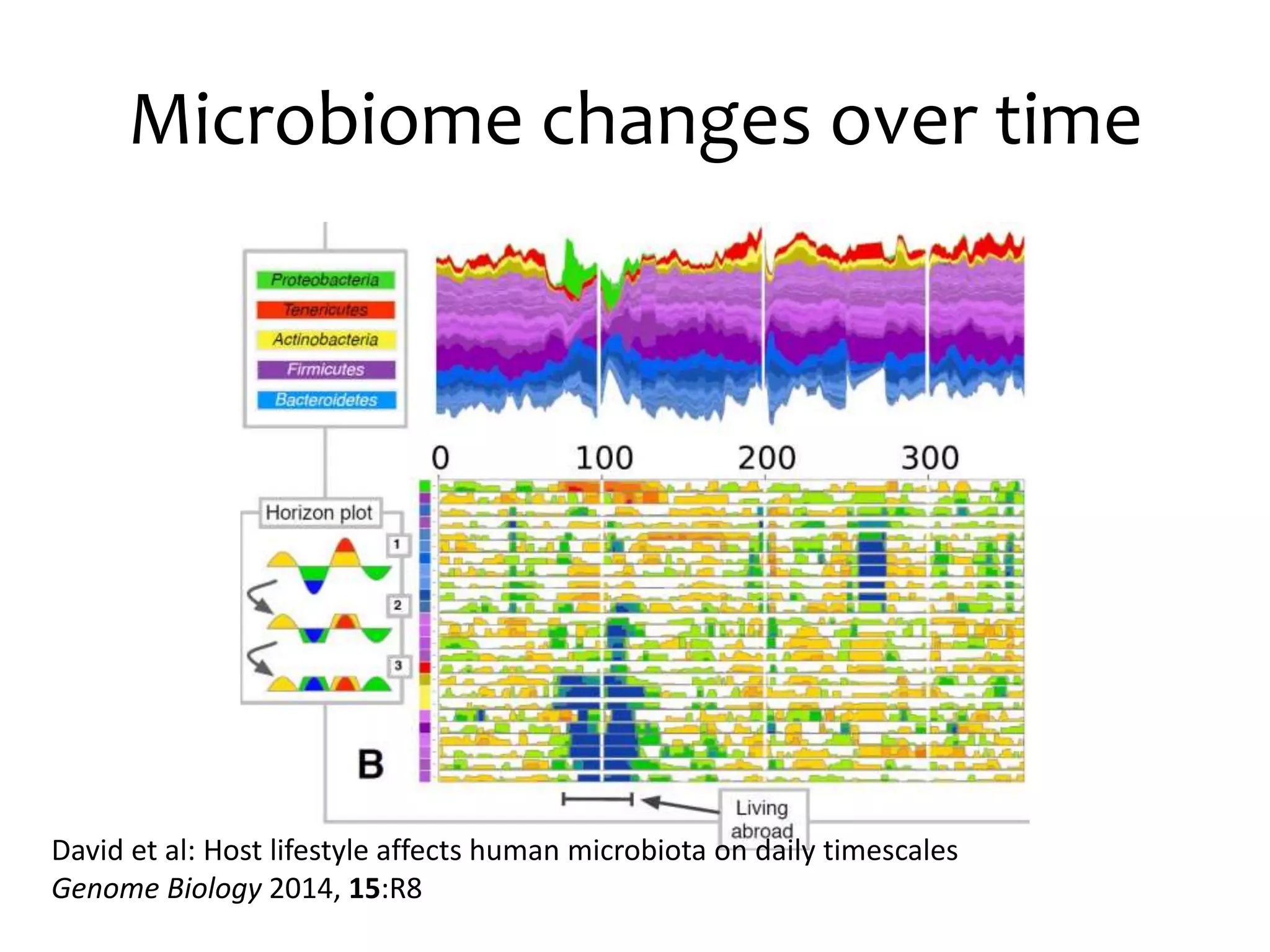
Microbiome changes over time
David et al: Host lifestyle affects human microbiota on daily timescales
Genome Biology 2014, 15:R8
The QS Questions
• What did I do?
– Measured how my gut biome changed after a 2-
week backpacking trip in New Mexico
• How did I do it?
– Gut tests before/after
– Analysis with Python/R
• What did I learn?
…
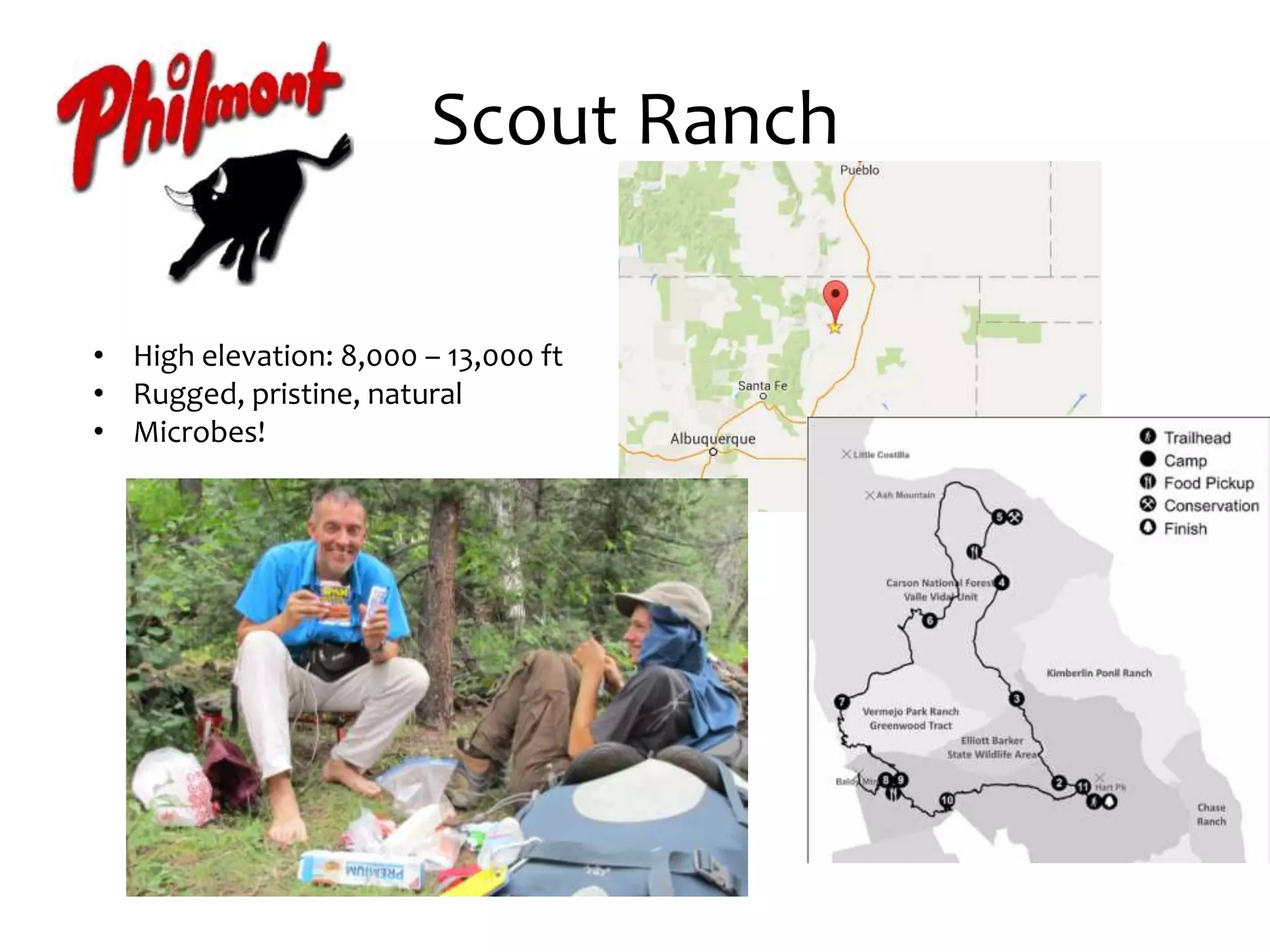
Scout Ranch
• High elevation: 8,000 – 13,000 ft
• Rugged, pristine, natural
• Microbes!
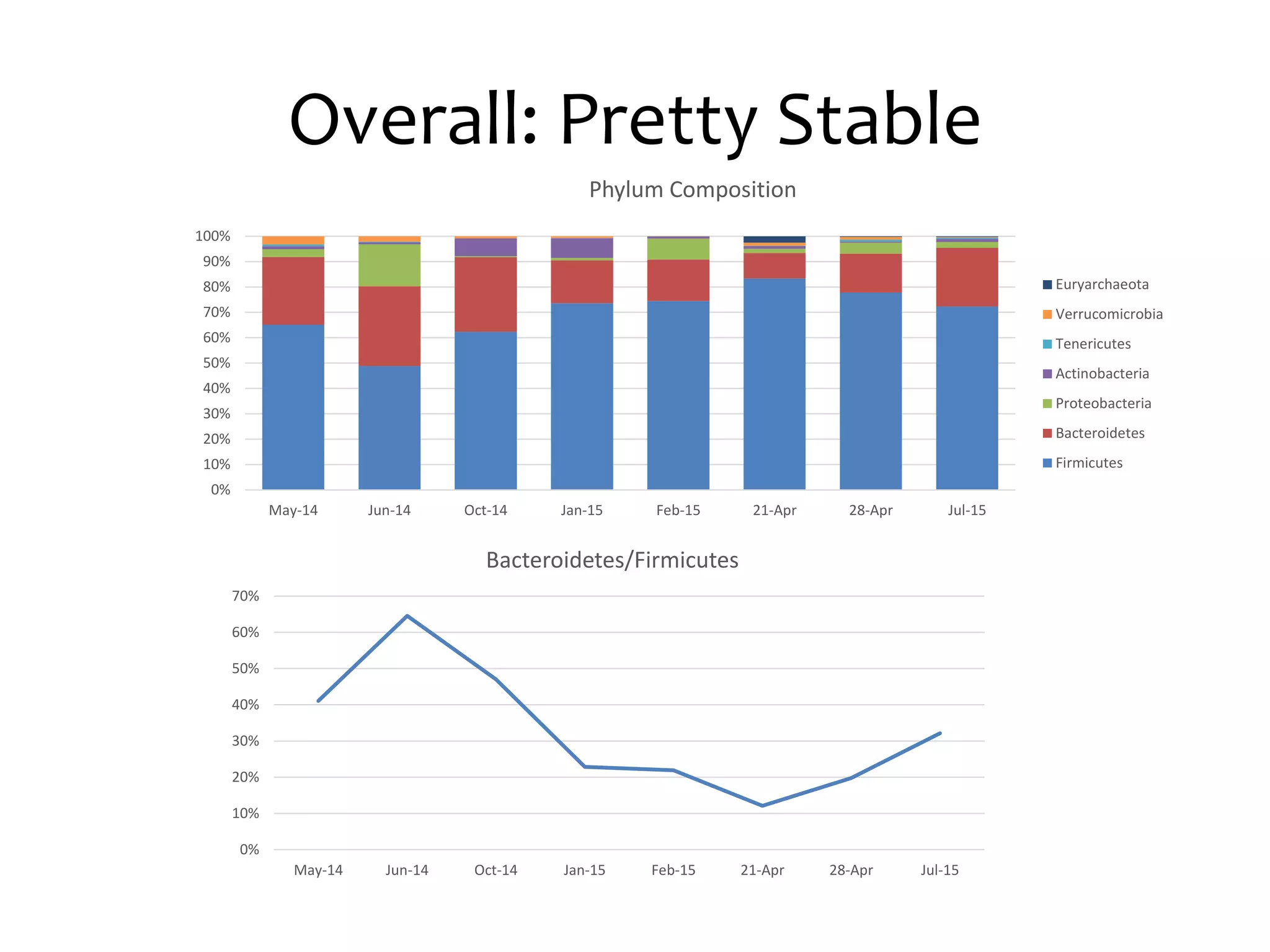
Overall: Pretty Stable
0%
10%
20%
30%
40%
50%
60%
70%
80%
90%
100%
May-14 Jun-14 Oct-14 Jan-15 Feb-15 21-Apr 28-Apr Jul-15
Phylum Composition
Euryarchaeota
Verrucomicrobia
Tenericutes
Actinobacteria
Proteobacteria
Bacteroidetes
Firmicutes
0%
10%
20%
30%
40%
50%
60%
70%
May-14 Jun-14 Oct-14 Jan-15 Feb-15 21-Apr 28-Apr Jul-15
Bacteroidetes/Firmicutes
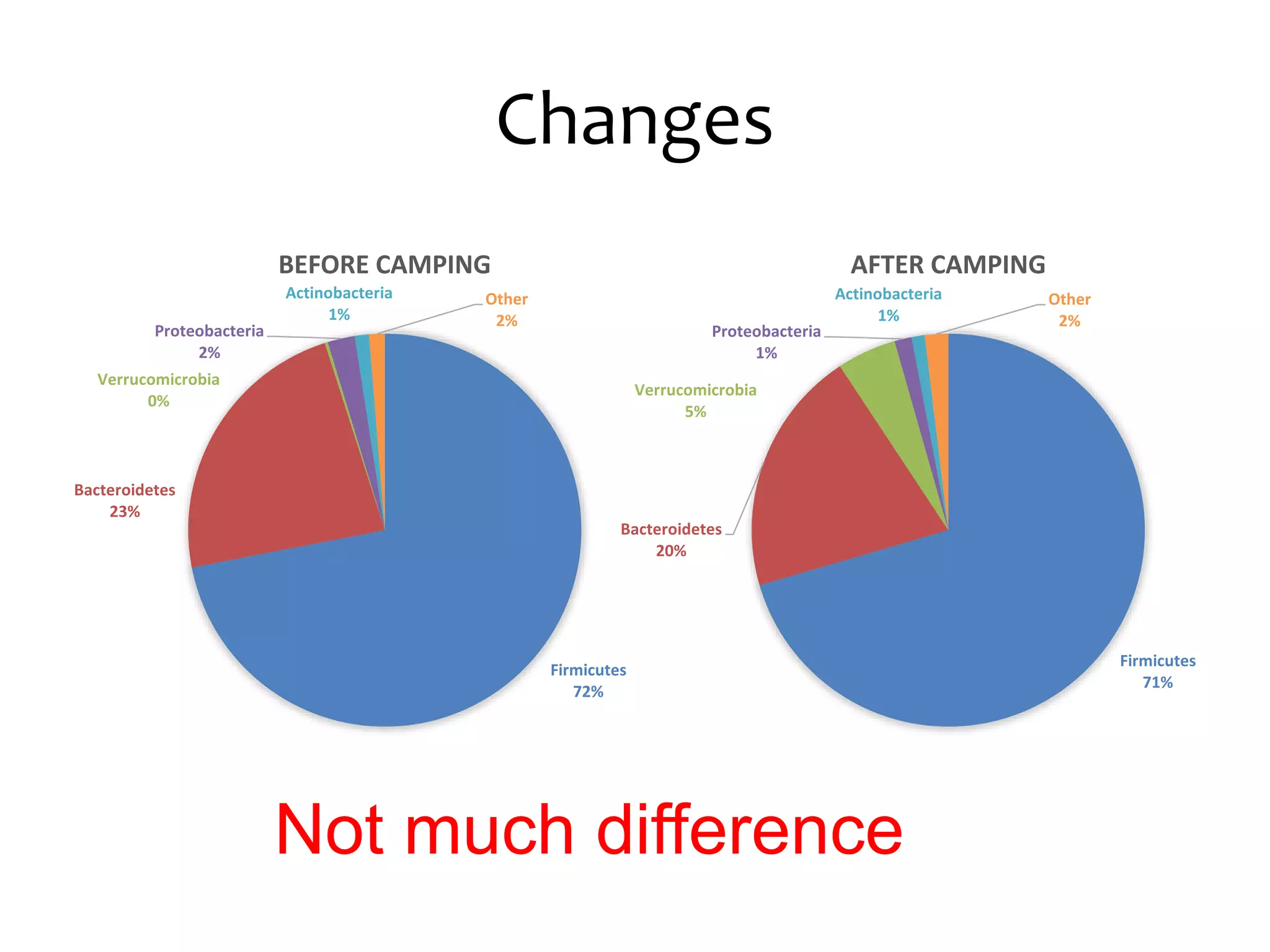
Changes
Firmicutes
72%
Bacteroidetes
23%
Verrucomicrobia
0%
Proteobacteria
2%
Actinobacteria
1%
Other
2%
BEFORE CAMPING
Firmicutes
71%
Bacteroidetes
20%
Verrucomicrobia
5%
Proteobacteria
1%
Actinobacteria
1%
Other
2%
AFTER CAMPING
Not much difference
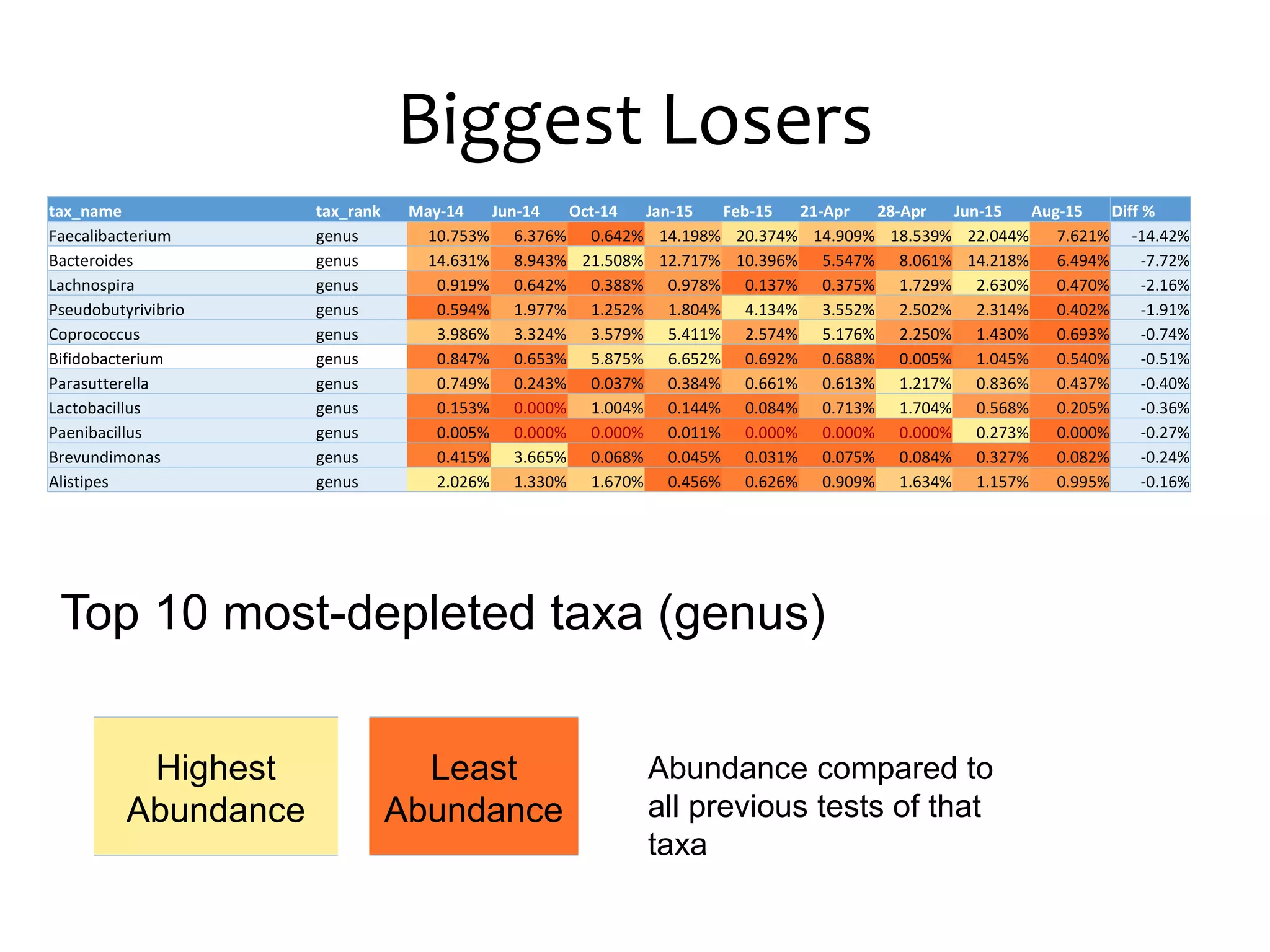
Biggest Losers
tax_name tax_rank May-14 Jun-14 Oct-14 Jan-15 Feb-15 21-Apr 28-Apr Jun-15 Aug-15 Diff %
Faecalibacterium genus 10.753% 6.376% 0.642% 14.198% 20.374% 14.909% 18.539% 22.044% 7.621% -14.42%
Bacteroides genus 14.631% 8.943% 21.508% 12.717% 10.396% 5.547% 8.061% 14.218% 6.494% -7.72%
Lachnospira genus 0.919% 0.642% 0.388% 0.978% 0.137% 0.375% 1.729% 2.630% 0.470% -2.16%
Pseudobutyrivibrio genus 0.594% 1.977% 1.252% 1.804% 4.134% 3.552% 2.502% 2.314% 0.402% -1.91%
Coprococcus genus 3.986% 3.324% 3.579% 5.411% 2.574% 5.176% 2.250% 1.430% 0.693% -0.74%
Bifidobacterium genus 0.847% 0.653% 5.875% 6.652% 0.692% 0.688% 0.005% 1.045% 0.540% -0.51%
Parasutterella genus 0.749% 0.243% 0.037% 0.384% 0.661% 0.613% 1.217% 0.836% 0.437% -0.40%
Lactobacillus genus 0.153% 0.000% 1.004% 0.144% 0.084% 0.713% 1.704% 0.568% 0.205% -0.36%
Paenibacillus genus 0.005% 0.000% 0.000% 0.011% 0.000% 0.000% 0.000% 0.273% 0.000% -0.27%
Brevundimonas genus 0.415% 3.665% 0.068% 0.045% 0.031% 0.075% 0.084% 0.327% 0.082% -0.24%
Alistipes genus 2.026% 1.330% 1.670% 0.456% 0.626% 0.909% 1.634% 1.157% 0.995% -0.16%
Top 10 most-depleted taxa (genus)
Highest
Abundance
Least
Abundance
Abundance compared to
all previous tests of that
taxa
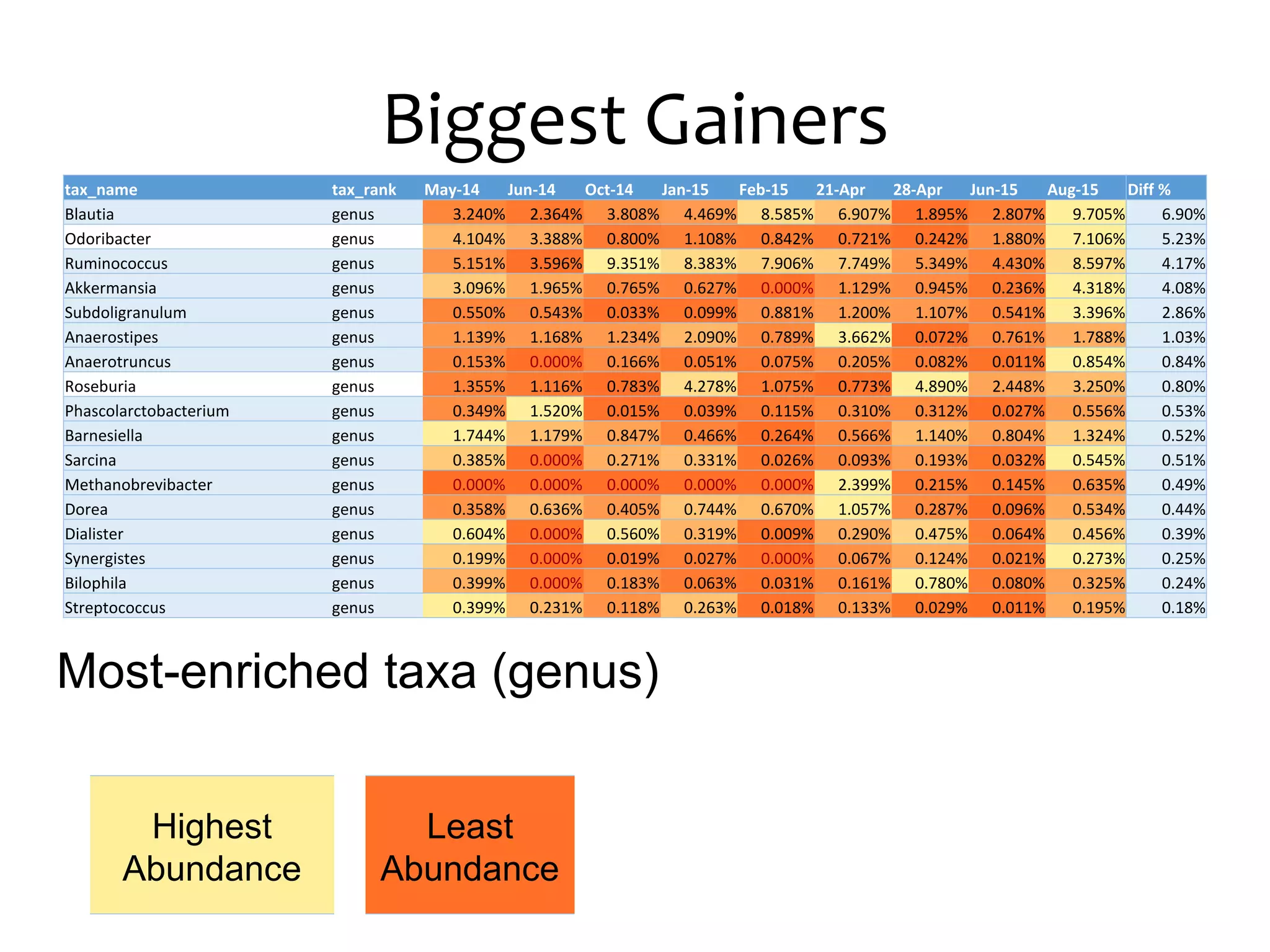
Biggest Gainers
tax_name tax_rank May-14 Jun-14 Oct-14 Jan-15 Feb-15 21-Apr 28-Apr Jun-15 Aug-15 Diff %
Blautia genus 3.240% 2.364% 3.808% 4.469% 8.585% 6.907% 1.895% 2.807% 9.705% 6.90%
Odoribacter genus 4.104% 3.388% 0.800% 1.108% 0.842% 0.721% 0.242% 1.880% 7.106% 5.23%
Ruminococcus genus 5.151% 3.596% 9.351% 8.383% 7.906% 7.749% 5.349% 4.430% 8.597% 4.17%
Akkermansia genus 3.096% 1.965% 0.765% 0.627% 0.000% 1.129% 0.945% 0.236% 4.318% 4.08%
Subdoligranulum genus 0.550% 0.543% 0.033% 0.099% 0.881% 1.200% 1.107% 0.541% 3.396% 2.86%
Anaerostipes genus 1.139% 1.168% 1.234% 2.090% 0.789% 3.662% 0.072% 0.761% 1.788% 1.03%
Anaerotruncus genus 0.153% 0.000% 0.166% 0.051% 0.075% 0.205% 0.082% 0.011% 0.854% 0.84%
Roseburia genus 1.355% 1.116% 0.783% 4.278% 1.075% 0.773% 4.890% 2.448% 3.250% 0.80%
Phascolarctobacterium genus 0.349% 1.520% 0.015% 0.039% 0.115% 0.310% 0.312% 0.027% 0.556% 0.53%
Barnesiella genus 1.744% 1.179% 0.847% 0.466% 0.264% 0.566% 1.140% 0.804% 1.324% 0.52%
Sarcina genus 0.385% 0.000% 0.271% 0.331% 0.026% 0.093% 0.193% 0.032% 0.545% 0.51%
Methanobrevibacter genus 0.000% 0.000% 0.000% 0.000% 0.000% 2.399% 0.215% 0.145% 0.635% 0.49%
Dorea genus 0.358% 0.636% 0.405% 0.744% 0.670% 1.057% 0.287% 0.096% 0.534% 0.44%
Dialister genus 0.604% 0.000% 0.560% 0.319% 0.009% 0.290% 0.475% 0.064% 0.456% 0.39%
Synergistes genus 0.199% 0.000% 0.019% 0.027% 0.000% 0.067% 0.124% 0.021% 0.273% 0.25%
Bilophila genus 0.399% 0.000% 0.183% 0.063% 0.031% 0.161% 0.780% 0.080% 0.325% 0.24%
Streptococcus genus 0.399% 0.231% 0.118% 0.263% 0.018% 0.133% 0.029% 0.011% 0.195% 0.18%
Most-enriched taxa (genus)
Highest
Abundance
Least
Abundance
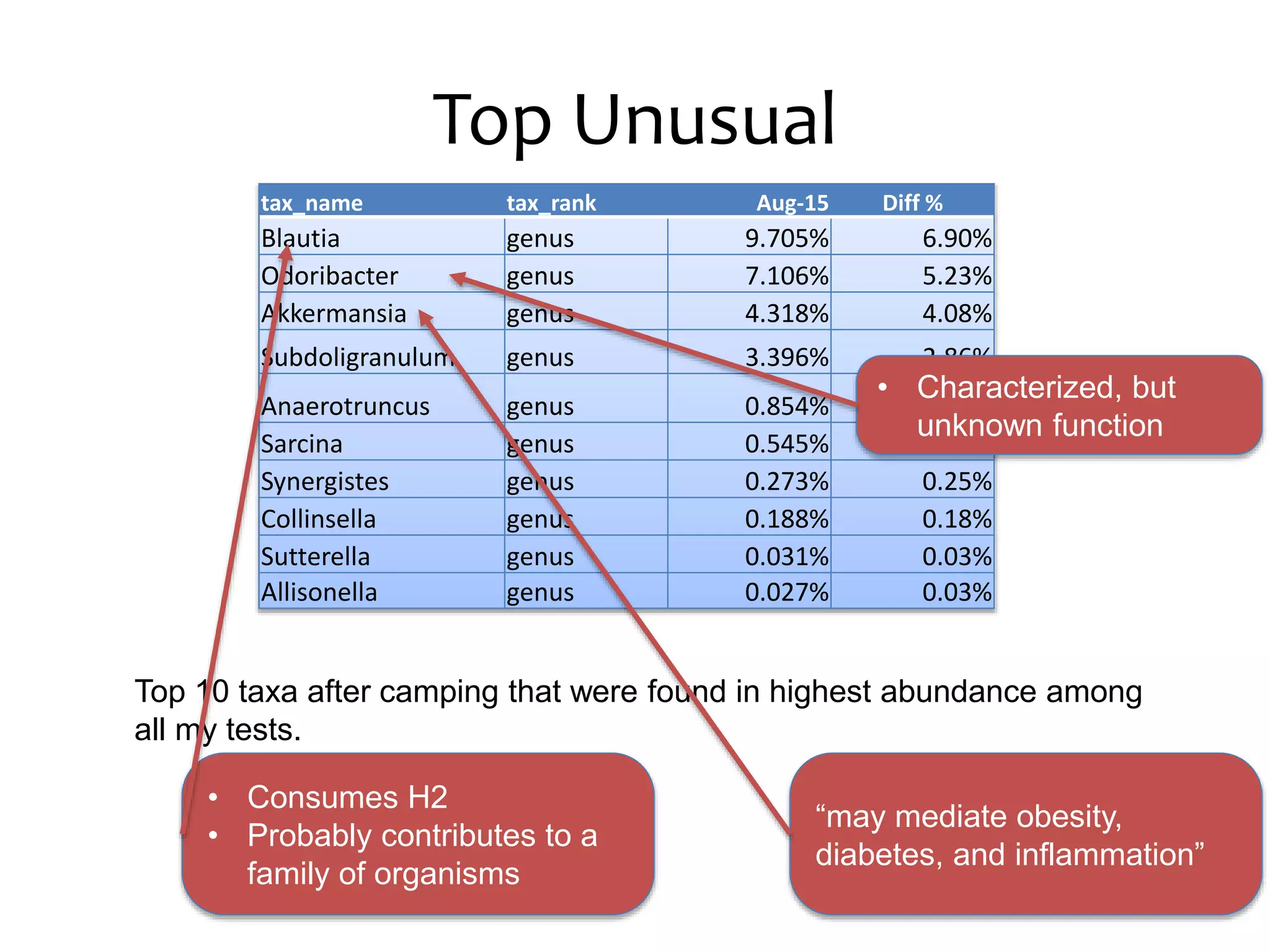
Top Unusual
tax_name tax_rank Aug-15 Diff %
Blautia genus 9.705% 6.90%
Odoribacter genus 7.106% 5.23%
Akkermansia genus 4.318% 4.08%
Subdoligranulum genus 3.396% 2.86%
Anaerotruncus genus 0.854% 0.84%
Sarcina genus 0.545% 0.51%
Synergistes genus 0.273% 0.25%
Collinsella genus 0.188% 0.18%
Sutterella genus 0.031% 0.03%
Allisonella genus 0.027% 0.03%
Top 10 taxa after camping that were found in highest abundance among
all my tests.
“may mediate obesity,
diabetes, and inflammation”
• Consumes H2
• Probably contributes to a
family of organisms
• Characterized, but
unknown function
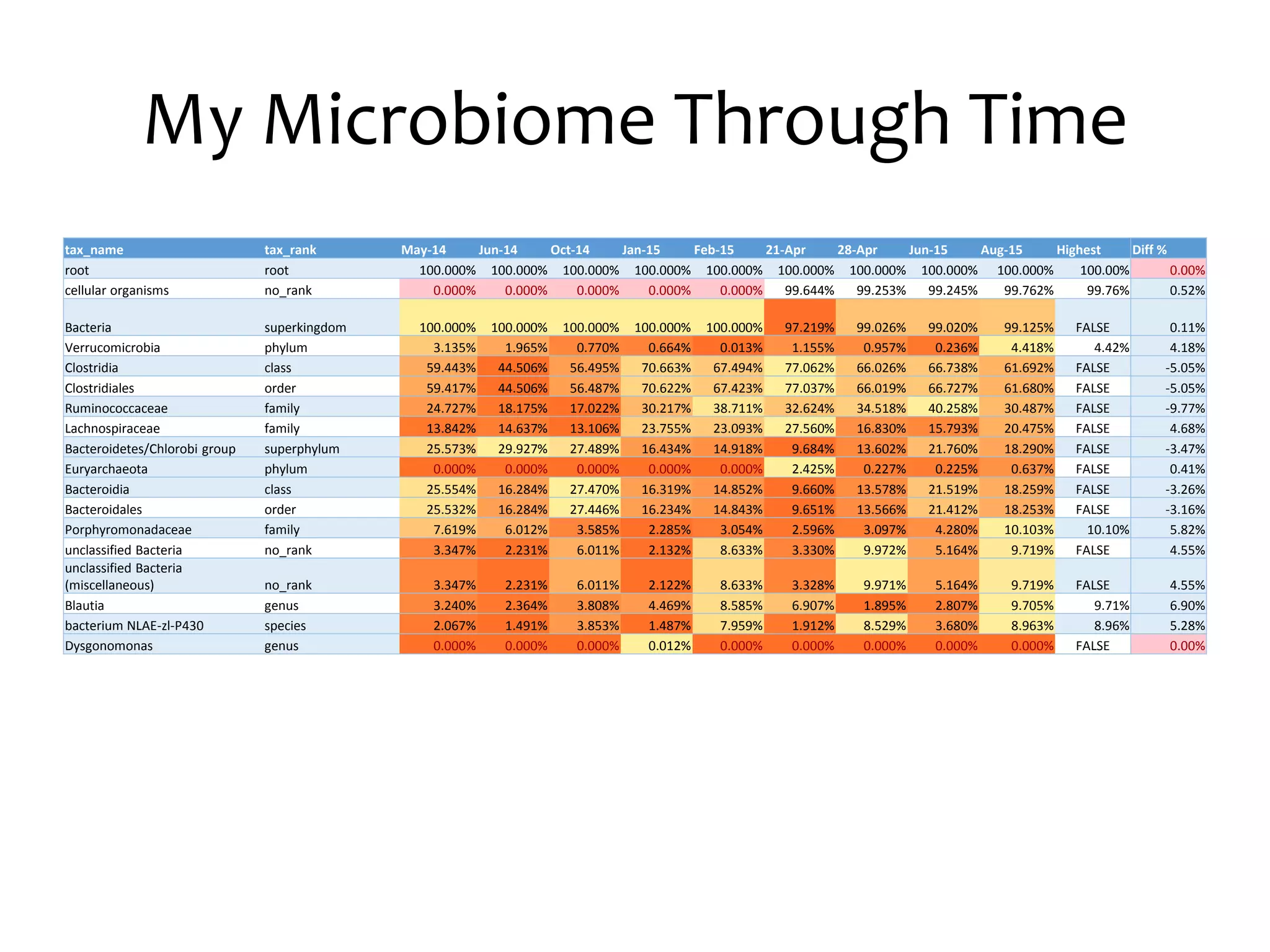
My Microbiome Through Time
tax_name tax_rank May-14 Jun-14 Oct-14 Jan-15 Feb-15 21-Apr 28-Apr Jun-15 Aug-15 Highest Diff %
root root 100.000% 100.000% 100.000% 100.000% 100.000% 100.000% 100.000% 100.000% 100.000% 100.00% 0.00%
cellular organisms no_rank 0.000% 0.000% 0.000% 0.000% 0.000% 99.644% 99.253% 99.245% 99.762% 99.76% 0.52%
Bacteria superkingdom 100.000% 100.000% 100.000% 100.000% 100.000% 97.219% 99.026% 99.020% 99.125% FALSE 0.11%
Verrucomicrobia phylum 3.135% 1.965% 0.770% 0.664% 0.013% 1.155% 0.957% 0.236% 4.418% 4.42% 4.18%
Clostridia class 59.443% 44.506% 56.495% 70.663% 67.494% 77.062% 66.026% 66.738% 61.692% FALSE -5.05%
Clostridiales order 59.417% 44.506% 56.487% 70.622% 67.423% 77.037% 66.019% 66.727% 61.680% FALSE -5.05%
Ruminococcaceae family 24.727% 18.175% 17.022% 30.217% 38.711% 32.624% 34.518% 40.258% 30.487% FALSE -9.77%
Lachnospiraceae family 13.842% 14.637% 13.106% 23.755% 23.093% 27.560% 16.830% 15.793% 20.475% FALSE 4.68%
Bacteroidetes/Chlorobi group superphylum 25.573% 29.927% 27.489% 16.434% 14.918% 9.684% 13.602% 21.760% 18.290% FALSE -3.47%
Euryarchaeota phylum 0.000% 0.000% 0.000% 0.000% 0.000% 2.425% 0.227% 0.225% 0.637% FALSE 0.41%
Bacteroidia class 25.554% 16.284% 27.470% 16.319% 14.852% 9.660% 13.578% 21.519% 18.259% FALSE -3.26%
Bacteroidales order 25.532% 16.284% 27.446% 16.234% 14.843% 9.651% 13.566% 21.412% 18.253% FALSE -3.16%
Porphyromonadaceae family 7.619% 6.012% 3.585% 2.285% 3.054% 2.596% 3.097% 4.280% 10.103% 10.10% 5.82%
unclassified Bacteria no_rank 3.347% 2.231% 6.011% 2.132% 8.633% 3.330% 9.972% 5.164% 9.719% FALSE 4.55%
unclassified Bacteria
(miscellaneous) no_rank 3.347% 2.231% 6.011% 2.122% 8.633% 3.328% 9.971% 5.164% 9.719% FALSE 4.55%
Blautia genus 3.240% 2.364% 3.808% 4.469% 8.585% 6.907% 1.895% 2.807% 9.705% 9.71% 6.90%
bacterium NLAE-zl-P430 species 2.067% 1.491% 3.853% 1.487% 7.959% 1.912% 8.529% 3.680% 8.963% 8.96% 5.28%
Dysgonomonas genus 0.000% 0.000% 0.000% 0.012% 0.000% 0.000% 0.000% 0.000% 0.000% FALSE 0.00%
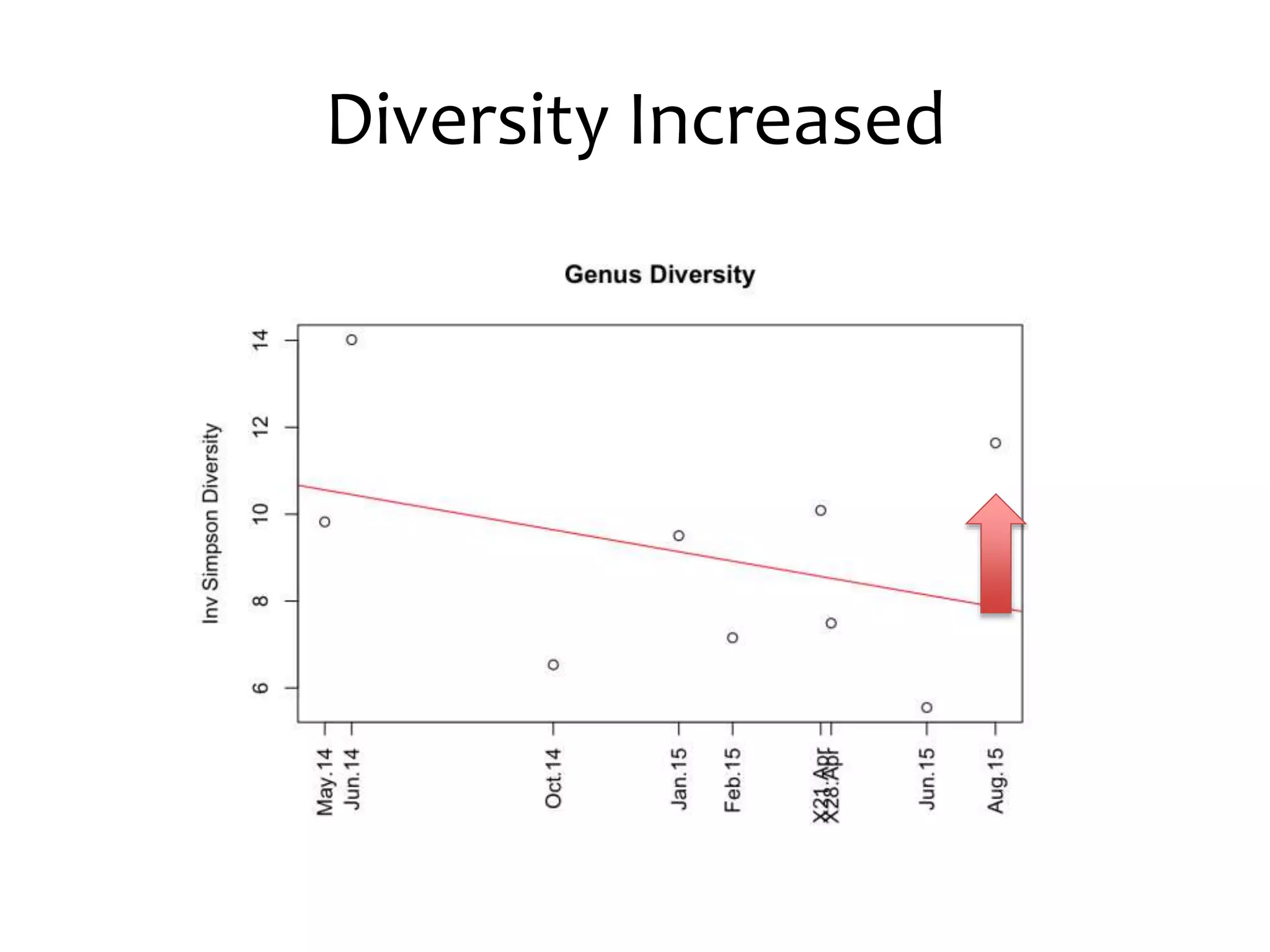
Diversity Increased
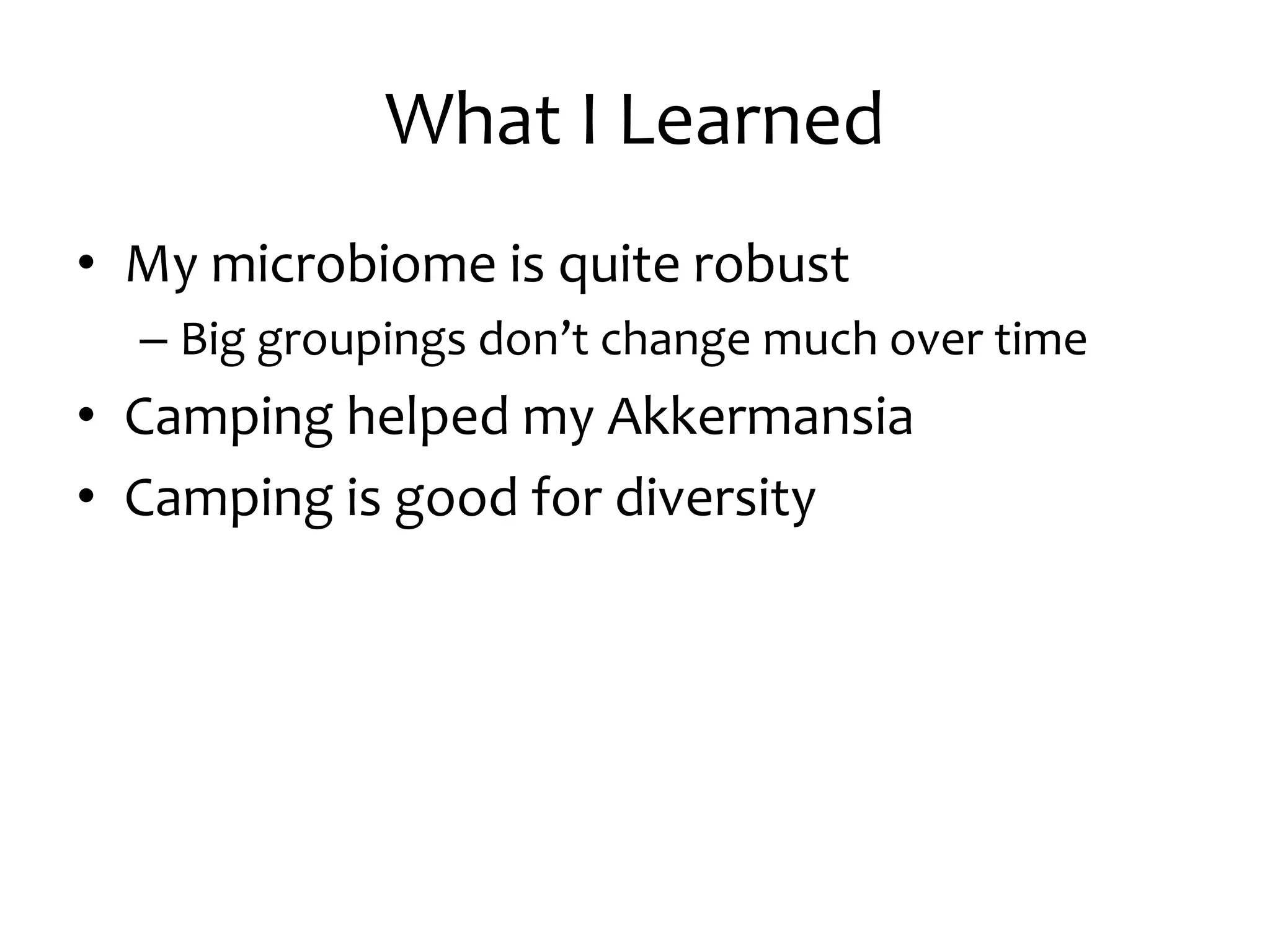
What I Learned
• My microbiome is quite robust
– Big groupings don’t change much over time
• Camping helped my Akkermansia
• Camping is good for diversity
Conclusions
Thank you
@sprague
Odoribacter
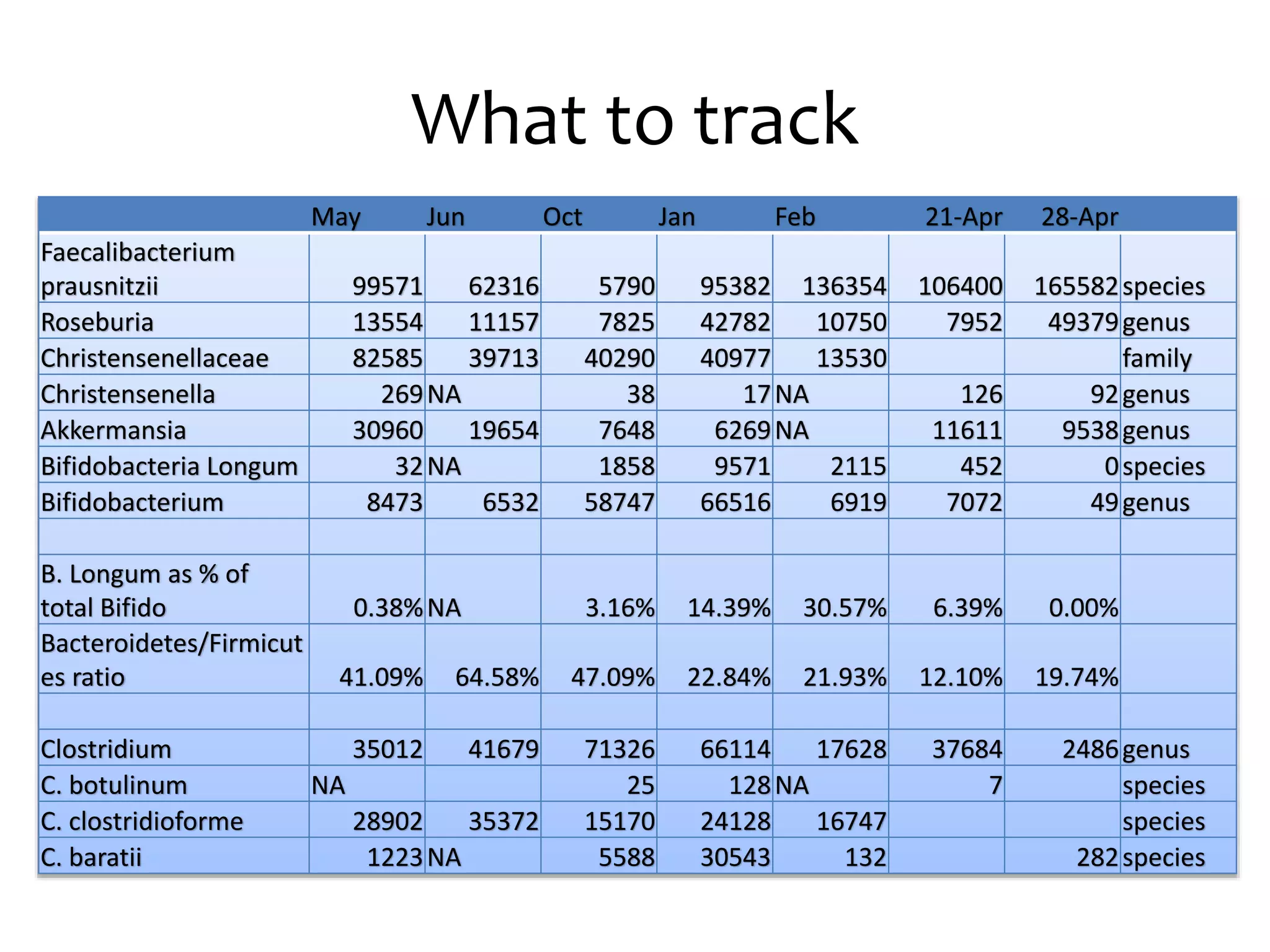
What to track
May Jun Oct Jan Feb 21-Apr 28-Apr
Faecalibacterium
prausnitzii 99571 62316 5790 95382 136354 106400 165582species
Roseburia 13554 11157 7825 42782 10750 7952 49379genus
Christensenellaceae 82585 39713 40290 40977 13530 family
Christensenella 269NA 38 17NA 126 92genus
Akkermansia 30960 19654 7648 6269NA 11611 9538genus
Bifidobacteria Longum 32NA 1858 9571 2115 452 0species
Bifidobacterium 8473 6532 58747 66516 6919 7072 49genus
B. Longum as % of
total Bifido 0.38%NA 3.16% 14.39% 30.57% 6.39% 0.00%
Bacteroidetes/Firmicut
es ratio 41.09% 64.58% 47.09% 22.84% 21.93% 12.10% 19.74%
Clostridium 35012 41679 71326 66114 17628 37684 2486genus
C. botulinum NA 25 128NA 7 species
C. clostridioforme 28902 35372 15170 24128 16747 species
C. baratii 1223NA 5588 30543 132 282species

How Backpacking Changed My Gut Microbiome

  • 1.
  • 2.
  • 3.
  • 4.
    Microbiome changes overtime David et al: Host lifestyle affects human microbiota on daily timescales Genome Biology 2014, 15:R8
  • 5.
    The QS Questions •What did I do? – Measured how my gut biome changed after a 2- week backpacking trip in New Mexico • How did I do it? – Gut tests before/after – Analysis with Python/R • What did I learn? …
  • 6.
    Scout Ranch • Highelevation: 8,000 – 13,000 ft • Rugged, pristine, natural • Microbes!
  • 7.
    Overall: Pretty Stable 0% 10% 20% 30% 40% 50% 60% 70% 80% 90% 100% May-14Jun-14 Oct-14 Jan-15 Feb-15 21-Apr 28-Apr Jul-15 Phylum Composition Euryarchaeota Verrucomicrobia Tenericutes Actinobacteria Proteobacteria Bacteroidetes Firmicutes 0% 10% 20% 30% 40% 50% 60% 70% May-14 Jun-14 Oct-14 Jan-15 Feb-15 21-Apr 28-Apr Jul-15 Bacteroidetes/Firmicutes
  • 8.
  • 9.
    Biggest Losers tax_name tax_rankMay-14 Jun-14 Oct-14 Jan-15 Feb-15 21-Apr 28-Apr Jun-15 Aug-15 Diff % Faecalibacterium genus 10.753% 6.376% 0.642% 14.198% 20.374% 14.909% 18.539% 22.044% 7.621% -14.42% Bacteroides genus 14.631% 8.943% 21.508% 12.717% 10.396% 5.547% 8.061% 14.218% 6.494% -7.72% Lachnospira genus 0.919% 0.642% 0.388% 0.978% 0.137% 0.375% 1.729% 2.630% 0.470% -2.16% Pseudobutyrivibrio genus 0.594% 1.977% 1.252% 1.804% 4.134% 3.552% 2.502% 2.314% 0.402% -1.91% Coprococcus genus 3.986% 3.324% 3.579% 5.411% 2.574% 5.176% 2.250% 1.430% 0.693% -0.74% Bifidobacterium genus 0.847% 0.653% 5.875% 6.652% 0.692% 0.688% 0.005% 1.045% 0.540% -0.51% Parasutterella genus 0.749% 0.243% 0.037% 0.384% 0.661% 0.613% 1.217% 0.836% 0.437% -0.40% Lactobacillus genus 0.153% 0.000% 1.004% 0.144% 0.084% 0.713% 1.704% 0.568% 0.205% -0.36% Paenibacillus genus 0.005% 0.000% 0.000% 0.011% 0.000% 0.000% 0.000% 0.273% 0.000% -0.27% Brevundimonas genus 0.415% 3.665% 0.068% 0.045% 0.031% 0.075% 0.084% 0.327% 0.082% -0.24% Alistipes genus 2.026% 1.330% 1.670% 0.456% 0.626% 0.909% 1.634% 1.157% 0.995% -0.16% Top 10 most-depleted taxa (genus) Highest Abundance Least Abundance Abundance compared to all previous tests of that taxa
  • 10.
    Biggest Gainers tax_name tax_rankMay-14 Jun-14 Oct-14 Jan-15 Feb-15 21-Apr 28-Apr Jun-15 Aug-15 Diff % Blautia genus 3.240% 2.364% 3.808% 4.469% 8.585% 6.907% 1.895% 2.807% 9.705% 6.90% Odoribacter genus 4.104% 3.388% 0.800% 1.108% 0.842% 0.721% 0.242% 1.880% 7.106% 5.23% Ruminococcus genus 5.151% 3.596% 9.351% 8.383% 7.906% 7.749% 5.349% 4.430% 8.597% 4.17% Akkermansia genus 3.096% 1.965% 0.765% 0.627% 0.000% 1.129% 0.945% 0.236% 4.318% 4.08% Subdoligranulum genus 0.550% 0.543% 0.033% 0.099% 0.881% 1.200% 1.107% 0.541% 3.396% 2.86% Anaerostipes genus 1.139% 1.168% 1.234% 2.090% 0.789% 3.662% 0.072% 0.761% 1.788% 1.03% Anaerotruncus genus 0.153% 0.000% 0.166% 0.051% 0.075% 0.205% 0.082% 0.011% 0.854% 0.84% Roseburia genus 1.355% 1.116% 0.783% 4.278% 1.075% 0.773% 4.890% 2.448% 3.250% 0.80% Phascolarctobacterium genus 0.349% 1.520% 0.015% 0.039% 0.115% 0.310% 0.312% 0.027% 0.556% 0.53% Barnesiella genus 1.744% 1.179% 0.847% 0.466% 0.264% 0.566% 1.140% 0.804% 1.324% 0.52% Sarcina genus 0.385% 0.000% 0.271% 0.331% 0.026% 0.093% 0.193% 0.032% 0.545% 0.51% Methanobrevibacter genus 0.000% 0.000% 0.000% 0.000% 0.000% 2.399% 0.215% 0.145% 0.635% 0.49% Dorea genus 0.358% 0.636% 0.405% 0.744% 0.670% 1.057% 0.287% 0.096% 0.534% 0.44% Dialister genus 0.604% 0.000% 0.560% 0.319% 0.009% 0.290% 0.475% 0.064% 0.456% 0.39% Synergistes genus 0.199% 0.000% 0.019% 0.027% 0.000% 0.067% 0.124% 0.021% 0.273% 0.25% Bilophila genus 0.399% 0.000% 0.183% 0.063% 0.031% 0.161% 0.780% 0.080% 0.325% 0.24% Streptococcus genus 0.399% 0.231% 0.118% 0.263% 0.018% 0.133% 0.029% 0.011% 0.195% 0.18% Most-enriched taxa (genus) Highest Abundance Least Abundance
  • 11.
    Top Unusual tax_name tax_rankAug-15 Diff % Blautia genus 9.705% 6.90% Odoribacter genus 7.106% 5.23% Akkermansia genus 4.318% 4.08% Subdoligranulum genus 3.396% 2.86% Anaerotruncus genus 0.854% 0.84% Sarcina genus 0.545% 0.51% Synergistes genus 0.273% 0.25% Collinsella genus 0.188% 0.18% Sutterella genus 0.031% 0.03% Allisonella genus 0.027% 0.03% Top 10 taxa after camping that were found in highest abundance among all my tests. “may mediate obesity, diabetes, and inflammation” • Consumes H2 • Probably contributes to a family of organisms • Characterized, but unknown function
  • 12.
    My Microbiome ThroughTime tax_name tax_rank May-14 Jun-14 Oct-14 Jan-15 Feb-15 21-Apr 28-Apr Jun-15 Aug-15 Highest Diff % root root 100.000% 100.000% 100.000% 100.000% 100.000% 100.000% 100.000% 100.000% 100.000% 100.00% 0.00% cellular organisms no_rank 0.000% 0.000% 0.000% 0.000% 0.000% 99.644% 99.253% 99.245% 99.762% 99.76% 0.52% Bacteria superkingdom 100.000% 100.000% 100.000% 100.000% 100.000% 97.219% 99.026% 99.020% 99.125% FALSE 0.11% Verrucomicrobia phylum 3.135% 1.965% 0.770% 0.664% 0.013% 1.155% 0.957% 0.236% 4.418% 4.42% 4.18% Clostridia class 59.443% 44.506% 56.495% 70.663% 67.494% 77.062% 66.026% 66.738% 61.692% FALSE -5.05% Clostridiales order 59.417% 44.506% 56.487% 70.622% 67.423% 77.037% 66.019% 66.727% 61.680% FALSE -5.05% Ruminococcaceae family 24.727% 18.175% 17.022% 30.217% 38.711% 32.624% 34.518% 40.258% 30.487% FALSE -9.77% Lachnospiraceae family 13.842% 14.637% 13.106% 23.755% 23.093% 27.560% 16.830% 15.793% 20.475% FALSE 4.68% Bacteroidetes/Chlorobi group superphylum 25.573% 29.927% 27.489% 16.434% 14.918% 9.684% 13.602% 21.760% 18.290% FALSE -3.47% Euryarchaeota phylum 0.000% 0.000% 0.000% 0.000% 0.000% 2.425% 0.227% 0.225% 0.637% FALSE 0.41% Bacteroidia class 25.554% 16.284% 27.470% 16.319% 14.852% 9.660% 13.578% 21.519% 18.259% FALSE -3.26% Bacteroidales order 25.532% 16.284% 27.446% 16.234% 14.843% 9.651% 13.566% 21.412% 18.253% FALSE -3.16% Porphyromonadaceae family 7.619% 6.012% 3.585% 2.285% 3.054% 2.596% 3.097% 4.280% 10.103% 10.10% 5.82% unclassified Bacteria no_rank 3.347% 2.231% 6.011% 2.132% 8.633% 3.330% 9.972% 5.164% 9.719% FALSE 4.55% unclassified Bacteria (miscellaneous) no_rank 3.347% 2.231% 6.011% 2.122% 8.633% 3.328% 9.971% 5.164% 9.719% FALSE 4.55% Blautia genus 3.240% 2.364% 3.808% 4.469% 8.585% 6.907% 1.895% 2.807% 9.705% 9.71% 6.90% bacterium NLAE-zl-P430 species 2.067% 1.491% 3.853% 1.487% 7.959% 1.912% 8.529% 3.680% 8.963% 8.96% 5.28% Dysgonomonas genus 0.000% 0.000% 0.000% 0.012% 0.000% 0.000% 0.000% 0.000% 0.000% FALSE 0.00%
  • 13.
  • 14.
    What I Learned •My microbiome is quite robust – Big groupings don’t change much over time • Camping helped my Akkermansia • Camping is good for diversity
  • 15.
  • 16.
  • 17.
  • 18.
    What to track MayJun Oct Jan Feb 21-Apr 28-Apr Faecalibacterium prausnitzii 99571 62316 5790 95382 136354 106400 165582species Roseburia 13554 11157 7825 42782 10750 7952 49379genus Christensenellaceae 82585 39713 40290 40977 13530 family Christensenella 269NA 38 17NA 126 92genus Akkermansia 30960 19654 7648 6269NA 11611 9538genus Bifidobacteria Longum 32NA 1858 9571 2115 452 0species Bifidobacterium 8473 6532 58747 66516 6919 7072 49genus B. Longum as % of total Bifido 0.38%NA 3.16% 14.39% 30.57% 6.39% 0.00% Bacteroidetes/Firmicut es ratio 41.09% 64.58% 47.09% 22.84% 21.93% 12.10% 19.74% Clostridium 35012 41679 71326 66114 17628 37684 2486genus C. botulinum NA 25 128NA 7 species C. clostridioforme 28902 35372 15170 24128 16747 species C. baratii 1223NA 5588 30543 132 282species

Editor's Notes

  • #3 Quick review if you couldn’t attend my previous talks. I’ve always been interested in genetic testing, but I learned that most of the genes in our bodies is non-human! Trillions of living microbes, many of them co-evolved with humans, inhabit every space of our bodies, adding up to a total of 3-5 pounds, about as much as your brain!
  • #4 Each costs about $100 uBiome gives you results now in a few weeks (used to be months) uBiome gives you details about your own data, downloadable as JSON.
  • #5 My favorite academic paper that followed the details of two subjects to see how their microbiomes changed over a year. http://genomebiology.com/2014/15/7/R89#sec2
  • #6 Like every QS talk, my remarks center around these three questions.
  • #7 I spent 2 weeks in an isolated backwoods backpacking trip at the Boy Scouts of America Philmont Scout ranch in northern New Mexico. This was serious camping: high elevation, strenuous workout, no facilities anywhere – and nothing but backpacking food.
  • #8 Having taken many uBiome samples over the past year, one observation: my gut biome is surprisingly stable. Sure there are ups and downs, but in the broadest categories things don’t change that much. I’m an omnivore, and my Bacteroidetes/Firmicutes ratio is remarkably unchanged.
  • #9 Bottom line: at the highest levels, my 2 weeks in the back country didn’t do much. There are a few exceptions, though
  • #10 So I wrote a Python script to organize my uBiome taxonomy data. This spreadsheet shows the top taxa that dropped in abundance after my camping trip. The light-colored cells in this sheet represent taxa that are in highest abundance at that particular test (dark cells are the opposite).
  • #11 …and here’s the list of taxa that went UP most after my trip.
  • #12 Here’s a closer look just at those taxa that (1) went up a lot, and (2) were at their extremes compared to all the other gut microbiome tests I’ve done in the past year.
  • #13 I keep this big spreadsheet that summarizes all my tests. You can make your own with the apps at: https://github.com/ubiome-opensource/microbiome-tools
  • #14 I also ran an “inverse simpson diversity” algorithm on my results. This is a measure that ecologists use to compare different environments to see which have the most diverse lifeforms. It’s crude, and I admit lots of problems with this measure, but interestingly it shows my diversity went up after my camping trip.
  • #15 I learned a few things as a result of this experiment, but…
  • #16 Mostly I’m stumped….so little is known about the gut microbiome. It’s a fascinating subject that deserves much more attention from QS types.
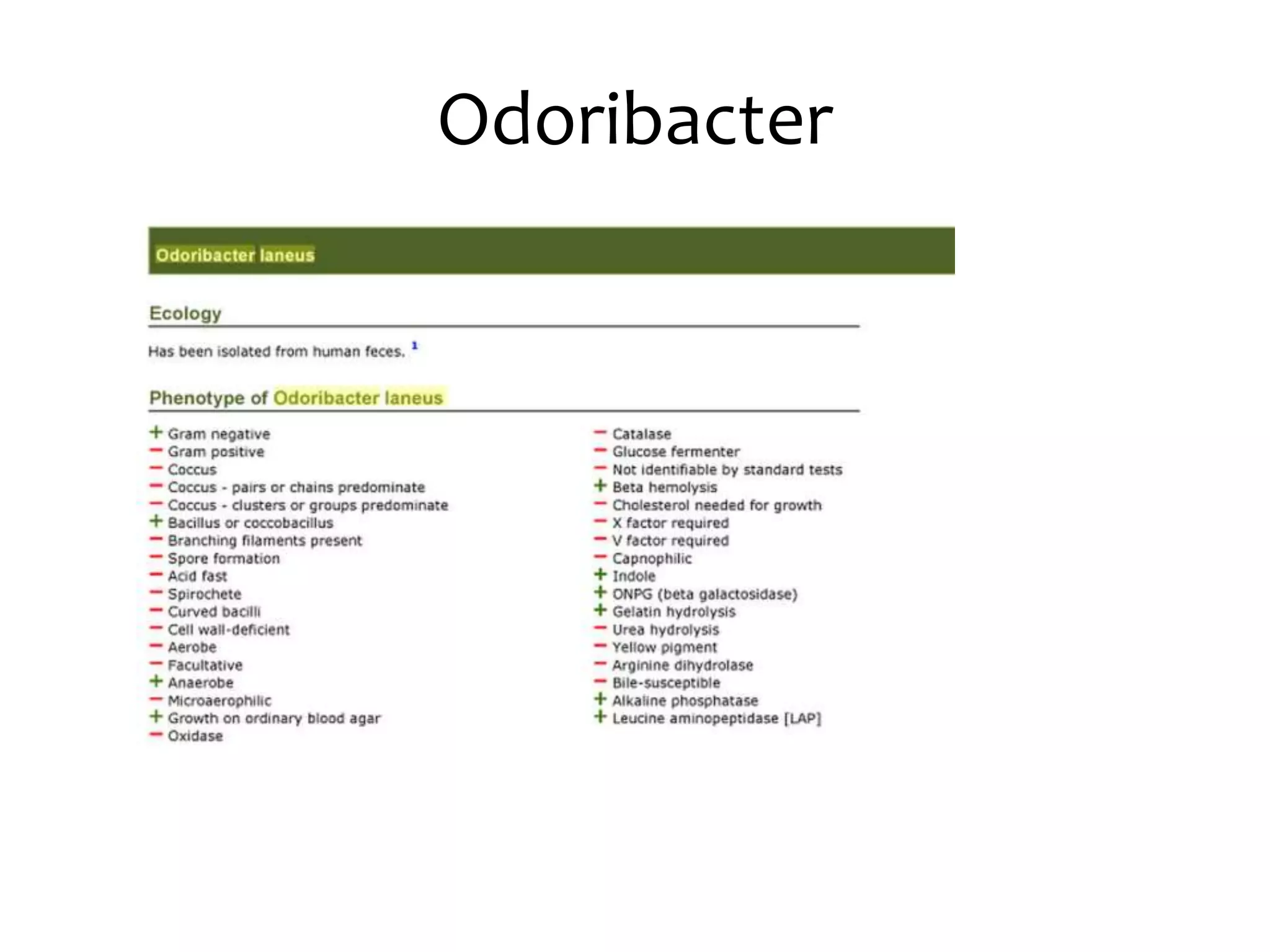
  • #18 https://books.google.com/books?id=6fh3BwAAQBAJ&lpg=PA1299&ots=PkK3Hb5C7y&dq=Odoribacter%20laneus&pg=PA1299#v=onepage&q=Odoribacter%20laneus&f=false