




How a PMP Actually works
Jana Meron
VP Programmatic & Data Strategy
2
Agenda
• What is a PMP?
• What are the ingredients for a successful PMP?
• PMP = Quality
• Best practices
• Key Takeaways
3
WTF — PMP?
• A Private Marketplace is an RTB auction where a publisher allows select​
buyers to bid on their premium inventory. In many cases buyers are allowed
to bid prior to lower tiered open exchange partners.
4
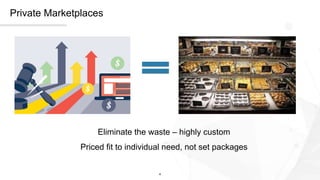
Private Marketplaces
Eliminate the waste – highly custom
Priced fit to individual need, not set packages
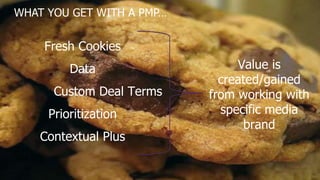
WHAT YOU GET WITH A PMP…
Contextual Plus
Data
Custom Deal Terms
Prioritization
Fresh Cookies
Value is
created/gained
from working with
specific media
brand
6
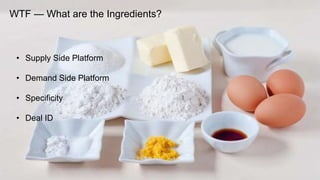
WTF — What are the Ingredients?
• Supply Side Platform
• Demand Side Platform
• Specificity
• Deal ID
7
PMP = Quality
Private Marketplaces:
• Allows clients preferred
access to inventory
• Better, more direct service = better
experience on both sides
• Gated access – maintains the
quality of our environment
8
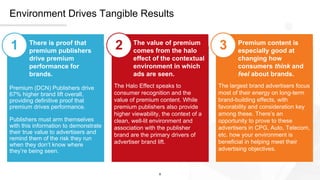
Environment Drives Tangible Results
Premium (DCN) Publishers drive
67% higher brand lift overall,
providing definitive proof that
premium drives performance.
Publishers must arm themselves
with this information to demonstrate
their true value to advertisers and
remind them of the risk they run
when they don’t know where
they’re being seen.
1 There is proof that
premium publishers
drive premium
performance for
brands.
The Halo Effect speaks to
consumer recognition and the
value of premium content. While
premium publishers also provide
higher viewability, the context of a
clean, well-lit environment and
association with the publisher
brand are the primary drivers of
advertiser brand lift.
2 The value of premium
comes from the halo
effect of the contextual
environment in which
ads are seen.
The largest brand advertisers focus
most of their energy on long-term
brand-building effects, with
favorability and consideration key
among these. There’s an
opportunity to prove to these
advertisers in CPG, Auto, Telecom,
etc. how your environment is
beneficial in helping meet their
advertising objectives.
3 Premium content is
especially good at
changing how
consumers think and
feel about brands.
9
Working Better With Publishers Programmatically
Be transparent.
10
Working Better With Publishers Programmatically
Understand
who’s bringing
what to the table
11
Working Better With Publishers Programmatically
Be
flexible.
12
Working Better With Publishers Programmatically
Expect
partnership.
13
Key Takeaways – Do’s & Don’ts
• PMPs are a great way to buy high quality inventory on a non-guaranteed basis
• PMP’s DO require partnership between buyers and sellers
• DO make sure your tech is set up optimally
• DON’T set it and forget it
Questions?
Thank You!

How a PMP Actually Works, WTF Programmatic, December 2016

  • 1.
    How a PMPActually works Jana Meron VP Programmatic & Data Strategy
  • 2.
    2 Agenda • What isa PMP? • What are the ingredients for a successful PMP? • PMP = Quality • Best practices • Key Takeaways
  • 3.
    3 WTF — PMP? •A Private Marketplace is an RTB auction where a publisher allows select​ buyers to bid on their premium inventory. In many cases buyers are allowed to bid prior to lower tiered open exchange partners.
  • 4.
    4 Private Marketplaces Eliminate thewaste – highly custom Priced fit to individual need, not set packages
  • 5.
    WHAT YOU GETWITH A PMP… Contextual Plus Data Custom Deal Terms Prioritization Fresh Cookies Value is created/gained from working with specific media brand
  • 6.
    6 WTF — Whatare the Ingredients? • Supply Side Platform • Demand Side Platform • Specificity • Deal ID
  • 7.
    7 PMP = Quality PrivateMarketplaces: • Allows clients preferred access to inventory • Better, more direct service = better experience on both sides • Gated access – maintains the quality of our environment
  • 8.
    8 Environment Drives TangibleResults Premium (DCN) Publishers drive 67% higher brand lift overall, providing definitive proof that premium drives performance. Publishers must arm themselves with this information to demonstrate their true value to advertisers and remind them of the risk they run when they don’t know where they’re being seen. 1 There is proof that premium publishers drive premium performance for brands. The Halo Effect speaks to consumer recognition and the value of premium content. While premium publishers also provide higher viewability, the context of a clean, well-lit environment and association with the publisher brand are the primary drivers of advertiser brand lift. 2 The value of premium comes from the halo effect of the contextual environment in which ads are seen. The largest brand advertisers focus most of their energy on long-term brand-building effects, with favorability and consideration key among these. There’s an opportunity to prove to these advertisers in CPG, Auto, Telecom, etc. how your environment is beneficial in helping meet their advertising objectives. 3 Premium content is especially good at changing how consumers think and feel about brands.
  • 9.
    9 Working Better WithPublishers Programmatically Be transparent.
  • 10.
    10 Working Better WithPublishers Programmatically Understand who’s bringing what to the table
  • 11.
    11 Working Better WithPublishers Programmatically Be flexible.
  • 12.
    12 Working Better WithPublishers Programmatically Expect partnership.
  • 13.
    13 Key Takeaways –Do’s & Don’ts • PMPs are a great way to buy high quality inventory on a non-guaranteed basis • PMP’s DO require partnership between buyers and sellers • DO make sure your tech is set up optimally • DON’T set it and forget it
  • 14.
  • 15.

Editor's Notes

  • #9 I’m not just saying this b/c I am a premium publisher there was a recent report by the DCN that found that the environment in which your ad is seen has an impact on the perception to the consumer and the impression that it leaves with your potential customers.