Programmatic 101
for Direct Sellers
31 March 2014
IAB
Questions?
Attendees should ask questions by typing into
the Question box on the GoToWebinar user
interface at any time during the presentations.
– We will create a queue and answer as
many questions as possible following
the presentations.
– Additional questions should be directed
to Nicole Horsford, Nicole@iab.net
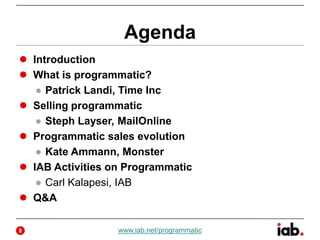
Agenda
 Introduction
 What is programmatic?
● Patrick Landi, Time Inc
 Selling programmatic
● Steph Layser, MailOnline
 Programmatic sales evolution
● Kate Ammann, Monster
 IAB Activities on Programmatic
● Carl Kalapesi, IAB
 Q&A
2 www.iab.net/programmatic
What is programmatic?
Patrick Landi, Time Inc
Programmatic Defined
Programmatic buying is the process of
executing media buys in an automated
fashion through digital platforms such as:
exchanges, trading desks, and demand-
side platforms (DSPs). This method
replaces the traditional use of manual
RFPs, negotiations and insertion orders to
purchase digital media
www.iab.net/programmatic4
Real Time bidding (RTB)Defined
eMarketer:
Real-time bidding (RTB) is a digital advertising technology that lets
marketers buy and publishers sell display ads dynamically, in real
time, on an impression-by-impression basis.
Scott Spencer, Director of Product Management, Ad Exchange,
Google
"Real time bidding (n);
1) A technology introduced in 2009 to make it easier for ad networks
to buy only the inventory they want.
2) A common buzzword that is part of everyone's business plan in
2013.
3) The act of buying digital inventory from multiple publishers on an
impression by impression basis, typically involving an auction
pricing mechanism.
4) One of the biggest opportunities for publishers to participate in new
media spend, but not a panacea if done in isolation.
www.iab.net/programmatic5
Open Marketplace vs Private Marketplace
Open Marketplace allows buyers to purchase media on an audience
basis through cookie-based targeting; achieving scale is usually a
higher priority than running campaigns with specific publishers
Private Marketplaces (PMP) allows publishers to leverage
programmatic technology(s) while maintaining a direct relationship
with agencies, advertisers, trade desks and other programmatic
buyers using a “Deal ID” to transact
Benefits:
• Greater control- specific rules around access to buyers can be
created
• Prioritization
• Exclusive inventory and access
• Transparency leads to higher CPMs for publishers and brings new
advertisers previously wary of programmatic
• Access to publishers’ first party data
www.iab.net/programmatic6
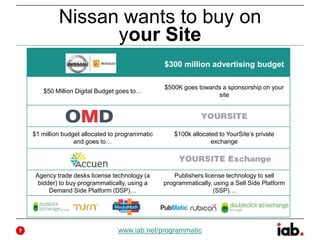
Nissan wants to buy on
your Site
7
$300 million advertising budget
$50 Million Digital Budget goes to…
$500K goes towards a sponsorship on your
site
$1 million budget allocated to programmatic
and goes to…
$100k allocated to YourSite’s private
exchange
Agency trade desks license technology (a
bidder) to buy programmatically, using a
Demand Side Platform (DSP)…
Publishers license technology to sell
programmatically, using a Sell Side Platform
(SSP)…
www.iab.net/programmatic
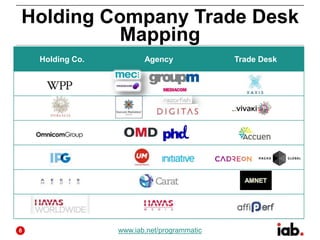
Holding Company Trade Desk
Mapping
Holding Co. Agency Trade Desk
www.iab.net/programmatic8
Selling Programmatic
Steph Layser, MailOnline
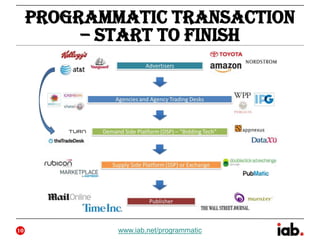
Programmatic Transaction
– Start to Finish
www.iab.net/programmatic10
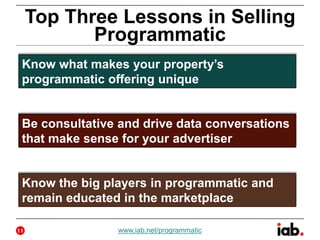
Know what makes your property’s
programmatic offering unique
Be consultative and drive data conversations
that make sense for your advertiser
Know the big players in programmatic and
remain educated in the marketplace
Top Three Lessons in Selling
Programmatic
www.iab.net/programmatic11
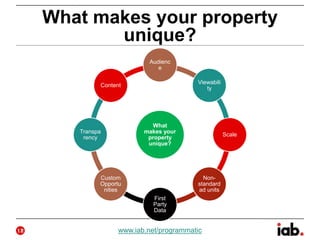
What
makes your
property
unique?
Audienc
e
Viewabili
ty
Scale
Non-
standard
ad units
First
Party
Data
Custom
Opportu
nities
Transpa
rency
Content
What makes your property
unique?
12 www.iab.net/programmatic
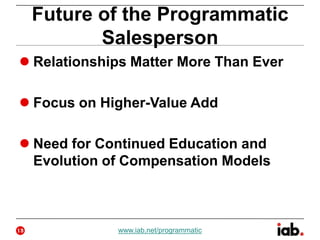
Future of the Programmatic
Salesperson
 Relationships Matter More Than Ever
 Focus on Higher-Value Add
 Need for Continued Education and
Evolution of Compensation Models
13 www.iab.net/programmatic
Programmatic sales evolution
Kate Ammann, Monster
Being proactive around
programmatic
How can I be proactive about bringing programmatic
into my sales conversations?
 RTB and Private Marketplace  use as a lead generation tool
 Leverage existing relationships (agency/network/trading desk,
etc.) to position yourself as a holistic partner
• Package custom sponsorships/integrations/high impact units with
RTB/automated buy
 Productize Programmatic
• Private Marketplace
 First-Party Data
• Offer data through programmatic channels
• Hybrid on-site/off-site audience packages
15 www.iab.net/programmatic
IAB activities on
Programmatic
Carl Kalapesi, IAB
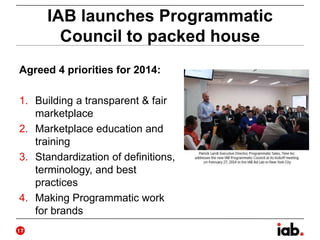
IAB launches Programmatic
Council to packed house
Agreed 4 priorities for 2014:
1. Building a transparent & fair
marketplace
2. Marketplace education and
training
3. Standardization of definitions,
terminology, and best
practices
4. Making Programmatic work
for brands
17
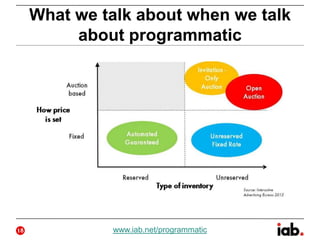
What we talk about when we talk
about programmatic
18 www.iab.net/programmatic
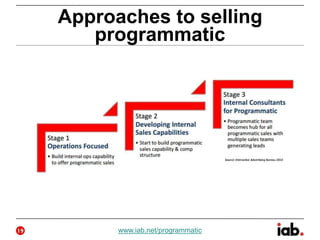
Approaches to selling
programmatic
19 www.iab.net/programmatic
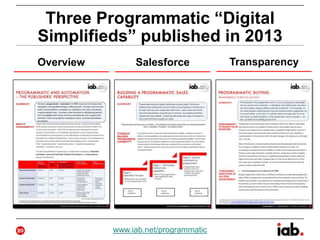
Three Programmatic “Digital
Simplifieds” published in 2013
20 www.iab.net/programmatic
Overview Salesforce Transparency
Many thanks
Carl Kalapesi, Director, Industry Initiatives
Contact:
carl@iab.net
Twitter:
@carlkalapesi
21 www.iab.net/programmatic
Carl Kalapesi
Director, Industry Initiatives
Steph Layser
MailOnline
Open Discussion / Q&A
Patrick Landi
Time Inc
Kate Ammann
Monster
Appendix
23
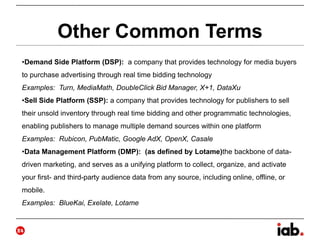
Other Common Terms
•Demand Side Platform (DSP): a company that provides technology for media buyers
to purchase advertising through real time bidding technology
Examples: Turn, MediaMath, DoubleClick Bid Manager, X+1, DataXu
•Sell Side Platform (SSP): a company that provides technology for publishers to sell
their unsold inventory through real time bidding and other programmatic technologies,
enabling publishers to manage multiple demand sources within one platform
Examples: Rubicon, PubMatic, Google AdX, OpenX, Casale
•Data Management Platform (DMP): (as defined by Lotame)the backbone of data-
driven marketing, and serves as a unifying platform to collect, organize, and activate
your first- and third-party audience data from any source, including online, offline, or
mobile.
Examples: BlueKai, Exelate, Lotame
24
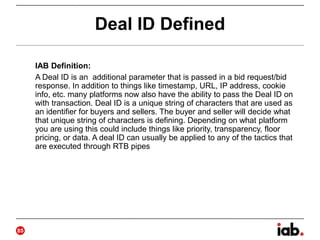
Deal ID Defined
IAB Definition:
A Deal ID is an additional parameter that is passed in a bid request/bid
response. In addition to things like timestamp, URL, IP address, cookie
info, etc. many platforms now also have the ability to pass the Deal ID on
with transaction. Deal ID is a unique string of characters that are used as
an identifier for buyers and sellers. The buyer and seller will decide what
that unique string of characters is defining. Depending on what platform
you are using this could include things like priority, transparency, floor
pricing, or data. A deal ID can usually be applied to any of the tactics that
are executed through RTB pipes
25
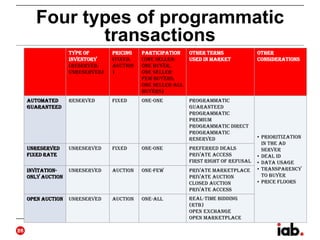
Four types of programmatic
transactions
26
Type of
Inventory
(Reserved,
Unreserved)
Pricing
(Fixed,
Auction
)
Participation
(One Seller-
One Buyer,
One Seller-
Few Buyers,
One Seller-All
Buyers)
Other Terms
Used in Market
Other
Considerations
Automated
Guaranteed
Reserved Fixed One-One Programmatic
guaranteed
Programmatic
premium
Programmatic direct
Programmatic
reserved • Prioritization
in the ad
server
• Deal ID
• Data usage
• Transparency
to buyer
• Price floors
Unreserved
Fixed Rate
Unreserved Fixed One-One Preferred deals
Private access
First right of refusal
Invitation-
Only Auction
Unreserved Auction One-Few Private marketplace
Private auction
Closed auction
Private access
Open Auction Unreserved Auction One-All Real-time bidding
(RTB)
Open exchange
Open marketplace
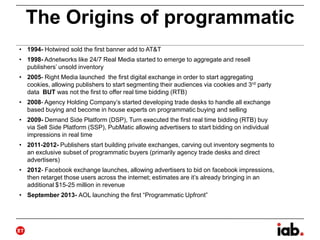
The Origins of programmatic
• 1994- Hotwired sold the first banner add to AT&T
• 1998- Adnetworks like 24/7 Real Media started to emerge to aggregate and resell
publishers’ unsold inventory
• 2005- Right Media launched the first digital exchange in order to start aggregating
cookies, allowing publishers to start segmenting their audiences via cookies and 3rd party
data BUT was not the first to offer real time bidding (RTB)
• 2008- Agency Holding Company’s started developing trade desks to handle all exchange
based buying and become in house experts on programmatic buying and selling
• 2009- Demand Side Platform (DSP), Turn executed the first real time bidding (RTB) buy
via Sell Side Platform (SSP), PubMatic allowing advertisers to start bidding on individual
impressions in real time
• 2011-2012- Publishers start building private exchanges, carving out inventory segments to
an exclusive subset of programmatic buyers (primarily agency trade desks and direct
advertisers)
• 2012- Facebook exchange launches, allowing advertisers to bid on facebook impressions,
then retarget those users across the internet; estimates are it’s already bringing in an
additional $15-25 million in revenue
• September 2013- AOL launching the first “Programmatic Upfront”
27
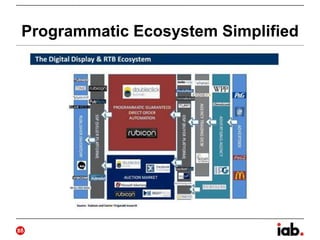
Programmatic Ecosystem Simplified
28
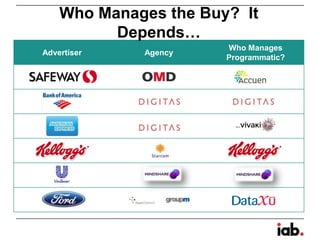
Advertiser Agency
Who Manages
Programmatic?
Who Manages the Buy? It
Depends…

Programmatic 101 webinar slides ck 032714 final

  • 1.
    Programmatic 101 for DirectSellers 31 March 2014 IAB
  • 2.
    Questions? Attendees should askquestions by typing into the Question box on the GoToWebinar user interface at any time during the presentations. – We will create a queue and answer as many questions as possible following the presentations. – Additional questions should be directed to Nicole Horsford, Nicole@iab.net
  • 3.
    Agenda  Introduction  Whatis programmatic? ● Patrick Landi, Time Inc  Selling programmatic ● Steph Layser, MailOnline  Programmatic sales evolution ● Kate Ammann, Monster  IAB Activities on Programmatic ● Carl Kalapesi, IAB  Q&A 2 www.iab.net/programmatic
  • 4.
  • 5.
    Programmatic Defined Programmatic buyingis the process of executing media buys in an automated fashion through digital platforms such as: exchanges, trading desks, and demand- side platforms (DSPs). This method replaces the traditional use of manual RFPs, negotiations and insertion orders to purchase digital media www.iab.net/programmatic4
  • 6.
    Real Time bidding(RTB)Defined eMarketer: Real-time bidding (RTB) is a digital advertising technology that lets marketers buy and publishers sell display ads dynamically, in real time, on an impression-by-impression basis. Scott Spencer, Director of Product Management, Ad Exchange, Google "Real time bidding (n); 1) A technology introduced in 2009 to make it easier for ad networks to buy only the inventory they want. 2) A common buzzword that is part of everyone's business plan in 2013. 3) The act of buying digital inventory from multiple publishers on an impression by impression basis, typically involving an auction pricing mechanism. 4) One of the biggest opportunities for publishers to participate in new media spend, but not a panacea if done in isolation. www.iab.net/programmatic5
  • 7.
    Open Marketplace vsPrivate Marketplace Open Marketplace allows buyers to purchase media on an audience basis through cookie-based targeting; achieving scale is usually a higher priority than running campaigns with specific publishers Private Marketplaces (PMP) allows publishers to leverage programmatic technology(s) while maintaining a direct relationship with agencies, advertisers, trade desks and other programmatic buyers using a “Deal ID” to transact Benefits: • Greater control- specific rules around access to buyers can be created • Prioritization • Exclusive inventory and access • Transparency leads to higher CPMs for publishers and brings new advertisers previously wary of programmatic • Access to publishers’ first party data www.iab.net/programmatic6
  • 8.
    Nissan wants tobuy on your Site 7 $300 million advertising budget $50 Million Digital Budget goes to… $500K goes towards a sponsorship on your site $1 million budget allocated to programmatic and goes to… $100k allocated to YourSite’s private exchange Agency trade desks license technology (a bidder) to buy programmatically, using a Demand Side Platform (DSP)… Publishers license technology to sell programmatically, using a Sell Side Platform (SSP)… www.iab.net/programmatic
  • 9.
    Holding Company TradeDesk Mapping Holding Co. Agency Trade Desk www.iab.net/programmatic8
  • 10.
  • 11.
    Programmatic Transaction – Startto Finish www.iab.net/programmatic10
  • 12.
    Know what makesyour property’s programmatic offering unique Be consultative and drive data conversations that make sense for your advertiser Know the big players in programmatic and remain educated in the marketplace Top Three Lessons in Selling Programmatic www.iab.net/programmatic11
  • 13.
  • 14.
    Future of theProgrammatic Salesperson  Relationships Matter More Than Ever  Focus on Higher-Value Add  Need for Continued Education and Evolution of Compensation Models 13 www.iab.net/programmatic
  • 15.
  • 16.
    Being proactive around programmatic Howcan I be proactive about bringing programmatic into my sales conversations?  RTB and Private Marketplace  use as a lead generation tool  Leverage existing relationships (agency/network/trading desk, etc.) to position yourself as a holistic partner • Package custom sponsorships/integrations/high impact units with RTB/automated buy  Productize Programmatic • Private Marketplace  First-Party Data • Offer data through programmatic channels • Hybrid on-site/off-site audience packages 15 www.iab.net/programmatic
  • 17.
  • 18.
    IAB launches Programmatic Councilto packed house Agreed 4 priorities for 2014: 1. Building a transparent & fair marketplace 2. Marketplace education and training 3. Standardization of definitions, terminology, and best practices 4. Making Programmatic work for brands 17
  • 19.
    What we talkabout when we talk about programmatic 18 www.iab.net/programmatic
  • 20.
    Approaches to selling programmatic 19www.iab.net/programmatic
  • 21.
    Three Programmatic “Digital Simplifieds”published in 2013 20 www.iab.net/programmatic Overview Salesforce Transparency
  • 22.
    Many thanks Carl Kalapesi,Director, Industry Initiatives Contact: carl@iab.net Twitter: @carlkalapesi 21 www.iab.net/programmatic
  • 23.
    Carl Kalapesi Director, IndustryInitiatives Steph Layser MailOnline Open Discussion / Q&A Patrick Landi Time Inc Kate Ammann Monster
  • 24.
  • 25.
    Other Common Terms •DemandSide Platform (DSP): a company that provides technology for media buyers to purchase advertising through real time bidding technology Examples: Turn, MediaMath, DoubleClick Bid Manager, X+1, DataXu •Sell Side Platform (SSP): a company that provides technology for publishers to sell their unsold inventory through real time bidding and other programmatic technologies, enabling publishers to manage multiple demand sources within one platform Examples: Rubicon, PubMatic, Google AdX, OpenX, Casale •Data Management Platform (DMP): (as defined by Lotame)the backbone of data- driven marketing, and serves as a unifying platform to collect, organize, and activate your first- and third-party audience data from any source, including online, offline, or mobile. Examples: BlueKai, Exelate, Lotame 24
  • 26.
    Deal ID Defined IABDefinition: A Deal ID is an additional parameter that is passed in a bid request/bid response. In addition to things like timestamp, URL, IP address, cookie info, etc. many platforms now also have the ability to pass the Deal ID on with transaction. Deal ID is a unique string of characters that are used as an identifier for buyers and sellers. The buyer and seller will decide what that unique string of characters is defining. Depending on what platform you are using this could include things like priority, transparency, floor pricing, or data. A deal ID can usually be applied to any of the tactics that are executed through RTB pipes 25
  • 27.
    Four types ofprogrammatic transactions 26 Type of Inventory (Reserved, Unreserved) Pricing (Fixed, Auction ) Participation (One Seller- One Buyer, One Seller- Few Buyers, One Seller-All Buyers) Other Terms Used in Market Other Considerations Automated Guaranteed Reserved Fixed One-One Programmatic guaranteed Programmatic premium Programmatic direct Programmatic reserved • Prioritization in the ad server • Deal ID • Data usage • Transparency to buyer • Price floors Unreserved Fixed Rate Unreserved Fixed One-One Preferred deals Private access First right of refusal Invitation- Only Auction Unreserved Auction One-Few Private marketplace Private auction Closed auction Private access Open Auction Unreserved Auction One-All Real-time bidding (RTB) Open exchange Open marketplace
  • 28.
    The Origins ofprogrammatic • 1994- Hotwired sold the first banner add to AT&T • 1998- Adnetworks like 24/7 Real Media started to emerge to aggregate and resell publishers’ unsold inventory • 2005- Right Media launched the first digital exchange in order to start aggregating cookies, allowing publishers to start segmenting their audiences via cookies and 3rd party data BUT was not the first to offer real time bidding (RTB) • 2008- Agency Holding Company’s started developing trade desks to handle all exchange based buying and become in house experts on programmatic buying and selling • 2009- Demand Side Platform (DSP), Turn executed the first real time bidding (RTB) buy via Sell Side Platform (SSP), PubMatic allowing advertisers to start bidding on individual impressions in real time • 2011-2012- Publishers start building private exchanges, carving out inventory segments to an exclusive subset of programmatic buyers (primarily agency trade desks and direct advertisers) • 2012- Facebook exchange launches, allowing advertisers to bid on facebook impressions, then retarget those users across the internet; estimates are it’s already bringing in an additional $15-25 million in revenue • September 2013- AOL launching the first “Programmatic Upfront” 27
  • 29.
  • 30.

Editor's Notes

  • #19 There is significant confusion in the marketplace around the meaning of terms like “programmatic”, “RTB”, “programmatic direct”, “programmatic premium”, and other verbiage, often being used interchangeably. To help clarify – IAB worked with publishers to set out key terms – mapped based on 2 characteristics – how the price was set (ie auction based or fixed price) and the type of inventory (reserved/unreserved)
  • #27 Started by thinking about what distinguishes them. Ultimately we boiled this down to 3 things – what type of inventory we are talking about (reserved vs unreserved), what type of pricing (fixed vs auction) and who is involved (1-1, 1-few, 1-many)Whilst there are lots of other issues like prioritization, Deal ID etc they can apply differently to each of the transaction types“Automated Guaranteed”This type of transaction most closely mirrors a traditional digital direct sale. The deal is negotiated directly between buyer and seller, the inventory and pricing are guaranteed, and the campaign runs at the same priority as other direct deals in the ad server. The programmatic element of the transaction that differentiates it from a traditional direct sale is the automation of the RFP and campaign trafficking process. Negotiation through to fulfillment can be, should the publisher desire, completed within the technology platform providing the automated reserve functionality. “Unreserved Fixed Rate”Transactions that fall into this category exist within an exchange environment, but have pre-negotiated, fixed pricing (CPM, CPC, etc.) Typically, Unreserved Fixed Rate deals sit at a higher priority than the Open and/or Invitation-Only Auction. A deal of this type typically is necessitated by advertiser demand for a more predictable offering within the exchange space.“Invitation-Only Auction”This auction type is very similar to an Open Auction except a publisher restricts participation to select buyers/advertisers via Whitelist/Blocklist. A publisher may choose to not participate in an Open Auction and only run an Invitation-Only Auction.  It is important to note that an Invitation-Only Auction is an auction and buyers will be expected to bid on inventory.  A publisher may choose to expose different information such as transparency or data, through the use of Deal IDs or Line Items to add value to this select group of buyers while participating in this tactic.“Open Auction”An Open Auction is the Wild West of auctions.  A publisher will generally allow any and all buyers to participate in accessing their inventory through this tactic.  Usually there is no direct relationship with the buyer.  Publishers may choose to use Blocklists and floor pricing to prevent advertisers from gaining access.  On the advertiser side they are often unaware of what publisher they are buying on.  DSP’s usually present a list of exchanges/SSPs to the buyer that they automatically opt into. Buyers may not know or care that they are buying a publisher’s inventory. Because of this, publishers can participate in the Open Auction on a blind basis.