Innovative Housing Options
 Jeremy Porteus – 25 January 2011
Why make the case between health and
housing?

• A fall at home that leads to a hip fracture costs the state
£28,665 on average – over 100 times the cost of installing
hand and grab rails

• Where it is appropriate, postponing entry into residential care
for one year saves an average of £28,080 per person

• A hospital discharge service that enables older people to
return to a safe and suitable home environment saves over
£100 per day – the amount charged to local authorities when
patients ‘block beds’

(source: Fit for Living Network Position Statement, hact 2010)
What are the perceived challenges for you
as an organisation?
• What is your future vision for care – residential, home
care, intermediate care, respite care, extra care?
• Is housing development or management a key
component of your delivery/growth plans?
• Sustainability of markets in present climate?
Uncertainty of funders, external relationships?
• What can you offer that is different? Can you foster
innovation, diversification and development?
• How to realise and evidence benefits eg dementia
• Motivate staff/create a learning and knowledge sharing
environment for workforce – sector care academy?
• Regulation and inspection – lighter touches, self-
assessment but balance against safequarding.
What are the health drivers for good quality
housing with care?
• over 15 million people in England with
a long term condition, includes heart
disease, diabetes, asthma, respiratory
problems and dementia
• proportionally far higher users of NHS
and PCTs
• Account for 55% of GP appointments,
68% of outpatient appointments and
77% of inpatient bed stays
• more likely to be older and have other
complex needs leading to disabilities
which require care and/or support
• they live in poor housing, which could
exacerbate their condition and make
them more likely to be admitted to a
care home (recent Sir Michael Marmot
Review, Fair Society, Healthy Lives)
An Ageing Population
• Significant age shift, especially older old

• Changing users’ housing/care
  aspirations eg lifestyle
  choices and needs
                                        30%

• Diversification housing               25%
  and care markets eg from
                                        20%
  specialist to adaptable, from
  single tenure and                     15%

  institutional to mixed tenure         10%
  and community based                         2004   2014   2024


• But, rapidly changing economic and financial climate

• And, what impact on both mainstream and specialist
  markets and consumer confidence?
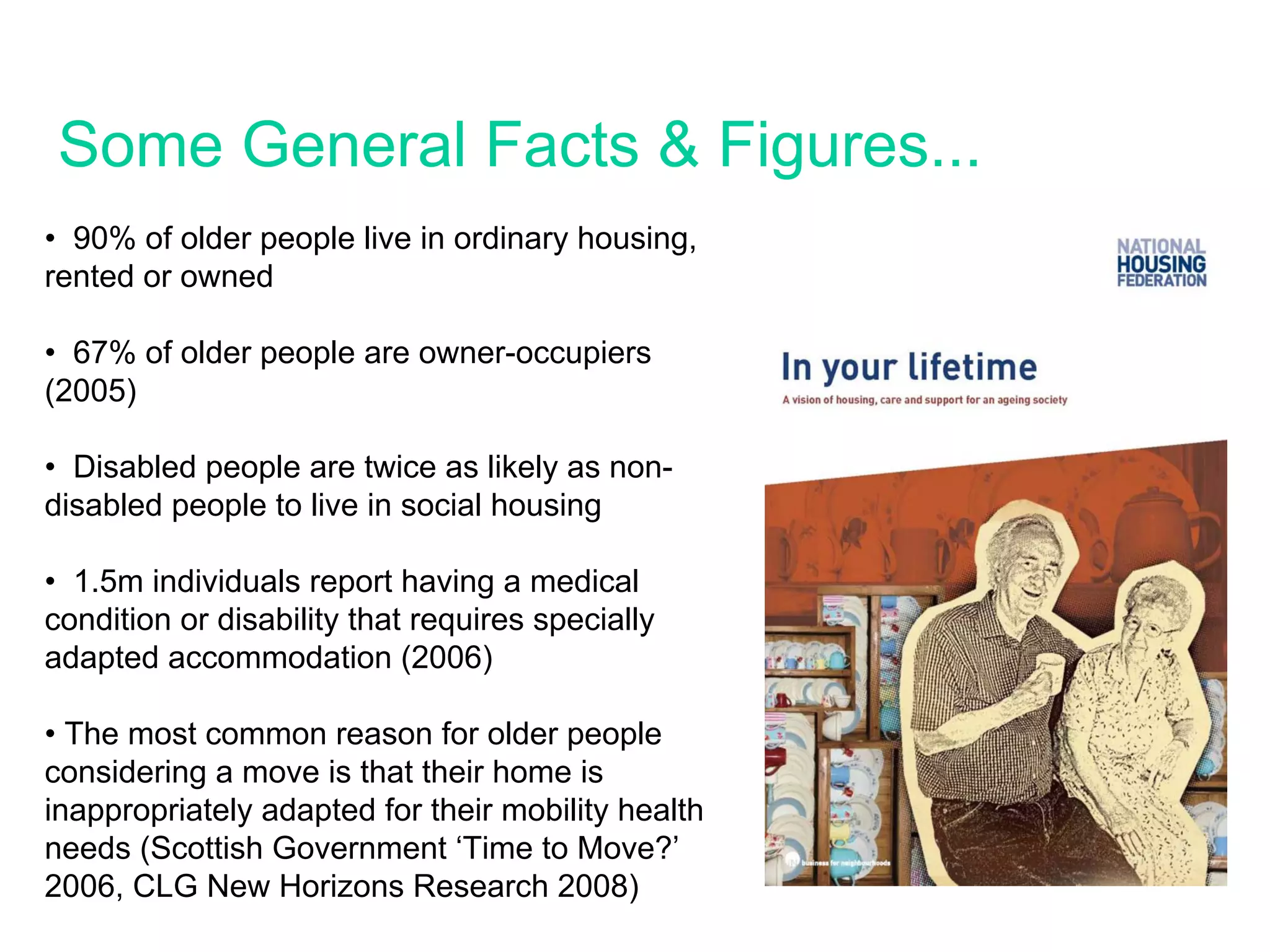
Some General Facts & Figures...
• 90% of older people live in ordinary housing,
rented or owned

• 67% of older people are owner-occupiers
(2005)

• Disabled people are twice as likely as non-
disabled people to live in social housing

• 1.5m individuals report having a medical
condition or disability that requires specially
adapted accommodation (2006)

• The most common reason for older people
considering a move is that their home is
inappropriately adapted for their mobility health
needs (Scottish Government ‘Time to Move?’
2006, CLG New Horizons Research 2008)
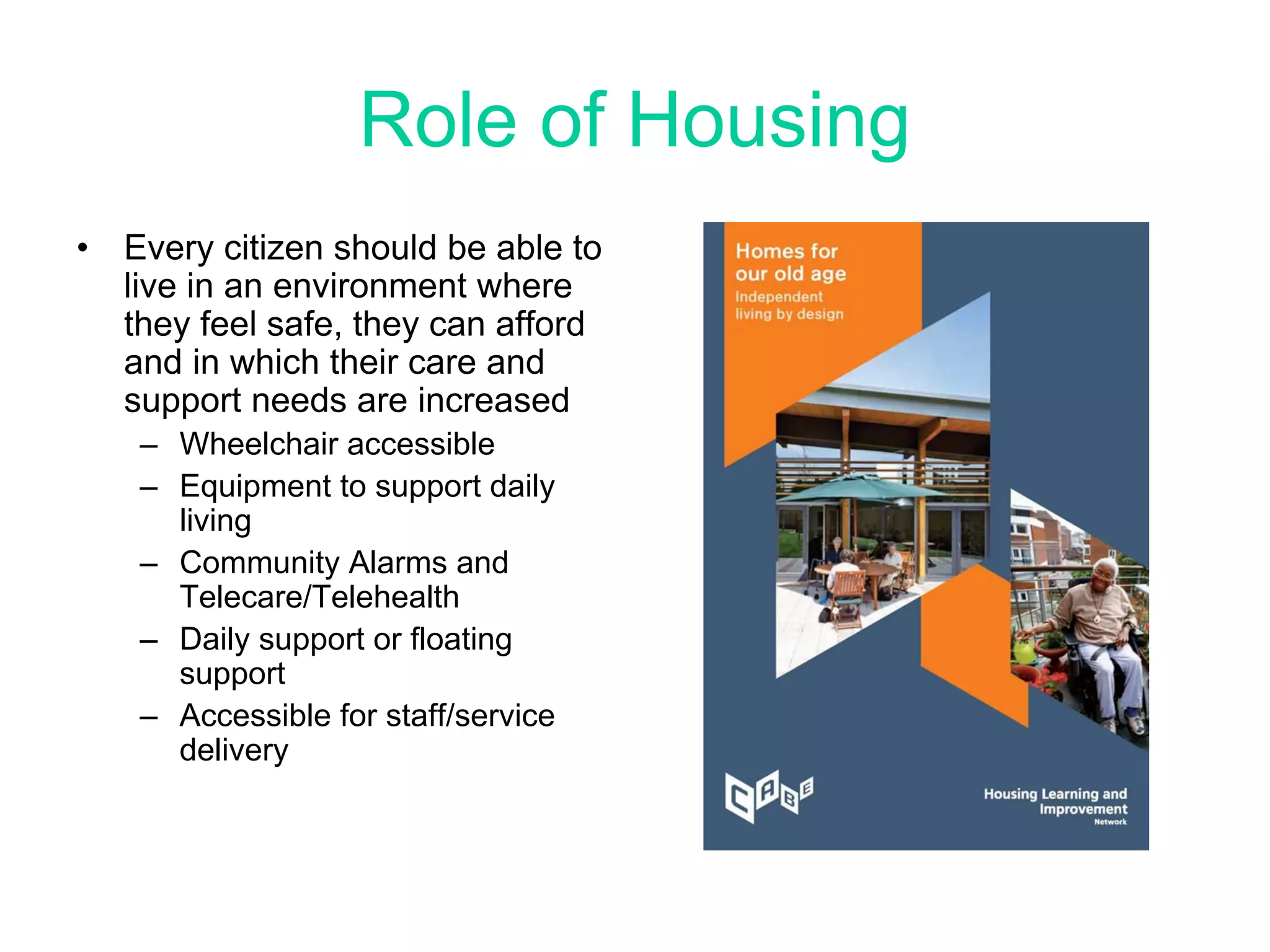
Role of Housing
•   Every citizen should be able to
    live in an environment where
    they feel safe, they can afford
    and in which their care and
    support needs are increased
     – Wheelchair accessible
     – Equipment to support daily
       living
     – Community Alarms and
       Telecare/Telehealth
     – Daily support or floating
       support
     – Accessible for staff/service
       delivery
Retirement housing new-build
The Policy landscape
    • We will establish a commission on long-term
     care.
•    We will break down barriers between health
     and social care funding to incentivise
     preventative action.
•    We will extend the greater roll-out of personal
     budgets to give people and their carers more
     control and purchasing power.
•    We will use direct payments to carers and
     better community-based provision to improve
     access to respite care.
•    We will help elderly people live at home for
     longer through solutions such as home
     adaptations and community support
     programmes.
•    We will prioritise dementia research.
•    We are committed to an NHS that is free at the
     point of use and available to everyone based on
     need, not the ability to pay
Developing policy & funding
•   NHS White Paper – extend personal
    budgets
•   Comprehensive Spending Review
•   Revision of the NHS operating framework
•   Response to the Law Commission
•   Establishment of a Care Commission
•   New social care Partnership Agreement
•   Dementia Declaration and Pledge
•   Review Carers Strategy
•   Public Health White Paper
•   Social Care White Paper (forthcoming)
•   Welfare benefit reform (DWP)
•   Localism Bill (CLG)
•   Reform of planning (CLG)

    DH if not otherwise indicated
Types of outcomes sought
• Less dependency on high cost care
• Developing intermediate care and re-ablement services
• Make best use of telecare and smart technology (grey
  and green)
• End of Life Care – avoid hospital admission
• Preventing costly health interventions eg, as a result of a
  fall
• Providing meaningful choices and lifestyle aspirations to
  meet personalisation objectives
• Building effective social capital to enable greater
  community engagement/informal care/volunteering
• Appropriate housing, including supported and assisted
  living (not dependent on social grants)
Role of Housing
•   Every citizen should be able to
    live in an environment where
    they feel safe, they can afford
    and in which their care and
    support needs are increased
     – Wheelchair accessible
     – Equipment to support daily
       living
     – Community Alarms and
       Telecare/Telehealth
     – Daily support or floating
       support
     – Accessible for staff/service
       delivery
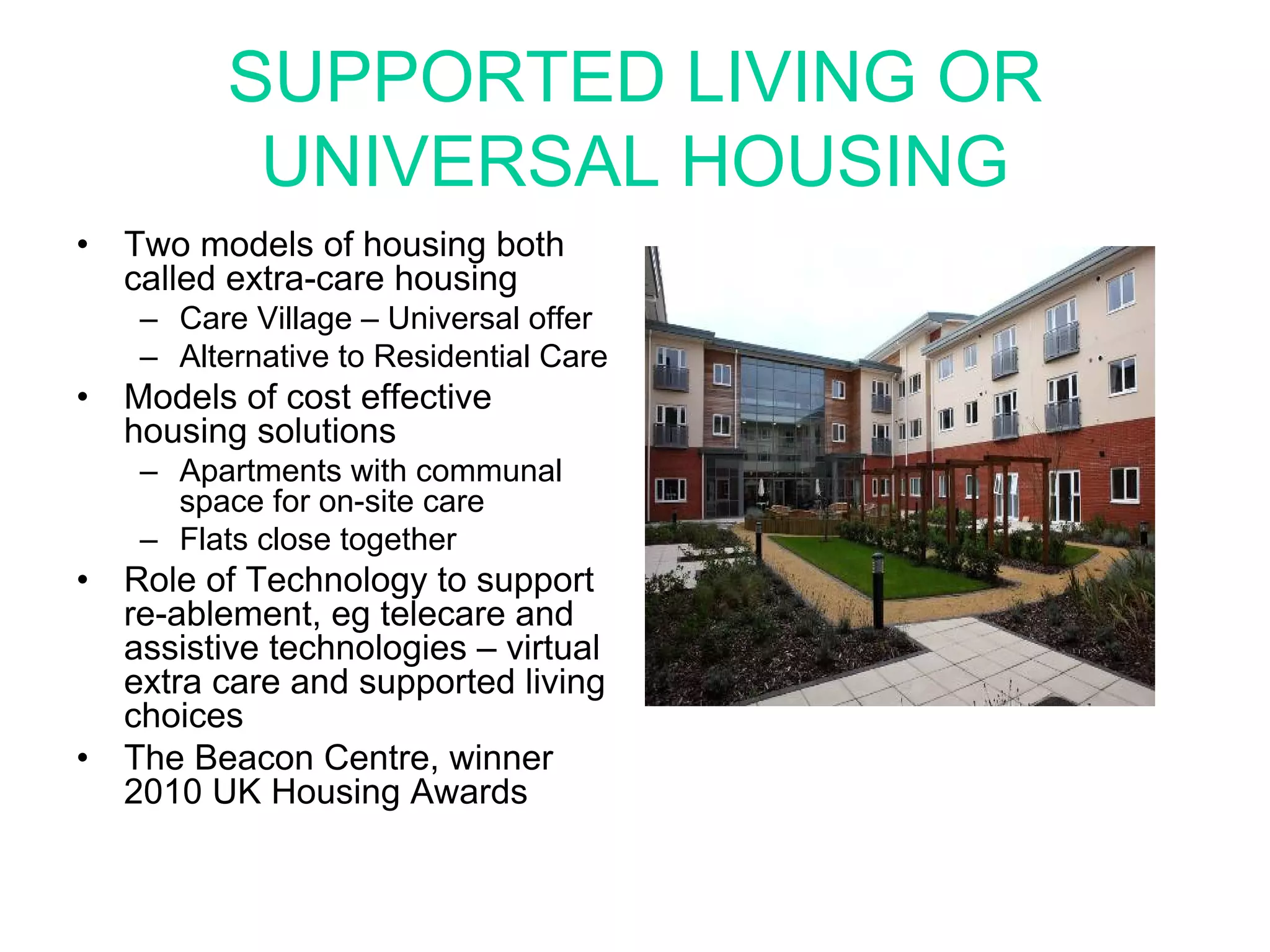
SUPPORTED LIVING OR
            UNIVERSAL HOUSING
•   Two models of housing both
    called extra-care housing
     – Care Village – Universal offer
     – Alternative to Residential Care
•   Models of cost effective
    housing solutions
     – Apartments with communal
       space for on-site care
     – Flats close together
•   Role of Technology to support
    re-ablement, eg telecare and
    assistive technologies – virtual
    extra care and supported living
    choices
•   The Beacon Centre, winner
    2010 UK Housing Awards
Capital Funding
•   Councils Capital programmes
•   Homes and Communities
    Agency
•   Section 106 – Local
    Development Framework
•   Government capital grants –
    DH extra-care housing
•   Housing Associations – ability
    to borrow.
•   Prudential Borrowing
•   Private Finance Initiatives
•   LIFT in DH
•   Private Investment
•   Need to consider longer term
    financing – awaiting CSR
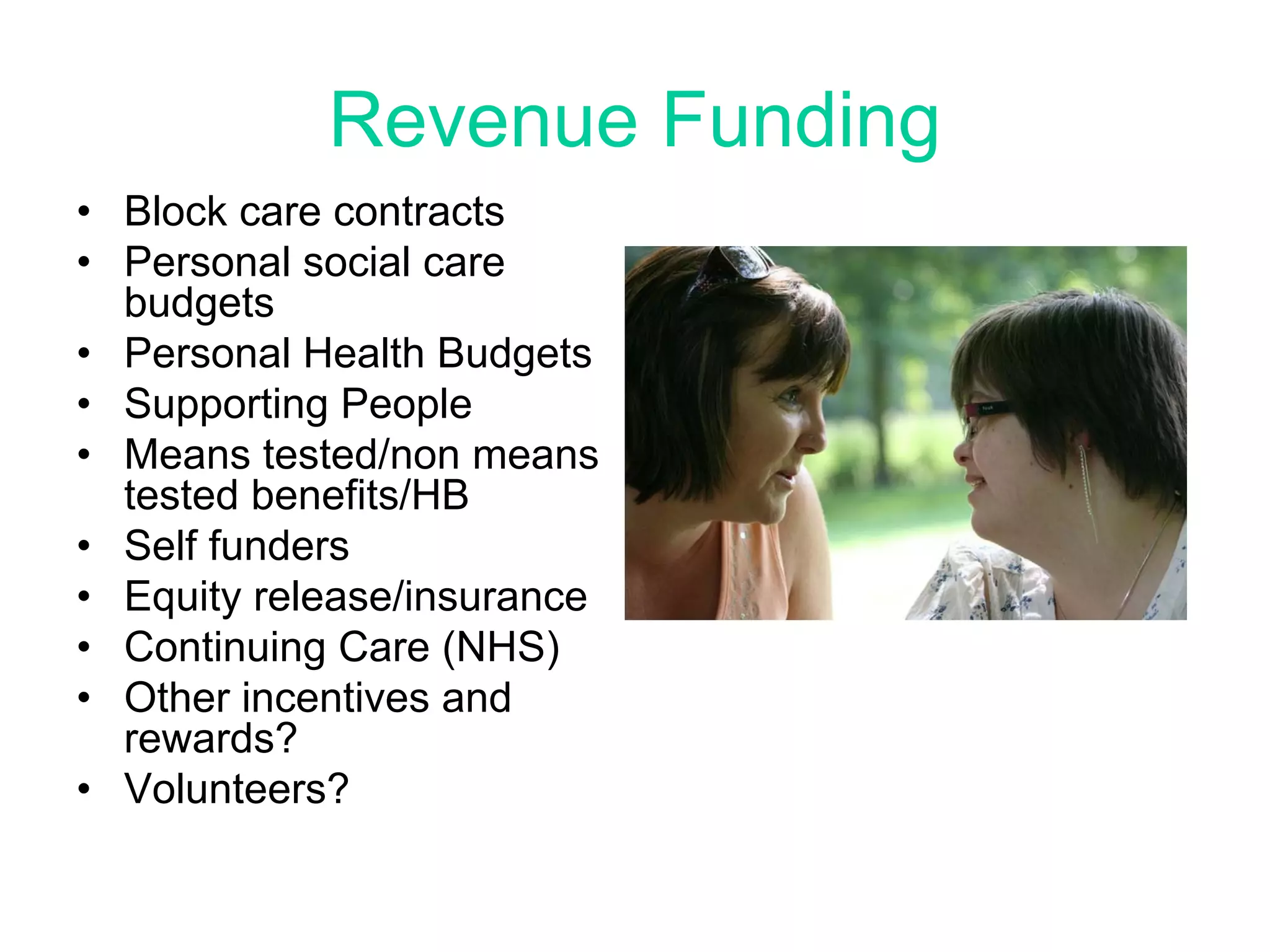
Revenue Funding
• Block care contracts
• Personal social care
  budgets
• Personal Health Budgets
• Supporting People
• Means tested/non means
  tested benefits/HB
• Self funders
• Equity release/insurance
• Continuing Care (NHS)
• Other incentives and
  rewards?
• Volunteers?
Going forward
•   Post CSR – All parties need to
    be more creative on capital &
    revenue (Supporting People)
    funding
•   Alignment of investment - local
    authorities, HCA, health sector
    and third sector within Local
    Investment Plans
•   Joint strategies and
    commissioning partnerships
•   Local (public) Land Initiative
    opportunities – land swaps
•   HCA’s Delivery Partner Panel
•   Local frameworks
Going Forward
• Affordable rent packages with registered providers to
  include Extra Care
• If care homes continue to close, reinvestment of land
  sale receipts in new projects
• Place making, regeneration and development to meet
  the needs of the whole community
• Extra Care is not the only solution for older people – is
  a different housing/care offer more appropriate?
• Local authorities – commissioning providers and
  development partners, supported by HCA
• Make sense of personal budgets and self funders’
  markets
Future arrangements
• Market presence: what is your offer to Housing, the NHS and social
  care? Have they heard you/know you are there re: extra care?
• Protecting the bricks and mortar: Is your stock ‘fit for the future?
  Adaptable, remodel, decommission, ‘care ready’? Convert to extra
  care?
• The extent of personalisation: what will this mean under a new
  govt. Will it extend choice and control even further?
• Health and care outcomes: can you evidence tackling health
  inequality, preventing homelessness, sustaining tenancies, avoiding
  a move to residential care
• Operating in a tighter financial envelope: Public sector spend
  looking for efficiency savings in all areas, access to capital/revenue
  streams, including HB and wider welfare benefit reform
• Workforce arrangements: recruitment/retention, training and
  learning improvement
• Leadership: Do you have the vision and capability (skills,
  knowledge etc) to change? Do you want to change?
Thank You
info@housinglin.org.uk

Jeremy Porteus Ageing Well presentation

  • 1.
    Innovative Housing Options Jeremy Porteus – 25 January 2011
  • 2.
    Why make thecase between health and housing? • A fall at home that leads to a hip fracture costs the state £28,665 on average – over 100 times the cost of installing hand and grab rails • Where it is appropriate, postponing entry into residential care for one year saves an average of £28,080 per person • A hospital discharge service that enables older people to return to a safe and suitable home environment saves over £100 per day – the amount charged to local authorities when patients ‘block beds’ (source: Fit for Living Network Position Statement, hact 2010)
  • 3.
    What are theperceived challenges for you as an organisation? • What is your future vision for care – residential, home care, intermediate care, respite care, extra care? • Is housing development or management a key component of your delivery/growth plans? • Sustainability of markets in present climate? Uncertainty of funders, external relationships? • What can you offer that is different? Can you foster innovation, diversification and development? • How to realise and evidence benefits eg dementia • Motivate staff/create a learning and knowledge sharing environment for workforce – sector care academy? • Regulation and inspection – lighter touches, self- assessment but balance against safequarding.
  • 4.
    What are thehealth drivers for good quality housing with care? • over 15 million people in England with a long term condition, includes heart disease, diabetes, asthma, respiratory problems and dementia • proportionally far higher users of NHS and PCTs • Account for 55% of GP appointments, 68% of outpatient appointments and 77% of inpatient bed stays • more likely to be older and have other complex needs leading to disabilities which require care and/or support • they live in poor housing, which could exacerbate their condition and make them more likely to be admitted to a care home (recent Sir Michael Marmot Review, Fair Society, Healthy Lives)
  • 5.
    An Ageing Population •Significant age shift, especially older old • Changing users’ housing/care aspirations eg lifestyle choices and needs 30% • Diversification housing 25% and care markets eg from 20% specialist to adaptable, from single tenure and 15% institutional to mixed tenure 10% and community based 2004 2014 2024 • But, rapidly changing economic and financial climate • And, what impact on both mainstream and specialist markets and consumer confidence?
  • 6.
    Some General Facts& Figures... • 90% of older people live in ordinary housing, rented or owned • 67% of older people are owner-occupiers (2005) • Disabled people are twice as likely as non- disabled people to live in social housing • 1.5m individuals report having a medical condition or disability that requires specially adapted accommodation (2006) • The most common reason for older people considering a move is that their home is inappropriately adapted for their mobility health needs (Scottish Government ‘Time to Move?’ 2006, CLG New Horizons Research 2008)
  • 7.
    Role of Housing • Every citizen should be able to live in an environment where they feel safe, they can afford and in which their care and support needs are increased – Wheelchair accessible – Equipment to support daily living – Community Alarms and Telecare/Telehealth – Daily support or floating support – Accessible for staff/service delivery
  • 8.
  • 9.
    The Policy landscape • We will establish a commission on long-term care. • We will break down barriers between health and social care funding to incentivise preventative action. • We will extend the greater roll-out of personal budgets to give people and their carers more control and purchasing power. • We will use direct payments to carers and better community-based provision to improve access to respite care. • We will help elderly people live at home for longer through solutions such as home adaptations and community support programmes. • We will prioritise dementia research. • We are committed to an NHS that is free at the point of use and available to everyone based on need, not the ability to pay
  • 10.
    Developing policy &funding • NHS White Paper – extend personal budgets • Comprehensive Spending Review • Revision of the NHS operating framework • Response to the Law Commission • Establishment of a Care Commission • New social care Partnership Agreement • Dementia Declaration and Pledge • Review Carers Strategy • Public Health White Paper • Social Care White Paper (forthcoming) • Welfare benefit reform (DWP) • Localism Bill (CLG) • Reform of planning (CLG) DH if not otherwise indicated
  • 11.
    Types of outcomessought • Less dependency on high cost care • Developing intermediate care and re-ablement services • Make best use of telecare and smart technology (grey and green) • End of Life Care – avoid hospital admission • Preventing costly health interventions eg, as a result of a fall • Providing meaningful choices and lifestyle aspirations to meet personalisation objectives • Building effective social capital to enable greater community engagement/informal care/volunteering • Appropriate housing, including supported and assisted living (not dependent on social grants)
  • 17.
    Role of Housing • Every citizen should be able to live in an environment where they feel safe, they can afford and in which their care and support needs are increased – Wheelchair accessible – Equipment to support daily living – Community Alarms and Telecare/Telehealth – Daily support or floating support – Accessible for staff/service delivery
  • 18.
    SUPPORTED LIVING OR UNIVERSAL HOUSING • Two models of housing both called extra-care housing – Care Village – Universal offer – Alternative to Residential Care • Models of cost effective housing solutions – Apartments with communal space for on-site care – Flats close together • Role of Technology to support re-ablement, eg telecare and assistive technologies – virtual extra care and supported living choices • The Beacon Centre, winner 2010 UK Housing Awards
  • 19.
    Capital Funding • Councils Capital programmes • Homes and Communities Agency • Section 106 – Local Development Framework • Government capital grants – DH extra-care housing • Housing Associations – ability to borrow. • Prudential Borrowing • Private Finance Initiatives • LIFT in DH • Private Investment • Need to consider longer term financing – awaiting CSR
  • 20.
    Revenue Funding • Blockcare contracts • Personal social care budgets • Personal Health Budgets • Supporting People • Means tested/non means tested benefits/HB • Self funders • Equity release/insurance • Continuing Care (NHS) • Other incentives and rewards? • Volunteers?
  • 21.
    Going forward • Post CSR – All parties need to be more creative on capital & revenue (Supporting People) funding • Alignment of investment - local authorities, HCA, health sector and third sector within Local Investment Plans • Joint strategies and commissioning partnerships • Local (public) Land Initiative opportunities – land swaps • HCA’s Delivery Partner Panel • Local frameworks
  • 22.
    Going Forward • Affordablerent packages with registered providers to include Extra Care • If care homes continue to close, reinvestment of land sale receipts in new projects • Place making, regeneration and development to meet the needs of the whole community • Extra Care is not the only solution for older people – is a different housing/care offer more appropriate? • Local authorities – commissioning providers and development partners, supported by HCA • Make sense of personal budgets and self funders’ markets
  • 23.
    Future arrangements • Marketpresence: what is your offer to Housing, the NHS and social care? Have they heard you/know you are there re: extra care? • Protecting the bricks and mortar: Is your stock ‘fit for the future? Adaptable, remodel, decommission, ‘care ready’? Convert to extra care? • The extent of personalisation: what will this mean under a new govt. Will it extend choice and control even further? • Health and care outcomes: can you evidence tackling health inequality, preventing homelessness, sustaining tenancies, avoiding a move to residential care • Operating in a tighter financial envelope: Public sector spend looking for efficiency savings in all areas, access to capital/revenue streams, including HB and wider welfare benefit reform • Workforce arrangements: recruitment/retention, training and learning improvement • Leadership: Do you have the vision and capability (skills, knowledge etc) to change? Do you want to change?
  • 24.