Housing & Health Seminar
3 Feb 2015
The case for Social Housing and
Health to achieve better outcomes
and opportunities
0
10
20
30
40
50
60
70
80
90
100
RDS Gardens Trips Events Youth asp Equipment
Funds 4 U - Number of approved applications 2014/15 - to 14/01/15
0
2000
4000
6000
8000
10000
12000
14000
16000
18000
RDS Gardens Trips Events Youth asp Equipment
Funds 4 U - Spend on approved applications 2014/15 (£) - to
14/01/15
Activity v Effectiveness
Customer centred approach
Opportunity for Agencies to work with Housing
So is the question
What can Housing do for Health?
Or
What can Health do for Housing ?
Housing and health
What’s the connection?
Gill Leng, Housing and Health Lead
Health Equity and Place
Public Health England
Housing?
• The ‘bricks and mortar’ house
• Knowing who lives where, and the impact this has on
their health and wellbeing is essential;
• Housing-related services (all tenures)
• On offer to people to enable them to live in their own
home, or to move from crisis into their own home;
• A sector with an estimated workforce of up to
200,000 people
• Regular contacts with households facing some of the
greatest inequalities, living in the most deprived
communities
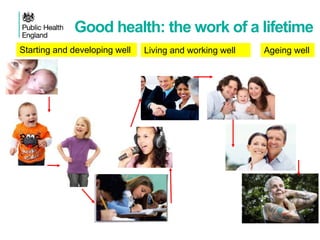
Good health: the work of a lifetime
Starting and developing well Living and working well Ageing well
What makes the difference?
Smoking 10%
Diet/Exercise
10%
Alcohol use 5%
Poor sexual
health 5%
Health
Behaviours 30%
Education 10%
Employment
10%
Income 10%
Family/Social
Support 5%
Community
Safety 5%
Socioeconomic
Factors 40%
Access to care
10%
Quality of care
10%
Clinical Care
20%
Environmental
Quality 5%
Built
Environment 5%
Built Environment
10%
Source: Robert Wood Johnson Foundation
and University of Wisconsin Population
Health Institute
Health promoting homes & services
• Starting and developing well
• Safe & warm environment in which to learn, play & be
nurtured
• Living and working well
• Access to work; well to work
• Space to bring up a family
• Ageing well:
• Connected to friends and family
• Space for: hobbies; changing health; for caring
• All – housing-related services which:
• Inform healthy choices
• Support transitions in life, and enable independence
Risks to health & wellbeing
1. Unhealthy and unsafe homes
• Bricks and mortar impact
2. Unsuitable homes
• Home environment does not meet needs eg,
disabled people, changing health and care needs,
overcrowding
3. Precarious housing and homelessness
• Home is at risk, or household is homeless
Housing related PHOF indicators
17
Overarching 0.1 Healthy life expectancy
1. Improving
the wider
determinants
of health
1.01 Children in poverty
1.02 School readiness
1.04 First time entrants to youth justice system
1.05 16-18 year NEET
1.06 Adults with a learning disability/in contact with secondary mental health
services in settled accommodation
1.09 sickness absence rate
1.11 Domestic abuse
1.13 reoffending levels
1.14 % population affected by noise
1.15 Statutory homelessness
1.17 Fuel poverty
1.18 Social isolation: social care users
1.19 Older people’s perception of community safety
2 Health
improvement
2.05 Child development at 2-2.5 years
2.06 Excess weight in 4-5 and 10-11 year olds
2.07 Hospital admissions injuries in children
2.08 Emotional well-being of looked after children
2.11 Diet
2.12 Excess weight in adults
2.14 Smoking prevalence – adults (over 18s)
2.15 Successful completion of drug treatment
2.18 Alcohol-related admissions to hospital
2.23 Self-reported wellbeing
2.24 Falls and injuries in the over 65s
3 Health
protection
3.03 Population vaccination coverage
3.05 Treatment completion for Tuberculosis (TB)
4 Healthcare
public health
and
preventing
premature
mortality
4.01 Infant mortality
4.03 Mortality from preventable causes
4.04 Mortality from cardiovascular diseases
4.07 Mortality from respiratory diseases
4.08 Mortality rate communicable diseases
4.10 Suicide rate
4.11 Emergency readmissions within 30 days of discharge from hospital
4.13 Health-related quality of life for older people
4.14 Hip fractures in over 65s
4.15 Excess winter deaths
4.16 Dementia and its impacts
Key:
Mental health related indicators
in italics
Shared or aligned with NHS
Shared or aligned with ASCOF*
Relevant to ASCOF*
* Adult Social Care Outcomes Framework
Unhealthy homes
For example
• Cold homes & fuel poverty: respiratory problems,
mental health, accidents & injuries; higher mortality
• Unsafe: unintentional injuries
• Fire: eg, burns, cardio-respiratory problems and
reduced lung function, disability, loss of life
• Security: injury, shock, depression, fear
Who is affected?
• People who are at home the most: children,
disabled people, people with a long term condition,
older people, carers
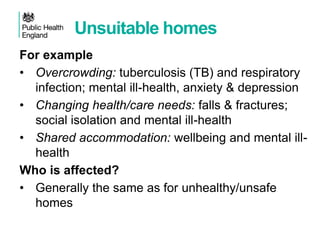
Unsuitable homes
For example
• Overcrowding: tuberculosis (TB) and respiratory
infection; mental ill-health, anxiety & depression
• Changing health/care needs: falls & fractures;
social isolation and mental ill-health
• Shared accommodation: wellbeing and mental ill-
health
Who is affected?
• Generally the same as for unhealthy/unsafe
homes
Precarious housing or homeless
• At higher risk from unhealthy & unsuitable homes
• Children: in B & B more likely low birth weight &
miss immunisations; greater risk of infection;
mental ill-health & development problems
• Rough sleepers/single homeless: high rates of
physical health needs & mental illness; higher
risk of blood borne viruses
• All: existing health conditions can be
exacerbated eg, asthma, depression; new issues
can arise eg, substance misuse; wellbeing &
mental ill-health
Impact of homes across lifecourse
B & B?
Overcrowded? Sharing? On own &
Isolated?
Can’t get upstairs?
Paying the
mortgage?
Cold home? Cold home?
Poor PRS?
Who lives where? Dementia example
• Most people with dementia live in the community
• Most want to live in their own home for as long as
possible
• The alternatives of residential care, or hospital, are
more costly.
• 2/3 of people with dementia live in community, 1/3 alone;
• 85% would want to stay at home for as long as possible
• For every person who is able to live at home rather than
in residential care there is a saving of £11,296 p.a.
• Delay of just 5% of admissions to res. care would create
a net saving of £55 million per annum (E, W & NI)
The problem? Dementia example
• Majority of older people own their home (82%)
• A disproportionate number of owner-occupied
homes are
• Poor condition and/or
• Unsuitable for changing health & care needs (one
in three)
• There are few alternatives
• Many older households are low income (two thirds
are owner occupiers)
• Shortfall of purpose-built specialist homes (240k)
The problem? Dementia example
• There are inequalities in access to homes and housing
services for many older people
• Older people experiencing the greatest inequalities in this
respect are
• Rural communities
• BME
• Disabled people
• Offenders
• Gypsies and Travellers
• LGBT
• People with a learning disability
• People with a mental health problem
• Homeless people
The solution? Dementia example
• ‘Who lives where’ locally
• Home Truths recommendations
• Reforms in health and social care
• The Health and Social Care Act 2012
• The Care Act 2014
• The Better Care Fund
• Partnership working with the housing sector
Contact
• Gill Leng
• Tel: 07766 660799
• Email: gill.leng@phe.gov.uk
MECC overview
Holly Easlick
Health Development Officer
Public Health Portsmouth
What is MECC?
 Using appropriate opportunities to talk about health & wellbeing
 Taking into account lifestyle choices and wider influencing factors
 Professional duty of care to adopt client-centred ways of working
 Supporting people to improve their own health & wellbeing
Public Health Portsmouth
MECC levels/process
All
service-
users
All staff
Fewer
service-
users
Fewer
staff
Stage/level one
Promote the benefits of healthy living. Ask an
individual about their lifestyle, if they want to make a
change and respond with appropriate action.
Stage/level two
Identify the focus of a change by
supporting an individual to review their
lifestyle.
Stage/level three
Increase motivation and
clarify the support needed
Stage/level four
1:1 using
SMART goals /
specialist
support
i. Enable people to access appropriate information to manage
their self-care needs
ii. Empower people to make informed choices to manage their
health & wellbeing
iii. Feel confident in providing opportunistic brief advice
Learning Outcomes (L1)
30 - PHP & IWT
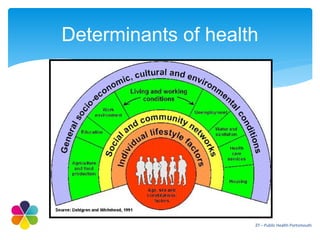
Determinants of health
31 - Public Health Portsmouth
Public Health Portsmouth
Housing link…
 Holistic approach to addressing health inequalities
 Many opportunities to Make Every Contact Count
 Housing has a huge impact on health & wellbeing
 Public health is everybody’s responsibility!
 Somerstown pilot (phase 1)
 Holistic approach
 Links with MECC approach
The new wellbeing service
 Good practice examples from housing sector…
 Challenges & opportunities
 Innovative!
Examples
Jane Leech - Programme Manager
Somerstown Neighbourhood Health
& Wellbeing Programme
 The Somerstown Programme is Phase 1 of a wider Public Health
initiative – piloting, creating, learning…
 To consolidate key current public health improvement services
into one integrated service so that lifestyle and behavioural issues
can be co-ordinated and provided on an individual basis.
 The Wellbeing Service will be a locality based service focusing on
the most deprived areas of the city, close to the people that need
them most.
The Somerstown Programme context:
Integrated Health & Wellbeing Service
 A key worker role - Health & Wellbeing workers - The service will
support individual residents and their families with lifestyle
issues, e.g. smoking, alcohol misuse, poor diet and lack of
exercise as well as emotional wellbeing.
 Underpinned by Community development initiatives and activity
to stimulate and support participation
- "without citizen participation and community engagement fostered
by public service organisations it will be difficult to improve penetration
of interventions and to impact on health inequalities".
Marmot Report 2014
The Health & Wellbeing Service
The Somerstown Programme team.
The model in action -
In addition, this service
will work with other
council services to
provide help and
support with issues that
are interrelated and
tend to be contributory
or underlying causes of
poor lifestyle including
debt, housing and
unemployment
October 2014 - our programme team have been busy building
the relationships and mechanisms necessary to facilitate
interrelated working based on the MECC model of making
every contact count.
We have been able to secure a hot desk arrangement in the
Somerstown housing office. We have also created a referral
and assessment process specific to this Housing office.
Building on the assumption that our Programme could
ultimately support their work, improve the quality of life for
their customers –
The Somerstown model & Housing –
sharing outcomes: A case study
 December 2014 - our Health & Wellbeing workers and many of the Somerstown
Housing officers began to work together in earnest. Referrals from Housing into
the programme stands at c.10 Somerstown residents
 One such referral came through to Julie, one of our Health & wellbeing workers
whose specialism is in health eating/weight
 What is clear this that the Housing officer in question, in their meeting with their
customer identified that she may need additional support and that our programme
may well be able to support her (opportunistic)
 They offered her our service and she accepted the invite to engage (appropriate)
 (Holistic) She started work on a 1:1 basis with Julie, incidentally it was the national
Change4life 'Sugar Swaps' that started her thinking about her levels of sugar
consumption. (In the business we call this pre-contemplation).
 Together Julie and her client they have created an action plan to take small steps in
reducing the amount of smoking (with the help of Pompey Quits) and drinking
sugary drinks and she has also agreed to gradually increase her level of physical
activity (walking).
 She can work with achieving these targets with Julie up to 12 months.
 Meanwhile…Julie has also been working with Marshada - the
Programme’s Community development lead who has been
instrumental in brokering many of the professional relationships
required to pilot and test a collaborative and integrated outcomes
way of working
 One of these relationships has been with Housing’s resident
participation team (rpt)
 Julie is now collaborating with Racheal from the rpt as they share
outcomes for this customer/client - Racheal is working with her
customer on her employability skills. Julie, with her client identified
that as a result of all the sugary drinks and smoking her teeth are
stained, this is impacting on her confidence, in turn impacting on
her confidence and ability at interview
 Julie & her client have identified a dentist who is taking clients.
Racheal is prepared to fund her clients’ descaling as extra with this
dentist, working in tandem towards a shared outcome

Housing seminar collated presentations

  • 1.
    Housing & HealthSeminar 3 Feb 2015 The case for Social Housing and Health to achieve better outcomes and opportunities
  • 8.
    0 10 20 30 40 50 60 70 80 90 100 RDS Gardens TripsEvents Youth asp Equipment Funds 4 U - Number of approved applications 2014/15 - to 14/01/15
  • 9.
    0 2000 4000 6000 8000 10000 12000 14000 16000 18000 RDS Gardens TripsEvents Youth asp Equipment Funds 4 U - Spend on approved applications 2014/15 (£) - to 14/01/15
  • 10.
    Activity v Effectiveness Customercentred approach Opportunity for Agencies to work with Housing So is the question What can Housing do for Health? Or What can Health do for Housing ?
  • 11.
    Housing and health What’sthe connection? Gill Leng, Housing and Health Lead Health Equity and Place Public Health England
  • 12.
    Housing? • The ‘bricksand mortar’ house • Knowing who lives where, and the impact this has on their health and wellbeing is essential; • Housing-related services (all tenures) • On offer to people to enable them to live in their own home, or to move from crisis into their own home; • A sector with an estimated workforce of up to 200,000 people • Regular contacts with households facing some of the greatest inequalities, living in the most deprived communities
  • 13.
    Good health: thework of a lifetime Starting and developing well Living and working well Ageing well
  • 14.
    What makes thedifference? Smoking 10% Diet/Exercise 10% Alcohol use 5% Poor sexual health 5% Health Behaviours 30% Education 10% Employment 10% Income 10% Family/Social Support 5% Community Safety 5% Socioeconomic Factors 40% Access to care 10% Quality of care 10% Clinical Care 20% Environmental Quality 5% Built Environment 5% Built Environment 10% Source: Robert Wood Johnson Foundation and University of Wisconsin Population Health Institute
  • 15.
    Health promoting homes& services • Starting and developing well • Safe & warm environment in which to learn, play & be nurtured • Living and working well • Access to work; well to work • Space to bring up a family • Ageing well: • Connected to friends and family • Space for: hobbies; changing health; for caring • All – housing-related services which: • Inform healthy choices • Support transitions in life, and enable independence
  • 16.
    Risks to health& wellbeing 1. Unhealthy and unsafe homes • Bricks and mortar impact 2. Unsuitable homes • Home environment does not meet needs eg, disabled people, changing health and care needs, overcrowding 3. Precarious housing and homelessness • Home is at risk, or household is homeless
  • 17.
    Housing related PHOFindicators 17 Overarching 0.1 Healthy life expectancy 1. Improving the wider determinants of health 1.01 Children in poverty 1.02 School readiness 1.04 First time entrants to youth justice system 1.05 16-18 year NEET 1.06 Adults with a learning disability/in contact with secondary mental health services in settled accommodation 1.09 sickness absence rate 1.11 Domestic abuse 1.13 reoffending levels 1.14 % population affected by noise 1.15 Statutory homelessness 1.17 Fuel poverty 1.18 Social isolation: social care users 1.19 Older people’s perception of community safety 2 Health improvement 2.05 Child development at 2-2.5 years 2.06 Excess weight in 4-5 and 10-11 year olds 2.07 Hospital admissions injuries in children 2.08 Emotional well-being of looked after children 2.11 Diet 2.12 Excess weight in adults 2.14 Smoking prevalence – adults (over 18s) 2.15 Successful completion of drug treatment 2.18 Alcohol-related admissions to hospital 2.23 Self-reported wellbeing 2.24 Falls and injuries in the over 65s 3 Health protection 3.03 Population vaccination coverage 3.05 Treatment completion for Tuberculosis (TB) 4 Healthcare public health and preventing premature mortality 4.01 Infant mortality 4.03 Mortality from preventable causes 4.04 Mortality from cardiovascular diseases 4.07 Mortality from respiratory diseases 4.08 Mortality rate communicable diseases 4.10 Suicide rate 4.11 Emergency readmissions within 30 days of discharge from hospital 4.13 Health-related quality of life for older people 4.14 Hip fractures in over 65s 4.15 Excess winter deaths 4.16 Dementia and its impacts Key: Mental health related indicators in italics Shared or aligned with NHS Shared or aligned with ASCOF* Relevant to ASCOF* * Adult Social Care Outcomes Framework
  • 18.
    Unhealthy homes For example •Cold homes & fuel poverty: respiratory problems, mental health, accidents & injuries; higher mortality • Unsafe: unintentional injuries • Fire: eg, burns, cardio-respiratory problems and reduced lung function, disability, loss of life • Security: injury, shock, depression, fear Who is affected? • People who are at home the most: children, disabled people, people with a long term condition, older people, carers
  • 19.
    Unsuitable homes For example •Overcrowding: tuberculosis (TB) and respiratory infection; mental ill-health, anxiety & depression • Changing health/care needs: falls & fractures; social isolation and mental ill-health • Shared accommodation: wellbeing and mental ill- health Who is affected? • Generally the same as for unhealthy/unsafe homes
  • 20.
    Precarious housing orhomeless • At higher risk from unhealthy & unsuitable homes • Children: in B & B more likely low birth weight & miss immunisations; greater risk of infection; mental ill-health & development problems • Rough sleepers/single homeless: high rates of physical health needs & mental illness; higher risk of blood borne viruses • All: existing health conditions can be exacerbated eg, asthma, depression; new issues can arise eg, substance misuse; wellbeing & mental ill-health
  • 21.
    Impact of homesacross lifecourse B & B? Overcrowded? Sharing? On own & Isolated? Can’t get upstairs? Paying the mortgage? Cold home? Cold home? Poor PRS?
  • 22.
    Who lives where?Dementia example • Most people with dementia live in the community • Most want to live in their own home for as long as possible • The alternatives of residential care, or hospital, are more costly. • 2/3 of people with dementia live in community, 1/3 alone; • 85% would want to stay at home for as long as possible • For every person who is able to live at home rather than in residential care there is a saving of £11,296 p.a. • Delay of just 5% of admissions to res. care would create a net saving of £55 million per annum (E, W & NI)
  • 23.
    The problem? Dementiaexample • Majority of older people own their home (82%) • A disproportionate number of owner-occupied homes are • Poor condition and/or • Unsuitable for changing health & care needs (one in three) • There are few alternatives • Many older households are low income (two thirds are owner occupiers) • Shortfall of purpose-built specialist homes (240k)
  • 24.
    The problem? Dementiaexample • There are inequalities in access to homes and housing services for many older people • Older people experiencing the greatest inequalities in this respect are • Rural communities • BME • Disabled people • Offenders • Gypsies and Travellers • LGBT • People with a learning disability • People with a mental health problem • Homeless people
  • 25.
    The solution? Dementiaexample • ‘Who lives where’ locally • Home Truths recommendations • Reforms in health and social care • The Health and Social Care Act 2012 • The Care Act 2014 • The Better Care Fund • Partnership working with the housing sector
  • 26.
    Contact • Gill Leng •Tel: 07766 660799 • Email: gill.leng@phe.gov.uk
  • 27.
    MECC overview Holly Easlick HealthDevelopment Officer Public Health Portsmouth
  • 28.
    Public Health Portsmouth Whatis MECC?  Using appropriate opportunities to talk about health & wellbeing  Taking into account lifestyle choices and wider influencing factors  Professional duty of care to adopt client-centred ways of working  Supporting people to improve their own health & wellbeing
  • 29.
    Public Health Portsmouth MECClevels/process All service- users All staff Fewer service- users Fewer staff Stage/level one Promote the benefits of healthy living. Ask an individual about their lifestyle, if they want to make a change and respond with appropriate action. Stage/level two Identify the focus of a change by supporting an individual to review their lifestyle. Stage/level three Increase motivation and clarify the support needed Stage/level four 1:1 using SMART goals / specialist support
  • 30.
    i. Enable peopleto access appropriate information to manage their self-care needs ii. Empower people to make informed choices to manage their health & wellbeing iii. Feel confident in providing opportunistic brief advice Learning Outcomes (L1) 30 - PHP & IWT
  • 31.
    Determinants of health 31- Public Health Portsmouth
  • 32.
    Public Health Portsmouth Housinglink…  Holistic approach to addressing health inequalities  Many opportunities to Make Every Contact Count  Housing has a huge impact on health & wellbeing  Public health is everybody’s responsibility!
  • 33.
     Somerstown pilot(phase 1)  Holistic approach  Links with MECC approach The new wellbeing service
  • 34.
     Good practiceexamples from housing sector…  Challenges & opportunities  Innovative! Examples
  • 35.
    Jane Leech -Programme Manager Somerstown Neighbourhood Health & Wellbeing Programme
  • 36.
     The SomerstownProgramme is Phase 1 of a wider Public Health initiative – piloting, creating, learning…  To consolidate key current public health improvement services into one integrated service so that lifestyle and behavioural issues can be co-ordinated and provided on an individual basis.  The Wellbeing Service will be a locality based service focusing on the most deprived areas of the city, close to the people that need them most. The Somerstown Programme context: Integrated Health & Wellbeing Service
  • 37.
     A keyworker role - Health & Wellbeing workers - The service will support individual residents and their families with lifestyle issues, e.g. smoking, alcohol misuse, poor diet and lack of exercise as well as emotional wellbeing.  Underpinned by Community development initiatives and activity to stimulate and support participation - "without citizen participation and community engagement fostered by public service organisations it will be difficult to improve penetration of interventions and to impact on health inequalities". Marmot Report 2014 The Health & Wellbeing Service
  • 38.
    The Somerstown Programmeteam. The model in action - In addition, this service will work with other council services to provide help and support with issues that are interrelated and tend to be contributory or underlying causes of poor lifestyle including debt, housing and unemployment
  • 39.
    October 2014 -our programme team have been busy building the relationships and mechanisms necessary to facilitate interrelated working based on the MECC model of making every contact count. We have been able to secure a hot desk arrangement in the Somerstown housing office. We have also created a referral and assessment process specific to this Housing office. Building on the assumption that our Programme could ultimately support their work, improve the quality of life for their customers – The Somerstown model & Housing – sharing outcomes: A case study
  • 40.
     December 2014- our Health & Wellbeing workers and many of the Somerstown Housing officers began to work together in earnest. Referrals from Housing into the programme stands at c.10 Somerstown residents  One such referral came through to Julie, one of our Health & wellbeing workers whose specialism is in health eating/weight  What is clear this that the Housing officer in question, in their meeting with their customer identified that she may need additional support and that our programme may well be able to support her (opportunistic)  They offered her our service and she accepted the invite to engage (appropriate)  (Holistic) She started work on a 1:1 basis with Julie, incidentally it was the national Change4life 'Sugar Swaps' that started her thinking about her levels of sugar consumption. (In the business we call this pre-contemplation).  Together Julie and her client they have created an action plan to take small steps in reducing the amount of smoking (with the help of Pompey Quits) and drinking sugary drinks and she has also agreed to gradually increase her level of physical activity (walking).  She can work with achieving these targets with Julie up to 12 months.
  • 41.
     Meanwhile…Julie hasalso been working with Marshada - the Programme’s Community development lead who has been instrumental in brokering many of the professional relationships required to pilot and test a collaborative and integrated outcomes way of working  One of these relationships has been with Housing’s resident participation team (rpt)  Julie is now collaborating with Racheal from the rpt as they share outcomes for this customer/client - Racheal is working with her customer on her employability skills. Julie, with her client identified that as a result of all the sugary drinks and smoking her teeth are stained, this is impacting on her confidence, in turn impacting on her confidence and ability at interview  Julie & her client have identified a dentist who is taking clients. Racheal is prepared to fund her clients’ descaling as extra with this dentist, working in tandem towards a shared outcome

Editor's Notes

  • #3 Role of Social Landlord : Collect rents, Do repairs, Build new properties ? But, being the best landlord is no good if tenants are suffering with Deprivation, ASB, health or employment issues Therefore the business of social landlords also should be to improve communities. The healthier the community – generally the more sustainable the tenancies – and this benefits the Housing Service by Reducing transfers – vacant property costs – reduces ‘disabled adaptations’ – reduces HB claims/changes and associated advice and maintains rent payments. Stable communities generally benefit all services PCC Housing service has 15,000 properties – of which 5,000 are in Havant Boro. About 10% -12% properties in Portsmouth Main estates : - Portsea, Landport, Somerstown, Buckland, Paulsgrove All areas of High Deprivation – understandably as the Housing Waiting list favours those people who are Homeless, Elderly, Disabled etc (Housing Options team advise people with income and no personal care needs to find homes in private sector) Close relationships with tenants (generally) – we know people’s personal, medical, social needsd at the time of registering for accommodation We need a financial assessment and provide help with benefits, debt advice to ensure the rent is affordable and paid We respond to emergencies – be it a burst pipe, neighbour dispute or family issue. A 365 & 24/7 service using our ‘out of hours’ team Photo above – shows what most of our accommodation looks like – flats and maisonettes (only 4,000 out of 15,000 are houses) Many extended for ‘community rooms ‘
  • #4 Range of Sheltered schemes and community rooms HIDS – cooking for 1 Falls Prevention
  • #5 Rise in Garden schemes – people asking us for garden clubs ‘Garden competition’ entries up Landport Community Garden and ‘Grow your own Zone’ Working with school – Bug hunts
  • #6 Fishing Club Outdoor activity for reduced mobility Led to inter-generational work Still expanding
  • #7 Youth and Adventure playgrounds Physical activity Healthy eating Youth service – ‘teen’ issue around pregnancies and sexual health Currently looking at NEET groups and CAHMS issues
  • #8 Employment / Resident participation – links to community boards Sabrina, small community grant to help set up and create a sustainable exercise/health focussed affordable way for healthy living for people local to Landport involving their children. Regular ‘weigh in’ and measurement to chart progress, looks at healthy living and choices rather than focus on weight loss. Funds 4 U added value by providing access to training to include nutrition in the programme. Sessions at £2, hall at Landport CC is now at capacity and further sessions being added regularly, and is part of a meaningful income.
  • #9 Slides
  • #11 Activity v Effectiveness – core business + wider picture The way we work - customer centred approach Presenting problem may be the start of the issue Reduce assess and refer
  • #18 ?
  • #28 Increasingly used term appearing in many agendas (national context: extend delivery of PH advice to all) Many opportunities to collaborate/form partnerships around MECC Council priority to reduce health inequalities & prevent LTC’s
  • #29 Maximise our contacts/opportunities to address PH through prevention, improvement & early diagnosis Individual responsibilities + codes of conduct (upskill workforce to see this & signpost where appropriate) Equipping the workforce with the skills, knowledge & confidence to provide H&W information (create this culture…)
  • #30 *differences between MECC levels (based on Y&H framework) but this is the main process – you may sit across all levels @ different times
  • #31 This is the level that every public-facing worker should be trained to (from 30secs to 30mins) Training includes: Defining MECC & Cues to Action (raising the issue of healthy lifestyles) / Effective communication / Tools & strategies / Experiential learning… MECC plays a major part in our wider WFD strategy whereby a whole systems approach is taken to encourage healthier choices
  • #32 *For everyone to recognise wider impact of health & wellbeing (holistic approach so applicable to the whole workforce) Mention bolt-ons…
  • #33 Learnt a lot from the pilot last year and have continued to develop the programme since… Role of the housing workforce in promoting a holistic approach to improving health and wellbeing and improving outcomes more generally for our community. The housing workforce can definitely promote good health & improve QoL through MECC in the many settings and environments they work in (huge access), i.e. Somerstown! Jane will be talking to you next about how we are incorporating it within the Somerstown phase 1 project.
  • #42 These relationships are new, we have been working 1:1 with our clients for only a very short period of time. But I do hope that this case study illustrates some of the ways that we can work together, share outcomes and deepen the positive impact that we have on our customers and our communities. I would hope that as an outcome of this seminar I would be able at some point to feedback to you the full evaluation of the Somerstown Programme adventures – which will be available by May 2015.